CyberCity 3D and Fayetteville, N.C., are moving the city from 2D to 3D GIS mapping, a transformation focused on interoperability, high scalability and wide reach. The result is a more engaging and detailed 3D streaming map that’s elevated the city’s planning and development capabilities.
The City of Fayetteville’s GIS Manager, Richard Tuinstra, spearheaded the plan to design a mapping system that used three-dimensional mapping and web-based architecture while getting a high rate of return on the investment. Tuinstra took an approach outside the traditional GIS “box,” seeking content that could run on scalable web architecture. He found CyberCity 3D, a geospatial city modeling company near Los Angeles.
“The City of Fayetteville has always understood the great benefits of using 3D GIS for its daily operations, from public safety, parks and recreation to urban design and planning, but has found it difficult to get a good start,” said Tuinstra. “Partnering with CyberCity has made our first steps in 3D GIS a quick and easy process. The result so far has been well received by our city manager’s office and the city staff members. Some of the great advantages of this mapping system are that it only requires a simple web browser and is very user friendly. We can’t wait to expand geographically and thematically on what we have achieved right now.”
According to the city’s information technology director, Dwayne Campbell, the plan had to include three requirements. “First, it had to avoid costly, time-consuming training and software licensing. Second, the solution needed to be delivered as a software service in an open environment capable of running on all mobile devices. Finally, the City needed a strategy that enabled it to continue to leverage our existing investment in Esri’s ArcGIS software.”
The city ultimately chose the combination of CyberCity 3D buildings for their accuracy and interoperability, while looking to CesiumJS.org for its open source 3D globe mapping. CyberCity 3D created more than 550 buildings for the project, from best-in-practices photogrammetry, to insure GIS integrity and flexibility. CyberCity 3D also provided imagery and street names via its streaming images services on the Cesium 3D Globe; as a government institution, the City of Fayetteville pays no streaming fees for the 3D Globe and image layers. In addition, the city requested a tree layer; the existing GIS zoning and district mapping data the city generated with Arc GIS software was also seamlessly included.
“The unique combination of CyberCity 3D’s buildings, the Cesium 3D Globe, and ArcGIS software create an unsurpassed mapping system for the City of Fayetteville,” said CyberCity 3D CEO Kevin DeVito. “This dynamic move to 3D will enable the city to best plan for its future while engaging its employees, stakeholders and the community at large in an immersive manner.”
As an early adopter, the City of Fayetteville has gone from using 2D PDF maps to owning cutting-edge 3D GIS content on a platform that reaches not only city employees and stakeholders, but every citizen. This dynamic solution vastly increases their understanding of the geospatial elements of the city. Its deployment also allows for the easy addition of other GIS layers such as business points of interest or FEMA poly-layers for environmental planning and sustainability, expanding the map’s usefulness, engagement and return on investment.
The PennDOT TDS developed by GeoDecisions enables collection and processing of millions of data points.
GeoDecisions, an information technology company specializing in geospatial solutions, has developed a new traffic data system (TDS) that processes more than 20 million new records per month for the Pennsylvania Department of Transportation (PennDOT).
Built on the Esri platform, the TDS helps PennDOT’s Bureau of Planning and Research better manage the download of traffic data from collection sites throughout the commonwealth of Pennsylvania.
“Built to Federal Highway Administration standards, GeoDecisions’ redesign of our TDS provides us a method to seamlessly introduce new counting devices, more efficiently verify our raw traffic data, and speed up our process for creating yearly traffic volume maps,” said Andrea Bahoric, planning division manager with PennDOT.
The new TDS improves PennDOT supervision of 45,000 short-term or portable counters that classify vehicles, record traffic volume and weight, and determine driving speed. The system’s mobile Field Operations Module (FOM) also streamlines in-pavement counter inventory and maintenance activities.
“FOM enables PennDOT field technicians to use smartphones or tablets to perform site reviews and document issues,” said Greg Ulp, senior project manager with GeoDecisions. “Convenience and efficiency are critical factors when enhancing technology and managing assets.”
PennDOT’s predecessor traffic data management system contained nine applications with dated technology requiring manual intervention to collect and verify information. GeoDecisions’ TDS redesign features five modules streamlined for better performance and usability. The new automated system includes remote user access and cutting-edge GIS mapping, web service, database and coding technologies.
“Our transportation system solutions provide a proven business model for analytics, reporting, reliability, and technology workflow management,” said Tom Saltzer, vice president of government delivery with GeoDecisions. “PennDOT’s redesigned TDS is a long-term collection, verification, and geospatial solution that reflects their ongoing enterprise GIS investment strategy.”
Gov. Jerry Brown signed legislation Tuesday to expand privacy protections to prevent paparazzi from flying drones over private property, reports sUAS news.
The bill, AB 856, changes the definition of a “physical invasion of privacy” to include sending a drone into the airspace above someone’s land to make a recording or take a photo.
Brown previously vetoed in September a proposal that would have made flying a drone above someone’s property without permission a trespassing violation, writing in a veto message, “While well-intentioned, [the bill] could expose the occasional hobbyist and the FAA-approved commercial user alike to burdensome litigation and new causes of action.”
The governor also rejected three bills that would have prohibited civilians from flying aerial drones over wildfires, schools, prisons and jails. Some of the proposals were intended to prevent interference with firefighting aircraft — a recurring problem, according to fire officials — and prevent inmates from receiving airborne contraband. Brown rejected the bills because they would create new crimes.
A new book published by Esri teaches how to use GIS software to analyze and visualize lidar data. Lidar is an optical remote-sensing system that uses a laser to measure topography, vegetation, objects such as buildings, and the ocean floor at some depths. Data collected from lidar can be used to create highly accurate elevation and terrain models.
Making Spatial Decisions Using GIS and Lidar: A Workbook presents problems that need to be solved using lidar data and the geospatial analysis tools in Esri’s GIS software, ArcGIS for Desktop. The book contains 10 learning modules that focus on how to use lidar data with GIS to answer questions and make informed decisions about real-world situations. Exercises include determining how much land to excavate for an underground parking garage, locating cell-phone towers for maximum signal coverage, placing solar panels based on the amount of solar radiation in an area; analyzing how a coastline has changed after a major hurricane; and making flood insurance rate maps based on hurricane inundation zones.
The workbook covers basic lidar data analysis techniques, 2D and 3D modeling, volumetric analysis, shadow maps, forest vegetation height analysis, and other lidar-related analyses. The book is a college-level textbook for students and geospatial technology professionals and was written with the assumption that readers are familiar with lidar and have some experience using ArcGIS for Desktop software.
Making Spatial Decisions Using GIS and Lidar: A Workbook is the third book in the Making Spatial Decisions series written by Kathryn Keranen and Robert Kolvoord. Keranen is an instructor at James Madison University in Harrisonburg, Virginia. Kolvoord is a professor of integrated science and technology at James Madison University. They wrote Making Spatial Decisions Using GIS and Remote Sensing: A Workbook and Making Spatial Decisions Using GIS: A Workbook, also published by Esri.
Making Spatial Decisions Using GIS and Lidar: A Workbook is available in print (ISBN: 9781589484290; 264 pages, $79.99 or as an e-book (ISBN: 9781589484344). The book is available at online retailers worldwide, at esri.com/esripress, or by calling 1-800-447-9778. Outside the United States, visit esri.com/esripressorders for complete ordering options, or visit esri.com/distributors to contact a local Esri distributor.
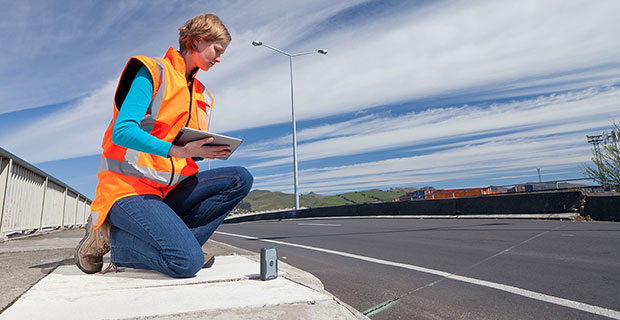
The Trimble R1 GNSS receiver is now available for collecting professional-grade GPS data with Esri’s Collector for ArcGIS. The GNSS receiver is rugged certified MIL-STD-810, IP65 rated, compact, and lightweight and provides professional-grade positioning information to iOS, Android or Windows mobile handhelds, smartphones and tablets using Bluetooth connectivity for Bring Your Own Device (BYOD) capabilities.
“We’re very pleased that Esri will distribute the R1 GNSS receiver to its customers,” said Ron Bisio, general manager of Surveying and Geospatial at Trimble. “Offering a complete, integrated solution that provides accurate data collection enables Esri and Trimble’s joint customers to build a better and more reliable asset inventory.”
Some users of Collector for ArcGIS on consumer-grade mobile devices might find their GPS to be less accurate than they need it to be. Now the locational precision of mobile devices can be enhanced via Bluetooth connected to the Trimble R1 GNSS receiver. The receiver is capable of supporting multiple global satellite constellation systems, including GPS, GLONASS, Galileo and BeiDou, and delivers GNSS positions in real time without the need for postprocessing.
“Collector for ArcGIS is used by organizations to collect and update GIS data in the field,” said Esri product manager Jeff Shaner. “Many of our customers like the ease of use of Collector for ArcGIS on consumer handheld devices. Paired with the Trimble R1 GNSS receiver, users can now capture GIS data on their smartphones and tablets that meets the more stringent spatial accuracy requirements of their organization.”
Designed for GIS professionals in a variety of organizations, the stand-alone Bluetooth Trimble R1 GNSS receiver enables users to collect high-accuracy location data with Collector for ArcGIS on an existing device — whether it’s a modern smart device, such as a mobile phone or tablet, or a traditional integrated data collection handheld or tablet. The receiver can be pole mounted, carried in a vest pocket, or attached to a belt using the optional belt pouch for ease of use.
The Trimble R1 GNSS receiver is available now through Esri. Learn more about Esri’s hardware solutions at esri.com/hardware.
The U.S. Department of Transportation’s Federal Aviation Administration (FAA) has announced the largest civil penalty the FAA has proposed against a UAS operator for endangering the safety of the national airspace.
The FAA proposes a $1.9 million civil penalty against SkyPan International Inc. of Chicago. Between March 21, 2012, and Dec. 15, 2014, SkyPan conducted 65 unauthorized operations in some of the most congested airspace and heavily populated cities, violating airspace regulations and various operating rules, the FAA alleges. These operations were illegal and not without risk.
The FAA alleges that the company conducted 65 unauthorized commercial UAS flights over various locations in New York City and Chicago for aerial photography. Of those, 43 flew in the highly restricted New York Class B airspace.
“Flying unmanned aircraft in violation of the Federal Aviation Regulations is illegal and can be dangerous,” said FAA Administrator Michael Huerta. “We have the safest airspace in the world, and everyone who uses it must understand and observe our comprehensive set of rules and regulations.”
SkyPan operated the 43 flights in the New York Class B airspace without receiving an air traffic control clearance to access it, the FAA alleges. Additionally, the agency alleges the aircraft was not equipped with a two-way radio, transponder and altitude-reporting equipment.
The FAA further alleges that on all 65 flights, the aircraft lacked an airworthiness certificate and effective registration, and SkyPan did not have a Certificate of Waiver or Authorization for the operations.
SkyPan operated the aircraft in a careless or reckless manner so as to endanger lives or property, the FAA alleges.
SkyPan has 30 days after receiving the FAA’s enforcement letter to respond to the agency.
BYOD Sub-Meter Positioning for Mapping and GIS Professionals
Employees bringing their own mobile phones and tablets to their jobs in the field enables them to complete more tasks using fewer devices. However, this practice introduces operational and security vulnerabilities.
By Matt van Doorn
In the mapping and GIS industries, mobile devices such as smart phones and tablets have a growing presence in the field; they enable businesses to work smarter and more efficiently. The Bring Your Own Device (BYOD) trend — essentially the use of commercial-grade devices for work purposes — will likely not slow down. BYOD is not without its pain points. Organizations face many security vulnerabilities when commercial-grade devices access critical data via corporate IT networks. Additionally, there are applications where a mobile device’s location capabilities are not accurate enough for GIS professionals to efficiently and effectively locate an asset and collect data.
Company IT departments have multiple options that control and monitor access to combat BYOD security issues; however these options do not resolve the accuracy issue. Traditional company-issued handheld integrated receivers for data collection are designed to meet accuracy demands in almost any physical environment condition. While these devices are the most appropriate technology option for some applications, they tend to be expensive for the positioning tasks where a smart phone or mobile device is “good enough.”
What to do when better accuracy on a mobile device is required, but it doesn’t make sense to invest thousands of dollars in a traditional receiver? With proper research, field professionals will find professional solutions that pair with consumer-grade smart devices to produce the requisite accuracy for a fraction of the cost of a traditional receiver.
Requirements and Accuracy
At a minimum, handheld receivers destined to work in conjunction with mobile devices must meet the following requirements:
The device must have moisture ingress protection to function properly in snow, ice, rain or dust environments.
The device must survive falls in hard terrain. It should have shock, drop and vibration protection.
The device must last the full workday for the professional to complete all workflows on a single battery charge.
Legacy company-owned receivers typically meet the requirements above and have had a long-term reputation for accurately providing positioning data. These devices are still the appropriate solution for environments where it does not make sense to take a smart device, such as a remote location in rough terrain where the smart device may not perform.
However, a smart device can in many cases enable the employee to be more efficient. Thanks to the accessory market, many of the above-listed requirements can be easily addressed. For example, smart-phone juice packs can fix the battery longevity issue; cases can protect against weather, shock or dropping; and screen covers can address the sunlight screen visibility issue. With a smart device in hand, GIS and mapping professionals not only have access to GPS data, but they are able to access and complete other work-related tasks from the same device such as email, internet access and voicemail. Plus, a smart phone is only a fraction of the cost of traditional receivers.
The most critical component that smart devices still cannot address is sub-meter accuracy, which many mapping and GIS professionals require to successfully do their job.
Accuracy Drives Cost. Mapping and GIS businesses are acutely aware of the efficiencies created by greater accuracy. With poor information, errors become increasingly costly. When robust, accurate data is collected, there is a direct correlation to improved workflows and operations. This allows professionals to be more strategic in ensuring that applications are effective and efficient across operations.
Aerial and satellite imagery made initial steps toward generating more accurate data collection, bringing mapping and GIS professionals to within a 50-centimeter range of the assets. Subsequently, high-speed lidar collection tools, designed to capture large areas at 5–10 cm accuracy, came to the market. While these tools significantly improved data collection, precise measurement typically requires more time, more expense and highly specific instruments in order to generate more data.
Today, handheld receivers can achieve high accuracy without using survey-grade tools, in applications that include:
Mapping: Any application, including locations, quantities, densities, specific areas and map change.
Aquatic monitoring
Buried utility infrastructure/cable location
Water/wastewater disposal
Location and elevation measurements: for example, elevation data on manholes or trunk lines.
Requirements vary across applications and industries. The mapping/GIS professional must determine the level of accuracy their workflow requires.
Accuracy Evaluation
A typical smart device, properly assisted, can achieve an accuracy range of up to 5–6 meters when used to locate an asset. In many cases this is good enough. To obtain positioning data, iOS devices use the application “Location Services,” which is available on multiple mobile platforms. Location Services enables location-based apps and other applications to use information from GPS and cellular and Wi-Fi networks to determine location information. The location provided by a hybrid system with cellular-assisted GPS (A-GPS) allows the device to identify location within a 5–6 meter range of an asset. Wi-Fi positioning alone can determine a location with an accuracy of about 74 meters, and cellular positioning alone offers about a 600-meter range for location, according to industry sources (www.windowscentral.com/gps-vs-agps-quick-tutorial).
However, cellular positioning can be limited when there is no network available. In remote or industrial settings, this could create difficulties in asset location. In water/wastewater, for example, when a GIS professional is in a ditch looking for a valve or a meter and there isn’t a network connection, the accuracy level provided without GPS may not be sufficient for that application. When A-GPS is not available due to a lack of cellular network, GIS professionals also have to deal with convergence time.
Another example involves searching for a manhole cover when the ground is covered by a couple feet of snow. In this case, the 5-6 meter range is quite large and could lead to a lot of time spent digging until the manhole is uncovered. This wastes time and energy, and leads to higher costs. Some receivers have the sub-meter capability and can provide the location data directly to the professional’s consumer-grade smart device through Bluetooth. By simply pairing the receiver with a cellphone, the GIS professional can quickly locate the asset, collect data and move on to the next task.
Accuracy Solutions
Location shortcomings in consumer-grade devices generally boil down to antenna performance. Consumer-grade smart devices are designed for exactly that: consumers. With antennas for Wi-Fi, Bluetooth and GPS built into the small device, there will be compromises in location accuracy. When location must be pinpointed, an integrated handheld receiver can enhance accuracy. Receivers are readily available with 12 channels parallel tracking. Some receivers can also support multiple satellite constellations, including GPS, GLONASS, Galileo, Beidou, and QZSS with up to 44 channels of parallel tracking. The accuracy of these devices is further supported by augmentation: WAAS, EGNOS, MSAS and GAGAN. These receivers can provide sub-meter accuracy, with asset location with as close as 60 centimeters. Some devices also support Virtual Reference Stations (VRS) and Trimble’s Real Time eXtended (RTX) correction service for sub-meter accuracy. Some RTX services achieve real-time sub-meter accuracy with IP and cellular connectivity, or over satellite L-band.
A receiver that integrates with the workflows of various mapping and GIS softwares as well as third-party applications will pair up nicely with a mobile device. The computations are all done for the professional, and will transmit signals via Bluetooth into the host devices using NMEA protocol. On iOS and Android devices, the location is available through the Location Services API. Third-party applications are also able to work with the receiver through consumer-grade devices that utilize the location services API. Some receivers are available across operating systems including iOS, Android and Windows, and are available to upgrade to the latest smart device whenever needed.
Important Device Attributes
Receivers designed to be compatible with a variety of smart devices can be shared among multiple devices. When it is time for a smart device upgrade, the new device can easily integrate with the receiver. Additional features that make these receivers especially convenient to use in the field include:
Small size: Mapping and GIS professionals don’t always have an extra hand available to carry an extra device. If it can fit in a vest, jacket pocket, pouch, clipped onto a belt, or pole mounted it will function in many scenarios.
Lightweight.
Rugged: Some receivers comply with MIL-STD-810 ruggedness with IP65 rating for shock, drop and vibration.
Battery life: for field performance for a full work day.
External antenna port: An accessory port for external data if the collecor needs to be mounted on top of a vehicle, or in a hard hat situation; a bonus feature worth consideration.
BYOD Trend and Limitations
The smart-device market will not cool down anytime soon. Gartner Research predicts that in 2015, almost 2.3 billion devices will be shipped worldwide. Whether these smart devices are provided by the company or truly BYOD, they will need to be augmented to effectively serve the applications they are intended to support. Solving the security issue can have a bearing on whether a company chooses to let employees use their own device or provide one; either way, enhancing the location capabilities of the device can be easily achieved with accurate receivers.
Matt van Doorn is a product management, product marketing, market management and business development professional at Trimble Navigation. He has years of experience in the data communication and telecommunication industry with deep knowledge of international markets.
Esri is providing a continuously updated hurricane map that shows the projected paths, storm surge, weather warnings and precipitation of Hurricane Joaquin. In addition, the real-time effects of the storm can be seen via social media posts. The website, Hurricanes & Cyclones, is part of the Esri Disaster Response Program.
The National Oceanic and Atmospheric Administration is offering updates through its National Hurricane Center.
Hurricane Joaquin strengthened into a Category 4 storm on Thursday as it moved through the eastern Bahamas, and could grow more intense as it nears the U.S. East Coast.
MAPPS, the national association of private-sector geospatial firms, released a Best Practices Guideline for firms’ handling of geospatial data to protect individual citizen privacy.
In an effort to establish best practices, principles and a self-regulatory framework for its member firms, a MAPPS task force led by MAPPS President Susan Marlow (Stantec, Nashville, Tenn.) drafted the guideline.
The guideline was developed in response to a March 2012 report of the Federal Trade Commission (FTC), report Protecting Consumer Privacy in an Era of Rapid Change, in which “the Commission calls on individual companies, trade associations, and self-regulatory bodies to adopt the principles contained in the final privacy framework.”
The FTC sought to protect the privacy of individual citizens’ “sensitive” data, including “precise geolocation data” that included, for example, an address. However, FTC did not define the term “precise geolocation data” and recommended that before any firm could collect, store, or use such data, it would be required to “provide prominent disclosures and obtain affirmative express consent before using consumer data in a materially different manner than claimed when the data was collected…”
The MAPPS guideline provides assistance to firms when determining when it should obtain individual consent for collection of geospatial data and when it is not needed to protect privacy. It was released at the association’s annual conference held in July in Sunriver, Ore.
“Recent legislative and regulatory efforts to protect consumers and citizens in the name of privacy have cast a wide net, creating unintended consequences for mapping and geospatial firms,” said John Palatiello, MAPPS executive director. “Geospatial data is derived from images and data collected from a variety of airborne and space borne platforms, as well as other mobile and terrestrial-based acquisition systems. This imagery and data is collected, utilized and applied in geographic information systems (GIS) by companies operating within the safeguards, rights and framework established by the Fourth and 14th Amendments to the Constitution of the United States, and with government often the client. This document helps engage in lawful, ethical and professional practice that is respectful of individual citizens.”
Air Line Pilots Association, Int’l (ALPA) is the newest supporter of the Know Before You Fly campaign, an initiative to promote the safe and responsible use of unmanned aircraft systems (UAS).
“Over the course of ALPA’s history, we have been a part of nearly every significant safety improvement in the airline industry, and have helped to make airline travel the safest mode of transportation in human history,” said Captain Tim Canoll, president of ALPA. “As a strong supporter of this UAS safety campaign, we will continue to promote and champion all aspects of aviation safety.”
The Know Before You Fly campaign was created by the Association for Unmanned Vehicle Systems International (AUVSI) and the Academy of Model Aeronautics (AMA). The campaign was launched in December 2014 in partnership with the Federal Aviation Administration (FAA) to provide UAS users with the information and guidance they need to fly safely and responsibly.
“ALPA’s support is significant and demonstrates how the airline pilot and unmanned aviation communities can work together to make the airspace safer for all users,” said Brian Wynne, president and CEO of AUVSI. “AUVSI’s members and ALPA’s members share a common commitment to the principles of airmanship that help foster a culture of safety.”
AMA President Bob Brown added, “The ties between model aviation and commercial aviation run deep. Model aviation has been a stepping stone to successful aviation careers. Many airline pilots report being influenced by model aviation early in life. Today, safety is a core principle shared within the aviation community.”
ALPA joins 23 other organizations that support Know Before You Fly, which include retailers, manufacturers, and distributors of UAS as well as several organizations representing the manned aviation community. For information, visit KnowBeforeYouFly.org or follow @FlyResponsibly on Twitter.
Hexagon Geospatial has introduced an early access program for technologies associated with the Hexagon Smart M.App experience. The two applications available in the early access program are M.App Chest and GeoApp.UAS.
M.App Chest provides a simple means to quickly upload, organize, and share imagery and point cloud data in the cloud. M.App Chest also provides optional compression capabilities along with streaming and delivery via web services.
“M.App Chest provides a better experience to easily upload, store and share geospatial data,” said Mladen Stojic, President of Hexagon Geospatial. “M.App Chest can standalone or compliment other Hexagon Smart M.Apps, providing a simple, cloud-based environment for managing imagery and point clouds.”
GeoApp.UAS was built by Hexagon Geospatial’s partner, Geosystems GmbH. GeoApp.UAS enables rapid processing of UAS data at the speed it is captured. With an intuitive workflow, GeoApp.UAS enables robust photogrammetric processing of UAS data on the cloud.
Interested individuals can register for the opportunity to participate in the early access program on the M.App Chest or GeoApp.UAS product pages. Hexagon Smart M.Apps will be launched at HxGN LIVE Hong Kong in November 2015.
Intergraph Government Solutions (IGS) has been awarded a contract by the U.S. Department of Agriculture (USDA) U.S. Forest Service to provide image processing software across the U.S. Forest Service enterprise. IGS is a wholly-owned subsidiary of Intergraph Corporation, a Hexagon company serving the U.S. federal market.
IGS will provide capabilities for core image processing and photogrammetry through Hexagon Geospatial’s Power Portfolio, including ERDAS IMAGINE for remote sensing and IMAGINE Photogrammetry. Integration of these products into the organization allows the U.S. Forest Service to perform mission-critical image processing and analysis on nearly 200 million acres of land for objectives such as forest restoration and emergency response to wildfires.
“The U.S. Forest Service is a long-standing customer of IGS and Hexagon software. This purchase provides the agency with the most advanced geospatial technology for monitoring and managing national forest resources,” said Joe Fehrenbach, CEO and president of IGS.
The result of a competitive best-value procurement, the award includes a base contract period of one year and an additional four option years. As part of the selection process, the U.S. Forest Service required live demonstrations of the proposed workflow technologies with government-provided datasets and rigorous requirements related to multiple areas of need in their business mission.