Tag: GNSS module

  • Telit unveils 450-Mbps LTE-advanced automotive-grade module

    Telit has introduced the LE940A9 smart module, an automotive-grade module designed to support LTE Advanced Category 9 (Cat 9) networks.

    The series offers three multi-band, multi-mode variants — including voice-over-LTE (VoLTE) — and is optimized for automobile manufacturers to deploy next-generation connected-car technology in world markets.

    The LE940A9 is the latest addition to Telit’s xE940 family of automotive-grade modules. According to Telit, it delivers 450 Mbps download and 50 Mbps upload speeds with extremely low latency and advanced security, enabling the next wave of automobile industry’s applications and services which also serve as a springboard for autonomous driving.

    https://youtu.be/kXBlY_L3OjI

    “Digital transformation is driving the evolution of the connected car with major improvements in driver safety, new revenue streams, and an immersive connected experience,” Telit said in a press release. “With government safety mandates around the globe, added advancements in the connected world, there is greater demand for more value-add services and feature-rich in-vehicle applications.

    The xE940A9 40×40 mm LGA form factor nests with the 34x40mm Telit xE920 automotive module family, offering flexibility for the OEM or tier-one integrator.

    “From commercial and consumer telematics services, to autonomous driving and driver assistance features, along with a host of other applications dependent on remote software updates, including infotainment; secure, wired broadband-like speed is now a requirement. The evolution to high-speed wireless connectivity is only possible if powered by LTE Advanced, with little to no lag time, for the applications to work.”

    The LE940A9 powers the entire connected-car platform, supporting current needs while including advanced features that enable future integration of upcoming value-added, telematics and managed services.

    The module can run in-vehicle applications inside a secure processing environment from the built-in application processor, storage and memory. Automotive application programs can run entirely and securely on the module itself, protected by advanced cyber-security capabilities.

    “In addition to serving as a significant advancement for the connected car industry, the LE940A9 series is a powerful testament to Telit’s continued technology leadership enabling the future of the connected car worldwide,” said Yossi Moscovitz, CEO of Telit Automotive Solutions. “Not only does the LE940A9 enable unprecedented applications with the speed and low latency of Cat 9 of the multi-mode variants, it also simplifies integration and reduces costs that help accelerate the development of our OEM partners’ global roadmaps.”

  • Tersus GNSS releases inertial navigation system

    Tersus GNSS releases inertial navigation system

    Tersus GNSS Inc. is now offering the INS-T-306, a GNSS-aided inertial navigation system. The INS-T-306 is the advanced module that combines GPS L1/L2, GLONASS, BDS navigation and a high-performance strap-down system. It is capable of determining position, velocity and absolute orientation (heading, pitch and roll) for any device on which it is mounted.

    The launch of the INS-T-306 aims at facilitating motionless and dynamic applications that need high accuracy, such as vessels, ships, helicopters, unmanned aerial vehicles (UAVs) and unmanned ground vehicles (UGVs).

    The INS-T-306 utilizes an advanced GNSS receiver, barometer, magnetometers, micro-electro-mechanical (MEMS) accelerometers and gyroscopes to provide accurate position, velocity, heading, pitch and roll of the device under measure.

    Besides GPS L1/L2, GLONASS and BDS, the unit supports differential GPS and real-time kinematic (RTK). It is able to integrate into lidar (Velodyne, Riegl and Faro brands). The on-board sensor fusion filter, navigation and guidance algorithms, and calibration software inside all make INS-T-306 a commercially exportable GNSS-aided inertial navigation system.

  • Swift Navigation releases firmware 1.1 upgrade for Piksi Multi

    Swift Navigation releases firmware 1.1 upgrade for Piksi Multi

    The Piksi Multi. Photo: Swift

    Swift Navigation has released its first major firmware upgrade for its flagship product, the Piksi Multi GNSS module.

    The upgrade is available at no cost to Piksi Multi users and expands on dynamic real-time kinematic (RTK) application support, increasing functionality for users, expanding use-case applications and allowing users to better leverage existing infrastructure and facilitate post-processing.

    Firmware version 1.1 updates include:

    • Increased Data Output Rates to Support Dynamic Use Cases
    • GNSS Measurements (Raw Data) – Up to 20 Hz
    • RTK Output Support
    • Low Latency Mode – Up to 20 Hz
    • Time-Matched/Heading Mode – Up to 5 Hz
    • IMU (Raw Data) – Up to 200 Hz

    Moving Baseline RTK Support. The capability to do real-time, precise relative positioning between two receivers where both receivers can now be in motion.

    RTK-Based Heading Support. The capability to do real-time RTK-based heading for direction finding — even when stationary — without the need for expensive navigational equipment such as gyrocompasses.

    Improved 1 PPS Support. The Piksi Multi Pulse Per Second (PPS) feature has been upgraded to support more customization.

    Standalone RINEX Conversion Utility Tool. The tool allows end-users using RTKLIB, such as those with UAV surveying applications, additional tools to support their post-process kinematic needs.

    Improved Compatibility with Existing Infrastructure (RTCM 3.1 Input). This added support enables end-users to better leverage existing base station infrastructure to receive RTK corrections (observations, station coordinates, etc.) from already deployed Continuously Operating Reference Stations (CORS).

    For detailed information about the upgrades, refer to the Piksi Multi Firmware 1.1 Release. For detailed instructions on how to upgrade a Piksi Multi device, refer to Section 7 of the Getting Started Guide, Piksi Multi – Upgrading Firmware. For firmware release binaries and product support documentation, visit support.swiftnav.com.

  • Sierra Wireless acquires GlobalTop’s GNSS embedded module business

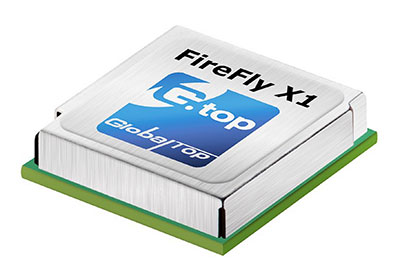
    The GlobalTop Firefly X1 GNSS module.
    The GlobalTop Firefly X1 GNSS module.

    Sierra Wireless, a provider of fully integrated device-to-cloud solutions for the Internet of Things, has completed the acquisition of GlobalTop Technology’s GNSS embedded module business for $3.2 million.

    GlobalTop’s GNSS embedded module portfolio will become part of the Sierra Wireless OEM Solutions product line, and the GNSS staff from GlobalTop will join Sierra Wireless.

    GlobalTop’s GNSS products generated $5 million in revenue in the last 12 months, and the business is break-even, Sierra Wireless said.

    “Building on our portfolio of cellular, Wi-Fi and Bluetooth modules, we will have additional products to offer to our customers in markets where positioning data is critical, including high-value asset tracking, telematics, drones and automotive,” said Dan Schieler, senior vice president and general manager of OEM Solutions for Sierra Wireless.

    The TitanX1 GNSS antenna.
    The TitanX1 GNSS antenna.

    GlobalTop GNSS modules include the Firefly, Ivory and Hummingbird series (GNSS standalone), and the Titan and Ladybird (GNSS with antenna). GlobalTop launched the Titan X1 module in February.

    “With a wide array of modules and established sales channels, as well as a proven engineering team, we believe that the GlobalTop GNSS business is an important addition to Sierra Wireless,” Schieler said.

  • U-blox launches multi-GNSS module for wearables, UAVs

    U-blox launches multi-GNSS module for wearables, UAVs

    The u-blox ZOE-M8Q is designed for wearables, UAVs and asset trackers.
    The u-blox ZOE-M8Q is designed for wearables, UAVs and asset trackers. Photo: U-blox 

    U-blox has launched a new positioning module, the ZOE-M8G. The ZOE-M8G is an ultra-compact GNSS receiver module designed for markets where small size, minimal weight and high location precision are essential.

    ZOE-M8G offers exceptionally high location accuracy by concurrently connecting to GPS, Galileo and either GLONASS or BeiDou. It also provides -167 dBm navigation sensitivity, important for wearable devices, unmanned aerial vehicles (UAVs) and asset tracker applications.

    The new u-blox ZOE-M8G helps simplify product designs, because it is a fully integrated, complete GNSS solution with built-in SAW-filter and Low Noise Amplifier (LNA). It can be used with passive antennas without the need for additional components, and doesn’t compromise performance.

    The ZOE-M8G GNSS module measures 4.5 x 4.5 x 1.0 millimeters. Due to its small size, a complete GNSS design using a ZOE-M8G module takes approximately 30 percent less printed circuit board (PCB) area compared to a conventional discrete chip design with a CSP chip GNSS receiver.

    “When you’re designing products such as smart watches, fitness trackers, asset trackers, UBI dongles and even drones, every square millimeter and every gram counts. The u-blox ZOE-M8G makes it significantly easier for product designers to achieve precise location tracking while keeping within their strict form factor and weight restrictions,” said Uffe Pless, product marketing, Positioning Product Center at u-blox.

    Samples of the u-blox ZOE-M8G will be available in February 2017, and volume production will start in October 2017.

  • Qualcomm offers variant of connected car platform

    Qualcomm Technologies Inc. has introduced a new variant of its connected car reference platform using its flagship gigabit class Snapdragon X16 LTE modem to help car manufacturers deliver the high-speed, high-quality and reliable connectivity required for advanced telematics and connected vehicle services — supporting peak download speeds up to 1 Gbps.

    Qualcomm is showcasing the variant at CES 2017, which is being held Jan. 5-8 in Las Vegas, Nevada.

    Snapdragon-QualcommBuilding on the Company’s leadership supplying 3G/4G LTE modems for automotive, the reference platform is designed to allow carmakers to quickly and easily integrate the broad range of additional wireless and networking technologies required in today’s vehicles, including Wi-Fi, Bluetooth, Bluetooth Low Energy and GNSS, with optional support for DSRC and Cellular-V2X.

    The platform also includes a module reference design for the Snapdragon X16 LTE modem to help automotive suppliers accelerate development and improve time-to-commercialization.

    Highlights of the new connected car reference platform include:

    • Gigabit Class LTE cloud connectivity: The Snapdragon X16 LTE modem supports Gigabit-class download speeds, up to 10x as fast as first generation 4G LTE devices. The modem is designed to employ sophisticated digital signal processing to pack more bits per transmission with 256-QAM, receives data on four antennas through 4×4 MIMO, and supports for up to 4x Carrier Aggregation. All of this comes together to support peak download speeds up to 1 Gbps, helping satisfy the connectivity needs and use cases of the next generation of connected vehicles including high-definition map updates, connected navigation with real-time traffic and road condition information, software upgrades, Wi-Fi hotspot and multimedia streaming.
    • In-car networking and satellite navigation: The connected car reference platform also integrates Wi-Fi 802.11ac, Bluetooth 4.2, Bluetooth Low Energy 4.2, sensor support for stolen vehicle tracking and recovery, quad-constellation GNSS and 3D Dead Reckoning (DR) location solutions, with optional support for vehicle-to-everything communications using DSRC/802.11p or Cellular-V2X. The solution is designed to manage concurrent operation of multiple wireless technologies using the same spectrum frequencies. In addition, the reference platform features in-vehicle networking technologies such as Gigabit Ethernet with Automotive Audio Bus (A2B), Controller Area Network (CAN) and Local Interconnect Network (LIN) interfaces.
    • OEM and third-party applications support: Qualcomm Technologies also provides a security-rich framework for the execution of custom OEM and third-party telematics applications. The simplified access to tightly-integrated apps processing functionality is designed to help automakers and service providers handle the increasing number of use cases requiring connectivity — simultaneously in many cases — and quickly prototype, develop and deliver unique and differentiated experiences to their customers.

    Qualcomm Technologies has also developed a reference hardware module in two different band configurations, North America and Rest of World (including Europe). The module design is engineered to support up to four antennas to utilize the 4×4 MIMO capabilities of the Snapdragon X16 modem and reach the peak download speeds of up to 1 Gbps. This can help accelerate the time-to-commercialization of this flagship device and the Company is working with module manufacturers and Tier 1 suppliers to further optimize 2-antenna and 4-antenna configurations aiming to meet cost-effectiveness and size requirements of specific automakers, specific segments and use cases.

    “Connected cars are becoming intelligent sensors on the road, not only using data for consumer use cases such as Wi-Fi hotspots and video streaming, but also collecting and transmitting critical, rich real-time information about road conditions, map updates and driver status,” said Patrick Little, senior vice president and general manager, automotive, Qualcomm Technologies, Inc. “As a leader in car connectivity, Qualcomm Technologies is well positioned to address the tremendous data demand, helping automakers integrate the broad set of technologies required by a new generation of connected vehicles.”

    The new connected car reference platform using Snapdragon X16 LTE modem, including its corresponding reference module, is expected to be available in the first half of 2017.

    All major global automakers currently use products from Qualcomm Technologies’ broad portfolio of automotive solutions, including the Company’s flagship Snapdragon automotive processors and modems.

    Across telematics, infotainment and connectivity, Qualcomm Technologies has achieved more than 150 automotive design wins, and car manufacturers across the globe have selected Snapdragon processors for their next generation infotainment solutions. To learn more, please visit Qualcomm Technologies’ automotive booth at CES, north hall, booth #5609, or visit qualcomm.com/automotive.

  • New golf rangefinder wearables use u-blox inside

    New golf rangefinder wearables use u-blox inside

    Photo: U‑bloxU‑blox components are at the core of two new GNSS golf products. The golf rangefinder wearables were launched by Voice Caddie, an international brand of rangefinders and trackers based in South Korea.

    The T3 Hybrid Golf GPS Watch uses the compact u‑blox UBX‑G7020‑KT professional‑grade GNSS chip, which links with GPS/QZSS or GLONASS satellite systems.

    The B1 GPS Band uses the u‑blox UBX‑M8030‑KT professional‑grade GNSS chip, which provides navigation sensitivity and low current consumption. It is compatible with GPS, Galileo, GLONASS and BeiDou satellite systems.

    The u‑blox GNSS technology enables the T3 Watch and the B1 Band to automatically detect golf courses and holes, and shows the wearer the driving distance and remaining distance to the hole as well as the distance to the front, middle and back of the green. The T3 Watch also measures short distances.

    “Miniaturization is key to our goal to make truly mobile golfing technology wearables,” said Ho‑Hyeong Lee, director of the Research Center at Voice Caddie parent company Ucomm Technology. “The u‑blox GNSS chips are the ideal solution for our products, because of a combination of their compact size, low power‑consumption and low cost. This has helped us to create advanced, comfortable products at the price points we were targeting.”

    Both companies foresee further collaboration with high precision GNSS and short range solutions.

  • Reyax integrates u-blox GNSS and cellular modules into router platform

    Reyax integrates u-blox GNSS and cellular modules into router platform

    The EVA-M8 GNSS module by u-blox.
    The EVA-M8 GNSS module by u-blox.

    Reyax Technology, an industrial and telematics systems provider for aftermarket telematics, has launched a new industrial router platform that incorporates cellular, short range and GNSS modules from u-blox.

    The RYW2000 4G LTE and Wi-Fi hot-spot router platform uses the EVA-M8M, a tiny concurrent GNSS module, a TOBY-L2 cellular LTE module that offers throughput of up to 150 Mb/s with LTE Cat.4, and an ELLA-W131 2.4-GHz Wi-Fi and Bluetooth module.

    “We selected u-blox modules because of their market-leading performance, excellent environmental tolerance characteristics and the fact they develop all of their technology in-house,” said Ritchie Chang, general manager of REYAX Technology. “Our RYW2000 router platform is designed for industrial and telematics applications where performance, reliability and conformance to changing environmental conditions are all critical to the success of our product.”

    Front and back of the Toby L2 module.
    Front and back of the Toby L2 module.

    The new router platform RYW2000 includes a router platform card for Industrial and telematics applications and measures only 50.95mm x 30mm. Its operating condition and power are DC 3.3V-5.5V.

    Ming Chiang, country manager of u-blox Taiwan explains, “This is another example of our on-going collaboration with REYAX Technology and we are excited they have chosen to incorporate three of our modules into their RYW2000 product. Together we have a shared vision for the promotional of IoT and M2M technologies to benefit many industries and applications.”

  • U-blox integrated antenna GNSS receiver eases embedded designs

    U-blox integrated antenna GNSS receiver eases embedded designs

    U-blox is introducing a new module designed to speed time to market for system developers of GNSS applications who have limited experience in RF and antenna design.

    The SAM-M8Q GNSS receiver with integrated antenna is housed in a tiny 15.5 by 15.5 by 6.3 millimeter package. It can be easily embedded in small devices that require location information, such as asset tracking and telematics systems, and generic automotive after-market applications, u-blox said.

    By using the latest u-blox M8 multi-GNSS receiver technology, the module is able to offer simultaneous reception of GPS, GLONASS, and Galileo satellite signals.

    Ultra-compact SAM-M8Q module.
    Ultra-compact SAM-M8Q module.

    The combination of an integrated wide-band antenna along with the module’s SAW filter and low-noise amplifier (LNA)architecture ensures that the SAM-M8Q receiver delivers robust performance in the presence of high frequency signals from other electronic equipment, such as cellular modems, which can cause interference.

    “The SAM-M8Q is intended for customers who don’t have much experience in RF and antenna design,” said Kim Kaisti, Director, Product Management, Product Center Positioning. He added, “It is aimed at applications that require an embedded antenna and where the surface mount package allows for easier assembly and installation in the end-equipment.”

    Samples of the SAM-M8Q will be available in mid-January 2017. The modules will be in full production in mid-February 2017.


  • Tiny u-blox EVA-M8Q module supports GPS, GLONASS, BeiDou and Galileo

    u-blox_EVA_3d_transU-blox has released its tiny EVA-M8Q high-sensitivity GNSS module in a 7 millimeter by 7 millimeter package. EVA-M8Q supports GPS, GLONASS, BeiDou and Galileo, the company said in a news release.

    The EVA-M8Q completes the company’s lineup of receivers in the miniature and EVA form-factor package.

    The EVA-M8Q is TCXO-based and is optimized to provide the highest acquisition and tracking sensitivity, the company says, making it suitable for use with small antennas either in covert applications such as asset tracking and stolen vehicle recovery, or in portable devices; the previously announced EVA-M8M is better suited to cost-sensitive systems.

    “The key differentiator of the EVA-M8Q to the other cost effective EVA variants is the sensitivity,” says Stéphane Vincent, product strategy director, positioning, u-blox. “This, along with the accuracy provided by concurrent reception of three GNSS constellations, enables an end-system and its antennas to be easily hidden within a vehicle or other high-value asset that need to be tracked.”

    The ease of manufacturing offered by the Quad Flat No-leads (QFN)-like package suits requirements for medium- to high-volume production. While the highly integrated module of the EVA-M8 series allows OEMs to achieve a faster time-to-market.

    EVA-M8 series are the smallest u-blox modules featuring GPS, BeiDou, Galileo and GLONASS reception. Three out of the four GNSS constellations can be received concurrently, which leads to high positioning accuracy. The series also features anti-spoofing and anti-jamming technology to provide superior security and integrity protection.

    Samples of the EVA-M8Q are available now. The modules will be in full production in Q4 2016.

    Features

    • Complete GNSS solution in 7 millimeter by 7 millimeter package.
    • Sensitivity — ideal for small or covert installations.
    • High accuracy from three concurrent GNSS.
    • Highly integrated module leads to faster time-to-market.
    • Anti-spoofing and anti-jamming.
  • Trimble debuts GNSS module for system integrators at AUVSI’s Xponential 2016

    Trimble Navigation introduced its MB-Two GNSS module at the Association of Unmanned Vehicles International‘s Xpontential 2016 show, held May 2-5 in New Orleans. Trimble’s Don Speedy gives an overview of the MB-Two, which delivers highly accurate GNSS-based heading plus pitch or roll in an advanced industry standard form-factor for system integrators.

  • Micro module designed for UAVs, wearables

    GNSS module maker OriginGPS has launched the new Multi Micro Spider, which has a fully integrated and highly sensitive multi-GNSS module, with support for GPS, Glonass, BeiDou and Galileo.

    The Multi Micro Spider is designed for applications that require quick movement, minimal power consumption and ultra-small form factors, such as wearables and drones.

    Like its predecessor, the Multi Micro Hornet (ORG1510-MK), the Multi Micro Spider’s (ORG4033) module utilizes MediaTek’s MT3333 chip and its onboard flash memory to achieve a rapid update rate and positioning speed of up to 10 Hz.

    “With the Multi Micro Spider, we’re breaking new ground in what’s possible with GNSS footprints,” said Gal Jacobi, CEO of OriginGPS. “It’s a plug-and-play solution that will enable developers to easily improve performance of products while shortening time to market. Because of its size, low power consumption and high performance, the Multi Micro Spider is the perfect GPS and GNSS solution to power the location services for a wearable out on the go to a UAV tracking action sports.”

    Key features include:

    • Peak performance with ultra-small size — At just 5.6 mm x 5.6 mm, with a height of 2.65 mm, the Multi Micro Spider packs in a sub-one second Time To First Fix (TTFF) and sensitivity of -165 dBm for two simultaneous constellations. All of this achieved using less than 9 mW of power.
    • OriginGPS’ Noise Free Zone (NFZ) — The ORG4033 utilizes OriginGPS’ patented and proprietary NFZ technology for continued noise immunity and razor-sharp sensitivity even in poor signal conditions.
    • Onboard flash for market-leading update rate — With an onboard flash memory and an update rate of up to 10Hz, the Multi Micro Spider breaks the market’s standard update rate benchmark of 5 Hz for positioning, accurate to within 2.5 meters.
    • Intuitive design that facilitates shorter time to market — The Multi Micro Spider makes use of a developer-friendly design that allows for seamless migration from GPS to GNSS pin-to-pin compatibility. This both reduces overall development costs for new products and shortens their time to market.
    • Easy integration with OriginGPS’ miniature GNSS antenna solutions — The Multi Micro Spider can be easily integrated with the ORG12-4T-GNSS miniature patch antenna to get the best performance out of a compact form-factor.