Tag: GSA

  • Galileo declares Initial Services

    Galileo declares Initial Services

    At a Dec. 15 ceremony in Brussels titled “Galileo Goes Live,” two high officials of the European Commission issued the Galileo Initial Services Declaration.

    The Declaration of Initial Services means that the Galileo satellites and ground infrastructure are now operationally ready. These signals will be highly accurate but not available all the time, since the constellation is not yet complete and users cannot always count on four satellites being visible at one time at all points on the Earth.
    Simultaneously, the European GNSS Agency (GSA)  awarded the Galileo Service Operator (GSOp) contract, with a value of up to 1.5 billion euros, to Spaceopal, a joint venture between Telespazio and the German Space Agency (DLR).

    At the moment, the Galileo constellation consists of 18 satellites in orbit. However, two of these are in an orbit not totally useful for positioning and navigation. Four more, launched in November, may or may not have completed their on-orbit testing (a series of notice advisory to Galileo users or NAGUs appeared today relating to the flag status of each satellite, see details at the end of this story) but have not yet been integrated to the operational constellation. This is foreseen to take place in spring 2017.

    During the initial phase, the first Galileo signals will be used in combination with other satellite navigation systems, like GPS. In coming years, new satellites will be launched to enlarge the constellation, gradually improving Galileo availability worldwide. The constellation is expected to be complete by 2020 when Galileo will reach full operational capacity (FOC) of 30 satellites: 24 satellites plus six orbital spares, intended to prevent any interruption in service.

    “The announcement of Initial Services is the recognition that the effort, time and money invested by ESA and the Commission has succeeded, that the work of our engineers and other staff has paid off, that European industry can be proud of having delivered this fantastic system,” stated ESA Director general Jan Woerner.

    Paul Verhoef, ESA’s Director of the Galileo Programme and Navigation-related Activities, added, “Today’s announcement marks the transition from a test system to one that is operational. We are proud to be a partner in the Galileo programme.

    “Still, much work remains to be done. The entire constellation needs to be deployed, the ground infrastructure needs to be completed and the overall system needs to be tested and verified.

    “In addition, together with the Commission we have started work on the second generation, and this is likely to be a long but rewarding adventure.”

    Galileo Initial Services are managed by the European GNSS Agency (GSA). The overall Galileo programme is run by the European Commission, which has handed over the responsibility for the deployment of the system and technical support to operational tasks to the European Space Agency (ESA).

    Operator Contract

    The GSOp contract runs for 10 years and covers  operation and maintenance of the Galileo satellite system and its committed performance level: in particular, the operations and control of the system, the logistics and maintenance of the systems and infrastructure as well as the user support services.

    “With its emphasis on service performance, this contract will shape the future of Galileo. We look forward to building a strong partnership with Spaceopal as Galileo moves towards full operational capability under the responsibility of the GSA from January 2017,” said GSA Executive Director Carlo des Dorides.

    Specifically, under GSA management the contract awarded to Spaceopal includes:

    • Secure operations of Galileo from two mission control centres (GCC), located in Germany and Italy, and the European GNSS Service Centre (GSC) for user support services in Spain;
    • Management of the Galileo Data Distribution Network (GDDN);
    • Integrated logistics support and maintenance for the entire space and ground infrastructure;
    • Monitoring of the system performance;
    • Support the completion of the Galileo infrastructure and associated launches.

    Spaceopal has served as the contractor for Galileo operations since 2010 under the Galileo Full Operational Capability (FOC) Operations Framework Contract.

    Products and Services

    The first Galileo smartphone by Spanish company BQ is now available on the market, and other manufacturers are expected to follow suit. Application developers can now test their ideas on the basis of a real signal.

    With this Declaration, Galileo will start to deliver, in conjunction with GPS, the following three types services free of charge. Their availability will improve as more satellites are launched.

    The Open Service is a free mass-market service for users with enabled chipsets in, for instance, smartphones and car navigation systems. Fully interoperable with GPS, combined coverage will deliver more accurate and reliable positioning for users.

    Galileo’s Public Regulated Service is an encrypted, robust service for government-authorised users such as civil protection, fire brigades and the police.

    The Search and Rescue Service is Europe’s contribution to the long-running Cospas–Sarsat international emergency beacon location. The time between someone locating a distress beacon when lost at sea or in the wilderness will be reduced from up to three hours to just 10 minutes, with its location determined to within 5 km, rather than the previous 10 km.

    Maroš Šefčovič, à gauche, et Elżbieta Bieńkowska
    Maroš Šefčovič, à gauche, et Elżbieta Bieńkowska.


    Accolades and Encouragements

    At the “Galileo Goes Live” ceremony in Brussels, EC Vice-President Maroš Šefčovič, responsible for the Energy Union, said: “Geo-localisation is at the heart of the ongoing digital revolution with new services that transform our daily lives. Galileo will increase geo-location precision ten-fold and enable the next generation of location-based technologies; such as autonomous cars, connected devices, or smart city services. Today I call on European entrepreneurs and say: imagine what you can do with Galileo — don’t wait, innovate!”

    Commissioner Elżbieta Bieńkowska, responsible for Internal Market, Industry, Entrepreneurship and SMEs, said: “Galileo offering initial services is a major achievement for Europe and a first delivery of our recent Space Strategy. This is the result of a concerted effort to design and build the most accurate satellite navigation system in the world. It demonstrates the technological excellence of Europe, its know-how and its commitment to delivering space-based services and applications. No single European country could have done it alone.”

    Canadian GNSS manufacturer NovAtel,  a long-time participant in Europe’s space navigation programs, sent its congratulations to ESA, the EC and GSA upon the launch of Galileo Initial Services. President and CEO Michael Ritter stated, “Today’s declaration validates the confidence of the program’s supporters that Europe would join the world’s operators of global navigation satellite systems.”

    NovAtel‘s receivers, antennas and certified ground-reference station receivers have supported Galileo signals in anticipation of the complete constellation. NovAtel now broadcasts Galileo Precise Point Positioning (PPP) corrections through its TerraStar correction services, and states that its  OEM customers are already benefiting from the enhanced reliability, availability and accuracy the Galileo constellation adds to the GNSS.

    Graham Purves, president and CEO of Veripos, a provider of global precise point positioning (PPP) correction services to the marine oil and gas industry, stated, “As a European company, we are particularly proud and excited about the opportunities the Galileo services create for our customers. The reliability and safety enhancements made possible through these new services allow Veripos to continue to expand the capabilities of our cutting edge safety critical positioning solutions.”

    Veripos’s worldwide network of 80 reference stations already supports Galileo, enabling Veripos to deliver Galileo PPP corrections over satellite through products such as its commercially available Apex5 correction service. Veripos also offers Galileo support on its LD5 and LD56 GNSS receivers and Quantum software for industry leading high precision marine positioning solutions.

    Advisory Updates

    USABINIT NAGUs were issued for 11 satellites: 0101, 0102, 0103, 0203, 0204, 0205, 0206, 0208, 0209, 0210, and 0211. USABINIT, or Initially Usable, notifies users that a satellite is set healthy for the first time. 0104 had a power problem and is operating on E1 only. 0201 and 0202 were launched into lower orbits. 0207 and 0212-0214 are still undergoing commissioning and drifting to their designated orbital slots.

  • Drone project increases accuracy despite obstruction

    Drone project increases accuracy despite obstruction

    The second-place winner in this year’s European Satellite Navigation Competition aims to improve surveying accuracy in urban canyons or under tree canopies.

    The project, Drones2GNSS, also took home the Special Prize offered by the European GNSS Agency (GSA).

    Space Geomatica Ltd.’s Tripolitsiotis Achilles joined with Panagiotis Partsinevelos, SenseLab Research, Technical University of Crete, to develop Drones2GNSS.

    In the tracking procedure, the engineer with the surveying pole might move around, yet the UAV tracks in real time and provides the GNSS coordinates.
    In the tracking procedure, the engineer with the surveying pole might move around, yet the UAV tracks in real time and provides the GNSS coordinates.

    Drones2GNSS includes a prototype drone equipped with a highly accurate GNSS receiver and a camera/laser measuring system that retrieves the coordinates of custom surveying poles featuring Wi-Fi, a prism and a target marker.

    The team’s image processing algorithms and error correction techniques provide real-time, centimeter-level coordinate estimation and can simultaneously measure multiple moving surveying poles.

    The processing is performed on-board the UAV without any ground-based hardware. In this way, Drones2GNSS provides a fast, reliable, cost-effective alternative for absolute coordinate positioning in obstructed environments where GNSS fails. It can cover multiple targets, including cars, people and vessels.

    It also offers a basis for other related challenges, including UAV GNSS networks, indoor positioning and error mitigation.

    “Although Galileo Initial Services are expected to enhance the accuracy of existing solutions, Drones2GNSS proposes an off-the-shelf application that uses European GNSS (Galileo, EGNOS) as the primary means of positioning,” Tripolitsiotis said. “As GNSS signals are degraded in obstructed environments by skyscrapers, vegetation and geomorphology, our project proposes using drones as intermediate carriers of high-precision GNSS signals that can then transfer the geolocation accuracy to the ground.”

    Drones2GNSS relies heavily on multi-constellation GNSS signal, which is where Galileo will make the difference. “As current constellations like GPS and GLONASS have proven inefficient in confronting the aforementioned surveying problem, the sector continues to rely on traditional surveying techniques,” Tripolitsiotis said. “However, with the launch of the Galileo era and the utilization of the Drones2GNSS approach, we can now provide surveying engineers a cost effective, accurate and fast positioning solution.”

  • EGNOS awarded by aerospace academy

    EGNOS awarded by aerospace academy

    News from the European Space Agency

    The multi-agency team behind the ESA-designed EGNOS augmentation system — making it possible for European aircraft to safely rely on satnav signals — has received a prestigious award from France’s national aerospace academy.

    As our region’s own satellite-based augmentation system (SBAS), the European Geostationary Navigation Overlay Service (EGNOS) improves the precision of GPS signals over most European territory, while also providing continuous and reliable updates on their integrity.

    Didier Flament, heading ESA’s EGNOS and SBAS Division, joined Mariluz de Mateo of Spain’s ENAIRE air traffic management agency, working on Europe’s Single European Sky Traffic Management Research (SESAR), and Jean-Marc Pieplu, overseeing EGNOS exploitation at the European Global Navigation Satellite System Agency (GSA) in receiving Vermeil Medals from France’s Académie de l’Air et de l’Espace in Toulouse.

    The medals were awarded to the trio during the annual Séance Solennelle de l’AAE on Nov. 25.

    receiving_medal_egnos-team-w
    EGNOS team: (from left) Jean-Marc Pieplu, overseeing EGNOS at the GSA; Mariluz de Mateo of Spain’s ENAIRE air traffic management agency, working on SESAR; and Didier Flament, heading ESA’s EGNOS and SBAS Division.

    “This award recognizes the success of the EGNOS programme,” comments Didier. “It has been a long-term effort, which began with a first demonstration step called European Complement to GPS, studied and implemented by CNES, French Civil Aviation and the ONERA national aerospace research centre between 1987 and 1995.

    “This was then followed by the European ESA ARTES-9 programme, started 20 years ago this year. So beyond the three nominees, the award goes to the various teams from ESA, CNES, civil aviation agencies and industry which have contributed to its success.“

    While Galileo is on the verge of entering initial operational service, EGNOS has already been operational for many years: it began open service in 2009, and became available for ‘safety-of-life’ use including aviation in March 2011.

    A network of 40 ground monitoring stations performs an independent measurement of GPS signals, so that corrections can be calculated and then passed to users immediately via a trio of geostationary satellites. A several-fold increase in precision is therefore delivered.

    The result is that the EGNOS-augmented signals are guaranteed to meet the extremely high performance standards set out by the International Civil Aviation Organisation standard (ICAO SARPS), as all other similar regional SBAS systems.

    Compliance to these standards is also ensuring full interoperability of these systems and seamless transition from one region to another for the end user – the pilot of an equipped aircraft.

    The signals from space can therefore be relied on routinely for the safety-critical task of vertically guiding aircraft during landing approaches.

    Today, more than 170 European airports in 19 countries use EGNOS, projected to increase to 346 in 25 states by 2020, according to Eurocontrol.

    Following its initial design and development by ESA, ownership of the EGNOS system was passed to the European Commission in March 2009, and is currently operated on behalf of the EC’s GSA by an operator based in France, the European Satellite Services Provider.

    ESA retains a role in procuring EGNOS’s future evolution, in particular the second generation of EGNOS aiming at augmenting all new modernized GPS signals and Galileo signals. ESA’s role includes liaising with other regional SBAS system providers to agree on common next-generational working standards through the international Interoperability Working Group, including making use of Galileo and additional satnav signals.

    The most recent meeting of this working group was hosted by the Agency for Aerial Navigation Safety in Africa and Madagascar Nov. 29–30 in Dakar, Senegal.

  • GSA releases first GNSS User Technology Report

    What lies ahead in the GNSS chipset and receiver domain, and what are the trends sure to transform the GNSS landscape of tomorrow? To answer those questions, the European GNSS Agency (GSA) has released its first GNSS User Technology Report.

    In recent years, GNSS technology has experienced a period of rapid development — both on the side of global constellations and user receivers. With this development, European systems such as EGNOS and Galileo are becoming increasingly present in GNSS receivers, providing enhanced performance to users both in Europe and worldwide. Even with the increased deployment of other positioning technologies, because it is the most widespread and cost-effective source of location information, GNSS will remain at the core of all positioning technology.

    “In view of the changing user needs in terms of expected positioning experiences, the appearance of new and modernized GNSS signals, and advances in semiconductor technologies, we felt the need to take a closer look at the impact these changes will have on user technology and GNSS’ role in the positioning solutions of the future,” said GSA Executive Director Carlo des Dorides.

    A closer look

    The outcome of this closer look is the GSA’s first GNSS User Technology Report. As a sister publication to the GNSS Market Report, the GNSS User Technology Report zeros in on the state-of-the-art GNSS receiver technology, along with analyzing the trends that are sure to change the entire GNSS landscape.

    The report provides an in-depth analysis of GNSS user technology as it pertains to:

    • mass-market solutions
    • transport safety and liability-critical solutions
    • high-precision, timing and asset management solutions.

    In addition, the report gives a general overview of the latest GNSS receiver technology, common to all application areas, along with a supplement on location technologies that looks beyond GNSS in the positioning landscape.

    Written with contributions from leading GNSS receiver and chipset manufacturers, the GNSS User Technology Report is meant to serve as a valuable tool to support planning and decision-making in regards to developing, purchasing and using GNSS user technology.

    “GNSS user technology is, now more than ever, experiencing a rapid and exciting evolution, answering the needs of ubiquity, automation and secure positioning,” said des Dorides. “This report explores in detail all of these new developments and how they will bring continuous location service, reliability and robustness to the main application domains.”

    Among the findings:

    • Nearly 65 percent of all chipsets and modules currently on the market support multiple constellations.
    • Within the next few years, it is expected that 100 percent of all new devices will be multi-constellation capable.
    • The leaders in multi-constellation capability are mass-market receivers and high-accuracy professional receivers, with nearly 30 percent already capable of using the four available global constellations.
    • Receivers targeting such safety-critical applications as aviation must wait for new technologies to be proven and new standards or regulations to become available before implementing them.
    • In terms of supported frequencies, 30% of all receivers implement more than one frequency, mostly in high precision.
    • With the increasing demand for better resilience across all applications, the need for higher accuracy and integrity that automation demands, adoption of dual-frequency solutions (E1/L1 + E5/L5) is expected to grow.
    • In the mass market, the chipset supply chain is extremely consolidated, with a few players worldwide driving innovation.
    • For liability and safety-critical transport solutions, a consolidated industry with an important European presence dominates innovation in automotive, maritime and aviation, while new players are expected to emerge in such new applications as autonomous vehicles.
    • In high precision, timing and asset management, the suppliers are specialized in various professional fields, although their products are based on a relatively low number of GNSS chipsets.

    The report is free and can be downloaded here.

  • Galileo Initial Services looming

    With Galileo Initial Services at last on the horizon and a quadruple satellite launch scheduled for November, here’s hoping that Europe’s GNSS constellation will be delivering limited, but reliable, global PNT services before the year is out.

    The four Galileo satellites for Arianespace’s first Ariane 5 mission for the constellation are being prepared at ESA’s launch facility in French Guiana. The flight is scheduled for 17 November. However neither these four new satellites, nor the two orbited in May, are required to deliver Galileo Initial Services, which should be launched officially some time in November. Fingers crossed.

    The European GNSS Agency (GSA) is gearing up to assume its operational role for Galileo in early 2017. During the summer the GSA formally accepted their Loyola de Palacio facility in Madrid, Spain that houses the European GNSS Service Centre (GSC). This is a significant milestone in the development of the programme and its service provision as Galileo’s “door to the GNSS world” as GSA Executive Director Carlo des Dorides described the facility at the handover ceremony.

    GSA already oversees the operation and service provision for the European Geostationary Navigation Overlay Service (EGNOS) (since 2015) along with managing the security accreditation and general security provision for both programmes.

    The GSC offers over 1,100 square metres of space and currently employs over 40 people. Since 2013, the core team at GSC has been providing limited services and working as a precursor to GSC v1. Its key work includes supporting the lead up to Galileo Initial Services provision, along with operating the GSC Helpdesk, disseminating orbital products to the Search and Rescue (SAR) community, supporting GNSS-related research and industrial activity and monitoring user satisfaction. Once operational, GSC v1 will be connected to the Galileo core system, thus enabling the long anticipated Commercial Service. This service is expected to enter operations by mid-2017.

    Once the Galileo Operations Contract is awarded and Initial Services officially declared, the GSC is expected to see a significant increase in staff.

    Also in the summer CNES President and France’s inter-ministerial coordinator for European satellite navigation programmes Jean-Yves Le Gall was elected as the new chair of the GSA Administrative Board with Mark Bacon, representing the United Kingdom, elected as deputy chair.

    “I am honoured to have been elected chair of the GSA Administrative Board, with Galileo now poised to enter its operational phase,” said Le Gall. “This election confirms the desire of Member States to join forces on the cusp of a prolific period for European space as we move Galileo towards full operational capability.”

    Brexit blues?

    Mark Bacon added “I am very pleased to have been elected to work with the Board and I look forward to helping the GSA deliver on the Galileo and EGNOS programmes over the coming years.”  However the UK’s decision to leave the EU (Brexit) must make his position rather uncomfortable – and temporary – to say the least.

    The GSA Administrative Board is composed of representatives from each EU Member State, the European Commission, and the EU parliament. The Board meets three times per year to ensure that the Agency performs its tasks correctly. As things stand if the UK is no longer an EU Member State it must lose its representative(s) on the advisory board.

    However, the relationship between the UK and EU space programmes is, of course, subject to the Brexit negotiations. The UK will almost certainly remain a member of the European Space Agency (ESA) as this is a pan-European body not an EU agency, however when it leaves the EU the country will have to renegotiate terms if it wants to continue to participate in the key EU programmes such as Galileo GNSS and Copernicus Earth Observation system.

    The ESA is autonomous from the EU and should not be directly affected by Brexit confirmed Jean Bruston, head of ESA’s EU policy office at a media briefing in mid-September. But “As soon as it [Britain] is leaving the EU it is not participating in these programmes [Galileo / Copernicus] any longer,” he observed.

    In addition, UK-based companies hold contracts worth tens of millions of euros from ESA to supply hardware for the Copernicus and Galileo GNSS. “If nothing changes [and Brexit goes ahead], we would have to stop these contracts,” said Bruston bluntly.

    Of course, Britain could still contribute to Galileo and Copernicus if it negotiated a third-party agreement with the EU, as Norway and Switzerland (both non EU members) have done. The down side is that this may take some time to initiate, let alone complete, and if Britain sticks to its guns on issues such as free movement of people then the likelihood of a successful outcome for the UK is not high.

    In an interview with French media ESA director-general Jan Woerner reinforced Bruston’s views saying that “the UK will remain a member state of ESA, this is very clear” but also continuing “As we are also dealing with European programmes like Copernicus and Galileo, and also the question of UK citizens working on the continent and all these legal issues, we have to take this into account.”

    EU opportunity

    Many in ‘continental Europe’, as we Brits so often condescend to describe our fellow Europeans, will be more than happy to see the U.K. no longer participating in deciding key aspects of EU space and other policy areas.

    It is no coincidence that the European Commission has become much more vocal on plans for a European defence force since the Brits announced their departure. The U.K. has long been opposed to the concept of an ‘EU Army.’ However planning and military cooperation between Member States outside normal NATO channels has been increasing over many years. The small and discreet (so discreet that I didn’t realise the exact location of its HQ in Brussels until the recent terrorist incidents meant burly Belgian paratroopers were stationed outside and I asked them what they were guarding. Has to be said they were not discreet!) has seen its budget frozen for the last five years, but this may now change.

    The interface of EU space and defence policy – in particular ‘dual use’ issues – will also become simpler without the U.K.’s protests. A leaked draft of the upcoming EU Space Policy communication talked directly of dual-use synergies to reinforce security from space, in particular to reduce costs and improve efficiency, and that the next generation of EU GNSS and Copernicus programmes should be designed from the start to be more relevant for security purposes. Defence-related research is also slated for future Horizon 2020 calls.

    The draft policy document also underlines that with EU space programmes becoming fully operational, building stability, trust and confidence in users is a key objective. Current services must be fully deployed and their long-term continuity and evolution assured. This continuity should be driven by user needs and take into consideration the mid-term (hardly mid-term for Galileo!) evaluation of the programmes that should happen in 2017. For Galileo and EGNOS, the document looks to improvements in the current services, including greater robustness and performance, and provision of additional services, such as regional or timing services.

    California dreaming

    So with Brexit what is the U.K.’s GNSS – and space-related – industry and research community to do? Of course many of the UK industrial players are multi-national companies and internal transfer of people and/ or projects will overcome many issues. And bi-lateral collaborative agreements on exchange of talent and ideas between partners can also achieve the same results for smaller companies and research groups. However not having a seat in the policy process and the development of programmes will put ‘UK plc’ at a distinct disadvantage in my opinion.

    But U.K. leaders say that Brexit is an opportunity to be seized and that the U.K. should be looking to sell  goods and services in other global markets than the EU. Which is something most U.K. industry has been doing since trade/ time began. And in my experience U.K. business leaders have always been much more eager to go jump on a plane to the States or Australia than go visit their European neighbours – something to do with our renowned national language skills perhaps?

    Space is no exception – and one that has been shown to be a success in recent times. A helping hand is provided by InnovateUK, the U.K.’s government innovation agency, that is organising its third ‘Space Mission UK’ to the US in November. These are trade and investment missions specifically designed to support U.K. start-up companies to build world-leading space and satellite application businesses.

    Space Mission 1 visited Utah, LA and Silicon Valley in August 2015 and Space Mission 2 landed in Houston in November 2015. Space Mission 3 will visit San Francisco and LA from 5-11 November this year.

    Mission programmes are varied but typically include visits to companies working at the forefront of the sector, networking opportunities with investors and corporate venture people interested in space, visits to incubators, accelerators and technology hubs, and masterclasses on pitch development, business culture and market entry.

    The previous two Space Missions have had immediate impact for the companies involved, including securing over £1 million in investment, and initiating collaborations with major organisations such as NASA and (ironically) ESA, and winning contracts with the UK Ministry of Defence at home.

    GNSS-related companies in previous missions include Arralis who build high-end semiconductor chips but have also been funded to develop novel GNSS antennas, and an exciting data fusion start-up – Gyana – that takes complex inputs from multiple data sources, including satellite, to build simple to understand 3D situational images. The founder of the business, engineering graduate Joyeeta Das, has raised US $1.1m since the mission.

    You can find a complete list of companies who have participated on the previous missions here.

    The selection for Space Mission 3 has closed and I am told there is at least one GNSS applications company that has been chosen to be on the plane in November. Good luck to them all!

    Google emergency LBS upgrade

    E112 is a location-based version of the 112 universal European emergency number, where the telecommunication operator transmits location information to the emergency centre in parallel to the call itself. With more than 70 percent of calls to emergency services coming from mobile phones, getting help fast and efficiently to the caller can be challenging if they don’t know where they are. Now, in a major step forward for implementation, Google has created and rolled out in two European countries (U.K. and Estonia) its Emergency Location Service on Android, with other regions to follow. The feature, when supported by the caller’s network, sends the phone’s location to emergency services when the 112 (or equivalent) emergency number is dialed.

    Emergency Location Service is supported by more than 99 percent of existing Android devices (version 2.3 and above) through Google Play services. The service activates when supported by the mobile network operator or emergency infrastructure provider.

    The new geographical location system claims to identify the source of a mobile phone emergency call to typically within 0.003 square kilometres (less than half the size of a football field) instead of a current average of around 12 square kilometres.

    When an emergency call is made with an enabled Android smartphone, the phone automatically activates its location service and sends its position by text message to the 112 service. This usually takes less than 20 seconds. This text message is not visible on the handset and is not charged for.

    And the first European Galileo-ready smartphone has been launched with the Aquaris X5 Plus smartphone, produced by the Spanish technology company BQ, and based on the Galileo-supported Qualcomm Snapdragon 652 processor with Galileo capability accessible via a software update to be released in Quarter 4 2016.

    U.S.-based Qualcomm announced in June that it was adding support for Galileo across its Snapdragon processor and modern portfolios for smartphone, computing, automotive and IoT applications.

    As well as Galileo capability, the Aquaris X5 Plus is powered by the latest Google Android OS and has all the usual features of a top end smart phone including 16 mega pixel ‘back’ camera and support for 4k video recording with a stabiliser and fingerprint recognition for added security.

    If you want to take the pulse of the GNSS user technology industry and keep up with the latest trends then you’ll need to get your hands on the GSA’s GNSS User Technology Report due out at the beginning of October.

    The 2016 report will be launched on 4 October as part of the Horizon 2020 Space Information Days in Prague. This two-day GSA-hosted event will introduce the third call for GSA-funded Horizon 2020 research and innovation proposals for Galileo and EGNOS.

    The document will take an in-depth look at the latest state-of-the-art GNSS receiver technology, along with providing expert analysis on the various trends that are defining the future global GNSS technology landscape. The report will focus on three key areas: mass market solutions; transport safety and liability-critical solutions; and high precision, timing and asset management solutions.

    Pulsar GNSS for deep space

    The use of pulsars, highly magnetized, rotating neutron star that emits a beam of electromagnetic radiation with a very precise period, have been potential candidates for a deep space navigation system for many years. Now a paper from the U.K.’s National Physical Laboratory (NPL) and the University of Leicester shows that pulsars can be used to obtain position along a particular direction in space to an accuracy of two kilometres in the direction of the pulsar. Furthermore such a technology could operate autonomously and greatly increase the number and capabilities of space missions, the paper claims.

    To calculate their position a space craft would need to carry a small X-ray telescope. The method uses X-rays emitted from pulsars, which can be used to work out the position of a craft in space in 3 dimensions to an accuracy of 30 km at the distance of Neptune. Certain types of pulsar, called ‘millisecond pulsars’, emit pulses of radiation with the regularity and precision of an atomic clock and therefore could be used much like GNSNS in space.

    The paper, published in Experimental Astronomy[1], details simulations undertaken using data, such as the pulsar positions and a craft’s distance from the Sun, for an ESA feasibility study of the concept. The simulations took these data and tested the concept of triangulation by pulsars with current X-ray telescope technology and state-of-the art position, velocity and timing analysis. This generated a list of usable pulsars and measurements of how accurately a small telescope can lock onto these pulsars and calculate a location.

    The key finding was that at a distance of 30 astronomical units – the approximate distance of Neptune from the Earth – an accuracy of 2km or 5km can be calculated in the direction of a particular pulsar (PSR B1937+21) by locking onto the pulsar for ten or one hours respectively and that by locking onto three pulsars, a 3D location with an accuracy of 30km can be calculated.

    This is an improvement on the current navigation methods of the ground-based Deep Space Network (DSN) and European Space Tracking (ESTRACK) network as it could be autonomous with no need for Earth contact for months or years, if an advanced atomic clock is also on the craft. Also ESTRACK and DSN can only track a small number of spacecraft at any one time. It is also possible that the pulsar technique could be quicker.

    Dr Setnam Shemar from NPL commented: “How these [space]craft navigate will in future become a limiting factor to our ambitions. The cost of maintaining current large ground-based communications systems based on radio waves is high and they can only communicate with a small number of craft at a time. Using pulsars as location beacons in space, together with a space atomic clock, allows for autonomy and greater capability in the outer solar system.”

    This simulation uses real-world technology and proves its capabilities for this navigation task. The X-ray telescope can be launched into space due to its low weight and size and it will be flown on a mission to Mercury in 2018. Could we be seeing the emergence of a navigation technology that can enable a new era of space exploration?

    And with that look into the future it is time to say “adios” to this column. From now on my EAGER dispatches will be sprinkled through other GPS World imprints and platforms. I’ll be at the global geospatial fun-fest that is Intergeo in Hamburg in October and sniffing around the first Galileo ‘hackathon’ in Berlin in early November, so I hope to see many of you at those and subsequent Euro-GNSS events in the future.

    A bientot as they say in these parts.

    [1] Towards practical autonomous deep-space navigation using X-Ray pulsar timing’ Shemar, S., Fraser, G., Heil, L. et al. Exp Astron (2016). doi:10.1007/s10686-016-9496-z

  • Global GNSS Market Trends & Forecasts: Highlights of the GSA GNSS Market Report 2015

    Sponsored by: NavCom
    Broadcast date: Thursday, April 16, 2015
    On-Demand Available Until: Friday, April 15, 2016
    Moderator: Tracy Cozzens, Managing Editor, GPS World and Geospatial Solutions
    Speakers: Gian Gherardo Calini, Head of Market Development, European GNSS Agency; Justyna Redelkiewicz Musial, Market Development Officer, European GNSS Agency; Peter Grognard, Director, Thales Alenia Space Belgium
    Summary: The fourth edition of the European GNSS Agency’s (GSA’s) GNSS Market Report is now available. The Report has become a key reference for organizations building their GNSS market strategies. Join us as we provide an overview of the report and its quantification of the GNSS market of today and the future. We’ll specifically look at the global GNSS market in terms of shipments, revenues and installed base of receivers, with a forecast up to 2023.

  • Galileo program governance: New chair of GSA Administrative Board named

    Galileo program governance: New chair of GSA Administrative Board named

    Jean-Yves Le Gall
    Jean-Yves Le Gall (Photo: Liberation)

    Meeting on Thursday, June 23, at its headquarters in Prague, the Administrative Board of the European Global Navigation Satellite Systems Agency (GSA) elected its new chair: Jean-Yves Le Gall, Centre National d’Etudes Spatiales (CNES, the French space agency) president and France’s interministerial coordinator for European satellite navigation programmes.

    Le Gall succeeds Sabine Dannelke, German federal minister of Transport and Digital Infrastructures.

    Headquartered in Prague, GSA is in charge of managing operations of satellite navigation systems on behalf of the European Union since 2014 for the European Geostationary Navigation Overlay Service (EGNOS) and from 2017 for Galileo. Carlo des Dorides is GSA’s executive director.

    Commenting on his election, Jean-Yves Le Gall said: “I am most honoured to have been elected Chair today of the GSA Administrative Board, with Galileo now poised to enter its operational phase.

    “My election recognizes France’s key role in satellite navigation, reflected in the commitment of the members of the Interministerial Working Group (GTI) and CNES’s historic expertise in this domain, for which it has shown unwavering support for the EGNOS and Galileo programmes since their inception.

    “This election and that as Deputy Chair of Mark Bacon, representing the United Kingdom, also confirms EU member states’ desire to join forces through Europe’s Space Team on the cusp of a period that is set to prove most prolific for GSA, since it will be moving Galileo towards full operational capability.

    “I would like to thank Sabine Dannelke for her decisive action over the last few years as Chair of the Board, and I very much look forward to working hand in hand with Executive Director Carlo des Dorides and everyone at GSA, whom I know, like and respect.”

  • GSA establishes Galileo Reference Centre to monitor performance

    News from the European GNSS Agency

    The Galileo Reference Centre (GRC), which will be established in the Netherlands, will play a crucial role in monitoring Galileo’s performance. The European GNSS Agency (GSA) made the announcement during this week’s European Space Solutions conference in The Hague.

    With Galileo Initial Services set to be declared this year, the GRC will play a pivotal role in the programme’s operations, the GSA announced during the 4th European Space Solutions conference in The Hague.

    The Galileo Reference Centre (GRC) will be established in Noordwijk, the Netherlands. The GRC’s core mission is to perform independent monitoring of Galileo’s performance and report on its findings.

    GRC’s core facility in Noordwijk will also actively integrate contributions from the EU Member States Norway and Switzerland. The core facility is charged with generating performance evaluation products, reporting and performing dedicated campaign-based analyses. It will also rely on a range of facilities and expertise available in the Member States.

    The GRC will be implemented using a versioning approach. The first step is expected to be in place at the time of declaration of Galileo Initial Services. The core facility is set to become operational in 2017.

    “The use of space data is becoming more urgent and relevant in many areas, for example in maritime safety and smart mobility,” said Melanie Schultz van Haegen, Dutch Minister of Infrastructure and the Environment. “The Galileo Reference Centre will help ensure the provision of high quality satellite data so users can better rely on and benefit from Galileo.”

    “When operational, the GRC will provide the GSA with an independent system to evaluate the performance of the Galileo Service Operator and the quality of the signals in space,” said GSA Executive Director Carlo des Dorides. Dorides and van Haegen were joined by Elżbieta Bieńkowska, European Commissioner for Internal Market, Industry, Entrepreneurship and SMEs, to officially sign the GRC hosting agreement during the conference’s opening session.

    The GRC in Brief

    • Galileo is Europe’s global navigation satellite system (GNSS), operated and maintained by the Galileo Service Operator, under contract with the European GNSS Agency (GSA).
    • The Galileo Service Operator is responsible for ensuring that the programme complies with the Galileo Services performance requirements.
    • The Galileo Reference Centre (GRC) is one of the Galileo Service Facilities: a facility to support the provision of services to the Galileo Core System and the Galileo users.
    • The GRC is operated by the GSA: it provides the GSA with an independent means of evaluating the performance of the Galileo Service Operator and the quality of the signals in space.
    • The GRC is fully independent of the system and the Galileo Service Operator with respect to both the technical solution and operations
    • The GRC is comprised of both a core facility and contributions available at EU Member States, Norway and Switzerland.
    • The core facility, located in Noordwijk (The Netherlands), is charged with:
      • generating performance evaluation products and reports using data collected by itself and through cooperation with Member States;
      • performing dedicated campaign-based analyses to support investigations of service performance and service degradations;
      • making use of the GRC’s own data, products and expertise.
    • Data and products from cooperating entities from the Member States support both daily operations and specific campaigns.
    • The GRC should benefit from but also contribute to maintaining the long term competences and expertise at the level of Member States.
    • All of the components of the GRC will be implemented using a versioning approach. The first performance monitoring solution, which primarily relies on contributions from Member States, is expected to be in place at the time of declaration of Initial Services. The core facility is expected to become operational in 2017.
  • GSA: 40 percent of GNSS receivers are Galileo-ready

    GSA: 40 percent of GNSS receivers are Galileo-ready

    60 percent support two or more constellations

    Chipset and receiver manufacturers are already equipping their devices with multi-constellation capabilities, including Galileo, and taking advantage of available services, according to a new analysis by the European GNSS Agency (GSA).

    The study examines the global top 31 companies and reviews publicly available technical documentation on their product portfolios, for more than 300 receivers, chipsets and modules available on the market. The parameters researched included such technical specifications as GNSS core constellation capabilities, space-based augmentation system (SBAS) capabilities and the market segments to which the manufacturers sell their products.

    Each device is given equal weight in the results displayed here, regardless of whether it is a chipset or a receiver and no matter what its sales volume. The results should therefore be interpreted not as the distribution of constellations utilized by end-users, but rather the distribution of constellations available in a manufacturer’s offerings. Because some receiver models are used in more than one market segment, it is impossible to have a direct match between general analysis charts and segment charts.

    Figure 1 shows the percentage of available receivers capable of tracking the various constellations. GPS is naturally present in all devices, followed by GLONASS. Galileo and BeiDou are progressively adopted by leading manufacturers.

    Figure 1. Capability of GNSS receivers, all Segments.
    Figure 1. Capability of GNSS receivers, all Segments.

    Figure 2 shows the percentage of available receivers capable of tracking signals from one GNSS (that is, GPS only), two GNSS (in various combinations), three GNSS, or tracking signals from all constellations at the same time. The percentages add up to 100.

    Figure 2. Supported constellation by receivers, all segments.
    Figure 2. Supported constellation by receivers, all segments.

    From this information, the GSA concludes that almost 60 percent of all available receivers, chipset and modules support a minimum of two constellations. Of these, nearly 40 percent are Galileo compatible. Furthermore, knowing that the top three providers of smartphone chips are on track to be Galileo compatible by the time Initial Services are declared later this year, the actual market share — this time taking into account the number of devices — is likely to be much higher than the 40 percent of Galileo-compatible models. The GSA states that this shows a multi-constellation capability including Galileo is becoming a standard feature across all market segments.

    Market segments

    Breaking down this level of Galileo compatibility further, the GSA found variations across different market sectors. In the high-precision market, used primarily for surveying and agriculture applications, all the leading brands have integrated Galileo into their products.

    For example, in 2008 Septentrio launched a fully integrated industrial Galileo-capable GNSS receiver, followed 1.5 years later by a multi-frequency multi-constellation OEM platform for machine control and survey applications built on a new, Galileo-capable application-specific integrated circuit (ASIC) tracking all Galileo signals and frequencies, called AsteRx3. Likewise, Javad GNSS‘ Triumph receivers track all satellite systems, including Galileo. Other companies in the high-precision market who have integrated Galileo into their products include NovAtel, Furuno, Leica Geosystems, ComNav, Trimble and Topcon.

    Looking toward automotive and mass-market products in general, the integration of Galileo within the hardware is complete, although activation tends to remain pending, depending on the request of customer. Most companies serving this sector — including u-blox, STMicroelectronics, Broadcom, Qualcomm, Intel and Mediatek — have announced products that are Galileo-capable.

    In regulated transport systems where safety and liability critical applications are key (for example, aviation, maritime and rail), the integration of Galileo signals tends to be slower. This is the result of integration being dependent on the updating of necessary standards and regulations, on top of the very long lifespan of these devices.

    Supporting integration

    To further increase the level of Galileo integration in all three of these market sectors, the GSA continues to work directly with chipset and receiver manufacturers, through technology workshops, sharing Galileo updates, co-marketing efforts, and dedicated funding for receiver development projects and studies.

    The GSA also coordinated a comprehensive testing program in cooperation with the European Commission’s Joint Research Centre and the European Space Agency (ESA). Over the past year, hundreds of tests and live in-field testing hours were conducted, verifying how different models integrate Galileo signals. This information allows manufacturers to update their technology and get the most out of the system’s increased accuracy and reliability within a multi-constellation environment.

    The GSA also launched its Fundamental Elements program, a research and development funding mechanism supporting the development of chipsets and receivers. The program will run through 2020 and has a projected budget of 111.5 million euros. Its main objective is to facilitate the development of applications across different sectors of the economy and promote the development of such fundamental elements as Galileo-enabled chipsets and receivers.

    The European Union’s Horizon 2020 research program, which aims to foster adoption of Galileo via content and application development, focuses on the integration of services provided by Galileo into devices and their commercialization. The Horizon 2020 third call for applications in satellite navigation-Galileo will open in November 2016, with a March 2017 deadline.

    With a budget of approximately 100 million euros for the 2014–2020 period dedicated to Europoean GNSS applications, the program provides excellent opportunities for their development. The third call addresses concrete solutions and applications in the GNSS market and aims to support innovative applications, products, feasibility studies and market tests that have a substantial impact on European innovation, know-how and economy.

    New ICD. The European Commission has published a new release of the Galileo Open Service Signal in Space Interface Control Document (OS SIS ICD v1.2). This document provides the information needed by receiver and chipset manufacturers, application developers and service providers to process and make use of the open signals generated by the Galileo satellites. In particular, the document specifies:

    • Galileo signal characteristics
    • characteristics of Galileo spreading codes
    • Galileo message structure
    • message data contents.

    This latest version of the ICD is based on direct feedback from receiver manufacturers and other stakeholders.

    The GSA is well advanced in developing the European GNSS Service Centre (GSC), which provides the single interface for information and help to users of the Galileo OS. Once fully developed, the GSC will operate on a 24/7 basis and offer a range of services, including hosting the Galileo User Helpdesk, providing the interfaces between the Galileo System and OS users, and hosting a center of expertise for OS service aspects.

    “The analysis, testing, funding and knowledge sharing are all geared towards promoting the development of receiver technology — the key enabler for translating Galileo signals into useful services,” said Carlo des Dorides, GSA executive director. “As a result of this work, the GSA has paved the way for Galileo to be fully integrated into a new generation of receivers, and ensured its signals provide a wide array of innovative applications and services that directly benefit the end-user.”

    Galileo Services, an industry consortium, offered this further perspective on the study. “We see that there is a strong interest from European industry to provide solutions for European GNSS applications globally,” said Gard Ueland, chairman. “An increased focus from European institutions leaves us optimistic for an increased presence of European players in the future. Notably, we see members of Galileo Services and OREGIN that already have or are developing receivers for a broad range of applications, in particular building on Galileo differentiators.”

  • First EGNOS LPV-200 approach implemented at Charles de Gaulle Airport

    First EGNOS LPV-200 approach implemented at Charles de Gaulle Airport

    On May 3, the first LPV-200 approaches were implemented at Paris Charles de Gaulle Airport (LFPG) — the first such approaches to be implemented in Europe. The milestone follows publication of the EGNOS-based procedures on April 28, according to the European GNSS Agency (GSA), which manages EGNOS on behalf of the European Commission.

    LPV-200 enables aircraft approach procedures that are operationally equivalent to a CAT I instrument landing system (ILS) procedures. This allows for lateral and angular vertical guidance during the Final Approach Segment (FAS) without requiring visual contact with the ground until a Decision Height (DH) down to only 200 feet above the runway (LPV minima as low as 200 feet).

    The first LPV-200 approach in Europe took place May 3 at Charles de Gaulle Airport.
    The first LPV-200 approach in Europe took place May 3 at Charles de Gaulle Airport.

    These EGNOS — European Geostationary Navigation Overlay Service — based approaches are considered ILS look-alike, as the LPV-200 service level is compliant with International Civil Aviation Organization (ICAO) Annex 10 Category I precision approach performance requirements, but without the need for the expensive ground infrastructure required for ILS.

    “EGNOS LPV-200 is now the most cost effective and safest solution for airports requiring CAT I approach procedures,” says GSA Executive Director Carlo des Dorides. “The involvement of major aircraft manufacturers confirms that this service is a real added-value for civil aviation setting the basis for a better rationalization of nav-aids in European airports.”

    The publication of LPV-200 procedures provides numerous benefits, including:

    • Reduced delays, diversions and cancellations thanks, to the lower minima, potentially reducing the operational costs for flying to this destination.
    • Increased continuity of airport operations in case of ILS outage or maintenance.
    • Enhanced safety levels, as the LPV-200 procedures can serve effectively as a CAT I approach procedures and can also be used as a back-up to ILS based procedures.
    • Improved efficiency of operations, lowering fuel consumption, CO2 emissions and decreasing aviation’s environmental impact.

    The LPV-200 Service provides European Airports with the means to implement the most demanding PBN operations as defined by ICAO,” explained ESSP CEO Thierry Racaud. “We congratulate the efforts of those involved in achieving this important milestone for the European aviation community.”

    DSNA, the French Air Navigation Service Provider, pioneered these procedures as an outcome of the work co-financed by the European Union and carried out since the GSA declared the EGNOS LPV-200 service operational on 29 September 2015.

    Maurice Georges, DSNA CEO, added, “The new LPV-200 approach procedures now implemented at Paris-CDG aim to demonstrate that the SBAS technology, EGNOS in Europe, is a Category I performance approach solution that is reliable. We are convinced that SBAS is a fundamental technology to modernize our navigation infrastructure. Following this first implementation, LPV-200 approach procedures will be progressively deployed over our IFR runway-ends network.”

    The approach was been flown by ATR 42-600, Dassault Falcon 2000 aircraft and Airbus A350, with positive pilot feedback. “The LPV system is much more stable and more reliable in terms of safety, but also more efficient than the ILS approach. It really makes a difference,” remarked Eric Delesalle, ATR Chief Pilot, after the first LPV 200 landing on runway 26L at CDG airport.

    “The accuracy and stability of the LPV guidance is really amazing, much better than with ILS. Lowering the LPV minima down to 200ft in Europe is a great improvement enabled by EGNOS, and is very valuable for business aviation operations,” confirmed Jean-Louis Dumas, Dassault Flight Test Pilot.

    Future implementation. The GSA expects that by launching the first LPV-200 procedure at such an international hub as Charles de Gaulle, it will pave the way for the publication of additional LPV-200 service level procedures at other European airports. In fact, it is already confirmed that Vienna International (LOWW) is set to be the next airport to publish LPV 200 procedures.

  • European Space Solutions to feature Galileo and EGNOS

    European Space Solutions 2016 is a five-day conference that will bring together business and policy makers with users and developers of space-based solutions. The conference will take place at the World Forum Convention Centre in The Hague, The Netherlands, May 30 to June 3. Registration is free of charge, but mandatory.

    The event will explore how space makes a difference to the lives, and livelihoods, of people across Europe and around the globe. Space-based services and technologies are the future of efficient, effective and sustainable services that society needs, organizers said. The conference is presented under the auspices of the 2016 Dutch Presidency of the Council of the European Union.

    Participants will learn about new innovations that harness information from the European flagship space programs, Galileo and EGNOS (satellite navigation) and Copernicus (Earth observation), and the European Union’s Horizon 2020 research program, for a wide range of applications, gather insights about current developments and discuss what is possible and needed in the future.

    The conference will be accompanied by a range of dedicated focus sessions and side events, opportunities and more.

    European Space Expo

    The conference also will run in conjunction with the European Space Expo, which comes to The Hague, The Netherlands, May 28 to June 5.

    The expo presents information on European space programs ranging from satellite navigation (Galileo and EGNOS) to Earth observation (Copernicus) in an engaging and entertaining way. Highlights include the OmniGlobe — an interactive hologram of the earth’s atmosphere, an impressive model of a Galileo satellite, and many more.

    More than 900,000 people have already visited the European Space Expo as it continues its tour of major European cities. The free exhibition highlights the many ways in which European Union space programs help Europeans “on the ground” every day.

    The aim of the expo is to show citizens how European space policy and space-based technologies benefit their everyday lives on Earth and the importance of space technologies to the European economy and job creation.

    EuropeanExpo
    Photo: GSA

    The European Commission, with the strong collaboration and support of the European GNSS Agency (GSA), launched the European Space Expo in 2012. The popular, interactive and free exhibition illustrates the many services and applications that come from the European flagship space programs.

    Free to the general public, record attendances have greeted the expo throughout its tour. 2016 is the fifth year of the highly successful road show, which has already visited cities from London to Larnaca and Rome to Riga. The expo was most recently in Luxembourg City, Luxembourg, Oct. 16-25, 2015.

    Follow the expo on Twitter at #euspaceexpo.


  • Septentrio reference station receivers now shipping to UNAVCO

    Septentrio reference station receivers now shipping to UNAVCO

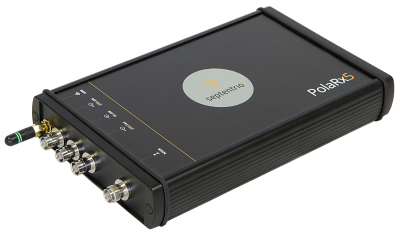
    Septentrio has started shipments to UNAVCO of its all new multi-frequency PolaRx5 reference receiver. This follows the 2015 announcement by UNAVCO that Septentrio was selected at the Geodesy Advancing Geosciences EarthScope (GAGE) Facility preferred vendor for next-generation GNSS reference station products.

    The Septentrio PolaRx5 GNSS receiver.
    The Septentrio PolaRx5 GNSS receiver.

    The PolaRx5 incorporates Septentrio’s most advanced multi-frequency GNSS engine, with support for all major satellite signals including GPS, GLONASS, Galileo and BeiDou, as well as the regional QZSS and IRNSS satellite systems.

    According to the UNAVCO GNSS Receiver Preferred Vendor RFP Evaluation Report, Septentrio consistently ranks highest in many areas of measurement quality and interference mitigation of the instruments tested. Moreover, the PolaRx5 offers low power consumption for its multi-constellation, multi-frequency GNSS reference receiver, operating on less than 2 Watts when receiving GPS and GLONASS satellite signals.

    “At UNAVCO, we are excited about the selection of the PolaRx5 for enhancement of the EarthScope Plate Boundary Observatory, the international standard for geodetic networks,” said M. Meghan Miller, president of UNAVCO. “We will work with Septentrio to modernize UNAVCO GPS networks, and explore the science innovation and broader applications that are possible in the rapidly evolving GNSS era.”

    UNAVCO is a non-profit university-governed consortium that facilitates geosciences research and education using geodesy. UNAVCO operates the GAGE Facility for the National Science Foundation with additional core support from NASA. The GAGE Facility includes more than 2,000 continuously operating GPS/GNSS reference stations around the world.

    UNAVCO-supported networks include EarthScope’s Plate Boundary Observatory (PBO), the Continuously Operating Caribbean GPS Observational Network (COCONet), the Trans-Boundary Land and Atmosphere Long-Term Observational and Collaboration Network (TLALOCNet) and the Polar Earth Observational Network (POLENet).

    Septentrio’s close cooperation with UNAVCO continues a tradition of partnering with leading scientific institutions and agencies that require high-performance GNSS technology in challenging environments. Septentrio partners include the European Space Agency (ESA) and the European GNSS Agency (GSA).

    “These deliveries mark a huge step in the modernization program for UNAVCO and UNAVCO partner networks around the globe,” said Neil Vancans, vice president of Septentrio Americas. “The use of new satellite technology will be the foundation for greater understanding of our planet. The entire Septentrio team is proud to be a part of this pivotal program.”