Tag: mobile mapping

  • Lidar USA integrates Z+F scanners for mobile mapping

    Lidar USA integrates Z+F scanners for mobile mapping

    The Z+F Profiler is the latest addition to Lidar USA's HiWay Mapper series. Photo: Lidar USA
    The Z+F Profiler is the latest addition to Lidar USA’s HiWay Mapper series. Photo: Lidar USA

    Lidar USA has integrated Z+F scanners for mobile mapping into its product line.

    According to the company, the Z+F Profiler is a high-speed, 360-degree scanner that provides more than 1 million points per second at up to 200 profiles per second with a range of nearly 120 meters. This product is the latest addition to the company’s HiWay Mapper series.

    The company also integrated the Z+F Imager, which can be transformed into a mobile system to maximize the use of the scanner. This allows companies to provide mobile mapping services with the highest accuracy — at a reduced cost — while maintaining backward compatibility for static scanning, the company said.

    Lidar USA, also known as Fagerman Technologies and based in Huntsville, Alabama, specializes in laser scanning, photogrammetry, instrumentation and geomatics.

    Z+F USA, Inc. is the United States subsidiary of Z+F GmbH Germany. It manufactures high quality control equipment, wire ferrules and laser scanners.

  • NCTech to unveil iSTAR Pulsar developments at Intergeo 2018

    NCTech, a developer of reality imaging systems, will showcase its iSTAR Pulsar mobile 360-degree data capture system at Intergeo in Frankfurt, Germany.

    Companies at Intergeo, including GeoSLAM and Orbit Geospatial Technologies, will also unveil innovative developments that incorporate iSTAR Pulsar.

    iSTAR Pulsar is NCTech’s professional edge-to-cloud big data system, optimized for capture on the move. iSTAR Pulsar is designed to capture 360-degree data while mounted on a vehicle, drone or on foot.

    At Intergeo, NCTech will be showing a demonstration of a future feature in its cloud-based processing software VR.WORLD that uses artificial intelligence and image recognition to analyze the images captured by iSTAR Pulsar. This means that objects like cars, trucks, traffic lights, road signs, pedestrians and cyclists can be automatically identified in images, the company said.

    Handheld 3D mobile mapping company GeoSLAM also will introduce new developments at Intergeo, including an innovation that integrates with iSTAR Pulsar.

    “We immediately saw the potential for collaboration when NCTech introduced the iSTAR Pulsar,” said Mark Reid, head of strategic business development, GeoSLAM. “And now we’re excited to show the attendees at Intergeo what we’ve been working on.”

    Orbit GT has updated its mobile mapping software to enable iSTAR Pulsar data to be integrated into its smart 3D mapping solutions.

    “We’re very pleased to announce that Orbit GT solutions now support data from NCTech’s iSTAR Pulsar,” said Peter Bonne, CEO, Orbit GT. “We’ll be showcasing the great 360-degree imagery captured by iSTAR Pulsar at our booth.”

    “We launched iSTAR Pulsar earlier this year, so it’s great to see that key industry players like GeoSLAM and Orbit GT are already leveraging its capabilities in their own developments,” said Andrew Baddeley, technical sales director, NCTech. “Combined with the exciting new AI developments from our labs, we look forward to showing everyone at Intergeo how we are helping to virtualize the world.”

  • NCTech to unveil iSTAR Pulsar developments at Intergeo

    Photo: NCTech
    Photo: NCTech

    NCTech, a developer of reality imaging systems, will showcase its iSTAR Pulsar mobile 360-degree data capture system at Intergeo in Frankfurt, Germany.

    Companies at Intergeo, including GeoSLAM and Orbit Geospatial Technologies, will also unveil innovative developments that incorporate iSTAR Pulsar.

    iSTAR Pulsar is NCTech’s professional edge-to-cloud big data system, optimized for capture on the move. iSTAR Pulsar is designed to capture 360-degree data while mounted on a vehicle, drone or on foot.

    At Intergeo, NCTech will be showing a demonstration of a future feature in its cloud-based processing software VR.WORLD that uses artificial intelligence and image recognition to analyse the images captured by iSTAR Pulsar. This means that objects like cars, trucks, traffic lights, road signs, pedestrians and cyclists can be automatically identified in images, the company said.

    Photo: NCTech
    Photo: NCTech

    Handheld 3D mobile mapping company GeoSLAM also will introduce new developments at Intergeo, including an innovation that integrates with iSTAR Pulsar.

    “We immediately saw the potential for collaboration when NCTech introduced the iSTAR Pulsar,” said Mark Reid, head of strategic business development, GeoSLAM. “And now we’re excited to show the attendees at Intergeo what we’ve been working on.”

    Orbit GT has updated its mobile mapping software to enable iSTAR Pulsar data to be integrated into its smart 3D mapping solutions.

    “We’re very pleased to announce that Orbit GT solutions now support data from NCTech’s iSTAR Pulsar,” said Peter Bonne, CEO, Orbit GT. “We’ll be showcasing the great 360-degree imagery captured by iSTAR Pulsar at our booth.”

    “We launched iSTAR Pulsar earlier this year, so it’s great to see that key industry players like GeoSLAM and Orbit GT are already leveraging its capabilities in their own developments,” said Andrew Baddeley, technical sales director, NCTech. “Combined with the exciting new AI developments from our labs, we look forward to showing everyone at Intergeo how we are helping to virtualize the world.”

  • Mobile mapping market size worth over $40B by 2024

    The mobile mapping market size is expected to be worth more than $40 billion by 2024, according to a new research report by Global Market Insights.

    The mobile mapping market is propelled by the increasing adoption of mobile devices such as smartphones and tablets across the globe. Smartphone users are extensively using mapping applications on their devices for navigation and driving assistance, the report said.

    Furthermore, they are also leveraging on the GIS and GPS applications to access geo-referenced data for searching nearby restaurants, cinema halls and other landmarks. This is encouraging the technology companies to commence mapping across the globe to acquire accurate GIS data and provide an enhanced customer experience.

    High initial investment is a major factor limiting the growth of the mobile mapping market. Currently, the market comprises a few major players with a long-standing expertise in location-based technologies. High initial investments in developing mobile mapping systems and assembling major components have restricted the entry of new players in the market.

    According to the report, the software market is anticipated to grow at a CAGR of 15 percent over the projected timespan. The growing demand for geo-referenced data acquisition and data analysis software among the organizations is driving the mobile mapping market growth. The software assists organizations in simplifying the data extraction process by combining the vital details. It retrieves geographic and spatial data captured by the positioning devices to develop maps and other graphic displays. This data is also used by enterprises to build effective decision support systems, which will drive the market demand.

    The report includes key industry insights in 250 pages with 341 market data tables and 38 figures and charts from the report, “Mobile Mapping Market Size, By Component (Hardware [Imaging Device, Laser Ranging Device & Scanning Device, Positioning Device], Software [Mapping Data Extraction, Data Processing], Service [Consulting, Integration & Maintenance, Managed Service]), By Application (Road & Railway Survey, GIS Data Collection, Vehicle Control & Guidance, Asset Management), By End-User (Agriculture, BFSI, Government & Public Sector, Real Estate, Retail, Mining, Telecommunication, Transport & Logistics), Industry Analysis Report, Regional Outlook (U.S., Canada, the United Kingdom, Germany, France, Italy, Spain, Australia & NZ, China, India, Japan, South Korea, Brazil, Mexico, Argentina, GCC, Israel, South Africa), Growth Potential, Competitive Market Share & Forecast, 2018 – 2024.”

    The mobile mapping technology is used for conducting road and rail surveys, collecting GIS data, and developing vehicle control and guidance systems and asset management systems. The road and rail survey market is expected to register a growth rate of over 17 percent during the forecast period. It is used to analyze the road and rail infrastructure and plan the engineering operations with minimum disruptions. The surveying authorities across the globe are using mobile mapping technology to create maps for the transportation department for road assessment purposes.

    The agriculture sector is estimated to grow at a CAGR of 22 percent during the forecast timeline. The integration of the GPS and GNSS devices into the farming process to acquire geospatial data is the primary factor driving the mobile mapping market share. Furthermore, the ability of the mobile mapping technology to monitor the crop yield and land variability also augments the demand for the technology among the farmers.

    The European region accounted for over 25 percent global mobile mapping market in 2017. The increasing investments by the government agencies have accelerated the adoption of mobile mapping technology in the region. For instance, in 2017, the U.K. government established the Geospatial Data Commission to frame a strategy for using the public sector location data to support the country’s growth.

    The Asia Pacific region will grow at a rapid pace over the forecast timespan. The rapid urbanization of the region and the growing number of infrastructural projects have fostered the growth of the mobile mapping market in the region. Moreover, the widespread adoption of smartphones has also driven the market size.

    Prominent players operating in the mobile mapping market are Phoenix LiDAR, Sharp Corporation, Teledyne Optech, TomTom International, Topcon Positioning Systems, MapJack, Mapquest, Navteq, NCTech, Microsoft, Mitsubishi, NovAtel, Phaseone industrial, Hexagon, EveryScape, Foursquare Labs and XIMEA.

    The major companies in the market are collaborating with other expert companies in the market to develop new product offerings and conduct strategic acquisitions to gain a competitive advantage over its competitors.

    For instance, in 2017, Garmin acquired Navionics, a provider of electronic navigational charts to the marine industry. This acquisition is aimed at combining the data from Navionics charts and Garmin’s blue charts to develop improved navigational services to its customers. Similarly, in 2017, Hexagon entered into an OEM partnership with Smart Guided Systems to develop new precision technologies for commercial applications.

    The global mobile mapping market research report includes an in-depth coverage of the industry with estimates and forecast revenue in USD respectively from 2013 to 2024, for the following segments.

    Mobile Mapping Market, By Component

    Hardware
    Imaging device
    Laser ranging and scanner device
    Positioning device
    Software
    Mapping data extraction
    Data processing
    Service
    Consulting
    Integration & maintenance
    Managed

    Mobile Mapping Market, By Application

    Road & railway survey
    GIS data collection
    Vehicle control & guidance
    Asset management

    Mobile Mapping Market, By End-User

    Agriculture
    BFSI
    Government & public sector
    Real estate & infrastructure
    Retail
    Mining
    Telecommunication

    Regions and Countries

    North America
    U.S.
    Canada
    Europe
    UK
    Germany
    France
    Spain
    Italy
    Asia Pacific
    ANZ
    China
    India
    Japan
    South Korea
    Latin America
    Brazil
    Mexico
    Argentina
    MEA
    GCC
    South Africa
    Israel
  • NavVis improves SLAM precision indoors

    NavVis, a mobile indoor mapping, visualization and navigation company, released new mapping software that significantly improves the accuracy of simultaneous localization and mapping (SLAM) technology in indoor environments, such as long corridors, the company said.

    The software update will be available for users of the NavVis M3 Trolley and will significantly improve the accuracy of the resulting maps and point clouds. NavVis’ mobile mapping system, the M3 Trolley, builds upon SLAM to increase speed and efficiency when scanning buildings.

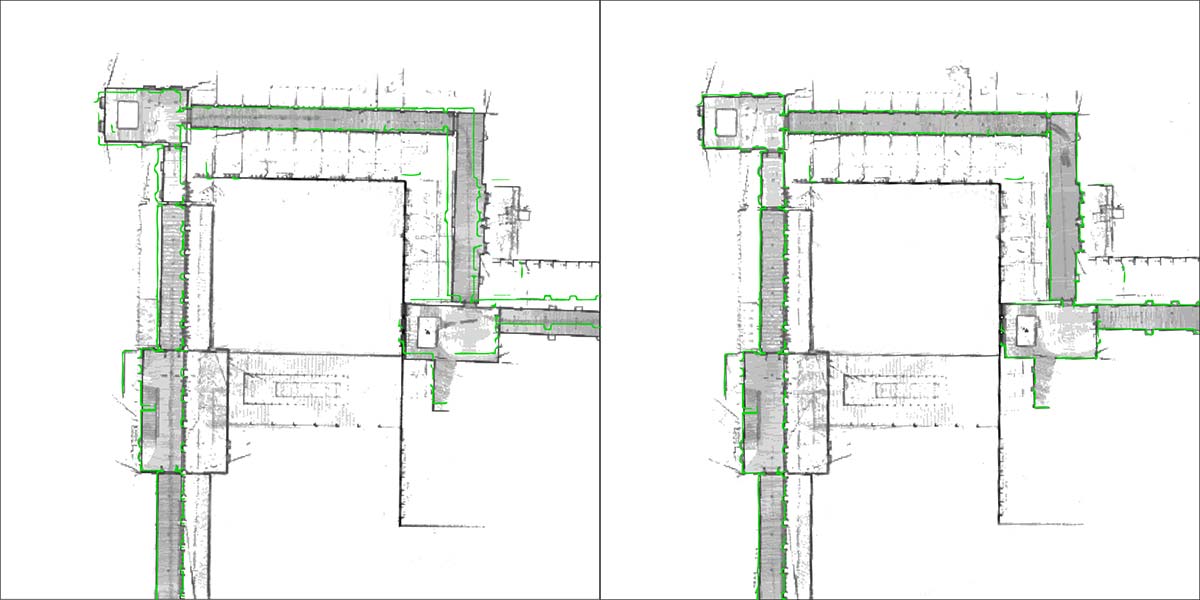
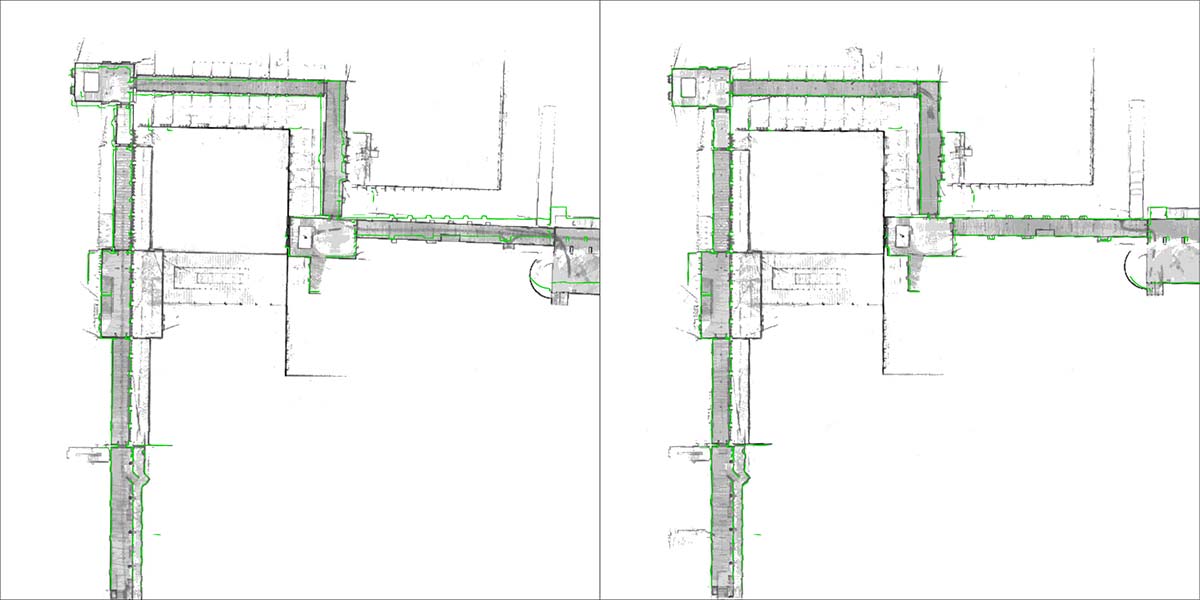
    The images below demonstrate the impact of NavVis Precision SLAM technology. The left image depicts a long corridor mapped with a conventional SLAM system where the above-mentioned drift error has occurred. The green outline shows how the map deviates from the true structure. The image on the right shows the significantly improved map accuracy obtained when mapping the same area using the M3 Trolley with the new Precision SLAM technology.

    Image: NavVis
    Image: NavVis

    Here is a closer look:

    Image: NavVis
    Image: NavVis

    SLAM is a technique originally developed by the robotics industry that is now increasingly being used in surveying and autonomous driving technologies. It solves a core problem that long plagued robotics engineers by enabling a device to determine its location while simultaneously mapping an unknown environment. This is done by chaining millions of measurements into a trajectory estimate.

    However, even when a device captures highly accurate individual measurements, chaining them will result in an accumulation of noise and tiny measurement uncertainties. Over time, the estimated motion will start to deviate from the true motion (drift error). This can often be observed as a slight bending of long corridors that are actually straight. All available SLAM systems — regardless of whether these use LIDARs or other sensors — are inherently affected by this phenomenon.

    The NavVis Precision SLAM technology significantly reduces drift error and improves the SLAM accuracy. This is particularly evident in cases where complementary techniques such as loop closures cannot be deployed, if, for example, the building’s layout does not allow for it.

    Precision SLAM even improves accuracy when SLAM anchors are used to incorporate ground control points into the mapping process.

    “I am very excited about our new Precision SLAM technology,” said Stefan Romberg, head of mapping and perception at NavVis. “We are always striving for the highest possible map and point-cloud accuracy and improving SLAM is a critical component to being successful. It is widely known among SLAM developers and users that complementary approaches such as loop closures or ground control points are needed to achieve a high accuracy.

    “However, with the Precision SLAM technology we have developed an approach that not only nicely complements the former techniques but is especially evident when these have little effect or cannot be used.”

  • Trimble MX9 mapping system designed for surveying, engineering, GIS

    Trimble has released its MX9 mobile mapping solution for large-scale scanning and mapping missions.

    The Trimble MX9 combines a vehicle-mounted mobile lidar system, multi-camera imaging and field software for efficient, precise and high-volume data capture for a broad range of mobile mapping applications such as road surveys, topographic mapping, 3D modeling and asset management.

    The Trimble MX9 captures dense point-cloud data along with 360-degree immersive georeferenced imagery using a spherical camera, GNSS/INS technology and dual-head laser scanning sensors.

    Trimbe-MX9-mobilemapper-O

    The system’s innovative and lightweight design facilitates easy installation and setup on a variety of vehicles. Spatial data can be captured at highway speeds from inside the vehicle for safe operation in transportation corridors.

    The intuitive, browser-based field software, accessible via most tablets or any notebook, enables operators to quickly establish and conduct data-acquisition missions, monitor the status of the system, and assess the quality of the acquired data in real time.

    “The Trimble MX9 is our next-generation mobile mapping system, focused on simple operation and integrated workflows for a new generation of users and applications,” said Ron Bisio, vice president of Trimble Geospatial. “We believe there’s a tremendous potential for a system that offers high-quality performance, simple installation and easy operation.

    “Being able to capture high-fidelity and survey-grade data for a whole project site, a complete city or even a statewide road-network allows our customers to use mobile mapping data for a variety of surveying, engineering and mapping applications.”

    The Trimble MX9 is designed for applications including transportation infrastructure planning, as-built surveying, GIS mapping and asset management. Survey and engineering professionals can analyze road cross-sections, perform clearance inspections, conduct topographic mapping, and also use the data for machine control.

    Mapping professionals can utilize the same data for city mapping and planning, inventory mapping and 3D modeling of buildings and linework.

    Complete integration with Trimble office software allows users to seamlessly process the acquired data and generate deliverables for a wide variety of applications. Tools are available for survey and engineering applications as well as deriving and publishing GIS and asset management deliverables.

    Users can also easily export their data for use with third-party software.

    The Trimble MX9 is available for virtual or live demonstrations, depending on customer location, beginning in April. The MX9 system includes a roof rack. Optional accessories such as a GNSS azimuth measurement system (GAMS) or a distance measurement instrument (DMI) are available.

  • SBG Systems rolls out new inertial nav series, Ekinox 2

    SBG Systems rolls out new inertial nav series, Ekinox 2

    SBG Systems has released a new generation of its advanced and compact inertial navigation systems. The Ekinox 2 series features new accelerometers and gyroscopes, enhancing attitude accuracy by a factor of two over the original Ekinox.

    SBG-Ekinox-2-IMU-W
    Photo: SBG

    The Ekinox series is a line of tactical grade MEMS-based inertial navigation systems, first released in 2013. The latest improvements come from a complete redesign of the in-house inertial measurement unit (IMU), integrating cutting-edge gyroscopes and accelerometers.

    With higher accuracy for the same form factor and price level, Ekinox 2 Series is designed for industrial-grade vehicle navigation, equipment motion compensation and data georeferencing. It provides a 0.02-degree roll and pitch, 0.05-degree heading and a centimeter-level position.

    Applications for the Ekinox 2 include hydrography, mobile mapping and antenna tracking. With new accelerometers, this new generation has also significantly improved its resistance to vibration. Finally, the addition of the BeiDou constellation improves signal availability in Asia.

    Compact and light-weight, the Ekinox Series has been designed to simplify installation operations. Configuration is made with an intuitive embedded web interface where all parameters can be displayed and adjusted. For example, users can choose a profile (vessel, plane, car, etc.), and the 3D view will provide a visualization of settings such as the sensor position, alignment and lever arms.

    The Ekinox 2 Series is ITAR Free. The product line will be available during the second quarter of 2017.

  • SBG Systems focuses on INS/GPS, robust data at Intergeo 2016

    SBG Systems Chief Technology Officer Alexis Guinamard discusses the company’s full line of inertial sensors at Intergeo 2016, which was held Oct. 11-13 in Hamburg, Germany. SBG Systems featured its mobile mapping, aerial survey and georeferencing solutions at the trade fair.

  • NovAtel announces VEXXIS family of GNSS antennas

    NovAtel announces VEXXIS family of GNSS antennas

    NovAtel has introduced its new VEXXIS series of GNSS antennas. NovAtel made the announcement at ION GNSS+, which is being held this week in Portland, Oregon.

    The VEXXIS series includes two lines of antennas, the new GNSS-800 series and the GNSS-500 series introduced earlier this year. The series offers the latest advancements in GNSS antenna technology for multi-constellation and multifrequency GNSS applications.

    The VEXXIS GNSS-800 series of antennas provide exceptional tracking performance previously unachievable in such a small form factor. Patented multi-point feeding network and radiation pattern optimization technology provides stable phase center and enhanced multipath rejection as well as exceptional low elevation satellite tracking while achieving high peak zenith gain.

    vexxis-antennas-novatel-oThe new technology enables the antenna to track the maximum number of satellites in any environment for an enhanced positioning solution. The GNSS-800 family of antennas are the toughest high precision antennas NovAtel has designed to date, ensuring their survivability in even the harshest operating environments.

    The VEXXIS GNSS-500 series of antennas were designed with a low profile, aerodynamic enclosure, useful for ground vehicles in applications such as agriculture, machine control and mobile mapping.

    Featuring the same multi-point feeding network as the GNSS-800 family, GNSS-500 antennas offer excellent multipath rejection and stable phase center. Signal reception is unaffected by the rotation of the antenna or satellite elevation, simplifying placement and installation. Vehicle mounting is easy with the antennas’ magnetic or screw mounting options.

    VEXXIS GNSS-500 antennas are available for immediate ordering. GNSS-800 antennas will be available in the fourth quarter of 2016.

  • Geodetics gives inertial navigation product overview at AUVSI’s Xponential 2016

    Geodetics had a wide range of products available at the Association of Unmanned Vehicles International‘s Xpontential show, held May 2-5 in New Orleans. Jeffrey Faman, Ph.D., discusses the company’s Geo-PNT, Geo-iNAV and Geo-iNAV1000 inertial navigation systems; the Geo-MMS lidar mobile mapping system; and the Geo-Pointer GPS-based heading system.

  • CartoDB acquires Nutiteq to bring location intelligence to mobile devices

    CartoDB is acquiring Nutiteq, a mobile mapping software development company with more than 15 million unique installations of its software development kit (SDK).

    CartoDB is a location intelligence, data analysis and visualization company. Nutiteq’s clients include SeatGeek, LonelyPlanet, iRobot and Accenture, among others.

    The acquisition will allow CartoDB to offer a cross-platform mobile mapping SDK, with a core rendering engine that complements its geo-analytics capabilities. The offline mapping and routing capabilities, along with an ability to work with a number of different sources of data, will enable enterprise customers to implement core location intelligence apps from a one-stop solution.

    “We believe there is a big opportunity to rethink how we interact with location data on mobile devices. Most geospatial innovation has been pushed to the consumer space. Now enterprises will be able to make use of location intelligence on mobile devices with CartoDB,” said Javier de la Torre, CEO of CartoDB.

    Nutiteq’s current SDK offering, including on-device analytics and vector rendering, will be augmented with CartoDB’s cloud location analytics and self-service products. This will provide a complete solution for companies building external facing apps or productivity tools on mobile.

    “We’re thrilled for the potential to unlock massive value for location intelligence in virtually every industry,” said Jaak Laineste, CEO of Nutiteq. “It’s no surprise that people are moving from laptops to smartphones, and it’s safe to say that enterprises will be quick to follow.”

    Laineste will lead the mobile division for CartoDB. The entire Nutiteq team will join CartoDB, with an office opening in Estonia, where Nutiteq is currently headquartered.

  • Remote GeoSystems and Due North Aviation integrate DVRs for helicopter utility inspections

    geoDVR configured for multi-sensor gyro-stabilized gimbal cameras.
    The geoDVR has been configured for multi-sensor gyro-stabilized gimbal cameras.

    Remote GeoSystems Inc. and Due North Aviation have successfully implemented the geoDVR Gen2 with a SWESystem 300 gimbal video camera on a Bell Helicopter for airborne utility line inspections, according to a news release from Remote GeoSystems.

    “The geoDVR is a purpose-built geospatial DVR for the airborne utility and pipeline patrol industry and it shows” said Nathan Kayes, managing member of Due North Aviation. “Being able to record all three HD and SD video channels to a single drive, along with the Live Moving Maps and Waypoint Keyword modules, offers significant advantages both in the air and for the final inspection deliverables we provide our clients.”

    The geoDVR Gen2 is an advanced mil-spec DVR for recording multiple channels of geo-referenced high-definition full motion video in airborne and mobile mapping environments. It is ideally suited for professional utility/pipeline inspection, electronic news gathering and airborne law enforcement applications that utilize multi-sensor gyro-stabilized gimbal video cameras, Remote Geo says.

    geoDVR monitor and interface with optional Live Moving Maps module installed
    The geoDVR monitor and interface with optional Live Moving Maps module were installed.

    Due North Aviation will use the geoDVR with their SWESystem 300 gimbal to perform helicopter-based electric utility inspections with HD color, infrared and corona (UV) video. Using LineVision software, Due North will combine the geoDVR videos as well as high-resolution oblique still photos to create geoProjects for their clients.

    Videos, photos, points of interest and audio notes collected with the geoDVR are compatible with Remote GeoSystems’ LineVision suite of GIS project mapping and reporting software. LineVision allows for simple desktop and browser-based playback, analysis and project reporting utilizing the Esri ArcGIS for Desktop, Server and Cloud platforms, as well as Bing Maps and PLS-CADD.