Tag: OEM

  • 2018 Inertial Buyers Guide

    2018 Inertial Buyers Guide

    VectorNav Technologies

    VectorNav designs and manufactures three different product types:

    • Inertial measurement unit / altitude heading reference System (IMU/AHRS)
    • GPS-aided inertial navigation system (GPS/INS)
    • GPS/INS with built-in GPS-compass (dual GNSS/INS).

    Each product type is offered in two performance categories, Industrial and Tactical Grade, which is an indication of the quality of the IMU core.

    Product Models

    VectorNav product models

    Key Product Features

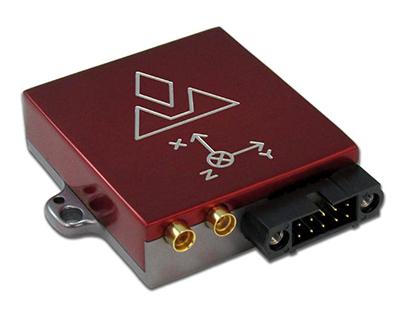
    The VectorNav VN-300

    Industrial Series:

    • High-performance in SWaP-C optimized packaging
    • 5˚/hr typical in-run gyro bias stability
    • 0.3˚ RMS heading, 0.1˚ pitch & roll
    • Miniaturized surface mount (OEM) and rugged packaging
    • Serial TTL, SPI and USB communication interfaces
    • < 30 grams

    Tactical Series:

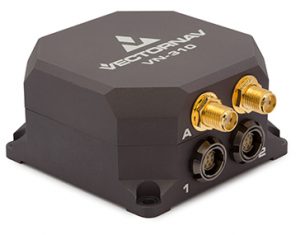
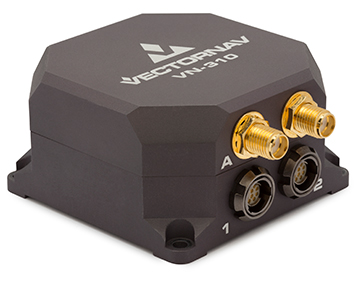
    • The VectorNav VN-310.

      Tactical-grade performance in ruggedized enclosures

    • < 1˚/hr in-run gyro bias stability
    • < 2 mrad attitude performance
    • IP68-rated enclosure designed to meet DO-160G
    • Support for external GPS/GNSS or IMUs
    • < 200 grams

    All VectorNav products:

    • incorporate VectorNav’s robust inertial navigation algorithms
    • are individually calibrated across full temperature range (–40 C to +85 C)
    • share a common communication protocol across all products
    • offer sync-in and sync-out functionality and GPS PPS
    • ship worldwide on short lead times (1–2 business days)
    • are supported directly by VectorNav’s team of applications engineers, business and production teams, and domestic and international representatives
    • are produced at VectorNav’s AS9100 certified facility
    • are made in the U.S. and ITAR-free.

    www.vectornav.com
    [email protected]
    10501 Markison Road
    Dallas, TX 75218 USA


    NovAtel

    PwrPak7D-E1
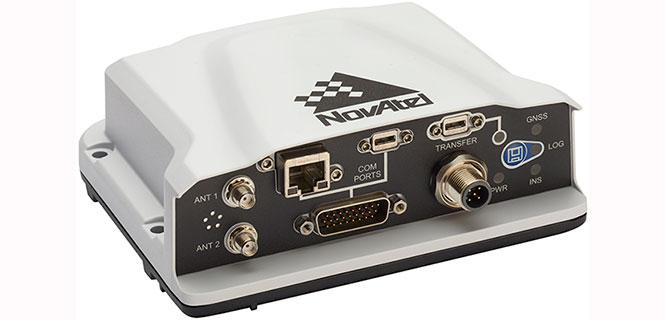
    The PwrPak7D-E1.

    The PwrPak7D-E1 is a robust, high-precision receiver that has multi-frequency, dual-antenna inputs and provides GNSS multi-constellation heading and position data. These capabilities make the PwrPak7D-E1 suitable for ground vehicle, marine or aircraft-based systems. NovAtel’s Synchronous Position, Attitude and Navigation (SPAN) technology brings together GNSS positioning and inertial navigation to provide an exceptional 3D navigation solution that is stable and continuously available. The PwrPak7D-E1 has a powerful OEM7 GNSS engine, integrated Epson G320N micro electromechanical (MEMS) inertial measurement unit (IMU), built-in Wi-Fi and 16 GB of internal storage.

    Key Product Features

    • SPAN-enabled enclosure featuring NovAtel’s tightly coupled GNSS+INS engine
    • Enhanced connection options including serial, USB, CAN and Ethernet
    • 555-channel, all-constellation, multi-frequency positioning solution
    • Multi-channel L-band supports TerraStar correction services
    • Onboard NTRIP client and server support
    • Multiple communication interfaces for easy integration and installation
    • Built-in Wi-Fi support
    • 16 GB of internal storage
    • ALIGN heading solution

    Signal Tracking

    Primary RF

    • GPS (L1 C/A, L1C, L2C, L2P, L5)
    • GLONASS (L1 C/A, L2 C/A, L2P, L3, L5)
    • BeiDou (B1, B2)
    • Galileo (E1, E5 AltBOC, E5a, E5b)
    • NavIC/IRNSS (L5)
    • SBAS (L1, L5)
    • QZSS (L1 C/A, L1C, L2C, L5)
    • L-Band (up to 5 channels)

    Secondary RF

    • GPS (L1 C/A, L1C, L2C, L2P, L5)
    • GLONASS (L1 C/A, L2 C/A, L2P, L3, L5
    • BeiDou (B1, B2)
    • Galileo (E1, E5 AltBOC, E5a, E5b)
    • NavIC/IRNSS (L5)
    • QZSS (L1 C/A, L1C, L2C, L5)
    www.novatel.com
    [email protected]

  • PNT Roundup: Uber turns on shadow matching

    PNT Roundup: Uber turns on shadow matching

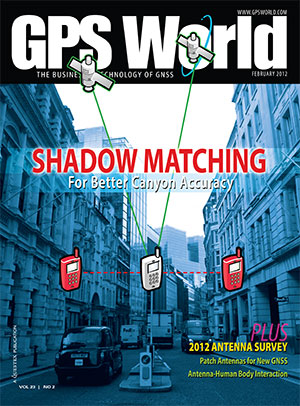
    The technological underpinning for stock markets’ techno-darlings doesn’t always work perfectly. That problem produces lost revenue and lost value. So Uber, for one, has done something about it, partly based on research developed by Paul Groves at University College London and featured in the February 2012 cover story of GPS World.

    Smartphones finding each other in the urban landscape constitute Uber’s business basis. When driver and rider can’t find each other, because they’re on opposite sides of the street or even opposite sides of the block, a ride can’t happen. In the GPS world, we call this multipath, reflected signals, shadowing or simply urban canyon. In Uber parlance it is “wasted supply.”

    To eradicate it, Uber acquired Shadow Maps in 2016 and has integrated the company’s technology into the Uber app. Beta testing now goes on in 15 cities; early results indicate that positioning accuracy has improved twofold.

    The Shadow Maps process, derived from Groves’ shadow-matching concept, directs the Uber algorithm to examine a 3D rendering of the cityscape and perform a probabilistic estimate of user location based on — simultaneously — which satellites are in direct line-of-sight and which aren’t, in conjunction with predicted satellite location, or almanac.

    The process uses ray tracing, color-coding satellite signals by strength to predict likely locations. Each probability calculation takes 20–100 milliseconds, and can run every four seconds for riders and more frequently for drivers, according to Uber engineers and former Shadow Maps principals Andrew Irish and Danny Iland.

    “You just want to have a better, tighter estimate to account for how much faster cars move,” Irish said.

    Prior Work. Paul Groves has researched this area for nearly a decade at the Space Geodesy and Navigation Laboratory, University College London, where he is an associate professor. Lei Wang won ION’s Parkinson Award for his Ph.D. thesis on shadow matching and now works at Apple. Marek Ziebart is a professor and vice-dean, research, UCL.

    “There are many different approaches to 3D-mapping-aided GNSS and several different research groups around the world working on them,” said Groves. “At UCL, we have been integrating shadow matching with 3D-mapping-aided GNSS ranging algorithms. We now have a real-time demo system running on an Android smartphone, albeit limited to Central London. By making full use of the new Android ‘raw measurements’ capability, we get around a factor of 5 accuracy improvement over conventional single-epoch GNSS in dense urban areas.”

    “It’s great to see people actually making use of our research rather than it just languishing in research papers. The more widely that shadow matching and other 3D-mapping-aided GNSS techniques are used, the better.”
    In February 2012, Groves and his co-authors presciently wrote:

    “A practical shadow-matching algorithm must be implementable in real time on a mobile device. Three models may be considered.

    • A network-based solution, whereby GNSS measurements are transmitted to a server, which stores the building boundary data, computes a solution and then sends it to the user.
    • A handset-based solution, where the shadow-matching algorithm is run on the handset, which also stores the building boundary data.
    • A hybrid model, whereby the shadow-matching algorithm runs on the handset, but the building boundary data is streamed from a server as and when required.

    “Using stored or streamed building boundaries, fewer than 50 comparison and addition operations are required to calculate an overall shadow-matching score for one candidate position with two GNSS constellations. Therefore, shadow matching may be performed in real time on a mobile device with several hundred candidate positions, where necessary.”

    The magazine article was based on a presentation at the European Navigation Conference 2011 in London. The authors will present their latest research, reflecting significant progress over the last seven years, at ION GNSS+ 2018 in Miami, Sept. 24-28.

  • Harxon exhibits positioning, data-transmission tech at AUVSI Xponential

    Harxon exhibits positioning, data-transmission tech at AUVSI Xponential

    Harxon showcased high-precision positioning GNSS antennas and its latest wireless data-transmission technologies for UAV applications at AUVSI Xponential, which was held April 30-May 4 in Denver.

    The Harxon D-Helix Antenna.

    Harxon’s D-Helix is a patented D-QHA (dual-quadrifilar helix antenna) multi-constellation antenna supports excellent reception of GPS, Galileo, BeiDou and GLONASS, as well as L-band signals. Harxon D-QHA technology ensures the ability of low elevation satellites tracking while maintaining 4-dBi high gain, which makes the D-Helix antenna an excellent choice for any applications where the sky is partially visible, the company said.

    The antenna’s low noise amplifier (LNA) with out-of-band rejection performance can suppress electromagnetic interference. Moreover, the D-Helix features the latest low wind resistance design with ruggedized IP67 protection for UAV inspection and monitoring, survey and mapping or agricultural UAVs.

    Photo: Harxon
    Photo: Harxon

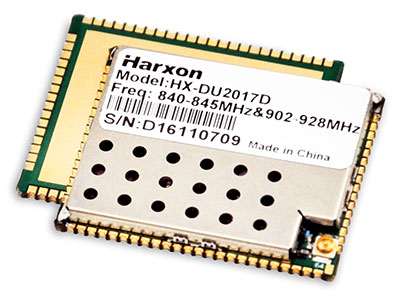
    The HX-DU2017D is a 5-gram frequency-hopping OEM transceiver supporting frequencies between 840 MHz and 900 MHz. It provides strong anti-jamming and signal receiving capability for complex data intensive applications. Its full duplex mode ensures data secure transmission, more stable long-range communication and short latency of data transmission.


    Watch this video to learn more about the HX-DU2017D.


    Other showcased Harxon GNSS products, such as Helix Antenna HX-CH7603A, HX-CH4601A and HX-CH6601A, are all featured with patented D-QHA technology. Moreover, the showcased Survey Antenna GPS 500, OEM Modem HX-DU1018D and Smart Antenna are also appropriate for surveying and mapping, as well as precision agriculture.

    Photo: Harxon
    Photo: Harxon
  • KVH and VectorNav collaborate to offer precision inertial navigation system

    KVH and VectorNav collaborate to offer precision inertial navigation system

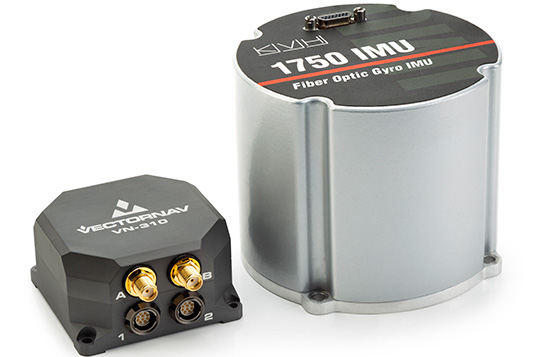
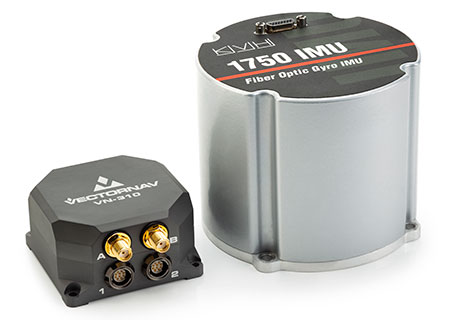
    VectorNav’s Tactical Series line of inertial navigation systems now supports KVH’s high-performance fiber optic gyro-based 1750 IMU and 1775 IMU.

    Inertial sensor companies KVH Industries Inc. and VectorNav Technologies LLC have announced that KVH’s fiber optic gyro (FOG)-based 1750 IMU and 1775 IMU will now be offered to enhance the operation of VectorNav’s VN-210 and VN-310 Tactical Series GNSS-aided inertial navigation systems.

    The products are on display in KVH’s (#2600) and VectorNav’s (#2214) booths at the AUVSI Xponential conference in Denver, Colorado, taking place April 30-May 3.

    The VectorNav Tactical Series products with KVH’s FOG-based inertial measurement units (IMUs) combine the precision and reliability of KVH’s FOG technology with the robust filters and high-performance navigation algorithms of VectorNav’s inertial navigation systems.

    The combined capabilities represent an affordable, effective alternative to larger, higher-cost inertial navigation systems and provide improved accuracy in challenging environments, the companies said.

    Photo: VectorNav/KVH
    Photo: VectorNav/KVH

    VectorNav’s Tactical Series includes an onboard micro-electromechanical systems (MEMS)-based IMU, which provides some advantages for customers who have constraints in terms of size and weight in their navigation and stabilization applications.

    However, in terms of inertial accuracy, the most demanding applications require performance that can only be delivered by FOG-based IMUs, for which KVH is a leading provider.

    The VectorNav Tactical Series products with KVH FOG-based IMUs are designed for such applications as:

    • Satcom On The Move
    • gimbal and camera pointing and stabilization
    • weapons systems targeting and stabilization
    • autonomous vehicle navigation
    • lidar mapping
    • georeferencing

    or any application where MEMS-based solutions are unable to deliver sufficient accuracy and precision.


    Watch this video from Xponential 2018 to learn more about the partnership.


    A single cable connects the two systems, running from KVH’s 1750 IMU or 1775 IMU directly to the auxiliary port on the VN-210 or VN-310. This pairing creates a fully integrated FOG-based inertial navigation system designed to provide a high-accuracy, continuous positioning, velocity, and attitude solution.

    KVH is a leading innovator for assured navigation and autonomous accuracy using high-performance sensors and integrated inertial systems. KVH’s widely fielded TACNAV systems are in use by the U.S. Army and Marine Corps as well as many allied militaries around the world.

    KVH’s FOGs and FOG-based IMUs are in use today in a wide variety of applications ranging from optical, antenna, and sensor stabilization systems to mobile mapping solutions and autonomous platforms and cars.

    “We are pleased to feature KVH technology in our Tactical Series and give our customers the option of utilizing a FOG-based IMU for higher precision performance to support a wide range of demanding applications,” said Jakub Maslikowski, director of sales and marketing for VectorNav.

    “The combination of VectorNav’s Tactical Series products with our FOG-based IMUs provides a great solution for applications that require advanced inertial navigation capability and FOG-level IMU performance,” said Jay Napoli, vice president of FOG/OEM sales for KVH.

  • Inertial Sense debuts rugged micro GNSS-INS module

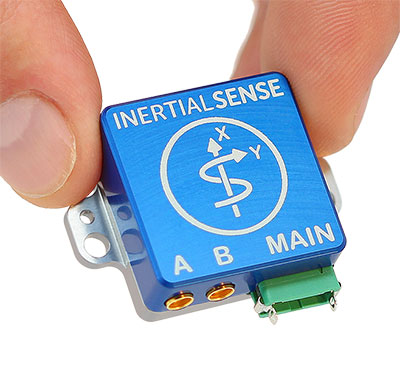
    Inertial Sense has announced the availability of a micro-sized rugged version of its combined GNSS-INS module, which has an onboard GNSS receiver as well as a fully fused inertial navigation solution.

    Designed to fill autonomous vehicle and sensing needs, the module is also available in AHRS/IMU versions.

    At 10 grams and with 1 x 1-inch footprint, the solution provides accuracy of 0.1-degree roll/pitch and 0.3-degree dynamic heading. It is also ITAR-free module.

    The modules represent 15 years of inertial navigation and motion measurement experience, according to the company.

    “When I set out on this journey to provide an accurate and low-cost navigation solution, I wanted to produce a product that engineers could purchase off the shelf, hassle free,” said company founder Walt Johnson. “In my past as a UAV engineer, I was always looking for ways to save myself time and money. It’s all about convenience. There is no need to spend time choosing IMU sensors and writing the algorithms to fuse navigation data. We provide it all for you.”

  • New Hemisphere GNSS antenna designed for UAVs

    Hemisphere GNSS has released its new multi-GNSS, multi-frequency four-helix HA32 UAV antenna.

    Hemisphere GNSS made the announcement at AUVSI Xponential, being held this week in Denver, Colorado.

    The HA32 is a high-performance antenna that supports GPS, GLONASS, Galileo, BeiDou, Hemisphere’s own Atlas L-band correction service. It was designed specifically for UAVs, GIS, surveying, real-time kinematic (RTK) and other applications requiring high-precision positioning and navigation.

    According to the company, the HA32 is built on an innovative and proprietary four-helix antenna technology that provides superior filtering and anti-jamming performance with low noise amplifier (LNA) features such as a low noise figure of 2.0 dB (typical) and up to 30 dB gain (typical).

    Suitable for most outdoor and harsh operating environments, the HA32 antenna is sealed in a durable and ruggedized IP67-rated enclosure for protection against dust and water and is equipped with an O-ring. The lightweight (40 g, typical) and compact form-factor (40 mm x 75 mm) design of the antenna makes it resistant to wind when installed on UAVs and offers easy integration with a single subminiature version A (SMA) RF connector.

    “We are very excited to be introducing this extremely competitive entry-level UAV GNSS antenna for a wide range of positioning and navigation applications such as UAVs, GIS, and RTK,” said Miles Ware, director of marketing with Hemisphere GNSS. “The features and specifications of this antenna is another example of the innovation and incredible value that Hemisphere is known for.”

    AUVSI Xponential attendees can visit the Hemisphere booth (#4228) to see the HA32 UAV GNSS antenna in person.

  • Swift Navigation presents, exhibits at Xponential 2018

    Swift Navigation is exhibiting and speaking at AUVSI Xponential 2018, being held this week in Denver.

    Swift Navigation is a ​​San ​​Francisco-based ​​technology ​​firm ​​building centimeter-accurate ​​GPS ​​technology ​​to ​​power ​​a ​​autonomous ​​vehicles.

    Xponential 2018, held at the Colorado Convention Center, is the largest and most comprehensive trade show for unmanned systems and robotics. Learn more about the convention and see GPS World’s coverage.

    On Wednesday, May 2, 3:15–3:45 p.m., Swift Navigation’s Product Manager Akshay Bandiwdekar and Sales Executive David Fischer will lead an educational session on “The Role of RTK in the Autonomous System Sensor Suite.” Join them in Room 203, where they will discuss how one sensor — a multi-band, multi-constellation RTK GNSS receiver — is a unique sensor in autonomy as the only sensor within the autonomous vehicle sensor suite to deliver absolute position, velocity and time.

    Swift Navigation’s Duro.

    At Booth 3311 in the exhibit hall, Swift Navigation is featuring its multi-band, multi-constellation real-time kinematic (RTK) GNSS receiver, the Piksi Multi GNSS Module, and its Duro Ruggedized Receiver, an easy-to-deploy GNSS sensor that is protected against weather, moisture, vibration, dust, water immersion and the unexpected that can occur in long-term outdoor deployments, such as for robotics applications.

    The company will also be featuring its newest Internet service Skylark, a cloud-based GNSS corrections service that delivers affordable, fast, centimeter-level accuracy and eliminates the complexity of deploying and maintaining GNSS networks.

    Fergus Noble

    Webinar on Location and IoT

    Those unable to attend Xponential 2018 but interested in Swift Navigation’s recent product announcements or looking to learn more about what is next for the company can join Swift’s upcoming webinar with GPS World: Location’s Role in the Internet of Things (registration is free).

    Oliver Cameron

    The webinar takes place on May 17 and features Fergus Noble, co-founder and CTO of Swift Navigation, along with Oliver Cameron, co-founder and CEO of Voyage — a company that deploys self-driving taxis in private communities across North America and uses both Skylark and Piksi Multi in its real-world autonomous driving application.

    “Xponential 2018 is the ideal venue for Swift to showcase its end-to-end ecosystem of products and cloud services, including our most recent innovation, Skylark,” said Diana Schlosser, executive vice president of marketing at Swift Navigation. “We are excited to demonstrate our low-cost, centimeter-accurate GNSS solutions to the unmanned systems industry.”

  • NovAtel introduces positioning solutions for space-constrained systems

    NovAtel introduces positioning solutions for space-constrained systems

    NovAtel has introduced several new precision positioning solutions for space-constrained applications. With enhanced positioning accuracy in a compact form, the PwrPak7D, PwrPak7DE1 and OEM7600 are suitable for automotive, airborne and other smaller unmanned systems.

    PwrPak7D and PwrPak7D-E1 are dual-antenna, multi-frequency enclosures, and the OEM7600 receiver board, plus NovAtel’s new Waypoint Inertial Explorer Express post-processing software are being showcased this week at AUVSI Xponential 2018.

    Dual-Antenna, Multi-Frequency Enclosures

    The new PwrPak7D enclosure. (Photo: NovAtel)
    The new PwrPak7D enclosure. (Photo: NovAtel)

    NovAtel’s new PwrPak7D and PwrPak7D-E1 enclosures provide space efficiency without sacrificing position accuracy and heading stability, even in stationary, slow-moving or hovering dynamics.

    The PwrPak7D-E1 enclosure integrates an inertial measurement unit (IMU) with NovAtel’s OEM7720 dual-antenna receiver board to deliver GNSS and inertial navigation system (INS) capabilities.

    When combined with NovAtel’s SPAN technology, positioning and attitude performance is optimized during extended GNSS outages.

    Both the PwrPak7D and PwrPak7D-E1 include NovAtel’s Interference Toolkit with advanced interference detection
    and mitigation features applicable to all stages of integration. A web user interface, accessible through Ethernet or
    Wi-Fi, allows for quick and easy system configuration and control.

    OEM7600 Receiver Board for Smaller Autonomous Systems

    The OEM7600 receiver board. (Photo: NovAtel)
    The OEM7600 receiver board. (Photo: NovAtel)

    The OEM7600 receiver board features NovAtel’s high-performance positioning solutions in an extremely small form factor, wrapped with protective shielding to isolate emissions from surrounding electronics in confined spaces.

    This new receiver integrates easily with NovAtel’s SPAN technology to optimize performance during extended GNSS outages.

    The new OEM7600 will be commercially available this summer.

    New Post-Processing Software for UAVs and Small Project Areas

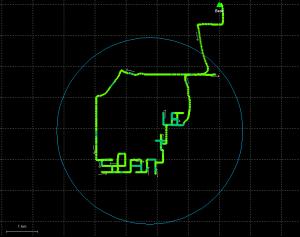
    Inertial Explorer Xpress centroid circle. (Image: NovAtel)
    Inertial Explorer Xpress centroid circle. (Image: NovAtel)

    Also at Xponential 2018, NovAtel is introducing Inertial Explorer Xpress (IEX), a cost-effective, post-processing software for GNSS+INS datasets.

    Inertial Explorer Express provides the same core processing and utilities as the
    Waypoint Inertial Explorer software for applications including unmanned aerial vehicles (UAVs) and smaller projects.

    Inertial Explorer Express will produce centimeter-level position and attitude solutions compatible for lidar, camera and other sensor data with faster processing times and reduced complexity

    “We are very excited to be introducing our new OEM7-based and Inertial Explorer solutions at Xponential 2018,” said Neil Gerein, director of product management at NovAtel. “These systems provide robust positioning and accuracy in a compact footprint for UAVs and smaller autonomous projects. An advanced range of software options, including NovAtel’s tightly coupled GNSS+Inertial SPAN technology and Interference Toolkit, provide assured positioning anywhere.”

  • Talen-X developing Modernized Navstar Security Algorithm

    Talen-X developing Modernized Navstar Security Algorithm

    Image: Talen-X
    Image: Talen-X

    For several months, Talen-X engineers have been working with the proper channels to develop MNSA (Modernized Navstar Security Algorithm). Talen-X is designing the implementation of MNSA for its flagship products: BroadSim and BroadSim Anechoic.

    BroadSim is a software-defined GNSS simulator made to accomodate engineers who test systems requiring encrypted signals, jamming and spoofing. According to the company, BroadSim Anechoic leverages the same software-defined capabilities, scaled to enable powerful anechoic chamber simulations.

    Encrypted signal simulation is being used to support many military testing applications, both in the lab and in the field. BroadSim can simulate many signals including the legacy GPS Y-Code and the modernized GPS Advanced Encryption Standard (AES) M-Code, the company said.

    Other companies use costly and outdated field programmable gate arrays (FPGAs) to upgrade their systems. With Talen-X, users can opt for a simple license upgrade to enable the new GNSS signals to include GPS AES M-Code and eventually MNSA on their BroadSim device.

    With the addition of MNSA, engineers testing capabilities will reach the closest they’ve ever been to simulating real-world scenarios, ensuring complete confidence in the accuracy and resiliency of the test unit.

  • u-blox high-precision GNSS module based on its F9 technology

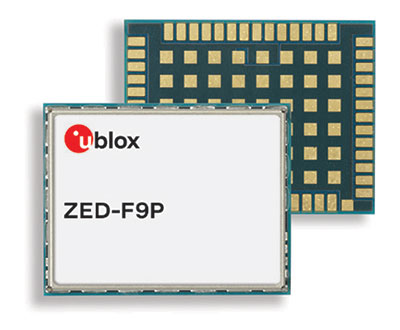
    u-blox, a global provider of leading positioning and wireless communication technologies, has released the ZED-F9P multi-band GNSS module with integrated multi-band real-time kinematics (RTK) technology for machine control, ground robotic vehicles and high-precision unmanned aerial vehicles (UAV) applications.

    The ZED‑F9P measures 22 x 17 x 2.4 millimeters and uses technology from the recently announced u‑blox F9 platform to deliver robust high-precision positioning performance in seconds.

    The u-blox ZED-F9P is a mass market multi-band receiver that concurrently uses GNSS signals from all four GNSS constellations (GPS, GLONASS, Galileo and BeiDou). Combining GNSS signals from multiple frequency bands (L1/L2/L5) and RTK technology lets the ZED‑F9P achieve centimeter-level accuracy in seconds, the company said.

    Receiving more satellite signals at any given time maximizes the availability of centimeter-level accuracy even in challenging environments such as in cities.

    With its high update rate, the ZED‑F9P is suitable for highly dynamic applications such as UAVs. Featuring on-chip integration of advanced multi-band RTK algorithms, it requires no additional hardware or third-party RTK libraries. Ready to use on delivery and easy to integrate, it helps product developers quickly bring their ideas to the market.

    ZED-F9P is fully geared to clearing the three main hurdles that have kept centimeter-level positioning accuracy from breaking into mass-market applications: cost, size and power consumption. Significantly smaller and more energy efficient than existing solutions, and as a cost efficient alternative, the ZED-F9P will enable new high-precision positioning applications for the mass market.

    “The new ZED-F9P GNSS receiver builds on the success of our NEO-M8P high-precision GNSS module, but takes performance to another level by leveraging all the available GNSS signals,” said Mårten Ström, senior principal product management, product center positioning at u‑blox. “By making robust and affordable high-precision positioning technology more accessible, we hope to fuel innovation and enable a new generation of high-precision GNSS navigation applications.”

    Engineering samples will be available at the end of July.

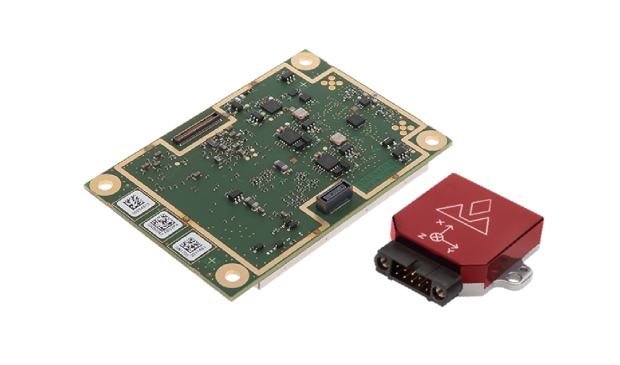
  • Septentrio AsteRx-i provides IMU-enhanced GNSS positioning

    Septentrio AsteRx-i provides IMU-enhanced GNSS positioning

    GNSS receiver manufacturer Septentrio has launched the next-generation AsteRx-i at the IEEE/ION Position Location and Navigation Symposium in Monterey, California.

    The AsteRx-i combines Septentrio’s latest compact, multi-frequency multi-constellation GNSS engine with an external industrial-grade MEMS-based inertial measurement unit (IMU). It can deliver accurate and reliable GNSS/IMU integrated positioning to the centimeter level as well as full 3D attitude at high update rates and low latency.

    Key benefits for users:

    • IMU-enhanced GNSS positioning with full attitude: heading pitch and roll
    • Quad-constellation, multi-frequency, all-in-view real-time kinematic (RTK) receiver
    • AIM+ interference monitoring and mitigation system
    • High-update rate, low-latency positioning and attitude

    Designed around demanding requirements for size, weight and power consumption, the AsteRx-i is suitable for optical inspection and photogrammetry.

    Accompanied by a UAS-tailored carrier board, the AsteRx-i integrates seamlessly into light UAVs. The versatility of design and range of connection interfaces extend the AsteRx-i applicability to automation and robotics and as well as logistics.

    The AsteRx-i includes Septentrio’s GNSS+ suite of positioning algorithms to convert difficult environments into good positioning: LOCK+ technology to maintain tracking during heavy vibration, APME+ to combat multipath and IONO+ technology to ensure continued position accuracy during periods of elevated ionospheric activity.

    It also features AIM+ interference mitigation and monitoring system which can suppress the widest variety of interferers, from simple continuous narrowband signals to the most complex wideband and pulsed jammers.

    “Complementing our GNSS portfolio with an INS offering is a natural evolution of our product range. At Septentrio, we design our GNSS solutions with a focus on reliability and availability. Smart integration of inertial sensors builds on these strengths to make affordable high-precision positioning and orientation solutions possible for ever more demanding applications,” said Francesca Clemente, product manager at Septentrio.

  • Hemisphere GNSS enables OEM-branded machine control systems

    Hemisphere GNSS has made significant achievements with its GradeMetrix OEM toolkit for high-precision GNSS-based machine control and guidance applications and systems.

    Hemisphere has expanded its portfolio of hardware offerings, including the A222 Scalable GNSS Smart Antenna introduced in November 2017, and made significant strides forward with its next-generation GradeMetrix OEM application software platform.

    Whether it is grading, mining, excavating, drilling and piling, or compaction applications, heavy equipment manufacturers can rebrand the solution and drive feature requirements to sell as their own.

    Hemisphere made the announcement at Intermat Paris 2018, where the company is exhibiting at stand 6 J 027.

    The GradeMetrix toolkit allows OEMs to select components, a-la-carte or as complete solutions, based on their accuracy and durability requirements and integrate into their machines to design their own IP. This allows manufacturers to maintain a competitive advantage in the marketplace, as they do not have to compete with conventional or traditional machine control and guidance dealers selling aftermarket systems, the company said.

    Hemisphere owns the design of the toolkit and its components and ensures each component is reliable with guaranteed compliance through design. The fully customizable and flexible toolkit provides the ability to tailor displays and outputs, per OEM requirements, and also offers OPA (open architecture) for implementing inputs and third-party sensors already available on machines.

    Through UniStrong, Hemisphere’s parent company, the GradeMetrix toolkit also has seamless access to complimentary and innovative technologies. This allows for much faster times to market, driving increased revenue streams for OEMs, and provides a high cost/value ratio.

    “The feedback we are receiving from OEMs already using our GradeMetrix toolkit is outstanding,” said Randy Noland, vice president of Global Sales & Business Development with Hemisphere GNSS. “For the first time in our industry, we are offering OEMs the opportunity to build their own machine control and guidance systems using their specifications and offering it to their customers, with their brand, 100% of the time.”

    Manufacturers are looking for flexibility and price performance in existing system offerings or in new systems. Hemisphere continues to provide anfull system OEM positioning solution toolkit for building powerful, complete or a-la-carte machine control and guidance systems including GradeMetrix OEM application software and an array of compatible GNSS hardware components.

    These include IronOne Rugged Display & Computer, A222 Scalable GNSS Smart Antenna, A326 Rugged GNSS Smart Antenna, Vector VR500 Rugged All-In-One Smart Antenna, Vector VR1000 Rugged GNSS Receiver, and C321+ RTK Base & Rover with SiteMetrix Site Management Software.