Tag: photogrammetry

  • Icaros to Unveil Oblique Image Viewer, Measuring Tool for ArcGIS at Esri UC

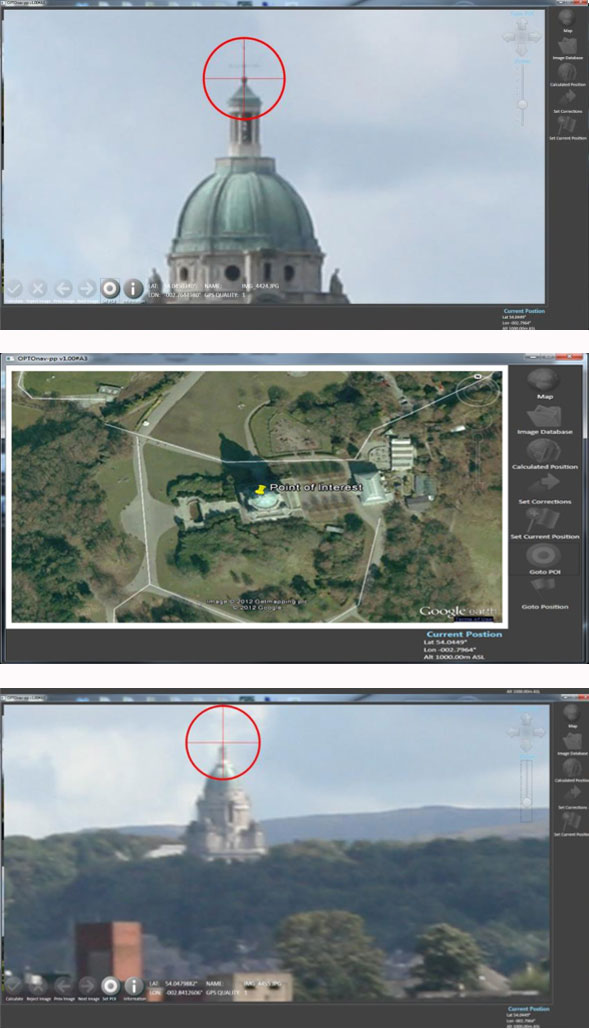
    Icaros Inc., a provider of advanced aerial remote sensing and 3D visualization solutions, will introduce its Icaros Measurement Tool (IMT), a simple but powerful photogrammetric visualization application based on ArcGIS technologies, at the 2014 Esri User Conference. The 2014 Esri User Conference will be held July 14-18 in the San Diego, California, Convention Center.

    The IMT enables customers working within Esri’s GIS environment to view and measure structures in oblique aerial imagery captured by any commercial oblique sensor system, including those from Pictometry, Vexcel/Microsoft, IGI, Leica, Midas, as well as oblique sensors mounted on unmanned aerial vehicles (UAV).

    “Icaros is opening the oblique imagery market to all GIS users by building our IMT’s coming functionality upon Esri’s Arc Engine,” said Richard Baumgartner, vice president of business development at Icaros. “IMT lets users unlock the full potential of their imagery by combining 3D analysis capabilities with their GIS data.”

    IMT is specifically designed to make highly accurate vertical and horizontal 3D measurements of structures and surfaces, including calculating distances, areas, slopes and azimuths in complex 3D features.

    For too long, Baumgartner explained, oblique imagery has been limited by proprietary collection systems and metadata formats. Usage beyond tax assessment and public safety applications is very rare. The Icaros vision is to expand the use, visualization and analysis of oblique aerial images into the entire spectrum of the GIS market with special focus on local and state government segments.

    Beyond tax assessment and public safety, oblique analysis of structures can be beneficial to a host of new applications such as facility management, pipeline corridor infrastructure monitoring, energy audits, economic development, and asset management. In addition, as Esri users continue the move to 3D, oblique imagery will be critical for constructing accurate image-based realistic 3D models.

    “Icaros has done a terrific job designing easy to use, yet highly sophisticated, measurement tools for any client wanting to do 3D oblique measurements. Not only are these tools well developed, but they are integrated completely within Esri’s ArcGIS platform, which is a critical advantage for our clients,” said Paige Parker, Vice President at Control Cam, an Icaros distributer serving the state and local markets.

    IMT enables users to manipulate and view oblique imagery while leveraging other geospatial data layers within their GIS environment. This capability allows users to navigate multi-image scenes in three dimensions while zooming and panning. The software also provides an optional Icaros Digitizer Tool (IDT).

    “IDT provides additional tools to extract physical building structures and digitize them into open format models, such as Collada, Obj, and Ply, textured from the source imagery,” said Baumgartner. “Automated 3D model generation from oblique imagery is at the intersection between imagery and GIS.”

    To view a demonstration of the Icaros Oblique Viewer, visit Icaros in booth #619 at the conference.


  • Tuck Mapping Integrates Leica RCD30 Camera with Applanix POSTrack

    Bell-LongRanger-O

    Leica Geosystems Inc. today announced that Tuck Mapping Solutions Inc. has completed the first integration of a Leica RCD30 airborne camera with the Applanix POSTrack system. With technical support from Leica Geosystems and Applanix, Tuck Mapping contracted Lead’Air Inc. of Kissimmee, Florida, to perform most of the software upgrades and new cabling required to integrate the Leica digital camera with the POSTrack all-in-one GNSS-aided inertial direct georeferencing and flight management system.

    The Leica RCD30 is a true metric camera built for mapping. Introduced by Leica Geosystems as a digital follow-on to its RC30 film cameras, the RCD30 is a medium-format digital imaging system developed for a variety of photogrammetric and remote sensing applications. The 60 MP single-camera-head design delivers co-registered, multispectral imagery in the Red, Green, Blue and Near IR portions of the spectrum. The sleek modular design allows the camera to fit easily in aircraft previously outfitted with film cameras, and the RCD30 integrates with many LiDAR sensors, including the Leica ALS series.

    For the many current owners of the POSTrack system, the availability of integration by Lead’Air makes the Leica RCD30 a more affordable and attractive choice among medium-format digital cameras. When buying a new Leica RCD30, POSTrack owners do not have to purchase the Leica flight management system, train flight crews in the use of multiple interfaces, and install redundant equipment in their aircraft.

    “The integrated systems enable our flight crews to operate the Leica RCD30 and a third-party LiDAR sensor with a single flight management interface,” said Tuck Mapping President, Bobby Tuck. “In addition, POSTrack collects the GNSS location and Inertial Measurement Unit (IMU) attitude data needed to georeference the imagery and LiDAR data sets.”

    Based in Big Stone Gap, Virginia, Tuck Mapping is a photogrammetric services and aerial mapping firm with a reputation for engineering innovative solutions related to geospatial data collection. Tuck was among the first aerial mappers to use a helicopter for LiDAR scanning operations, and more than a decade ago the firm took the lead in successfully integrating an airborne camera and LiDAR sensor for simultaneous collection. Tuck Mapping owns four POSTrack systems, three helicopters, two fixed-wing airplanes, and state-of-the-art airborne cameras and laser scanners.

    “Bobby Tuck deserves credit for driving the integration of the Leica RCD30 with the POSTrack system,” said Jean Gardiner, General Manager of Leica Geospatial Solutions. “From a business perspective, Leica believes that supporting the compatibility of our products with other manufacturers’ products is an integral part of providing solutions to our clients.”

    “This joint integration project exemplifies the maturity of Leica and Applanix,” said Joe Hutton, Applanix Director of Inertial Technology and Airborne Products. “It’s a natural progression of good customer support.”

    Jointly developed by Applanix and Track’Air, the POSTrack product integrates the Applanix POS AV direct georeferencing technology, utilizing GNSS and IMU components, with the XTRACK Flight Management System software from Track’Air into a single, compact package. POSTrack provides direct georeferencing for airborne mapping sensors, mission planning, real-time sensor control and pilot guidance.

    Lead’Air, a subsidiary of Track’Air, specializes in integrating the Track’Air flight management systems with any airborne camera or LiDAR sensor. Now that the first Leica RCD30/POSTrack integration has been completed for Tuck Mapping, Lead’Air offers this integration as a commercially available service.

  • New JAVAD TRIUMPH-LS Receiver Features 864 Channels

    New JAVAD TRIUMPH-LS Receiver Features 864 Channels

    The TRIUMPH-LS receiver, by JAVAD GNSS.
    The TRIUMPH-LS receiver, by JAVAD GNSS.

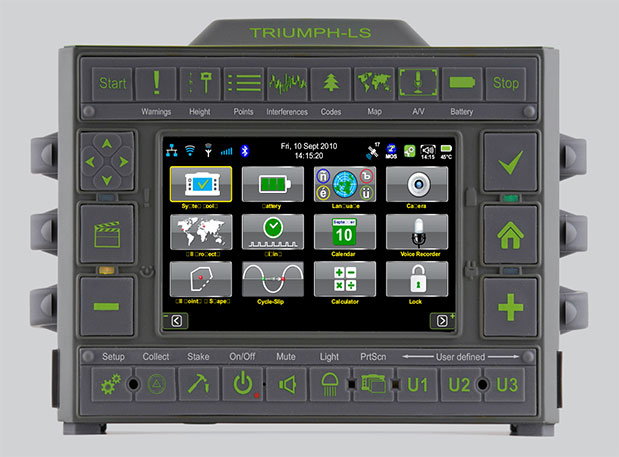
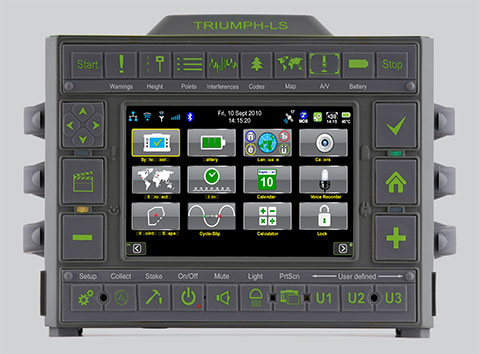
    JAVAD GNSS has launched a new version of the TRIUMPH GNSS receiver, which features 864 channels — more than any receiver it has yet offered. The TRIUMPH-LS land survey receiver offers, in addition to the 864 GNSS channels, three powerful processors, 256 I/O, 24 digital filters, 24 anti-jam filters and 14-MB program memory all in a single chip, which uses less power and makes the total system less expensive, according to the company.

    The announcement was made at the ION GNSS+ Conference, being held this week in Nashville, Tennessee.

    Javad Ashjaee, CEO and founder, explained the decision to incorporate 864 channels. “Some questioned the need for the 216 channels. They now realize the need for 440 channels. We assign multiple channels to each satellite for redundancy and reliability. We use more than 100 channels to scan GNSS bands for interference — 864 channels is the key to reliable performance.”

    The TRIUMPH-LS provides visual stake-out, six parallel RTK engines, more than 3,000 coordinate conversions, advanced coordinate geometry features, and rich attribute tagging on a high-resolution 800 x 480 pixel display. When used in photogrammetry, offsets can be calculated using the internal camera for 10-centimeter accuracy, or an external camera for 5-centimenter accuracy. TRIUMPH-LS is the first JAVAD GNSS receiver to offer photogrammetry for land survey.

    Other features include versatile attribute tagging, feature coding, automatic photo and voice documentation, and an interference monitoring and reporting feature.

    The TRIUMPH-LS  has a battery life of 25 hours in RTK rover mode with full screen brightness and UHF/GSM. Two hours of charge equals two days of surveying. The internal batteries are field serviceable and can be easily replaced by the user when needed.

    The TRIUMPH-LS, including batteries and pole, is the lightest GNSS RTK receiver in its class, according to JAVAD GNSS. The total weight of the system — including radio, controller, pole and 25 hours of internal battery — is 2.5 kilograms.

    Built on a tough magnesium alloy chassis, all connectors, SIM cards, and micro-SD cards are protected against harsh environmental conditions. The pole can be collapsed and the unit can easily fit in a car seat — there are no long poles and no separate controller or brackets to disassemble.

    The TRIUMPH-LS automatically updates all firmware when connected to the Internet via Wi-Fi. The built-in GNSS full tracking antenna has a large ground place and excellent centering and rotational performance.

    To learn more about the TRIUMPH-LS, stop by the JAVAD GNSS booth (Booth D) in the ION GNSS+ Exhibit Hall now through Friday.Presentation will be given Thursday at the conference room of the exhibition hall at 2:00 pm.


  • Trimble Launches Unmanned Aircraft System for Photogrammetric Aerial Mapping

    Trimble Launches Unmanned Aircraft System for Photogrammetric Aerial Mapping

    The Trimble UX5. Photo: Trimble
    The Trimble UX5. Photo: Trimble

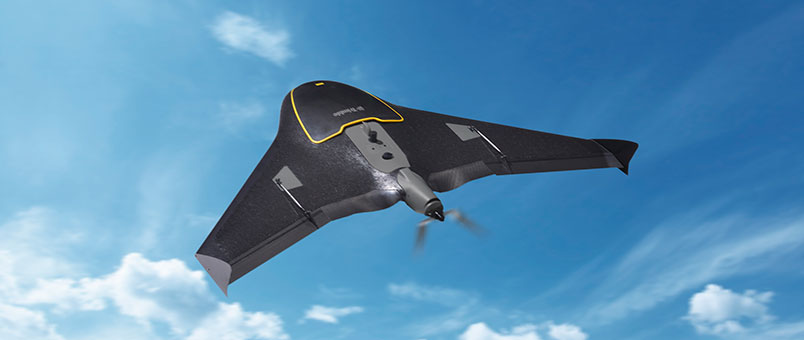
    Trimble has introduced its next-generation Unmanned Aircraft System (UAS) — the Trimble UX5 aerial imaging rover with the Trimble Access aerial imaging application. The new solution builds upon the strengths of its predecessor, the Trimble Gatewing X100, to offer enhanced image quality and intuitive workflows. Combined with the Trimble Business Center photogrammetry office software module, the Trimble UX5 is the a complete UAS photogrammetric mapping solution specifically designed for surveyors and geospatial professionals.

    Trimble’s UAS for photogrammetric aerial mapping allows surveyors and geospatial professionals to collect data with an unmanned aircraft for large projects. A wide variety of traditional surveying applications such as topographic surveying, site and route planning, progress monitoring, volume calculations, disaster analysis and as-builts in industries such as surveying, oil and gas, mining, environmental services, and agriculture can now benefit from aerial imaging by allowing professionals to safely collect large amounts of accurate data in a short time.

    “With the recent introduction of the Trimble Business Center photogrammetry module and now the Trimble UX5 and Trimble Access aerial imaging application, Trimble continues to pioneer the development of UAS photogrammetry data collection and integration for geospatial professionals,” said Erik Arvesen, vice president of Trimble’s Survey Division. “The complete solution represents a significant leap in efficiency, transforming traditional workflows with faster data collection, easier processing and enhanced deliverables.”

    The new Trimble Access aerial imaging application is field software for planning UAS missions, performing flight checks and monitoring flights — all with intuitive workflows. The imaging application is used to define the project area, avoidance zones, and flight parameters as well as take-off and landing locations. In the field, it is used to perform pre- and post-flight checks and download the flight data and images after landing. The new wizard-like digital checklists give the operator a complete “to-do list” so critical steps are not bypassed or missed in the field that can enhance reliable and safe flights. The software also includes fixed post-flight procedures to ensure that operators do not leave the field with a dataset that is incomplete or inconsistent.

    The Trimble UX5 can provide a safer method to collect data compared to traditional surveying methods, Trimble said. Flights are fully automated, from launch to landing, and require no piloting skills. The operator facilitates the aircraft’s operation and built-in safety procedures can ensure safe and successful launches. Data collection can be performed remotely without exposing individuals to hazardous terrain, environmental contaminants or heavy equipment and machinery.

    The Trimble UX5 unmanned system in use at a construction site. Photo: Trimble
    The Trimble UX5 unmanned system in use at a construction site. Photo: Trimble

    The Trimble UX5 aerial imaging rover has been designed to follow the latest developments in the “prosumer” camera market, providing optimal image quality along with maximum photogrammetric accuracy.

    Incorporating a mirrorless 16-megapixel camera with a fixed focal-length external lens, the Trimble UX5 provides high-resolution imagery and accurate deliverables. The large field of view from the camera allows the UX5 to cover 50-75 percent more area to enhance efficiency and reduce operational costs. In addition to the increase in flight efficiency, the Trimble UX5 is capable of producing 3D surface deliverables with a ground sampling distance of approximately 2.4 centimeters (approximately 1.0 inch).

    Designed to operate in real-world conditions, the Trimble UX5 is capable of flights between 75 and 750 meters (approximately 246 and 2,460 feet) above ground level and can be flown in light rain and windy conditions, up to 65 kph (approximately 40 mph).

    The Trimble UX5 airframe is comprised of a carbon frame inside expanded polypropylene. Impact-resistant plastics and composite fibers are used for the aircraft components, including winglets and belly plate. This design and choice of materials results in a rigid aircraft with strong torsional stability and the ability to withstand rough landings.

    Performance enhancements also include the ability to execute steep landing approaches and thrust reversal for accurate and repeatable landings. The landing procedure starts 300 meters (approximately 984 feet) from the landing location allowing the UX5 to be used for jobs that have site restrictions such as buildings, towers or trees.

    Orthophotos, contour maps, point clouds, digital surface models (DSMs) and feature maps can easily be created from aerial images using the Trimble Business Center photogrammetry module. Single-click processing for stitching images streamlines the office process for generating powerful deliverables, Trimble said.

    The Trimble Business Center allows surveyors and other geospatial professionals to combine aerial photography with data collected from GNSS receivers, total stations, 3D laser scanners and more. By combining imagery from the Trimble UX5 and any Trimble VISION instruments, users can visualize their project from both aerial and terrestrial perspectives, measure points within the images and create 3D models of the infrastructure and terrain.


  • Trimble Adds Photogrammetry to Business Center Software for Surveyors

    Trimble has introduced a new version of its office surveying software — Trimble Business Center Software version 3.00. Trimble Business Center Software version 3.00 is a powerful, next-generation surveying office software suite designed to manage, analyze and process all field survey data, including optical, GNSS and imaging data.

    The new version features photogrammetry enhancements, including the ability to process images from the Gatewing X100 unmanned aerial system (UAS). These enhancements provide surveyors with increased visualization and processing capabilities, allowing them to further maximize productivity and create aerial survey deliverables.

    “Powerful and intuitive, Trimble Business Center and its integration with UAS data introduces new capabilities to surveyors and represents a significant leap in efficiency. Surveyors, engineers and geospatial data managers can increase their productivity, efficiency and quality of deliverables through the software’s aerial data processing capabilities,” said Erik Arvesen, vice president of Trimble’s Survey Division. “Traditional sites, such as large mines, that in the past have taken days to map using conventional methods can now be accurately modeled in just hours.”

    Version 3.00 introduces a new photogrammetry module for importing and working with flight data and images collected from the Gatewing X100 UAS and optical instruments, such as the Trimble S8 with Trimble VISION technology, which integrates calibrated digital cameras to collect survey data, stream video from the perspective of the instrument and capture panoramic still images. Based on software from Inpho, the Trimble Business Center photogrammetry module also provides office surveyors with the capability to process complete mapping projects containing aerial data, GNSS and total station observations. Surveyors can produce deliverables, including georeferenced orthophotos, 3D point clouds and digital surface models directly from Trimble Business Center.

    With the ability to integrate photogrammetry with data collected from GNSS receivers, total stations, and digital levels, surveyors can combine aerial images with GNSS measurements on ground control points and 3D laser scans of buildings to precisely, comprehensively and efficiently map large and complex sites.

    The new version also introduces 64-bit processing. As a 64-bit application, Trimble Business Center allows surveyors in the office to utilize their computer’s RAM, maximizing the productivity of the surveyor’s workstation, to display large images and point clouds for increased visualization functionality. Users can also display large images seamlessly; images “tile” automatically on import and the displayed resolution adjusts seamlessly as users zoom in and out for superior image viewing.

    “Inpho is a proven leader in digital aerial photogrammetry,” said Arvesen. “Trimble has taken that expertise and applied it to the survey market, as we pioneer the development of UAS data integration for surveyors.”