Tag: photogrammetry

  • Topcon and Agisoft sign partnership agreement for UAS photogrammetric software

    Topcon Positioning Group announces a new partnership with digital photogrammetric solution provider Agisoft LLC. The agreement is designed to further expand the Topcon solutions portfolio for mass data collection (MDC).

    Topcon_Agisoft-WAgisoft is a world leader in the processing of digital imagery in order to generate high-accuracy 3D spatial data using photogrammetric and computer vision techniques, and has been developing imaging solutions for nearly 10 years. Topcon will provide the Agisoft Photogrammetric Kit for Topcon — Professional Edition software for post-processing of data collected using the Falcon 8 and Sirius Pro unmanned aerial systems (UAS).

    Features include photogrammetric triangulation, dense point-cloud editing and classification, digital terrain or surface model export to a variety of formats including georeferenced orthomosiac production (including GeoTIFF and KML export), multi-spectral imagery processing, 3D model generation and texturing, as well as full measurement analysis tools.

    “We are very excited to be able to offer the combination of our Sirius Pro and Falcon 8 UAS devices and Agisoft Photogrammetric Kit Professional software. The solution provides an integrated workflow for reaching high-accuracy survey results using unmanned aerial systems with minimal field work,” said Eduardo Falcon, executive vice president and general manager for the Topcon GeoPositioning Solutions Group. “For example, when using the Sirius Pro, absolute accuracies down to 1.6 cm (0.6 in.) in plan and 2.7 cm (1 in.) in height are possible without the need for any ground control.”

    The photogrammetric kit solution is now available.

  • SimActive strengthens enterprise UAV offering with version 6.3

    Photogrammetry software developer SimActive has announced Correlator3D version 6.3 with an expanded UAV enterprise offering. A new floating licensing option allows computers on the same network to seamlessly borrow licenses from a pool, increasing transferability for enterprise requirements.

    Because of the worldwide client base of Correlator3D, SimActive has also introduced multi-language support with this version. Users can now operate the software in multiple languages, along with the default English option. Examples of the increased selection include Chinese, Japanese and French.

    “With users in over 50 countries, including many with enterprise requirements, we continue adding features to meet the immense industry demand for the product,” said Louis Simard, CTO of SimActive. “With processing speed at least 10 times faster than entry-level UAV software, Correlator3D is the only affordable global enterprise solution.”

    For a live demonstration at the Capturing Reality Forum (Nov. 23-25, Salzburg, Austria), visit booth 37 or send an email to [email protected].

  • Intergraph Government Solutions Wins USDA Contract Award

    ERDAS_Photogrammetry

    Intergraph Government Solutions (IGS) has been awarded a contract by the U.S. Department of Agriculture (USDA) U.S. Forest Service to provide image processing software across the U.S. Forest Service enterprise. IGS is a wholly-owned subsidiary of Intergraph Corporation, a Hexagon company serving the U.S. federal market.

    IGS will provide capabilities for core image processing and photogrammetry through Hexagon Geospatial’s Power Portfolio, including ERDAS IMAGINE for remote sensing and IMAGINE Photogrammetry. Integration of these products into the organization allows the U.S. Forest Service to perform mission-critical image processing and analysis on nearly 200 million acres of land for objectives such as forest restoration and emergency response to wildfires.

    “The U.S. Forest Service is a long-standing customer of IGS and Hexagon software. This purchase provides the agency with the most advanced geospatial technology for monitoring and managing national forest resources,” said Joe Fehrenbach, CEO and president of IGS.

    The result of a competitive best-value procurement, the award includes a base contract period of one year and an additional four option years. As part of the selection process, the U.S. Forest Service required live demonstrations of the proposed workflow technologies with government-provided datasets and rigorous requirements related to multiple areas of need in their business mission.

  • Frozen Assets: GeoDecisions Platform Tracks Icebergs

    Frozen Assets: GeoDecisions Platform Tracks Icebergs

    Drifting tabular icebergs viewed from the Amundsen. (Photo courtesy of Greg McCullough, University of Manitoba)
    Drifting tabular icebergs viewed from the Amundsen. (Photo courtesy of Greg McCullough, University of Manitoba)

    A Canadian expedition team used GeoDecisions’ GeoILS platform to help track icebergs during a voyage to better understand how icebergs drift. An intelligent location server using the Esri ArcGIS platform, GeoILS enables users to monitor and locate assets and facilitate quick and coordinated responses.

    GeoDecisions, an information technology company specializing in geospatial solutions, partnered with Solara Remote Data Delivery Incorporated, Canada’s Carleton University and Esri during the project.

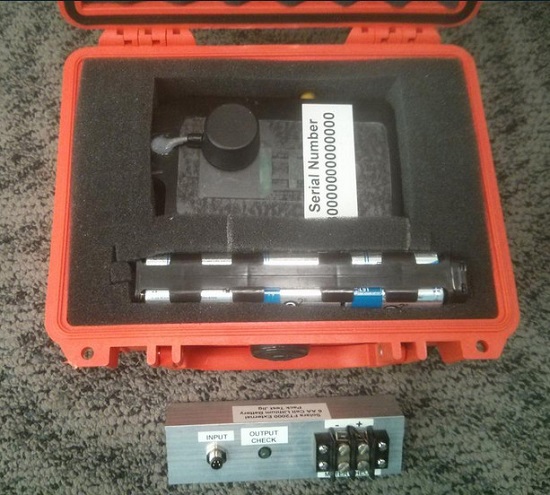
    The FT2000IB Solara tracker. (Photo by Tom Tessier)
    The FT2000IB Solara tracker. (Photo by Tom Tessier)

    Led by University of Manitoba Scientist David Barber, the crew of Canadian Coast Guard icebreaker Amundsen sailed off the coast of Newfoundland and Labrador to research ice hazard mitigation, the effects of climate change, and polar region technology requirements. GeoILS location intelligence helped crew members visualize, analyze, and leverage project-pertinent data.

    “During the expedition, researchers and scientists used GeoILS to assess drifting through sensor monitors attached to the icebergs,” said Brian Smith, vice president of commercial solutions with GeoDecisions. “In addition to reporting and notifications, GeoILS provided the project team with maps that were tailored by selecting desired iceberg information and the geographic area of interest based on user-defined criteria.”

    GeoDecisions’ data portal was used with Iridium Solara tracking devices during the iceberg research project. Two icebergs were outfitted with FT2000IB Solara trackers, explained Derek Mueller, assistant professor and physical geography program supervisor with Carleton University.

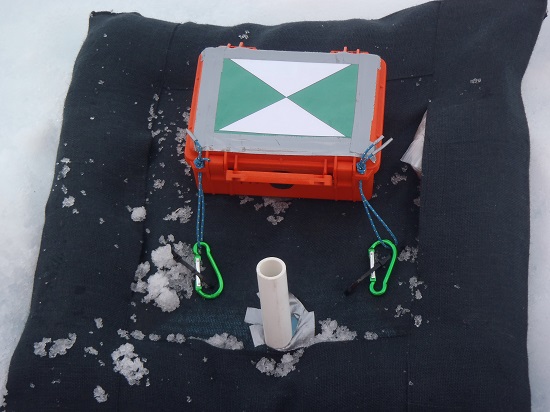
    THE GROUND control point and beacon. (Photo by Derek Mueller)
    THE GROUND control point and beacon. (Photo by Derek Mueller)

    For each iceberg, two beacons were attached for redundancy and to determine the iceberg’s rotation. Holes were drilled and stakes inserted, then GeoDecisions Platform Tracks Icebergs the trackers attached to the stakes.

    The trackers were also used as ground control points for photogrammetry, specifically the structure from motion ranging imaging technique.

    “GeoILS and the satellite tracking beacons worked very well during this project,” Mueller said. “Thanks to our partners’ efforts, we now have a great new suite of tools for examining our data.”

    “We are excited to provide tools to scientists who are gaining critical insights into the behavior of icebergs and global climate change,” said Tom Tessier, president of Solara Remote Data Delivery Incorporated.

    The last tracker stopped transmitting on June 13. “The others ended earlier, likely because the iceberg rolled or broke up,” Mueller said.

    The data will eventually be made public on the Polar Data Catalogue.

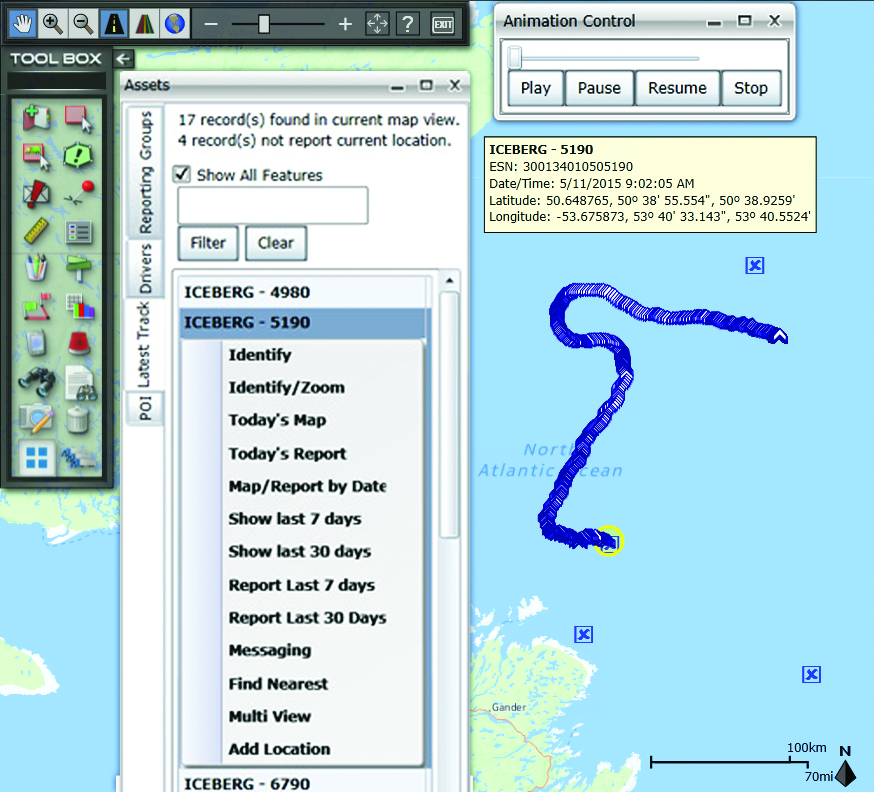
    A representative snapshot of GeoILS’ features and range of functionality used during the Canadian iceberg expedition.
    A representative snapshot of GeoILS’ features and range of functionality used during the Canadian iceberg expedition.
  • SimActive Provides Integrated Lidar and Photo Software to Altoa

    SimActive Inc., developer of photogrammetry software, has purchased the Correlator3D software by Altoa from French Guiana. The software will be used to process images and lidar data for the production of orthomosaics.

    “Following our recent acquisition of two digital cameras including the Phase One color and infrared, we needed precise, powerful, and versatile photogrammetric software,” said Walid Mostafa, manager of Altoa. “After analyzing the available tools, we decided to choose Correlator3D.”

    “We are pleased to see an important company in South America such as Altoa adopt Correlator3D,” said Philippe Simard, president of SimActive. “Their use of Correlator3D demonstrates the software’s ability to adapt to different production environments and to integrate a lidar sensor with a camera.”

    For a live demonstration at Commercial Unmanned Show Asia 2015 (June 30-July 1, Singapore), visit booth B10 or send an email to [email protected].


  • ASPRS Releases New Accuracy Standards for Digital Geospatial Data

    The American Society for Photogrammetry and Remote Sensing (ASPRS) has released new Positional Accuracy Standards for Digital Geospatial Data. The PDF is available here.

    The new ASPRS accuracy standards fill a critical need for map users and map makers alike. For centuries, map scale and contour interval have been used as an indication of map accuracy. Users want to know how accurately they can measure different things on a map, and map makers want to know how accurate maps need to be in order to satisfy user requirements. Those contracting for new maps depend on some form of map accuracy standard to evaluate the tradeoff between the accuracy required vs. how much time and expense are justified in achieving it, and then to describe the accuracy of the result in a uniform way that is reliable, defensible, and repeatable, ASPRS explains in a statement.

    The new ASPRS standards address recent innovations in digital imaging and non-imaging sensors, airborne GPS, inertial measurement units (IMU) and aerial triangulation (AT) technologies. Unlike prior standards, the new standards are independent of scale and contour interval, they address higher levels of accuracies achievable by the latest technologies (such as unmanned aerial systems and LiDAR mobile mapping systems), and they provide enough flexibility to be applicable to future technologies as they are developed. Finally, the new standards provide cross references to older standards, as well as detailed guidance for a wide range of potential applications.

    No prior U.S. accuracy standard comprehensively addresses the current state of mapping technology, which is why the new ASPRS standards were developed. The National Map Accuracy Standards (NMAS), developed in 1947, are still used because they are simple, but there is no scientific correlation between those standards and current mapping methodologies.

    The ASPRS 1990 Standards were an improvement over NMAS; however, they did not do well in representing the capabilities of LiDAR, orthoimagery, digital mapping cameras or other current technologies in wide-spread use today.

    The National Standard for Spatial Data Accuracy (NSSDA) is a reporting standard that references the old ASPRS 1990 standards and is cross-referenced in the new ASPRS standards.  NSSDA provides no accuracy thresholds and does not by itself provide any new or updated guidance on how to select or specify an appropriate accuracy for intended applications.

    The new ASPRS standards were developed by the ASPRS Map Accuracy Standards Working Group, a joint committee under the Photogrammetric Applications Division, Primary Data Acquisition Division and LiDAR Division, which was formed for the purpose of reviewing and updating ASPRS map accuracy standards to reflect current technologies. A subcommittee of this group, consisting of Qassim Abdullah, David Maune, Doug Smith, and Hans Karl Heidemann, was responsible for drafting the document.

    Draft versions of the standard underwent extensive review, both within ASPRS as well as through public review by other key geospatial mapping organizations, prior to final approval by the ASPRS Board of Directors on November 17, 2014.

  • Phase One Aerial Cameras Support IGI’s GNSS/IMU

    AEROcontrol with export-free FOG IMU.
    AEROcontrol with export-free FOG IMU.

    All Phase One Industrial aerial cameras now fully support the IGI AEROcontrol, GNSS/IMU positioning system, the companies announced. Aerial camera models include iXA-R, iXA, and iXU.

    Phase One aerial cameras are high-quality industrial-grade camera systems, which have found wide success in the photogrammetry market, both among end users and OEM integrators.

    AEROcontrol is a GNSS/IMU system for the precise determination of position and altitude of multiple airborne sensors. Beside the choice of MEMS- and FOG-based IMUs, the system is also suitable for mobile mapping applications. Used together with IGIplan and CCNS-5, a complete and comprehensive solution for mission planning, aircraft guidance with sensor management and geo-referencing is available to Phase One aerial camera users.

    “With the addition of IGI’s AEROcontrol, users of Phase One aerial cameras are able to use IGI’s popular AEROcontrol, GNSS/IMU positioning system with a single camera or as part of an array,” said Dov Kalinski, general manager of Phase One Industrial.

    “With the integration of the IGI AEROControl GNSS/IMU with the Phase One aerial cameras, all Phase One users now have access to geo-referencing with different IGI IMU models and IMU-based, precise stabilized mount control. This smart geospatial solution helps users obtain the best possible aerial photography results,” added Philipp Grimm, IGI marketing and sales manager.

  • GPS World Unveils Industry-Exclusive Online Buyers Guide

    gps_world_buyers_guideGPS World, the leading publication serving the GNSS Industry, is pleased to announce the industry’s first online buyers guide — gpsworldbuyersguide.com — featuring access to information on hundreds of manufacturers, products and services.

    “We’ve taken the GPS World Buyers Guide in print, which we’ve been publishing for 20+ years, to an entirely new level,” said Alan Cameron, editorial director and group publisher of GPS World. “Adding a robust online version offers many benefits to the industry.”

    Engineers, integrators, professional end-users and others in search of products and services will continue to have two resources available to them — the print Buyers Guide publishing in June — and the cutting-edge, robust version accessible 24/7 at: gpsworldbuyersguide.com.

    Visitors can search for manufacturers by name or location. Products and services are searchable by name or via the following categories:

    • Accessories
    • Antennas
    • Differential GPS
    • Digital compasses
    • Electronic charts/maps
    • GLONASS hardware/software
    • Integrated navigation equipment
    • Integrated instrumentation with GPS
    • Mapping
    • Photgrammetry/GPS integrated systems
    • Precise ephemeris information
    • Publications, guides, videos, training software
    • Receive components
    • Receiver-performance analysis
    • Receivers
    • Satellite signal simulators/pseudolites
    • Security code decryption devices
    • Seminars/training
    • Software
    • Surveying-related equipment
    • System design/integration
    • Timing
    • Tracking services (mobile assets, roadside assistance, E-911, etc.)
    • Vehicle location/tracing workstations and systems (computer-aided dispatch)

    These categories are also searchable by sub-categories.

    Manufacturers and suppliers are now in control of their listings year-round by having the ability to make listing updates in real time. Listings are free and numerous upgrades are available. Listings found at gpsworldbuyersguide.com will automatically be used to create the print version of the directory.

    GPS World’s new online product offers many economical ways for a manufacturer or supplier to enhance their exposure,” said Steve Copley, GPS World publisher. “We’re excited to offer an online element to our print product and provide a positive experience for users.”

    Manufacturers and suppliers are encouraged to review their current listings by using the search functionality found on the directory’s home page. Manufacturers and suppliers not listed in directory are encouraged to create a new listing. All questions relating to the online directory should be directed to Chloe Kalin, Buyers Guide Marketing & Sales Manager, at 216-363-7929.

  • Hexagon Geospatial Tech Measures Tallest Mountain in New Zealand

    Topography of Mount Cook, New Zealand's tallest peak, changed following a rock avalanche. (Photo Wikipedia Commons, C.M. Lynch)
    Topography of Mount Cook, New Zealand’s tallest peak, changed following a rock avalanche. (Photo Wikipedia Commons, C.M. Lynch)

    The National School of Surveying, University of Otago, implemented Hexagon Geospatial technologies provided by Intergraph in its quest to measure the summit of Mount Cook, the tallest mountain in New Zealand and a UNESCO World Heritage Site. The University of Otago is New Zealand’s oldest university.

    The university turned to Hexagon Geospatial’s ERDAS IMAGINE and IMAGINE Photogrammetry (formerly LPS) to help measure the height of Mount Cook, also called Aoraki, following a large rock avalanche that changed the peak’s topography and height in 1991. For many years, the university has benefited from Hexagon Geospatial’s education licenses through Intergraph, and chose these technologies for the project because of  their image processing and photogrammetric capabilities, as well as integrated workflows.

    “ERDAS IMAGINE is the cornerstone of the project. It started from there,” said Pascal Sirguey, senior lecturer at National School of Surveying and project leader. “Using the photogrammetric capability, we were led to look more closely at what the model was telling us. The software gave us the right answer in the end.”

    Following the avalanche, a resurvey found the mountain to be 3,754 meters high — down from the surveying estimate of 3,764 meters in 1881. The university undertook the unique challenge of validating the new elevation. Photogrammetry and remote sensing were the only viable methods for measuring the summit as it is considered sacred by the Maori tribe of Ngāi Tahu and standing on it is prohibited.

    Using Hexagon Geospatial’s software, along with Global Navigation Satellite System receivers, the university determined the actual height of Mount Cook is 3,724 meters. For the university’s remarkable efforts, Sirguey received the top award from the New Zealand Institute of Surveyors in 2014 for teaching and education and the New Zealand Spatial Excellence Award 2014 in the Education and Professional Development category.

    The University of Otago was founded in 1869 by an ordinance of the Otago Provincial Council. Its School of Surveying offers the only academic qualification leading to professional recognition as a professional land surveyor in New Zealand, following a period of post-graduation training and examination by the New Zealand Institute of Surveyors. The courses offer a broad range of disciplines — surveying, land planning and development, survey measurement and Geographic Information Systems — that equip graduates for a professional career.

    Provided through Intergraph, Hexagon Geospatial’s education program provides the university with a complete geospatial software portfolio that offers support and tools for academic research projects and teaching.

  • SimActive Launches Version 6.0 with Photogrammetric Workflow

    SimActiveSimActive Inc., a developer of photogrammetry software, has announced Correlator3D version 6.0, which features a new interface for streamlined image processing for any sensor type. Other new features include support of multi-camera setups and large blocks of satellite images.

    The completely redesigned interface allows powerful actions to be easily executed, SimActive said. Correlator3D 6.0 adds a project creation wizard to easily import any type of data. With a created project, processing steps, automated or not, remain the same irrespective of sensor. Moreover, all data and results can be displayed and edited simultaneously at all times by the user.

    “From the neophyte to the experienced user, the elegance of design empowers all, while further increasing functionality and possibilities,” said Louis Simard, CTO of SimActive. “Correlator3D continues to define the industry standard for UAV, large format aerial, and satellite imagery; it is the one-stop solution for all users.”

    For a live demonstration at the India Geospatial Forum 2015 (February 10-12, Hyderabad, India), email [email protected].

  • Icaros to Unveil Versatile Nadir/Oblique Aerial Mapping System at InterGeo

    Icaros, Inc., a provider of aerial remote sensing and 3D visualization solutions, will unveil the IDM 1000 digital oblique mapping system next week at the 2014 InterGeo Conference in Germany. The versatile Icaros Digital Mapper (IDM) 1000 combines a high-accuracy photogrammetric nadir camera with four high-quality oblique sensors in a modular airborne imaging package.

    “Icaros developed the IDM 1000 for mapping organizations that want to maximize their investment in an aerial sensor system,” said Tom Bosanko, CEO of Icaros. “The IDM 1000 can be configured to meet the geospatial application needs of traditional photogrammetric imaging as well as 3D oblique mapping, all in one flexible system.”

    Icaros will display the IDM 1000 in booth #A4.009 Hall 4.1 at the InterGeo Conference and Trade Fair being held in Berlin October 7-9.

    The modular IDM 1000 package is built around the IDM 200 nadir camera with a new mount supporting up to four 45-degree oblique sensors. The standard IDM 1000 configuration includes an 80-megapixel (MP) nadir natural-color (RGB) sensor, four 36-MP oblique RGB sensors, modular mount, embedded GPS/INS, flight planning and management system, and the Icaros Photogrammetric Suite (IPS) of software tools.

    “Clients have the option of purchasing the IDM 1000 as a complete solution,” said Bosanko. “Or they can buy and operate the IDM 200 as a stand-alone unit and add the oblique cameras and mount later as their mapping offerings expand to include 3D modeling and oblique visualization.”

    The IDM camera family offers eight sensor-design alternatives, including near infrared and thermal infrared imaging. Each IDM camera delivers sub-pixel accuracy, high-dynamic range and true-color pixel collection. Depending on altitude, the pixel GSD ranges from 1 cm to 100 cm in nadir or oblique operations. The IDM 1000 can be flown on rotor or fixed wing aircraft and modified for flight on some UAVs.

    Aerial oblique imagery is used extensively in tax appraisal and assessment, and its applications are expanding rapidly into facility management, infrastructure monitoring, building energy audits, public safety and other GIS markets that benefit from creation of accurate 3D models and elevation data sets. The IDM 1000 is considered ideal to serve in the energy, utility, oil & gas, mining, urban development, security and defense markets.

    “The IDM 1000 package includes all of the software needed to process nadir and oblique imagery and perform advanced photogrammetric measurements,” said Bosanko. “The new Icaros Measurement Tool (IMT) is included.”

    The IMT is a universal oblique measurement tool. It enables customers working within Esri’s GIS environment to view and measure structures in oblique aerial imagery captured by any commercial oblique sensor system, including those from Pictometry, Vexcel/Microsoft, IGI, Leica, and Midas. IMT works equally well measuring images captured by oblique sensors mounted on unmanned aerial vehicles (UAVs).

    As GIS users continue the move to 3D, oblique imagery will be critical for constructing accurate image-based realistic 3D models. IMT enables users to manipulate and view oblique imagery while leveraging other geospatial data layers within their GIS environment. This capability allows users to navigate multi-image scenes in three dimensions while zooming and panning.

    The IMT software will also be demonstrated in the Icaros booth at InterGEO.


  • Icaros to Demonstrate Measuring Tool for Oblique Imagery at InterGeo

    Icaros_Intergeo

    Icaros Inc., a provider of advanced aerial remote sensing and 3D visualization solutions, will demonstrate the Icaros Measurement Tool (IMT) at the 2014 InterGeo Conference in Germany. Designed for use with oblique aerial imagery, IMT is a simple but powerful photogrammetric visualization application based on ArcGIS technologies, the company said.

    To view a demonstration of the IMT, visit Icaros in stand #A4.009 Hall 4.1 at the InterGeo Conference and Trade Fair being held in Berlin on October 7-9.

    The IMT is a universal oblique measurement tool. It enables customers working within Esri’s GIS environment to view and measure structures in oblique aerial imagery captured by any commercial oblique sensor system, including those from Pictometry, Vexcel/Microsoft, IGI, Leica, and Midas. IMT works equally well measuring images captured by oblique sensors mounted on unmanned aerial vehicles (UAV).

    “Icaros is opening the oblique market to all GIS users by enabling them to purchase imagery from any of the growing number of aerial oblique data providers,” said Richard Baumgartner, vice president of Business Development at Icaros. “For too long, the purchase and use of oblique imagery have been limited by proprietary collection systems and metadata formats.”

    Access to additional oblique vendors will reduce data costs in the long run, Icaros said. In addition, IMT lets users unlock the full potential of their imagery by combining 3D analysis capabilities with their GIS data. The tool is specifically designed to make highly accurate vertical and horizontal 3D measurements of structures and surfaces, including calculating distances, areas, slopes, and azimuths in complex 3D features.

    Baumgartner explained that oblique imagery is already used extensively in tax assessment and public safety applications, but many other markets are waiting to be served by off-nadir image data. The Icaros vision is to expand the use, visualization and analysis of oblique aerial images into the entire spectrum of GIS markets. Oblique analysis of structures can be beneficial to a host of new applications such as facility management, pipeline corridor infrastructure monitoring, energy audits, economic development, and asset management.

    “Asset and facility management are the next big applications for oblique imagery within the emerging 3D GIS market,” said Baumgartner.

    As GIS users continue the move to 3D, oblique imagery will be critical for constructing accurate image-based realistic 3D models. IMT enables users to manipulate and view oblique imagery while leveraging other geospatial data layers within their GIS environment. This capability allows users to navigate multi-image scenes in three dimensions while zooming and panning.

    The IMT software also provides an optional Icaros Digitizer Tool (IDT) for generating 3D models. “IDT provides additional tools to extract physical building structures and digitize them into open format models, such as Collada, Obj, and Ply, textured from the source imagery,” Baumgartner said. “Automated 3D model generation from oblique imagery is at the intersection between imagery and GIS.”