Tag: photogrammetry

  • SenseFly and Trimble optimize workflow for geospatial drone operators

    SenseFly and Trimble optimize workflow for geospatial drone operators

    Photo: Sensefly
    Photo: Sensefly

    SenseFly is partnering with Trimble to optimize the drone mapping workflow for geospatial professionals.

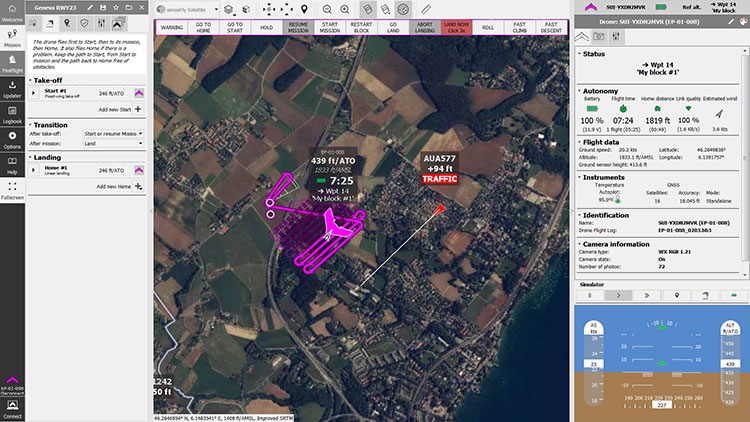
    The new integration is designed to ensure a smooth end-to-end mapping drone workflow. senseFly operators can now, within the recently launched eMotion 3.5 software, transform a senseFly S.O.D.A. camera’s georeferenced imagery into an automatically collated project (in .jxl format).

    This enables the one-click import of drone imagery into the Trimble Business Center Aerial Photogrammetry module without the need for manual project creation and organization of images.

    The senseFly-to-Trimble mapping workflow includes:

    • planning and monitoring a senseFly S.O.D.A.-based drone flight (in eMotion 3.5)
    • downloading the drone’s images for one-click georeferencing in eMotion 3.5 (Flight Data Manager)
    • clicking to create a .jxl format mapping project
    • opening a project within the Trimble Business Center Aerial Photogrammetry module
    • processing the drone’s imagery to generate orthophotos, contour maps, point clouds, digital surface models (DSMs) and feature maps
    • analyzing and acting upon the data.
    Screenshot: Trimble
    Screenshot: Trimble

    “Making work easier and more efficient for geospatial professionals is the goal that drives every solution we develop,” said Jean-Christophe Zufferey, senseFly co-founder and CEO. “Therefore, we are excited to collaborate with Trimble on more tightly integrating our solutions, since enhancements such as this new eMotion-to-Trimble Business Center workflow do exactly that, ensuring that the transition from data collection to acting upon this data is as seamless as possible.”

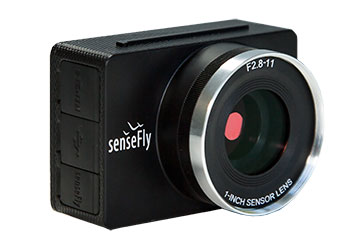
    The senseFly S.O.D.A. is built for professional drone photogrammetry work. The 1-inch, 20-megapixel RGB camera captures sharp aerial images across a range of light conditions, allowing senseFly fixed-wing drone operators to produce detailed, vivid orthomosaics and ultra-accurate 3D digital surface models.

    senseFly S.O.D.A. is compatible with most senseFly fixed-wing mapping drones, including the large-coverage eBee Plus.

    Trimble Business Center allows surveyors and other geospatial professionals to combine aerial photography with data collected from GNSS receivers, total stations, 3D laser scanners and more, for a complete field-to-finish workflow. By combining imagery from unmanned aerial systems with ground-based survey data, users can visualize their project from both aerial and terrestrial perspectives, measure points within the images and create 3D models of the infrastructure and terrain.

  • Delair unveils large-area mapping drone

    The UX11 drone from DelAir.

    Commercial drone-maker Delair has introduced a professional unmanned aerial vehicle (UAV) for survey-grade photogrammetric mapping.

    The UX11 is a small fixed-wing UAV that combines a powerful integrated onboard system, industry-grade sensors, limitless communication range and PPK centimeter-level positioning. It  carries enough onboard computing power to access and process the pictures, then sends them to the operator in real-time.

    According to the company, it will run automated quality checks on the images (such as blur detection or overlap checks) to help ensure the operator is acquiring quality data.

    The UX11’s redundant communications system includes a proprietary line of sight radio and 3G/4G connectivity between the ground control station and the UAV using a worldwide machine-to-machine pre-paid plan.

    Building on Delair’s experience with beyond visual line of sight (BVLOS) operations since 2012, the UX11 is ready for BVLOS flights with unlimited range and adds a new level of safety with this communication link.

    The UX11 is lightweight, ultra-stable, simple to hand-launch at takeoff and it lands precisely where planned using distance measuring technology. New user-friendly Android mission planning software boasts innovative features such as support for in-flight camera feedback and live data review, the company said.

    Made to help professionals in GIS, survey, and construction optimize area coverage per flight, the UX11 flies for 59 minutes with the best coverage and resolution specifications in its class for flights at 122 m (400 ft) altitude above ground level. The UX11 will be available for purchase via DELAIR’s global network of distributors by January, 2018.

    The UX11 is a product offer for data acquisition which can be complemented by data processing and analytics software programs to address a range of commercial applications. Geospatial users can create 2D and 3D models and then generate elevation profiles, contour lines, slope qualifications and volumetric estimates with high accuracy and resolution using post-processed kinematic data and ground-control points.

  • VTOL drone company Wingtra partners with Pix4D

    VTOL drone company Wingtra partners with Pix4D

    Wingtra One in the air. (Photo: Wingtra)

    Professional drone company Wingtra is partnering with photogrammetry company Pix4D. Pix4D’s software suite is now available to WingtraOne users, both directly and via Wingtra’s distributors.

    WingtraOne, Wingtra’s main product, is a vertical take-off and landing (VTOL) UAV that enables data collection for a variety of industries. The partnership with Pix4D aims to augment its status with an end-to-end solution including 2D map and 3D model construction from aerial data.

    The WingtraOne drone bridges the gap between traditional multi-rotors and fixed-wing drones, the company said. It takes off and lands vertically like conventional multirotors, but once in flight, the drone tilts forward to fly like a fixed-wing aircraft.

    Being able to carry heavy payload such as the Sony RX1RII, the drone offers high mapping accuracy, while covering an area of 980 acres (400 Ha) at 3 cm/px (1.2 in/px) GSD or the equivalent of 570 football fields.

    The WingtraOne is available in use in Europe, China, the United States and Australia for applications ranging from surveying and precision agriculture to glacier monitoring.

    Wingtra (booth 109) and Pix4D (booth 415) are exhibiting at Commercial UAV Expo Americas, which takes place Oct. 24-26 in Las Vegas.

    Map made by Pix4D pictures taken by WingtraOne with RX1RII camera. (image: Wingtra)

    Turning Information into Insight. Wingtra’s diverse user base is complemented by Pix4D, whose product range is aimed at the surveying and agriculture industry, among others.

    Pix4D has allows professionals to generate high-quality point clouds, orthomosaics, surface and terrain models from aerial imagery. Some of its popular offerings include Pix4Dmapper for precisely georeferenced 2D maps and 3D models, and Pix4Dag for accurate reflectance and index maps (NDVI, NDRE).

    With WingtraOne’s autonomous aerial data collection and Pix4D’s advanced data-analysis capabilities offered as a single bundle, professional users can now expect a plug-and-play solution. “We are keen on collaborating strongly in our upcoming events. Actually we are meeting very soon at UAV Expo in Las Vegas,” Bailey said.

    “The bond between the companies was established some time ago, since realizing the potential of pairing high-resolution aerial images with cutting-edge photogrammetry modeling software,” said Caroline Bailey, Pix4D regional sales manager for Europe. “We are very happy to announce the decision to become official partners.”

    Leopold Flechsenberger, sales manager at Wingtra, added, “We have always aimed at providing the best survey-grade aerial imagery to our users, so Pix4D was an obvious choice from the start. From now on, Wingtra is offering a reduced price on WingtraOne drones, when bundled with Pix4Dmapper.”

  • Hexagon presents solutions for geospatial, construction industries at Intergeo

    Hexagon AB showcased its geospatial and construction portfolio at Intergeo 2017 in Berlin, Germany.

    Hexagon’s sensor portfolio combined with a range of software creates solutions that support the geospatial and construction industries.

    According to the company, visitors were able to explore a number of solutions, including mobile mapping; asset collection and management for geographic information systems (GIS); 3D laser scanning; photogrammetry; remote sensing; airborne sensors and unmanned aerial vehicles (UAVs); global positioning and monitoring like GNSS; construction project controls and progress documentation; utility detection; measurement software and cloud-based dynamic mapping. Hexagon will be at booth A1.024 in Hall 1.1.

    “Hexagon is focused on creating smart digital realities,” said Hexagon President and CEO Ola Rollén. “At Intergeo, we will demonstrate the productivity and savings that can be realized from digitalizing customer workflows, automating processes and ensuring all stakeholders have access to dynamic, critical information.”

    During the conference portion of Intergeo, Hexagon executives addressed the growing need for digitalization in geospatial and construction industries:

    • Transformation through digitalization. Hexagon Geosystems President Juergen Dold provides the Intergeo opening keynote exploring the need for businesses to transform from efficient digitisation to connected digitalisation for continued progress.
    • The power of combining cost, schedules and models in the cloud. Director of Global Business Development for HxGN SMART Build at Hexagon PPM, Cathi Hayes, explains how SMART Build integrates model, schedule, cost and digital layout capabilities into a single solution that addresses the most critical phases of construction planning and execution.
    • Hexagon integrated solution for utility detection and mapping. Leica Geosystems Construction Tools President Katherine Broder and IDS GeoRadar President Alberto Bicci present how to achieve high productivity in mapping utilities with Hexagon’s underground detection portfolio, including ground penetrating radar (GPR) solutions.
    • Escaping the flatlands. Hexagon Geospatial President Mladen Stojic envisions new and easier approaches that ingest the influx of data, use automated approaches to extract the signal from the noise and provide intuitive ways of communicating insights to decision makers and field teams so they can shape smarter change.
    • Connecting perceptions with reality in the world of BIM, GIS and survey. Leica Geosystems Laser Scanning Vice-President of Business Development Faheem Khan looks at the benefits of sensor fusion, the growth of digital reality solutions and how both are affecting project lifecycles in the real, digital world.
    • Streamlining UAV workflows for surveying, construction and inspection. Leica Geosystems Product Manager for UAV Solutions Valentin Fuchs and Leica Geosystems Director of Marketing and Communications for UAV Solutions Benjamin Federmann deliver a series of presentations and hands-on demonstrations on how Hexagon integrates UAVs as part of the technology tool kit to digitalise workflows.
  • What to expect from ION GNSS+ and Intergeo 2017

    What to expect from ION GNSS+ and Intergeo 2017

    Intergeo 2016

    It’s almost September. For the GPS World staff, this means scramble time. We have two important industry events to attend: The venerable ION GNSS+ conference and the huge Intergeo trade show.

    ION GNSS+ is the Institute of Navigation’s largest technical meeting and showcase of GNSS technology, products and services. Hundreds of papers are shared by experts in the field, in presentations and panels.

    The show has changed over the years to broaden its focus to applications, and added a “+” to its name to incorporate all the positioning, navigation and timing (PNT) technology that aids GNSS in location, much as we have also done in providing a new subtitle to our magazine.

    New this year are Short Courses, aimed at bringing your non-technical staff up to speed on the technology behind the industry, no matter their background. For instance, one course is “GNSS 101: An Introduction.”

    Intergeo, which is held each year in different city in Germany, comes to Berlin. The huge show, attended by about 17,000 people, is a conference and trade fair (emphasis on trade fair) for the fields of geodesy, spatial data, surveying, UAVs and land management.

    A hot topic at Intergeo continues to be Geospatial 4.0, the massive transformation where big data, mobility and cloud solutions are driving a new global digital economy.

    Other buzzed-about topics include photogrammetry, building information modeling (BIM) and smart cities.

    One important and timely topic is the need for infrastructure that ensures data security and protection. Once again, the Interaerial Solutions show for UAVs will take place as part of Intergeo.

  • Intergeo preview: Photogrammetry heads for new markets

    We’ve entered a new golden age for photogrammetry, powered by the ease of digitizing images and their ubiquitous availability.

    Photogrammetry is the science of making measurements from photographs. While science drives the process, business is driving a wealth of associated applications.

    “Photogrammetry is ahead of its time because everything is already fully digital in this discipline,” said Heinz-Jürgen Przybilla, professor of Geodesy at Bochum University of Applied Sciences.

    UAVs, digital cameras and image sensors on the Internet of Things, in aircraft or on satellites are opening up applications that only the world of science was predicting a few years ago.

    Intergeo Show. The developments that photogrammetry is setting in motion will be on display at Intergeo 2017, Sept. 26–28 in Berlin.

    The art of using photographs for surveying, which laid the foundation for present-day photogrammetry, dates back 150 years and involves developing processes to derive information from images that go far beyond simply viewing them. In recent years, the discipline has made huge progress, with businesses discovering new application areas.

    The high level of automation makes it possible to interpret huge volumes of data from sources such as large-scale satellite imagery. The process also works in real time — a prerequisite in applications such as autonomous navigation.

    “Automation in image evaluation makes people incredibly flexible. We’re no longer restricted to viewing the world from our own height,” said Christian Heipke, president of the International Society for Photogrammetry and Remote Sensing (ISPRS).

    Photogrammetry applications are moving into numerous sectors and tackling a host of challenges. Global change is being documented using images from space. Image data is being used to forecast crop sizes. Inaccessible structures are being monitored with the help of images from UAVs.

    As Przybilla said, image evaluations from UAVs are already being used for high-precision land register surveys. What took days manually can now be accomplished in minutes.

    Disaster Prevention. Other applications include disaster prevention and monitoring refugee movements. In many cases, drones provide a rapid overview, while satellites offer the large-scale basis for evaluating a situation.

    In architecture, 3D models from aerial images complement computer-aided design (CAD) plans.  In conjunction with virtual reality, 3D models enable design variants for a building to be depicted in the actual environment.

    Information is also being shared with disciplines such as computer vision and robotics, with “seeing robots” increasingly recording and mapping their surroundings.

    Industrial site in 3D: A digital elevation model from a series of overlapping photos taken from a UAV at 300 feet above ground level.
    Industrial site in 3D: A digital elevation model from a series of overlapping photos taken from a UAV at 300 feet above ground level. (Image: Eric Gakstatter)

    More and more, the processes and algorithms on which image evaluations are based are becoming like a “black box” for users — hard to understand from the outside. While the black box is getting bigger, scientists are refining their methods.

    “We’re increasingly combining existing data and this will leverage a huge amount of new potential,” explained Heipke. The black box for photogrammetry will be discussed at Intergeo.

    Once the process of image content recognition is automated, applications are limitless.

    Several sessions organized by the German Society for Photogrammetry, Remote Sensing and Geoinformation (DGPF) at Intergeo will be looking at topical issues in photogrammetry. The contents of the presentations range from new sensors and remote sensing to “engineering geodesy meets photogrammetry.” Numerous companies will also be showcasing their image-evaluation solutions at Intergeo’s specialist exhibition.

  • New version of DatuSurvey hints at ground control points

    New version of DatuSurvey hints at ground control points

    Datumate has released DatuSurvey version 5.1 for both Professional and Enterprise editions of the software. DatuSurvey (formerly DatuGram 3D) turns drone- and camera-based images to accurate, georeferenced 2D maps and 3D models, which saves the need for expensive and risky field work and expedites deliveries, according to Datumate.

    DatuSurvey Professional V5.1 now also includes:

    • Ground Control Points Hints – Once the model is built with the minimal requirement of 3 GCP’s on two images each, the system will start showing hints for selected GCP on all images it is not marked in. This will make the GCP marking easier and faster.
    • Differentiating Clusters in Map View – Different clusters are now shown in different colors in the map view.

    DatuSurvey Enterprise V5.1 now also includes:

    • Dense Point Cloud Generation Quality – Dense Point Cloud may now be generated at four different density levels as specified by the user.
    • Mesh and Texture Support – Dense Point Cloud may now be generated with mesh or with textured mesh. Mesh and texture may be exported to OBJ format.
    • True Orthophoto Export Quality – Orthophoto may now be generated at four different resolutions.
    • Visualization Viewer Improvement – 3D Viewer is able to handle up to 100 million points. Thus, viewing an excellent quality model with mesh and texture.
    • Volume Calculation Improvement – Volume calculation was improved to allow definition of stockpiles right on the dense point cloud, including physical and base surfaces. The definition process is now faster and easier, and the volume calculation of more precise.
    • Ground Control Points Hints – Once the model is built with the minimal requirement of three GCP’s on two images each, the system will start showing hints for selected GCP on all images it is not marked in. This will make the GCP marking easier and faster.
    • Differentiating Clusters in Map View – Different clusters are now shown in different colors in the map view.
    DatuSurvey by DatuMate.
    DatuSurvey by DatuMate.
  • SimActive enables processing in the cloud

    Correlator3D photogrammetry software is officially supporting processing in the cloud. Users can subscribe to an online computing service, such as Amazon EC2, and run Correlator3D on a virtual machine, according to developer SimActive Inc.

    The main advantage is the capability to use multiple licenses as required. It permits an on-demand deployment of the software on several processing machines, without any computer hardware.

    “The new option allows our customers to continuously adjust their processing power,” said Louis Simard, CTO of SimActive. “Combined with our monthly subscription plan, clients have the cloud’s flexibility, while maintaining full control of their production workflow.”

    SimActive is offering a free trial as well as a webinar on Correlator3D in the cloud, to be held Tuesday, Dec. 6, 10 a.m. Eastern Time.

  • Eos introduces photogrammetry software for drone photography

    Eos Systems Inc. has introduced new photogrammetry software optimized specifically for photographs taken with drones or unmanned aerial systems (UAS).

    The new PhotoModeler UAS 2016 creates 3D models, measurements, and maps from photographs taken with ordinary cameras built-in or mounted on drones. It has numerous features for operation with drone photos, including post processing kinematics (PPK), volume objects, full geographic coordinate systems support, multispectral image support and control point assist.

    Eos Systems will be showcasing PhotoModeler UAS Oct. 31 to Nov. 2 at the Commercial UAV Expo in Las Vegas, and will offer the new software at 35 percent off the normal price Nov. 1-30.

    eos-photogrammetry-wThe new version of PhotoModeler is suited for drone photogrammetry applications, including surveying, ground contouring, surface model creation, stockpile volume measurement, mining and mine reclamation, environmental analysis, slope analysis, forensic analysis, construction and agricultural crop analysis.

    New applications for drone photogrammetry are developed monthly. Eos PhotoModeler was introduced 23 years ago and has become one of the leading photogrammetric software platforms with a wide range of users in fields such as architecture, engineering, surveying, research, manufacturing and forensics.

    PhotoModeler UAS 2016 software includes numerous features that provide higher performance in drone photogrammetry. Camera calibration is optimized for high accuracy with UASs and GPS. Post processed kinematics (PPK) makes it possible to correct a survey with GPS data after the fact for survey grade accuracy.

    Volume objects provide easy and accurate volume data for stock piles and mining operations. Full geographic coordinate system support enables users to work in their local geographic coordinate system for better compatibility. Support is provided for multispectral images including Normalized Difference Vegetation Index (NDVI) surface models and orthomosaics for precision agriculture. An intuitive interface is provided for efficiently marking ground control points.

  • Datumate unveils DatuFly, professional imagery app for drones

    Datumate has released a new tablet app for drone flight planning and automated, high-resolution photo-shooting. The DatuFly app saves up to 80 percent of field surveying time and eliminates follow-up site visits, according to the company.

    “DatuFly automates the entire field surveying process, while keeping field work simple and safe,” said Tal Meirzon, Datumate CEO. “Ease of use and survey-grade results makes DatuFly a valuable tool for any surveyor and drone operator. The bundle of Drone, DatuFly app and DatuGram 3D photogrammetry software forms the ideal site surveying solution for professional results.”

    A friendly, wizard-type user interface makes it easy to select the job type and the required outputs to achieve best results. The area of interest is instantly marked on the map, including complex polygons, and the drone is ready for launch.

    Flight and aerial photography, vertical or oblique, are automatic and optimized per job type, such as topography, stockpiles and roads. Mission progress is constantly monitored on the tablet screen, including flight time, distance, waypoints and the required number of batteries.

    Once a battery is exhausted, the drone automatically returns for a battery exchange and resumes flight and photo-shooting from where it left off.

    The DatuFly image-taking plan is executed based on the best-practice requirements of DatuGram 3D, Datumate’s field-to-plan software that automates surveyors’ field and office work, ensuring survey-grade accuracy, high quality and quick results.

    DatuFly is compatible with DJI drones and is available on AppStore for iPads. An Android app will be available in the Google Play store in October 2016.

  • SimActive releases new version of Correlator3D for photogrammetry

    Photogrammetry software company SimActive is releasing a new version of Correlator3D with a redesigned aerial triangulation (AT) module.

    Correlator3D is a patented end-to-end photogrammetry solution for the generation of high-quality geospatial data from satellite and aerial imagery, including UAVs.

    The tie point extraction and bundle algorithms have been enhanced, along with the added capability to address problematic input data (such as low overlap projects).

    The release features an alignment tool that automatically registers new projects to older mosaics and DEMs. It removes the need for recollecting ground control points (GCPs). In addition, a new semi-automatic workflow was developed for GCP tagging.

    “Our significant R&D efforts on the AT are due to its substantial impact on all subsequent results,” said Louis Simard, CTO of SimActive. “As such, the release vastly improves and simplifies the entire production chain.”

    For a live demonstration at AUVSI’s Xponential 2016 (May 2-5 in New Orleans), visit booth 260 or send an email to [email protected].

  • U.S. Environmental Protection Agency to use SimActive’s Correlator3D

    SimActive’s Correlator3D has been selected by the United States Environmental Protection Agency (EPA) to create 3D datasets of vegetation for input into biophysical models. The software will also support generation of urban landcover maps for the agency’s GIS, EnviroAtlas.

    “Correlator3D has been serving governments globally, encompassing a wide spectrum of requirements,” said Philippe Simard, president of SimActive. “We are proud to be working with the EPA and supporting their environmental mandate.”

    Correlator3D software is a patented end-to-end photogrammetry solution for the generation of high-quality geospatial data from satellite and aerial imagery, including UAVs. Correlator3D performs aerial triangulation and produces dense digital surface models, digital terrain models, point clouds, orthomosaics and vectorized 3D features.