Tag: satellite launch

  • First Galileo Satellite Arrives in French Guiana for October Launch

    The first Galileo navigation satellite has arrived in Europe’s Spaceport in French Guiana, ready to begin preparations for launch on October 20, reports the European Space Agency (ESA). Packed within a protective, air-conditioned container, the satellite known as Flight Model 2 (FM2) landed at Cayenne Rochambeau Airport aboard an Antonov aircraft at 06:45 local time on Wednesday after departing from Thales Alenia Space Italy’s Rome facility where it was built.

    A Thales and ESA team stood ready to receive FM2, having flown into French Guiana the previous week, along with all the testing and support equipment. The team loaded the satellite container on a lorry for transport to the Guiana Space Center, where it arrived at 10:00 local time and was moved into the preparation facility. It stayed there overnight for the temperature to settle before it was taken out of its container the following morning.

    The FM2 satellite is due to be launched aboard a Soyuz ST-B vehicle on October 20, together with a second Galileo satellite called the Proto-Flight Model (PFM), now being readied for its own flight to French Guiana.

    This will be the first launch of Russia’s Soyuz rocket from French Guiana, and the first Soyuz launch from a spaceport outside of Baikonur in Kazakhstan or Plesetsk in Russia. The launch will take place from a new facility 13 km northwest of the Ariane 5 launch site. French Guiana is much closer to the equator, so each launch will benefit from Earth’s spin, increasing the maximum payload into geostationary transfer orbit from 1.7 tonnes to 3 tonnes.

    The first four Galileo satellites, built by a consortium led by EADS Astrium Germany, will form the operational nucleus of the full Galileo satnav constellation.

    For more information, see the ESA website.

    Source: GPS world staff
    Galileo IOV satellite in its protective wrap.
    Source: GPS world staff
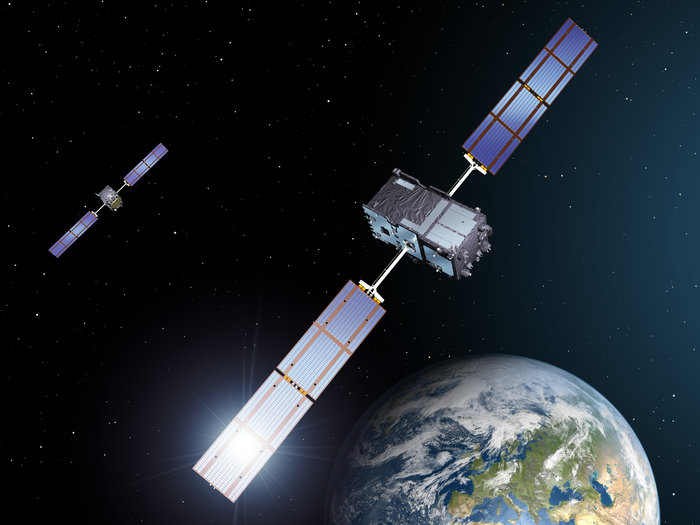
    Artist’s concept of Galileo IOVs in orbit.


  • GLONASS K-1 Launch Delayed Twice, Rescheduled for Tomorrow


    GLONASS-K is moved to the launchpad.

    News courtesy of CANSPACE listserv.

    According to a Roscosmos report, the state commission governing rocket launches will launch GLONASS-K1 on February 26 at 03:06 UTC. The launch of GLONASS-K1 has been pushed back for “technical reasons.” The original schedule called for a February 24 launch.

    Quoting the commander of the Russian Space Forces, Lieutenant-General Oleg Ostapenko, an Interfax news item stated that there was insufficient time to ready the rocket for launch february 25, though it was announced as a launch date following the scrub on February 25. “The probability of a launch on the 26th is very high,” Ostapenko said.

    Meanwhile, Komsomolskaya Pravda quoted an unnamed space industry official as saying that if the launch is not held tomorrow, it will be put off for a month. “[The decision will be] once again to be safe, rather than to carry out the launch, which for technical reasons, was postponed for the second day in a row. Without further checks, and to eliminate technical problems, no one [wants to] take responsibility to conduct the launch,” he said.

    Gazeta.ru, an online Russian newspaper, has carried a report in which Nikolai Testoedov, the chief designer and CEO of Information Satellite Systems Reshetnev states that seven GLONASS satellites will be launched this year. In addition to GLONASS-K satellites being launched this month and in December, five GLONASS-M satellites will be launched. Three will be launched on a Proton-M rocket from Baikonur (this launch is expected in June). He said that, in addition, two GLONASS-M satellites will be launched on the Soyuz-2 rocket from Plesetsk. The first of the five GLONASS-M satellites is to be delivered to the customer on February 28.

  • GLONASS Launch Failed, Three Satellites Crash into Pacific Ocean

    Quoting industry sources, the Russian Federal Space Agency announced that the December 5 launch of three GLONASS-M satellites ended in failure when the Proton-M rocket’s Block DM upper stage and its three payloads crashed into the Pacific Ocean about 1,500 kilometers, or 932 miles, northwest of Honolulu. Although an investigation will look into the exact cause of the failure, early unconfirmed reports indicate a software error.

    Apparently, the Proton carrier’s third stage deviated from its planned trajectory.

    The three satellites were launched from the Baikonur cosmodrome in Kazakhstan. According to telemetry, the carrier rocket’s upper stage containing the satellites was launched into a “non-targeted orbit.” According to a BBC news report, the upper stage and GLONASS-M navigation satellite payload crashed into the Pacific Ocean near Hawaii. BBC news also reported that sources informed them that the launch rocket had deviated by eight degrees from its intended path after launch.

    The Russian Federal Space Agency reported that a “special board has been established to find out the cause of the contingency and to define the next steps.”

    According to the Russian News Agency RIA Novosti, incorrect calculations were loaded into the rocket’s onboard computer missiles. As a result, the rocket engine provided too much momentum, leading to the deviation of the vehicle from its planned trajectory.

    RIA Novosti also reported that because of the accident, the pace of satellite launches will have to be accelerated. For example, the launch scheduled for September 2011 is likely to take place earlier.

    The new generation GLONASS-K satellite is due to launch later this month from the northern Plesetsk cosmodrome.

    Video of the pre-launch rocket delivery can be viewed here:

     There are currently 20 operational GLONASS satellites, with another four undergoing maintenance and two reserved as spares.


  • New Beidou Satellite Launched

    China launched its fifth Beidou/Compass navigation satellite on Friday, April 13.  The initial orbital elements (inclination = 55.0°, eccentricity = 0.62, mean motion = 3.84 orbits per day) may indicate that this is not another GEO satellite but rather the first of the MEO satellites.

    Meanwhile, it seems that NORAD had “lost” the 4th Beidou satellite for awhile. Launched on February 2, the satellite reportedly had a problem with a stuck solar panel which needed to be fixed before the satellite could be transitioned from its geostationary transfer orbit to its intended geostationary location. The last publicly released element set for this satellite had been dated 8 March 2007. Perhaps this was the day the Chinese started to move the satellite to its geostationary position.

    NORAD released an element set for the satellite in its near geostationary orbit. NORAD is currently reporting the satellite to be in an inclined orbit (6.3°) with a sub-satellite longitude of about 144°E. The latest Beidou/Compass might not be heading for GEO but either to an inclined geosynchronous orbit or MEO, similar to that of GPS and GLONASS satellites.

    The Chinese have talked about various Beidou/Compass options:

    1. 4 GEO + 9 inclined (50°) geosynchronous
    2. 4 GEO + 12 MEO (55° x 20,200 km)
    3. 30 MEO (56° x 21,363 km)

    In one of their ITU filings, the Chinese referred to some of the satellites as Compass-M.

  • Why are GLONASS satellites launched on Christmas Day?

    Why are GLONASS satellites launched on Christmas Day? Question posted on CANSPACE on December 10, 2006, by Kerry Matthews

    The latest triple-satellite GLONASS launch occurred on December 25th at 23:18 Moscow Time. This launch is the sixth GLONASS December launch in a row. In fact, all 9 launches since December 1995 have occurred in the last month of the year with the exception of the launch on October 13th, 2000 (see a list of GLONASS launches going back to 1990).

    Including this month’s launch, three of the recent launches have occurred on December 25th and one originally scheduled for the 25th, occurred on the 26th. Why the preponderance of December launches and launches on Christmas Day in particular?

    First of all, we should realize that for most people in the Russian Federation, there is nothing special about December 25th. Most Christians in Russia belong to the Russian Orthodox Church which celebrates Christmas according to the Julian calendar — on January 7th. And in modern Russia, January 7th is a state-wide holiday. So, GLONASS launches don’t occur around December 25th because it’s a special day on the Russian calendar. So why do they occur then?

    I posed this question to Col. (ret.) Nikolai Shienok, the former chief of the Information Department of the Coordination and Scientific Information Center of the Russian Ministry of Defense. After conferring with officials from Roscosmos (the Russian space agency) responsible for the GLONASS program, Col. Shienok confirmed that it is only for financial or organizational reasons that there is a preponderance of launches in December. “It is the last month of the year and it is impossible to postpone a planned launch further” Col. Shienok said.

    Nevertheless, there may be some operational calendar constraints on GLONASS satellite launches as there are for launches of other satellites. Satellite operators typically try to avoid launching satellites when the Sun-orbit-plane or beta angle for the intended orbit is unfavorable. The beta angle is the angle between the geocentric position vector to the Sun and the satellite’s orbital plane. This angle determines if and for how long a satellite will be in the Earth’s shadow during its orbit. For a given orbit (altitude, inclination, and initial right ascension of the ascending node), the beta angle will vary over the year. Operators try to avoid a launch date when the satellite would be in eclipse for a significant fraction of its orbit so that during the crucial satellite deployment and commissioning phase, the satellite’s solar panels receive as much sunlight as possible to keep the satellite’s batteries fully charged. The recent GLONASS launch put the satellites into Plane 2 which is actually in one of its eclipse seasons right now. However, the satellites will be out of eclipse by early January.

    Prof. Richard B. Langley

    Dept. Geodesy and Geomatics Engineering

    University of New Brunswick