Tag: satellite launch

  • GPS Block IIF-4 Launch Set for Today

    GPS Block IIF-4 Launch Set for Today

    News courtesy of CANSPACE Listerv.

    Update: The launch window for the liftoff has been adjusted slightly to  21:38-21:56 UTC.

    The United Launch Alliance (ULA) Atlas 5 rocket’s rollout to the pad  took place Tuesday. Weather forecasters have predicted an 80
    percent chance of favorable conditions for launch.

    Updates on the mission and live video coverage of the launch is available.

    Live video will also be available here and on this satellite feed (for those of you still with backyard dishes): SES 2, Transp. 21, C-band, 87° West

    ULA is also posting to Facebook and tweeting to Twitter at twitter.com/ulalaunch; look for the #GPSIIF-4 hashtag.


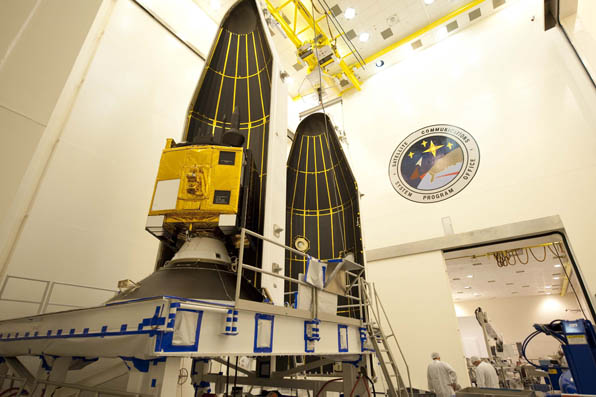
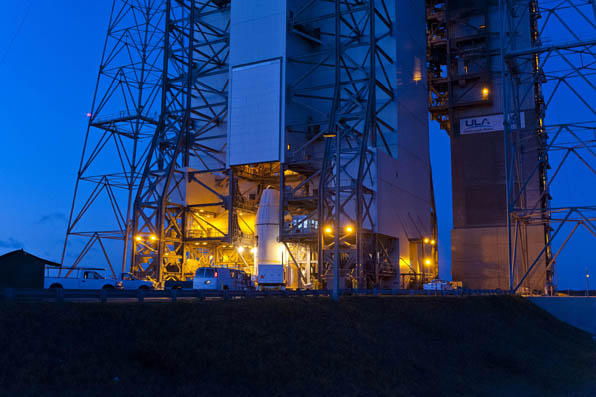
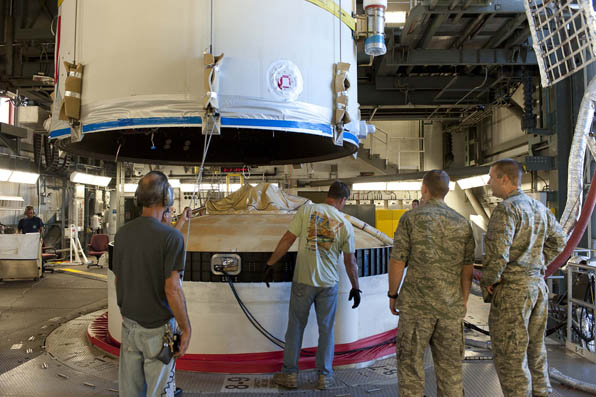
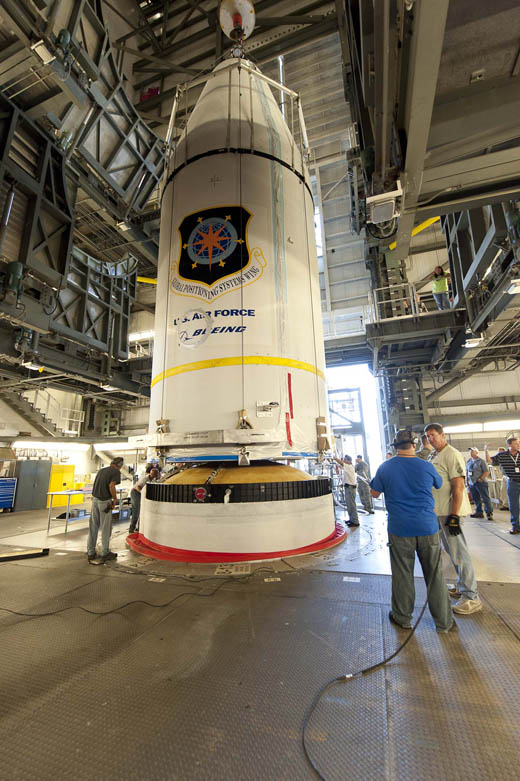
    The next GPS satellite launch is scheduled for May 15 with the launch window extending from 21:39 to 21:58 UTC. An Atlas 5 rocket will be used to place the satellite, GPS IIF-4, into orbit from Cape Canaveral Air Force Station.

    This is the first time in almost 28 years that an Atlas rocket will be used to launch a GPS satellite. All of the prototype or Block I satellites were orbited with Atlas rockets. Since then, Delta rockets have been used exclusively for GPS launches. The IIF satellites are being launched with a mixture of Atlas and Delta rockets.

    The IIF-4 satellite, also known as SVN66, will operate as PRN27. SVN66/PRN27 will eventually occupy the C-2 slot, replacing SVN33/PRN03, a Block IIA satellite launched in 1996. Reportedly, SVN66/PRN27 will go through an extended period of testing following launch, and is not expected to be set healthy until August. SVN33 will become a reserve or backup satellite.
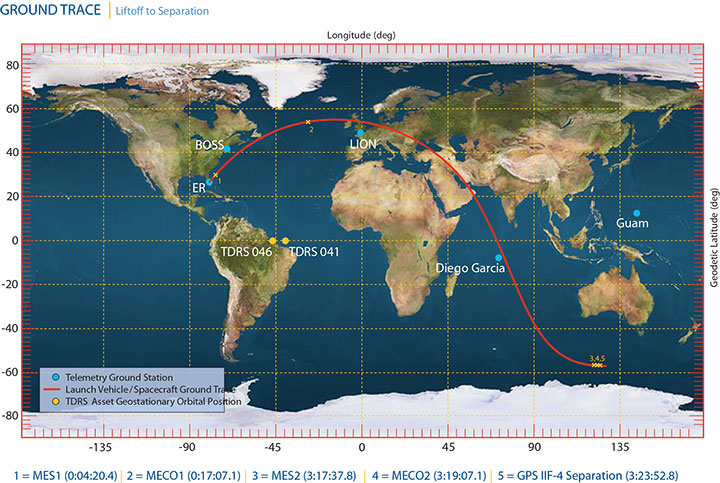
    Ground Stations: ER = Eastern Range; BOSS = Call sign of New Hampshire   Station, New Boston Air Force Station, New Hampshire; LION = call sign   of Telemetry & Command Station, Royal Air Force Oakhanger, Hampshire,   U.K.; Diego Garcia = Diego Garcia Station (call sign REEF), British   Indian Ocean Territory; Guam = Guam Tracking Station (call sign GUAM),   Dededo, Guam. TDRS: Tracking and Data Relay Satellite MES1: Centaur first main engine start MECO1: Centaur first main engine cutoff MES2: Centaur second main engine start MECO2: Centaur second main engine cutoff At spacecraft separation, the GPS satellite's orbit will be circular   with a height of 11,047 nautical miles or 20,459 kilometers and an   inclination of 55 degrees.
    Ground Stations: ER = Eastern Range; BOSS = Call sign of New Hampshire Station, New Boston Air Force Station, New Hampshire; LION = call sign of Telemetry & Command Station, Royal Air Force Oakhanger, Hampshire, U.K.; Diego Garcia = Diego Garcia Station (call sign REEF), British Indian Ocean Territory; Guam = Guam Tracking Station (call sign GUAM), Dededo, Guam.
    TDRS: Tracking and Data Relay Satellite
    MES1: Centaur first main engine start
    MECO1: Centaur first main engine cutoff
    MES2: Centaur second main engine start
    MECO2: Centaur second main engine cutoff
    At spacecraft separation, the GPS satellite’s orbit will be circular with a height of 11,047 nautical miles or 20,459 kilometers and an inclination of 55 degrees.
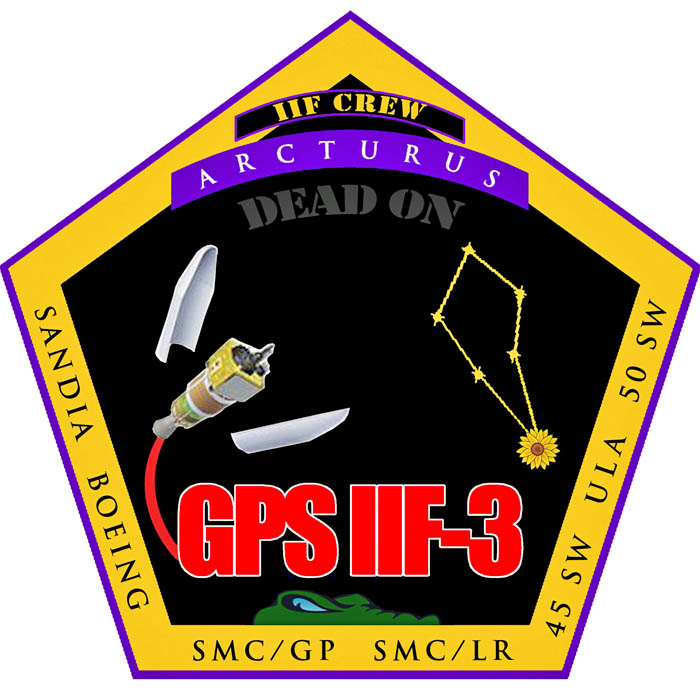
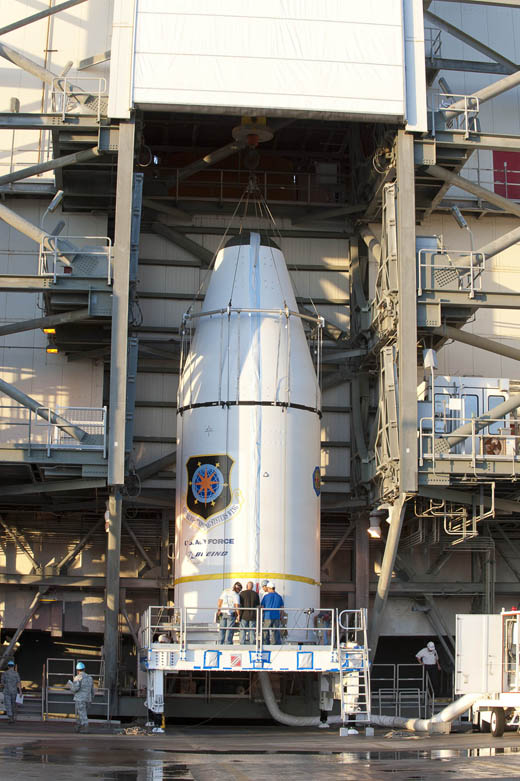
    (Courtesy of SpaceFlight Now) This is the 45th Launch Support Squadron crew patch for the GPS 2F-4   mission, which is Boeing's Space Vehicle (SV) #5. Each SV is a named   for a navigation star and its constellation. SV-5 is named Vega, with   constellation Lyra. On the patch, they are the large star and   constellation in the background of space. The United Launch Alliance   Atlas 5 rocket is shown lifting the satellite from the Eastern Launch   Site at Cape Canaveral Air Force Station. The Squadron mascot is a   gator, and a lyra is a Greek harp. SSgt Thomas Hogan drew a   "Toga-Gator" and Lt Ken Stuart did the patch design.
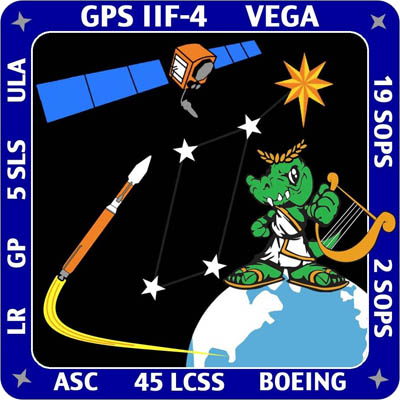
    (Courtesy of SpaceFlight Now) This is the 45th Launch Support Squadron crew patch for the GPS 2F-4 mission, which is Boeing’s Space Vehicle (SV) #5. Each SV is a named for a navigation star and its constellation. SV-5 is named Vega, with constellation Lyra. On the patch, they are the large star and constellation in the background of space. The United Launch Alliance Atlas 5 rocket is shown lifting the satellite from the Eastern Launch Site at Cape Canaveral Air Force Station. The Squadron mascot is a gator, and a lyra is a Greek harp. SSgt Thomas Hogan drew a “Toga-Gator” and Lt Ken Stuart did the patch design.


  • Upcoming GNSS Satellite Launches Scheduled

    News courtesy of CANSPACE Listserv.

    Satellites expected to be launched in support of various Global Navigation Satellite Systems are the following:

    GPS
    May 15: Block IIF-4, SVN66, launch window: 17:39-17:58 UTC
    November: Block IIF-5

    GLONASS
    April 26: Single GLONASS-M or -K satellite from Plesetsk
    June 28: Three GLONASS-M satellites from Baikonur

    Galileo
    October: FOC-1 launch (two satellites)

    Indian Regional Navigation Satellite System (IRNSS)
    June (This is the first launch for an expected constellation of seven satellites, some of which will be geostationary. The constellation will provide continuous regional coverage for positioning, navigation and timing services.)


  • Luch-5B Arrives at Orbital Slot

    The second Russian SBAS satellite, Luch-5B, has now been positioned at its designated orbital slot of 16 degrees west longitude. The satellite had been in a drift orbit since its launch on November 2 at 21:04:00 UTC along with the domestic communications satellite Yamal-300K.

    Tracking data from NORAD/JSpOC showed Luch-5B arriving at its geostationary position by about December 13. The footprint of the satellite is shown below with the elevation-angle contours at 30-degree intervals.

    Luch-5B is expected to use PRN code 125.

  • Launch of GPS Satellite Struggled through Tense Moments

    A new report by Spaceflight Now reveals that the launch October 4 of a GPS satellite experienced tense touch-and-go moments.

    The Delta 4 rocket’s cryogenic upper stage engine experienced a fuel leak that caused a low-thrust condition. Four-and-a-half minutes into the launch, after the first stage had shut down and separated, the trouble began as the RL10B-2 engine on the upper stage extended its nozzle and fired to life.

    When the powerplant was igniting and reached its peak chamber pressure, a leak started above the narrow throat portion of the thrust chamber, setting off a chain of nail-biting events over the next three hours as the vehicle made its climb to the GPS constellation. The Delta 4 made autonomous adjustments, however. The onboard inertial guidance and flight control systems compensated for the lower thrust conditions. Its closed loop guidance system measured the decreased thrust in real time and revised the trajectory and burn durations to ensure the mission succeeded. The GPS IIF-3 satellite was delivered to the correct orbit as planned.

    United Launch Alliance has begun an investigation into the incident.

  • Galileo Launch Goes off Without a Hitch

    The Soyuz ST-B launcher carrying the next two Galileo In-Orbit Validation satellites took off as scheduled on 18:15:00 GMT (11:15 PDT) October 12. Deployment of its twin satellites into orbit took place 3 hours 44 minutes after take-off. All the stages of the Soyuz vehicle performed as planned and the
    Fregat-MT upper stage released the Galileo satellites into their targeted orbit at close to 23 200 km altitude.

    CANSPACE Listserv reports, “NORAD/JSpOC are tracking three objects from the launch:

    1 38857U 12055A   12287.39028510 -.00000010  00000-0  00000+0 0    40
    2 38857 055.3417 239.5297 0002857 220.9108 309.5819 01.70229112    21

    1 38858U 12055B   12287.39028542 -.00000010  00000-0  00000+0 0    24
    2 38858 055.3421 239.5258 0011396 234.3183 295.7952 01.70006115    13

    1 38859U 12055C   12287.39161626 -.00000010  00000-0  00000+0 0    37
    2 38859 055.3444 239.5347 0072340 243.6619 284.3270 01.68014156    19

    “Presumably, the first two (A and B) are the Galileo satellites. They are drifting towards their designated orbits.”

    The European Space Agency (ESA) launched this second pair of Galileo IOV satellites from Europe’s Spaceport in French Guiana.

    This flight is designated VS03 in Arianespace‘s mission numbering system, and it was the Spaceport’s third launch since Soyuz was introduced at this near-equatorial facility one year ago. Arianespace is the launch contractor.

    The two Galileo satellites will join the first two spacecraft orbited by Arianespace’s historic VS01 flight on October 21, 2011, marking Soyuz’ introduction at the Spaceport. Once all four are operational in space, they will provide the minimum number of satellites required for navigational fixes — enabling system validation testing when all are visible in the sky.

    As a European initiative, the Galileo satellite navigation system is being developed in a collaborative effort of the European Union and the European
    Space Agency. The In-Orbit Validation (IOV) satellites weigh 700 kg. each and were built by a consortium led by the Astrium division of EADS — which
    produced the platforms and has responsibility for the payloads, while Thales Alenia Space handled the assembly and testing tasks.

  • Launch Tomorrow for Second Pair of Galileo IOV Satellites

    The European Space Agency (ESA) will be launching a second pair of Galileo IOV satellites tomorrow from Europe’s Spaceport in French Guiana.

    The satellites will ride a  Soyuz ST-B rocket from Europe’s Spaceport in French Guiana. Launch is scheduled for 18:15:00 GMT (20:15:00 CEST) October 12.  Live streaming will begin at 17:48 GMT (19:48 CEST) for about one hour.

    From launch to final deployment, when the dispenser releases the satellites sideways in opposite directions, takes three hours and 44 minutes. Live coverage resumes at 21:25 GMT (23:25 CEST).

    More details, including live streaming of the launch, are available at the ESA website.

    This flight is designated VS03 in Arianespace‘s mission numbering system, and it will be the Spaceport’s third launch since Soyuz was introduced at this near-equatorial facility one year ago. Arianespace is the launch contractor.

    The two Galileo satellites will join the first two spacecraft orbited by Arianespace’s historic VS01 flight on October 21, 2011, marking Soyuz’ introduction at the Spaceport.  Once all four are operational in space, they will provide the minimum number of satellites required for navigational fixes — enabling system validation testing when all are visible in the sky.

    As a European initiative, the Galileo satellite navigation system is being developed in a collaborative effort of the European Union and the European
    Space Agency.  The In-Orbit Validation (IOV) satellites weigh 700 kg. each and were built by a consortium led by the Astrium division of EADS — which
    produced the platforms and has responsibility for the payloads, while Thales Alenia Space handled the assembly and testing tasks.

  • Galileo Satellites Cleared for Launch

    Photo: Galileo
    Soyuz VS03, the third Soyuz flight from Europe’s Spaceport in French Guiana, was transferred to the launch zone on October 8. The vehicle was rolled out horizontally on its erector from the preparation building to the launch zone and then raised into the vertical position, in preparation of the launch of two Galileo satellites.

    Europe’s next two Galileo satellites have received technical clearance for their launch this Friday. They are currently resting in place atop their Soyuz launcher.

    Yesterday saw the three-stage Soyuz ST-B launcher moved horizontally to the launch pad on the 600-meter long railway. It was then lifted into the vertical position to await the attachment of the Upper Composite — the combination of twin Galileo satellites, the dispenser holding them in place, the Fregat-MT upper stage and the protective fairing.  
    Meanwhile, the satellites themselves underwent their formal Launch Readiness Review, after which the Upper Composite joined the Soyuz at the launch pad to be mated to the Soyuz that evening using the mobile gantry. The Soyuz and Upper Composite will undergo a full launch dress rehearsal in the remaining days before the 18:15:00 GMT (20:15:00 CEST) launch on October 12, including preparations for fueling the vehicle, which will begin four and a half hours before liftoff.

    This follow-up launch marks a major step for Europe’s own satellite navigation system. Four is the minimum number of satellites needed to achieve a navigational fix on the ground, with one satellite each to measure latitude, longitude, altitude and provide a time reference. So once this second pair of satellites has been commissioned and tested, the quartet will form a completely operational mini-constellation that will be used to validate the Galileo system.

    The performance of the satellites in space together with the worldwide ground infrastructure serving to maintain Galileo’s service accuracy will be assessed in depth, to prepare the way for the launch of further satellites and then deliver initial services by mid-decade and finally build up to full operational capability.

    These two new satellites are also the first to carry search and rescue antennas to pinpoint aircraft and ships in distress as part of the international Cospas–Sarsat system.

    Photo: Galileo
    The two Galileo In-Orbit Validation satellites are protected during their launch by Soyuz by a launch fairing. Once the Soyuz has passed most of the way through the atmosphere, this fairing can then be ejected.


  • GPS IIF Launch Set for Thursday

    Photos from United Launch Alliance
    Photos from United Launch Alliance

    Lift-off is set for 8:10 a.m. EDT (1210 GMT) Thursday for a GPS IIF satellite, reports Spaceflight Now. GPS IIF-3 will replace an aging 19-year-old craft in plane A, slot 1, part of the program to incrementally upgrade the GPS constellation with greater accuracy, better jam-resistance, and a new civilian aviation signal, all of which are features of the Boeing-build Block IIF series.

    The United Launch Alliance Delta 4 rocket and GPS satellite payload will undergo a final technical assessment today and a readiness review Tuesday before entering into countdown operations Wednesday night.

    The 19-minute launch window is timed to deliver the GPS IIF-3 satellite directly into plane A of the navigation network 11,000 miles above Earth.

    The satellite is expected to be checked out and ready for handover to Air Force controllers by mid-November, according to Jan Heide, Boeing’s GPS program director.

    Photos from United Launch Alliance:

  • Twin Galileo Satellites Fueled and Ready for Launch

    credit: ESA
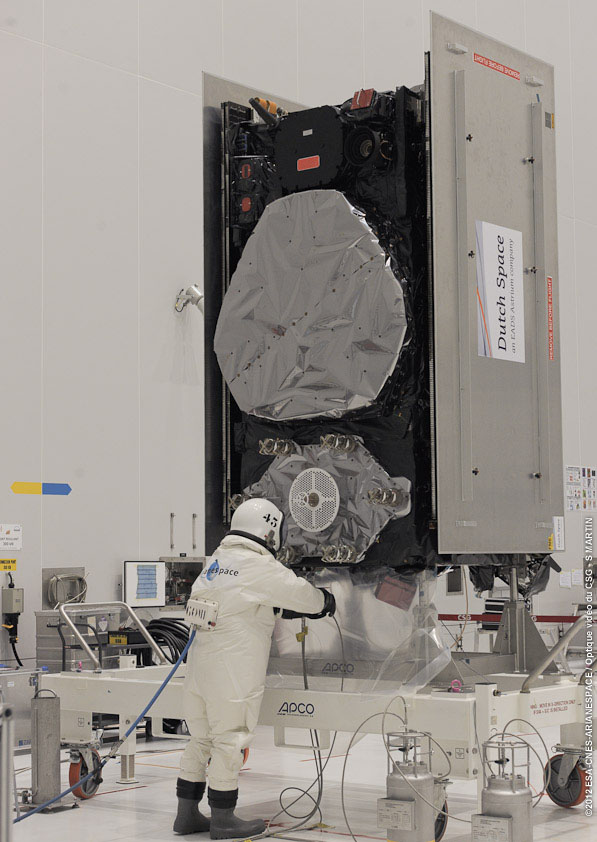
    Galileo FM3 Fueling (credit: ESA).

    A pair of Galileo satellites are now fully fueled and mated together atop the upper stage that will haul them most of the way up to their final orbit. The launch is planned for the evening of October 12, reports the European Space Agency.

    Technicians donned protective suits to fill the two satellites’ tanks with hydrazine fuel, used to maintain the satellites’ attitude and orbital position during their planned 12-year lifetime.

    Rather than carry a significant amount of extra fuel to insert themselves into their planned orbits – like typical telecommunications satellites or Galileo’s US GPS equivalents – the Galileo satellites are transported to medium orbit by the Fregat fourth stage of their Soyuz ST-B launcher.

    Doing without this extra fuel and orbital thrusters means that Galileo satellites are small enough to be launched in pairs aboard the Soyuz – or in fours by the new Ariane 5 variant currently being prepared.

    The Galileo satellites are attached to a special dispenser that holds them securely in position during launch, before pyrotechnic mechanisms release them sideways in opposite directions once their set 23 222 km altitude is reached.

    The aluminum plates on each side of the satellites are temporary additions to protect their delicate solar panels; these will be removed later.

    credit: ESA
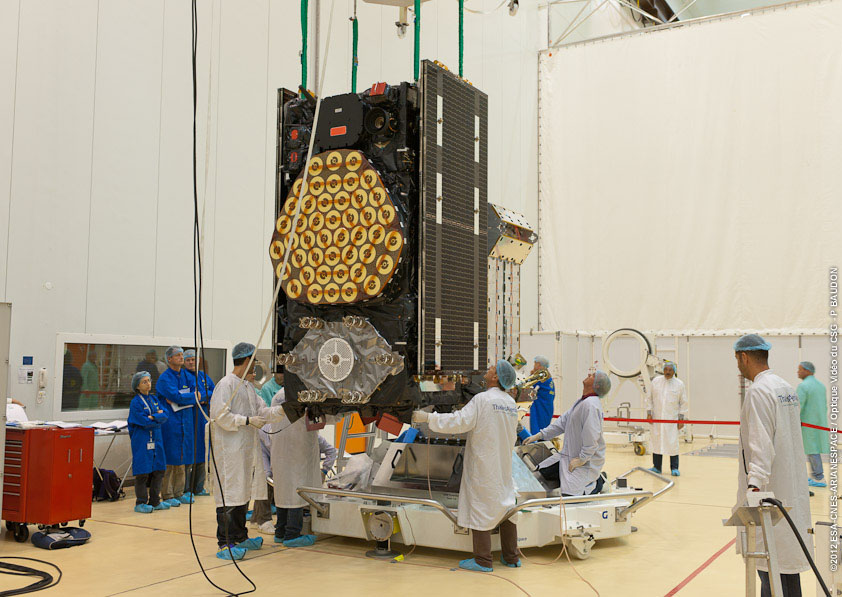
    Galileo’s fit-check with dispenser (credit: ESA).

    The combined satellites, dispenser and Fregat upper stage will now be carefully checked ahead of the next major milestone, the fitting of the protective launch fairing on Thursday.

    The mission’s satellite launch readiness review will begin at the start of the following week. If that goes well, the combined ‘Upper Composite’ will be moved from the Fregat Integration Building to the launch pad, where it will be attached to the Soyuz launcher.

    Completing Galileo’s validation phase

    The launch will see these two new Galileo In-Orbit Validation satellites joining the first two that have been orbiting since October 2011.

    This is a significant milestone for Europe’s Galileo programme because four is the minimum number required for navigational fixes, enabling full system testing whenever they are all visible in the sky.

    This validation phase will be followed by the deployment of more satellites and ground segment components to achieve ‘Full Operational Capability’. After that, users on the ground can exploit the services.

    The first four Galileo satellites were built by a consortium led by EADS Astrium, Germany, with Astrium producing the platforms and Astrium UK responsible for the payloads. They were assembled and tested in Rome by Thales Alenia Space.

    credit: ESA
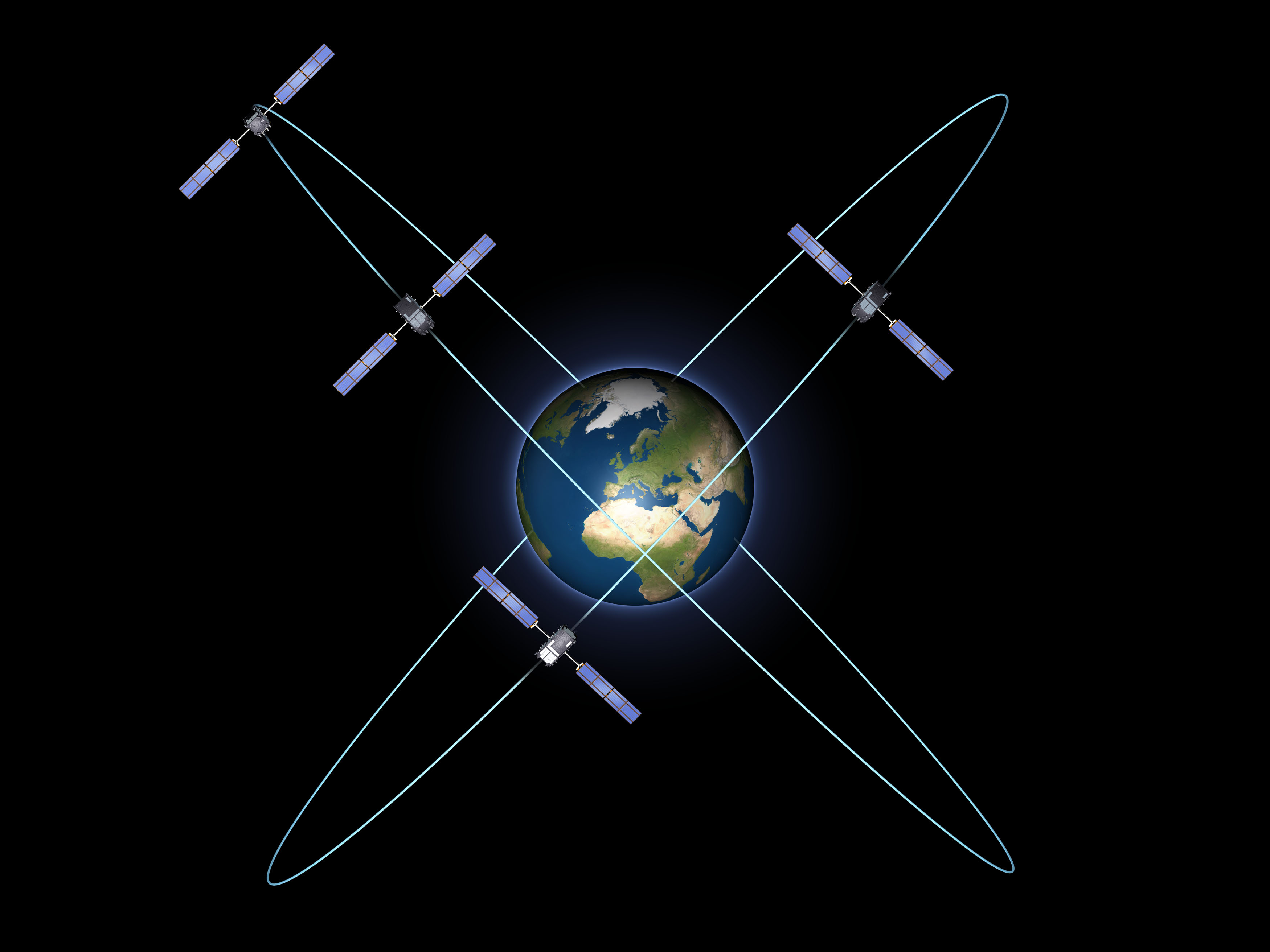
    Galileo IOV in orbit (artist’s rendering, courtesy of ESA.)
  • GSAT-10 GAGAN Satellite Launched

    News courtesy of CANSPACE Listserv.


    The Indian Space Research Organisation’s GSAT-10 geostationary communications satellite was launched from the European spaceport in Kourou, French Guiana, on 28 September at 21:18 UTC. The dual-satellite launch also carried the Astra 2F direct-to-home broadcast satellite into orbit for Luxembourg-based operator SES.

    GSAT-10 contains a payload to support the Indian GPS and GEO Augmented Navigation (GAGAN) satellite-based augmentation system. The satellite will likely use PRN code 128 from its orbital slot at 83 degrees east longitude.

    NORAD/JSpOC is tracking four objects from the launch, all in geostationary transfer orbits:

    OBJECT A
    1 38778U 12051A   12274.70409814  .00000012  00000-0  00000+0 0   107
    2 38778 003.6775 154.7710 5937516 178.5931 014.2031 02.01889852    46

    OBJECT B
    1 38779U 12051B   12274.00388870 -.00000099  00000-0  00000+0 0    93
    2 38779 005.9367 154.4296 7276764 178.6603 185.9046 02.28251452    34

    OBJECT C
    1 38780U 12051C   12273.56648427 -.00000125  00000-0  00000+0 0    70
    2 38780 005.9425 154.5770 7276251 178.3304 186.5889 02.28343008    14

    OBJECT D
    1 38781U 12051D   12273.55880826 -.00000125 +00000-0 +00000-0 0 00072
    2 38781 005.9710 153.0905 7273242 179.7915 181.3163 02.28773171000012

    The two satellites are accompanied by the Sylda 5 dual-payload adapter and the ESC-A upper stage of the Ariane 5 launch vehicle. It’s not yet known which objects are which.

    Once GSAT-10’s GAGAN L-band payload is activated, the satellite will be tracked by stations of the International GNSS Service’s Multi-GNSS Experiment in addition to those of the official GAGAN monitoring and control network.

    The following is from a press release issued by ISRO:

    “ISRO’s Master Control Facility (MCF) took over the command and control of the GSAT-10 immediately after the injection. Preliminary health checks on the various subsystems of the satellite, namely, Power, Thermal, Command, Sensors, Controls, etc., were performed and all the parameters were found satisfactory. Following this, the satellite was oriented towards the Earth and the Sun using the onboard propulsion system. The satellite is in good health.

    “In the coming five days, orbit raising maneuvers will be performed to place the satellite in the Geostationary Orbit with required inclination with reference to the equator. The satellite will be moved to the Geostationary Orbit (36,000 km above the equator) by using the satellite propulsion system in a three step approach.

    “After the completion of orbit raising operations, the two solar panels and both the dual gridded antenna reflectors of GSAT-10 will be deployed for further tests and operations. It is planned to experimentally turn on the communication payloads in the second week of October 2012.

    “After the successful completion of all in-orbit tests, GSAT-10 will be ready for operational use by November 2012. GSAT-10 will be positioned at 83deg East orbital location along with INSAT-4A and GSAT-12. The operational life of GSAT-10 is expected to be 15 years nominal.

    “GSAT-10 Satellite has 30 Communication Transponders [12 in Ku-band, 12 in C-band and 6 in Extended C-Band]. Besides, it has a Navigation payload “GAGAN” that would provide GPS signals of improved accuracy (of better than 7 meters) to be used by the Airports Authority of India for Civil Aviation requirements. GSAT-10 is the second satellite in INSAT/GSAT constellation with GAGAN payload after GSAT-8, launched in May 2011.”

  • Two Compass Satellites Launched

    News courtesy of CANSPACE Listserv.


    China successfully launched two BeiDou-2/Compass MEO satellites Tuesday at 19:10:04 UTC. The satellites are designated Compass-M5 and Compass-M6. They are also referred to BeiDou-14 and BeiDou-15.

    UPDATE: More details have emerged on yesterday’s BeiDou-2/Compass satellite launch. According to Web sources, the new satellites will occupy slots 7 and 8 in Plane A of the Compass MEO orbit design. The existing operational Compass MEO satellites, MEO-3 and MEO-4 occupy slots 3 and 4 in Plane B, 120 degrees to the west of Plane A. The Compass MEO constellation will eventually consist of 24 primary satellites, eight in each of three equally spaced planes. It is reported that the satellites now use Chinese-made atomic clocks.

    The exact time of yesterday’s launch was 19:10:04.179 UTC. NORAD/JSpOC is tracking four objects from the launch: the satellites, the adapter, and the third stage of the launch vehicle. They are all in elliptical transfer orbits at the present time and the satellites will likely transfer to their MEO orbits within the next few days.

    According to a Compass official, the current generation of Compass navigation satellites has a predicted lifetime of eight years. This will be increased to 11-12 years for future models.

    Compass managers now claim that the 5 GEO + 5 IGSO +4 MEO initial configuration will have good robustness and economic efficiency for such a regional navigation system. They state that “[T]he four MEO satellites increases the repeat coverage for users: the probability for position dilution of precision being less than three is now at 74.89 percent for more than 23 hours per day, up from 38.55 percent earlier this year.”

    The final Compass GEO satellite for the initial constellation deployment, GEO-6, is scheduled for launch in October of this year.

    CCTV-13 video report of the launch:
    http://www.youtube.com/watch?v=brzO8UtnXEM

  • Upcoming Navigation Satellite Launches Scheduled

    News courtesy of CANSPACE listserv.


    Launch dates this fall for GNSS satellites are as follows, according to various sources:

    Compass M2 and M5: September 18, 18:12 UTC (speculative); Compass G6: No earlier than October 1.

    GSAT-10 (includes a GAGAN SBAS transponder): September 21.

    GPS IIF-3: October 4, 2012. Launch window: 12:10-12:29 UTC.

    Galileo IOV FM3 and FM4: October 10, 18:31 UTC.

    Luch-5B: Originally scheduled for October 15, launch has slipped to no earlier than November 1 due to an issue with the “Briz-M” upper stage, which caused the loss of the Telkom-3 and Ekspress-MD2 communication satellites during their launch on August 6.

    GLONASS-K1 (block K2s): November 14.