Tag: satellite launch

  • The System: Next GPS IIF in October

    Next GPS IIF in October

    The next GPS satellite, Block IIF-3 (SVN65), scheduled to be launched on October 4, will be positioned in orbital slot 1, which is in plane A. This slot is currently occupied by a Block IIA satellite, SVN39, operating as PRN09. SVN39 is one of the oldest operating satellites in the GPS fleet, dating from June 1993. SVN65 will the the third of a projected 12 IIF satellites to attain orbit.

    Galileo IOV Tandem in October, Too

    The previously announced September 28 launch date for the second set of Galileo IOV satellites has reportedly been pushed back to October 10.

    Meanwhile, after more than four years of service as a Galileo testbed satellite, GIOVE-B was retired on July 23. Its navigation transmitters were switched off, according to an announcement from the European Space Agency, and the satellite’s height was raised in a series of steps to a graveyard orbit where there will be no danger of it interfering with the operational Galileo satellites or other spacecraft.

    The SES-5 geostationary communications satellite (also known as Sirius 5 and Astra 4B), launched in July, arrived at its orbital slot of 5 degrees east longitude late that month. The current position is actually about 5.2 degrees. The satellite carries L1 and L5 transponders for the European Geostationary Navigation Overlay Service (EGNOS) satellite-based augmentation system. The GPS Directorate has assigned C/A PRN code 136 and L5 PRN code 136 for use by the satellite.

    GAGAN in September

    India’s GSAT-10 telecommunications satellite — one of two passengers for Arianespace’s upcoming Ariane 5 mission on September 21 — has completed pre-flight preparations at the Spaceport in French Guiana. Aboard GSAT-10 is the GAGAN (GPS and GEO augmented navigation) payload, which will support the Indian government’s implementation of a satellite-based regional capability to assist aircraft navigation over Indian airspace and in adjoining areas. GSAT-10 is expected to be positioned at 83 degrees east longitude and use PRN code 128. It will join the first GAGAN-equipped satellite, GSAT-8, launched in May 2011, and now at 55 degrees east longitude and transmitting test signals on the L1 frequency using C/A PRN code 127. Although GSAT-8 reportedly carries a dual-frequency transponder, no L5 signals from this satellite have yet been detected by International GNSS Service tracking stations.

    GLONASS SBAS in September as Well

    Luch-5B, the second of three geostationary satellites to reactivate Roscosmos’s Luch Multifunctional Space Relay System, is scheduled for launch no earlier than November 1, 2012, to be positioned at 16 degrees west longitude. The system’s multi-functional satellites carry transponders for the System for Differential Correction and Monitoring (SDCM), Russia’s satellite-based augmentation system. The transponders will broadcast GNSS corrections on the standard GPS L1 frequency using C/A PRN codes assigned by DoD’s GPS Directorate.

    Luch-5A, launched in December 2011, has been placed in an orbital slot at 95 degrees east longitude. It began transmitting corrections on July 12, using PRN code 140.

    SVN49 Back on the Air, Unhealthy

    The GPS Block IIR-M satellite, SVN49, briefly resumed transmissions as PRN24 on August 9. The signals were marked unhealthy and the satellite was not included in broadcast almanacs. SVN49 was launched in March 2009, but remains out of service until an L1/L2 satellite multipath issue is resolved. Although not in the almanacs, a number of stations of the International GNSS Service tracked SVN49. See http://gge.unb.ca/test/IGS_stns_tracking_G24_223.pdf. SVN49 stopped transmitting signals as PRN24 on August 22. SVN49 previously operated between March 28, 2009, and May 6, 2011, as PRN01, and between February 2 and March 14, 2012, as PRN24.

    Beidou Begins Testing Network

    China will build a Beidou testing and certification network over the next three years to sharpen the system’s global competitiveness, according to a statement from China’s Certification and Accreditation Administration. By 2015, a national testing center will be set up in Beijing, while seven local sub-centers will be established across the nation, it said. The centers will test the safety and accuracy of products designed for use with Beidou and qualify them for civilian use. China plans to launch 30 satellites to complete the system by 2020.

    The launch of next two Beidou-2/Compass medium-Earth-orbit satellites, M2 and M5, did not occur in August as was previously speculated. A knowledgable source states: “All three active Chinese tracking ships have retreated to their home base Jiangyin, north of Shanghai. (Two ships are required for tracking down-range for a typical Chinese beyond-low-Earth-orbit launch.) The launch was put off for the remaining part of August and at least the first couple of weeks in September. The most recently speculated launch date is September 18.”


  • Preparations Move Forward for Next Galileo Launch


    Galileo Flight Model #3 (FM3) is readied for the satellite’s fit check on the dispenser that will carry it and FM4 in a parallel arrangement on Soyuz’ next launch. The silver-colored dispenser is partly visible behind two mission team members during this activity in the Spaceport’s S1B payload preparation building.


    Both Galileo navigation satellites for Arianespace’s third Soyuz flight from the Spaceport are now in French Guiana, marking a new milestone for this mission scheduled in the second half of 2012, according to Arianespace.

    The Flight Model #4 (FM4) satellite arrived Friday at Félix Eboué International Airport near the capital city of Cayenne, delivered by a chartered Ilyushin Il-76TD cargo jetliner.

    Its FM3 co-passenger remains busy in the Spaceport’s S1B payload preparation building — completing its fit check with the dispenser for the dual-satellite payload arrangement on Soyuz. The dispenser was developed for Arianespace by RUAG Space, and carries the satellites in a parallel arrangement.

    These two spacecraft will join another pair of Galileo satellites launched by Arianespace in October 2011 on Soyuz’ maiden flight from French Guiana. All four are In-Orbit Validation platforms that will enable European industry to validate prototype Galileo-based receivers and services using actual satellite signals, while also allowing performance assessments of the ground system that will maintain the Galileo system’s precision.

    Arianespace is responsible for deploying the entire Galileo constellation, to be composed of 30 satellites in orbit as an independent global satellite navigation system for Europe.

    Galileo launches began with the 2005 and 2008 orbiting of two experimental satellites — GIOVE-A and GIOVE-B — carried on Soyuz vehicles operated from Baikonur Cosmodrome in Kazakhstan by Arianespace’s Starsem affiliate. It was followed by October 2011’s maiden Soyuz launch from French Guiana with the constellation’s first two operational satellites.

    Arianespace is able to use a mix of both its medium-lift Soyuz and heavy-lift Ariane 5 launchers in deploying the full Galileo system, demonstrating the company’s flexibility in orbiting satellite constellations.


    The photo shows FM4’s unloading from the Ilyushin Il-76TD cargo jetliner at Cayenne’s Félix Eboué International Airport.


    The fourth Galileo flight model satellite being unloaded at Cayenne Airport in French Guiana on August 17. (Credits: ESA/EADS Astrium – Raoul Kieffer)

  • GSAT-10 with GAGAN Spreads Its Wings in Test Before Ariane 5 Launch

    India’s GSAT-10 telecommunications satellite — one of two passengers for Arianespace’s upcoming Ariane 5 mission in September — has been put through its paces during pre-flight preparations at the Spaceport in French Guiana, including a solar panel deployment test, according to Arianespace.

    Also aboard GSAT-10 is the GAGAN (GPS and GEO augmented navigation) payload, which will support the Indian government’s implementation of a satellite-based regional capability to assist aircraft navigation over Indian airspace and in adjoining areas. The initial GAGAN payload was carried aboard the GSAT-8 spacecraft, orbited by Arianespace on an Ariane 5 mission in May 2011.

    The solar panel checkout involved the extension of its multi-segment solar panels, validating the proper operation before they are definitively stowed against the satellite in the final lift-off configuration. The test uses an overhead latticework that helps support the solar panel’s weight — simulating zero gravity conditions of space as the panel opens to its full length.

    Performed under the control of GSAT-10 satellite team members, the extension validation was conducted in the S5C high bay area of the Spaceport’s S5 payload preparation center — the largest individual hall in this facility.

    GSAT-10 was developed by the Indian Space Research Organisation (ISRO), and will meet the growing need for Ku- and C-band transponder capacity.  It is to become part of the Indian National Satellite (INSAT) system of geostationary spacecraft — representing one of the largest domestic communications satellite networks in the Asia-Pacific region.

    Configured with 12 Ku-band, 12 C-band and 12 extended C-band transponders, GSAT-10 utilizes the I-3K satellite bus developed by ISRO, with a power capability of some six kilowatts and a liftoff mass estimated at 3,400 kg.

    The upcoming Ariane 5 flight with GSAT-10 and the Astra 2F satellite as its co-passenger is set for September 21 from the Spaceport’s ELA-3 launch
    complex. This will be Arianespace’s fifth mission from French Guiana in 2012 with the heavy-lift workhorse.

    Below, one of GSAT-10’s two solar panels is extended during deployment verifications performed in the Spaceport’s S5 payload preparation center.

    940-1

    940-2

    940-3


  • Second Russian SBAS Satellite Prepared for Launch

    News courtesy of CANSPACE Listserv.


    Luch-5B, the second of a set of three geostationary satellites being launched to reactivate Roscosmos’s Luch Multifunctional Space Relay System, has been delivered to the Baikonur Cosmodrome. It arrived together with the Yamal-300K satellite in a single shipping container aboard an Antanov An-124-100 Ruslan flight from Krasnoyarsk.

    This marked the first time that Information Satellite Systems – Reshetnev has used the special container, which is large enough to carry two middle-class spacecraft at one time. According to the company, sophisticated equipment fitted with a control system that helps monitor the environment inside the container helps avoid any chances of external damage or unwanted environmental impact during transportation.

    Luch-5B is now undergoing preparations for launch.

    The Luch system will be used to relay communications and telemetry between low-Earth-orbiting spacecraft, such as the the Russian segment of International Space Station, and Russian ground facilities.

    The system’s satellites also carry transponders for the System for Differential Correction and Monitoring (SDCM), Russia’s satellite-based augmentation system. The transponders will broadcast GNSS corrections on the standard GPS L1 frequency using C/A PRN codes assigned by DoD’s Global Positioning Systems Directorate.

    As previously reported, Luch-5A, which was launched on 11 December 2011, has been placed in an orbital slot at 95 degrees east longitude. It began transmitting corrections on July 12, 2012, using PRN code 140.

    Luch-5B, scheduled for launch on September 7, 2012, will be positioned at 16 degrees west longitude.


    Satellite Luch-5B in an anechoic chamber at ISS-Reshetnev.

  • Boeing Ships Third GPS IIF Satellite to Cape Canaveral for Launch

    On July 9, Boeing shipped the third of 12 GPS IIF satellites for the U.S. Air Force from the company’s Satellite Development Center in El Segundo to Cape Canaveral Air Force Station, Florida, aboard a Boeing-built C-17 Globemaster III airlifter.

    SVN-65 is scheduled to be launched in the fourth quarter of this year aboard a United Launch Alliance Delta IV rocket. It will join the first and second Boeing-built GPS IIF satellites, launched May 27, 2010, and July 16, 2011, to continue the sustainment and modernization of the GPS network.

    “As each IIF satellite becomes operational, we continue the seamless transformation of the GPS constellation into an even more accurate, reliable and durable navigation resource for the U.S. military and the global civilian user community,” said Craig Cooning, vice president and general manager of Boeing Space & Intelligence Systems. “Our efficient pulse-line manufacturing process, adapted from Boeing’s commercial airplane production lines, also ensures that we deliver each spacecraft on time and on cost.”

    SVN-65 will now undergo preflight checkout, fueling, and integration to prepare for the early October launch. When on orbit, it will be controlled by the Operational Control Segment, the GPS network’s ground control system. Developed by a Boeing-led team, the OCS entered service in 2007 and was turned over to the Air Force 50th Space Wing in April 2011.

    GPS IIF features greater navigational accuracy through improvements in atomic clock technology, a more secure and jam-resistant signal for the military, and a protected, more precise, and interference-free civilian L5 signal for commercial aviation and search-and-rescue operations. Other enhancements to the IIF include an extended 12-year design life and a re-programmable on-orbit processor that can receive software uploads for improved system operation.

    Of the remaining nine IIFs that Boeing is building for the Air Force, three are complete and in storage, and six are being assembled and tested.

  • SES-5 SBAS Satellite Successfully Launched

    SES-5 SBAS Satellite Successfully Launched

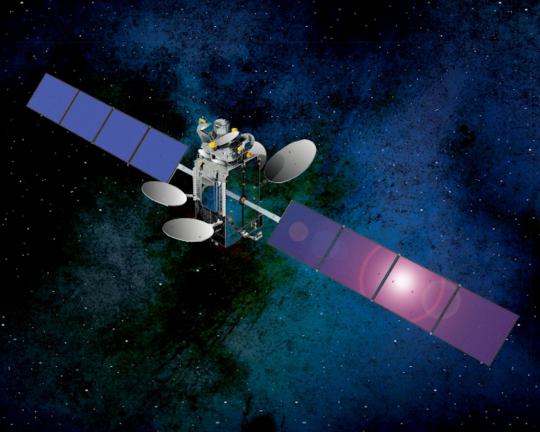
    Artist's rendering of the SES-5. Photo: CANSPACE Listserv
    Artist’s rendering of the SES-5. Photo: CANSPACE Listserv

    News courtesy of CANSPACE Listserv.

    The SES-5 geostationary communications satellite (also known as Sirius 5 and Astra 4B) was launched from the Baikonur Cosmodrome on July 9 at precisely 18:38:29.994 UTC. After a number of manoeuvres by the various rocket stages, the satellite was released from the Breeze-M upper stage into its geostationary transfer orbit (GTO) at 03:50:15.150 UTC on July 10.

    The planned GTO has a perigee height of 4,170 km, an apogee height of 35,786 km, and an orbital inclination of 23.1 degrees. The satellite’s apogee-kick motor should place the satellite into its geostationary Earth orbit (GEO) within the next few days. The GEO sub-satellite point will be at 5 degrees east longitude.

    SES-5 hosts a dual-frequency transponder for the European Geostationary Navigation Overlay Service (EGNOS). The pseudorandom noise codes to be used by the satellite are not yet known.

    “SES-5 is an important addition to our fleet serving both our commercial and government customer with our first L-band payload for EGNOS to augment the GPS system for Europe. This is a great accomplishment by all of the teams who worked on the SES-5 mission — SES, ILS, Khrunichev, and Space Systems/Loral — and we thank them for their dedicated work on the successful launch,” said SES President and CEO, Romain Bausch.

  • UPDATE: Launch of EGNOS Satellite Delayed until Monday


    News courtesy of CANSPACE Listserv.

    Roscosmos is conducting further tests on the launch vehicle for the SES-5 satellite, and have postponed the launch for two days. The new launch date is Monday, July 9, with an approximate launch time of 18:24 UTC.

    The launch of SES-5 from the Baikonur Cosmodrome, originally scheduled for June 18, was first rescheduled to July 7 due to a problem with a first stage subsystem on the Proton launch vehicle.

    SES-5 is also known as Sirius 5 stemming from the development of the Sirius satellite constellation by Nordic Satellite AB, now ownded by Luxembourg's SES. The satellite carries a transponder for the European Geostationary Navigation Overlay Service (EGNOS). The transponder is intended to eventually replace or supplement one of those on the currently used EGNOS satellites (Inmarsat 3-F2 at 15.5 degrees west using PRN 120, Inmarsat-4-F2 at 25 degrees east using PRN 126, and Artemis at 21.5 degrees east using PRN124, and designated for industry tests).

    Unlike the present L1-only EGNOS satellites, SES-5 will have transponders on both the L1 and E5 frequencies similar to the setup on the Wide Area Augmentation System satellites, which broadcast on L1 and L5.

    SES-5 is to be stationed at 5 degrees east longtiude. A second SES satellite with EGNOS transponders is under construction. The SES Astra 5B satellite is scheduled for launch in the second quarter of 2013 and will be positioned at SES Astra's 31.5 degrees east orbital position.

  • UPDATE: EGNOS Satellite Launch Set for August 6


    News courtesy of CANSPACE Listserv.

    UPDATE: The Interfax news agency has announced that the rescheduled launch date for SES-5 from the Baikonur Cosmodrome, originally scheduled for June 18, is August 6, 2012.

    The launch is being delayed due to a problem with a first stage subsystem on the Proton launch vehicle. The rocket has been rolled back to the assembly building for further tests.

    SES-5 is also known as Sirius 5 stemming from the development of the Sirius satellite constellation by Nordic Satellite AB, now owned by Luxembourg’s SES.

    The satellite carries a transponder for the European Geostationary Navigation Overlay Service (EGNOS). The transponder is intended to eventually replace or one of those on the currently used EGNOS satellites (Inmarsat 3-F2 at 15.5 degrees west using PRN 120, Artemis at 21.5 degrees east using PRN124, and Inmarsat-4-F2 at 25 degrees east using PRN 126 and designated for industry tests).

    Unlike the present L1-only EGNOS satellites, SES-5 will have transponders on both the L1 and E5 frequencies similar to the setup on the Wide Area Augmentation System satellites, which broadcast on L1 and L5.

    SES-5 is to be stationed at 5 degrees east longtiude.

    A second SES satellite with EGNOS transponders is under construction. The SES Astra 5B satellite is scheduled for launch in the second quarter of 2013 and will be positioned at SES Astra’s 31.5 degrees east orbital position.

    Role Switch. On March 22 and 23, Inmarsat-4-F2 at 25 degrees east using PRN126 and Artemis at 21.5 degrees east using PRN124 switched roles. PRN126 became an EGNOS operational signal-in-space satellite while PRN124 became the test satellite, transmitting message type 0. PRN120 and PRN126 returned to service around 17:00 UTC on Tuesday, June 26.

    According to an EGNOS service announcement dated April 3, the switch was due to the aging state of the Artemis satellite.

  • Trial by Vacuum Brings Next Galileo Satellites Closer to Launch

    Source: GPS world staff
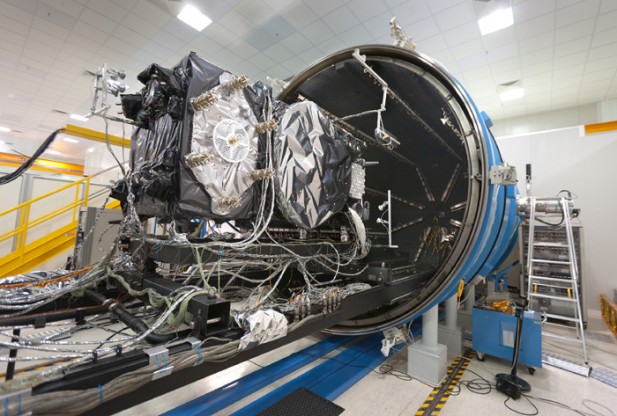
    The fourth Galileo In-Orbit Validation flight model satellite, FM4, pictured at the start of thermal vacuum testing at Thales Alenia Space Italy’s facility in Rome in May 2012. The third Galileo flight model, FM3, had already undergone this testing. Credits: ESA/EADS Astrium – R. Kieffer

    The next two Galileo navigation satellites have now endured the harsh vacuum and temperature extremes of space on the way to their scheduled 28 September launch, according to the European Space Agency. The fourth satellite completed 20 days of thermal vacuum testing at Thales Alenia Space Italy’s plant in Rome at the start of June. The third satellite completed the same tests the previous month.

    “These two satellites are almost identical to the first two Galileo satellites that were launched last 21 October,” explained ESA’s Nigel Watts. “So we don’t need to carry out full-scale qualification tests because we already know from our in-orbit test campaign that the design performs to our expectations. Instead, what we are carrying out is acceptance testing: checking the workmanship, performance and readiness to launch of these new satellites.”

    Thermal vacuum testing involves placing each satellite into a vacuum chamber and pumping out all the air. Its external surfaces are then variously heated and cooled while the satellite is operated. With no air in orbit to moderate temperatures, any part of a satellite in sunlight can become extremely hot, while those parts in shadow or facing deep space grow extremely cold. Critical systems must be kept within a set temperature range, however.
    “To give an idea, Galileo’s laser retroreflector on its exterior reached –110°C during the cold phase of testing,” said Guido Barbagallo, Galileo thermal engineer. “Meanwhile, the navigation high-power amplifiers could be driven to more than +40°C during the hot phase.”

    Like most satellites, Galileo’s uses a variety of methods to maintain its temperature range, including multi-layer insulation, heaters, heat pipes relying on evaporating ammonia to shift heat, and radiators to dump waste heat out to space. Galileo’s passive hydrogen maser atomic clock at the heart of its navigation services is precise to a second in three million years.

    But it requires extremely stable thermal conditions to achieve this. Its operating temperature needs to be regulated within a single degree, though in practice a tenth of that can be achieved.
    “The passive hydrogen maser is mounted on a 3 mm-thick aluminium plate to help hold a uniform temperature, with waste heat finally radiated to space from the external satellite surface,” added Guido.

    The atomic clock and the mounting plate are wrapped in multi-layer insulation and attached to the top panel of the satellite, which is itself kept permanently out of the Sun.

  • Galileo Launches Accelerated

    Javier Benedicto, the head of the Galileo Project Office for the European Space Agency (ESA), set an aggressive schedule for launching some Galileo satellites as many as four at a time in 2014 and 2015, in an effort to meet a target provision date of Galileo's initial services in 2014 and full services in 2015. The announcement emerged at the Munich Summit on March 14.

    The hurry-up to carry a further 22 satellites into orbit will get underway with continued dual-satellite launches aboard Russian Soyuz rockets, as was the case for the most recent in-orbit validation (IOV) launch in October, 2011. There will be three Soyuz launches in 2013, for a total of six new satellites boosted into orbit, and two Soyuz launches in 2014, adding four more. Then the burden will shift to European rockets provided by Arianespace, according to a contract signed in February of this year. One Ariane 5 rocket is slated to carry four Galileo satellites aloft in 2014, bringing the projected total of IOV and eventually operational Galileo satellites in space to 16 by the end of 2014.

    Previously, ESA had aired plans to continue with Soyuz-borne IOV launches in 2012, but the schedule announced in Munich did not mention these.

    In 2015, two more Ariane 5 launches will add eight satellites, for a total on orbit of 24, estimated to be sufficient for Galileo full operational capability.

    In subsequent talks with European satellite manufacturers OHB Systems and Astrium, GPS World contributing editor Don Jewell was told that the future launch schedule is "subject to change."

    ESA has made no official announcement of a detailed launch schedule; inquiries regarding the Benedicto remarks were referred to the February contract statement, cited above.


  • Galileo Launches Accelerated

    Javier Benedicto, the head of the Galileo Project Office for the European Space Agency (ESA), set an aggressive schedule for launching some Galileo satellites as many as four at a time in 2014 and 2015, in an effort to meet a target provision date of Galileo’s initial services in 2014 and full services in 2015. The announcement emerged at the Munich Summit on March 14.

    The hurry-up to carry a further 22 satellites into orbit will get underway with continued dual-satellite launches aboard Russian Soyuz rockets, as was the case for the most recent in-orbit validation (IOV) launch in October, 2011. There will be three Soyuz launches in 2013, for a total of six new satellites boosted into orbit, and two Soyuz launches in 2014, adding four more. Then the burden will shift to European rockets provided by Arianespace, according to a contract signed in February of this year. One Ariane 5 rocket is slated to carry four Galileo satellites aloft in 2014, bringing the projected total of IOV and eventually operational Galileo satellites in space to 16 by the end of 2014.

    Previously, ESA had aired plans to continue with Soyuz-borne IOV launches in 2012, but the schedule announced in Munich did not mention these.

    In 2015, two more Ariane 5 launches will add eight satellites, for a total on orbit of 24, estimated to be sufficient for Galileo full operational capability.

    In subsequent talks with European satellite manufacturers OHB Systems and Astrium, GPS World contributing editor Don Jewell was told that the future launch schedule is “subject to change.”

    ESA has made no official announcement of a detailed launch schedule; inquiries regarding the Benedicto remarks were referred to the February contract statement, cited above.

  • Galileo IOV Satellites Succesfully Launched into Orbit

    21102011-_SCO3184-W

    The first pair of satellites for Europe’s Galileo global navigation satellite system has been lofted into orbit by the first Russian Soyuz vehicle ever launched from Europe’s Spaceport in French Guiana in a milestone mission, reports the European Space Agency.

    The launch occurred one day after initially scheduled to resolve a problem with the ground-support fueling system.

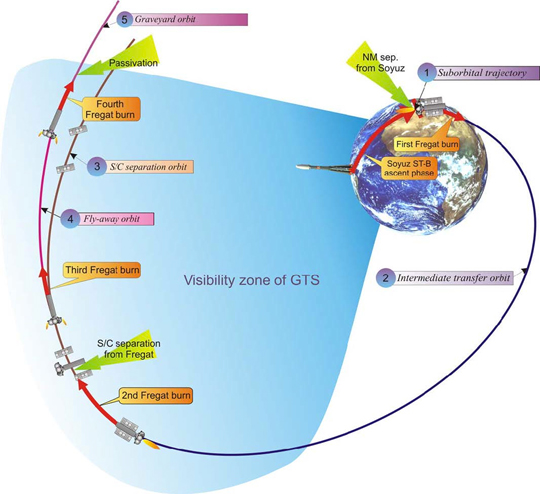
    The Soyuz VS01 flight, operated by Arianespace, started with liftoff from the new launch complex in French Guiana at 10:30 GMT on October 21. All of the Soyuz stages performed as expected and the Fregat-MT upper stage released the Galileo satellites into their target orbit at 23,222 km altitude, 3 hours 49 minutes after liftoff. A launch replay is available. A look inside the IOV satellite is available on the BBC website.

    The two Galileo satellites riding the Soyuz are part of the In-Orbit Validation (IOV) phase that will see the Galileo system’s space, ground and user segments extensively tested. The satellites are now being controlled by a joint ESA and CNES French space agency team in Toulouse, France. After these initial operations, they will be handed over to SpaceOpal, a joint company of the DLR German Aerospace Center and Italy’s Telespazio, to undergo 90 days of testing before being commissioned for the IOV phase.

    The next two Galileo satellites, completing the IOV quartet, are scheduled for launch in summer 2012.

    “This launch represents a lot for Europe: we have placed in orbit the first two satellites of Galileo, a system that will position our continent as a world-class player in the strategic domain of satellite navigation, a domain with huge economic perspectives,” said Jean-Jacques Dordain, director General of ESA.  “Moreover, this historic first launch of a genuine European system like Galileo was performed by the legendary Russian launcher that was used for Sputnik and Yuri Gagarin, a launcher that will, from now on, lift off from Europe’s Spaceport.

    “These two historical events are also symbols of cooperation: cooperation between ESA and Russia, with a strong essential contribution of France; and cooperation between ESA and the European Union, in a joint initiative with the EU. This launch consolidates Europe’s pivotal role in space cooperation at the global level. All that has been possible thanks to the vision and commitment of ESA member states.”

    This was also the first Soyuz to be launched from a site outside of Baikonur in Kazakhstan or Plesetsk in Russia. A new site for Soyuz in French Guiana, operated by Arianespace, adds to the flexibility and competitiveness of Europe’s fleet of launchers.

    Soyuz is a medium-size vehicle, complementing ESA’s launchers: Ariane 5 handles large payloads, and the new Vega, planned to debut in 2012, will lift smaller satellites.

    Launching from close to the equator allows the European Soyuz to offer improved performance. From French Guiana, Soyuz can carry up to 3 tonnes into the ‘geostationary transfer orbit’ typically required by commercial telecommunications satellites, compared to the 1.7 tonnes that can be delivered from Baikonur.

    Source: GPS world staff
    The launch profile of the Galileo IOV satellites.