Tag: Septentrio

  • Septentrio, Esri BeLux Bring Centimeter Accuracy to Mobile GIS Apps

    Septentrio, Esri BeLux Bring Centimeter Accuracy to Mobile GIS Apps

    Septentrio-geopod-W
    Photo: Septentrio

    Septentrio NV, the Belgian manufacturer of high-end GNSS receivers, and Esri BeLux, the regional distributor of Esri software, have joined forces to offer a user-friendly mobile solution that is accurate up to 1 centimeter. The combination of Esri software and the AsteRx-m GeoPod operates seamlessly using standard, open interfaces on any professional tablet. Used today by a major utility company, the new bundled solution allows anyone in the organization to accurately locate field assets and record geo-referenced data on the spot, Septentrio said.

    The AsteRx-m GeoPod upgrades professional tablet PCs with a high accuracy GNSS receiver, giving the user access to sub-meter, or even centimeter, accurate positions without needing specialized equipment. Using a standard USB connection, the AsteRx-m GeoPod can be connected to any professional tablet, giving the user free choice to select a device.

    The receiver uses satellites from the GPS and GLONASS constellations to increase the availability of a high-quality position solution, even in areas with bad satellite visibility. In addition, the receiver offers innovative tracking and positioning algorithms designed for demanding professional environments.

    The included RxAssitant software takes care of configuring the receiver and connecting to NTRIP-capable RTK or DGNSS networks, allowing a seamless integration with existing software applications like esri ArcGIS for mobile.

    Applications for the AsteRx-m GeoPod include construction, field service, utility mapping, highway maintenance, government mapping and emergency services.

  • Expert Advice: Product Testing: Simulation and Beyond

    By Pierre Nemry and Jean-Marie Sleewaegen, Septentrio Satellite Navigation

    Today’s customers ask for high-accuracy positioning everywhere, even in the most demanding environments. The time is long gone that the only requirement for a receiver was to track GPS L1 and L2 signals in open-sky conditions. State-of-the-art receivers operate in increasingly difficult conditions, cope with local radio-frequency interference, survive non-nominal signal transmissions, decode differential corrections from potentially untrusted networks — and more!

    Difficult real-life operating conditions are typically not addressed in textbooks or in the specialized literature, and yet they constitute the real challenge faced by receiver manufacturers. Most modern GNSS receivers will perform equally well in nominal conditions, or when subjected to nominally degraded conditions such as the ones that correspond to standard multipath models. However, the true quality of a GNSS receiver reveals itself in the environment in which it is intended to be used.

    In view of this, a GNSS manufacturer’s testing revolves around three main pillars:
    ◾    identifying the conditions and difficulties encountered in the environment of the intended use,
    ◾    defining the relevant test cases, and
    ◾    maintaining the test-case database for regression testing.

    In developing new receiver functionality, it is important to involve key stakeholders to comprehend the applications in which the feature will be used and the distinctive environment in which the receiver will function. For example, before releasing the precise-point-positioning (PPP) engine for the AsteRx2eL, we conducted a field-test campaign lasting a full month on a ship used for dredging work on the River Thames and in the English Channel. This enabled engineers to capture different types of sea-wave frequency and amplitude, assess multipath and signal artifacts, and characterize PPP correction data-link quality.

    Most importantly, we immersed the team in the end-user environment, on a work boat and not simply in a test setup for that purpose. As another example, in testing our integrated INS/GNSS AsteRxi receiver for locating straddle carriers in a container terminal, we spent months collecting data with the terminal operator. This was necessary to understand the specificities of a port environment, where large metal structures (shore cranes, container reach-stackers, docked ships) significantly impair signal reception.

    Furthermore, the close collaboration between the GNSS specialist, the system integrator, and the terminal owner was essential to confirm everything worked properly as a system. In both examples, in situ testing provide invaluable insight into the operating conditions the receivers have to deal with, much surpassing the possibilities of a standard test on a simulator or during an occasional field trip.

    Once an anomaly or an unusual condition has been identified in the field, the next step is to reproduce it in the lab. This involves a thorough understanding of the root cause of the issue and leveraging the lab environment to reproduce it in the most efficient way. Abnormalities may be purely data-centric or algorithmic, and the best approach to investigate and test them would be software-based. For example, issues with non-compliance to the satellite interface control document or irregularities in the differential correction stream are typically addressed at software level, the input being a log file containing GNSS observables, navigation bits, and differential corrections.

    Other issues are preferably reproduced by simulators, for example those linked to receiver motion, or those associated to a specific constellation status or location-dependent problems. Finally, certain complicated conditions do not lend themselves to being treated by simulation. For example, the diffraction pattern that appears at the entrance of a tunnel is hard to represent using standard simulator scenarios. For these circumstances, being able to record and play back the complete RF environment is fundamental.

    Over the years, GNSS receiver manufacturers inventoried numerous cases they encountered in the field with customers or during their own testing. For each case, once it has been modeled and can be reproduced in the lab, it is essential to keep it current. As software evolves and the development team changes, the danger exists that over time, the modifications addressing a dysfunctional situation get lost, and the same problem is reintroduced. This is especially the case for conditions that do not occur frequently, or do not happen in a systematic way. Good examples are the GLONASS frequency changes, which arise in an unpredictable way, making it very difficult for the receiver designer to properly anticipate. This stresses the importance of regression testing. It is not enough to model all intricate circumstances for simulation, or to store field-recorded RF samples to replay later. It is essential that the conditions of all previously encountered incidents be recreated and regularly tested in an automated way, to maintain and guarantee product integrity.

    The coverage of an automated regression test system must range from the simplest sanity check of the reply-to-user commands to the complete characterization of the positioning performance, tracking noise, acquisition sensitivity, or interference rejection. Every night in our test system, positioning algorithms including all recent changes are fed with thousands of hours of GNSS data, and their output compared to expected results to flag any degradation. Next to the algorithmic tests, hardware-in-the-loop tests are executed on a continuous basis using live signals, constellation simulators, and RF replay systems, with the signals being split and injected in parallel into all our receiver models. Such a fully automated test system ensures that any regression is found in a timely manner, while the developer is concentrated on new designs, and that a recurring problem can be spotted immediately. The test-case database is a valuable asset and an essential piece of a GNSS company’s intellectual property. It evolves continuously as new challenges get detected or come to the attention of a caring customer-support team. Developing and maintaining this database and all the associated automated tests is a cornerstone of GNSS testing.

  • The System: Galileo Autonomous Fix, Indoor Nav Standards

    The System: Galileo Autonomous Fix, Indoor Nav Standards

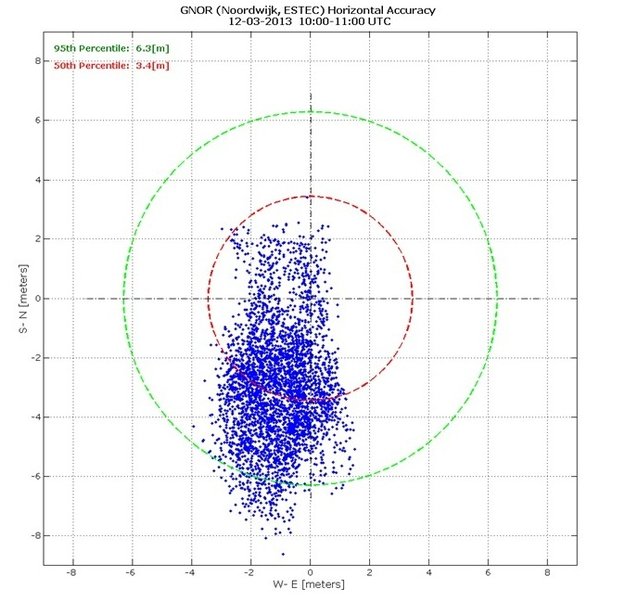
    Measurements of individual Galileo horizontal position fixes performed for the first time using the four Galileo satellites in orbit plus the worldwide ground system between 1000 and 11:00 CET on Tuesday 12 March 2013, showing an overall horizontal accuracy over ESTEC in Noordwijk, the Netherlands, of 6.3 m.
    Measurements of individual Galileo horizontal position fixes performed for the first time using the four Galileo satellites in orbit plus the worldwide ground system between 1000 and 11:00 CET on Tuesday 12 March 2013, showing an overall horizontal accuracy over ESTEC in Noordwijk, the Netherlands, of 6.3 m.

    Galileo Logs First Autonomous Fix; Galileo over Canada (By James T. Curran, Mark Petovello, and Gérard Lachapelle); and Indoor Nav: Early Steps towards FCC Standards

    Galileo Logs First Autonomous Fix

    Entitling its release “From Orbit with Love,” the European Space Agency (ESA) announced March 12 that the four current satellites of the Galileo constellation achieved their first autonomous position fix. The feat was replicated by the NavSAS group of Politecnico di Torino, by GNSS manufacturer Septentrio, and by a University of Calgrary team as the four satellites appeared over North America.

    The obtained accuracy lies in the 10-meter range, according to ESA, adding that this fulfills expectations, considering the infrastructure is only partly deployed. The fix was obtained by ESA’s Netherlands navigation lab, using the four satellites, launched in October 2011 and 2012, and the Galileo programme’s ground infrastructure: control centers in Italy and Germany and a global network of ground stations.

    With only four satellites for the time being, the full Galileo constellation is visible at the same time for a maximum two to three hours daily. This frequency will increase as more satellites join the constellation in orbit, along with extra ground stations coming online, for Galileo’s early services to start at the end of 2014.

    With the validation testing activities under way, users might experience breaks in the content of the navigation messages being broadcast, said ESA. In the coming months the messages will be further elaborated to define the offset between Galileo System Time and Coordinated Universal Time (UTC), enabling Galileo to be relied on for precision timing applications, as well as the Galileo to GPS Time Offset, ensuring interoperability with GPS.

    NavSAS Confirmation. Almost simultaneously with the ESA announcement, the NavSAS group of Politecnico di Torino and Istituto Superiore Mario Boella in Turin, Italy, also achieved a position fix using the signals of the four In-Orbit Validation satellites (PFM, FM2, FM3, FM4). NavSAS researchers computed the positions using full software receivers developed by the team.

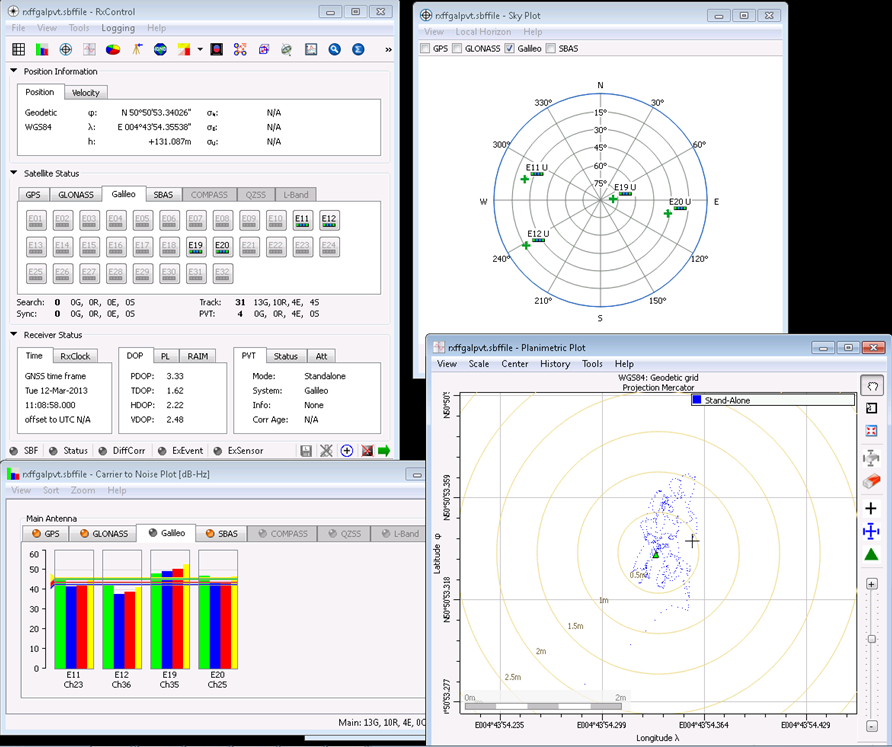
    Septentrio, Too. Septentrio became the first receiver manufacturer to report an autonomous real-time position calculation using Galileo IOV satellites with its own standard commercial receiver. The company based in Leuven, Belgium announced on March 12 that it performed  standalone position calculated from in-orbit navigation messages using a standard PolaRx4 GNSS receiver equipped with commercially released firmware.

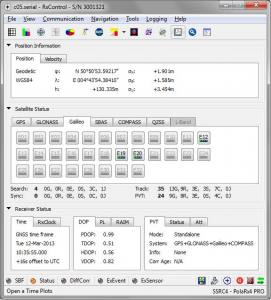
    This achievement was followed by a further Septentrio release stating performance of what it believes to be the first 4-constellation PVT by a standard commercial receiver, on March 12 at approximately 10:35 UTC.

    The milestone in all three accounts is that it is Galileo-only real-time positioning. Galileo positioning in post-processing mode was described by authors from the Technische Universität München and the German Space Operations Center, in a GPS World account, February 2012 issue.

    Galileo over Canada

    By James T. Curran, Mark Petovello, and Gérard Lachapelle

    Within a day of activation over Europe, Galileo satellites were visible over North America. The PLAN Group of the University of Calgary captured and processed signals from Galileo PRN 11, 12, and 19 on E1B/C. The PLAN software GSNRx  simultaneously tracked GPS L1 and GLONASS L1 for combined solutions in real time.

    The Galileo navigation message on E1B stated that the satellite health status is flagged as E1BHS=3 meaning “Signal Component currently in Test” and the data validity status is flagged as E1BDVS=1 meaning “Working without guarantee.” Current Galileo-ready commercial receivers may automatically discard measurements from a satellites broadcasting such messages. Parsing the received words in the I/NAV message, more than 50 percent were of type 0, although all words (types 0 to 10) were decoded at some point during the test.

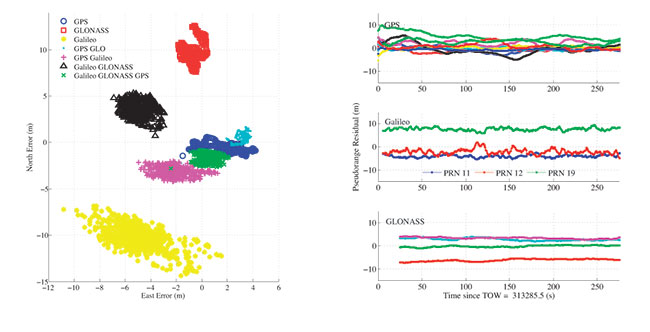
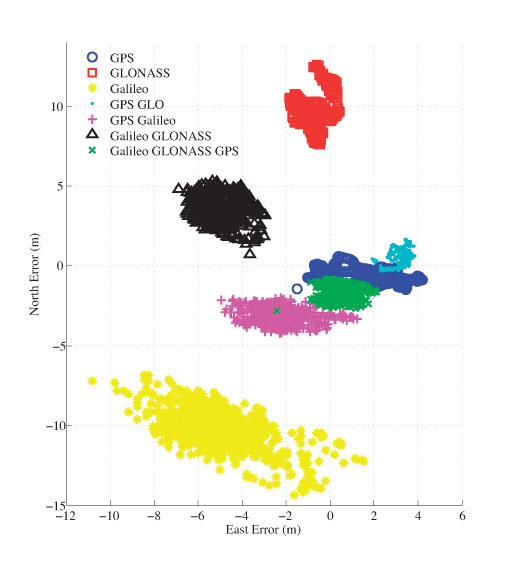
    Figure 1. 2D position errors.
    Figure 1. 2D position errors.

    Data was collected using a roof-mounted NovAtel 702GG antenna and an in-house two-channel digitizing front-end clocked by a high quality OCXO, in addition to a three-channel National Instruments front-end for post-processing. The two-channel intermediate frequency data was streamed live to a laptop computer for real-time processing with GSNRx. The GPS and GLONASS signals were tracked using a Kalman-filter-based tracking strategy while the Galileo signals were tracked using a specialized data-pilot algorithm.

    Pseudorange and Doppler observations were extracted from the tracking strategies at a rate of 2 Hz. Single-frequency single-point position solutions were then computed for each of the three systems, each of the three pairs of systems and for the full combined Galileo-GLONASS-GPS. In the case of the three-satellite Galileo solution, the height was held fixed. Figure 1 shows 2D position errors with respect to antenna ITRF coordinates. Departures of the solutions involving GLONASS are likely due to orbital biases, given location of Calgary with respect to GLONASS ground stations.

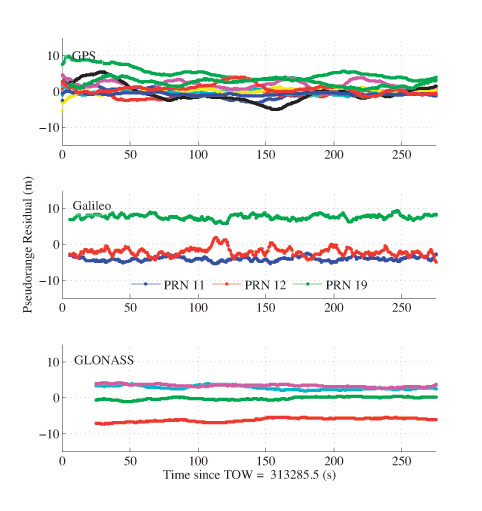
    Figure 2. Pseudorange residuals.
    Figure 2. Pseudorange residuals.

    Next, by fixing the known position in the solution and solving only for the three clock biases, accurate pseudorange residuals were computed and are shown Figure 2. Galileo PRN 19, launched a year later than PRN 11 and 12, exhibits larger residuals, perhaps attributable to ephemeris or orbital errors. The overall results show very good consistency of the Galileo results and the PLAN Group equipment and GSNRx receiver.

    Indoor Nav: Early Steps towards FCC Standards

    The Federal Communications Commission (FCC) on March 14 released two reports from its Communications Security, Reliability, and Interoperability Council (CSRIC): the “Indoor Location Test Bed Report,” and “Leveraging LBS and Emerging Location Technologies for Indoor Wireless E9-1-1.”
    They report on Bay Area tests of technology from NextNav, Polaris Wireless, and Qualcomm, in four representative morphologies (dense urban, urban, suburban, rural) and various building types. They are available online, via env-gpsworld-integration.kinsta.cloud/csric, are the subject of an Expert Advice column (see page 10), and will be more fully discussed in May issue.  For now, this summary from the first-named report:

    “Seven location vendors/technologies began the process to demonstrate their performance indoors through the common test bed, but only three completed the process. Of these three, two technologies (AGPS/AFLT and RF Fingerprinting) are already in common use for emergency services, while the third (metropolitan beacons) is not yet commercially available. However all technologies tested demonstrated relativity high yield and various levels of accuracy in indoor environments.

    “Significant standards work is required for practical implementation of many emerging location technologies for emergency services use.

    “Many positioning methods require handset modifications. Integration of these modified handsets into the subscriber base, once the location technology is commercially available, will take years to complete.

    “Progress has been made in the ability to achieve significantly improved search rings in both a horizontal and vertical dimension. However, even the best location technologies tested have not proven the ability to consistently identify the specific building and floor, which represents the required performance to meet Public Safety’s expressed needs. This is not likely to change over the next 12–24 months. Various technologies have projected improved performance in the future, but none of those claims have yet been proven through the test bed process. It is hoped that such technologies would be tested and validated in future test bed campaigns.”

    An April 16 GPS World Webinar covers this topic with test participants. Registration is free.

  • Septentrio Makes Galileo and Four-Constellation Position Fixes

    Septentrio Makes Galileo and Four-Constellation Position Fixes

    Septentrio became the first receiver manufacturer to report an autonomous real-time position calculation using Galileo IOV satellites, with its own standard commercial receiver. The company based in Leuven, Belgium announced on March 12 that it performed a first autonomous real-time Galileo position, velocity, and timing (PVT) calculation, based on live Interface Control Document (ICD)-compliant Galileo messages from the four Galileo in-orbit validation (IOV) satellites.

    Galileo-PVT

    The standalone position was calculated from in-orbit navigation messages using a standard PolaRx4 GNSS receiver equipped with commercially released firmware.

    This achievement followed another recent Septentrio milestone; the announcement of a first GPS+Glonass+BeiDou PVT less than two weeks after the BeiDou2 ICD publication in December — and it was itself followed by a Septentrio release stating performance of what it believes to be the first 4-constellation PVT performed by a standard commercial receiver.

    4-constellation_PVT

    “On Tuesday 12-Mar-2013 at approximately 10:35 UTC we included three Galileo IOV satellites (E12, E19 & E20) in a multi-constellation PVT. The 3D-position fix happened shortly after it was brought to Septentrio’s attention that the Galileo IOV satellites were transmitting, for the first time ever, a fully usable navigation message as part of an ESA experiment.

    “This ability to rapidly incorporate new constellations demonstrates the flexibility of the architecture of Septentrio receivers,” the company statement continued.

    “We are delighted that Septentrio receivers are amongst the first to witness the readiness of the Galileo navigation message to perform a position fix from in orbit signals,” commented Peter Grognard, Septentrio’s founder and CEO. “Septentrio has been involved since 2003 in all major milestones that pave the way for the European constellation genesis.”

  • Septentrio Demonstrates BeiDou+GPS+GLONASS Positioning

    Septentrio announced on January 7 that it has successfully implemented BeiDou support in the company’s high-precision receiver software, taking advantage of the recent official release of BeiDou’s Interface Control Document (ICD) to including the Chinese satellite navigation signals into its position-velocity-time (PVT) solution.

    According to the Belgian GNSS receiver manufacturer, its engineers “are currently processing further data sets to finalize the implementation of full BeiDou support. Although the BeiDou constellation is still being deployed, the data analysis already shows promising results.”

    The top panel of Figure 1 compares the height from a stand-alone solution of GPS-only with a GPS+GLONASS solution and a third (in light blue) including BeiDou. “The value added by BeiDou is more than what was expected from a constellation that is still being deployed,” according to Septentrio business development manager Laurent Le Thuaut. “Although the solution is not aided by differential corrections, the position shows an increase in accuracy when sufficient BeiDou satellites are included.”

    The bottom panel of Figure 1 shows that, even with the current BeiDou constellation (15 satellites total, of which five are geostationary over China, five in full mid-Earth orbit similar to GPS and GLONASS, and five in inclined geosynchronous orbit over Asia), the total number of satellites used over the European region reached 26 for a short moment.

    Figure 2 shows the L1 pseudorange residuals for all constellations individually. This comparison highlights the advantage of the GPS constellation, which builds on two decades of real-time orbit prediction. The BeiDou orbits are “quite accurate for a relatively young constellation, but show typical meter-level jumps when ephemerides are updated,” according to Septentrio.

    Septentrio says that the new feature will soon become available on selected company platforms. Users of its multi-constellation receivers will then benefit from improvements in urban availability and signal integrity, thanks to the augmented signal coverage.

  • Septentrio Announces First GNSS Receiver with Full Support of TerraStar Services

    Septentrio announces the full support of TERRASTAR wide-area differential and Precise Point Positioning (PPP) capabilities in some of its receivers. The Septentrio AsteRx2eL is an all-in-view dual-frequency GPS/GLONASS receiver, featuring an integrated L-band modem to receive TERRASTAR data transmitted by satellite and field-proven dm-accurate positioning using this data. AsteRx2eL also features GNSS+ technology, a unique combination of industrial grade performance algorithms, to better serve high-precision positioning needs even in the most severe conditions, Septentrio said.

    Support of TERRASTAR-M and TERRASTAR-D allows precise position calculation anywhere on the globe, Septentrio said. TERRASTAR services achieve accuracy levels down to 10 cm without the use of extra communication such as radio or mobile. Powered by TERRASTAR services, AsteRx2eL provides a high level of flexibility for consistent dm-level accuracy everywhere on earth and cm-level where local RTK corrections are available. Septentrio multi-constellation receivers will provide position accuracy and high-availability independently of local infrastructure for the various applications in any of the markets that they traditionally serve:

    • Land and aerial survey and mapping
    • Machine control for agriculture, construction and mining
    • Precise navigation for land, sea and air

    ‘The introduction of support for TERRASTAR offers our customers an important additional option for accurate positioning, notably in the absence of local infrastructure,” Peter Grognard, founder and CEO of Septentrio Satellite Navigation, said. “It has been a pleasure for us at Septentrio to closely collaborate with the great team at TERRASTAR to develop and deliver a strong new value proposition with robust industrial performance everywhere on the globe.”

  • GPSWorldTV – Septentrio Satellite Navigation at ION GNSS

    GPSWorldTV talks with Peter Grognard of Septentrio Satellite Navigation at the ION GNSS 2012 conference.

  • The System: Fly the Pilotless Skies: UAS and UAV


    Unmanned aerial vehicles and civil aircraft may co-habit the airspace after September 2015.

     As the U.S. Federal Aviation Administration (FAA) moves ahead with plans for unmanned aerial systems/vehicles (UAS/UAV) to have regular access to U.S. airspace by 2015, it has encountered several barriers. For UAVs to be treated like manned aircraft, their systems likley need to be qualified to the same standards as civil avioncs. This is a challenge, as each UAS has largely unique systems. UAS equipment standards are emerging, but threats to GNSS abound, requiring defense/mitigation.

    Demand for UAS has produced many different types flying in a range of applications. With no apparent standard avionics fit or uniform safety standards, each UAS type is basically configured for specific tasks. Commercial UAS applications continue to emerge, and major market growth is anticipated. One forecast indicates that the UAS market could reach $7.26 billion this year alone. The promise of new and better ways to reduce costs, improve safety, and increase operational efficiency feeds market expansion.

    However, in the United States the FAA currently requires each UAS commercial project desiring access to controlled airspace to obtain an FAA-approved Certificate of Authorization. While the FAA has made efforts to speed up approvals, this process slowed widespread commercial adoption of UAS. Nevertheless, opportunities abound in pipeline and transmission line inspection, crop spraying, law enforcement, security, and surveillance, survey/mapping, remote area mail delivery, and hundreds of other applications. The FAA may have felt some pressure to move forward, because Congress has put in place the Modernization and Reform Act of 2012, which calls on the FAA to fully integrate unmanned systems, including those for commercial use, into the national airspace by September 2015.

    UAS in the NAS. Meanwhile, a project called the Unmanned Aircraft Systems Integration in the National Airspace System (UAS in the NAS), undertaken by NASA’s Dryden Flight Research Center, seeks to reduce technical barriers related to safety and operational challenges associated with enabling routine UAS access to the NAS.

    Europe has also launched a study on the integration of UAS in non-segregated airspace for the future Single European Sky. The ICONUS study will be carried out by a consortium within the European air traffic management program called Single European Sky ATM Research Programme (SESAR). The study will drive the definition of the requirements, capabilities, and equipment which UAS will need to operate safely and efficiently in the coming European SESAR environment.

    The U.S. RTCA SC-203 committee is drafting UAS operational requirements, and there has been significant progress towards publishing Minimum Aviation Performance Standards (MASPS), including requirements for navigation. Europe has similar activities underway aimed at improving UAS access to its airspace.

    MOPS. The big picture is that requirements for unmanned aircraft are being brought into conformance with the standards applied to the performance and behavior of manned aircraft. Navigation requirements for UAS are expected to specify that systems will need to be qualified to Minimum Operational Performance Standards (MOPS). This means that on-board electronics, including GNSS systems, will probably need to be FAA Technical Standard Orders (TSO) qualified, just as they are now for manned aircraft.

    Why do we need to investigate certified avionics now? In the scheme of avionics, more than two years breathing space to certify UAS avionics systems is not a long time, not at all, until the September 2015 deadline. FAA airborne software and hardware qualification will take much time and effort to implement, and re-configuration of systems, interfaces, and operating procedures may take even longer.

    For Manufacturers. UAS makers have the option to move forward in stages. For instance, by selecting a few existing airborne-qualified OEM avionics, they could minimize the internal effort to comply. As the first UAS with certified avionics emerge, they will probably get good support from FAA to adopt U.S. operating rules for the NAS. Embedding an existing certified GPS receiver in UAS avionics will reduce the internal work needed and allow more effort for developing commercial market opportunities that look to quickly adopt UAS.

    Meanwhile, efforts are in full swing to change the U.S. and European navigation landscapes over the next few years. So it would be better to be ready with a capable GNSS receiver that is already built to meet the challenges of NextGen and SESAR.

    GPS III and Galileo. The L5 civil GPS frequency may be operational around the time that UAS unrestricted access becomes possible. GPS L1/L5 dual-frequency operations will enable higher navigation accuracy, reliablity, and integrity. The FAA is already developing NextGen WAAS to include L5, and revisions to the GPS MOPS to include L5 should begin shortly, in time for a usable GPS L5 constellation in 2015/2016. The FAA is already preparing for L5 avionics, and industry investigative work is underway. Its possible that GPS L1/L5 may meet the accuracy and integrity requirements for CAT II/III automated landings. In Europe, Eurocae work is expected to gain momentum for the Galileo E1/E5a MOPS as the Galileo satellite navigation system becomes operational.

    The new GNSS environment also includes WAAS/SBAS precision approach (localizer performance with vertical guidance, or LPV) capability: LPV is available now in the United States and will soon be in wider operation in Europe. Automatic Dependendant Surveillance (ADS-B) is rolling out in the United States and around the world. ADS-B is being mandated within the U.S. NAS as the means for air-traffic control to track all aircraft, so UAS avionics will need to include certified ADS-B Out capability.

    In one commercial instance, the Septentrio AiRx2 receiver comes out of the box as a certified L1 GPS with ADS-B and WAAS LVP, but is also ready for GPS L5 and Galileo E1/E5a.

    Even as greater steps forward enhance how GNSS is used in this wider definition of aviation that will soon include UAS, a team at the University of Texas demonstrated how a UAV could be maliciously side-tracked (see article on page 30 of this issue) —  reminiscent of the Iranian downing of a U.S. surveillance drone in December 2011.

    Admittedly the GPS on the vehicle in the UT test was not a qualified airborne receiver, but how could this happen when there was also an inertial sensor and a radio-altimeter on the UAV? A good question, which UAV manufacturers will need to consider when they implement their on-board Kalman filters, knowing that spoofing is now an additional threat to parry.

    Couldn’t we detect that high-power RF spoofing signal at the front-end of the GPS receiver? Even if only to tell the on-board systems that there could be hazardous misleading information about? Or run separate GPS and GPS/inertial position solutions, detect significant divergence, and set the same warning flag? And multi-constellation, multi-frequency receivers, and even controlled radiation pattern antennas — all things to investigate.  More work for the aviation receiver guys who labor tirelessly to improve GNSS integrity.

    Of course if you hijack a UAV with a high-power spoofer, you are also spoofing civil transports operating in the same airspace, so now there is the potential to trigger a Federal investigation. It will probably be easier to detect this stuff with moving airborne sensors rather than the fixed ground equipment used to find jammers on trucks at Newark airport, and lots of pilots likely providing real-time location information on radios if their GPS goes even a little haywire. All would help to quickly locate and shut down any spoofer. Nevertheless, it’s a threat to be mitigated.

    Fatal Crash. In South Korea, the effects of intermittent North Korean jamming of GPS to disrupt seal, land, and air navigation in the South may have contributed to the recent fatal crash of a Schiebel Camcopter S-100 drone, a 150-kilogram rotorcraft capable of 220 km/h flight. It should have coped with loss of GPS as the Camcopter has multiple inertial measurement units that allow safe operation and recovery in the absence of GPS signals. Emergency procedures to ensure a safe recovery in such a situation do not appear to have been correctly and adequately followed, manufacturer Schiebel alleges.

    NovAtel may have found one way to help mitigate spoofing on UAVs; the company released a combined civil/SAASM GPS receiver, the OEM625S, aimed specifically at UAVs. Granted, the idea is to add SAASM anti-spoofing capability to a number of UAVs which currently use NovAtel commercial receivers, mostly in military systems. That may be motivated by the desire to avoid further Iranian incidents!

    BAE Systems has been thinking of giving GPS a back-up for just those situations where jamming or even spoofing is detected. BAE’s Navigation via Signals of Opportunity (NAVSOP) system was just announced at the Farnborough air show in the UK and is still in research phase, but looks extremely promising. It interrogates the radio environment for the ID and signal strength of local digital TV and radio signals, plus air traffic control radars, with finer grained adjustments coming from cellphone masts and Wi-Fi routers. Mapping the location of all these sources might be quite an undertaking, and given that these are all non-safety-of-life commercial signals, the sources are subject to the vagaries of power outages, regular maintenance, and breakdowns. Nevertheless, with such a multitude of signals, NAVSOP could well turn out to be a viable back-up for GNSS.

    So, shared access to civil airspace, wider applications in commercial operations, and changes in equipment qualification, along with potential solutions for GNSS jamming and spoofing: lots to consider for the UAS industry.


    Taking It to the House

    U.S. House of Representatives Committee on Homeland Security; Subcommittee on Oversight, Investigations, and Management; Hearing, July 19, 2012:  Using Unmanned Aerial Systems Within the Homeland: Security Game Changer?

    Testimony by Todd E. Humphreys, Ph.D.; Assistant Professor, Cockrell School of Engineering, The University of Texas at Austin. [Excerpted. Prof. Humphreys is a co-author of the article “Drone Hack” in the August issue of GPS World.]

    The vulnerability of civil GPS to spoofing has serious implications for civil unmanned aerial vehicles (UAVs), as was recently illustrated by a dramatic remote hijacking of a UAV at White Sands Missile Range.

    Hacking a UAV by GPS spoofing is but one expression of a larger problem: insecure civil GPS technology has over the last two decades been absorbed deeply into critical systems within our national infrastructure. Besides UAVs, civil GPS spoofing also presents a danger to manned aircraft, maritime craft, communications systems, banking and finance institutions, and the national power grid.

    Constructing from scratch a sophisticated GPS spoofer like the one developed by the University of Texas is not easy. It is not within the capability of the average person on the street, or even the average Anonymous hacker. But the emerging tools of software-defined radio and the availability of GPS signal simulators are putting spoofers within reach of ordinary malefactors.

    There is no quick, easy, and cheap fix for the civil GPS spoofing problem. What is more, not even the most effective GPS spoofing defenses are foolproof. But reasonable, cost-effective spoofing defenses exist which, if implemented, will make successful spoofing much harder.

    I recommend that for non-recreational operation in the national airspace civil UAVs exceeding 18 lbs be required to employ navigation systems that are spoof-resistant.

    More broadly, I recommend that GPS-based timing or navigation systems having a non-trivial role in systems designated by DHS as national critical infrastructure be required to be spoof-resistant.

    Finally, I recommend that the DHS commit to funding development and implementation of a cryptographic authentication signature in one of the existing or forthcoming civil GPS signals.

    Complete testimony (PDF) covers:

    • The potential vulnerabilities of U.S. national transportation, communications, banking and finance, and energy distribution infrastructure;
    • What does it take to build a spoofer? Buy a spoofer?
    • Range and required knowledge of target.
    • Fixing the problem:

    •    Jamming-to-noise sensing defense;
    •    Defense based on SSSC or NMA on WAAS signals;
    •    Multi-system multi-grequency defense;
    •    Single-antenna defense;
    •    Defense based on spread-spectrum security codes on L1C;
    •    Defense based on navigation message authentication on L1C, L2C, or L5;
    •    Correlation prole anomaly defense;
    •    Multi-antenna defense;
    •    Defense based on cross-correlation with military signals.

  • Septentrio, QinetiQ Partnership Delivers Galileo PRS Signal Reception

    Another major milestone in the Galileo system’s development and deployment program has been achieved. Septentrio and QinetiQ, working in close partnership with the European Space Agency (ESA) and their industrial partners, achieved the world’s first successful reception of the encrypted Galileo Public Regulated Service (PRS) signal from the first Galileo satellites, launched in November 2011.

    The signal was received on the Galileo PRS Test User Receiver (PRS-TUR) jointly developed by Septentrio and QinetiQ under an ESA contract. For the reception test, the receiver was installed in the Galileo Control Centre in Fucino, Italy and operated by technical experts from ESA. This milestone builds on a number of previous major Septentrio/QinetiQ achievements including:

    • First ever laboratory demonstration of the PRS signal acquisition and tracking in QinetiQ (Malvern, UK, 2006).
    • Successful RF compatibility test between a Galileo payload and the PRS-TUR (Portsmouth, UK, 2010).
    • Successful Galileo end-to-end system test including the Galileo Ground Mission Segment (GMS) and its key management facilities, satellite and PRS-TUR (Rome, Italy, 2011).

    Septentrio and QinetiQ are long-term contributors to the Galileo Programme, working closely with ESA, the European GNSS Agency (GSA), and European industrial partners since 2003.

    “Septentrio is extremely proud of this historic milestone for the Galileo programme," said Peter Grognard, founder and CEO of Septentrio Satellite Navigation. "This is the most important milestone for Septentrio since the reception of the world’s first Galileo signal from space on January 12, 2006, with a Septentrio receiver. We are honoured and grateful for the excellent collaboration with ESA. Septentrio is marking another industry-first on the Galileo programme, and will continue playing a key role in this exciting and ambitious European project. Today, together with our partners, we take a decisive step in the early availability of commercial PRS receivers to foster user acceptance and market success of this Galileo service.”

    "This achievement, together with Europe’s recent commitment to a full Galileo constellation, has been a necessary step in giving European industry confidence to start investing in developing commercial PRS receiver products ready for the launch of Galileo navigation services in a few years time,” Leo Quinn, CEO of QinetiQ, said.

  • Septentrio, QinetiQ Partnership Delivers Galileo PRS Signal Reception

    Another major milestone in the Galileo system’s development and deployment program has been achieved. Septentrio and QinetiQ, working in close partnership with the European Space Agency (ESA) and their industrial partners, achieved the world’s first successful reception of the encrypted Galileo Public Regulated Service (PRS) signal from the first Galileo satellites, launched in November 2011.

    The signal was received on the Galileo PRS Test User Receiver (PRS-TUR) jointly developed by Septentrio and QinetiQ under an ESA contract. For the reception test, the receiver was installed in the Galileo Control Centre in Fucino, Italy and operated by technical experts from ESA. This milestone builds on a number of previous major Septentrio/QinetiQ achievements including:

    • First ever laboratory demonstration of the PRS signal acquisition and tracking in QinetiQ (Malvern, UK, 2006).
    • Successful RF compatibility test between a Galileo payload and the PRS-TUR (Portsmouth, UK, 2010).
    • Successful Galileo end-to-end system test including the Galileo Ground Mission Segment (GMS) and its key management facilities, satellite and PRS-TUR (Rome, Italy, 2011).

    Septentrio and QinetiQ are long-term contributors to the Galileo Programme, working closely with ESA, the European GNSS Agency (GSA), and European industrial partners since 2003.

    “Septentrio is extremely proud of this historic milestone for the Galileo programme,” said Peter Grognard, founder and CEO of Septentrio Satellite Navigation. “This is the most important milestone for Septentrio since the reception of the world’s first Galileo signal from space on January 12, 2006, with a Septentrio receiver. We are honoured and grateful for the excellent collaboration with ESA. Septentrio is marking another industry-first on the Galileo programme, and will continue playing a key role in this exciting and ambitious European project. Today, together with our partners, we take a decisive step in the early availability of commercial PRS receivers to foster user acceptance and market success of this Galileo service.”

    “This achievement, together with Europe’s recent commitment to a full Galileo constellation, has been a necessary step in giving European industry confidence to start investing in developing commercial PRS receiver products ready for the launch of Galileo navigation services in a few years time,” Leo Quinn, CEO of QinetiQ, said.

  • Faster than a Speeding Light Particle


    We published a news story recently suggesting that Albert Einstein, the Mighty Hip Einie, got one thing wrong, or at least not quite totally right: the universal upper limit constituted by the speed of light. Precise-timing GPS receivers in a Geneva lab helped indicate that subatomic neutrinos can travel at a velocity just a smidge faster than the speed of light. Someone at a burning idea factory in the Netherlands riposted that the scientists erred in their conclusion because they failed to take into account the relative movement of the GPS clocks in space and thus miscalculated the neutrinos’ time of flight. We hereby refute that assertion with our heavy-lifting Innovation columnist, Richard B. Langley.

    The original news story, derived from a breathless announcement out of the European Organization for Nuclear Research (CERN) in Geneva, Switzerland, reported that Septentrio’s precise-timing GPS receivers PolaRx2eTR synchronize the time bases at CERN and Gran Sasso Laboratory in Italy, 730 kilometers away, for the OPERA experiment. Researchers at the two labs synchronized to an accuracy of a couple of nanoseconds and then measured transit speeds of 15,000 neutrino events in a neutrino beam between the two sites.

    Light moves at 299,792,458 meters per second. Let’s see, doing the math, that’s 299,792.5 kilometers per second, divide into the distance from Geneva to Gran Sasso, carry the one, cross the fingers, spit downwind, gives 0.002435017553808 seconds. Two-and-a-half thousandths of a second. 24,350 nanoseconds. If the neutrinos got to sunny Abruzzo any sooner, well then, they were the new universe record-holders.

    It turns out, the little buggers made the trip 60 nanoseconds faster than that. Killing it. Just killing it. And poking a hole in the Mighty Hip Einie’s Special Theory of Relativity.

    “This result comes as a complete surprise,” said Oscillation Project with Emulsion-tRacking Apparatus (OPERA) spokesperson Antonio Ereditato.

    Then Ronald van Elburg of the University of Groningen in the Netherlands climbed into the ring. The OPERA project researchers did not take into account the relative movement of GPS clocks in space and thus miscalculated the distance, he said. “From the perspective of the clock, the detector is moving towards the source and consequently the distance travelled by the particles as observed from the clock is shorter.”

    Thus, according to van Elburg, the travel time measured by the GPS was shorter than the travel time measured in the reference frame on the ground. Accounting for the changing distances between the GPS clocks and the neutrino detectors would lengthen the observed time of flight by 32 nanoseconds on each end of the experiment, making for a total time delay of 64 nanoseconds — close to the interval that OPERA observed using the difference between the speed of neutrinos and that of light. Case dismissed.  Einstein restored.

    Unable to parse this myself, I asked Richard Langley of the University of New Brunswick whether it seemed reasonable.

    “No, I don’t think so,” Langley replied. “Special Relativity is already taken into account whenever GPS is used, whether for timing or positioning, which amounts to the same thing, since 1 nanosecond of timing error equals about 30 centimeters of distance error (simply using the speed of light). Of course, anyone can use GPS incorrectly or infer something incorrectly. There is an error (likely) somewhere but I don’t think it is in the “standard way” that clocks are synchronized using GPS. The error is either a timing error (unrelated to Special Relativity but perhaps related to the electronics and associated delays) or a neutrino-path-length measurement error. The OPERA folks have put online their internal reports on the calibration of the GPS time link between the neutrino emitter and detector:

    http://operaweb.lngs.infn.it/Opera/publicnotes/note134.pdf

    and on how the distance travelled by the neutrinos was determined:

    http://operaweb.lngs.infn.it/Opera/publicnotes/note132.pdf

    I haven’t had time to read these reports yet but it appears, at face value, that the work was quite thorough.

    “By the way,” Richard said, “there have been a number of relevant articles in GPS World over the years. And we do apologize that some of these are no longer available digitally, due to a trashing of this site by its former owner, Questex Media Group.

  • Septentrio and Altus Announce Expansion of Strategic Relationship

    Septentrio Satellite Navigation NV and Altus Positioning Systems today announced that the two companies are expanding their strategic relationship to pursue growth opportunities in the high-precision satellite-based surveying sector.

    Septentrio is a manufacturer of high-end Global Navigation Satellite System (GNSS) receivers for professional navigation, positioning, and timing applications. Altus is an international supplier of GNSS equipment for survey applications. Both are privately held companies.

    Under the agreement, Septentrio is making a substantial investment in Altus through its U.S. subsidiary, Septentrio Inc., which is jointly owned by Septentrio Satellite Navigation NV, and by the Belgische Maatschappij voor Internationale Investering – Société Belge d’Investissement International (BMI-SBI) / Participatiemaatschappij Vlaanderen (PMV), a Belgium-based investment consortium.

    “The investment in Altus is an exciting new step in the life of Septentrio,” said Peter Grognard, founder and CEO of Septentrio. “Surveying has traditionally been the largest segment of the professional GNSS industry. Both in traditional and emerging markets, the survey segment has continued to enjoy double-digit growth rates in recent years, and our investment in Altus will further accelerate our growth and expand our global presence in this key industry sector.

    “Since the surveying community demands the highest-possible performance in precise measurements, it is a very important driver for GNSS technology,” Grognard said. “Our expanded relationship with Altus will help us refine and improve our products to meet these exacting standards, which will benefit other markets as well, and will create a closer bond between the technology and the marketplace.”