Tag: Survey Scene

  • The need for trained geodesists is an international issue

    The need for trained geodesists is an international issue

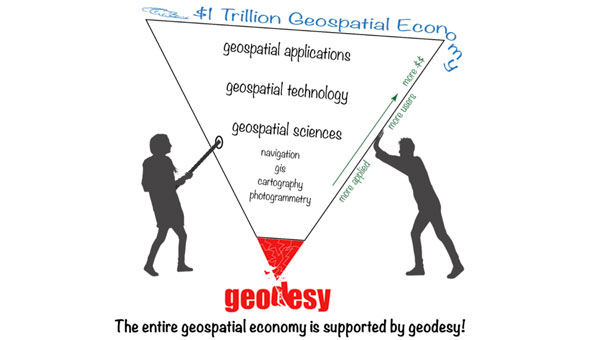
    My previous newsletter highlighted activities associated with the Transportation Research Board ADK70 Standing Committee on Geospatial Data Acquisition Technologies. As I mentioned in the newsletter, Linda Foster, ESRI and president-elect of the National Society of Professional Surveyors (NSPS), highlighted how geodesy and surveying provide the foundation for digital twin products. Similar to the inverted geospatial pyramid depicted in my February 2022 GPS World newsletter, Foster’s presentation highlighted that geodesy is at the base of an inverted triangle. See my February 2022 and August 2024 newsletters for more details. Both diagrams emphasize the importance of geodesy and surveying in creating geospatial products and services.

    That said, on August 20, I had the opportunity to participate in the UN-GGIM: Europe webinar series: Quo Vadis Geodesy? webinar. Quo vadis is a Latin phrase meaning “Where are you going?” The webinar highlighted the importance of geodesy and the need for more trained geodesists. This is a topic that I have been highlighting for several years.
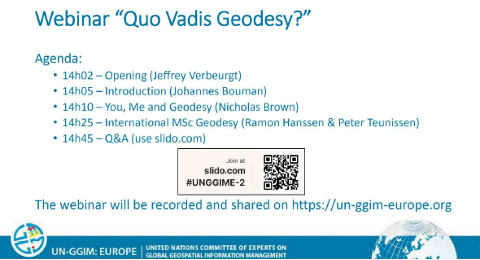
    Agenda for webinar. (Photo: UN-GGIM: Europe)
    Agenda for webinar. (All photos courtesy of UN-GGIM: Europe webinar.)

    Webinar write up

    Modern society relies heavily on satellite services for various critical functions, including economic development, the operation of critical infrastructure, and defense applications. Despite their clear and proven significance, these satellite services are at risk of degradation or failure due to the lack of resources provided to the global geodesy supply chain. It is crucial for decision-makers to understand the far-reaching implications of not strengthening this supply chain, which impacts societal, economic, and environmental applications. Additionally, these decision makers need clear pathways to address these vulnerabilities effectively.

    The Community of Interest on Geodetic Reference Frames – Europe, established by UN-GGIM: Europe, is dedicated to supporting the sustainment and growth of the geodetic profession. To address current knowledge gaps, we have organized this webinar featuring two insightful presentations. The first presentation will discuss the risks associated with weak geodetic foundations and their potential to compromise satellite services. The second presentation will introduce an initiative to launch an international Master of Science in Geodesy, emphasizing the importance of formal geodesy education in building robust geodetic foundations.

    There were three objectives of the webinar:

    1) Provide geo-experts resources to help them convincingly communicate and advocate for a strong global geodesy supply chain.

    2) Inform decision makers of the risks of not strengthening the global geodesy supply chain.

    3) Support the initiative of the IDEA-league universities to establish an international Master of Science in Geodesy.

    The webinar was recorded and can be found here. The presentations can be downloaded from the following weblinks:

    This newsletter is going to highlight some interesting items from the webinar, but I would encourage everyone to listen to the recording to obtain the full discussion.

    First, I would like to note that Ramon Hanssen included the geospatial inverted pyramid (designed by Dana J. Caccamise II, NGS Regional Geodetic Advisory) and the white paper titled “The Geodesy Crisis” (prepared by Mike Bevis collaborating with others) that documented the concern about the lack of trained geodesists in the United States (see February 2022 GPS World newsletter). Based on the presentation by Ramon Hanssen it appears that the lack of trained geodesists is also a concern of the European geospatial community.
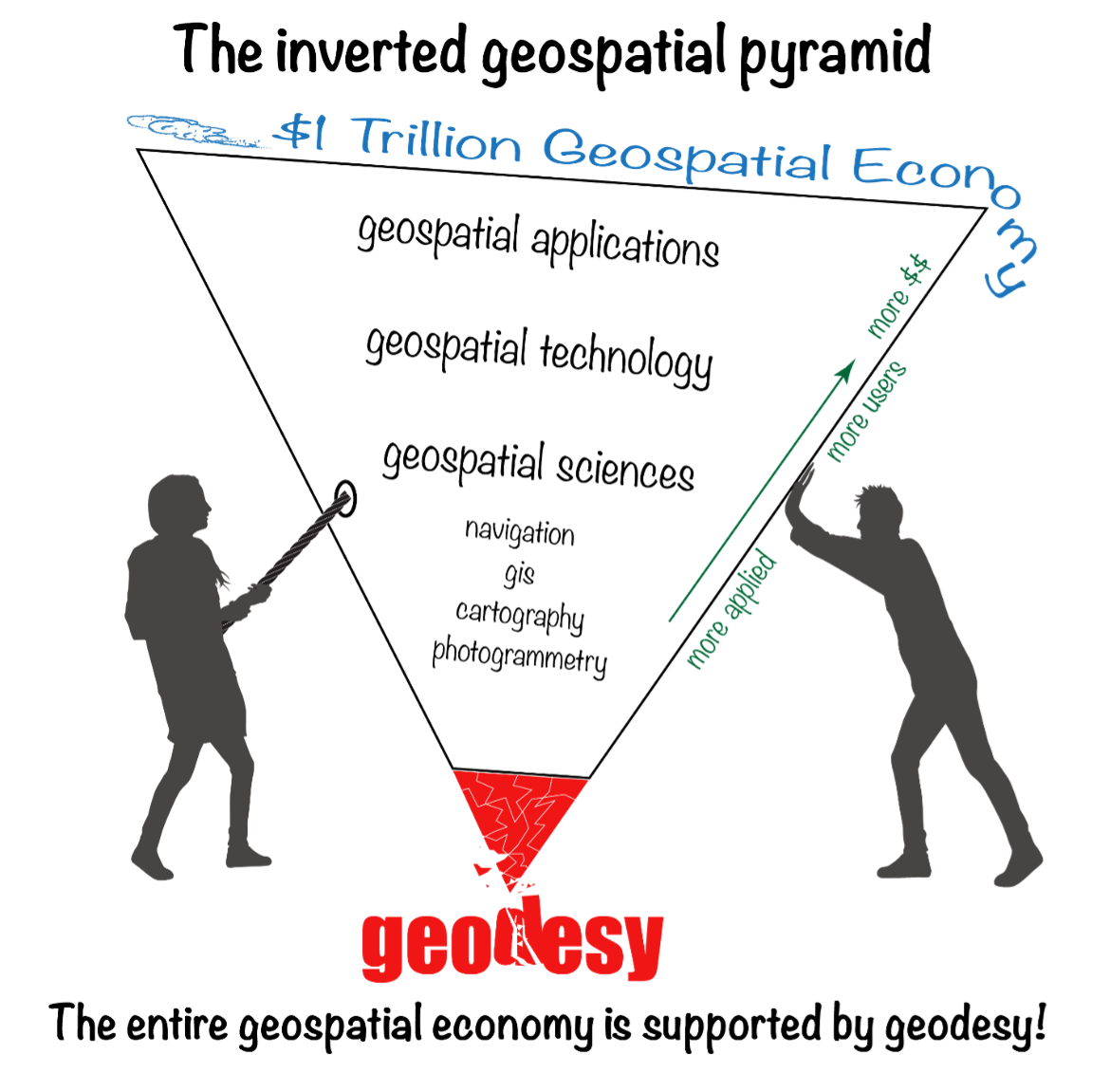
    Image: Dana Caccamise II
    Image: Dana Caccamise II

    Nicholas Brown, Head of Office, United Nations Global Geodetic Centre of Excellence, did a nice job of explaining the importance of geodesy in everyday activities. He highlighted how GNSS is a critical infrastructure for telecommunications, emergency services, and financial exchanges. In my opinion, GNSS and geodesy are unsung heroes of everyone’s daily activities.

    He provided a scenario that would affect almost everyone in their daily routines.

    Imagine a scenario without GNSS. (Photo: Nicholas Brown)
    Imagine a scenario without GNSS. 


    This highlights the importance of geodesy and the need to increase the number of trained geodesists in the world. My July 2020  “First Fix” article in GPS World discussed the need to increase the number of trained geodesists in the United States, and it appears the same issue is a concern of many individuals in Europe. Ramon Hanssen and Peter Teunissen, TU Delft, presented a way forward for Europe. The following are some highlights of the presentation but, again, I would encourage readers to download the slides and webinar for more details.

    The presentation described “The IDEA League,” which is a strategic alliance between five European universities of technology: TU Delft, ETH Zurich, RWTH Aachen, Chalmers University, and Politecnico di Milano. One goal of the partnership is to re-establish Europe as a technological and scientific leader by integrating academic resources and knowledge. The concept includes pooling resources for collaborative and complementary programs for teaching students and researchers.

    The alliance established an initiation team to develop a proposal that included the following:

    1. Establish a joint international European MSc program in Geodesy.
    2. Combine resources of universities, scientists, and educators in Europe.
    3. Respond to the urgent need for academic geodesists.
    4. Inspire collaboration via complementary fields.

    The group sent a questionnaire to stakeholders in the geodetic job market to obtain an understanding of the need for trained geodesists. The responses to the questionnaire highlighted the urgent need for more trained geodesists. Two important responses by stakeholders were (1) 72% perceived the current availability of MSc graduates in geodesy to be unsatisfactory and (2) 83% expects the demand for (academic) professionals with expertise in geodesy to grow in the foreseeable future.

    Photo: Nicholas Brown

    As mentioned above, 72% perceived the current availability of MSc graduates in geodesy to be unsatisfactory. The questionnaire asked, “What challenges or gaps do you face in recruiting qualified geodetic professionals?”

    Photo: UN-GGIM

    There were many responses to this question; the image below provides a few examples that were presented at the webinar.
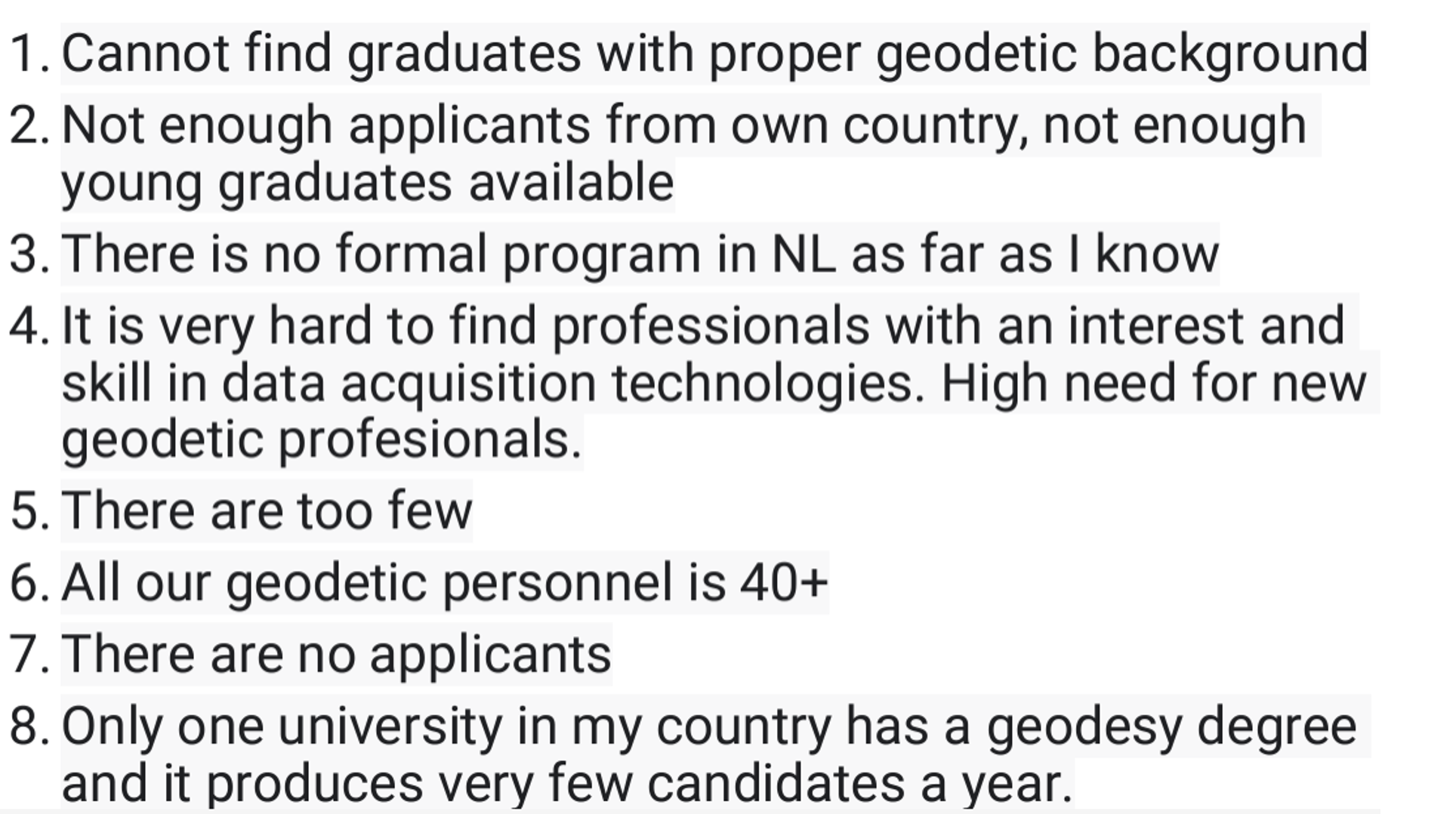
    Challenges and gaps. (Photo: UN-GGIM)

    Photo:

    The stakeholders provided reasons why they believe that the demand for geodesists will increase in the future. The list below provides a breakdown of the reasons provided by the stakeholders. The top two reasons were technological advancements and digital transformation. Concerns with consistency in the digital delivery of geometric products were highlighted in my August 2024 newsletter.

    We now live in a world where everything is digital. Today, most surveying and mapping instruments collect and generate data in digital format. This paradigm has affected how surveyors, geodesists, and engineers provide their products and services. So, it makes sense that advancements in technology and the transformation of digital data would be important to stakeholders.

    The stakeholders were asked their opinion on what expertise is needed by geodesists to meet their requirements. The image below shows the responses of the stakeholders. There were six expertises that exceeded 50%:

    • Quality (Precision, Accuracy) – 75.8%
    • Sensors and Techniques – 63.6%
    • Data Analytics – 60.6%
    • Mathematical Fundamentals – 58.6%
    • Reference Frames – 58.6%
    • GIS and Geo-Databases – 52.5%

    The group provided a preliminary program design for a MSc Geodesy. See the image below.

    Draft overview MSc Geodesy. (Photo: UN-GGIM)
    Draft overview MSc Geodesy. 

    As in all partnerships and collaborations, there are challenges. The group is working together to overcome these challenges. The stakeholders could help by supporting the IDEA League concept and proposal.

    Photo:

    Nicholas Brown’s presentation, “You, Me and Geodesy,” provides information that others can use to explain how the global geodesy supply chain is fundamental to what they do and how critical it is to our daily lives. He describes five weaknesses (see the box titled “Weakness in Geodetic Message”) that need to be addressed to improve the message of why it is important to increase the geodetic capacity in the world. I have provided a short summary below, but readers should listen to the webinar for more details.

    • Evidence – There is no clear, understandable evidence to explain the importance of investing in geodesy to decision makers.
    • Resources – Leadership cannot make the business case to invest in geodesy without good evidence.
    • Awareness – There is a need to communicate the importance of geodesy to other science agencies and scientists in different fields of study. For example, climate change is highly dependent on geodesy for measuring sea level rise, changes in gravity, ice melt, and the location of Earth’s center of mass.
    • Capacity – Capacity development in geodetic science needs to be strengthened everywhere not just in developing countries.
    • Governance – The scientific geodetic community has done an exceptional job of managing the geodetic infrastructure (e.g., International Association of Geodesy) but they are expected to do too much. During Nicholas Brown’s presentation, he mentioned that, in his opinion, an improved governance model could help advance geodesy around the world. He mentioned the need to have a governance model like the World Meteorological Organization (WMO). WMO members contribute resources to the organization, technical commissions are established to address issues, and operational support and resources are provided to implement capacity development programs.


    Weakness in geodetic message. (Photo: UN-GGIM: Europe webinar.)
    Weakness in geodetic message.

    The UN-GGIM: Europe webinar series: Quo Vadis Geodesy webinar highlighted the importance of geodesy and the need for more trained geodesists. Anyone reading my GPS World newsletters knows that I have been highlighting the need for more trained geodesists in the United States for several years. This newsletter highlighted interesting items from a webinar that discussed the need for more trained geodesists in Europe. Again, I would encourage everyone to listen to the recording to obtain the full discussion.
  • TRB ADK70 Standing Committee on Geospatial Data Acquisition Technologies summer meeting

    TRB ADK70 Standing Committee on Geospatial Data Acquisition Technologies summer meeting

    My last newsletter highlighted the products on the National Geodetic Survey (NGS) Alpha Preliminary Products site. The alpha site provides products that individuals can use to better understand the products that will be distributed as part of the new, modernized National Spatial Reference System (NSRS).

    This newsletter is going to highlight activities associated with the Transportation Research Board’s ADK70 Standing Committee on Geospatial Data Acquisition Technologies. This committee is concerned with applications of high-accuracy geospatial data acquisition technologies in support of the digital infrastructure for the design and construction of transportation facilities. Members have various backgrounds and expertise and are located in different regions of the United States.

    The committee holds two meetings a year, one at the January TRB Annual Meeting held in Washington, D.C., and a summer meeting in different locations each year in late July.

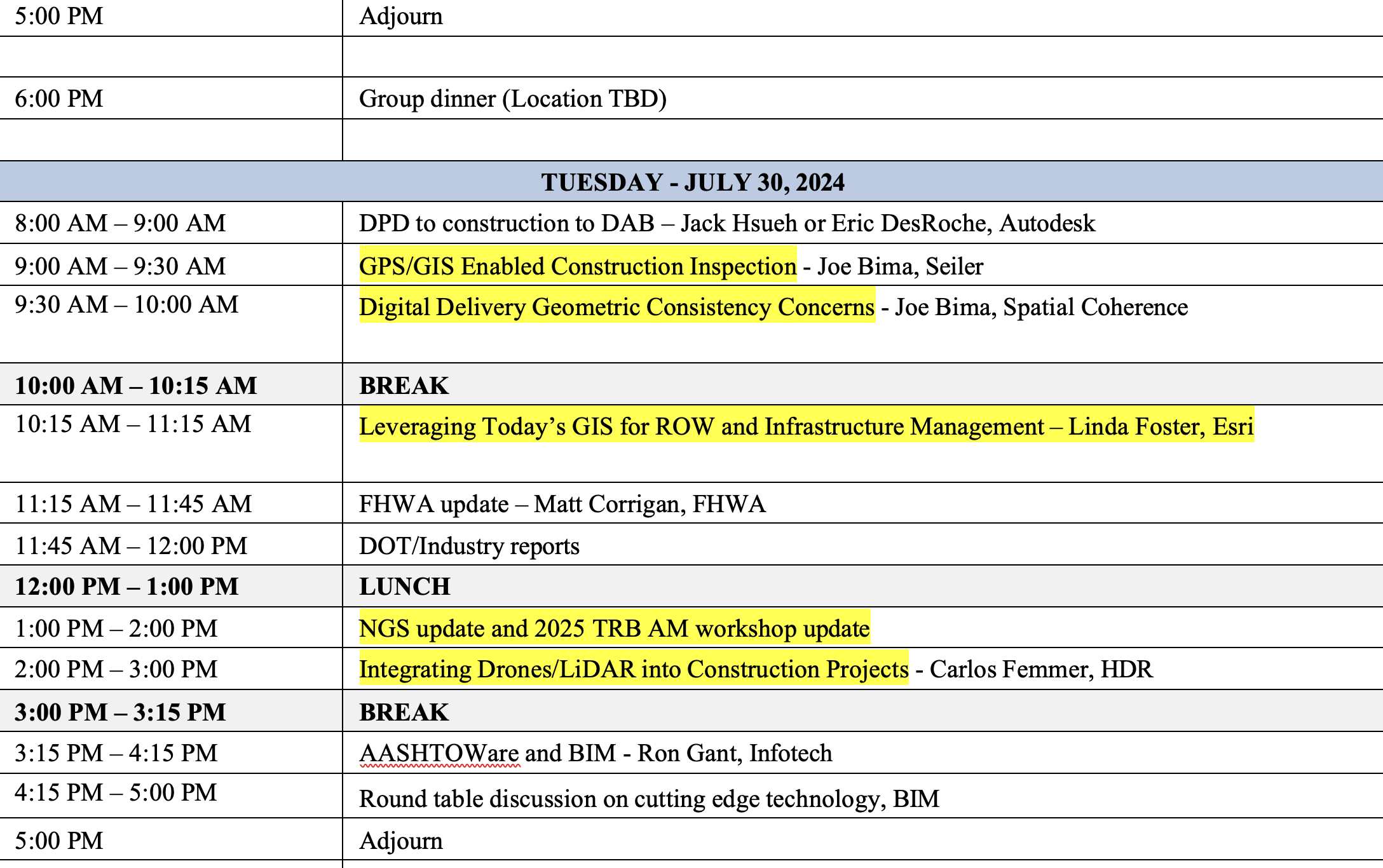
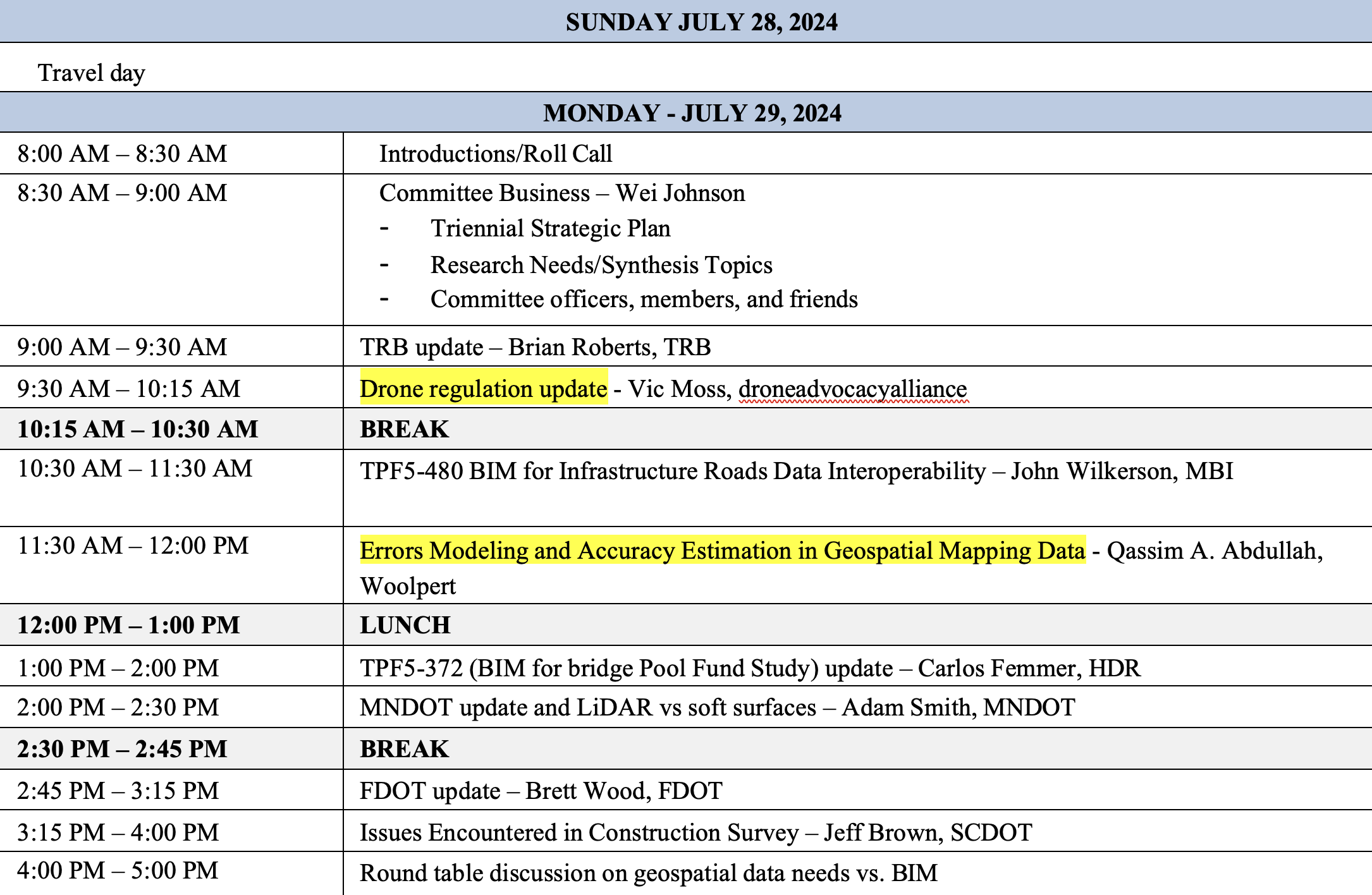
    This year, the meeting of the Geospatial Acquisition Technologies in Design and Construction Summer Committee was held on July 29-31, 2024, in Washington, D.C. Topics included new technologies on data collection, modeling and plan delivery. There were updates from organizations such as the National Geodetic Survey, the Federal Highway Administration, the American Association of State Highway and Transportation Officials and various state departments of transportation on technology, standards, specifications and industry needs. See the agenda below.

    Photo: NGS schedule 1

    Photo: NGS schedule 2

    Photo: NGS schedule 3

    I first got involved with this committee in 1999, when I worked for NGS. One may ask, why would a geodesist be interested in a committee that focuses on the design and construction of transportation facilities? In my opinion, this is an important committee that addresses geospatial issues that affect all users of geospatial data, not just state Department of Transportation (DOT) surveyors and engineers.

    As anyone who has been reading my GPS World Survey Scene newsletters knows, I remind everyone that “geodesy is the foundation for all geospatial products and services.” As previously stated, this committee is concerned with applications of high-accuracy geospatial data acquisition; therefore, surveyors and geodesists must be involved to address issues associated with positioning. Anyone using or acquiring geospatial data should be interested in this committee’s activities.

    During AKD70 summer workshop meetings, participants talk with technical experts about the latest advancements in geospatial data acquisition technologies. I would encourage anyone interested in high-accuracy geospatial data acquisition technologies to learn more about this TRB committee, which is currently chaired by Wei Johnson, South Carolina DOT.

    Digital delivery geometric consistency concerns

    One session at the meeting discussed concerns with digital delivery geometric consistency. We now live in a world where everything is digital. Today, most surveying and mapping instruments collect and generate data in digital format. This paradigm has affected how surveyors, geodesists, and engineers provide their products and services. So, what is the issue with digital delivery geometric consistency?

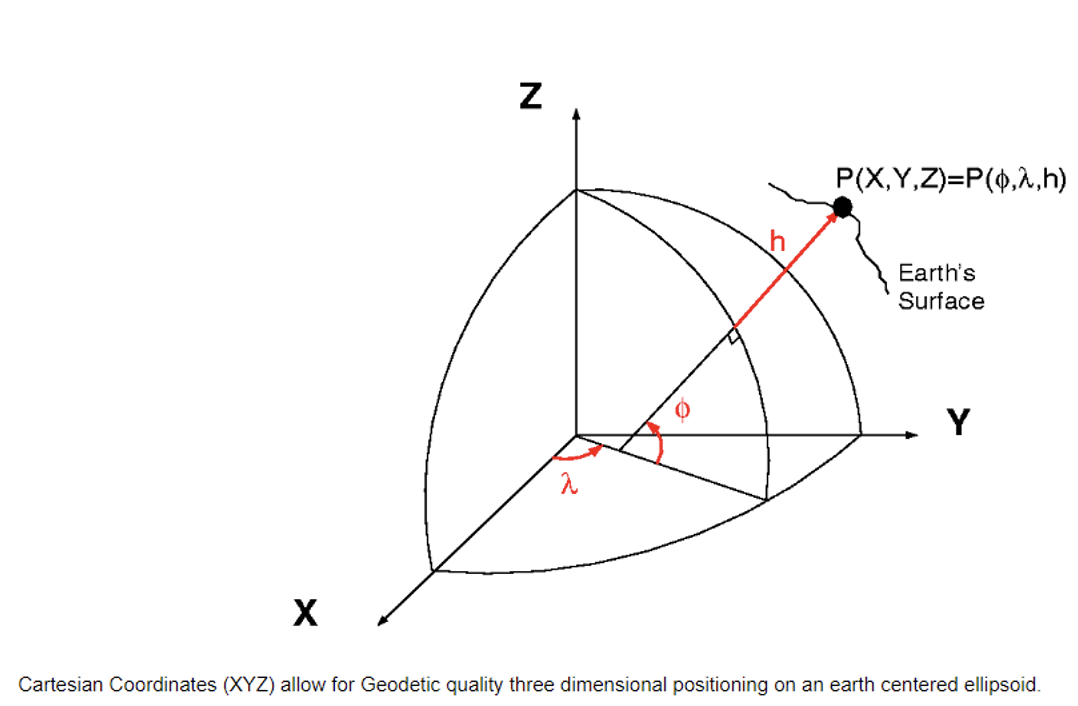
    As I previously stated, I am a geodesist, so I think in geodetic coordinates (latitude, longitude, ellipsoid and orthometric height) or cartesian coordinates (X, Y and Z).

    Photo: NGS
    Three-Dimensional Positioning (XYZ). (Photo: NGS)
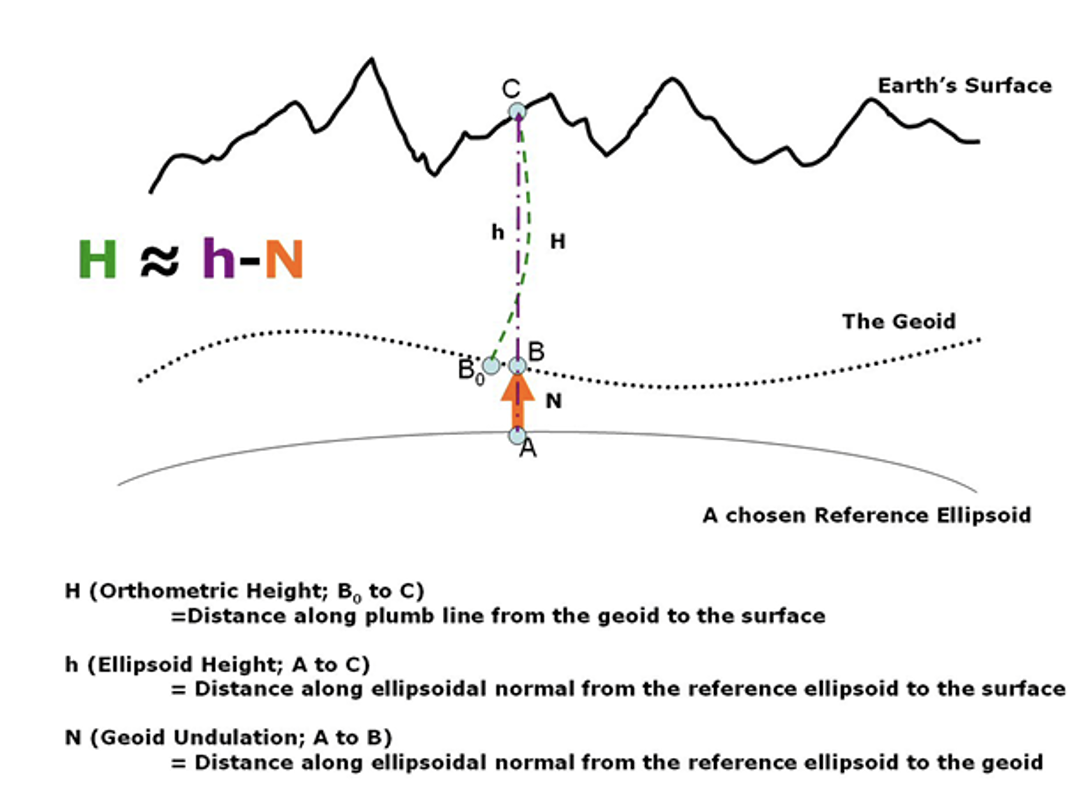
    From NOAA Technical Memorandum NOS NGS 59. (Photo: NGS)
    Orthometric, Ellipsoid and Geoid Heights from NOAA Technical Memorandum NOS NGS 59. (Photo: NGS)

    Looking at the diagram in the above image, I would like to highlight that the orthometric height is measured from the geoid along a curved line. The curved line is based on an infinite number of geopotential level surfaces that exist between the geoid, which is a geopotential surface, and the mark located on Earth’s surface. This is why gravity plays a part in determining the orthometric height of a mark.

    This means that leveling height differences are not the same as ellipsoid height differences. To compute a GNSS-derived orthometric height, a geoid height is subtracted from the GNSS-derived ellipsoid height. This is only an approximation because of how the two heights are measured but, at this moment, it is accurate enough for surveying and mapping applications.

    What about computing an ellipsoid height from an orthometric height? The ellipsoid height can be computed using the equation h = H + N (ellipsoid height = orthometric height + geoid height). Once you have an ellipsoid height, you can compute the X, Y, and Z coordinates of the mark. Orthometric heights derived from leveling data are one-dimensional (orthometric height only), whereas GNSS-derived coordinates are three-dimensional (XYZ or latitude, longitude, ellipsoid height). Therefore, to compute a cartesian coordinate (XYZ), from a leveling-derived height users must generate a latitude and longitude of the mark. It is important to use the appropriate geoid height and to record that information in a metadata file.

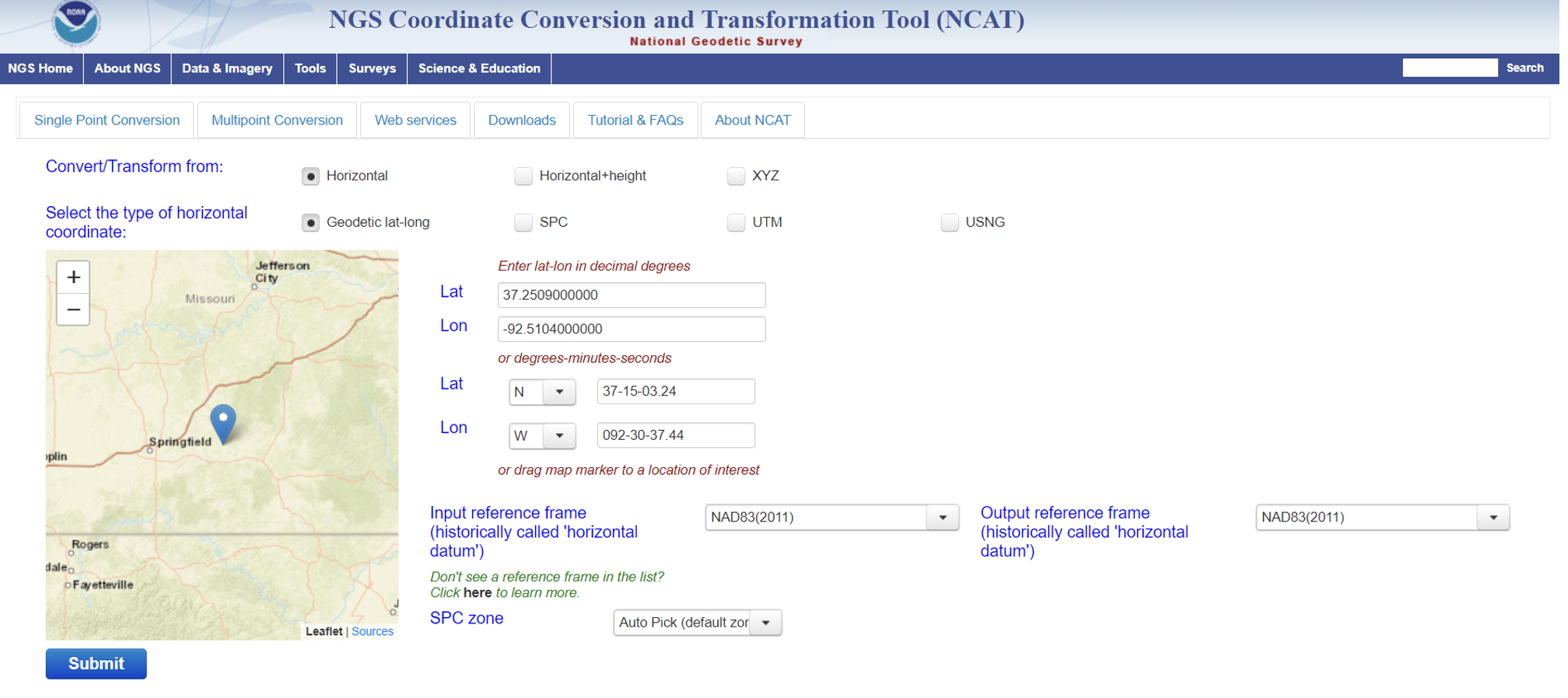
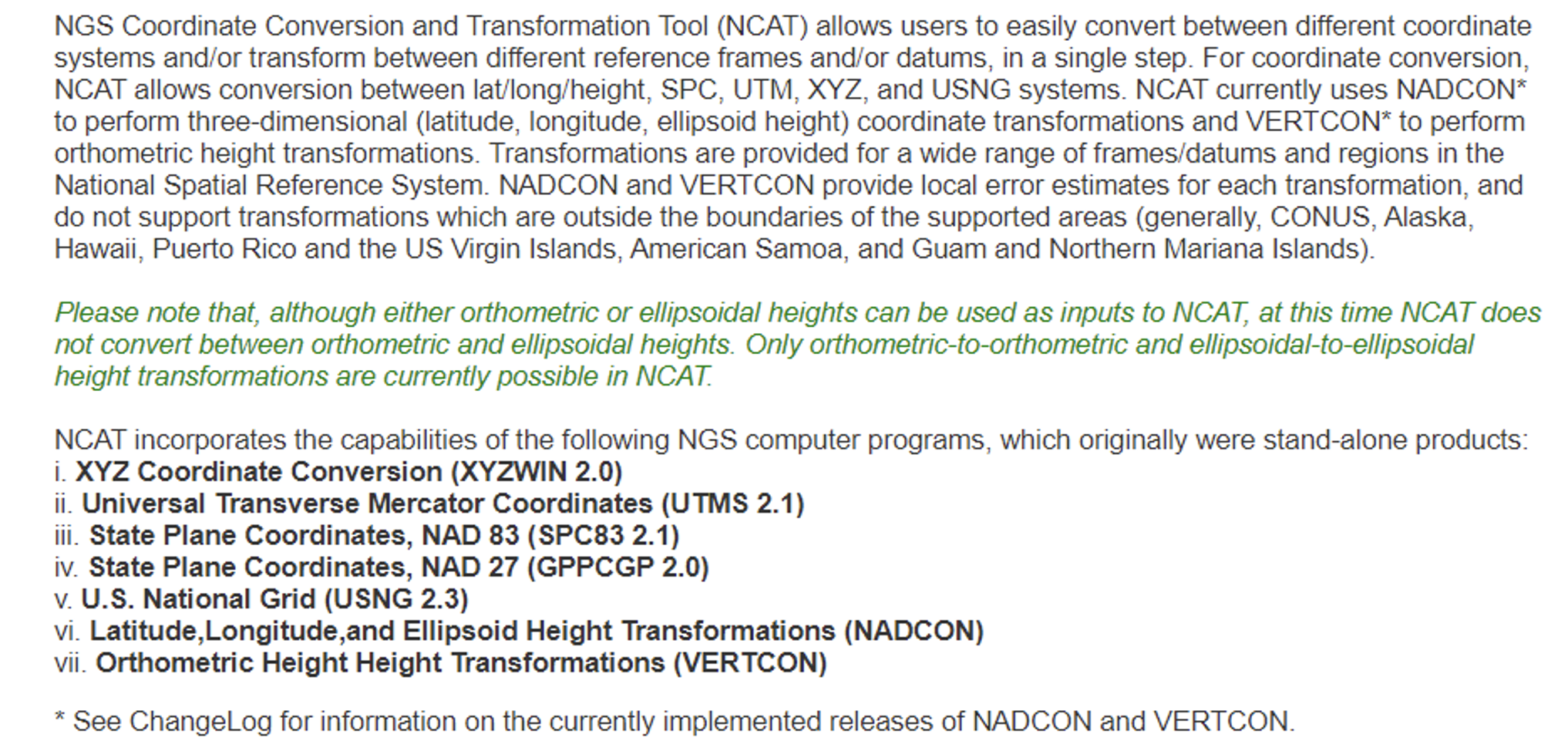
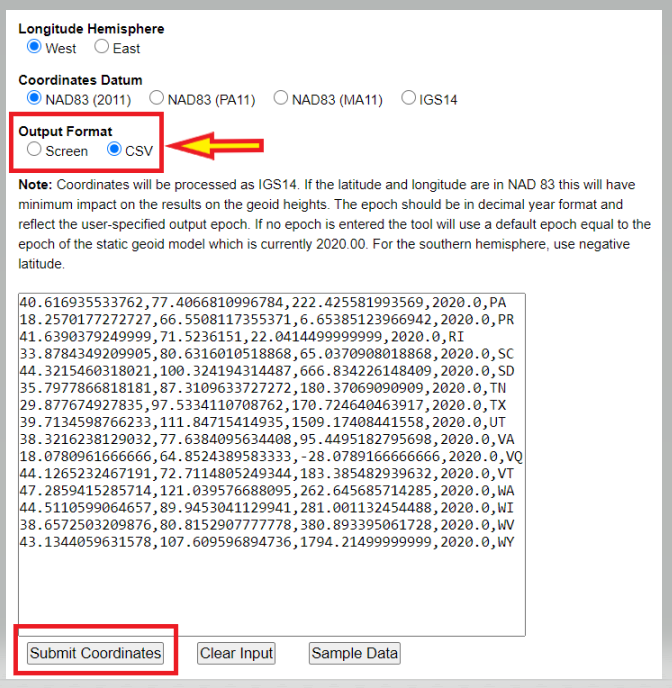
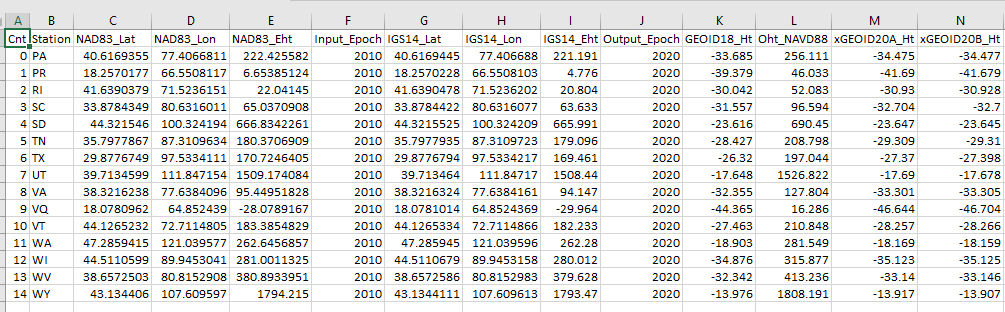
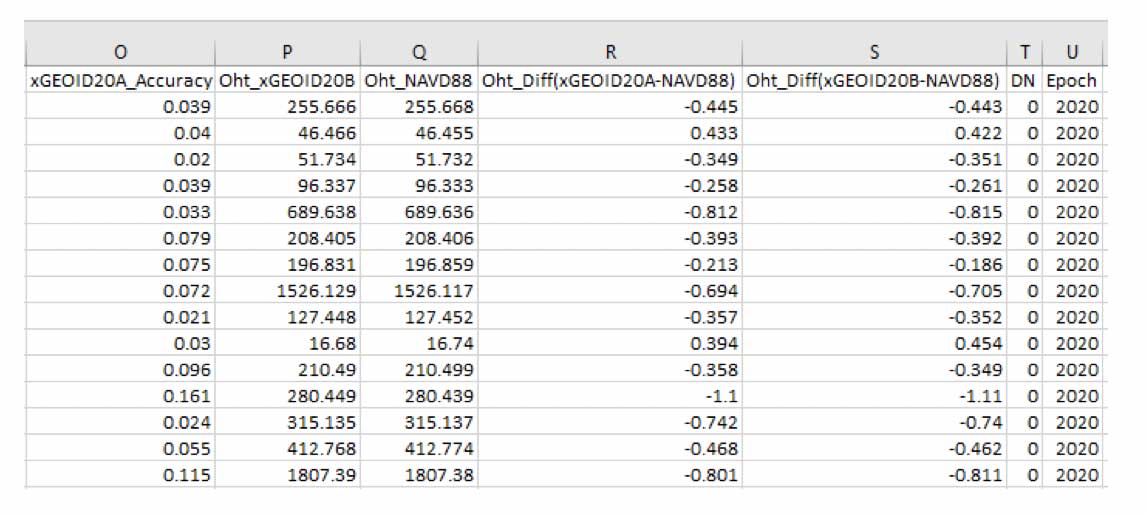
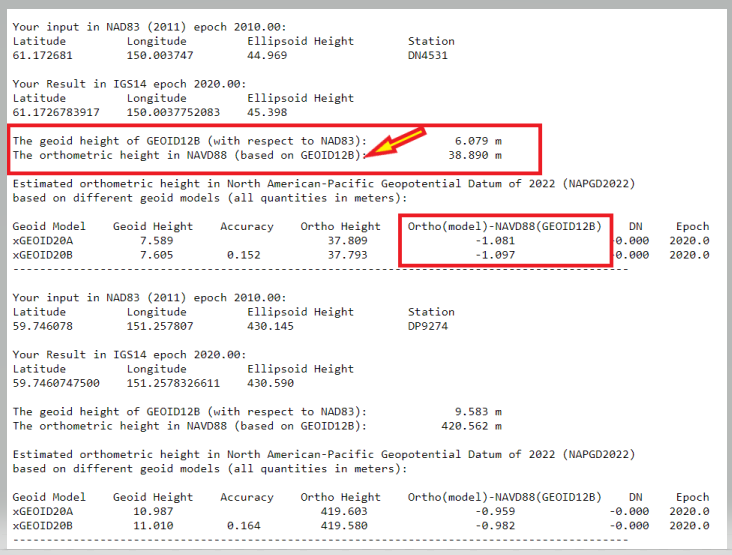
    NGS has developed web-based applications to convert coordinates between different coordinate systems and transform between different reference frames and/or datums. See the box titled “NGS NCAT Web Tool.” I described the NCAT web tool in my October 2019 and September 2023 GPS World newsletters.

    NGS NCAT web tool. (Photo: NGS)
    NGS NCAT web tool. (Photo: NGS)
    Photo: NGS o:
    Photo: NGS

    So, from a geodesist’s point of view, there is no issue with digital delivery geometric consistency if the appropriate tools are correctly used to convert coordinates between different coordinate systems and transform them between different reference frames and/or datums. That said, unique coordinate systems may be used by engineers to create 2D and 3D as-built drawings, such as blueprints and models. This should not be a problem for developing a transformation model if the appropriate information is available.

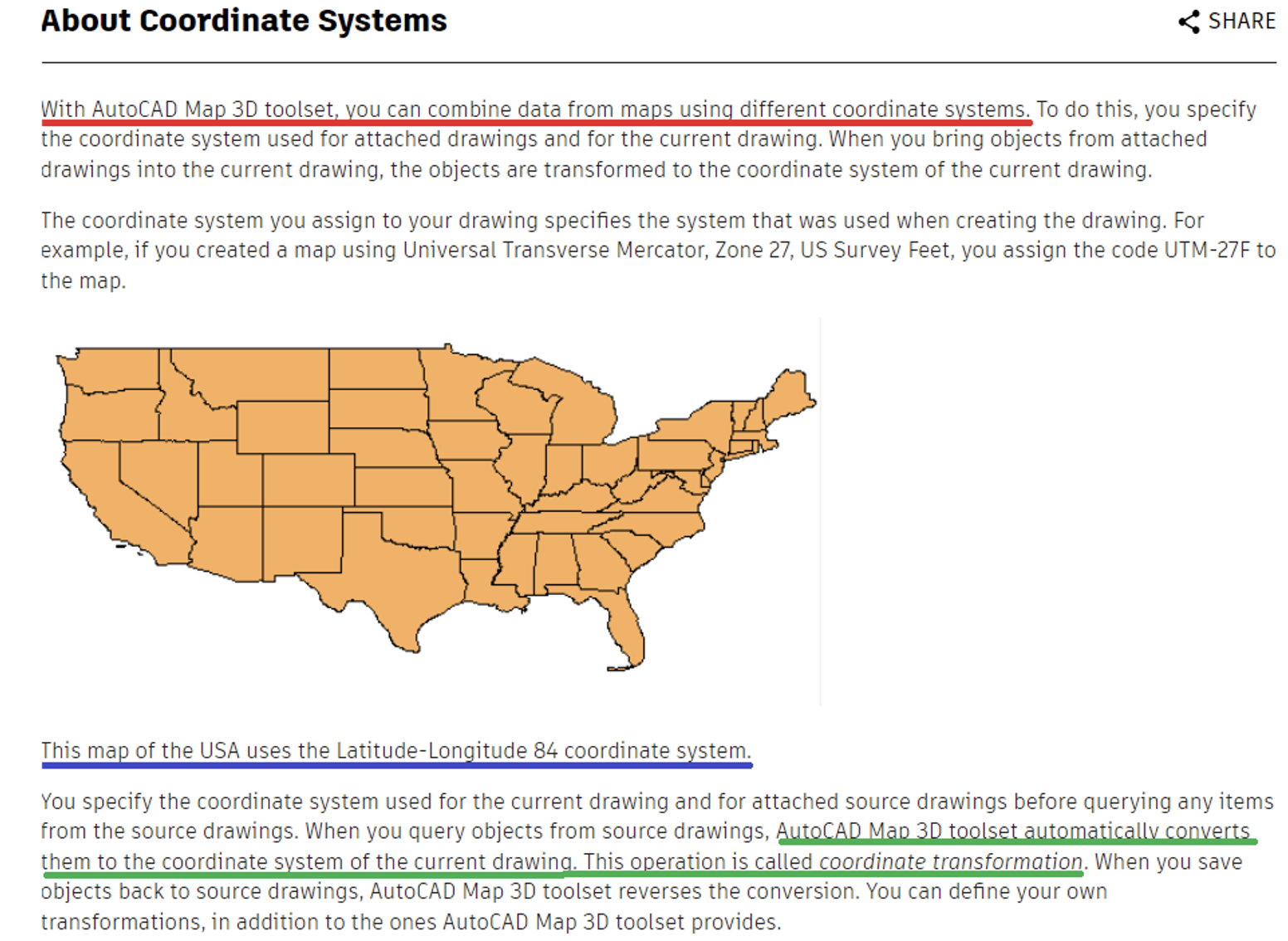
    The AutoCAD Map 3D website states that users can combine data from maps using different coordinate systems (see the box titled “Excerpt from AutoCAD Map 3D Site”).  The site states that “AutoCAD Map 3D toolset automatically converts them to the coordinate system of the current drawing.”  This is an indication that CAD routines are working on handling different coordinate systems.

    That said, users should make sure that the conversions and transformations are using the correct formulas and parameters. For example, I would like to know what defines the Latitude-Longitude 84 coordinate system that is highlighted in the box. I am not suggesting that anything is incorrect in the definition of the coordinate system. I am just saying that I do not know what the statement means; I would need more information before I can use the data.

    Excerpt from AutoCAD Map 3D 2025 site.
    Excerpt from AutoCAD Map 3D 2025 site.

    That said, ESRI and Autodesk, two industry leaders, have created a partnership to integrate GIS and Building Information Models (BIM), which seeks to create an integrated and collaborative workflow that connects data sources. ESRI denotes this as ArcGIS GeoBIM.

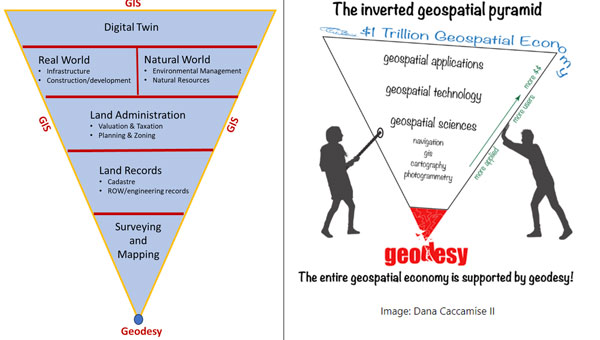
    Representatives from ESRI and Autodesk participated in the meeting. During the meeting, Linda Foster, ESRI and President-Elect of the National Society of Professional Surveyors (NSPS), gave a presentation that included a discussion of the ArcGIS GeoBIM web-based tool. Linda highlighted how geodesy and surveying provide the foundation for Digital Twin products. Her presentation included a diagram that I have recreated below.

    Notice that geodesy is at the base and digital twin is at the top of the inverted triangle. See the box titled “Geodesy Provides the Foundation for all Geospatial Products and Services.” The diagram is like the one I highlighted in my February 2022 GPS World Newsletter to emphasize the geodesy crisis. Both diagrams emphasize the importance of geodesy and surveying in creating geospatial products and services. It is encouraging to see that ESRI and Autodesk are working together to understand the needs of both communities. This will lead to the development of an improved system.

    Photo:
    Image: Dave Zilkoski — based on Linda Foster’s presentation at the TRB AKD70 summer meeting on July 30, 2024.

    From a geodesist’s viewpoint, there does not seem to be a problem with digital delivery geometric consistency. Of course, I know that it is not as simple as I am making it. I realize that the “devil is in the details,” which means that something that appears to be simple will identify issues that will have to be dealt with during development and implementation. During the meeting, it was announced that the TRB AKD70 Committee is developing a webinar titled “Resolving ambiguities between 3D virtual models and the real world” to make people aware of the issues.


    Proposed Webinar

    Proposed title: “Resolving ambiguities between 3D virtual models and the real world”
    Proposed description: The transportation industry is rapidly moving towards achieving digital product delivery and digital as-built objectives in the Civil Infrastructure sector. They are doing this by adopting a 100% end-to-end digital, asset-centric, interoperable data flow. However, the current methodologies being discussed use outdated concepts that rely on 2D/1D plans and profile/cross-section sheets as part of physical construction reality. These methodologies are not in line with current construction objectives, which require the use of Open BIM and Digital Twin concepts. Therefore, it’s crucial to address the current geospatial and geodesic ambiguity between the real world and BIM (virtual 3D models) to ensure a clear understanding of the proposed solution and its efficient implementation. This is especially important considering the industry’s reliance on Global Navigation Satellite System (GNSS) measurement methodologies. There is an imperative need to resolve this geospatial and geodesic ambiguity by adopting sound geodetic methodologies. The webinar will present the basic tenets of geodetic engineering from three points of view: the Department of Transportation (DOT) perspective, the digital product delivery perspective and the Survey/Geodesy perspective.
    Proposed purpose: To raise awareness among the DOT community, which is intent on achieving the 100% digital end-to-end asset-centric interoperable flow objectives, of the need to resolve the ambiguities between virtual 3D models and the real world.


    I always learn something new at these meetings and continue to build new relationships expanding my professional network. These meetings are open to anyone, so I would encourage everyone to learn more about the TRB ADK70 Standing Committee on Geospatial Data Acquisition Technologies. Please contact Wei Johnson for more information about getting involved with the committee.

  • NGS new alpha preliminary products in support of the modernized NSRS

    NGS new alpha preliminary products in support of the modernized NSRS

    Photo: SonjaBK / iStock / Getty Images Plus / Getty Images
    Photo: SonjaBK / iStock / Getty Images Plus / Getty Images

    In my last newsletter, I highlighted the release of a beta version of a new NOAA CORS Network (NCN) Station Web Page. As demonstrated in my newsletter, each CORS in the NCN has its own page with data, metadata, maps and photos for that station displayed in a modular layout so information is easily found all in one location. This past month, I had the privilege of participating in a meeting with representatives from the American Association for Geodetic Surveying (AAGS), the National Society of Professional Surveyors (NSPS) and the National Geodetic Survey (NGS). As a Past President of AAGS and the current Chair of the AAGS Membership Committee, I participate in these quarterly meetings.

    AAGS aims to lead the community of geodetic, surveying, and land information data users through the 21st century. AAGS members develop new educational programs, including presentations, seminars, and workshops on topics related to geodetic surveying; and articles and papers that inform the membership of the latest scientific and technological developments and how to implement them in the most cost-effective and efficient manner.

    In my previous newsletters, I have reminded everyone that time is running out to obtain a working knowledge of the new, modernized National Spatial Reference System (NSRS). The release of the new, modernized NSRS is only about a year away. As of July 2024, NGS plans to have a beta version of the new, modernized NSRS available around the summer of 2025 for users to test and evaluate new products and services. After enough testing has been performed, the new, modernized NSRS will be officially published – probably in early to mid-2026.

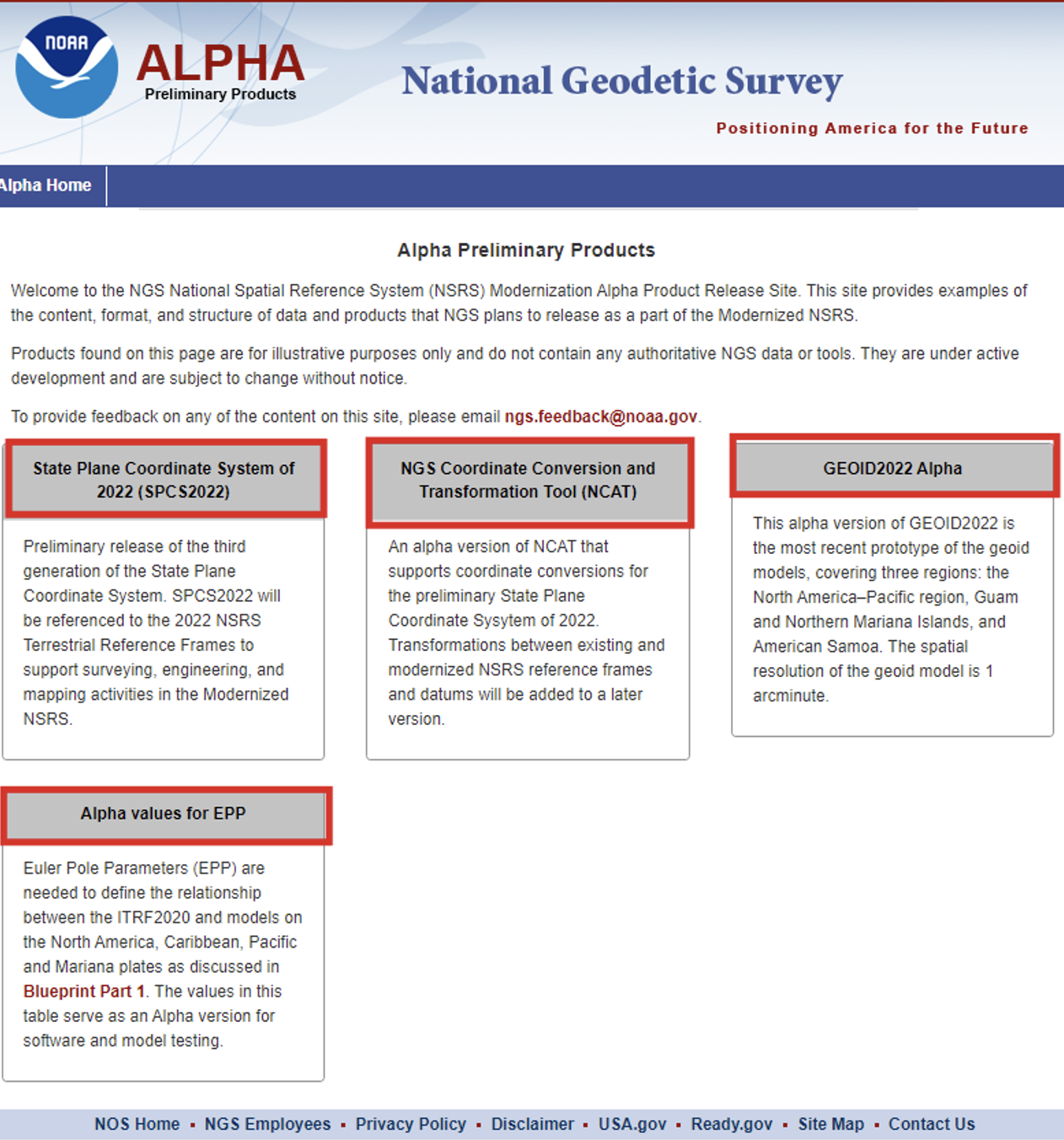
    At the meeting, NGS highlighted some new products on its Alpha Preliminary Products site. The alpha site provides products that are useful for individuals who want to obtain a better understanding of the products that will be distributed as part of the new, modernized NSRS.

    Photo:

    Some of my previous newsletters have discussed the Alpha product concept.  My September 2023 newsletter highlighted the first two Alpha products; that is, State Plane Coordinate System of 2022 (SPCS2022) and NGS Coordinate Conversion and Transformation Tool (NCAT).  As of June 2024, two more products have been added to the Alpha Preliminary Products site – “GEOID2022 Alpha” and “Alpha Values for EPP.”  The State Plane Coordinate System of 2022 (SPCS2022) is probably the most important to land surveyors.  There are significant changes between the SPCS2022 and the State Plane Coordinate System of 1983 (SPCS83). I will highlight the latest options in the alpha site later in this newsletter.

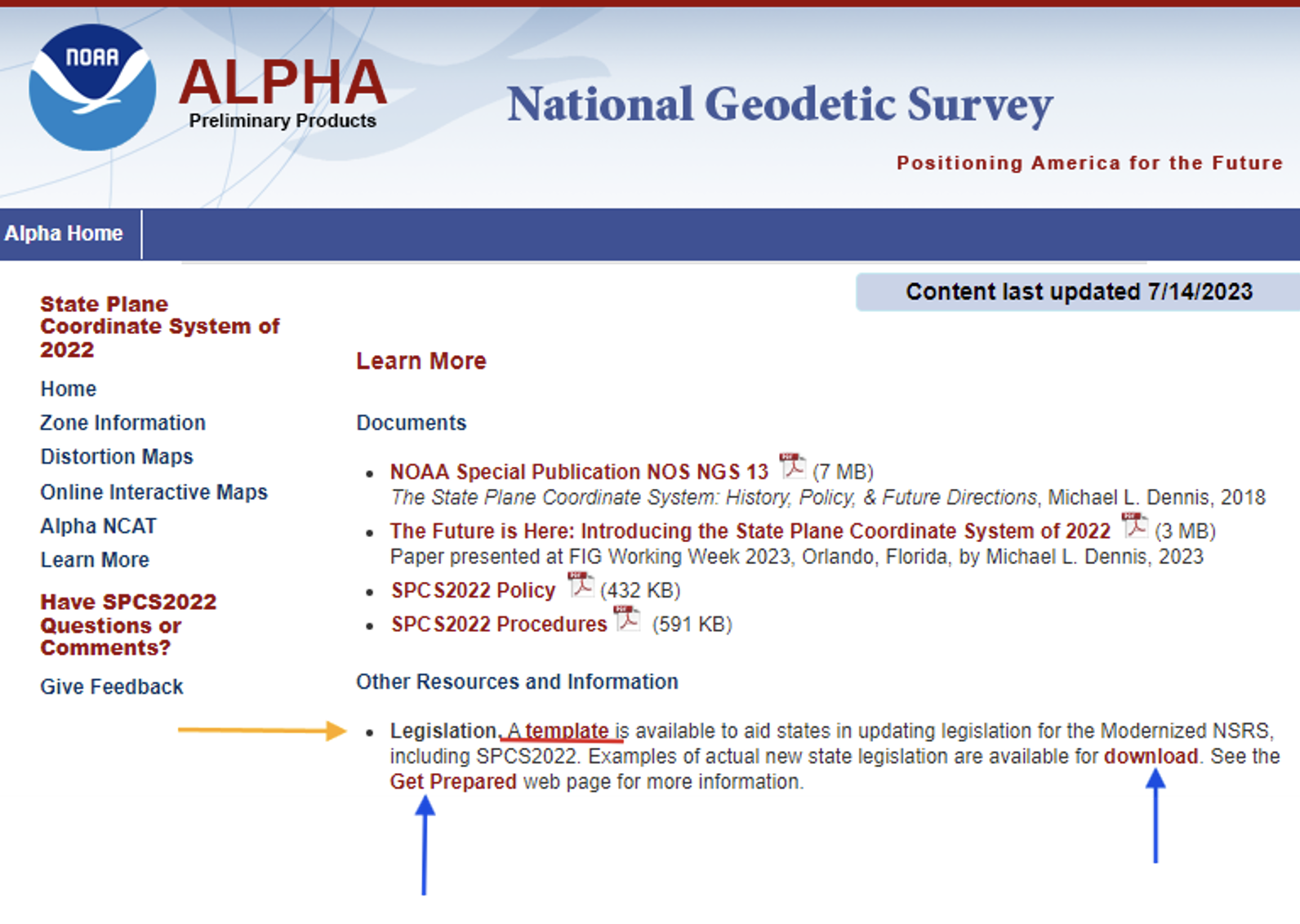
    First, I want to bring attention to the importance of ensuring that the state’s legislation is modified or rewritten, if required, to include that the current horizontal and vertical datums are being replaced with the new, modernized NSRS. The “Learn More” button on the SPCS2022 Alpha site provides information about legislation.

    Photo:

    On the “Learn More” site, NGS provides an SPCS legislation template.

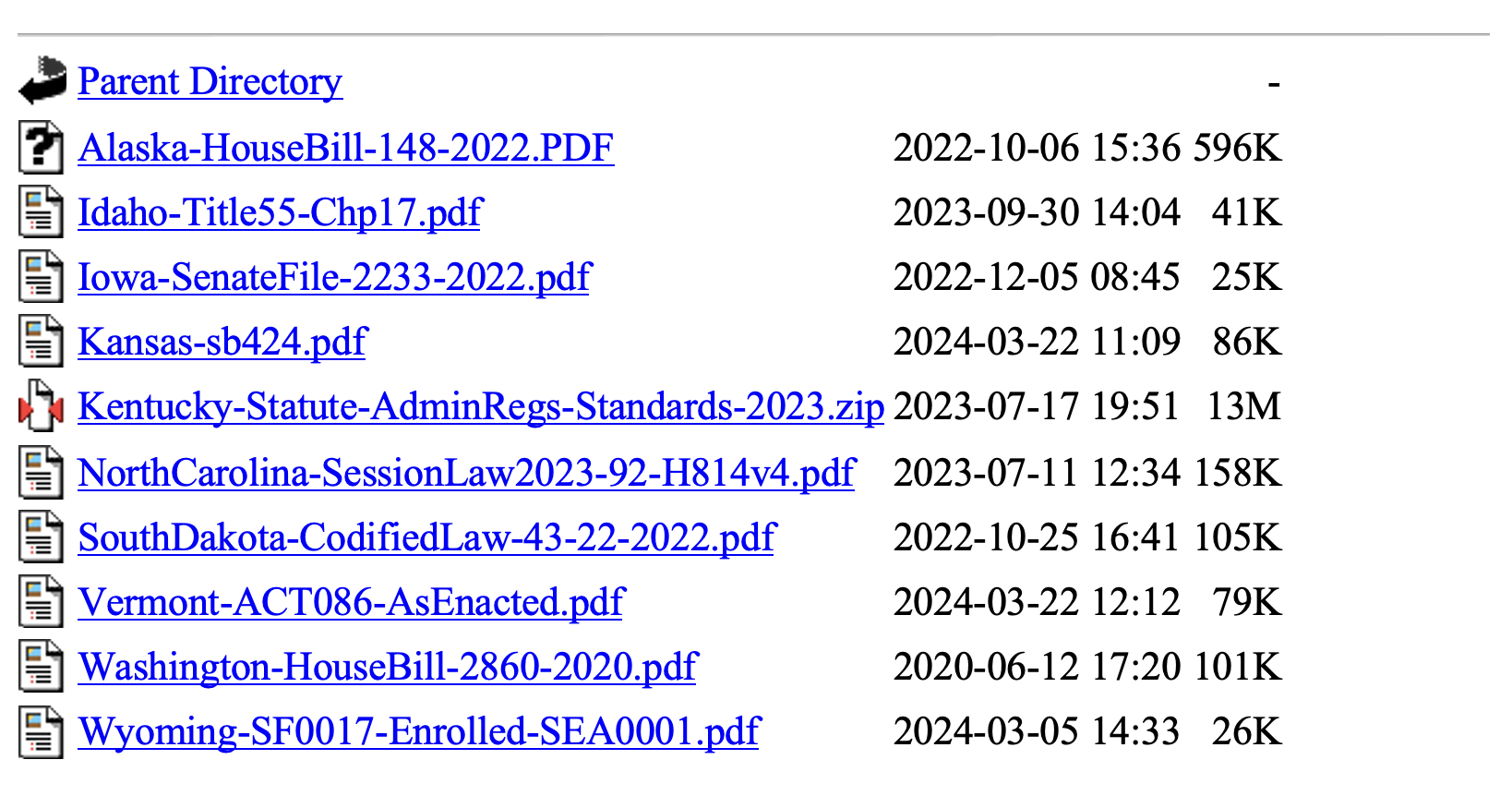
    Per personal communication with Michael Dennis, Ph.D., NGS SPCS2022 Manager, as of June 26, 2024, the following 12 states have have enacted into law NSRS modernization: Alaska, Idaho, Iowa, Kansas, Kentucky, Louisiana, Nebraska, North Carolina, South Dakota, Vermont, Washington, and Wyoming.

    Users can download examples of actual new state legislation here.

    Photo:
    Examples of legislation.

    During the joint AAGS/NSPS/NGS meeting, Tim Birch, the executive director of NSPS, said that anyone who has questions about updating legislation for the new, modernized NSRS, including SPCS2022, can contact him directly. NSPS has experience working with agencies and individuals to develop legislation as indicated in the following statement on the NSPS website.

    “We are the voice of the professional surveying community in the US and its territories. Through its affiliation agreements with the respective state surveying societies, NSPS has a strong constituency base through which it communicates directly with lawmakers, agencies, & regulators at both the national and state level. NSPS monitors and comments on legislation, regulation, & policies that have potential impact on the activities of its members and their clients, and collaborates with a multitude of other organizations within the geospatial community on issues of mutual interest.”

    Tim’s contact information is provided on the NSPS home webpage: Staff List – National Society of Professional Surveyors (nsps.us.com).

    As previously stated, the two latest alpha products are the “GEOID2022 Alpha” and “Alpha Values for EPP.” My December 2017 newsletter discussed GEOID 2022 and the North American-Pacific Geopotential Datum of 2022 (NAPGD2022), and my February 2022 newsletter discussed the Euler Pole Parameters process and use in the new, modernized NSRS.

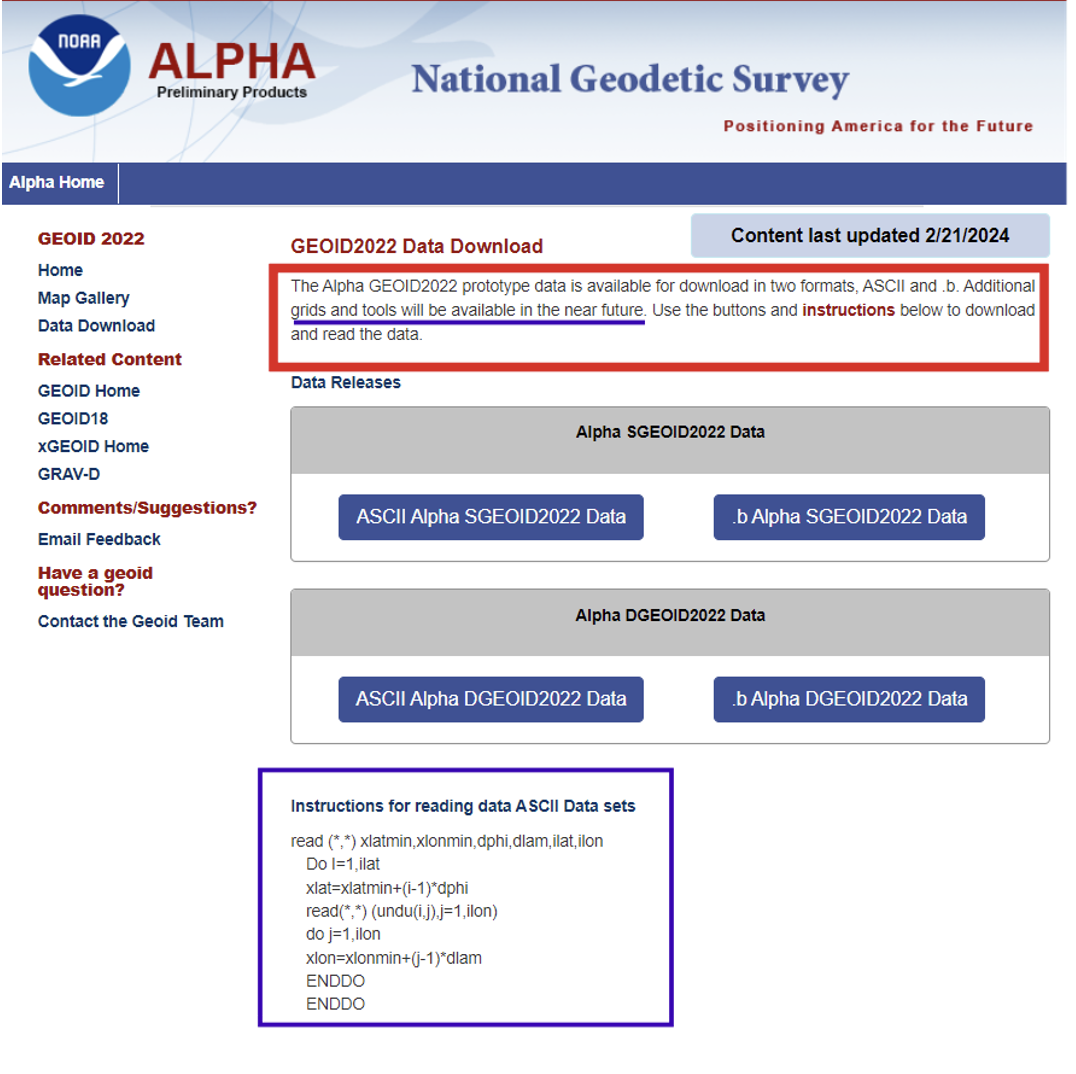
    The GEOID2022 Alpha page provides a version of GEOID2022, which is the most recent prototype of the geoid models. The reference ellipsoid is Geodetic Reference System 1980 (GRS 80, but the geometric reference frame is ITRF2020). The Alpha GEOID2022 prototype data is available for download in two formats, “ASCII” and “.b.” There is a static component (SGEOID2022) and a dynamic component (DGEOID2022). These grids will be useful to programmers who want to develop and test their systems. Additional grids and tools will be available in the future.


    Technical Details of the Alpha prototype of GEOID2022

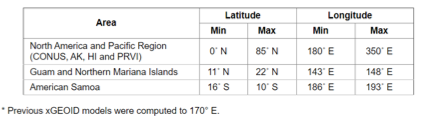
    GEOID2022 alpha is the last prototype of GEOID2022. It covers three regions: the North America–Pacific region, Guam and Northern Mariana Islands, and American Samoa. The spatial resolution of the geoid model is 1 arcminute. The geoid heights, which are in the tide-free system, are with respect to the reference ellipsoid of the Geodetic Reference System 1980 (GRS80) in the ITRF2020 geometric reference frame. GEOID2022 alpha includes static and dynamic components for the geoid heights. For detailed fundamental parameters of the geoid model, refer to NOAA Technical Report 78.


    Photo:
    GEOID2022 Alpha


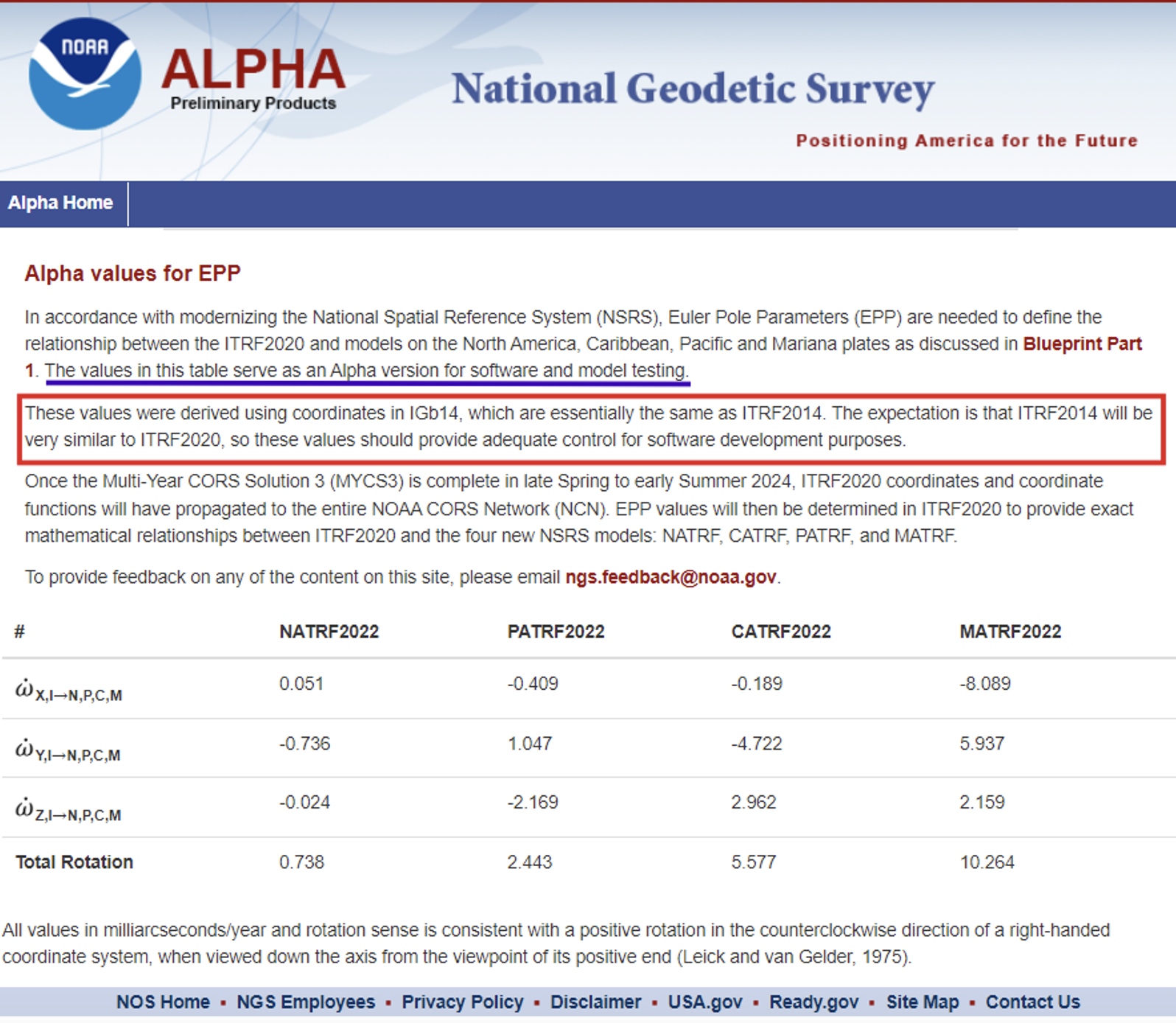
    The Alpha EPP site provides the Euler Pole Parameters (EPP) that are needed to define the relationship between the ITRF2020 and models on the North America, Caribbean, Pacific and Mariana plates as discussed in NGS’s Blueprint Part 1 document.

    Photo:
    Alpha Values for EPP

    As stated in Blueprint Part 1, NGS will define the official relationship between ITRF2020 and the four NSRS TRFs through equation 59, using the rotation matrix in equation 58 resulting in equation 60.

    I programmed this using a simple Excel spreadsheet to compute some of the potential changes between epochs for North Carolina. They were very similar to the ones that I depicted in my February 2022 newsletter that discussed the Euler Pole Parameters process and provided plots depicting the movement.

    Photo:

    I would like to highlight the latest information available on the State Plane Coordinate System of 2022 alpha site. As previously stated, in about a year, the new, modernized NSRS will be available as a beta product. Users must get prepared by accessing NGS’s alpha products as well as taking the opportunity to provide feedback to NGS to improve their products and services. The Online Interactive Maps page provides information about the zones for every U.S. state and territory.

    Photo:

    Clicking on the Online Interactive Maps link opens a NOAA ArcGIS online website that provides information about the Alpha State Plane Coordinate System 2022 preliminary zone designs. I have highlighted a few items that may be of interest to users.

    The site provides a description of the site, links to various types of zones, links to data sources and information about distortion.

    SPCS2022 online interactive maps
    SPCS2022 online interactive maps.


    Clicking on the link for zone definitions provides a list of zones and their parameters. This same information is also provided when users click on a zone on the map. I will demonstrate this later in this newsletter.

    Per personal communication with Dennis, as of June 26, 2024, seven states have some or all their SPCS2022 zone definitions formally finalized, consisting of 205 out of the 965 zones (the total number of zones is still preliminary):

    • Alaska (partial coverage multizone layer)
    • Arizona (both multizone layers)
    • Idaho (both multizone and statewide)
    • Kentucky (both multizone and statewide)
    • North Carolina (statewide zone; it has no other zones)
    • South Dakota (both multizone and statewide)
    • Wisconsin (multizone)

    Dennis informed me that the information on the alpha SPCS2022 Experience has been updated. He told me that the total number of zones decreased from 967 to 965, but based on coordination with the International Association of Oil & Gas Producers (IOGP) Geodesy Subcommittee the number may eventually increase to 972 (more about that in a future newsletter).

    He stated that his goal is to finalize the zone definitions by the end of this calendar year or early 2025. Users should keep checking the alpha site.

    Dennis mentioned that the website now offers a new feature that provides the distortion value when users click on the map. A nice thing about that is the site can be used on a smartphone, allowing users to obtain real-time distortion information from their location.

    Clicking on the link titled “View” in the upper right corner of the box brings up a map that depicts the SPCS2022 zones.

    View of ALPHA (preliminary) SPCS2022 zone designs.
    View of ALPHA (preliminary) SPCS2022 zone designs.

    When you click on the note about the ALPHA being preliminary, the map underneath appears where the user can select the type of maps they wish to review.

    The following options are available: All Zone Layers, Statewide Zone Layers, Multizone Complete Layers, Multizone Partial Layers, and Special Use Zone Layers.

    Users can use their mouses or the “+” button on the left-hand side” to zoom to a particular region, or use the search button on the right-hand side to select a State or zone.

    Photo:

    Using the search box.
    Using the search box.

    Information about a particular zone pops up by clicking on a point on the map.

    Detailed information provided for a zone.
    Detailed information provided for a zone.

    Each zone provides links to other features based on the location of the point selected on the map.

    The image below provides the distortion in ppm for the point selected on the map.

    Photo:

    Photo:

    The Alpha NCAT site can be used to obtain an estimate of the changes between SPCS83 and SPCS2022. It should be noted that all values will be in meters (m) and international feet (ft).

    International feet may be new to some surveyors who were previously using the U.S. survey feet in SPCS83. The U.S. survey foot will not be used with the NSRS, including SPCS2022 coordinates. NGS and the National Institute of Standards and Technology (NIST) have taken action to deprecate the U.S. survey foot. What does that mean?. NIST has the following statement on its website: “Beginning on January 1, 2023, the U.S. survey foot should be avoided, except for historic and legacy applications, and has been superseded by the international foot.” This means that NGS will not be publishing SPCS2022 in U.S. survey feet but all historic products and services such as SPCS83 will still be provided in U.S. survey feet (sft) and international feet (ift).

    More information and resources about the deprecation of the sft are listed below (personal communication from Dennis):

    • The official announcement is the final determinationFederal Register Notice (FRN) on deprecation of the sft issued on 10/5/2020. It was jointly issued by the National Institute of Standards and Technology (NIST) and NGS. I encourage everyone concerned about this topic to read it closely and in its entirety; it can likely answer most questions. The FRN includes information on the continued use of sft for legacy applications (such as SPCS 83). That is stated in the last paragraph of the “Notice of Final Determination” section; in items #1 and #2 in the “Counterpoints to Feedback Expressing Opposition”section; and in the second paragraph of the “Implementation Summary and Actions” section.
    • The legacy issue is also addressed in the 10th FAQon the NIST website and in the 11th FAQon our “new datums” FAQs web page.
    • The 40 states that officially adopted the sft for SPCS 83 are listed in Table C.1 of Appendix C of NOAA Special Publication NOS NGS 13, “The State Plane Coordinate System History, Policy, and Future Directions.”
    • Although the final determination FRN is itself not a law, Congress has passed several laws giving NIST the authority to maintain national standards of measurement. These and other related federal laws are given in the initial sft FRNissued on 10/17/2019.
    • An NGS webinar given on 11/10/2022 addresses the deprecation of the sft in the context of state plane. Two previous NGS webinars also provide additional background and historical information on the sft, one given on 4/25/2019 and the other on 12/12/2019.
    Input to Alpha NCAT.
    Input to Alpha NCAT.
    Photo:
    Photo:Output from Alpha NCAT.

    This newsletter highlighted the products on NGS’s Alpha Preliminary Products site. The alpha site provides products that can be useful for individuals to obtain a better understanding of the products that will be distributed as part of the new, modernized National Spatial Reference System (NSRS). NGS is providing these products on an alpha site so that they can get feedback from users. I would encourage all users to access the alpha sites and provide comments to NGS so that their products and services better meet the needs of the surveying and mapping community.


    Alpha Preliminary Products

    Welcome to the NGS National Spatial Reference System (NSRS) Modernization Alpha Product Release Site. This site provides examples of the content, format, and structure of data and products that NGS plans to release as a part of the Modernized NSRS.

    Products found on this page are for illustrative purposes only and do not contain any authoritative NGS data or tools. They are under active development and are subject to change without notice.

    To provide feedback on any of the content on this site, please email [email protected].

  • NGS beta version of a new NOAA CORS Network station web page

    NGS beta version of a new NOAA CORS Network station web page

    My past GPS World newsletters (February 2024, March 2024, April 2024 and May 2024)  highlighted the NGS Geospatial Modeling grantees which included creating a CORS Dashboard that will be very useful to NGS employees monitoring the CORSs and evaluating the Intra-Frame Deformation Model (IFDM).

    I mentioned in the May 2024 newsletter that NGS announced the release of a beta version of a new NOAA CORS Network (NCN) Station Web Page. Each CORS station in the NCN will have its own page with data, metadata, maps and photos displayed in a modular layout so information is easily found in one location. This newsletter will describe some features of the new beta site.

    The beta site is located here.

    I will highlight some of the information provided by the routine, but I would encourage others to access the beta site and provide feedback to NGS. NGS states on the site that “This is a Beta product. We are interested in your feedback. Please email us at: [email protected] and indicate the subject as “NCN Station Pages Feedback.”

    When you access the website, it defaults to the CORS station GODE. The user has the option to enter their own CORS station in the box located on the right-hand side of the webpage.

    Texas CORS Station TXLV
    Texas CORS Station TXLV.

    A nice feature of the site is that the CORS data availability for the last seven days is provided under the Station Information section. For those interested in downloading data, there is a button titled “Quick Data Download,” on the top left corner. The site allows users to download daily data from the past 30, seven or two days.

    In my example, I downloaded the last seven days of data for CORS TXLV. It only took a few seconds to download and provide the data in a zipped file. If a user includes this process in their standard operating procedure, they can easily download all the CORS data required for their project.

    Downloading TXLV GNSS data
    Downloading TXLV GNSS data.

    Another planning tool available is the weather information for a week. Today, most users can get the weather information on their phone. However, this is a convenient option to have when you are looking at available CORS on the day of occupying marks. It can help in managing schedule changes.

    Photo: USGS

    There is an option to show the five nearest CORS relative to your selected CORS by clicking on the button titled “Show Closest 5 on Map.”

    CORS Located near TXLV.
    CORS Located near TXLV.

    Clicking on the button labeled “Show Legend” provides information about the CORS depicted on the map. This is a useful feature especially if selecting CORS that provide GNSS data other than GPS and/or data at different sampling rates.

    Photo:

    If a user clicks on the button “Open NGS Map,” the site will access the NGS Map website and provide information about the selected CORS. This allows users to get information about the CORS. I found that the beta site provided most of the same information using the various options on the NGS Map website.


    NGS Map depicting CORS TXLV
    NGS Map depicting CORS TXLV.

    The site provides photos and equipment history that may help in troubleshooting an issue associated with processing sessions or during the analysis of the adjustment results. I have highlighted that a new antenna was installed at the TXLV CORS on August 5, 2021. I will explain later in this newsletter how this information helped me during my analysis of a GNSS project.

    Photos and equipment history of TXLV.
    Photos and equipment history of TXLV.

    Under the Coordinates and Velocities section, the site provides information about the latest coordinates and velocities along with superseded values for the selected CORS. The superseded values may not be of interest to most users, but I am always looking at the changes in CORS coordinates. It is my nature to try to understand the reason why something has changed; especially for CORS that I am including in a GNSS project.

    Coordinates and velocities.
    Coordinates and velocities.

    Clicking on the link titled “Position and Velocity” under the Coordinates and Velocities section provides the coordinate and velocity information for your selected CORS. I have highlighted the ITRF2014 velocities, the NAD 83 (2011) velocities, the latest antenna type, installation date and the dates the positions and velocities were revised.

    Photo:Photo:

    As shown in the image above, the position and velocity sheet provide the dates that the position was revised. Clicking on the link titled “Datasheet with GRP/MON included (if available)” in the Coordinates and Velocities section provides the datasheet that lists the NAD 83 (2011) superseded survey control values. The superseded ellipsoid heights from the datasheet are provided in the box titled “Excerpt from TXLV Datasheet.”

    When you are trying to estimate heights to the 2 cm level, changes in published NAD 83 (2011) CORS heights at the 2 cm level are significant and should be investigated and understood. This beta CORS website offers useful information that can help understand some of these changes. I will explain later in the newsletter how this information and other data from the beta site helped me in the analysis of my GNSS project.

    Excerpt from TXLV data sheet.
    Excerpt from TXLV data sheet.

    The beta site provides plots that depict the daily positions and residuals for a CORS. In my May 2024 newsletter, I stated that NGS has developed a Beta CORS Time Series Tool that provides information that assists users in selecting appropriate CORS for a project. The Beta CORS Time Series Tool provides the residual differences from the daily NGS OPUS-NET solutions with the coordinates from the official CORS’ coordinate functions. The excerpt below explains the plots and residuals:


    NCN Residual Time Series Comparison Tool (NCN PloTS)

    This tool computes and displays the residuals for up to 50 CORS stations within the NCN. The mean, standard deviation, and root-mean-square error of the residuals are also provided in a summary table that is available for download. This tool is informational, not authoritative.

    The residuals are calculated as the difference between the daily observation at a station and the official daily coordinates for a station. The daily observation is processed from the GPS L1 and L2 signals only, using a network adjustment program. There must be a minimum of 8 hours of data present in a 24 hour file for a solution to be generated. The network adjustment program is an internal application developed by NGS for monitoring the position of the CORS stations in the NCN (Gillins et al., 2019). The official daily coordinates for a station are calculated using the reference epoch (2010.0) position and velocity published as the station coordinate function in the Position and Velocity File. An example of a Position and Velocity File for NCN station GODE can be found here. To obtain Position and Velocity Files for NCN stations please visit the NCN Station Pages and navigate to the Coordinates and Velocities section.

    This tool is optimized for plotting data extending between 30 to 90 days in length but can be customized to other time frames. The earliest start date currently available is October 27, 2018, which is the completion date of the MYCS2 and the end date can be as recent as 3 days before the present day. This three-day time lag is so that the final orbits can be used in the network adjustment to create the daily solutions. Then, please enter the 4-character station ID for at least one and up to 50 CORS stations in the NCN and submit this request to obtain a map, summary table of comparative statistics, and residual plots during the date range.


    The beta NGS NCN station pages show similar plots to the Beta CORS Time Series Tool. the station pages also allow users to create position and residual plots at different periods. I find these plots very useful when selecting CORS to be included in a GNSS project. The latest plots are of interest to users when selecting CORS to be included in their GNSS project but there are reasons to look at plots depicting older time periods.

    Position and residual plots for TXLV
    Position and residual plots for TXLV.

    I previously mentioned that the antenna of CORS TXLV was changed on August 5, 2021, so I used the option to plot the last five years to include data before and after the date the antenna was changed. I highlighted August 7, 2021, on both plots. This was two days after the antenna was changed on CORS TXLV.

    There appears to be a 2 cm upward shift in the up component after the new antenna was installed. There was also a change of about 1 cm in the north component. Something else to notice in the position plot is that the east component has a significant tilt during the five years. The below provides the ITRF2014 velocities — the eastward component velocity is —1.21 cm/year. In 5 years, one could expect to see about a 6 cm change.

    Position and Residual Plots for TXLV
    Position and residual plots for TXLV.
    Five-year position plot of TXLV.
    Five-year position plot of TXLV.
    Five year residual plot of TXLV.
    Five-year residual plot of TXLV.
    Position plot of TXLV for selected time interval
    Position plot of TXLV for selected time interval.

    These small changes affected my analysis and network adjustment results. During the past several years, I have participated in several Harris-Galveston Subsidence District (HGSD) GNSS projects performed in the Houston-Galveston, Texas, region. I have been involved with estimating subsidence in the Houston-Galveston, Texas, region for about 40 years so when I see changes in height values indicating an apparent uplift it makes me question my results. Therefore, I started investigating the CORS involved in the GNSS project. I looked at the Texas CORS surrounding the GNSS project: WHARTON CORS, COLUMBUS CORS, HEMPSTEAD CORS, LIVINGSTON CORS, and LIBERTY CORS.

    The table below provides the differences between the published ellipsoid height and the previous superseded height for the five CORS. As the table indicates, the published ellipsoid height of the CORS increased by about 2 cm from the superseded height. This led me to use the NGS NCN Station Pages to investigate these CORSs. I found that all five of these CORSs had new antennas installed in 2021 and their position plots depicted a similar shift.

    I want to emphasis that I am not saying that anyone did anything wrong or incorrect.  The CORS manager of these sites provided the appropriate metadata to the NGS CORS team so the site information could be updated and correctly reported. What this indicates to me is that the installation of the new antenna and setup may have affected the height component of these CORS, that is, it may have changed the official position of the monument’s reference point. Again, I want to emphasize that I am not saying that anyone did anything wrong or incorrect.  NGS’s process includes monitoring all CORS that are part of the NOAA CORS Network (NCN). The NGS CORS Team noticed the significant change in the up component comparing it to its expected value, so they computed a new coordinate and published the new coordinate in 2022. In my opinion, anyone using these CORSs as constraints in their GNSS projects after the date that the new antenna was installed and before the new coordinate was published could have generated adjusted heights that are in error by 2 cm. As previously stated, when you are estimating heights to the 2 cm level, changes in published NAD 83 (2011) CORS heights at the 2 cm level are significant. In my opinion, this type of analysis should be performed by all users that are incorporating CORS in their GNSS processing.

    CORS ID PID Station Name Published Ellipsoid Height (m) Published Date Date the New Antenna was Installed Date Station Coordinates Superseded Superseded Ellipsoid height (m) Difference Between Published and Superseded Heights (cm)
    txwh DL9086 WHARTON 8.615 04/22 4/28/2021 06/19 8.595 2.0
    txcm DL9812 COLUMBUS 45.481 04/22 3/17/2021 06/19 45.459 2.2
    txhe DH3608 HEMPSTEAD 48.823 04/22 5/06/2021 06/19 48.803 2.0
    txlv DN4508 LIVINGSTON 29.100 04/22 8/05/2021 06/19 29.075 2.5
    txli DH3612 LIBERTY -9.782 02/22 5/06/2021 06/19 -9.802 2.0

    Keep checking NGS beta site because NGS makes changes based on user feedback. As I previously stated, I would encourage everyone to access the beta site and provide your feedback to NGS. NGS states on the site that “This is a Beta product. We are interested in your feedback. Please email us at: [email protected] and indicate the subject as “NCN Station Pages Feedback.”  I have talked to the CORS team and they really would like feedback. The team will make changes to the website based on feedback from users.

  • MSU developing CORS dashboard and geodetic program

    MSU developing CORS dashboard and geodetic program

    Photo: Dana Caccamise II
    Photo: Dana Caccamise II

    In my November 2023 GPS World newsletter, I highlighted the announcement made by the National Geodetic Survey (NGS) of the recipients of the National Oceanic and Atmospheric Administration (NOAA) FY 23 Geospatial Modeling Competition awards. The primary objectives of these projects are to modernize geodetic tools and models and to develop a geodetic workforce for the future. My last three GPS World newsletters — February 2024, March 2024 and April 2024 — highlighted three of the grantees, Scripps Institution of Oceanography, The Ohio State University, and Oregon State University that included developing models to address what NGS denotes as the Intra-Frame Deformation Model (IFDM) and creating geodesy curriculums that will help address the geodesy crisis. Changes in these geomatic programs will provide students with the skills in geospatial systems that will make available opportunities for employment in the public and private sectors. This newsletter will address the proposal by the fourth NGS geospatial modeling grant awardee, Michigan State University (MSU).

    First, it should be noted that this award is denoted as the MSU geospatial modeling award; that said, the execution of the project will be led by MSU, along with two sub-awardees — University of Alaska Fairbanks (UAF) and Michigan Tech University (MTU). Jeffrey Freymueller and Julie Elliott are the MSU grant’s principal investigators (PI). They provided me with information about the goals and objectives of their grant proposal.

    The MSU proposal includes enhancing software and monitoring capabilities for NGS, enhancing graduate-level geodetic education and providing opportunities for graduate and undergraduate students to be exposed to geodetic science. Again, focusing on geodesy curriculums will help address the geodesy crisis and will provide students with the skills in geospatial systems that will increase their opportunities for employment in the public and private sectors. The proposal has two main goals and objectives.

    Goals and objectives

    CORS Dashboard 

    • Build an online, web-based CORS dashboard that will support monitoring of the continuously operating reference station (CORS) network.
    • Making it easier to continually validate the current position of CORS sites to the existing motion models (IFDM).
    • To validate and correct the motion models themselves in the presence of time-dependent tectonic and volcanic activity.

    Education

    • Work with partner universities toward developing and establishing a consortium model for future distributed geodetic degree programs that leverage the capabilities and capacity of multiple universities.
    • Develop new course material for graduate level geodetic education that is intended for hybrid or asynchronous remote delivery and the establishment of a formal degree program.
    • Host summer undergraduate interns who will work on a variety of geodetic projects including the CORS dashboard.
    • Two graduate students will be supported to work on various aspects of the proposed work at MSU and MTU.

    Anyone using NGS’s “user-friendly” software knows that they are working on improving their web-based services. However, NGS still needs help from outside users.

    I want to emphasize that I am not criticizing NGS’s products and services. I worked for NGS for over three decades, and I personally know that NGS has limited resources to accomplish too many tasks. NGS needs to focus on the science and get help with the development of models, tools and the dissemination of results and data. That is one of the reasons that these geospatial modeling grants are important to all users of the National Spatial Reference System (NSRS).

    The proposed CORS Dashboard will be very useful to NGS employees monitoring the CORS and evaluating the IFDM. The proposal highlights that users of NGS products and services have various precision and accuracy requirements and that all users expect that NGS products will be sufficiently precise and accurate to meet their positioning needs. Their design of the CORS Dashboard will provide a tool for effectively monitoring and assessing a CORS site status and the validity of its coordinates. The first phase of this tool is being developed for internal use at NGS. However, in my opinion, after all the bugs have been identified and dealt with, NGS will release a version for the user.

    Not all CORS are created equal. So, having a CORS Dashboard that quickly identifies and notifies CORS users of a systematic deviation at a site, regardless of cause, will avoid promulgating erroneous positions to users. In addition, providing statistical information about a CORS site such as short- and long-term plots and their residuals would provide users with helpful information for planning a GNSS project. The metadata of CORS is extremely important since most of the CORS included in the NOAA CORS Network are not maintained by NGS.

    CORS managers are supposed to notify NGS when they make any change to their CORS site such as an antenna change and any changes surrounding the CORS site, including new vegetation or construction that could cause potential obstructions. The CORS Dashboard will help identify issues with CORS before users include them in their projects.

    NGS’s OPUS Project online user guide provides information on selecting the best CORS.  The following is from the user guide:

    • Using the centered time-series plots, select the candidates with RMS (in northing, easting, and up) less than 2 cm. Candidates with large spikes, data gaps or discontinuities should be rejected. Selecting candidates in this manner will provide some assurance that the published coordinates and velocities at the CORS agree with the daily solutions for the CORS.
    • The best CORSs should have “consistent” data depicted in 90-day short-term time-series plots. NGS processes each day of GNSS data collected at each CORS and plots the differences between the resulting coordinates and the published coordinates on short-term time-series plots (in terms of delta northing, easting, and up). These plots can be accessed for every CORS at https://geodesy.noaa.gov/corsdata/Plots/. CORS with plots that depict significant biases from the published coordinates (more than 2 cm in northing, easting, or more than 4 cm), spikes or data gaps should be avoided.

    NGS has developed a Beta CORS Time Series Tool that provides information that assists users in the selection of appropriate CORS for a project. The tool computes and displays the residual differences from the daily NGS OPUS-NET solutions with the coordinates from the official CORS’ coordinate functions. The tool also generates a summary table with the mean, standard deviation, and root-mean-square error of the residuals. On April 24, 2024, NGS announced the release of a beta version of a new NOAA CORS Network (NCN) Station Web Page. According to the announcement, each CORS in the NCN will have its own page with data, metadata, maps and photos for that station displayed in a modular layout so information is easily found all in one location. I will describe this new beta site in a future newsletter.

    The new, modernized NSRS will offer time-dependent coordinates based on an IFDM. This has been described in previous GPS World newsletters (February 2022 and August 2022). The MSU proposal includes developing a model that accounts for crustal movements — such as earthquakes, slow slip events, and volcanic eruptions, — as well as slower, cumulative growth of error due to post-seismic deformation, surface loading (ice or water changes) and changes in rates of human-induced subsidence due to fluid withdrawal. Like any model, the IFDM model will have uncertainties. Being able to provide a realistic estimate of the uncertainties of the IFDM is very important. The PIs of the proposal have extensive knowledge and experience in generating models and uncertainties. As noted in their proposal, the “problem” may not be an issue with the site or the equipment but with the model. See the box titled “Excerpt from the MSU Proposal.”  I have highlighted several sections that I believe are important to the users of the new, modernized NSRS.

    Excerpt from the MSU ProposalExcerpt from the MSU Proposal (2)

    As anyone who has been following my newsletters knows, I have been highlighting the geodesy crisis and programs that advance the science of geodesy — July 2020, November 2022, and December 2022. The proposal includes developing geodetic science courses that will be optimized for hybrid or asynchronous online courses that address advanced technical topics on GNSS, InSAR, map projections, reference frames, and adjustment theory. This will build on existing programs at MSU, UAF and MTU that will provide an online graduate degree in geodesy. MSU envisions this to be a step toward a consortium-based enhanced graduate-level education that provides a range of course options and flexibility. The university believes that there will be opportunities to expand the consortium in the future. The courses have not been finalized yet,  but below are some of the topics and concepts that are being considered for the program.

    Topics and Concepts
     

    Map Projections

    Map projections, geodetic datums, grid systems and transformations. Use of mapping software including GMT.


    Geodetic Models

    Course provides solid geospatial background in geodetic reference frames, datums, geoids and reference ellipsoids. 2D and 3D geodetic network adjustments are considered based on 3D spherical models.


    Modern Geodesy and Applications

    Modern geodetic methods including GPS, measuring steady or time-variable motions, the physical models that are used to interpret these observations and applications to active geological processes, the cryosphere and hydrology.


    Geodetic Methods and Applications

    Theory and application of modern geodetic tools to measure Earth’s surface deformation with emphasis on GPS and InSAR. Basics of data processing; evaluation of signals and modeling of their sources; applications include magma systems, earthquake cycle and hydro- and cryosphere. Labs in Python require programming experience


    Geodetic Data Processing and Analysis

    Course provides students hands-on experience in the selection, processing and analysis of geodetic data sets, particularly InSAR and GNSS. Selection of data from diverse sources, evaluation of data strengths and weaknesses, processing and analysis of data and application to the investigation of geological problems.
     

    Solid Earth Geophysics and Geodynamics

    Theory and applications of solid-Earth geophysics including geochronology, geothermics, geomagnetism and paleomagnetism, geodesy and gravity, rheology and seismology.


    Foundations of Geophysics

    Applications of continuum mechanics, heat flow theory and potential theory to geophysical, geologic and glaciological problems. Topics such as postglacial rebound, non-Newtonian fluid flow, thermal convection, stress-relaxation, rheology of Earth materials, gravity and magnetics will be discussed. Emphasis will be placed on methods and tools for solving a variety of problems in global and regional geophysics and the geophysical interpretation of solutions.
     

    Positioning with GNSS

    In-depth study of GPS, GLONASS, Galileo, COMPASS satellite systems; theory and processing of global positioning measurements.
     

    Intro Numerical Tools for Earth and Environmental Sciences

    Introduction to Linux and C including numerical methods, integration, curve-fitting and differential equations with an emphasis on applications to the geological sciences.


    Programming and Automation for Geoscientists

    Basic concepts of computer programming and effective task automation for computers, with an emphasis on tools and problems common to the geosciences and other physical sciences. Use of Python, Jupyter Notebooks, shell scripting and command line tools, making scientific figures, maps and visualizations.


    Data Analysis and Adjustments

    Course explores fundamentals of mathematical error propagation theory, including various observation equations, least squares adjustment and Kalman filter methods. Blunder detection, decorrelation and inversion of patterned large matrices processes are considered. Involves analysis of position estimation deploying geospatial measurements.


    Inverse Problems and Parameter Estimation

    An inverse problem uses observations to infer properties of an unknown physical model. This course covers methods for solving inverse problems, including numerous examples arising in the natural sciences. Topics include linear regression, method of least squares, estimation of uncertainties, iterative optimization and probabilistic (Bayesian) and sampling approaches.
     

    Numerical Analysis

    Direct and iterative solutions of systems of equations, interpolation, numerical differentiation and integration, numerical solutions of ordinary differential equations and error analysis.
     

    3D Surveying and Modeling with Laser Scanning Data

    Theory and application of terrestrial lidar scanning. Typical application scenarios are also included. Intensive lab component provides hands-on experience in lidar point cloud processing and visualization.


    Advanced Photogrammetry – Satellite Photogrammetry

    Fundamentals of spaceborne imaging systems relevant to topographic mapping. Imagery products —preprocessing levels and metadata. Specific methods of space photogrammetry. Review of contemporary spaceborne imaging systems and imagery products available. Airborne non-frame sensors and photogrammetric processing of the imagery.


    Microwave Remote Sensing

    The principles and applications of active and passive microwave remote sensing with emphasis on spaceborne remote sensing of the Earth’s atmosphere, land and oceans. The laboratory section will provide hands-on experience on special processing techniques and the possibility of using these techniques for a student-defined term project in areas of geology, volcanology, glaciology, hydrology and environmental sciences


    InSAR and its Applications

    Introduction to the concepts of repeat-pass spaceborne SAR interferometry. Practical use of the technique to derive displacements of the solid Earth, glaciers and ice sheets to a precision of a few centimeters and accurate digital elevation models of the Earth’s surface.

    As previously stated, these courses have not been finalized. An important aspect of the courses is that they contain content that will provide students with the skills and knowledge in geodetic concepts to help address the geodesy crisis in the United States.

    I first mentioned the need for more trained geodesists in my July 2020 article for the “First Fix” column of GPS World, where I stated that the shortage of U.S.-trained geodesists poses a significant economic risk for the United States. In that column, I mentioned how geodetic science and technology now underpin many sciences, large areas of engineering such as driverless vehicles, UAVs, navigation, precision agriculture, smart cities and location-based services.

    My November 2022 GPS World Newsletter highlighted “The inverted geospatial pyramid” graphic, which depicts how the entire $1 trillion geospatial economy is supported and dependent on geodesy. A lack of geodetic expertise in the United States presents a significant challenge, with future impacts on positioning, navigation, mapping and dependent geospatial technologies. These changes in the geomatic programs at the universities being funded by NGS’s geospatial modeling grants will provide students with the skills in geodetic concepts that will provide opportunities for employment in the public and private sectors involved with geospatial technology.

    This newsletter and my past three GPS World newsletters highlighted the four NGS Geospatial Modeling grantees, which included creating geodesy curriculums that will help address the geodesy crisis. The MSU proposal describes a consortium-based enhanced graduate-level education program that will provide a range of course options and flexibility. I believe their proposed hybrid or asynchronous online program will provide more opportunities for individuals to study geodesy and advance the science of geodesy.

    One final note about the NGS Geospatial Modeling Grants. On June 4, 2024, Brad Kearse, director of NGS, will moderate a session at the UESI Surveying and Geomatics 2024 Conference held in Corvallis, Oregon, on June 4 to 5, 2024. This will be a good opportunity for participants to obtain a better understanding of the geospatial modeling grants.

    Lunch & panel discussion: NGS Geospatial Modeling Grants panel session

    Moderator: Brad Kearse, Acting Director, NGS

    The NGS Geospatial Modeling grant program is focused on modernizing and improving the National Spatial Reference System (NSRS) and address emerging research problems in the field of geodesy. A secondary objective of this funding opportunity is to support a geodesy community of practice in collaboration with federal and nonfederal stakeholders to address the nationwide deficiency of geodesists and improve the coordination and use of geospatial data. This panel session will explore the research and other activities underway from recipients of the most recent round of the NGS Geospatial Modeling Grant Program.

  • Time is running out to submit GNSS or leveling data for initial NSRS modernization

    Time is running out to submit GNSS or leveling data for initial NSRS modernization

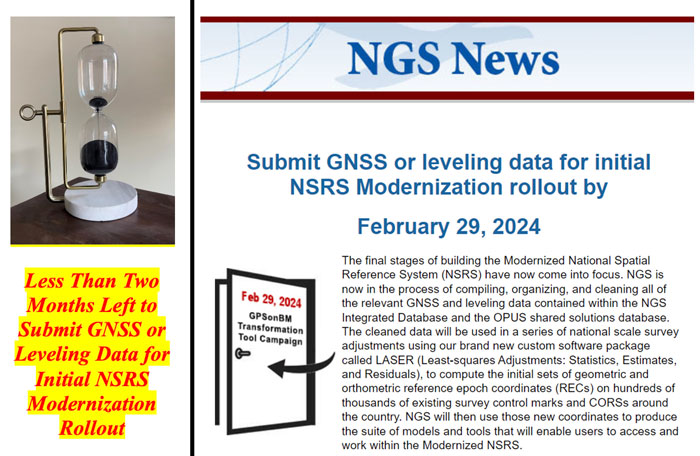
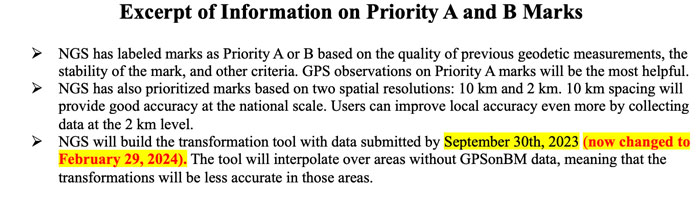
    The National Geodetic Survey (NGS) has announced that users have until February 29, 2024, to submit data for the initial National Spatial Reference System (NSRS) modernization rollout. This means time is running out to submit GNSS or leveling data for initial NSRS Modernization. It is anticipated that NGS will release the new, modernized NSRS in 2025, once new data is incorporated into the database. The following newsletter will provide some advice on strategically selecting marks to improve the local accuracy of the NAVD 88-to-NAPGD 2022 transformation tool.

    Image: NGS Website
    Image: NGS website

    As the announcement stated, NGS is in the process of compiling, organizing, and cleaning all the relevant GNSS and leveling data contained within the NGS Integrated Database and the OPUS shared solutions database for preparation of the new, modernized NSRS. The data will be used in national scale survey adjustments using NGS’ new software package called LASER (Least-squares Adjustments: Statistics, Estimates, and Residuals). The adjustments will compute the initial sets of geometric and orthometric reference epoch coordinates (RECs) on many existing survey control marks and CORS around the country. The definitions of RECs and survey epoch coordinates (SECs) are spelled out in NOAA Technical Report NOS NGS 67, NGS’s Blueprint Part 3. My April 2021 GPS World newsletter highlighted the Blueprint Part 3 document, and my August 2022 GPS World newsletter provided details on RECs and SECs. Using the results of the adjustments, NGS will produce a suite of models and tools that will enable users to access and work within the Modernized NSRS.

    During the last several years, NGS’ GPS on Benchmarks program has been encouraging stakeholders and partners around the country to submit GNSS data to NGS on marks that they use. This will ensure that these marks will have updated RECs when the new system is implemented. Also, just as important, marks that also have North American Vertical Datum of 1988 (NAVD 88) heights will be used to improve the local accuracy of the NAVD 88-to-NAPGD 2022 transformation tool.

    NGS’ plans include accepting user data, but after February 29, 2024, they will not include additional GNSS and leveling data for the initial REC national adjustment and for use in building the transformation tools. In 2018, I wrote a series of GPS World newsletters that highlighted NGS’ GPS on BM program (February 2018, April 2018, June 2018, and August 2018). At that time, the GPS on BM program was very useful in the development and implementation of the hybrid geoid model GEOID18. This newsletter will provide an update on the GPS on BM Transformation Program and provide some advice on strategically selecting marks to improve the local accuracy of the NAVD 88-to-NAPGD 2022 transformation tool.

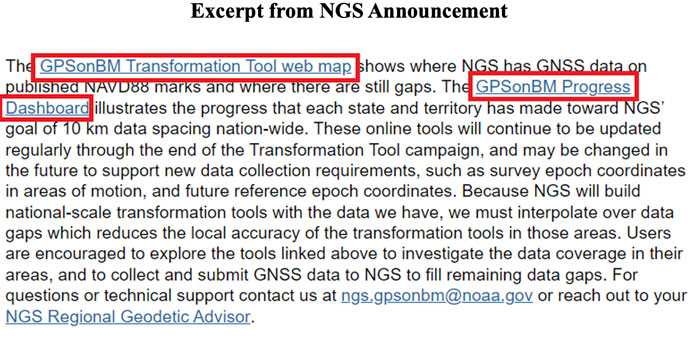
    Links to the GPSonBM Transformation Tool web map and GPSonBM Progress Dashboard are provided in NGS’ announcement. As the announcement states, the GPSonBM Transformation Web Map provides information on marks that have GNSS-derived ellipsoid heights and published NAVD 88 orthometric heights, and where there are still gaps.

    Photo:

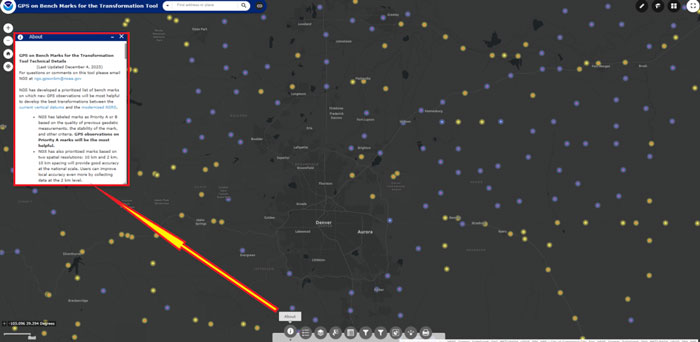
    When users click the link GPSonBM Transformation Tool Web Map, they are connected to a web map depicting a prioritized list of marks where new GNSS observations would be most helpful to the development of the transformation model between the current vertical datum (e.g., NAVD 88) and the modernized NSRS.

    NGS’ prioritized list of benchmarks are labeled as Priority A or B. Clicking on the “About” button on the webpage provides information about the priority marks. See the boxes titled “GPSonBM Transformation Tool Web Map” and “Excerpt of Information on Priority A and B Marks.”

    GPS on BM Transformation Tool Web Map. (Image: NGS website)
    GPS on BM Transformation Tool Web Map. (Image: NGS website)

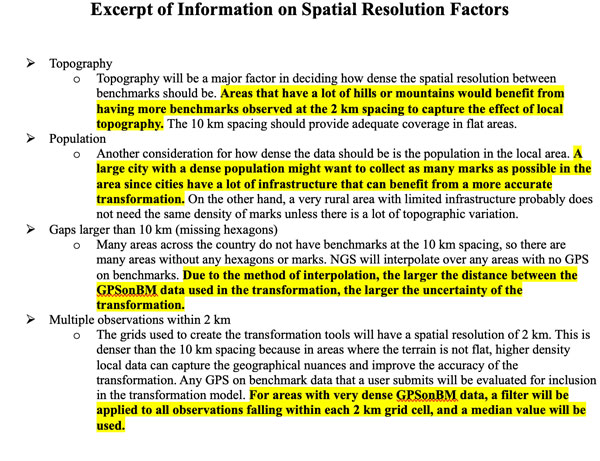
    Photo:To assist users in their selection of marks, NGS developed criteria based on spatial resolution factors. See the box titled “Excerpt of Information on Spatial Resolution Factors.” As previously stated, time is running out. In my opinion, users should prioritize their GPS on BM plans based on the NGS’ criteria. I have highlighted what is important for users to consider when selecting marks.

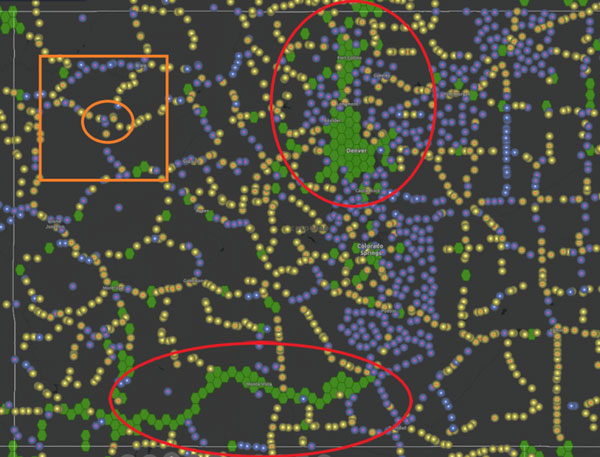
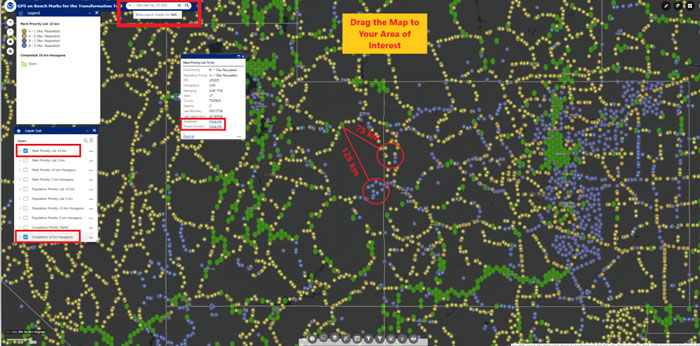
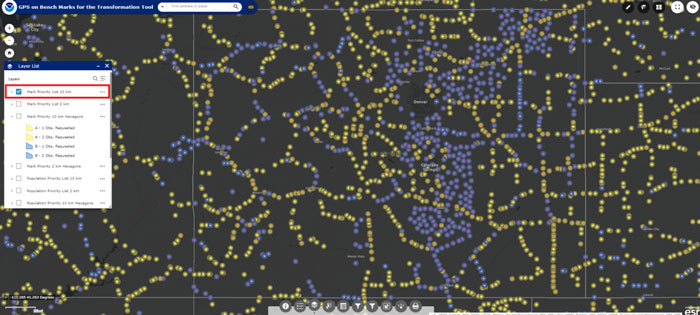
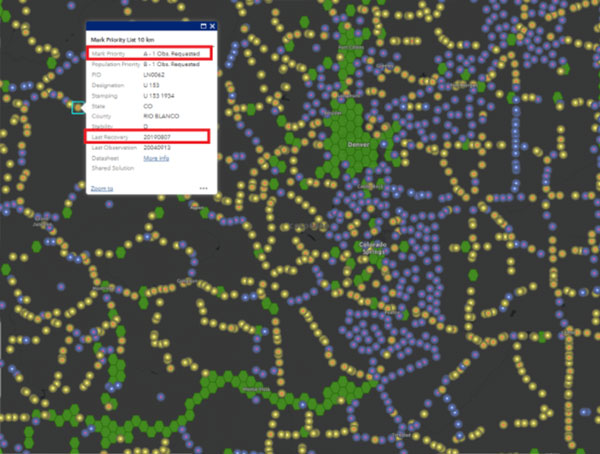
    Photo:Many areas across the country do not have benchmarks at the 10 km spacing, so there are some areas without any hexagons or marks. As stated in the spatial resolution factors, NGS will interpolate over any areas with no GPS on benchmarks. In areas that have gaps larger than 10 km, that is, that are missing hexagons, I would recommend occupying several marks in each hexagon surrounding the gap to ensure that marks with valid NAVD 88 heights are part of the transformation tool. The web tool defaults to the Denver, Colorado, region when you access it but users can drag the map to an area of their interest or select a location.

    Locating marks using the GPSonBM transformation tool web map. (Image: NGS Website)
    Locating marks using the GPSonBM transformation tool web map. (Image: NGS Website)

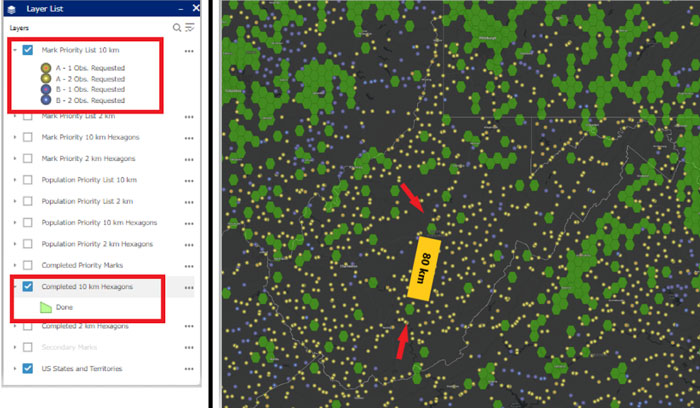
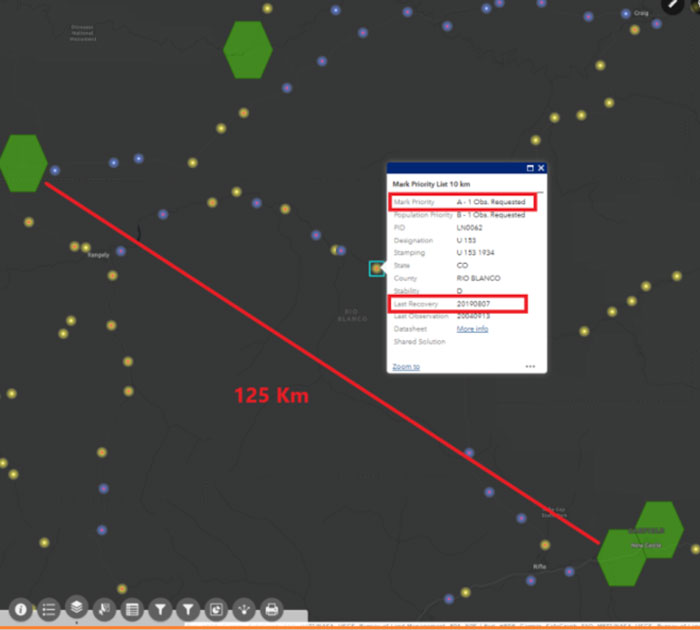
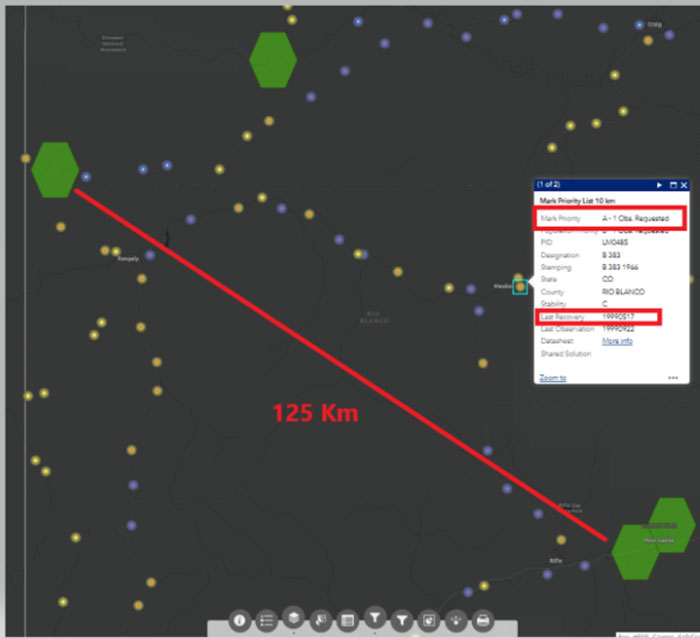
    Acquiring data in mountainous regions and areas that have large distances between completed hexagons is probably the most important for users to focus on. The box titled “Locating Marks Using the GPS on BM Transformation Tool Web Map” provide marks that need to be observed.  As an example, I have highlighted two areas that have large distances between benchmarks and completed hexagons.  In this case, it would be important to occupy a couple of marks in the highlighted locations. Clicking on a mark provides a box with the following information: Mark Priority, Population Priority, PID, Designation, Stamping, State, County, Stability code, Last Date of Recovery, Last Date of Observation, Link to NGS Datasheet, and a Link to a Shared Solution (if one exists).

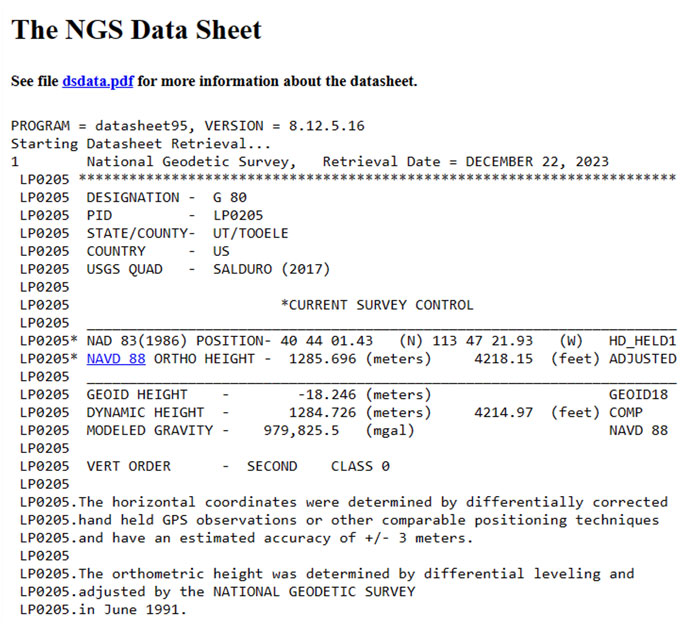
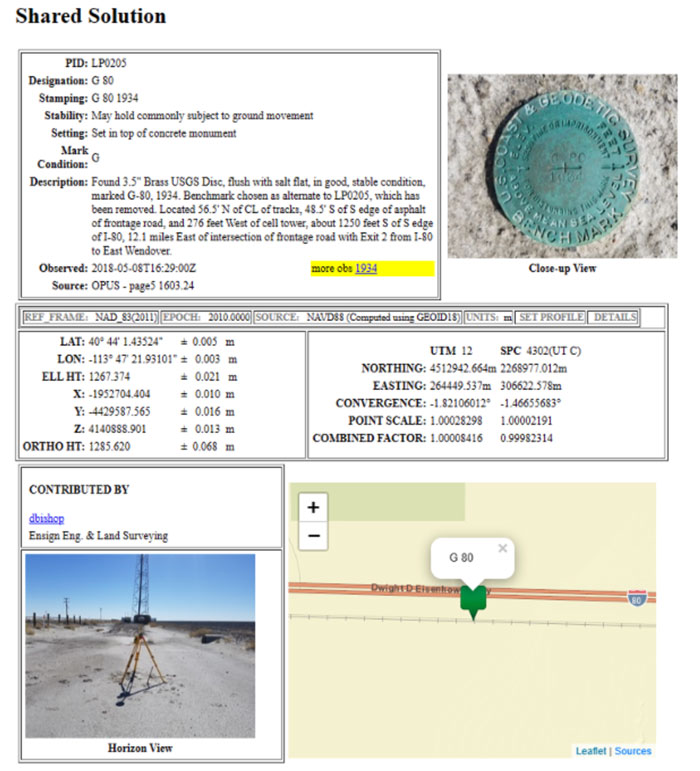
    Clicking the link titled “More Info” next to Datasheet brings up the NGS datasheet for the mark, and clicking the link titled “More Info” next to Shared Solution” brings up the Shared Solution information (see the boxes titled “Mark Priority Information for Mark G 80,” “Excerpt from NGS Datasheet for Mark G 80,” and “Shared Solution for Mark G 80.”). I would recommend that State surveying organizations (and surveyors) perform this type of analysis and strategically occupy marks that fill in important gaps. There is less than two months remaining to submit data to NGS that will support the transformation tool. 

    Excerpt from NGS datasheet for Mark G 80. (Image: NGS website)
    Excerpt from NGS datasheet for Mark G 80. (Image: NGS website)
    PhotoShared solution for Mark G 80. (Image: NGS website)
    Shared solution for Mark G 80. (Image: NGS website)

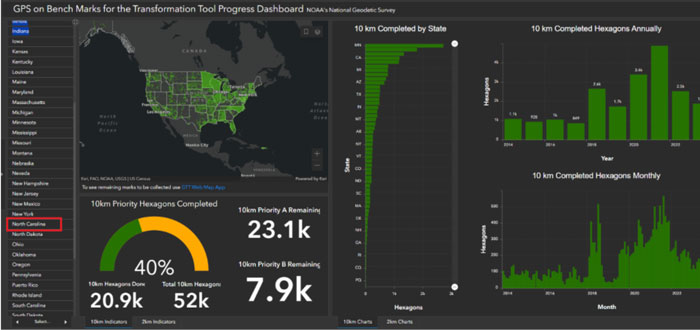
    The GPSonBM Progress Dashboard illustrates the progress that each state and territory has made toward NGS’ goal of 10 km (and 2 km) data spacing nationwide.

    GPSonBM Program Dashboard. (Image: NGS website)
    GPSonBM Program Dashboard. (Image: NGS website)

    Users can see the GPS on Benchmark information for a particular state by clicking on the name of the state on the left side of the website.

    Selection of North Carolina. (Image: NGS website)
    Selection of North Carolina. (Image: NGS website)

    I highlighted North Carolina because I live in that state. The map informs the users of how many 10 km priority A (89) and B (32) marks are remaining to be occupied, and the percentage completed (92%). Clicking on the link “To see remaining marks to be collected use GTT Web Map App,” located under the map, depicts the remaining marks to be collected. As you can see from the plot, North Carolina has several marks in the eastern portion of the state that still need to be occupied with GNSS.

    Status of GPS on benchmarks in North Carolina. (Image: NGS website)
    Status of GPS on benchmarks in North Carolina. (Image: NGS website)

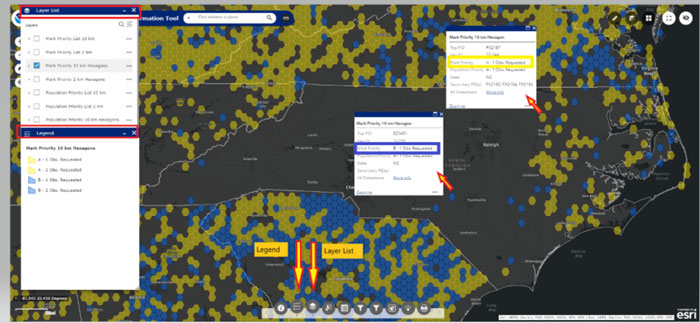
    A nice feature of the map is the legend and layer list buttons. Also, information about the mark appears if you click on a mark.

    Example of Legend and Layer List. (Image: NGS website)
    Example of legend and layer list. (Image: NGS website)

    The image below provides a list of layers that can be selected using the webtool.

    Photo:

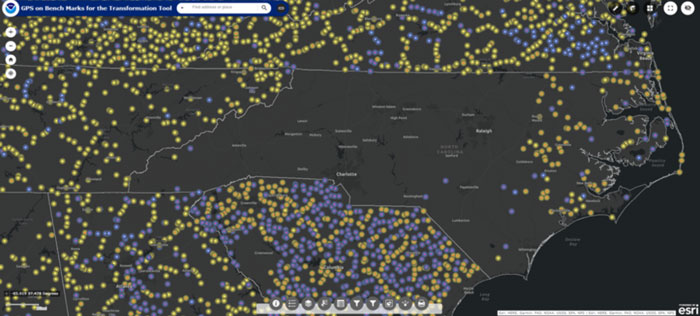
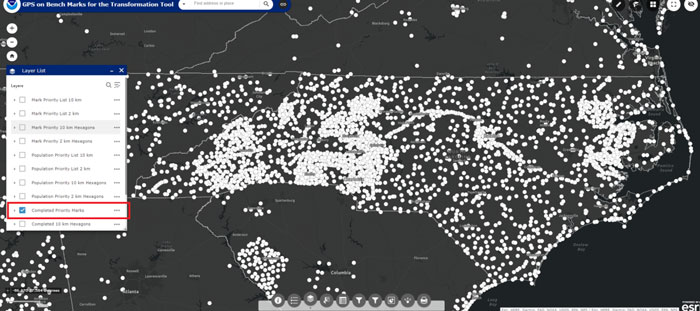
    The following image depicts marks that have been completed. As you see from the plot, North Carolina has been very active in the GPS on Benchmark program.

    Completed marks in North Carolina. (Image: NGS website)
    Completed marks in North Carolina. (Image: NGS website)

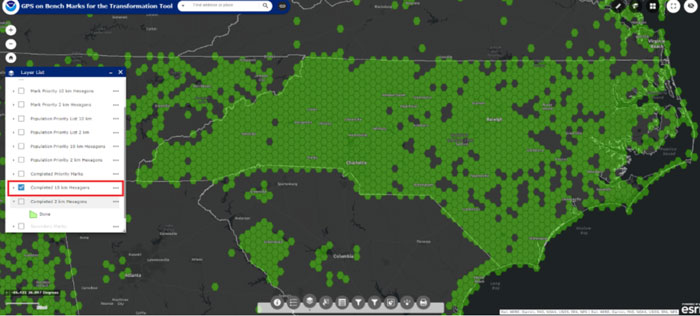
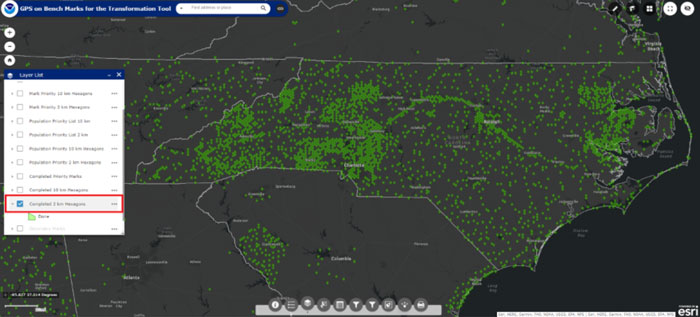
    Users can also click on the button to see which 10 km (and 2 km) hexagons have been completed (see the boxes titled “Completed 10 km Hexagons in North Carolina” and “Completed 2 km Hexagons in North Carolina”).

    Completed 10km Hexagons in North Carolina. (Image: NGS website)
    Completed 10km Hexagons in North Carolina. (Image: NGS website)
    Completed 2km Hexagons in North Carolina. (mage: NGS website)
    Completed 2km Hexagons in North Carolina. (mage: NGS website)

    The North Carolina Geodetic Survey, under the leadership of Gary Thomson, along with NC surveyors has been involved with the GPSonBM program from its inception.

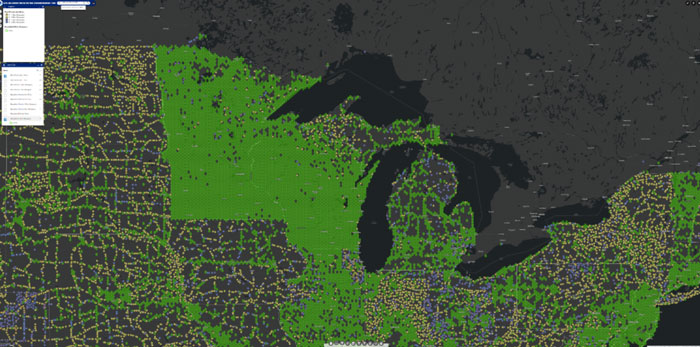
    As previously stated, the website provides the list of priority benchmarks and the status of GPS on Benchmark for each state. There are other states that have been very active in the GPS on Benchmark program such as Minnesota and Wisconsin.

    Completed 10 km Hexagons in Great Lakes Region. (Image: NGS website)
    Completed 10 km Hexagons in Great Lakes Region. (Image: NGS website)

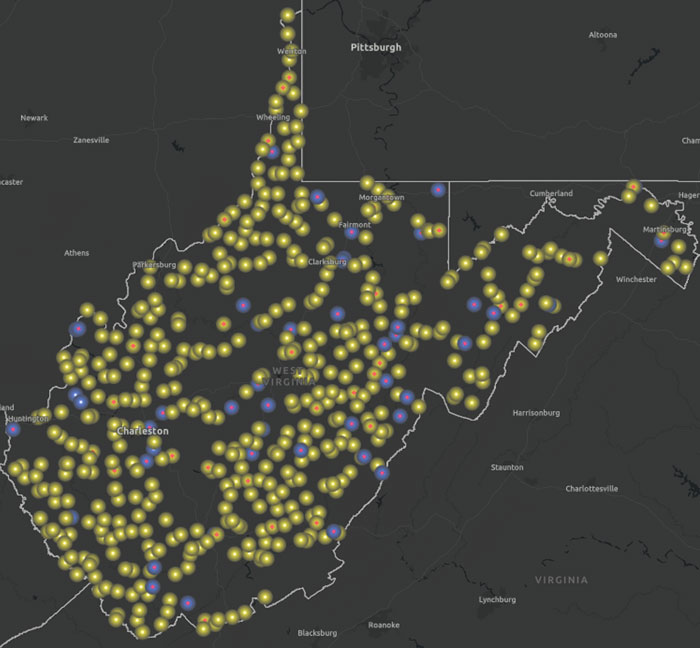
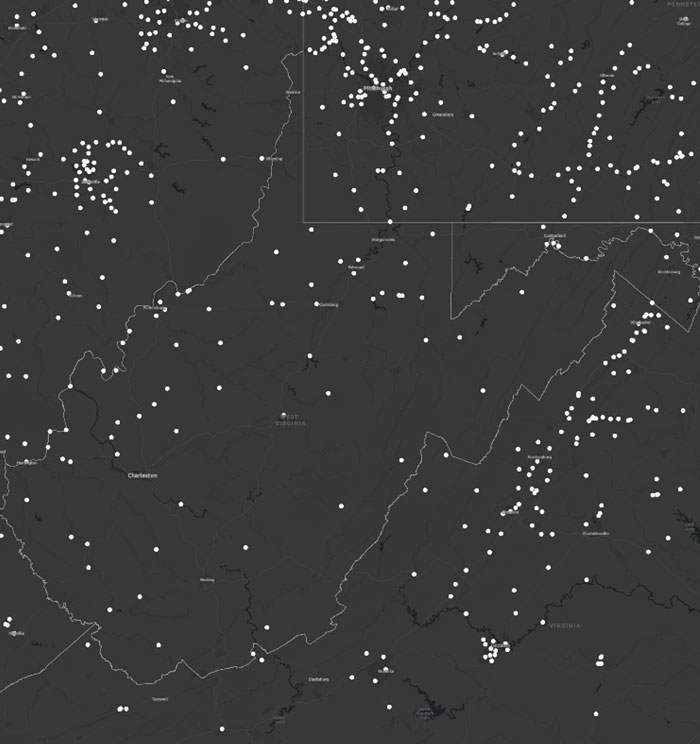
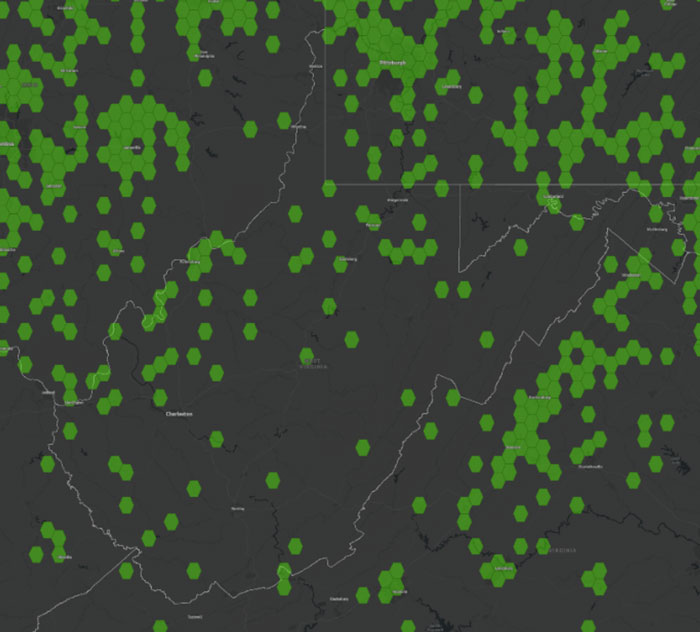
    The following images provide the GPS on Benchmark information for West Virginia.

    Status of GPS on benchmarks in West Virginia. (Image: NGS website)
    Status of GPS on benchmarks in West Virginia. (Image: NGS website)
    Completed marks in West Virginia. (NGS website)
    Completed marks in West Virginia. (NGS website)
    Completed 10 km hexagons in West Virginia. (Image: NGS)
    Completed 10 km hexagons in West Virginia. (Image: NGS)


    The following image provides a plot of an area in West Virigina that highlights a region with a large gap between completed 10 km hexagons. If a user was interested in supporting the development of the transformation model in West Virigina, occupying a mark with GNSS in this area would help improve the local accuracy of the NAVD 88-to-NAPGD 2022 transformation tool.

    Overlay of completed and status of benchmarks in West Virginia. (Image: NGS website)
    Overlay of completed and status of benchmarks in West Virginia. (Image: NGS website)

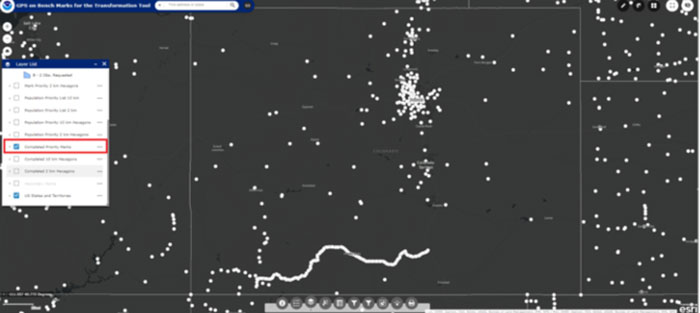
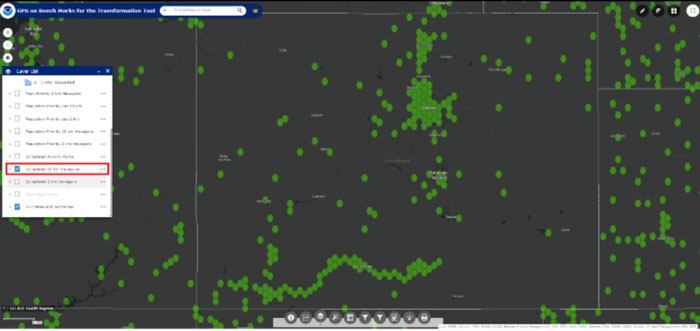
    North Carolina and West Virginia are not large states compared to some western states. The boxes titled “Status of GPS on Benchmarks in Colorado,” “Completed Marks in Colorado,” “Completed 10 km Hexagons in Colorado,” and “Overlay of Completed and Status of Benchmarks in Colorado” provide the information for Colorado. Looking at the plots there appears to be many regions that could use GPS on Benchmark occupations.

    Status of GPS on benchmarks in Colorado. (Image: NGS website)
    Status of GPS on benchmarks in Colorado. (Image: NGS website)
    Completed marks in Colorado. (Image: NGS)
    Completed marks in Colorado. (Image: NGS)
    Completed 10 km hexagons in Colorado. (Image: NGS website)
    Completed 10 km hexagons in Colorado. (Image: NGS website)

    Looking at the plot in the image below, there appear to be many marks that were occupied in populated areas such as Denver, Fort Collins, and Colorado Springs. The marks along the southern border were part of NGS’ 2017 Geoid Slope Validation Survey (GSVS) Project. The area highlighted by the orange box is an area that is lacking GPS on Benchmark occupations. The distance between the nearest completed 10 km hexagon is 60 kilometers. In other words, the two completed hexagons are more than 120 km apart. As previously stated, NGS will interpolate over any areas with no GPS on benchmarks.

    Overlay of completed and status of benchmarks in Colorado. (Image: NGS website)
    Overlay of completed and status of benchmarks in Colorado. (Image: NGS website)

    Again, in areas that have gaps larger than 10 km with missing hexagons, I recommend occupying several marks in each hexagon surrounding the gap to ensure that marks with valid NAVD 88 heights are part of the transformation tool. To demonstrate this concept, I have selected an area in Colorado near benchmark U 153 (PID LN0062).

    Benchmark U 153 in Colorado. (Image: NGS website)
    Benchmark U 153 in Colorado. (Image: NGS website)

    The following image depicts the locations of the completed hexagons near benchmark U 153.

    Photo:

    NGS has developed web tools to assist users in the selection of marks for the program. Two web tools that I find useful are the Leveling Project Page and the Passive Mark Page. The Leveling Project Page provides information on leveling line data. Users can find information about the marks involved with a certain leveling line. There are links to the Passive Mark Page and NGS datasheets on the Leveling Project Page. My October 2020 GPS World newsletter described the Passive Mark Page web tool in more detail, and my June 2021 GPS World newsletter demonstrated the use of the tools.

    In this example, I selected U 153 because it was located between two completed 10 km hexagons that are 125 km apart. That said, looking at the information from the passive mark web tool, it appears that the published height of the benchmark is based on 1934 leveling data. That by itself is not a bad thing but the Orthometric Height Residual is very large (-23.1 cm). This implies that the difference between the GNSS-derived orthometric height using Geoid18 and the published NAVD 88 height disagreed by 23.1cm. This could be due to the movement of the mark and, in my opinion, is not a good candidate for the transformation tool.

    Photo:

    Photo:

    As previously stated, NGS’ Leveling Project Page, provides information on the benchmarks and associated data involved in a leveling line. See the box titled “Excerpt from NGS Leveling Project Page for L2577.” Users can find information about all the marks involved with a certain leveling line.


    Excerpt from NGS Leveling Project page for L2577. (Image: NGS website)
    Excerpt from NGS Leveling Project page for L2577. (Image: NGS website)
    Distance between 10km hexagons near B 383 in Colorado. (Image: NGS website)
    Distance between 10km hexagons near B 383 in Colorado. (Image: NGS website)

    Again, I used the Passive Mark tool to find detailed information about the mark. See the box titled “Excerpt from NGS Passive Mark Tool for B 383.” This mark was last leveled in 1966 and the Orthometric Height Residual is small (1.2 cm). This implies that the difference between the GNSS-derived orthometric height using Geoid18 and the published NAVD 88 height disagreed by 1.2 cm.

    This could be a good candidate for the GPS on BM program and the transformation tool.

    Excerpt from NGS passive mark tool for B 383. (Image: NGS)
    Excerpt from NGS passive mark tool for B 383. (Image: NGS)

    Photo:

    For completeness, I looked at another mark in the same area.

    Distance Between 10km hexagons near B 154 in Colorado. (Image: NGS website)
    Distance Between 10km hexagons near B 154 in Colorado. (Image: NGS website)

    I highlighted this mark because it was last leveled on the same 1934 leveling line as mark U 153. Unlike U 153, looking at the information provided by the Passive Mark tool for B 154 indicates that the GNSS-derived orthometric height agrees with the published leveling-derived orthometric height. The orthometric height residual is only -2.1 cm. This would be another good candidate to fill the area between the two completed hexagons.

    Photo:Photo:

    This newsletter provided some advice on strategically selecting marks to improve the local accuracy of the NAVD 88-to-NAPGD 2022 transformation tool. Again, I would recommend that state surveying organizations and surveyors perform the analysis described above and strategically occupy marks that fill in important gaps. There is less than two months remaining to submit data to NGS that will support the transformation tool.

    NGS has developed web tools such as Passive Mark Page and Leveling Project Page to assist users in identifying marks for inclusion in the development of the transformation model between the current vertical datums (e.g., NAVD 88) and the modernized NSRS.


  • Coordinating surveyors on where we draw the lines

    Coordinating surveyors on where we draw the lines

    Technology changes the rules of the game, and surveying may be more in its crosshairs than the profession will admit

    Maps have existed for centuries. The lines on maps indicating the boundaries of political and administrative units — cities, counties, states, and countries — are graphic representations of the limits of those entities. These lines don’t, however, typically exist in real life. There isn’t a large line between the United States and Canada stretching from the Pacific Ocean, through the Great Lakes, and onto the Atlantic Ocean.

    The same goes for latitude and longitude lines on maps and globes. The public generally accepts the various delineations on maps as being somewhat accurate with an unwritten level of trust in those who have produced these maps.


    Definition

    trust: assured reliance on the character, ability, strength, or truth of someone or something.


    Here are the guidelines surveyors use for determining surveys.

    1. lines physically verified in the field and proven from evidence
    2. monuments and/or boundaries set and called for within legal descriptions
      • natural monuments
      • artificial monuments
    3. adjoiners (to determine junior/senior rights)
    4. courses
      • bearings, then distances (metes and bounds states)
      • distances, then bearings (public land survey states)
    5. recitation of area
      • controlling description
      • evidentiary description
    6. coordinates: local and/or geodetic

    Surveyors rely on physical monuments, title documents and evidence of occupation to assist with the establishment of not just major dividing lines, but all lines of property, public or private. Finding, setting and honoring physical monuments has been a significant character trait of the surveyor for as long as maps have existed.

    Monuments are placed to determine the endpoints of these lines as depicted on maps or plats, but what happens when technology introduces new ways to re-establish these lines? What will happen to our monuments when technology — more specifically those who utilize them — deems them obsolete?

    The guidelines above are known as “priority of calls” or “rules of construction” by the surveying community. These items have provided the instructions for surveyors to follow in retracement of lines for many years. However, like nearly everything else in our modern world, technology has a hand in modernizing even this time-honored “surveyor’s code of retracement.”

    Who would have guessed that the rotary phone dial would give way to touch-tone buttons, that the system would jump from landlines to cellular and satellite signals to remote handsets, then progress to receivers evolving away from physical buttons to touchscreens?

    Technology changes the rules of the game, and surveying may be more in its crosshairs than the profession will admit.

    Here come the numbers

    Note that the last entry in the above guidelines for survey retracement is “coordinates.” In accordance with most accepted lists, coordinates can be local or geodetic. These coordinate values are generated by surveyors, geodesists and public agencies; they can be found on plats, and in records and websites kept by government agencies.

    Now that we are more than two decades into the 21st century, it would be safe to say that most of the surveying profession uses an established geodetic coordinate system. The use of GNSS receivers is widely accepted as normal practice by many surveyors because these systems are much more user friendly than in years past. Additional constellations have added to the availability and accuracy of GNSS positional values, so utilizing state plane coordinates has become the norm.

    We are now surrounded by something that has an incredible impact on our profession and the world around us. We are placing trust in a georeferenced coordinate system that cannot be identified by any of our senses, like we can with a physical monument.

    A coordinate cannot be seen, touched, tasted, heard or smelled.

    We are placing our full trust in a reliable position on Earth as determined by our GNSS receiver working within a published coordinate system. Because of these advancements in technology, a new generation of geospatialists is insisting we should revise the way we survey, because technology provides much higher precision and accuracy.

    Just like lines on a map or plat, coordinates only exist as a calculation of a position on the face of Earth. So why is there animosity in trusting coordinates over the more traditional items on the list of retracement guidelines? It may have to do with the fact that the ground we are surveying is not in the same place it was a short time ago. Depending on where you live, it may have moved more than you think. For more information on the shifting ground we live on, let us dig into some research about our continents.

    Pangea: Description of moving land masses

    (Text from USGS.gov)

    From about 300-200 million years ago (late Paleozoic Era until the very late Triassic), the continent we now know as North America was continuous with Africa, South America and Europe. They all existed as a single continent called Pangea. Pangea first began to be torn apart when a three-pronged fissure grew between Africa, South America and North America. Rifting began as magma welled up through the weakness in the crust, creating a volcanic rift zone. Volcanic eruptions spewed ash and volcanic debris across the landscape as these severed continent-sized fragments of Pangea diverged. The gash between the spreading continents gradually grew to form a new ocean basin, the Atlantic. The rift zone known as the mid-Atlantic ridge continued to provide the raw volcanic materials for the expanding ocean basin.

    Meanwhile, North America was slowly pushed westward away from the rift zone. The thick continental crust that made up the new east coast collapsed into a series of down-dropped fault blocks that roughly parallel today’s coastline. At first, the hot, faulted edge of the continent was high and buoyant relative to the new ocean basin. As the edge of North America moved away from the hot rift zone, it began to cool and subside beneath the new Atlantic Ocean. This once-active divergent plate boundary became the passive, trailing edge of westward moving North America. In plate tectonic terms, the Atlantic Plain is known as a classic example of a passive continental margin.

    Today, the Mesozoic and Cenozoic sedimentary rock layers that lie beneath much of the coastal plain and fringing continental shelf remain nearly horizontal.

    Image: USGS
    Image: USGS

    In geologic terms, a plate is a large, rigid slab of solid rock. The word tectonics comes from the Greek root “to build.” Putting these two words together, we get the term plate tectonics, which refers to how the Earth’s surface is built of plates.

    The theory of plate tectonics states that the Earth’s outermost layer is fragmented into a dozen or more large and small plates that are moving relative to one another as they ride atop hotter, more mobile material. Before the advent of plate tectonics, however, some people already believed that the present-day continents were the fragmented pieces of pre-existing larger landmasses (“supercontinents”).

    The diagrams below show the break-up of the supercontinent Pangaea (meaning “all lands” in Greek), which figured prominently in the theory of continental drift — the forerunner to the theory of plate tectonics.

    Image: USGS
    Image: USGS

    Continental drift, plate tectonics and prime meridians

    Historians and other scientists have theorized about Pangea for centuries. Common soil types, fossils, and other evidence found on different continents help to solidify the concept of Pangea. Items discovered on the west coast of Africa have many similarities with those found on eastern South America. The physical evidence is quite convincing that an earlier supercontinent existed millions of years ago.

    Now, let’s apply a fixed measurement system with lines upon Earth that defines latitude and longitude. In the past, geodesists, geographers and mathematicians established various “prime meridians” around the world to serve as a basis for maps. Locations and cities used included Amsterdam, Antwerp, the Bering Strait, Bern, Brussels, Copenhagen, Florence, Giza, Jerusalem, Kyoto, Lisbon, Madrid, Naples, Oslo, Paris, Philadelphia, Pisa, Rio de Janeiro, Rome, Stockholm, Warsaw and Washington, D.C. (in four different places!), just to name a few.

    Thankfully, scientists gathered in the 19th century to agree upon a singular “initial meridian” that would pass through Greenwich, England, and was based upon several centuries of astronomical observations at the nearby Royal Observatory.

    For approximately 100 years, mapmakers (and geodesists) used the new Prime Meridian at Greenwich as the beginning baseline for longitude determination around the world. After all, it was based upon years of astronomical observations and solved the age-old problem of where longitude starts. (Latitude was a much easier calculation for astronomers and geodesists, but that story is for another day.)

    Photo: majaiva/iStock/Getty Images Plus/Getty Images
    Photo: majaiva/iStock/Getty Images Plus/Getty Images

    The late 20th century and the fourth industrial revolution

    Technology, once again, provides us with conflicting results. While most technological advancements are game-changing improvements to mankind, they also tend to shake up information and standards that have existed for many generations. Like the previously discussed advancements in telephones, technology makes us change the way we look at things and how we go about our lives.

    Mapping has become a central part of our everyday lives. Georeferenced positions for literally everything is now a standard characteristic of many functions within our environment, especially in our surveying world. Most of these improvements are due to GPS, which was originally developed for the U.S. military to guide and assist with positional location of our defense systems in relation to our enemies. We use this same precise technology to establish positional locations for boundary points, infrastructure and topographic information.

    Image: Burch
    Image: Tim Burch

    We have also used GPS to learn much about our tectonic plates and varying movement of the continents.The first thing we learned is that the Prime Meridian established in 1884 does not fall in the same place as our 0° latitude designation as determined by GPS/GNSS calculations.

    This finding, however, is not the telling item within our adaptation of GPS data; it came when various agencies established the continuously operating reference system (CORS), composed of static GPS base stations. CORS stations, while used to help establish new survey positions in relation to a known reference location, also measure a continuous drift of latitude and longitude positions over time.

    The National Geodetic Survey (NGS) is in the process of finalizing a new reference framework for establishing coordinate values that utilize time as a core component. Future implementation of the new National Spatial Reference System (NSRS) will require the additional attribute of time within the metadata of any new values.

    Read more in David Zilkoski’s Survey Scene column.

    The reality of ‘moving’ monuments

    So how does this affect surveying and the monuments we surveyors hold on such a high pedestal? The answer varies depending on who one asks. Most surveyors will continue to hold the “priority of calls” as listed above. Several practitioners, however, want to move coordinates higher up the list because of technology, and the ability to retrace a published point because of the increase in technology and the higher accuracy and precision of today’s GNSS.

    This is possible if the user of the technology follows the procedures as established by NGS with metadata and accurate timing, but there are still several variables in the setting and retracing methodologies. When was the last time the equipment was calibrated? Was adequate research performed to minimize environmental errors? Was there any interference due to solar storms or multipath? There are many potential issues a surveyor can face, but few are checking all the boxes when performing highly accurate and precise positional measurements.

    Technology has brought surveying into the 21st century with GPS/GNSS and ever-increasing accuracy and precision. It should also be the profession’s goal that the technology does not override what the general public can see. They can see monuments, fence lines, buildings and other improvements, but they cannot see coordinates, which remain invisible to the naked eye. Technology may change that in the future, too, but until that time, we must rely on what we can see.

  • GPS World contributor Tim Burch appointed executive director of NSPS

    GPS World contributor Tim Burch appointed executive director of NSPS

    Headshot: tim-burch
    Tim Burch

    The board of directors of the National Society of Professional Surveyors (NSPS) has appointed Timothy W. Burch to be its new executive director. Burch took up the position on Jan. 3.

    Tim Burch is a contributing editor to GPS World’s Survey Scene newsletter, authoring columns six times a year.

    Burch is a professional land surveyor (PLS) licensed in Illinois and Wisconsin. He has been involved with NSPS for more than 20 years as secretary of the board of governors as well as the board of directors, NSPS vice president, a member of the Certified Survey Technician Board, Joint Government Affairs and American Land Title Association (ALTA)/NSPS Land Title Survey committees. Along with content contributor for NSPS social media, he is creator and producer of the NSPS podcast “Surveyor Says!” and a contributing writer to the NSPS newsletter “News and Views.”

    Burch has been involved with the land surveying profession for more than 30 years and has represented NSPS at numerous functions and conferences. He has provided testimony on behalf of the profession at both the state and federal levels as well as helping establish a partnership with “Get Kids into Surveying.”

    He is currently chair of the International Federation of Surveyors (FIG) Working Group 1.1 (Professional Ethics) and is chair-elect for FIG Commission 1 (Professional Standards).

    Burch succeeded Curt Sumner, who was executive director for the past 23 years.

  • NGS Beta OPUS released, accepting RTK and post-processed data

    NGS Beta OPUS released, accepting RTK and post-processed data

    On Sept. 16, the National Geodetic Survey (NGS) released the latest beta version of OPUS, called Beta OPUS Projects 5.0.  This version of OPUS now accepts real-time kinematic data and post-processed GNSS vectors from vendor software. See the box titled “Beta OPUS Projects 5.0 Webpage” on the website.

    As stated in the announcement, NGS has developed a file format for submitted real-time kinematic (RTK) data and post-processed GNSS vectors from vendor software to NGS. It is denoted as GNSS Vector Exchange Format (GVX).  This format enables NGS to incorporate the data into its GNSS processing routines.

    This is similar to the original Receiver Independent Exchange Format (RINEX) developed for making post-processing more efficient when combining GNSS data from manufacturers outputting raw GPS data in varying file formats. In my opinion, this is a significant improvement to NGS’s OPUS web utility.

    Beta OPUS Projects 5.0 Webpage

    Image: NGS website
    Image: NGS website

    Users can obtain background information about the GVX file format by clicking the link GVX file format. More detailed information about the GVX format can be obtained by clicking on the Documentation link.

    GNSS Vector Exchange File Format Webpage

    Image: NGS website
    Image: NGS website

    Basically, GVX is a standardized format for exchanging GNSS vectors derived from GNSS survey data using any manufacturer hardware and software results (see the box titled “Excerpt from Documentation of GVX”).  NGS designed the format so that it included all of the necessary data (including metadata) of a GNSS vector for incorporation into a survey network for performing a least-squares adjustment.

    Excerpt from Documentation of GVX

    (Link to PDF of GVX Documentation)

    To this end, this document proposes a new standardized file format known as the GNSS Vector Exchange Format (GVX). GVX aims to provide a standard format for exchanging GNSS vectors derived from varying GNSS survey methods and manufacturer hardware. The file format includes all of the necessary data of a GNSS vector for inclusion in a survey network for least squares adjustment, as well as metadata which describes the vector. The format is meant for any type of GNSS vector, whether it was derived in real-time or from baseline post-processing. GVX has been written in extensible markup language (XML). XML was chosen because it was designed to carry and store data in plain text format, it is easy to expand and/or upgrade to new operating systems, and it can be read by both humans and machines.

    A sample GVX file can be obtained by clicking on the link titled “Example of GVX file, project day 066, day 052, day 053, day 054.” As NGS states in the documentation, the output can be read both by humans and machines. What’s important is that it can be read by machines so the information can be incorporated into software programs. GNSS vendors have all the information they need to generate the output file to enable users to import the data into OPUS Project 5.0. Users will have to contact their software providers to determine whether their software routines generate the GVX output files.

    Example of GVX file, project day 066

    Image: NGS website
    Image: NGS website

    As I previously mentioned, this new option in OPUS Projects 5.0 is a significant improvement because many surveyors use RTK networks to obtain coordinates of marks. It will also facilitate the occupation of benchmarks with GNSS equipment to support the NGS 2022 Transformation tool. North Carolina, my home state, has a real-time network (RTN) that includes 96 GNSS CORS. (See the box titled “NC GNSS CORS and Real-Time Network.”) Currently, the North Carolina GNSS CORS and RTN has 4584 RTN service subscriptions.

    NC GNSS CORS and Real-Time Network

    Image: North Carolina Geodetic Survey Website
    Image: North Carolina Geodetic Survey Website

    I could not find a current list of public RTK networks in the United States, but I did locate a Jan. 7, 2014, GPS World article by Eric Gakstatter that provided a list of public RTK base stations in the country. It’s not up-to-date, but it highlights that, more than seven years ago, more than half of the U.S. states  had some kind of public RTK network. I would like to update the table, so I’d appreciate receiving information on the status of any public RTK network. Please feel free to send me an email at [email protected].

    List of Public RTK Base Stations in 2014

    Based on GPS World 2014 Article by Eric Gakstatter

    Note: States not listed did not have a public RTK network.

    State

    Status of Public Network

    Alabama Alabama Department of Transportation. Leica network.
    Alaska Two PBO RTK bases. One in Fairbanks and one in Palmer. Otherwise, no public service.
    Arizona Arizona State Cartographer’s Office. Leica network. Plate Boundary Observatory (single baseline).
    California California Real Time Network (CRTN) (single baseline).  Plate Boundary Observatory. Single baseline.
    Colorado Mesa County (Trimble network) and Plate Boundary Observatory (single baseline).
    Florida Florida Department of Transportation. Leica network.
    Idaho Plate Boundary Observatory (single baseline).
    Indiana Indiana Department of Transportation. Leica network.
    Iowa Iowa Department of Transportation. Leica network.
    Kentucky Kentucky Transportation Cabinet. Trimble network.
    Louisiana Louisiana State University. Trimble network.
    Maine Maine Department of Transportation. Trimble network.
    Massachusetts Massachusetts Department of Transportation. Leica network.
    Michigan Michigan Department of Transportation. Leica network.
    Minnesota Department of Transportation. Trimble network.
    Mississippi University of Southern Mississippi. Trimble network.
    Missouri Missouri Department of Transportation. Trimble network.
    Montana Plate Boundary Observatory (single baseline).
    Nevada Washoe County. Trimble network. Las Vegas Valley Water District. Leica network. Plate Boundary Observatory (single baseline).
    New Mexico Plate Boundary Observatory (single baseline).
    New York New York Department of Transportation. Leica network.
    North Carolina N.C. Department of Environment and Natural Resources. Trimble network. $500 one-time sign-up fee.
    Ohio Ohio Department of Transportation. Trimble network.
    Oregon Oregon Department of Transportation. Leica network. Plate Boundary Observatory (single baseline).
    South Carolina South Carolina Geodetic Survey. Public but charges a usage fee. Trimble network.
    Tennessee Tennessee Department of Transportation. Public but charges a usage fee. Topcon network.
    Texas Texas Department of Transportation. Public but only available to TxDOT employees and TxDOT contractors. Trimble network.
    Utah Utah Automated Geographic Reference Center.  Public but charges a usage fee. Trimble network. Plate Boundary Observatory (single baseline).
    Vermont Vermont Geodetic Survey. Trimble network.
    Washington Washington State Reference Network (Seattle Public Utilities). Trimble network. Public but charges a usage fee. Pierce County (Leica Network). Plate Boundary Observatory (single baseline).
    West Virginia West Virginia Department of Transportation. Trimble network.
    Wisconsin Wisconsin Department of Transportation. Trimble network.
    Wyoming Plate Boundary Observatory (single baseline).

    Why do I believe that this new option in OPUS Projects 5.0 is so important? Because it facilitates the incorporation of accurate GNSS-derived ellipsoid and orthometric heights into the National Spatial Reference System (NSRS).  With the development of improved algorithms, the results of coordinates computed using GNSS CORS/RTNs are more accurate today than ever before. During the last decade, there have been many studies analyzing GNSS data to estimate the accuracy values of coordinates from RTN data.

    A study titled “Accuracy of GNSS Observations from Three Real-Time Networks in Maryland, USA” by Daniel Gillins, Jacob Heck, Galen Scott, Kevin Jordan and Ryan Hippenstiel presented at FIG Working Week 2019 in Hanoi, Vietnam, April 22–26, 2019, provided a comparative evaluation on the accuracy of three independent RTNs constructed with differing hardware and software. Their study was based on 486, 5-minute duration GPS + GLONASS network RTK (NRTK) observations. The results indicated that repeat NRTK vectors could be combined to meet 1 cm horizontally and 2 cm vertically (ellipsoid height) accuracies at 95%. confidence.  See the box below.  It should be noted that the repeat observations should be observed at different times of the day (for instance, separated by > 2–3 hours), as well as, in my opinion, if possible at least more than two different days.

    Conclusions from Daniel Gillins, et al. 2019 FIG Paper

    A total of 486, 5-min duration, GPS+GLONASS NRTK observations were collected on nine bench marks distributed over a 4,000 square km area with rovers connected to three different RTNs in Maryland. Each RTN was developed with equipment and software from a different manufacturer, yet all three RTNs performed similarly in terms of accuracy. When differenced with coordinates from a static GNSS survey campaign, the horizontal and vertical RMSE of the NRTK-derived coordinates was 2.3 cm horizontally and 4.5 cm vertically at 95% confidence. Repetitive NRTK vectors on each baseline differed between ± 2.4 cm horizontally and ± 3.4 cm vertically at 95% confidence. As a final accuracy evaluation, hybrid survey networks consisting of repeat NRTK vectors and baseline solutions from post-processing static GPS data collected at RTN base stations and CORSs were adjusted by least squares. Prior to adjustment, the VCV matrices of the vectors were scaled by variance-component estimation. Adjustment of hybrid survey networks with four repeat NRTK vectors per bench mark produced network accuracies at 95% confidence for the adjusted coordinates at all bench marks less than 1 cm horizontally and 2 cm vertically (ellipsoid height). In addition to the benefits of using efficient and accurate NRTK vectors, the hybrid survey network approach makes use of redundant vectors for checking data and avoiding blunders. The approach also provides traceability because the NRTK vectors are tied to an RTN base station which is tied to CORS. Finally, these networks ensure the survey is referenced to the published coordinates of the CORSs which are held as constraints in the adjustment.

    Lastly, I would like to remind users that only three months remain until the December 31, 2021, cutoff to submit GPS on Benchmarks data that NGS can guarantee will be analyzed to compute the initial set of 2020.0 Reference Epoch Coordinates (RECs) that will be released with the Modernized NSRS. This initial set of RECs is currently the only set that NGS can guarantee will be used to build the 2022 Transformation Tool.  Once the transformation model is finalized, the NAVD 88 – NAPGD 2022 transformation values will be locked in and will not be updated as additional sets of RECs are computed.  If you have questions or concerns about this cut-off date, please contact your NGS Regional Geodetic Advisor, or drop NGS a line at [email protected].

    Beta OPUS Project 5.0 is a web-based tool that makes it easier to submit data to NGS.  I would encourage NSRS users to occupy as many benchmarks with GNSS equipment and submit the data to NGS before the Dec. 31 deadline.  Not only will these data help in improving the transformation model, but the marks will be included in the first computation of Reference Epoch Coordinates (RECs).  You can obtain information about Reference Epoch Coordinates in NGS’s NOAA Technical Report NOS NGS 67 publication titled “Blueprint for the Modernized NSRS, Part 3: Working in the Modernized NSRS.” A future column will address the different types of coordinates that will be distributed by NGS with the modernized NSRS.

  • The surveyor and augmented reality – ready for the future

    The surveyor and augmented reality – ready for the future

    Photo: ipopba/iStock / Getty Images Plus/Getty Images
    Photo: ipopba/iStock / Getty Images Plus/Getty Images

    The surveying profession has experienced a plethora of advancing technology over the past two decades and it does not look like there will be a slowdown any time soon. From robotic total stations to laser scanning to the use of multiple GNSS constellations, the profession is constantly adapting these emerging technologies into a useful tool for daily applications. For most practicing surveyors, it is a challenge to keep up with not just the hardware of these advancements, but also with software, which is being developed in parallel. Have you tried to open and draw a simple figure in any of the industry standard CAD programs lately?

    The complexity of these programs, while advancing the capability of many technical professions, forces even the casual user to maintain a regular habit of software education and training. While it may seem primitive to say that a practitioner is a “practicing” surveyor, on-the-job training never stops. Just when the profession thinks there are no more significant advancements, something comes out of left field that truly blindsides us. (See the adoption of UAVS by the surveying profession compared to the public sector…) What do I think will be one of the next “big things” to revolutionize surveying? The technology is already here, and we need to seriously get on board with adoption before we miss another opportunity to highlight the expertise of the profession.

    VIRTUAL REALITY and AUGMENTED REALITY (VR & AR)

    First, we need to know that virtual reality (VR) and augmented reality (AR) are different, even though many people use these terms interchangeably. The differences are as follows:

    Virtual Reality (VR)

    • VR is a virtual world generated by computers and programming.
    • VR is a closed environment that is fully immersive.
    • VR requires a device (specialized glasses and/or a headset).
    • Users in the VR experience are limited by the programming and their computer’s abilities.
    • The VR experience may be based upon real-world conditions but is a fictional setting.
    • Users of VR can travel and experience conditions in real and fictitious places.
    • VR can allow users to have experiences that are not physically possible in the real world.
    • VR is 75% virtual + 25% real (industry “rule of thumb”)

    Augmented Reality (AR)

    • AR is typically based on actual physical places.
    • AR is an open environment that is partly immersive.
    • In AR, the user controls the environment.
    • AR combines virtual elements and experiences with real world conditions.
    • Experiences in AR can be accessed by computer, tablet, and smartphones.
    • AR is useful for product visualization and evaluation.
    • AR is 75% real + 25% virtual (industry “rule of thumb”)

    It is important to know these difference between the two technologies in order to implement the correct one for the task at hand. However, both will play an important in surveying for generations to come.

    Photo: Georgijevic/iStock / Getty Images Plus/Getty Images
    Photo: Georgijevic/iStock / Getty Images Plus/Getty Images

    USES OF VIRTUAL REALITY TECHNOLOGY FOR SURVEYING

    One of the surveyor’s biggest responsibilities is to complete an accurate site conditions model by topographic methods. Once the topographic survey is completed, site designers will utilize this information to create a unique project that works with the existing site conditions. Advances in CAD software and technology allow engineers and architects to design in 3D and blend the new site with the existing conditions, drainage, and utilities. These designs can be further refined into virtual reality models to give the project’s stakeholders a better indication of what the final product will be when construction is completed.

    The key takeaway here is that the surveyor is responsible for delivering the existing conditions model. A model that accurately represents the subject site but in digital form enables the design of the project to be more efficient and realistic to meet the client’s expectation. Surveyers, however, will not use virtual reality as much as augmented reality, for many good reasons.

    USES OF AUGMENTED REALITY TECHNOLOGY FOR SURVEYING

    AR is still in its infancy. Because surveyors have an interest in the existing and proposed conditions of sites, the use of AR becomes an important tool for the future. Merging proposed information with existing site conditions can become the norm, but like many emerging technologies, the profession will need to learn how to embrace it.

    To get a better idea of how the technology works and why surveyors need to consider using it, let us look at an application that showcases AR: Pokémon Go. Yes, the smartphone game app that took the world by storm in 2016 and captivated many “trainers” to search the streets for Ultra Balls and characters. (There are still more than 100 million active players worldwide.) Players of all ages have continued to search for elusive items and characters in a high-tech scavenger hunt that is constantly changing, and all based upon the real world around us. By merging a real-time view with game entities at random geographic locations, players move about our world using one of the best examples of AR.

    How does this apply to the surveying profession? Surveyors could utilize AR in everyday tasks but that would require having a fully developed 3D design model that could merge with the existing conditions in their visual device. There are a variety of devices for utilizing AR, including smartphones and tablets. Many of the new data collectors running Windows and Android operating systems can also be used for incorporating AR into the field operation. Here are some examples of AR how can be utilized for surveying tasks:

    • While construction staking, AR can be used to assist with structure and improvement location. A quick visual check can help confirm staking calculations are consistent with engineering design.
    • Use AR to visually check installed improvements, including curbs, utility structures, and paving. Any deviation from the proposed design should be quite evident.
    • When establishing property corners, AR will help the field crew quickly determine whether the calculated location is accessible. This can be used for staking out pre-calculated boundary points and/or proposed lot corners in a new subdivision.
    Photo: AnnaFrajtova/iStock / Getty Images Plus/Getty Images
    Photo: AnnaFrajtova/iStock / Getty Images Plus/Getty Images

    Here are a few ideas as to how surveyors could utilize AR in everyday tasks in the future:

    • As public utilities are becoming more available within GIS shape files with geographic locations, they could be utilized with AR to help visually establish locations in the field. Mainline utilities and service lines would become easier to physically verify using AR.
    • Another GIS shapefile entity, the parcel line layer, could be used to help the surveyor understand where the property owner believes the line(s) to be as opposed to the actual monumented location.
    • All reference monuments and benchmarks established by public agencies using geographic location information could enhance the “treasure hunt” of confirming local datum points.

    SURVEYING USING AR TO PROTECT THE PUBLIC

    Geospatial information has revolutionized our world, so using AR to help when trouble strikes can potentially be a lifesaver. Recently, an oceanfront condominium in Florida collapsed due to structural failure. While the age of the structure precluded it from having any digital geographic location data, any new similar development could be measured and recorded to assist with future emergency needs. Almost all new development has digital surveying, engineering, and architecture and must use local horizontal and vertical datums. Using the proposed information and verifying with post-construction record drawings, the digital record can be created.

    It doesn’t take a design flaw to create a public hazard. For instance, a gas leak could render any building, such as the Florida condo, susceptible to catastrophic damage. By having a digital model of the underground structure, emergency crews could use AR to help locate potential open spaces in the building. As is the case with installing fire suppression systems and emergency exits, the cost to create a digital model of a completed building will be well worth it to save lives.

    Underground utility corridors within cities, campuses, or manufacturing facilities could also utilize geospatial locations to establish a digital map for future use with AR. It will take time and significant cost to map existing facilities, yet it should be required for new sites to provide this information for emergencies and for use when designing expansions within the site. Having this utility information to use with AR during the design phase could lead to identifying potential problems before construction starts.

    Photo: 1001nights/E+/Getty Images
    Haiti after an earthquake. (Photo: 1001nights/E+/Getty Images)

    Another reason to plan for future safety is how much uncertainty we face in today’s society. At press time, we are coming up on the 20th anniversary of 9/11. We also just watched Haiti suffer another devastating earthquake. The 2021 hurricane season has also been very active, so that danger looms large, too. Disasters happen all the time with little to no warning. Our world is much more advanced than we were at the turn of the century, so we can use these advancements to map our infrastructure. Let us hope we never need to use the digital information for another disaster akin of 9/11. Instead, let us use it to ensure that we can get to someone in a remote spot if necessary.

    THE ROAD TO FUTURE MAPPING AND AUTOMATION

    As previously discussed, establishing a digital twin of our world could help provide a better map for establishing parcel ownership, reducing construction conflicts, and offering better planning tools for future expansion. Will it be completed within my lifetime? No, and I doubt it will be done within the next couple of generations after me.

    We can, however, get a significant start on capturing the necessary information to begin the process of digitization. Technology has exceeded my expectations just within the past decade, so I can only hope that more advancements will help with building this digital beast. More architects and engineers are utilizing BIM (building information modeling) for 3D design and collaboration. Most municipalities and counties have built some form of GIS that uses one of the standard geographic datums. Surveyors have fully embraced GNSS technology so state plane and national geographic coordinate systems have become the norm. In addition, we are seeing a wide number of consultants use autonomous vehicles (aerial, hydro, and terrestrial) with photogrammetry, LiDAR, and SLAM remote sensing. Another bit of good news is that computing power is higher than ever and that storage space is cheap for all this data. We should also include how 5G has expanded our reach and, with cloud storage, we can work from just about anywhere. We can do so much more than most of us ever dreamed of, so we need to leverage that into creating a digital entity that can be helpful.

    Photo: RyanJLane/E+/Getty Images
    Photo: RyanJLane/E+/Getty Images

    HOW TO IMPLEMENT THE LATEST TECHNOLOGY

    Augmented reality is one of many new technologies surveyors need to introduce into their toolbox. Many of you may be asking where to begin; my answer, depending on your age, may offend you.

    Hire a Gen Zer. Really.

    As a Gen Xer, I have come to realize my limitations on technology and being able to fully implement it. The Z generation, while lacking the experience of us wily old guys, see things much differently. The smartphone/tablet/computer, and even the latest data collectors, are designed with them in mind. They grew up playing computer games based in virtual reality, developed excellent hand-eye coordination, and find efficient ways of getting things done. Our surveying world is almost completely digital (when is the last time a client only wanted paper copies of a plat?), so now is the time to make the leap and ditch the drafting table. We have as much to learn from them as they do from us. Together, we can get the surveying profession ready for the next generations. It has been a great profession for us, so let us hand it off to the Z generation. They will (eventually) be glad we did.

  • Surveying and the future: Where is technology going?

    Surveying and the future: Where is technology going?

    Photo: FDA
    Photo: FDA

    Earlier this year, we looked back at 2020 and reviewed how surveying has dealt with the worldwide pandemic while adapting to the new tools and technology being created. We discovered the need for surveyors did not diminish during this crisis, and in many places the demand has gone up significantly. Instruments, computers and measuring methods continue to increase in capability and complexity to help with the shortage of qualified field crews, yet we still need to expand our efforts to find the next generation of surveyors.

    How do we find those future geospatial experts, data collectors and surveying professionals? The answer is right under our noses, and our current group of practitioners needs to get the word out.

    What is the word, you ask?

    Technology.

    Younger generations understand technology better than most practicing surveyors. New devices, methods and operations are being invented at a fast pace, and our best and brightest should be considering using that technology in a rewarding career. Before we make the big pitch to them, however, we should refresh our understanding of recent surveying history to better understand why technology is a good thing.

    How did we get here? A short historical look at measuring

    The measurement methods, devices and instruments used by surveyors have radically changed in the past 50 years, and we have covered their evolution in past columns (Survey Scene May 2016, May 2017 and Sept. 2019).

    Instruments and devices used by surveyors vary in their function and output of information. Some are used to physically measure the distance from a stationary point to another, determine horizontal and vertical angles at a specific location, or determine grade differentials between various points. Other instruments are used to determine horizontal or vertical positions to establish locations and elevations. All these instruments are being used to gather positional data on any number of items, but the quality of the information may vary depending on the technology and method used. How?

    Devices and methods for measuring distances

    AGA Geodimeter NASM-2A. (Photo: NOAA)
    AGA Geodimeter NASM-2A. (Photo: NOAA)

    Tools for measuring distances have been around for centuries. The Egyptians are famous for their “rope stretchers,” while early surveyors in Europe and the New Colonies were known to use the Gunter’s chain and a measuring wheel. In the early 1800s, steel tapes were invented to replace the chain. These measuring tapes continued to evolve well into the 20th century with varying metals, fiberglass and nylon-coated plastics.

    In the mid-20th century, scientists and physicists began to experiment using light waves as a means of measuring terrestrial distances. These experiments led to the development of the first electronic distance meter (EDM), commercially produced by the Swedish company Svenska Aktiebolaget Gasaccumulator (AGA) in the early 1950s. Other methods of electronic measurement, including microwave and infrared wave technology, were also developed in the years following the introduction of the lightwave EDM.

    For many years, the EDM was used independently from transits or theodolites to measure long distances. For those who needed to consistently measure long distances, the invention of the EDM was not just a time saver, but also provided much higher accuracy than manual measurements.

    Other technologies were developed in the latter part of the 20th century, introducing the surveyor to laser scanning, but we can defer this topic until later in this column.

    Devices for measuring angles

    The T3 theodolite was introduced in 1925. With its 10.5-inch telescope, this theodolite had a range of up to 60 miles. It saw heavy use between 1952 and 1984. (Photo: NOAA)
    The T3 theodolite was introduced in 1925. With its 10.5-inch telescope, this theodolite had a range of up to 60 miles. It saw heavy use between 1952 and 1984. (Photo: NOAA)

    The surveyor, like the astronomer, has consistently been at the forefront of developing optical instruments. The key has been combining high optical quality with a means of measuring horizontal and vertical angles within the instrument. The creation of the theodolite and the transit revolutionized the ability of the surveyor to accurately measure angles and apply trigonometric functions to determine mathematical computations. In addition, the surveyor’s compass was also developed to assist with angle measurement — with less accuracy but greater flexibility.

    By the 1920s, optical theodolite technology was rapidly improving through the work of Switzerland’s Heinrich Wild. Beginning with the T2 and T3, these instruments provided accuracy and precision not previously available to the surveyor. Other manufacturers followed suit with similar instruments for the next several decades and were used in conjunction with the EDM for larger surveys. Anticipation grew with the competition to see which instrument company could marry the theodolite and the EDM into one easy-to-use, yet accurate, optical instrument.

    Introducing the total station

    By the late 1960s, technology had firmly entered the surveying world with a few electronic advancements. In 1968, Zeiss — a German company known for its lenses and optical systems — produced the first known tachymeter, combining a theodolite with an electronic distance meter. The tachymeter became better known as the total station, as it was capable of measuring angles and distances in one instrument. While somewhat crude and hard to use, the Elta 14 total station introduced the world to a future generation of surveying instruments that would revolutionize the field.

    In the course of a few years, several manufacturers developed their own total stations. The biggest hurdle was combining the optics of the scope with the measuring axis of the EDM. By the end of the 1970s, most total stations were coaxial, therefore measuring angles and distances was done with one sighting.

    Robotics were introduced in the early 1990s, with two servo motors to drive the horizontal and vertical movements of the total station. These movements were controlled remotely by the tracking system connected to the prism pole and data collector. Not requiring a human being to remain stationary and manually operate the total station provided cost savings and additional efficiency for the field crew.

    Positions, everyone! Positions!

    U.S. National PNT Architecture from a 2007 Department of Transportation report, updated in 2017. (Graphic: U.S. Department of Transportation)
    U.S. National PNT Architecture. (Graphic: U.S. Department of Transportation)

    Positional measurement has revolutionized not just the surveying profession, but a large portion of everyday tasks as well. From monitoring travel times for your commute to providing your food-delivery driver with your location, position determination is the key element to these services. Satellite navigation is now the primary technology used for positioning, navigation and timing (PNT) and a big part of most aspects of surveying.

    Remote sensing

    Here is where we can discuss laser scanning and other remote sensing technologies. Remote sensing is the science and technology of gathering data from a distance. Traditionally this has been mostly done from aircraft, satellites and vessels. However, technology has expanded so that most practitioners now consider the use of laser scanning, lidar, photogrammetry, hyperspectral cameras, bathymetric sonar and simultaneous localization and mapping (SLAM) to be included in the category. Keep in mind that all these technologies are types of measurements; they are not the vehicle or instruments used for the measurement.

    Image: NASA
    Image: NASA

    These various sensor types can collect millions of data points in a short amount of time. While surveyors are adapting to working with point clouds and gigabytes/terabytes of data, it is a radical departure from our recent past using only total stations and GNSS receivers. Significant advancements in computer processing, data storage and programming have simplified the manipulation of point clouds, but they remain a challenging task for even newer surveyors to tackle.

    Autonomous vehicles

    Hobbyists have been building (and crashing) model airplanes and helicopters for many years. Most of the public does not realize that the big advancement in remote-control aircraft was the introduction of GNSS technology into the flight system. Sure, we all have GNSS receivers  in our phones, but now to be included in our toys? This somewhat simple addition has turned unmanned aerial vehicles (UAV) into a revolutionary tool for several occupations, not just surveyors. More control and stability of the UAV means expanded uses for emergency personnel, utility providers, parcel delivery and much more. Being able to program a specific flight provides the UAV user with higher accuracy and precision, but it takes away the element of human control.

    Image: Department of Transportation
    Image: Department of Transportation

    Another vehicle gaining market share is the unmanned surface vessel (USV), used for performing hydrographic surveys. Like its UAV cousin, the USV is autonomous and is programmed to follow a specific route for greater accuracy and precision. Because of the shallow draft of a USV, it can be used in many areas deemed inaccessible by manned vessels.

    An additional aspect of newer technology working with autonomous vehicles is collision avoidance systems. These systems have been implemented on newer UAVs and continue to improve, allowing their the use in tighter confines and spaces. By having a radar-based avoidance signal surrounding the entire UAV, collisions become less likely.

    Geofencing is another advancement being implemented into more UAVs to help keep them from intruding into unauthorized spaces, by programming into their computer specific geographic areas that are off limits. UAVs are often also programmed to return to its takeoff location under certain circumstances.

    Other technological advances to consider

    Image: State Department
    Image: State Department

    How much technology do you have in your home and office? Probably more than you realize. While one may immediately think about a smart speaker or home automation system (Alexa, Echo, Nest, etc.), other components offer simple yet productive solutions.

    Remote control systems enable you to check whether your doors are locked and your garage door is shut. If not, a touch of a button does the job. Motion sensors enable you to detect intruders around and inside the house, of course. Environmental sensors now monitor for water leaks, moisture and gas/carbon monoxide and provide alerts. How about home automation that utilizes robotic technology? The Roomba vacuum, automatic pool cleaners, and even window washing systems activated when dirt is recognized on your exterior windows are just some of the robotic devices in the modern home.

    Precision agriculture utilizes autonomous vehicle control to increase the precision of planting, spraying and harvesting crops. This increase in efficiency has led to higher yields and lower operating costs for the equipment. Another market starting to see more interest is the robotic lawn mowers that functions like the Roomba vacuum. While significantly more expensive than manual mowers, they offer features that can be considered for trade-offs for your time. Depending on your location and needs, they can be set on timers to run day or night and return to base when their battery runs low.

    Adapting today’s technology to tomorrow’s surveying tasks

    Another relevant technology that does not fit into any of the topics above is the inertial measurement unit (IMU). These sensors are now routinely paired with GNSS receivers in UAVs to help them compensate for pitch and roll. Because of their small form factor, IMUs will increasingly be incorporated into other measurement devices.

    It is also safe to say that more handheld devices and smartphones will include lidar scanning capability, as the iPhone 12 Pro and iPad Pro already do. Application and software developers are writing code to make use of data from these devices, so plan on other hardware makers following Apple’s lead.

    Voice and motion control will continue to be integrated into data collectors and workstations. By minimizing physical entries into an input system, computers will begin to recognize patterns and automate procedures to increase efficiencies. Programmable voice commands during field data collection will activate various procedures (for instance, specific roadway cross sections or curb island locations) and walk the user through a predetermined set of steps. The possibilities are endless, but we should prepare to take advantage of the technology.

    Enticing future generations into a geospatial career

    Image: Digital.gov
    Image: Digital.gov

    A geospatial career is so much more than just being a surveyor. Our profession needs bright minds who see the world differently. What does that mean?

    Most surveying and mapping tasks used to produce 2D deliverables on paper. Today’s geospatial technicians fly UAVs, use point clouds, draft existing conditions in 3D, and analyze data for future applications. By applying what they are learning with new devices, technologies and software platforms, our younger generations can help the surveying and geospatial profession evolve into a data-rich environment that helps facilitate change for our planet. These efforts can help with climate change, provide better data for our communities, and bring societies back together.

    Our profession is much more than gathering data; it is helping to make our world a better place through better data analysis and knowledge. Who would not want that?

  • NGS releases annual experimental geoid models and gravity interpolation tools

    NGS releases annual experimental geoid models and gravity interpolation tools

    My last column highlighted an ArcGIS web application that incorporates various datasets and data layers to assist surveyors planning vertical control surveys. On Jan, 29, the National Geodetic Survey (NGS) released the latest experimental geoid model, xGeoid20, and a new gravity interpolation tool (see box below, “NGS Releases Annual e& Gravity Interpolation Tools”).

    This newsletter will highlight some attributes of these two new products. First, why am I writing about another experimental geoid model. I discussed xGeoid18 in my December 2018 column and xGeoid16 in my June 2017 column. What’s important here is that this will be the last experimental geoid model until 2022, and the dynamic geoid model has also been updated this year in the form of xDGEOID20.

    xDGEOID20 is produced by NGS within the Geoid Monitoring Sƒervice (GeMS) and is part of the new NAPGD2022. Therefore, users only have a few more years to understand the differences between the hybrid geoid model that is being used today to estimate GNSS-derived orthometric heights and the gravimetric geoid model which will be used to estimate North American-Pacific Geopotential Datum of 2022 (NAPGD2022) GNSS-derived orthometric heights.

    NGS also announced a new gravity tool, denoted as “The Experimental Gravity Model 2020 (xGRAV20).” xGRAV20 is designed to provide a full-field gravity value and a digital elevation model height at a-specified location. The xGRAV20 model will be important to users that are computing leveling-derived orthometric heights consistent with NAPGD2022.
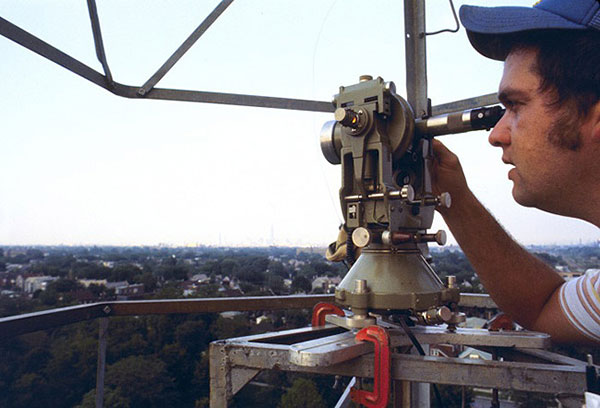
    It is important to note that the xGEOIDs provide a preliminary but increasingly-accurate view of the changes expected from the upcoming NAPGD2022. Also, the xGEOID20 geoid model is the first combination of the geoid models computed by scientists at NGS and Canadian Geodetic Survey (CGS). One unique element to xGEOID20 is that the differences between the A and the B model are due to the contribution of the GRAV-D airborne gravity and differences in methodology.

    The National Geodetic Survey (NGS) has published annual experimental geoid (xGEOID) models since 2014. Each of these experimental geoids demonstrate the improvements provided by the addition of airborne gravity data (GRAV-D data) and by the refinement of geoid computation methods.

    NGS Releases Annual Experimental Geoid Models & Gravity Interpolation Tools. (Image: NGS)
    NGS Releases Annual Experimental Geoid Models & Gravity Interpolation Tools. (Image: NGS)

    First, users can access the xGeoid20 model here. See the box titled Experimental Geoid Models 2020 (xGEOID20).

    Experimental Geoid Models 2020 (xGEOID20). (Image: NGS)
    Experimental Geoid Models 2020 (xGEOID20). (Image: NGS)

    As the image above indicates, the xGEOID20 is available over a very large area. The box below lists the latitude and longitude boundaries of the areas where xGeoid20 is available.

    Areas Where xGeoid20 Model Is Available. (Image: NGS)
    Areas Where xGeoid20 Model Is Available. (Image: NGS)

    To use the xGeoid20 Interactive Computation Page, the user can click on the “ACCESS TOOL” button below the map or the Interactive Computation button on the left side of the webpage (see the image above, “Experimental Geoid Models 2020 (xGEOID20)”). I’d like to highlight a statement that NGS added as a note on the computation page:

    1. Coordinates will be processed as IGS14.
    2. The epoch should be in decimal year format and reflect the user-specified output epoch. If no epoch is entered, the tool will use a default epoch equal to the epoch of the static geoid model, which is currently 2020.00.

    The user needs to know that the epoch is used to compute the xDGEOID20 value. I will demonstrate how this works later in this column.

    xGEOID20 Interactive Computation Page. (Image: NGS)
    xGEOID20 Interactive Computation Page. (Image: NGS)

    As in past xGeoid interactive computations web applications, the user can submit data in various formats. The box titled “Input Formats Permitted for xGeoid20 Webtool” provides a list of the permitted formats. It should be noted that inputting an ellipsoidal height, epoch and name are optional. However, the default epoch is 2020.00, so if you want a different epoch, you need to enter the date. Also. the program will only compute an orthometric height if the user provides an ellipsoidal height.

    Input Formats Permitted for xGeoid20 Webtool. (Image: NGS)
    Input Formats Permitted for xGeoid20 Webtool. (Image: NGS)

    Users have the option of getting the output from the xGeoid20 tool on their computer screen or in the CSV format. The box below is an example of inputting data using the screen option. Once you enter your data, the user clicks on the submit button.

    Example of Input Format for Screen Option. (Image: NGS)
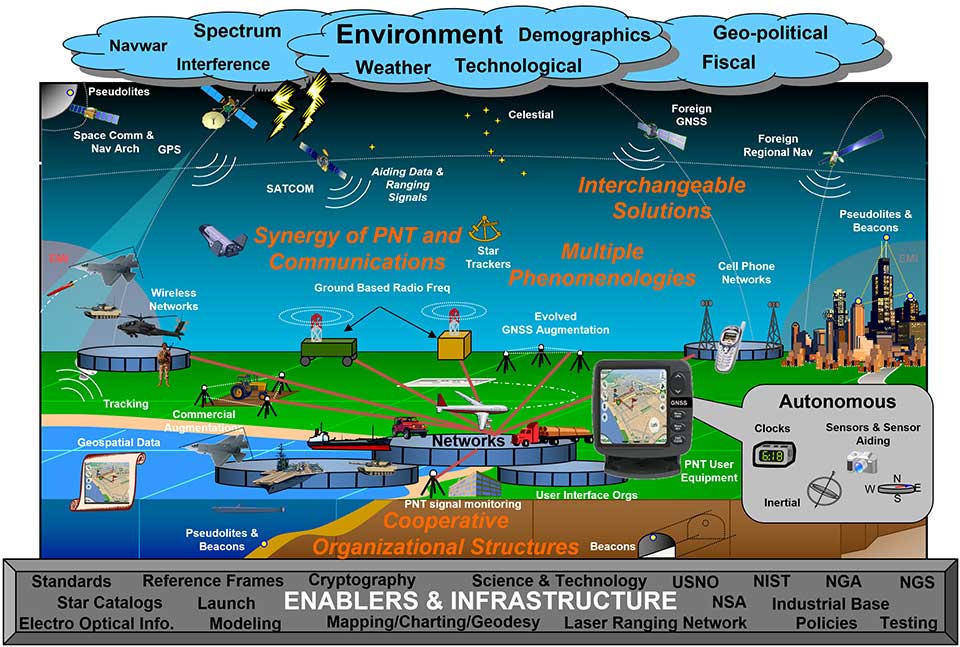
    Example of Input Format for Screen Option. (Image: NGS)

    The next image shows an example of the output using the screen option. I have highlighted a few numbers that I’d like to address.

    • Your input in NAD83 (2011) epoch 2010.00 (red). I entered my coordinates as NAD 83 (2011), and it assumed that these coordinates are epoch 2010.0.
    • Your Result in IGS14 epoch 2020.00 (blue). The routine provides your output coordinates in IGS14, epoch 2020.00. This is the epoch of the static geoid model.
    • The geoid height of GEOID18 (with respect to NAD83) and the orthometric height in NAVD88 (based on GEOID18) (green). This NAVD 88 value is for comparison purposes only. It is using GEOID18 and provides an estimate of the differences between the future NAPGD2022 and the current NAVD 88. The orthometric height is computed using the following formula: NAD 83 (2011) ellipsoid height (epoch 2010.0} minus GEOID18.
    • Ortho Height (brown). This is the estimation of the orthometric height using the following formula: IGS14 ellipsoid height (epoch 2020.0} minus xGEOID20A (or B).
    • Ortho(model)-NAVD88(GEOID18) (purple). These differences are the estimates of the differences between the future NAPGD2022 and the current NAVD 88. It provides the differences for both the xGeoid20A and xGeoid20B model. I look at the B model because it used the GRAV-D data in the development of the model.
    • Accuracy (yellow). This is the estimated 95% confidence interval for geoid height.

    Example of Output Format from Screen Option

    xGEOID20 Interactive Computation Output

    Note: The GRS80 ellipsoid is used for both NAD83 and IGS14.

    N: The geoid height at epoch t0 = 2020.0, which is geocentric and relative to the GRS80 reference ellipsoid.

    Accuracy: Estimated 95% confidence interval for geoid height.

    DN: The time-dependent geoid change computed between user inputted epoch (t) and t0. To obtain the dynamic geoid height at user inputted epoch (t), add N + DN.
    Either Model A or Model B N values may be used for this depending on user preference.

    Example of Output Format from Screen Option. (Image: NGS)
    Example of Output Format from Screen Option. (Image: NGS)

    The box below shows an example of inputting data using the CSV option.

    Example of Output Format from CSV Option

    Note: The GRS80 ellipsoid is used for both NAD83 and IGS14.

    N: the geoid height at epoch t0 = 2020.0, which is geocentric and relative to the GRS80 reference ellipsoid.

    Accuracy: Estimated 95% confidence interval for geoid height.

    DN: the time-dependent geoid change computed between user inputted epoch (t) and t0. To obtain the dynamic geoid height at user inputted epoch (t), add N + DN. Either Model A or Model B N values may be used for this depending on user preference.

    Cnt,Station,NAD83_Lat,NAD83_Lon,NAD83_Eht,Input_Epoch,
    IGS14_Lat,IGS14_Lon,IGS14_Eht,Output_Epoch,GEOID18_
    Ht,Oht_NAVD88,xGEOID20A_Ht,xGEOID20B_Ht,xGEOID20A_Accuracy,
    Oht_xGEOID20B,Oht_NAVD88,Oht_Diff(xGEOID20A-NAVD88),Oht_Diff(xGEOID20B-NAVD88),DN,Epoch

    0,PA,40.616935533762,77.4066810996784,222.425581993569,
    2010.00,40.6169445389,77.4066880139,221.191,2020.00,
    -33.685,256.111,-34.475,-34.477,0.039,255.666,255.668,
    -0.445,-0.443,0.000,2020.0001,PR,18.2570177272727,66.5508117355371,
    6.65385123966942,2010.00,18.2570227778,66.5508102806,
    4.776,2020.00,-39.379,46.033,-41.690,-41.679,0.040,46.466,46.455,
    0.433,0.422,0.000,2020.000

    Example of Input Format for CSV Option. (Image: NGS)
    Example of Input Format for CSV Option. (Image: NGS)

    The printed output from the CSV option looks very confusing, but it can be imported into an excel spreadsheet. The headings and values are all separated by a comma so everything falls into the appropriate columns after importing the data (see image below.)

    Example of CSV Output Format Imported into Excel. (Screenshot: David Zilkosky)
    Example of CSV Output Format Imported into Excel. (Screenshot: David Zilkoski)
    Example of CSV Output Format Imported into Excel. (Screenshot: David Zilkoski)
    Example of CSV Output Format Imported into Excel. (Screenshot: David Zilkoski)

    I stated in the xGeoid20 write up that the dynamic geoid model has also been updated this year in the form of xDGEOID20. This model is produced by NGS within the Geoid Monitoring Service (GeMS) and is part of the new NAPGD2022. For a thorough discussion on GeMS and the time-dependent geoid, view the webinar from NGS’ presentation library. See the box titled “GeMS Webinar by Kevin Ahlgren.”

    GeMS Webinar by Kevin Ahlgren (available at https://www.ngs.noaa.gov/web/science_edu/presentations_library/). (Screenshot: David Zilkoski)
    GeMS Webinar by Kevin Ahlgren (available at ngs.noaa.gov/web/science_edu/presentations_library). (Screenshot: David Zilkoski)

    Also, one of my previous columns described NGS’ GeMS program. The images titled “Examples of the Time-Dependent Geoid Change in Alaska EPOCH 2020.0” and “Examples of the Time-Dependent Geoid Change in Alaska EPOCH 2025.0” show the change in geoid value from Epoch 2020 to Epoch 2025 for two stations in Alaska.

    Examples of the Time-Dependent Geoid Change in Alaska EPOCH 2020.0. (Image: NGS)
    Examples of the Time-Dependent Geoid Change in Alaska EPOCH 2020.0. (Image: NGS)
    Examples of the Time-Dependent Geoid Change in Alaska, EPOCH 2025.0. (Image: NGS)
    Examples of the Time-Dependent Geoid Change in Alaska, EPOCH 2025.0. (Image: NGS)

    First, looking at the box titled “Examples of the Time-Dependent Geoid Change in Alaska EPOCH 2020.0,” the change between NAPGD2022 and NAVD 88 is approximately 1 meter. Users should note that the GEOID12B is used to establish the NAVD 88 height. Alaska was not included in GEOID18. Comparing the two Alaska labeled boxes, the xDGEOID2022 change between 2020.0 and 2025.0 is –4 mm. I will address this topic in more detail in future newsletters.

    As stated by NGS news announcement, “The xGEOID models provide a preliminary but increasingly-accurate view of the changes expected from the upcoming North American-Pacific Geopotential Datum of 2022 (NAPGD2022).” NGS has produced many figures that describe the bias and trend between the future NADGP2022 and NAVD 88. In my June 2017 column I provided a plot that depicted the difference between NAPGD2022 and NAVD 88 based on the GPS on Bench Mark dataset. See the image below.

    Figure from June 2017 Survey Scene column. (Image: NGS)
    Figure from June 2017 Survey Scene column. Approximate Change Between NAPGD2022 and NAVD 88 Using GPS on BMs Data (units = cm). (Image: NGS)

    These figures provide a broad picture of the change but to better understand the changes across the Nation, I used the GPS on Bench Mark dataset, that was involved in the creation of Geoid18 model, to compute an average latitude, longitude, and ellipsoid height for every State. Obviously, this is a fictitious mark but it provides an idea of the average change based on marks that have both a GNSS-derived ellipsoid and a leveling-derived orthometric height. The plot titled “Difference Between the Future NAPGD2022 and NAVD 88” depicts the average difference for each state based on the GPS on Bench Mark data file. These differences were generated using the xGeoid20B values from the output of the xGeoid20 website.

    Difference Between the Future NAPGD2022 and NAVD 88. (Image: NGS)
    Difference Between the Future NAPGD2022 and NAVD 88. (Image: NGS)

    I would encourage everyone to select a couple of marks and compute the differences to understand the change in their particular region. I was the NAVD 88 Project Manager and I informed users of the potential changes between the NGVD 29 and NAVD 88 for about a decade, and I still had surveyors tell me that they didn’t know it was coming. Please take a few minutes to read NGS’ write up on xGEOID20, estimate the differences in your area of interest, and spread the word to your colleagues, friends, and clients.

    The last item that I’d like to highlight is that NGS has released a beta version of a surface gravity model consistent with xGEOID20. See the box titled “Experimental Surface Gravity Model 2020 (xGRAV20).” Users can access the beta webtool here.

    Experimental Surface Gravity Model 2020 (xGRAV20). (Image: NGS)
    Experimental Surface Gravity Model 2020 (xGRAV20). (Image: NGS)

    The access and input to the tool is similar to the xGEOID20 web tool. Saying that, I’d like highlight a few items:

    • The input height should be an orthometric type of height not an ellipsoid height.
    • If a height is entered, the tool will assume that is correct and use it for the gravity prediction.
    • If you do not know the elevation, leave the entry blank. The tool will use the DEM interpolated height if it is blank.
    xGRAV20 Interactive Computation Page. (Image: NGS)
    xGRAV20 Interactive Computation Page. (Image: NGS)

    The box below provides the output using the tools sample data.

    Output from Screen Output Format from xGRAV20 Tool. (Image: NGS)
    Output from Screen Output Format from xGRAV20 Tool. (Image: NGS)

    This gravity tool will be important when users want to incorporate leveling-derived orthometric heights into NAPGD2022. We will address this tool in more detail in future newsletters. I want to emphasis that these two web tools are beta sites. As a beta site, users should verify all information from the site. I encourage everyone to access the tool and check out a few of their favorite marks, and then send an email to NGS informing them of what you like, what you would like to change, and what you would like to see added to the tool.

    NGS is releasing this tool as a beta product to get feedback from users. They are interested in your feedback concerning its function and usability as well as how users would like to interact with NGS web tools in the future. Email NGS at [email protected].

    In conclusion, I want to leave you with a thought about change. When I give presentations and seminars, I usually include a slide that probably expresses the thoughts of many individuals.

    My brother once told me:

    “If you geodesists did it correctly the first time you wouldn’t have to keep performing adjustments and changing the values. Just do it right the first time.”

    He’s a doctor and said he must do it right the first time.

    My response to my brother and to everyone else is the following:

    If you want to improve you have to be willing to change, and if you want to continue to meet future positioning requirements you need to continually change.

    Winston Churchill said it better “To improve is to change; to be perfect is to change often.”