Tag: Survey Scene

  • Surveying and the GNSS generation: The future is now

    As we approach the halfway point of 2018, one cannot help but notice the amount of technology that we use every day and how it affects our daily lives. While George Jetson isn’t whizzing by in a flying car to his glass condo in the clouds, we are utilizing an incredible amount of technology in normal life.

    I can sit here typing on a computer or tablet that is many times advanced than the first one I used in junior high school and think nothing of it as futuristic technology has become the norm.

    The old standard joke about technology used to be about cell phones and television remote controls; if you needed to figure it out, get your child or even grandchild to help. The youngsters were the majority that could embrace technology because they didn’t have past methods to confuse their ability to figure out how to work the new device.

    A funny thing has happened along the way, though; those kids are now grown, and technology has advanced even further.

    To help explain the names and timeframes of our generations, I found this chart that explained it all:

    Generation Name Births
    Start
    Births
    End
    Youngest
    Age Today*
    Oldest Age
    Today*
    The Lost Generation –
    The Generation of 1914
    1890 1915 103 128
    The Interbellum Generation 1901 1913 105 117
    The Greatest Generation 1910 1924 94 108
    The Silent Generation 1925 1945 73 93
    Baby Boomer Generation 1946 1964 54 72
    Generation X (Baby Bust) 1965 1979 39 53
    Xennials –
    1975 1985 33 43
    Generation Y –
    The Millennials –
    Gen Next
    1980 1994 24 38
    iGen / Gen Z 1995 2012 6 23
    Gen Alpha 2013 2025 1 5

    (Chart courtesy of Career Planner.)

    To help put this chart in context, the average age of the professional surveyor in the United States is 59 and solidly in the Baby Boomer category. But even with an average that high, there are still a significant number of surveyors in the Silent Generation as the economic downturn of the late 2000s has forced them to continue well into their golden years.

    HOW SURVEYORS FIT IN THIS DISCUSSION

    The surveying profession has suffered through the same generational challenge as the rest of society. The younger set that started out surveying with electronics have now graduated to much more complex yet capable machinery. Prior to the mid- to late 1970s, electronic technology did not play a role in most surveying operations and tasks. The professional surveyor was widely considered a boundary expert, map maker and establisher of topographic data, with the high-tech mapping work left to the government geodesists (see my July 2017 Survey Scene column).

    Most surveyors who learned their craft prior to the electronic age were trained on the job or obtained an engineering degree through a program that may have offered a limited surveying curriculum. Surveying was a career for the outdoor type and required traversing rough terrain at times, as well as being able to withstand weather extremes.

    THE NON-TECHNOLOGY GENERATIONS

    As a second-generation surveyor, I was fortunate enough to have been exposed to land surveying literally as it was performed by our forefathers. While the tasks performed didn’t utilize a true Gunter’s chain and compass, they were completed with a modern transit and steel tape. The surveys we completed didn’t require high tech equipment as our manual procedures greatly exceeded commonly accepted positional tolerances.
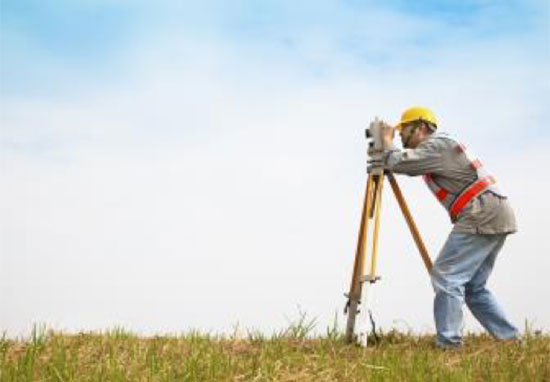
    A surveyor maps out boundaries for construction. (Photo: Bureau of Labor Statistics)

    Most of the work performed by surveyors leading up to the early Baby Boomer generation was much simpler in theory but rarely easy to accomplish due to terrain, weather and the computations necessary to complete the boundary analysis. Traversing a parcel meant having a field crew of several people, often through brush and woods, and time consuming. A large parcel may be days or weeks of field to traverse around with most of it on foot. Once completed, the professional surveyor was tasked with often days of manual calculations, reduction of notes and determination of traverse closure. All the error from days of field work was then balanced through more hand calculations, usually by compass rule or transit rule, and hand drafted onto the final survey plat.

    A similar story is followed with topographic and bathymetric surveys and creation of maps with existing conditions. Data collection performed to obtain locations and elevations of existing sites were by radial angle and distance or by grid method, with water depths being determined manually by use of lead lines. In the office this data is placed by manual drafting onto paper, sepia or vellum. Once elevations were plotted, contour intervals were determined by interpolation between each of these points. The creation of the contours was then drawn in by several methods, each with their own level of creativity by the drafter.

    Because of the increased use and importance of electronic technology, data collection and advancements of the profession, today’s surveyor is faced with many more challenges than their predecessors. While the concepts for many tasks do follow the protocol for completing a multitude of survey duties, the way we go about collecting and analyzing the data is much more complex than in the past.

    The need for our profession to identify these challenges and create opportunities for modern day surveyors is upon us, as our educational and training needs to be ramped up to stay current with demand. All professional surveyors, regardless of what generation they were born in, have filled or will fill an important role in society as expert measurers.

    However, the rapid advancement of technology has exposed the lack of additional education and training necessary to keep our standing in serving the public’s health and welfare.

    My point here is not that the work and tasks performed by past generations of surveyors was easier, but it did require more manual labor and less technical education and training. I liken the situation to automotive mechanics and how much more technology goes into working on a modern car versus vehicles of earlier generations.

    Many mechanics tuned engines by “feel” with no recordable technology to tell them otherwise. I wouldn’t think of calling the expertise shown by past mechanics as inferior to today’s automotive mechanics; each has been trained to rely on different skills sets to work with completely different engines. Thus, I feel the same way in comparing different generations of surveyors. Different tools and methods require unique and specific training for the surveyor to perform at the highest level.

    For example, look at the survey-related equipment, software and services within GPS World magazine; most of the articles, case studies and advertisements are for things not even considered five to 10 years ago. All these items require a different mindset of more technical and analytical processing, so the surveyor’s educational requirements and approach must adjust with the technology.

    As time marches forward, the need for more advanced surveyors is reaching a critical point.

    HOW TODAY’S SURVEYORS GET THE JOB DONE

    Today’s surveying profession, including the field and office technicians, rely heavily on technology more than ever.

    Many threads of advancing technology go into weaving the tapestry of modern surveying, with the primary material of GNSS being utilized throughout. I have written in the past regarding my thoughts on the single greatest advancement in surveying (see my May 2016 Survey Scene column) and my argument gets stronger with newer technology adding to the way we measure our world.

    Here are some of the tasks in which the surveying profession uses GNSS as a basis of measurement and location, and why specific education and training is critical to proper execution:

    Boundary surveys
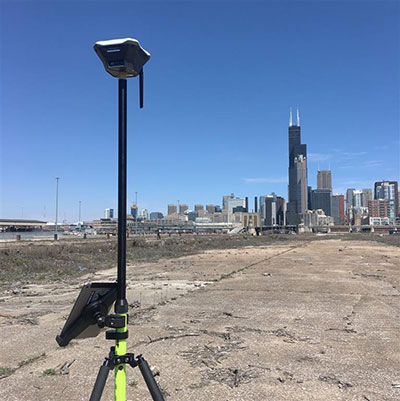
    Photo: Tim Burch

    Like the surveyors before us, boundary establishment and re-establishment are the main responsibility of the profession. However, with GNSS, the ability to produce more location data has increased tremendously by reducing the need to perform intricate traverses through places when not necessary. It has also reduced the need to perform tedious traverse computations and adjustments; instead, least square adjustments are made to GNSS observational data to provide accurate results.

    Topographic surveys

    This data can be acquired by a combination of GNSS and conventional total station methods but is based upon geolocation information determined by primarily geodetic coordinates through GNSS solutions. Relying on GNSS data with no standard procedure for location and elevation verification can lead to major issues if not caught by an educated user.

    Laser scanning / lidar / SLAM / photogrammetry / hyperspectral imaging

    All these methodologies, also known as remote sensing, have revolutionized mass data collection with the enormous amounts of information that can be acquired in a short amount of time. Each has specific functionality and limitations but rely on geolocation as a main attribute of the data. Because of the large data files that are created, the output is in the form of a point cloud rather than the traditional P,N,E,Z,D format normally utilized by surveyors. Like topographic surveys, this data typically relies on GNSS information for geolocation.
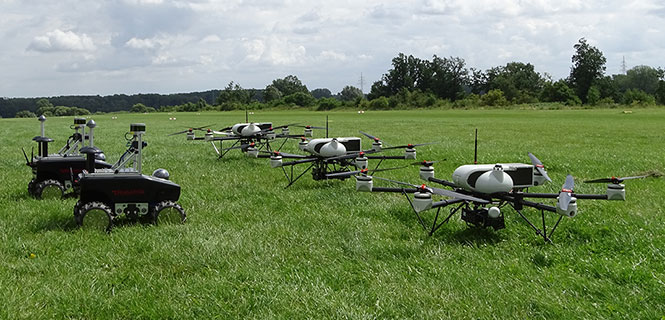
    Photo: Simon Batzdorfer, Markus Bobbe, Martin Becker and Ulf Bestmann

    Unmanned aerial and terrestrial systems

    The newest of the data collection methodologies, the unmanned aerial vehicle (UAV) has taken the surveying world by storm. A good percentage of the new adopters (including me) utilize commercial grade multi-rotor units coupled with a high-resolution camera for orthometric photos and video clips of project sites.

    While this method uses photogrammetry as its data collection method, it relies on GNSS for establishing ground control points (GCP) to establish geolocation to a known coordinate system. Higher end models incorporate RTK units to minimize the number of control points as well as utilizing lidar and/or hyperspectral modules for high end remote sensing.

    Along with the airborne variety, land-based unmanned vehicles are starting to catch on as additional data collectors of open, navigable terrain. These autonomous devices are being equipped with lidar and cameras to augment aerial data in concert with UAVs to gather redundant information for quality checks.

    As stated above, these remote sensing technologies, whether used statically or on an unmanned system, all create large point cloud data files that can be cumbersome to manage.

    Bathymetric surveys

    Many advancements have been made in producing measuring devices using sonar technology, including side- and multi-beam models for more detailed observations in varying conditions. GNSS plays a big role in this survey method due to the electronic ability to combine the depth readings of sonar instantaneously with geographic location. This improvement in data collection provides much more accurate and reliable information for the mapping of water bodies and passageways.

    Bathymetric surveys are also getting in on the unmanned vehicle program as well with shallow draft autonomous watercraft being used in places where regular bathymetric vessels cannot go for survey data. More of these crafts are being implemented as they become more affordable.

    What do these categories have in common? Most rely on specialized training and equipment to perform each specific task. Surveying has evolved past a “one size fits all” situation and demands that each sector of surveying have personnel trained for the job and have the right equipment to get it done.

    A central figure in all these tasks is also GNSS technology; from survey-grade receivers to UAV’s, the tasks all revolve around geolocation.

    HOW DOES THE PAST COEXIST WITH THE FUTURE?

    The modern-day surveyor now has many different tools at their disposal that generations of surveyors before us couldn’t begin to fathom. The ability to perform at such levels of production and accuracy using new equipment and software is incredible and humbling. However, I’m afraid the technology is outpacing the profession. How many surveyors have taken the time to educate themselves on these enhancements? Because I think we are stretching ourselves too thin, now is the time for the professional surveying community to pause for a self-assessment of our abilities and what it will take to catch up with reality.

    One of the biggest hurdles the surveying profession is facing are the lack of qualified technicians for positions both inside and out. The recession of 2008-2011 reduced the number of technicians in our field due to the lack of work being done in the economic downturn, but it also came at a time when technology was starting its upward run at increasing survey task efficiency. The downturn forced many surveyors and firms to make drastic cuts and reduce their investment in new technology, equipment and training to be more efficient. The surveying profession is now paying the price for that downturn with few adequately trained technicians along with licensed professionals not staying current with technological innovation and advances.

    WHERE DO WE GO FROM HERE…?

    Tim Burch with seventh-and eighth-grade students.

    The professional surveyor must embrace technology by promoting the profession to more places beyond the four-year college. We must start in junior-high and high school in math, science and history classes encouraging students to investigate surveying as a career. We also need to support technical and vocational programs that can help introduce surveying as a possible path beyond their certificate or associate degree. One of the simplest topics I use in presentations is the discussion of GNSS technology and how it is built into almost everything the student sees. From their cellphone to the cars their parent’s drive, GNSS surrounds us with geolocation information to make our lives easier.

    These technicians aren’t going to all come from a four-year university programs; they are going to come from those teenagers who spend hours honing their hand-eye coordination with video games and drone racing. They will also be the fluid minds writing code for the next big app, and the surveying profession needs to embrace them to incorporate their work in our geolocation world.

    The professional surveying occupation has become much more than establishing boundaries of parcels; it now requires knowledge for mapping literally anything in the world. The challenge now is to find those who want to help us continue this surveying and mapping tradition. Fellow surveyors: are you up to the challenge to find your replacement?

  • UAV manufacturer senseFly joins April 20 webinar panel

    UAV manufacturer senseFly joins April 20 webinar panel

    A speaker from UAV manufacturer senseFly will appear on the free April 20 webinar, “From Flying Drones to Doing Business,” addressing ease of use for the user in business applications. The Switzerland-based company specializes in professional-grade UAVs for survey, mapping, precision agriculture and asset inspection. The company recently became the first drone operator to be granted anytime Beyond Visual Line of Sight (BVLOS) authorization in Switzerland.

    ebee copy 2
    Photo: senseFly

    The webinar will cover a broad range of issues concerning sensor integration aboard a flying platform, and in particular their use for commercial purposes. Webinar attendees will have the opportunity to ask direct questions of the speakers, both upon registration and during the live event. Register free at env-gpsworld-integration.kinsta.cloud/webinar.

    The senseFly speaker (name to be announced soon) will join a panel that consists of:
    Gustavo Lopez, Product manager GNSS solutions for UAV applications, Septentrio; Jan Leyssens
, Managing Director, Sales & Business Development, Airobot; and Zak Kassas, Assistant Professor in the Department of Electrical and Computer Engineering, University of California, Riverside.

    Further speaker details:

    Lopez: Septentrio is an leader in bringing high end GNSS technology when accuracy and reliability matters. Gustavo Lopez is Product manager for UAS applications at Septentrio. Since joining the company, he has held a number of R&D and product management roles. Gustavo holds a Bachelor of Computer Science degree from Monterrey’s Technology Institute and an MBA from United Business Institute

    Leyssens: Airobot specializes in meeting safety demands for UAVs by providing intelligent safety components, specifically designed for drones, and in facilitating end-users’ success in completing their missions. Leyssens has Masters’ degrees in avionics, electrical engineering and business administration.

    Kassas will present the research material from his cover story in the April issue of GPS World: “LTE Steers UAV — No GPS? No Problem! Signals of Opportunity Work in Challenged Environments.” Long-term evolution cellular can be exploited for accurate and resilient autonomous vehicle navigation in the absence of clear GNSS signals. Simulation and experimental results demonstrate that GPS-like performance can be achieved in the absence of GPS signals when cellular pseudoranges aid an inertial navigation system.

  • GNSS and the Surveyor: Take Me to School

    The adaptation of GPS for civilian use is the single greatest step taken by  the land surveyor, more specifically the advance to  real-time kinematic networks. Now unmanned aerial vehicles enable data collection in places thought impossible previously, and laser/LiDAR scanners are on the horizon as the next game-changer. But how did we get here? An understanding of our history can be help us prepare for the future.

    The land surveyor has been practicing this occupation since man first claimed rights to physical property. In similar fashion with almost all other professions and trades, forward progress in knowledge and technology has increased educational requirements for even the most mundane of surveying tasks. An environment in which a simple survey is completed by manual measurements and depicted on a hand-drawn plat still exists but will continue to decrease as technological acceptance and governmental requirements become increased. The challenge will be a continual advancement to educate the surveying community as a whole.

    Today, the average age of the professional land surveyor approaches that of a sexagenarian (no worries, it’s just a fancy word for being in your sixties). Here’s a rundown of how we got there:

    Boots on the Ground

    In a previous article, I wrote of my journey to becoming a professional land surveyor (GPS World November 2015) and how it was possible for a high school graduate to be introduced to this wonderful profession with little to no formal training. Even though my introduction into land surveying started in the early 1980’s, it was still during what I refer to the early “high tech” surveying era. While electronics were evolving the surveying industry from the late 1960’s to my beginning days, it didn’t change the career path for the surveyor.

    At the time of my surveying opportunity, an entry level employee didn’t require the knowledge of higher level math, science and geodesy to gain a position as a chainman on a three-man survey crew. At a minimum, the employee was instructed to hold the measuring tape (known as the “chain”) at specific locations as directed by the survey party chief. The employee also was utilized as a pack mule to carry equipment and staking materials, so physical conditioning and stamina were much more important characteristics that knowledge of the profession.

    Over time (and usually through employee attrition), the chainman could learn to run the surveying equipment, which included transits, levels, and theodolites. Total stations with integrated electronic distance meters (EDM) were just becoming mainstream during my early days as an instrument person but little additional knowledge was necessary other than on-the-job training. The benefit of the EDM allowed the survey crew to measure further and faster than previous manual methods.

    An additional benefit of the total station was the digital readout of the horizontal and vertical angles and the elimination of the time-consuming need of reading the angular verniers.  These electronic advancements were great but didn’t affect the procedures for calculating survey figures and boundary analysis; they only increased the productivity of the field crew.

    Once an instrument man became more knowledgeable in the math and processes of land surveys, it was possible to advance further as a party chief. This path included many days on construction sites, hand calculating staking points and alignments, squaring up buildings and running traverses under the direction of a party chief, who in many cases, had become a professional land surveyor by these methods as well.

    Most of the knowledge obtained for career advancement was still on-the-job, but now also included some office tasks to compute boundary calculations and staking calculations through simple geometry/trigonometry means. Not rocket science but still required a good head for math and problem solving; this step also provided a potential career roadblock. This meant an occupational ceiling for some and advancement for others.

    Most of those who continued to advance were the ones with the stronger mathematical aptitude and capability to evolve with the knowledge they were gaining during their experiences as an apprentice land surveyor. The success of these future professional land surveyors depended greatly on successful mentoring capabilities of his/her previous supervisors. For those fortunate enough to learn under a great mentor, many more facets of the profession were introduced to them to gather experience. They were provided with time and care to explain and demonstrate proper methods and procedures for many surveying tasks, along with an example of how paying it forward helps everyone in the process.

    There are those, however, that received limited personal and professional training from their supervisors. These supervisors/managers possessed little experience in formal education or training methods. While these superiors excelled well enough to pass the licensing requirements at the time, the fast-paced movement of the surveying profession has left them in the dust. It is also these individuals who lack the necessary knowledge to successfully train and mentor the next generation of professional land surveyors.

    Old School versus New School

    The point here is that all of this was possible for the “old world” way of surveying. Several of my professional land surveyor contemporaries came up through this pathway of apprenticeship and mentoring with little to no formal education or training, yet have succeeded in business very well for themselves. But I caution you; they are not the norm. This minority of forward thinking professional land surveyors are the ones who remain visible in our business environment and continue to push themselves toward improvement for personal and professional gain.

    Where does this leave everyone else? Like so many other professions that have existed for centuries, the system of learning the craft of land surveying is based upon being self-serving. A historical look at the profession will reveal a long list of generational lines of land surveyors (yours truly included…) and have passed down the occupation somewhat like a family crest. But like so many vocations that get passed down like a family heirloom, if the means and methods of the occupation don’t progress with the times, it will eventually falter.

    The earlier example of the career of the land surveyor was possible until the early 1990’s; that’s when the electronic modernization of our profession picked up steam and the survey equipment manufacturers began revolutionizing our measuring and data collection methods. Couple the hardware enhancements with the boost in drafting capabilities of several drafting packages and that starts us down the road of needing staff with more educational requirements. Because of the advancements in both the field and office tasks of land surveying, we must look at each to understand how technology must be embraced to succeed as a profession.

    Not Your Father’s Transit & Chain (or Theodolite or Total Station…)

    I believe the field portion of the land surveying revolution started in the mid-1990’s with the rapid change in technology. Geodimeter led the conventional instrument innovation with servo-driven theodolites and robotic total stations that increased field productivity along with reducing errors. Along with the advancement of data collectors, these improvements greatly modernized a manual method of locating information. It also gave surveying firms an opportunity to reduce the number of staff members necessary on a field crew and spread their work out to more customers.

    The continuing improvement of the software on the data collector also made it more user friendly but also providing a “dumbing down” of the way the information is collected. While the data collection is now more efficient, the overall calculation process hasn’t changed much. But when this information is incorporated into various datums and coordinate systems, it gets much more complicated. We’ll cover this area more later.

    As stated in my previous articles, it is my opinion that the adaptation of the global positioning system created by the United Stated Department of Defense for civilian use is the single greatest improvement for the land surveyor (GPS World May 2016), more specifically the advancement to the real-time kinematic network. Couple this now with the exploding market of the unmanned aerial vehicle (UAV) with GNSS location capability, the surveying community now can collect data in places though impossible previously.

    The use of GNSS is a big part of that equation (no pun intended) and having the right balance of education and experience with its use will be key to our profession’s success. The continued to use of all facets of GNSS by surveyors worldwide will require the need for more responsible field staff. They will need to have the proper education and experience to comprehend the technology and calculations behind the data.

    I would be remiss if I didn’t mention laser/LiDAR scanners as tools for surveyors. There are companies who utilize these devices on a regular basis but they haven’t become the game changer like other technologies. These will come more into play as technology makes them smaller and the price point for entry into potential purchase is more affordable. The learning curve for processing the field data in point clouds is long and tedious but will evolve like everything else.

    It’s Always Warm and Dry in the Office

    Equally as important requiring proper training, education and mentoring are the land surveying tasks completed by office staff. As I stated in the opening paragraph, the norm used to be hand-drafted maps and plats depicting the results of field surveys from the notes of the party chief. Many drafters came through high school vocational programs and were hired directly after graduation. Simple angles, distances and direct measurements between entities were easy to portray and didn’t take much training. The introduction of the personal computer in the late 1970’s/early 1980’s also brought various platforms of computer-aided drafting (CAD) so another level of training was now necessary to learn both the software and the computer. Early versions were simplistic and mostly line-based but as technology increased the capability, it become more clear that a high school graduate didn’t have enough formal training to keep up with it.

    In addition to the drafting packages, computation software has become increasingly complex. These systems have developed into incredibly capable programs with a multitude of surveying solutions. This category includes aerial photography rectifying systems, point cloud manipulation and control network planning/computation systems that were only available previously on mainframe computers. While they are user friendly, they are well above the general education level of the high school graduate. The requirement to stay pertinent in the surveying environment must be centered around education.

    This Is Supposed to Be about GPS; How Do All These Things Fit In?

    I wrote in my last column regarding geolocation and how relied upon it has become in our society, (GPS World January 2017), and the land surveying community is no exception. The story here becomes about how quickly we can train the entire surveying profession to recognize the importance of location in our vocation or get left in the dust.

    It used to be location only mattered to explorers and mappers. Even with the creation of the latitude/longitude system, it was embraced more for the those who were traveling and giving directions to those planning to do so. Early surveys only related to surrounding properties and didn’t give much mind to specifically where it was located on the face of the earth. The surveys and related legal descriptions relied on physical monuments and avoiding hindrances versus actual measurements. That’s one reason why in the surveyor’s Rule of Construction that monuments carry significantly more weight that distance or direction in a legal description. The early settlers of the American Colonies relied on this system for conveyance of properties.

    It was only when the United States wanted to sell the lands gained from the Revolutionary War and Louisiana Purchase did they come up with a system for dividing the land. The Land Ordinance of 1785 was the beginning of the Public Land Survey System (PLSS) with the Surveyor General sending his staff westward to begin the task of establishing the sectional system.

    Fast forward to the 20th century and the rapid expansion of civilization worldwide. In the post-WW2 timeframe, our world was going places. Highway systems were increasing and the need to map it all was becoming more important on much larger scales. These entities charged with this mapping needed a much bigger method of planning and charting to depict where information was being located. The implementation of state plane coordinate systems was utilized to help with this task but involved high-order surveying along with brain-numbing geodesy. Very few individuals and firms were capable of doing this work but it provided a needed baseline for future endeavors.

    Fast forward to the past 20 years and think of the technological explosion of geolocation in the surveying and engineering fields. What used to be simple plat and plans has become a georeferenced dataset relied upon by clients, contractors, governing bodies and our firms. There are many geographical information systems in place now (from cities/counties/states down to rural utility companies) that all rely on geolocation. It would be easy to sit back and state I’m just a surveyor and this geolocation thing doesn’t come across my radar, but I would be greatly mistaken. Geolocation is an important factor of my profession and must be considered for almost all of my work going forward.

    Education Is the Key

    The professional land surveyor is uniquely qualified to provide accurate measurement for platting and mapping purposes. Our main focus throughout history has been to provide guidance and knowledge on boundary matters worldwide. Our background, knowledge and experience is not only in the physical location of the boundary but of the legal precedent and standing within the court system. Only the professional land surveyor can provide the legal opinion of where a boundary line lies; a judge or jury are not permitted to do that under law. The judge can rule whether to accept your opinion as fact but cannot make the determination themselves. We have an incredible duty and responsibility to the public; now we have the opportunity to instill more trust from them regarding geolocation.

    These statements are not intending to water down the importance of any of the Rules of Construction for surveys. It is intended to bring it in a brighter light so that surveyors see they have another role to fill, and that is the role of providing locations for the world in a spatial context. All of those tasks we provide can now be referenced in another view; data location in relation to the world.

    The professional land surveyor and their use of GNSS provides the basis of all real and potential mapping. Our inherent background in geodesy, technology and analysis of survey data leads the way as promoting our capability as the geolocation experts. While I still believe that conventional instruments will be utilized for a significant portion of our work, it will be the GNSS portion that will further define us as the experts in geolocation.

    All surveyors, both existing and future ones, need to get on board and embrace the future. This means additional education for us old timers along with planting the seeds in the junior high and high school age students who don’t know what a surveyor is or does. It means supporting the programs that train future surveyors; from the Boy Scouts through the collegiate level.

    Here is where the big difference in land surveying from past generations to now lies: education. I was fortunate enough to have started during a generation that allowed me to gain the necessary on-the-job education and training to become a professional land surveyor. I will also be the first to tell you that path is not the proper one for today’s surveying environment. Higher level math, science, and surveying training topics along with specific knowledge of geodesy, GNSS concepts, and environmental conditions are among the necessary tools for becoming a successful professional land surveyor in today’s world.

    Because of the family and financial barriers to formal schooling, there is a movement to roll back the educational requirements for professional land surveyors. I’m here to state for the record that surveying is much harder than when I began my career, so I can’t imagine trying to break into the profession now without the proper formal training. Just as many other occupations have need to adapt to stay current, the surveying profession need to do the same. There is too much at risk to not properly train our staffs to not just operate the equipment and software but to understand the concepts and results that are gained by it.

    While I became interested in land surveying for different reasons, my focus on geolocation as a subset of my boundary knowledge has me more energized for our profession. It is this enthusiasm that I ask that you help me spread to the world but also help provide the education and guidance that will be necessary for these young future professionals. In the end, the professional land surveyor through the use of GNSS can lead the charge with geolocation. All it takes is the proper education, training and guidance; after that, everything is easy.

  • Analyzing NGS’ GPS on benchmark dataset used to make GEOID12B — Part 9

    Analyzing NGS’ GPS on benchmark dataset used to make GEOID12B — Part 9

    These columns have focused on procedures and routines for establishing GNSS-derived orthometric heights. There are many ways to analyze and investigate GNSS data and adjustment results. I have provided some basic concepts that I believe are important for users to understand.

    The selection of constraints is a very important part of establishing accurate and consistent NAVD 88 GNSS-derived orthometric heights. All of the analysis and recommendations have been based on using the National Geodetic Survey‘s latest scientific geoid model.

    I recommend first performing the analysis using the scientific geoid model because the hybrid geoid model has been warped to be consistent with the published NAVD 88 values. However, as mentioned in Part 7 (June 2016), in practice, GNSS-derived orthometric heights are incorporated into the NAVD 88 using the latest hybrid geoid model GEOID12B. This column will focus on the NGS “GPS on BMS (GPSBM)” dataset that was used to create the hybrid geoid model.

    As mentioned in Part 3 (October 2015), the hybrid geoid model is designed to fit the published NAVD 88 leveling-derived orthometric heights. Saying that, the GPSBM dataset can be used to identify potential issues in the NAVD 88 published orthometric heights. GNSS users should be familiar with this dataset and how it can be used in their analysis. This column will provide tools and routines that can be used to identify potential issues in NAVD 88 heights and/or NAD83 (2011) published ellipsoid heights.

    The National Geodetic Survey provides information on the bench marks occupied by GPS that were used to make GEOID12B.

    The write up from the NGA website is given below. I have highlighted a few sentences that I’ll address in this column.

    Write up from: GPS On Bench Marks (GPSBM) Used To Make GEOID12B

    Each of the below regions uses variants of the NAD 83 reference frame and a local vertical datum. Several versions of NAD 83 exist conforming to significant plates: Pacific, Mariana, and North America. Likewise, each region has its own vertical datum. It is not possible to level across water, so islands will have selected a tide gauge to serve as the local datum point and all leveling is tied to that site. The only exception to this is Hawaii. No tide gauge was selected in the Hawaiian Islands and no vertical datum has been established as of yet. Hence, GEOID12B in Hawaii transforms between NAD 83 (PA11) and the same geopotential (geoid) surface as the USGG2012 model ( W0 = 62636856.00 m**2/s**2).

    Items that are listed in the below table include the final GPSBM files for each region as both Excel spreadsheets and text files as well as thumbnail images linked to larger images showing the distribution of the GPSBM’s. Alaska and the island regions are more consistent, so not many points were dropped and each is provided in its own spreadsheet/text file and identified with the appropriate ellipsoidal reference frame and level datum (see below).

    The most significant work occurred in the COnterminous United States (CONUS). For CONUS, there were 24,782 points with 911 rejected leaving 23,961. These were supplemented from the OPUS-database with 737 points of which 238 were rejected leaving 499. There were also 579 points in Canada with 5 rejected leaving 574. In Mexico, there 744 of which 497 were clipped since they were too far south and another 70 were rejected leaving 177. This brings a total of 26,932 points of which 1,721 were rejected or clipped and 25,211 retained for modeling GEOID12B. The data in Canada and Mexico provide continuity up to and across the U.S. borders but do not make the GEOID12B model valid in those countries.

    Points were rejected either because the State Advisor recommended it be dropped (e.g., known subsidence region), the residual ellipsoid height errors (from the NA2011 project) indicated a point was too noisy in comparison to other points in a state/region, the orthometric height was suspect, or the residual errors during geoid modeling were too high. The corresponding error flags are ‘S’, ‘h’, ‘H’, and ‘N’ as seen on the spreadsheet and text files. These points then represent the control data that were used to define the transformation between NAD 83 and NAVD 88 for CONUS.

    The control data were much simpler in other regions due to the lack of quantity (more than two orders of magnitude less). Data in these regions follows a similar pattern where some data are rejected based on the codes given above for CONUS. The columns on the right side give the respective datums realized by GEOID12B for each region.


    REGION Excel Spreadsheets GeoPDF maps Ellipsoidal Reference Frame Vertical Datum
    CONUS (xlsx)  ,  (xls) CONUS NAD83 (2011) NAVD88
    Alaska (xlsx) ,  (xls) AK NAD83 (2011) NAVD88
    Puerto Rico (xlsx) ,  (xls) PR NAD83 (2011) PRVD02
    U.S. Virgin Islands (xlsx) ,  (xls) USVI NAD83 (2011) VIVD09
    Am. Samoa (xlsx) ,  (xls) AS NAD83 (PA11) ASVD02
    Guam (xlsx) ,  (xls) Guam NAD83 (MA11) GUVD04
    CNMI (xlsx) ,  (xls) CNMI NAD83 (MA11) NMVD03

    Table 1 is an excerpt of the excel spreadsheet for the GPSBM dataset and provides a sample of the contents. The headings of the columns are fairly self-explanatory. What’s important here is that the excel spreadsheet provides the name, latitude, longitude, NGS’ PID, the ellipsoid height and orthometric height of the stations used in making GEOID12B.

    Table 1
    Excerpt of the Excel spreadsheet for GPS on benchmarks (GPSBM) used to make GEOID12B.
    table1-excerpt-gps-bench-marks

    The “GPS On Bench Marks (GPSBM) Used To Make GEOID12B” write up states that 1,721 stations were rejected and were not used in developing the hybrid geoid model. It also states that for the conterminous United States (CONUS), there were 24,782 stations with 911 rejected leaving 23,961. This column is going to focus on CONUS but the analysis can be performed everywhere.

    As the write up states, stations were rejected for four different reasons:

    • Code S – The State Advisor (now called Regional Geodetic Advisors) recommended it be dropped,
    • Code h – The residual ellipsoid height errors from the NAD 83 (2011) project indicated that the point was too noisy,
    • Code H – The orthometric height was suspect,
    • Code N – The residual errors during geoid modeling were too high.

    These rejected stations were not used to make the hybrid geoid model but since the hybrid geoid model is distorted to fit the NAVD 88, these rejected stations as well as stations nearby the rejected stations should be re-evaluated using the latest scientific geoid model, e.g. xGeoid16b.

    So, what should the user do with the GPSBM table? I recommend that users perform the following steps when analyzing the stations in the GPSBM table.

    • Step 1: Compare the modeled GEOID12B (N12B) value to the computed GPS/Leveling (h minus H) value using the following formula: Published N12B from the NGS data sheet minus (ellipsoid height from the GPSBM table minus orthometric height from the GPSBM table). We discussed this procedure a year ago in Part 3 (October 2015). It should be noted that the orthometric height in the GPSBM table may be different than the published NAVD 88 height on the NGS data sheet if the station has been readjusted since the GPSBM table was created.
    • Step 2: Repeat the procedure in Step 1 using the latest NGS experimental geoid model, e.g. xGeoid16b. At this time, NGS only provides the experimental geoid models referenced to IGS08 so the user will have to use NGS’ xGeoid16 web tool to obtain the station’s IGS08 ellipsoid height and xGeoid16b value. The input to the tool is the station’s NAD 83 (2011) coordinates (latitude, Longitude, and ellipsoid height). [An example of using the xGeoid16 web tool is provided in the box titled “Example of Using NGS xGeoid16 Web Tool.”] As discussed in Part 3 (October 2015), the user will have to remove a bias and trend based on the differences in the region.
    • The user could also transform xGeoid16b/IGS08 geoid values to xGeoid16b/NAD 83 (2011) geoid values using their own tools, and then remove a bias and trend based on the differences. Michael Dennis, a PhD candidate at Oregon State University, created an ArcGIS raster of the xGeoid16b model, where his model has been referenced to NAD 83 (Michael L. Dennis, RLS, PE, MS Civil Eng., Geodetic Analysis, LLC, 55 Creek Rock Road, Sedona, AZ 86351). He removed a trend using the GPS/Leveling data set as input; therefore, this raster file is a form of a hybrid geoid model distorted only to remove the tilt assumed to be in the NAVD 88. I will refer to this model as Geoid16B_NAD83 to avoid confusion with NGS’ xGeoid16b model.
    Example of Using NGS xGeoid16 Web Tool
    Your input in NAD83 (2011)/GRS80 Ellipsoid:
    Latitude Longitude Ellipsoid Height Station
    38 43 54.95105 79 58 19.75931 599.253 L 275
    Your Result in IGS08/GRS80 Ellipsoid:
    Latitude Longitude Ellipsoid Height
    38 43 54.98136 79 58 19.78679 597.984
    Geoid Model Geoid Height(m) Ortho Height(m) Change in Ortho Height(m)*
    GEOID12B -32.086 630.07 -0.493
    USGG2012 -31.592 629.576 0.001
    xGEOID16A -31.594 629.578 -0.001
    xGEOID16B -31.593 629.577 0
    *Orthometric height difference between xGEOID16B to model shown
    • Step 3: Use the station’s data sheet to identify how the station’s orthometric height was determined; for example, was it rigorously adjusted into the NAVD 88 (published height attribute – Adjusted). We discussed the attributes of the NGS data sheet in Part 5 (February 2016). A summary of the attributes from the NGS data sheet DSDATA.TXT file is provided in the box titled “Extracted from NGS’ DSDATA.TXT.” I have highlighted the most common attributes of the stations involved in making GEOID12B.
    Extracted from NGS’ DSDATA.TXT
    ***************************************************************************
    * dsdata.txt *
    ***************************************************************************
    There are various Vertical Control sources, as specified below:ADJUSTED = Direct Digital Output from Least Squares Adjustment of Precise Leveling.
    (Rounded to 3 decimal places.)ADJ UNCH = Manually Entered (and NOT verified) Output of Least Squares Adjustment of Precise Leveling.
    (Rounded to 3 decimal places.)

    POSTED = Pre-1991 Precise Leveling Adjusted to the NAVD 88 Network After Completion of the NAVD 88 General Adjustment of 1991.
    (Rounded to 3 decimal places.)

    READJUST = Precise Leveling Readjusted as Required by Crustal Motion or Other Cause.
    (Rounded to 2 decimal places.)

    N HEIGHT = Computed from Precise Leveling Connected at Only One Published Bench Mark.
    (Rounded to 2 decimal places.)

    RESET = Reset Computation of Precise Leveling.
    (Rounded to 2 decimal places.)

    COMPUTED = Computed from Precise Leveling Using Non-rigorous Adjustment Technique.
    (Rounded to 2 decimal places.)

    GPSCONLV = Leveled Orthometric Height tied to GPS HT_MOD Orthometric Height.
    (Rounded to 2 decimal places.)

    LEVELING = Precise Leveling Performed by Horizontal Field Party.
    (Rounded to 2 decimal places.)

    H LEVEL = Level between control points not connected to bench mark.
    (Rounded to 1 decimal places.)

    GPS OBS = Computed from GPS Observations.
    (Rounded to 1 decimal places.)

    VERT ANG = Computed from Vertical Angle Observations.
    (Rounded to 1 decimal place; If No Check, to 0 decimal places.)

    SCALED = Scaled from a Topographic Map.
    (Rounded to 0 decimal places.)

    U HEIGHT = Unvalidated height from precise leveling connected at only one NSRS point.
    (Rounded to 2 decimal places.)

    VERTCON = The NAVD 88 height was computed by applying the VERTCON shift value to the NGVD 29 height.
    (Rounded to 0 decimal places.)

    • Step 4: Use the station’s NGS data sheet to determine the adjustment date of the station’s published NAVD 88 orthometric height. We discussed this in Part 7 (June 2016). As mentioned in Part 7, if the station has a different adjustment date than other stations nearby, there could be inconsistencies due to adjustment distribution corrections and/or movement.

    Step 1 was demonstrated in Part 3 (October 2015) so we don’t need to describe the process in this column. Comparing published GEOID12B values with computed values is the first step; the difference is an indication of how well the data fit the model and can be useful for identifying large outliers. It can be helpful in prioritizing where additional observation should be obtained when there are limited resources. Provided below is an example of where to obtain the information for comparing the modeled GEOID12B (N12B) value to the computed GPS/Leveling (h minus H) value using the following formula: Published N12B from the NGS data sheet minus (ellipsoid height from the GPSBM table minus orthometric height from the GPSBM table). The user can obtain the GEOID12B value from the NGS data sheet [see box titled “Excerpt from NGS Data Sheet For Station L 275 (HW2088)”]; for this example, the GEOID12B value for station L 275 is -30.813 m. Table 2 is an excerpt from the GPSBM file that contains the ellipsoid height (599.253 m) and the orthometric height (630.016 m) for station L 275. It should be noted that the ellipsoid and orthometric heights in the GPSBM table are given in millimeters. The first row of table 3 provides the results of the computation: [-30814 mm – (599253 mm – 630016m m) = 51 mm], or 5.1 cm.

    Table 2
    Excerpt of the Excel spreadsheet for GPS on benchmarks (GPSBM) used to make GEOID12B – Stations on plots in this column.
    table2-excerpt-gps-bench-marks

    Excerpt from NGS Data Sheet For Station L 275 (HW2088)
    PROGRAM = datasheet95, VERSION = 8.9.1
    1 National Geodetic Survey, Retrieval Date = OCTOBER 1, 2016
    HW2088 ***********************************************************************
    HW2088 CBN – This is a Cooperative Base Network Control Station.
    HW2088 DESIGNATION – L 275
    HW2088 PID – HW2088
    HW2088 STATE/COUNTY- WV/RANDOLPH
    HW2088 COUNTRY – US
    HW2088 USGS QUAD – MILL CREEK (1995)
    HW2088
    HW2088 *CURRENT SURVEY CONTROL
    HW2088 ______________________________________________________________________
    HW2088* NAD 83(2011) POSITION- 38 43 54.95105(N) 079 58 19.75931(W) ADJUSTED
    HW2088* NAD 83(2011) ELLIP HT- 599.253 (meters) (06/27/12) ADJUSTED
    HW2088* NAD 83(2011) EPOCH – 2010.00
    HW2088* NAVD 88 ORTHO HEIGHT – 630.016 (meters) 2066.98 (feet) ADJUSTED
    HW2088 ______________________________________________________________________
    HW2088 NAD 83(2011) X – 867,581.099 (meters) COMP
    HW2088 NAD 83(2011) Y – -4,906,352.726 (meters) COMP
    HW2088 NAD 83(2011) Z – 3,969,521.039 (meters) COMP
    HW2088 LAPLACE CORR – 0.13 (seconds) DEFLEC12B
    HW2088 GEOID HEIGHT – -30.814 (meters) GEOID12B
    HW2088 DYNAMIC HEIGHT – 629.553 (meters) 2065.46 (feet) COMP
    HW2088 MODELED GRAVITY – 979,873.5 (mgal) NAVD 88
    HW2088
    HW2088 VERT ORDER – FIRST CLASS II
    HW2088
    HW2088 Network accuracy estimates per FGDC Geospatial Positioning Accuracy
    HW2088 Standards:
    HW2088 FGDC (95% conf, cm) Standard deviation (cm) CorrNE
    HW2088 Horiz Ellip SD_N SD_E SD_h (unitless)
    HW2088 ——————————————————————-
    HW2088 NETWORK 1.00 1.94 0.45 0.36 0.99 -0.05669181

    Table 3 contains the comparisons between modeled geoid values and their computed geoid values for five station pairs that have large relative differences. Looking at table 3 one can see that there are several large relative differences between the published GEOID12B model and computed geoid model (see column titled “N12B minus (h-H)” in table 3). This doesn’t mean that the model is incorrect, it only means that there were large relative differences that the model had to account for. As previously mentioned, GEOID12B was created to be consistent with the NAVD 88.

    Since the experimental geoid model xGeoid16b_NAD is not distorted to conform to the NAVD 88 everywhere, it should provide better information for identifying outliers and determining which stations appear to be inconsistent with its neighbors.

    Figure 1 - All GPS on BMS Residuals Using Geoid16b_NAD model (note: rejections by geoid team have been removed).
    Figure 1 – All GPS on BMS Residuals Using Geoid16b_NAD model (note: rejections by geoid team have been removed).

    Table 3
    Table of selected stations involving large relative differences depicted in plots in this column.
    (Results are provided for GEOID12B and Geoid16B_NAD Models*)
    *Michael Dennis, a Ph.D. candidate at Oregon State University, created the xGEOID16B ArcGIS raster, where the model has been referenced to NAD 83 with a trend and bias added to account for the apparent tilt in the NAVD 88. This model is denoted as Geoid16B_NAD (N16b) in this column.

    table3-excerpt-gps-bench-marks

    Figure 1 is a plot of all of the GPSBM residuals using the Geoid16B_NAD83 model. This plot indicates that there are a lot of large residuals. First, let’s define what I’m calling residuals. The residuals on my plots are the differences between the modeled geoid height value and the computed geoid height value using the ellipsoid height (h) and orthometric height (H) from the GPSBM data set; that is, residual = modeled gravity value – (h minus H). The largest negative residual is -37.3 cm and the largest positive residual is 33.8 cm.

    image012
    Figure 2 – Positive GPS on BMS Residuals Using Geoid16b_NAD model (note: rejections by geoid team have been removed).

    Figure 2 is a plot of the positive GPS on BMS residuals using Geoid16b_NAD geoid model. There are 5957 residuals greater than 5 cm (not including the stations rejected by the NGS geoid team). As you can see, it appears that most of the positive residuals are on the eastern half of the United States.

    Figure 3 - Negative GPS on BMS Residuals Using Geoid16b_NAD model (note: rejections by geoid team have been removed).
    Figure 3 – Negative GPS on BMS Residuals Using Geoid16b_NAD model (note: rejections by geoid team have been removed).

    Figure 3 is a plot of the negative GPS on BMS residuals using Geoid16b_NAD geoid model. There are 4113 residuals less than -5 cm (not including the stations rejected by the NGS geoid team). As you can see from the plot, the negative residuals appear to be more evenly distributed across the United States than the positive residuals. It does, however, appear that there are more negative residuals greater than -5 cm along the Gulf Coast, Atlantic Coast, and the Great Lakes than there are positive residuals greater than 5 cm. In addition, there appears to be a lot of negative residuals in the northeastern United States.

    image016
    Figure 4 – GPS on BMS Residuals Using Geoid16b_NAD model in North Carolina and South Carolina (note: rejections by geoid team have been removed).

    Figure 4 is a plot of the GPS on BMS residuals using the Geoid16b_NAD geoid model in the North Carolina and South Carolina border region. What’s interesting about this plot is that South Carolina doesn’t seem to have many negative residuals where North Carolina has both negative and positive residuals. We will look at this in more detail later in this column.

    image018
    Figure 5 – GPS on BMS Residuals Using Geoid16b_NAD model in Washington and Oregon Region (note: rejections by geoid team have been removed).

    Figure 5 is a plot of the GPS on BMS residuals using Geoid16b_NAD model in the Washington and Oregon Region. This graphic shows some large grouping of negative and positive residuals, especially along the Pacific Coast in Northwestern Washington State.

    Now, let’s look at some large relative differences in residuals between stations that are spatially close together. Figure 6 is a plot of large relative differences between groups of GPS on BMS residuals (using Geoid16b_NAD model) at the North Carolina/South Carolina border. In figure 6, two stations (FA1337 and FA1560) are about 20 km apart and the difference in residuals is -18.6 cm (-12.4 cm minus 6.2 cm). This is a large difference for only 20 km. What is even more significant is that the group of stations near FA1337 are all negative residuals (around -10 cm) and the group of stations near FA1560 are all positive residuals (around 6 cm), this could be an indication of a large distribution correction due to the NAVD 88 design. We discussed the distribution correction in Part 7 (June 2016). These stations definitely needs to be investigated.

    The next step in my process is to look at the NGS data sheets for these stations to determine how the stations were adjusted.

    Step 3: Look at the station’s data sheet to identify how the station’s orthometric height was determined; for example, was it rigorously adjusted into the NAVD 88 (published height attribute is “Adjusted”) or was it determined by precise leveling performed by horizontal field party (published height attribute is “Leveling”).

    The data sheet for station FA1337 states that the NAVD 88 attribute code is “GPS OBS.” [See box titled “Excerpt from NGS Data Sheet for PID FA1337.”] The data sheet for FA1560 states that the NAVD 88 attribute code is “Adjusted.” The orthometric height on the GPSBM file is different than the current published NAVD 88 orthometric height for station FA1337 (See table 3). This station’s leveling-derived orthometric height was superseded by a GNSS-derived orthometric height. Saying that, the GPSBM file only uses leveling-derived orthometric heights; therefore, stations that have been superseded by GNSS surveys are still included in the GPSBM file but their original published leveling-derived height is used for the analysis. Table 3 provides the orthometric height for FA1337 that was used in making GEOID12B. As previously mentioned, stations may be rejected by the geoid team based on the criteria outlined in the beginning of this column. Saying that, neither of the two stations were rejected by the NGS geoid team. This implies that the stations were consistent with their neighbors as far as the geoid model was concerned. Figure 6 confirms that all the stations around FA1337 and FA1560 are consistent with each other based on the Geoid16b_NAD geoid model. The fact that the two groups differ by 18 6 cm needs to be investigated.

    Excerpt from NGS Data Sheet for PID FA1337
    PROGRAM = datasheet95, VERSION = 8.9.1
    1 National Geodetic Survey, Retrieval Date = OCTOBER 3, 2016
    FA1337 ***********************************************************************
    FA1337 HT_MOD – This is a Height Modernization Survey Station.
    FA1337 DESIGNATION – RU 36
    FA1337 PID – FA1337
    FA1337 STATE/COUNTY- NC/RUTHERFORD
    FA1337 COUNTRY – US
    FA1337 USGS QUAD – FOREST CITY (1993)
    FA1337
    FA1337 *CURRENT SURVEY CONTROL
    FA1337 ______________________________________________________________________
    FA1337* NAD 83(2011) POSITION- 35 18 08.14237(N) 081 51 17.93516(W) ADJUSTED
    FA1337* NAD 83(2011) ELLIP HT- 249.869 (meters) (06/27/12) ADJUSTED
    FA1337* NAD 83(2011) EPOCH – 2010.00
    FA1337* NAVD 88 ORTHO HEIGHT – 281.79 (meters) 924.5 (feet) GPS OBS
    FA1337 ______________________________________________________________________
    Figure 6 - GPS on BMS Residuals: Large Relative Differences Between a Group of Stations at the North Carolina/South Carolina Border (note: rejections by geoid team have been removed)
    Figure 6 – GPS on BMS Residuals: Large Relative Differences Between a Group of Stations at the North Carolina/South Carolina Border (note: rejections by geoid team have been removed)

    Figure 7 is a plot of the GPS on BMS residuals using Geoid16b_NAD that depicts a large difference between two stations only 20 km apart near the Maryland/West Virginia border. I will use this station pair to demonstrate the next step in my process.

    Step 4 is to use the station’s NGS data sheet to determine the adjustment date the of station’s published NAVD 88 orthometric height.

    The NAVD 88 attribute on the NGS data sheet states that both of these stations are coded as “Adjusted” but station JW0639 adjustment date is April 1995 (see box titled “excerpt from NGS Data Sheet for PID JW0639”) and JW1296 adjustment date was in June 1991 (the General Adjustment of NAVD 88). These large relative differences could be due to inconsistencies between adjusted heights due to the adjustment distribution corrections and/or constraints imposed in the April 1995 adjustment. Bench marks near the stations should be observed to determine if the same large relative difference exists, and the 1995 NAVD 88 adjustment project report should be reviewed to determine if a large distribution correction was applied.

    Excerpt from NGS Data Sheet for PID JW0639
    1 National Geodetic Survey, Retrieval Date = OCTOBER 3, 2016
    JW0639 ***********************************************************************
    JW0639 CBN – This is a Cooperative Base Network Control Station.
    JW0639 DESIGNATION – J 17 RESET
    JW0639 PID – JW0639
    JW0639 STATE/COUNTY- MD/GARRETT
    JW0639 COUNTRY – US
    JW0639 USGS QUAD – ACCIDENT (1994)
    JW0639
    JW0639 *CURRENT SURVEY CONTROL
    JW0639 ______________________________________________________________________
    JW0639* NAD 83(2011) POSITION- 39 37 53.59739(N) 079 18 57.44776(W) ADJUSTED
    JW0639* NAD 83(2011) ELLIP HT- 701.266 (meters) (06/27/12) ADJUSTED
    JW0639* NAD 83(2011) EPOCH – 2010.00
    JW0639* NAVD 88 ORTHO HEIGHT – 732.713 (meters) 2403.91 (feet) ADJUSTED
    JW0639 ______________________________________________________________________
    *
    *
    *
    JW0639
    JW0639.The orthometric height was determined by differential leveling and
    JW0639.adjusted by the NATIONAL GEODETIC SURVEY
    JW0639.in April 1995.
    JW0639
    Figure 7 – GPS on BMS Residuals Using Geoid16b_NAD: Large Relative Difference Between Stations About 20 km Apart Along MD/WV Border (note: rejections by geoid team have been removed).
    Figure 7 – GPS on BMS Residuals Using Geoid16b_NAD: Large Relative Difference Between Stations About 20 km Apart Along MD/WV Border (note: rejections by geoid team have been removed).
    Figure 8 – GPS on BMS Residuals Using Geoid16b_NAD: Large relative Difference Between Stations 15 km Apart in Randolph County, West Virginia (note: rejections by geoid team have been removed).
    Figure 8 – GPS on BMS Residuals Using Geoid16b_NAD: Large relative Difference Between Stations 15 km Apart in Randolph County, West Virginia (note: rejections by geoid team have been removed).

    Figure 8 is a plot of GPS on BMS residuals using Geoid16b_NAD that depicts a large relative difference between stations 15 km apart in Randolph County, West Virginia. This plot involves station HW3677 which has a published NAVD 88 attribute of “Leveling.” (See box titled “Excerpt from NGS Data Sheet for PID HW3677.”) The excerpt from the data sheet has the following statement: “The orthometric height was determined by differential leveling. The vertical network tie was performed by a horz. field party for horz. obs reductions. Reset procedures were used to establish the elevation.”

    It would be useful if stations near this station were observed by GNSS surveys to determine what is occurring in this region.

    Excerpt from NGS Data Sheet for PID HW3677
    1 National Geodetic Survey, Retrieval Date = OCTOBER 2, 2016
    HW3677 ***********************************************************************
    HW3677 DESIGNATION – GPS 1
    HW3677 PID – HW3677
    HW3677 STATE/COUNTY- WV/RANDOLPH
    HW3677 COUNTRY – US
    HW3677 USGS QUAD – MILL CREEK (1995)
    HW3677
    HW3677 *CURRENT SURVEY CONTROL
    HW3677 ______________________________________________________________________
    HW3677* NAD 83(2011) POSITION- 38 37 50.21531(N) 079 55 29.64175(W) ADJUSTED
    HW3677* NAD 83(2011) ELLIP HT- 1129.355 (meters) (06/27/12) ADJUSTED
    HW3677* NAD 83(2011) EPOCH – 2010.00
    HW3677* NAVD 88 ORTHO HEIGHT – 1159.91 (meters) 3805.5 (feet) LEVELING
    HW3677 ______________________________________________________________________
    *
    *
    *
    *
    HW3677
    HW3677.The orthometric height was determined by differential leveling.
    HW3677.The vertical network tie was performed by a horz. field party for horz.
    HW3677.obs reductions. Reset procedures were used to establish the elevation.

    HW3677

    Figure 9 is a GPS on BMS residual plot of large relative stations about 30 km apart in Wasco County, Oregon. This plot has two stations with large differences and both stations have the NAVD 88 attribute of “Adjusted.” Their NGS data sheet states that they were both established in the general adjustment of NAVD 88 in June 1991. In this particular case, the leveling in this region is very old. As described in Part 7 (June 2016), you can retrieve all project identifiers for those projects with observations to or from a station using the station’s PID. The output from the NGS Data Sheet Mark Source Routine for PID RC1228 is shown in the box titled “Output from NGS Data Sheet Mark Source Routine.”

    Output from NGS Data Sheet Mark Source Routine
    Program: mark_sources Version: 3.0 Date: May 1, 2013RC1228OR/065 J 108
    ———————————————————-
    GPS_OBS
    ———–
    GPS_OBS FORE_POINT in GPS1655
    DIR_OBS
    ———–
    DIST_OBS
    ———–
    VERT_OBS
    ———–
    LEV_OBS
    ———–
    LEVEL_OBS
    ———–
    LEVEL_OBS STAND_POINT in L3410
    LEVEL_OBS FORE_POINT in L3410***********************************************************
    Figure 9 – GPS on BMS Residuals Using Geoid16b_NAD: Large relative stations about 30 km apart in Wasco County, Oregon (note: rejections by geoid team have been removed).
    Figure 9 – GPS on BMS Residuals Using Geoid16b_NAD: Large relative stations about 30 km apart in Wasco County, Oregon (note: rejections by geoid team have been removed).

    Figure 9 is a GPS on BMS residual plot of large relative stations about 30 km apart in Wasco County, Oregon. This plot has two stations with large differences and both stations have the NAVD 88 attribute of “Adjusted.” Their NGS data sheet states that they were both established in the general adjustment of NAVD 88 in June 1991. In this particular case, the leveling in this region is very old. As described in Part 7 (June 2016), you can retrieve all project identifiers for those projects with observations to or from a station using the station’s PID. The output from the NGS Data Sheet Mark Source Routine for PID RC1228 is shown in the box titled “Output from NGS Data Sheet Mark Source Routine.”

    Excerpt from NGS Data Sheet for PID RC1228

    PROGRAM = datasheet95, VERSION = 8.9.1
    1 National Geodetic Survey, Retrieval Date = OCTOBER 2, 2016
    RC1228 ***********************************************************************
    RC1228 DESIGNATION – J 108
    RC1228 PID – RC1228
    RC1228 STATE/COUNTY- OR/WASCO
    RC1228 COUNTRY – US
    RC1228 USGS QUAD – WAPINITIA (1996)
    RC1228
    RC1228 *CURRENT SURVEY CONTROL
    RC1228 ______________________________________________________________________
    RC1228* NAD 83(2011) POSITION- 45 06 49.69715(N) 121 19 19.81396(W) ADJUSTED
    RC1228* NAD 83(2011) ELLIP HT- 624.596 (meters) (06/27/12) ADJUSTED
    RC1228* NAD 83(2011) EPOCH – 2010.00
    RC1228* NAVD 88 ORTHO HEIGHT – 646.140 (meters) 2119.88 (feet) ADJUSTED
    RC1228 ______________________________________________________________________
    *
    *
    *
    RC1228
    RC1228 HISTORY – Date Condition Report By
    RC1228 HISTORY – 1934 MONUMENTED CGS
    RC1228 HISTORY – 1985 MARK NOT FOUND USPSQD
    RC1228 HISTORY – 1985 MARK NOT FOUND USPSQD
    RC1228 HISTORY – 20001010 GOOD OR-065

    Figure 10 – GPS on BMS Residuals Using Geoid16b_NAD: Large relative Differences between Stations along the Oregon/Washington Border (note: rejections by geoid team have been removed).
    Figure 10 – GPS on BMS Residuals Using Geoid16b_NAD: Large relative Differences between Stations along the Oregon/Washington Border (note: rejections by geoid team have been removed).

    Figure 10 is a plot of GPS on BMS residuals using Geoid16b_NAD depicting large relative differences between stations along the Oregon/Washington State border. It is the near Puget Island along the Columbia River. Station SC0330 and SC1086 are only 7 km apart and the relative difference is -20 cm (-11.4 cm minus 8.6 cm). This could be an issue with the NAVD 88 network design because there doesn’t appear to be many river crossing along the river between border stations. The fact that the residuals on the Washington State side are negative and the Oregon State side are positive is an indication that the stations need to be investigated.

    Figure 11 – GPS on BMS Residuals Using Geoid16b_NAD: Large Negative Residuals North of Border between Oregon and Washington and Positive (or Small Negative) Residuals South of Border (note: rejections by geoid team have been removed).
    Figure 11 – GPS on BMS Residuals Using Geoid16b_NAD: Large Negative Residuals North of Border between Oregon and Washington and Positive (or Small Negative) Residuals South of Border (note: rejections by geoid team have been removed).

    The last figure, figure 11, is a plot of the GPS on BMS residuals using Geoid16b_NAD model that depicts large negative residuals north of the border between Oregon and Washington and positive (or small negative) residuals south of the border. This plot shows that the northern side of the river has large negative residuals all the way to the Pacific Coast. Once again, this is an indication that this portion of the NAVD 88 network should be investigated.

    This column has focused on analyzing NGS’ GPS on BM data set that is used to make NGS’ hybrid geoid models. It provided procedures that users could employ when analyzing the differences between the modeled geoid values and the computed geoid values using GPS/Leveling data. This GPSBM data set or one similar will be used to make the next hybrid geoid model, as well as provide input to the transformation model between NAVD 88 and the new 2022 Vertical Reference System. All geospatial users should help develop this GPS on BMS data set to help improve the National Spatial Reference System and future hybrid geoid models. This column provided several examples of large relative differences in residuals between neighboring stations. Each example represents stations that should investigated based on different reasons, such as a weak NAVD 88 leveling network design in the region, the station’s published height attribute code implies that the station was not rigorously adjusted into the NAVD 88, and station pairs have different adjustment dates indicating a possible adjustment distribution correction issue or movement.

    NGS has a program called “GPS on Bench Mark” to support users that occupy bench marks with GNSS equipment. This web site contains a lot of good information and provides the users with methods to recover, observe, and report information about stations in NGS’ database. The write up from the webpage is given below. I have highlighted a few sentences that the reader may find useful.


    Write up from: GPS on Bench Marks?

    What is GPS on Bench Marks?

    Improve the National Spatial Reference System (NSRS):

    Recover: Look up the description of an existing bench mark and visit the bench mark of your choice.
    Observe: Record field notes, take digital photos, and collect GPS observations or coordinates for the bench mark you visit.
    Report: Use online tools to send the information to NGS.

    Where?

    Currently there are over 400,000 bench marks across the Conterminous United States (CONUS), Alaska, Hawaii and all U.S. territories. Tidal marks and bench marks are used for determining heights. Use the maps to prioritize which bench marks to observe.

    Who can participate?

    Anyone with Global Positioning System (GPS) enabled phones, hand held devices or survey-grade GPS receivers can participate. Recommended procedures vary depending on the type of equipment used.

    When should I start?

    You can collect and share information any time. Join volunteer efforts across the United States in celebration of National Surveyors Week beginning March 20, 2016. Contact the local National Society of Professional Surveyors chapter or your NGS geodetic advisor to learn about projects being planned in your local area.

    How?

    For specific information on how to help please visit the Recover, Observe, and Report web pages that have instructions. Other resources include “Hunting for Marks!” and Geocaching Benchmark Hunting.

    Why does this matter?

    By providing GPS on benchmarks today you can help NGS improve the next hybrid geoid model, increasing access to NAVD 88, and enabling conversions to the new vertical datum in 2022.

    You can also help the local surveying community know about nearby marks by improving scaled horizontal positions and updating the mark condition or description by submitting a mark recovery.

    What happens next?

    NGS will use your data to update its databases and improve future models and tools. If you still have questions, contact the GPS on BM Team.

    In addition to participating in the NGS’ GPS on Bench Mark program, all geospatial users should participate in NGS’ 2017 geospatial summit, which will be held in April in Silver Spring, Maryland.

    This summit is an opportunity for all users of the National Spatial Reference System (NSRS) to obtain a better understanding of NGS’ plans to modernize the NSRS. Users will be able to provide feedback directly to NGS leadership. My next column will address NGS plans to replace the North American Vertical Datum of 1988 in 2022.

  • Establishing orthometric heights using GNSS — Part 8

    Establishing orthometric heights using GNSS — Part 8

    Upcoming Survey Scene newsletters will carry additional columns in this series.


    Basic procedures and tools for determining valid published NAVD 88 GNSS-derived orthometric heights for constraints

    These columns have provided the reader with basic concepts, routines and procedures for understanding, analyzing, evaluating and estimating GNSS-derived ellipsoid and orthometric heights.

    In my last column, Part 7 (June 2016), we analyzed the changes in adjusted heights due to different leveling-derived NAVD 88 height constraints and compared the results with the published NAVD 88 leveling-derived orthometric heights. My column demonstrated how every constraint has an influence on the final set of adjusted heights.

    As mentioned in previous columns, when incorporating new geodetic data into the National Spatial Reference System (NSRS), it is important to maintain consistency between neighboring stations. If the station has moved since the last time its height was established then not constraining the published value and superseding the height is the appropriate action to take. As I emphasized in Part 6 (April 2016), if the difference is not due to movement but due to some other reason such as the results of a previous adjustment distribution correction then superseding the height may not be the appropriate action to take. In Part 6, we looked at the network design of the NAVD 88 project and estimated the potential NAVD 88 distribution correction between two benchmarks involved in the original NAVD 88 general adjustment. It was also mentioned in the last newsletter that all of the analysis and recommendations have been based on using the latest scientific geoid model xGeoid15b.

    However, in practice, GNSS-derived orthometric heights are incorporated into the NAVD 88 using the latest hybrid geoid model, i.e., GEOID12B. I recommend first performing the analysis using the scientific geoid model because the hybrid geoid model has been warped to be consistent with the published NAVD 88 values. This was described in detail in my October 2015 newsletter. The analysis using the scientific geoid should be included in the project report especially if the user finds significant differences between the results using the two different geoid models. In my last column, I stated that “maintaining consistency between closely spaced stations is extremely important when incorporating data into an existing network. Based on the information so far and the results using GEOID12B, I would not recommend constraining the published NAVD 88 heights of stations PHANIEL and PLAZA in the final NAVD 88 GNSS-derived orthometric height adjustment. These two stations resulted in significant changes in relative adjusted heights when they were constrained. (See Part 6.)”

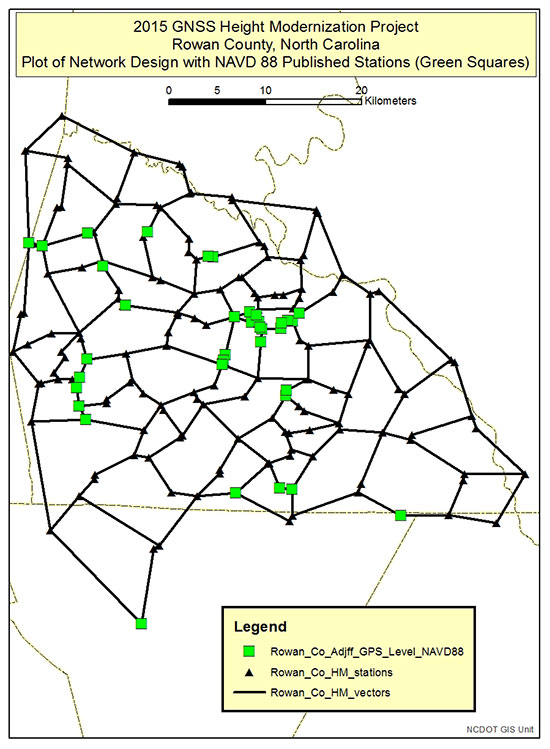
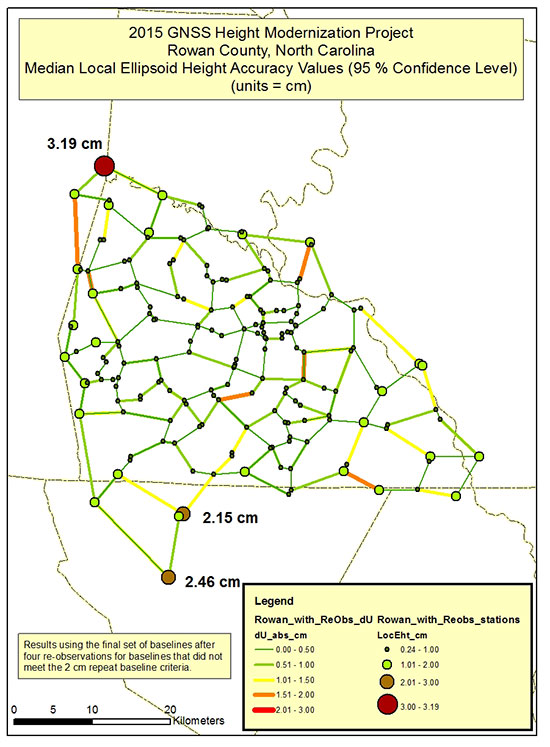
    It was also noted in a previous column (Part 5, February 2016) that 10 of the 2015 GNSS Rowan County Height Modernization project’s stations have published NAVD 88 GNSS-derived orthometric heights. These station are denoted as Height Modernization stations and are important because they are on the edge of the network where there’s a void of published NAVD 88 leveling-derived orthometric heights. In this newsletter, for these 10 stations we will look at the differences between their published NAVD 88 heights and their adjusted GNSS-derived orthometric heights from the Rowan County project.

    First, we need to briefly look at one of the leveling-derived stations — Station PLAZA — that was identified as a potential outlier in Part 7. In that column, I provided the following information about station PLAZA:

    The geodetic data and information for station PLAZA is listed below:

    • As described in Part 6 (April 2016), station PLAZA and station FIFTH have a large relative difference between the adjusted GNSS-derived orthometric height and the published NAVD 88 orthometric height value (-3.2 cm);
    • Four other stations in the vicinity have small relative differences between the adjusted GNSS-derived orthometric heights and the published NAVD 88 orthometric heights values, 37 DRD (0.6 cm), Midtown (-0.1 cm), Midway (1.0 cm), and J 181 (1.1 cm) — indicating a problem with station PLAZA;
    • Station FIFTH and PLAZA are only 400 meters apart, and their adjusted heights were established in two different adjustments: station FIFTH was leveled in 2013 (adjustment date of March 2015) and station PLAZA was leveled to in 1989 (adjustment date of September 1997) — indicating a potential inconsistency between adjustments;
    • PLAZA’s datasheet states that “the station was recovered as described in 2012 except the area between the curb and sidewalk has been filled with concrete. Mark is now part of the sidewalk but does not appear to have been disturbed.”

    Based on the available information to date, I would not recommend constraining the published height of station PLAZA in the final adjustment. Once again, this station’s published height should not be superseded by the GNSS project until new leveling has been performed between station FIFTH and PLAZA.

    As I mentioned, Station PLAZA’s published height should not be superseded by the GNSS project until new leveling has been performed between station FIFTH and PLAZA. Well, ask and you will receive. Gary Thompson, the director of the North Carolina Geodetic Survey, had one of his field crews, which was in the area, relevel the section between station FIFTH and PLAZA. The newly leveled results changed the leveling-derived height of PLAZA relative to FIFTH by 3.5 cm. The new leveling-derived orthometric height of PLAZA now agrees with the GNSS-derived orthometric height to within a centimeter.

    This means that the published height of PLAZA should not be constrained in the final adjustment and should be superseded by the GNSS-derived orthometric height. If the leveling data is submitted to NGS for inclusion into the NAVD 88, then the NAVD 88 height resulting from the new leveling data should be constrained in the final adjustment.

    Now, let’s look at the 2015 GNSS Rowan County Height Modernization project’s stations that have published NAVD 88 GNSS-derived orthometric heights. The user can identify stations that have been established following NGS Height Modernization procedures by looking at NGS datasheets. The datasheets for Height Modernization stations have the following statement at the top of the datasheet: “This is a Height Modernization Survey Station.” In addition to that statement, the NAVD 88 orthometric height is published to the centimeter level with the attribute code of “GPS OBS.” (See the example titled “Excerpt from the NGS Datasheet for Station GOODMAN.)

    Excerpt from the NGS Datasheet for Station GOODMAN

    1 National Geodetic Survey, Retrieval Date = JULY 2, 2016
    DL9977 ***********************************************************************
    DL9977 HT_MOD – This is a Height Modernization Survey Station.
    DL9977 DESIGNATION – GOODMAN
    DL9977 PID – DL9977
    DL9977 STATE/COUNTY- NC/STANLY
    DL9977 COUNTRY – US
    DL9977 USGS QUAD – GOLD HILL (1983)
    DL9977
    DL9977 *CURRENT SURVEY CONTROL
    DL9977 ______________________________________________________________________
    DL9977* NAD 83(2011) POSITION- 35 30 06.47415(N) 080 15 37.24680(W) ADJUSTED
    DL9977* NAD 83(2011) ELLIP HT- 171.358 (meters) (06/27/12) ADJUSTED
    DL9977* NAD 83(2011) EPOCH – 2010.00
    DL9977* NAVD 88 ORTHO HEIGHT – 201.76 (meters) 661.9 (feet) GPS OBS
    DL9977 ______________________________________________________________________
    DL9977 NAVD 88 orthometric height was determined with geoid model GEOID09
    DL9977 GEOID HEIGHT – -30.377 (meters) GEOID09
    DL9977 GEOID HEIGHT – -30.402 (meters) GEOID12B
    DL9977 NAD 83(2011) X – 879,427.184 (meters) COMP
    DL9977 NAD 83(2011) Y – -5,123,507.841 (meters) COMP
    DL9977 NAD 83(2011) Z – 3,683,429.929 (meters) COMP
    DL9977 LAPLACE CORR – 1.70 (seconds) DEFLEC12B
    DL9977
    DL9977 Network accuracy estimates per FGDC Geospatial Positioning Accuracy
    DL9977 Standards:
    DL9977 FGDC (95% conf, cm) Standard deviation (cm) CorrNE
    DL9977 Horiz Ellip SD_N SD_E SD_h (unitless)
    DL9977 ——————————————————————-
    DL9977 NETWORK 0.41 0.80 0.18 0.15 0.41 -0.01103221
    DL9977 ——————————————————————-
    DL9977 Click here for local accuracies and other accuracy information.
    DL9977

    The procedures for analyzing the published NAVD 88 GNSS-derived orthometric heights are the same as those used to analyze the NAVD 88 leveling-derived orthometric heights. These procedures and routines have been documented in my previous columns. There is, however, one major difference between incorporating new leveling data into NAVD 88 and incorporating new GNSS data into NAVD 88. That is, when a station gets superseded in a leveling network adjustment due to previous adjustment distribution corrections, to maintain consistency the older leveling data in the area are readjusted to be consistent with the newly observed leveling data and latest published adjusted heights.

    An adjustment distribution correction from the NAVD 88 general adjustment was discussed in the Part 7 (See Figure 6, “An Example of an Estimate of the NAVD 88 Distribution Correction Between two Stations Established with Old Leveling Data and Large Loops.”). So, what’s the difference?

    Both NAVD88 leveling-derived orthometric heights and GNSS-derived orthometric heights are based on adjustments constraining NAVD 88 published orthometric heights. However, GNSS-derived orthometric heights are also computed using the latest NGS hybrid geoid model. If a station’s GNSS-derived orthometric height gets superseded, the previous GNSS data are not readjusted to be consistent with the latest observations and published heights. Once again, if the station physically moved then superseding the height is the appropriate action and there is no requirement to readjust the older GNSS data.

    However, if the station did not physically move then the new published height may be inconsistent with its neighboring stations. I’m not saying that this is right or wrong, I’m only mentioning it so the user considers this information in their analysis.

    The procedures outlined in NGS’ NGS 59 document, which was discussed in Part 5, were developed to minimize the effect due to different geoid models and superseded heights. (See excerpt titled “Four Basic Control Requirements for Estimating GNSS-Derived Orthometric Heights.”) The requirements include surrounding the project with valid NAVD 88 benchmarks and, if necessary, enlarging the project area to occupy enough leveling-derived benchmarks. The intent of these requirements are to help control any small relative differences between previously published hybrid geoid models. It should be noted that some of the latest hybrid geoid models are significantly different the older hybrid geoid models.

    Therefore, when comparing a project’s adjusted heights with published NAVD 88 GNSS-derived orthometric heights, the user needs to consider which hybrid geoid model was used to establish the published GNSS-derived orthometric height. The NGS datasheet provides the hybrid geoid model and geoid height value used to establish the height. This was highlighted on the datasheet for station GOODMAN (see the example titled “Excerpt From the NGS Datasheet for Station GOODMAN). The statement NAVD 88 orthometric height was determined with geoid model GEOID09 means that station GOODMAN’s GNSS-derived orthometric height was established in a GNSS project using the hybrid geoid model GEOID09. The question is, what’s the difference between GEOID09 and the latest hybrid model?

    The datasheet provides the hybrid geoid model value used to establish the height (in this example, GEOID09 = -30.377 m) as well as the latest hybrid geoid model value (in this example, GEOID12B = -30.402 m). Based on station GOODMAN’s published datasheet, the difference is only 2.5 cm. This difference may be much larger in the mountains of North Carolina.

    Four Basic Control Requirements
    for Estimating GNSS-Derived Orthometric Heights:

    Requirement 1: GNSS-occupy stations with valid NAVD 88 orthometric heights; stations should be evenly distributed throughout project.

    Requirement 2: For project areas less than 20 km on a side, surround project with valid NAVD 88 benchmarks, i.e., minimum number of stations is four; one in each corner of project. [NOTE: The user may have to enlarge the project area to occupy enough benchmarks, even if the project area extends beyond the original area of interest.]

    Requirement 3: For project areas greater than 20 km on a side, keep distances between valid GNSS-occupied NAVD 88 benchmarks to less than 20 km.

    Requirement 4: For projects located in mountainous regions, occupy valid benchmarks at the base and summit of mountains, even if the distance is less than 20 km.

    Station BLACK BEAR, located in the mountains near Asheville, North Carolina, is an example of a significant difference between GEOID09 and GEOID12B; the difference is -14.9 cm. (See the example titled “Excerpt from the NGS Datasheet for Station BLACK BEAR.) This may not be a problem if all stations in the area are effected by the same difference but that’s not the case in this area.

    Station BUCK is a nearby station (about 11 km away from BLACK BEAR) and according to the NGS database “mark_source option”, stations BLACK BEAR and BUCK were involved in the same GNSS project so their GNSS-derived orthometric heights most likely were established in the same adjustment project. [NOTE: The use of the “mark_source” option of the NGS datasheet was described in Part 7.] The GEOID09 and GEOID12B difference at station BUCK is 1.0 cm. The relative difference in hybrid geoid models between stations BLACK BEAR and BUCK is almost 16 cm.

    Excerpt from the NGS Datasheet for Station BLACK BEAR

    PROGRAM = datasheet95, VERSION = 8.9
    1 National Geodetic Survey, Retrieval Date = JULY 26, 2016
    DM2549 ***********************************************************************
    DM2549 HT_MOD – This is a Height Modernization Survey Station.
    DM2549 DESIGNATION – BLACK BEAR
    DM2549 PID – DM2549
    DM2549 STATE/COUNTY- NC/YANCEY
    DM2549 COUNTRY – US
    DM2549 USGS QUAD – MT MITCHELL (1946)
    DM2549
    DM2549 *CURRENT SURVEY CONTROL
    DM2549 ______________________________________________________________________
    DM2549* NAD 83(2011) POSITION- 35 46 00.04321(N) 082 15 54.04248(W) ADJUSTED
    DM2549* NAD 83(2011) ELLIP HT- 1974.465 (meters) (06/27/12) ADJUSTED
    DM2549* NAD 83(2011) EPOCH – 2010.00
    DM2549* NAVD 88 ORTHO HEIGHT – 2004.48 (meters) 6576.4 (feet) GPS OBS
    DM2549 ______________________________________________________________________
    DM2549 NAVD 88 orthometric height was determined with geoid model GEOID09
    DM2549 GEOID HEIGHT – -29.990 (meters) GEOID09
    DM2549 GEOID HEIGHT – -29.841 (meters) GEOID12B
    DM2549 NAD 83(2011) X – 697,556.510 (meters) COMP
    DM2549 NAD 83(2011) Y – -5,135,618.055 (meters) COMP
    DM2549 NAD 83(2011) Z – 3,708,370.482 (meters) COMP
    DM2549 LAPLACE CORR – -6.14 (seconds) DEFLEC12B
    DM2549
    DM2549 Network accuracy estimates per FGDC Geospatial Positioning Accuracy
    DM2549 Standards:
    DM2549 FGDC (95% conf, cm) Standard deviation (cm) CorrNE
    DM2549 Horiz Ellip SD_N SD_E SD_h (unitless)
    DM2549 ——————————————————————-
    DM2549 NETWORK 0.47 0.86 0.21 0.17 0.44 -0.05699591
    DM2549 ——————————————————————-
    DM2549 Click here for local accuracies and other accuracy information.
    DM2549

    chart

    Figure 1 is a contour plot of the differences between GEOID12A and GEOID09 in the area surrounding stations BLACK BEAR and BUCK. [NOTE: The ESRI raster plots are based on GEOID12A not GEOID12B. GEOID12A is identical to GEOID12B everywhere, except in Puerto Rico and Virgin Island region. Therefore, in North Carolina, GEOID12A is equivalent to GEOID12B.] Looking at the plot it is obvious that there is a significant difference between the two hybrid geoid models in this region of North Carolina. What does this mean to someone performing a new GNSS-derived orthometric height adjustment in the area? If they occupied station BLACK BEAR and compared their adjusted GNSS-derived orthometric height using GEOID12B to the NAVD 88 published GNSS-derived orthometric height that was established using GEOID09, they most likely will get a large residual due to the difference between the two hybrid geoid models. As previously mentioned in this newsletter, NGS’ NGS 59 guidelines were developed to minimize the effects of different hybrid geoid models, but in these extreme cases the procedures may not have been able to minimize the total effect. It is important for the user to understand the differences between the various published hybrid models and experimental geoid models being developed by NGS. This topic was discussed in detail in the October 2015 newsletter.

    Figure-1
    Figure 1. A contour plot of the differences between GEOID12A and GEOID09 in the area surrounding stations BLACK BEAR and BUCK.

    Now, let’s look at the published NAVD 88 GNSS-derived orthometric heights occupied in the Rowan County Height Modernization project. Table 1 is a list of the stations occupied in the Rowan County project that have published NAVD 88 GNSS-derived orthometric heights. The table provides the hybrid geoid model value used to establish the published NAVD 88 height as well as the latest hybrid geoid model value, GEOID12B. Figure 2 is a contour plot of the differences between the GEOID12A and GEOID09 in the Rowan County Height Modernization project area. Looking at the plot, the user can see that most of the differences are all less than 3 cm between GEOID12A and GEOID09 in the Rowan County Project area.

    Figure-2
    Figure 2. A contour Plot of the differences between GEOID12A and GEOID09 in the Rowan County Height Modernization project area.

    Table1

    As we can see from Table 1, all of the differences between the two hybrid geoid models are less than or equal to 2.5 cm. (See highlighted rows and column in Table 1.)

    Figure 2 plots the adjusted GNSS-derived orthometric height (using GEOID12B) from a minimally constrained adjustment minus the published NAVD 88 GNSS-derived orthometric heights. Most of the differences are less than 3 cm which for some stations could be a result of the difference hybrid geoid models to establish the published GNSS-derived orthometric heights.

    Looking at figure 2, almost all of the differences between the GNSS-derived orthometric heights (using GEOID12B) from the minimum-constraint least squares compared with the published NAVD 88 GNSS-derived orthometric heights are less than 3 cm. No station appears to be an obvious outlier. The fact that all differences except for one are negative is interesting and is worth investigating at a later date. More analysis will need to be performed to understand if this is significant or not. Table 2 provides the adjusted GNSS-derived heights from a minimally constrained adjustment minus the published heights (both ellipsoid and orthometric).

    The last item to look at is a comparison of the adjusted heights from a constrained adjustment where all valid published leveling-derived heights were constrained. Figure 3 and Table 2 provide the constrained adjustment results (where all of leveling-derived published heights except for the 3 suspect heights were constrained) compared with the published NAVD 88 GNSS-derived orthometric heights. All of the differences are less than +/- 2 cm except for station NATHAN which is -2.1 cm. All of the relative differences of closely-spaced stations are less than 2 cm and most are less than 1 cm. This means constraining these stations should not adversely influence the unconstrained stations. Note that after constraining the published NAVD 88 leveling-derived heights, the negative bias is gone but the differences do not appear to be random. That is, the northern stations are all negative and the southern stations are positive (See figure 3).

    Table2

    Figure 3. A plot of the constrained adjustment results (where all of leveling-derived published heights except for the 3 suspect heights were constrained) compared with the published NAVD 88 GNSS-derived orthometric heights.
    Figure 3. A plot of the constrained adjustment results (where all of leveling-derived published heights except for the 3 suspect heights were constrained) compared with the published NAVD 88 GNSS-derived orthometric heights.

    These newsletters have focused on procedures and routines for establishing GNSS-derived orthometric heights. There are many ways to analyze and investigate GNSS data and adjustment results. I have provided some basic concepts that I believe are important for users to understand. The selection of constraints is a very important part of establishing accurate and consistent NAVD 88 GNSS-derived orthometric heights. It is just as important to document all decisions and results so others know how the published heights were established. NGS has a prescribed set of data and information that are required when submitted data for inclusion into the NSRS. This information is available from the NGS website (see section titled “MATERIALS NEEDED TO SUBMIT FOR THE PROJECT” in the document “adjustment_guidelines.pdf.”). We will address submitting the results in future columns.

    In my next column, I will focus on the NGS GPS on BMS (GPSBM) dataset. This is the dataset used to create the hybrid geoid models; I mentioned this in Part 3. As mentioned in Part 3, the hybrid geoid model is designed to fit the published NAVD 88 leveling-derived orthometric heights. This file can be used to identify potential issues in the NAVD 88 network. GNSS users should be familiar with this dataset and how it can be useful to their analysis. My next column will address this topic.

  • Establishing orthometric heights using GNSS — Part 7

    Establishing orthometric heights using GNSS — Part 7

    Basic procedures and tools for determining valid NAVD 88 heights for constraints

    To date, the six parts of “Establishing Orthometric Heights Using GNSS” have provided the reader with basic concepts, routines and procedures for understanding, analyzing, evaluating and estimating GNSS-derived ellipsoid and orthometric heights.

    In Part 5 of this series, we discussed National Geodetic Survey’s NGS 59 guidelines and methods for evaluating the results of the GNSS-derived orthometric height project. It provided methods for evaluating the results of the project and identifying stations with valid North American Vertical Datum of 1988 (NAVD 88) published heights.

    In Part 6, we continued to analyze the changes in adjusted heights due to different NAVD 88 height constraints and compared the results to the published NAVD 88 orthometric heights. We demonstrated that every constraint has an influence on the final set of adjusted heights so determining valid published NAVD 88 heights is important. With that, when incorporating new geodetic data into the National Spatial Reference System (NSRS), it is important to maintain consistency between neighboring stations. If the station has moved since the last time its height was established, then not constraining the published value and superseding the height is the appropriate action to take. As it was mentioned and emphasized in Part 6, if the difference is not due to movement and is due to some other reason such as the results of a previous adjustment distribution correction then superseding the height may not be the appropriate action to take.

    In this part of the series, we will look at the network design of the NAVD 88 project and estimate the potential NAVD 88 distribution correction between two benchmarks involved with the original NAVD 88 adjustment.

    First, we need to address the network design in the area that was used in the General Adjustment of the North American Vertical Datum of 1988 (NAVD 88). The NAVD 88 was a major leveling network adjustment project performed by the National Geodetic Survey (NGS) that was started in the early 1970s and completed in the early 1990s. NGS provides a summary of vertical datums. The excerpt (below) from the website describes the major attributes of the NAVD 88.

    Excerpt from the North American Vertical Datum of 1988 (NAVD 88)

    North American Vertical Datum of 1988 (NAVD 88) consists of a leveling network on the North American Continent, ranging from Alaska, through Canada, across the United States, affixed to a single origin point on the continent:

    • Tide Station & Location = Pointe-au-Pere,Rimouski, Quebec, Canada
    • PID = TY5255
    • GSD* Designation = 54L071
    • Bench Mark = 1250 G
    • Ht above LMSL(Meters) = 6.271

    * Geodetic Survey of Canada = GSD

    In 1993, NAVD 88 was affirmed as the official vertical datum in the National Spatial Reference System (NSRS) for the Conterminous United States and Alaska. Although many papers on NAVD 88 exist, no single document serves as the official defining document for that datum.

    View a special report of the NAVD 88 providing information about the NAVD 88, or view an abstract from the special report below.

    Abstract from the NAVD 88 Special Report
    Special Report
    Results of the General Adjustment of the
    North American Vertical Datum of 1988
    David B. Zilkoski, John H. Richards, and Gary M. Young
    American Congress on Surveying and Mapping
    Surveying and Land Information Systems, Vol. 52, No. 3, 1992, pp.133-149

    ABSTRACT. For the new general adjustment of the North American Vertical Datum of 1988 (NAVD 88), a minimum-constraint adjustment of Canadian-Mexican-U.S. leveling observations was performed holding fixed the height of the primary tidal benchmark, referenced to the new International Great Lakes Datum of 1985 (IGLD 85) local mean sea level height value, at Father Point/Rimouski, Quebec, Canada. IGLD 85 and NAVD 88 are now one and the same. Father Point/Rimouski is an IGLD water-level station located at the mouth of the St. Lawrence River, and is the reference station used for IGLD 85. This constraint satisfies the requirements of shifting the datum vertically to minimize the impact of NAVD 88 on U.S. Geological Survey mapping products, and provides the datum point desired by the IGLD Coordinating Committee for IGLD 85. The only difference between IGLD 85 and NAVD 88 is that IGLD 85 benchmark values are given in dynamic height units, and NAVD 88 values are given in Helmert orthometric height units. The geopotential numbers of benchmarks are the same in both systems. Preliminary analyses indicate differences for the conterminous United States between orthometric heights referred to NAVD 88 and to the National Geodetic Vertical Datum of 1929 (NGVD 29) range from -40 cm to +150 cm. In Alaska, the differences range from +94 cm to +240 cm. However, in most “stable” areas, relative height changes between adjacent benchmarks appear to be less than 1 cm. In many areas, a single bias factor, describing the difference between NGVD 29 and NAVD 88, can be estimated and used for most mapping applications. The overall differences between dynamic heights referred to IGLD 85 and to International Great Lakes Datum of 1955 will range from 1 cm to 40 cm. The use of Global Positioning System (GPS) data and a high-resolution geoid model to estimate accurate GPS-derived orthometric heights will be directly associated with the implementation of NAVD 88 and IGLD 85. It is important that users initiate a project to convert their products to NAVD 88 and IGLD 85. The conversion process is not a difficult task, but will require time and resources.

    More than one million kilometers of leveling data were analyzed during the NAVD 88 project. The design of the leveling network involved in the NAVD 88 project is shown in Figure 1.

    Figure 1. Leveling Network Design Used in the General Adjustment of the North American Vertical Datum of 1988 (Figure 3 from the report).
    Figure 1. Leveling Network Design Used in the General Adjustment of the North American Vertical Datum of 1988 (Figure 3 from the NAVD88 report).

    Not all of the leveling data depicted in Figure 1 were used in the general adjustment. Some of the older leveling data were not consistent with the newer data so these older data were not included in the adjustment. When proper procedures are followed, leveling data is very precise and accurate over short distances but the leveling network design usually does not provide a lot of redundancy. That’s why it is important to design a leveling network with many connecting loops. The loops provide the redundancy required to ensure that the leveling data does not contain any remaining significant systematic errors and/or blunders. At a minimum, the connected loops help to control and/or localize the remaining errors. Some of the older leveling data that were not included in the general adjustment were incorporated into the NAVD 88 after the general adjustment and were loaded into the NGS database. These stations are denoted as POSTed monuments on the NGS datasheet, shown in the highlighted section below in the excerpt labeled “NAVD 88 General Adjustment: What Does This Really Mean?”

    Excerpt from the NAVD 88 Special Report

    NAVD 88 General Adjustment: What Does This Really Mean?

    The general adjustment of NAVD 88 was completed in June 1991. All heights from the general adjustment were loaded into the NGS geodetic database in September 1991. This means that benchmarks included in the NAVD 88 Helmert blocking phase (approximately 80% of the total) have final NAVD 88 heights available for distribution to the public.

    The remaining 20% of the benchmarks in “stable” areas were removed from the adjustment (denoted as “POSTed” benchmarks), because older data were inconsistent with newer data. NAVD 88 heights for these posted benchmarks will be determined from these older data during 1992-93. This task involves analyzing the data associated with the posted benchmarks to determine the best estimate of their NAVD 88 heights.

    “POSTed” benchmarks in large crustal movement areas (e.g., southern Alaska, southern California, Phoenix, Houston, and southern Louisiana) will be published as special reports. This is a long-term task that started in January. It is important to note that some benchmarks in crustal-movement areas (i.e., benchmarks that were included in the NAVD 88 Helmert blocking phase) are available now. The heights of these benchmarks were usually based on the latest available data, but still may be influenced by crustal movement effects. In some areas, these benchmarks were not based on the latest available data, because this would have forced large distribution corrections into good, but older, adjacent leveling data.

    In addition, there are approximately 500,000 USGS third-order benchmarks for which NGS does not yet have any data.

    The NGS datasheet provides the date the station’s NAVD 88 orthometric height was adjusted so a user can determine if the station was part of the general adjustment of NAVD 88 or if the station was readjusted or incorporated in the NAVD 88 after the general adjustment. Station V 49 (PID = FA0151) is an example of a station that was involved in the general adjustment and published in 1991. The highlighted statement “The orthometric height was determined by differential leveling and adjusted by the NATIONAL GEODETIC SURVEY in June 1991” in the text portion of the datasheet indicates that this station’s adjusted height was established in the general adjustment of NAVD 88, as shown in the highlighted section in excerpt from “NGS datasheet for station V 49″ below.

    NGS-1991

    Station Phaniel is an example of a station that was incorporated into NAVD 88 after the general adjustment. Phaniel’s datasheet has the following statement, highlighted below: “The orthometric height was determined by differential leveling and adjusted by the NATIONAL GEODETIC SURVEY in January 2005.”

    NGS-Phaniel

    So why is this important?

    It is important to realize that just because the leveling data is newer than the rest of the leveling network around it, it doesn’t necessarily mean its absolute height value is more accurate or more reliable than the stations it was established from. The newer leveling data most likely is associated with an older leveling survey used in the general adjustment of NAVD 88. This older leveling data may have been affected by crustal movement and could be inconsistent with its neighbors 5-15 kilometers away. If proper procedures were adhered to, such as the FGCS geodetic leveling procedures, then the new leveling should have been connected to the NAVD 88 through a two- or three-mark leveling validation check leveling procedure, shown in the excerpt from “FGCS Specifications and Procedures to Incorporate Electronic Digital/Bar-Code Leveling Systems” below.

    Page 1 from FGCS Specifications and Procedures Document

    FGCS Specifications and Procedures to Incorporate Electronic Digital/Bar-Code Leveling Systems*

    3.5 Geodetic Leveling

    Geodetic leveling is a measurement system comprised of elevation differences observed between nearby rods. Geodetic leveling is used to extend vertical control.

    Network Geometry


    Order
    Class
    First
    I
    First
    II
    Second
    I
    Second
    II
    Third
    Bench mark spacing not more than (km) 3 3 3 3 3
    Average bench mark spacing not more than (km) 1.6 1.6 1.6 3.0 3.0
    Line length between networkcontrol points not more than (km) 300a 100a 50a 50a 25b
    Minimum bench mark ties 6 6 4 4 4

    aElectronic Digital/Bar-Code Leveling Systems, 25 km
    bElectronic Digital/Bar-Code Leveling Systems, 10 km


    As specified in above table, new surveys are required to tie to existing network bench marks at the beginning and end of the leveling line. These network bench marks must have an order (and class) equivalent to or better than the intended order (and class) of the new survey.

    First-order surveys are required to perform valid check connections to a minimum of six bench marks, three at each end. All other surveys require a minimum of four valid check connections, two at each end.

    A valid “check connection” means that the observed elevation difference agrees with the published adjusted elevation difference within the tolerance limit of the new survey. Checking the elevation difference between two bench marks located on the same structure, or so close together that both may have been affected by the same localized disturbance, is not considered a proper check.

    In addition, the survey is required to connect to any network control points within 3 km of its path. However, if the survey is run parallel to existing control, then the following table specifies the maximum spacing of extra connections between the survey and the existing control.

    When using Electronic Digital/Bar-Code Leveling Systems for area projects, there must be at least 4 contiguous loops and the loop size must not exceed 25 km. (Note: This specification may be amended at a future date after sufficient data have been evaluated and it is proven that there are no significant uncorrected systematic errors remaining in Electronic Digital/Bar-Code Leveling Systems.)


    * NGS’ analyses of the data will be the final determination if the data meet the desired FGCS order and class standards.

    The validation check leveling procedure ensures that the new leveling is consistent with the local stations it’s connected to. However, if the local area around these monuments all moved together than the validation check leveling procedure may meet the allowable tolerances but the new heights could still be inconsistent with neighbors 5 to 15 kilometers away. Similarly, if the validation check leveling stations were involved in a large distribution correction in the NAVD 88, than, once again, the validation check leveling may meet the allowable tolerances but the new heights could still be inconsistent with neighbors 5-15 kilometers away. This is not to say that the older leveling or published heights of the stations are bad or incorrect; all it is ensuring is that the new leveling is consistent with the adjusted heights in the local area surrounding the new leveling project.

    Another statement on the NGS datasheet that should be explained is “No vertical observational check was made to this station,” shown in the highlighted statement from the excerpt of Phaniel’s datasheet, below. This means that the station was determined on a leveling line that is known as a spur level line. This means that the leveling data were not involved in a loop. This is important because the lack of redundancy means that there is no check on the adjusted heights of these stations other than the checks performed during the double running procedure. The double-running procedure is very important but the procedure may not detect, reduce, and/or eliminate all systematic errors and/or blunders. The GNSS-derived values may be the first check on the published height of these stations. When performing GNSS-derived orthometric height adjustments the users should investigate all stations that seem to be inconsistent with its neighboring stations especially stations that their published datasheet contains the statement “No vertical observational check was made to this station” such as station Phaniel.

    When analyzing GNSS projects, it is helpful to understand how the NAVD 88 height of the station was established and what year it was leveled. Figures 2 and 3 depict the original leveling network design used in the general adjustment of the NAVD 88 in the Rowan County, North Carolina, project area, and Figures 4 and 5 depict the current NAVD 88 leveling network design. Looking at Figures 2 and 3, it appears that the leveling network used in the general adjustment of NAVD 88 in Rowan County was fairly sparse and mostly consisted of leveling data observed in the 1930s and 1960s.

    Figures 4 and 5 show the amount of leveling data incorporated into the NAVD 88 after the general adjustment. The red stars on Figure 4 are the stations that have been incorporated into the NAVD 88 since the general adjustment. Figure 5 depicts the dates of the leveling lines that were used to establish the new NAVD 88 heights. All of these new stations will have adjustment dates after June 1991. Having a different adjustment date than the general adjustment date of 1991 is not an issue, it’s just a way of informing the user that the station was incorporated into NAVD 88 and constrained to previously published NAVD 88 heights. The user should know the adjustment date of the control they are using in their GNSS project because the accumulated NAVD 88 distribution correction could be large especially between stations with different adjustment dates in areas with old leveling data and large loops.

    Figure 2. Leveling Network Design Used in the General Adjustment of the North American Vertical Datum of 1988 (Green stations are stations established in the NAVD 88 and published in June 1991).
    Figure 2. Leveling Network Design Used in the General Adjustment of the North American Vertical Datum of 1988 (Green stations are stations established in the NAVD 88 and published in June 1991).
    Figure 3. Dates of the Original Leveling Network Design in the Vinicity of the Rowan County, North Carolina, Height Modernization Project.
    Figure 3. Dates of the Original Leveling Network Design in the Vinicity of the Rowan County, North Carolina, Height Modernization Project.
    Figure 4. Leveling Network Design Incorporated into the General Adjustment of the North American Vertical Datum of 1988 (Red stars are stations that were incorporated in NAVD 88 after June 1991).
    Figure 4. Leveling Network Design Incorporated into the General Adjustment of the North American Vertical Datum of 1988 (Red stars are stations that were incorporated in NAVD 88 after June 1991).
    Figure 5. Dates of the Current Leveling Network Design in the Vinicity of the Rowan County, North Carolina, Height Modernization Project.
    Figure 5. Dates of the Current Leveling Network Design in the Vinicity of the Rowan County, North Carolina, Height Modernization Project.

    As depicted in Figure 3, the original leveling data used in NAVD 88 in southern Rowan County, NC, was an east-west leveling line performed in 1935. It was connected at both ends of the line to leveling data performed in the 1970s. The validation check leveling procedure was performed and met the required tolerances. The loops that the 1935 leveling line was involved in are fairly large, around 175 kilometers. The leveling data involved in the loops consists of first- and second-order data. The allowable loop closure would have been based on the amount of leveling of each order and class involved in the loop. The allowable loop closure for the older second-order, class 0 leveling line would have been based on 8.4 mm times the square root of the length of loop in kilometers. In this case, a loop 175 kilometers would have an allowable closure of 111 mm. The allowable loop closure for first-order, class 2 leveling is 4 mm times the square root of the length of loop in kilometers. In this case, a loop 175 kilometers would have an allowable closure of 53 mm. Since this is based on a mixture of order and classes of leveling data, the allowable loop closure would have been somewhere in between.

    For this column, I decided to estimate the NAVD 88 distribution correction between two benchmarks involved with the older leveling lines in southern Rowan County. The observed Helmert orthometric height difference between station V 49 and T 78 is -6.850 meters, and the Published NAVD 88 Helmert orthometric height difference from the NAVD 88 general adjustment is -6.891 meters. This means that the distribution correction between stations V 49 (FA0151) and T 78 (FA0295) is 0.041 meters (4.1 cm).

    Figure 6 depicts the location of the stations and the leveling route used to estimate the NAVD 88 distribution correction. Since the leveling distance between these two stations is approximately 60 kilometers, the distribution correction is less than 1 mm per kilometer (0.7 mm/km). This is a very reasonable distribution correction because it only modifies each leveling section observation by about 1 mm per kilometer allowing users to check their local leveling projects. This, however, may be an issue with some GNSS surveys that extend over a large area were the leveling network consists of old leveling data with large loops. The GNSS-derived orthometric heights may be more accurate than the leveling-derived orthometric heights. As shown in Figure 6, stations V 49 and T 78 are involved in large loops and were established using older leveling data in the original NAVD 88 resulting in a distribution correction of 4.1 cm.

    Figure 6. Example of an estimate of the NAVD 88 Distribution Correction between two stations established with old leveling data and large loops.
    Figure 6. Example of an estimate of the NAVD 88 distribution correction between two stations established with old leveling data and large loops.

    Station V 49 was used in this analysis because the station was occupied during the Rowan County GNSS project. The shortest leveling distance between station V 49 and T 78 was used to estimate the NAVD 88 distribution correction. Station T 78 was selected because it is the junction station for the leveling line that was used to incorporate station Buffalo 2 into the NAVD 88 in January 2005. Since T 78 was the junction station and its height changed 4.1 cm, 4.1 cm was applied to station Buffalo 2’s height to obtain its modified height. This is not the most rigorous way to estimate the effects of the distribution correction but it provides a quick method to determine an estimate of the NAVD 88 distribution correction between two stations.

    Figure 7 is a plot that depicts the differences at station Buffalo 2 using the modified NAVD 88 height. The difference between the GNSS-derived orthometric adjusted height and the new NAVD 88 height decreased from 3.5 cm to -0.6 cm. This difference agrees to within 1 cm with the results of station V 49 (see Figure 7). It should be noted that one of the recommendations in the National Geodetic Survey’s NGS 59 document is to occupy valid NAVD 88 stations every 20 km. Following this procedure can help reduce the number of stations that need to be investigated due to NAVD 88 distribution corrections from the general adjustment.

    Figure 7. Example of the possible effect of the NAVD 88 distribution correction on an adjusted GNSS-derived orthometric height.
    Figure 7. Example of the possible effect of the NAVD 88 distribution correction on an adjusted GNSS-derived orthometric height.

    Three stations were identified as potential outliers in Part 6 — Phaniel, Plaza, and Row 3. As mentioned in Part 5 (February 2016), station Phaniel has a large difference between the adjusted GNSS-derived orthometric height and the published NAVD 88 orthometric height value (-4.2 cm); indicating an issue with the ellipsoid height and/or orthometric height (see Figure 8). However, Phaniel’s published NAD 83 (2011) ellipsoid height and the Rowan County minimum-constraint adjusted height of Phaniel only differed by 0.8 cm. The comparison of adjusted ellipsoid heights and published ellipsoid heights for the Rowan County GNSS project were provided in Part 4 (December 2015). This is an indication that the GNSS-derived ellipsoid height of station Phaniel is not an issue and that the station hasn’t moved since the original GNSS survey and the 2015 Rowan County GNSS survey. It should be noted that the leveling project used to incorporate station Phaniel into NAVD 88 was performed in 2001 which was in between the two GNSS surveys.

    Two other stations (Row 17 and Row 16) were leveled on the same leveling line as Phaniel and their adjusted GNSS-derived orthometric height and the published NAVD 88 orthometric height values agree to 1.6 cm and 1.7 cm respectively; this is an indication that the leveling data and GNSS data are consistent from the main level line to these two stations. Phaniel’s datasheet has the statement “No vertical observational check was made to this station,” indicating the station’s height was established on a spur leveling line and therefore has a lack of redundancy and reliability. Based on the information up to now, I would not recommend constraining station Phaniel in the final adjustment. Saying that, before it is superseded by the GNSS project, the benchmarks between Phaniel and Row 17 should be re-leveled to determine if a leveling error was made between these stations in 2001.

    Figure 8. NAVD 88 leveling network design involving station Phaniel.
    Figure 8. NAVD 88 leveling network design involving station Phaniel.

    The geodetic data and information for station Plaza is listed below:

    • As described in Part 6 (April 2016), station Plaza and station Fifth have a large relative difference between the adjusted GNSS-derived orthometric height and the published NAVD 88 orthometric height value (-3.2 cm); (See Figure 9.);
    • Four other stations in the vicinity have small relative differences between the adjusted GNSS-derived orthometric heights and the published NAVD 88 orthometric heights values, 37 DRD (0.6 cm), Midtown (-0.1 cm), Midway (1.0 cm), and J 181 (1.1 cm) – indicating a problem with station Plaza;
    • Station Fifth and Plaza are only 400 meters apart, and their adjusted heights were established in two different adjustments: station Fifth was leveled in 2013 (adjustment date of March 2015) and station Plaza was leveled to in 1989 (adjustment date of September 1997) – indicating a potential inconsistency between adjustments;
    • Plaza’s datasheet states that “the station was recovered as described in 2012 except the area between the curb and sidewalk has been filled with concrete. Mark is now part of the sidewalk but does not appear to have been disturbed.”

    Based on the available information to date, I would not recommend constraining the published height of station Plaza in the final adjustment. Once again, this station’s published height should not be superseded by the GNSS project until new leveling has been performed between station Fifth and Plaza.

    Figure 9. NAVD 88 leveling network design involving station Plaza.
    Figure 9. NAVD 88 leveling network design involving station Plaza.

    Figure 10 depicts the leveling network involving station Row 3. As described in Part 6 (April 2016), station Row 3 has a large difference between the adjusted GNSS-derived orthometric height and the published NAVD 88 orthometric height value, -3.8 cm (see Figure 10.). Except for station AE4540 (382 JAS), all of the differences between the adjusted GNSS-derived orthometric height and the published NAVD 88 orthometric height value at the other nearby stations are all less than 1.7 cm; as a matter of fact, most of the differences are less than +/- 0.5 cm.

    I could not find any leveling data in NGS’ database involving station AE4540 (382 JAS). (See Figure 11.) As far as I could determine, this station was not leveled to by NGS and leveling data were not submitted to NGS for inclusion in the NAVD 88. You can retrieve all project identifiers for those projects with observations to or from a station using the stations’s PID. The station’s PID is provided on the NGS datasheet. The input and output for PID AE4540 is shown below. There are no identifiers listed under the sections labeled “Vert_Obs,” “Lev_Obs,” or “Level_Obs” indicating that this station does not have any leveling observations in NGS database.

    Input for PID AE4540 from http://www.ngs.noaa.gov/cgi-bin/SURV_ID/mark_sources.prl.

    Output for PID AE4540 from http://www.ngs.noaa.gov/cgi-bin/SURV_ID/mark_sources.prl.

    Figure 10. NAVD 88 leveling network design involving station row 3.
    Figure 10. NAVD 88 leveling network design involving station row 3.


    Figure 11. NAVD 88 leveling network design involving station 382 JAS.
    Figure 11. NAVD 88 leveling network design involving station 382 JAS.

    Based on the available information so far, I would not recommend constraining the published heights of station Row 3 or 382 JAS (AE4540) since they will distort the adjusted heights of surrounding stations (see Part 6, Figure 10). If no supporting leveling data can be found for station 382 JAS then I would recommend superseding that station’s height with the GNSS-derived value. As for station Row 3, I wouldn’t recommend superseding the published height with the GNSS-derived height until a leveling check has been made between Row 3 (DG5673) and a nearby station such as station 384 JAS (FA0564).

    I realize that by not constraining a station and not superseding the published height that an inconsistency between the leveled NAVD 88 height and the NAVD 88 GNSS-derived orthometric height may occur. This information needs to be noted in the project report with an explanation of why you made certain decisions in your final adjustment. The analysis and plots provided in these columns are the types of information that should be provided in the final report.

    All of the analysis and recommendations have been based on using the latest scientific geoid model xGeoid15b. However, in practice, GNSS-derived orthometric heights are incorporated into the NAVD 88 using the latest hybrid geoid model GEOID12B. I recommend first performing the analysis using the scientific geoid model because the hybrid geoid model has been warped to be consistent with the published NAVD 88 values. This was described in detail in my Part 3 (October 2015). The analysis using the scientific geoid should be included in the report especially if the user finds significant differences between the results using the two different geoid models. Saying that, maintaining consistency between closely spaced stations is extremely important when incorporating data into an existing network. Based on the information so far and the results using GEOID12B, I would not recommend constraining the published NAVD 88 heights of stations Phaniel and Plaza in the final NAVD 88 GNSS-derived orthometric height adjustment. These two stations resulted in significant changes in relative adjusted heights when they were constrained. (See Part 6, April 2016.)

    It was noted in Part 5 (February 2016) that ten of the 2015 GNSS Rowan County Height Modernization project’s stations have published NAVD 88 GNSS-derived orthometric heights. These station are important because they are on the edge of the network where there’s a void of published NAVD 88 leveling-derived orthometric heights. In the next column, we will look at these stations and the differences between their minimum-constraint least squares adjusted GNSS-derived orthometric heights and their published NAVD 88 GNSS-derived orthometric height.

    These columns have provided a lot of routines and procedures for analyzing and estimating GNSS-derived orthometric heights. My intent was to provide the analyst with tools for documenting the results of the analysis and providing a basis for making recommendations associated with the GNSS project. A future column will address what information should be included in a project report.

  • GNSS and the real-time network: The surveyor’s best friend

    A lot of talk is being made about UAVs these days and how this technology is going to revolutionize many industries, with surveying being one of the biggest users.

    I won’t deny the impact this new tool is going to have on our profession (as written in my last column). But I don’t think it will compare to the use of GNSS technology and how it modernized measuring methods for the surveyor.

    Gammon-reelI’m often asked by young surveyors what I think is the biggest improvement experienced by the surveying profession. Ironically, I asked that same question to my teachers when I was a new survey technician. My mentors will talk of the electronic distance meter, the theodolite or the total station. (Some old timers even told me the best improvement was the gammon reel for their plumb bob or the reel for a steel “chain”!)

    While these were good advancements, for me the biggest improvement was the introduction of GPS into surveying, followed by the advancement to real-time network capability. Now, coupled with modern communication methods of radio or cellular transmission to permanent base stations, the GNSS rover has become one of the most valuable tools in the surveyor’s toolbox.

    To understand the importance of GNSS technology and its use by the surveying community, first take a look at the history of the profession and method/devices used for measuring. Land surveyors have been measuring boundaries of parcels for centuries, dating back to Egyptian times and workers known as “rope stretchers.” Their use of rope with knots tied at specific intervals was the measuring stick of the time period.

    As centuries passed and measuring units were developed, surveyors used these dimensional tools for measuring and describing land parcels. By the time the early settlers of America began traveling westward, surveyors were using a 66-foot-long Gunter’s chain made with 100 links, each almost eight inches long. Over time the links would stretch until the surveyor’s measurements were not accurate for land surveys.

    By the early 1900s, tapes made from low-expansion steel became more widely used and much more accurate for surveying. The early 1960s brought new technology with measurement systems using laser light beams with the ability to travel several miles with sufficient accuracy.

    A total station.
    A total station.

    The electronic distance meter (EDM) allowed the surveyor to cover longer distances in much less time than the conventional method of the steel tape, leading to more productive field time. This technology was further refined to be installed inside of traditional theodolites to create the modern total station instrument — still used today for basic measuring of angles and distance. Almost all surveying projects can be completed using a total station, but the invention of a remotely available measuring device would be a welcome tool in the surveyor’s toolbox.

    Enter the 1980s and the adaptation of the military’s satellite measuring system for civilian use. While early users and developers needed a Ph.D. in mathematics to configure its use, GPS measurement revolutionized long-distance measurement for the surveying profession. Static GPS measurement took many hours of data collection and even longer processing time, but with terrific results and with tremendous accuracy.

    Further refinements with hardware and software configurations brought more affordable and user-friendly systems that gave surveying community another resource for accurate measurement. While the use of real-time kinematicc (RTK) expanded greatly in the late 1990s and 2000s, the big difference in the past 10+ years has been the introduction of real-time networks and permanent base stations. This advancement helps by eliminating the need for a base receiver and radio with an amplified repeater, and thus another employee guarding the idle base station equipment.

    Depending on the surveyor’s location, real-time networks are readily available by paid subscription or through publicly funded transportation department. These systems are very reliable and don’t require a six-figure investment in equipment.

    All survey data-collection methods, no matter the measuring procedure used and positional accuracy required for the project, needs to follow a strict quality-control procedure for verification of its content and position. The old adage “Measure twice, cut once” works well here, too, so let’s discuss what is involved with good measuring procedures.

    Measuring procedures

    Prior to any field measurements are taken, it is good practice to verify satellite availability during your planned measuring period. The U.S. GPS currently consists of 31 active and healthy units orbiting the planet and crisscrossing the sky 24/7. The geometry created by radio signals received from these satellites constantly vary in size and strength. By using mission-planning software, the user can accurately predict the best times of the day to collect positional locations with the highest accuracy and repeatability. Low numbers of satellites or strength of constellational geometry can lead to inaccurate locations and incorrect measurements between points.

    The introduction and allowance of other satellite systems into our data collection system (GLONASS, Galileo, BeiDou, IRNSS) will enhance the availability and strength of constellation geometry throughout the data-collection process.

    Another potential problem for GNSS data collection is solar storms, sunspots and other radio interruptions. Most manufacturers will notify the user of major atmospheric radiation events, but check the NOAA Space Weather Prediction Center (SWPC) website for updates on potential events. The key here is to plan your field collection prior to execution, in order to reduce errors in measurement or even interruptions to completing the work in a timely manner.

    Survey results are only as good as the measurements, and following strict guidelines is very important. When using survey-grade GNSS equipment in a real-time function, many items need to be monitored while collecting data to ensure good quality positions. Here are items as listed by the National Geodetic Survey (NGS) in the “User Guidelines for Single Base Real-Time GNSS Positioning” manual on the NGS website:

    • Accuracy versus precision
      • Accuracy is how your collected data compares to the defined standard.
      • Precision is how often the solution is repeated.
      • Achieving both provides necessary confidence in field measurements.
    • Redundancy
      • The ability to collect similar measurements at different times, satellite constellation geometry and atmospheric conditions.
    • Multipath
      • Minimizing opportunities for measurement to be affected by reflected or misdirected signals.
    • Position dilution of precision (PDOP)
      • Higher readings usually achieved when measuring during periods of weak satellite constellation geometry.
    • Root-mean-square (RMS)
      • Statistical measurement of precision notifying the user of the positional quality of the measurement based upon quality of satellite signals.
    • Site localizations/calibrations
      • Basing the strength of survey network on the location of the base station and the accuracy of the monument it is located upon.
      • Typically used when real-time network connectivity is not achievable.
    • Latency
      • The delay of the received satellite signal data and correction information at the base, sent to the rover for computing correction values.
    • Signal-to-noise ratio (S/N)
      • Ratio in which burdening noise is measured versus the actual signal from the satellite.
    • Float and fixed solutions
      • Floating solutions occur when precision for survey-grade measurements is not met due to noise, lack of satellites, weak satellite geometry and latency.
    • Elevation mask
      • This setting is a filter to eliminate signals from satellites below the user-defined angle, thus eliminating opportunities for weak constellation geometry and noise interference.
    • Geoid model
      • Correction model used to improve vertical measurement with GNSS data collection by incorporating previously determined elevations across a wide area.

    While all of these components are necessary for quality data collection, one of the most critical steps is horizontal and vertical verification on published or previously established control points or monuments. By checking into a known point before every data-collection session, you can eliminate errors in rod/antenna height and/or coordinate system setup. Checking a known point can also help determine if the correction signal is providing accurate information, either from the RTK base station or as part of a subscription service via cellphone or radio. It will also help discover poor PDOP or RMS due to weak satellite configurations. Also, if the rover unit takes longer than usual to initialize, a potential data-collection issue may occur to bad conditions.

    The biggest complaint I get (and see) is field crews not checking the accuracy of the GNSS unit during the course of a survey. Hopping out of the vehicle, firing up the data collector, and taking a measurement multiple times without redundant measurements or verifying existing control points/monuments is a recipe for disaster.

    Here are my keys to successful data collection with GNSS technology:

    1. Keep the equipment is good working order: batteries charged, receivers and collectors in travel cases when not in use, poles kept in safe places and regularly checked for plumb.
    2. Utilize a checklist for project startup.
      a. Horizontal coordinate system to be used.
      b. Vertical datum to be used.
      c. List of multiple published or previously established control points for datum verification.
    3. Once receiver has a fixed solution, verify horizontal and vertical position on known point.
    4. Minimize loss of fixed solution times, recheck when establishing new fixed positions.
    5. If possible, recheck main control points at various time throughout the day to establish redundancy.
    6. Reverify at the end of the session and at the end of the day.

    While GNSS has greatly decreased field time for covering large areas quickly, it must still be used correctly in order to provide accurate positional locations. The accuracy of these positions are what the measurements of the surveyor relies upon, and they must meet a high standard of confidence. Our profession prides itself on being called upon as the “expert measurer,” so our methods of measurement must be up to those standards.

    While it took a little time to get the cost-effectiveness, reliability and user friendliness to a level of affordability for the surveyor, GNSS has become one of the best tools in our toolboxes. GNSS has revolutionized modern surveying, and I, for one, appreciate its ability to help me offer my services as an expert measurer.

  • Establishing orthometric heights using GNSS — Part 6

    Basic procedures and tools for ensuring GNSS-derived orthometric heights meet the project’s desired accuracy

    To date, this series of columns has addressed the following topics: basic concepts of GNSS-derived heights, National Geodetic Survey’s (NGS) guidelines for establishing GNSS-derived ellipsoid heights (NGS 58), differences between hybrid and scientific geoid models, procedures and tools for detecting GNSS-derived ellipsoid height data outliers, and basic procedures for estimating GNSS-derived orthometric heights (NGS 59). These columns are meant to provide the reader with basic concepts, routines, and procedures for analyzing, evaluating, and estimating GNSS-derived heights.

    As mentioned in the last column “Determining valid North American Vertical Datum of 1988 (NAVD 88) published heights is the most important process when using GNSS data and geoid models to estimate GNSS-derived orthometric heights.” In Part 5 (February 2016) of this series, we discussed NGS 59 guidelines and methods for evaluating the results of the GNSS project. It provided methods for evaluating the results of the project and identifying stations with valid NAVD 88 published heights. In this column, we will continue to analyze the changes in adjusted heights due to different height constraints and compare the results to the published NAVD 88 orthometric heights.

    First, we need to discuss what should be considered an outlier when identifying valid NAVD 88 published heights to be used as constraints. According to NGS guidelines for performing GNSS adjustments, the rule of thumb for outliers are shifts greater than 2 cm horizontally and 4 cm vertically (see highlighted section in the box below). The guidelines also stated that “It is important to realize that this threshold is merely a ‘rule of thumb.’ For individual projects, unconstraining a station may be necessary if shifts are less than the ‘rule of thumb’ threshold, and in some cases it can remain constrained even if shifts slightly exceed the threshold.”

    It is important to understand this concept because constraining the height of a station influences the heights of stations nearby that constraint. Also, not constraining a published height of a station will result in establishing a new height for that station which means it could be inconsistent with other published stations nearby that station. If the station had moved since the last time it was leveled to then not constraining the height is the appropriate action to take. However, if the shift is due to some other reason (such as a previous adjustment distribution correction, or ellipsoid and/or geoid issue), then constraining the height may be the appropriate action to take. Selecting constraints is not an exact science; as a matter of fact, at times, it appears to be more like an art or like solving an enigmatic puzzle.

    Excerpt of NGS Adjustment Document, adjustment_guidelines.pdf, under section 5 titled Constrained Horizonal Adjustment.


    As a general rule, if the adjusted values of the constrained coordinates of a station shift by more than 2 cm horizontally and/or 4 cm in height, its horizontal coordinates and/or ellipsoid height, respectively, should be unconstrained. Doing so means that the published values for the unconstrained passive control station will be updated by the adjusted values determined in the submitted survey (CORS coordinates will not be updated). This 2 cm horizontal and 4 cm vertical threshold is consistent with that used by NGS for updating published CORS coordinates, although for CORS this is done by NGS independent of individual campaign-style GPS projects. It is important to realize that this threshold is merely a “rule of thumb.” For individual projects, unconstraining a station may be necessary if shifts are less than the “rule of thumb” threshold, and in some cases it can remain constrained even if shifts slightly exceed the threshold. The decision to constrain or not constrain also depends on other factors, such as the statistics of the adjustment, residuals, shifts at other stations, and station accuracies. It requires judgment and should not simply be an automatic response to constrained station shifts.

    The NGS guideline mentioned above is for horizontal coordinates and ellipsoid heights. The NGS guidelines under section 6 implies that the user should apply the same guidelines for shifts between GNSS-derived orthometric heights and published NAVD 88 orthometric heights (see highlighted section in the box below). The guidelines also recommend that the user analyze the shifts of stations near each other to determine if stations nearby each other are shifting consistently or if one of the station’s value appears to be an outlier (see underlined section in box below).

    Excerpt of NGS Adjustment Document, adjustment_guidelines.pdf, under section 6 titled Vertical Adjustment (Free and Constrained).

    SECTION 6, VERTICAL ADJUSTMENTS (FREE AND CONSTRAINED)

    6-1. Create the vertical free Afile (Afilevf). Fix one position and one published orthometric height. They can be from the same station or different stations (e.g., good horizontal position in one CC record for a CORS, good OH in separate CC record for a bench mark). Leaving column 77 of the CC record blank indicates the record contains an orthometric height value. Standard deviations of the constrained coordinates and heights should NOT be entered (i.e., columns 15-32 of the CC record should be blank).
    Include the VS record from the horizontal constrained Afile.

    70-76 Height, units of millimeters (integer)

    77-77 Height Code blank — orthometric height

    6-2. Run Adjust with minimum constraints. Input: Bfileght, Afilevf, Gfile,
    Output: adjvf.out, Bfilevf

    Assuming the adjustment ran to completion, the statistics of this run will be identical to those of the horizontal free adjustment. Check adjvf.out for big shifts between published and free-adjusted heights.

    It would be helpful to compute the shifts between the results of the vertical free adjusted and the published heights. Additionally, plot these shifts on a project sketch to determine if several heights near each other are shifting consistently or a height appears to be an outlier and therefore should not be used as control. For inconsistent shifts use resources available such as recovery notes, photographs, and rubbings of the mark. Possible causes could include movement, an unintended mark was observed such as the underground mark instead of the surface mark, or occupying a reference mark rather than the parent station. Look for inconsistent shifts as opposed to areas where the shifts, even high shifts, are consistent. Likewise, look at the geoid heights to ensure they are consistent. If no cause for the shift can be found, the orthometric height may need to be readjusted.

    6-3. Create the vertical constrained Afile (Afilevc). Constrain all previously adjusted orthometric heights as indicated above and one NAD 83 adjusted position. The same comments about CC records apply. All GPS-derived Ht Mod heights should be constrained along with bench marks. For ht mod stations the datasheet will read:

    HT_MOD – This is a Height Modernization Survey Station.
    Include the VS record with its appropriate values.

    6- 4. Run Adjust with vertical constraints. Input: Bfilevf, Afilevc, Gfile,
    Output: adjvc.out, Bfilevc

    Run PrePlt2 to list and sort the residuals. Investigate observations with large shifts or residuals to see if any heights should be readjusted. Apply the same rule as in the horizontal constrained adjustment: no rejections due to constraints. Free any heights in question and rerun as a test. Note the differences between the published and readjusted heights obtained from the vertical constrained adjustment. Consider the requirements of the project before deciding whether to readjust additional points. Save the output Bfile from the final constrained vertical adjustment.

    In Part 5, I highlighted a potential issue at station Phaniel. I’ve included the diagrams and tables from Part 5 that depicts the differences between GNSS-derived orthometric heights from a minimum-constraint adjusyment (using GEOID12B and xGeoid15b) and the published NAVD 88 height values (see figures 1-4, and tables 1-2). Looking at figures 1 and 2, there are several large differences between closely spaced constraints when using the hybrid geoid model – Phaniel, Buffalos 2, V 49, and Row 9. As stated in Part 2, the user should compute the results using both the hybrid and the scientific geoid models. Figures 3 and 4 depict the differences using the scientific geoid model xGeoid15b. Notice that the large differences between Phaniel and Buffalo 2 decreased from 4.9 cm using GEOID12B to 0.7 cm using xGeoid15b. However, the larger relative difference between Phaniel and V 49 (3.8 cm) and ROW 9 (5.2 cm) still exists. Also, the difference between Buffalo 2 and V 49 is large (3.1 cm), and Buffalo 2 to Row 9 is large (4.5 cm), but the difference between V 49 and Row 9 is less than 2 cm. The neighbor stations of Row 9 all seem to agree within a couple of centimeters indicating that Buffalo 2 may be a station that needs further investigation.

    Figure 1. [Figure 3 from Part 5] - Diagram depicting differences between GNSS-derived orthometric heights from a Minimum-Constraint Adjustment (using GEOID12B) and published NAVD 88 height values (units=cm).
    Figure 1. [Figure 3 from Part 5] Diagram depicting differences between GNSS-derived orthometric heights from a Minimum-Constraint Adjustment (using GEOID12B) and published NAVD 88 height values (units=cm).
    Figure 2. [Figure 4 from Part 5] - Diagram depicting differences between GNSS-derived orthometric heights from a Minimum-Constraint Adjustment (using GEOID12B) and published NAVD 88 height values (units=cm).
    Figure 2. [Figure 4 from Part 5] Diagram depicting differences between GNSS-derived orthometric heights from a Minimum-Constraint Adjustment (using GEOID12B) and published NAVD 88 height values (units=cm).

    Figure 3. [Figure 5 from Part 5] - Diagram depicting differences between GNSS-derived orthometric heights from a Minimum-Constraint Adjustment (using xGeoid15b) and published NAVD 88 height values (units=cm).
    Figure 3. [Figure 5 from Part 5] Diagram depicting differences between GNSS-derived orthometric heights from a Minimum-Constraint Adjustment (using xGeoid15b) and published NAVD 88 height values (units=cm).
    Figure 4. [Figure 6 from Part 5] - Diagram depicting differences between GNSS-derived orthometric heights from a Minimum-Constraint Adjustment (using xGeoid15b) and published NAVD 88 height values (units=cm).
    Figure 4. [Figure 6 from Part 5] Diagram depicting differences between GNSS-derived orthometric heights from a Minimum-Constraint Adjustment (using xGeoid15b) and published NAVD 88 height values (units=cm).
     

    Next we need to look at the adjusted ellipsoid heights from a minimum-constraint solution compared to the published ellipsoid heights. This procedure was decribed and demonstrated in Part 4. Figure 5 is plot of adjusted ellipsoid height minus published NAD 83 (2011) ellipsoid heights for stations near Phaniel. Figure 5 indicates that the adjusted ellipsoid heights at Buffalo 2, Phaniel, and V 49 all agree within 2 cm. As a matter of fact, Buffalo 2 and Phaniel agree to better than 1 cm from the NAD 83 (2011) published heights. This is an indication that the orthometric height of station Phaniel may be an outlier and should not be constrained. The leveling network in the area requires investigation to validate this conclusion. This will be addressed in a future column. Looking at Tables 1 and 2, two other stations, stations Plaza and Row 3, have large differences between the GNSS-derived orthometric heights from a minimum-constraint adjustment and the published NAVD 88 heights, and they should be investigated.

    Figure 5. Plot of adjusted ellipsoid height minus published NAD 83 (2011) Ellipsoid Heights for Stations near Phaniel (the number is the difference for that particular station; units = cm).
    Figure 5. Plot of adjusted ellipsoid height minus published NAD 83 (2011) Ellipsoid Heights for Stations near Phaniel (the number is the difference for that particular station; units = cm).
    Table 1. Differences between GNSS-derived orthometric heights from a minimum-constraint adjustment (using GEOID12B) and published NAVD 88 heights (GEOID12B results sorted and highlighted).
    Table 1. Differences between GNSS-derived orthometric heights from a minimum-constraint adjustment (using GEOID12B) and published NAVD 88 heights (GEOID12B results sorted and highlighted).
    Table 2. Differences between GNSS-derived orthometric heights from a minimum-constraint adjustment (using xGeoid15b) and published NAVD 88 heights (xGeoid15b results sorted and highlighted).
    Table 2. Differences between GNSS-derived orthometric heights from a minimum-constraint adjustment (using xGeoid15b) and published NAVD 88 heights (xGeoid15b results sorted and highlighted).

    Figure 6 is a diagram depicting differences between GNSS-derived orthometric heights from a minimum-constraint adjustment using GEOID12B and published NAVD 88 heights surrounding station Plaza. The user should notice that the relative difference in height changes between Plaza and 37 DRD is -3.8 cm (-2.5 – 1.3) and between Plaza and Fifth it is -3.2 cm (-2.5 – 0.7). This is an indication that there is a potential issue with station Plaza. Next, we need to compute the results using xGeoid15b. Figure 7 is a plot of the differences surrounding station Plaza using xGeoid15b. Figure 7 shows that station Plaza outliers relative to station 37 DRD and Fifth are exactly the same, i.e., -3.8 cm (-3.2 – 0.6) and -3.2 cm (-3.2 – 0.0) respectively. Something interesting to note is that station J 181 difference decreased from 2.1 cm using GEOID12B (see figure 6) to 1.1 cm using xGeoid15b (see figure 7). Once again, this is a reason why users should use both the hybrid geoid model and the scientific geoid model when analyzing GNSS-derived orthometric heights.

    Figure 6. (More Detail at Station Plaza)Diagram depicting differences between GNSS-derived orthometric heights from a Minimum-Constraint Adjustment (using GEOID12B) and published NAVD 88 height values (units=cm).
    Figure 6. (More Detail at Station Plaza) Diagram depicting differences between GNSS-derived orthometric heights from a Minimum-Constraint Adjustment (using GEOID12B) and published NAVD 88 height values (units=cm).


    Figure 7. ((More Detail at Station Plaza) Diagram depicting differences between GNSS-derived orthometric heights from a Minimum-Constraint Adjustment (using xGeoid15b) and published NAVD 88 height values (units=cm).
    Figure 7. (More Detail at Station Plaza) Diagram depicting differences between GNSS-derived orthometric heights from a Minimum-Constraint Adjustment (using xGeoid15b) and published NAVD 88 height values (units=cm).

    The other station to investigate based on the large difference in table 2 is station Row 3. Figure 8 is a diagram depicting the differences near station Row 3 using GEOID12B. Notice that the difference at Row 3 is considerably less than the 4 cm; however, the relative difference between Row 3 (-2.7 cm) and station 384 JAS (0.2 cm) is -2.9 cm. This doesn’t seem too large but computing the results using xGeoid15b indicates something different. Figure 9 is a plot of the differences using the scientific geoid model xGeoid15b. Notice that the difference at station Row 3 increased to -3.8 cm and the relative difference between Row 3 and 384 JAS is -3.9 cm. Note, this again emphases the importance of using both the hybrid and scientific geoid models when analyzing GNSS-derived orthometric heights. This large relative difference is an indication that the height of station Row 3 may not have a valid NAVD 88 published height and should be further investigated before constraining the height in the final adjustment.

    Figure 8. (More Detail at Station Row 3) Diagram depicting differences between GNSS-derived orthometric heights from a Minimum-Constraint Adjustment (using GEOID12B) and published NAVD 88 height values (units=cm).
    Figure 8. (More Detail at Station Row 3) Diagram depicting differences between GNSS-derived orthometric heights from a Minimum-Constraint Adjustment (using GEOID12B) and published NAVD 88 height values (units=cm).
    Figure 9.  (More Detail at Station Row 3) Diagram depicting differences between GNSS-derived orthometric heights from a Minimum-Constraint Adjustment (using xGeoid15b) and published NAVD 88 height values (units=cm).
    Figure 9.  (More Detail at Station Row 3) Diagram depicting differences between GNSS-derived orthometric heights from a Minimum-Constraint Adjustment (using xGeoid15b) and published NAVD 88 height values (units=cm).

    After analyzing the differences between GNSS-derived orthometric heights from a minimum-constraint adjustment and published NAVD 88 heights to help identify potential outliers, the user can perform a constrained adjustment holding the published height values as constraints. The user should ensure that a constraint does not significantly affect the adjusted heights of neighboring stations. To understand the effects of the constraints on the heights of stations that are not constrained, the user can plot the changes in adjusted heights between the constrained adjustment and the minimum-constraint adjusted heights (with a bias removed). As mentioned in Part 5, any constraint can be used to obtain a minimum-constraint solution so removing a bias based on the differences between the published height values and the adjusted height values obtained from a solution constraining one published height is appropriate. Figure 10 is a plot that depicts the differences between the adjusted heights from an adjustment with all published NAVD 88 height values constrained and the adjusted heights values from the minimum-constraint adjustment. Figure 10 highlights the large relative changes of closely spaced stations such as between Phaniel (-2.8 cm) and Open (-0.6 cm). This means that the constraint at station Phaniel has changed the relative height difference between station Phaniel and station Open by 2.2 cm. This is a large change when you trying to obtain 2 cm heights. Another method to see the effect of the constraints is by plotting the changes in “dU” residuals between the constrained adjustment and the minimum-constraint adjustment. Figure 11 is a plot of the differences in vector “dU” residuals between the constrained adjustment (with all published heights constrained) and the minimum-constraint adjustment.

    Figure 10. Diagram depicting differences between GNSS-derived orthometric heights from a Constrained Adjustment (All Published Heights Constrained) minus Minimum-Constraint Adjustment (using GEOID12B) - units=cm.
    Figure 10. Diagram depicting differences between GNSS-derived orthometric heights from a Constrained Adjustment (All Published Heights Constrained) minus Minimum-Constraint Adjustment (using GEOID12B) – units=cm.

    Looking at figure 11, the user can quickly see that constraining station Phaniel has changed the three vectors associated with Phaniel by 1.9 cm, 2.1 cm, and 2.3 cm. This means that the observed vectors were changed by 2 cm to be consistent with the constraint at Phaniel. This could have an impact on a surveyor performing leveling between these two stations. The analyst should now perform an adjustment not constraining the stations identified as potential outliers. At this moment, in this study, stations Phaniel, Plaza, and Row 3 are considered questionable and their heights will not be constrained.

    Figure 11. Diagram depicting differences between dU Residuals of Vectors from a Constrained Adjustment (All Published Heights Constrained) minus Minimum-Constraint Adjustment (using GEOID12B) - units=cm.
    Figure 11. Diagram depicting differences between dU Residuals of Vectors from a Constrained Adjustment (All Published Heights Constrained) minus Minimum-Constraint Adjustment (using GEOID12B) – units=cm.


    Figure 12 is a diagram depicting the differences between the GNSS-derived orthometric heights from a constrained adjustment were the height values of stations Phaniel, Plaza, and Row 3 were not constrained. Figure 13 is a diagram depicting the differences between the dU residuals of baselines from the constrained adjustment with heights of stations Phaniel, Plaza, and Row 3 not constrained and the dU residuals from the minimum-constraint adjustment. Figures 14 and 15 provide more detail of the changes in residuals near station Phaniel. Figure 14 depicts the differences when all NAVD 88 heights are constrained and figure 15 depicts the differences when the suspected stations (Phaniel, Plaza, and Row 3) are not constrained. Comparing figures 14 and 15 clearly show that by constraining station Phaniel, the relative differences between station Phaniel and its neighbors are adversely effected by the constraint. For example, the difference in dU residuals between Phaniel and Brown Az Mk decreased from 2.3 cm to -0.2 cm resulting in a 2.5 cm relative height change.

    Figure 12. Diagram depicting differences between GNSS-derived orthometric heights from a Constrained Adjustment (Three Stations Unconstrained) minus Minimum-Constraint Adjustment (using GEOID12B) - units=cm.
    Figure 12. Diagram depicting differences between GNSS-derived orthometric heights from a Constrained Adjustment (Three Stations Unconstrained) minus Minimum-Constraint Adjustment (using GEOID12B) – units=cm.
    Figure 13. Diagram depicting differences between dU Residuals of Vectors from a Constrained Adjustment (Three Stations Unconstrained) minus Minimum-Constraint Adjustment (using GEOID12B) - units=cm.
    Figure 13. Diagram depicting differences between dU Residuals of Vectors from a Constrained Adjustment (Three Stations Unconstrained) minus Minimum-Constraint Adjustment (using GEOID12B) – units=cm.
    Figure 14. More Detail at Station Phaniel) Diagram depicting differences between dU Residuals of Vectors from a Constrained Adjustment (All Stations Constrained) minus Minimum-Constraint Adjustment (using GEOID12B) - units=cm.
    Figure 14. (More Detail at Station Phaniel) Diagram depicting differences between dU Residuals of Vectors from a Constrained Adjustment (All Stations Constrained) minus Minimum-Constraint Adjustment (using GEOID12B) – units=cm.
    Figure 15. More Detail at Station Phaniel) Diagram depicting differences between dU Residuals of Vectors from a Constrained Adjustment (Three Stations Unconstrained) minus Minimum-Constraint Adjustment (using GEOID12B) - units=cm.
    Figure 15. (More Detail at Station Phaniel) Diagram depicting differences between dU Residuals of Vectors from a Constrained Adjustment (Three Stations Unconstrained) minus Minimum-Constraint Adjustment (using GEOID12B) – units=cm.


    As previously mentioned, station Plaza is another station with a large difference between the adjusted height from the minimum-constraint adjustment and its published height (see tables 1 and 2). Constraining station Plaza results in very large dU residuals between station Plaza and station 37 DRD, i.e, 3.7 cm over a distance of 1.1 km (see figure 16). By not constraining the height of station Plaza the dU residuals on the vector between station Plaza and station 37 DRD changed from 3.7 cm to 0.4 cm (see figure 17). Also, the dU residuals on the vector between station College and station Hudson changed from -1.8 cm to -0.1 cm, and dU residuals on the vector between station Dorsett and station Hudson changed from -1.7 cm to 0.2 cm. The distance between Dorsett and Hudson is 1.2 km. The allowable section closure for second-order, class 2 leveling in 1.2 km is 0.88 cm. If a user wanted to check their leveling work using these two stations they may not check within the allowable because of the large distribution correction applied to the adjusted heights due to constraining the height of station Plaza.


    Figure 16. More Detail at Station Plaza) Diagram depicting differences between dU Residuals of Vectors from a Constrained Adjustment (All Stations Constrained) minus Minimum-Constraint Adjustment (using GEOID12B) - units=cm.
    Figure 16. (More Detail at Station Plaza) Diagram depicting differences between dU Residuals of Vectors from a Constrained Adjustment (All Stations Constrained) minus Minimum-Constraint Adjustment (using GEOID12B) – units=cm.
    Figure 17. More Detail at Station Plaza) Diagram depicting differences between dU Residuals of Vectors from a Constrained Adjustment (Three Stations Unconstrained) minus Minimum-Constraint Adjustment (using GEOID12B) - units=cm.
    Figure 17. (More Detail at Station Plaza) Diagram depicting differences between dU Residuals of Vectors from a Constrained Adjustment (Three Stations Unconstrained) minus Minimum-Constraint Adjustment (using GEOID12B) – units=cm.

    Next, the user should look at the differences in ellipsoid heights between minimum-constraint adjustment and published NAD 83 (2011) ellipsoid heights in the area of station Plaza (see figure 18). Station Plaza did not have a published NAD 83 (2011) ellipsoid height but the closest two stations (Dorsett and Salisbury CORS ARP) both agree within 0.6 cm of the published NAD 83 (2011) ellipsoid heights. This is a good sign tht the ellipsoid heights meet the desired accuracy but doesn’t help to explain the large difference at station Plaza.


    Figure 18. More Detail at Station Plaza) Diagram depicting differences between Adjusted GNSS-Derived Ellipsoid Heights (with average bias removed) minus Published NAD 83 (2011) Ellipsoid Heights (units=cm).
    Figure 18. (More Detail at Station Plaza) Diagram depicting differences between Adjusted GNSS-Derived Ellipsoid Heights (with average bias removed) minus Published NAD 83 (2011) Ellipsoid Heights (units=cm).

    The third station with a large relative difference highlighted in table 2 is station Row 3. Figures 19 and 20 provide more detail of the changes in residuals near station Row 3. Notice that the dU residual of the vector between station Railroad and Magna changed from 1.5 cm to 0.1 cm when the height of Row 3 is not constrained. The distance between the two stations is 4 km so the effect of constraining this station is not really significant. It should be noted that one of the reasons it’s being investigated is because of the large relative difference between Row 3 and station 384 JAS using xGeoid15b (-3.9 cm, see figure 9). Figure 21 is a plot of the differences in ellipsoid heights obtained from the minimum-constraint adjustment and their published NAD 83 (2011) ellipsoid heights in the vicinity of station Row 3. Station Row 3 does not have a published NAD 83 (2011) ellipsoid height but all of the stations surrounding the station are less than 2 cm. There does not appear to be any large outliers compared with the published ellipsoid heights in the area. Once again, this means that the next step in the process is to investigate the leveling network in the area.

    Figure 19. (More Detail at Station Row 3) Diagram depicting differences between dU Residuals of Vectors from a Constrained Adjustment (All Stations Constrained) minus Minimum-Constraint Adjustment (using GEOID12B) - units=cm.
    Figure 19. (More Detail at Station Row 3) Diagram depicting differences between dU Residuals of Vectors from a Constrained Adjustment (All Stations Constrained) minus Minimum-Constraint Adjustment (using GEOID12B) – units=cm.
    Figure 20. More Detail at Station Row 3) Diagram depicting differences between dU Residuals of Vectors from a Constrained Adjustment (Three Stations Unconstrained) minus Minimum-Constraint Adjustment (using GEOID12B) - units=cm.
    Figure 20. More Detail at Station Row 3) Diagram depicting differences between dU Residuals of Vectors from a Constrained Adjustment (Three Stations Unconstrained) minus Minimum-Constraint Adjustment (using GEOID12B) – units=cm.
    Figure 21. (More Detail at Station Row 3) Diagram depicting differences between Adjusted GNSS-Derived Ellipsoid Heights (with average bias removed) minus Published NAD 83 (2011) Ellipsoid Heights (units=cm).
    Figure 21. (More Detail at Station Row 3) Diagram depicting differences between Adjusted GNSS-Derived Ellipsoid Heights (with average bias removed) minus Published NAD 83 (2011) Ellipsoid Heights (units=cm).

    Up to this point we have analyzed changes in adjusted heights due to different constraints and compared the results to the published NAVD 88 GNSS-derived orthometric heights to identity stations that should be constrained in the final adjustment. As one can see, performing GNSS-derived orthometric height adjustments is more like an art than an exact science. There are a lot of variables and unknowns. Every constraint has an influence on the final set of adjusted heights. Determining this effect and the consequences of selecting an invalid constraint has been described in this column.

    When incorporating new geodetic data into the National Spatial Reference System, it is important to maintain consistency between neighboring stations. If the published height of a station is not constrained, it will be superseded by the newly adjusted height. If the station has moved since the last time its height was established then superseding the height is the appropriate action to take. If the difference is due to some other reason such as the results of a previous adjustment distribution correction then superseding the height may not be the appropriate action to take.

    In my next column, Part 7, we will look at the design of the NAVD 88 leveling network and published heights in the area to help determine the final set of stations to constrain.

  • Unlicensed UAV services threaten survey profession


    Unless one has lived under a rock for the past few years, it is hard to miss the influx of unmanned aerial vehicles (UAV), otherwise known as drones. Once considered expensive toys for hobbyists, these vehicles have become the hottest ticket in town for gathering aerial photography and video with professionals and amateurs alike.

    Miniaturization of cameras, batteries and GPS receivers has allowed these former toys to become important tools for many different users. Like so many other pieces of equipment that have become more affordable to the general public, it still requires trained and licensed experts to produce data and deliverables from the UAV and applicable software. The trouble with all this rapid growth in technology is finding truly qualified users who understand that UAVs are just another tool to compete a task and not a replacement for the trained and licensed professional.

    Surveyors are facing this challenge every day as technology races ahead. The market for UAVs in the surveying environment seems to have blossomed along with the worldwide boom. Services utilizing UAVs by the unlicensed and non-professional vendor is becoming the largest threat to the surveying profession. Firms advertising “eliminate expensive survey crews” are becoming more visible in print publications and on the Internet as cheaper alternatives to the licensed professional surveyor.

    To fully understand the hazard these individuals and firms are presenting to the public, we shall first look at the laws that govern the surveying profession. For example, from my home state is an excerpt of Illinois Professional Land Surveyor Act of 1989 (225 ILCS 330/) referring to measurements to be performed by the professional land surveyor (see excerpt at the end of this column.)

    This act defines the tasks that are to be undertaken by the licensed surveyor. Like most professions, the surveyor is required to obtain a bachelor’s degree with a specific number of surveying classes along with four years of responsible charge of surveying duties. Illinois State Statutes also declare that those who offer these services without the proper licensing or training can be charged with Class A misdemeanor for a first offense, and guilty of a Class 4 felony for a second or subsequent offenses.

    Part of being a professional surveyor is also utilizing the proper tools of the trade. For the past 20 years, GPS has become the single greatest asset to the surveyor. It has allowed many tasks to be completed in greatly reduced time with more accurate results. The surveyor now has several different GPS tools to choose from, depending on the task. In my last column, “Data is the crop — GNSS used by surveyors and farmers,” I wrote of the varying levels of GPS receivers used by land surveyors and mappers for different types of data collection. Here is a brief review:

    Mapping Grade GPS (>= 3 meters)
    This handheld unit is primarily used for mapping utilities and improvements that don’t require high accuracy.

    Differential GPS (<= 1 meter)
    These systems are used by hydrographic surveyors for use in mapping lake and river bottoms as well as surveyors working in open pit mines producing existing condition maps and volumetric surveys.

    Real time kinematic (RTK) (<= 2.5 centimeters)
    RTK systems range from base station/rover/radio combination to virtual reference systems (also known as “real time networks” or RTN) over cellular networks. These systems are prevalent with today’s surveyor as standard measuring equipment.

    While using any of these GPS types, surveyors have procedures for measuring and checking their results in a precise and particular manner. Most surveyors primarily use RTK or RTN-based systems for all of their work and require continuous data verification throughout the collection process. Control points and monuments are utilized for quality checks and verification in order to assure the work being performed meets the required accuracy standards.

    The integrity of the data is closely guarded by the surveyor as their duty to performing the job correctly and efficiently. These policies and procedures are also paramount to the work being performed remotely by a UAV under the direction of a surveyor, so the service being provided is professional.

    The consumer (and small business) side of the UAV industry, however, is much different. The costs vary from $100 and up, depending on rotors, batteries and camera capability. One of the main advances has been the implementation of GPS receivers but with much lower accurate positional information.

    Like the dashboard GPS screens in cars and now GPS on every smartphone, John Q. Public assumes that the geographic positions provided by the UAV receivers are very accurate and have little to no error. On the contrary, most GPS receivers in these units provide autonomous positions with horizontal accuracies in the 2-5 meter range (at best) and can follow a preset flight path created on a smartphone or tablet.

    Also, these UAVs and software have also opened the door to new opportunities for entrepreneurs everywhere. The high-definition cameras with capabilities including 4K video and 15-20 megapixel images allows the tech-savvy user to fly and collect aerial photography and video that rivals companies with a fleet of aircraft and expensive cameras. These images are used with software that stitches multiple shots together based upon GPS location and common elements in each image to create 3D models for terrain analyzation. No “on the ground” data verification or survey measurements are utilized to confirm the image’s integrity or scale.

    Many vendors are also offering verification of quantities in gravel pits and mining operations utilizing the volume calculation modules within the software. These images may be a pretty picture but for surveying purposes, they don’t pass the sufficient accuracy tests.

    In contrast, survey-specific UAVs and software will cost $25,000 and up, but are designed to provide the necessary accuracy required to perform a professional surveying task. Flight planning with state plane coordinate systems are most common, as these systems directly relate to the surveys being performed in conjunction with the aerial flights. Panel points are set for identification within the images to verify known distances and accuracy checks.

    Volume quantities can also calculate with greater accuracy based upon these methods and procedures. Surveyors are also using the technology to perform ongoing as-built conditions in order to provide construction sites progress reports of installation of improvements. All of these tasks are possible with the higher accuracy capability of the survey-grade UAV under the direction and guidance of the professional surveyor.

    The surveyor, with the professional knowledge of geographical and state plane coordinates, also understands the boundaries of “no fly zones” and the use of geofencing by the U.S. government and the UAV manufacturers. As these zones become more prevalent, knowing how to honor and adapt to them is already a staple in the surveyor’s tool bag.

    The State of Illinois is currently drafting rules for UAV operation that will coincide with the proposed rules due from the FAA in June 2016. While most concern from the public is in regard to privacy and public safety, I am concerned as a professional surveyor that the current trend of use of UAVs by unlicensed professionals for surveying and engineering services will harm the public as much as the other issues combined. Engineering designs that are based upon data collected by unlicensed professionals should not be accepted by governing bodies in an effort to protect the public. Licensed surveyors, utilizing the proper tools (including survey grade GPS and UAVs), provide the accurate data for these designs.

    Technology has made the UAV an exciting toy for most and a new tool for some industries, including surveying. Like any tool, proper use and instruction is necessary for the safety of the operator and the public. The UAV does not make its owner a surveyor, just as buying a pipewrench doesn’t make its user a plumber.

    For more information on UAV use and procedures, go to Know Before You Fly.


    Excerpt of Illinois Professional Land Surveyor Act of 1989

    (225 ILCS 330/5) (from Ch. 111, par. 3255)
    (Section scheduled to be repealed on January 1, 2020)

    Sec. 5. Practice of land surveying defined. Any person who practices in Illinois as a professional land surveyor who renders, offers to render, or holds himself or herself out as able to render, or perform any service, the adequate performance of which involves the special knowledge of the art and application of the principles of the accurate and precise measurement of length, angle, elevation or volume, mathematics, the related physical and applied sciences, and the relevant requirements of law, all of which are acquired by education, training, experience, and examination. Any one or combination of the following practices constitutes the practice of land surveying:

    (a) Establishing or reestablishing, locating, defining, and making or monumenting land boundaries or title or real property lines and the platting of lands and subdivisions;

    (b) Establishing the area or volume of any portion of the earth’s surface, subsurface, or airspace with respect to boundary lines, determining the configuration or contours of any portion of the earth’s surface, subsurface, or airspace or the location of fixed objects thereon, except as performed by photogrammetric methods or except when the level of accuracy required is less than the level of accuracy required by the National Society of Professional Surveyors Model Standards and Practice;

    (c) Preparing descriptions for the determination of title or real property rights to any portion or volume of the earth’s surface, subsurface, or airspace involving the lengths and direction of boundary lines, areas, parts of platted parcels or the contours of the earth’s surface, subsurface, or airspace;

    (d) Labeling, designating, naming, or otherwise identifying legal lines or land title lines of the United States Rectangular System or any subdivision thereof on any plat, map, exhibit, photograph, photographic composite, or mosaic or photogrammetric map of any portion of the earth’s surface for the purpose of recording the same in the Office of Recorder in any county

  • Establishing orthometric heights using GNSS — Part 5

    Basic procedures and tools for ensuring GNNS-derived orthometric heights meet the project’s desired accuracy

    So far, this series of columns has addressed the following topics: basic concepts of GNSS-derived heights (Part 1), National Geodetic Survey’s (NGS) guidelines for establishing GNSS-derived ellipsoid heights (NGS 58) (Part 2), differences between hybrid and scientific geoid models (Part 3), and procedures and tools for detecting GNSS-derived ellipsoid height data outliers (Part 4).

    These four columns were meant to provide the reader with basic concepts and procedures for estimating GNSS-derived ellipsoid heights and understanding hybrid and scientific geoid models. Now that the reader has a basic understanding of GNSS-derived ellipsoid heights and geoid models, this column will discuss procedures for estimating GNSS-derived orthometric heights.

    Determining valid North American Vertical Datum of 1988 (NAVD 88) published heights is the most important process when using GNSS data and geoid models to estimate GNSS-derived orthometric heights. As mentioned in Part 4, NGS has developed procedures for estimating GPS-derived orthometric heights and these guidelines are documented in NOAA Technical Memorandum NOS NGS 59. The NGS 59 guidelines are separated into three basic rules, four control requirements, and five procedures that need to be adhered to for computing accurate NAVD 88 GNSS-derived orthometric heights. This column will address the NGS 59 guidelines and methods for evaluating the results of the GNSS project.

    The three basic rules are fairly simple to understand and implement, provided that the reader has followed the previous columns in this series.

    Three Basic Rules for Estimating GNSS-Derived Orthometric Heights:

    Rule 1: Follow NGS 58 guidelines for establishing GNSS-derived ellipsoid heights when performing GNSS surveys (Parts 2 and 4 addressed this rule),

    Rule 2: Use NGS’ latest National hybrid geoid model (such as GEOID12B) and latest experimental geoid model (such as xGeoid15B) — when computing GNSS-derived orthometric heights (Part 3 addressed this rule), and

    Rule 3: Use the latest National Vertical Datum — for instance, NAVD 88 — height values to control the project’s adjusted heights (this column will address this rule).

    The four basic control requirements are also simple, but, in certain regions of the country, may be difficult to implement.

    Four Basic Control Requirements for Estimating GNSS-Derived Orthometric Heights:

    Requirement 1: GNSS-occupy stations with valid NAVD 88 orthometric heights; stations should be evenly distributed throughout project.

    Requirement 2: For project areas less than 20 km on a side, surround project with valid NAVD 88 benchmarks, i.e., minimum number of stations is four; one in each corner of project. [NOTE: The user may have to enlarge the project area to occupy enough benchmarks, even if the project area extends beyond the original area of interest.]

    Requirement 3: For project areas greater than 20 km on a side, keep distances between valid GNSS-occupied NAVD 88 benchmarks to less than 20 km.

    Requirement 4: For projects located in mountainous regions, occupy valid benchmarks at the base and summit of mountains, even if the distance is less than 20 km.

    Figure 1 depicts the NCGS Rowan County Height Modernization project discussed in Part 4. Looking at Figure 1, there are stations with published leveling-derived NAVD 88 orthometric heights distributed throughout the project (requirement number 1).

    What do I mean by published leveling-derived NAVD 88 orthometric heights? This is important to note because all NGS datasheets provide the NAVD 88 height with an attribute that describes what method was used to establish their height. The following is a list of attributes used on the NGS datasheet for NAVD 88 published heights:

    Extracted from NGS’ DSDATA.TXT
    http://www.ngs.noaa.gov/cgi-bin/showdoc.prl?Doc=dsdata.txt


    * dsdata.txt *


    There are various Vertical Control sources, as specified below:

    ADJUSTED = Direct Digital Output from Least Squares Adjustment
    of Precise Leveling.
    (Rounded to 3 decimal places.)

    ADJ UNCH = Manually Entered (and NOT verified) Output of
    Least Squares Adjustment of Precise Leveling.
    (Rounded to 3 decimal places.)

    POSTED = Pre-1991 Precise Leveling Adjusted to the NAVD 88 Network After Completion of the NAVD 88 General Adjustment of 1991.
    (Rounded to 3 decimal places.)

    READJUST = Precise Leveling Readjusted as Required by Crustal Motion or Other Cause.
    (Rounded to 2 decimal places.)

    N HEIGHT = Computed from Precise Leveling Connected at Only One Published Benchmark.
    (Rounded to 2 decimal places.)

    RESET = Reset Computation of Precise Leveling.
    (Rounded to 2 decimal places.)

    COMPUTED = Computed from Precise Leveling Using Non-rigorous Adjustment Technique.
    (Rounded to 2 decimal places.)

    GPSCONLV = Leveled Orthometric Height tied to GPS HT_MOD Orthometric Height.
    (Rounded to 2 decimal places.)

    LEVELING = Precise Leveling Performed by Horizontal Field Party.
    (Rounded to 2 decimal places.)

    H LEVEL = Level between control points not connected to benchmark.
    (Rounded to 1 decimal places.)

    GPS OBS = Computed from GPS Observations.
    (Rounded to 1 decimal places.)

    VERT ANG = Computed from Vertical Angle Observations.
    (Rounded to 1 decimal place; If No Check, to 0 decimal places.)

    SCALED = Scaled from a Topographic Map.
    (Rounded to 0 decimal places.)

    U HEIGHT = Unvalidated height from precise leveling connected at only one NSRS point.
    (Rounded to 2 decimal places.)

    VERTCON = The NAVD 88 height was computed by applying the VERTCON shift value to the NGVD 29 height.
    (Rounded to 0 decimal places.)

    During the design of the survey, the user should first select as many stations with the attribute of ADJUSTED or LEVELING. If there aren’t any stations in a certain area of the project with the attribute of ADJUSTED or LEVELING, then stations labeled as GPS OBS with values rounded to 2 decimal places should be occupied. The other types of NAVD 88 heights aren’t accurate enough to validate your GNSS results.

    Looking at Figure 1, there appears to be a few void areas in the north and east sections of the project. Although, it should be noted that the design meets the 20 km spacing rule (Rule number 3). Figure 2 depicts the NAVD 88 published heights for all leveling-derived stations and GPS-derived orthometric heights published to two decimal places (i.e., cm level). The published GPS-derived orthometric NAVD 88 heights filled in the void areas of the project. This is the practical reality of implementing the guidelines of NGS 59.

    In some areas of the United States it may be difficult to locate enough valid NAVD 88 heights in the project’s area. First, let’s define a valid NAVD 88 height. Valid NAVD 88 height values include, but are not limited to, the following: control points which have not moved since their heights were last determined, were not misidentified, and are consistent with NAVD 88. This appears to be fairly simple, but it may be difficult for some users to determine if a station has moved since the height was last determined. In addition, in some areas of the country the user may not find valid NAVD 88 benchmarks every 20 km due to crustal movement. The user then may have to perform some classical precise leveling observations to evaluate the existing NAVD 88 heights and determine the relative accuracy of the geoid model in the areal extent of the project.

    This doesn’t mean that the user must perform a leveling survey such that all GNSS stations are leveled to or even perform a large leveling network survey. The purpose of the leveling is to evaluate the geoid model and properly connect to the NAVD 88. Since each case is difference, i.e., NAVD 88 height problems and geoid accuracy will vary in each region of the country, as well as each individual project accuracy requirement will be different, it is impossible to describe exactly what the user will have to do. NGS will, however, assist users when they’re planning their surveys. You can contact a NGS advisor through their Regional Advisor Program.

    The five basic procedures for estimating GNSS-derived orthometric heights may appear to users to be the most complex and most difficult to understand. However, as users perform more GNSS surveys and discuss their results with others, they seem to quickly understand why these procedures are needed.

    Five Basic Procedures for Estimating GNSS-Derived Orthometric Heights:

    Procedure 1: Perform a 3-D minimum-constraint least squares adjustment of the GNSS survey project, i.e., constrain one latitude, one longitude, and one orthometric height value. This procedure was described in Part 4.
    .
    Procedure 2: Using the results from the adjustment in procedure 1, detect and remove all data outliers. (NOTE: If the user follows NGS’ guidelines for establishing GNSS-derived ellipsoid heights (NGS 58), the user will already know which vectors may need to be rejected and following the GNSS-derived ellipsoid height guidelines should have already re-observed those base lines.)

    The user should repeat procedures 1 and 2 until all data outliers are removed.

    Procedure 3: Compute the differences between the set of GNSS-derived orthometric heights from the minimum constraint adjustment (using the latest National geoid model, for example GEOID12B, and National experimental geoid model, for example xGeoid15B) from procedure 2 above and the corresponding published NAVD 88 benchmarks.

    Procedure 4: Using the results from procedure 3, determine which benchmarks have valid NAVD 88 height values. This is the most important step of the process. Determining which benchmarks have valid heights is critical to computing accurate GNSS-derived orthometric heights. (NOTE: The user should include a few extra NAVD 88 benchmarks in case some are inconsistent, i.e., are not valid NAVD 88 height values.)

    Procedure 5: Using the results from procedure 4, perform a constrained adjustment holding one latitude value, one longitude value, and all valid NAVD 88 height values fixed.

    As mentioned in Part 4, during the analysis of the GNSS-derived ellipsoid heights, the user needed to perform a minimum-constraint least squares adjustment and look for outliers. This ensures that the GNSS-derived ellipsoid heights meet the user’s desired standards. Now, the user must ensure that the NAVD 88 heights that are going to be used to control the final set of GNSS observations and geoid heights are valid.

    Part 4 described in detail how to analyze the project’s ellipsoid heights. If the user followed the procedures outlined in Part 4, then procedures 1 and 2 were performed.

    The techniques described below are meant to be fairly simple for users to implement. They are not rigorous and are not the only way to detect outliers. They will, however, assist the user in determining which NAVD 88 benchmarks are valid. Procedure 3 is simply computing the GNSS-derived orthometric heights and comparing the results with the published leveling-derived NAVD 88 heights. The set of GNSS-derived orthometric heights are obtained by performing procedure 1. Figures 3 and 4 provide the differences between the GNSS-derived orthometric heights using GEOID12B and published leveling-derived NAVD 88 orthometric heights. (NOTE: One station’s latitude, longitude, and orthometric height (Buffalo 2) was constrained in the minimum-constraint least squares adjustment. Since any of the stations with a published height could have been constrained in a minimum-constraint least squares adjustment, an average difference (a bias) computed using all of the differences was removed from each difference.)

    All relative height differences between adjacent station pairs should agree within 2 cm for 2-cm surveys and 5 cm for 5-cm surveys to be considered valid NAVD 88 benchmarks. Relative height differences that do not meet this guideline should be investigated.

    Part 3 discussed the difference between hybrid and scientific geoid models and that the user should use both models during their analysis of GNSS surveys. As mentioned above, Figures 3 and 4 provided the difference using GEOID12B; Figures 5 and 6 provide the differences using xGeoid15b. Tables 1 and 2 provide this information in tabular form.

    Source: David B. Zilkoski
    Table 1. Differences between GNSS-derived orthometric heights from a minimum-constraint adjustment (using GEOID12B) and published NAVD 88 heights (GEOID12B results sorted and highlighted).
    Source: David B. Zilkoski
    Table 2. Differences between GNSS-derived orthometric heights from a minimum-constraint adjustment (using xGeoid15b) and published NAVD 88 heights (xGeoid15b results sorted and highlighted).

    The reader should note that most differences in Figure 3 are less than 2 cm, but there is a several differences greater than +/- 2cm. Eight stations have differences greater than +/- 2 cm [see Table 1, column labeled “GNSS-Derived Orthometric Height (using GEOID12B) minus Published NAVD 88 Height (cm)”]. These stations should be investigated as a potential outliers.
    Looking at Figure 3, the reader should notice that several stations less than 20 km apart have a relative differences greater than 4 cm.

    For example, the following three station pairs have large relative height differences: [Buffalo 2 (AB6805) – Phaniel (AB6836): 4.9 cm], [V 49 (FA0151) – Phaniel: 5.6 cm], and [Row 9 (DG5715) – Phaniel: 5.7 cm]. To investigate this further, we need to introduce the scientific geoid model in the analysis. Figures 5 and 6 are plots of the differences using xGeoid15b. The user should notice that the relative differences using the scientific geoid model (Figure 5) between the same stations pairs are all less than the differences using GEOID12B (Figure 3).

    For example, the relative differences between Phaniel and Buffalo 2 is 4.9 cm [(2.8 – (-2.1)] using the GEOID 12B geoid model. The relative differences between the same two stations using xGeoid15b is only 0.7 cm [4.2 – 3.5]. This implies that the hybrid geoid model may have been distorted to agree with stations that may have moved since the last time they were observed. This could be an indication that station Phaniel and/or Buffalo 2 may have moved since they were last surveyed. If so, once again, they should not be constrained in the final adjustment.

    It should also be noted that only five stations have differences greater than +/- 2 cm using xGeoid15b [see Table 2, columns labeled “GNSS-Derived Orthometric Height (using xGeoid15b) minus Published NAVD 88 Height (cm)”]. However, the five outliers are significantly larger than the rest of the differences (see highlighed section on Table 2). All other differences using xGeoid15b are less than +/- 1.7 cm. These five leveling-derived heights should be investigated for possible movement before constraining their heights in the final adjustment.

    As previously mentioned, looking at Figures 5 and 6, stations Phaniel and Buffalo 2 seem inconsistent with the other stations in the southern half of the project. Another potential outlier highlighted in Table 2 is station Row 3 with a difference of -3.8 cm. These stations should definitely be investigated for potential movement.

    When performing constrained GNSS-derived orthometric height adjustments, it is important to determine the effect of the constraints on the adjusted heights of the unconstrained stations. If a station’s published height is not valid, then constraining that value could distort the final set of adjusted coordinates. Users should compare the differences between the adjusted heights from the constrained adjustment with the adjusted heights from the minimum-constraint adjustment. Figures 7 and 8 are plots that depict the differences between the adjusted heights obtained from a fully constrained adjustment (using GEOID12B) and a minimum-constraint adjustment.

    Looking at Figures 7 and 8, the reader should notice that several of the heights of stations in the southern portion of the network have changed by more than 3 cm. More importantly, some of the closely spaced stations have large differences in relative height changes. For example, the adjusted height at station Phaniel changed -4.9 cm (this station was constrained) and its neighbor station Moose (4 km from Phaniel) only changed -3.1 cm. This means the constraint changed the height difference between Phaniel and Moose by 1.8 cm. If the constraint is valid, then the user should use it in the constrained adjustment. However, during our analysis of this project, we identified station Phaniel as a potential outlier which means that station Phaniel may have moved since it was last surveyed. As previously mentioned, if a station moved since it was last surveyed it should not be constrained because it may distort the adjusted heights around it. Saying that, it is important to maintain consistency in a National Vertical Control Network, e.g., NAVD 88, when incorporating survey data into the network. If the station is not constrained and it did not move since it was last surveyed, then all stations surrounding the superceded station will be inconsistent with its neighbors. Therefore, if a user cannot determine that the station has moved since it was last surveyed, it should be constrained in the final adjustment.

    To determine the effect of constraining station Phaniel, another constrained adjustment was performed constraining all published NAVD 88 leveling-derived orthometric heights except for station Phaniel. Figures 9 and 10 are plots that depict the differences in adjusted heights due to constraining all published NAVD 88 leveling-derived orthometric heights except for station Phaniel. The plots indicate that by not constraining Phaniel, the changes in adjusted heights due to that constraint were all reduced. All differences in the area of station Phaniel are less than 3 cm and the relative height changes have been significantly reduced. For example, the relative height change involving station Phaniel and Moose was reduced from -1.8 cm [-4.9 – (-3.1)] to -0.2 cm [-1.9 – (-1.7)], and from station Phaniel to Cold, the relative height change decreased from -2.9 cm [-4.9 – (-2.0)] to -0.6 cm [-1.9 – (-1.3)]. (See Figures 8 and 10.) This is a reason why it is very important to determine if a station’s published height is still a valid NAVD 88 height.

    This column discussed procedures for estimating GNSS-derived orthometric heights following NGS 59 guidelines. It provided methods for evaluating the results of the project and identifying stations with valid NAVD 88 published heights. More analysis needs to be performed to identify all the valid stations to be constrained in this project. In the next column, we will continue to analyze the changes in adjusted heights due to different constraints, compare the results to the published NAVD 88 GNSS-derived orthometric heights observed in this project, and investigate the leveling network used to establish the published NAVD 88 leveling-derived orthometric heights.

  • Data is the crop: GNSS used by surveyors and farmers

    Data is the crop: GNSS used by surveyors and farmers

    As technology continues to march forward, and storage and data evaluation use grows, the surveyor and the farmer will begin to use each other’s skillsets to increase their own productivity. So how do we get there? First, we must establish how each side uses their prospective GPS tools.

    As a child, I spent several summer vacations at my relatives’ farms in central Illinois. My early impression of working on a farm was one of long hours and hard work. Work and chores completed by my family members was very physical with no set hours to look forward to. My uncles didn’t get to set the schedules for rain and sun and had no say in whether or not a piece of equipment would break down.

    What I encountered as a child taught me that there was no technology in farming; it was nothing but hard work. The thought of using something as high-tech as GPS would have made most old-time farmers laugh you right out of the coffee shop.

    My career as a land surveyor has had its share of hard work at times, but it has been the technology that has always fascinated me. When I began as a rodman, the electronic distance meter allowed surveyors to measure distances more than a mile instead of hand taping the entire way, and with much more accuracy. Along the way, I’ve watched computer technology grow, with total stations that incorporate cameras and video and GPS receivers that provide accurate locations instantaneously.

    That brings us to our modern-day crossroads. As surveyors, we are constantly trying to find ways to incorporate our skills into other occupations to increase productivity. We also see the modern farmer moving away from small family operations with only several hundred acres, morphing into farm management corporations with tens of thousands of acres as well as millions of dollars of equipment.

    Efficiency is what they are after, and they are spending significant amounts of money on technology to make it happen. My own curiosity and research has opened my eyes to how far the farming profession has grown, and in many ways surpassed the land surveyor with technology. But I think there is still common ground that needs to be explored, so let’s start at the root of each profession.

    The Farmer and the Surveyor

    As different as the two professions may seem, farming and surveying have one large common link: data. More specifically, the tools, methods and procedures they operate to acquire the data used in their everyday jobs and projects.

    The implementation of GPS equipment and the ability to collect location data has greatly improved the productivity of both professions, but for drastically different reasons. However, as technology continues to march forward, and storage and data evaluation use grows, the surveyor and the farmer will begin to use each other’s skillsets to increase their own usefulness.

    So, how do we get there? First, we must establish how each side uses their respective GPS tools.

    The Land Surveyor

    The land surveyor and his or her staff use GPS daily, with varying degrees of accuracy. Here are a few examples:

    Mapping-Grade GPS Device (>= 3 meters)

    This handheld unit is primarily used for mapping utilities and improvements that don’t require high accuracy. The data and attributes acquired by this unit will be inserted into geographic information system (GIS) databases for inventory, and maintenance logs for future review and upgrade needs. Surveyors use these units for mapping items that require additional attributes and information necessary to improve the overall usefulness of a GIS database.

    Differential GPS (<= 1 meter)

    Differential GPS provides live positional solutions for applications that require more accuracy than mapping-grade GPS, at a reasonable equipment and operational price. These systems are used by aeronautical companies for mapping assistance, logistics companies for asset tracking, and emergency operations for 911 systems. These systems are also used by hydrographic surveyors for use in mapping lake and river bottoms as well as surveyors working in open pit mines, producing existing condition maps and volumetric surveys.

    Survey-Grade GPS

    Surveyors began implementing GPS equipment into their measuring repertoire in the mid 1980s with the introduction of data collection by static methods. This technique allowed for long-distance measurements with good accuracy and precision, but it came at an incredibly expensive cost.

    By the mid 1990s, real-time kinematic (RTK) equipment was introduced, and gave the land surveyor a new gateway into long-distance measurement with shorter occupation time and less cost. Additional enhancements to RTK systems included on-the-fly initialization, increased data-collector capability, and cellular/long-distance radio networks.

    These improvements allowed increased data-collection productivity, including mobile collection on all-terrain and survey vehicles. A topographic survey of a 40-acre parcel that would take several days of walking now is completed in less than 6 hours on an ATV. Boundary retracements of large parcels that used to take weeks of traversing the perimeter can now be done in a few days.

    Many credit GPS technology and functionality for greatly improving land surveying production as well as increasing accuracy and precision of the work.

    The Farmer

    Photo credit: ViaMoi via Foter.com / CC BY-NC-ND
    Photo credit: ViaMoi via Foter.com / CC BY-NC-ND

    Farming has been passed down from generation to generation for hundreds of years. History tells us this has been a hard life for many of these families as manual labor was at the root of the occupation. Livestock and family members were used to pull the necessary implements for planting each year’s crop, with most harvesting being done by hand.

    The Industrial Revolution brought the tractor and planting and harvesting equipment. After World War II, equipment manufacturers retooled their factories to increase the size and capacity of tractors. Even with the reduced manual labor that a farm tractor allowed, it was still a physical burden on the farmer planting crops and driving the miles of rows necessary to plant fields.

    Also, many agricultural areas became more organized, with local farm bureaus and associations being formed to help the farmer. These organizations provided information on how to increase yields in their crops; this data became the basic form of a GIS database for soils and drainage mapping well before digital mapping. These databases provided the initiative for the farmer to analyze planting methods and rates; herbicide, pesticide and fertilizer applications; and to review crop yields for notable increases and deficiencies.

    In the 1980s, yield monitoring equipment became a new tool for the forward-thinking farmer to invest in, analyzing how well his crops were producing. The only negative was the inability to accurately map the location of the various yield rates that would occur in the harvest. The farmer was forced to spend more time reading the yield analyzations in smaller parts of his fields in order to identify where adjustments were needed for increasing the output. Many farmers didn’t see the return on investment for this system, and those who did purchase such a system soon gave up.

    In the early 1990s, Rockwell International debuted the Vision System, a GPS unit using a U.S. Coast Guard correction system paired with a yield monitoring unit to map the location of yield rates during field operations. Trimble, John Deere and others were soon developing their own systems. All of these systems were expensive, delicate and too complex for most farmers to justify installing in their tractors.

    However, new discoveries in GPS technology during the late 1990s brought sweeping changes to this new tool for the farmer. While the term “precision agriculture” had floated around for a while, it wasn’t until the introduction of high-accuracy GPS that the statement reflected correctly on the industry.

    Differential GPS (<= 1 meter)

    John Deere began its pursuit of GPS technology in the early 1990s along with many others, but the company’s decision to continue pursuing this competitive edge is what led to several advancements for the farming industry. Deere’s work with Stanford University and NASA led to the revision of differential corrections for GPS locations to gain additional accuracy for a guidance system for Deere equipment.

    By 1998, John Deere presented a differential GPS system that provided 1-2 meter accuracy to assist farmers with smaller tolerances of precision field planting and harvesting. Innovations such as this led to many more advancements in the farming industry.

    Real-Time Kinematic (<= 2.5 centimeters)

    Today’s precision farming is more accurate than ever, with RTK networks providing a bulk of the coverage necessary to supply the farmer with corrections. In places where a local correction provider is not available, the farmer has choices of setting up his own base for correction or subscribing to other real-time networks via cellphone coverage. These systems allow for highly accurate mapping and guidance systems so the farmer has more control and information on his field and crops than ever before. Farmers now using GPS control in precise methods have more tools for increasing yields and production, including crop planning, soil sampling, pesticide/herbicide/fertilizer application and harvest analyzation.

    Crop planning used to be strictly in the hands of the farmer who drove his tractor in his field in an effort to follow the lay of the land. Today’s farmer uses topographic maps, aerial photography and mapping software to create planting patterns that make farming more efficient. By maximizing the planting configuration, this is also an opportunity to minimize fuel consumption. Soil sampling and weed mapping are now staples of many farmers’ activities.

    The farmer uses these methods to reduce the number of contaminants within the crop. He can also analyze the field’s health in order to apply the appropriate amount of necessary chemicals. These procedures are now computer controlled to vary the rate of application depending on the location within the field.

    Harvest analyzation has become the biggest source of data collected. Yield monitoring equipment was the first tool introduced into the electronic farming age. Now, coupled with GPS mapping of yield rates and volumes, farmers can accurately predict spot, regional and overall crop production from their fields. This data, along with soil mapping, is reviewed after the harvest and is used to determine a strategic plan for the next year’s planting.

    The biggest improvement, in most farmers’ opinions, is the implementation of steering-guidance systems. Initially produced to be strictly a guide to the driver, systems are now automated into the steering system to follow a predetermined path within a 1-inch tolerance. This frees the driver to monitor planting, spray application and harvesting operations.

    By turning the driving over to an automated system, field row overlap is reduced by up to 30 percent. This decreases double coverage of seed and spray application and it minimizes fuel consumption. This system also allows for less driver fatigue with the ability to work around the clock as needed or conditions dictate. Coupling this steering system with variable rate planters and sprayers, the farmer has a system that allows him to be more effective in managing and monitoring operations.

    Bringing the Two Occupations Together

    Both of these noble professions are using a highly accurate form of measurement and data recording, but we must review further how they can help each other. To do that, we must analyze what each is doing with the technology.

    Surveyors and GPS Use

    Roles of the surveyor are to measure land, provide his professional knowledge regarding parcel boundaries, and collect data for engineering and drainage purposes. A majority of this data is now collected by GPS methods and is in NAD83 state plane coordinates with NAVD88 elevations. This information can be supplemented by county and state GIS data as well. Surveyors also have knowledge of existing monuments by local, state and federal authorities tied to these coordinate systems/datums so all future surveys can be related to each other geographically.

    Farmers and GPS Use

    Farmers who have embraced GPS technology now have the power not only to map and collect data, but to also utilize previous data for crop efficiency. This ability to run a more efficient farming system is happening now for many farmers. The farmer is educated in regard to seed germination, weed and bug prevention, and maximizing crop yields so collecting this data has become a necessary task.

    The Farmer and the Surveyor — Harvesting Data

    The farmer and the surveyor can use their knowledge in many ways for the mutual benefit of increasing crop yields, efficiently working the land, and maximizing production.

    The surveyor’s knowledge of topography and drainage can assist the farmer with shaping of land to minimize water runoff and loss of key nutrients in the soil. This loss is estimated to be an average of two to three tons of soil per acre per year. Installation of drainage tile in addition to grading can be a critical part of minimizing soil loss, and the surveyor can help with this analysis.

    Accurate boundaries allow the farmer to know the limits of his property. The surveyor can provide this information so the farmer can maximize his planting configuration, yet not encroach on the adjacent property. The surveyor can also help with the creation of land-management systems to help farmland owners plan for financial decisions and tax strategies.

    The biggest opportunity for the surveyor is to offer assistance to the farmer who has little or no knowledge of data collection. This geospatial data can be confusing to those not familiar with this information. Farmers who become educated in analyzing and reading crop data can increase production and yields.

    Surveyors have the math skills and background to assist with the management of the data from a location standpoint. This effort will help the farmer know soil conditions, germination, spray application and harvesting to maximize the cost effectiveness of his investment in the land.

    Together, the farmer and the surveyor can create a successful partnership that can increase crop production worldwide. Data is the crop that brings them together, and planted with the right amount of care and nurturing, this data can become more valuable than ever.

  • Establishing orthometric heights using GNSS — Part 4

    Part 1 of this series appeared in the June Survey Scene newsletter, Part 2 appeared in the August newsletter, and Part 3 appeared in the October newsletter. Upcoming Survey Scene newsletters will carry additional columns in this series.


    Basic Procedures and Tools for Ensuring GNNS-Derived Ellipsoid Heights Meet the Project’s Desired Accuracy

    David B. Zilkoski
    David B. Zilkoski

    In Part 1 of this series, I discussed the basic concepts of GNSS-derived heights; the article discussed the three types of heights involved in determining GNSS-derived orthometric heights: ellipsoid, geoid, and orthometric.

    Part 2 discussed guidelines for detecting, reducing, and/or eliminating error sources in ellipsoid heights. It focused on guidelines for establishing accurate ellipsoid heights in a local geodetic network. It discussed procedures that need to be followed to detect, reduce, and/or eliminate error sources to estimate accurate GNSS-derived ellipsoid heights, and procedures for evaluating published NAD 83 (2011) ellipsoid heights.

    Part 3 in this series described the differences between a scientific gravimetric geoid model and a hybrid geoid model, and why it is important to use both geoid models in your analysis. It highlighted that the latest published United States National Geodetic Survey (NGS) hybrid geoid model, Geoid12B, is made consistent with the United States national vertical height reference frame, that is the North American Vertical Datum of 1988 (NAVD 88). It emphasized that this means a user will be consistent with NAVD 88 when using GEOID12B to estimate GNSS-derived orthometric heights, but it doesn’t guarantee that your GNSS-derived orthometric heights are accurate. It demonstrated how to use these geoid models and ellipsoid heights to identify potential issues with published NAVD 88 heights.

    This column (the fourth in this series) will focus on basic procedures and tools that should be used to establish accurate GNSS-derived ellipsoid heights for a project. It will provide basic procedures for ensuring a project’s GNSS-derived ellipsoid heights are meeting the desired accuracy. The accuracy of the adjusted ellipsoid heights must be evaluated first, so if there is an issue with the difference between the GNSS-derived orthometric height and published NAVD 88 height, the user will know if the ellipsoid height or the orthometric height is the problem.

    NGS has developed guidelines that address the establishment and densification of vertical control networks through the use of GNSS surveys and valid NAVD 88 orthometric control. NGS has documented these procedures in NOAA Technical Memorandum NOS NGS-59, titled “Guidelines for Establishing GNSS-derived Orthometric Heights (Standards: 2 cm and 5 cm). The document provides basic rules and procedures that need to be adhered to for computing accurate NAVD 88 GNSS-derived orthometric heights. However, before we can validate NAVD 88 height constraints used to estimate GNSS-derived orthometric heights, we first need to ensure that the GNSS-derived ellipsoid heights are accurate to the desired requirements. It is impossible to describe all situations in a short newsletter, so this column will address the basic procedures with a few caveats.

    Validating Your GNSS Survey Project’s Ellipsoid Heights

    Part 2 discussed guidelines for detecting, reducing and eliminating error sources in ellipsoid heights (NGS 58). It focused on evaluating published NAD 83 (2011) ellipsoid heights. This column will discuss a few basic procedures for analyzing a GNSS project’s data to ensure the desired ellipsoid height accuracy standard has been met.

    GNSS data can be evaluated by analyzing repeat baseline differences, network loop closures and residuals from a minimum-constraint least-squares adjustment. It was noted in the second article that if GNSS users follow the NGS guidelines, they will reduce and/or eliminate errors in ellipsoid heights and, at a minimum, they will detect problems or errors in data. It was also mentioned that the basic concepts are very simple, but they all need to be followed exactly as prescribed. For example, “the observing scheme for all stations requires that all adjacent stations (baselines) be observed at least twice on two different days and at two different times of the day.”

    GNSS can provide “absolute” and relative positioning information much easier, faster and more precisely than some classical techniques. However, the wrong station can still be occupied, the height of the antenna can be measured wrong or incorrectly entered during the baseline reduction processing phase, the receiver can malfunction, an abnormal atmospheric condition can cause large errors in the height component, or some “unknown Gremlin” can be causing an error source.

    Classical techniques of establishing horizontal and vertical control used networks that consisted of many loops, triangles and braced quadrilaterals. This design provided enough redundant observations to detect data outliers. NGS guidelines for establishing GNSS-derived heights were designed with this same concept in mind. Since all baselines must be repeated and adjacent station observed, analyzing repeat baseline differences, loop closures and residuals from minimum-constraint least-squares adjustments are very effective analysis tools for detecting data outliers.

    Comparing Ellipsoid Height Differences from Repeat Baselines

    This procedure is very simple: subtract one ellipsoid height difference from another, for instance, the ellipsoid height difference from baseline A to B on day 1 minus the ellipsoid height difference from baseline A to B on day 2. If this difference is greater than 2 cm, one of the baselines must be observed again. Comparing ellipsoid height differences from repeat baselines is a very simple procedure, but it’s also one of the most important. Many users complain about having to repeat baselines, but requiring an extra occupation session in the field can often save many days of analysis in the office. In addition, repeating the baseline provides the redundancy necessary to obtain the desired relative accuracy of the survey (that is, repeat measurements help to derive a more accurate result than a result derived from a single measurement).

    Figure 1 depicts the network design of a 2015 North Carolina Geodetic Survey (NCGS) GNSS Height Modernization Project. The data from this GNSS project was provided to me by the North Carolina Geodetic Survey (James G. Gay, chief of Western Field Operations, North Carolina Geodetic Survey, Division of Emergency Management/Risk Management, North Carolina Department of Public Safety, 2090 US 70 Highway, Swannanoa, NC 28778). It should be noted that these results should be considered preliminary and have not been finalized by NCGS personnel. This is an excellent example of a GNSS project that followed the guidelines outlined in NGS 58. The network design includes short baselines with many loops. The average length of baselines is 2.9 km, the maximum baseline is 13.5 km, and there are 465 baselines connected to 182 stations. All baselines were repeated, making the analysis easy.

    Figure 1. Plot depicting the Network Design of the NCGS Rowan County Height Modernization GNSS Project.
    Figure 1. Plot depicting the Network Design of the NCGS Rowan County Height Modernization GNSS Project.

    Figure 2 is a plot of the differences between repeat baselines. First, it should be noted that most baselines are less than 5 km and most repeat baselines differences are less than +/- 2 cm. There are some outliers, which is not unusual when performing GNSS surveys even when following all guidelines outlined in NGS 58. What is important is that these outliers are identified, and then additional observations are performed to meet the guidelines and obtain the desired accuracy of the survey.

    The repeat baseline procedure helps to identify these outliers such as the baselines highlighted in figure 2. As noted in figure 2, the largest outliers are on two different baselines. These baselines should be re-observed to meet the NGS 58 guidelines. The requirement is to repeat the baseline on different days and at different time of the day. The reason for the requirement is to get two observations under different conditions and different satellite geometry. The user needs to determine which baseline is the outlier so he can ensure that he has two baselines with different satellite geometry. When a network is properly designed with short baselines and many loops, the results from a minimum-constraint least-squares adjustment can help identify the outlier.

    Figure 2. Plot of repeat base lines for the NCGS Rowan County Height Modernization GNSS Project (does not include re-observations of repeat base lines that did not meet the 2 cm guideline).
    Figure 2. Plot of repeat baselines for the NCGS Rowan County Height Modernization GNSS Project (does not include re-observations of repeat baselines that did not meet the 2 cm guideline).

    Analyzing Loop Closures

    Loop closures can be used to detect “bad” observations. If two loops with a common baseline have large closures, this may be an indication that the common baseline is an outlier. The following statement appeared in Part 2: “Please be aware that repeatability and loop closures do not always disclose all problems, and that is why it is important to adhere to the procedures outlined in NGS’ publications.”  So why is it okay to use loop closures now?

    Since users must repeat baselines on different days and at different times of the day, there are several different loops that can be generated from the individual baselines. If a repeat baseline difference is greater than 2 cm, then comparing the loop closures involved with the baseline may help determine which baseline is the outlier. As previously stated, according to NGS 58 guidelines, if a repeat baseline difference exceeds 2 cm, one of the baselines must be observed again, and baselines must be observed at least twice on two different days and at two different times of the day. If it can be determined which baseline is the potential outlier, the user will know which time of the day to re-observe the baseline. Therefore, loop closures can be very helpful in isolating errors when the user followed all of the guidelines outlined in the NGS 58 document.

    Plotting Ellipsoid Height Residuals from Least Squares Adjustments

    It is important that during the analysis of the GNSS-derived ellipsoid heights, the user performs a minimum-constraint least-squares adjustment and identifies potential outliers. This ensures that the GNSS-derived ellipsoid heights meet the user’s desired standards. This is not a complex procedure if the user knows how to perform a least-squares adjustment of GNSS data. Explaining least-squares adjustments is beyond the scope of this column. Today, most GNSS manufacturers provide support software that includes performing least-squares adjustments. NGS also provides software tools for validating data formats and performing adjustments. These tool can be found here. I used these tools to analyze and adjust the survey data of the Rowan County GNSS Height Modernization Project.

    Photo: National Geodetic Survey

    If users follow NGS guidelines and evaluate all repeat baselines, the adjustment results should confirm what has already been determined. For example, if a repeat baseline indicates a large difference between two vectors, then typically one of the residuals of one baseline should be larger than the other. Following NGS guidelines usually provides enough redundancy for the adjustment process to detect outliers and usually apply the residual to the appropriate observation, that is, the bad vector.

    Like comparing repeat baselines, analyzing ellipsoid height residuals is also important. During this procedure, the user performs a 3D minimum-constraint least-squares adjustment of the GNSS survey project (constrain one latitude, one longitude and one ellipsoid height), plots the ellipsoid height residuals, and investigates all residuals greater than 2 cm.

    Figures 3 and 4 depict the dU residuals from a least-squares adjustment of the Rowan County Height Modernization Project. NGS’ adjustment program provides the vector residuals in dX, dY and dZ; and dN, dE and dU (local geodetic horizon coordinate system). dU residuals are not the same as dh residuals, but for all practical purposes can be analyzed just like dh residuals. Looking at Figures 3 and 4, a few items should be noted. First, all dU residuals are less than 2 cm except for five baselines. Four of the five baselines had repeat baselines that exceeded the 2 cm repeat baseline requirement (see Figure 2). For example, the plot of repeat baseline differences indicated that baseline between station 296 and 442 disagreed by 5.25 cm (see Figure 2). The plot of dU residuals (Figure 4) from the least-squares adjustment shows that one of the baseline’s residual is -4.4 cm and the other is 0.9 cm. The adjustment results are indicating which baseline needs to be re-observed to meet the guideline’s requirement of repeat baselines on two different days at two different times of the day. That’s all there is to it, when the user follows NGS guidelines exactly as prescribed.

    Figure 3. Plot depicting absolute dU residuals from the NCGS GNSS Height Modernization Project (does not include re-observations of repeat base lines that did not meet the 2 cm guideline).
    Figure 3. Plot depicting absolute dU residuals from the NCGS GNSS Height Modernization Project (does not include re-observations of repeat baselines that did not meet the 2 cm guideline).
    Figure 4. Plot of all residuals from the NCGS Rowan County GNSS Height Modernization Project (does not include re-observations of repeat baselines that did not meet the 2 cm guideline).
    Figure 4. Plot of all residuals from the NCGS Rowan County GNSS Height Modernization Project (does not include re-observations of repeat baselines that did not meet the 2 cm guideline).

    The reader may have noticed that one large residual on the residual plot, baseline 442 to 253 (11.5 km), did not show up as a large different on the repeat baseline plot. There are several reasons why this could occur. For example, the stations involved in the baseline are not adjacent stations, so the baseline wasn’t repeated; the repeat baseline closure was large, but not greater than 2 cm; or the pair of stations are involved with many vectors and the one vector is inconsistent with the other vectors. Regardless of the reason, if there’s enough redundant observations to and from a station and the repeat baselines don’t indicate a problem, then the adjustment is doing what it’s designed to do; that is, detecting outliers and reducing their influence on the final adjusted height. In this particular case, the repeat baseline closure between stations 442 and 253 was 1.84 cm, which meets the NGS 58 guideline of 2 cm. The adjustment uses all of the data to determine the best set of coordinates. Based on the repeat baselines and loops surrounding the two stations, the adjustment indicated that one of the vectors fits better with the other vectors surrounding the two stations. Per the requirement of NGS 58 guidelines, the NCGS re-observed all five baselines with large residuals.

    After all outliers are detected and removed from the adjustment, the user should compare the adjusted ellipsoid heights with the latest published ellipsoid heights, that is, NGS published NAD 83 (2011) ellipsoid heights. Figures 5 and 6 are plots of the adjusted ellipsoid heights from a minimum-constraint least-squares adjustment minus the NAD 83 (2011) ellipsoid heights. Since this was a minimum-constraint adjustment (that is, only one latitude, one longitude and one ellipsoid height value were constrained), a bias shift based on the average differences was removed from all differences. Most of the differences agree within +/- 2 cm. There are several that are greater than +/- 2 cm, but only one is greater than +/- 4 cm.

    As mentioned in Part 2, many of the older GPS survey projects that were part of the NAD 83 (2011) network adjustment were not Height Modernization projects and were not performed following the NGS 58 guidelines. That is, most baselines are greater than 10 km and were not repeated. Therefore, in my opinion, many of the published ellipsoid heights local-height accuracies may be optimistic. The user should consider this when determining whether their results are more accurate than the published values. NGS’ Constrained Adjustment Guidelines for incorporating GNSS project data into NAD 83 (2011) state, “As a general rule, if the adjusted values of the constrained coordinates of a station shift by more than 2 cm horizontally and/or 4 cm in height, its horizontal coordinates and/or ellipsoid height, respectively, should be unconstrained.”

    The stations that have height differences greater than 4 cm should be investigated. In addition, stations that have large relative height differences (greater than 4 cm) between closely spaced neighbors should also be investigated. For example, station Jockey’s difference is 3.6 cm, and two of its neighbors’ differences are only -0.5 cm. The relative difference exceeds 4 cm [3.6 cm – (-0.5 cm)] between two closely spaced stations.

    Figure 5. Plot of adjusted ellipsoid height minus published NAD 83 (2011) Ellipsoid Heights (the number is the difference for that particular station; units = cm).
    Figure 5. Plot of adjusted ellipsoid height minus published NAD 83 (2011) Ellipsoid Heights (the number is the difference for that particular station; units = cm).
    Figure 6. Plot of adjusted ellipsoid height minus published NAD 83 (2011) published heights.
    Figure 6. Plot of adjusted ellipsoid height minus published NAD 83 (2011) published heights.

    It is important to understand the quality of the adjusted ellipsoid heights. When analyzing the project’s ellipsoid heights, the user should compute the local ellipsoid height accuracy values. Part 2 discussed NAD 83 (2011) network and local accuracies. NGS’ adjustment program has an option of computing network and local accuracy values.

    Figures 7 and 8 are plots of NCGS Rowan County GNSS Height Modernization median local ellipsoid height accuracy values. Stations that have local ellipsoid height accuracy values greater than 2 cm should be investigated. Figure 7 highlights the two largest median local ellipsoid height values [Camping (3.19 cm) and Buffalo 2 (2.46 cm)]. The observations and residuals of the baselines in the area should be closely analyzed.

    Figure 8 is a plot of the local ellipsoid height accuracy value with the absolute dU residual values. If the user follows all of the NGS 58 guidelines, then all baseline residuals should be small (less than 2 cm). In this project, the largest “dU” residual is 1.86 cm. Saying that, the network design could be modified to try to improve a station’s median local ellipsoid height accuracy value.

    For example, station Buffalo 2 has a median local ellipsoid height accuracy value of 2.46 cm (see Figure 7). It’s only involved in one loop, and it’s relatively large. The loop has five baselines consisting of lengths of 13.5 km, 9.8 km, 7.9 km, 4.6 km and 0.7 km. Two of the baselines lengths are greater than the guideline’s average baseline recommendation of 7 km, but all repeat baselines meet the 2 cm guidelines, and all residuals are “reasonable.” Adding another baseline between two different stations to create two smaller loops from the one larger loop would decrease the size of the loop and increase the redundancy in the network.

    In this particular case, station Buffalo 2 has a published NAD 83 (2011) ellipsoid height, and the difference between the adjusted height and the published height is only 1.1 cm (Figure 5), indicating the new survey is consistent with the old survey. Station Camping also has a published NAD 83 (2011) ellipsoid height, and the difference between the adjusted ellipsoid height and published height is -1.9 cm (Figure 5). Once again, this indicates that the Rowan County GNSS survey is consistent with the previous survey.

    This column focused on describing procedures for analyzing a project’s GNSS-derived ellipsoid heights. As previously stated, it important to ensure that your GNSS-derived ellipsoid heights meet the desired accuracy of the project before using the survey data to estimate GNSS-derived orthometric heights.

    Figure 7. Plot of NCGS Rowan County Height Modernization project’s median local ellipsoid height accuracy values.
    Figure 7. Plot of NCGS Rowan County Height Modernization project’s median local ellipsoid height accuracy values.
    Figure 8. Plot of NCGS Rowan County Height Modernization project’s median local ellipsoid height accuracy values and absolute dU residuals.
    Figure 8. Plot of NCGS Rowan County Height Modernization project’s median local ellipsoid height accuracy values and absolute dU residuals.

    So far, this series has addressed the following topics:

    • basic concepts of GNSS-derived heights
    • NGS’ guidelines for establishing GNSS-derived ellipsoid heights (NGS 58)
    • differences between hybrid and scientific geoid models, and
    • procedures and tools for detecting GNSS-derived ellipsoid height data outliers.

    These four columns were meant to provide the reader with basic concepts and procedures for estimating GNSS-derived ellipsoid heights.

    My next column, which will appear in the February 2016 Survey Scene newsletter, will discuss procedures for estimating GNSS-derived orthometric heights. Determining valid NAVD 88 published heights is very important when using GNSS data and geoid models to estimate GNSS-derived orthometric heights. NGS has documented these procedures in NOAA Technical Memorandum NOS NGS-59. The NGS 59 guidelines are separated into three basic rules, four control requirements and five procedures that need to be adhered to for computing accurate NAVD 88 GNSS-derived orthometric heights. The next column will address the NGS 59 guidelines.