Tag: timing

  • Timing center to protect UK from risk of satellite failure

    Timing center to protect UK from risk of satellite failure

    The UK’s emergency service responders and other critical services could be set for more resilient time systems through the National Timing Centre.

    The United Kingdom has established a new timing center to reduce reliance of public services and its economy on GNSS satellites. The center uses a network of atomic clocks housed at secure locations, and consists of a team of researchers based at sites across the U.K.

    The National Timing Centre will provide additional resilience for accurate timing, which underpins many everyday technologies including emergency response systems, 4G/5G mobile networks, communication and broadcast systems, transport, the stock exchange and the energy grid — all of which depend on precision timing from GNSS.

    A large-scale GPS failure would cause a £1 billion a day economic impact to the UK. Loss of this accurate data would also have severe and life-threatening effects, such as on getting ambulances to patients or getting power to homes around the country. The center’s land-based technologies will improve the UK’s resilience and provide important back-up.

    The UK’s current dependence on satellite technologies has been identified by the government as a potential security risk if a satellite were to experience a failure. The Blackett Review in 2018 looked at the UK’s vulnerabilities to over-reliance on Global Navigation Satellite Systems (GNSS).

    The Blackett Review, published in January 2018 by the UK Government Office for Science, identified an over-reliance on GNSS.

    National Timing Centre to add resilience

    The government is investing £36 million to create the National Timing Centre, which will ensure the UK economy and public services have additional resilience to the risk of satellite failure. The investment will build a resilient network of clocks across the UK. It includes £6.7 million which will be made available via Innovate UK funding calls to SMEs and industry to innovate around timing and clocks.

    Science Minister Amanda Solloway announced the center on Feb. 19. “Our economy relies on satellites for accurate timing,” she said. “Without satellites sending us timing signals, everything from the clocks and maps on our phones, to our emergency services and energy grid would be at risk. I’m delighted that this world-first centre will see our brightest minds, from Surrey to Strathclyde, working together to reduce the risks from satellite failure.”

    “The failure of these systems has been identified as a major risk, and The National Timing Centre programme will help to protect both vital services and the economy from the disruption this would cause while delivering considerable economic benefits,” said UK Research and Innovation Chief Executive Professor Sir Mark Walport.

    “We are proud to be leading the way in providing trusted and assured time and frequency,” said National Physical Laboratory CEO Pete Thompson. “The work undertaken by the team here has ensure the National Timing Centre programme will provide huge benefits to society, whilst underpinning secure applications in the future.”

    The center also includes researchers at the University of Birmingham, the University of Strathclyde, University of Surrey, BT Adastral Park, Suffolk, BBC, Manchester, and the National Physical Laboratory in Teddington.

    The £76 million investment furthers the government’s commitment to significantly boost R&D investment across every part of the UK, including funding transformational technologies and increasing the number of researchers.

    The funding is provided through the Strategic Priorities Fund, which supports high-quality discipline research and development priorities, with investment also going towards autonomous systems and national collections.

    Alongside investment in the new center, the UK government is investing a further £40 million in a new research programme, Quantum Technologies for Fundamental Physics.

    Total investment through the National Quantum Technologies Programme is set to pass £1 billion since its inception in 2014.
  • ADVA tackles GNSS jamming and spoofing with AI solution

    ADVA has launched a centralized GNSS monitoring and assurance tool that uses artificial intelligence (AI) and machine learning (ML) for comprehensive predictive maintenance.

    The new customer-owned tool enables users to collect and analyze huge amounts of information from across the network to remotely identify issues and protect networks from GNSS vulnerabilities, including jamming and spoofing attacks.

    It also helps to identify GNSS obstruction issues, detect blind/poor spots that appear over time, and enable optimal antenna positioning.

    Built into ADVA’s Ensemble Controller network management suite with Sync Director, the solution enables customers to detect potential problems in advance, maintain the highest quality of network synchronization and significantly reduce opex. By complementing today’s limited distributed approach to GNSS assurance with a centralized-global system, it offers a major boost to critical infrastructure dependent on satellite-based timing.

    “What we’re offering is a way for network operators to see the bigger GNSS picture. Using AI and ML to analyze the entire synchronization network, our centralized GNSS monitoring and assurance solution will be key in the fight against GNSS cyber issues, such as jamming and spoofing attacks,” said Gil Biran, general manager, Oscilloquartz, ADVA.

    “This new technology provides the power to proactively tackle issues that jeopardize vital services,” Biran said. “Harnessing the capabilities of our synchronization devices to identify spoofing problems, it intelligently mines a wealth of data and gives network operators the precise info they need in a highly accessible way. By using long-term heat maps and enormous amounts of data from a wide range of GNSS receiver sources, our solution identifies patterns and preempts issues. It alerts maintenance teams to obstructions or jamming conditions so that countermeasures can be put in place well before services are affected.”

    As part of the network infrastructure, ADVA’s centralized GNSS assurance and monitoring solution enables a network-wide view of GNSS receiver health. Requiring no additional hardware or site visits, it remotely delivers detailed analysis, automatically detecting abnormal patterns with a patent-pending algorithm.

    Utilizing AI and ML, it alerts maintenance teams to potential GNSS service degradation and safeguards against spoofed signals. Network operators receive updates through a user-friendly GUI as well as regular reports tailored to individual criteria.

    As a component of ADVA’s comprehensive Ensemble Controller suite, the new technology makes synchronization monitoring and assurance an integral part of overall network management and control. For network operators, having a single system to track inventory simplifies operations and helps bolster network security.

    “GNSS is the fundamental source of network time, phase and frequency generation across so many of today’s industries. From IT to telecommunications, from energy to finance, the reliability of satellite-based timing is crucial and the cost of interference is huge. This latest launch is a key part of our ongoing mission to remove the risk of GNSS vulnerabilities,” said Nir Laufer, senior director, product line management, Oscilloquartz, ADVA.

    “The new solution joins our multi-band, multi-constellation GNSS receiver technology — which overcomes ionospheric delay variation — as well as our range of grandmaster clocks with network-based timing and outstanding holdover capabilities,” Laufer said. “Combined with our highly stable cesium clock technology, these create our ePRTC solutions for ultimate GNSS backup. With our comprehensive portfolio, all industry verticals are guaranteed accurate, cost-effective and highly resilient timing.”

  • Demand rises for defense solutions in NAVWAR and GPS-denied environments

    Demand rises for defense solutions in NAVWAR and GPS-denied environments

    Illustration: Orolia
    Illustration: Orolia

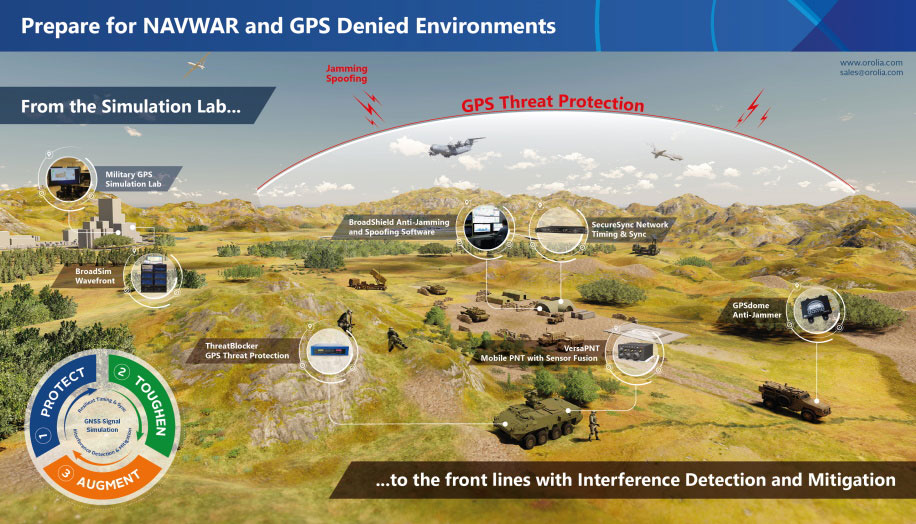
    Resilient positioning, navigation and timing (PNT) company Orolia has nearly tripled new U.S. military orders for specialized resilient PNT solutions in the third quarter of 2019, the company stated in a press release.

    Orolia said its solutions are helping to meet growing military demand for assured operations in Navigation Warfare (NAVWAR) and GPS-denied environments.

    In the third quarter, Orolia unveiled its new Simulation and Interference, Detection & Mitigation (IDM) suite, announced the acquisition of GNSS simulation company Talen-X and introduced new advanced GNSS jamming and spoofing countermeasures.

    The new U.S. military orders include the full range of Orolia’s resilient PNT solutions.

    “This rapid industry response affirms Orolia’s commitment to delivering trusted military solutions for GPS denied environments,” said Paul Zweers, Orolia vice president of sales and marketing.

  • ADVA introduces multi-band GNSS receiver for 5G timing accuracy

    ADVA introduces multi-band GNSS receiver for 5G timing accuracy

    Pluggable line card enables easy transition to precise ePRTC (enhanced primary reference time clock) and PRTC-B based synchronization

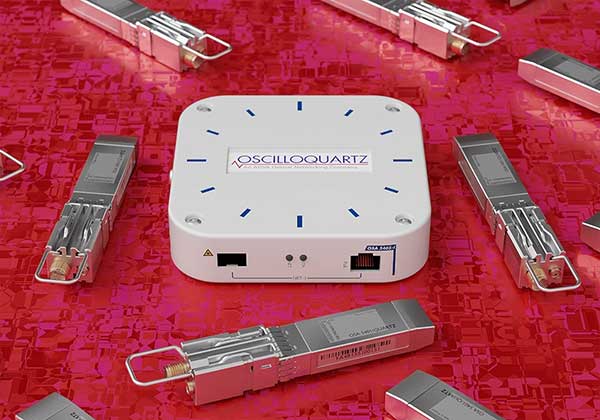
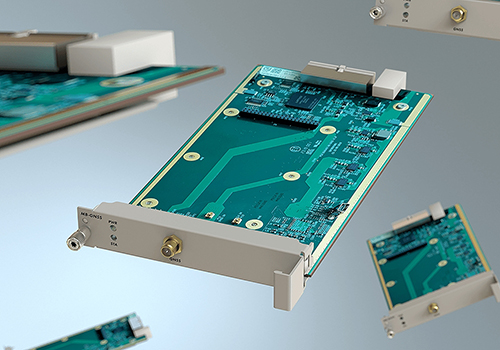
    Adva has launched a modular multi-band GNSS receiver for ePRTC and PRTC-B synchronization, bringing increased precision timing to 5G networks.

    The new solution is engineered to overcome ionospheric delay variation that causes timing inaccuracy, enabling communication service providers (CSPs) and enterprises to deliver nanosecond precision.

    Previously, this was achieved with expensive, rubidium clocks.

    Installed synchronization infrastructure can be installed to increase accuracy and reliability. The multi-band, multi-constellation GNSS receiver card plugs into Adva’s OSA 5430 and OSA 5440, advanced core grandmaster clocks able to support PTP, NTP and SyncE over multiple 1Gbit/s and 10Gbit/s Ethernet interfaces.

    This enables network operators to meet the requirements of the ITU’s stringent PRTC-B specifications and support advanced 5G applications.

    “What we’re offering the market is an entirely new route to high-precision UTC-traceable network timing that doesn’t require significant investment. Our future-proof technology gives businesses and CSPs a way to boost synchronization performance and meet the ITU’s tight PRTC-B specifications without resorting to expensive alternatives.”

    Photo: Adva
    Photo: Adva

    “Our new multi-band GNSS receiver is a major milestone for network synchronization. For the first time, operators can harness a solution with multi-band GNSS capabilities combined with our core devices, which can deliver line rates up to 10Gbit/s and support ePRTC levels of timing accuracy,” said Gil Biran, general manager, Oscilloquartz.

    “Our modular technology offers a way to enhance equipment in the field, achieve PRTC-B levels of timing and improve the timing accuracy of ePRTC. All that’s required is a simple antenna upgrade. Then our multi-band solution can be plugged into the available slot of our OSA 5430 or OSA 5440 for the nanosecond accuracy that will be key to the services of tomorrow. And, as enhanced availability is also essential for emerging applications, the new technology features unrivalled jamming and spoofing detection capabilities combined with our centralized AI-powered GNSS assurance suite.”

    Today’s launch answers the urgent demand for improved precision in GNSS-based timing. Currently, most synchronization networks rely on single-band receivers, which can only be accurate to a limited degree as delay between satellites and receivers is affected by space weather. This creates delay variations leading to time information being out of step by up to several tens of nanoseconds.

    Adva’s Oscilloquartz multi-band technology receives GNSS signals in several frequency bands, enabling it to use the delay differences between them to calculate delay variation and compensate for it. This method is more cost-effective than other techniques, such as deploying GNSS receivers with a filter implemented by a costly high-stability rubidium oscillator. The OSA 5440 can utilize two multi-band cards, providing ultimate hardware redundancy.

    “What we’re offering the market is an entirely new route to high-precision UTC-traceable network timing that doesn’t require significant investment. Our future-proof technology gives businesses and CSPs a way to boost synchronization performance and meet the ITU’s tight PRTC-B specifications without resorting to expensive alternatives,” commented Nir Laufer, senior director, product line management, Oscilloquartz. “Combined with our OSA 5430 and OSA 5440 core grandmasters, the technology creates a scalable, fully hardware-redundant solution. Its built-in security also guarantees the most sophisticated detection of malicious attacks. By supporting GPS, GLONASS, BeiDou and Galileo, our multi-band, multi-constellation line card offers a versatile and resilient solution for migrating from legacy to next-generation timing. Simply put, there’s no other technology available today that can match the accuracy, redundancy, capacity and price point of our core devices combined with our new multi-band GNSS cards.”

    The new multi-band GNSS receiver will be officially launched this week at ITSF and can be viewed on Oscilloquartz’s stand Nov. 4-7.

    A supporting solution brief is also available.

  • Adva brings sub-microsecond synchronization to utility and broadcast networks

    Adva brings sub-microsecond synchronization to utility and broadcast networks

    The OSA 5401 and OSA 5405 now enable power utility and broadcast networks to achieve sub-microsecond synchronization. (Photo: Business Wire)
    The OSA 5401 and OSA 5405 now enable power utility and broadcast networks to achieve sub-microsecond synchronization. (Photo: Business Wire)

    Upgraded PTP grandmaster clocks deliver precise, robust timing in compact form factor

    Adva has extended the capabilities of its compact Oscilloquartz PTP timing technology to enable power utility and broadcast networks to achieve sub-microsecond synchronization.

    Now electricity companies can harness the accuracy needed for smart power grids, and media enterprises can meet key timing challenges, the company said.

    The two upgraded solutions are the pluggable OSA 5401, a small PTP grandmaster clock, and the versatile OSA 5405, an integrated PTP grandmaster with dual GNSS antenna and receiver.

    Both technologies have proved critical in the telecommunications industry, where they have been widely deployed across the globe. They offer outstanding precision and design density. Thanks to unique spoofing and jamming detection capabilities, they also provide high availability.

    “This upgrade is big news for utility and media network operators looking to harness the most advanced innovation in their field. With our OSA 5401 and 5405 bringing new levels of accuracy and resilience to their infrastructure, they can reap the benefits of emerging bandwidth-intensive, latency-sensitive applications”

    “This upgrade is big news for utility and media network operators looking to harness the most advanced innovation in their field. With our OSA 5401 and 5405 bringing new levels of accuracy and resilience to their infrastructure, they can reap the benefits of emerging bandwidth-intensive, latency-sensitive applications,” said Nir Laufer, senior director, product line management, Oscilloquartz, Adva.

    “These devices are feature rich and incredibly efficient. But as well as their versatility, what really sets them apart is their extremely small footprint and low power consumption. This is key to bringing packet time distribution to the edge of network. With our technology ensuring sub-microsecond synchronization, smart grids can perform flexible, real-time decision making, as well as monitoring and automated maintenance. And for media companies, the possibilities for high-quality, interactive broadcasting from any location are enormous.”

    The OSA 5401 and OSA 5405 now comply with the latest PTP profiles for time, frequency and phase synchronization in both power utility and broadcast networks. These include the IEC/IEEE 61850-9-3 Power Utility Profile for precise time distribution and clock synchronization in electrical grids with an accuracy of 1μs, and SMPTE 2059 for synchronizing video and audio equipment over packet networks.

    By supporting NTP, both solutions also enable enterprises to run an on-premises NTP server for high levels of accuracy and uncompromised availability. What’s more, the OSA 5401 and OSA 5405 include advanced GNSS jamming and spoofing detection mechanisms, which are integrated in a centralized AI-based GNSS assurance toolkit.

    Taking up zero real estate and using very little power, the OSA 5401 can be deployed in the most space-restrictive locations. Its capabilities include multi-constellation GNSS (GPS/GLONASS/BEIDOU) and accurate time and frequency recovery, even in challenging environments such as urban canyons.

    Available in both indoor and outdoor variants, the OSA 5405 radically simplifies and extends the reach of GNSS antenna installation by allowing operators to forget about archaic and expensive RF cables and instead use simple Ethernet over copper cables or optical fiber.

    With the OSA 5405, highly precise GNSS-sourced synchronization is supported by network-based SyncE and PTP backups for highly stable sub-microsecond timing accuracy.

    “Our mission is to make precise, resilient and affordable timing available in every industry. Both our OSA 5401 and OSA 5405 have had a significant impact on communication service provider networks, supporting mass small cell rollout and the transition to 5G connectivity. Now we’re ready to bring accurate, reliable and cost-efficient PTP timing to the edge of power and broadcast networks,” commented Ulrich Kohn, director, technical marketing, Adva.

    “One feature of these devices that will prove key to network operators in these industries is their unique spoofing and jamming detection capabilities. These work on two layers. Firstly, network elements identify disruption autonomously. Then, on top of that, a layer powered by AI analyzes information from multiple devices. Using machine learning, this delivers the highly sophisticated and extremely robust protection needed for machine type communication applications in energy grid protection and control,” Kohn said.

    Further information can be found in these slides.

    A supporting solution brief is also available.

  • US DOT prepares for GPS backup demonstrations

    US DOT prepares for GPS backup demonstrations

    Diana Furchtgott-Roth (Photo: DOT)
    Diana Furchtgott-Roth (Photo: DOT)

    The U.S. Department of Transportation is preparing for a GPS backup and complementary positioning, navigation and timing demonstration for the Department of Defense at the Joint Base Cape Cod, Massachusetts.

    Demonstration for testing is expected to begin in the spring of 2020, and DOT is seeking contractors to make Building #2410 at the base functional so that the demonstrations can be held there.

    Diana Furchtgott-Roth, deputy assistant secretary of Transportation for Research and Technology, is leading the project. Working through the Volpe National Transportation Systems Center, Furchtgott-Roth’s goal is to demonstrate as many of the technologies as possible and conclude the effort by March of next year.

    Learn more about the project here.

  • SiTime offers MEMS timing solutions for rugged GNSS

    SiTime offers MEMS timing solutions for rugged GNSS

    Endura MEMS timing products. (Photo: SiTime)
    Endura MEMS timing products. (Photo: SiTime)

    SiTime Corp. has unveiled its Endura micro-electro-mechanical system (MEMS) timing solutions for aerospace and defense applications including precision GNSS, as well as field and satellite communications, avionics and space.

    The Endura products are engineered to provide high performance in harsh conditions — severe shock, vibration and extreme temperature — that are routinely experienced in these applications.

    SiTime offers customers 5 million possible part numbers that can be created from 17 programmable products.

    “When exposed to high levels of shock, vibration, and extreme temperatures, legacy timing components have been prone to failure, degrading system performance and reliability,” said Piyush Sevalia, executive vice president of marketing. “To solve these problems, SiTime created an oscillator system of silicon MEMS, analog circuits, compensation algorithms, and advanced packaging, which is designed to outperform any other available timing solution in harsh environments.

    “For example, Endura precision TCXOs deliver 4 parts per trillion per g (ppt/g) of acceleration sensitivity, which is 50 times better than legacy quartz-based solutions. With such performance, we believe that Endura will transform the oscillator landscape in aerospace and defense.”

    Highlights of the company’s solutions include:

    • 4 parts per trillion per g force of acceleration (50 times better than quartz)
    • Supports –55 degreesCelsius and +125 degrees Celsius operation
    • Key timing specifications conform to MIL-PRF-55310
    • Five million possible part numbers

    Endura Super-TCXOs (temperature compensated oscillators) for use in high-speed communications and GNSS applications include:

    • SiT5146/SiT5147 – 1 to 220 MHz, ±0.5 to ±2.5 ppm, -40 degrees Celsius to +105 degrees Celsius
    • SiT5346/SiT5347 – 1 to 220 MHz, precision ±0.1 to ±0.25 ppm, -40 degrees Celsius to +105 degrees Celsius
    • SiT5348/SiT5349 – 1 to 220 MHz, ultra-precision ±0.05 ppm

    SiTime’s portfolio of commercial off-the-shelf (COTS) Endura products spans six oscillator types and 17 products. All devices offer programmable options such as frequency, operating voltage and stability.

    In addition, some devices offer specialized programmable features such as spread spectrum, pull-range, and differential output type.

    Endura products are available with up to two grades of acceleration sensitivity, as low as 4 ppt/g (typical). This breadth of products provides customers with a large selection and the ability to configure each device for their application requirements.

    Endura products are also designed for continuity of supply for long-life programs.

  • The latest tech fights for GNSS resilience

    The latest tech fights for GNSS resilience

    Image: Harxon
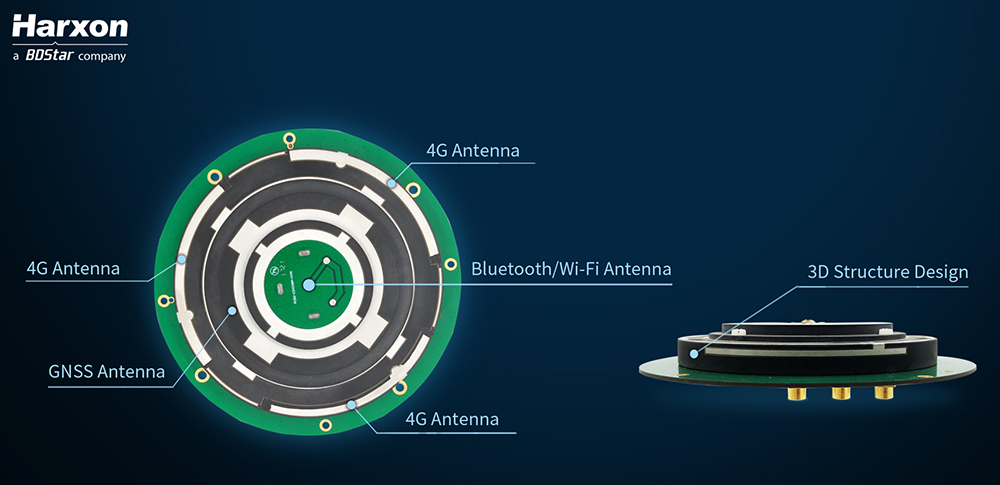
    Architecture of the X-Survey antenna. (Image: Harxon)

    Blocking interference

    Interference can be blocked at the data-collection stage, using an advanced antenna.

    Harxon’s X-Survey is a compact high-precision GNSS antenna. It provides superior navigation and communication performance in surveying applications. A frontal band-pass filter setting effectively rejects out-of-band signals before they enter the low-noise amplifier of the antenna for signal augmentation.

    Meanwhile, the filter itself has insertion loss, making a low insertion loss filter a prerequisite for optimal system noise reduction. To avoid this situation, X-Survey employs ceramic filter with low signal loss and in-band flatness to significantly improve system anti-interference capability and ensure reliable signal receiving.

    The mosaic module provides AIM+ mitigation technology. (Image: Septentrio)
    The mosaic module provides AIM+ mitigation technology. (Image: Septentrio)

    See also:

    How resilient PNT protects global networks from attack or failure

    Is internet time good enough for cybersecurity?


    Resilient receivers

    Septentrio began to tackle the interference problem more than 20 years go, designing and manufacturing high-precision GNSS receiver technology with emphasis on reliability and robustness. The result is Advanced Interference Monitoring and Mitigation (AIM+) technology which secures the company’s GNSS receivers against jamming and spoofing interference. AIM+ has recently been upgraded with an extended anti-spoofing functionality.

    Building on its existing spoofing detection, Septentrio has developed a new anti-spoofing algorithm for its commercial receivers. The algorithm leverages Galileo Open Service Navigation Message Authentication (OSNMA) for spoofing resistance. It was developed in the framework of the GSA FANTASTIC project with the goal of improving the security of timing in critical infrastructure.

    Mobile devices and cloud applications increasingly rely on GNSS technology used by telecom companies. Having secure and robust GNSS receivers in telecom infrastructure is key to reliable mobile and positioning services.

    Alternative signals

    Prototype design of the PNT-5500. (Image: Jackson Labs)
    Prototype design of the PNT-5500. (Image: Jackson Labs)

    A new reference receiver, Jackson Labs PNT-5500, includes a custom Satelles/Iridium (STL) and GPS receiver, and an optional Edge Grandmaster/PTP1588 capability.

    Using STL signals received directly through a small antenna mounted on the device, the PNT-5500 provides nanosecond timing synchronization in GPS-challenged environments, including deep indoors (no rooftop antenna required). It provides secure timing during GPS jamming and spoofing events. The unit is designed for high-volume, low-cost telecom small-cell synchronization, and is optionally available with holdover oscillators such as DOCXO and CSAC atomic clocks.

    While GPS is vulnerable to jamming and spoofing, the PNT-5500 uses the Iridium infrastructure to provide assured timing that is impervious to spoofing and provides 1,000X higher signal strength compared to GPS, producing jamming resilience and deep-indoor reception. The system is designed to be fully interoperable with legacy equipment, for a low-cost, fully-deployed Assured PNT capability alternative to GNSS today.

    Assessing vulnerability

    Image: Qascom
    Image: Qascom

    Qascom offers several robust PNT services and products, including vulnerability assessment, robust navigation and interference localization.

    Vulnerability assessment is the key proactive measure, using cutting-edge signal generators to design and test tomorrow’s receivers. For example, Qascom’s QA707 GNSS simulator tests receivers against emerging jamming and spoofing threats, allowing OEMs to discover in advance any potential vulnerability that may affect the availability and the integrity of the signal.

    Robust navigation is supported by advanced mitigation algorithms, equipped with pre and post-correlation algorithms, as well as the inclusion of sensor fusion and dead-reckoning features.

    Qascom’s attack detection products include external monitoring networks that support GNSS receivers. These networks provide an accurate perception of the operational environment, allowing threat characterization, classification and forecast. For instance, Qascom’s QB100 enables the simultaneous threat detection and localization by means of a monitoring cluster that delivers 24/7 situational awareness to a set of target receivers within the protection area.

    Reliable timing

    Meinberg provides GNSS timing solutions for nearly every application type. Its reliable systems are based on firmware built from the ground up by an in-house team of expert engineers. All Meinberg firmware is constantly checked and updated to ensure it adapts to evolving industry standards.

    The company’s synchronization systems use a built-in Meinberg GPS receiver or combined GPS/GLONASS clock. They also support a broad range of reference time sources, including 1 PPS, 10 MHz, inter-range instrumentation group time codes (both direct current level shift and amplitude modulated), or network time protocol (NTP) servers. This redundancy in synchronization sources means Meinberg’s systems are protected against a loss of signal. Furthermore, to ensure the correctness of the reference time and date, an intuitive Secure Hybrid System (SHS) feature includes an independent secondary clock for enhanced plausibility checks.

    For superior holdover performance, the Meinberg XHERB (with one or two Rubidium modules from Stanford Research) can be added to the Meinberg Intelligent Modular Synchronization (IMS) time and frequency systems. If the reference clock loses its sync source, the XHE chassis will provide the sync reference for the IMS chassis based on its holdover performance.

  • Is internet time good enough for cybersecurity?

    Is internet time good enough for cybersecurity?

    By Jeremy Onyan, Director, TIme Sensitive Networks, Orolia

    Cybersecurity is critical to all facets of the internet. Companies spend millions on cybersecurity every year. Still, often-overlooked areas degrade security. A key example of this is time.

    Time plays an essential role in synchronizing core business and network systems. It supports authentication protocols as well as accurate log files critical for an audit trail — necessary for any cyber forensics program. As such, synchronization is often a requirement for network security standards.

    A deployment of network time protocol (NTP) synchronizes a local system to a time server. The time source can come from within the network or outside of it.


    See also:

    How resilient PNT protects global networks from attack or failure

    The latest tech fights for GNSS resilience


    NTP over the internet. NTP time servers are widely available on the internet. National authorities operate internet time servers based on extremely accurate atomic clocks, such as the National Institute of Standards and Technology (NIST) or the U.S. Naval Observatory.

    But even with these sources, many factors impact traceability. According to ntp.org, “If business, organization or human life depends on having correct time or can be harmed by it being wrong, you shouldn’t ‘just get it off the internet’.”

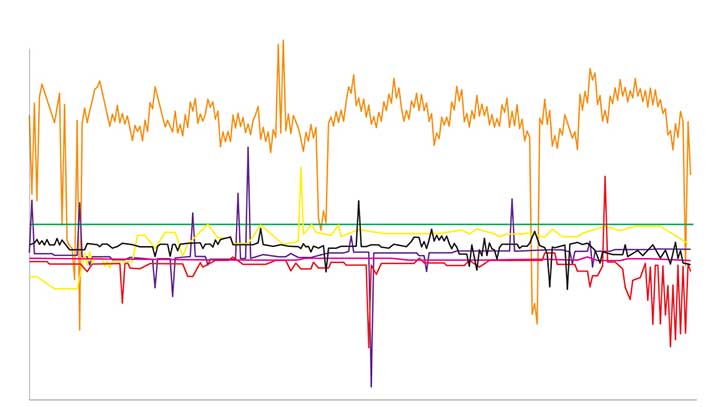
    One problem with time synchronization is the variability of network conditions. Network load, variable path delays and firewall settings can impact time quality on the local system. To illustrate this effect, we can use the time-quality monitoring feature of a time server with a built-in GPS receiver as its reference that is accurate to tens of nanoseconds. NTP can be used to compare it to another GPS time server on a local area network. The offset is around 15-20 microseconds (Figure 1).

    Figure 1. The comparison between two GPS time servers on the same LAN using NTP results in 15–20 microseconds offset. (Chart: Orolia)
    Figure 1. The comparison between two GPS time servers on the same LAN using NTP results in 15–20 microseconds offset. (Chart: Orolia)

    We connected the SecureSync time server to some of the most popular internet time servers. The variation result, shown in Figure 2, is as high as tens of milliseconds — 1,000 times worse than NTP across a local area network. If we assume all the time servers are accurate, then the difference is solely due to greater path delay and other dynamic conditions. This variation is enough to question the traceability of time from the internet.

    Figure 2. The comparison of internet time servers as measured by NTP on a local GPS time server. The scale is 1,000 times greater than in Figure 1. (Chart: Orolia)
    Figure 2. The comparison of internet time servers as measured by NTP on a local GPS time server. The scale is 1,000 times greater than in Figure 1. (Chart: Orolia)

    The internet obscures time traceability. Perhaps more important for a security-critical network is the validity of the source used by the time server that distributes time to your network. Time from GPS/GNSS signals is recognized as the most accurate, available and traceable time source.

    GPS/GNSS-based time servers are easy and simple appliances to add to the local network. Even when different GPS/GNSS time servers are deployed in different locations, they will provide the same time regardless of geography. What’s more, GPS/GNSS as a local time source can be monitored, so its logs can become part of the audit trail.

    Of the seven internet time servers monitored over a 24-hour period, 20 different time sources were identified. Less than half of the sources could be identified as coming directly from GPS/GNSS. In one case, GPS/GNSS time was distributed through three different time servers.

    The best practice of using NTP server pools is one reason why there are more sources than time servers. Server pools rotate among various internet time servers, each with their own source of time, to reduce the chance of one bad or unavailable time server catastrophically affecting the synchronization. But this is a problem for traceability. The source of time is not known, nor can it even be determined.

    Indeterminate source identification, indeterminate accuracy variation and the inability to log the resulting time synchronization calls into question the efficacy of getting time from the internet. Internet time servers are also subject to being spoofed (bad NTP data sent from a faked IP address) and to direct attacks, including NTP poisoning, replay and denial of service.

    When there is a business-critical need to trace time to an accurate source, a GPS/GNSS-based time server should be deployed on the local network.

  • Mercury-ion atomic clock holds promise for greater GPS accuracy

    Mercury-ion atomic clock holds promise for greater GPS accuracy

    The National Aeronautic and Space Administration (NASA) is readying for an ultra-precise atomic clock that could not only transform the navigation of deep space missions, it could also improve the accuracy of GPS timing and thus GPS positioning. It is expected to launch in June.

    DSAC graphic: NASA:
    Drawing of the DSAC mercury-ion trap showing the traps and the titanium vacuum tube that confine the ions. The quadrupole trap is where the hyper-fine transition is optically measured and the multipole trap is where the ions are “interrogated” by a microwave signal via a waveguide from the quartz oscillator. (Image: NASA.)

    The Deep Space Atomic Clock (DSAC) is a very small (the size of a toaster) mercury-ion atomic clock that is as stable as a highly precise ground atomic clock, yet small enough to fly aboard a spacecraft, and rugged enough to operate in deep space. Current ground-based atomic clocks that locate and navigate deep space missions are too massive to fly in space themselves.

    Thus, tracking data from the far-flung spacecraft must be collected and processed on Earth, meaning a two-way tracking link. DSAC will enable NASA to improve tracking data precision by an order of magnitude for its deep space missions out to Jupiter, Saturn — and beyond.

    It could also be used to improve the accuracy of GPS. DSAC is more stable and accurate than the atomic clocks currently aboard GPS satellites. As system modernization proceeds, use of a DSAC aboard future satellites holds out many promises. DSAC technology uses the property of mercury ions’ hyperfine transition frequency at 40.50 GHz to steer the frequency output of a quartz oscillator to a near-constant value.

    The clock confines the mercury ions with electric fields in a trap and protects them by applying magnetic fields and shielding. It is anticipated that DSAC would produce only 1 microsecond of error over 10 years.

    For further details on NASA’s Deep Space Atomic Clock project and detailed callouts on the diagram above, look here.

  • Orolia SecureSync to synchronize FAA’s enroute radar systems

    Orolia SecureSync to synchronize FAA’s enroute radar systems

    Orolia, a provider of resilient positioning, navigation and timing (PNT) solutions, announced that its SecureSync time and synchronization servers have been selected to support enroute radar systems across the U.S.

    The selection comes as part of the Federal Aviation Administration’s (FAA) move towards a Next Generation Air Transportation System (NextGen). NextGen is about halfway through a multi-year investment and implementation plan.

    The FAA plans to keep rolling out NextGen technologies, procedures and policies through 2025/2030 and beyond.

    While NextGen will rely heavily upon GNSS to increase capacity, efficiency, and safety in the National Air Space (NAS), many technologies including legacies such as radar will be integrated into the system for maximum robustness to error and disruption.

    The FAA employs a variety of radar types for short-, medium- and long-range air traffic control requirements. These diverse radars require different types of timing signals and outputs to suit their operations.

    SecureSync. Orolia’s SecureSync provides the necessary timing outputs and signals to meet these requirements. The time server’s ability to provide resilient, accurate and reliable timestamps for the data that it receives from radars is used to quickly organize the data for the aircraft control user interface.

    The only time and synchronization device approved by the Defense Information Systems Agency (DISA) for use in U.S. Government networks, Orolia’s SecureSync provides reliability, security and flexibility to synchronize critical aviation operations. SecureSync combines multi-GPS/GNSS signal synchronization, options for alternative signals and BroadShield GPS anti-jamming/spoofing protection for transportation systems. SecureSync combines Orolia’s precision master clock technology and secure network-centric approach with a compact modular hardware design.

    The FAA selected Orolia for the competitive program based on its proven timing and synchronization technology and its ability to offer multiple output options as commercial off-the-shelf (COTS) products that do not require additional research and development time or investment.

    “Consistently accurate timestamps and the synchronization of thousands of real-time flight data points are essential for safe and efficient enroute air traffic operations,” said Jean-Yves Courtois, CEO of Orolia. “Orolia is proud to support the FAA’s radar data and aircraft control user interface requirements to improve air travel services nationwide.”

    More About the SecureSync COTS Product. Built-in time and frequency functions are extended with up to 6 input/output modules. Included with the base unit is a 1PPS timing signal aligned to a 10 MHz frequency signal without any 10 MHz phase discontinuity.

    A variety of internal oscillators are available, depending on requirements for holdover and phase noise. On-board clocks synchronize to a variety of external references as standard, factory-installed or upgradable options.

    Users may add alternate signals of opportunity to GPS or GNSS input references to improve resilience, or use them for indoor applications and choose from a variety of option cards to add to configuration of timing signals, including additional 1PPS, 10 MHz, time code (IRIG, ASCII, HaveQuick), other frequencies (5 MHz, 2.048 MHz, 1.544 MHz), telecom T1/E1 data rates, multi-network NTP and PTP. Modules can be customized for exact requirements.

    To support network time synchronization, SecureSync supports the latest features of network time protocol (NTP) and precision time protocol (PTP, IEEE-1588v2). An optional multi-port NTP configuration allows for operation across 4 isolated LAN segments. Up to 6 PTP ports can be added to operate in various PTP deployments.

    SecureSync is a security-hardened network appliance designed to meet rigorous network security standards and best practices. It ensures accurate timing through multiple references, tamper-proof management and extensive logging. Robust network protocols are used to allow for easy but secure configuration.

    Features can be enabled or disabled based on network policies. Installation is aided by DHCP (IPv4), AUTOCONF (IPv6), and a front-panel keypad and display. The 1 RU chassis supports multi-GNSS (GPS/ Galileo/GLONASS/BeiDou/QZSS) input.

    Options include SAASM, supporting L1/ L2, available for authorized users and required for the US DoD, and BroadShield GPS jamming and spoofing detection. The unit is powered by AC on an IEC60320 connector. DC as back-up, or primary, is available.


    Featured photo: Orolia

  • Qulsar software enables timing in GPS-challenged areas

    Qulsar software enables timing in GPS-challenged areas

    Qulsar announces precision time protocol (PTP) software availability for Qualcomm FSM platform.

    Logo: QulsarThe QNgine-S precision time protocol (PTP) software by Qulsar is now available on the Qualcomm FSM9xxx platform, which is used in small-cell designs worldwide.

    With QNgine-S, products based on the FSM9xxx platform have access to a precision timing solution that will enable indoor and urban canyon deployments of small cells, where GNSS signals are rather weak.

    As operators continue to upgrade and modernize their networks, there is an increasing demand for a packet-based timing solution (such as 1588 PTP) to support LTE-TDD and LTE-A deployments.

    The QNgine–S made available by Qulsar to use with the FSM9xxx platform is designed to enable operators to deploy small cells cost effectively and without a hardware upgrade to existing networks (such as on an existing timing unaware network), especially in locations where GNSS signals are unavailable or impeded.

    Qulsar’s 1588 PTP slave technology already powers many eNodeBs and mobile backhaul infrastructure.

    QNgine-S is a software-only solution that integrates with the baseband software of the FSM9xxx platform to provide an IEEE 1588-2008 PTP solution capable of recovering both time and frequency from a remote PTP grandmaster.

    According to Minoo Mehta, Qulsar’s VP of Sales and Strategic Partnerships, “QNgine-S is optimized to operate in networks that haven’t implemented full on path PTP support. Qulsar’s advanced time recovery servo uses adaptive algorithms to allow time recovery to better than the required 1.1 μs for TDD applications, coupled with frequency alignment better than 15 ppb to meet the air interface requirements — a level of performance that typically cannot be achieved with unsophisticated servos and/or open source PTP solutions.”

    “QNgine-S provides an increasingly important solution for synchronization of small cells and remote radio heads,” said Puneet Sethi, senior director, product management, Qualcomm Atheros, Inc. “We applaud Qulsar’s approach to delivering precise timing performance to customers using the FSM9xxx platform without new specialized hardware requirements, as this will help accelerate the global adoption of these platforms.”

    Qulsar also provides design engineering services to tailor QNgine-S to variant architectures and platforms as needed and offers lab testing services to validate PTP performance.