Tag: timing

  • Microsemi timing module designed for IEEE 1588 protocols

    Microsemi timing module designed for IEEE 1588 protocols

    Microsemi Corporation has launched a new IEEE 1588 timing synchronization module, offering a complete self-contained platform for customers to implement IEEE 1588 network timing client protocols.

    The solution, which consists of hardware, firmware and software, combines capabilities from Microsemi’s broad product portfolios by leveraging the company’s SmartFusion2 system-on-chip (SoC) field programmable gate array (FPGA), ZL30363 IEEE 1588 phase-locked loop (PLL) and VSC8575 Ethernet PHY devices.

    Microsemi’s new IEEE 1588 timing synchronization module streamlines customers’ developments to add synchronization network timing to their designs, simplifies the sourcing process and reduces development time while providing an easy integration.

    The module also includes drivers, servos/algorithm firmware, IEEE 1588 Precision Time Protocol (PTP) stack software, a user guide and reference board schematics to deliver a fully tested chip-set solution from a trusted tier-one vendor.

    The IEEE 1588 timing synchronization module blends Microsemi’s expertise in nanosecond-level accurate timestamping for IEEE 1588 via the VSC8575 Ethernet PHY; embedded IEEE 1588 protocol engine and servo via its SmartFusion2 SoC FPGA host processor; and high precision clock generation, holdover and reference switching via its ZL30363 system synchronizer.

    The solution is addressed via a command line interface to minimize software integration efforts.

    The combination of these capabilities makes the new solution suitable for applications within the industrial networking, smart grids, communications, defense and data center markets.

    Depending on the applications holdover and reliability requirements, either an XO, TCXO or OCXO can be used to provide holdover supported by the IEEE 1588 timing synchronization module.

    According to a 2017 GNSS Market Report, issue 5, the timing capability offered by satellite navigation systems is at the core of most vital infrastructures; telecom networks operation, energy distribution, financial transactions and TV broadcast are some examples of areas where a GNSS is used for timing or synchronization purposes.

    The annual shipments of GNSS devices used in the timing and synchronization market will exceed 300,000 units in 2017 and are expected to grow at a compound annual growth rate (CAGR) of 5.3 percent over 2017-2025.

    Catering to this growth opportunity, Microsemi’s new IEEE 1588 timing synchronization module is designed specifically for such applications, which require much more precise timing, including base stations and small cell markets for 5G, 4G, 4G LTE, LTE-Advanced, microwave and millimeter wave based fixed wireless networks, smart grids and secure edge networks.

    Other key features of Microsemi’s new IEEE 1588 timing synchronization module include:

    • High accuracy timestamping of less than 4 nanoseconds
    • Frequency and phase synchronization
    • Holdover with initial accuracy of <1ppb and long-term holdover of 1.5µs over 24 hours using the appropriate performance OCXO
    • Hitless reference switching
    • Precision frequency and phase control
    • Multiple profiles, including IEEE 1588-2008 Annex J.3 End-to-End
    • IEEE 1588-2008 Annex J.4 Peer-to-Peer
    • IEEE C37.238-2011 Power Profile
    • ITU-T G.8275.1 Telecom Profile for Phase
    • ITU-T G.8265.1 Telecom Profile for Frequency
  • PNT Advisory Board presentations now available

    Presentations from the 20th meeting of the National Space-Based Positioning, Navigation, and Timing Advisory Board (PNTAB), held Nov. 15-16, are now available online at GPS.gov.

    Ligado Networks was scheduled to appear and present at the meeting, which was held in Redondo Beach, California. Read more about the issues here.

    Ligado and its predecessors have sought to install high-powered ground transmitters that have been shown to harm and overwhelm GPS signals and receivers in their general vicinity. The controversy has simmered for at least eight years without resolution.

    PNTAB provides independent advice to the U.S. government on GPS-related policy, planning, program management, and funding profiles in relation to the current state of national and international satellite navigation services.

  • Microsemi’s BlueSky GPS Firewall protects critical infrastructure

    Microsemi’s BlueSky GPS Firewall protects critical infrastructure

    Microsemi Corporation, a provider of semiconductor solutions, today announced its new approach to protecting critical infrastructure against GPS spoofing and jamming threats.

    The BlueSky GPS Firewall is designed to provide security protection for GPS-delivered position, navigation and timing (PNT) data. It can be deployed in-line between any standard GPS antenna and stationary GPS receiver to provide protection against GPS signal incidents, both intentional or accidental, before they enter a GPS receiver system.

    Microsemi is making BlueSky GPS Firewall Evaluation kits available in advance of its full production release, both in response to the growing number of GPS incidents and their potential threat to critical infrastructure, and to assist customers in rapid adoption.

    BlueSky GPS Firewall filters the GPS signal in real time, removing anomalies before the signal is consumed by the downstream GPS receiver. This creates an intelligent and secure barrier against jamming and spoofing, and prevents the GPS receiver from being impacted by such incidents.

    Deployment of the BlueSky GPS Firewall does not require any new cabling or alteration of the pre-existing antenna installation and is interoperable with standard GPS receivers. Additionally, the BlueSky GPS Firewall incorporates an Ethernet interface for remote management and monitoring and includes a secure web interface that any browser can use for configuration and set-up of the device.

    The BlueSky GPS Firewall includes a broad range of data validation rules based on real, live-sky GPS threats, both intentional and unintentional. Similar to network security threats, new GPS vulnerabilities are on the rise and Microsemi is continuously tracking GPS signal manipulation including spoofing threats, jamming attacks, multipath signal interference, atmospheric activity and many other issues that can create GPS signal anomalies, disruptions and outages.

    These advancements are incorporated into the software platform of the BlueSky GPS Firewall, which can be updated remotely using Microsemi’s TimePictra management system.

    GPS Dependency

    The dependency on PNT is increasingly important to critical infrastructure sectors such as telecommunications, energy, transportation, emergency services, financial services and enterprise infrastructure, and is mainly provided through GPS.

    “Worldwide critical infrastructure dependency on unprotected GPS receivers is a serious security risk. These receivers are susceptible to jamming and spoofing incidents and the industry recognizes this as an increasing threat,” said Randy Brudzinski, vice president and business unit manager of Microsemi’s Frequency and Time division. “The vast number of GPS systems already in operation means a significant investment would be required if every system was to be replaced. Microsemi’s BlueSky GPS Firewall is a cost-effective and easy-to-deploy solution to protect GPS without requiring replacement of deployed GPS systems.”

    Published best-practice documents by the Department of Homeland Security (DHS) Science and Technology Directorate (S&T) describe steps that can be taken to mitigate outages and disruptions with GPS reception. In alignment with these documents, Microsemi’s new BlueSky GPS Firewall provides critical infrastructure sectors with a first line of defense against GPS threats to help build out a secure, robust and resilient PNT platform for their infrastructures.

    According to the 2017 GNSS Market Report, Issue 5, by the European GNSS Agency, professional market segments such as maritime, rail, telecom/utility/enterprise, surveying, aviation, agriculture and drones which use GNSS devices to operate their infrastructures, enable billions of people globally to benefit from them on a day-to-day basis—whether by enjoying the produce of sustainable and cost-effective agriculture, by using efficiently coordinated transport networks, or by leveraging on GNSS-synchronized telecommunications networks. The total installed base of GNSS devices in these professional segments was estimated at 14.4 million units in 2015 and is expected to grow to 97.8 million units by 2025.

  • Microsemi publishes application note on NTP Reflector

    Microsemi publishes application note on NTP Reflector

    Microsemi has published a new application note on its Security Hardened SyncServer NTP Reflector.

    The NTP (Network Time Protocol) Reflector is a fast, accurate NTP server. It features denial of service resilience, monitoring and notification functions.

    Characteristics include 100 percent hardware NTP time-stamping for accuracy and high performance; NTP packet monitoring for DoS detection; bandwidth limiting and packet filtering for CPU protection; and alarming if NTP loading is above expected levels.

    To help users better understand the advantages of Microsemi’s NTP Reflector and packet limiting/monitoring technology, the company explains the underlying technology and its security benefits in the new application note, available for download.

    Key Characteristics

    • 100 percent hardware NTP timestamping for accuracy and high performance
    • NTP Packet monitoring for DoS detection
    • Bandwidth limiting and packet filtering for CPU protection
    • Alarming if NTP loading is above expected levels.

    The NTP Reflector is one of the many differentiating features of Microsemi’s new SyncServer S600 series network time servers.

    The reflector is a real-time, hardware-based NTP packet identification and time-stamping engine uniquely designed to protect the SyncServer CPU from excessive network traffic denial of service  attacks and notify the operator if NTP traffic is above expected levels.

    The innovative technology enables extremely high-bandwidth, high-accuracy, high-reliability and security-hardened NTP operations.

  • Oscilloquartz unveils dual-antenna GNSS SyncReach for small cells

    Oscilloquartz has launched the OSA 5405 SyncReach, an integrated PTP grandmaster and GNSS receiver with a patent-pending dual antenna and receiver to enable the mass roll out of small cells.

    The new technology has been specifically engineered to provide accurate and affordable phase synchronization for the rapidly growing small-cell market and meet the stringent timing requirements of 4.5G and 5G connectivity.

    With the OSA 5405, operators can migrate from legacy GNSS RF antennas and cables to standard, cost-effective copper and fiber Ethernet cabling, reducing capital expenditure and operating expenses, Oscilloquartz said.

    Available in both indoor and outdoor variants, the OSA 5405 can be deployed in challenging environments, including urban canyons where GPS signals fail. The OSA 5405’s miniscule form factor also enables it to be positioned on indoor windows to avoid multipath signal interference from objects within the building.

    The OSA 5405 uses a unique dual GNSS antenna and receiver algorithm to mitigate interference from multipath signals that can affect accuracy, particularly in urban canyons, according to the company.

    “We’re at the start of a new era. With the internet of things (IoT) connecting more wireless devices and 5G just around the corner, small cells will have a big role to play,” said Gil Biran, general manager at Oscilloquartz. “This market is set to grow exponentially in the next few years. Small cells will soon be everywhere and that makes precise synchronization essential. Operators urgently need a way to reliably and affordably deliver new levels of phase accuracy.

    “We’ve created our OSA 5405 to effectively deliver small cell synchronization in any environment and eliminate all restrictions,” Biran said. “Our new technology radically simplifies GNSS antenna installation. The use of PTP removes the need to compensate for cable delay and extends the reach of GNSS. It enables operators to forget about archaic and expensive RF cables and use simple copper cabling or optical fiber for longer distances. And, with variants that can be positioned in almost any location, it provides strictly accurate timing precisely where it’s needed.”

    The compact design and power-over-Ethernet capabilities of the indoor- or outdoor-mounted OSA 5405 enable synchronization at the edge of the mobile network. This creates dramatic reductions in complexity and power requirements as well as lower costs for installation and operation.

    Another feature of the new technology is IP connectivity, so that synchronization becomes another element of the internet of things.

    The OSA 5405’s highly precise GNSS-sourced synchronization is supported by network-based Sync-E and PTP backups. In high-rise buildings it can also deliver synchronization recovered from the GNSS smart receiver over optical fiber.

    The ADVA FSP Network Manager with comprehensive Syncjack assurance guarantees efficient operation.

    “Make no mistake; the launch of our OSA 5405 is a major milestone in the progress towards mass-scale small cell deployment,” said Nir Laufer, product line director at Oscilloquartz. “With its plug-and-play simplicity, miniscule form factor and multiple timing functions in a single device, this is a key technology for 5G networks and the IoT.

    “Currently deployed in trials with major carriers, it will shortly be available to all operators looking to harness next-generation synchronization precisely where it’s needed,” Laufer said.

  • Spectracom, Satelles sync in multiple indoor locations

    Orolia has synchronized a Spectracom SecureSync high-precision time server with the new Iridium Satelles Satellite Time & Location (STL) time synchronization signal powered by Iridium satellites in several indoor environments in the field. Configured with an embedded STL receiver and a small patch antenna, the SecureSync synchronized with the STL signal in several challenging indoor locations. Indoor success can be attributed in part to use of a low-Earth orbit satellite-based signal 1,000 times stronger than GPS.

    The first successful synchronization was in the interior of a building in one of the most challenging urban canyons on Earth: downtown Manhattan on the 7th floor of the New York Stock Exchange. The second was in the interior of a conference center with multiple sources of potential signal interference during The Institute of Navigation event in Monterey, California. Additional successful indoor timing signal synchronization locations include MiFiD2 events near the Paris Stock Exchange, a multi-story building and inside Gibson Hall in downtown London.

    More GNSS challenged locations to come, the two companies promise.

    Other satellite signals — notably GNSS — have limitations indoors. The Satelles STL signal uses the narrow-band paging channels of Iridium, a one-way transmission from the satellite with a very high gain system. The STL signal is completely different from the wide band, lower gain two-way channel of the Iridium phone. The STL signal is 1,000 times stronger than GPS because it originates from the Iridium constellation of 66 satellites orbiting in a low earth orbit. It is also encrypted for high security, which greatly enhances the resilient PNT capabilities of the Spectracom product lines, specificallly the SecureSync precision time and frequency reference. SecureSync with integrated STL synchronization is available to order from the Spectracom website or by contacting a representative.

    “The new STL signal is the ideal solution for those needing increased security and reliability, applications such as high frequency securities trading, financial transaction time-stamping compliance and critical infrastructure timing,” said John Fischer, vice president of Orolia for advanced R&D. “It is not only an additional signal to back up traditional GNSS, it is also stronger and more secure, adding significantly to the resiliency of high performance systems and networks that must rely on precise time synchronization.”

    Having proven the ability to provide a strong and reliable alternative signal in various indoor field locations, the new globally accessible STL signal adds a significant safety net to any critical GNSS application. Adding to the mix of signals of opportunity the resiliency of positioning and timing for financial, defense and critical infrastructure is greatly enhanced.

    “Orolia is focused on providing Resilient PNT solutions, and by combining and layering technology in innovative ways we help our customers meet their mission goals,” said Rohit Braggs, vice president of Orolia’s PNT networks and sources. “This new satellite-based service provides a unique signal that augments Spectracom systems, enhancing our ability to effectively mitigate emerging GPS and GNSS threats.”

    Orolia is the parent company of Spectracom, McMurdo, Kannad, and Sarbe brands, focused on resilient positioning, navigation and timing (RPNT) solutions that improve the reliability, performance and safety of customers’ critical, remote or high-risk operations.

    Satelles has developed and deployed a real-time PNT service based on low-Earth orbit satellites, the Iridium constellation. Satellite Time and Location (STL) signals are highly secure, penetrate deep indoors, and are available anywhere on Earth.  Satelles partners with other companies to deliver secure time and location capabilities to government and commercial users worldwide.

  • PNT Roundup: Scaling down GPS-reliant devices

    By Ramki Ramakrishnan

    In many respects, the story of innovation in electronics has been about miniaturization: designers pack more features, functionality and performance into electronics that are smaller, lighter and more power-efficient. However, this has traditionally been applied only to a limited extent to atomic clocks, which electronic devices employ to maintain correct time if their GPS signal is lost.

    Atomic clocks have significant limitations in terms of scalability and portability, so until recently the best designers could use were ovenized crystal oscillators (OCXOs), which were smaller, lighter and consumed less power than atomic clocks.

    However, they were also less accurate and precise. Now, micro-atomic clocks enable addressing an entirely new range of use cases. A miniature atomic clock (MAC) is not the same clock made smaller; it’s a different clock.

    Timing Quality Measurements. A clock is accurate if its time agrees with a standard such as cesium reference or GPS. A clock is precise if its interval between ticks — its frequency of oscillation — is the same as a reference clock’s interval, even if the reference clock is inaccurate.

    A stern measure of precision is syntonicity, which is a measure of consistency in the occurrence of ticks within the environment. Radar requires syntonicity. To obtain a clear image of a scanned object, the receiver of the signal bounced off the object needs to know the exact instant the associated pulse was sent from the transmitter.

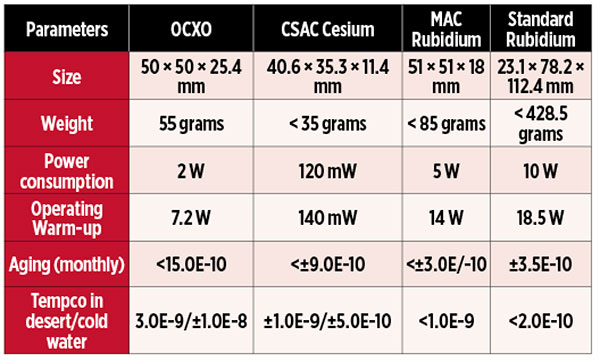
    It’s All About SWaP. One challenge of any timing miniaturization is whether the clock’s size, weight and power (SWaP) meet the needs of a given application. For example, a cesium chip-scale atomic clock (CSAC) is the smallest sized atomic clock in the current market; see the table below. By contrast, the rubidium MAChas the lowest power consumption after the CSAC (that is, 40 times more than CSAC). Before the introduction of the MAC, the standard rubidium clock was the clock with the lowest power consumption and with similar performance.

    Performance metrics of clock technologies.

    Benefits of small SWaP values are easily seen. Devices that required an external power source can now operate on batteries, without a heat sink. A person or a drone can now carry devices that were stationary or required a truck.

    Improvements in SWaP only matters if application requirements for accuracy and precision are also met. What happens if an application’s GPS access is lost? All clocks tend to drift once they no longer reference an external time source. This is known as aging. A key factor that affects aging is temperature. While operating in extreme environments (such as, deserts, high altitudes or under sea), the rate of timing error increases due to temperature variation; the amount of temperature-related error is called tempco.

    The availability of clocks with tight specifications signifies that designers can now employ accurate and precise timing in many ways and places. However, one must specify, analyze and select the clock carefully to meet the requirements of the application. For example, replacing the OCXO with a standard rubidium clock is typically not an option because the standard rubidium clock does not fit in to the OCXO form factor. Designers may consider replacing an OCXO with a CSAC or MAC if greater portabiity and better timing accuracy and precision are the key requirements.

    The choice often comes to one between the CSAC’s lower power consumption and weight versus the MAC’s superior aging performance in the event of GPS loss. The difference between the two clocks lies in how gas atoms trapped into resonance by a microwave synthesizer are excited and then interrogated, a concept known as coherent population trapping.

    Applications suitable for rubidium atomic clocks (MAC) include the following.

    Cellular Base Stations. Rubidium atomic clocks can meet the tight timing requirements for 4G-/LTE-base stations up to 24 hours (even longer for 3G and 4G). Moreover, rubidium’s superior aging ensures longer holdover, meaning the network can remain operational for longer even if the sync reference is lost. The MAC’s lower power consumption compared to a standard rubidium clock also contributes to a lower power and heat density overall, potentially reducing the need for external cooling while increasing the electronic reliability and reducing its size. Low tempco is also critical, considering the environments in which these stations often operate.

    Radar Base Stations. Radars require highly precise synchronization between transmitter and receiver signals. MACs are increasingly replace OCXO in these applications, which also benefit from the technology’s lower power.

    Applications suitable for CSACs include these.

    IED Jammers. Low-power consumption is critical in dismounted intelligent electronic devices (IED) jammers, which must be small, light and battery-powered. Yet they must be precise enough to tightly synchronize and allow pre-defined time slots in the signals (known as look windows) to allow friendly communications through.

    Dismounted Military Radios. Portability and precise synchronization are critical, especially given the higher bandwidth waveforms required to handle encoded video and other data-rich signals.

    Tactical Unmanned Aerial Vehicles (UAVs). In addition to relying on GPS (or clock holdover) for navigation, unmanned aircraft drones also require precise timing for their encoded data-rich and video communications. They also present challenges in terms of the size, weight and power consumption of payloads.

    Undersea Seismic Sensing. Differences in time measurements of acoustic pulses across sensor nodes are used to map subterranean formations such as oil deposits. In the absence of GPS under water, precise synchronization and very good aging performance are critical to harvesting reliable data during the duration of a survey deep under the ocean.

    More innovation lies ahead! Low-powered SWaP-friendly atomic clocks are revolutionizing the world without compromising clock performance, enabling many mission-critical applications.


    RAMKI RAMAKRISHNAN is director of product line management and business development, Clocks Business Unit, Microsemi Corporation.

  • Homeland Security spells out receiver improvements

    In early January, a new U.S. Department of Homeland Security (DHS) document appeared: “Improving the Operation and Development of Global Positioning System (GPS) Equipment Used by Critical Infrastructure.”

    Improving_the_Operation_and_Development_of_Global_Positioning_System_(GPS)_Equipment_Used_by_Critical_Infrastructure_S508C-coverThe document focuses on receivers used in critical infrastructure, with an emphasis on timing receivers. It provides owners, operators, researchers, designers and manufacturers with information to improve the security and resilience of PNT equipment across the spectrum of equipment development, deployment and use.

    Specifically, its recommendations address:

    • installation and operation strategies that can be implemented for current equipment,
    • strategies that can result in more robust and resilient new and/or improved products based on existing technology and knowledge,
    • research and development that can lead to improved future capabilities.

    It introduces clear definitions of different categories of threats and hazards, including the new term “data spoofing.” It recommends some creative ways to install receive antennas, such as using decoy antennas and obscuring the location of the actual antennas being used, presumably to foil some spoofing attacks. It also points out that modern GNSS receivers are computers, and need to be operated and maintained with good cyber hygiene, just like other computers.

    The extensive list of recommended development strategies will challenge manufacturers while informing purchasers about the features they can seek in new equipment.

    Implementing these recommendations will lead to increased competence — that is, equipment that is better able to accommodate imperfect or faulty inputs, intentional or not.

    The document reflects the recognition that many reported problems or difficulties with GPS could be prevented or mitigated by improvements in GPS user equipment and how it is installed and operated. It is encouraging to see DHS taking steps to remedy this situation, and important that manufacturers of timing receivers, as well as critical infrastructure owners and operators that use timing receivers, follow through on these recommendations.

    The document is posted on the website for DHS’ National Cybersecurity & Communications Integration Center, National Coordinating Center for Communications-Computer Emergency Readiness Team.

  • EndRun delivers atomic frequency standard performance in compact module

    EndRun delivers atomic frequency standard performance in compact module

    EndRun Technologies, a provider of precision time and frequency solutions, announced at the Precision Time and Time Interval Systems and Applications (PTTI) meeting the release of the RTM3205 precision timing module for portable time and frequency applications.

    The PTTI meeting is being held Jan. 30-Feb. 2 in Monterey, California.

    The RTM3205 precision timing module by EndRun Technologies.
    The RTM3205 precision timing module by EndRun Technologies. Photo: EndRun

    The second-generation RTM3205 is optimized for size, weight, and power (SWaP), but can exceed the stability of a standard cesium atomic frequency reference.

    The GPS-synchronized RTM3205 is based on EndRun’s Meridian II precision timebase instrument providing a subset of outputs with the same accuracy, stability and ultra-low phase noise. For ultimate performance, EndRun’s innovative real-time ionospheric corrections are available to directly measure and compensate for the ionospheric delay of received GPS signals in real time.

    The network-centric RTM3205 provides a dual-gigabit Ethernet interface supporting a high-bandwidth Stratum 1 Network Time Protocol (NTP) server, optional IEEE 1588 — Precision Time Protocol (PTP) grandmaster, and secure management.

    “The versatile RTM3205 precision timing module is a consolidation of EndRun’s state-of-the-art time and frequency technologies in a small, thermal efficient module.” said Michael Korreng, senior R&D engineer, EndRun Technologies. “Customers can now easily integrate this high-performance, time and frequency module into portable and tactical systems.”

    Key RTM3205 performance specifications with Real-time Ionospheric Corrections and an Ultra-Stable OCXO are:

    • Time accuracy of <10 nanoseconds RMS to UTC (USNO)
    • Frequency accuracy better than 4×10-14 (1 day average)
    • Short-term stability <5.1×10⁻¹³ at 1 second
    • Ultra-low phase noise 10 MHz (<-110 dBc @ 1 Hz offset)
    • Dual-gigabit Ethernet with a Stratum 1 NTP server (7500 packets per second)
    • IEEE 1588 PTP grandmaster option
    • Low power, <10 watts

    The RTM3205 is available now.

  • New defense signals offered, new defense editor sought

    New defense signals offered, new defense editor sought

    Two important new signals — or rather, one signal and one group of signals — became available for military users worldwide last week. Satelles made an exciting announcement of what amounts to a new dimension in satnav: a whole new constellation in low-Earth orbit, bringing global coverage and most critically, a signal strength hitherto unknown to GNSS users. The satellite time and location (STL) has primary application in the timing realm, which is vital in many applications.

    Higher in the sky, Europe’s GNSS satellites constituting the Galileo system officially began offering their services, and the multiple frequencies available here mean robustness, greater availability in obstructed environments, and — some say, though this is controversial — greater positioning accuracy, largely through more precise timing onboard.

    Meanwhile, GPS World seeks a new defense editor for this column, and adopting the concept of “promoting from within,” now turns to its readership for interested parties to volunteer.

    A New SatNav That’s Not GNSS

    A strategic alliance announced on Dec. 15 between companies Orolia and Satelles includes will provide positioning, navigation and timing (PNT) solutions provided by the Iridium satellite constellation, independent of GPS/GNSS signals. The companies intend to provide PNT solutions to military, defense, government and commercial customers worldwide. Their new satellite timing and location (STL) service can supply much-needed robustness to GPS-dependent operations.

    Orolia, the parent of GNSS-active companies Spectracomm, McMurdo, and  Spectratime, has extensive experience in the defense realm. The company says it is #1 worldwide in the manufacture of military beacons outside the U.S. with a 60% market share, and #2 within the U.S., and that it is the first-ranked provider of Medium-altitude Earth Orbit Search and Rescue system (MEOSAR) worldwide.  In partnership with Satelles, it will provide the STL service independent from traditional GPS and other GNSS satellite signals. STL is reported to be less susceptible to vulnerabilities such as spoofing, interference and jamming that are associated with GPS/GNSS — and the stronger signal penetrates buildings where GPS/GNSS cannot reach.

    Iridium satellite, courtesy Iridium.

    Iridium satellite, courtesy Iridium.

    Based on the low-Earth orbit (LEO) Iridium satellite constellation, STL signals are up to 1,000 times stronger than GPS/GNSS; this signal strength, due in part to the constellation’s closer proximity to users, helps to prevent jamming and enables signal reach into buildings and other difficult locations. STL’s additional cryptographic security also enhances performance, productivity and security.

    For further background on Iridium, see the June 2016 Defense PNT column by Don Jewell,“Iridium and GPS revisited: A new PNT solution on the horizon?

    Projected key applications and use cases include energy/utility grids, enterprise data networks including financial systems, maritime/aviation navigation, fleet/asset tracking management, search and rescue and data center management.

    “The timing signal is very accurate and close enough to GPS for most timing applications, although the positioning accuracy is lower than what GPS users are used to,” said Orolia CTO Jean-Yves Courtois. “It is an augmentation for timing primarily, and secondarily for positioning.”

    “In terms of timing accuracy, it provides on the order of tenths of microseconds in accuracy, and this covers a lot of timing applications, very familiar to us and to our customers. This is an ideal timing backup or augmentation of GPS. As number 2 worldwide in high-precision timing, we know this market and its applications very well.”

    “In positioning it’s closer to fifty meters or more. Much better for fixed objects than for mobile objects. The more mobile, the faster the vehicle, then the lower the positioning accuracy. It’s not directly usable for GPS applications that require a few meters accuracy, but it can be associated with inertial navigation for much better results.”

    “The signal is encrypted, so you have to subscribe to a service to receive a key, allowing access to the signal. Applications are developing based on equipment that will be STL-enabled. For the user it will be transparent. The user will have a different antenna.”

    “We are also active in tracking and emergency location devices, where this is also of interest. It has some authentication capability, to guarantee that the person who accesses the signal is in the location that he pretends to be.”

    Galileo, live at last!

    Also on Dec. 15, the European Commission issued the Galileo Initial Services Declaration. The Declaration of Initial Services means that the Galileo satellites and ground infrastructure are now operationally ready. These signals will be highly accurate but not available all the time, since the constellation is not yet complete and users cannot always count on four satellites being visible at one time at all points on the Earth.

    Galileo has a significant role to play in military operations. It adds multiple frequencies to the GNSS palette, important for resistance to jamming. It adds satellites, and will add more in the new future, very important for signal availability.  And its Public Regulated Service (PRS) is specifically designed with special features for security, defense and military operations.

    I attended a GNSS Symposium recently in Australia where an academic expert repeated the oft-made assertion that Galileo is the only GNSS that is civil-designed and civil-controlled. At which point an industry expert leaned over, grabbed the microphone and growled “Yeah, right.”

    No matter how you look at it, Galileo add important benefits to GPS for  the suitably equipped warfighter.

    This Newsletter Enters a New Era

    Beginning in January 2017, this Defense PNT newsletter will combine with our GeoIntelligence Insider e-newsletter to offer broad coverage of both hardware and software matters, driven by GPS/GNSS, and enhancing the capabilities of security, defense, military and other government forces. Readers of both newsletters will receive the new combined edition as a matter of course.

    Many readers will know of  the recent passing of Don Jewell, the longtime editor of Defense PNT.  We must soldier on, and GPS World hereby extends an invitation to readers of this newsletter — many of whom, we know, are military experts in your own right — who may wish to volunteer to fill Don’s position.  Please write to [email protected] to request details, and please provide a brief outline of your background and experience.

    Until next time,

    Happy Navigating.

  • New SatNav offerings come to market via STL service

    Pursuant to a recent announcement of new PNT solutions independent of GPS/GNSS signals, provided via the Iridium constellation, GPS World talked with Jean-Yves Courtois, CEO of Orolia. Orolia has partnered with Satelles to bring new PNT products and services to the global market, with a focus on military, and defense, government and commercial customers worldwide.

    Jean-Yves Courtois, CEO of Orolia
    Jean-Yves Courtois, CEO of Orolia.

    “We are a manufacturer and integrator of timing equipment,” Courtois said. Orolia is the parent company of GPS/GNSS product and service providers Spectracom, McMurdo and Spectratime. “This new STL service is not fully commercialized yet, but it’s operational and it can be tested. Receivers are available and can be integrated into our equipment.

    “The timing signal is very accurate and close enough to GPS for most timing applications, although the positioning accuracy is lower than what GPS users are used to. It is an augmentation for timing primarily, and secondarily for positioning.

    “In terms of timing accuracy, it provides on the order of tenths of microseconds in accuracy, and this covers a lot of timing applications, very familiar to us and to our customers. This is an ideal timing backup or augmentation of GPS. As number 2 worldwide in high-precision timing, we know this market and its applications very well.”

    The STL signal strength is much greater than GNSS because the LEO satellites are much closer. (slide courtesy Satelles)
    The STL signal strength is much greater than GNSS because the LEO satellites are much closer. (slide courtesy Satelles)

    Because the signal providing the satellite time and location (STL) service emanates from low-Earth orbit (LEO) satellites, its strength is much greater than GPS and other GNSS signals. Among its key characteristics: it gets good reception inside buildings and beneath other obstructions.

    “The STL signal works very well,” Courtois continued. “We were surprised. Satelles is very conservative in their statements, and we got better results than they promised in our tests. They under-promised and over-delivered. It penetrates buildings well, it has unique features and it performs at a high level. So we decided to invest in it. All our engineers are excited about it!

    “In positioning it’s closer to fifty meters or more. Much better for fixed objects than for mobile objects. The more mobile, the faster the vehicle, then the lower the positioning accuracy. It’s not directly usable for GPS applications that require a few meters accuracy, but it can be associated with inertial navigation for much better results.

    “The signal is encrypted, so you have to subscribe to a service to receive a key, allowing access to the signal.

    “Applications are developing based on equipment that will be STL-enabled. For the user it will be transparent. The user will have a different antenna.

    “We are also active in tracking and emergency location devices, where this is also of interest. It has some authentication capability, to guarantee that the person who accesses the signal is in the location that he pretends to be.”

    “For customers to be able to use this service, there is some integration work to be done, some dedicated STL receivers to integrate into our current hardware set up, and software modifications. Our engineers are ready, we are all ready to work with government and defense organizations and other new clients.”

    “Our basic interest is to add some robustness to our equipment for our current customers, and then of course to develop new customers worldwide.”


  • Feedback sought on federal GPS backup plan

    The U.S. Department of Transportation is seeking feedback on the potential use by the federal government of one or more positioning, navigation and timing (PNT) technologies to back up GPS signals and ensure resiliency of PNT for critical infrastructure (CI).

    A Federal Register notice was published Nov. 30, with a deadline for comments of Jan. 30, 2017.

    The Transportation Department also said it is interested in “leveraging PNT service technology initiatives under consideration or currently undertaken by industry.”

    “The federal government is presently documenting civil requirements for PNT capabilities to serve as the basis for potential future acquisition activity. The initial objective is to support sustainment of domestic CI timing continuity with the capability to extend service(s) in the future to provide positioning/navigation continuity as well.”

    The “Presidential Policy Directive on Critical Infrastructure Security and Resilience” (PPD-21; Feb. 12, 2013) designates 16 CI sectors: Chemical; Commercial Facilities; Communications; Critical Manufacturing; Dams; Defense Industrial Base; Emergency Services; Energy; Financial Services; Food and Agriculture; Government Facilities; Healthcare and Public Health; Information Technology; Nuclear Reactors, Materials, and Waste; Transportation Systems; and Water and Wastewater Systems. To support the initial objective, CI sectors need access to timing information for both nationwide applications and, in some cases, for more stringent regional and local applications.

    For more information, see the notice.