Tag: UAV

  • u-blox brings GNSS RTK precision to the mass market

    u-blox has launched a receiver module that brings real-time kinematic accuracy to the mass market. The NEO-M8P GNSS receiver module delivers high performance down to centimeter-level accuracy.

    RTK technologies have been used for some time in low-volume niche markets, such as surveying and construction. Because of high costs and complexity, this enhanced positioning technology has been inaccessible for most other uses.

    Emerging high volume markets, such as unmanned vehicles, require high-precision performance that is low cost and energy efficient. Other application areas include agriculture and robotic guidance systems, such as tractors or robotic lawnmowers. The u-blox NEO-M8P answers these demands for a small-sized, highly cost-effective, and very precise RTK-based module solution.

    The RTK algorithms are pre-integrated into the module. As a result, the size and weight are significantly reduced, and power consumption is five times lower than existing solutions, cutting costs and improving usability dramatically, u-blox said.

    Measuring 12.2 x 16 x 2.4 millimeters, NEO-M8P is a small, high-precision GNSS RTK module based on GPS and GLONASS satellite-based navigation systems.

    u-bloxSlideDeck-NEO-M8P-W

    The module is available in two variants. The NEO-M8P-0 has rover functionality, and the NEO-M8P-2 has rover and base-station functionality. The rover with the u-blox NEO-M8P-0 receives corrections from the u-blox base receiver NEO-M8P-2 via a communication link that uses the RTCM (Radio Technical Commission for Maritime Services) protocol, enabling centimeter-level positioning accuracy.

    By using the NEO-M8P module, customers can reduce their research and development efforts, because they do not have to spend significant resources and time to develop an in-house RTK solution on a separate microprocessor system.

    “NEO-M8P lowers the barriers for innovative companies looking to develop equipment that needs centimeter-level accuracy in many markets and applications, such as UAVs,” said Daniel Ammann, Executive Director Positioning and Co-Founder of u-blox. “Today, most solutions are based on board-level receiver products. NEO-M8P delivers performance that is simply a level above competitive offerings in terms of size and low-power consumption, thereby providing easy integration into customers’ existing product platforms, as well as a significant saving in their cost of goods.”

    u-blox NEO-M8P is available for sampling now and will be shipping in volumes in the third quarter of 2016.

  • First responder UAS video: Affordable geolocation and spatial indexing

    When I entered the civilian part of my GIS career as the GIS manager for the Atlanta Regional Commission, I tried to get first responders interested in GIS. Of course, in the early ’90s we were happy to be able to accurately draw points, lines and polygons on a piece of paper. Soon we had the luxury of ortho imagery as a backdrop for our GIS data, but I still couldn’t build a lot of enthusiasm among those first responders.

    That changed completely when we started using metric oblique imagery provided by Pictometry. I realized that since we live in an oblique/3D world many non-GIS users had real difficulty visualizing objects or locations using two-dimension visualizations such as drawings, blueprints, maps or even ortho imagery.

    By contrast, oblique views made visualization much easier for the vast majority of non-GIS users, and use of oblique imagery coupled with GIS tools exploded. Since then, many of us have been searching for faster, easier and cheaper ways to collect oblique imagery and video, and build 3D models.

    For more than a decade, major defense contractors developed leading-edge systems to capture and exploit aerial imagery and video. Although effective, as one would expect of new custom technology, the systems were very expensive and out of reach for most local government agencies. Remote GeoSystems seems to have developed a system that leverages current technology to provide capabilities that may address some of those needs at a reasonable price.

    Remote GeoSystems is in the business of capturing, displaying and managing “georeferenced” video and imagery. The company has designed and built high-end geospatial video recording systems for full motion video (FMV) and GIS mapping software primarily aimed at regulatory compliance of energy corridors, grids and critical infrastructure inspection applications.

    Fortunately, my UAV is a DJI Inspire 1. I chose the Inspire because of its reputation, and because it seems to be the best combination of features needed for first-responder work at a prosumer price (about $3,500). The Inspire can record up to 4K video/12-mp stills, has a 94-degree field of view so there is no wide angle “fish-eye” distortion typical of an action camera, and has “Lightbridge” technology that permits positive control up to 3 miles and the ability to stream live 720p video (now 1080p) back to the ground controller.

    The controller can feed large-screen video for command center group viewing via an HDMI output. Most important, the Inspire records GPS position data and altitude along with the video/imagery stream. (The DJI Phantom 3 Pro is a cheaper alternative that also records telemetry data, but if one upgrades to a 4K camera and the Lightbridge transmitter/receiver, the price approaches the integrated Inspire 1 price.)

    An .srt file.
    An .srt file.

    Since I’m always leery of marketing pieces and company demos, I wanted to try the system myself, and Remote Geo was happy to oblige. My first hands-on test was very satisfying. The LineVision software downloaded, unpacked and loaded quickly with no problems. I then recorded some aerial video of our condo building on Lake Guntersville near Huntsville, Alabama. I chose this building because it was convenient, safe to fly and a multi-story building in the open.

    In addition to recording the video, one needs to turn on the DJI Inspire metadata recording to generate the .srt file. This is done in the DJI application “General Settings/Camera” by toggling “Video Caption” on. The .srt file was initially designed to provide altitude and location data as on-screen captions, but the data can be used as needed for other purposes.

    When done with the flight and recording, transfer the video file and .srt file to your computer. Make sure the video file .mov/.mp4 and .srt file are in the same folder. Open LineVision and you will see an ArcGIS window. From the pull-down menu, load the video and you will instantly see the video play in a separate window with red position dots on the ArcMap view. As the video plays, the dot associated with the location of the UAV will turn yellow. If you click on any dot, the video will jump to that location/position on the video.

    Here are screen captures of LineVision showing the ArcGIS view of an ortho image with red dots illustrating the path of the UAV:

    LineVision 1
    LiveVision screen capture.
    LineVision 2
    Another LineVision screen capture.
    LineVision 2 Zoom
    Closeup showing the UAV track detail.

    One advantage of LineVision for first responders is that it is a complete package with ArcGIS embedded, all for a price well below $1,500. There is no need for a separate ArcMap license. Additionally, although LineVision Esri ArcGIS can display GIS data from online sources, if you have GIS data for your location loaded on your computer the system will operate in a disconnected remote environment. These sample screengrabs don’t do the system and video justice, since I recorded at 1080p rather than 4K. My laptop, this website and the reader’s playback equipment limit accurate playback of 4K content, so I did my work at 1080p.

    I can envision a disaster-response scenario where the response team arrives on site, launches a UAV, and starts recording the scene. The captured video could then be loaded, viewed, indexed and cataloged with GIS data overlays on a laptop all in a matter of minutes, even in a disconnected environment. Hours, days or months later, finding the right video clip for analysis or forensics should be significantly easier and faster.

    With the explosion of UAV hardware and software, it’s going to be an exciting year as new smaller, cheaper and more capable systems hit the market. Remote GeoSystems is working with UAV manufacturers to make LineVision capability available for many of the newcomers.

    Leveraging UAV and LineVision capability, Skyline has worked with Remote GeoSystems to bring yet another capability: rapid 3D model creation. Taking appropriate geo-located frames of the video, Skyline uses its PhotoMesh software to build fully metric 3D models in short order. The full capability of this system and its 3D viewer TerraExplorer is so extensive that I will cover it in a future column, after this month’s ESRI Federal Users’ Conference. If you see me at the UC Feb. 24-25, please stop me and say hello.

    Media: Remote GeoSystems

  • DJI propulsion system aimed at industry, aerial imaging

    UAV company DJI is offering its first tuned propulsion system designed for all-weather use in industrial applications and filmmaking.

    The E2000 propulsion system has the power to handle add-ons such as computing devices and advanced imaging equipment. It uses a combination of 6010 motors, 1240S/X field-oriented control (FOC) electronic speed control (ESCs), and 2170 propellers to carry payloads of 1800–2500 grams (g) per axis, with a maximum thrust of up to 5100 g/rotor (50V, sea level).

    The 6010 motor’s bearings are fully sealed to prevent flu

    ids such as salt water from causing corrosion. A special surface coating applied to the stator also greatly improves its ability to withstand rusting.

    To more effectively dissipate heat generated under intensive industrial use, the 6010 motor features an integrated centrifugal cooling system that effectively cools the motor while keeping dust and micro particles out. The 1240S FOC ESC is equipped with a silica thermal pad and heat sink for maximum heat transfer and dissipation.

    The E2000 is available in Standard and Pro versions to meet the demands of professional and industry users. Both the 6010 Standard and Pro motor bearings are fully sealed to prevent fluids like rain, pesticide, and salt spray from entering and causing corrosion. A special surface coating applied to the stator also greatly improves its ability to withstand rusting.

    The same effective weather sealing has also been applied to the external 1240S ESC found with the E2000 Standard. The E2000 Standard has an IP56 rating.

  • US Navy unmanned system passes tests on submersible

    US Navy unmanned system passes tests on submersible

    A surrogate LDUUV is submerged in preparation for a test to demonstrate the capability of the Navy's Common Control System at the Naval Undersea Warfare Center Keyport in Puget Sound, Washington. (U.S. Navy photo)
    A surrogate LDUUV is submerged in preparation for a test to demonstrate the capability of the Navy’s Common Control System at the Naval Undersea Warfare Center Keyport in Puget Sound, Washington. (U.S. Navy photo)

    The U.S. Navy tested its newly developed Common Control System (CCS) with a submersible unmanned vehicle during a series of underwater missions at the Naval Undersea Warfare Center Keyport in Puget Sound, Washington.

    The CCS successfully demonstrated its capability to provide command and control to a surrogate Large Displacement Unmanned Undersea Vehicle (LDUUV).

    CCS is a software architecture with a common framework, user interface and components that can be integrated on a variety of unmanned systems. It will provide common vehicle management, mission planning and mission management capabilities for the Naval unmanned systems portfolio.

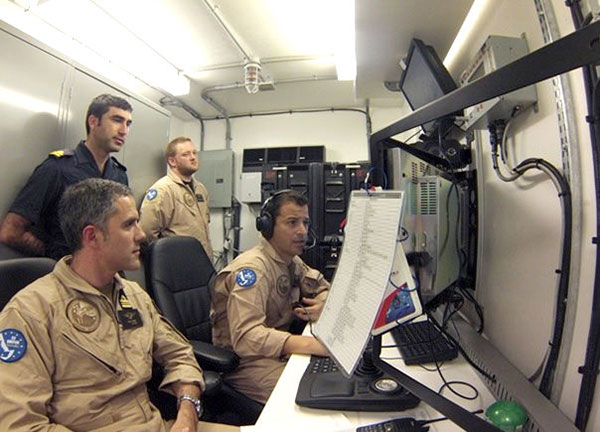
    During the test events in Dec. 7-11, operators from Submarine Development Squadron 5 Detachment UUV used CCS to plan and execute several surveillance and intelligence preparation missions. The CCS sent pre-planned missions — via radio link — to the LDUUV’s autonomous controller and displayed actual vehicle status information to operators during the test. The vehicle was able to maneuver to the target areas and collect imagery.

    “These tests proved that operators could use CCS from a single global operations center to plan, command and monitor UUVs on missions located anywhere in the world,” said Capt. Ralph Lee, who oversees the Navy’s CCS program at Patuxent River, Maryland. “This event also showed us that CCS is adaptable from the UAV (unmanned aerial vehicle) to UUV missions.”

    Teams from the Navy’s Strike Planning and Execution and Unmanned Maritime Systems program office (PMA-281), Naval Air Warfare Center Weapons Division, Space and Naval Warfare Systems Command Pacific, John Hopkins and Penn State universities worked together to design, develop and test the software before executing the live demonstration in December.

    “We had a really talented group of people working on this project,” said Vern Brown, who supports the CCS Advanced Development team based in China Lake. “It was exciting taking the CCS concept of controlling an undersea vehicle from inception early in the year to a successful in-water demonstration.”

    CCS is intended to be compatible across all domains — air, surface, undersea and ground. The Navy initially plans to deploy the CCS on unmanned air vehicles. It will provide common vehicle management, mission planning and mission management capabilities for the Naval unmanned systems portfolio.

    “Ultimately, CCS will eliminate redundant efforts, encourage innovation and improve cost control for unmanned systems,” Lee said.

    Personnel supporting the Navy's CCS program review data during a test event in December 2015 at the Naval Undersea Warfare Center Keyport in Puget Sound, Wash. (U.S. Navy photo)
    Personnel supporting the Navy’s CCS program review data during a test event in December 2015 at the Naval Undersea Warfare Center Keyport in Puget Sound, Wash. (U.S. Navy photo)
  • AUVSI provides interactive map of UAS legislation

    As the 2016 legislative session kicked off this month, the Association for Unmanned Vehicles Systems International (AUVSI) has been tracking all active legislation pertaining to unmanned systems. This year, to provide the best information to its members, legislators, regulators and the media, AUVSI has organized data on all unmanned systems-related state legislation into a sortable, interactive map with details that include a summary of each bill.

    Included are bills that place restrictions on police, recreational or commercial unmanned aircraft systems; legislation that forms unmanned systems or autonomous vehicle commissions and task forces; bills that try to treat unmanned technology differently than other information-gathering devices; and bills that place operating limitations on unmanned aerial systems (UAS) in specific scenarios such as preventing all UAS from flying over prisons or from interfering with hunting and fishing.

    To date, more than 150 active bills in more than 30 states have either carried over from 2015 or been introduced this year.

    See the map below.

  • ArcGIS Earth: Google Earth, GIS style

    For most GIS professionals, Esri’s new ArcGIS Earth will replace the soon-to-be-discontinued Google Earth Enterprise. I take a tour through the new software, which is much like Google Earth with a few added features. Plus: Q&A from our December UAV webinar.

    In early 2015, Google announced that Google Earth Enterprise is being deprecated. In the software world, deprecated means the software is heading towards obsolescence and the vendor isn’t going to develop it further.

    Google’s announcement stated that Google Earth Enterprise was being deprecated as of March 20, 2015, but will be supported through March 22, 2017. According to Esri, Google will continue to provide map and location services APIs as well as content.

    Here comes Esri, introducing ArcGIS Earth.

    At the Esri User Conference last summer, Jack Dangermond announced Esri is working on ArcGIS Earth. Last week, Esri announced the introduction of ArcGIS Earth 1.0. You can download ArcGIS Earth for free.

    GSS-Jan-1

    The opening screen looks a lot like Google Earth, but clearly with an Esri touch via the toolbar in the upper left corner.

    GSS-Jan-2

    You can connect to ArcGIS Online and access its library of data, or import SHP and KML data (no TIF/TFW import, though).

    GSS-Jan-3

    Here are the convenient editing and querying tools (measure).

    GSS-Jan-4

    I imported a KML file containing an orthophoto I created from a UAV flight. Sorry for the orthophoto offset (darned horizontal datum thing).

    GSS-Jan-5

    As it stands now, ArcGIS Earth 1.0 is much like Google Earth with a few added features. However, based on what I perceive Jack Dangermond’s mantra to be, ArcGIS Earth is going to evolve into a powerful mapping tool and platform for consumerizing feature-rich GIS data, much like Google Earth did in the past 10 years, but in a much more GIS way. I look forward to that.

    December’s UAV webinar

    Speaking of imagery, Google Earth and UAVs, in December I participated in a webinar entitled “Introduction to Using UAVs for Mapping” along with my colleagues from Applanix and C-ASTRAL. If you missed the webinar, you can still view it by signing up here.

    It was a solid, 60-minute discussion about the basics of mapping using UAVs. We had a few questions that we didn’t have time to address during the webinar, so I provide answers below. Also, I added some questions that may have been answered, but deserve mention again.

    How significant is the quality of GNSS sensors for UAV mapping performance?

    In my experience so far, you need precision GNSS measurements either in the air or on the ground if you want high-accuracy results. If you want to use a consumer UAV that has a consumer GNSS receiver in it, you’ll need to use more ground-control points that are mapped with high-precision GNSS receivers. On a wide-open 150-acre site (think agriculture field), that means setting 10-15 ground-control targets. On the other hand, if your UAV has an RTK GNSS receiver in it, you can get by with very few ground-control points. The type of topography also has a significant impact. For example, heavy tree cover, water bodies and other homogenous terrain (such as snow) make it more difficult for image-processing software to process the images.

    How accurate can volumes be obtained on stockpiles?

    I plan on running some tests and compare volumes computed using terrestrial measurement techniques vs. volumes computed by low-cost UAV images. Based on my experience, I’m willing to wager that the results will be very close.

    What are the reasonable accuracies achievable with UAV mapping these days?

    With a low-cost UAV (12MP camera), I’m collecting images with a 2-cm/pixel resolution. Horizontal accuracy (with RTK ground control points) is 30 cm or better. Thirty centimeter (30 cm) elevation contours are achievable, and possibly better than that. I’m still exploring how far we can push low-cost UAVs.

    Can we use a UAV with our own GPS-RTK base station?

    The best use of your GPS-RTK base station is to use it to set RTK ground control for image processing. It’s likely not feasible that you can send corrections from your GPS-RTK base to the UAV unless the UAV is specifically designed to accept those corrections.

    Can you tell us the benefits of fixed wing vs. rotary UAVs for mapping work (such as considerations of weather conditions and the benefits of a gimbal-based camera versus a non-gimbal camera typical in fixed-wing UAVs)?

    A fixed-wing UAV can cover a much greater area per battery than a rotary UAV, but if you’re located in the U.S., you are restricted to line-of-sight operations. That severely limits the value of a fixed-wing UAV. Fixed-wing UAVs also require a much larger landing area and are trickier to land. It takes much more training to land a fixed-wing UAV than a rotary UAV. I can’t answer your question about gimbal vs. non-gimbal, except that the rotary UAV that I operate has a gimbal for dampening the effects of vibration. With it, vibration doesn’t seem to be an issue.

    In forestry, one of the real challenges is stitching the photos together. Did I hear right that RTK will ensure stitching will be greatly improved?

    In my limited experience with flying over heavy tree canopy, the best way to handle this scenario is to fly with a heavy overlap (such as 90 percent) or fly at a higher elevation. Since most commercial authorizations in the U.S. limit flight elevation to 200 feet, there’s not a choice to fly higher, so you must fly with a higher overlap.

    Eric, could you change the camera to a near infrared camera?

    Mine is a consumer UAV, so there’s little support for customization unless I want to really tear it apart myself. There is some after-market support for NDVI and NIR sensors on consumer UAVs, but I’m not knowledgeable about the quality of those. I think that after-market and manufacturer support of various sensors (cameras, NIR, NDVI, lidar) will become more popular on higher-end consumer UAVs.

    Eric, the contours seem to capture the curbs in the upper right. Is that correct?

    Correct, it’s pretty impressive for a consumer UAV. Granted, I set a dozen or so RTK ground-control points on a 5-acre site, but I’m pretty sure I could cut that in half and achieve the same result. By the way, I should smooth the elevation contours next time.

    UAV-GE-Contours1-W

    What software was used to create DEM?

    I used Agisoft PhotoScan Pro.

    Currently, the use of UAVs seems to be limited to a relatively small project area and required line of sight. Within the natural resource sector, what is the critical barrier at this point to expanding the project size and thus the range of flight — is it technology or air traffic regulations?

    In the U.S., the limitation is a regulatory one. The FAA requires visual line-of-sight at all times when operating the UAV. The FAA is testing beyond visual line-of-sight (BVLOS), and we hope that someday BVLOS rules will be issued for commercial operators. For now, you are correct in that UAVs are limited to relatively small areas.

    How do the new FAA drone registration rules affect commercial mapping?

    According to the FAA, you need to apply for a Section 333 Exemption and CoA (Certificate of Authorization or Waiver) from the FAA to fly UAVs for commercial purposes. This applies even if you want to fly above your own land or even if you don’t charge for flying. If you fly for any other purpose than as a hobby, it gets complicated very quickly.

    Look for more content on UAVs in the near future. I’m pushing consumer UAVs to the maximum to see what we can reliably expect from them.

    See you next month.

    Follow me on Twitter.

  • Insurance and law firms start drone services

    Insurance companies in the U.S. and Canada have jumped on the UAV bandwagon, with many now offering coverage for commercial drone users. The insurance usually covers liability for any damage caused by the drone, with comprehensive options covering damage to the drone itself.

    Unmanned Risk Management, which also insures helicopters and other aircraft, has insured drones in all 50 U.S. states and in other countries, and has insured the seven film operators that received Section 333 exemptions.

    ProSight Specialty Insurance, which operates in the U.S. and UK, was given a Best in Biz Award partly for creating insurance for drone operators. ”It’s so prescient and forward-thinking given the burgeoning use of drones in today’s business world,” said a Best in Biz judge.

    AIG has developed commercial UAV coverage designed for the exposure faced by remotely piloted, semi-autonomous and fully autonomous aircraft.

    In Canada, Intact Insurance’s UAV coverage caters to small and medium-sized businesses that use or plan to use drones in their business operations.

    Meanwhile, a Chicago law firm is now specializing in federal commercial drone law. Antonelli Law became the first law firm in the U.S. to be invited by drone maker DJI to participate in the company’s referral program for commercial drone users to help them receive Section 333 exemptions from the Federal Aviation Administration (FAA). In 2015, Antonelli Law filed more than 50 petitions with the FAA.

    The firm also launched a specialized drone law service for police and fire departments, community colleges, universities and municipalities obtain FAA exemptions.

  • AUVSI to host massive trade show, works with US UAV regulators

    The Association for Unmanned Vehicle Systems International (AUVSI) has renamed its major annual conference — XPONENTIAL — and the 2016 edition will be held in New Orleans at the Morial Convention Center on the west bank of the Mississippi, May 2–5. The huge convention center is hosting the event across two large halls, with more than 350,000 square feet of space for up to 600 exhibits.

    With 370 exhibitors already signed up, you might want to decide who to put on your visit list if you’ve never been to one of these AUVSI exhibitions. Because just roaming the show floor without a plan can lead to frustration and exhaustion — the show is huge, not only in square feet, but also in the number and size of the exhibits. Full-size helicopters, Humvee-type vehicles and drones — lots and lots of different types of unmanned air vehicles (UAVs) or drones for any and all applications.

    There is everything a drone manufacturer might need to develop and integrate into the latest small (sUAV), medium or large quadcopter, hexcopter, octocopter, fixed wing or STOL (short take-off and landing) air vehicle. Plus, you’ll find ground vehicles and surface and underwater vehicles of all shapes and sizes.

    Propellers, engines, payloads of all sorts including cameras, radars, IR and lasers, plus connectors and electrical, mechanical and electro-mechanical components and systems, manufacturing systems, 3D printing, modeling, designing, developing — all in all, too much stuff to even mention everything that goes into, onto and processes/tools for manufacturing a UAV.

    But, of course, our interest might be more readily captured by the booths exhibiting flight-control systems, sensors, antennas, autopilots, inertial, satellite and terrestrial radios and services, computing, GNSS and other guidance systems — and even avionics for drones. UAV ground control systems (UAV + ground control system = unmanned air system or UAS) are also present in force, along with all their constituent pieces. A ground control system can be more complex than a larger UAV, or sometimes as simple as an app on a tablet.

    Applications are also featured in exhibit groupings for survey and mapping, air and start-up. Also, a large number of U.S. states and related academic, research, test and development organizations are represented this year, along with dedicated Chinese, French, Canadian and UK exhibit areas.

    There also seems to be some presence for insurance, legal, certification and training organizations aiming to support the emerging commercial opportunities that Federal Aviation Administration (FAA) Section 333 approvals have enabled. The FAA continues to grant Section 333 exemptions, which have allowed commercial, research and agency drones to fly in the U.S. National Airspace System (NAS) on a trial and operational basis.

    The FAA issued a fact sheet in mid-December that outlined safety reasons for federal oversight of aviation and airspace, and explained federal responsibility in this area. The object appears to be to let states know that the FAA has federal jurisdiction, and is therefore in charge of regulating access to and operations in the U.S. NAS. The fact sheet perhaps also aims to slow down recent state and city efforts — such as those in Miami, Albany County and New Jersey — to publish their own ordinances and laws related to UAV activity.

    Meanwhile, the FAA’s recent UAV registration requirements for anything unmanned that takes to the air in the U.S. have met with mixed reactions. U.S. drone operators have indeed already complied and registered more than 181,000 UAVs, but one individual has filed a suit against the FAA alleging Section 333 does not allow the FAA to make any new rules or regulations regarding model aircraft if they’re flown for hobby or recreational purposes. We’ll have to see how this all turns out — AUVSI, which represents a good portion of the UAS industry, has already come out supporting the FAA’s UAV registration program.

    AUVSI continues to call for the FAA to publish regulations that would allow small UAVs to operate in the U.S. NAS. These small UAV regulations have been in the works for several years and have yet to be formally released or implemented by the FAA. AUVSI argues that if these regulations were to be released, the commercial UAV industry would really take off and produce billions in revenue and create thousands of jobs.

    In order to help move UAV integration forward, NASA has been working on traffic management concepts for UAS. The first section of this system was tested in August, looking mostly at topics such as geofencing so drones automatically avoid certain restricted areas, and also trajectory planning.

    Google and Amazon have also been looking into UAS Traffic Management (UTM) systems. Amazon has proposed a high-speed UAS transit corridor between 200 and 400 feet, with slower vehicles flying below, and larger ones above it. Verizon has also been exploring how cellular networks could be used to enhance drone safety in the future. The FAA’s Pathfinder Programs also aim to investigate areas, such as beyond-visual-line-of-sight flights, that may assist in the development of UTM.

    So, XPONENTIAL 2016 is a great UAV show to put in your calendar (May 2-5 in New Orleans) if you have interest in learning more about UAV/UAS, or in moving further into the growing business of UAVs, plus lots of related activity promising growth for actual UAV commercial operations in the U.S. There is always a lot going on nowadays in the world of unmanned vehicles.

    Tony Murfin
    GNSS Aerospace

  • DARPA awards Northrop Grumman contract for unmanned system demonstration

    An illustration of Tern, Northrop Grumman's next-generation unmanned system for maritime ISR and strike. (Image: Northrop Grumman)
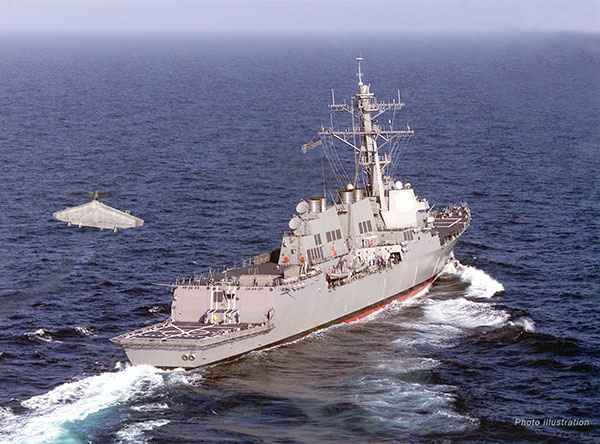
    An illustration of Tern, Northrop Grumman’s next-generation unmanned system for maritime ISR and strike. (Image: Northrop Grumman)

    The Defense Advanced Research Projects Agency (DARPA) and the Office of Naval Research have awarded Northrop Grumman the third phase of the Tern unmanned systems program. Phase three plans include final design, fabrication and a full-scale, at-sea demonstration of the system.

    Tern seeks to develop an autonomous, unmanned, long-range, global, persistent intelligence, surveillance, reconnaissance (ISR) and strike system intended to safely and dependably deploy and recover from small-deck naval vessels with minimal ship modifications.

    Designed to operate in harsh maritime environments, Tern aims to enable greater mission capability and flexibility for surface combat vessels without the need for establishing fixed land bases or requiring scarce aircraft carrier resources.

    According to DARPA, Tern would use smaller ships as mobile launch and recovery sites for medium-altitude long-endurance (MALE) unmanned aircraft (UAVs). Named after the family of seabirds known for flight endurance — many species migrate thousands of miles each year — Tern aims to make it much easier, quicker and less expensive for the Department of Defense to deploy persistent airborne intelligence, surveillance and reconnaissance (ISR) and strike capabilities almost anywhere in the world.

    Ideally, Tern would enable on-demand, ship-based unmanned aircraft systems (UAS) operations without extensive, time-consuming and irreversible ship modifications. It would provide small ships with a “mission truck” that could transport ISR and strike payloads to very long distances from the host vessel. The solution would support field-interchangeable mission packages for both overland and maritime missions. It would operate from multiple ship types and in elevated sea states.

    Northrop Grumman’s Tern solution seeks to provide an innovative system that integrates mature and advanced technologies, including a distinctive propulsion solution designed to help expand global persistent ISR/strike capabilities for small-deck naval surface vessels.

    “We intend to highly leverage our Unmanned Systems Center of Excellence to develop and demonstrate this type of demanding unmanned systems capability to advance the Navy’s mission,” said Chris Hernandez, vice president, research, technology and advanced design, Northrop Grumman Aerospace Systems. “We believe our unique ship-based unmanned systems experience, expertise, and lessons learned from programs including our MQ-8B/C Fire Scout, MQ-4C Triton, X-47A Pegasus and X-47B UCAS, is critical to the success of the Tern.”

    “Using an innovative design that integrates vertical take-off and landing transitioning to an efficient flying-wing for cruise, our team is creating a system that we believe would achieve Tern’s revolutionary performance objectives in support of our combatant commanders,” said Ralph Starace, director, advanced design, Northrop Grumman Aerospace Systems. “Our full-scale demonstrator system is highly traceable to our operational concept to burn down risk, resulting in a compelling step forward for this game-changing, multi-mission capability,” said Bob August, Tern program manager, Northrop Grumman Aerospace Systems.

    The Northrop Grumman Tern team includes its wholly owned subsidiary Scaled Composites, as well as General Electric (GE) Aviation, AVX Aircraft Company and Moog.

  • Silent watchers over Somalia

    The Spanish navy is using UAVs for intelligence operations on the northern and eastern coasts of Somalia to locate possible illegal activities. This past summer, the navy used the Scan Eagle unmanned air system during Operation Atalanta, a European Union mission combating piracy in the Indian Ocean.

    The Scan Eagle system, deployed from the amphibious assault ship Galicia, produced valuable intelligence for the Naval Force of the European Union (EUNAVFOR). The system consists of four aircraft, one of which is designed to acquire night images.

    The New Spanish Armada: Sailors onboard Galicia in the Indian Ocean prepare to launch a Scan Eagle on a surveillance mission. (Photos: Spanish Ministry of Defense)
    The New Spanish Armada: Sailors onboard Galicia in the Indian Ocean prepare to launch a Scan Eagle on a surveillance mission. (Photos: Spanish Ministry of Defense)

    The Scan Eagle is launched via a catapult, and lands by means of a pole, into which the aircraft is “locked.” A set of antennas sends and receives information between the control station and the UAV.

    The system can operate continuously for more than 18 hours at a stretch, collecting data, images and video both day and night.

    During Operation Atalanta, the Scan Eagles completed more than 175 flight hours, collecting imagery for more than 11 hours without being detected and providing command with real-time images of possible targets.

    The UAV system was also deployed in Afghanistan, where it operated from the advanced support base of Qala i Naw until the withdrawal of the Spanish contingent in 2013.

    The mission represents a milestone for the Spanish navy — the first remotely piloted aircraft operating successfully from a navy vessel.

    Night eyes: One of the four UAVs deployed was equipped for night imagery.
    Night eyes: One of the four UAVs deployed was equipped for night imagery. (Photo: Spanish Ministry of Defense)
    Control Station: From the ship’s hangar, the UAV is controlled by operators of the new 11th aircraft squadron of the Spanish Navy.
    Control Station: From the ship’s hangar, the UAV is controlled by operators of the new 11th aircraft squadron of the Spanish Navy. (Photo: Spanish Ministry of Defense)
  • Launchpad: Timing antennas, UAV camera and smartwatch

    OEM

    The UB380 GPS/GLN/BDS tri-constellation octa-frequency high-precision board. Photo: Unicore
    The UB380 GPS/GLN/BDS
    tri-constellation octa-frequency high-precision board.

    High-end GNSS board

    For high-precision positioning, navigation and GBAS applications

    The UB380 multi-GNSS receiver has 384 channels, based on Unicore’s multi-GNSS system on a chip. It features Unicore’s latest real-time kinematic (RTK) engine, which can process triple-frequency BDS and GPS and dual-frequency GLONASS observation data. This can significantly reduce initialization time, improve position accuracy and enhance reliability in difficult environments such as city canyon and canopy, as well as make the long baseline RTK possible. The receiver board can support GPS L1, L2 and L5; GLONASS L1, L2; and BDS B1, B2 and B3. The support of GPS L2P and L2C can satisfy the high-precision requirements of GBAS reference station equipment. The UB380 is compatible with industry-standard GNSS boards in size, interfaces and electrical standards.

    Unicore, www.unicorecomm.com


    M12M Replacement Receiver GNSS module. Source: Jackson Labs Technologies
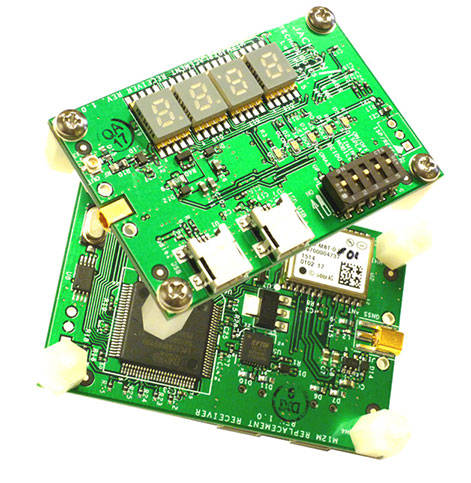
    M12M Replacement Receiver GNSS module. Photo: Jackson Labs Technologies

    Legacy receiver module

    Plug-and-play upgrade for xli server, fury GPSDO

    The M12M Replacement Receiver released is form, fit and function compatible to the legacy Motorola M12M and M12+ timing and navigation receivers. It uses an eighth-generation GNSS timing-enabled receiver, allowing 72 GNSS-channel reception with any two GNSS systems being received simultaneously. It adds configurability via USB ports and dual in-line package (DIP) switches and various status displays. GPS, GLONASS, BeiDou, QZSS and SBAS signals can be received. The module supports NMEA, Motorola binary and u-blox binary as well as SCPI (GPIB) communication protocols; is designed to allow plug-and-play retrofit of equipment designed for legacy Motorola receivers; and is certified as a plug-and-play upgrade to the Symmetricom/Microsemi XLI server and the Jackson Labs Technologies Fury GPSDO. It can be used to retrofit products for GLONASS/BeiDou compatibility. The module enhances performance parameters such as time to first fix; position, velocity and timing accuracy; tracking sensitivity; the addition of SBAS (differential compensation) capability; and the addition of external interfaces such as USB and a synthesized frequency output.

    Jackson Labs Technologies, jackson-labs.com


    Tallysman_timing_antenna Photo: Tallysman
    Photo: Tallysman

    Timing antennas

    High-gain, high-rejection family designed for cell and telecom

    The TW3150/52 antennas feature a 50-dB low-noise amplifier (LNA) gain to handle long cable runs often associated with installation on telecommunications towers. They cover the GPS L1 and SBAS (WAAS, EGNOS and MSAS) frequency bands and provide excellent cross-polarization rejection and enhanced multipath rejection.The TW3150 antenna features a four-stage dual-filtered LNA, while the TW3152 antenna includes an additional SAW pre-filter. This provides better than 80-dB of signal rejection above 1610 MHz and below 1545 MHz. The antennas are IP67 and MIL-STD-801F Section 509.4 compliant to withstand challenging environmental conditions.

    Tallysman, www.tallysman.com


    OriginGPS-Hornet-W

    10 x 10 mm module

    Provides support for GPS, GLONASS and BeiDou with MediaTek

    The ORG1510-MK Multi Micro Hornet is a fully integrated multi-GNSS (GPS, GLONASS and BeiDou) module. The miniature low-power architecture is designed to provide a GNSS component to devices that require fully featured components with small footprints, such as UAVs designed to follow action sports and other fast-moving activities or wearables. The ORG1510-MK contains the MediaTek MT3333 chip, which supports a fast update position calculation rate, and contains an onboard flash memory that does not erase when power is off. It consumes little power with the use of both standby mode and backup mode, and, in advanced applications, a periodic mode that can turn the device on and off when in backup or standby.

    OriginGPS, www.origingps.com


    UAV

    FLYPRO-xeagle Source: Shenzhen FLYPRO Aerospace Tech
    Source: Shenzhen FLYPRO Aerospace Tech

    Smartwatch control

    Wrist and voice control enable UAVs

    Designed for recording sports activities, the FLYPRO XEagle UAV has replaced traditional UAV remote controllers with the XWatch, a smartwatch designed to control the XEagle. Users can control the devices to take off, land and follow, as well as adjust flight height with one click on the wrist within 300 meters. The smartwatch design enables users to fly the aerial vehicles to take high-definition pictures and videos while engaging in intense sports. A voice-control feature allows users to fly the XEagle without moving their hands using commands such as “FLYPRO, take off” and “FLYPRO, follow me”.

    Shenzhen FLYPRO Aerospace Tech, www.flyprouav.com


    Tau2-thermal-core-FLIR-W Photo:FLIR
    Photo: FLIR

    Infrared camera

    Thermal imaging camera core designed for integration

    FLIR Tau 2 thermal imaging cameras are suited for demanding applications like UAVs, thermal weapon sights and handheld imagers. Improved electronics now give Tau 2 even more capabilities, including radiometry, increased sensitivity (<30 mK), 640/60 Hz frame rates, and powerful image processing modes that dramatically improve detail and contrast. Since the electrical functions are common between the Tau 2 640, 336 and 324, integrators have direct compatibility between the different camera formats, and Tau camera versions share many of the same lens options.

    C, www.flir.com


    Delivery drone

    Amazon’s latest version is designed to deliver packages in 30 minutes

    amazon-prime-drone-4 Source: Amazon
    Source: Amazon

    A new drone design introduced by Amazon for its planned Prime Air Delivery service is larger than the previous quadcopter and has a more advanced design, including the ability to operate with an auto-loading system that sets the payload inside an internal carrier bay. The hybrid design combines vertical lift and horizontal flight capabilities using lift fans and a pusher prop. The drone is capable of flying at an altitude of about 400 feet (122 meters) at about 55 mph (88 km/h) for a range of 15 miles (24 kilometers). It has sense-and-avoid situational awareness technology and is designed to deliver small packages in under 30 minutes.

    Amazon, www.amazon.com


    Survey

    M300Pro Source: ComNav
    Source: ComNav

    Reference station receiver

    Surveying and geodetic network positioning

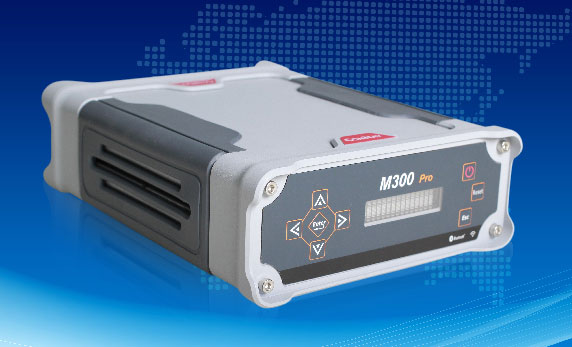
    The M300 Pro is a multi-purpose CORS GNSS receiver designed for applications such as positioning infrastructure, active geodetic network, deformation monitoring, machine guidance, harbor construction, land surveying and marine surveying. Designed for reference stations, the M300 Pro tracks GPS, GLONASS and BeiDou (B1, B2, B3), and will track Galileo, QZSS and other coming constellations. Its web server function enables remote control for access, configuration, programming, data download, reboot/restart, firmware update and code registration. It is compatible with many kinds of CORS software, using the standard data format RTCM and the various data transfer protocols such as UDP, TCP and NTRIP. Raw GNSS observation data can be saved in RINEX format and remotely downloaded. Multiple ports can be configured and connected with external sensors such as meteorological sensors, barographs and inclinometers. The PPS output function provides a guarantee for precision timing. It also has the functionality of event mark and external memory.

    ComNav, www.comnavtech.com


    Leica_VADASE.jpg
    Source: Leica Geosystems

    GNSS monitoring

    Autonomously detects fast movements in real time

    The Leica Velocity and Displacement Autonomous Solution Engine (VADASE) detects fast movements of man-made and natural structures in real time, running on board Leica reference stations and monitoring receivers. VADASE provides an in-depth look at accurate, high-rate velocity and displacement information of various activities and structures. It gives engineers and researchers complete, precise and reliable monitoring information. VADASE delivers actionable information independent of any GNSS real-time kinematic (RTK) correction service.

    Leica Geosystems, leica-geosystems.com


    Delta
    Source: JAVAD GNSS

    High-precision receiver

    GNSS receiver with onboard memory for data storage

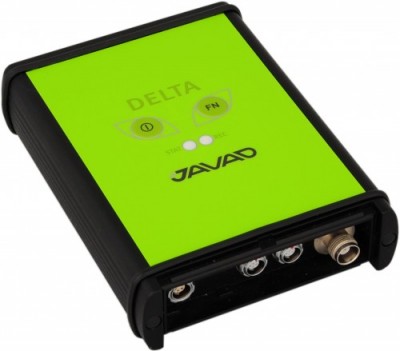
    The DELTA-3 receiver has 864 GNSS channels, along with three powerful processors and program memory in a single chip, which uses less power and makes the total system less expensive. The 864 channels allow tracking of all current and future satellite signals. Delta-3 can track and decode the QZSS LEX signal messages. It is a powerful and reliable receiver for high-precision navigation systems, including high-dynamic systems, for machine and traffic control, high-precision surveying, and geodynamics and aerogeophysics applications. Delta-3 can operate as a receiver for post-processing, as a Continuously Operating Reference Station (CORS), or as a portable base station for real-time kinematic (RTK) applications, and as a scientific station collecting information for special studies such as ionosphere monitoring.

    JAVAD GNSS, www.javad.com


    Mapping

    esri-photo-survey-speeds-property-surveys-W
    Photo: Esri

    Property surveys

    A configuration of ArcGIS and a JavaScript application

    Photo Survey is designed for local governments to publish street-level photo collections and conduct focused property surveys that can identify blight, damaged structures or construction activity. It leverages location-enabled photos produced by many commercially available cameras and simplifies data processing so street-level photo collections can be gathered on a regular basis. Photo collections can then be combined with relevant survey questions in an ArcGIS Online map, and shared with the Photo Survey application. Once complete, the Photo Survey application can be used by the general public or local government staff to review street-level photos and complete property surveys.

    Esri, www.esri.com

  • CES 2016: ProDrone introduces new DSLR capability for Byrd drone

    ProDrone has announced its new Ultimate Flying Platform line featuring a static mount capable of lifting and integrating with several DLSR cameras. The company stated in a news release it will be demonstrating the new system at CES 2016 in booth No. 25417, held Jan. 6–9 in Las Vegas. The new mounts will be available for sale in Q2 2016, with new features and capabilities being added in Q3 2016.

    “This marks the first time a consumer drone has been able to integrate with heavier DSLR cameras, increasing the ease and value of producing super high quality aerial photography,”ProDrone stated in the news release.

    The ProDrone Byrd, best known for its unique ability to fold up to the size of an iPad for hyper portability, has now added another unique ability by introducing a static mount for DSLRs. The new mount is integrated with several Sony cameras — DSC-RX100M4, ILCE6000 and a7RII — and the RICOH GR2. The system is also available with limited operations for the Panasonic GH4, Blackmagic Micro Cinema Camera BMD and the Canon 5DIII. Full integration will be available for all these cameras by Q2 2016, the company says.

    “With the drone market maturing, it becomes obvious that a flying platform that integrates with the world’s best cameras is the best option for the most people,” said Joseph Haagensen, community manager for ProDrone. “A lot of people have been asking for integration with the top cameras they already use for photography. This was the basis for our Ultimate Flying Platform line that we’ll continue to expand with more cameras and stabilized gimbals. At the end of the day, the ProDrone Byrd will be the only drone anyone will need to buy.”

    With each of the Sony cameras, users may view footage via the ProFlight app. The DSC-RX100M4, ILCE6000, a7RII and GR2 have the ability to take photos and video via the ProDrone controller.

    ProDrone also has a new partnership program, and is seeking to expand relationships with the world’s leading camera manufacturers to develop the best solutions and options for the drone market. Camera manufacturers interested in learning more about the partnership program can contact [email protected].