Tag: UAV

  • FAA releases B4UFLY iPhone app on Apple Store

    The Federal Aviation Administration’s (FAA) drone app — B4UFLY — is being released for Apple, following an initial beta testing period. The app can be dowloaded from the Apple store.

    The FAA also is releasing a beta version of B4UFLY for Android devices, which can be downloaded from Google.

    B4UFLY tells users about current or upcoming requirements and restrictions in areas of the National Airspace System (NAS) where they may want to operate their unmanned aircraft system (UAS).

    “We expect B4UFLY will help raise public awareness about what it means to operate unmanned aircraft safely,” FAA Administrator Michael Huerta said at the Consumer Electronics Show in Las Vegas. “It is another important part of our education and awareness efforts to foster a culture of safety and accountability for the UAS community.”

    The B4UFLY app includes a number of enhancements the FAA developed as a result of user feedback during the beta testing announced in May 2015. Within two taps, users know if it is safe to fly at their current location. The app provides a status indicator that tells users: “Proceed with Caution,” “Warning – Action Required,” or “Flight Prohibited.”

    The app also features a planner mode that allows users to select a different time and location for an upcoming flight and determine if there are any restrictions at that place and time.

    By law, hobbyists who want to fly within five miles of an airport must notify the airport operator and the air traffic control facility (if there is one) prior to flying.

    For now, B4UFLY will ask users who are supposed to notify the airport before flying for voluntary information about their planned flight. This will not meet the statutory requirement to notify the airport and air traffic control facility, but the data will help the agency make informed policy decisions related to notification. This information will not be publicly available.

    You can find more information on our B4UFLY webpage.
  • DJI launches public beta of geofencing software for drones

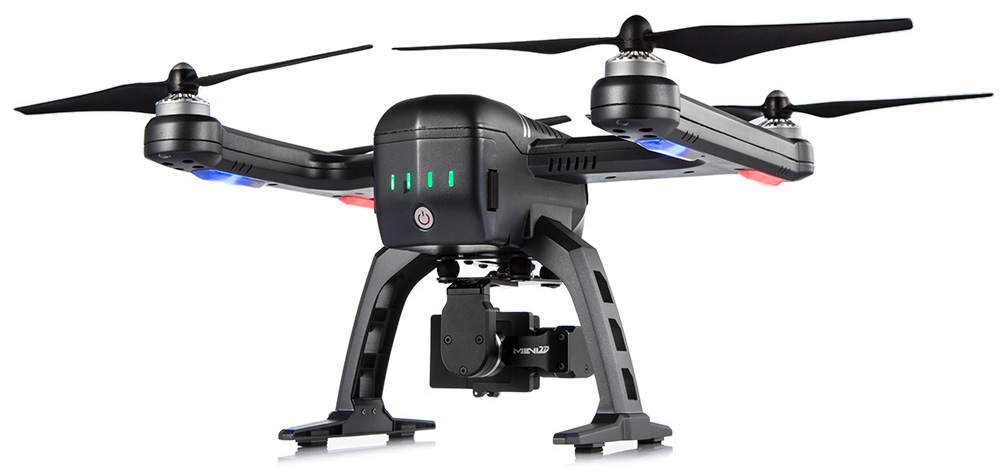
    Drone-maker DJI has launched a public beta version of its new geofencing system in North America and Europe.

    Geospatial Environment Online (GEO) will provide drone users with up-to-date guidance on locations where flight may be restricted by regulation or raise safety or security concerns. With this major upgrade to DJI’s existing geofencing system, users will have access to live information about areas temporarily restricted from flight due to forest fires, major stadium events, VIP travel and other changing circumstances.

    The GEO system will also show restricted areas around locations like prisons, power plants and other sensitive areas where drone flight would raise non-aviation security concerns.

    To accommodate the large variety of authorized applications, GEO will allow drone operators with verified DJI accounts to self-authorize and temporarily unlock flight in some locations. Certain areas where drone flight is not allowed, such as Washington D.C., will remain as unlockable no-fly zones. Unlocking requires a DJI account verified with a credit card, debit card or mobile phone number. DJI will neither collect nor store the information, and the service is free.

    The verified account is required only if a user chooses to fly in a location that might raise aviation safety or security concerns.

    Use of GEO requires a drone firmware update and installation of a beta version of the DJI Go app.

    Android users can directly download the APK file. Users of iOS devices can request a download of the beta app by providing an email address to [email protected].

    DJI expects to release a final version of GEO after completion of this short beta period.

    The GEO public beta will work with both DJI’s Phantom 3 and Inspire 1 drones, with specific versions available for download.

  • Santa caught delivering presents via UAV

    Santa Claus has apparently gone high-tech. This past Christmas, he was captured delivering presents using a Hexo+ unmanned aerial vehicle.

  • Defeating poachers with stealth

    Defeating poachers with stealth

    Night and day: UAV patrols defend dwindling elephant and rhino populations.
    Night and day: UAV patrols defend dwindling elephant and rhino populations.

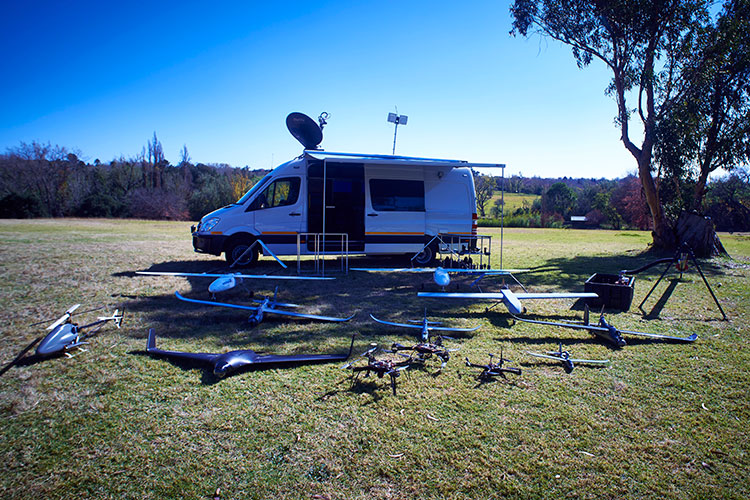
    To stem the staggering wildlife losses on the African continent from poaching, the Air Shepherd Campaign is employing a force of unmanned aerial vehicles (UAVs) equipped with GPS and infrared cameras.

    Teams on the ground, in close cooperation with wildlife reserve management organizations, use the UAVs and sophisticated predictive analysis to hunt the illegal hunters.

    More than 40,000 elephants were killed by poachers in Africa in 2014.The problem is similar for rhinoceros.

    Poachers operate at night, when park rangers equipped with conventional aircraft can’t fly. Air Shephard searches for poachers using predictive analysis to determine the behavior patterns of both animals and poachers. Small drones with cameras search likely areas — once poachers are identified, pre-positioned rangers can intercept the suspects.

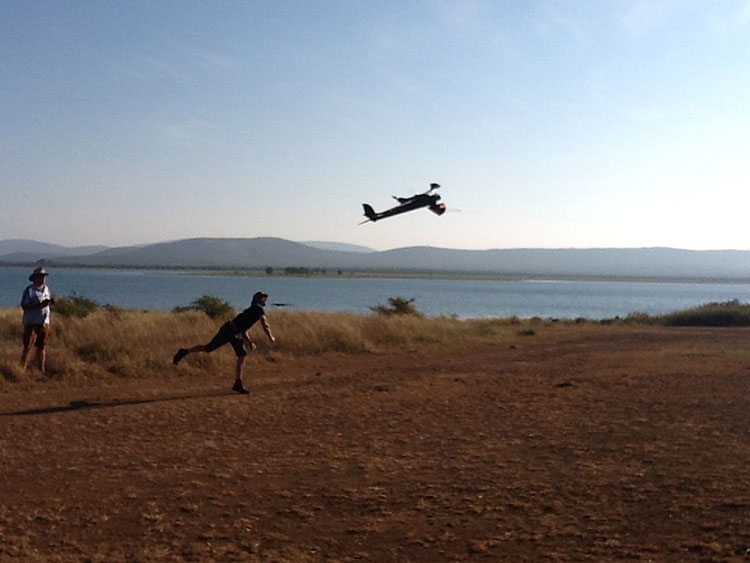
    The hand-launched UAVs carry high-resolution cameras for both daylight and nighttime infrared scanning. At operating altitude, they can easily tell the difference between animals and humans, and transmit real-time geolocation information to the operating team on the ground. The UAVs fly for more than 1.5 hours; they are clean, stealthy and provide an eye-in-the-sky capability.

    UAV fleet deployed around an Air Shepard mobile operating center.
    UAV fleet deployed around an Air Shepard mobile operating center.

    The Charles A. and Anne Morrow Lindbergh Foundation, originator of the Air Shepherd Initiative, has partnered with a dedicated group in South Africa that, over the last two years, has flown more than 650 drone missions over one of the most sensitive rhino poaching areas in Africa. During that period, no rhinos were lost to poachers where the UAVs were flown.
    Once the process is proven, Air Shepherd expects it to be used in national parks and private reserves in South Africa and Botswana, then expand as funding increases to Namibia, Zambia, Tanzania, Gabon, Democratic Republic of the Congo, and eventually Asia.

    Learn more about the project at www.AirShepherd.org.

  • Aerial mapping of Macchu Pichu: Drone helps preserve archaeological treasure

    Two flights were conducted at 120 meters and 100 meters to gather data to help the Peruvian government protect the site from erosion and wear from tourism. (Photo: Trimble)
    Two flights were conducted at 120 meters and 100 meters to gather data to help the Peruvian government protect the site from erosion and wear from tourism. (Photo: Trimble)

    High up in the Peruvian Andes Mountains lies Machu Picchu, an Incan citadel built in the 15th century, now a UNESCO World Heritage Site.

    In the fall of 2014, Trimble demonstrated its UX5 Unmanned Aircraft System (UAS) — along with the Trimble Business Center and Inpho UASMaster processing software — at the famed archaeological site.

    Machu Picchu is under the threat of landslides and erosion — plus the site experiences heavy rains known to wash away roads. It has also seen an increase in tourism over the years.

    As a consequence, the preservation of the landmark is a growing concern for the Peruvian government. Data captured by a fixed-wing UAS is expected to help the many organizations that govern and preserve the site to visualize and monitor the location.

    Getting to Machu Picchu is a challenge in itself. A 3.5-hour train ride from the city of Cusco takes visitors almost 8,000 feet above sea level. When a Trimble team visited the site, access to Machu Picchu was arranged well in advance by its distribution partner Geosystems and the Peruvian Ministry of Culture.

    Orthophoto of the Macchu Pichu site. (Image: Trimble)
    Orthophoto of the Macchu Pichu site. (Image: Trimble)

    The day of the flight, a small area on one of the terraces was cleared of tourists (but not local llamas) for the flight. Two flights were conducted at 120 meters and 100 meters for enhanced data. Along with Trimble and Geosystems representatives, local archaeologists and surveyors from the Ministry of Culture attended the flight, which went off without any challenges.

    With the flight complete, Trimble and Geosystems went to work processing the data immediately in Trimble Business Center and Inpho UASMaster. Trimble Business Center allowed the data to be quickly processed into high-quality point clouds and orthophotos while Inpho UASMaster offers feature-rich photogrammetry workflows.

    The following day, Trimble and Geosystems presented government officials with orthophotos and a 3D point cloud model.

  • FAA small unmanned aircraft registration begins

    The Federal Aviation Administration’s (FAA) Small Unmanned Aircraft System (UAS) registry is now live and ready for owners of hobby UAS to use at www.faa.gov/uas/registration. Registration is free for the first 30 days with a rebate, then $5 after that.

    The online registration system does not yet support registration of small UAS used for any purpose other than hobby or recreation — for example, using an unmanned aircraft in connection with a business. The FAA is developing enhancements that will allow such online registrations by spring of 2016.

    During the registration process, each owner must provide his or her name, home address and e-mail address. When registration is complete, the web application will generate a Certificate of Aircraft Registration/Proof of Ownership including a unique identification number for the UAS owner, which must be marked on the aircraft.

    Owners using the model aircraft for hobby or recreation will only have to register once and may use the same identification number for all of their model UAS. The registration is valid for three years.

    All aircraft weighing more than 0.55 pounds (250 grams) and less than 55 pounds (approx. 25 kilograms), including payloads such as on-board cameras, must be registered.

    Under this rule, owners who previously operated an unmanned aircraft exclusively as a model aircraft prior to Dec. 21, 2015, must register no later than Feb. 19, 2016. Owners of any other UAS purchased for use as a model aircraft after Dec. 21 must register before the first flight outdoors. Owners can use either the paper-based process or the new streamlined, web-based system. Owners using the new streamlined web-based system must be at least 13 years old to register.

    If assistance is needed with registration, email [email protected].

    The FAA also reminds unmanned aircraft owners there’s no need to work with a “drone registration” company to help file an application for a registration number. The registration site is designed to be simple and easy to use for every hobbyist.

    The FAA has partnered with several industry associations to educate the public about using unmanned aircraft safely and responsibly. Flight rules include:

    Fly below 400 feet altitude.

    • Keep your unmanned aircraft in sight at all times.
    • Never fly near manned aircraft, especially near airports.
    • Never fly over groups of people, stadiums or sporting events.
    • Never fly near emergency response efforts.
  • FLYPRO announces smartwatch-controlled XEagle drone

    FLYPRO announces smartwatch-controlled XEagle drone

    Shenzhen FLYPRO Aerospace Tech Co. has officially released the XEagle, an unmanned aerial vehicle (UAV) equipped with auto follow and obstacle avoidance functions.

    Photo: FLYPRO Aerospace Tech Co.Unlike other popular self-flying drone models on the market that are taken off by throwing the aircrafts in the air, which increases the risks of crashing the vehicles, XEagle introduces various features including voice control, smartwatch and automatic obstacle avoiding to offer a better user experience. By liberating both hands, users do not need to have any previous knowledge and experience when handling an XEagle.

    Designed for recording sports activities, FLYPRO has replaced traditional UAV remote controllers with XWatch for the new XEagle. XWatch is a smartwatch designed to control XEagle that’s portable and easy to navigate — users can control the devices to take off, land and follow, as well as adjust flight height with just one click on the wrist within 300 meters. The smartwatch design enables users to fly the aerial vehicles to take high-definition pictures and videos while engaging in intense sports such as skiing and mountain bike cycling.

    The voice control feature allows hobbyists to fly the XEagle without moving their hands at all — the built-in intelligent voice recognition system responses fast and accurately to commands in both Chinese and English. Users only need to instruct the XEagle with commands such as “FLYPRO, take off” and “FLYPRO, follow me” to launch the XEagle in the air and have it follow automatically.

    To lower the risk of crashing the UAV in both takeoff time and during flight, XEagle offers a crash prevention solution by installing four layers of protection. With an infrared obstacle avoidance system and built-in photoelectric sensors, the XEagle can calculate precisely and in real time for obstacles to avoid collisions. The detection is effective when the obstacle is at the distance between 0.1 to 15 meters with relative velocity of 12 meters per second. The UAV can dodge obstacles and barriers while flying in the air by changing its flight path automatically.

    As a newcomer in the UAV market, FLYPRO’s technological breakthrough in developing consumer drones not only resolves the safety concerns customers have with other similar UAVs, but also improves user experience through innovative control measures that makes flying the drones as easy as clicking a button, leading the UAV industry with the company’s user-centered philosophy and high product quality standards.

    “Now, customers favor UAV products with lower risks associate with operating the aerial vehicles as well as technological innovations that enable users to perform complex tasks without advanced training. When other companies are looking for ways to make UAV products more accessible to the public, FLYPRO has already achieved that with our innovative functions like smart watch control, auto follow and obstacle avoidance that allow everyone to enjoy flying the UAVs for sports and entertainment,” said Lin Hai, founder and CEO of FLYPRO.

  • Expert Opinions: FAA UAV registration requirement

    Q: What do you think of the FAA requirement that all UAV purchasers register their devices?

    Lydia Bock President and CEO Geodetics Inc.
    Lydia Bock
    President and CEO
    Geodetics Inc.
    A: We need a pragmatic and sensible response to the integration of UAVs into the civil airspace, balancing safety of civil aviation and the economic benefits associated with the emerging markets and applications of UAV technologies.

    Clearly maintaining flight safety in the national airspace is critical. A balanced approach would include registration of UAVs, education for hobbyists and FAA flight certifications for commercial operations.

    New technologies for automated sense-and-avoid should be investigated, and their certification for use should be streamlined.


    John Studenny Director System Engineering Esterline - CMC Navigation Systems
    John Studenny
    Director System Engineering
    Esterline – CMC Navigation Systems
    A: Registration of all radio-controlled (RC) aircraft or UAVs upon purchase may be too broad or harsh, and may conflict with current freedoms already enjoyed by hobbyists.

    However, as capabilities (altitude, speed, flight duration, payload capacity) increase beyond what today’s RC aircraft or UAVs can deliver, regulations and registration may be required.

    It comes down to UAV capability and how the UAVs are used. That needs to be the focus of any regulation or enforcement.

  • Taking Position: Elephants, citadels and UAVs promote social good

    By Tracy Cozzens
    Managing Editor

    As the holiday season approaches, many of us think about ways we can help others, or promote the social good. This month, our Market Watch section features three different projects designed to do just that.

    In our Mapping section, we explore how geospatial information systems can be used to help us help the homeless. Geographic information systems (GIS), community involvement and app builders are helping gather and use data to deliver critical services to the homeless in major metropolitan areas in the United States.

    In our UAV section, we discover that unmanned aerial vehicles can be used for more than commercial purposes. One company used its fixed-wing UAV to help the Peruvian government save Machu Picchu, an Incan citadel, from the 15th century and a UNESCO World Heritage Site.

    In another project, UAVs are being used in an effort to stop the poaching of rare and endangered African wildlife. Silent, stealthy UAV patrols can spot the poaching activity by providing eyes in the sky, even at night using infrared cameras.

    These are just three examples of ways we are using location and positioning technology — ways that probably didn’t even come close to the top ideas when the tech was conceived.

    As we look toward 2016, it’s exciting to think what new applicatins might be in store. If you have an application story to share, please email me at [email protected]. Perhaps your story will appear in a future issue.

  • U.S. Environmental Protection Agency to use SimActive’s Correlator3D

    SimActive’s Correlator3D has been selected by the United States Environmental Protection Agency (EPA) to create 3D datasets of vegetation for input into biophysical models. The software will also support generation of urban landcover maps for the agency’s GIS, EnviroAtlas.

    “Correlator3D has been serving governments globally, encompassing a wide spectrum of requirements,” said Philippe Simard, president of SimActive. “We are proud to be working with the EPA and supporting their environmental mandate.”

    Correlator3D software is a patented end-to-end photogrammetry solution for the generation of high-quality geospatial data from satellite and aerial imagery, including UAVs. Correlator3D performs aerial triangulation and produces dense digital surface models, digital terrain models, point clouds, orthomosaics and vectorized 3D features.

  • VDOS Global and Cunningham Lindsey partner for drone insurance claims

    Cunningham Lindsey, a global loss adjusting and risk management services company, is partnering with VDOS Global, an unmanned inspection services company, to incorporate drone technology solutions into the insurance market.

    As the first FAA-authorized UAS-inspection company in the United States, VDOS is a provider of unmanned aerial vehicle (UAV) services whose commercial pilots are seasoned and fully licensed with FAA certifications. Cunningham Lindsey and VDOS will work together to achieve improved efficiencies in daily claims scenarios by assisting insurers with the creation of a drone program into their claims process, providing safer pre- and post-loss assessments with aerial flyovers, and customized UAV-training tailored to the needs of field adjusters and additional experts seeking certification.

    The partnership will provide carriers immediate access to aerial data for application efficiencies in the underwriting process as well as catastrophic claims situations for all types of property. When claims occur that require a forensic investigation, VDOS will also work with EFI Global, the forensic division of Cunningham Lindsey, to provide the UAVs needed to expedite the gathering of field data in challenging locations.

    “We are excited to partner with a highly respected and recognizable brand like VDOS to share the benefits of the emerging drone technology with our clients,” said David Repinski, president and chief client officer of Cunningham Lindsey, Americas. “It is undeniable our industry is changing constantly, and the data application possibilities using drone technology are tremendous. This partnership represents the best path forward to help insurers incorporate a UAV strategy to gain a competitive and differential advantage across all channels in the claims and risk assessment process.”

    “Working with VDOS in using UAVs in our forensic evaluations is a natural complement to EFI’s investigation process,” said Jeremy Mele, president of EFI Global. “This type of technology will enhance our technical experts’ investigative reach, and add a level of safety and security in the field when accessing sites with unsafe property conditions.”

    “We are truly excited to partner with such an incredible team at Cunningham Lindsey who understands how drones are changing traditional business models,” said Brian Whiteside, CEO of VDOS stated. “Our enterprise deployment program using UAV technology is the first of its kind, and will accelerate safe and efficient claims services for adjusters through the team’s integrated training and operations structure.”

  • Topcon and Agisoft sign partnership agreement for UAS photogrammetric software

    Topcon Positioning Group announces a new partnership with digital photogrammetric solution provider Agisoft LLC. The agreement is designed to further expand the Topcon solutions portfolio for mass data collection (MDC).

    Topcon_Agisoft-WAgisoft is a world leader in the processing of digital imagery in order to generate high-accuracy 3D spatial data using photogrammetric and computer vision techniques, and has been developing imaging solutions for nearly 10 years. Topcon will provide the Agisoft Photogrammetric Kit for Topcon — Professional Edition software for post-processing of data collected using the Falcon 8 and Sirius Pro unmanned aerial systems (UAS).

    Features include photogrammetric triangulation, dense point-cloud editing and classification, digital terrain or surface model export to a variety of formats including georeferenced orthomosiac production (including GeoTIFF and KML export), multi-spectral imagery processing, 3D model generation and texturing, as well as full measurement analysis tools.

    “We are very excited to be able to offer the combination of our Sirius Pro and Falcon 8 UAS devices and Agisoft Photogrammetric Kit Professional software. The solution provides an integrated workflow for reaching high-accuracy survey results using unmanned aerial systems with minimal field work,” said Eduardo Falcon, executive vice president and general manager for the Topcon GeoPositioning Solutions Group. “For example, when using the Sirius Pro, absolute accuracies down to 1.6 cm (0.6 in.) in plan and 2.7 cm (1 in.) in height are possible without the need for any ground control.”

    The photogrammetric kit solution is now available.