Tag: wearables

  • Qualinx launches reconfigurable GNSS chip and developer kit

    Qualinx launches reconfigurable GNSS chip and developer kit

    Qualinx will showcase its market-ready 1 mW QLX3Gx Series GNSS chip with its dynamic reconfigurable architecture, along with a developer evaluation kit (EVK), at Embedded World 2026 taking place March 10-12 in Nuremberg.

    The QLX3Gx EVK enables OEMs to directly validate Qualinx’s power-to-performance leadership and integration readiness in real-world device environments across IoT, UAVs, wearables, asset tracking, mobility and infrastructure applications. Additional demos include ultra-low-power GNSS powered by Dragonfly Digital RF, on-chip Galileo authentication with EUSPA’s OSNMA, QLX3AX AFE flexibility, beacon-to-beacon communication and sustainable smartwatch integration.

    1 mW GNSS Powered by Dragonfly

    Qualinx’s patented Dragonfly Digital Radio Frequency (DRF) architecture is at the core of the QLX3GX chip and shifts traditionally analog RF functions into the digital domain, an approach that brings RF back in line with Moore’s Law and, as such, significantly reduces power consumption without compromising performance.

    Market-ready and built for scale, the highly integrated chip combines an ultra-low-power digital RF front end with an advanced GNSS digital baseband engine, ready for high-volume production and OEM deployment.

    Additionally, the Dragonfly architecture enables dynamic, over-the-air (OTA) reconfiguration of the device throughout its lifecycle, eliminating substantial cost and complexity from customers’ supply chains and sparking new cycles of downstream product innovation, all from a single chip.

    Supported by a European-designed GNSS architecture engineered for industry-leading power-to-performance versatility, hardware-level security and resilience, tracking is performed natively on-chip rather than in the cloud, further improving resilience to spoofing, jamming and interference.

    Live demonstrations planned

    Live demos at Embedded World 2026 highlight Qualinx’s performance and agility, and reinforce the company’s strategy to redefine connectivity by ensuring ultra-low-power, secure, and reconfigurable GNSS is accessible at scale:

    • QLX3Gx developer evaluation kit (EVK). Hands-on validation of real-world power consumption, reconfigurability and integration readiness.
    • Ultra-low-power GNSS powered by Dragonfly Digital RF. The 1 mW operating mode reduces one of the largest energy drains in connected systems, enabling longer battery life, smaller form factors and lower carbon footprint.
    • Qualinx Transmit. Qualinx will demonstrate that the same chip used for beacon-to-beacon collaboration can enable a range of new applications in which devices work together as an intelligent swarm, accelerating the deployment of ambient IoT.
    • Galileo OSNMA authentication with EUSPA. With more than 4 billion devices connected to Galileo, Qualinx on-chip navigation message authentication strengthens protection against spoofing among connected devices while reinforcing alignment with Europe’s sovereign Galileo infrastructure.
    • QLX3AX analog front end (AFE). A dynamic OTA reconfigurable AFE supporting multiple radio technologies for specialized receivers and custom systems.
    • Wearable integration display. Smartwatch-class form-factor readiness, validating compact footprint and suitability for IoT and wearable devices.

    The availability of the QLX3Gx GNSS chip and EVK follows the recent announcement of a €20M investment round to support and accelerate Qualinx’s growth and international expansion. As governments and enterprises reassess their exposure to fragile, globally concentrated semiconductor supply chains, Qualinx stands out as a European deep-tech company that combines European IP and manufacturing, with hardware-level security that delivers resilient, ultra-low-power connectivity and does not rely on cloud-based processing.

    All Qualinx chips, including the QLX3Gx GNSS chip, are designed and manufactured in Europe, anchoring production within the EU and reducing supply chain risk.

    OEMs are invited to register their interest in the Qualinx developer EVK at Embedded World, from 10-12 March at the Exhibition Centre Nuremberg, Hall 3, Booth 2211, to secure hands-on evaluation of the QLX3Gx GNSS chip for upcoming consumer, industrial, and mobility applications ahead of mass production this year. Contact [email protected] to schedule a media interview.

  • TDK launches STRIDE, a low-power, real-time positioning software for wearables and IoT 

    TDK launches STRIDE, a low-power, real-time positioning software for wearables and IoT 

    TDK Corporation has announced Trusted Positioning STRIDE, an embedded pedestrian dead reckoning (PDR) software solution engineered specifically for wearables such as smart watches, head-mounted devices, glasses and compact sensors.

    As OEMs push for more intelligent, context-aware wearable experiences, STRIDE provides reliable positioning without the power and hardware demands traditionally required for GNSS-based tracking. 

    Wearables today face a critical challenge: adding high-quality positioning typically requires bulky antennas, high-drain GNSS or costly custom hardware — barriers that limit form factor, battery life, and user experience. 

    STRIDE overcomes these constraints with a low-power, sensor-agnostic software engine that fuses inertial data with GNSS and opportunistic wireless signals, delivering continuous location tracking indoors, outdoors and everywhere in between. 

    STRIDE runs as embedded software, giving OEMs freedom to deploy positioning without redesigning hardware or relying on cloud connectivity. STRIDE processes sensor data in real time, ensures low latency, and can be configured for on-device, companion-device, or cloud-assisted architectures. This flexibility helps manufacturers balance performance, power, and form-factor constraints based on their device strategy. 

    For integration questions or technical documentation, contact TDK.

  • TDK launches STRIDE positioning software for wearables

    TDK launches STRIDE positioning software for wearables

    TDK Corporation has announced Trusted Positioning STRIDE, an embedded pedestrian dead-reckoning (PDR) software solution engineered specifically for wearables — smart watches, head-mounted devices, glasses and compact sensors. STRIDE provides reliable positioning without the power and hardware demands traditionally required for GNSS-based tracking.

    STRIDE’s low-power, sensor-agnostic software engine fuses inertial data with GNSS and opportunistic wireless signals, delivering continuous location tracking both indoors and outdoors.

    STRIDE runs as embedded software, giving OEMs freedom to deploy positioning without redesigning hardware or relying on cloud connectivity, according to the company. STRIDE processes sensor data in real time, ensures low latency, and can be configured for on-device, companion-device, or cloud-assisted architectures. This flexibility helps manufacturers balance performance, power and form-factor constraints based on their device strategies.

    Main features and benefits

    • Low-power on-device mode: Enables continuous PDR in platforms constrained by power, memory or thermal limits.
    • Geofencing mode: Allows location-based alerts and boundaries for children’s wearables, personnel safety, or activity zones.
    • Tethering of sensors: Seamlessly uses GNSS and sensors from a companion phone, reducing hardware demand on the wearable.
    • Off-device processing: Supports computation on a smartphone or in the cloud for advanced analytics or battery saving.
    • GNSS duty-cycling: Dramatically extends battery life by activating GNSS only when necessary.
    • Flexible mounting support: Works across watches, smart glasses, helmets, chest-mounted devices and more.
    • Embedded and real-time: Runs directly on the device with low latency — no dedicated infrastructure, no specialized hardware
    • Hardware-independent and sensor-agnostic: Integrates easily with a broad range of IMUs and GNSS receivers.

    STRIDE is available immediately for trial evaluation, OEM integration, or companion-device implementations.

  • GNSS MAX 3 Click designed as a professional-grade receiver

    GNSS MAX 3 Click designed as a professional-grade receiver

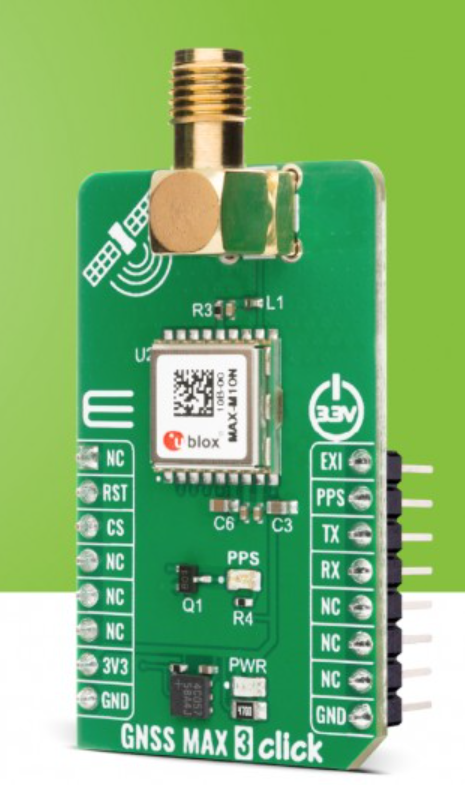
    A new GNSS board is available from Mikroe. The GNSS MAX 3 Click is a compact add-on board designed for low-power satellite positioning for embedded applications. It is based on the MAX-M10N-10B, a professional-grade standard-precision GNSS receiver from u-blox, built on the ultra-low-power u-blox M10 platform.

    Key Features

    • Multi-Constellation GNSS. Offers exceptional tracking capability across GPS, Galileo, BeiDou, and QZSS/SBAS systems for reliable global coverage
    • Ultra-low power. Uses the u-blox M10 platform and the LEAP (Low Energy Acquisition and Processing) energy-saving mode for extended battery life
    • Enhanced RF immunity. Features an additional SAW (Surface Acoustic Wave) filter for excellent performance in the presence of strong RF interference
    • Interference detection. Includes integrated jamming and spoofing detection for robust security and reliable operation
    • Fast acquisition. Supports AssistNow Predictive and Live Orbits for faster satellite acquisition (time-to-first-fix)
    • Standard precision. Provides consistent L1 GNSS performance at a standard precision level.

    Applications

    • Asset tracking devices and logistics solutions requiring long battery life and accurate location data
    • Portable devices and wearables where power efficiency is critical
    • Industrial monitoring and sensor applications requiring reliable, interference-resilient positioning
    • Any application demanding interference-resilient GNSS positioning.

    EmbeddedWiki

    Hundreds of ready-to-use embedded projects featuring this Click board are available on EmbeddedWiki.

  • Qualcomm launches Snapdragon W5+ and W5 platforms for wearables

    Qualcomm launches Snapdragon W5+ and W5 platforms for wearables

    Image: Qualcomm
    Image: Qualcomm

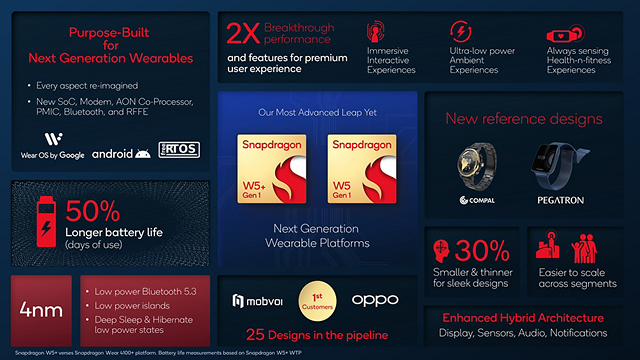
    Qualcomm Technologies has unveiled new wearable platforms, the Snapdragon W5+ Gen 1 and Snapdragon W5 Gen 1.

    The platforms are designed to advance ultra-low power and breakthrough performance for next-generation connected wearables with a focus on extended battery life and premium user experiences. They incorporate a series of innovations including low power islands for GNSS, Wi-Fi and audio; ultra-low power Bluetooth 5.3 architecture; and low power states such as Deep Sleep and Hibernate.

    New enhancements to the flagship Snapdragon W5+ platform offer 50% lower power, 2X higher performance, 2X richer features, and 30% smaller size, compared to our previous generation, enabling wearable manufacturers to deliver the differentiated experiences consumers demand. Based on the hybrid architecture, the purpose-built platform is comprised of a 4 nm-based system-on-chip and 22 nm-based highly integrated always-on co-processor.

    By using these platforms, manufacturers can scale, differentiate and develop products faster in the continuously growing and segmenting wearables industry, Qualcomm said.

    Qualcomm  also announced two reference designs from Compal and Pegatron, which showcase the capabilities of the platform and the company’s collaboration with ecosystem partners, helping customers develop products faster.

    Image: Qualcomm
    Image: Qualcomm

  • U-blox launches its smallest GPS module, the MIA-M10

    U-blox launches its smallest GPS module, the MIA-M10

    Photo: u-blox
    Photo: u-blox

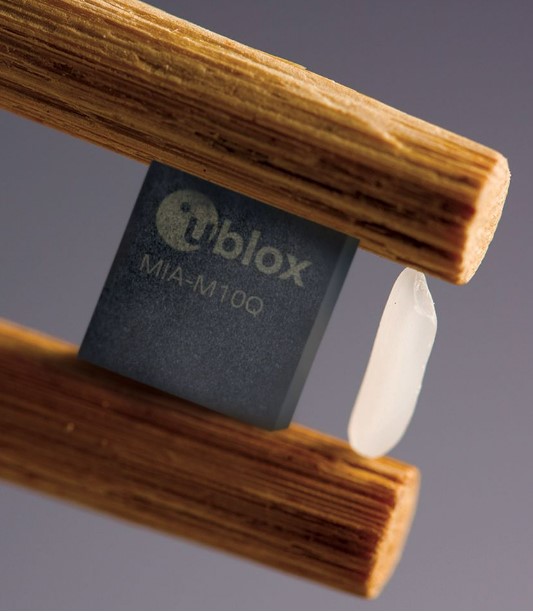
    U-blox has announced its smallest GNSS module series to date, the u-blox MIA-M10.

    Built on the ultra-low-power u-blox M10 GNSS platform, MIA-M10 offers a power-efficient solution for size-constrained battery-powered asset tracking devices. The module targets an expanding market for people, pet and livestock trackers, as well as industrial sensors and consumer goods.

    The 4.5 x 4.5-mm form factor of the M1A-M10 allows developers to design more attractive and comfortable solutions, further driving the adoption of positioning technology in consumer and industrial solutions. The module offers ultra-low power consumption without compromising GNSS performance, the company said. Moreover, its power-save modes can double the battery life by optimally balancing position accuracy and power consumption.

    Like all u-blox M10 modules, the MIA-M10 concurrently receives four GNSS constellations (GPS, Galileo, BeiDou and GLONASS) for maximum satellite signal availability. Combined with its superior RF sensitivity, the module offers robust positioning performance for solutions with small antennas as well as for devices operating in weak signal environments such as deep urban canyons.

    Support for u-blox AssistNow assisted GNSS service, which delivers orbital data via the internet, cuts the time it takes the MIA-M10 to determine its initial position at startup, allowing it to immediately track satellites without having to wait for slow satellite data downloads to complete. And applications requiring extra-long power autonomy can use u-blox’s CloudLocate service, which extends the life of internet-of-things applications by offloading power-hungry position calculation to the cloud.

    The chip-sized, ready-to-use GNSS module requires no external components, reducing engineering and testing efforts, saving costs and resources, and speeding time to market.

    Two Variants

    MIA-M10 is available in two product variants.

    • The MIA-M10Q is for a growing market of highly size-constrained battery-powered tracking devices, wearable devices and highly dynamic applications such as small drones, cameras, bike computers and battery-powered sensors.
    • The MIA-M10C targets customers requiring more flexibility to combine the module with an active or custom antenna circuit.

    The MIA-M10 will be on display at the Sensors Converge and Embedded Technologies trade show in San Jose, California, at booth 1228. First samples will be available in July.

  • OneNav announces pureL5 GNSS digital IP core

    OneNav announces pureL5 GNSS digital IP core

    The PureL5 Customer Evaluation System is being tested by California and Chinese companies

    oneNav logoOneNav has announced the commercial availability of its pureL5 GNSS digital IP core.

    The pureL5 digital IP core’s architecture enables it to directly acquire and track L5 signals from GPS, Galileo, BeiDou, QZSS and GLONASS without any L1 aiding. This eliminates the entire L1 RF chain, saves space on the printed circuit board, and simplifies the RF front-end and antenna subsystem in smartphones, wearables and trackers.

    The pureL5 digital IP core’s massively parallel array processor searches the entire 1-millisecond L5 code space in parallel, delivering 1 second time to first fix (TTFF). The pureL5 digital IP core is 0.28mm2 in the 3-nm semiconductor process and consumes 4.7 mW of power in 1-Hz tracking mode.

    OneNav has delivered the pureL5 digital IP core register-transfer level (RTL) to its first system-on-chip (SOC) customer. IP core RTL verification and physical implementation are complete, and oneNav’s SOC licensee will tape out in the first quarter of this year. The pureL5 digital IP core RTL is available for customer licensing and shipment now.

    Customer Evaluation System. OneNav’s pureL5 Customer Evaluation System is being tested by companies in California and China. The system is available for smartphone and wearable OEMs and SOC providers who want to evaluate oneNav’s pureL5 in the field and the lab.

    PureL5 GNSS Features

    • Smaller footprint than L1+L5 hybrids, simplifying implementation in highly space-constrained devices such as 5G smartphones and wearables
    • Lowers bills of material (BOM) cost and simplifies the RF front-end and antenna subsystem by eliminating the entire L1 RF chain
    • No L1 aiding required: directly acquires L5/E5/B2 with 1-second TTFF
    • Less software complexity, simplifies RF coexistence engineering
    • Better interference resiliency
    • Scalable IP signal processing core is semiconductor process-node independent
    • Multi-constellation L5: Beidou, Galileo, GPS, QZSS, GLONASS.
  • Samsung Introduces 5-nm processor with GNSS for wearables

    Samsung Introduces 5-nm processor with GNSS for wearables

    The Exynos W920 offers high performance, efficiency and LTE connectivity in tiny form factor

    Image: Samsung
    Image: Samsung

    Samsung Electronics is offering a new processor for wearables, the Exynos W920. The new processor integrates an LTE modem and is built with an advanced 5-nanometer (nm) extreme ultraviolet process node, offering powerful yet efficient performance demanded by next-generation wearable devices.

    The Exynos W920 is embedded with a GNSS L1 receiver (GPS, GLONASS, Beidou, Galileo) for tracking speed, distance and elevation during outdoor activities. It also has a 4G LTE Cat. 4 modem.

    “Wearables like smartwatches are no longer just a cool gadget to have. They’re now a growing part of our lifestyles to keep you fit, safe and alert,” said Harry Cho, vice president of System LSI marketing at Samsung Electronics. “With the Exynos W920, future wearables will be able to run applications with visually appealing user interfaces and more responsive user experiences while keeping you connected on the go with fast LTE.”

    The Exynos W920 has two Arm Cortex-A55 cores for high-performing, power-efficient processing and an Arm Mali-G68 GPU with CPU performance improved by 20 percent and 10 times better graphics performance than its predecessor. With upgraded cores and improved performance, the Exynos W920 enables faster application launches and more interactive, eye-catching 3D graphical user interface (GUI) on a device’s qHD (960×540) display.

    The Exynos W920 comes in a tiny package with Fan-Out Panel Level Packaging (FO-PLP). The technology incorporates the Exynos W920, power management IC and embedded multimedia card. The processor’s compact size allows smartwatches to house larger batteries or have sleeker designs.

    Always-on-display (AOD) for wearables, especially for smartwatches, is a widely adopted feature as it makes it effortless to take a quick look at the time, notifications, missed calls and more without the need to wake the watch up from sleep mode. Rather than powering up the main CPU, the W920 activates a dedicated low-power display processor, the Cortex-M55, reducing display power consumption under AOD mode compared to its previous Exynos model.

    The Exynos W920 supports a new unified wearable platform Samsung built jointly with Google, and will be first applied to the upcoming Galaxy Watch model.

  • Rx Networks adds StarCourse extended ephemeris services

    Rx Networks adds StarCourse extended ephemeris services

    Rx Networks has added a new extended ephemeris service called StarCourse.

    According to the company, real-time ephemeris services provide GNSS chipsets in connected mobile devices a headstart in determining position accurately and quickly. For devices with limited connectivity, typical extended ephemeris solutions have provided a headstart with 7-14 days of ephemeris data.

    With the evolution of the internet of things (IoT), low power consumption and a limiting of connection time are essential for extending the usable life of a device. This creates a challenge for IoT vendors seeking an extended ephemeris offering that can minimize onboard resource usage without compromising accuracy.

    The new StarCourse service provides a 50% reduction in RAM requirements, 90% reduction in CPU cycles, and ephemeris accuracy exceeding that of previous market offerings. This empowers Rx Networks customers to extend the usable life of their products while delivering an excellent positioning experience, the company said. Full data customization is offered to StarCourse subscribers, allowing them to create optimal solutions for their needs.

    StarCourse enables autonomous positioning on a wide array of connected GNSS IoT devices, including asset tracking, wearables, in-dash navigation and mobile devices. For situations where accuracy is paramount, StarCourse Premium provides ultra-precise predicted ephemeris for the first 24 hours.

    “GNSS assistance services are essential to solving the spatial intelligence requirements of the booming IoT world,” said Chris Perriam, product owner at Rx Networks. “StarCourse endeavours to quickly enlighten all connected devices with location.”

    Rx Networks provides location information to strengthen the connection between people, devices and businesses by improving the GNSS experience and creating enhanced opportunities for next-generation products and services.

    Image: Rx Networks
    Image: Rx Networks

  • Telit offers first L1+L5 module under collaboration with Sony

    Telit offers first L1+L5 module under collaboration with Sony

    Photo: Telit
    Photo: Telit

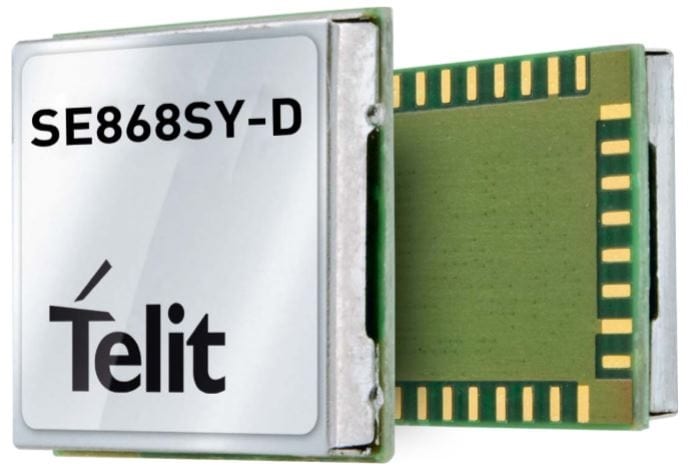
    Telit has launched the SE868SY-D multi-frequency, high-precision GNSS receiver module for applications that require high accuracy, fast updates, multi-constellation support and multipath resistance.

    At 11 x 11 mm, the SE868SY-D accommodates ultra-compact devices and IoT trackers.

    Available now, the high-precision SE868SY-D module is Telit’s first multi-frequency, multi-constellation GNSS receiver module, featuring an ultra-sensitive -167 dBm (tracking) RF front end. By using both the L1 and L5 bands, the SE868SY-D supplies a significantly higher location accuracy than single-frequency devices — even in high-multipath environments such as urban canyons, Telit said.

    This sub-1-meter precision is a major reason ABI Research expects more than 1 billion multi-frequency GNSS devices to ship annually by 2023.

    The SE868SY-D is the first product from a new strategic collaboration between Sony and Telit, and features Sony’s next-generation CXD5610 GNSS receiver large-scale integrated circuit (LSI).

    The Telit SE868SY-D is designed for battery-powered applications such as IoT trackers and wearables. With less than 45 mW in L1+L5 tracking mode, the module has low power consumption, despite using both L1 and L5 bands.

    For high-dynamic applications, the SE868SY-D a high update rate of up to 25 Hz. Its high-accuracy, one-pulse-per-second signal also makes the module suitable for timing applications.

    “With the new SE868SY-D, Telit is uniquely prepared to meet the burgeoning global demand for multi-frequency, multi-constellation GNSS receivers for IoT trackers, wearables and more,” said Eric Lagorce, Telit business development director. “The SE868SY-D also perfectly complements Telit’s two decades of GNSS expertise and its broad portfolio, and highlights the potential of our strategic collaboration with Sony.”

    The Telit SE868SY-D provides pin-to-pin compatibility for applications based on Telit’s legacy GPS module JF2 and GNSS module SE868V3.

  • U‑blox low-power M10 receiver designed for wearables, asset tracking

    U‑blox low-power M10 receiver designed for wearables, asset tracking

    M10 receiver platform can track four GNSS constellations, even in challenging environments

    Photo: u-blox
    Photo: u-blox

    U-blox’s new M10 GNSS platform is designed for ultra-low-power high-performance positioning applications such as sport watches and asset trackers.

    The M10 positioning platform can track up to four GNSS constellations at once to deliver positioning data even in challenging environments such as deep urban canyons. The receiver’s Super-S technology helps distinguish positioning signals from background noise to capture positioning data even when satellite signals are weak.

    Its high RF sensitivity also enables it to work well with small antennas, making it suitable for compact product designs. In sport watches, for instance, u-blox M10 guarantees highly dynamic positioning accuracy during a run in cities, woods or under an open sky, while preserving battery life.

    Low power consumption. The u-blox M10 is designed to consume 12mW in continuous tracking mode, five times less than the power consumed by previous u-blox meter-level GNSS technology, making it beneficial for battery-powered applications.

    U-blox M10’s enhanced RF sensitivity also cuts the time it takes for the platform to achieve a first position fix when initialized, further reducing systemic power consumption. And switching to the improved Super-E mode can extend battery life even more.

    This new GNSS platform will be supported by AssistNow, u-blox’s assisted GNSS service, to accelerate positioning and improve accuracy. Depending on the required level of assistance, the service is available free of charge or for a recurring fee.

    Jamming detection. The u-blox M10 platform benefits from u-blox’s experience in building robust GNSS receivers, incorporating proven techniques for detecting spoofed signals through the analysis of raw GNSS data, jamming-detection strategies, and embedded filters to mitigate the effects of in-band RF interference.

    “U-blox can be proud of over 20 years of experience with GNSS technology, and with u-blox M10 we are setting a new benchmark in ultra-low power high performance positioning applications,” said Bernd Heidtmann, product manager, Product Center Positioning, u-blox. “We have increased concurrent reception of satellite signals by a GNSS platform from three to four constellations and improved the power consumption level five-fold compared to previous generations while shrinking the chip size by 35 percent.”

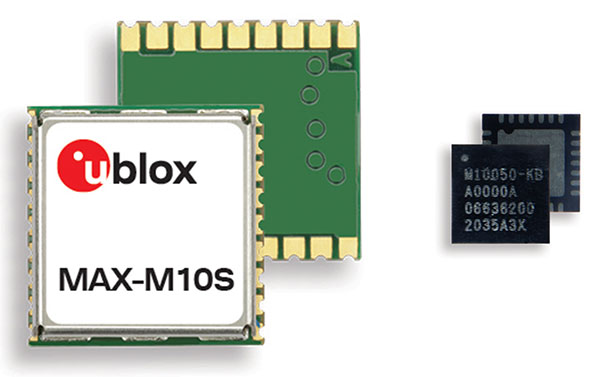
    The first products based on the u-blox M10 positioning platform are the MAX- M10S GNSS module and the UBX-M10050 GNSS chipset, which are both available now. Design-in of the new u-blox M10 platform is enhanced and simplified with u-center GNSS evaluation software.

  • YIC offers low-power GPS/GNSS module for internet of things

    YIC offers low-power GPS/GNSS module for internet of things

    YIC logoYuechung International Corp. (YIC) is offering a GPS/GNSS module for internet of things (IoT) applications.

    YIC is a manufacturing and design company for quartz crystals, crystal oscillators, GPS/GNSS modules, GPS/GNSS receivers and RF antennas. It provides low-power solutions to solve product problems that require frequent charging.

    YIC’s new product — the Ultra Low Power GPS/GNSS Module (Model YIC71009EBGG and YIC71513PGMGG) — is designed as an IoT product solution, targeted to improve the operating times of IoT applications such as trackers, wearables and portable devices.

    According to its press release, YIC “is dedicated to providing the best solution for GPS devices and sees a tremendous opportunity in the GNSS market to solve power consumption problems.” The recent industry trend of multi-frequency GPS, low-power consumption, and dead reckoning will be advantageous to YIC in terms of high-grade products entering the global market.

    Models YIC71009EBGG and YIC71513PGMGG provide:

    • Ultra-low power consumption – 6mA (Typical).
    • Multi-constellation – GPS/QZSS + GLONASS.
    • Small size

    About YIC

    Founded in 1994 and headquartered in New Taipei City, Taiwan, YIC is a professional partner in frequency control, GPS/GNSS modules, receivers and RF antennas, advanced low power GPS, and small size solutions.