Tag: wearables

  • In aftermath of ransomware attack, Garmin services begin to return

    In aftermath of ransomware attack, Garmin services begin to return

    Following a ransomware attack last week that left Garmin Connect and other services offline, the company is gradually restoring its internet capabilities.

    For those who make use of fitness tracking, however, Garmin Connect workouts are still not able to sync to devices and the app is under maintenance, reports CNN.

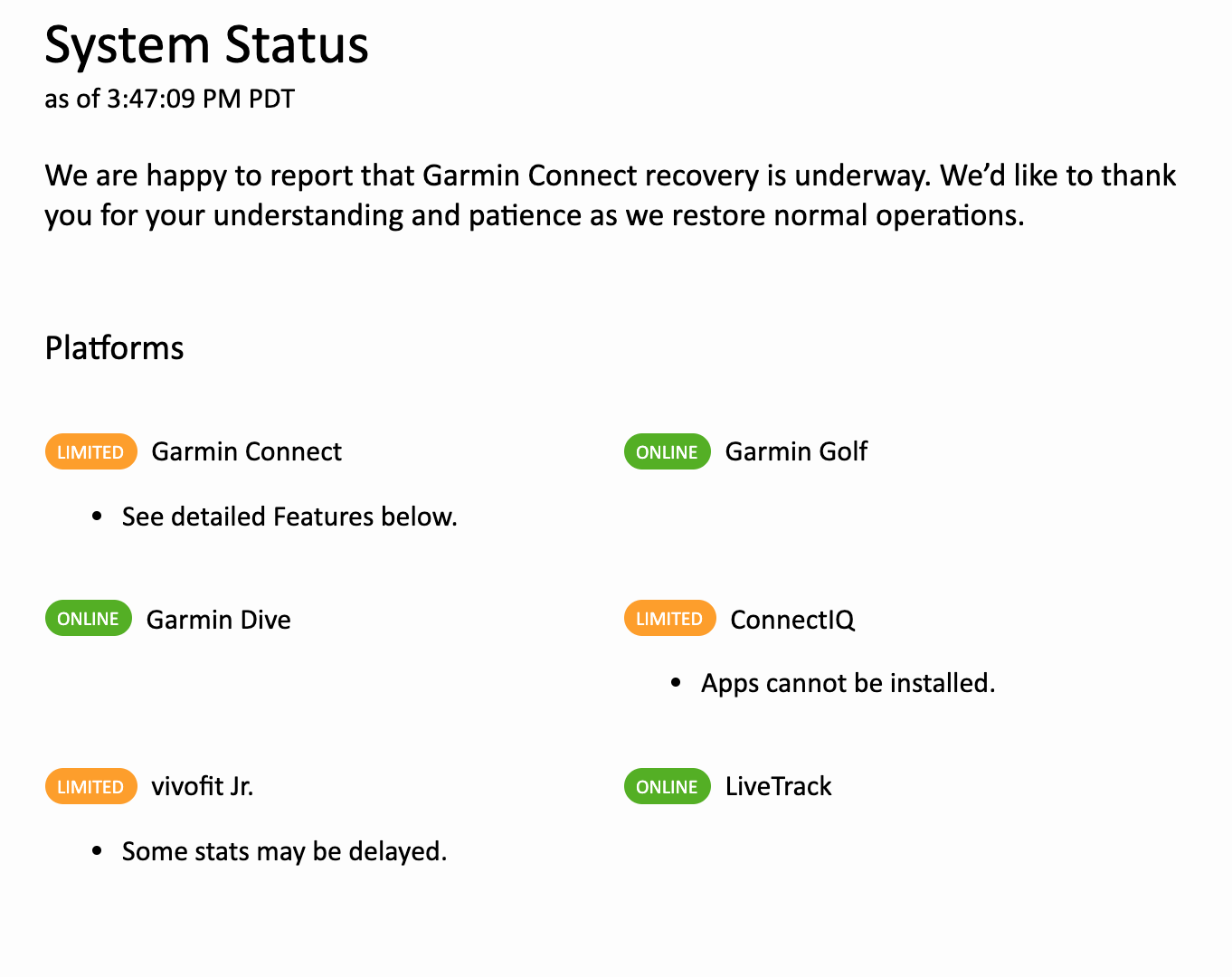
    “We are happy to report that Garmin Connect recovery is underway,” the company announced on the Garmin Connect website. Some platforms have been given the green light, while others are offering limited services.

    The company also said in a statement that there is “no indication” that customer data was accessed, stolen or lost.

    Screenshot of Garmin Connect website, July 27.
    Screenshot of Garmin Connect website, July 27.
  • Garmin hit by massive ransomware attack

    Garmin hit by massive ransomware attack

    Fitness wearables disconnected for one day and counting

    Garmin fitness devices have been disconnected for nearly a day after the company suffered a major outage, reports the Verge.

    The outage may be caused by a ransomware attack. The outage was first reported by Garmin July 23. It affects Garmin wearables, apps and call centers, which has made customer support impossible.

    The message on the Garmin Connect website reads, “We’re sorry. We are currently experiencing an outage that affects Garmin.com and Garmin Connect. This outage also affects our call centers, and we are currently unable to receive any calls, emails or online chats. We are working to resolve this issue as quickly as possible and apologize for this inconvenience.”

    Garmin Connect allows customers to obsessively track their exercise performance and fitness goals. FlyGarmin, the navigation service that supports Garmin’s aviation devices, has also been down affecting some pilots, reports ZDNET.

    The ransomware attack has encrypted Garmin’s internal network and some production systems, according to ZDNET. The company is planning a multi-day maintenance window to deal with the attack’s aftermath, which includes shutting down its official website, Garmin Connect, FlyGarmin, and even some production lines in Asia.

    Screenshot: Garmin website
    Screenshot: Garmin website
  • New Bosch sensor for wearables improves GPS location tracking

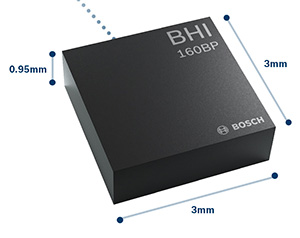
    The BHI160BP position tracking smart sensor. (Photo: Bosch Sensortec)
    The BHI160BP position tracking smart sensor. (Photo: Bosch Sensortec)

    Bosch Sensortec has released the BHI160BP, a position tracking smart sensor that uses integrated inertial sensors to improve GPS location tracking.

    Bosch will exhibit the new sensor at Electronica Munich, Nov. 13-16.

    When used with a GPS or GNSS module, the BHI160BP enables users to take full advantage of pedestrian position tracking with up to 80 percent saving in system power consumption compared with a typical GNSS-only solution, without compromising on accuracy, the company said.

    Users benefit from greatly extended battery life and longer charging intervals for wearable applications such as smartwatches and fitness trackers as well as mobile devices such as smartphones.

    The new position tracking approach is set to enable a new class of compact devices with even smaller batteries, Bosch claimed.

    The BHI160BP tracks a person’s position by intelligently applying an inertial-sensor-based algorithm for pedestrian dead reckoning. To maintain accuracy, it calculates the user’s relative location based on data collected from the inertial sensors and then recalibrates itself every few minutes to obtain the absolute position provided by the GNSS/GPS module. This means that the GNSS/GPS module can be kept in sleep mode for most of the time, which drastically reduces a device’s power consumption and extends its operating time.

    “Pedestrian position tracking is a crucial application for mobile applications; unfortunately, GPS modules can rapidly drain a device’s battery capacity — especially when the battery is as small as in wearable devices,” said Stefan Finkbeiner, CEO of Bosch Sensortec. “Our new position tracking smart sensor solves this problem and enables users to navigate reliably while extending the operation of GPS tracking in their devices from several hours up to several days.”

    With the BHI160BP, a device can maintain solid accuracy even when the GNSS signal is blocked or weak, such as near tall buildings or indoors, the company added. This ensures accurate pedestrian navigation at all times, even in shielded indoor areas such as subways, Bosch said.

    The BHI160BP is a new member of Bosch Sensortec’s BHI160 family and adds application-specific functionality for position tracking. It provides a ready-to-use solution that can be quickly and easily integrated into a system design without requiring an update to a new GNSS module, thereby significantly cutting time to market, Bosch said.

    While the current configuration is optimized for use with GNSS receivers (such as GPS), the BHI160BP can also support most of the common global localization technologies. According to the company, the BHI160BP can handle gesture recognition and 3D orientation, with 3D calculations performed by the sensor itself rather than by an application processor.

    The new BHI160BP draws 1.3 mA in active operation mode and integrates the company’s Fuser Core microcontroller and a six-axis inertial measurement unit. The BHI160BP offers a variety of customized virtual sensors, such as a calibrated accelerometer, orientation and wake-up gesture, within a single device. It BHI160BP can be extended by connecting additional physical sensors, such as a magnetometer, over a secondary interface.

    The new BHI160BP comes in a compact 3 x 3 x 0.95 mm³ LGA-package and is pin-to-pin compatible with the BHI160. It will be available via distribution in December.

  • OriginGPS launches ultra-compact GNSS module

    OriginGPS launches ultra-compact GNSS module

    OriginGPS has released its new ORG 4500 series, which is a fully-integrated product that supports ultra-compact applications for both GPS and GLONASS.

    The ORG 4500, kin to the ORG 4400 series introduced in 2016, addresses the increasing demand for high precision with the smallest possible footprint, and takes the company’s ultra-small form factor to a new level.

    OriginGPS ORG 4500 is designed for ultra-compact IoT applications such as wearables, smartwatches, clothes and pet trackers, drones, connected cars, and health testing and tracking devices.
    OriginGPS ORG 4500 is designed for ultra-compact IoT applications such as wearables, smartwatches, clothes and pet trackers, drones, connected cars, and health testing and tracking devices.

    “The newest GNSS product perfects the industry’s most comprehensive GNSS/GPS family of solutions,” said Haim Goldberger, CEO of OriginGPS. “Our modules readily resolve the industry’s acute pain points of unreliability and sensitivity in the commercial, engineering and defense sectors, enhancing the quality of experience and helping our customers remain competitive.”

    OriginGPS offers a range of fully-integrated GNSS/GPS and antenna solutions, encompassing a wide gamut of standard and essential tools for navigation. The small form factor and high sensitivity of OriginGPS’s modules enable new business models, like “machine as a service,” and are suited for a variety of applications, such as wearables, like smart watches and pet tracking, as well as smart cities and drones.

    OriginGPS modules are deployed around the globe in key sectors, such as transportation, civil engineering, precision agriculture and time reference.

    Narrowband IOT platform. Ramping up the race to offer the best Narrowband IoT (NB-IoT) products, OriginGPS continues to expand its presence in the global navigation market with a steady stream of new IoT-enabled solutions, such as its recently released IoT platform (ORG 2100).

    A key theme again at this year’s Mobile World Congress was the Internet of Things, with an additional focus on the challenges of ensuring interoperability of home and industrial applications. OriginGPS’s IoT Platform effectively removes usability challenges with a plethora of customizable sensors, such as temperature, pressure, accelerometer, light and humidity.

    OriginGPS will showcase its range of mini + mighty GNSS/GPS modules at Embedded World 2017, Germany, March 14-17, hall 3, booth 121.

  • U-blox launches multi-GNSS module for wearables, UAVs

    U-blox launches multi-GNSS module for wearables, UAVs

    The u-blox ZOE-M8Q is designed for wearables, UAVs and asset trackers.
    The u-blox ZOE-M8Q is designed for wearables, UAVs and asset trackers. Photo: U-blox 

    U-blox has launched a new positioning module, the ZOE-M8G. The ZOE-M8G is an ultra-compact GNSS receiver module designed for markets where small size, minimal weight and high location precision are essential.

    ZOE-M8G offers exceptionally high location accuracy by concurrently connecting to GPS, Galileo and either GLONASS or BeiDou. It also provides -167 dBm navigation sensitivity, important for wearable devices, unmanned aerial vehicles (UAVs) and asset tracker applications.

    The new u-blox ZOE-M8G helps simplify product designs, because it is a fully integrated, complete GNSS solution with built-in SAW-filter and Low Noise Amplifier (LNA). It can be used with passive antennas without the need for additional components, and doesn’t compromise performance.

    The ZOE-M8G GNSS module measures 4.5 x 4.5 x 1.0 millimeters. Due to its small size, a complete GNSS design using a ZOE-M8G module takes approximately 30 percent less printed circuit board (PCB) area compared to a conventional discrete chip design with a CSP chip GNSS receiver.

    “When you’re designing products such as smart watches, fitness trackers, asset trackers, UBI dongles and even drones, every square millimeter and every gram counts. The u-blox ZOE-M8G makes it significantly easier for product designers to achieve precise location tracking while keeping within their strict form factor and weight restrictions,” said Uffe Pless, product marketing, Positioning Product Center at u-blox.

    Samples of the u-blox ZOE-M8G will be available in February 2017, and volume production will start in October 2017.

  • MediaTek offers hardware development kit for wearables

    MediaTek offers hardware development kit for wearables

    MediaTek has announced the availability of the LinkIt 2523 Hardware Development Kit (HDK) for developers looking to create advanced wearable products. Based on the MediaTek MT2523G chipset, the HDK — produced by Silicon Application Corp (SAC) — offers dual-mode Bluetooth, comprehensive GNSS standards support and industry leading performance in terms of time-to-first-fix, accuracy and power consumption.

    The HDK is designed for developers looking to create sophisticated wearables such as smartwatches, fitness trackers, health monitors, emergency locators and more.

    mt2523-hdk
    MediaTek LinkIt 2523 HDK.

    This new HDK — the second for the LinkIt Development Platform for RTOS — takes advantage of the platform’s common tool chain and set of APIs. It offers developers the ability to create a range of IoT devices using a common software development kit, the MediaTek LinkIt SDK v4. With the HDK launch, the SDK has also been updated to include a new smaller, more efficient Bluetooth stack and various improvements to support the MT2523 chipset variants.

    The goal of the LinkIt Development Platform for RTOS is to make it easy for developers to create code that powers a range of wearables and IoT devices. The new HDK puts MediaTek leading technology in the hands of professional developers to create exciting and compelling wearable products.

    The LinkIt 2523 HDK is developed by SAC, one of MediaTek’s value-added resellers of chipsets and modules, using a hardware board reference design from MediaTek. The HDK provides an easy-to-use IoT development board for the design, prototyping, evaluation and implementation of commercial wearables projects.

    The board offers developers a range of essential features to ensure devices are market ready. Key features of the board include:

    • Robust connectivity with support for dual-mode Bluetooth 2.1 + EDR and Bluetooth 4.2 Low Energy with integral antenna.
    • Fast, low-power, high-precision positioning with integral HDK antenna for GPS and SMA connector for GLONASS, Galileo and BeiDou.
    • Integrated display and versatile peripheral options, including I2C, master and slave SPI, master and slave I2S, PCM, UART, 12-bit ADC and PWM which can be used for a broad range of wearables, including smartwatches, fitness trackers and wristbands incorporating various sensors.
    • Low power consumption achieved by highly integrated SoC using 55nm ultra-low power (ULP) technology from TSMC with Power Management Integrated Circuit (PMIC), and multiple frequency and voltage modes.
    • Flexible power options for external battery and USB (5V) charger.
    • Additional onboard memory (eMMC) or the option to use a microSD card.

    Key features of the LinkIt Development Platform for RTOS include:

    • Based on the popular FreeRTOS with additional open-source modules (source code available).
    • Supports chipsets based on the ARM Cortex-M4 architecture, offering high performance, low power connectivity.
    • Supports multiple chipsets/hardware, including the MT7687F Wi-Fi SoC and the MT2523 Bluetooth/GNSS chipset family.
    • Development and debugging in ARM Keil μVision, IAR Embedded Workbench and GCC.
  • Xsens launches knowledge BASE for inertial tracking, wearable motion capture

    Xsens launches knowledge BASE for inertial tracking, wearable motion capture

    xsens-base-w

    Xsens has launched BASE, an online technology platform with a community forum and a knowledge base on 3D motion tracking technology and products.

    On BASE.xsens.com, the knowledge base contains inside information about micro-electro-mechanical system (MEMS) sensors, inertial measurement units (IMU), sensor fusion algorithms, body-motion tracking and motion capture.

    It also provides best practices, tips and tricks for the use of Xsens’ successful products the MTi series, the MTw and the MVN wearable motion capture solutions. A second section of BASE is the community forum with direct access to Xsens’ engineers and other Xsens users.

    The knowledge base and community forum make it easier to integrate the MTi or MTw and to get the most out of MVN. If a question is not answered in the knowledge base, it is straightforward to ask a question to the community. With short response times from either other Xsens users or the entire Xsens engineering team, the user community is a quick way to continue development, Xsens said.

    BASE is a next step by Xsens to support the growing community and interest in inertial technology. It further enhances the interaction between users and Xsens.

    “Although Xsens makes it easy to use inertial technology in their applications, the underlying technology is complex and there are many features for specific applications,” said Remco Sikkema, Xsens marketing manager. “Understanding the technology makes it easier to integrate the products and be successful with Xsens.”

    With BASE, engineers and engineering teams in the Xsens community can come closer together. The primary goal is to make Xsens customers more successful by providing a platform to exchange information.

    There is no need to register for BASE to access the community forum and the knowledge base. To ask questions or comment on articles, registration is possible via SSO or email.

  • Rio Olympics reflected technology advances

    Rio Olympics reflected technology advances

    The Olympics are great for technology. Yes, the competition held every four years highlights amazing athletes. But its vast support network relies on numerous technologies, including GNSS.

    rio-OLYMPICS-2016-WGNSS technology helped fans follow the canoe sprint and rowing events in Rio in more detail than before. With GPS devices attached to every vessel, spectators were able to see key data such as speed and direction — information that helps when following a lengthy race taking place offshore.

    For the first time, Olympic athletes used high-tech wearables to give them an edge. Solos Smart Eyewear was designed for the USA’s Cycling team with features that allowed cyclists to see key metrics such as speed, power, distance, cadence and heart rate, plus more data from any number of connected sensors.

    Drones Aloft. Drone technology has exploded since the London 2012 Olympics. In Rio, broadcasters experimented with hovering cameras. The BBC worked with Open Broadcast Service to provide international broadcasters with drone coverage of the rowing.

    As for hobbyists, drone-maker DJI updated its firmware with Olympic geofences, preventing drones from flying over events. Not every drone manufacturer implements geofences, so the Brazilian military was equipped with new devices to jam drone-control signals mid-flight. The IACT DroneBlockers blast incoming drones with radio signals, effectively jamming the signal from the controller.

    Beware Zika. Meanwhile, mapping technology is helping to track the spread of the Zika virus. Before the games, the World Health Organization launched a Zika app to provide information about the disease.

    After the Olympics, IBM will provide local authorities with ways to track weather, social media data and travel patterns. Esri is supporting local authorities and coordinating field workers to track and contain the disease in Brazil and elsewhere.

    What’s next? We’ll find out in Tokyo in 2020.

  • OriginGPS and TDK collaborate on antenna integration for wearables

    TDK, a manufacturer of electronic components, and OriginGPS, a manufacturer of miniature GNSS modules, are collaborating to maximize GNSS performance in small devices such as wearables.

    As part of the collaboration, customers using OriginGPS Spider modules will receive increased support to integrate TDK antennas into their designs, including existing reference designs coupled with TDK’s extensive electromagnetic simulation capabilities on GNSS performance.

    “TDK is one of the most well-respected names in the RF industry, so it goes without saying that we’re very excited to be working with them to provide best-in-class location modules to their customers,” said Gal Jacobi, CEO of OriginGPS. “By joining designs of our products with TDK’s small form-factor chip antennas, customers will be able to get a firsthand understanding of how our GNSS solutions pack the world’s smallest footprint and add functionality to a wide range of wearables and other Internet of Things devices that require low-profile miniaturized chip antennas.”

    The collaboration pairs OriginGPS’ smallest GNSS receiver modules, including the recently unveiled Multi Micro Spider, with the tiny chip antennas by TDK to deliver a “mini + mighty” solution for wearables that combines TDK’s specialized RF simulation capabilities with OriginGPS’ GNSS expertise and support.

    The collaboration also benefits OriginGPS customers, the companies said. Those who purchase Spider product line modules for their wearables can now use them in conjunction with TDK antennas to meet specific requirements while minimizing design time, and receive TDK’s support for antenna matching and simulations.

    “The combination of TDK’s small chip antennas along with OriginGPS’ GNSS receiver modules provides customers the best solution to miniaturize their products,” said Tuomo Katajamaki, Product Manager, RF Components of TDK. “Now customers can effectively see for themselves the advanced location capabilities that are possible by pairing OriginGPS’ GNSS modules with our omni-directional antennas, creating a unique solution for wearable applications that balances efficiency with our small form factor.”

  • Micro module designed for UAVs, wearables

    GNSS module maker OriginGPS has launched the new Multi Micro Spider, which has a fully integrated and highly sensitive multi-GNSS module, with support for GPS, Glonass, BeiDou and Galileo.

    The Multi Micro Spider is designed for applications that require quick movement, minimal power consumption and ultra-small form factors, such as wearables and drones.

    Like its predecessor, the Multi Micro Hornet (ORG1510-MK), the Multi Micro Spider’s (ORG4033) module utilizes MediaTek’s MT3333 chip and its onboard flash memory to achieve a rapid update rate and positioning speed of up to 10 Hz.

    “With the Multi Micro Spider, we’re breaking new ground in what’s possible with GNSS footprints,” said Gal Jacobi, CEO of OriginGPS. “It’s a plug-and-play solution that will enable developers to easily improve performance of products while shortening time to market. Because of its size, low power consumption and high performance, the Multi Micro Spider is the perfect GPS and GNSS solution to power the location services for a wearable out on the go to a UAV tracking action sports.”

    Key features include:

    • Peak performance with ultra-small size — At just 5.6 mm x 5.6 mm, with a height of 2.65 mm, the Multi Micro Spider packs in a sub-one second Time To First Fix (TTFF) and sensitivity of -165 dBm for two simultaneous constellations. All of this achieved using less than 9 mW of power.
    • OriginGPS’ Noise Free Zone (NFZ) — The ORG4033 utilizes OriginGPS’ patented and proprietary NFZ technology for continued noise immunity and razor-sharp sensitivity even in poor signal conditions.
    • Onboard flash for market-leading update rate — With an onboard flash memory and an update rate of up to 10Hz, the Multi Micro Spider breaks the market’s standard update rate benchmark of 5 Hz for positioning, accurate to within 2.5 meters.
    • Intuitive design that facilitates shorter time to market — The Multi Micro Spider makes use of a developer-friendly design that allows for seamless migration from GPS to GNSS pin-to-pin compatibility. This both reduces overall development costs for new products and shortens their time to market.
    • Easy integration with OriginGPS’ miniature GNSS antenna solutions — The Multi Micro Spider can be easily integrated with the ORG12-4T-GNSS miniature patch antenna to get the best performance out of a compact form-factor.
  • New CEVA Dragonfly platform designed for M2M systems

    CEVA Inc. has introduced the Dragonfly reference platform to accelerate the design of low-data-rate machine-to-machine (M2M) and Internet of Things (IoT) communication applications, including standalone wearables, smart grid, surveillance systems, asset tracking, remote monitoring systems, connected cars and smart utilities.

    The Dragonfly multifunction platform is enabled by the recently announced CEVA-XC5 and CEVA-XC8 digital signal processor (DSP) cores and accompanied by the hardware and software components required to rapidly design machine-type communications (MTC) systems.

    The platform supports GPS, Wi-Fi and other IoT-related communications standard set to be deployed for M2M communication as well as existing and emerging LTE MTC releases and LPWAN standards such as LoRa, SiGFox and Ingenu. LTE MTC — LTE Advanced for machine-type communications — significantly increases battery life, reduces device complexity, and enhances coverage for low data rate machine-type communications.

    At Mobile World Congress 2016, CEVA will demonstrate the Dragonfly reference platform running LTE Cat-0 and GPS concurrently on its silicon-based development platform together with test and measurement equipment from Keysight Technologies and a GNSS simulator from Galileo Satellite Navigation. Mobile World Congress takes place in Barcelona, Spain, Feb. 22-25. CEVA is located in Hall 6, Stand A50.

    Dragonfly offers system developers a flexible platform that allows for optimal hardware/software system partitioning, combining a low-power vector communication DSP with a range of hardware co-processors. Such partitioning enables the software flexibility essential for upgradability and long service life of typical M2M devices, while delivering the power efficiency required to support extended battery life of up to 10 years.

    As an example, for CEVA licensees developing M2M systems incorporating LTE Cat-1 or Cat-0 today, these systems can be easily upgraded to support LTE Cat-M or other future standards when available. The DSP can also be used to implement proprietary features for specific device use cases, such as seamless indoor and outdoor positioning concurrently with Wi-Fi 802.11n or LTE Cat-0, in a highly efficient manner.

    “Our Dragonfly reference platform brings together all of the essential hardware, software and system integration components required by customers developing low-power machine-type communication solutions, in a highly cost and power efficient manner,” said Michael Boukaya, vice president and general manager, Wireless Business Unit at CEVA. “We have leveraged our deep expertise in low-power baseband processing and complemented it with a range of software offerings to deliver a platform that is highly customizable and flexible for developing a broad range of IoT and M2M products, quickly and efficiently.”

    The Dragonfly reference platform includes the vector communications DSP and all the required co-processors and interfaces, together with software application layers and libraries, RTOS and drivers for MTC systems design. These hardware and software components are available for LTE MTC, Wi-Fi and GNSS standards. Also included is a 500-MHz silicon-based development system that includes all of these components together with RF front ends and a host interface.

  • CES 2016: Bosch Sensortec unveils intelligent accelerometers and high-performance gyroscopes

    Bosch Sensortec is unveiling new generations of intelligent accelerometers and high-performance gyroscopes at the 2016 International CES in Las Vegas.

    Aimed at smartphones, tablets and wearables, the new devices cover a wide range of requirements, from low-power consumption for always-on applications such as step counting, to high-performance optical image stabilization (OIS).

    Intelligent three-axis accelerometers — BMA422 and BMA455

    Today’s applications running on modern mobile devices place many demands on motion sensors. These sensors are required to continuously sense motion, such as for step counting operations, while at the same time delivering a high level of performance without compromising battery lifetime.

    To meet these challenges, the new sensors from Bosch Sensortec integrate embedded intelligence functionality into standalone accelerometers. Adding intelligent features to an accelerometer enables innovative applications, while minimizing power consumption by eliminating the need to wake up an application processor or an additional discrete sensor hub. Overall system power management and user experience can be improved by the accelerometer detecting and processing motions such as glance, pick-up and tilt.

    Current consumption of the new accelerometers is kept very low to extend battery life. The integrated Android 6.0 “Marshmallow” features minimize programming effort for customers. Each device delivers outstanding accelerometer performance for low offset, low temperature coefficient offset (TCO) and low noise levels, the company said.

    Two new accelerometers are being launched: the BMA422 “all-rounder” is suitable for standard applications, and the BMA455 provides high performance for gaming and immersive activity tracking. In addition, the high level of performance enables demanding applications covering augmented reality, virtual reality, image stabilization and industrial measurement applications such as spirit leveling and inclination measurement.

    High-performance gyroscopes — BMG250 and BMG280

    Mobile devices require gyroscopes for many applications, including gaming, augmented reality, virtual reality and OIS. To provide the necessary performance, Bosch Sensortec’s new gyroscopes combine the most important parameters in a single device: low noise, low TCO and high bias stability.

    Although delivering high performance, they do both feature the lowest power consumption of any standalone gyroscope in the market, thus helping to extend battery lifetime in mobile devices.

    Today’s announcement includes two three-axis gyroscopes: the BMG250 provides low noise, low TCO and high bias stability, while the BMG280 delivers ultra-low noise optimized for OIS and includes a secondary interface for OIS, making it fit for use in camera modules. The BMG280’s secondary interface can be used in parallel with the primary user application interface, for example for simultaneous panorama creation and OIS.

    Packages and availability

    The new devices are provided in small packages. The BMA422 measures 2.0 x 2.0 x 0.95 mm³, while the BMA455 is 2.0 x 2.0 x 0.65 mm³. The BMG250 and BMG280 gyroscopes both measure 3.0 x 2.5 x 0.83 mm³.

    Samples of the all sensors are available now, with mass production of the gyroscopes to commence in Q1 2016 and mass production of the accelerometers starting in mid-2016. For pricing, contact Bosch Sensortec.