Blog

  • Commanding Conversation

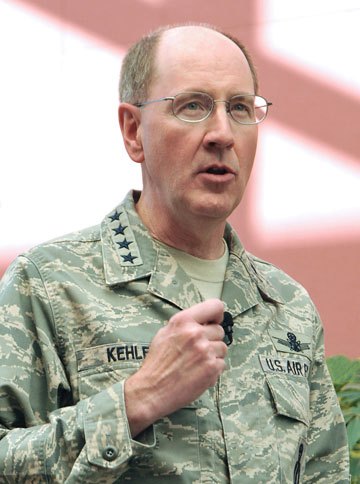
    General C. Robert Kehler, Commander of the U.S. Air Force Space Command
    General C. Robert Kehler, Commander of the U.S. Air Force Space Command

    Editor Don Jewell Talks with the Air Force General Heading Space Command: His Views, Use, and Plans for GPS

    Defense editor Don Jewell is a retired Air Force officer who served for 30 years; many of his former peers and contemporaries are currently senior officers in today’s U.S. Air Force. Don sat down recently with General C. Robert Kehler, Commander of the U.S. Air Force Space Command, whom he has known and worked with for more than 20 years, to discuss GPS from the four-star point of view.

    Don Jewell (DJ): General Kehler, thanks for taking the time to have this discussion today. I would like to keep this very informal, more of a conversation, like the days when you and I and Willie Shelton [now Lt. Gen. Shelton, USAF] sat around on your lanai, sharing a brew, telling war stories, and solving the world’s problems.

    General Kehler (GK): Believe me, Don, there are days when I wish we were still doing that. I appreciate the opportunity to have a conversation with you.

    DJ: Great. Sir, to get to the crux of the matter, as the senior warfighter for space, how do you see GPS in the future, and how does it contribute to the joint fight?

    GK: Don, you know this, as may many of your readers at GPS World, but I don’t believe we can say it often enough: GPS is the primary source of position, navigation, and timing (PNT) information for the Department of Defense, and it will remain that way at least until the year 2030. This has been a remarkably successful program, supporting the joint warfighter in nearly every aspect of joint operations. How GPS supports joint operations, whether it’s the individual soldier, sailor, airman, Marine, or Coast Guardsman, who is on the ground or inflight or who happens to be in the dark in a mountainous region somewhere or in the flat expanse of the desert — it doesn’t much matter. GPS has been their constant companion now for many years. They have come to rely on GPS in ways that help them do their job better, and it allows them to perform missions that in the past they would not have been able to perform in this kind of a manner, with this kind of perfectness.

    GPS is going to remain the foundation of the PNT strategy. And with the modernization effort that we have underway in GPS, we are going to make sure that it remains the world’s premier source of position, navigation, and timing information, and in particular that it remains woven through the fabric of the joint warfighting network.

    DJ: This portends an excellent future for GPS, despite comments by the Air Force Chief of Staff and Gen. “Hoss” Cartwright, vice chairman of the Joint Chiefs of Staff, that we should move away from GPS. Do the Chief’s comments cause you any concern?

    GK: They do not cause me any concern. We are committed to keeping GPS the gold standard. We have a commitment in that regard. I understand exactly what the Chief of Staff said and why. I will be happy to discuss that more.

    DJ: We’ll table that for now, and get to it later if we have the time. I have often heard you say in your GPS update and status briefings that GPS is one of your good systems. Indeed, you have described it as one of the systems you don’t have to worry about too much, because it works. It would be interesting to ascertain how you know when you are doing a good job with GPS. How do you know it works? For example, do you receive comments, e-mails, or letters from warfighters?

    GK: I think there are really two big ways that we know we are doing a good job with GPS. First of all, we measure our performance against the standard. What the users see, of course, is accuracy and satellite availability. Those have become our two primary standards. We make sure we are performing up to those standards. And in fact, as you know, we continually outperform those documented standards and the requirements that we have.

    We also look, not only at the satellites, but at the ground command and control (C2) system and the ground support network. We make sure those elements are always up and running as well. From a numbers standpoint, from a  “how well are we meeting the standards we have set for ourselves” standpoint, we exceed those standards. We exceed in terms of accuracy and availability, both the satellite system and the ground-supporting infrastructure as well.

    But these days, I will tell you, I think the numbers are interesting, but what I think we look at just as hard is how the public talks about GPS.

    And if you look today, GPS, at least in my opinion, is everywhere in the public conscience. I was saying earlier today, you really don’t have to go much farther than your television set. Almost any evening you turn the TV on you’ll hear something about GPS. You’ll either hear people who are equating their product to GPS, or you’ll hear in a television show someone mention GPS or their GPS device. And that is without it being a program about the satellites themselves, or the U.S. Air Force, or the things we do at Schriever Air Force Base to make it all work.

    My view is that the fact that we get this informal public feedback constantly, and that it’s positive, says a lot about how good a job we are doing as well. When your program becomes a new word in the English language, I think that says something about success. Any more, if you say GPS to people they might not point to a satellite, they might point to the little device they are holding in their hand, but they understand somebody is providing that for them and that it is working well.

    The final piece to that is also our civil partners. You know we have a GPS Executive Committee (PNT ExCom) inside the government that meets periodically to have conversations about the way ahead on GPS for the entire government, and by extension for the United States. The feedback that we get at those meetings, and unfortunately I can’t get to every one of them, but in those that I have attended, the feedback has been universally positive.

    We just had a Civil Focus Day recently, and the feedback we got was universally positive. Are there things we can do better? Yes, of course there are, there are always things you can do better, but I can tell that we are doing a good job with GPS, not only because of the numbers that we look at but because of the feedback that we get, and the way GPS has been accepted and adopted, if you will, as part of the lexicon.

    DJ: You’re absolutely right about the positive feedback. I attended Civil Focus Day, wearing a different hat, as you know, and I agree, everybody was onboard and positive about GPS.

    The next topic revolves around how your scorecard is graded by the joint community, and do you have a way of actually getting feedback from the warfighter?


    GK: Yes, as I said, we are graded or we grade ourselves primarily on accuracy and availability as they are documented for us in the performance standards. In watching those numbers, we know that we are exceeding the performance standards that we set for ourselves. But we also receive feedback directly from the warfighters. We receive feedback from the military users through the GPS Operations Center (GPSOC). You know, and I think most of your readers know, that there is a way that you can directly contact what we call the GPSOC 24 hours a day, seven days a week, and we find that both our military and civilian users do that.

    Another way that we receive feedback is through the Coa
    st Guard Navigation Center (NAVCEN), where they are specifically watching and helping us watch the performance of GPS. We get feedback directly from them as well. But much like the prior topic, there are also other ways that we get feedback.

    For example, in each of our theaters of operations, for each of our combatant commanders, the joint or combined force air component commander is also designated as the space coordinating authority. And working for that space coordinating authority in the AOC (Air Operations Center) is someone called the director of space forces, an Air Force officer who is responsible for making sure that the space support is there when it needs to be and in the fashion that it needs to be. Those directors of space forces also have a small staff working with the combined force air component commanders.

    They are getting direct feedback from the warfighters as well. They are either getting it as a normal course of business, on a day-in day-out basis, or they are asking for it specifically as well. We are also getting direct feedback from the units themselves. We have made contact through a number of our forward space people. We work with Army Space and Missile Defense Command and as a matter of fact we have talked with the Marines and others directly. We don’t wait for their feedback, we go out and solicit it also, and we actually help them solve some very difficult problems that we had early on in the conflict with some of our weapons systems that we have now fixed.

    We are mindful, we know when certain operations are underway, we deconflict that with activities in the [GPS] constellation, making sure that we are providing the very best service all the time. We are embedded through the planning process in the theaters with military operations and with space professionals who are in the planning cells and Air Operations Centers. We are very comfortable. We are getting constant feedback from the warfighters in addition to the scoring we do ourselves and against the performance standards.

    DJ: As you know, in many of my articles I frequently comment that where GPS is concerned, geometry and numbers matter. In that regard you recently approved a 24+3 GPS constellation change. Now we get a good many letters from warfighters at GPS World, and some letters are all about GPS accuracy as you spoke of earlier, but actually more letters mention GPS availability as being critical. Where do you stand on the debate of what is more critical, accuracy or availability, as far as the warfighters are concerned?

    GK: We don’t separate the two children here, availability and accuracy. Obviously, it doesn’t mean a lot to us if you have high availability and not high accuracy, or if you have high accuracy and not high availability. They go together, and we work both of those issues. We try to make sure that we have the highest availability and accuracy. The accuracy numbers have been very good, as you know. We have been trying to improve availability, particularly for users in impeded environments. We are doing that by taking advantage of the largest constellation of operational GPS satellites we have ever had on orbit. We have begun to adjust the way we have configured the on-orbit constellation.

    You called it 24+3, and we were all calling it 24+3 for a while. Now we are calling it Expandable 24, because those are the words that are actually in the Standard Positioning Service Performance Standard. We are expanding the available operational useful slots from 24 in the constellation to 27, and that movement is underway. This should result in improved availability for users in challenged areas like mountainous terrain, deep canyons, and in some cases urban terrain. It improves those kinds of availability numbers worldwide for everyone, for all users. This is not just for warfighters, it’s for all users.

    We have begun the movement of the satellites (SVs), and because we are trying to balance on-orbit longevity with movement, it will take us a period of months to move the satellites to the new locations. That movement is underway, and the availability numbers should begin to improve as the movement begins; you don’t have to wait until they are all in their final locations.

    By the way, as an aside, just last night, I was driving in Washington [D.C.] and I was using the navigation feature in my cell phone. One of the things it tells you is how many satellites are in view as you are driving along. Now, just to be clear, I was not driving, I was a passenger in the car, so I was not distracted by trying to drive. But I sat there with the thing in my lap, watching it while we were driving through the streets of Washington, D.C., and there were never less than nine satellites in view. At best I noticed that there were 12.

    So I thought about that for a minute. Half of the constellation was occasionally in view as we were driving around the streets of Washington. This is pretty powerful, and we are talking about availability. I sat there thinking to myself, yo, if we can help somebody out there — turn that availability when they need it into the right number of satellites — this is a pretty powerful movement that we’ve got going.

    DJ: It is, and what you just said about being in the back of the car reminds me about what General Chuck Horner (USAF, ret.) said after he retired as commander in chief, Space Command. He said you know you are truly retired as a four-star general when you go out and get in the back of the car in the morning, and nothing happens.

    GK: You’re exactly right. I have a new officer aide who had never been stationed in Washington, and can’t survive in Washington without some kind of a GPS navigation device. He had one going in the front seat, and I had mine going in the backseat, and we were comparing notes as we drove along. It really is pretty remarkable.

    DJ: Our readers will he happy to hear that you also have dueling GPSs. I have readers write and say they have up to three or four going at one time on long trips, comparing different GPS device accuracies and interfaces.

    GPS has truly been a life-changing event for many of our users, especially the warfighters. I receive hundreds of letters and e-mails from warfighters and this move to Expandable 24 is meeting with unanimous approval.

    GK: That’s good to know, and I must say that originated here. Actually, that originated with the IRT [GPS Independent Review Team], as you well know. We then took that to Strategic Command, and Strategic Command embraced it. General Chilton embraced it immediately, and I think that we have done the right thing here. The downside risk here did not outweigh the positive impact that we think we can have on people who need expanded availability.

    DJ: Sir, as I said before, wearing a different hat, I attended your Civil Focus Day and I thought it was outstanding. Do you have any comments you would like to make concerning that event, and do you think you achieved your goals?

    GK: We did achieve our goals, because our primary goal is improving communication and cooperation, as well as making sure we’ve got a stronger working relationship between the civil and military GPS communities. In that regard I think our goal was achieved. We addressed a lot of crucial concerns that impact both communities. We emphasized that the ongoing GPS modernization and enhancement efforts are going to be transparent to the civil users, and in fact will result in pretty dramatic improvements for civil users:more signals and other enhancements that I think are going to be useful as time goes by. In that regard I was very pleased.

    We had a number of very senior people throughout the government who expressed their interest in GPS with their attendance. We had seen, as you know, additional commitment from some of the other [U.S.] government agencies to be supportive in helping to invest in GPS, which I think is very positive. I just think that in general terms we want to make ourselves more transparent in terms of how we are dealing with the constellation and the future of the constellation.

    We recognize in Air Force Space Command the unique role that we have for this global utility that the United States of America provides free of charge for everyone else on planet Earth. We recognize that with the use of this and the increasing impact it has on all our lives, comes a unique responsibility for stewardship. We have embraced that responsibility, and that means we have to be transparent and we have to have a collaborative team that we work with, and that was a large part of the Civil Focus Day.

    DJ: Many of the proposed systems that may or will one day compete with or complement the GPS are on hold, delayed, or still not at full operational capability. What is your viewpoint on where we stand in relationship to these systems, such as GLONASS, Galileo, and Beidou, for example?

    GK: Our objective from an Air Force standpoint has been to support the U.S. government’s goal of wanting to engage in cooperative activities related to space-based PNT, and I think the focus of that cooperation has been to try and ensure that we have compatibility between GPS and other space-based PNT systems. There is a goal on our part to make sure we can be compatible and interoperable. There is a goal on our part to make sure we are protecting our national security interests and that we are maintaining a level playing field in the global market for space-based PNT goods and services.

    Those are our objectives, those are the national objectives of the U.S., and the Air Force is supporting those objectives through our management and operation of the GPS constellation. That will continue to be our posture: to make sure, as best we can, to have fostered successful relationships on space-based PNT.

    DJ: You certainly can’t ask for more than that. The objectives are laudable, but on the surface they don’t necessarily fit well with the recent comments by the chief of staff of the USAF, and I guess that brings us to the topic we briefly discussed earlier. Do you fully understand where the chief was going with his comments concerning GPS at Tufts University last month, and do you have any comments that might help our readers put the chief’s remarks in the proper perspective?

    GK: I do. I was present when General Schwartz made his comments, and honestly I understood what he was saying and why. I think that he was misunderstood in implication. I think what he said was misapplied by some. In my view, General Schwartz fully supports GPS. What he was doing, though, is he was talking about GPS and its value for military operations.

    What we know is that, like any other military capability that we rely on for important pieces of our warfighting force, GPS will be challenged by a determined enemy that is interested in trying to defeat U.S. forces on the field of battle somewhere. He was reminding us that we need to be mindful of that:adversaries could potentially exploit GPS as a vulnerability because of the way we have come to rely on our GPS for our own American way of warfare. And because it is such a critical system to the warfighter, it will be an attractive target to any would-be enemy.

    Having said that, his point was, with which I fully agree, we have to be diligent in finding ways to operate with the same accuracy and precision in the event that GPS is degraded. That’s exactly what the GPS Modernization Program is designed to do. But this goes beyond GPS as well, it goes into other things, for example, missiles are guided to targets or munitions are guided to targets in some cases by GPS, in some cases by inertial systems, and in some cases by a combination of both. It would be foolish for us to not have provided for the eventuality where GPS will be jammed. But again he was talking about a military environment here; he was not talking about the global environment, he was talking about the military environment.

    I recommend to people sometimes that they should go look at, well, pick your search engine of choice on your home computer, and type in “GPS jammers” and see what you get. There is a proliferation of GPS jammers around the world, everything from the sizes that will plug into the cigarette lighter in your car to large devices that are sold internationally for military purposes. We know that GPS will be contested when or if we are involved in any military conflict. The chief was warning us that we need to take that into account, and I believe he was exactly right to do it.

    DJ: Thank you, sir, that helps clarify the Chief’s remarks considerably. I just wish he had said what you said versus what he said. Sometimes senior leaders are just too close to the problem and they erroneously assume their audience has information, knowledge, or insights that they in fact just do not possess, and it skews their perception of the senior leader’s remarks.

    The last topic I would like to discuss concerns the infamous AEP 5.5C update that did not go quite as well as planned. Again in this instance, the public perception may be skewed by a lack of information and a lack of communication. I know you are fully up to speed on this issue; what are your thoughts?

    GK: I would make a couple of points about upgrading the ground software. First, with this latest version of the ground software, AEP 5.5 and all of its iterations, we learned a lot about the complexity of the GPS system, how complex it has become. We learned a lot about standards, and what happens if you make receivers and you don’t follow the standards, because there was nothing wrong with the [AEP] 5.5 software in this case. The issue was in the receivers — a very small percentage of our military receivers — where the manufacturers did not comply with the standards. We hold ourselves to a set of standards, we publish those standards, as you well know, and it is important for people who are making GPS devices to follow those standards.

    Now here’s what we learned, though. We learned that not only is it important to follow the standards, but we learned that we can do better in how extensively we test prior to installing software. By that I mean — not that we didn’t test extensively before — increase the population of receivers that we test against and the rigor with which we test them, would be a better way to say this.

    The other thing we learned is that collaboration and cooperation needs to be more robust, such that we are doing these upgrades on an active basis, not a passive basis. What we had been doing before is we would publish a NANU and say that we were about to do an upgrade to the ground software. We would then do the upgrade. We would wait to find out what was happening. What we learned this time was, that is probably too passive as we go to the future. Not only will we test more extensively across a broader range of GPS devices, but we will also put [receivers] in place, in a series of predetermined locations, if you will, where we will contact them actively to find out as we are progressing whether they are encountering any difficulties. We did learn a lot here.

    We also learned that these upgrades need to be done in a fashion that is repeatable, so that every time we do this we will have a process in place that allows us to treat them roughly the same, depending on the magnitude and risk associated with the change, if you will, in terms of how we intend to go forward. I think we learned a lot about vetting and we learned a lot about execution. We
    reminded ourselves again why standards are so important, and we reminded ourselves why partnerships are so important and why rapid feedback is important: so that we can deal with problems as they emerge.

    We also learned something for the longer term, Don. We learned that we probably need better simulation tools as we look to the future, because you know there is only one active system, and it is the active system. It has become so complicated that there are hundreds of millions of receivers out there, as you well know, and the likelihood that we can characterize all of them in advance of a software drop is pretty low. We are going to have to get better at following a simulation as we go forward.

    The most significant piece of data, though, from all this was there was nothing wrong with AEP 5.5. It performed exactly the way it was designed. The issues that were encountered were anomalies in user equipment, and that user equipment was identified because it did not follow the standards.

    DJ: General Kehler, do you have any closing remarks for our readers, a message you want to make sure gets heard?

    GK: Don, we understand the unique position that we are in as stewards of GPS.  This is unusual, I believe, throughout the U.S. military, that a military service would have this type of responsibility for a system that has this kind of global impact. And it has that global impact 24 hours a day, seven days a week, 365 days a year. We recognize that unique responsibility that we have.

    We know that means we have to be transparent about the way we conduct our business. We think that we are doing much better at that, and we will get better at that even more as we look to the future.

    Our bottom line is that we believe that GPS is the gold standard today for the world. We intend to keep it that way as we look to the future, and we will allow the performance of the GPS system to speak for itself. We are very, very proud of the job that we do regarding GPS.

    The young — many very young — men and women who operate and fly that constellation everyday, the outstanding technical people we have who design and build the satellites, the phenomenal launch team that we have that gets them to the Cape and gets them successfully on orbit — all of these pieces that are taken together along with, by the way, a civil group of participants from across the government who work very hard at all of this, along with independent folks who are on our review teams and elsewhere as well as the industry, the broader industry —this is a remarkable success story that has now influenced virtually everything we do, everywhere on the face of the planet. I think we ought to be very proud of that, and I can tell you that this Command is extraordinarily proud of it and recognizes that this puts a unique burden on us to deliver. We are going to continue to do just that.

    DJ: That’s a great message and a very important one. In closing, might I ask you about your future? Rumor has it that there are plans afoot for you to move onward and upward.

    GK: Don, my wife keeps saying that we go to Myrna — she is the dry cleaner and tailor down the street here — to find out where we are going.

    I don’t know. I have been here two and a half years, Don, and typically this assignment will last about three years. That will take us into late summer, early fall, and I honestly, honestly do not know what happens with us next. We are going to have to wait and see what the pleasure is of my superiors and how all the pieces sort of fit together.

    I think you know, when you get to be a four-star, there are a lot of factors that come to bear. At this point we will just have to wait and see. The only thing that I am worried about right now is the job that I’ve got, and I will be very, very pleased to stay here. We could stay here for 10 more years, and I would be delighted to stay here because this is a magnificent command.

    We are doing phenomenally important work, and I am very proud of the people in Air Force Space Command. This is a wonderful, wonderful group of people.

    DJ: You should be proud of them, sir. We get a lot of mail about what a great job the Air Force is doing as the steward of GPS. Our mail is always very positive concerning Air Force Space Command. I want you to know, sir, in closing, that working with Colonel Ford and Colonel Buckman has been a real pleasure. Your folks have been just super.

    GK: I think so, too, and I don’t tell them that enough, really. We’ve got a great team here at headquarters, and we’ve got a great team across this command. We are delighted to have cyber responsibilities now, and there is clearly a relationship between space and cyberspace, and we see it. Every time I get a chance to commend the people in the Command, I like to take the opportunity to do so.

    DJ: Thank you for your time today, sir. I know how busy you are, and I think we should find the time soon to sit down and have another discussion, possibly on cyberspace.

    GK: That’s fine with me. Thanks, Don.

  • Expert Advice: Quasi-Coherent Delay Lock Loop Tracking and Generalized Binary Coded Symbols in Multipath

    James Spilker
    James Spilker

    By James J. Spilker, Jr.

    The original GPS signals, and indeed most GPS signals including L5, utilize conventional pseudonoise (PN) signal code division multiple access (CDMA), some with both in-phase and quadrature-phase modulation. In the late 1990s, I generalized Manchester PN symbol-spreading by defining split-spectrum binary square wave symbol-spreading, in a series of limited-distribution papers for the Air Force GPS Independent Review Team (IRT). These split-spectrum signals have been developed and analyzed much more fully by many others, and they are now termed binary offset carrier (BOC) modulation. The BOC codes can provide a noise-error advantage by placing more of their spectral energy at an offset frequency, thereby increasing the Gabor bandwidth. They can also provide spectral separation from other GNSS signals in the same frequency band, for example, L1.
    Efficient GPS/GNSS satellite power amplification dictates constant envelope signaling. After power amplification, however, signals are generally filtered by a cavity or other filter before broadcast through the antenna. In some instances, the cavity filter has an RF bandwidth of 24 MHz or 30 MHz. Receiver filtering removes out-of-band noise interference and permits signal-sampling rate reduction.

    Objectives

    Our first objective is to analyze performance of an assisted quasi-coherent delay-lock loop (QCDLL), a differentially coherent tracking receiver that employs the same discriminator channel as the optimal coherent DLL for noise and multipath performance advantages.

    The second objective is to generalize the BOC symbol-spreading codes by employing other families of well-known finite-length codes and spreading techniques, and to compute some measures of their multipath and noise performance and spectral-shaping capabilities. We focus on general filtered binary coded symbol (BCS) signals using time-multiplexed Walsh codes that have potential advantages for multipath performance, along with more general spectral control. They may have applications for future GNSS signals and pseudolite transmitters where multipath is a serious concern. Time- or other multiplexed versions can perhaps be useful in permitting legacy signals to operate while upgrading to new signals with perhaps different and longer PN sequences.

    QCDLL

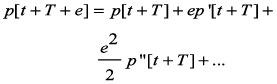
    Optimal digital communications signal processing in Gaussian noise employs a matched filter or correlator where the reference is the waveform itself. In contrast, for optimal tracking of small changes in signal time-delay, key information content is carried, not by the waveform itself, but by the changes in the waveform with time, that is, the time derivative. Focus on the changes in the waveform is consistent with my original 1961 paper on the delay lock loop (DLL), which showed that the optimum tracking estimator uses a delay discriminator reference signal that is the differentiated signal. The derivation of the maximum likelihood estimator of delay for small delay error in Gaussian noise is not repeated here, but we note that the Taylor’s series expansion of a differentiable baseband signal p[t] received with delay T+e delay for sufficiently small e after acquisition at estimate T is

    EA-E1

    We track various PN and BCS PN carrier modulated signals using an aided QCDLL. The QCDLL operates on a PN or other coherently modulated carrier. The QCDLL has two channels.

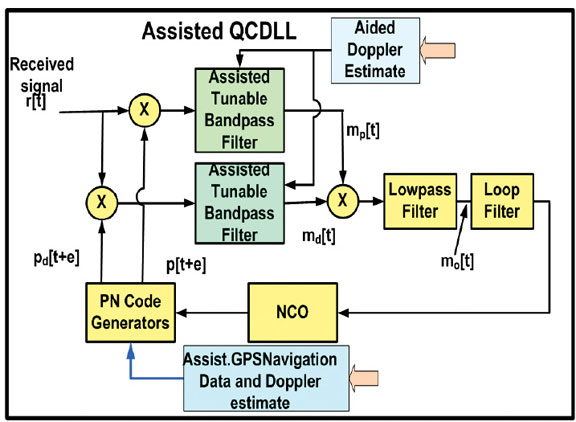
    The upper channel in Figure 1 is the punctual autocorrelation carrier channel, where the received signal is correlated with the reference waveform, p[t+e], the PN waveform itself with delay error e. The punctual channel is also used for initial acquisition and data recovery. It provides both a reference carrier, data, and autocorrelation weighting for the lower discriminator channel. If there is no data modulation, the bandpass filters can be made more narrow. Also note that the QCDLL can operate on multiple I/Q or other multiplexed BCS signal by using composite reference codes.

    FIGURE 1. Simplified quasi-coherent delay-lock loop (QCDLL) block diagram. The number-controlled oscillator (NCO) generates a continuous phase sine wave.
    FIGURE 1. Simplified quasi-coherent delay-lock loop (QCDLL) block diagram. The number-controlled oscillator (NCO) generates a continuous phase sine wave.

    The lower channel is the delay error discriminator carrier channel where the reference, p’[t1e], is the time derivative of the PN signal p with the same delay error e. The filters in both channels have matched group delay and assisted digital tunable narrow-band filters for noise and Doppler removal. Thus, this QCDLL is a special type of assisted-GPS receiver that receives Doppler information from an external communications link. Both channels can also be assisted by an inertial measurement unit (IMU), for example a MEMS device, to estimate velocities (Doppler offset) and further reduce the tracking-filter bandwidth. The filtered product of the two carrier channels is termed the discriminator output, and it provides an estimate of the delay error. By multiplying the discriminator channel with the punctual channel, the discriminator output versus time error is narrowed in width while maintaining the sharp slope versus delay error, as well as removing carrier and data.

    The QCDLL is the generalization of the Costas loop, just as the DLL is the generalization of the phase lock loop (PLL); for example, if p is a sine wave, then p’ is a cosine wave. For a trapezoidal signal waveform, the QCDLL has been shown to produce a similar but not identical output to a non-coherent DLL.

    In Figure 1, the upper bandpass filter recovers the punctual channel, and the lower channel is the discriminator channel. The product of the two removes the carrier and data, and provides a delay error cross-correlation-autocorrelation product, the discriminator output.

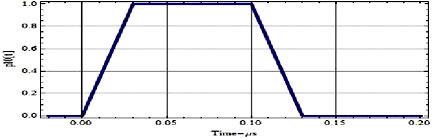
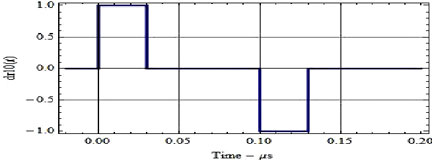
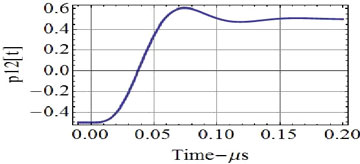
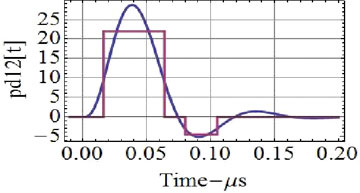
    Figure 2 shows an example PN trapezoidal waveform and its derivative as a simple example of a filtered PN pulse punctual channel reference and the differentiated filtered pulse as the discriminator channel reference. It can easily be shown that the discriminator channel (not the discriminator output) is equivalent to an early-late DLL with a early-late separation equal to the rise time of the trapezoidal pulse. Figure 3 shows the discriminator channel and output.

    EA-2A

    EA-2BFIGURE 2. Trapezoidal PN (1 Mcps) waveform pulse and its time derivative with a 0.1-microsecond rise time.

    FIGURE 2. Trapezoidal PN (1 Mcps) waveform pulse and its time derivative with a 0.1-microsecond rise time.

    FIGURE 3. Discriminator channel, d[e], and (bottom) discriminator output, R[e] Rd[e], for the 1.0 Mcps PN with the optimum 0.1-microsecond reference and the 0.1-microsecond rise-time trapezoidal waveform.
    FIGURE 3. Discriminator channel, d[e], and (bottom) discriminator output, R[e] Rd[e], for the 1.0 Mcps PN with the optimum 0.1-microsecond reference and the 0.1-microsecond rise-time trapezoidal waveform.
    For comparison, Figure 4 shows the step response of a 4-pole Butterworth filter with a 12-MHz bandwidth and its derivative. We also show a two-step approximation to this analog step response, which can be used to optimize a weighted multiple early-late DLL or multiple correlator approximation to the QCDLL.

    EA-4A

    EA-4B

    FIGURE 4. Step amplitude response and slope for a 4-pole Butterworth filter with a 3-dB bandwidth of 12 MHz (one-sided). The time derivative of this step response is shown on the lower plot along with a rectangular approximation.

    Although not proven, the QCDLL appears to have several advantages in both noise and multipath performance as compared to the more conventional early-late gate (that I first presented in 1963):

    The QCDLL discriminator channel reference is the differentiated pulse. Although for the trapezoidal pulse waveform, the conventional early-late DLL can in effect use the same discrimiantor reference if the early-late separation is set equal to the rise-time, for more general filtered waveforms, the early-late DLL can only approximate the optimal reference. Properly weighted multiple early-late DLLs offer a better approximation as shown in Figure 4, but still only an approximation.

    The QCDLL discriminator output of Figure 3 is the product of the correlator channel and the discriminator channel. When tracking precisely, the correlator channel output is at its peak correlation. In contrast, a noncoherent early-late DLL only produces correlator outputs that are by definition early and late. Thus neither of these is at their peak, and the noise performance suffers accordingly. By the same token, the noncoherent early-late DLL discriminator output must be wider than that of the QCDLL, and the QCDLL multipath performance is improved in the same manner.

    From a computational point of view, the early-late DLL is computing the small difference between two large numbers, namely the small difference between the ealy and late correlator channels. In contrast, the QCDLL is only computing the correlation of the received waveform with the narrow differentiated waveform used as the discriminator reference. For the simple example of the trapezoidal PN waveform, this reference is simply a narrrow time gate of width equal to the rise time.

    Generalized BCS Techniques

    My 2010 ION ITM paper, upon which this article is based, discusses a number of generalized symbol coding techniques including Neuman-Hofman, Barker, and Generalized Multiphase Barker, each of which provides minimal autocorrelation sidelobes. Various chirp-coded symbols with linear variation in chip-rate with time are analyzed and provide reduced sidelobes and spectral shaping. Rademacher and Walsh codes, time-multiplexed and properly weighted, form further generalizations. These can be time- or IQ-multiplexed, and the time-multiplexing can in turn be pseudorandomly permuted. In the limited space of this article we only discuss time-multiplexed (TM) Walsh Code symbols.

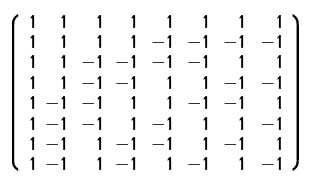
    TM Walsh Codes. Walsh functions form a complete orthonormal set of binary functions of dimension 2n. Walsh codes are generated as products of Rademacher codes. There are 2n Walsh function of 2n binary elements. Thus a weighted sum of Walsh functions can approximate any discrete-time, time-limited waveform. Each PN symbol is coded with a Walsh code. Then time-multiplex two or more different Walsh-coded symbols in a sequential or time-weighted manner. We can then tailor the autocorrelation function and its sidelobes and spectra by using selected members of this set and appropriate weighting. The resulting combined autocorrelation function is then the sum or weighted sum of the individual autocorrelation functions, since we assume independence of the PN chips. The 8-dimensional binary Walsh codes (Walsh order) are the rows in the matrix:

    The 8-dimensional binary Walsh codes (Walsh order) are the rows in the matrix:

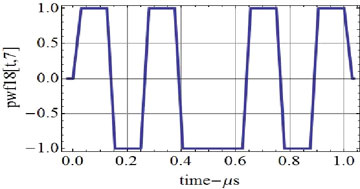
    Figure 5 shows the trapezoidal filtered version of Walsh 7 for the dimension-8 Walsh functions.

    FIGURE 5. Finite rise time trapezoidal Walsh coded symbol for Walsh code 7 with rise-time 0.03 microseconds and 1 Mcps.
    FIGURE 5. Finite rise time trapezoidal Walsh coded symbol for Walsh code 7 with rise-time 0.03 microseconds and 1 Mcps.

    Each Walsh sequence time multiplex modulates a separate and independent pseudorandom PN chip in sets of PN chips beginning from a PN epoch time; for example, the defined beginning of the PN sequence. Note that the equally weighted sum of all 8 Walsh functions is the vector {8,0,0,0,0,0,0,0}, which is equivalent to a single high-amplitude pulse of narrow width. Thus if we sum all of the Walsh functions, we obtain the equivalent of a single narrowband pulse where the autocorrelation sidelobes disappear. Even with filtering of the spreading waveform, the sidelobes can still be small. Likewise, the equally weighted sum of codes 5,6,7,8 is {4,4,0,0,0,0,0,0}, the Manchester code.

    Since the Walsh functions form a complete orthonormal set, a weighted sum of Walsh functions can approximate any finite-duration signal of the same dimension, just as the Fourier series can approximate any periodic function. Thus a weighted sum of the Walsh functions in TM fashion can tailor the signal power spectral densities and autocorrelation functions to closely match a desired realizable function. Weighted TM BOC signals and Rademacher codes can also create useful approximations, but are not as general since they are not a complete orthonormal set.

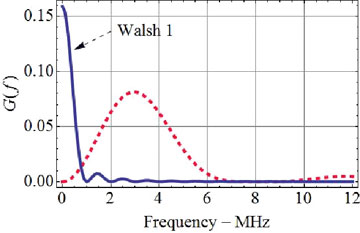
    The spectrum and autocorrelation functions of the individual Walsh functions vary markedly from one another. Figure 6 shows two different selections of Walsh functions to illustrate an example of spectral separation. The wider-frequency spectra signal is a TM of Walsh codes 5, 6, 7, 8 and has improved autocorrelation with lower sidelobes compared to a single BOC signal. The lower-frequency spectrum represents the 0 Walsh, which is conventional PN.

    FIGURE 6. Shaped power spectra for two TM trapezoidal Walsh signals.Blue solid curve Walsh 1, dashed curve TM Wash 5,6,7,8.
    FIGURE 6. Shaped power spectra for two TM trapezoidal Walsh signals.Blue solid curve Walsh 1, dashed curve TM Wash 5,6,7,8.

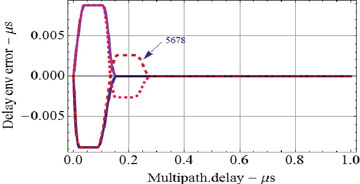
    Figure 7 shows the multipath error envelope of the TM Walsh spreading waveform for TM of all 8 codes in comparison, with TM of 5,6,7,8 in the presence of multipath amplitude 0.5 versus multipath delay. These results for TM of all 8 Walsh correspond closely to that of PN waveform of 8 Mcps and rise time of 0.03 ❍s as expected.

    FIGURE 7. Envelope of the multipath delay error when using the Walsh spreading function of dimension 8 and a trapezoidal signal rise time of 0.03 microseconds.
    FIGURE 7. Envelope of the multipath delay error when using the Walsh spreading function of dimension 8 and a trapezoidal signal rise time of 0.03 microseconds.

    The envelope of the error increases as one would expect, to approximately 0.03-microsecond multipath delay. The solid blue curve is the result where all TM 8 Walsh codes are used. The dashed curve is for the TM 5,6,7,8 used to generate the spectral separation shown in Figure 6.

    We can permute TM of Walsh functions and transmit each of these permutations in a pseudorandom sequence. There are 8! 5 40,320 different permutations of 8 Walsh functions. Thus we can use a different arrangement of the 40,320 patterns every 8 PN chips and do so with a different PN sequence to prevent a jammer from time-synchronizing the jammer spectrum to the Walsh multiplexing spectra with time. Weighted time-multiplexing can also be augmented with I/Q multiplexing. Pseudorandom permutation of the Walsh codes can also diminish spectral lines of the basic PN sequence if the two PN sequences are relatively prime.

    Conclusions

    This discussion first examines the QCDLL and its performance for conventional PN signals, and then generalizes the family of symbol coding/spreading techniques. The BOC signal, first called the split-spectrum signal, has a limited but important ability to shape the spectrum. It also increases its Gabor bandwidth and corresponding noise performance as indicated by the Cramer-Rao bound. However, the BOC signal has large autocorrelation sidelobes that when operating on both sidelobes simultaneously can cause limitations. There are BOC receivers which avoid that issue by operating separately on upper and lower frequency components. However, our focus is on more
    general symbol-coding techniques that reduce autocorrelation sidelobes and provide good multipath performance.

    The assisted QCDLL may improve performance as compared to the more conventional early-late non-coherent DLL in at least these respects:

    • The non-coherent early-late DLL autocorrelation is by definition offset by D/2 in the early–late DLL when locked rather than a perfect punctual channel.
    • The conventional early-late reference is not equal to the differentiated signal except for a trapezoidal signal with rise time of D/2.
    • The QCDLL uses an optimal reference for the discriminator channel.
    • The discriminator output of the QCDLL is the product of the punctual channel correlator with the discriminator channel, and thus has a narrower width than that of an early-late DLL and c better multipath performance.
    • The early-late DLL computes the small difference between two large correlator outputs, whereas the QCDLL computes that difference directly.

    QCDLL performance in multipath is not claimed optimum; I and others have shown other techniques for reducing multipath by estimating and subtracting multipath components to reduce bias error on the direct signal. The results shown here with the trapezoidal wave-shapes may approximate the best performance possible, since the trapezoid has no precursor/tail that would be removed by a multipath-estimating receiver.

    The optimal discriminator channel reference waveforms (the differentiated pulse waveform) defined for the QCDLL for any filtered received signal can be approximated by a sequence of pulses. These sequences of pulses define a quasi-optimal set of weighted conventional early-late DLL or multi-correlator tracking receiver configuration that approximate the optimal reference, the differentiated signal.

    More general symbol coding techniques include: NH, Barker, generalized Barker, chirp, and TM Rademacher and Walsh codes. Barker, Generalized Barker, and NH codes have greatly reduced autocorrelation sidelobes and excellent multipath performance. These can also be time and I/Q multiplexed. Variants of chirp and TM Rademacher, Walsh can provide both spectral shaping and improved multipath performance. Weighted TM Walsh-coded symbols can be designed to synthesize any discrete-time, time-limited realizable function. Ordinary legacy PN can be time-multiplexed with any of these BCS symbols, with perhaps another longer PN sequence to generate a composite signal where a tracking receiver can operate on both simultaneously and yet leave legacy receivers still operational. Although we have only shown equal weighting in the TM multiplexing, clearly the weighting can be varied by changing the duty factor.

    Acknowledgments

    I wish to acknowledge the suggestions of Chris Hegarty of MITRE, J.K. Holmes, Aerospace Corporation, and Per Enge and Grace Gao, Stanford University. I give special recognition to Hegarty, Betz, and Saidi for their generalized BCS work on NH and Barker codes, and the thesis of J. A. A. Rodriguez, University FAF Munich, also on generalized BCS. The detailed version of this article appears in the 2010 ION International Technical Meeting Proceedings, and contains about 50 references.

    James Spilker is a consulting professor in electrical engineering, aeronautics, and astronautics at Stanford, and co-author of Global Positioning System: Theory and Applications, Volumes I, II.

  • SBAS Crashing

    It’s been a tough couple of weeks for SBAS (Satellite-Based Augmentation System), namely the USA’s WAAS program and India’s GAGAN program. WAAS and GAGAN have taken big hits recently that threaten the integrity of the programs. Both events were totally unexpected and are causing disruptions of GPS correction services.


    Let’s Start with WAAS

    First of all, consider the following infrastructure graphic describing WAAS.

    WAAS Infrastructure (note: GEO satellites positioning not geographically correct in graphic)

    At the moment, WAAS uses two geostationary satellites (referred to as GEOs) to broadcast GPS corrections throughout the WAAS service area, which covers the U.S., Mexico, and most of Canada. The user’s GPS receiver must be able to “see” at least one of the WAAS GEOs in order to receive the GPS corrections. Currently, one WAAS GEO (PRN 135) is located at 133°W longitude and one (PRN 138) is located at 107°W longitude. They are positioned, for the most part, to provide “dual coverage” in case one fails as the following graphic illustrates. The solid line represents the visibility above the horizon of PRN 138 (107°W). The dashed line represents the visibility above the horizon of PRN 135 (133°W). In New York, for example, PRN 138 is visible at 30°+ above the horizon while PRN 135 is visible at ~15° above the horizon.

    WAAS GEO Footprint Coverage (Dashed = PRN 135, Solid = PRN 138)

    The Federal Aviation Administration (FAA) is the WAAS steward. WAAS (and SBAS) was designed for aviation use and paid for by the FAA. The fact that surveying and mapping users benefit from WAAS is a by-product. The FAA owns and controls most of the WAAS infrastructure, such as the 38 WAAS reference stations located throughout the U.S., Canada, and Mexico. About the only thing they don’t own are the WAAS GEO satellites, and this has been the source of most of the problems with WAAS in the past few years.

    Lease vs. Buy

    It would be prohibitively expensive for the FAA to own GEO satellites that were exclusively used by WAAS. Instead, the agency leases bandwidth from owners of commercial satellites. These are the same commercial satellite owners who lease bandwidth to media (e.g., television) customers. It’s not unlike a utility pole you see along the road with many different wires and devices attached to the pole from different companies who pay to lease space on the pole, except it’s a very expensive pole orbiting in space.

    If you’ve been using WAAS for a number of years, you’ll remember back in 2006 there was a hiccup with the WAAS GEOs at that time. The FAA was leasing space on two Inmarsat satellites (AOR-W and POR). They began transitioning to the current WAAS GEOs but before the transition was complete, Inmarsat began moving AOR-W. This was a headache for some WAAS users and really showed the vulnerability of WAAS.

    Losing Control

    The vulnerability reared its ugly head again last week when one of the commercial satellite operators (Intelsat) that the FAA leases space from announced it had lost contact with its Galaxy 15 (G-15) satellite, which is the GEO that WAAS PRN 135 is broadcast from. Intelsat reported it had lost the ability to send commands to G-15. Without the ability to control the satellite, it will slowly drift out of orbit until it becomes unusable. The FAA estimates this will occur in one to three weeks.

    Solutions?

    Intelsat’s answer was to bring in an older generation backup satellite (G-12), which was in a backup orbit at 122°W. It arrived at 133°W around April 14. Intelsat said that G-12 has virtually an identical C-band package as the G-15 and they could transfer C-band customers to the G-12. The problem is that there is no L-band package (which WAAS needs) on the G-12, so the FAA was out of luck.

    Since Intelsat’s G-12 backup won’t help WAAS, the FAA is looking at other alternatives:

    1. Contract with Inmarsat to bring back POR (178°E). The FAA says that will take 12-18 months. Personally, I don’t think it’s a good solution. It’s too far to the east to help much at all. Its coverage footprint barely covers the western U.S.
    2. Speed up the testing on the new PRN 133 (98°W) and bring it into service more quickly than the original December 2010 schedule. The FAA says it can accelerate testing by one to two months. This is good and I see the benefit, but it still doesn’t help Alaskan users.
    3. The replacement backup satellite being moved to 122°W to backup G-12 may be a solution. It will be a few weeks before it is known what is possible. That would be the best scenario from a coverage footprint standpoint. The question is how long it would take to bring it into service.

    On another note, the FAA stated that with the money they are saving with G-15 going out of service, they will be able to accelerate the acquisition of another WAAS GEO. I have no doubt that this has put a new level of fear into the FAA folks, and they have to realize that they can’t be running thin on WAAS GEOs. If you weren’t aware, the future of aviation navigation is based on GPS, WAAS, LAAS, etc. These sorts of hiccups would be an absolute nightmare if the National Airspace System (NAS) was already dependent on GPS.

    GAGAN

    GAGAN (GPS-Aided Geo Augmentation Navigation) is India’s SBAS. It has been under development for many years and is quite far along in development. It is funded through implementation by the Airport Authority of India with the Indian Space Research Organization. In 2008, GAGAN was broadcasting a test signal from an Inmarsat GEO with reasonable results.

    India’s intent was to launch its new GSAT-4 communication satellite with part of its purpose being a GAGAN GEO satellite. GSAT-4 was to be India’s first rocket with an Indian-designed and built cryogenic-fueled third stage. Apparently it is a very difficult technology to master as it reportedly took India 16 years to develop.

    Last week, after much anticipation, the rocket with GSAT-4 onboard was brought to the launch pad. Liftoff was reportedly flawless. At 8:25 minutes into flight, the rocket failed and the entire rocket, GSAT-4 and all, ended up splashing into the Bay of Bengal. It’s a crushing blow to India’s GAGAN SBAS program, which has suffered a number of delays.

    P.S. Veeraraghavan, director of the Vikram Sarabhai Space Centre in Thiruvananthapuram, said “Our target is to fly a GSLV with our indigenous cryogenic engine within one year. But it will be tough.”

    Following is a video report from an India news organization describing the event:


    Webinar Tomorrow

    If you don’t receive this too late (or you can access the archive if you do miss it), you might want to catch my 60-minute webinar “GPS, GLONASS and SBAS Constellation Updates.” It’s free and full of the latest information. I’ll also be answering a number of questions from people who registered. I hope to see you there!


    GITA and ACSM Conferences Next Week

    Next week, I’ll be blogging and such from the Geospatial Infrastructure Technology Association (GITA) annual conference and American Congress on Surveying and Mapping (ACSM) annual conference in Phoenix, Arizona. In addition to presenting at both conferences, I’ve got a number of interviews scheduled with interesting people. Follow my blog on the Geospatial Solution’s website Live Event Blog area.


    Thanks, and see you next week.

    Follow me on Twitter at

    http://twitter.com/GPSGIS_Eric

  • World Domination: The Sequel

    Perhaps we should call this The Interquel rather than The Sequel, as the latter will take place September 23 in Portland, Oregon, during the ION GNSS 2010 Conference.

    In January, 12 brave individuals joined me in San Diego to see if this thing would work at all.  It did!  The exercise revealed many adjustments needed to the game, but overall, a successful role-playing, negotiation game grounded in the workings of GNSS.

    The rules are briefly recounted in an earlier blog, and to large extent, they will remain unchanged for the full-on game, to be played by 12 teams of 9 people each in Portland. It’s mostly the metrics that need some tinkering, a few of the quantities that govern exchange, and renewal of each team’s resources at the end of each quarter.

    Here are each team’s goals over three quarters of play, and the points that they actually racked up. User communities could purchase receivers for as many signals as were “on the air,” from any national satellite system.  Interoperability rules!

    GPS System Operator     Goals: 40 satellites, 3 global signals     Achieved: 45 satellites, 3 global (civil) signals
    U.S. GPS/GNSS Industry     Goals:$750 million     Achieved:$1.55 billion
    U.S. User Community     Goals 100 million 3-frequency receivers, 100 million 4-frequency receivers      Achieved: 50 million 3-frequency receivers, 100 million 4-frequency receivers

    Galileo System Operator     Goals:30 satellites, 2 global signals     Achieved:35 satellites, 2 global civil signals
    European GNSS Industry    Goals: $750 million     Achieved: $1.25 billion
    European User Community    Goals:100 million 3-frequency receivers, 100 million 4-frequency receivers     Achieved:100 million 3-frequency receivers, 200 million 4-frequency receivers

    GLONASS System Operator     Goals:35 satellites, 2 global signals      Achieved: 25 satellites, 1 global sigal
    Russian GLONASS/GNSS Industry      Goals: $500 million     Achieved: $1.325 billion
    Russian User Community     Goals: 50 million 3-frequency receivers, 50 million 4-frequency receivers    Achieved: 300 million 3-frequency receivers

    Compass System Operator      Goals: 30 satellites, 2 global signals     Achieved: 45 satellites, 3 global civil signals
    Chinese GNSS Industry     Goals: $1 billion      Achieved: $1.3 billion
    Chinese User Community     Goals: 50 million 4-frequency receivers, 200 million 3-frequency receivers      Achieved: 150 million 3-frequency receivers

    As you can see, those performing strongest relative to their goals, or outperforming their goals (in other words, the gamemaster’s expectations) were all industries, across nations (making out like bandits), and the Compass system operator.

    Auguries for the future?

    Those performing less well, relative to goals, were the Russian system operator, and the Chinese user community.

    Again, auguries anyone?

    Those playing the respective parts above were: Frank van Diggelen, John Betz, Chris Hegarty, Dorotoa Grejner-Brzezinska with Kathleen Bosely, Sam Pullen, Ron Hatch, Matt Harris, Sasha Mitelman, Maarten Ujit de Haag, Tim Murphy, Thomas Pany, and Jade Morton.

    Here is some of the feedback gathered at the scene:

    have smaller-denomination bills in the mix;
    at the same time, multiply all cost amounts by factor 5 to make them more realistic;
    have a banker available on the side during play;
    all deals/transactions must complete in the quarter when negotiated; no carryover;
    increase the number of receivers;
    create moment(s) of randomness with a wheel of fortune or change cards;
    use a laptop to quickly compute each quarter’s new payouts for each team;
    satellites that reach end-of-life should do so during a quarter, rather than once it ends.

    All will be fine-tuned and trotted out again in Portland. Thanks to all players for participating.

    Sleep was what I wanted, you know what I got.  Wide awake, staying up late, wishing I was not.

  • Trimble NetR9 Reference Receiver Aimed at Infrastructure, Scientific, and Network Apps

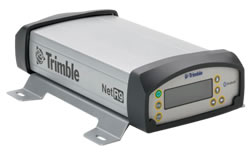
    Trimble NetR9 Photo: Trimble
    Trimble NetR9. Photo: Trimble

    Trimble has introduced an innovative Global Navigation Satellite System (GNSS) reference receiver for infrastructure, precise scientific, and network applications. The Trimble NetR9 GNSS reference receiver is a Continuously Operating Reference Station (CORS) receiver that can support the demanding applications for the earth science community and for the surveying, construction, mapping, and agricultural industries, Trimble said, adding that the NetR9 was designed to provide the user with maximum features and functionality from a single receiver.

    The Trimble NetR9 reference receiver offers 440 channels for robust GNSS constellation tracking. The receiver supports a wide range of satellite signals, including GPS and GLONASS signals. In addition, Trimble is committed to providing Galileo-compatible products in advance of Galileo system availability, the company said. In support of this plan, the Trimble receiver is capable of tracking the experimental Galileo GIOVE-A and GIOVE-B test satellites for signal evaluation and test purposes.

    The Trimble NetR9 reference receiver can be used as a standalone receiver or as part of a network solution. Specific applications include high-accuracy positioning as part of a Trimble VRS network, as a mobile field base station or CORS for real-time kinematic (RTK) corrections, as a scientific reference station collecting information for specialized studies, as a field campaign receiver for post-processing applications, and as support for Differential Global Positioning System (DGPS) coastal beacons. In addition, the Trimble NetR9 reference receiver can be used for monitoring the integrity of VRS networks as well as the deformation of physical infrastructure such as bridges, dams, mines, oil platforms, and other natural and manmade structures.

    The Trimble NetR9 reference receiver’s large internal memory (8 GB) allows post-processed results for base stations to be computed after survey completion, improving the accuracy of the survey. The highly compressed secure internal memory allows for more than 20 years of 15-second dual-frequency GPS data storage. In addition, the NetR9 also has USB logging capability for additional storage capacity, Trimble said.

    The receiver supports the new CMRx communications protocol, which provides correction compression for optimized bandwidth and full utilization of all satellites in view. This gives the customer more robust positioning data and reliable positioning performance, Trimble said.

    Optimized for field use with built-in rechargeable batteries, the NetR9 reference receiver consumes very little power and can be used for projects with remote connectivity and in extreme weather conditions. It has an IP67 rating, which means it is sealed against dust and can survive immersion in up to a meter of water for approximately 30 minutes. It also meets MIL-STD 810F standard for drops, vibration, and temperature extremes.

    The Trimble NetR9 has its physical memory built into the circuit board, providing greater protection of data, particularly under extreme conditions. Multiple built-in serial ports supply communications and power to support field use, whether connecting to a radio for RTK surveys, direct communication with a satellite phone for remote operations, or for ancillary input devices such as inclinometers and meteorological sensors, and it offers Bluetooth communication with a cell phone for real-time data streaming. In addition, both power and Ethernet can be supplied over a single cable using Power over Ethernet (PoE) technology.

  • Aeroflex Introduces Portable Positional Simulator for GPS/Galileo Receivers

    Aeroflex has introduced the GPSG-1000, a portable GPS and Galileo positional simulator. The GPSG-1000 is lightweight and configurable. It fills a gap in the market by providing a low-cost 12-channel test set that creates three-dimensional simulations, Aeroflex said.

    With the advent of GPS signal modernization, many GPS simulators on the market today are now obsolete, according to the company, which is based in Witchita, Kansas. The GPSG-1000 supports civil and military avionics field and bench maintenance technicians, production test technicians, and system integrators with a modern simulator for L1, C/A code and L1C, L2C, L5 GPS modernization signals, as well as new Galileo E1, E5, E6 services. It can be configured with single channel, 6-channel, or 12-channel simulation. Typical tests include acquisition sensitivity, tracking sensitivity, time-to-first-fix for cold/warm/hot starts, time-to-second-fix, positional accuracy, RAIM failure tolerance, and subsystem stimulation for 3D flight execution.

    The Aeroflex GPSG-1000 uses modular technology for RF and baseband signal generation to produce highly accurate and repeatable test results. Unlike bench top simulators, Aeroflex’s approach also allows the test system to be upgraded at low cost.

    Features include:

    • Simulation of GPS L1C, L2C, L5 signals, supporting the modernization of signals used by the latest designs of GPS receivers.
    • Simulation of Galileo E1, E5, E6 signals to support unencrypted services.
    • SBAS, WAAS/EGNOS L1, L5, for automatic SBAS simulation.
    • Built-in GPS C/A code receiver for automatic GPS almanac download.
    • Waypoint navigation, a 3D-navigation scheme that allows airport-to-airport flight plan simulation.
    • Programmable satellite parameters allow specific tests to be conducted to determine receiver behaviour under degraded or invalid signal conditions.
    • Dynamic satellite signal simulation for real-world constellation signal conditions.

    The GPSG-1000 Portable Positional Simulator is available in single channel, 6-channel, and 12-channel configurations. The GPSG-1000 is available in 16 weeks upon receipt of order.


  • Solar Activity and RFID Technology

    Updated: Friday, April 9 11:00am US Pacific. I added more specific information regarding signing up for Space Weather Prediction Center email alerts. See below.


    It’s time to touch on the solar activity subject again, as there was an event earlier this week and rumors began to fly. The mainstream press jumped on a story back in January when the first solar flare of Solar Cycle 24 occurred. Of course, journalists were writing about worst-case scenarios in the event of extreme solar events that could cause power grids to fail, GPS to stop working, etc.

    While that is true, it’s a real stretch and the typical “sky is falling” reporting. In reality, the solar flare back in January had no effect on GPS operations. In fact, it would take an event 10-20 times stronger than last January’s to begin to notice any effect on GPS operations. Earlier this week (Monday 0800 GMT), the first geomagnetic storm of Solar Cycle 24 occurred.

    Geomagnetic storms are the ones that will give GPS users problems, although this one didn’t because it was relatively minor. The last geomagnetic storm strong enough to noticeably affect GPS users occurred in December 2006. During such an event, it might interrupt your GPS receiver for 10-15 minutes. Most users would not notice or they might attribute it to a local system malfunction. By the time they investigate and reset the system, the event would have passed and the user is back in operation. It would be barely noticeable, if at all.

    According to Joe Kunches of the NOAA Space Weather Prediction Center, a geomagnetic storm is a global event (as opposed to a regional event) that is caused by a highly energized solar wind that is fast and embedded with a strong magnetic field. In the following chart, you can see how this week’s event illustrates this.

    Source: NOAA Space Weather Prediction Center

    In the above chart, the top panel illustrates how the magnetic field becomes much more turbulent starting at 0700 GMT. The fourth panel on the chart denotes the solar wind speed, which ramped up to approximately 2,000,000 mph (3,218,688 kph) at its peak.


    Extreme geomagnetic storms = Dynamic TEC = GPS interruptions

    There needs to be very turbulent solar wind that disturbs the Earth’s geomagnetic field in order for GPS operations to be affected. For those of you who are familiar with the Total Electron Count (TEC), a dynamic TEC density in the ionosphere is what really messes up GPS operations. If the TEC is stable, the ionospheric models work fine and we get really good GPS performance like we’ve seen in the past few years in between solar cycles.

    GPS L1 users are affected most by a dynamic TEC density in the ionosphere. These are users of WAAS, DGPS, and commercial L1 correction services like OmniSTAR VBS (not their XP or HP service). During the extreme geomagnetic event in October 2003, published simulations (Yousuf, Skone, Coster, University of Calgary, ION NTM 2005) that illustrated the WAAS maximum horizontal error (95th percentile) blew out to 25 meters while single baseline DGPS maximum horizontal error (95th percentile) blew out to 18 meters. This extreme event lasted for several days.

    This doesn’t mean you’re going to have major problems in the future if you are using WAAS (or another SBAS) or DGPS, but just that high-performance GPS L1 receivers are the most susceptible to extreme solar events. In the case of the December 2006 event, SBAS and DGPS users might have experienced 10-15 minutes of unusual behavior depending on their locations. According to Kunches, high latitude geographic regions (60+ degrees latitude) and the region within 10 degrees of the geomagnetic equator (as opposed to the geographic equator) are affected the most by geomagnetic storms.

    GPS L1/L2 receivers are less susceptible to extreme solar events because they can actively model the affects of the ionosphere, but they are not immune. Extreme events such as in October 2003 can cause a loss of phase lock, especially on L2 with GPS receivers that utilize codeless/semicodeless techniques, which are virtually all of the dual-frequency GPS receivers on the market today. The L2 signal-to-noise (SNR) ratio on L2 is quite a bit lower due to the codeless/semicodeless technique so it is more susceptible.

    GPS L1/L2 receivers using L2C will be less affected (assuming a sufficient number of GPS satellites are broadcasting L2C) due to a stronger SNR.


    Not the time to panic

    The reason I wrote this article is to share what I’ve learned about the effects of solar storms on GPS operations from speaking with a number of different scientists. This isn’t meant to be a warning of impending doom for GPS users or anything or that sort. Extreme events typically occur near the solar peak and then again during the decline of the cycle. The peak is estimated to occur around May 2013, so the typical extreme events affecting GPS would likely occur in 2013, 2014, and 2015. It’s too early to start worrying much about it now.

    However, as Solar Cycle 24 ramps up, we’ll see more and more geomagnetic storm activity. If you’re a high-performance GPS user (meter or sub-meter level GPS L1 and GPS L1/L2), I think it’s a good idea to monitor space weather now. Fortunately, the NOAA Space Weather Prediction Center (where Kunches works) provides a service that will notify you of unusual space weather by e-mail. You can sign up to receive e-mail alerts at http://www.swpc.noaa.gov

    Following are detailed instructions for signing up for alerts:

    -Goto the Space Weather Prediction Center website.

    -Click on Email products (under the Support Services menu on the left)

    -Create an account if you don’t have one already (it’s free).

    -Click on Subscribe

    You don’t want to subscribe to everything. Here are the ones specific for GPS operations:

    -Advisories/Space Weather Bulletin

    -Geomagnetic Storm Products/(sign up for both Alerts and Warnings for K6, K7, K8, K9 events.

    -For high latitude (55 degrees and higher) users, also sign up for Alerts and Warnings for K4 and K5 events.


    Following are some good reference links regarding the Solar Cycle and TEC:

    GPS World article in January 2010 (scroll to end of article)

    GPS World article in October 2009 (follow-up to other October 2009 article)

    GPS World article in October 2009

    GPS World article in May 2003

    Latest NOAA prediction on Solar Cycle 24

    Solar Cycle 24 page

    Real-time TEC plot from the Jet Propulsion Lab

    Wikipedia description of the Ionosphere

    Wikipedia description of the Total Electron Content (TEC)


    RF ID (Radio frequency Identification) in Survey Monuments

    If you haven’t been followi
    ng my Geospatial Solutions Weekly newsletter (sign up here for free), you might want to sign up and read the article I wrote on how RF ID is going to be a technology very much used by surveyors in the future. You can read the article by clicking here.


    Webinar later this month (April 22, 10 a.m. Pacific time, 6 p.m. GMT): GPS, GLONASS, and SBAS Constellation Updates

    There’s been a lot of infrastructure changes with GPS, GLONASS, and SBAS in the past six months. We’ve already got several hundred people registered for this webinar. It’s going to be a good one. Here are some of the questions I’ve received already and will be addressing:

    1. When and where will the new FAA WAAS GPS Satellite cover?
    2. Will the accuracy of hand-held units be increased with these latest changes?
    3. What developments will make GPS & GLONASS work better together? In terms of RTK accuracy.

    There have been some questions as to whether you can receive continuing education credit (PDH, CEUs, etc.) by attending the webinar. Please e-mail me directly with these requests and I will do my best to accomodate.


    See you next time.

    Follow me on Twitter at http://twitter.com/GPSGIS_Eric


  • Innovation: GPS by the Numbers

    A Sideways Look at How the Global Positioning System Works

    In his 200th Innovation column, Contributing Editor Richard Langley takes a look at GPS by the numbers, getting a sense of how GPS works by examining the key numbers that govern its remarkable capabilities, from zero to pi and beyond.

    INNOVATION INSIGHTS by Richard Langley
    INNOVATION INSIGHTS by Richard Langley

    WELCOME TO INNOVATION COLUMN NUMBER 200. I have managed this column continuously since the first issue of GPS World magazine, which appeared back in 1990. From the outset, we established that the column should deal with issues that have broad application and interest and are presented in terms that are accessible to as wide a range of readers as possible. Since 1990, we have covered a wide range of topics, some of them at the leading edge of GPS development and some of them reviewing the basics of GPS operation in tutorial fashion. The column has appeared 199 times and now we come to number 200.

    So clearly 200 is an important number for me and, I hope, for you. But the number 200 is interesting for other reasons, too. It is the smallest base 10 unprimeable number — you can’t turn it into a prime number by changing just one of its digits to any other digit. It’s how many dollars you get when you pass Go in Monopoly. And in 2012, it will be how many years have elapsed since The War of 1812 — the last time Canada and the United States had a serious quarrel (other than in hockey). But more to the point of this column, it is the designation of the basic reference document that describes how GPS works: IS-GPS-200. Formerly known as an Interface Control Document or ICD, it has gone through several revisions since its first public release in July 1991. It is full of numbers. Numbers that tell us how the GPS signals are generated and how a receiver is to interpret the signals to provide a position fix.

    If you are a regular reader of the Innovation column, then likely you have an inquisitive bent. You like to know how things work — GPS in particular. And you don’t have to be convinced about the importance of numbers and their role in understanding the world around us. As Sir William Thomson, a.k.a. Lord Kelvin, said in one of his lectures,

    “I often say that when you can measure what you are speaking about, and express it in numbers, you know something about it; but when you cannot measure it, when you cannot express it in numbers, your knowledge is of a meagre and unsatisfactory kind.”

    So in this column, the 200th, we’re going to look at GPS by the numbers, getting a sense of how GPS works by examining some of the key numbers that govern its remarkable capabilities, from the smallest to the largest. I’ll draw heavily on material from the past 199 columns.

    Let’s get started.


    “Innovation” features discussions about advances in GPS technology, its applications, and the fundamentals of GPS positioning. The column is coordinated by Richard Langley, Department of Geodesy and Geomatics Engineering, University of New Brunswick.


    Numbers. We use them for counting and measuring, for labeling and ordering, and for codes and calculations. The number of numbers is infinite. However, there are some special numbers that characterize how GPS works. Some of these are peculiar to GPS; others are more common, finding utility in other global navigation satellite systems or even in our everyday lives. In this article, we’ll take a look at some of these special numbers and their importance to GPS.

    We’ll begin with the smallest non-negative number and work our way up to one of the largest GPS-relevant numbers, concluding with an imaginary but very important number.

    0

    Zero. The smallest cardinal number and the smallest non-negative integer. While zero is a pure real number (a number on an infinitely long number line), it is also a purely imaginary number (see the last entry in this article) because it lies on both the real and imaginary axes on the complex plane. It is used to indicate a null amount. The English mathematician, Alfred North Whitehead, wrote in his 1911 book An Introduction to Mathematics, “The point about zero is that we do not need to use it in the operations of daily life. No one goes out to buy zero fish. It is in a way the most civilized of all the cardinals, and its use is only forced on us by the needs of cultivated modes of thought.” Perhaps it was not needed for daily operations in 1911 but it is indispensible in our modern world. For zero is also one of the two binary digits (the other is one, of course) used in the binary or base-2 number system that is fundamental to how computers, digital electronics, and communications systems operate. For example, we represent the GPS pseudorandom noise (PRN) ranging codes and the navigation message as sequences of zeros and ones and the zeros are just as important as the ones.

    The C/A- and P(Y)-codes (see entries 1023 and 235,469,592,765,000), along with the navigation message, are modulated onto the signal carriers using binary phase-shift keying or BPSK. BPSK is a digital modulation scheme that conveys a signal by changing, or modulating, the phase of the carrier wave between two values separated by 180°. The spectrum of a BPSK-modulated signal is a sinc function, with most of the power concentrated around the carrier frequency. An alternative modulation technique is binary offset carrier (BOC) modulation. BOC modulation uses a square-wave subcarrier to offset the spectral power from the carrier frequency and thus allows a BOC-modulated signal to share the same bandwidth as a BPSK signal. The new GPS M-code on L1 and L2 uses a BOC(10.23,5.115) — abbreviated as BOC(10,5) — modulation, which specifies a subcarrier frequency of 1021.023 MHz and a spreading-code chipping rate of 5.115 megachips per second. The spreading code is a pseudorandom bit stream from a signal protection algorithm, having no apparent structure or period. The future L1C signal, the new civil signal to be implemented on L1 by Japan’s Quasi-Zenith Satellite System and the GPS III satellites, will also use BOC modulation. And Europe’s Galileo system, now in development, will also use this modulation technique, which has already been tested in space by the forerunner GIOVE test satellites.

    0.00000000000001

    (Or 1 x 10-14 in scientific notation). The approximate frequency stability of the rubidium atomic frequency standards in the GPS Block IIR satellites. These devices are used to control the frequency and timing of all aspects of the navigation signals, including the generation of the carrier frequencies and the pseudorandom noise modulation codes. Given their role in controlling the timing of the signals, they are also referred to as clocks.

    Each Block IIR satellite contains three rubidium clocks, only one of which is active at any time. The others are spares and the GPS Control Segment carries out a “clock swap” when the performance of an active clock begins to deteriorate, cycling through the remaining units. Many of the Block IIR satellites are still on their first clock.

    The Block IIF satellites will also contain three clocks, however, only two will be rubidium clocks. The third clock will be a cesium clock. This mixture of clock types is patterned after the arrangement used on the Bloc
    k II and IIA satellites, which used two rubidium clocks and two cesiums.

    0.77922077922…

    The rational number 60/77. A rational number is any number that can be expressed as a fraction or quotient a/b of two integers, with the denominator b not equal to zero. The decimal expansion of a rational number always either terminates after a finite number of digits or begins to repeat the same sequence of digits over and over again. The digits 077922 of this particular rational number repeat ad infinitum. And why should we be interested in this particular number? It is the ratio of the L2 and L1 carrier frequencies. This number and its inverse ( — the dot above the 3 indicates it repeats indefinitely) are used in various combinations of GPS measurements. For example, if we let η = 60/77, then the ionosphere-free pseudorange combination is

    Eq-1
    where P1 is a pseudorange measurement on L1 and P2 is the corresponding pseudorange measurement on L2.

    1

    The loneliest number according to the American rock band Three Dog Night and the Google calculator (try typing “loneliest number” into the Google search engine). It was also the space vehicle number (SVN) of the first Block I GPS satellite, which was launched on February 22, 1978. The satellite did not stay lonely for long. By the end of the year, three more Block I satellites were launched. In total, 10 Block I satellites were successfully orbited between 1978 and 1985 to demonstrate the feasibility of GPS. SVN1 continued in operation until July 17, 1985.

    The first satellite of the Block II operational constellation was launched in February 1989. The four-year hiatus in launches was due, in part, to the Space Shuttle Challenger disaster as it had been planned to launch the operational satellites using the Shuttle. Following the accident, it was decided to continue with expendable rockets for GPS launches but to switch to the newly designed Delta II rocket.

    The pace of Block II launches was rapid, with five launches of the original Block II design in 1989 and four in 1990. A modified version of the Block II satellite — the IIA — was developed, and between 1990 and 1997 19 Block IIAs were launched. The Block II and IIA satellites established the operational GPS constellation. Full operational capability was declared on April 27, 1995.

    A new variant of the Block II satellite was developed for replenishing the constellation as the earlier satellites were retired. Following an initial launch failure, 12 of the Block IIR satellites were launched between 1997 and 2004.

    Under the GPS modernization program, the remaining eight Block IIR satellites were modernized with a new navigation payload that included the L2C and M-code signals as well as a new antenna panel (also included on the last four of the classic Block IIRs). The IIR-M satellites were launched between 2005 and 2009, bringing the total number of GPS satellites ever placed in orbit to 58.

    One is also the PRN number of SVN49, the Block IIR-M satellite that was modified to transmit the first L5 GPS signals (see 1176.45).

    2.4

    The approximate delay, in meters, experienced by a GPS signal propagating vertically (from the zenith) through the neutral atmosphere to a receiver at mean sea level. Although the electrically neutral, or unionized, atmosphere extends from ground level up to 50 kilometers and more, the bulk of it is in the lowest most part we call the troposphere. Consequently, the neutral atmosphere delay is often termed the tropospheric delay. The delay varies with actual atmospheric conditions and the elevation angle at which a GPS signal arrives at the receiver’s antenna. If unaccounted for, tropospheric delay would result in position errors of several meters in the horizontal plane and two to three times these values in the vertical. Predictive or “blind” tropospheric models based on climatology attempt to significantly reduce the effect of the troposphere on GPS position fixes.

    One such model is UNB3m, developed at the University of New Brunswick. Using a look-up table of surface meteorological parameter values from standard atmospheric models, it can compute the tropospheric delay for a given day of year, latitude, and station height. For example, the UNB3m zenith delay for a sea-level site at a latitude of 60° on day-of-year 201 is 2.435 meters. UNB3m is able to predict zenith delays with an average root-mean-square error of 4.9 centimeters. Better and more consistent performance has been obtained with a wide-area model developed specifically for North America, UNBw.na.

    A version of an earlier UNB model became the basis of the RTCA Minimum Operational Performance Standards (MOPS) troposphere model that is included in the firmware of most GPS receivers.

    3.1415926…. π

    Every nerd’s favorite number. It is the ratio of a circle’s circumference to its diameter in conventional or Euclidean space. We use it, for example, to convert angles measured in radians to degrees (π radians 4 180 degrees). π is an irrational number, which means that its value cannot be expressed exactly as a fraction m/n, where m and n are integers. Consequently, its decimal representation never ends or repeats. But we sometimes use an easily remembered fraction, such as 22/7, to get an approximate value. In this case, 3.14. But, if we compute more digits with this fraction, we get 3.1428571…, clearly an incorrect result. A better way to remember π to eight digits is to count the number of letters in each word of the mnemonic “May I have a large container of coffee?”

    In computations related to GPS, how many digits of π should be used? It depends. If you are developing your own algorithms and software for modeling GPS observations or determining precise orbits for the satellites, you’ll likely need π to 16 digits for double-precision floating-point calculations. But it would be a mistake to use π to this precision in computing the position of a satellite from the broadcast ephemeris. The GPS interface specification document, IS-GPS-200, specifies a 14-digit value for π (3.1415926535898) in the satellite coordinate computation. Use fewer or more digits, and the resulting satellite coordinates will not be as accurate.

    4

    This is the minimum number of satellites that a receiver needs to track and generate a pseudorange measurement to produce a three-dimensional “instantaneous” position fix. The receiver solves a system of four nonlinear equations to obtain the three receiver coordinates and the offset of the receiver’s clock from GPS (System) Time. It is possible to use fewer than four satellites for positioning or navigation, but then additional information must come from elsewhere. For example, if we are navigating and we know our height accurately or can safely assume a value, say, so many meters above the sea surface, then only three pseudoranges would be needed to determine the horizontal coordinates. If the number of satellites drops to two, then another assumption must be made to continue navigation (for example, holding the receiver clock offset constant or assuming a constant driving direction). If the clock offset is held constant, then position accuracy deteriorates quickly since the actual receiver clock offset will diverge from the assumed value. On the other hand, if the direction of travel is held constant, the GPS receiver can at least compute the position along the assumed trajectory. In reality, the vehicle will likely not travel along a perfectly straight path and navigation fails after the first turn.

    For single-satellite navigation, three assumptions must be made concerning height, trajectory, and clock offset, but the navigation results are, at best, educated guesses.

    If a receiver can acquire and track more than four satellites, it typically uses an optimizing Kalman filter procedure to obtain its position.

    10.23

    The frequency of a GPS satellite atomic frequency standard in megahertz and the fundamental frequency for signal generation in the satellite. The carrier frequencies and the code chipping rates are harmonically related to this frequency. The P-code chipping rate is identical to the fundamental frequency, while the C/A-code rate is 1/10 of it.

    12.5

    The length of the full navigation message in minutes. To convert the measured signal delays or pseudoranges between the receiver and the satellites, the receiver must know where the satellites are. To do this in real time requires that the satellites broadcast this information. Accordingly, there is a message superimposed on both the L1 and L2 carriers along with the PRN codes. Each satellite broadcasts its own message, which consists of orbital information (the ephemeris) to be used in the position computation, the offset of its clock from GPS Time, and information on the health of the satellite and the expected accuracy of the range measurements.

    The message also contains almanac data for all of the satellites in the GPS constellation, as well as their health status and other information. The almanac data, a crude description of the satellite orbits, is used by the receiver to determine the location of each satellite. The receiver uses this information to quickly acquire the signals from satellites that are above the horizon but are not yet being tracked. So, once one satellite is tracked and its message decoded, acquisition of the signal from other satellites is quite rapid. A receiver will store a copy of the almanac to speed up initial acquisition of satellites when it is switched on.

    The GPS navigation message is sent at a relatively slow rate of 50 bits per second, taking 12.5 minutes for all of the information to be transmitted. To minimize the time it takes for a receiver to obtain an initial position, the ephemeris and satellite clock offset data is repeated every 30 seconds.

    24

    The number of satellites in the current GPS baseline constellation. The GPS constellation went through a number of design alternatives even after the first satellites were launched with different numbers of orbit planes, satellites per plane, and orbit inclinations. The current design has four satellites, irregularly spaced, in six orbit planes. The orbit planes, labeled A through F, are spaced at 60° intervals around the equator with a nominal inclination to the equator of 55°. However, we have typically had a surfeit of satellites with more than 24 in operation since the mid-1990s. In fact, during 2008, as many as 31 satellites were transmitting healthy signals at the same time. However, although a modern GPS receiver should be able to handle a 32-satellite active constellation, there are limits imposed by the GPS Control Segment and some legacy military equipment that currently imposes a 30-satellite active constellation limit.

    Although the number of active satellites is well in excess of 24, the constellation has been operated as a 24-satellite constellation without optimizing the orbit locations of the “bonus” satellites. In fact, several pairs of satellites are bunched together minimizing geometrical performance. This is in the process of being changed. The GPS Wing recently announced the transition to a 24+3 or “Expandable 24” baseline constellation. Taking about 24 months to complete, six on-orbit satellites are being rephased within their respective orbit planes to improve the overall geometry of the active constellation so that the number of GPS satellites in view from anywhere on Earth will increase, enhancing the possibility of getting a position fix in partially obscured environments, and potentially improving the accuracy of fixes.

    Of course, 24 is also the number of hours in the day during which GPS is available at any point on the Earth’s surface with good sky visibility. It is also the title of a popular American TV series, whose protagonist, Jack Bauer, frequently makes use of imaginary GPS tracking capabilities.

    40.3

    The scaling factor, which together with the signal frequency and the total electron content, is used to compute the delay experienced by a GPS signal as it propagates through the ionized part of the Earth’s atmosphere. The total electron content is the integrated electron density along the signal’s path. Basically, it is the total number of electrons in a tube with a cross-sectional area of one square meter centered on the signal path. To a very good approximation, the delay, in meters, is computed as

    Eq-2

    where TEC is the total electron content in so-called TEC units or TECUs (1016 electrons per square meter) and f is the signal carrier frequency in MHz. The scaling factor is a function of the electron’s charge and mass and a constant of electromagnetism theory called the permittivity of free space also known as the electric constant. The scaling factor is actually 40.308193 but this much precision is not generally needed in GPS calculations.hile the code signals are delayed, making pseudoranges longer than they would be in the absence of the ionosphere, the phases of the signal carriers are advanced, make carrier-phase measurements shorter — but by exactly the same magnitude as the code delays.

    TEC is highly variable both temporally and spatially. The dominant variability is diurnal following the variation in incident solar radiation. Maximum ionization occurs at approximately 1400 local time. On the ionosphere’s nighttime side, in the absence of solar radiation, free electrons and ions tend to recombine, thereby reducing the TEC. The protonosphere, or uppermost region of the ionosphere, may contribute up to 50 percent of the electron content during the nighttime hours. Typical nighttime values of vertical TEC for mid-latitude sites are of the order of 10 TECU or less with corresponding daytime values of the order of 100 TECU. However, such typical daytime values can be exceeded by a factor of two or more, especially in near-equatorial regions. TEC also varies seasonally with higher values during equinoxes.

    1023

    This is the number of chips in the C/A-code. The C/A-, or coarse/acquisition-, code is one of the two legacy PRN ranging codes that have been transmitted by all GPS satellites. These PRN codes consist of sequences of binary values (zeros and ones) that, at first sight, appear to have been randomly chosen. But a truly random sequence can only arise from unpredictable causes over which, of course, we would have no control, and which we could not duplicate. However, using a mathematical algorithm or special hardware devices called tapped feedback registers, we can generate sequences that do not repeat until after some chosen interval of time. Such sequences are termed pseudorandom. The apparent randomness of these sequences makes them indistinguishable from certain kinds of noise such as the hiss heard when a conventional AM radio is tuned between stations.

    The C/A-code is a sequence of 1,023 binary digits, or chips, which is repeated every millisecond. This means that the chips are generated at a rate of 1,023 million per second and that one chip has a duration of about 1 microsecond.

    The C/A-code is generated by two 10-cell feedback registers referred to as G1 and G2. A delayed version of the G2 sequence is obtained by binary adding the contents of a pair of tapped G2 cells and binary adding that result to the output of G1. That becomes the C/A-code. The various alternative pairs of G2 taps (delays) are used to generate the complete set of 36 unique PRN C/A-codes. There are actually 37 PRN C/A-codes, but two of them (34 and 37) are identical. The first 32 codes are assigned to satellites. Codes 33 through 37 are reserved for other uses such as for ground transmitters. This family of codes is a subset known as Gold codes, which have the property that any two have a very low cross correlation (are nearly orthogonal). The term for the codes comes from the inventor, Robert Gold, not from their lustrous properties.

    The C/A-code is modulated only onto the L1 carrier, unlike the P(Y)-code (see 235,469,592,765,000) which appears on both L1 and L2. However, beginning with the first Block IIR-M or modernized Block IIR satellite, a new civil code, L2C or L2 Civil, has been transmitted on the L2 frequency. The future Block IIF satellites will also transmit L2C.

    1023 is also the maximum value of the GPS week. This is the number of full weeks that have elapsed since the GPS Time zero point of midnight UTC beginning January 6, 1980 — but with a special counting procedure. GPS weeks are numbered consecutively with week zero starting on January 6 and ending on January 12, 1980. The GPS week, together with the Z-count (see 403199), specifies an epoch or event related to GPS signals or measurements. The current GPS week is included in subframe one of the navigation message, which — along with other subframes containing satellite clock, ephemeris data, and other user-required information — is transmitted every 30 seconds. Only 10 bits are used to represent the GPS week, and so the largest possible week number is 1023 (210–1). In other words, the GPS week number is modulo 1024 (see the “Modular Arithmetic” sidebar). At the end of week number 1023, the week number rolls over to zero. This first occurred on August 21/22, 1999, and caused difficulties for some GPS receivers as their manufacturers had failed to account for the “end-of-week rollover” in receiver firmware. The next occurrence will be in April 2019. By that time, the new Civil Navigation (CNAV) message will be in use, in which the GPS week number is represented as a 13-bit value, meaning it rolls over after 8192 weeks, or about every 157 years.

    Although officially the GPS week number is still modulo 1024, some agencies, such as the International GNSS Service, prefer to use a running count of the GPS week, ignoring the rollover. The number of the week beginning April 4, 2010, is then alternatively given as 1578 or 554. Or, mathematically speaking (see sidebar), 1578 ≡ 554 (mod 1024).

    1176.45

    The L5 carrier frequency in megahertz. The L5 carrier frequency is obtained by electronically multiplying the satellite 10.23 MHz standard frequency by 115. It is the lowest and the newest of the GPS frequencies and is used for the new civil-only GPS signal.

    The addition of the L5, or Link 5, civil signal to the suite of signals transmitted by the satellites is a key feature of GPS modernization. The introduction of such a signal on a different carrier frequency than that used by the legacy L1 GPS signal was proposed in the 1995 reports by the U.S. National Research Council and the National Academy of Public Administration on the future of GPS. The reports argued that an unencrypted signal on a second frequency would offer civil users the benefit of ionospheric delay correction, wide-lane carrier-phase ambiguity resolution, improved interference rejection, and faster accuracy recovery in multipath environments. The frequency is in a protected aeronautical radionavigtion services band and, unlike L2, means that L5 can be used for safety-of-life services. The L5 signal will be standard on all Block IIF and future satellites. An L5 demonstration payload was included on Block IIR-M satellite SVN49 to secure the L5 frequency under the rules of the International Telecommunication Union.

    1227.60

    The L2 carrier frequency in megahertz. The L2, or Link 2, carrier is modulated with the P(Y)-code. Additionally, starting with the Block IIR-M satellites, a new civil ranging code, L2C, is being transmitted on L2 along with the new military M-code. These new signals are also part of the GPS modernization effort. The L2 carrier frequency is obtained by electronically multiplying the satellite 10.23 MHz standard frequency by 120.

    1381.05

    The L3 carrier frequency in megahertz. This frequency is used in conjunction with the GPS satellites’ secondary purpose, which is to detect nuclear detonations. The L3 carrier frequency is obtained by electronically multiplying the satellite 10.23 MHz standard frequency by 135.

    1575.42

    The L1 carrier frequency in megahertz. The L1, or Link 1, carrier is modulated with the C/A-code and the P(Y)-code. Starting with the Block IIR-M satellites, the new military M-code is also transmitted on L1. The L1 carrier frequency is obtained by electronically multiplying the satellite 10.23 MHz standard frequency by 154. If you’ve been counting, you’ll have noticed that we didn’t list an L4 frequency. L4 has never been implemented but it has been studied. For example, a frequency of 1841.40 MHz (10.23×180) was once considered for ionospheric correction.

    403199

    The maximum value of the GPS time of week count. The GPS satellites count and communicate GPS Time in a unique manner that is ultimately related to how they generate the PRN ranging codes. As described below, the P-code is generated by combining two shorter PRN codes, X1 and X2, which are clocked in phase at a chipping rate equal to the satellite’s 10.23-MHz oscillator frequency. X1 has a repetition interval, or period, of 1.5 seconds — a fundamental GPS timing unit. The start of each 1.5-second interval identifies an epoch. The number of X1 epochs since the beginning of the week is called the time of week (TOW) count, which runs from zero to 403,199 at the end of week. The TOW count returns to zero coincident with the resetting of the PRN codes.

    The TOW count can be represented as a 19-bit binary number, a truncated version (the 17 most significant bits) of which is part of the handover word (HOW) that a satellite transmits every six seconds. The HOW appears as the second word in each data subframe of the navigation message. These 17 bits correspond to the TOW count at the X1 epoch that occurs at the start of the immediately following subframe, and so effectively preannounces the arrival of a time marker, just like telephone “speaking clocks” and shortwave radio time and frequency stations.

    The TOW count by itself cannot be used to unambiguously establish the date of an event. It can only time an event at modulo 604,800 seconds [(403199+1)x1.5] because it is reset every week. This time ambiguity is reduced by noting the number of full weeks that have elapsed since January 6, 1980 modulo 1024 — the GPS week number (see 1023). The TOW count and the GPS week number combine to form the 29-bit Z count. The 19 least-significant bits are the TOW count and the 10 most-significant bits are the GPS week number.

    299,792,458

    The speed of light in meters per second. This is the speed with which all electromagnetic radiation propagates in a vacuum. Until 1983, the speed of light was measured experimentally using adopted standards for the length of the second and the length of the meter. However, compared to the second, the definition of the meter had a large uncertainty. So in 1983, the 17th General Assembly of Weights and Measures defined the meter as the distance travelled by light in a vacuum during 1/299,792,458 of a second, fixing the speed of light at 299,792,458 meters per second — exactly. This constant is used by a GPS receiver, for example, to convert the measured signal propagation time in seconds to a pseudorange in meters.

    235,469,592,765,000

    (Or 2.35469592765000 x 10¹⁴ in scientific notation). This is the number of chips in the P-code if it were allowed to continue without being reset. The P-, or precision code, is one of the two legacy PRN ranging codes that have been transmitted by all GPS satellites. The other is the C/A-code, already discussed.

    The P-code is actually the product of two PRN codes, each of which is generated with a pair of feedback registers. The X1 code has a length of 15,345,000 chips while the X2 code has a length of 15,345,037 or 37 chips longer. So the complete P-code has a length equal to the product of the lengths of the X1 and X2 codes, or 235,469,592,765,000. The codes are clocked at a rate of 10.23 MHz so that each chip has a length of about 0.097752 microseconds. This means the pattern of chips in the full P-code would not repeat for almost 266 days. Each satellite is assigned a unique one-week segment of the P-code, which is reset at Saturday/Sunday midnight each week. The individual P-codes have low cross-correlations with each other. In other words, no significant segments of the P-code of one satellite matches that of another.

    Before transmission, a P-code chip sequence is encrypted to form a new sequence called the Y-code. The combined sequence is usually referred to as P(Y). Although civil GPS receivers cannot use conventional correlation procedures to acquire and track the P(Y) code, they can use knowledge of the underlying P-code sequence and C/A-code tracking on L1 to produce pseudorange and carrier-phase measurements on both the L1 and L2 frequencies.

    √-1

    The square root of -1. This is the unit of imaginary numbers. The concept of imaginary numbers, actually known to the ancient Greeks, was introduced in the effort to solve algebraic equations. Not all equations can be solved using real numbers. In particular, x2=-1 has no real-valued solution. But we can say some solution exists and represent it by the symbol i. (Mathematicians and physicists use this symbol whereas electrical engineers prefer j, since i usually describes a varying electrical current.) Then i has the property — by definition — that its square is -1. Of course, that equation would also permit the solution -i. An imaginary number — sometimes called pure imaginary — is any number of the form bi, where b is a non-zero, real number. A real number, a, and an imaginary number, bi, can be combined into a complex number, a+bi, or a+ib, the more usual notation. Using complex numbers and a set of rules governing their manipulations, any algebraic equation can be solved.

    It is useful to consider the real and imaginary parts of a complex number to be orthogonal so that we can represent a complex number geometrically on a plane — the complex plane — where the real component is plotted on the x-axis and the imaginary component on the y-axis. We can then represent a 2-dimensional vector as a complex number, with one component considered real and the other imaginary. The magnitude or modulus of the vector, r, is the positive square root of the sum of the squares of the real and imaginary components with the vector making an angle, Φ , with respect to the positive real axis.

    It can be easily shown that

    Eq-3

    This is Euler’s famous formula, which provides an enlightening connection between plane geometry and algebra.
    And, we may also write any complex number in the form

    Eq-4 or even more compactly as  Eq-5

    If the vector rotates counterclockwise with angular speed ω, its projection onto the real axis generates a sine wave. The modulus of this vector is the amplitude of the oscillations, while its argument is the total phase,

    Eq-6

    where t is time. The phase constant θ represents the angle that the vector forms with the real axis at t=0. This representation of a sine wave as a phase vector, or phasor, finds great utility in signal theory including descriptions of the propagation of radio waves such as those emitted by GPS satellites.


    Modular Arithmetic

    GPS Time, like all time systems, is based on modular arithmetic. This arithmetic is a little different from conventional arithmetic in that numbers, typically restricted to integers, have a finite maximum value. Adding one to that number doesn’t get you a larger number — it gets you a smaller one, a much smaller one: zero.

    Modular arithmetic is known to us all as clock arithmetic. Take the 24-hour time system as an example. If it’s currently 1800, then 8 hours later we say it’s 0200, not 2600. Similarly, if it’s currently 0400, then 6 hours earlier it was not -0200 but 2200. The idea here is that if two numbers differ by 24 or a multiple of 24, then they are “equal.” We could simply write 26 = 2 but this could be confusing. So we write 26 ≡ 2 (mod 24), and -2 ≡ 22 (mod 24), or in words, 26 is congruent (or somehow “equal”) to 2 (modulo 24) and -2 is congruent to 22 (modulo 24). In arithmetic modulo 24, any number larger than 24 is congruent to some number less than 24 because we can always subtract a multiple of 24 from the larger number to get the smaller one. Similarly, any negative number is congruent to some positive number less than 24, and 24 is congruent to 0. This means that in arithmetic modulo 24, we need deal only with integers from 0 to 23.

    We can choose any positive integer for the modulus and carry out arithmetic operations accordingly. Using a modulus of 4, for example, we would have 2+2=0 in our loose notation — a disturbing result if interpreted as conventional arithmetic. But when written 2+2 ≡ 0 (mod 4), the meaning is clear.

    As another example of modular arithmetic, consider this question: If today is Monday, what day of the week is it 185 days from now? The modulus here of course is 7, the number of days in the week. So, mathematically stated: 1+185 ≡ ? (mod 7). The answer: 4 or Thursday. The answer is obtained by dividing the sum on the left side of the congruency by 7, using “long division,” and noting the remainder. Or, alternatively, the sum is divided by 7, and the decimal part of the result is then multiplied by 7.

    An interesting quirk of modular arithmetic is that a number and the sum of its digits are congruent, modulo 9. This property is the basis for a formerly well-known procedure (before the days of calculators and computers) for checking the correctness of hand multiplication — the rule for casting out nines, which states that the product of two numbers and the product of the sums of their digits must have the same remainder on division by 9.

    Many computer languages have a built-in modular arithmetic function or operator. Typically called MOD, it returns the remainder from an integer division operation. In BASIC, for example, if we enter 5 MOD 2, we get 1 because 5 divided by 2 is 2 with a remainder of 1. The same computation is coded 5 2 MOD in Forth, 5 % 2 in Python, and MOD (5,2) in FORTRAN.

    The following line of FORTRAN code by Henry Fliegel of The Aerospace Corporation inherently uses modular arithmetic by way of integer division to determine the Julian day (JD) number from the year, month, and day of an AD Gregorian calendar date, incorporating all leap year rules:

    JD=367*Y-7*(Y+(M+9)/12)/4-3*((Y+(M-9)/7)/100+1)/4+275*M/9+D+1721029

    And just how can the GPS end-of-week rollover be described using modular arithmetic? Very simply: 1023+1 ≡ 0 (mod 1024).


    FURTHER READING

    • GPS Interface Control Documents

    Navstar GPS Space Segment / Navigation User Interfaces, Interface Specification, IS-GPS-200 Revision D (IRN-200D-001), prepared by ARINC Engineering Services LLC, El Segundo, California, March 2006.

    Navstar GPS Space Segment / User Segment L5 Interfaces, Interface Specification,
    IS-GPS-705 Revision IRN-705-003, prepared by ARINC Engineering Services LLC, El Segundo, California, 22 September 2005.

    Navstar GPS Space Segment / User Segment L1C Interfaces, Interface Specification,
    IS-GPS-800,
    prepared by Science Applications International Corporation, El Segundo, California, 4 September 2008.

    • Imaginary Numbers

    An Imaginary Tale: The Story of √-1 by Paul J. Nahin, Princeton University Press, Princeton, New Jersey, paperback edition, 2007.

    • Innovation Column 1

    “GPS: A Multipurpose System” by D. Wells and A. Kleusberg in GPS World, Vol. 1, No. 1, January/February 1990, pp. 60–63. (Scanned versions of the first 15 Innovation columns are available.)

    • Innovation Column 100

    “Smaller and Smaller: The Evolution of the GPS Receiver” by R.B. Langley in GPS World, Vol. 11, No. 4, April 2000, pp. 54–58.

    • Some Other Numerically Relevant Innovation Columns

    “Why is the GPS Signal so Complex?” by R.B. Langley in GPS World, Vol. 1, No. 3, May/June 1990, pp. 56–59.

    “The Orbits of GPS Satellites” by R.B. Langley, in GPS World, Vol. 2, No. 3, March 1991, pp. 50–53.

    “Time, Clocks, and GPS” by R.B. Langley in GPS World, Vol. 2, No. 10, November/December 1991, pp. 38–42.

    “Detecting Nuclear Detonations with GPS” by P. Highie and N. K. Blocker in GPS World, Vol. 5, No. 2, February 1994, pp. 48–50.

    “The Promise of a Third Frequency” by R.R. Hatch in GPS World, Vol. 7, No. 5, May 1996, pp. 55–58.

    “The GPS End-of-Week Rollover” by R.B. Langley in GPS World, Vol. 9, No. 11, November 1998, pp. 40–47.

    “Tropospheric Delay: Prediction for the WAAS User” by P. Collins and R.B. Langley in GPS World, Vol. 10, No. 7, July 1999, pp. 52–58.

    “GPS, the Ionosphere, and the Solar Maximum” by R.B. Langley in GPS World, Vol. 11, No. 7, July 2000, pp. 44–49.

    “The New L5 Civil GPS Signal” by A.J. Van Dierendonck and C. Hegarty in GPS World, Vol. 11, No. 9, September 2000, pp. 64–71.

    “Time for a Better Receiver: Chip-Scale Atomic Frequency References” by J. Kitching in GPS World, Vol. 18, No. 11, November 2007, pp. 52–57.

    The GPS L2C Signal: A Preliminary Analysis of Data Quality” by R.F. Leandro, R.B. Langley, L. Sükeová, T. Thirumurthi, and M.C. Santos in GPS World, Vol. 19, No. 10, October 2008, pp. 42–47.

    GPS L5 First Light: A Preliminary Analysis of SVN49’s Demonstration Signal” by M. Meurer, S. Erker, S. Thölert, O. Montenbruck, A. Hauschild, and R.B. Langley in GPS World, Vol. 20, No. 6, June 2009, pp. 49–58.

  • Mobile World Congress 2010: Planet of the Apps

    Mobile World Congress 2010: Planet of the Apps

    APP PLANET featured 100 exhibitors and a lounge for old-fashioned social networking.
    APP PLANET featured 100 exhibitors and a lounge for old-fashioned social networking.

    By Moni Malek

    It’s that time of year, around Valentine’s Day, when most of the who’s who in the mobile phone industry meet at the Mobile World Congress. I have been attending this event for nearly 15 years, and have seen the location change from Cannes to Barcelona, and the name change from GSM World Congress to 3GSM World Congress to Mobile World Congress.

    At the same time, the number of mobile phone users shot up from the millions to the billions. A new feature this year was the App Planet hall. The attendance of 47,000 was only marginally down from the 49,000 visitors in 2009, making it still a very busy a event, with no sign of the recession compared to other shows I’ve seen. It’s still the best place to meet companies in the mobile space — I met 25 in three days, as well as running into ex-colleagues and contacts who, like me, have been attending for years.

    Smartphone Entry. The trend of the last year or so has been the burst entry of smartphones. First started by Apple iPhone for consumers and to some extent Blackberry for professionals (the so-called fruit phones), operating systems (OS) have evolved to include Android from Google, Palm Pre’s webOS, Nokia and Intel merging their top-end smartphone operating systems, and Symbian going open source. Microsoft has people excited with Windows Phone 7, with the first handsets running on it scheduled to hit the markets around the holiday season.

    Most of the smartphones are GPS-enabled, and as these phones increase the market penetration of GPS, GPS use will increase, leading to more use of location-based applications.

    Deep Pockets. For those of you who think GPS personal navigation device market pricing is tough, the mobile phone market is cut throat. Volumes are out of this world, and in lots of countries around the globe, the volumes are more than the population! These volumes require deep pockets to keep up the investment to make money on decreasing margins.

    There has been a trend toward  consolidation in the GPS chip industry. Less than a year or two ago in Barcelona booths represented eRide (acquired by Furuno), Global Locate (acquired by Broadcom), GloNav (acquired by NXP, then wound up in ST Ericsson), Nemerix (which seems to have disappeared, though it’s rumored some assets went to another chip company), and finally SiRF (now part of CSR-SiRF). CSR-SiRF’s booth was more like a fortress, but at least I got to talk to the SiRF founder.

    It will be interesting to see what a Bluetooth-GPS company with a lot of cash in the bank plans as a next move. As for survivors, u-blox still had a booth (they weren’t acquired; they did an Initial Public Offering), and CellGuide had a small section of the Israel booth.

    App Planet. Since I first attended this show, global mobile-phone technology has gone from GSM voice to GPRS data to 3G voice/data to HSPA. Now comes LTE (Long Term Evolution), which is really a packet data network that can use VoIP.  Together, 3G and smartphones give us an environment which lets apps become a new business model worth billions. The Apps Planet hall showcased a lot of these models. The hall didn’t exist last year, but this year had 100 exhibitors. It easy to predict this number will grow.

    There are so many applications, they will need to differentiate to stand out from the crowd and gain mass. I think location-based apps need to get better, and I see that happening at the show. deCarta allows searches for places based on real walking distances or near the route you are traveling. Aloqa has clients for every smartphone with channels that you can choose for your interest. Mireo impressed me with not only natural text guidance (“turn left after the Apple store”) but its super-fast routing in less that 2 seconds, as opposed to 30-seconds-plus on other devices. It features algorithms with pre-stored routes to major junctions, so only the rest is routed. In any case, the net effect is you are routed before you have to think which way to drive or walk. I always say mobile phone users have short attention spans and expect instant gratification, and fast routing certainly helps.

    Finally, an Audi A5 Cabriolet displayed a solution for the European Commission’s eCall emergency call initiative, a car which automatically sends your position after an accident to a Public Safety Answering Point. eCall should be implemented in Europe by 2014, but Qualcomm is looking to put the system into the Audi A8 this year.
    Moni Malek is CEO of ML-C MobileLocation-Company GmbH, a new company integrating location and communication in a system platform.

    Motorola’s Christian Kurzke discusses Android with developers.
    Motorola’s Christian Kurzke discusses Android with developers.
  • Low-Frequency Vibrations

    Low-Frequency Vibrations

    Detection with High-Rate Data and Filtering

    By Ana P. C. Larocca, Ricardo E. Schaal, and Augusto C. B. Barbosa, University of São Paulo

    Multipath makes it difficult to detect very low-frequency structural vibrations, ranging from 0.05 to 1 Hz, important in characterizing dynamic loads and determining safe structural lifetimes. The authors have developed a phase-residual method for use with very high-frequency data to distinguish receiver noise, multipath, and the periodic displacements that are most structurally significant. The methodology can apply to bridges, tall buildings, and towers.

    Civil engineers continuously seek reliable methods and tools to improve the quality and lifetime of large structures. Most studies in this field have been based on static loading. Nowadays, dynamic loading has become a particular concern, and GPS offers direct measures of dynamic displacements of large structures induced by traffic, wind, and earthquakes.

    Precisely characterizing the vibrations that are a common behavior of large structures such as bridges, tall buildings, and towers undergoing dynamic loads facilitates structural analysis studies. It is feasible to detect structural vibrations using a computational model and GPS sensors. The critical vibration frequencies of bridges detectable with different GPS positioning techniques (real-time kinematic, static, quasi-static) range from 0 to 0.3 Hz.

    However, the unavoidable presence of multipath signals in the same frequency range makes it difficult to detect very low-frequency vibrations, mostly ranging from 0.05 up to 1 Hz, for short- to medium-span bridges.

    Our preliminary results show that the structural vibration measurements, mixed with random amplitude and frequency signals generated by electronics and the ionosphere, together with slowly varying signals generated by multipath, can be better detected with an oversampled GPS data set. This hypothesis relies on fact that the structure oscillation is reasonably stable during the data-collecting period.

    The analyses of GPS time series used were done by mathematical addition of well-known sine waves in the raw phase of a 100-Hz data set collected from a short baseline. This strategy simulates the antenna vibrating vertically on a structure, for example at the deck’s midpoint of a bridge.

    Methodology

    The methodology used to collect and analyze GPS data was developed for providing low-cost high-accuracy monitoring with single-frequency GPS receivers. The technique is the interferometry method based on the analysis of the L1 double-difference phase residuals of regular static observations. In this data-processing, one satellite is considered as a reference, and its selection is according to the direction of the vibration to be measured. The satellite not taken as a reference — located in the same direction as the vibration movement — has the residual values that contain information about bridge deckvibrations (phase changes). In 2001, we named this the phase-residual method (PRM); see “Millimeters in Motion” in GPS World, January 2005.

    The residuals incorporate all phase deviations from the adjusted double-difference position during the observation. These phase deviations are due to electronic receiver noise, multipath, small dynamic antenna movements, and other error sources. Converting the residuals to the frequency domain by the fast Fourier transform (FFT) associated with a continuous wavelet transform (CWT), it is possible to see the different behaviors of the receiver phase noise,

    multipath, and periodic vibration, enabling the distinction between them. The periodic displacement presents a peak due to the fundamental vibration mode, while the receiver noise presents a white-noise spectrum, and the multipath presents a broad spectrum close to zero frequency. The last feature is very dependent on how the antennas “see” their vicinity. As PRM does not need well-known coordinates epoch-by-epoch to determine the amplitude and the frequency values of the oscillations, it is possible to get reliability.

    The spectrum analyses were done by FFT, which provides a design of the vibration’s peak amplitude values; the CWT was used to detect the variation of the frequency value during the timespan of observations, and for validating the results.

    Simulation and Filtering

    The preliminary investigation was done by the mathematical addition of sine waves on satellite signals close to zenith, which are the most affected by a vertical amplitude vibration in a real situation. The double-difference phase was calculated, taking as reference the lowest satellite.

    The mathematically generated sine wave had peak-to-peak amplitude of 1 millimeter and frequency values ranging from 0.06 Hz up to 1 Hz. The analyses for sine-wave detection were done by applying the FFT and the CWT with the Morlet Wavelet, which deserves a short description.

    The CWT was used because structural vibration signals with small peak-to-peak amplitudes in the low frequency region are not well represented in time and frequency by the FFT methods. A particular wavelet, Morlet, was used and is defined as

    Screen shot 2013-10-15 at 4.02.34 PM(1)

    where wo is dimensionless frequency and η is dimensionless time. When using wavelets for feature extraction purposes, the Morlet wavelet is a good choice, because it provides a good balance between time and frequency localization.

    The idea behind the CWT is to apply the wavelet as a band-pass filter to the time series. The CWT of a time series (f (t),t = 1,…,N) with uniform time steps dt, is defined as the convolution of f (t) with the complex combination of the mother wavelet scaled and normalized, as:

    Screen shot 2013-10-15 at 4.02.20 PM(2)

    where Wj,k(t) represents the similarity between wavelet function and the analyzed time series f (t); that is, the higher the value of Wj,k(t), the greater the similarity between the analyzed function and the mother wavelet function that modulates the analyzed signal. The CWT was implemented in MATLAB software.

    100-Hz Phase Data

    Regarding the detection of low frequencies due to a small peak-to-peak amplitude vibration, it is important to show the L1 double-difference residuals of a 100-Hz data rate (Figure 1) and its spectrum before mathematically adding the sine-wave signal due to periodic vibrations. The figure shows the raw phase residuals of 20 seconds of data between two satellites, SV05 (lowest) and SV20 (highest).

    FIGURE 1. Raw L1 double-difference phase residuals from a time series at a 100-Hz data rate.
    FIGURE 1. Raw L1 double-difference phase residuals from a time series at a 100-Hz data rate.

    Figure 2 presents a 1-second data span for better visualization of peak-to-peak amplitude of the raw double-difference phase residuals, which is lower than 3 millimeters.

    FIGURE 2. Residuals from L1 double-difference phase residual.
    FIGURE 2. Residuals from L1 double-difference phase residual.

    Figure 3 was produced to verify the variability of 100-Hz residuals and the probability of errors in the signal that can contribute to degrading the identification of the sine-wave vibration peaks. The resulting histogram is close to a bell curve of a Gaussian distribution, demonstrating the good quality of the 100-Hz data. Figure 4 shows the Morlet CWT computed to identify the low-frequency bias term and a high-frequency noise term. The 5-percent significance (95-percent confidence) level of significant signal-wave information is delimited by a thick contour. The signal information of double-difference phase residuals was used as a reference for supporting a better distinction between noise and sine-wave signals.

    FIGURE 3. The Gaussian distribution of 100-Hz data rate residuals.
    FIGURE 3. The Gaussian distribution of 100-Hz data rate residuals.
    FIGURE 4. Continuous Wavelet Transform of the residual time series. The 5-percent significance level of sine wave detection is shown as a thick contour.
    FIGURE 4. Continuous Wavelet Transform of the residual time series. The 5-percent significance level of sine wave detection is shown as a thick contour.

    Zero-Baseline Test

    A zero-baseline test was performed to determine the correct operation of a GPS receiver, associated antennas, and cabling. The objective was to verify the precision of the receiver. A 1-minute data sample was collected. Figure 5 shows the residuals of L1 double-difference phase.

    FIGURE 5. Zero baseline 100-Hz data rate residuals of L1 double-difference phase.
    FIGURE 5. Zero baseline 100-Hz data rate residuals of L1 double-difference phase.

    Figure 6 shows 5 seconds of the zero-baseline data; the peak-to-peak amplitude of residuals is very small, close to 2.0 millimeters. This information leads us to expect detection of very low-frequency vibrations, ranging up to 0.3 Hz with a 1-millimeter amplitude displacement peak-to-peak.

    FIGURE 6. Residuals from a zero baseline with 100-Hz data.
    FIGURE 6. Residuals from a zero baseline with 100-Hz data.

    Figure 7 shows the spectrum of the zero-baseline residuals; it is possible to observe the region close to zero strongly affected by multipath. This makes the detection of very low frequencies difficult.

    FIGURE 7. Power spectrum of a zero-baseline residual.
    FIGURE 7. Power spectrum of a zero-baseline residual.

    The CWT was applied to decomposing the zero-baseline double-differenced residuals into a low-frequency bias term and a low-frequency noise term. Figure 8 shows the behavior of the residuals of the 100-Hz phase data, where red regions represent the most suggestive energy level of the measurement noise term.

    FIGURE 8. Morlet CWT of zero-baseline residual time series. The 5-percent significance level of sine-wave detection is shown as a thick contour.
    FIGURE 8. Morlet CWT of zero-baseline residual time series. The 5-percent significance level of sine-wave detection is shown as a thick contour.

    Preliminary Simulation Results

    Figure 9 illustrates the raw L1 double-difference phase residuals with a periodic sine wave of 1 millimeter peak-to-peak amplitude mathematically added to the time series. It is possible to observe the presence of the periodic signal.


    FIGURE 9. Raw L1 residual time series with a sine wave of 1-Hz frequency and 1-millimeter amplitude.
    FIGURE 9. Raw L1 residual time series with a sine wave of 1-Hz frequency and 1-millimeter amplitude.

    Figure 10 shows that the stronger energy is close to 1 Hz due to the 1-Hz sine wave, as expected. The resulting well-defined peak is due to the high sampling rate provided by 100-Hz receivers. Figure 11 shows details of the peak due to the sine wave of 1 Hz added to the residuals.

    FIGURE 10. Spectrum of L1 double-difference phase residuals with a sine wave of 1 Hz and 1 millimeter.
    FIGURE 10. Spectrum of L1 double-difference phase residuals with a sine wave of 1 Hz and 1 millimeter.
    FIGURE 11. Close-up of region with the most power at 1 Hz.
    FIGURE 11. Close-up of region with the most power at 1 Hz.

    We analyzed these data with the Morlet CWT to find events to compared when other low frequencies had been simulated, helping separate noise from signal. Figure 12 presents the standardized time-series residuals, showing a region with highest power level. The continuous red region corresponds to a 1-Hz sine wave, and the spread-out red-orange regions may be due to electronic noise and multipath. The region outside the cone, delimited by the thick contour, indicates the detection of significant signal information but without the 95-percent confidence.

    FIGURE 12. Morlet CWT of time series of residuals with 1-Hz sine wave with 1 millimeter amplitude. The 5-percent significance level of sine-wave detection is shown as a thick contour.
    FIGURE 12. Morlet CWT of time series of residuals with 1-Hz sine wave with 1 millimeter amplitude. The 5-percent significance level of sine-wave detection is shown as a thick contour.

    0.5-Hz Sine Wave. The second sine wave generated had the same peak-to-peak amplitude, 1 millimeter, and the frequency value of 0.5 Hz. Figure 13 illustrates the raw L1 double-difference phase residuals with a periodic 0.5-Hz sine wave mathematically added to the time series.

    FIGURE 13. Raw L1 double-difference phase residuals with a sine wave of 0.5 Hz.
    FIGURE 13. Raw L1 double-difference phase residuals with a sine wave of 0.5 Hz.

    Figure 14 shows an energy peak at a frequency of approximately 0.5 Hz, also with a well defined peak.

    FIGURE 14. Spectrum of L1 double-difference phase residuals with a sine wave of 0.5 Hz.
    FIGURE 14. Spectrum of L1 double-difference phase residuals with a sine wave of 0.5 Hz.

    Figure 15 shows details of the peak.

    FIGURE 15. Close-up of region with the most power at 0.5 Hz.
    FIGURE 15. Close-up of region with the most power at 0.5 Hz.

    The CWT in Figure 16 shows that the intensity energy level represented by the red continuous region and the spread-out red-orange regions are quite similar to those of the CWT of the 1-Hz sine wave (Figure 12). Note a decrease in energy intensity (orange-yellow) that occurs due to decreased signal sampling of the 0.5-Hz signal (10 cycles) in 20 seconds of data, compared to 1 Hz (12 cycles) in the same 20 seconds.

    FIGURE 16. Morlet CWT of time series of residuals with 0.5 Hz sine wave with 1 mm amplitude. The 5-percent significance level of sine wave detection is shown as a thick contour.
    FIGURE 16. Morlet CWT of time series of residuals with 0.5 Hz sine wave with 1 mm amplitude. The 5-percent significance level of sine wave detection is shown as a thick contour.

    0.1-Hz Sine Wave. The third sine wave mathematically generated had the same peak-to-peak amplitude, 1 millimeter, and a frequency of 0.1 Hz. Figure 17 illustrates the raw L1 double-difference phase residuals with the periodic 0.1-Hz sine wave mathematically added to the time series. Figure 18 shows the power at one frequency, approximately 0.10 Hz, still with a well-defined peak.

    FIGURE 17. Raw L1 double-difference phase residuals with a sine wave of 0.10 Hz.
    FIGURE 17. Raw L1 double-difference phase residuals with a sine wave of 0.10 Hz.
    FIGURE 18. Close-up of region with the most power at 0.10 Hz.
    FIGURE 18. Close-up of region with the most power at 0.10 Hz.

    Figure 19 presents identification of the 0.1-Hz sine wave by CWT with the 5-percent significance level shown as a thick contour. A decrease of energy intensity (orange-yellow) occurs due to decreased signal sampling of 0.1 Hz (2.5 cycles) in 20 seconds of data compared to 0.5 Hz (10 cycles) in the same 20 seconds.

    FIGURE 19. Morlet CWT of time series of residuals with 0.1-Hz sine wave with 1-millimeter amplitude; 5-percent significance level of sine wave detection shown as a thick contour.
    FIGURE 19. Morlet CWT of time series of residuals with 0.1-Hz sine wave with 1-millimeter amplitude; 5-percent significance level of sine wave detection shown as a thick contour.

    0.08-Hz Sine Wave. We simulated a sine wave of this frequency (Figure 20). Figure 21 presents identification of the 0.08-Hz sine wave by CWT through the 5-percent significance level shown as a thick contour. A decrease in energy intensity (orange-yellow) occurs due to decreased signal sampling of 0.08 Hz (almost two cycles) in 20 seconds of data compared to 0.5 Hz (ten cycles) in the same 20 seconds.

    FIGURE 20. Close-up of region with most power at 0.08 Hz.
    FIGURE 20. Close-up of region with most power at 0.08 Hz.
    FIGURE 21. Morlet CWT of time series of residuals with 0.08 Hz sine wave with 1-millimeter amplitude; 5-percent level of sine-wave detection shown as a thick contour.
    FIGURE 21. Morlet CWT of time series of residuals with 0.08 Hz sine wave with 1-millimeter amplitude; 5-percent level of sine-wave detection shown as a thick contour.

    0.06-Hz Sine Wave. Finally, a 0.06-Hz sine wave was simulated and added to the residuals, but the FFT spectral analysis did not present the power peak. This can be attributed due to the sine-wave period providing only 1.5 cycles during 20 seconds and did not generate enough power to be detected by FFT.

    Figure 22 presents a close-up view of 0.06-Hz sine-wave power spectrum of the residuals not indicating a significant peak close to the expected frequency region.

    FIGURE 22. Power spectrum of double-difference phase residuals with 0.06-Hz sine-wave signal.
    FIGURE 22. Power spectrum of double-difference phase residuals with 0.06-Hz sine-wave signal.

    The investigation continued with a Morlet CWT. In Figure 23 it is possible to verify the presence of a faded red region close to the period corresponding to 0.06 Hz — at the bottom of figure and under the cone’s thick contour — signalling that the wavelet was able to detect a very low frequency even with a small sampling. However, due to small signal sampling, the detection is not within a 95-percent confidence. Otherwise, if the time series had lasted more than 20 seconds, certainly the sine wave would have been detected.

    FIGURE 23. Morlet CWT of time series of residuals with 0.06 Hz sine wave with 1-millimeter amplitude.
    FIGURE 23. Morlet CWT of time series of residuals with 0.06 Hz sine wave with 1-millimeter amplitude.

    These analyses suggest that longer time-series data would enable detection of very low frequencies with 95-percent confidence.

    Conclusions

    The lack of amplitude accuracy does not constitute a significant restriction in large structure monitoring, as the exactness of its natural oscillating frequency, harmonics, and response to external dynamic forces are more important for identification of a structural problem.

    Using 100-Hz receivers to detect very low-frequency vibrations, the combination of 100-Hz data with filtering techiniques enables detection of signal vibrations of very low frequencies. The tests were conducted using a mathematical simulation of sine waves added to raw residuals of L1 double-difference phase.

    The results of simulations and filtering techniques indicate that very low frequency vibrations can be detected when the sampling rate of GPS data and the sampling frequency of an embedded sine wave is large.

    Additionally, zero baseline and static short baseline trials have been conducted to assess the noise of the receivers that is close to 2.5 millimeters — extremely low and contributing to detection of vibrations with low peak-to-peak amplitude.

    Spectral analysis is a fundamental tool for engineering development. Despite such new analysis concepts as FFT and CWT used here, as well as higher-order spectra, basic frequency domain analysis will remain the practical analysis tool in the foreseeable future.

    Future tests will be carried out collecting 100-Hz data, sufficient for having oversampling of sine-wave frequencies due to structural vibrations, and using a new methodology with just one GPS receiver.

    Acknowledgments

    Thanks to the JAVAD GNSS Moscow Research and Development team for providing a Triumph receiver and 100-Hz data through Michael Glutting, whom we also thank. The researchers received a sponsorship from the National Counsel of Technological and Scientific Development Government (CNPq) of the Brazil Federal Government to purchase a pair of 100-Hz data-rate GPS receivers.

    Manufacturers

    The 20 seconds of data were kindly provided by JAVAD GNSS Moscow Research and Development team and were collected using Javad GNSS Triumph receivers with JNS choke-ring antennas.


    Ana P.C. LaRocca is a lecturer in the Department of Transportation Engineering of the Polytechnic School at the University of São Paulo (USP) and holds a Ph.D from that same institution.

    Ricardo E. Schaal is an associate professor with a Ph.D. from USP.

    Augusto C. B. Barbosa is a Ph.D candidate at the Institute of Astronomy, Geophysics and Atmospheric Sciences, at USP.

  • Out in Front: What’s in a Number?

    Computers killed a trusty companion of my teenage years. That is, after those proto-computers known as pocket calculators knocked him out and left him unconscious on the cooling floor.

    But I come to praise my slide rule, not to bury him.

    I marveled at the way he worked. You had a tactile relationship with numbers on a slide rule. You could see — and feel — how a small adjustment here effected a big change over there. With computers, it’s just numbers in, numbers out.

    Maybe that high-tech approach led both the GPS Wing and the Government Accountability Office into trouble with constellation gaps. GPS satellites have proven themselves very hardy in space, outlasting their predicted lifetimes. The GPS Wing has grown to lean on those longer lives a bit, and what with Congress and the Administration booting budgets a year or two to the right with addictive regularity, the Air Force has saved money by replenishing upon need. And need has been not all that great, so replenishment, and the contract awards and manufacturing that feed the replenishing line, have been allowed to relax.

    But not the mathematical models that someone has held to more conservative standards. Those models use the shorter predicted satellite lifetimes. When those models were projected against the real-world timelines for IIF and Block III — whoa GAO! Some black gaps suddenly yawned.

    Now we learn that GAO and the Wing will re-undertake this exercise, factoring instead the longer lifetimes that the satellites have proved capable of. Tinker a small adjustment here, see a big change out there.

    Speaking of numbers, I’ve grown fond of 20, and lately enamored of 200. The former being the number of years we have published this magazine, the latter the new world record for GNSS technical articles, attained by one Richard B. Langley.

    With characteristic Canadian unbravura, Langley fidgets and frets that we have made too much of him on this magazine’s cover and page 42. It looks too braggy for him and he feels uncomfortable with it. But I have prevailed upon him to swallow his humility, to take one for the team. We bask in his reflected glory.

    Quick, what’s the difference between 160 and 144.5? Not in absolute terms, but in tactical advantage. If I add a metric, east longitude, geosynchronous orbit, does that help? I’m puzzling out why Compass would move its G1 satellite from one location to another after only ten days in space. Better ground control might be the answer. But more mystifying, why China’s spokespersons at the Munich Summit would proffer the first location, when they must know very well — in fact, they so admitted when I confronted them with it — that the second is actually the case.

    Numbers don’t obfuscate. People do.

  • Galileo Test User Receiver

    Galileo Test User Receiver

    Status, Key Results, Performance

    By Axel van den Berg, Tom Willems, Graham Pye, and Wim de Wilde, Septentrio Satellite Navigation, Richard Morgan-Owen, Juan de Mateo, Simone Scarafia, and Martin Hollreiser, European Space Agency

    A fully stand-alone, multi-frequency, multi-constellation receiver unit, the TUR-N can autonomously generate measurements, determine its position, and compute the Galileo safety-of-life integrity.

    Development of a reference Galileo Test User Receiver (TUR) for the verification of the Galileo in-orbit validation (IOV) constellation, and as a demonstrator for multi-constellation applications, has culminated in the availability of the first units for experimentation and testing. The TUR-N covers a wide range of receiver configurations to demonstrate the future Galileo-only and GPS/Galileo combined services:

    • Galileo single- and dual-frequency Open Services (OS)
    • Galileo single- and dual-frequency safety-of-life services (SoL), including the full Galileo navigation warning algorithms
    • Galileo Commercial Service (CS), including tracking and decoding of the encrypted E6BC signal
    • GPS/SBAS/Galileo single- and dual- frequency multi-constellation positioning
    • Galileo single- and dual-frequency differential positioning.
    • Galileo triple-frequency RTK.

    In parallel, a similar test user receiver is specifically developed to cover the Public Regulated service (TUR-P). Without the PRS components and firmware installed, the TUR-N is completely unclassified.

    Main Receiver Unit

    The TUR-N receiver is a fully stand-alone, multi-frequency, multi-constellation receiver unit. It can autonomously generate measurements, determine its position, and compute Galileo safety-of-life integrity, which is output in real time and/or stored internally in a compact proprietary binary data format.

    The receiver configuration is fully flexible via a command line interface or using the dedicated graphical user interface (GUI) for monitoring and control. With the MCA GUI it is also possible to monitor the receiver operation (see Figure 1), to present various real-time visualizations of tracking, PVT and integrity performances, and off-line analysis and reprocessing functionalities. Figure 2 gives an example of the correlation peak plot for an E5 AltBOC signal.

    FIGURE 2. TUR-N control screen.
    FIGURE 1. TUR-N control screen.
    FIGURE 3. E5 AltBOC correlation peak.
    FIGURE 2. E5 AltBOC correlation peak.

    A predefined set of configurations that map onto the different configurations as prescribed by the Test User Segment Requirements (TUSREQ) document is provided by the receiver.

    The unit can be included within a local network to provide remote access for control, monitoring, and/or logging, and supports up to eight parallel TCP/IP connections; or, a direct connection can be made via one of the serial ports.

    Receiver Architecture

    The main receiver unit consists of three separate boards housed in a standard compact PCI 19-inch rack. See Figure 3 for a high-level architectural overview.

    FIGURE 4. Receiver architecture.
    FIGURE 3. Receiver architecture.

    A dedicated analog front-end board has been developed to meet the stringent interference requirements. This board contains five RF chains for the L1, E6, E5a/L5, E5b, and E5 signals. Via a switch the E5 signal is either passed through separate filter paths for E5a and E5b or via one wide-band filter for the full E5 signal. The front-end board supports two internal frequency references (OCXO or TCXO) for digital signal processing (DSP).

    The DSP board hosts three tracker boards derived from a commercial dual-frequency product family. These boards contain two tracking cores, each with a dedicated fast-acquisition unit (FAU), 13 generic dual-code channels, and a 13-channel hardware Viterbi decoder. One tracking core interacts with an AES unit to decrypt the E6 Commercial Service carrier; it has a throughput of 149 Mbps.

    Each FAU combines a matched filter with a fast Fourier transform (FFT) and can verify up to 8 million code-frequency hypotheses per second. Each of the six tracker cores can be connected with one of the three or four incoming IF streams. To simplify operational use of the receiver, two channel-mapping files have been defined to configure the receiver either for a 5-frequency 13-channel Galileo receiver, or for a dual-frequency 26-channel Galileo/GPS/SBAS receiver. Figure 4 shows all five Galileo signal types being tracked for nine visible satellites at the same time.

    FIGURE 1. C/N0 plot with nine satellites and all five Galileo signal types: L1BC (green), E6BC (blue), E5a (red), E5b (yellow), and E5 Altboc (purple).
    FIGURE 4. C/N0 plot with nine satellites and all five Galileo signal types: L1BC (green), E6BC (blue), E5a (red), E5b (yellow), and E5 Altboc (purple).

    The receiver is controlled using a COTS CPU board that also hosts the main positioning and integrity algorithms. The processing power and available memory of this CPU board is significantly higher than what is normally available in commercial receivers. Consequently there is no problem in supporting the large Nequick model used for single-frequency ionosphere correction, and achieving the 10-Hz update rate and low latency requirements when running the computationally intensive Galileo integrity algorithms. For commercial receivers that are normally optimized for size and power consumption, these might prove more challenging.

    The TUR project included development of three types of Galileo antennas:

    • a triple-band (L1, E6, E5) high-end antenna for fixed base station applications including a choke ring;
    • a triple-band (L1, E6, E5) reference antenna for rover applications;
    • a dual-band (L1, E5b) aeronautic antenna for SOL applications

    Figure 5 shows an overview of the main interfaces and functional blocks of the receiver, together with its antenna and a host computer to run the MCA software either remotely or locally connected.

    FIGURE 5. TUR-N with antenna and host computer.
    FIGURE 5. TUR-N with antenna and host computer.

    Receiver Verification

    Currently, the TUR-N is undergoing an extensive testing program. In order to fully qualify the receiver to act as a reference for the validation of the Galileo system, some challenges have to be overcome. The first challenge that is encountered is that the performance verification baseline is mainly defined in terms of global system performance. The translation of these global requirements derived from the Galileo system requirements (such as global availability, accuracy, integrity and continuity, time-to-first/precise-fix) into testable parameters for a receiver (for example, signal acquisition time, C/N0 versus elevation, and so on) is not trivial. System performances must be fulfilled in the worst user location (WUL), defined in terms of dynamics, interference, and multipath environment geometry, and SV-user geometry over the Galileo global service area.

    A second challenge is the fact that in the absence of an operational Galileo constellation, all validation tests need to be done in a completely simulated environment. First, it is difficult to assess exactly the level of reality that is necessary for the various models of the navigation data quality, the satellite behaviour, the atmospheric propagation effects, and the local environmental effects. But the main challenge is that not only the receiver that is being verified, also the simulator and its configuration are an integral part of the verification. It is thus an early experience of two independent implementations of the Galileo signal-in-space ICD being tested together. At the beginning of the campaign, there was no previously demonstrated or accepted test reference.

    Only the combined efforts of the various receiver developments benchmarked against the same simulators together with pre-launch compatibility tests with the actual satellite payload and finally IOV and FOC field test campaigns will ultimately validate the complete system, including the Galileo ground and space segments together with a limited set of predefined user segment configurations. (Previously some confidence was gained with GIOVE-A/B experimental satellites and a breadboard adapted version of TUR-N). The TUR-N was the first IOV-compatible receiver to be tested successfully for RF compatibility with the Galileo engineering model satellite payload.

    Key Performances

    Receiver requirements, including performance, are defined in the TUSREQ document.

    Antenna and Interference. A key TUSREQ requirement focuses on receiver robustness against interference. It has proven quite a challenge to meet the prescribed interference mask for all user configurations and antenna types while keeping many other design parameters such as gain, noise figure, and physical size in balance. For properly testing against the out-of-band interference requirements, it also proved necessary to carefully filter out increased noise levels created by the interference signal generator.

    Table 2 gives an overview of the measured values for the most relevant Antenna Front End (AFE) parameters for the three antenna types. Note: Asymmetry in the AFE is defined as the variation of the gain around the centre frequency in the passband. This specification is necessary to preserve the correlation peak shape, mainly of the PRS signals.

    Picture 1

    Table-2

    The gain for all antenna front ends and frequencies is around 32 dB. Figures 6 and 7 give an example of the measured E5 RHCP radiating element gain and axial ratio against theta (the angle of incidence with respect to zenith) for the high-end antenna-radiating element. Thus, elevation from horizontal is 90-theta.

    FIGURE 6. High-end antenna E5 RHCP gain.
    FIGURE 6. High-end antenna E5 RHCP gain.
    FIGURE 7. High-end antenna E5 axial ratio.
    FIGURE 7. High-end antenna E5 axial ratio.

    UERE Performance. As part of the test campaign, TUR performance has been measured for user equivalent range error (UERE) components due to thermal noise and multipath.

    TUSREQ specifies the error budget as a function of elevation, defined in tables at the following elevations: 5, 10, 15, 20, 30, 40, 50, 60, 90 degrees. The elevation dependence of tracking noise is immediately linked to the antenna gain pattern; the antenna-radiating element gain profiles were measured on the actual hardware and loaded to the Radio Frequency Constellation Simulator (RFCS), one file per frequency and per antenna scenario. The RFCS signal was passed through the real antenna RF front end to the TUR. As a result, through the configuration of RFCS, real environmental conditions (in terms of C/N0) were emulated in factory.

    The thermal noise component of the UERE budget was measured without multipath being applied, and interference was allowed for by reducing the C/N0 by 3 dB from nominal. Separately, the multipath noise contribution was determined based on TUSREQ environments, using RFCS to simulate the multipath (the multipath model configuration was adapted to RFCS simulator multipath modeling capabilities in compliance with TUSREQ). To account for the fact that multipath is mostly experienced on the lower elevation satellites, results are provided with scaling factors applied for elevation (“weighted”), and without scaling factors (“unweighted”). In addition, following TUSREQ requirements, a carrier smoothing filter was applied with 10 seconds convergence time.

    Figure 8 shows the C/N0 profile from the reference antenna with nominal power reduced by 3 dB. Figure 9 shows single-carrier thermal noise performance without multipath, whereas Figure 10 shows thermal noise with multipath. Each of these figures includes performance for five different carriers: L1BC, E6BC, E5a, E5b, and E5 AltBOC, and the whole set is repeated for dual-frequency combinations (Figure 11 and Figure 12).

    FIGURE 8. Reference antenna, power nominal-3 dB, C/N0 profile.
    FIGURE 8. Reference antenna, power nominal-3 dB, C/N0 profile.
    FIGURE 9. Reference antenna, power nominal-3 dB, thermal noise only, single frequency.
    FIGURE 9. Reference antenna, power nominal-3 dB, thermal noise only, single frequency.
    FIGURE 10. Reference antenna, power nominal-3 dB, thermal noise with multipath, single frequency.
    FIGURE 10. Reference antenna, power nominal-3 dB, thermal noise with multipath, single frequency.
    FIGURE 11. Reference antenna, power nominal-3 dB, thermal noise only, dual frequency.
    FIGURE 11. Reference antenna, power nominal-3 dB, thermal noise only, dual frequency.
    FIGURE 12. Reference antenna, power nominal-3 dB, thermal noise with multipath, dual frequency.
    FIGURE 12. Reference antenna, power nominal-3 dB, thermal noise with multipath, dual frequency.

    The plots show that the thermal noise component requirements are easily met, whereas there is some limited non-compliance on noise+multipath (with weighted multipath) at low elevations. The tracking noise UERE requirements on E6BC are lower than for E5a, due to assumption of larger bandwidth at E6BC (40MHz versus 20MHz). Figures 9 and 10 refer to UERE tables 2 and 9 of TUSREQ. The relevant UERE requirement for this article is TUSREQ table 2 (satellite-only configuration). TUSREQ table 9 is for a differential configuration that is not relevant here.

    UERRE Performance. The complete single-frequency range-rate error budget as specified in TUSREQ was measured with the RFCS, using a model of the reference antenna. The result in Figure 13 shows compliance.

    FIGURE 13. UERRE measurements.
    FIGURE 13. UERRE measurements.
    FIGURE 14. L1 GPS CA versus E5 AltBOC position accuracy (early test result).
    FIGURE 14. L1 GPS CA versus E5 AltBOC position accuracy (early test result).

    Position Accuracy. One of the objectives of the TUR-N is to demonstrate position accuracy. In Figure 14 an example horizontal scatter plot of a few minutes of data shows a clear distinction between the performances of two different single-frequency PVT solutions: GPS L1CA in purple and E5AltBOC in blue. The red marker is the true position, and the grid lines are separated at 0.5 meters. The picture clearly shows how the new E5AltBOC signal produces a much smoother position solution than the well-known GPS L1CA code. However, these early results are from constellation simulator tests without the full TUSREQ worst-case conditions applied.

    FIGURE 14. L1 GPS CA versus E5 AltBOC position accuracy (early test result).
    FIGURE 14. L1 GPS CA versus E5 AltBOC position accuracy (early test result).

    The defined TUSREQ user environments, the basis for all relevant simulations and tests, are detailed in Table 3. In particular, the rural pedestrian multipath environment appears to be very stringent and a performance driver.

    Table-3

    This was already identified at an early stage during simulations of the total expected UERE and position accuracy performance compliance with regard to TUSREQ, summarized in Table 4, and is now confirmed with the initial verification tests in Figure 10. UERE (simulated) total includes all other expected errors (ionosphere, troposphere, ODTS/BGD error, and so on) in addition to the thermal noise and multipath, whereas the previous UERE plots were only for selected UERE components. The PVT performance in the table is based on service volume (SV) simulations.

    Table-4

    The non-compliances on position accuracy that were predicted by simulations are mainly in the rural pedestrian environment. According to the early simulations:

    • E5a and E5b were expected to have 43-meter vertical accuracy (instead of 35-meter required).
    • L1/E5a and L1/E5b dual-frequency configurations were expected to have 5-meter horizontal, 12-meter vertical accuracy (4 and 8 required).

    These predictions appear pessimistic related to the first position accuracy results shown in Table 5. On single frequency, the error is dominated by ionospheric delay uncertainty. These results are based on measurements using the RFCS and modeling the user environment; however, the simulation of a real receiver cannot be directly compared to service-volume simulation results, as a good balance between realism and worst-case conditions needs to be found. Further optimization is needed on the RFCS scenarios and on position accuracy pass/fail criteria to account for DOP variations and the inability to simulate worst environmental conditions continuously.

    Table-5

    Further confirmations on Galileo UERE and position accuracy performances are expected after the site verifications (with RFCS) are completed, and following IOV and FOC field-test campaigns.

    Acquisition. Figure 15 gives an example of different signal-acquisition times that can be achieved with the TUR-N after the receiver boot process has been completed. Normally, E5 frequencies lock within 3 seconds, and four satellites are locked within 10 seconds for all frequencies. This is based on an unaided (or free) search using a FAU in single-frequency configurations, in initial development test without full TUSREQ constraints.

    FIGURE 15. Unaided acquisition performance.
    FIGURE 15. Unaided acquisition performance.

    When a signal is only temporarily lost due to masking, and the acquisition process is still aided (as opposed to free search), the re-acquisition time is about 1 second, depending on the signal strength and dynamics of the receiver. When the PVT solution is lost, the aiding process will time out and return to free search to be robust also for sudden user dynamics.

    More complete and detailed time-to-first-fix (TTFF) and time-to-precise-fix (TTPF), following TUSREQ definitions, have also been measured.

    In cold start the receiver has no prior knowledge of its position or the navigation data, whereas in warm start it already has a valid ephemeris in memory (more details on start conditions are available in TUSREQ). Table 6 shows that the acquisition performances measured are all compliant to TUSREQ except for warm start in E5a single frequency and in the integrity configurations. However, when the navigation/integrity message recovery time is taken off the measurement (as now agreed for updated TUSREQ due to message limitations), these performances also become compliant.

    Table-6

    Specific examples of statistics gathered are shown in figures 16–21, these examples being for dual-frequency (E5b+L1) with integrity configuration. The outliers, being infrequent results with high acquisition times, are still compliant with the maximum TTFF/TTPF requirements, but are anyway under further investigation.

    FIGURE 16. TTFF cold-start performance, dual frequency with integrity E5b+L1.
    FIGURE 16. TTFF cold-start performance, dual frequency with integrity E5b+L1.
    FIGURE 17. TTFF cold-start distribution, dual frequency with integrity E5b+L1.
    FIGURE 17. TTFF cold-start distribution, dual frequency with integrity E5b+L1.
    FIGURE 18. TTPF cold-start performance, dual frequency with integrity E5b+L1.
    FIGURE 18. TTPF cold-start performance, dual frequency with integrity E5b+L1.
    FIGURE 19. TTPF cold-start distribution, dual frequency with integrity E5b+L1.
    FIGURE 19. TTPF cold-start distribution, dual frequency with integrity E5b+L1.
    FIGURE 20. TTFF warm-start performance, dual frequency with integrity E5b+L1.
    FIGURE 20. TTFF warm-start performance, dual frequency with integrity E5b+L1.
    FIGURE 21. TTFF warm-start distribution, dual frequency with integrity E5b+L1,
    FIGURE 21. TTFF warm-start distribution, dual frequency with integrity E5b+L1,

    Integrity Algorithms. The Galileo SoL service is based on a fairly complex processing algorithm that determines not only the probability of hazardous misleading information (PHMI) based on the current set of satellites used in the PVT computation (HPCA), but also takes into consideration the PHMI that is achieved when one of the satellites used in the current epoch of the PVT computation is unexpectedly lost within the following 15 seconds. PHMI is computed according to alarm limits that are configurable for different application/service levels. These integrity algorithms have been closely integrated into the PVT processing routines, due to commonality between most processing steps.

    Current test results of the navigation warning algorithm (NWA) indicate that less than 10 milliseconds of processing time is required for a full cycle of the integrity algorithms (HPCA+CSPA) on the TUR-N internal CPU board. Latency of the availability of the integrity alert information in the output of the receiver after it was transmitted by the satellite has been determined to be below 400 milliseconds. At a worst-case data output rate of 10 Hz this can only be measured in multiples of 100 millisecond periods. The total includes 100 milliseconds of travel time of the signal in space and an estimated 250 milliseconds of internal latency for data-handling steps as demodulation, authentication, and internal communication to make the data available to the integrity processing.

    Conclusions

    The TUR-N is a fully flexible receiver that can verify many aspects of the Galileo system, or as a demonstrator for Galileo/GPS/SBAS combined operation. It has a similar user interface to commercial receivers and the flexibility to accommodate Galileo system requirements evolutions as foreseen in the FOC phase without major design changes.

    The receiver performance is in general compliant with the requirements. For the important safety-of-life configuration, major performance requirements are satisfied in terms of acquisition time and position accuracy.

    The receiver prototype is currently operational and undergoing its final verification and qualification, following early confirmations of compatibility with the RFCS and with the Galileo satellite payload.

    Manufacturers

    TUR-N was developed by Septentrio Satellite Navigation, with the participation of Orban Microwave Products, Deimos Space, and QinetiQ.