Blog

  • Xsens Avior OEM IMU offers high accuracy and stability in demanding conditions

    Xsens Avior OEM IMU offers high accuracy and stability in demanding conditions

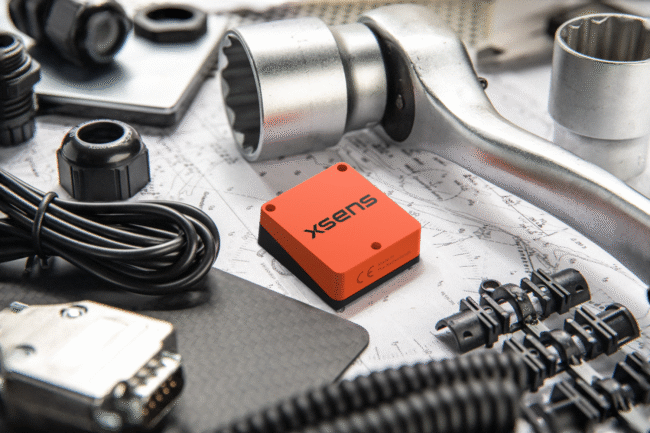
    Xsens has launched Xsens Avior, a lightweight, OEM form factor inertial measurement unit (IMU) with a compact 36.8mm x 40mm footprint that offers enhanced performance in a wide variety of industrial and commercial applications.

    The Xsens Avior is suitable for products manufactured in high volume thanks to its vertical 10×2-pin socket connector for simple board mounting, and its tolerance of any mounting orientation in all three axes. The product also eases design integration, with UART, CAN, SPI and I2C interfaces on-board and support for RS232 and RS422 via the product’s development kit or an external transceiver.

    Xsens has integrated a new generation of sensing components in the Avior, as well as advanced analog filtering for higher stability and noise reduction, resulting in substantially better performance compared to the previous generation product. Heading accuracy is 1° RMS and roll and pitch accuracy is 0.2° RMS. Stability is also enhanced in the Xsens Avior: in-run bias stability in the gyroscope is 8°/hr, and accelerometer in-run bias stability is 15μg.

    Weighing 35.2g, the Xsens Avior is enclosed in a robust aluminum housing and has a rating of IP51 and an operating temperature range of –40°C to 85°C. The sensor’s small size, light weight, high performance and robust construction provide value in applications such as drones, 3D mapping, and marine remotely operated vehicles (ROVs).

    Flexible product options

    The new sensor is available in three versions:

    • IMU providing calibrated inertial sensor data
    • Vertical Reference Unit (VRU) providing accurate, calibrated values for roll and pitch, and unreferenced yaw data
    • Attitude and Heading Reference System (AHRS), providing accurate, calibrated roll and pitch values, and heading data referenced to true North

    The Xsens Avior is available in a ready-to-use hardware development kit, and is supplied with free software development kits supporting the C#/C++, Python, ROS 1 and ROS 2 and Matlab environments, as well as full documentation and step-by-step guides to design integration.

    Key product specifications:

    • Typical power consumption: <0.5W
    • Maximum output data rate: 400Hz
    • Gyroscope full range: ±300°/s
    • Accelerometer full range: ±8 g
    • Magnetometer full range: ±8 G
    • Fully supported in the MT Software Suite development environment
    • Certifications: CE, FCC, RoHS, ITAR free
  • SmallSat Conference heads to Salt Lake City

    SmallSat Conference heads to Salt Lake City

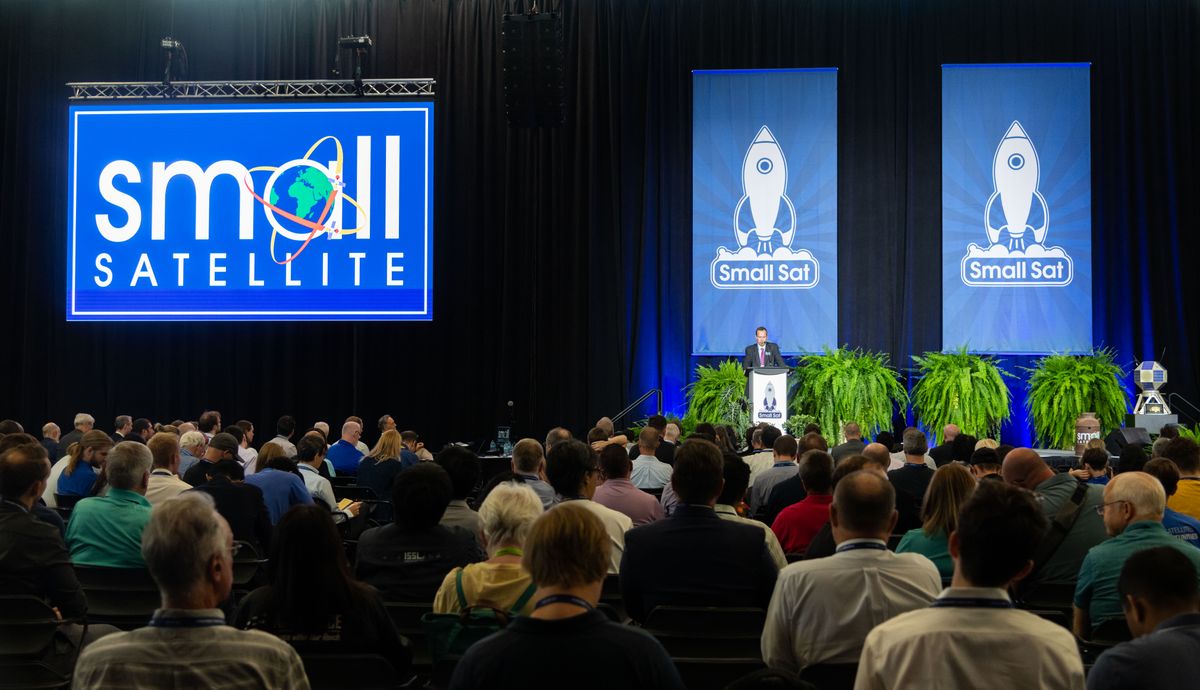
    The 39th Annual Small Satellite Conference (colloquially referred to as SmallSat) takes place Aug. 10-13, 2025, at the Salt Palace Convention Center in Salt Lake City.

    SmallSat will bring together 4,000 participants from 1,300 organizations and 45 countries, along with 400 exhibitions, to explore all aspects of small satellites — from breakthrough missions and capabilities to launch services and student research. It is the world’s largest gathering devoted to small satellite innovation, exploration and impact.

    Keynote speaker Nicola “Nicky” Fox, NASA’s Associate Administrator for the Science Mission Directorate, will speak on Monday, Aug. 10, at 10 a.m. in the Grand Ballroom of the Salt Palace.

    Explore the full program at https://www.smallsat.org.

  • SparkFun launches compact multi-band GNSS timing breakout 

    SparkFun launches compact multi-band GNSS timing breakout 

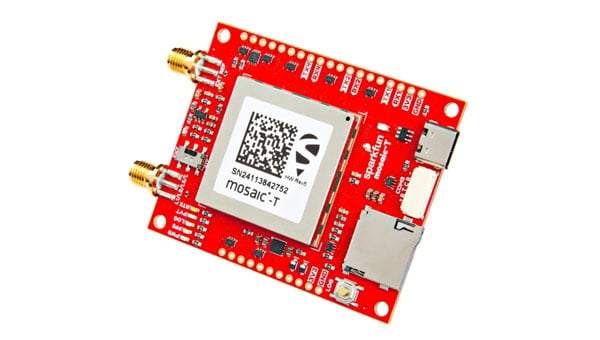
    Sparkfun Electronics has released the SparkFun Timing GNSS Breakout – mosaic-T, a compact, multi-band, multi-constellation GNSS timing receiver designed for precise time synchronization applications. At its core is the Septentrio mosaic-T module, which offers timing precision of 5 ns and can achieve accuracy better than 1 ns with an optional Fugro AtomiChron L-band timing service subscription. Event timing accuracy is better than 20 ns.

    The mosaic-T module is engineered for ultra-low power consumption and supports multiple satellite constellations. It features AIM+ technology for interference mitigation and anti-spoofing, designed to improve reliability and accuracy in challenging environments.

    The breakout board is designed for integration into projects requiring high-precision timing. It provides standard interfaces for connectivity and is suitable for applications in telecommunications, data centers, and scientific research that demand precise time references.

  • Ukraine receives Shark ultralights with EW capabilities

    Ukraine receives Shark ultralights with EW capabilities

    Ukraine has received its first Shark ultralight aircraft with electronic warfare (EW) capabilities from the Czech-Slovak company Shark.Aero, reports European Security and Technology (ES&T), a German publication. The Shark can detect and jam enemy drones and will strengthen the defense of Ukraine against Russian attacks.

    The Shark’s two-seat tandem configuration was originally designed as a high-performance ultralight aircraft for civilian use. Its main features are its high speed of nearly 300 km/h and its maneuverability.

    The military version of the ultralight is designed to detect and jam enemy drones. It offers the Ukrainian army a mobile, airborne defense option against loitering UAVs and reconnaissance drones.

    Electronic warfare system

    The first EW component suppresses GNSS navigation signals; the second suppresses video and remote control channels of enemy drones. The system is installed in a suspended container under the center of the fuselage so as not to affect the aerodynamics of the craft. From an altitude of 1800 m, the system can interfere with the operation of drones within a radius of up to 4.5 km.

    A Shark representative discusses the ultralight with EW capabilities below.

  • Quantum magnetometer could solve GNSS-denied navigation problems

    Quantum magnetometer could solve GNSS-denied navigation problems

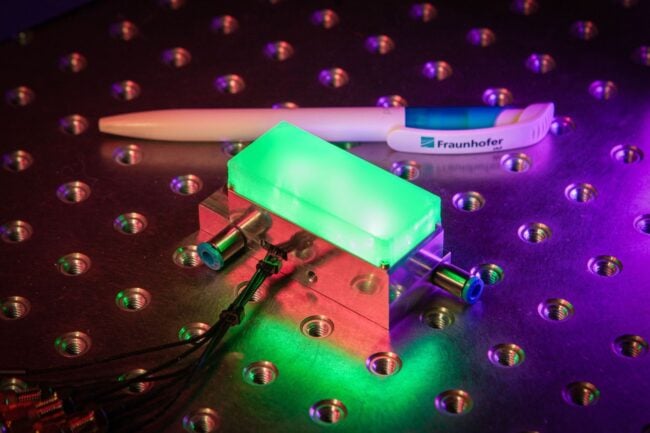
    Fraunhofer IAF presented the latest version of its compact integrated quantum magnetometer at World of Quantum in Munich. The diamond-based system is characterized by its robustness, high integration density, and measurement sensitivity. It offers new measurement possibilities for a wide range of applications, including navigation.

    The highly integrated vector magnetometer developed by the Fraunhofer Institute for Applied Solid State Physics IAF is based on nitrogen vacancies (NV) in diamond and provides access to the smallest magnetic fields with a previously unattainable degree of flexibility and precision. The miniaturized measuring system offers new possibilities in applications that require precise measurement with minimal interference, such as in biochemical measurements of nerve pathways or in microelectronics.

    “What makes the diamond-based NV vector magnetometer so special is its native and intuitive functionality, which enables it to precisely measure the vector components of the Earth’s magnetic field under most operating conditions,” explained Michael Stoebe, Business Unit Manager for Quantum Devices at Fraunhofer IAF. “This makes the sensor not only a technical innovation, but also a significant advance in sensor technology,”

    The unique properties of the NV center on the diamond lattice, which is arranged along the four crystal axes, enable all vector components of the magnetic field to be detected with a single sensor chip using <100> diamond. This reduces the calibration effort and opens up new possibilities for applications that were previously limited by the restrictions of conventional magnetometers. This sensor represents a significant step toward more precise and efficient measurement techniques, according to Fraunhofer.

    Safe navigation without GNSS

    Despite their high precision and coverage, today’s navigation systems are often prone to interference and are not available everywhere. Alternative navigation methods that function independently of GNSS are therefore gaining in importance. The Earth’s magnetic field is a promising basis for this, as it exhibits regional differences that can be used as an invisible map for autonomous navigation, especially in areas where GNSS signals are disrupted or difficult to receive.

    The quantum sensor developed at Fraunhofer IAF makes it possible to create comprehensive magnetic field maps and provide reliable navigation based on them. The vector magnetometer offers an autonomous, interference-free method for global positioning and navigation. It complements satellite-based navigation and also works without satellite signals, for example underwater, in canyons, underground, in buildings, or in tunnels.

    Increased integration density and sensitivity

    Researchers at Fraunhofer IAF have succeeded in reducing the size of their integrated quantum magnetometer by a factor of 30 in just one year. The sensor head now has a compact size comparable to conventional and industrially used optically pumped gas cell magnetometers (OPMs) with high sensitivity in the picotesla range. The diamond-based system stands out from competing technologies thanks to its high robustness and wide measuring range, which allows it to be used flexibly in a wide variety of measurement scenarios with extremely low calibration requirements.

    “We are striving for even greater integration density, while increasing sensitivity. Our goal for the coming year is to reduce the size of the sensor by a factor of 5 again, while further increasing sensitivity to enable measurements in the sub-picotesla range,” emphasizes Dr. Michael Stoebe.

    The special feature of the integrated quantum magnetometers developed by Fraunhofer IAF is their optional water cooling, which ensures robust and reliable measurement of magnetic fields even under the difficult operating conditions. This flexibility in design and integration is what sets the latest sensor prototypes from the Freiburg-based institute apart.

    “We take an application-oriented approach to the continuous development of our sensor systems and respond to the individual requirements placed on our systems,” said Michael Kunzer, project manager at Fraunhofer IAF.

    In addition to further developing the system, the core element of the sensor — its nitrogen-vacancy (NV)-doped diamond sensor head — is also being improved at Fraunhofer IAF. The synthetic diamond is grown at the institute in special reactors and further processed into quantum devices through the controlled exchange of carbon atoms with nitrogen atoms. The wafer sizes of the ultra-pure diamond are to be further developed next year from the current two inches to industrially scalable four-inch wafers.

    Geological measurements quickly and contact-free

    The quantum magnetometer developed by Fraunhofer IAF enables precise, contact-free localization of underground mineral deposits, thereby providing access to valuable resources. It can also detect unexploded ordnance over large areas, significantly reducing the risk to people in affected areas. Using the same principle as in navigation, the composition of the Earth’s crust and its magnetic field can be used to draw conclusions about geological formations. Magnetic anomalies such as ore deposits or metallic objects such as unexploded ordnance can thus be detected.

    The collected data can be converted into magnetic maps that show the locations of suspicious objects and provide information about their depth, shape, and size. This method enables comprehensive and non-invasive exploration of affected areas and the location of even deep-lying objects.

    World of Quantum 2025

    At the World of Quantum 2025 June 24-27 in Munich, Fraunhofer IAF presentsthe latest prototype of its NV vector magnetometer n Hall A1, Booth 439-3, on the Quantum Future Boulevard.
  • TDK expands MEMS sensor portfolio 

    TDK expands MEMS sensor portfolio 

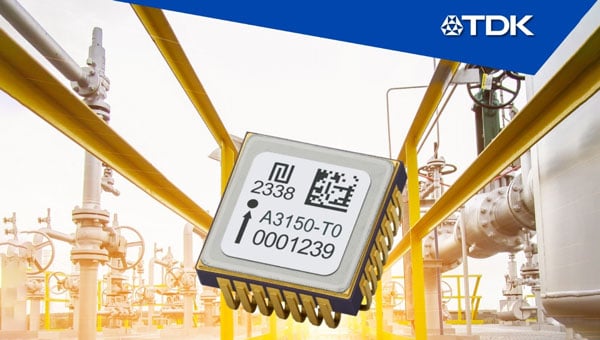
    TDK Corporation has introduced the Tronics AXO315T0, a high-temperature MEMS accelerometer designed for measurement while drilling (MWD) applications in the energy sector. The new sensor features a ±14 g input range and a digital interface, expanding TDK’s MEMS inertial sensor portfolio.

    The AXO315T0 uses TDK’s closed-loop architecture, which delivers advanced vibration rectification and resistance to operational shocks. The device maintains a bias residual error of 0.8 mg across its operating temperature range of minus 30°C to 150°C, enabling precise and continuous inclination measurements for directional drilling tools exposed to high temperatures.

    To meet the demanding reliability requirements of complex drilling operations in harsh environments, TDK qualified the AXO315T0 through more than 1,000 hours of powered life testing at 165 degrees Celsius, temperature cycling from minus 55 degrees Celsius to 165 degrees Celsius, and high-temperature vibration tests at 20 g RMS random vibration combined with a 50 g sine sweep.

    The AXO315T0 offers a typical bias drift of less than 1 mg without recalibration after 1,000 hours at high temperature, providing a digital, low size, weight and power (SWaP) alternative to traditional quartz accelerometers. This advancement supports a new generation of MWD tools capable of long-term operation at elevated temperatures without compromising performance.

    AXO315T0 sensors and evaluation boards are available for sampling and customer evaluation. TDK plans to further expand its MEMS portfolio for the energy market with a new accelerometer capable of operating at temperatures up to 175 °C.

    Main applications:

    • Measurement while drilling (MWD)
    • Logging while drilling (LWD)
    • Directional drilling
    • Wireline

    Key features and benefits:

    • ±14 g input range, single-axis accelerometer
    • Operating temperature range: minus 30 °C to 150 °C
    • Bias residual error: 0.8 mg
    • Powered lifetime: more than 1,000 hours at 150 °C
    • Vibration rejection: 20 μg/g²
    • Noise density: 10 μg/√Hz
  • Machine learning boosts GPS precision: New method enhances ambiguity resolution

    Machine learning boosts GPS precision: New method enhances ambiguity resolution

    High-precision GNSS applications, such as real-time displacement monitoring and vehicle navigation, rely heavily on resolving carrier-phase ambiguities. However, traditional methods like the R-ratio and W-ratio tests often use empirical thresholds, which can lead to unreliable results due to biases and environmental variability.

    These limitations hinder the efficiency of Precise Point Positioning Ambiguity Resolution (PPP-AR), especially in dynamic or challenging conditions. Based on these challenges, there is a pressing need to develop more robust and adaptive techniques for ambiguity validation.

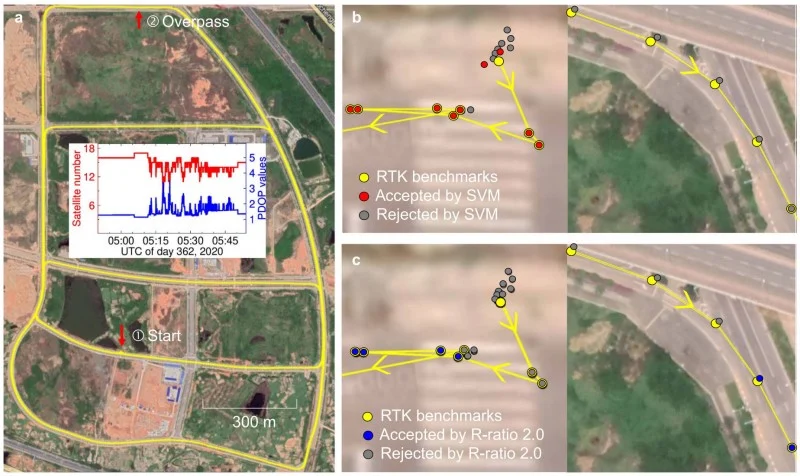
    Published (DOI: 10.1186/s43020-025-00167-8) on June 9, 2025, in Satellite Navigation, researchers from the Royal Observatory of Belgium and the State Key Laboratory of Precision Geodesy in China unveiled a Support Vector Machine (SVM)-based method for GNSS ambiguity validation.

    The study leverages machine learning to combine multiple diagnostic metrics, achieving higher accuracy and reliability than conventional approaches. The model was trained on extensive datasets and validated through real-world experiments, showcasing its potential to transform high-precision positioning.

    The study’s key innovation lies in its integration of seven diagnostic metrics — including R-ratio, ADOP, and ambiguity dimension — into an SVM model. This approach addresses the limitations of traditional methods, which often rely on single thresholds and fail to account for complex dependencies among variables.

    The SVM model achieved an 92% success rate in ambiguity validation, outperforming the R-ratio test’s 82% in kinematic scenarios. Notably, the model reduced convergence time prediction errors to just 1.0 minute, compared to 5.0 minutes for conventional methods.

    Highlights of the research include:

    • Enhanced Reliability. The SVM model’s ability to adaptively weigh multiple metrics ensures more consistent ambiguity resolution.
    • Real-World Validation. A vehicle-borne experiment demonstrated a 92% success rate, proving the method’s practicality in dynamic environments.
    • Scalability. The framework is adaptable to both single- and multi-constellation GNSS systems, broadening its applicability.

    Despite its advancements, the study acknowledges a 5% error rate in unresolved ambiguities, pointing to future research directions, such as incorporating variance-covariance data for further refinement.

    “Our SVM model represents a paradigm shift in ambiguity validation,” emphasized Jianghui Geng, co-author of the study. “By harnessing machine learning, we’ve not only improved accuracy but also provided a scalable solution for diverse GNSS applications, from autonomous vehicles to geodetic monitoring.”

    The SVM-based method holds significant promise for industries requiring ultra-precise positioning, such as autonomous navigation, aerospace, and infrastructure monitoring. Its ability to shorten convergence times and enhance reliability could revolutionize real-time GNSS applications, particularly in urban or obstructed environments where signal interruptions are common.

    Future iterations of the model, incorporating additional data layers, could further bridge the gap between theoretical precision and real-world performance, setting a new standard for GNSS technology.

  • Trimble and TDK join forces to accelerate precision navigation

    Trimble and TDK join forces to accelerate precision navigation

    Trimble and InvenSense, a TDK group company, will work together to deliver an advanced navigation solution that combines the Trimble ProPoint Go engine and Trimble RTX correction service with TDK’s SmartAutomotive inertial measurement units (IMUs) module from InvenSense.

    The solution is expected to provide greater accuracy and reliability in positioning and navigation across various automotive and IoT applications.

    The Trimble ProPoint Go positioning engine is designed to deliver high-accuracy position and orientation data by utilizing internationally accessible Trimble correction services. With quad-frequency GNSS signal support and Trimble ProPoint Go’s first-in-market Automotive Safety Integrity Level-C (ASIL-C) certified correction data, this positioning ecosystem helps companies enhance their automated driving capabilities with a focus on safety. It also helps drive accuracy for IoT applications such as field robotics.

    TDK IMUs integrate a triaxal accelerometer and a triaxal gyroscope in a compact six-axis motion sensor to detect the linear acceleration and angular velocity of vehicles and objects with superior level of accuracy. With its proprietary six-axis and MEMS fabrication platform, TDK inertial sensors enhance applications possibilities thanks to their high-performance, small-size and low-power features.

    “Together with TDK we are bringing the power of high-accuracy and precise positioning along with state-of-the art ASIL-certified sensors to help our customers build innovative solutions for automotive and IoT markets,” said Olivier Casabianca, vice president, advanced positioning at Trimble. “As we continue to expand our positioning services with TDK and other tier one companies, we are powering the connected world while ensuring the safety and accuracy of connected systems.”

    Positioning Solutions Built for the Connected World
    Key benefits of the ProPoint Go positioning engine and RTX correction with TDK’s modules include:

    • Accuracy. The synergy between the two solutions delivers superior positioning accuracy under all conditions: open sky, urban canyons and indoor, even in harsh environments and among wide temperature variations.
    • Reliability. Customers can rely on consistent and dependable orientation and navigation data, crucial for applications such as autonomous vehicles, drones and industrial machinery.
    • Versatility. The integrated solution is adaptable to a wide range of applications, such as automotive positioning, advanced driver-assistance systems (ADAS), cellular vehicle-to-everything (C-V2X), field robotics and unmanned aerial vehicles (UAVs).

    “Inertial and positioning data have become critical in enabling automation, improving efficiency and monitoring conditions,” said Stefano Zanella, automotive motion VP and general manager, TDK. “Building on almost a decade of collaboration with Trimble, we are delighted to take our efforts to the next level: by offering an integrated solution, we empower customers to accelerate deployment, streamline integration and maximize the value of this transformative technology.”

    The TDK automotive safety IMU components, developed as SEooC according to ISO 26262, are suitable for applications with requirements up to ASIL-D. In addition to its six-axis solution, TDK provides quality-managed solutions that also include a three-axis magnetometer in a nine-axis solution.

  • Safran’s Skylight GNSS receiver enhances PNT resilience with Galileo PRS and M-code

    Safran’s Skylight GNSS receiver enhances PNT resilience with Galileo PRS and M-code

    Safran Electronics & Defense has launched Skylight, a multi-mode military GNSS receiver designed to withstand electronic warfare threats. The company unveiled the new receiver at the Paris Air Show, describing it as a compact and resilient GNSS solution with high integrity.

    Skylight is notable for being the first GNSS receiver to be flight-tested with compatibility for Galileo Public Regulated Service (PRS). Its performance was validated during flight trials aboard a combat aircraft. The receiver delivers encrypted, spoofing-resistant PRS signals, designed to enhance security for operations in contested environments.

    The device is also compatible with M-code, ensuring interoperability with U.S. and allied military systems. Additionally, Skylight features a certified civil GPS channel, enabling navigation in civil airspace when necessary. According to Safran, this feature eliminates the need for a separate civil GPS receiver, resulting in weight and cost savings for platform integrators.

    Skyligh also incorporates advanced anti-jamming and anti-spoofing algorithms that have been proven through more than 16,000 operational cases. The receiver is designed to operate with anti-jamming antennas and is fully compatible with the SkyNaute inertial navigation system, allowing for integration into resilient positioning, navigation and timing (PNT) architectures.

    Alexandre Ziegler, executive vice president for the Defense Global Business Unit at Safran Electronics & Defense, said the company already counts two leading aerospace manufacturers among the first adopters of Skylight, including Airbus Helicopters, which has selected the H225M platform to be equipped with the receiver.

    “In an era where PNT resilience is critical, Skylight delivers agility, precision and reliability with a standalone, multi-constellation GNSS receiver whose robustness is strengthened by our expertise in defensive Navwar,” Ziegler said.

  • GPS World launches new digital opportunities and printing schedule

    GPS World launches new digital opportunities and printing schedule

    As GPS World marks its 35th anniversary, we continue to evolve to meet the needs of our valued subscribers and marketing partners. This month, we unveil strategic refinements to our magazine publishing schedule and our expanding digital content and solutions portfolio plans. 

    Tod McCloskey
    Tod McCloskey

    To better align with buying cycles and industry events, GPS World is transitioning from a monthly print and digital edition cadence to a six-times-per-year magazine frequency. Remaining 2025 issues are set for September and October. Beginning in 2026, GPS World issues will publish in February, March, May, June, September and October.

    Each GPS World issue will continue to deliver exclusive technical content and market insights. 

    In tandem with our magazine’s evolution, GPS World is significantly expanding its digital content and media solutions offerings, including:

    • Expanding GPSWorld.com: We will feature more exclusive content, delving deeper into today’s hottest trends in GNSS’ and complementary PNT’s top segments: autonomous solutions, defense, mobile, machine control/precision ag, simulators, surveying, mapping and transportation
    • New Custom Media Solutions: Leading technology suppliers now have an arsenal of platforms and offerings to educate our audiences on trends and advancements
    • Expanding Enews: Navigate Weekly!, Survey Scene, Autonomous Arena and Defense PNT e-newsletters: We will deliver even beefier segment news to your inbox each week 

    GPS World’s audiences are highly engaged confirmed buyers/specifiers. We promise to continue to evolve our integrated media offerings to meet readers’ and marketers’ changing preferences — because you are, and always have been, at the center of our information constellation.

  • Safran Electronics & Defense debuts resilient PNT system

    Safran Electronics & Defense debuts resilient PNT system

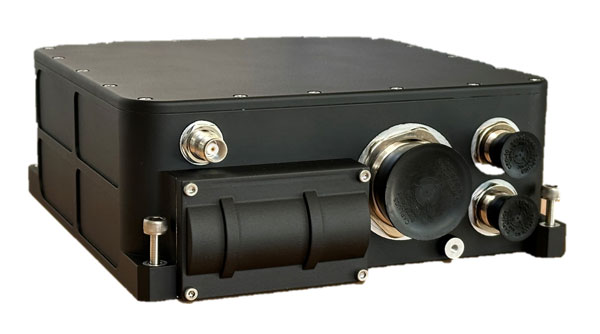
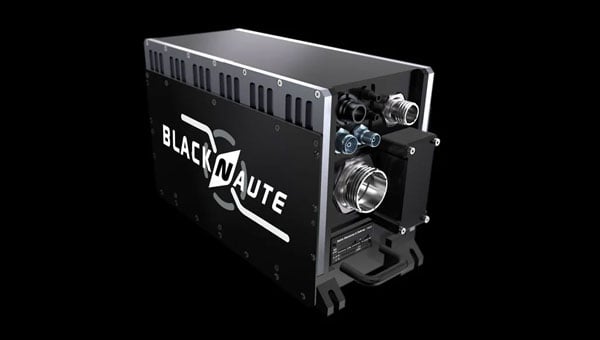
    Safran Electronics & Defense has introduced BlackNaute, a new autonomous positioning, navigation and timing (PNT) system. The system integrates Safran’s HRG Dual Core inertial navigation technology, the Skylight multi-mode GNSS receiver board and an atomic clock to offer navigation resilience in challenging electronic warfare environments.

    BlackNaute’s built-in atomic clock is designed to maintain precise timing, which is essential for secure communications and collaborative combat operations. The system features advanced anti-jamming and anti-spoofing algorithms, which have been validated in more than 16,000 operational cases. These capabilities allow BlackNaute to detect compromised signals and automatically switch to autonomous and trusted navigation and timing sources to ensure continuity of operations.

    Its modular design allows it to be adapted across a variety of platforms. Airbus Helicopters has selected the NH90 to be equipped with this new Embedded GNSS and Time INS (EGTI).

    “What we are offering today is not just a new solution — it’s an operational guarantee, designed to meet the challenges of electromagnetic warfare,” said Alexandre Ziegler, Executive Vice President, Defense Global Business Unit at Safran Electronics & Defense. “It is a concentration of innovation combining precision, versatility, and security to ensure positioning, navigation and timing — anywhere, under any circumstances.”

  • The rise of precision timing for aerospace and defense applications

    The rise of precision timing for aerospace and defense applications

    In the mission-critical world of aerospace and defense, where reliability and resilience can mean the difference between success and failure, precision timing is an essential technology for increasingly sophisticated and connected systems. Every nanosecond matters, whether ensuring UAVs operate safely or enabling secure real-time communication in high-threat environments. At the heart of these systems is precision timing technology, which ensures precise synchronization within and between systems, enabling high data throughput with minimal latency.

    Aerospace and defense systems operate in some of the harshest environments on the planet, where extreme temperatures, shock and vibration and electromagnetic interference (EMI) are commonplace. While quartz technology has historically been used to deliver timing references in aerospace and defense applications, precision timing based on microelectromechanical systems (MEMS) technology has recently proven to be a superior alternative due to its better performance, resilience and reliability.

    To understand the key differences between MEMS and quartz technologies for timing devices used in aerospace and defense applications, let’s focus on size, weight and power consumption (SWaP), as well as the ability of these two distinct types of timing technologies to perform reliably and accurately in harsh, demanding operating environments.

    The Rise of MEMS Oscillators in Aerospace and Defense

    MEMS-based precision timing technology is proven and highly reliable, designed to perform reliably in the harsh environments in which aerospace and defense applications operate. Unlike quartz timing devices, MEMS-based timing devices such as resonators, oscillators and clock generators are manufactured using semiconductor processes. This silicon MEMS technology enables unparalleled miniaturization, better resilience, and higher performance across a variety of environmental conditions. By encapsulating a MEMS resonator in a vacuum-sealed cavity, these timing devices are protected from contamination, aging, and environmental disruptions such as shock and vibration.

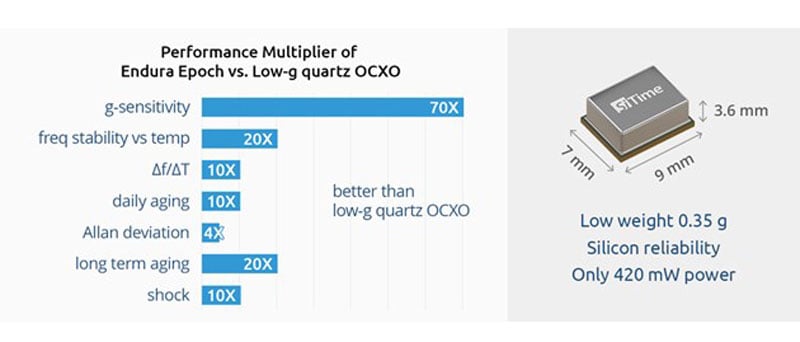
    SiTime, a leader in MEMS-based precision timing technology, has developed a variety of MEMS-based oscillators and clocks that outperform quartz counterparts in key areas like stability, ruggedness, and SWaP. (See Figure 1.) These include popular devices such as temperature-compensated oscillators (TCXOs) and oven-controlled oscillators (OCXOs). The company’s MEMS-based Endura family of ruggedized Super-TCXOs and OCXOs, for example, is specifically designed for demanding aerospace and defense applications.

    Figure 1. MEMS OCXOs surpass vibration-rated quartz OCXOs in performance, offering superior functionality with reduced SWaP. (Credit: all photos and tables provided by author)
    Figure 1. MEMS OCXOs surpass vibration-rated quartz OCXOs in performance, offering superior functionality with reduced SWaP. (Credit: all photos and tables provided by author)

    Key Advantages of MEMS Precision Timing Devices

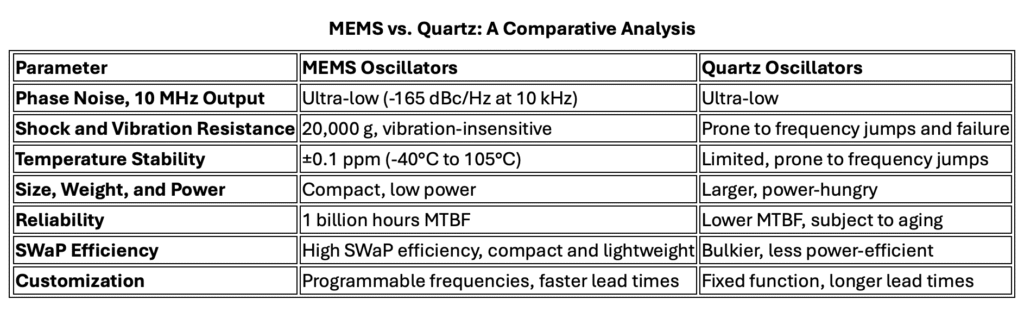
    • Low Phase Noise: MEMS Super-TCXOs deliver ultra-low phase noise, even in the presence of environmental stressors such as shock, vibration, and rapid temperature changes, which is essential for high-frequency RF systems such as tactical radios and satellite communication terminals. With low phase noise at 10 MHz output frequency of -165 dBc/Hz at 10 kHz offset and -175 dBc/Hz noise floor, these MEMS oscillators outperform typical quartz-based devices, ensuring cleaner signal transmission and better system performance.
    • Shock and Vibration Resistance: MEMS oscillators are qualified by SiTime to the highest MIL-STD-883 shock stress level of 30,000 g and customers have reported they can operate at 100,000 g shock levels. This extreme shock resistance in conjunction with ultra-low acceleration sensitivity, as low as 0.009 ppb/g total gamma, make them ideal for rugged environments including space missions, aircraft and military vehicles. In contrast, quartz oscillators are prone to failure or frequency jumps under similar conditions.
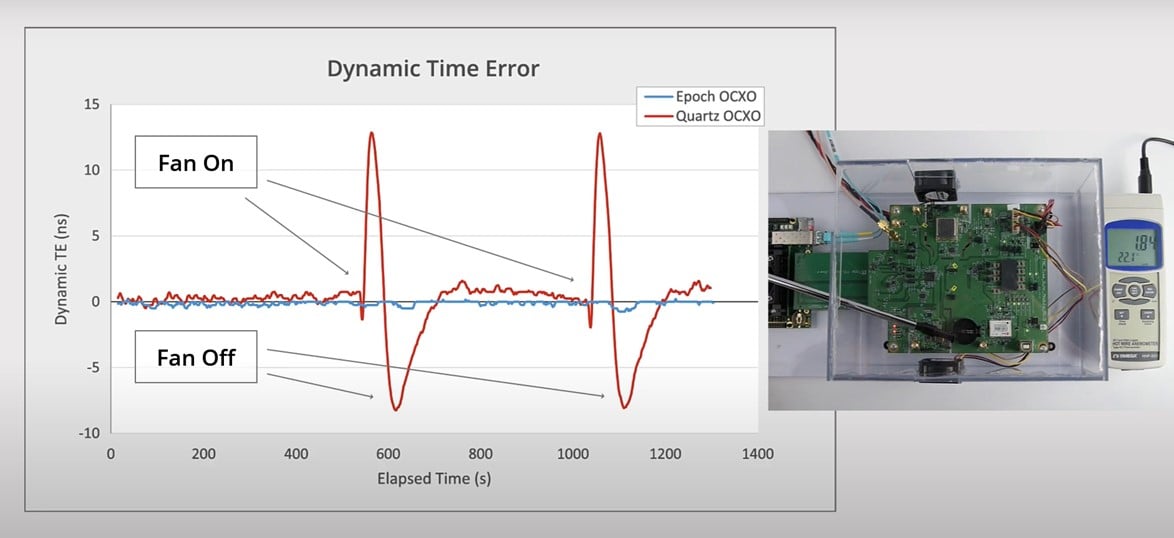
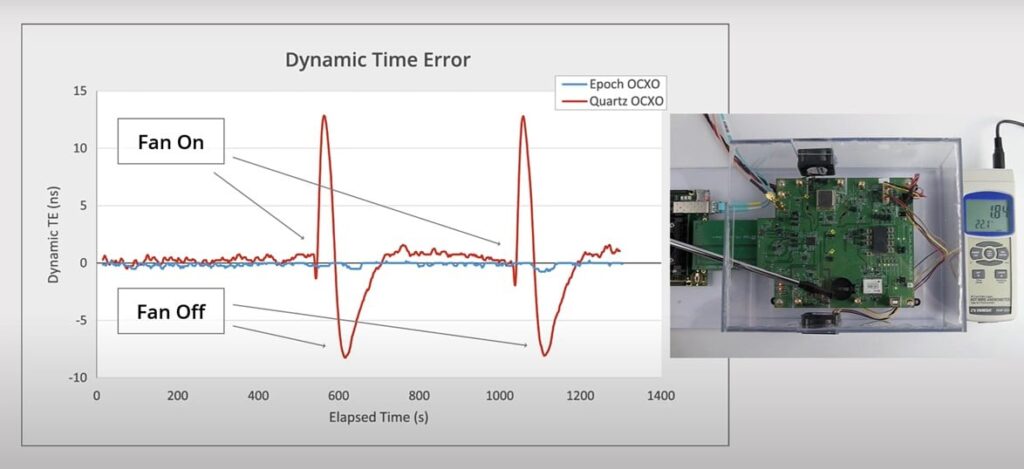
    • Temperature Stability: Super-TCXOs exhibit excellent temperature stability, with frequency stability of ±10 ppb across a temperature range of -40 °C to +105 °C. This stability is critical for aerospace and defense applications subject to rapid temperature changes, which cause traditional quartz oscillators to fail or experience frequency jumps. (See Figure 2.)
    • SWaP Efficiency: MEMS oscillators are significantly smaller, lighter, and more power-efficient than quartz devices, meeting the stringent SWaP requirements of modern aerospace systems. For example, OCXO-grade TCXOs (Elite-X) come in a compact 7.0 x 5.0 mm2 surface-mount package and consume less than 115 mW of power while delivering ±5ppb frequency stability over temperature performance. This makes them ideal for space-constrained, low-power applications like small satellites (SmallSats) and tactical communication systems.
    • Reliability: MEMS oscillators offer superior long-term reliability, with a mean time between failures (MTBF) of more than 1 billion hours – about 30 times greater than quartz-based oscillators. Additionally, MEMS devices exhibit lower aging rates than quartz, ensuring consistent performance over extended missions.
    Figure 2. Endura Epoch OCXOs are unaffected by rapid temperature changes, as simulated by air flow that is turned on and off repeatedly.
    Figure 2. Endura Epoch OCXOs are unaffected by rapid temperature changes, as simulated by air flow that is turned on and off repeatedly.

    Real-World Applications of Precision Timing Technology

    • Tactical Radios: Precision Timing is critical for secure data transmission in military communication systems. Super-TCXOs, offering low phase noise and vibration resistance, ensure signal integrity even in the harshest battlefield conditions, improving the reliability of tactical radios used by defense forces.
    • Satellite Communication Systems: Reliability, component size and power efficiency are paramount in satellite communications. MEMS oscillators enable high-bandwidth data transmission with minimal signal degradation, and their robust design ensures uninterrupted performance during mission-critical operations. Their small size and energy efficiency also make them ideal for space- and power-constrained satellite systems.
    • UAVs: UAVs are often deployed in dynamic environments where they are exposed to extreme temperatures and vibrations. MEMS oscillators, with their superior shock and vibration resistance, are a preferred timing solution for maintaining stable navigation and communications, ensuring UAVs can carry out their missions without interruption.
    • Radar Systems: Advanced radar systems depend on precise timing to synchronize signal processing, reduce interference, and optimize target detection. MEMS-based Precision Timing devices, with their high vibration resistance and temperature stability, deliver reliable performance in high-intensity environments, such as on naval vessels or fighter jets, where traditional quartz oscillators may struggle to maintain accuracy.
    Photo: SiTime chart

    The Future of Precision Timing in Aerospace and Defense

    As aerospace and defense systems become more advanced, the need for reliable precision timing solutions will continue to grow. MEMS-based oscillators, with their superior SWaP efficiency, rugged design, and inherent reliability, represent the future of Precision Timing technology in these critical sectors.

    While quartz oscillators have served the aerospace and defense and industry for decades, MEMS technology is proving to be a more effective Precision Timing solution for next-generation systems. MEMS-based TCXOs and OCXOs are setting new benchmarks for Precision Timing, offering unmatched resilience, reliability, and performance in the most demanding environments.