Blog

  • LizardTech Launches GeoExpress 9 at Esri Conference

    LizardTech, a provider of software solutions for managing and distributing geospatial content, announced the launch of GeoExpress9 at this week’s Esri International User Conference in San Diego, California, where the company is also a Platinum Imagery Sponsor and exhibitor in booth number 1704.

    GeoExpress enables geospatial professionals to compress and manipulate satellite and aerial imagery and the latest version features a significant performance improvement from previous versions, LizardTech said. The latest version is four times faster than before with support for spanning multiple jobs across multiple cores. This increase in speed enables users to complete projects faster than ever before within the application.

    This release also introduces Intelligent Encoding, with the software automatically reconfiguring itself for optimal performance. GeoExpress 9 automatically chooses to Encode, Optimize or Update based on the encoding operations that the user chooses, which results in high performance with minimal training, LizardTech said.

    In addition, Jon Skiffington, LizardTech’s director of product management, will introduce GeoExpress 9 to the Esri attendees by giving a Demo Theater presentation titled “LizardTech – What’s New with MrSID and GeoExpress” on Wednesday, 1:30 p.m. – 2:30 p.m. at the Imagery Island Exhibit in Exhibit Hall C.

    “This is going to be an exciting week for LizardTech,” said Skiffington. “We’re launching the latest version of our flagship product, GeoExpress with its new features, faster performance and updated user interface. We look forward to showing our customers the new features and receiving feedback from our users and partners.”

    LizardTech will also host product demonstrations in its booth to showcase the new features of GeoExpress 9. These presentations will be held on Tuesday and Wednesday at 10 a.m., 1 p.m. and 3 p.m., with a final presentation held on Thursday at 10 a.m. Product demonstrations of Express Server software for high-performance delivery and publication and LiDAR Compressor software, which turns giant point cloud datasets into efficient MrSID files will also be available.

  • DigitalGlobe and Esri to Provide Premium Services to ArcGIS Online Users

    DigitalGlobe announced that ArcGIS Online users will now have access to DigitalGlobe’s Premium Services. Revealed today at the plenary address during the Esri User Conference, the new offering brings expanded geospatial products and solutions to select users of ArcGIS Online on a subscription basis.

    According to the announcement, DigitalGlobe’s Global Basemap, FirstLook, and Multispectral Premium Services can now be seamlessly integrated into the workflow of ArcGIS users, allowing them to access the most current imagery and information available directly from the source!

    “Accessing high resolution imagery with ArcGIS has taken a giant leap forward,” said Lawrie Jordan, Esri director of imagery. “The new DigitalGlobe Premium Services enable everyone to benefit from quick and easy access to one of the best collections of high resolution imagery through ArcGIS Online.”

    “The Premium Services partnership will serve as the next era in the expansion of our relationship with Esri,” said Bert Turner, senior vice president, sales at DigitalGlobe. “We’re excited to work with Esri, the GIS market leader, to bring users of ArcGIS Online some of the most advanced imagery services available today.”

    The Global Basemap Premium Service provides some of the best available natural color and panchromatic imagery. This imagery is available as a cached tile service with vast coverage of the U.S. and Canada. This service will be regularly updated to reflect new, high quality imagery from DigitalGlobe.

    The FirstLook Premium Service is a disaster and crisis monitoring service populated with imagery when a qualifying event occurs, such as a natural disaster, manmade crisis, political instability, or human interest occurrence. Through this service, users have access to near real-time post-event imagery as well as pre-event imagery for comparison.

    The Multispectral Premium Service offers access to rich, full resolution multispectral content through an ArcGIS Online interface running on a highly scalable cloud architecture. The service and the content it hosts can be tailored to the client’s specific project needs. Users who require highly detailed imagery for image analytics, geodatabase updates, and surface change analysis can work with DigitalGlobe experts to maximize the value of the subscription.


  • Topcon Offers HiPer SR Integrated Receiver for GIS, Mapping

    Topcon Offers HiPer SR Integrated Receiver for GIS, Mapping

    HiPerSR_GIS_Topcon-W Photo: Topcon Positioning Systems
    Photo: Topcon Positioning Systems

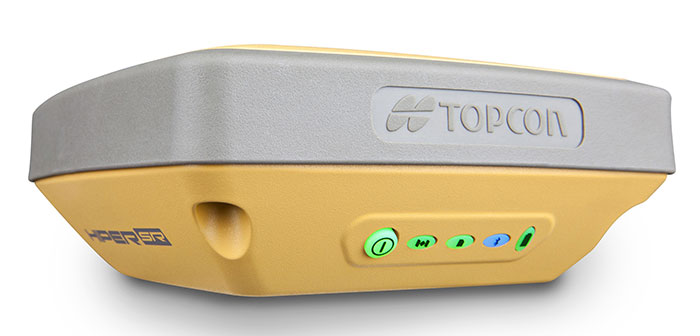
    Topcon Positioning Systems has announced the HiPer SR integrated receiver for GIS and mapping applications.

    The HiPer SR for GIS is a compact, integrated GNSS receiver with sub-meter accuracy. Additional, scalable options are available via OAF (Options Authorization File) upgrades, delivering accuracy levels of sub-decimeter and centimeter without the need for additional hardware, Topcon said.

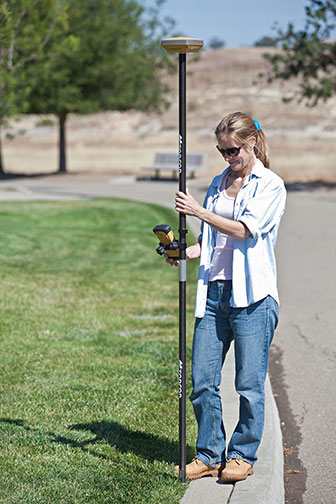
    The HiPer SR for GIS can be paired with a Topcon controller and eGIS software, or used with Topcon’s eGPS utility software to use with a third-party device and application such as ArcPad or ArcGIS mobile running on a Windows tablet or mobile device.

    “The HiPer SR for GIS brings the very finest in Topcon GNSS technology into a compact and rugged housing,” Jason Hooten, TPS sales manager for GIS, said. “Superior tracking and positioning is provided by the HiPer SR’s Vanguard receiver technology with advanced Fence Antenna.”

    “GIS field work is changing as more field workers are using various types of collection devices like smartphones, tablets, and laptops in addition to the traditional data collectors. Unfortunately, the GPS in these devices are not accurate enough for locating buried assets or doing initial inventory collection. The HiPer SR provides this accuracy regardless of job site demands,” Hooten said.

    HiPerSR_Topcon-W Photo: Topcon Positioning Systems
    Photo: Topcon Positioning Systems

    “The new HiPer SR is an adaptable device that can be used to locate utilities within an inch one day and the next provide sub-meter accuracy for an environmental study. This device provides accurate positioning to different applications as needed. The HiPer SR is small in size, but giant in performance and flexibility.”

  • GPS World, Geospatial Solutions Report from Esri Conferences

    GPS World, Geospatial Solutions Report from Esri Conferences

    Geospatial Solutions Editor Eric Gakstatter, who is also a contributing editor to GPS World magazine, will be attending the 2013 Esri Survey Summit and Esri International User Conference, providing continuous new and analysis for the duration of both conferences. The conferences are being held this week in San Diego, California.

    On Tuesday at 1:30 p.m. in Room 24A of the San Diego Convention Center, Gakstatter will deliver a presentation entitled “High-Precision GPS/GNSS on your Smartphone, Handheld and Tablet,” discussing trends and new product innovations for sub-meter and centimeter mapping on smartphone, handheld and tablet devices, including Windows Mobile, Android and iOS (Apple) devices.

    Steve Copley, GPS World and Geospatial Solutions associate publisher, shared images of the event on his Twitter account. A few of them are below.

    For live coverage all week follow:

    Eric Gakstatter @GPSGIS_Eric

    Steve Copley @SteveCopleyGPS

    Geospatial Solutions @GSS_NCM


  • 2C or Not 2C: The First Live Broadcast of GPS CNAV Messages

    By Oliver Montenbruck, Richard B. Langley, and Peter Steigenberger

    Over the past several years, some users of the GPS navigation system have already benefitted from the addition of various new signals in addition to the legacy C/A- and P(Y)-code. With the introduction of the Block IIR-M satellites in 2005, a new civil signal (L2C) was transmitted on the L2 frequency, and a new signal on a new frequency (L5) was introduced as a standard signal with the Block IIF satellites beginning in 2010. These new signals provide direct access to dual-frequency observations and thus enable improved ionospheric corrections for civil, including aeronautical, users. In addition, a new Civil Navigation (CNAV) broadcast message has been defined in the GPS Interface Specifications (IS-GPS-200 and IS-GPS-705).

    This message will be transmitted jointly on the L2C and L5 signals and provides a variety of useful new parameters. Compared to the legacy L1 C/A-code navigation message, the CNAV message also offers an increased flexibility concerning the type, sequence, and repeat rate of specific messages.

    CNAV messages have already been broadcast over the past two years by the Michibiki (QZS-1) satellite of the Japanese Quasi-Zenith Satellite System (QZSS), which shares many aspects of the GPS signal design. In contrast to this, Block IIR-M and IIF GPS satellites have only transmitted dummy messages so far and a fully operational CNAV transmission is only foreseen once the ongoing modernization of the GPS control segment has been completed.

    Triggered by various interest groups, the Global Positioning Systems Directorate has just conducted a first test campaign with live CNAV transmissions on L2C and L5 over the two-week period from June 15 to 29 (see Global Positioning System Modernized Civil Navigation (CNAV) Live-Sky Broadcast Test Plan.) It served as a first opportunity for end users and receiver manufacturers to test the decoding and use of the new messages under a wide range of different configurations.

    CNAV messages have a common length of 300 data bits and are identified by a message type number that signifies their contents. The messages presently defined for GPS are summarized in Table 1. For QZSS, complementary messages have been established, which enable, among other features, a rebroadcast of GPS-specific data to QZSS users.

    Table 1. Summary of CNAV message types transmitted by space vehicles (SVs). Messages marked by an asterisk were transmitted during the recent CNAV test campaign.

    Message

    Type

    CNAV Message Title

    Function/Purpose

    0*

    Default Default message (transmitted when no message data is available)

    10*

    Ephemeris 1 SV position parameters for the transmitting SV

    11*

    Ephemeris 2 SV position parameters for the transmitting SV

    12*

    Reduced Almanac Reduced almanac data packets for seven SVs

    13

    Clock Differential Correction SV clock differential correction parameters

    14

    Ephemeris Differential Correction SV ephemeris differential correction parameters

    15*

    Text Text (29 eight-bit ASCII characters)

    30*

    Clock, Iono & Group Delay SV clock correction parameters, ionospheric and group delay correction parameters (inter-signal correction parameters)

    31

    Clock & Reduced Almanac SV clock correction parameters, reduced almanac data packets for four SVs

    32*

    Clock & EOP SV clock correction parameters, Earth orientation parameters; Earth-centered, Earth-fixed to Earth-centered inertial coordinate transformation

    33*

    Clock & UTC SV clock correction parameters, Coordinated Universal Time parameters

    34

    Clock & Differential Correction SV clock correction parameters, SV clock and ephemeris differential correction parameters

    35*

    Clock & GGTO SV clock correction parameters, GPS to GNSS time-offset parameters

    36

    Clock & Text SV clock correction parameters, text (18 eight-bit ASCII characters)

    37

    Clock & Midi Almanac SV clock correction parameters, midi (mid-accuracy) almanac parameters

    Other than the legacy L1 navigation message, which adheres to a fixed order of subframes, the sequence of CNAV messages can be varied widely to provide users with an optimized set of low latency information and parameters that change infrequently. As a baseline, the two ephemeris message types 10 and 11 are combined with any of the clock-and-auxiliary data messages (types 30 through 37) to provide users with the orbit and clock data of the received satellites. With a transmission duration of 12 seconds per CNAV message on L2C, a minimum of 36 seconds is required to transfer this information to the user if no other messages are transmitted. On L5, which operates at twice the data rate, a new frame is transmitted once every 6 seconds yielding a minimum of 18 seconds for the broadcast of ephemeris and clock data.

    The recent test campaign started at 18:00 GPS Time on Saturday, June 15, 2013, with the transmission of message types 10, 11, 15, and 30 on a first space vehicle (PRN24) and included PRN12 from 18:42 onwards. Other space vehicles were sequentially phased in until all active IIR-M and IIF satellites (except for the recently launched IIF-4 satellite) transmitted CNAV on the supported signals. When the test ended exactly two weeks later (June 29, 18:00 GPST), all participating satellites were transmitting a complex master frame of 15 x 4 = 60 individual messages, which was repeated once every 12 minutes (on L2C). Each minor frame comprised the two ephemeris messages and at least one clock-data message (see Table 2).

    Table 2. Sequence of message types in a CNAV master frame.

    Message Types

    10

    11

    15

    30

    10

    11

    32

    33

    10

    11

    12

    35

    10

    11

    12

    30

    10

    11

    12

    33

    10

    11

    12

    35

    10

    11

    12

    30

    10

    11

    32

    33

    10

    11

    15

    35

    10

    11

    32

    30

    10

    11

    12

    33

    10

    11

    12

    35

    10

    11

    12

    30

    10

    11

    12

    33

    10

    11

    12

    35

    Other messages included a reduced almanac (message type 12) and a text message (message type 15) with dummy content (“THIS IS A GPS TEST MESSAGE.”)

    The CNAV data were recorded by selected multi-GNSS monitoring stations of the German Aerospace Establishment (Deutsches Zentrum für Luft- und Raumfahrt or DLR) and the University of New Brunswick (UNB), which were specifically configured to record raw GPS navigation frames in addition to the normal observation data. The stations are located at Singapore (SIN0); Sydney, Australia (UNX2); Maui, U.S.A. (MAO0); and Hartebeesthoek, South Africa (HRAG); as well as Fredericton, Canada (UNB) and are equipped with either Javad Delta-G2/G3TH or NovAtel OEM6 receivers. Following initial validation, the raw and decoded data from the CNAV test will be made available to interested users through the Multi-GNSS Experiment (MGEX) of the International GNSS Service (see http:/igs.org/mgex) to facilitate the development of user software and suitable data formats (such as an extended RINEX navigation message format).

    The CNAV orbit and clock data were updated once every two hours and offer a slightly higher bit resolution than their legacy counterparts. However, the accuracy of the ephemeris data has not yet been evaluated nor compared to that of the L1 C/A-code navigation data.

    As indicated above, the CNAV data can also provide a particularly compact form of almanac data known as the reduced almanac. It does not offer clock information (that is not normally required for a signal search) and assumes a circular orbit, which reduces the overall accuracy. Still, it can be transmitted (and repeated) in a much shorter time interval than the legacy almanac, which requires a total of 12.5 minutes. Each reduced almanac message (message type 12) provides orbit information for a total of seven satellites and it takes a set of five such messages to convey information for a complete constellation. For the master frame layout described above, the full constellation reduced almanac is repeated twice within 12 minutes on L2C (and half this time on L5).

    Novel types of CNAV data not covered by the legacy navigation message include the differential code biases (also known as inter-system corrections or ISCs), which are required for pseudorange-based positioning with signals other than the legacy P(Y)-code (in addition to the established Timing Group Delay parameter or TGD). An overview of TGD and ISC values broadcast by the various satellites participating in the CNAV test is given in Table 3.

    Table 3. Differential code biases (in nanoseconds) of GPS Block IIR-M and IIF satellites broadcast during the test campaign as part of the message type 30 CNAV messages.

    SV Type

    SVN

    PRN

    TGO

    ISC L1CA

    ISC L2C

    ISC L5I5

    ISC L5Q5

    IIR-M

    48

    07

    -10.71

    -0.84

    6.52

    IIR-M

    50

    05

    -10.24

    -0.32

    5.41

    IIR-M

    52

    31

    -13.04

    -0.55

    7.36

    IIR-M

    53

    17

    -10.24

    -0.84

    6.17

    IIR-M

    55

    15

    -10.24

    -0.47

    5.62

    IIR-M

    57

    29

    -9.31

    -0.76

    5.06

    IIR-M

    58

    12

    -12.11

    -0.76

    6.64

    IIF

    62

    25

    5.59

    -2.07

    -5.24

    -0.38

    -0.87

    IIF

    63

    01

    8.38

    -2.30

    -7.57

    0.38

    2.15

    IIF

    65

    24

    2.79

    -0.26

    -2.27

    2.27

    3.70

    Another important achievement is the provision of Earth orientation parameters (EOP) in message 32, which provides GPS users with access to the celestial reference frame.  EOPs were transmitted during the second test week and updated on a daily basis (see Table 4). Knowledge of these parameters is of particular interest for GPS-based orbit determination and navigation of spacecraft (in low Earth orbit), which is preferably referred to an inertial rather than an Earth-fixed coordinate system.

    Table 4. Daily Earth orientation parameters from the CNAV test campaign (pole coordinates and dUT1 (UT1-UTC) time differences and derivatives).

    Epoch (GPST)

    x_p

    (arcseconds)

    x_p_dot

    (arcseconds per day)

    y_p

    (arcseconds)

    y_p_dot

    (arcseconds per day)

    dUT1

    (seconds)

    dUT1_dot

    (seconds per day)

    June 22, 0:00

    0.13517

    0.00104

    0.39657

    -0.00054

    0.06341

    -0.00046

    June 23, 0:00

    0.13621

    0.00102

    0.39604

    -0.00056

    0.06295

    -0.00049

    June 24, 0:00

    0.13740

    0.00101

    0.39535

    -0.00058

    0.06231

    -0.00053

    June 25, 0:00

    0.13815

    0.00099

    0.39487

    -0.00060

    0.06164

    -0.00063

    June 26, 0:00

    0.13846

    0.00096

    0.39443

    -0.00062

    0.06078

    -0.00067

    June 27, 0:00

    0.13885

    0.00094

    0.39381

    -0.00064

    0.06004

    -0.00067

    June 28, 0:00

    0.13947

    0.00093

    0.39310

    -0.00066

    0.05909

    -0.00063

    June 29, 0:00

    0.13987

    0.00090

    0.39246

    -0.00068

    0.05842

    -0.00053

    Overall, CNAV offers exciting prospects for improved GPS utilization and users may look forward to the next test campaigns, which will tentatively be conducted once every six months.

    As a side note, it should be mentioned that individual satellites could be observed to transmit various types of non-standard CNAV messages as well as CNAV messages with improper data (such as an invalid week count) after the end of the main test campaign. Various receivers in the MGEX network, which were processing the received CNAV messages internally and which put full confidence in their proper contents, were mislead by such information. During the actual test campaign, all data appeared fully valid and no problems were reported by the stations.


    OLIVER MONTENBRUCK is the head of the GNSS Technology and Navigation Group at DLR’s German Space Operations Center in Oberpfaffenhofen, Germany.

    RICHARD B. LANGLEY is a professor in the Department of Geodesy and Geomatics Engineering at the University of New Brunswick, Fredericton, New Brunswick, Canada.

    PETER STEIGENBERGER is  a staff member in the Institut für Astronomische und Physikalische Geodäsie of the Technische Universität München (TUM) in Munich, Germany.
     

  • HERE Brings Real-Time Traffic to Esri’s Global Platform

    HERE, a Nokia business, announced that it is bringing its real-time traffic information to Esri, a market leader in Geographic Information System (GIS) mapping software used by enterprise and government fleet management companies around the world. With HERE Traffic, Esri will enhance its web and cloud location platform with more precise location data for intelligent routing. Fleet operators will be able to better manage problems as they occur in real time, re-routing fleets when traffic unexpectedly hits, and providing alerts when pickup or delivery delays occur.

    With congestion in the top 100 highway bottlenecks getting worse, real time traffic information helps fleets avoid traffic hotspots so that they get can get to their destinations faster and more safely.

    “For 10 years, Esri and HERE have had the shared goal of enhancing safety and increasing the efficiency of fleet operations by offering the most accurate transportation information on more roads than any other provider across the world,” said Chris Cappelli, Director of Sales at Esri. “Launching real-time traffic from HERE on Esri’s platform for our ArcGIS Online and ArcGIS for Transportation Analytics software products will offer a deeper level of logistic and analytic capabilities for enterprise and government fleet companies.”

    According to the announcement, real-time traffic is one of the services that HERE delivers based on the data it gathers from a wealth of sources including, the world’s largest compilation of both commercial and consumer probe data, the world’s largest fixed proprietary sensor network, event-based data collected from government and commercial sources, and billions of historical traffic records.

    “Dependable real-time traffic information is crucial to improving fleet operations strategy today and for the long-term,” said Roy Kolstad, Vice President for Mobile, Web and Enterprise in North America at HERE. “Our traffic offering will complement HERE map content, which Esri has been using for a decade. Through this combination of traffic and map content, Esri will be able to offer a richer location-based analytics offering that will help businesses make more informed decisions.”

    HERE reports that the freshness of that data enables HERE Traffic to provide a more accurate picture of traffic conditions. HERE currently processes 20 billion real-time GPS probe points a month, with almost half of all the data less than 1 minute old and more than three-quarters less than 5 minutes old.

    “Traffic data is the single most important telematics application,” said Roger C. Lanctot, Associate Director in the Global Automotive Practice for Strategy Analytics. “Whether for fleets or consumers, traffic data is essential to determining the fastest or most efficient route and HERE’s expanding relationships on the enterprise side are significant. Traffic information is core to maximizing uptime and essential for alternative fuel vehicles such as EVs.”

  • U.S. Navy Conducts Anti-Jam Tests

    In July, the Communications and GPS Navigation Program Office mounted a Small Antenna System on an Aerostar unmanned aircraft, then placed the small UAV in a room lined with signal-absorbent material, where it was subjected to GPS jamming signals. Read more about the tests here.


  • Geospatial Solutions, GPS World Cover Esri Survey Summit and International User Conference

    Geospatial Solutions Editor Eric Gakstatter, who is also a contributing editor to GPS World magazine, will be attending the 2013 Esri Survey Summit and Esri International User Conference, providing continuous new and analysis for the duration of both conferences. The conferences are being held this week in San Diego, California.

    On Tuesday at 1:30 p.m. in Room 24A of the San Diego Convention Center, Gakstatter will deliver a presentation entitled “High-Precision GPS/GNSS on your Smartphone, Handheld and Tablet,” discussing trends and new product innovations for sub-meter and centimeter mapping on smartphone, handheld and tablet devices, including Windows Mobile, Android and iOS (Apple) devices.

    Steve Copley, GPS World and Geospatial Solutions associate publisher and account executive, shared images of the event on his Twitter account. Here are a few of them:

    Photos: Erik Gakstatter


  • Geneq to Introduce Major GNSS Products at the 2013 Esri User Conference

    Geneq Inc. announced it will be introducing two major product lines on Wednesday, June 10th at the 2013 Esri International User Conference in San Diego, CA.

    According to the announcement, Geneq invites interested parties to attend the announcement at a lunch event on Wednesday, July 10th, 12:00p-12:50p, in Room 30C at the San Diego Convention Center. Lunch boxes and drinks will be provided and priority will be given to those who RSVP via email to Marcel Belanger [email protected].

    The SXPad product line will be expanded with products that will set a new price/performance standard for sub-meter and centimeter accurate GNSS handheld devices.

    The SXBlue product line will be expanded to include an interface to the Apple Ipad, for both sub-meter and centimeter accuracy.

    Geneq reports that both announcements promise to introduce ground-breaking products that will set new standards for GNSS mapping and surveying receivers.

  • Laser Technology, Inc. to Unveil New Laser Rangefinders at the 2013 Esri User Conference

    Laser Technology, Inc. (LTI) announced it will be unveiling two new TruPulse models July 9, 2013, at the Esri User Conference in San Diego, CA.

    Currently in pre-production, LTI reports the new lasers will expand LTI’s TruPulse laser series that are already being used by tens of thousands of professionals worldwide. Listening to key market feedback, LTI has responded by addressing the need for both a lower cost professional measurement laser rangefinder and one that produces a higher level of accuracy.

    LTI_image

    Be among the first to see the newest additions to the TruPulse laser rangefinder family by visiting LTI’s Esri UC booth number 2517. Another new product to be showcased will be an LTI exclusive FotoMapr L100 GPS unit that integrates with the TruPulse and stores remote offset data. This is low-cost alternative to other GPS handheld devices.

    LTI will also be demonstrating other mobile mapping solutions that delivers efficiency to field work, such as LaserGIS for ArcPad, ArcGIS for Mobile, a new LaserSoft Measure app for the iPhone and MapSmart that is packaged with a new lower-cost BAP data collector.

    Esri UC attendees can learn how to map with smartphones, tablets and lasers by attending a lunch and learn session Wednesday, July 10 from 12:00– 1:00 p.m., in Room 28C. LTI will be co-hosting the session with GeoSpatial Experts, the leader in photo mapping software.

    The presentation will walk through the entire process of capturing geo-tagged photos, remotely positioning your target and measuring additional height data using GeoJot+ and a TruPulse laser.

    The field data can then be synced to the cloud and GeoJot+ Core can process everything in the office to create ArcGIS and Google Earth compatible files.

    Professionals in forestry, natural resource management, public works, utilities, mining, telecommunication or any other discipline that collects and reports GIS data, will walk away from the Esri UC with knowledge about the most advanced laser measurement and mapping tools available.

  • Experts Meet to Standardize Satellite Augmentation Systems

    Experts Meet to Standardize Satellite Augmentation Systems

    More than 30 specialists overseeing the world’s five satellite navigation augmentation systems gathered in Russia last week, planning for a high-performance future with many more navigation satellites in orbit, reports the European Space Agency.

    The Satellite-Based Augmentation Systems (SBAS) Interoperability Working Group was hosted June 25–27 in St. Petersburg by Russia’s Roscosmos space agency and the Russian Academy of Sciences.

    With augmentation, additional ground monitoring stations and satellite transponders are applied to sharpen satnav accuracy and reliability across given geographical regions. This enhancement makes satnav suitable for the guidance of aircraft and other precision applications.

    Today there are three certified SBAS in operation worldwide: the U.S. Wide Area Augmentation System (WAAS), Japan’s Multi-functional Satellite Augmentation System (MSAS), and Europe’s Geostationary Navigation Overlay Service (EGNOS), the last designed by ESA then turned over for operation by the European Satellite Service Provider, ESSP.

    Participants of the 25th Satellite-Based Augmentation Systems (SBAS) Interoperability Working Group, taking place on 25–27 June in St Petersburg, Russia, photographed beside Russia’s Svetloe Radio Astronomy Observatory. Equipped with a 32 m-diameter antenna, this site is part of the Very Long Baseline Interferometry network for high-resolution radio astronomy. It is also hosting a reference station for the System of Differential Correction and Monitoring, Russia’s forthcoming SBAS network.
    Participants of the 25th Satellite-Based Augmentation Systems (SBAS) Interoperability Working Group, taking place on 25–27 June in St Petersburg, Russia, photographed beside Russia’s Svetloe Radio Astronomy Observatory. Equipped with a 32 m-diameter antenna, this site is part of the Very Long Baseline Interferometry network for high-resolution radio astronomy. It is also hosting a reference station for the System of Differential Correction and Monitoring, Russia’s forthcoming SBAS network.

    Two more are under development in Russia and India: the Roscosmos-designed System of Differential Correction and Monitoring (SDCM), and the GPS and Geo-Augmented Navigation (GAGAN) system, the work of Indian Civil Aviation and India’s ISRO space agency.

    Meeting twice yearly, the task of the Working Group is to ensure that the various systems work together on a standardized

    basis, so end-users can pass seamlessly between them.

    “The Group’s terms of reference include developing a shared vision for future generations of these systems,” commented Didier Flament, representing ESA.

    “The future will see many more navigation satellites in place. So among the most important achievements of the meeting was agreeing on a common SBAS message based on dual-frequency multi-constellation (DFMC) signals from up to four constellations — GPS, Galileo, Compass, and GLONASS — for the post-2020 era.

    “Field tests by our Japanese colleagues using GPS and GLONASS combined with MSAS are confirming the improved performance expected from this DFMC concept,” Flament said. “Two solutions have been studied in parallel, one by ESA and one by the U.S. Federal Aviation Authority (FAA). Both have been compared, with a final single definition to be made before the end of this year. This represents a major step forward towards providing a quasi-global SBAS service.”

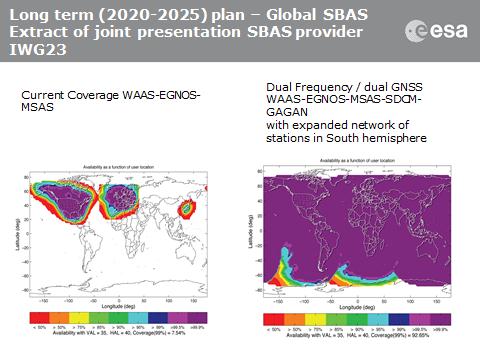
    Comparing current worldwide SBAS coverage – based on WAAS, EGNOS and MSAS – to the situation envisaged for 2020–25: near-global coverage based on WAAS, EGNOS, MAAS, SDCM and GAGAN, with an expanded network of stations in the southern hemisphere, all based on a common dual-frequency/dual satnav standard being finalised by the SBAS Interoperability Working Group.
    Comparing current worldwide SBAS coverage – based on WAAS, EGNOS and MSAS – to the situation envisaged for 2020–25: near-global coverage based on WAAS, EGNOS, MAAS, SDCM and GAGAN, with an expanded network of stations in the southern hemisphere, all based on a common dual-frequency/dual satnav standard being finalised by the SBAS Interoperability Working Group.
  • North America to Claim Nearly Half of $72 Billion Tablet Purchases in 2013

    ABI Research announced that more than 39 million tablets shipped worldwide during the first calendar quarter of 2013, representing the second largest volume of shipments to date; only bested by the previous quarter ending calendar year 2012. The spending power of the largest three world regions and availability of new, higher cost Windows devices from PC OEMs are continuing to drive market awareness and growth.

    Tablets remain a lucrative market for the three largest world regions for consumer electronics and computer adoption: North America, Western Europe, and Asia-Pacific’s Japan and South Korea. “Three regions of the world are expected to yield 97% of tablet revenues in 2013,” says senior practice director Jeff Orr. “North America is forecasted to claim nearly half of the estimated $72 billion expected to be spent this year on tablet devices. Western Europe and Asia-Pacific will also have their hands in the honey pot for a combined 50% of world tablet revenues, respectively.”

    Media Tablet Revenue by Region in 2013


    Contributing to the revenue growth is the broader availability of Windows-based tablets. ABI Research estimates only 1.5 million Microsoft Surface tablets shipped during 1Q’2013. “The average selling prices for Windows 8 and Windows RT are higher than other platforms, which is keeping price erosion minimized,” adds Orr. Several tablet partners have joined Microsoft in launching Windows tablets, including Acer, ASUS, Dell, HP, Lenovo, Panasonic, Samsung, Sony, Toshiba, and Vizio. Businesses, many of which have loyal Windows PC followings, are a prime growth audience for tablets.

    These “Media Tablets and eReaders” Market Data findings are part of ABI Research’s Media Tablets, Ultrabooks & eReaders Research Service which includes Research Reports, Market Data, Insights, and Competitive Assessments on technologies and vendor ecosystems shaping the tablet computing industry.