Blog

  • Rohde & Schwarz GNSS Simulator Creates Real-World Scenarios

    Rohde & Schwarz GNSS Simulator Creates Real-World Scenarios

    Rohde & Schwarz provides developers of satellite-based navigation instruments with a global navigation satellite system (GNSS) simulator, which runs on the R&S SMBV100A vector signal generator. The new R&S SMBV-K101 option allows developers in the automotive and wireless communications industries, for example, to test GNSS receivers for specific effects such as obscuration and multipath propagation. Buildings, tunnels and bridges as well as reflections from concrete and glass surfaces affect the GNSS signal, regardless of whether the receiver is stationary or in motion. This option makes it easy to configure these kinds of scenarios.

    If the GNSS receiver of a navigation instrument or smartphone is located inside a vehicle, testing must also take into account the obscuring effect of the vehicle’s metal body. The R&S SMBV-K102 option can simulate this obscuration and, if required, also the additional antenna pattern.

    In addition to test scenarios for A-GPS, smartphone developers also have the Assisted Galileo (R&S SMBV-K67) and Assisted GLONASS (R&S SMBV-K95) options at their disposal. (Mobile radio networks transmit location-specific information to wireless devices via A-GNSS so that they can determine the current position faster.)

    In many cases, navigation instruments handle signals of digital communications standards other than GNSS. As the first GNSS simulator of its kind on the market, the R&S SMBV100A also supports these standards. Now, manufacturers of mobile phones and car radios with integrated GNSS receivers need just one signal generator to test multiple functionalities. The R&S SMBV100A can also be used to perform interference tests on the DUT.

    Users in the aerospace and defense industry can use the R&S SMBV-K103 option to simulate the relative position of a flying object as well as its rotation at a rotation rate of up to 400 Hz. This allows developers to perform lab tests to determine how a flying object’s different positions, the ground reflection of GNSS signals and rotary movements affect reception quality.

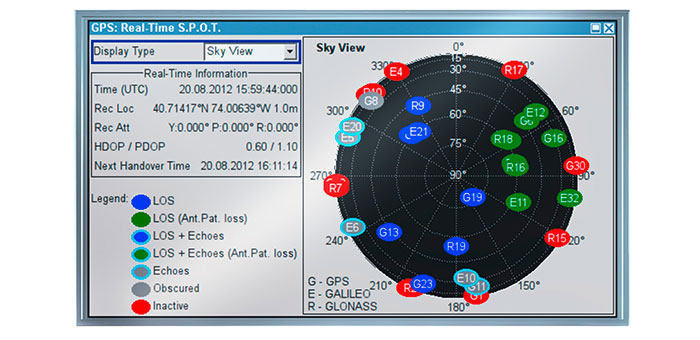
    The GNSS simulator in the R&S SMBV100A uses up to 24 satellites to generate signals in realtime for GPS with civilian C/A code and military P code as well as for Glonass and Galileo in different constellations. In just a few steps, users can define their  own scenarios for testing their GNSS receivers under various conditions. The R&S SMBV100A is the only GNSS simulator on the market that does not require an external PC. As a result, it is easier to automate, and test setup is simple.

    The new options for the GNSS simulator in the R&S SMBV100A are now available from Rohde & Schwarz.

  • Lockheed Martin Delivers Antenna Assemblies for First GPS III Satellite

    Lockheed Martin has completed and is preparing to install the navigation, communication, and hosted payload antenna assemblies for the first satellite of the next-generation GPS III.

    Seven antenna assemblies, produced at Lockheed Martin’s Newtown, Pennsylania, facility were delivered to the company’s GPS III Processing Facility (GPF) near Denver, Colorado, on June 14.  The antennas will be installed on the first GPS III space vehicle (SV01), which Lockheed Martin will deliver to the U.S. Air Force on schedule, “flight-ready,” in 2014.

    The new antennas for GPS III SV01 will provide the satellite’s capability to send and/or receive data for Earth-coverage and military Earth-coverage navigation; a UHF crosslink for inter-satellite data transfer; telemetry, tracking and control for satellite-ground communications; and data acquisition and communication for the nuclear detection system hosted payload. The antenna designs enable three to eight times greater anti-jamming signal power to be broadcast to military users across the globe when compared to previous GPS generations.

    “These antennas on the next generation of GPS III satellites will transmit data utilized by more than one billion users with navigation, positioning and timing needs,” explained Keoki Jackson, vice president of Lockheed Martin’s Navigation Systems mission area. “We have become reliant on GPS for providing signals that affect everything from cell phones and wristwatches, to shipping containers and commercial air traffic, to ATMs and financial transactions worldwide.”

    GPS III is a critically important program for the Air Force, affordably replacing aging GPS satellites in orbit, while improving capability to meet the evolving demands of military, commercial and civilian users. GPS III satellites will deliver three times better accuracy, include enhancements which extend spacecraft life 25 percent further than the prior GPS block, and a new civil signal designed to be interoperable with international global navigation satellite systems.

    The production of the first GPS III satellite continues on schedule. Recent testing of the SV 01 bus — the portion of the space vehicle that carries mission payloads and hosts them in orbit — assured that all bus subsystems are functioning normally and that they are ready for final integration with the satellite’s navigation payload.
    This milestone follows February’s successful initial power on of the SV01 spacecraft bus, which demonstrated  the electrical-mechanical integration, validated the satellite’s interfaces and led the way for functional electrical hardware-software integration testing.

    Lockheed Martin is under contract for production of the first four GPS III satellites (SV01-04), and has received advanced procurement funding for long-lead components for the fifth, sixth, seventh and eighth satellites (SV05-08).

    The GPS III team is led by the Global Positioning Systems Directorate at the U.S. Air Force Space and Missile Systems Center. Lockheed Martin is the GPS III prime contractor with teammates ITT Exelis, General Dynamics, Infinity Systems Engineering, Honeywell, ATK and other subcontractors. Air Force Space Command’s 2nd Space Operations Squadron (2SOPS), based at Schriever Air Force Base, Colorado, manages and operates the GPS constellation for both civil and military users.

  • Trimble Expands Mobile Spatial Imaging Portfolio

    Trimble-MX2-Spatial-Imaging-System[1].jpg Photo: Trimble
    Photo: Trimble
    Trimble has introduced the Trimble MX2 mobile spatial imaging data capture system. The MX2 extends the capabilities of geospatial professionals, allowing them to safely and effectively address complex projects by collecting spatial data from a mobile scanning platform, the company said. The Trimble MX2 provides a versatile and complimentary addition to Trimble’s family of mobile data capture systems.

    Designed for mapping, surveying and engineering environments, the MX2 is rugged, lightweight and portable. It is also easily deployed and redeployed on projects similar to conventional surveying equipment. A precise laser scanner, along with an embedded Trimble-Applanix GNSS/Inertial positioning system, allows geospatial professionals to create the point cloud accuracies necessary for many spatial imaging projects. Accompanied by Trimble Trident software to capture, process and analyze point data, the MX2 offers a ready-to-use workflow for surveyors and professionals in mapping, engineering, planning, oil and gas, utilities, mining, environmental, public safety and more. The system is available in single and dual-laser versions.

    In conjunction with the MX2 system, Trimble also announced new features for its Trident Software 6.0. The software developed for rapid transformation of point clouds and imagery into geospatial intelligence has been significantly enhanced to provide a scalable software suite for a wide range of users. Additions include the incorporation of direct trajectory import and the Trimble Coordinate System Manager. The Trimble Trident software suite is ideal for the analysis of mobile laser scanner data and geo-referenced imagery.

    “The Trimble MX2 provides survey companies with the opportunity to enter the world of mobile scanning at a time when it is becoming a desired service within their solution portfolios,” said Katherine Sandford, general manager of Trimble’s Imaging Division. “The MX2 offers a simple and highly productive mobile data collection capability and a 3D point cloud workflow for a wide range of users.”

  • Galileo Spreads Its Wings in Pre-Flight Test

    Galileo Spreads Its Wings in Pre-Flight Test

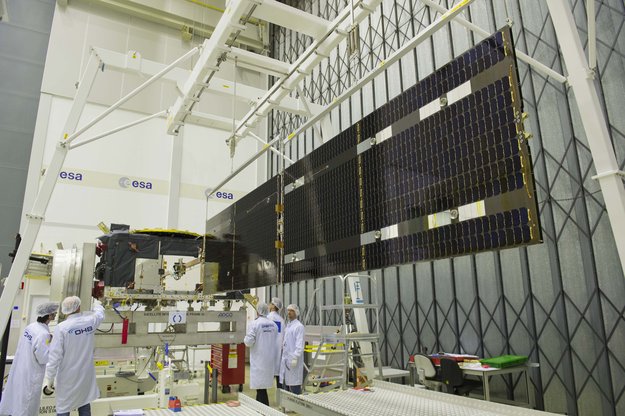
    In the photo above, deployment of the solar wings on the latest Galileo satellite is being checked at the European Space Agency’s technical hub in the Netherlands. The navigation satellite’s pair of 1 x 5-meter solar wings, carrying more than 2,500 gallium arsenide solar cells, will power the satellite during its 12-year working life.

    With the first four Galileo In-Orbit Validation satellites already in orbit, this is the first of the rest of Europe’s satnav constellation.

    A counterweighted rig supports the deployment; otherwise the delicate fold-out wings — designed for the weightlessness of space — would crumple under the pull of Earth gravity.

    These Full Operational Capability satellites provide the same operational services as their predecessors, but they are built by a new industrial team: OHB in Bremen, Germany, built the satellites with Surrey Satellite Technology Ltd. in Guildford, UK, contributing the navigation payloads.

    This satellite is the first of 22 ordered from OHB. It arrived at ESA’s ESTEC research and technical centre in Noordwijk in May to begin a rigorous campaign of testing in simulated launch and space conditions, guaranteeing its readiness for launch.

    The first test performed on the satellite once it came out of its container was a System Compatibility Test Campaign, linking it up with the Galileo Control Centres in Germany and Italy and ground user receivers as if it was already in orbit.

    Galileo’s wings with 30%-efficient solar cells were fitted at the end of June, supplied by Dutch Space in nearby Leiden. Future satellites will have their wings fitted at OHB before coming to ESTEC, but this first satellite offered an opportunity for Dutch Space engineers to train their OHB counterparts in the procedure.

    “The 22 Galileo FOC satellites are being produced and tested on a batch production basis, which is a new way of working for ESA,” explained Jean-Claude Chiarini, overseeing FOC satellite procurement for the Agency. “The concept is really to set up a steady flow of satellites from OHB to ESTEC and then Kourou for launch over the next few years.

    “The first four will undergo full validation testing, checking the underlying design is correct, in order to support the formal ground qualification of the design, with subsequent FOC satellites then going through acceptance testing, concentrating on checking workmanship,” Chiarini said.

    The FOC satellites, while resembling their predecessors, are designed with this production concept in mind. Hinged modules offer easy access to internal subsystems for rapid repair or potential replacement of units.

    The next satellite is due to arrive around the start of August. The battery of simulations includes vibration and acoustic testing, as well as thermal-vacuum testing — submitting them to the airlessness and temperature extremes of space for weeks at a time.

  • IRNSS-1A Reaches Preliminary Destination Orbit

    News courtesy of CANSPACE listserv.

    Following the July 1 launch of the Indian Regional Navigation Satellite System 1A satellite, five orbit maneuvers were to be conducted by the master control facility to position the satellite in its circular inclined geosynchronous orbit (IGSO) with an equator crossing at 55 degrees east longitude.

    Reports indicate that orbit raising maneuvers have been completed with a fifth apogee motor firing on July 6 at 16:57 IST or 11:27 UTC. All the spacecraft subsystems have been evaluated and are functioning normally.

    The satellite was reported to be in IGSO with a 27 degree inclination at 44 degrees east longitude.

    NORAD/JSpOC has released a two-line element set for the IGSO of the satellite with an epoch of a few days ago:

    1 39199U 13034A   13189.83931637  .00000103  00000-0  00000+0 0    55
    2 39199 027.0197 141.0618 0046168 179.3431 315.7902 01.00666774   276

    This data indicates that the sub-satellite equator crossing was about 47 degrees east longitude at the reference epoch. The satellite orbit equator crossing is drifting eastwards and should reach 55 degrees east longitude by about July 14.

  • California Supreme Court Rules that Orange County Must Provide GIS Data to the Public for a Nominal Fee Under the Public Records Act

    The Sierra Club announced that the California Supreme Court ruled in a unanimous decision that geographic information systems (GIS) data must be provided to the public for a nominal fee under the Public Records Act. The decision has broad application, confirming that information not exempt from disclosure under the Act must be provided to the public for a nominal charge, regardless of whether it is kept in paper form or as electronic data.  The Court also affirmed the public’s civil right under the California Constitution of access to government  information, holding that it can be used as a tiebreaker in case such as this, where the public right of access is disputed.

    According to the announcement, the case started in 2007, when the Sierra Club requested from Orange County a copy of its GIS parcel database, containing the location and layout of each legal parcel of land in the county. At that time, Orange County licensed copies of the parcel database to private companies and public agencies for $375,000. The county also required licensees to sign non-disclosure agreements preventing further distribution. The county supported its GIS operation in part with licensing revenues from the sale of parcel data and argued that this revenue stream would dry up if the county was required to provide copies of the data to the public for a nominal fee under the Public Records Act.

    The Sierra Club sued in 2009. Orange County argued that the parcel database is “computer software,” as that term is used in the Public Records Act, because it is part of a “computer mapping system.” Under the Act, software is not a public record, and software includes “computer mapping systems.” The Orange County Superior Court agreed with Orange County, denying the Sierra Club’s request to compel the county to provide the parcel database under the Act. The Sierra Club appealed and lost on appeal in the Fourth District Court of Appeal, in Santa Ana, Orange County, California.

    In September, 2011, the California Supreme Court agreed to review the case. Amici curiae filed briefs on behalf of the Sierra Club, including the Media and Open Government coalition, representing newspapers such as the Los Angeles Times and the Orange County Register, a coalition of companies that provide value-added services based on electronic public records, the Stanford Environmental Law Clinic, the Electronic Frontier Foundation, a group of academic researchers at UCLA, Jack Cohen, and a coalition of GIS professionals.

    Attorney Sabrina Venskus, the Sierra Club’s lead counsel, argued the case in the California Supreme Court in early May. Today, the Court ruled that the lower courts got it wrong. The Court’s seven justices decided unanimously in favor of the Sierra Club, ordering that the County be compelled to provide the Sierra Club with a copy of its parcel database for the cost of producing the physical copy. Orange County will now join the other 49 out of 58 California counties that provide their parcel data to the public for a nominal charge.

    The Sierra Club reported that the Angeles Chapter’s GIS Committee will use the data to make maps for its conservation campaigns. GIS Parcel data previously obtained from Los Angeles County under the Public Records Act was used to map land parcels in the Verdugo Mountains in the cities of Los Angeles, Glendale and Burbank, color-coding each parcel as to whether it was publicly or privately owned. This allowed a task force including the Sierra Club and agencies from the three cities to prioritize the acquisition of open space in the Verdugos. The club continually produces GIS maps in support of its conservation campaigns, and will put the Orange County data to good use in fighting for the environment.

    The Supreme Court decision focused on GIS parcel data, but its holding applies to all types of computer mapping data. GIS data is becoming increasingly important as state and local agencies continue to incorporate it into their operations. Some agencies have requirements that all street addresses in their databases be geocoded, i.e. converted into latitude and longitude, i.e. GIS data. Applications go beyond purely environmental issues.  For example, public health agencies use computer mapping technology to track the spread of infectious diseases. Following today’s decision, all this information will be available to the public, who can use it for their own purposes, at a nominal charge.

    Attorney Sabrina Venskus stated: “This is great day for California’s citizens: the public will now have appropriate access to important government mapping data – government records which are only used and useful in electronic format – and taxpayers won’t be required to pay for data they already effectively paid for with their tax dollars when the County compiled and organized those records in the first instance.”

    Though the information at issue in the case was GIS data, the decision affirms a previous Supreme Court holding that electronic databases are subject to the Public Records Act disclosure requirements when they contain data that’s not exempt under the Act. This is important because agencies increasingly keep their records in databases. “The move from paper to electronic recordkeeping shouldn’t affect the public’s right to the information,” says Dean Wallraff, another lawyer representing the Sierra Club in the case.

    Ms. Venskus added: “It is extraordinarily gratifying that the Supreme Court ruled unanimously in favor of my client after having litigated this case for almost five years and suffering through two losses in the lower courts. Yet Mr. Wallraff and I felt so strongly about the public having access to this important information, and that Orange County was in violation of the law, we forged ahead despite the fact we took this case on contingency and ran the risk of working thousands of hours with no compensation. Everyone’s hard work, including amici curiae’s has been vindicated on this day.”

  • USGS Seeks Citizen Input in Crowdsourcing Effort

    “Experience an earthquake? See a landslide? Are your flowers blooming earlier? New building in your neighborhood? Tell us about it!”

    That’s the message issued today by the U.S. Geological Survey.

    “In an ever-changing environment, it would be ideal if the U.S Geological Survey had a presence in every corner of the nation. While we may not be able to cover every inch of the landscape, we can greatly enhance our scope with your help,” the USGS continues.

    The USGS has a variety of citizen science efforts where people can report what’s happening in their own backyards. It’s seeking information on events such as earthquakes, landslides, new construction, and climate. “If you live in Alaska, we want you to tell us if you experience a volcanic ash fall and even collect a sample,” the USGS said.

    The information gets aggregated and disseminated through a variety of tools geared toward making this information easily accessible so it can be put to use. Using , there are interactive online systems where people can report what it was like during an earthquake, and then see all the reports for that event mapped out for the affected area.

    “Through your contribution, not only will your observations build a much larger and more complete database, but you will also become a virtual member of the USGS scientific team!” the USGS said.

    Map of tweets containing the word “terremoto” (Italian for “earthquake”) collected in the two minutes following a magnitude 6.0 earthquake in Northern Italy on May 5, 2012. The red star shows the location of the earthquake. The tweets are concentrated in the epicentral area but discussion of the earthquake has already spread beyond the impacted region. This shows the speed that USGS Tweet Earthquake Dispatch (TED) collects tweets to provide insight into potential earthquake events. Image Credit: USGS.
    Map of tweets containing the word “terremoto” (Italian for “earthquake”) collected in the two minutes following a magnitude 6.0 earthquake in Northern Italy on May 5, 2012. The red star shows the location of the earthquake. The tweets are concentrated in the epicentral area but discussion of the earthquake has already spread beyond the impacted region. This shows the speed that USGS Tweet Earthquake Dispatch (TED) collects tweets to provide insight into potential earthquake events. Image Credit: USGS.

    The valuable role of crowd-sourcing data is outlined in a 2013 report by the Woodrow Wilson International Center for Scholars, authored in collaboration with the USGS. The report highlights success stories from the USGS’ Tweet Earthquake Dispatch (@USGSted) program, Did You Feel It? and related USGS activities. For example, although there was an exceedingly swift international aid response to the massive 2008 earthquake in Wenchuan, China, the first reports of the event outside of the impacted area came from citizens, and information spread through the use of social networking tools such as Twitter. Similarly, 148,000 individuals used Did You Feel It? to describe their experience of a magnitude 5.8 earthquake that occurred in Virginia on August 23, 2011. Because large-magnitude earthquakes are fairly rare along the East Coast, there were only a handful of seismometers installed nearby to record the event. Thus, much of the preliminary data regarding this earthquake came from the DYFI? system.

    These are the ways USGS gathers information from the public:

    Improving Earthquake Monitoring

    Did You Feel It? (DYFI?) is an online crowd-sourcing system developed by the USGS for the public to provide first-hand accounts of earthquakes they experience. As one of the longest standing and most successful examples of citizen-based science to date, it has garnered more than 2,790,000 total responses since its launch in 1997.

    Through this program, users are able to document the shaking level they experienced and find out what was felt elsewhere. Specifically, USGS scientists aggregate results by zip code (domestically) and by city (globally) to show reported shaking intensity. Those reports also augment shaking data from sensors and are incorporated in ShakeMaps used for emergency response. To document a seismic encounter, visit the DYFI? home page and fill out a brief questionnaire.

    Tweeting and Shaking

    Many regions around the world have only a scant number of seismometers, complicating the rapid detection and characterization of earthquakes. To enhance earthquake monitoring, Twitter has proven to be an advantageous source for USGS scientists to receive rapid firsthand accounts of potential events.

    The USGS Tweet Earthquake Dispatch (TED) program rapidly detects possible earthquakes when a large number of public tweets mention “earthquake” or its equivalent in several languages. These tweet-based detections often come prior to sensor alerts in sparsely instrumented regions. USGS analysts at the National Earthquake Information Center (NEIC) receive these indicators and then turn to more accurate earthquake sensors and instrumental data for confirmation and quantitative assessment. For earthquakes with a magnitude 5.5 or greater, the USGS sends out notifications via the Twitter account @USGSted to people around the world.

    Did You See It? Watch Out for Landslides

    In an average year, landslides can cost the United States up to $2 billion in damage. Now, scientists at the USGS are asking the public to help track landslides to better understand how to protect lives and property. This is being done through the system, Did You Feel It? This program allows respondents to report detailed accounts of observed landslides, including photographs. To make your contribution, visit the DYSI? webpage and click on the Report a Landslide tab.

    Ascending eruption cloud from Redoubt Volcano as viewed to the west from the Kenai Peninsula. Photo Credit: R.J. Clucas, USGS.
    Ascending eruption cloud from Redoubt Volcano as viewed to the west from the Kenai Peninsula. Photo Credit: R.J. Clucas, USGS.

    Is Ash Falling? Helping Monitor Volcanic Eruptions

    Alaska has an abundance of active volcanoes, averaging two eruptions a year. Citizens in Alaskan communities can now go online and report their observations of volcanic ash through the Is Ash Falling? system, which was developed by the Alaskan Volcano Observatory (AVO). Ash fall reports are shared with the National Weather Service (NWS) to track where an ash plume is headed and to guide them in making official statements and advisories about ash fallout onto the landscape. AVO is jointly operated by the USGS, the Alaska Division of Geological and Geophysical Surveys, and the University of Alaska, Fairbanks.

    This tool will help AVO scientists build a more complete record of the amount, duration, and extent of ash fall. Getting first-hand accounts of ash fall will also help refine computer models of ash cloud movement and interpretation of satellite imagery. Citizens are also encouraged to collect ash samples and send them to AVO. With your help, volcano scientists can greatly expand their sampling of ash deposits.

    Phenology-PhotographThe National Map Corps

    Citizen volunteers are also making significant additions to The National Map (TNM), a web-based geospatial visualization platform. The public is encouraged to collect data on manmade structures such as schools, hospitals, post offices, police stations, and other buildings. The project started in 2012 in Colorado and has expanded to 35 states. A recognition program has also been created where badges can be earned based on the number of data points a volunteer contributes. This effort is through The National Map Corps (TNMCorps) Volunteered Geographic Information project, which partners with organizations such as 4-H and GISCorps.

    Observing Nature’s Calendar

    As the seasons come and go, temperatures fluctuate, leaves emerge and change colors, and animals migrate. The USA National Phenology Network gives you this opportunity through its program Nature’s Notebook. Volunteers are collecting observations of these seasonal changes—referred to as phenology—to help scientists better understand subjects including climate change, invasive species, agricultural production, impacts of frosts and freezes, and the timing of pests and diseases.

  • USGS Seeks Citizen Input in Crowdsourcing Effort

    “Experience an earthquake? See a landslide? Are your flowers blooming earlier? New building in your neighborhood? Tell us about it!”

    That’s the message issued today by the U.S. Geological Survey.

    “In an ever-changing environment, it would be ideal if the U.S Geological Survey had a presence in every corner of the nation. While we may not be able to cover every inch of the landscape, we can greatly enhance our scope with your help,” the USGS continues.

    The USGS has a variety of citizen science efforts where people can report what’s happening in their own backyards. It’s seeking information on events such as earthquakes, landslides, new construction, and climate. “If you live in Alaska, we want you to tell us if you experience a volcanic ash fall and even collect a sample,” the USGS said.

    The information gets aggregated and disseminated through a variety of tools geared toward making this information easily accessible so it can be put to use. Using , there are interactive online systems where people can report what it was like during an earthquake, and then see all the reports for that event mapped out for the affected area.

    “Through your contribution, not only will your observations build a much larger and more complete database, but you will also become a virtual member of the USGS scientific team!” the USGS said.

    Map of tweets containing the word “terremoto” (Italian for “earthquake”) collected in the two minutes following a magnitude 6.0 earthquake in Northern Italy on May 5, 2012. The red star shows the location of the earthquake. The tweets are concentrated in the epicentral area but discussion of the earthquake has already spread beyond the impacted region. This shows the speed that USGS Tweet Earthquake Dispatch (TED) collects tweets to provide insight into potential earthquake events. Image Credit: USGS.
    Map of tweets containing the word “terremoto” (Italian for “earthquake”) collected in the two minutes following a magnitude 6.0 earthquake in Northern Italy on May 5, 2012. The red star shows the location of the earthquake. The tweets are concentrated in the epicentral area but discussion of the earthquake has already spread beyond the impacted region. This shows the speed that USGS Tweet Earthquake Dispatch (TED) collects tweets to provide insight into potential earthquake events. Image Credit: USGS.

    The valuable role of crowd-sourcing data is outlined in a 2013 report by the Woodrow Wilson International Center for Scholars, authored in collaboration with the USGS. The report highlights success stories from the USGS’ Tweet Earthquake Dispatch (@USGSted) program, Did You Feel It? and related USGS activities. For example, although there was an exceedingly swift international aid response to the massive 2008 earthquake in Wenchuan, China, the first reports of the event outside of the impacted area came from citizens, and information spread through the use of social networking tools such as Twitter. Similarly, 148,000 individuals used Did You Feel It? to describe their experience of a magnitude 5.8 earthquake that occurred in Virginia on August 23, 2011. Because large-magnitude earthquakes are fairly rare along the East Coast, there were only a handful of seismometers installed nearby to record the event. Thus, much of the preliminary data regarding this earthquake came from the DYFI? system.

    These are the ways USGS gathers information from the public:

    Improving Earthquake Monitoring

    Did You Feel It? (DYFI?) is an online crowd-sourcing system developed by the USGS for the public to provide first-hand accounts of earthquakes they experience. As one of the longest standing and most successful examples of citizen-based science to date, it has garnered more than 2,790,000 total responses since its launch in 1997.

    Through this program, users are able to document the shaking level they experienced and find out what was felt elsewhere. Specifically, USGS scientists aggregate results by zip code (domestically) and by city (globally) to show reported shaking intensity. Those reports also augment shaking data from sensors and are incorporated in ShakeMaps used for emergency response. To document a seismic encounter, visit the DYFI? home page and fill out a brief questionnaire.

    Tweeting and Shaking

    Many regions around the world have only a scant number of seismometers, complicating the rapid detection and characterization of earthquakes. To enhance earthquake monitoring, Twitter has proven to be an advantageous source for USGS scientists to receive rapid firsthand accounts of potential events.

    The USGS Tweet Earthquake Dispatch (TED) program rapidly detects possible earthquakes when a large number of public tweets mention “earthquake” or its equivalent in several languages. These tweet-based detections often come prior to sensor alerts in sparsely instrumented regions. USGS analysts at the National Earthquake Information Center (NEIC) receive these indicators and then turn to more accurate earthquake sensors and instrumental data for confirmation and quantitative assessment. For earthquakes with a magnitude 5.5 or greater, the USGS sends out notifications via the Twitter account @USGSted to people around the world.

    Did You See It? Watch Out for Landslides

    In an average year, landslides can cost the United States up to $2 billion in damage. Now, scientists at the USGS are asking the public to help track landslides to better understand how to protect lives and property. This is being done through the system, Did You Feel It? This program allows respondents to report detailed accounts of observed landslides, including photographs. To make your contribution, visit the DYSI? webpage and click on the Report a Landslide tab.

    Ascending eruption cloud from Redoubt Volcano as viewed to the west from the Kenai Peninsula. Photo Credit: R.J. Clucas, USGS.
    Ascending eruption cloud from Redoubt Volcano as viewed to the west from the Kenai Peninsula. Photo Credit: R.J. Clucas, USGS.

    Is Ash Falling? Helping Monitor Volcanic Eruptions

    Alaska has an abundance of active volcanoes, averaging two eruptions a year. Citizens in Alaskan communities can now go online and report their observations of volcanic ash through the Is Ash Falling? system, which was developed by the Alaskan Volcano Observatory (AVO). Ash fall reports are shared with the National Weather Service (NWS) to track where an ash plume is headed and to guide them in making official statements and advisories about ash fallout onto the landscape. AVO is jointly operated by the USGS, the Alaska Division of Geological and Geophysical Surveys, and the University of Alaska, Fairbanks.

    This tool will help AVO scientists build a more complete record of the amount, duration, and extent of ash fall. Getting first-hand accounts of ash fall will also help refine computer models of ash cloud movement and interpretation of satellite imagery. Citizens are also encouraged to collect ash samples and send them to AVO. With your help, volcano scientists can greatly expand their sampling of ash deposits.

    Phenology-PhotographThe National Map Corps

    Citizen volunteers are also making significant additions to The National Map (TNM), a web-based geospatial visualization platform. The public is encouraged to collect data on manmade structures such as schools, hospitals, post offices, police stations, and other buildings. The project started in 2012 in Colorado and has expanded to 35 states. A recognition program has also been created where badges can be earned based on the number of data points a volunteer contributes. This effort is through The National Map Corps (TNMCorps) Volunteered Geographic Information project, which partners with organizations such as 4-H and GISCorps.

    Observing Nature’s Calendar

    As the seasons come and go, temperatures fluctuate, leaves emerge and change colors, and animals migrate. The USA National Phenology Network gives you this opportunity through its program Nature’s Notebook. Volunteers are collecting observations of these seasonal changes—referred to as phenology—to help scientists better understand subjects including climate change, invasive species, agricultural production, impacts of frosts and freezes, and the timing of pests and diseases.

  • Trimble Juno T41: Rugged, Sturdy, and a Great Display

    I keep waiting for the cryptic phone call or emphatic email from Trimble that says, “You have had our evaluation units for over four months — when can we expect to see a review and when will you be returning our equipment?” Fortunately, Trimble is very understanding and would never make such a call or send such an email, I hope. The truth is Trimble sent me a T41 and Yuma 2 for review back when it was still snowing in the Rocky Mountains and I am still evaluating the units. You see that’s the rub with excellent equipment — it is a pleasure to review GPS equipment that exceeds all expectations, and frankly, it is difficult to send it back because there is always one more project, one more test or one more application that needs to be run. Fortunately the Trimble PNT equipment (position, navigation and timing) has never been found wanting. So here finally is the T41 review that so many of you have requested.

    First, however, for those of you who are of a similar age to yours truly — and let’s just say it hopefully relates to a certain level of maturity and in my case familiarity with GPS since 1978 — I just can’t see the designation T41 without thinking of: (1) a basic USAF pilot and navigation training aircraft once flown at Mather Air Force Base in California and one I still see every day at the Unites States Air Force Academy and flying over my home on a regular basis, and (2) the first successful commercial GPS unit built by my think-tank colleague Philip Ward at Texas Instruments, designated the T1-4100. I have no idea if Trimble was aware of these associations when naming conventions were considered for the T41, but for many of us seniors the associations certainly exist. That is not a bad thing — it probably even extends to goodwill in a business sense, if you understand that jargon. But, as usual, I digress!

    BLUF (Bottom Line Up Front)

    As loyal readers are aware, I never give a product a bad review. That is not to say I do not receive my share of simply “bad” GPS equipment to review. I just refuse to take the time to pen a bad review — my philosophy being, why should I take the time to write and why should you take the time to read about something you can’t or won’t use? There are enough “good,” even exceptional, GPS devices out there today that deserve to be written about — so let’s just skip the bad ones and save us all some grief and deflated expectations. So the very fact that I am writing about the Trimble T41 means that it has passed all my tests for ruggedness and usefulness. In fact (I checked the figures with my review logs for the past seven years), for every 20 GPS devices I receive, I only review one on average. This month it is the Trimble JunoT41/5 X-Model with gray pin striping and an IP68 ruggedness rating, and you will see why that level of model detail is important shortly.

    Who Matters as Much as What

    Before I get into the technical aspects of the T41, let’s consider for a moment who would want to use this unit. Without a doubt, it is perfect for warfighters and first responders or I probably would not write about it, but it is also perfect for anyone that needs a rugged handheld computer with embedded GPS running either the Windows or Android operating system (OS). The touchscreen display covers about the same real estate as the new iPhone 5 but the T41 is slightly larger, heavier, thicker and, it almost goes without saying, incredibly rugged. I guess that is why I have received several letters from T41 users that use it on horseback.

    Now, while I perceive the equine GPS market to be a niche market, another one of my think-tank colleague, the Honorable Jim Geringer, who ran the great state of Wyoming from 1995 to 2003, has mentioned several times in passing, and I mistakenly thought jokingly, ranchers using GPS on horseback. Now that I think about it and read some of my email from Colorado, Wyoming, and Montana ranchers, it makes sense. Think about navigating thousands of acres of ranch land that in some cases all looks the same, looking for lost cattle or damaged fences. Think about wanting to mark the spot where cattle or damaged fences were found and then being able to quickly communicate that information to someone who could help, and then just as quickly navigate back to civilization, even in a blizzard. The fact is my correspondence from several ranchers tells me that GPS has become indispensible – and not just any GPS, but a reliable, accurate and rugged GPS that has a long battery life, comes with a built-in camera, and the option for a solar charger, and of course has embedded communication capabilities. Sounds a great deal like the T41 – I think you will agree.


    Basics and Specifications

    The Juno T41/5 approximates a slightly larger iPhone 5 in size, but one with an extremely rugged case. The case  makes it bigger and heavier, but at the same time much more useable in all weather conditions, to include snow, ice, water, dust, all of which I personally tested for, and I suspect it will survive being dropped in horse manure, although I will admit this is one test that I have not personally performed. I will graciously defer to my equine mounted readers when it comes to performing this particular test. Can you say rubber gloves, Purell Hand Sanitizer and Fabreze?


    Trimble Juno T41/5 Specifications

    FEATURES

    • Processor: 800 MHz or 1 GHz, Texas Instruments DM3730
    • RAM: 256 MB or 512 MB
    • Flash Storage: 8 GB or 16 GB
    • 4.3” WVGA sunlight-readable Gorilla® Glass display
    • Light sensor to auto-adjust display brightness
    • Capacitive multi-touch interface
    • Integrated 3.75G cellular data, text and voice capability
    • 8 megapixel camera with geo-tagging and dual LED flash
    • Bluetooth 2.1 with Enhanced Data Rate
    • Wi-Fi (802.11 b/g/n)
    • GPS Receiver, 2-4 meter accuracy (WAAS/SBAS Capable)
    • MCX port for optional External GPS Antenna
    • Electronic Compass
    • Accelerometer
    • Robust Custom Port with USB 2.0 Full Speed Protocol
    • Conversion Cables available for 9-pin Serial or USB host
    • Micro SD memory card slot (supports SDHC up to 32 GB)
    • Integrated speaker and microphone
    • 3.5 mm Headset Jack with Audio Capability

    OPERATING SYSTEMS

    • Windows Embedded Handheld 6.5
    • Android 4.1 – which is faster, has better battery usage, more secure and with better developer specifications than the older version 2.3.4
    • Language Support: Chinese (Simplified), English, French, German, Italian, Japanese, Korean, Portuguese, Russian or Spanish

    Windows Embedded Handheld 6.5

    Standard Software:

    • Trimble SatViewer (GPS interface application)
    • Trimble CellStart (WWAN configuration application)
    • Microsoft Office Mobile 2010 (Word Mobile, Excel Mobile, PowerPoint Mobile, Outlook Mobile)
    • Internet Explorer Mobile 6
    • Microsoft My Phone with SMS Text Messaging
    • Camera Control Application
    • Flashlight Control Mode Application
    • Calculator
    • Calendar
    • Microsoft Pictures and Videos
    • Windows Media Player
    • Windows Live Messenger
    • Microsoft Task Manager and Notes
    • Adobe Reader LE 2.5

    Android 4.1 Advanced Software:

    • Trimble Outdoors Navigator
    • Email
    • Phone and SMS Text Messaging
    • Picture and Video Gallery
    • Multimedia Player
    • Web Browser
    • Camera Control Application
    • Flashlight Mode Control Application

    Application Developer Support:

    • Software Developer Kit with Documentation for WEH 6.5
    • Software Developer Kit with Documentation for Android 4.1

    STANDARD ACCESSORIES

    • International AC Charging Kit
    • T412 USB Cable
    • Wrist Strap
    • Ultra Clear Screen Protectors (qty-2) Kit
    • Quick Start Kit

    OPTIONAL ACCESSORIES

    • 9-pin Serial Adapter
    • USB Host Adapter
    • Capacitive Stylus with Tether
    • External Battery Pack
    • Port Cover
    • Ultra Clear Screen Protectors (qty-10) Kit
    • Anti-reflective Screen Protectors (qty-2) Kit
    • Vehicle Charging Kit
    • Capacitive Touch Screen Gloves
    • Trimble Headset
    • External GPS Antenna

    ENVIRONMENTAL SPECIFICATIONS

    Water: Survives immersion at 3.3 feet (1 meter) for two hours (gray models), IEC-60529 IPx8. Survives driving rain & water spray (yellow models), IEC-60529 IPx5, water jet 12.5 mm diam @ 2.5-3 m.
    Dust: Protected against dust, IEC-60529 IP6x, dust chamber with under-pressure
    Drops: Survives multiple drops of 4 ft. (1.22 m), MIL-STD-810G, Method 516.6, Procedure IV, Transit Drop
    Operating Temperature: -22 ºF to 144 ºF (-30 C to 60 C), MIL-STD-810G, Method 502.5, Procedure I, II, III (Low Temp Operating -30 C); Method 501.5, Procedure I & II (High Temp Operating 60 C)
    Storage Temperature: -40 ºF to 158 ºF (-40 C to 70 C), MIL-STD-810G, Method 502.5, Procedure I, II, III (Low Temp Storage -40 C); Method 501.5, Procedure I & II (High Temp Storage 70 C)
    Temperature Shock: Cycles between -22 ºF and 144 ºF (-30 C and 60 C), MIL-STD-810G, Method 503.5, Procedure I-C
    Humidity: 90% relative humidity with temperatures between 22 ºF and 144 ºF (30 C and 60 C), MIL-STD- 810G, Method 507.5, Procedure II
    Altitude: 15,000 ft (4,572 m) at 73 °F (23 C) to 40,000 ft (12,192 m) at -22 °F (-30 C), MIL-STD-810G, Method 500.5, Procedure I, II & III
    Vibration: General minimum integrity and loose cargo tests, MIL-STD-810G, Method 514.6, Procedure I & II, Category 5
    Solar Exposure: Survives prolonged UVB exposure, MIL-STD- 810G, Method 505.5, Procedure II
    Chemical Exposure: Resistant to mild alkaline and acid cleaning solutions, fuel hydrocarbons, alcohols and common vehicle and factory machine lubricants.

    PHYSICAL

    Size. . . . . . . . . .6.1 in . 3.2 in . .9 in (15.5 cm x 8.2 cm x 2.5 cm)
    Weight. . . . . . . . . . . . . . . . . . . . 13.5 oz (.4 kg), including battery
    Color . . . . . . . . . . . . . . . . . . .Black with Yellow or Black with Gray (Color does make a difference; see Product Models below.)

    ELECTRICAL

    Processor: 800 MHz or 1 GHz, Texas Instruments DM3730
    Memory: 256 MB or 512 MB
    Storage: 8 GB or 16 GB, non-volatile
    Expansion: micro SD card slot, SIM card slot
    Display: 4.3 in (10.9 cm), 480 x 800 pixel, WVGA TFT
    Battery: 3.7 V, 3.3 Ah, 12.2 Wh, Lithium-ion polymer
    I/O: 3.5mm audio jack; Custom Port that supports USB 2.0 Host, USB Client, 9-pin Serial and 5.6 V (5.0 V to 5.9 V) DC input power
    GPS Receiver: 2-4 m accuracy with WAAS/SBAS correction; MCX port for optional external antenna
    Radios: Bluetooth 2.1 +EDR; Wi-Fi 802.11 b/g/n
    WWAN radios: UMTS / HSPA+, GSM / GPRS/ EDGE; UMTS Bands (WCDMA/FDD): 800, 850, 1900, AWS and 2100 MHz; GSM Bands: 850, 900, 1800, 1900 MHz

    CERTIFICATIONS

    FCC, CE, R&TTE, IC (Canada), C-tick, GCF compliant, RoHS compliant, Section 508 compliant, PTCRB, SAR, AT&T network compatible, Wi-Fi Alliance certified, CCX, USB 2.0 Full Speed, MIL-STD-810G, IP65/IP68, MIL-STD-461E.

    PRODUCT MODELS

    Color

    IP Rating

    Processor          RAM       Storage

         WWAN

          GPS

    Camera

    M

    Gray

    IP68

    800 MHz

    256 MB

    8 GB

    2-4 m

    C

    Yellow

    IP65

    800 MHz

    256 MB

    8 GB

    2-4 m

    8 MP

    C

    Gray

    IP68

    800 MHz

    256 MB

    8 GB

    2-4 m

    8 MP

    X

    Yellow

    IP65

    1 GHz

    512 MB

    16 GB

    3.75G

    2-4 m

    8 MP

        X

    Gray

    IP68

    1 GHz

    512 MB

    16 GB

    3.75G

    2-4 m

    8 MP

    The M model features a GPS receiver, 800-MHz processor, 256 MB RAM, 8-GB storage and is available in gray with IP68 rating. The C model adds an 8-megapixel camera with dual LED flash, Bluetooth and Wi-Fi to the M model feature set and is available in yellow with IP65 rating or gray with IP68 rating. The X model adds penta-band GSM cellular phone and data capability to the features of the C model, has a 1 GHz processor, 512 MB RAM and 16 GB storage and is available in yellow with IP65 rating or gray with IP68 rating.


    Key Features

    WVGA Sunlight-Readable Gorilla Glass Display. I found the 4.3-inch color display to be readable in all lighting conditions. From very low light to bright sunlight, even sun reflecting off snow, which I have found to be the most difficult condition. The Gorilla glass is aptly named, as its unique composition allows for a deep layer of high compressive stress, which is created through an ion-exchange process during the manufacturing process by Corning Glass. This compression acts as a sort of “armor,” making the glass exceptionally tough and durable, and yet the display is crystal clear.

    Multi-Touch User Interface with Capacitive Stylus Compatibility. Now, I am well aware that one of my heroes, Steve Jobs, once said that “…if you are required to use a stylus on a computer, you have lost your advantage.” However, there are just simply times, especially with GIS (geographical information systems) and map displays, when something smaller and more accurate than the end of your little finger is called for, and on the T41 you have your choice. The display also functions with a capacitive glove, which you can purchase from Trimble as an option or from many other vendors. The bottom line is the 4.3-inch high resolution screen is very clear, and as Trimble says “…the multi-touch support allows complex selections and controlled zoom to optimize the user experience with maps and detailed information.”

    3.75G Cellular Data, Text and Voice Capability. A GPS or PNT device today without communication capabilities is a device that simply cannot compete, in the marketplace or in any situational awareness competition/situation you would care to name. Communication capabilities allow any PNT device to make use of PNT augmentation available over the Internet and through private networks such as the Trimble VRS or Virtual Reference Station and the John Deere StarFire network. Indeed, the Trimble VRS network enables precise, real-time GNSS positioning through the distribution of correction data. The global networks provide a highly reliable method for surveyors, warfighters, and other geospatial and PNT professionals to work faster and achieve accurate GNSS results, as precise as three centimeters in real time, for a variety of positioning applications including geodetic and cadastral surveying, road and bridge construction, mapping, agriculture, earthquake and tectonic plate movement monitoring, warfighter applications, and scientific research, as well as other high-accuracy positioning applications. Trimble’s VRS networks use RTK (real-time kinematic) solutions that, when combined with the Trimble RTKNet software, provide high-accuracy RTK GNSS positioning for wide areas. A VRS network improves productivity while reducing complexity and the global footprint for warfighters, by eliminating the need to set up a base station.

    A VRS network is made up of the latest in GNSS hardware, modeling, and networking software, plus communications interfacing. Once set up, RTK roving receivers in the field or AOR (Area of Responsibility) have access to real-time network modeled corrections. In the field you also have the reassurance of the built-in integrity monitoring system that warns if there are any problems with the data.

    Today Trimble’s VRS networks are considered an integral tool for providing fast, high-precision, wide area positioning for warfighters and first responders in countries around the world. The Trimble VRS and John Deere RTK StarFire systems also give the device, especially in the case of a warfighter, additional situational awareness, along with the capability to act not only as a receiver, but as a networked device, a sensor, and a monitoring station. The T41 handheld has voice, SMS text, and 3.75G cellular data transfer capabilities on GSM cellular networks worldwide. You can upload and download data from the cloud using Wi-Fi or WWAN connections. The 8-megapixel camera can be set to automatically include time and location metadata from the GPS receiver. The T41 not only has the ability to increase the individual warfighter’s situational awareness but to increase the SA for all users on the network and in the AOR as well.

    Bluetooth 2.1 + EDR and Wi-Fi b/g/n. You may well wonder why I have listed this as a separate feature when it could just be included under communications. I have listed it separately because of the Army’s laudable Puck and Hub endeavors. (See my GPS World May column for the detailed briefing). Without going into too much detail, the Puck and Hub are sorely needed PNT receivers with augmentation capabilities to include Wi-Fi, inertial, and CSAC (Chip Scale Atomic Clocks) that are hopefully multi-GNSS signal-capable. The only feature both devices lack is a suitable and rugged display mechanism. This is where the Bluetooth, Wi-Fi and Android capabilities of the T41 come into play. The Army seems, for the time being, to have mysteriously settled on the Android OS as a basic capability and building block that, when combined with Bluetooth and Wi-Fi, make the T41 the perfect display device. I cannot say much more in this venue, but take my word for it when I say I have never tested another purpose-built rugged PNT-capable device more suitable for the Army’s Puck and Hub applications. Suffice it to say that Software Developer Kits (SDK) for both Android and Windows OS enable custom application software to easily interface, wired and wirelessly, with the many built-in sensors, radios, and data ports on the T41. For instance, a secured Bluetooth signal embodied in the 2.1 and EDR (Enhanced Data Rate) specifications would allow users to transfer data to and from the Puck or Hub while maintaining voice or SMS connectivity with other networked users and commanders, who are able to make faster and hopefully better decisions based on real-time information.

    GPS Receiver with 2-4 Meter Accuracy. At its core, the T41 is indeed a GPS receiver that is SBAS (Satellite Based Augmentation System) capable, which means it can take advantage of the augmentation and integrity signals from the U.S. WAAS (Wide Area Augmentation System) and the European EGNOS (European Geostationary Navigation Overlay Service). However, when combined with the device’s prodigious communications capabilities — Wi-Fi, Bluetooth, and the Internet — the device becomes a truly multi-GNSS capable receiver with ports that can, hopefully in the future, accommodate such devices as the CGM (common GPS module) that includes SAASM (Selective Availability Anti-Spoofing Module) and M-Code capabilities. It also includes the Trimble and John Deere networks as mentioned earlier, and this gives the device the capability of 3-centimeter RTK accuracy. Think about it: I have never heard a warfighter say, “I need a less capable, less versatile and less accurate device.”

    Accelerometer and Electronic Compass. Ask a warfighter if he needs an accelerometer, and he might scratch his head, but ask about an electronic compass and the answer is an emphatic yes. Think map reading, orienteering, and getting out of Dodge fast. Think urban canyons or vast, featureless deserts where a warfighter has no intrinsic idea which way is which. That’s when you need a compass, but an accelerometer —as any iPhone aficionado will tell you — is almost indispensible. The accelerometer detects physical movement and is primarily used for motion sensing and tilt controls. It also detects vibration and acceleration, allowing the T41 to detect the distance and speed it has moved in three-dimensional space. Combined with the right software, it may prove to be a key component of determining position, distance, and speed in challenged environments.

    Nine-Pin Serial and Power Port. The last feature I will highlight about the T41 is the nine-pin serial data and power port. The serial cable is secured to the T41 for power and data by a secure data/power cable that is attached with thumb screws on one end and by a USB connector on the other. In rugged environments it provides both a secure means of power from multiple sources and a universal data connector, neither of which are going to work their way loose and leave you with a dead battery or no data. It is almost legacy in design, but innovative in that one multi-function cable provides power and serial data inputs. I used it for both power and data and it worked flawlessly — plus I never had to worry about a loose or lost connection.

    Bottom Line

    The bottom line is I highly recommend the Trimble Juno T41 in any of its configurations, which are many. It is rugged to a fault, sturdy and has one of the best displays I have ever seen. I reviewed the Windows OS version but have no doubt the Android OS works equally well, and that is, after all, the OS on which the Army is pinning its future plans and hopes for PNT devices. However, as I said in the beginning, I do not want to limit this device to the warfighter. It certainly fills the bill there, but it also competes well and indeed exceeds the capabilities of many similar devices that lack the built-in ruggedness and the Trimble reputation for consistently producing superior devices. This review is already 3,500 words, and I could easily write another 5,000 words, but hopefully you get the point. If you need a very rugged phone, a computer in a handheld form factor with embedded 3-cm level GPS capabilities that sports a crystal clear display and is a device with huge growth potential, then the T41 is exactly what you need. I know of nothing better in the marketplace today. It is really going to be tough to send this one back.

    Now I wonder just how long I can keep it before that dreaded emphatic phone call or cryptic email…

    Until next time, happy navigating and give the T41 a test-drive.


    Editor’s note: Readers interested in owning a Juno T41 can enter a GPS World drawing by filling out our State of the Industry Survey.
     

  • Lockheed Martin GPS III Prototype Validates Test Facilities

    Lockheed Martin GPS III Prototype Validates Test Facilities

    Lockheed Martin’s GPS III Non-Flight Satellite Testbed (GNST) has successfully completed a series of high-fidelity pathfinding events which validate the process and facility for vehicle integration checkout, as well as signals interference testing, that the next-generation satellites of GPS III will go through before delivery for launch.

    An innovative investment by U.S. Air Force under the original GPS III development contract, the GNST is a full-sized GPS III satellite prototype which has helped to identify and resolve development issues prior to integration and test of the first GPS III space vehicle (SV 1). Following the Air Force’s rigorous “back-to-basics” acquisition approach, the GNST has gone through the development, test and production process for the GPS III program first, significantly reducing risk for the flight vehicles, improving production predictability, increasing mission assurance and lowering overall program costs.

    During this latest milestone, the GNST successfully completed thermal vacuum (T-Vac) chamber trail blazing, demonstrating facility, mechanical and electrical ground equipment integration, and ran a series of vehicle integration test procedures. The GNST also completed Passive Intermodulation (PIM) and Electromagnetic Compatibility (EMC) testing, which assures that multiple high-powered signals generated from the satellite’s navigation downlink transmissions, or transmitted from the hosted nuclear detection system payload on the satellite, do not interfere with each other or themselves.

    “As the GNST serves as a pathfinder for the GPS III program, its successful completion of this testing validates that development risks have been retired and our engineering and technology is sound for the flight vehicles being built,” explained Keoki Jackson, vice president for Lockheed Martin’s Navigation Systems mission area.

    The GNST is now being prepared for shipment to Cape Canaveral U.S. Air Force Station, Florida, for more risk reduction activities related to satellite launch.

    The GPS III prototype in an anechoic chamber where it completed Passive Intermodulation (PIM) and Electromagnetic Compatibility (EMC) testing at Lockheed Martin’s GPS III Processing Facility outside of Denver, Colorado. Photo:  Lockheed Martin’s Navigation Systems
    The GPS III prototype in an anechoic chamber where it completed Passive Intermodulation (PIM) and Electromagnetic Compatibility (EMC) testing at Lockheed Martin’s GPS III Processing Facility outside of Denver, Colorado. Photo: Lockheed Martin’s Navigation Systems

    GPS III is a critically important program for the Air Force, affordably replacing aging GPS satellites in orbit, while improving capability to meet the evolving demands of military, commercial and civilian users. GPS III satellites will deliver three times better accuracy and — to outpace growing global threats that could disrupt GPS service — up to eight times improved anti-jamming signal power for additional resiliency. The GPS III will also include enhancements adding to the spacecraft’s design life and a new civil signal designed to be interoperable with international global navigation satellite systems.

    Lockheed Martin is currently under contract for production of the first four GPS III satellites (SV 1-4), and has receivedadvanced procurement funding for long-lead components for the fifth, sixth, seventh and eighth satellites (SV 5-8).

    The Lockheed Martin team remains on track to deliver the first GPS III satellite, with its enhanced capabilities over current orbiting systems, for launch availability in 2014.

    The GPS III team is led by the Global Positioning Systems Directorateat the U.S. Air Force Space and Missile Systems Center. Lockheed Martin is the GPS III prime contractor with teammates ITT Exelis, General Dynamics, Infinity Systems Engineering, Honeywell, ATK and other subcontractors. Air Force Space Command’s 2nd Space Operations Squadron (2SOPS), based at Schriever Air Force Base, Colorado, manages and operates the GPS constellation for both civil and military users.

  • Northrop Grumman to Offer Improved GPS-Challenged Navigation and Geo-Registration Solution for U.S. Air Force

    Northrop Grumman Corporation has been awarded a phase two inertial navigation system-related contract from the Air Force Research Laboratory to continue improving geo-registration accuracy for positioning and pointing applications, even in GPS-denied conditions.

    Geo-registration of data is critical for accurate interaction between systems, such as locating targets and handing off coordinates to another aircraft. Geo-registration of images involves pairing unreferenced images with the physical locations or exact coordinates of depicted items. This allows aircraft to create accurate maps by stitching together photos and correlating them with their world-based locations, which is useful for intelligence gathering and targeting.

    In phase one of the Maintain Accurate Geo-registration via Image-nav Compensation (MAGIC) program, Northrop Grumman integrated geo‑registration algorithms in a vision-aided inertial navigation system that can even operate in GPS-denied conditions. In phase two, the contractor will flight-test the integrated system as well as incorporate additional improvements such as highly detailed 3-D map generation in the algorithm.

    “Our positioning and geo-registration solution will help to precisely locate our own aircraft positions and target locations, particularly in challenging, high-threat environments where the adversary might be jamming GPS,” said Charles Volk, vice president of Northrop Grumman’s Advanced Navigation Systems business unit. “Additionally, this will increase the situational awareness of warfighters and help to keep them safer.”

    Partnered with Toyon Research Corporation, Northrop Grumman is building on its experience in vision-aided inertial navigation under past programs such as Collaborative Robust Integrated Sensor Positioning, which matched image features and processed visual motion estimations for precise navigation without relying on GPS.

    The MAGIC program’s objective is to develop and demonstrate advanced real-time geo-registration and navigation algorithms using a combination of cameras, an inertial measurement unit and GPS information (when available). The program aims to capitalize on recent advances in the availability of low-size, -weight, -power and -cost camera systems that make the inclusion of camera information in navigation and geo‑registration systems for airborne vehicles a significant opportunity.

  • SAP to Integrate GIS Offerings with Esri ArcGIS Platform

    SAP AG today announced it has joined forces with Esri to more deeply integrate Esri’s geographic information system (GIS) solutions with platforms and enterprise applications from SAP. The move is expected to improve business efficiency and decision-making for SAP customers. The announcement was made at the 2013 Esri International User Conference, being held July 8-12 in San Diego.

    End-to-end support from Esri for spatial data is planned across SAP HANA, the SAP BusinessObjects Business Intelligence (BI) platform and SAP Mobile Platform, aiming to offer organizations the ability to:

    • enrich SAP Business Suite applications with geographic content.
    • rapidly process spatial, location and enterprise data using SAP HANA in real time.
    • visualize geographic information in maps, graphs and charts using tools from the SAP BusinessObjects portfolio.
    • deliver applications to field workers that effectively process geospatial and business data using SAP Mobile Platform.

    “SAP plans to provide real-time high-performance processing of spatial data with SAP HANA, a single platform for transactions, analytics and big data,” said Steve Lucas, executive vice president and general manager, Analytics, Database and Platform, SAP. “By integrating with the Esri ArcGIS platform across SAP HANA, SAP BusinessObjects BI platform and SAP Mobile Platform, and by enriching SAP Business Suite applications with spatial content, we want to enable customers to combine the added dimension of location information with enterprise data, in real time. This will give businesses a new level of immediacy in their decision-making capabilities and will increase their competitive advantage.”

    SAP plans to expand the SAP HANA platform with the introduction of spatial data processing capabilities that combine location data with enterprise data to enrich and enhance real-time business applications. Furthermore, Esri and SAP intend to optimize connectivity between Esri ArcGIS and SAP HANA via Query Layers, which will allow Esri ArcGIS users to push spatial processing into SAP HANA, unleashing high-performing and real-time capabilities.

    SAP plans to enable customers and independent software vendors (ISVs) to consume, process and analyze spatial, transactional and text data within one unified platform for predictive, location-based solutions based on big data. In addition, the company intends to offer SAP HANA customers a native application development platform, including geo-content and location services, to quickly develop and deploy spatially-based solutions. SAP HANA is an open platform allowing BI tools, as well as customer, partner and SAP applications, to leverage the breadth and depth of real-time, spatial processing capabilities.

    The SAP BusinessObjects BI suite and SAP applications share a common HTML5 visualization platform and software development kit (SDK). The SDK is planned to enable organizations to extend their visualizations with 50 pre-built chart types, geographic maps and advanced visualizations. SAP is enhancing the SDK to include the Esri API for Javascript. SAP aims to help customers leverage existing Esri ArcGIS server and licensed online Esri maps inside BI tools from the SAP BusinessObjects portfolio. SAP Lumira™ software is planned to be the first SAP product to offer the embedded Esri API.

    SAP plans to add new integration using the SDK for SAP Mobile Platform to extend companies’ geospatial data from ESRI ArcGIS systems to mobile field employees. Similar to desktop systems, SAP Mobile Platform is planned to enable application users to manipulate interactive maps and to obtain extremely detailed information on the geographic region in question. By tying into SAP Business Suite, mobile apps like SAP Work Manager and SAP CRM Service Manager are intended to effectively combine business process information like work orders, parts inventory levels and historical asset information with geospatial data to give mobile users an extremely rich, multi-system work environment. For instance, SAP plans to enable mobile users to efficiently find jobs and assets nearby, filter for equipment by location and view work orders from a map. Such use cases can serve to completely eliminate paper data entry and the hunt for the right information.

    “Esri ArcGIS is the leading platform for organizations implementing a location analytics strategy through the geo-enablement of their enterprise business systems,” said Chris Cappelli, director, Sales, Esri. “By working with SAP to integrate ArcGIS across SAP HANA, analytic solutions and SAP Mobile Platform, intends that customers can easily leverage Esri within their SAP landscape.”