Blog

  • Indoor Trial Results, Next FCC Chief

    The long awaited results from the independent field trial of indoor wireless location technologies are here. The FCC-chartered Communications Security, Reliability and Interoperability Council (CSRIC) tested NextNav, Qualcomm and Polaris. NextNav bested the others.

    Speakers from NextNav and Polaris, as well as test adminstrator Technocom, will take part in a GPS World webinar on April 18. Registration is free.

    Also, there is a guessing game in town and stakes are high. Who will President Obama nominate to replace FCC Chief Julius Genachowski? Tom Wheeler, popular in the telecom community, has been a front runner, but the tide may be turning against him with some charging that he is too snug with our industry.

    Developers will be even more enticed to utilize indoor location now that Apple has signaled its market intents with the purchase of indoor-GPS company WifiSLAM. Safety and security mandates around the world are spurring a wave of telematics offerings by automotive OEMs. For more, read on.

    Who Will Be the New FCC Chief? A coalition of public interest groups sent a letter to Obama warning that Wheeler is too close to the industry that he would be regulating. “You can’t have an objective chairman of the FCC that’s got 20 years of his life invested in being the head lobbyist for industry,” Sascha Meinrath of the New America Foundation said in an interview. In his past life, Wheeler was an industry lobbyist and also served as head of both CTIA and the National Cable and Telecommunications Association.

    Adding to Wheeler’s woes, 37 Democratic senators have signed a letter supporting FCC Commissioner Jessica Rosenworcel. Since she already sits on the commission, Rosenworcel would not need Senate confirmation to ascend to the chairmanship. That could be appealing to Obama, who has faced GOP opposition to many of his second-term nominees.

    However, it could also put Obama in a sticky spot, as he would have to jump over the FCC senior Democrat, Commissioner Mignon Clyburn, the daughter of Rep. James Clyburn, a member of the House Democratic leadership who has strong African-American support. Obama has been criticized for low minority leadership appointments in his second term.

    Genachowski’s term was a disappointment to people on many sides of the fence, but not the all-out disaster of his predecessor, Kevin Martin. Genachowski will be remember for the introduction of the National Broadband Plan, as well as plans for a complete overhaul of the Universal Service Fund. During his time as chairman, Genachowski took the lead on killing AT&T’s proposed $39 billion acquisition of T-Mobile. The next FCC chair will need to navigate hefty issues including media ownership, Internet rules, universal and affordable broadband, and locking of phones.

    CSRICHow Good Is It Indoors? The FCC chartered CSRIC to test the indoor performance of location systems across urban, suburban and rural areas in the San Francisco Bay Area. TechnoCom, an independent agent, conducted the trial with more than 13,000 test calls placed from different technologies in 75 unique indoor locations. Three vendors submitted technologies for evaluation: Qualcomm, NextNav and Polaris. They were scored for horizontal and vertical accuracy, speed of location, and reliability and consistency of results. NextNav stood out for its performance on height and horizontal accuracy. The full report is available from the FCC.

    To hear from the experts involved, tune in to GPS World’s webinar, “Indoor Positioning & Navigation: Results of the FCC’s CSRIC Bay Area Trials,” on Thursday, April 18. Speakers include Khaled Dessouky (Technocom); Ganesh Pattabiraman (NextNav); Norm Shaw (Polaris Wireless); and Greg Turetzky (CSR). Registration is free.

    Apple Goes Inside. Apple has acquired indoor-GPS company WifiSLAM, a sign that the indoor mobile location market will be heating up. Apple’s involvement is a significant move that will ignite the developer community to rush to create more innovative apps and solutions based on indoor location. WiFiSlam is a two-year-old start-up that detects a phone user’s indoor location by analyzing the strengths and IDs of Wi-Fi signals in its vicinity. WiFiSlam has been offering the technology to developers for indoor mapping and new types of retail and social networking apps. Retail has been the first adopter of indoor technology.

    Interactive Voice Ads Leverage Location. Nuance Communications unveiled Voice Ads, a new mobile ad format that enables consumers to interact directly with ad campaigns by speaking (or perhaps, yelling) into their smartphones. Voice Ads expands on voice and natural language technologies and leverages capabilities like location to deliver ads that prompt the user to ask questions. In a YouTube video, Mike McSherry of Nuance demonstrates a virtual Magic 8-Ball campaign that answers users’ verbal queries to promote a fictional deodorant brand. “Mobile has a monetization challenge,” McSherry told AllThingsD. “By introducing voice you can transcend the small screen size.”

    Telematics Boom. The telematics market is about to ride a wave of growth. Vehicle OEMS are rolling out safety telematics in advance of safety and security mandates throughout the world including Europe (eCall, 2015), Russia (ERA GLONASS, 2013) and Brazil (Contran, 2013). ABI predicts that the OEM and aftermarket safety/security telematics vendors will see the number of users rise from 72 million at year-end to more than 300 million in 2018.

    GPS Ankle Monitors Not Working. In 2012 the state of California started conducting tests on the GPS ankle devices that monitor more than 4,000 high-risk sex offenders and gang members. Officials discovered that the batteries died early and reported locations were off by as much as three miles. Tampering alerts failed and offenders could cover the devices with foil or use GPS jammers to go undetected. Many of California’s ankle monitors were replaced with devices from a different vendor, but test results of the new system were not made public.
  • California’s Ban on Texting while Driving Extends to Navigation

    California Map – Bear Flag

    Steve Spriggs was cited for holding his smartphone in his hand using it for navigation while driving. California code 23123 reads, “A person shall not drive a motor vehicle while using a wireless telephone unless that telephone is specifically designed and configured to allow hands-free listening and talking, and is used in that manner while driving.” Spriggs  fought the ticket, saying the law does not apply to looking at maps.

    But a judge of the appellate court said holding a phone to look at a map is distracted driving — the same as sending a text message — and the law applies.  “Our review of the statute’s plain language leads us to conclude that the primary evil sought to be avoided is the distraction the driver faces when using his or her hands to operate the phone. That distraction would be present whether the wireless telephone was being used as a telephone, a GPS navigator, a clock or a device for sending and receiving text messages and emails. This case requires us to determine whether using a wireless phone solely for its map application function while driving violates Vehicle Code section 23123. We hold that it does. “

    The National Safety Council has noted that there is no research or evidence that indicates voice-activated technologies eliminate or even reduce the distraction to the drivers’ mind.

  • Comodo Integrates Skyhook Wireless Location Tech into Android Anti-Theft App

    Skyhook Wireless, a provider of location positioning, announced a partnership to integrate Skyhook’s hybrid location platform into Comodo’s Anti-Theft app for Android devices.

    Comodo’s Anti-Theft for Android is a new service that enables customers to remotely locate, lock and recover a lost or stolen Android smartphone or tablet. The app can remotely capture and upload photos of whoever is operating the missing device to aid authorities in their recovery efforts and also in identifying the thief.  The product is designed to address the security, monitoring, and management needs of users with limited time and IT support.

    “Comodo selected Skyhook’s leading hybrid location service because of its precision, speed, and power efficiency, all of which are critical to Comodo in our mission to locate, track, and recover lost or stolen devices,” said Melih Abdulhayoglu of Comodo.

    Comodo Anti-Theft for Android is free and available at the Android Play Store. Skyhook provides an SDK for developers across most platforms.


  • FairSearch Files European Commission Complaint on Google’s ‘Anti-Competitive’ Mobile Strategy

    FairSearch.org has filed a complaint with the European Commission laying out what it sees as Google’s anti-competitive strategy to dominate the mobile marketplace and cement its control over consumer Internet data for online advertising as usage shifts to mobile.

    The complaint says Google uses deceptive conduct to lockout competition in mobile. Google’s Android is the dominant smartphone operating system, running in 70 percent of units shipped at the end of 2012, according to Strategy Analytics. Google also dominates mobile search advertising with 96 percent of the market, according to eMarketer.

    “Google is using its Android mobile operating system as a Trojan Horse to deceive partners, monopolize the mobile marketplace, and control consumer data,” said Thomas Vinje, counsel to the FairSearch coalition. “We are asking the commission to move quickly and decisively to protect competition and innovation in this critical market. Failure to act will only embolden Google to repeat its desktop abuses of dominance as consumers increasingly turn to a mobile platform dominated by Google’s Android operating system.”

    FairSearch is an international coalition of 17 specialized search and technology companies whose members include Expedia, Microsoft, Nokia, Oracle, and TripAdvisor.

    Google achieved its dominance in the smartphone operating system market by giving Android to device-makers for “free.” Android phone makers who want to include must-have Google apps such as Maps, YouTube, or Play are required to pre-load an entire suite of Google mobile services and to give them prominent default placement on the phone, the complaint says. This disadvantages other providers, charges FairSearch, and puts Google’s Android in control of consumer data on a majority of smartphones shipped today.

    The FairSearch complaint comes at a time when users are increasingly switching from desktop to mobile platforms. Mobile Internet usage is expected to overtake desktop usage as soon as 2014, according to MindCommerce.

    The European Commission is already considering how to remedy concerns that Google may be abusing its dominance in desktop search advertising, in particular Google’s search bias that favors its own services in search results.

    Meanwhile, in April, six European data protection authorities began coordinating efforts to force Google to comply with European Union privacy laws they say Google violated by consolidating its privacy policies. Google paid a record fine to the U.S. Federal Trade Commission in August 2012 to settle charges it gave misleading privacy promises to Safari Internet browser users.

    “European consumers deserve a rigorous investigation of Google’s mobile practices, and real protections against further abuses by Google,” said Vinje. “Given Google’s track record of ignoring the law, mobile Internet users should be very concerned.”

  • CrowdOptic, LBMA Research Focus-Aware Mobility for Events

    CrowdOptic, a maker of crowd-powered mobile applications for live events, and the Location Based Marketing Association (LBMA) have joined forces to develop and promote new focus-aware mobile technology for fans at live events.

    Part of LBMA’s mandate is to foster research, innovation and pilot projects that push the boundaries of place-based marketing. Through this initiative, LBMA has partnered with several top-tier global brands carefully selected from among LBMA’s large network of marketing affiliates to introduce the new technology to consumers. The technology will be introduced in a series of test launches at major entertainment events throughout the summer, before making it widely to marketers in the fall, the association said.

    Focus awareness combines traditional GPS-location awareness with data on where mobile users are aiming their smartphones. Focus-based technology enables new kinds of apps in which users aim their phones to engage with one another as they watch events simultaneously — for example to connect, chat or vote on the shared subject of focus. Focus-awareness also allows marketers to chart the shifting momentum in crowds.

    The partnership comes as demand grows among LBMA’s network for mechanisms to enhance context-awareness in mobile. Marketers want to know how many phones are engaged with their apps as events are happening (heat), who those users are, where they are looking, and how the crowd’s engagement is dynamically changing moment to moment — all capabilities of CrowdOptic’s technology.

    “Our vision of the future is new apps that dynamically adapt based on knowing what activities people in a crowd are watching and engaging in, as well as joining people with shared interests together, right there in the moment,” said Asif Khan, founder and president of LBMA.

    “Focus is an emerging mobile category that will play a significant role in the next generation of location services,” said Brent Iadarola, Global Research Director of Mobile & Wireless Communications at Frost & Sullivan. “In contrast to augmented reality, which combines location and mobile Internet search to provide information on landmarks in static environments, focus-based services enable the tracking and tagging of objects (or individuals) in moving or dynamic environments. By enabling mobile users to point their phones at moving objects or people to access real-time information about their subject of interest, this area of technology in which CrowdOptic is a pioneer clearly presents some very unique and lucrative avenues for hyper-targeted marketing promotions, advertising, and mobile coupons.”

    CrowdOptic is in use around the world in apps that enable users to “aim their phone” to act or interact — whether to discuss, report or discover other people based on their shared focus.  The company powers a range of applications which vary from finding friends in a crowd, to aiming a phone to vote, to aiming to alternate views of a live broadcast, to aiming to connect with athletes and celebrities at live events.  The technology works both through an app and anytime without an app, by historically mining the standard metadata tags embedded in shared photo images. The mechanisms used to acquire context beyond location include continuous streams of GPS, compass and triangulation algorithms illuminating common points of focus between mobile users.

    The LBMA will begin to introduce these projects which leverage the CrowdOptic platform for top global brands beginning in the summer of 2013.

    About LBMA – http://thelbma.com/

    The Location Based Marketing Association is an international group dedicated to fostering research, education and collaborative innovation at the intersection of people, places, and media. Our goal is simple: To educate, share best practices, establish guidelines for growth and to promote the services of member companies to brands and other content-related providers. The over 600 members of the LBMA include retailers, restaurant chains, agencies, advertisers, media buyers, software and services providers, and wireless companies.

    About CrowdOptic – www.crowdoptic.com

  • GIS Technology Modernizes Nationwide Land Conservation

    Editor’s Note: The following is summary of CoreLogic’s nationwide parcel database that was provided by CoreLogic, followed by a short Q & A from Eric Gakstatter and the end of the article.

    ————————————————————————————————————————————————————-

    When the Trust for Public Land (TPL)began organizing its extensive conservation research and project information, its executives planned several database initiatives to showcase the volume of land that has been conserved for public use to date. Already innovators in funding conservation projects and city park creation, the TPL team set a goal of using GIS technology to make it easy for government agencies and other partner organizations to find the information they need to generate public funding for land conservation. The challenge: Organizing decades’ worth of comprehensive research and historical project information to accurately depict the true volume of U.S. land conservation.

    The initial project, TPL’s Protected Places Inventory (PPI), involved modernizing a database that included over 4,500 land projects spanning more than 40 years of conservation work. TPL knew the database needed nationwide parcel data to produce reports that would give urban residents, city officials and elected representatives more detailed information—such as the percentage of residents in the nation’s 40 largest cities who live within a half-mile of a park.

    The National Conservation Easement Database (NCED) resulted from collaboration with four other leading conservation organizations to provide a comprehensive view of an estimated 40 million acres of privately owned conservation easement lands throughout the country. When TPL and its partners—Ducks Unlimited, Defenders of Wildlife, NatureServe and the Conservation Biology Institute—began work on what would become the NCED, the team discovered that many land trusts and entities that manage easements did not have those easements mapped at the parcel level. By mapping conservation easements at the parcel level, the easement database offers government agencies, land trusts and conservation professionals a more accurate assessment of an easement’s size and location.

    Another project, the Conservation Almanac, which was developed around the same time as the Protected Places Inventory, presented a similar opportunity to enhance historical records with parcel-level data. Designed to track land area conservation activity across the U.S., the Conservation Almanac helps key stakeholders understand the context of land conservation and funding from both the public and private sectors. This database helps answer common questions, such as how much land has been protected per state, which state and federal agencies have protected land, and what the cost to protect that land was.

    “When looking to add to our databases, we soon discovered that in some areas, parcel data either didn’t exist or was so expensive through the local government that it prohibited our organization from economically acquiring it,” said Breece Robertson, TPL’s national conservation vision and GIS director. “Additionally, the data we did finally acquire was often outdated or incomplete.”

    With that in mind, TPL began a search to find a cost-effective single source for nationwide parcel data. The organization found a solution through CoreLogic ParcelPoint, the largest standardized nationwide property database, which contains data for 134 million parcels, covering 2,391 counties and representing 93.6 percent of the U.S. population.

    ParcelPoint_Dataset_HR
    Parcel database architecture
    Source: CoreLogic


    ParcelPoint Map_2012_4
    US ParcelPoint Coverage
    Source: CoreLogic

    “With the help of CoreLogic, the organization’s budget for adding parcel data was significantly reduced, and the PPI project took a single year to complete instead of the estimated five years ,” said Robertson. “Plus, with more than 4,500 completed projects in the Protected Places Inventory database, it’s not only easier to keep the parcel boundary information current, but entering new projects now only takes 15 minutes instead of the previous three hours.”

    Q & A on ParcelPoint

    Gakstatter: What was the range of costs you were quoted from local governments for parcel data?

    CoreLogic: It ranges from $60 for them to get the data onto a disk to mail to us, to upwards of $3-4k.  One county in California quoted us $10k for their parcel data, another used to charge $1 million for their parcel data but they’ve since been forced to offer it for a nominal “packaging” fee.

    Gakstatter: Are you going to/Did you enhance the parcel data you acquired? With what data and how?

    CoreLogic: In some cases, we ran parcel prioritization analyses on the parcel data using many other datasets to show where priorities stack up on the landscape, such as size of parcel, adjacency to protected lands, adjacency to wildlife habitat areas, parcels that flood during storm events, etc. The parcels get tagged with a score or metric depending on how important it is for conservation based on a variety of inputs.

    Gakstatter: Which horizontal datum do you use for your nationwide database? What is the estimated horizontal accuracy of the database?

    CoreLogic: For all of our projects, we work locally so we always have to clip out the parcel data we need for an area and re-project that using either the local UTM or state plane projections.

    Added 4/12/13 from CoreLogic: Spatial accuracy can be highly variable depending on the source of the data and the methods under which the data are created.  CoreLogic employs statistically valid testing methodologies based on guidelines developed by the Federal Geographic Data Committee (FGDC) to provide quantitative and statistically valid accuracy statistics for the vast majority of counties within ParcelPoint.  During the most recent compilation, the overall ParcelPoint dataset tested approximately five meters (15 feet) horizontal accuracy with a 95 percent confidence interval.

    Gakstatter: Can you expand on the three programs and the process you went through to compile data before going “modern” with ParcelPoint?

    CoreLogic:  For all three programs, it was the same. We’d have to do a Google search to see if parcel data was readily available online. If not, we got a contact phone number for the local assessor’s office and contacted them. At that point, we found out what type of license agreement we would need to sign, or if there was a fee for the data. At that point, we would have to figure out if the license agreement was too stringent or if the cost of purchasing the data was prohibitive. We involved our legal staff to review the license agreements and provide suggested changes or write up addendum stating our use of the data for the county or city to consider. That process was expensive (in staff time) and took a long time with all of the back and forth. Finally, when we received the parcel data, if we were working on a project that spanned many counties or cities, we’d have to using GIS tools to project the data and stitch it together – running into issues like datasets not matching up or overlapping parcels, etc. With ParcelPoint, we just go to the database, clip out what we need and we are off and running. What used to take weeks or months to just acquire the parcel data from various entities now takes 15 minutes.

    Follow Eric Gakstatter on Twitter by clicking here.

  • comScore Reports February 2013 U.S. Smartphone Subscriber Market Share

    comScore, Inc. released data from the comScore MobiLens service, reporting key trends in the U.S. smartphone industry for the three month average period ending February 2013.

    This most recent data release represents the 100th month of data collection for MobiLens, a leading mobile measurement product that was first delivered to clients in November 2004 as the flagship product of M:Metrics (later acquired by comScore). Since then, MobiLens has delivered the market with important mobile marketing insights and trends, including market share information, user demographics, device usage and characteristics, and mobile media behavior.

    comScore MobiLens currently includes the following:

    • 8 countries of reporting (U.S., UK, France, Germany, Spain, Italy, Canada, and Japan)
    • 100 monthly data collection cycles dating back to 2004
    • 1,176 surveys fielded
    • 3.124 million total survey respondents

    Smartphone OEM Market Share

    133.7 million people in the U.S. owned smartphones (57 percent mobile market penetration) during the three months ending in February, up 8 percent since November. Apple ranked as the top OEM with 38.9 percent of U.S. smartphone subscribers (up 3.9 percentage points from November). Samsung ranked second with 21.3 percent market share (up 1 percentage point), followed by HTC with 9.3 percent share, Motorola with 8.4 percent and LG with 6.8 percent.

    comscorehandsets
    Source: comScore mobiLens

    Smartphone Platform Market Share

    Google Android ranked as the top smartphone platform with 51.7 percent market share, while Apple’s share increased 3.9 percentage points to 38.9 percent. BlackBerry ranked third with 5.4 percent share, followed by Microsoft (3.2 percent) and Symbian (0.5 percent).

    comscoremobileOS
    Source: comScore mobiLens

    About MobiLens

    MobiLens data is derived from an intelligent online survey of a nationally representative sample of mobile subscribers age 13 and older. Data on mobile phone usage refers to a respondent’s primary mobile phone and does not include data related to a respondent’s secondary device.

  • Esri Releases Video: Leveraging ArcPad with ArcGIS Online

    Esri released a video describing how to leverage ArcPad with ArcGIS Online.

    According to the ArcPad Team Blog , if you are already using ArcPad and ArcGIS Online (or are looking at integrating ArcGIS Online into your organization), this video will give you some ideas on how these products work together to support your field work workflows.

    ArcPad Packages (available since December 2012) are the key to this relationship. The ability to distribute ArcPad Templates and Packages using ArcGIS Online could improve data transfer between remote locations, provide reliable back-up and storage for your projects or even remove the need for tethered data transfer altogether.

    1:49 minute video, Source: Esri

  • TomTom Congestion Index shows that Moscow is the Most Congested City

    TomTom announces its annual 2012 Congestion Index, a report comparing congestion levels in 2012 versus 2011 in 161 cities and across five continents. The Annual Congestion Index finds Moscow the most congested city.

    According to the announcement, on average, journey times in Moscow are 66% longer during non-congested periods when traffic is flowing freely, and 106% longer during morning rush hour. TomTom’s Congestion Index, including individual continent and city reports, can be found at www.tomtom.com/congestionindex.

    TomTom’s Congestion Index is a barometer of congestion in urban areas. The Index is uniquely based on real travel time data captured by vehicles driving the entire road network. TomTom’s traffic database contains over six trillion data measurements and is growing by five billion measurements every day.

    The top ten most congested cities, ranked by overall Congestion Level, in 2012 are:

    1. Moscow 66%

    2. Istanbul 55%

    3. Warsaw 42%

    4. Marseille 40%

    5. Palermo 39%

    6. Los Angeles 33%

    7. Sydney 33%

    8. Stuttgart 33%

    9. Paris 33%

    10. Rome 33%
    “TomTom’s Annual Congestion Index provides accurate insight into the world’s most congested cities,” said Ralf-Peter Schäfer, Head of Traffic at TomTom. “This detailed knowledge of the entire road network helps businesses and governments to make more informed decisions about how best to tackle, and avoid congestion. TomTom’s world-class traffic information also helps drivers get to their destinations faster. Significantly, when used on a large scale, TomTom HD Traffic has the potential to ease congestion in cities and urban areas by routing drivers away from congested areas.”

    About the TomTom Congestion Index

    The methodology used in the Congestion Index compares measured travel times during non-congested periods (free flow) with travel times in peak hours. The difference is expressed as a percentage increase in travel time. The Index takes into account local roads, arterials, as well as highways. All data is based on actual GPS based measurements.

    As well as assigning and ranking the overall congestion levels of over 161 cities around the world, the report analyses the congestion levels in cities at different times of the day and on different days of the week. TomTom analysed capital cities as well as cities with a population of over 800,000. In addition, a selection of key cities with smaller populations was included based on their regional importance to the transportation network. The purpose of adding these smaller cities was to provide a better understanding of congestion levels within individual countries.

    Individual city reports include more detailed information such as the most congested day, time delay per year for commuters and congestion levels on main and secondary roads.

  • Japan to Expand QZSS with Three Birds, Ground Control

    The Japanese government has ordered three navigation satellites from Mitsubishi Electric Corp. to expand the Quasi-Zenith Satellite System (QZSS), reports Spaceflight Now. QZSS augments GPS navigation signals for users in the Asia-Pacific region.

    NEC Corporation has also been awarded a contract, for the Ground Control Segment.

    Japan’s Cabinet Office announced the QZSS expansion on March 29, approving a $526 million contract with Mitsubishi Electric for the construction of three satellites for launch before the end of 2017. Two of the spacecraft will be placed in inclined orbits, and one satellite will operate in geostationary orbit over the equator.

    Michibiki-Alan
    Michibiki, the website version.

    NEC Corp. will operate QZSS for 15 years under a $1.2 billion contract that covers the design, verification and maintenance of the QZSS ground system.

    Michibiki, launched in September 2010, is Japan’s first QZSS.

  • Sources of Public, Real-Time, High-Precision Corrections

    I probably reminisce a bit too much at times, but I can’t help but think back to the ’90s, when obtaining three-meter accuracy via post-processing took a bit of planning. You either had to operate your own GPS base station, or you had to find a publicly available one before you went to the field to make sure you had a source of base station data. Remember, back then publicly available CORS weren’t very common.

    Then, towards the late ’90s, there were enough publicly available GPS CORS in the U.S. that you could collect data in the field without knowing where the closest base station was located, but you knew GPS base stations were so prolific that you could find one close enough to use for post-processing without prior planning/coordinating.

    Then, sources of real-time GPS corrections started through the same progression. In the ’90s, if you wanted real-time corrections, you either had to operate your own GPS base station and wireless datalink or, if you were lucky you were close to a U.S. Coast Guard beacon transmitter, which were few a far between. OmniSTAR was an option, but subscription was a quite a bit more expensive back then and the equipment was bulky.

    Today, post-processing is a no brainer. You don’t even need to have to license post-processing software. Through the National Geodetic Survey’s OPUS, Austraila’s AUSPOS and Canada’s CSRS-PPP, you can collect GPS data anywhere in the world, submit it to one of these free, online processing centers, and have the answer in your email inbox in a few minutes. But, as I’ve lamented more than once over the years, post-processing is a dinosaur. Mind you, it will never go away completely, but it doesn’t belong in the typical mainstream data collection workflow. It just doesn’t make sense.

    As it was 20 years ago and as it is today, the challenge with real-time GPS/GNSS data collection is the wireless datalink. If you’ve ever worked with real-time GPS/GNSS data collection and had a unreliable wireless data link between the base and your receiver, you know what I mean. It’s exceedingly frustrating and unproductive. However, when everything is working as designed, the real-time GPS/GNSS data collection workflow is a thing of beauty.

    Sources of high-precision real-time GPS/GNSS corrections are still a rather disparate group of public and commercial services that depend heavily on geography and communications infrastructure. For example, in the U.S. there is plenty of wireless coverage (GSM, CDMA, Wi-Fi) in metro areas and along major interstate roads, but there are still vast areas of rural farmland, prairie and desert where wireless networks don’t reach, leaving the choice of either satellite-based communications or setting up your own private wireless communications (UHF/VHF/900 MHz) between a base station and your receiver.

    That said, there are more choices for real-time, high-precision GPS/GNSS corrections than ever before. In fact, just last week, the International GNSS Service (IGS) announced that it has started to offer a global real-time PPP data stream for high-precision, dual-frequency GPS receivers via NTRIP. That means anyone with a dual-frequency GPS receiver and an Internet connection can achieve sub-decimeter accuracy anywhere in the world, free of charge. How exciting is that! I think about the regions of the world like South America, Central and Southern Africa, Australia, and parts of Asia that aren’t served well by public SBAS or other free sources of high-precision GPS/GNSS corrections. This service will open up those regions to a new level of real-time, high-precision positioning. There’s one catch though; GPS/GNSS receiver designers have to implement special firmware to use the IGS RT PPP service. Some manufacturers are talking about implementing this, which would be a boon for the high-precision GNSS user community. Global IGS RT accuracy = ~10 cm.

    Of course, OmniSTAR, Fugro, Starfire, Veripos have been providing real-time PPP for years  (as well as Terrastar and Trimble more recently) in their respective vertical markets (land and offshore) but it requires an annual subscription fee and specialty hardware (L-band) to receive the signal. The receiver hardware can be prohibitively expensive for some potential users, and their coverage, based on leased communications satellite footprint, isn’t dependent on local Internet connectivity. However, I will say that OmniSTAR subscription pricing is very competitive now, and that a public service like what IGS is offering has no guarantees of availability or accuracy. On the other hand, since commercial services like OmniSTAR are collecting a fee, they have an obligation to service their users. Nevertheless, public, sub-meter SBAS services like WAAS, EGNOS, MSAS, GAGAN, and SDCM are offered to non-aviation users on the same terms as IGS, and those services have worked out very well for our surveying and mapping user community.

    Other public sources of high-precision GPS/GNSS corrections are on the rise:

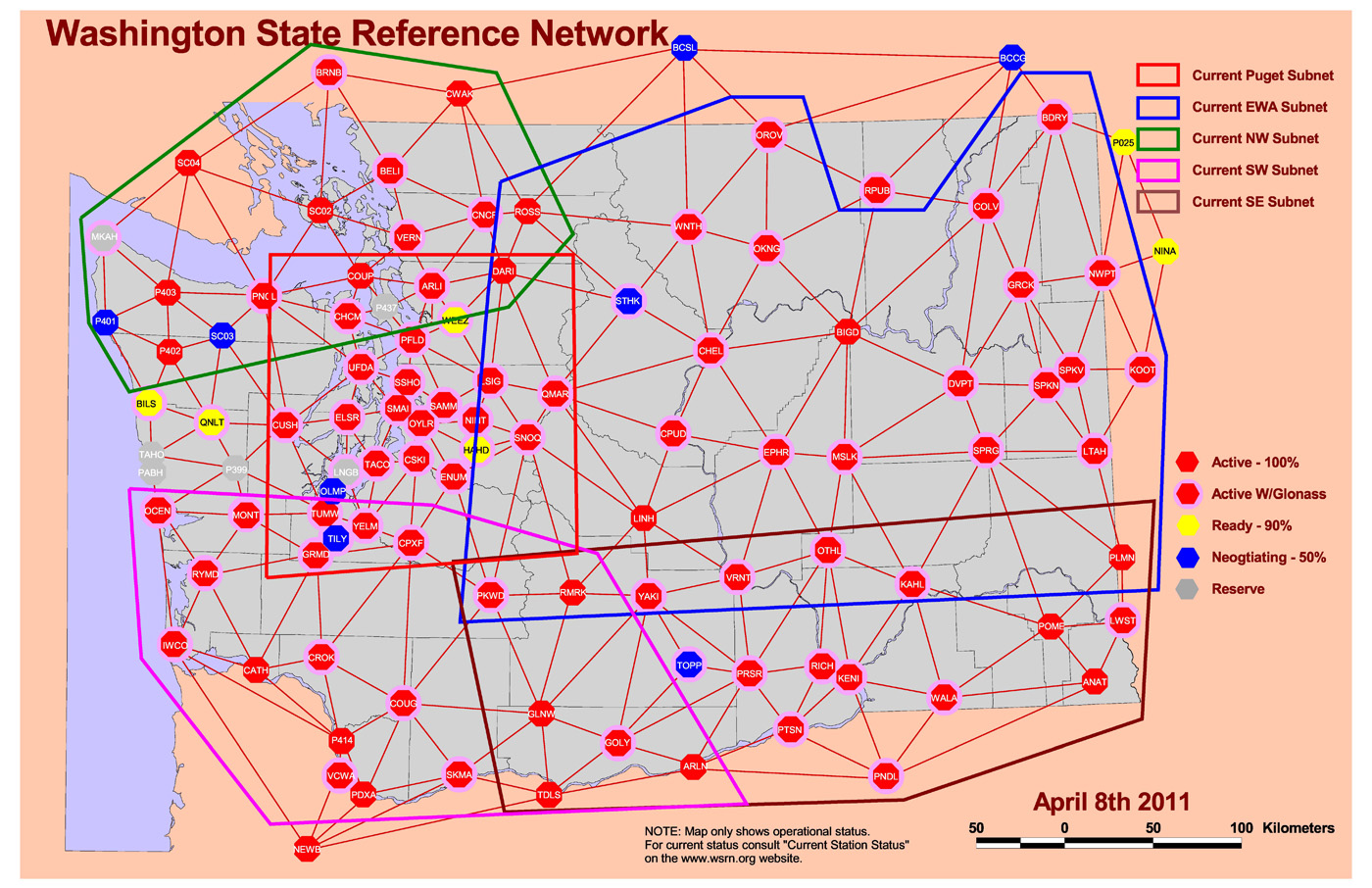
    RTK Networks. RTK networks continue to proliferate. In the U.S., many states offer free access to their centimeter-level statewide RTK networks. These are somewhat well-known within the surveying and agriculture community, but not as well known within the GIS community. Many countries also offer regional and country-wide RTK networks. RTK network accuracy = 1-2 cm.

    WSRNMap2011
    Washington State RTK Network
    Source: Washington State Reference Network. http://www.wsrn3.org/

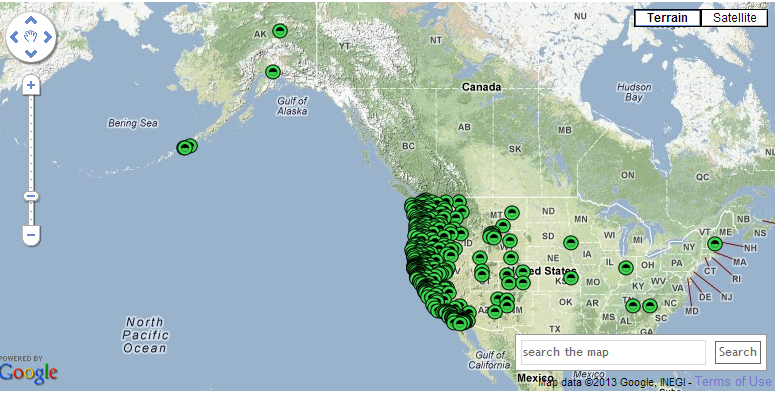
    PBO real-time streaming. In the western U.S., UNAVCO’s Plate Boundary Observatory (PBO) maintains more than 1,000 GNSS base stations with many of them broadcasting RTCM3-formatted data. If you’re in California, Oregon, Washington, and the surrounding states, you should take a look at its website. The only requirement is that you have a receiver capable of handling RTCM3 data and you have Internet access in the field. You’ll also need an NTRIP client software (there are free ones available) running on your data collector (smartphone, handheld, tablet). Note that these are single baseline solutions (as opposed to the RTK network solution), so the further you are from the base station, the more error will be introduced. One caveat: be sure you understand which horizontal datum and epoch the particular PBO base station is streaming. PBO real-time streaming accuracy within 20 km = 1-2 cm.

    PBORealtime
    PBO Station Streaming Map
    Source: UNAVCO Plate Boundary Observatory. http://pbo.unavco.org/data/gps/realtime

    CORS Streaming. The National Geodetic Survey (NGS) is testing real-time streaming from nearly a couple of dozen CORS sites, mostly in the Eastern U.S. This is very similar to PBO real-time streaming. If you are 50-75 km from the base station, you’ll still be under 10 cm. If you’re within 20 km, you’ll be down to 1-2 cm.

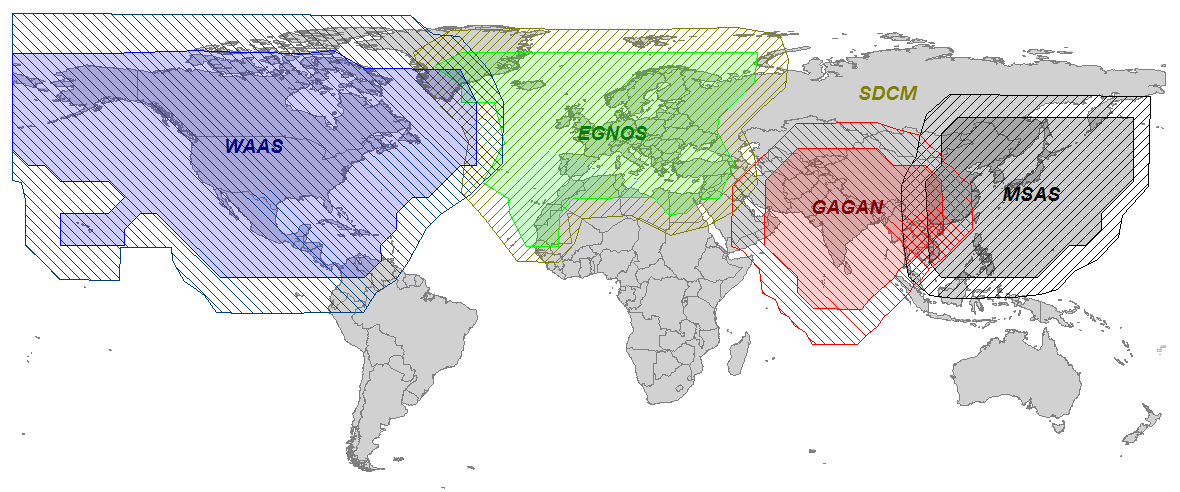
    SBAS. SBAS (WAAS/EGNOS/MSAS/GAGAN/SDCM) was the first true source of public, country-wide high-precision GPS corrections. What make SBAS so easy is its ergonomics. It’s become such a standard that virtually every high-performance GPS/GNSS receiver designed today has SBAS capability built-in. You don’t need to purchase any extra hardware or software to use it. SBAS accuracy = sub-meter (with a receiver designed to optimize WAAS).

    SBAS_World_20121212_Extrapolated
    Global SBAS Coverage Map
    Source: Geneq, Inc. www.sxbluegps.com

    There’s no doubt that years from now, we’ll look back and be amused at how “difficult” and expensive real-time, high-precision positioning was. Today, there are many more sources of high-precision, real-time GPS/GNSS corrections than there were ten years ago. In ten years, there may or may not be many more choices for high-precision GPS/GNSS corrections, but certainly the sources will be less complex, more ubiquitous and more convenient than they are today.

    For the latest GPS/GNSS news, follow me on Twitter by clicking here.

    Thanks, and see you next month.

  • US Geological Survey Report: What is the Economic Value of Satellite Imagery?

    Does remote-sensing information, such as that from Landsat and similar Earth-observing satellites, provide economic benefits to society, and can this value be estimated? Using satellite data for northeastern Iowa, U.S. Geological Survey scientists modeled the relations among land uses, agricultural production, and dynamic nitrate (NO3) contamination of aquifers. They demonstrated that information from such modeling can allow more efficient management of agricultural production without sacrificing groundwater quality. Just for northeastern Iowa, the value of such remote-sensing information was shown to be as much as $858 million ± $197 million per year, which corresponds to a current value of $38.1 billion ± $8.8 billion for that flow of benefits into the foreseeable future.

    fs2013-3003_Image