Blog

  • Carlson Introduces SurvCE 3.0 Data Collection Software

    At the Carlson Software Annual User Conference, Carlson announced that the newest version of Carlson Software’s SurvCE 3.0 GPS/GNSS data collection software.

    Featuring hundreds of additions and improvements, Carlson SurvCE 3.0 supports the widest range of popular and new release RTK GPS and conventional/robotic total stations of any other data collection software on the market. Newest instrument drivers added for Total Stations and GPS receivers include: Geomax Zoom 80, Carlson CR2/CR5 robotic, Topcon PS, Sokkia SX/50RX and South OnBoard total stations, and 20 or more new models of GPS from Carlson, Hemisphere, Datagrid, Topcon, Leica, Altus, CHC, Hi-Target, Navcom, Stonex, Javad, Geomax, Satlab and even including the Spectra Epoch 50.

    SurvCE30

    “SurvCE 3.0 continues to set the standard in data collection,” says Carlson. “While Carlson is well known for its surveying and roading features, especially in the U.S. and Australia, the new options in SurvCE should also appeal very strongly to the European market with its emphasis on precision occupation for total stations, and expanded reporting of GPS localization and measurement data.”

    SurvCE 3.0 is available now in more than two dozen languages. These include: English, Spanish, French, French (Canadian), Portuguese, Czech, Dutch, simplified Chinese, Korean, Greek, Italian, Polish, Hungarian, Swedish, Latvian and more.

    Now over 12 years in production, with incremental updates along the way, Carlson SurvCE 3.0 features an optional icon-based interface and new Cloud-based messaging, file transfer, NGS monument recall, simplified stakeout methods and powerful GPS measurement averaging and blunder detection in the field (with accuracies in-between RTK and post-processing). The Carlson SurvCE 3.0 upgrade is offered for just $150 for Carlson customers already using SurvCE. The price to purchase SurvCE remains the same as it has since 2007.

    “The main and universal advantages of SurvCE are retained—a simple interface, quick learning curve, now even stronger graphics, and a rich set of features to complete any work from building and highway stakeout, to property surveying, TOPO, control, and GIS data collection,” adds Carlson.

    According to the announcement, those upgrading to SurvCE 3.0 will find new camera integration among its many improvements. This integration will provide the ability to attach pictures to points and lines and store in KMZ and EXIF files containing relevant data such as position and description.

    Other top new features include:

    • Ability to stake roads by complete LandXML Road Model—a new method augmenting “By Sections,” “By Templates,” and “From Map;”
    • Ability to use point “blocks” from drawings as point symbols or as objects to snap to for stakeout or for creating alignments, with GIS attributes associated with blocks recognized;
    • Large Point ID and Description Fields – expanded to 256 characters;
    • Use of RTCM 3.1 messages from virtual reference stations to auto-compute grid and geoid shifts.
  • The Inner Edge: Who Holds the Key to Indoor Nav?

    The Inner Edge: Who Holds the Key to Indoor Nav?

    The FCC released in March results of intensive indoor location trials of various technology solutions to this most difficult of PNT problems — yet the one that will unlock the greatest remaining untapped potential. The results will shape FCC-mandated position-reporting requirements for cell phones, and will drive future development of all indoor positioning applications. This story gives a top-level view of the results. For in-depth exploration, tune in to the free webinar this Thursday to hear critical information, insight, and perspective on this groundbreaking study from four key participants.

    The April 18 webinar is free, but you must register beforehand. A downloadable file of the webinar will be available roughly one week afterwards, in case you miss the live presentation. Speakers include Khaled Dessouky from TechnoCom Corporation, a company that supervised the trials; Ganesh Pattabiraman from NextNav and Norm Shaw from Polaris Wireless, two companies whose technologies underwent rigorous testing in the trials; and Greg Turetzky from CSR, a company closely involved in the process.

    Testing Overview

    Conducted by the Communications Security, Reliability, and Interoperability Council (CSRIC) of the Federal Communications Commission (FCC), Working Group 3 (WG3), the tests trialled thousands of attempted location fixes in four representative morphologies (dense urban, urban, suburban, rural) and various building types.

    The massive R&D movement focus on consumer-level applications, that is, cell phones, but this work will also ultimately affect professional and high-precision uses of GNSS. Those involved in machine control for warehousing, industrial assembly, indoor and even underground mapping, construction both above- and underground, underground mining, utility work, and even forestry will find this of particular interest — any activity in areas where sky-view is limited or negligible.

    Today, well more than half of mobile phone calls are made inside buildings. The number of emergency calls roughly parallels that, and both figures are only projected to rise. The FCC has a clear mandate to bring E-911 capability to indoor calls.

    The 2001 regulations governing such emergency calls required that both landlines and cellphones should provide the location of callers to within specific accuracy levels. Location information was to be sent transparently to public safety answering points (PSAPs), to dispatch fire/rescue/police personnel to the source the 911 call, and not just to the right street address, but to the right floor of a multi-storied building. That’s the driver for all this.

    Widespread application of successful technology/ies meeting the indoor requirement, once determined, is the key to significant revenue for many parties, not least of them GNSS manufacturers and location-based services (LBS) providers.

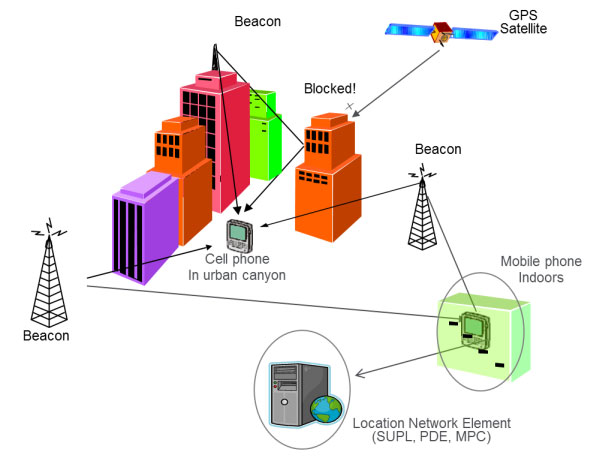
    GPS and augmented GPS technologies were only part of the cellphone solution, and other implementations included use of the cell signal itself along with an extensive database which can contain amongst other things signal attributes and network asset locations.

    The WG-3 Locations Based Services (LBS) sub-group set about finding what technologies exist, how well they work and how they could be applied to E-911. Click here for the full report.

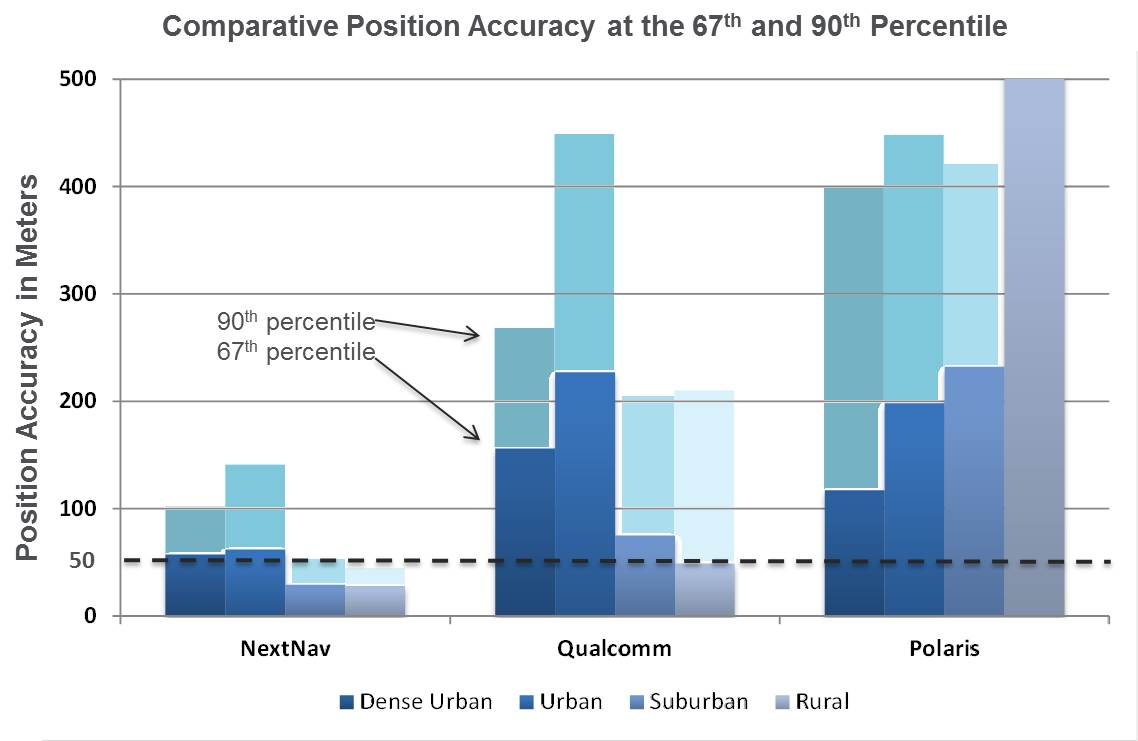
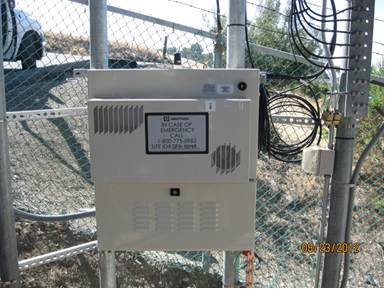
    In the tests, Polaris Wireless used an RF pattern-matching/fingerprinting technique, Qualcomm used a hybrid assisted-GPS (A-GPS)/advanced forward link trilateration (AFLT) system, and NextNav used wireless beacon technology.

    WG3 selected the San Francisco Bay Area for the Stage-1 Indoor Test Bed. The methodology centered on indoor testing in sample buildings within the most common wireless use environments, called morphologies: dense urban, urban, suburban, and rural.

    Bldg. 2: One Front Street, San Francisco, California.
    Dense urban: Bldg. 2: One Front Street, San Francisco, California.
    Bldg. 18: Super 8 Motel on O’Farrell St., San Francisco, California.
    Urban: Bldg. 18: Super 8 Motel on O’Farrell St., San Francisco, California.
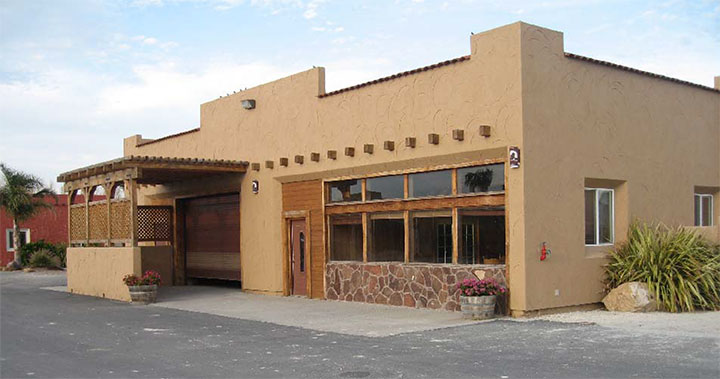
    Bldg. 13: Gilroy Gaits, Beige Stable Building, Hollister, California.
    Rural: Bldg. 13: Gilroy Gaits, Beige Stable Building, Hollister, California.

    Polygons surrounding areas containing 19 buildings were selected; the distribution of buildings tested was 6 dense urban, 5 urban, 6 suburban and 2 rural. 75 test points were selected by TechnoCom within these 19 buildings. Statistically significant samples of stationary test calls were placed from each test point using multiple test devices for each of the 3 location technologies under test by NextNav, Polaris Wireless, and Qualcomm.

    More than 13,000 valid test calls were collected across the test points for each of the three technologies. Broad, representative wireless industry participation in the test bed meant that Polaris’ results were aggregated over AT&T’s and T-Mobile’s networks; Qualcomm’s results were aggregated over Sprint’s and Verizon’s networks; and NextNav operated essentially as a standalone overlay location network.

    A certified land surveyor provided indoor ground-truth accuracy to compare test-call locations. The certified accuracy was +/-1 cm horizontal and +/-2 cm vertical.

    The test results show the location-performance attributes under test: horizontal location accuracy, vertical accuracy, yield, time to first fix (TTFF), and reported uncertainty.

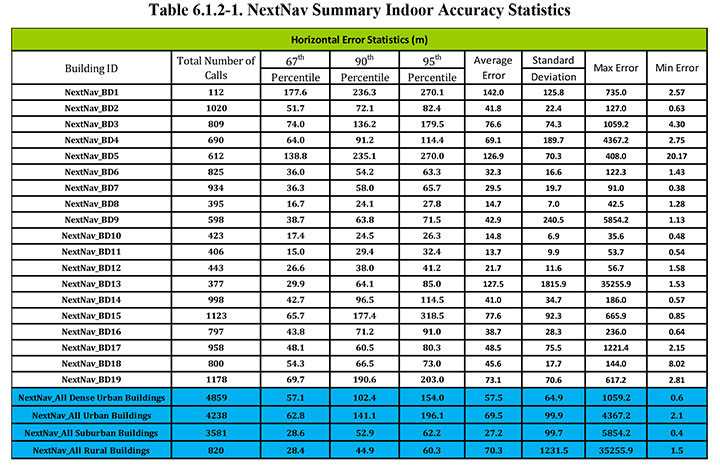
    NextNav Summary Indoor Accuracy Statistics.
    NextNav Summary Indoor Accuracy Statistics.
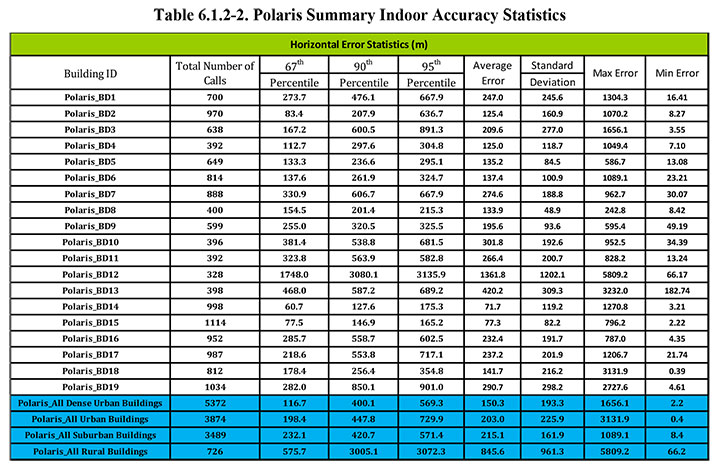
    Polaris Summary Indoor Accuracy Statistics.
    Polaris Summary Indoor Accuracy Statistics.
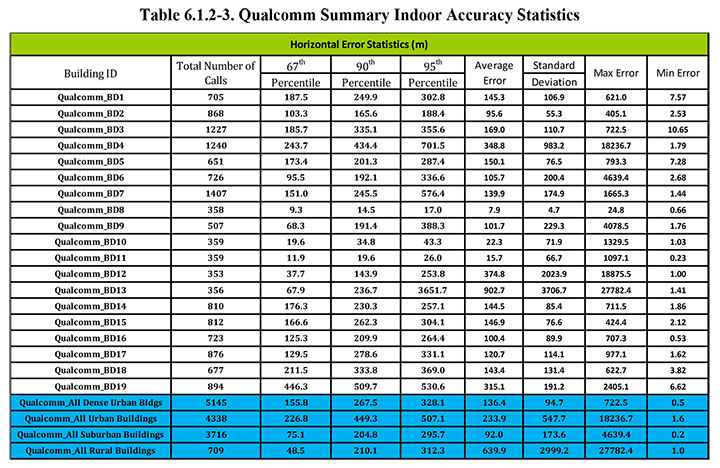
    Qualcomm Summary Indoor Accuracy Statistics.
    Qualcomm Summary Indoor Accuracy Statistics.

    Dense Urban Environment

    Satellite signals (in this instance, GPS) have, of course, significant challenges in penetrating large buildings. Consequently, AGPS fall-back modes, such as AFLT, were experienced frequently. Accuracy degraded as expected when GPS fixes were not attained. While a surprising proportion of hybrid fixes were experienced, even at test points where one would not expect a satellite signal to penetrate, the quality of the hybrid fixes was in general significantly degraded compared to GPS fixes.

    RF finger-printing experienced its best performance in the dense urban setting. This is probably a combination of a confined environment that could be extensively calibrated and many RF cell sites and handoff boundaries that could be leveraged in creating a good RF fingerprint map of the dense urban center.

    The best observed performance in the dense urban setting was that of the dedicated terrestrial (beacon) location system — a new infrastructure. However, due to multipath, location fixes that may be relatively close in absolute distance (for example, 40 meters away) are often located in a building across the street, in a neighboring building, or even across a few blocks from the test point.

    Urban Environment

    Each individual test building in the urban morphology produced different challenges, and the three technologies under test met them in varying degrees.

    A major-league baseball stadium created a situation where AGPS fallback fixes could be very far away due to the exposed RF propagation outside the structure in which the test points were located. Stadium structure created challenges to RF fingerprinting at some test points.

    A convention center created in some cases an environment that was deep indoors but with very strong cellular signal from cell sites inside the building. This made the beacon-based location system perform poorer than in most other test points, since attenuation to different directions in the outside world was particularly strong in those scenarios. AGPS and RF fingerprinting relied on the cell sites inside the structure to create adequate location fixes.

    An older building of comparatively heavy construction, with a large atrium in its middle, produced widely varying results based on distance from windows or the atrium. Again, the phenomenon of apparent location in a building across the street was seen for both NextNav and Qualcomm. RF fingerprinting fixes appeared to cluster about the larger reflectors in this urban corner of San Francisco, which happened to be mostly across the streets from the target building.

    A motel building demonstrated the unique challenge with indoor location: absolute distances (like 50 or 150 meters) which may have meant much in assessing outdoor performance mean less for the indoors, since emergency dispatch to the wrong building or even the wrong block could be easily encountered at those distances. A location across the street is certainly better than one a few or many blocks away but it may still leave some human expectations unmet.

    A tall condominium building in a (non-dense) urban downtown San Jose created relatively poor AGPS performance, uneven beacon system performance, and RF fingerprinting performance that degraded with the height of the test point. All of the above factors related to each of the urban buildings, combined with a generally lower cell site density for fall back (than in dense urban), resulted ultimately in an aggregate urban performance that is slightly worse than the dense urban performance.

    Suburban Environment

    The effect of smaller buildings with lighter construction and more spacing between buildings quickly became evident. Outstanding GPS performance, almost as good as outdoors, can be achieved inside single-story homes. Similarly outstanding performance is achieved on average by the beacon-based location technology under similar circumstances. RF fingerprinting appears to suffer from performance degradation compared to more dense morphologies in the city.

    The AGPS performance predictably changes as the suburban buildings become bigger and higher. The terrestrial beacon-based network continues to perform well in the larger suburban. RF finger-printing shows some enhancement relative to the smaller suburban buildings, but still shows most of the location fixes along the roads, highways or reflecting buildings.

    Rural Environment

    Large one-story structures with metal roofs limited the available number of satellite signals available for trilateration. In these cases more hybrid fixes were experienced with a concomitant increase in the spread of the location fixes about the true location. The performance of the beacon-based network was less impacted by the metallic roof (since that roof had more impact on sky visibility rather than on side visibility towards terrestrial beacons). Consequently the performance was somewhat better than for AGPS. The performance of the beacon-based network would of course depend on the density of its deployed beacons covering the rural area, which was sufficient in the case of the rural test polygon.

    RF finger-printing showed reduced performance relative to the suburban environment due to the large spacing between surveyed roads (where calibration is done) and the rural structures as well as the lower density of cell sites.

    Conclusion

    Finally, the report concludes: “Stage-1 of the test bed contained in the end only three technologies to test. With the complexity of the task at hand, this created a good learning opportunity for both CSRIC WG3 members and the test house. However, there are a number of technologies that are either in use for location based services (LBS) or that are emerging which should be evaluated for their potential to contribute to the improvement of indoor wireless E911.

    “Indoor wireless E911 is a critical public safety issue that will only increase.”

    One key factor that the report does not at all address is relative cost of implementing these respective solutions. The same can be said for timeline. While some observers have concluded that “NextNav came out on top,” this solution in particular can be presumed to face much greater challenges for full or nationwide implementation than the other two, which rely largely on already existing infrastructures.

    Another round of E-911 test-bed activities will ensue once funding and management issues are resolved. See CSRIC WG 3 LBS Subgroup member Greg Turetzky’s “Expert Advice” column from GPS World for perspective and a forward look.

    Once again, for an up-close and personal look at the CSRIC Bay Area indoor tests, register beforehand here for Thursday’s webinar, April 18. A downloadable file of the webinar will be available roughly two weeks afterwards, in case you miss the live presentation.


  • Locata Positioning to Underpin Crash Avoidance Research

    Locata Corporation announced today that the Insurance Institute for Highway Safety (IIHS) plans to install a Locata network as the core positioning technology in a $30 million upgrade soon to be underway at its Vehicle Research Center near Washington, D.C.

    A LocataNet will provide the vitally important high-precision positioning required by the VRC to perform rigorous, consistent and repeatable scientific evaluation of the new vehicle crash avoidance systems, Locata said. VRC crash tests produce the “Top Safety Pick” ratings that have helped consumers make informed decisions about buying safer cars for years. Now research into new technology systems, which allows cars to avoid crashes in the first place, will elevate the value of the institute’s safety ratings, Locata said.

    Carrying out these new tests is not a trivial exercise, Locata said. The VRC will have to research and install new robotic and positioning technology to enable the required level of precision. The LocataNet installation will furnish the IIHS with a locally controlled positioning system that is seamless over all of the VRC test areas, enabling extremely reliable automated positioning of vehicles. The newly expanded facility includes a continuous vehicle test track that traverses not only open-air roadway areas, but also a vast 300- by 700-foot fully covered testing area. Locata’s ability to provide centimeter-accurate, locally controlled positioning across both outdoor and indoor environments gives the IIHS flexibility to design a positioning system to meet their vital test requirements, while also allowing easy upgrade and expansion in the future, Locata said.

    The dramatic video footage from IIHS crash tests draws extensive media coverage, which becomes a powerful public incentive for automakers to improve the safety of their vehicles. The media, auto industry and policymakers look to the IIHS as a leader in highway safety research, and the expanded VRC will enable the IIHS to play a major role in the emerging area of crash avoidance testing, Locata said. IHS’s YouTube channel shows crash tests and dicusses the ratings system.

    “Crash tests and research conducted at the VRC have helped drive life-saving improvements in vehicle designs,” said Adrian Lund, IIHS president. “Our new state-of-the-art facility will allow us to also evaluate emerging vehicle-based systems intended to prevent crashes or lessen their severity, so that we can encourage the entire industry to adopt the most effective ones.”

    To do this new research, it is essential to conduct tests under identical, controlled condition, Locata said. With Locata, IIHS researchers will be able to ensure precise positioning data is available in all of its test areas. In places where GPS signals would be unreliable or unavailable when tests are conducted under cover, Locata seamlessly delivers consistent, reliable and accurate positioning, available everywhere, the company said. It will help IIHS carry out automated, identical testing to allow “apples to apples” comparisons of motor vehicles. This is a critical advancement for testing systems that will save many lives in the future, Locata said.

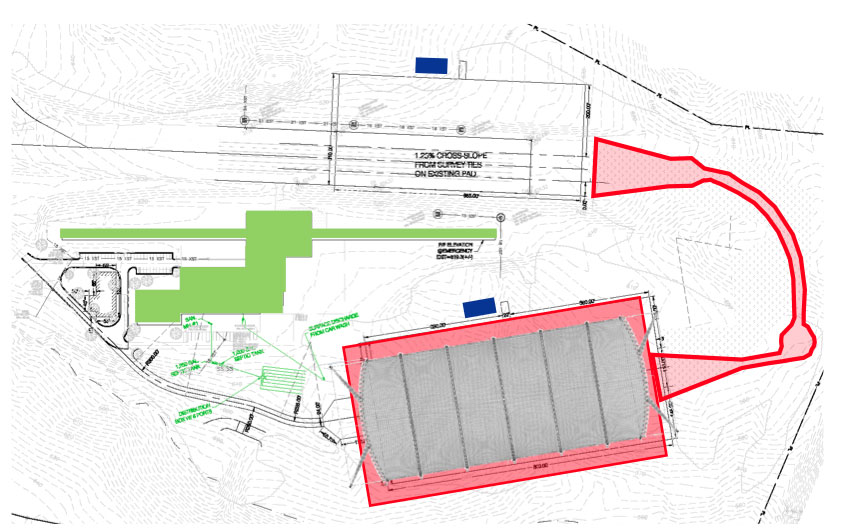
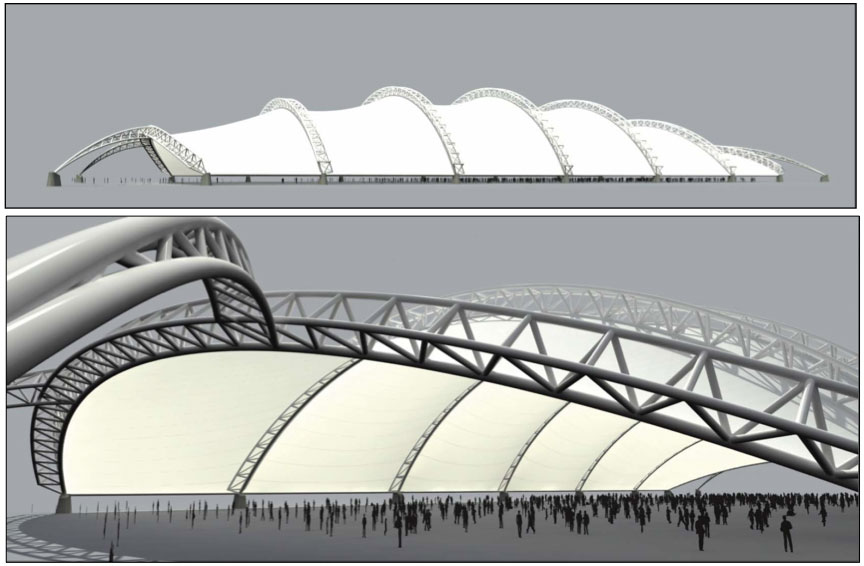
    The planned Locata-enabled covered test track.
    The planned Locata-enabled covered test track.
    The Locata-enabled covered test track building (artist's concept).
    The Locata-enabled covered test track building (artist’s concept).

    Here is a video tour of the VRC.

    Locata technology provides GPS-style, ground-based positioning covering local areas ranging in size from a parking lot to thousands of square miles. It provides precise positioning either in combination with, or in the total absence of, GPS. It is the first technology that can replicate GPS’s precise positioning capability without using satellites.

    Locata’s current devices have already delivered new positioning capabilities to professional applications in mining, aviation, warehousing, and as “GPS backup systems” for important strategic areas. Locata is being trialed by several government bodies in urban areas as a locally controlled positioning infrastructure in applications for transport, first responders, surveyors, and container port automation. As Locata devices are further miniaturized over the next few years, this technology promises to be a game changer for the positioning capabilities available to indoor, mobile and smartphone applications, Locata said.

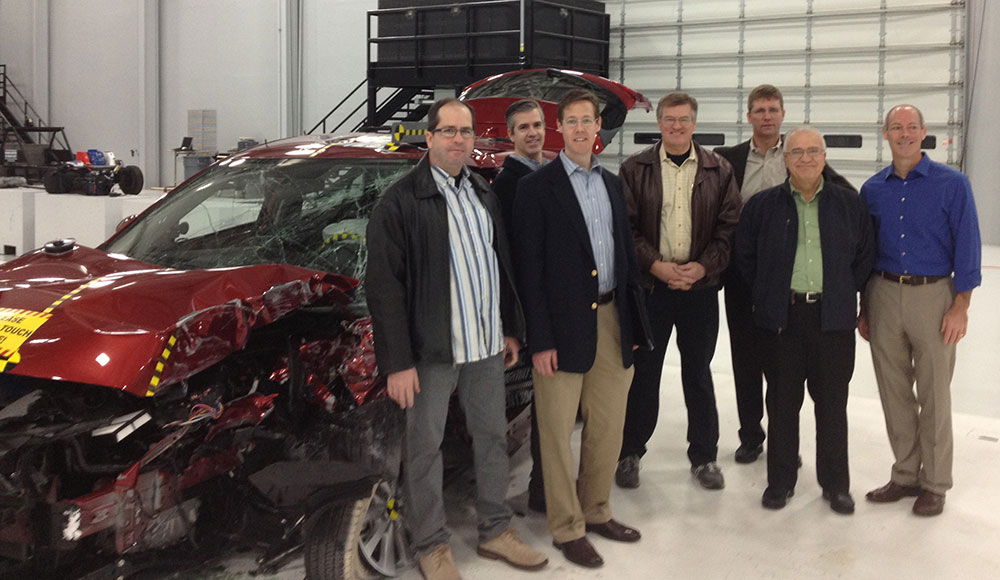
    The partners met at the VRC on February 14 to plan out the Locata installation. From left are Robert “Bo” Jones, IIHS engineer; Paul Perrone, president, Perrone Robotics; Geoff Hoekstra, business development, Perrone Robotics; Adrian Lund, president, IIHS; David Zuby, chief research officer, IIHS; Nunzio Gambale, Locata CEO; Jimmy LaMance, Locata. The auto is the result of a crash test conducted that day.
    The partners met at the VRC on February 14 to plan out the Locata installation. From left are Robert “Bo” Jones, IIHS engineer; Paul Perrone, president, Perrone Robotics; Geoff Hoekstra, business development, Perrone Robotics; Adrian Lund, president, IIHS; David Zuby, chief research officer, IIHS; Nunzio Gambale, Locata CEO; Jimmy LaMance, Locata. The auto is the result of a crash test conducted that day.

    “GPS satellites are in a constant state of motion,” said Nunzio Gambale, CEO of Locata Corporation. “In many environments, this makes it impossible to achieve the level of reliable positioning required for meaningful scientific testing. Locata readily steps into these environments to deliver an always-on, unfailing and superbly accurate positioning signal. We are honored to be chosen as the positioning technology that helps the IHS research, test and drive forward the development of life-saving automotive initiatives. This Locata installation at the legendary Vehicle Research Center will be the most publicly visible jewel in our crown to date. Relationships like this confirm the value of years of hard work we put in to invent this amazing and unique technology.”

    “The Locata team is thrilled to see how rapidly our systems are being taken up by the creme-de-la-creme of the positioning industry,” continued Gambale. “We know this VRC testing is world-first, groundbreaking work that has enormous global and social value. It’s wonderful to think that our work may contribute to one day saving my life—or yours.”

  • Comments Sought on Future User Needs for Nationwide DGPS

    The U.S. Department of Transportation’s Research and Innovative Technology Administration (RITA), in partnership with the U.S. Coast Guard, is seeking public comments on  current and future user needs for the Nationwide Differential Global Positioning System (NDGPS).

    The agencies want to know how users use NDGPS, and are seeking ideas for future uses or alternative uses.

    According to the notice in the Federal Register,”The NDGPS was designed to broadcast signals to improve the accuracy and integrity of the Global Positioning System (GPS) derived positions for surface transportation, as well as other civil, commercial, scientific, and homeland security applications. This analysis will be used to support future NDGPS investment decisions by the Department of Homeland Security and the Department of Transportation beyond fiscal year 2016. This notice seeks comments from federal, state, and local agencies, as well as other interested members of the public regarding current and future usage of the NDGPS, the need to retain the NDGPS, the impact if NDGPS signals were not available, alternatives to the NDGPS, and alternative uses for the existing NDGPS infrastructure.”

    NDGPS is a ground-based augmentation system that provides increased accuracy and integrity of GPS information to users on U.S. land and waterways. The system consists of the Maritime Differential GPS System operated by the U.S. Coast Guard and an inland component funded by the Department of Transportation. NDGPS is built to international standards, and similar systems have been implemented by 50 countries around the world. Modernization efforts include the High Accuracy NDGPS (HA-NDGPS) system, currently under development, to enhance the performance and provide 10-15 centimeter accuracy with integrity throughout the coverage area. For more information about NDGPS, visit the following webpages:

    Comments and related material must reach the Docket Management Facility on or before July 15, 2013.

    Comments can be submitted identified by docket number USCG-2013-0054 or RITA-2013-0001 using any one of the following methods:

    1. Federal eRulemaking Portal: http://www.regulations.gov.
    2. Fax: 202-493-2251.
    3. Mail: Docket Management Facility (M-30), U.S. Department of Transportation, West Building Ground Floor, Room W12-140, 1200 New Jersey Avenue SE., Washington, D.C.   20590-0001
    4. Hand delivery: Same as mail address above, between 9 a.m. and 5 p.m., Monday through Friday, except Federal holidays. The telephone number is 202-366-9329.

    All comments received will be posted, without change, to http://www.regulations.gov and will include any personal information provided.

    For more details on submitting comments, see the Federal Register notice.

    More information on the status of the NDGPS can be found on the RITA site and the U.S. Coast Guard site. More information on the HA-NDGPS is at the U.S. Department of Transportation site.

  • UAV Aircraft to Fly Near Hermiston, Oregon, for Potato Research

    Oregon State University announced that two small, remote-controlled aircraft are expected to start flying over potato fields in the Hermiston area this month as part of Oregon State University’s efforts to help farmers more efficiently use water, fertilizers and pesticides to bolster yields and cut costs.

    While taking photographs, the aircraft will fly over 50 acres of OSU’s 300-acre Hermiston Agricultural Research and Extension Center (HAREC), as well as several crop circles totaling about 1,000 acres at a research cooperative farm west of Boardman. The flights will take place at least three times a week until the potatoes are harvested in the fall, beginning with a test run Wednesday at the Boardman farm.

    HawkeyeUAV
    Tetracam’s Hawkeye UAV

    OSU researchers will use various cameras on the aircraft to photograph the potato plants. The cameras will include ones that detect different wavelengths of light. One of these wavelengths, infrared, is reflected by plants, but unhealthy plants reflect less of it, and in infrared photographs sick plants are much darker. Researchers will also explore using other wavelengths of light to determine which ones will be most helpful in identifying troubled plants.

    Researchers aim to see if the cameras, which are capable of zooming in on a leaf, can detect plants that aren’t getting enough fertilizer and water. They’ll purposely reduce irrigation and fertilizer on some plants and will then see how quickly, if at all, the equipment detects the stressed plants. If it works, the scientists hope that the project will continue in subsequent years so they can test the cameras to also find plants that are plagued by insects and diseases. The idea is to help farmers take action before larger crop losses occur and it becomes more difficult and expensive to control the problem.

    “The key is to pick up plants that are just beginning to show stress so you can find a solution quickly, so the grower doesn’t have any reduced yield or quality issues,” said Phil Hamm, the director of HAREC. “This in turn can save money. It’s an early warning system for plants with issues as well as an opportunity for growers to reduce costs by being more efficient in water and fertilizer use.”

    Potatoes were chosen as the focus of the research because they’re a high-valued crop, expensive to raise and must be carefully managed to reduce internal and external blemishes and irregular growth spurts, said Don Horneck, an agronomist with the OSU Extension Service. One of Oregon’s leading crops, the state’s farmers sold $173 million of potatoes in 2012, according to the U.S. Department of Agriculture. But spuds are prone to devastating problems caused by diseases and insects, said Horneck, who is the lead researcher from OSU on the project.

    “They are one of the most difficult and expensive crops to grow,” he said, adding that it typically costs Hermiston farmers $4,000 or more per acre to grow them. That equates to about $500,000 for the average size of field in the area.

    OSU hopes that the aircraft it tests will reduce these costs. The aircraft that will fly over OSU’s land is called a HawkEye and is sold by a company called Tetracam. About the size of a suitcase and weighing only 8 pounds, its maximum flight time is 10-30 minutes. The hull-less, battery-operated machine is easy to operate and was made for farmers with plots of land that are less than one square mile. A motor and propeller allow it to take off on four wheels. A parachute keeps it in the air. Photos and videos of it are at http://bit.ly/10LDbjt.

    A delta-winged aircraft made of plastic foam will fly over the private farm. Made by Procerus Technologies and called a Unicorn, it has a wingspan of no more than 6 feet and weighs less than 6 pounds. A bungee cord launches it like a slingshot. A factsheet on it is at http://bit.ly/XTqioS.

    Procerus-Technologies-UAV-Test-Airframe
    Lockheed Martin Unicorn UAV

    OSU is inviting the public to see the HawkEye fly during its potato field day at its Hermiston research center on June 26.

    Allaying concerns about privacy, Hamm said, “These unmanned aircraft are for agricultural research only and will be used to do nothing more than that. This is about helping our local growers do a better job of growing crops, something HAREC has been doing for the past 102 years.”

    The Federal Aviation Administration has authorized the flights of the aircraft, which aren’t allowed to fly higher than 400 feet and must stay within sight of the operator, typically less than a mile away.
    OSU is leasing the aircraft from Boeing Research & Technology. n-Link, an information technology firm in Bend, is also a partner in the project. Ray Hunt, a plant physiologist with the USDA in Beltsville, Md., will collaborate with OSU’s Horneck on the data analysis.

    OSU aims to become one of the nation’s premiere universities using unmanned aircraft for research. It is using or has plans to use them in studies on natural resources, wildlife, land-use management, forestry, oceanography and engineering.

  • Google Releases Technical Specifications for Google Glasses

    Google posted technical specifications for its much-touted Glasses.

    GoogleGlasses1

    Fit

    Adjustable nosepads and durable frame fits any face.
    Extra nosepads in two sizes.

    Display

    High resolution display is the equivalent of a 25 inch high definition screen from eight feet away.

    Camera

    Photos – 5 MP
    Videos – 720p

    Audio

    Bone Conduction Transducer

    Connectivity

    Wifi – 802.11b/g
    Bluetooth

    Storage

    12 GB of usable memory, synced with Google cloud storage. 16 GB Flash total.

    Battery

    One full day of typical use. Some features, like Hangouts and video recording, are more battery intensive.

    Charger

    Included Micro USB cable and charger.
    While there are thousands of Micro USB chargers out there, Glass is designed and tested with the included charger in mind. Use it and preserve long and prosperous Glass use.

    Compatibility

    Any Bluetooth-capable phone.
    The MyGlass companion app requires Android 4.0.3 (Ice Cream Sandwich) or higher. MyGlass enables GPS and SMS messaging.

  • Topcon Web Portal Provides Real-Time Job Site Management Tool

    Topcon Positioning Group has launched a new web portal—Sitelink3D.net—designed specifically for general construction and engineering companies.

    In its announcement at the Munich construction trade show Bauma 2013, Topcon focused on the website’s features, which include giving end-users an intuitive way to manage and control every aspect of Topcon 3D machine control systems anywhere in the world.

    The subscription web-based service—accessed via computer, tablet or smartphone—is a user-friendly, real-time visualization and communications tool that allows users to access job site status and create new or update job site parameters, and view movement of machines on the job, Topcon said.

    Features of Sitelink3D include file transfers, messaging, machine tracking, remote support and training, real-time cut/fill mapping, and acquiring and storing real-time survey data.

    “While Sitelink3D is a complete site communications systems providing data control, machine tracking and a reporting system in one solution, Sitelink3D.net gives complete site management power in real time and provides remote information access to and from any piece of enabled equipment regardless of location,” said Richard Jackson, vice president of machine control applications.

    “The web portal provides simple, effective tools for monitoring machine efficiencies and site progress,” Jackson said. Through Sitelink3D.net, “companies can now better manage onsite progress, maintain data integrity, optimize production and minimize downtime. The ability to be able to send and receive job data and make instantaneous decisions or corrections saves time, fuel and money.”

    Most machines currently equipped with a Topcon 3D-MC system can be included in the Sitelink3D network by adding the SL-100 radio modem. New Topcon 3D-MC systems can be ordered with the modem pre-installed. Users of Topcon Pocket3D and 3D Office software can also be included in the Sitelink3D network.

  • DeLorme Launches Next-Generation inReach Satellite Communicator with GPS

    inreachse_m01
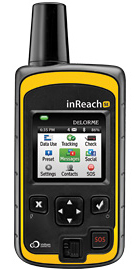
    inReach SE (Screen Edition)

    DeLorme has announced the launch of its newest product, the inReach SE (Screen Edition) satellite communication device. With 90 percent of the world’s surface lacking cell phone coverage, inReach SE is designed  for the traveler or outdoor adventurer to keep them connected and safe anywhere in the world. The expanded standalone capabilities of inReach SE include a color screen, virtual keyboard, slim design and long-lasting internal lithium battery. In standalone mode, inReach SE provides free-form texting capabilities of up to 160 characters to any cell phone number, email address or social media page.

    Using DeLorme’s Earthmate App, inReach SE pairs wirelessly with iPhone, iPad and iPod touch to access topographic maps and NOAA charts and to make text messaging more convenient. inReach SE is also compatible with Android devices.

    With the ability to maintain satellite signal lock even in difficult GPS environments, inReach SE also offers global SOS capabilities, adjustable tracking intervals from 10 minutes to four hours, and remote real-time follow-me/find-me tracking and ping-me locating. In the event of an emergency, the interactive SOS capability of inReach automatically triggers remote tracking and allows users to describe and update their situation so proper resources can be deployed, DeLorme said.

    “Whether you’re deep in the backwoods, floating on a remote lake, or simply traveling abroad, anyone can benefit from the comprehensive functionality of inReach SE,” said Michael

    Heffron, DeLorme CEO. “Over the last two years we have been listening to customer feedback, so the next generation of inReach includes many new features based on their input. The internal rechargeable battery and the on-screen, free-form texting are especially beneficial, making on-the-go communications more convenient and delivering peace of mind to family and friends easier than ever before.”

    inReach operates over the Iridium satellite network, providing global two-way satellite communications, high network reliability and low-latency data links (less than 60 second delivery of messages end-to-end) anywhere on Earth, with no gaps, fringe or weak signal areas, DeLorme said.

    The follow me / find me tracking feature of inReach provides GPS position updates allowing family and friends to follow the user’s trip as it happens. Family and friends can log into a dedicated MapShare page to follow a detailed breadcrumb trail, ping a location, and send messages to the inReach owner. In the event of an emergency, the built-in SOS button can be activated to trigger a distress alert with delivery confirmation and it automatically activates the remote GPS tracking feature. GPS tracking assists search-and-rescue personnel with homing in on the user’s location, whether stationary or on the move.

    Pairing the inReach SE via Bluetooth with the Earthmate App turns a mobile device into a global satellite communicator and navigation tool. Real-time GPS location, tracking and text messages are overlaid on the digital maps for easy navigation and position location. inReach owners get exclusive, unlimited access to DeLorme’s topographic maps and North American NOAA charts, which can be downloaded via an Internet connection prior to departure and remain available in the Earthmate App even when outside cellular coverage.

  • Mobile Location-Based Advertising Will Be Worth 6.5B Euros in 2017

    According to a new research report from the analyst firm Berg Insight, the total value of the global real-time mobile location-based advertising and marketing (LBA) market will grow from €526 million in 2012 at a compound annual growth rate (CAGR) of 65 percent to €6.5 billion in 2017. This will then correspond to 32.8 percent of all mobile advertising and marketing. This means that location-based advertising and marketing will represent around 5 percent of digital advertising, or more than 1 percent of the total global ad spend for all media. SMS, mobile search and coupons are today important high-volume LBA formats.

    The ability to precisely target prospective customers using real-time location is currently one of the most promising additions to the advertising toolbox, Berg Insight said. “Key drivers for LBA include the growing adoption of both outdoor and indoor location technologies, as well as the increasing consumer acceptance of location-based services in general,” said Rickard Andersson, Telecom Analyst, Berg Insight. Location targeting in combination with other contextual and behavioral segmentation greatly enhances the relevance of mobile advertising. “Major brands are so far the main spenders, but LBA has also opened the mobile channel for small local merchants. Local businesses can extend their marketing initiatives with mobile components such as location-sensitive coupons using online self-services, while big box retailers leverage enterprise LBA solutions for conquesting and to combat showrooming,” Andersson said.

    The LBA value chain is still forming and there are a large number of players involved in the ecosystem, Berg Insight said. Since the value chain is fragmented and the industry has not yet reached maturity, many different roles are involved. Companies range from LBA specialists such as Verve, Placecast and xAd, to LBS players including Telmap, Telenav and Waze, and operators such as AT&T, SFR and the new UK joint venture Weve.

    There is, furthermore, an abundance of location-aware applications and media that serve geo-targeted ads, with examples such as Foursquare, Shopkick and SCVNGR. Other stakeholders include coupons and deals providers including Vouchercloud, Yowza!! and COUPIES, search solutions such as Yell and Yelp, and proximity marketing providers like Proxama, NeoMedia and Scanbuy. A number of traditional mobile advertising players are also active in the LBA space, for example Millennial Media, Madvertise and Nexage, as well as major digital and telecom players such as Google, Apple and Facebook.

  • First GPS Cell Phone on Display at Smithsonian

    WASHINGTON, D.C. — The first GPS-enabled cell phone, developed by Navsys Corporation, is now on display at the Smithsonian National Air and Space Museum’s Time and Navigtion exhibition, which opened today. This device marks an important step in GPS history that paved the way for positioning to become the integral component of communications technology that exists today, Navsys said.

    Navsys assisted in the development of the Colorado Department of Transportation’s Emergency Vehicle Location System Mayday platform in 1995. To address the need for faster notification and responsiveness during emergencies, Navsys was contracted to integrate GPS positioning into a cell phone so that location information could be sent to a communications center for mobile 911 calls.

    One of the enabling technologies Navsys developed for this system was LocaterNET. When activated by a user’s in-vehicle unit (IVU), LocaterNET collects a snapshot of raw GPS information. That information is then sent to a remote processing system to determine the user’s location. This technique allowed for low power consumption and processing requirements for the IVU, which is vital for small form factor personal navigation and communication devices.

    “We are honored to be a part of this exhibition and for the awareness it creates for how GPS technology has advanced many other technologies we use today,” said Alison Brown, president and CEO of Navsys.

    The Smithsonian exhibition covers a multitude of navigation and timing innovations and opens on April 12. A detailed description of the LocaterNET Mayday platform can be found here.

  • GIOVE-A Uses GPS Side Lobe Signals for Far-Out Space Navigation

    GIOVE-A Uses GPS Side Lobe Signals for Far-Out Space Navigation

    The European Space Agency’s (ESA’s) retired GIOVE-A navigation mission has become the first civilian satellite to perform GPS position fixes from high orbit. Its results demonstrate that current satnav signals could guide missions much further away in space, up to geostationary orbit or even as far as the Moon.

    GIOVE-A has been able to fix its position, velocity and time from GPS signals, despite orbiting more than 1000 km above the downward-pointing U.S. satellites.

    “Satellite navigation has become almost as indispensable for most low-orbiting satellites as it is for car drivers and other terrestrial users,” said ESA’s Steeve Kowaltschek. “Satellites equipped with satnav receivers can continuously monitor their orbit in space, enabling largely autonomous operations with limited ground intervention. GIOVE-A’s three months of data show that future geostationary satellites could operate in the same way, bringing real competitive advantage to the multi-billion-euro telecommunications satellite market.”

    Launched in 2005 to claim radio frequencies and test hardware for Europe’s Galileo satnav constellation, the Galileo In-Orbit Validation Element-A, or GIOVE-A, mission far outlasted its original two-year design life. It was formally decommissioned by ESA in the middle of last year, once the first Galileo satellites completed their orbital commissioning. Having been moved into a graveyard orbit about 100 km above Galileo’s orbital altitude of 23 222 km, control was passed to its prime contractor Surrey Satellite Technology Ltd. of Guildford, UK.

    ESA had originally worked with SSTL to customize one of the company’s existing satnav receivers for testing on GIOVE-A, an activity supported through ESA’s Advanced Research in Telecommunications Systems (ARTES) program. In the event, the satnav receiver was activated for only 90 minutes during the very beginning of the satellite’s seven-year operational life, with GIOVE-A’s main tasks given priority. Once the formal mission was over, ESA and SSTL took the opportunity to switch the receiver on again.

    “We have been really encouraged by the initial results from our receiver,” said Martin Unwin at SSTL. “Our patience has finally been rewarded, and we would like to make the best of this unique opportunity.”

    SSTL is able to upload new software to the receiver in orbit, and has been able to apply sophisticated software algorithms to help detect faint satnav signals. Further work is planned to refine operation through the use of an accurate onboard clock and orbit-estimating algorithms.

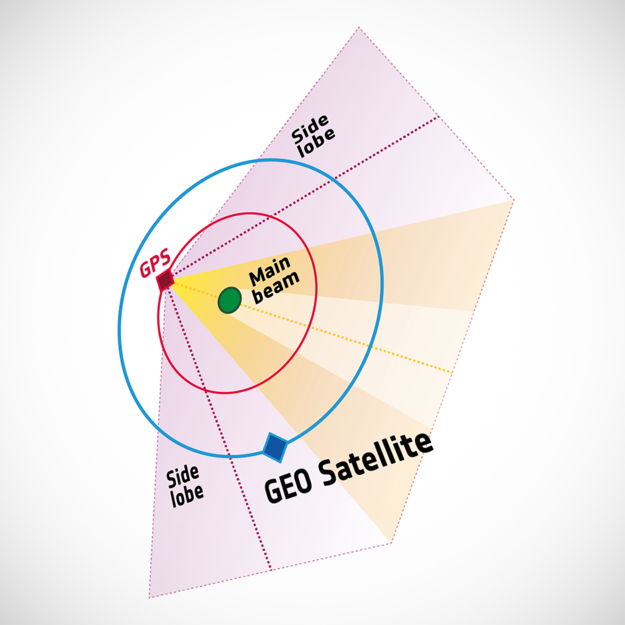
    GPS satellites – like those of Galileo, Russia’s Glonass or their Japanese, Chinese and Indian counterparts – aim their antennas directly at Earth. Any satellite orbiting above the GPS constellation can only hope to detect signals from over Earth’s far side, but the majority are blocked by the planet. For a position fix, a satnav receiver requires a minimum of four satellites to be visible, but this is most of the time not possible if based solely on front-facing signals. Instead, GIOVE-A has been able to make use of signals emitted sideways from GPS antennas, within what is known as ‘side lobes’. Just like a flashlight, radio antennas shine energy to the side as well as directly forward.
    GIOVE-A has been able to make use of signals emitted sideways from GPS antennas, within what is known as side lobes.

    GPS Side Lobes. GPS satellites — like those of Galileo, Russia’s Glonass or their Japanese, Chinese and Indian counterparts — aim their antennas directly at Earth. Any satellite orbiting above the GPS constellation can only hope to detect signals from over Earth’s far side, but the majority are blocked by the planet. For a position fix, a satnav receiver requires a minimum of four satellites to be visible, but this is most of the time not possible if based solely on front-facing signals.

    Instead, GIOVE-A makes use of signals emitted sideways from GPS antennas, within what is known as side lobes. Just like a flashlight, radio antennas shine energy to the side as well as directly forward.

    “These side lobes are not typically well measured because this is energy that doesn’t reach users on Earth,” explained Kowaltschek. “Antenna designers seek to minimize them, but the laws of physics mean they will always be present in some form. Measuring these GPS side lobes has shown them to be stronger than anticipated, and the combination of side lobes and signals spilling over from the other side of Earth mean that a position fix can be maintained throughout GIOVE-A’s orbit.”

    The satellite has also acquired detailed profiles of the signal side-lobe characteristics of the various GPS design blocks.

    Geostationary satellites reside in set orbital slots, some 80-km across, up in the 36,000-km-altitude belt. Chemical thruster firings are needed every fortnight or so to correct for drift, checked against radio ranging from the ground.

    Harnessing satnav would be a way of automating station-keeping functions. It also meshes with the current move to all-electric comsat designs, such as ESA’s Electra. Electric propulsion would do the job of conventional chemical thrusters, delivering more compact satellites capable of flying on cheaper launch vehicles while offering longer mission lifetimes. But electric propulsion provides lower thrust and therefore requires almost permanent ground ranging. Continuous position fixes via satnav could perform this task onboard, maintaining the orbit position with better accuracy.

    SmallGEO. (Image: ESA)
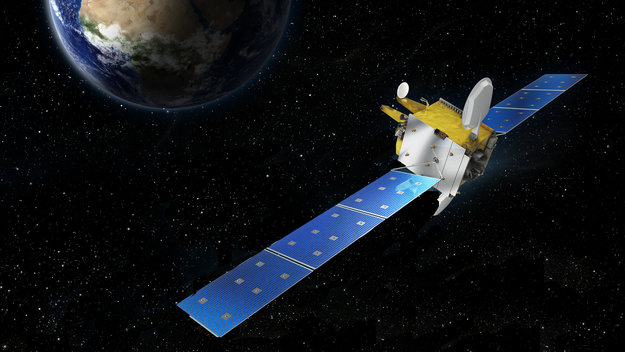
    SmallGEO. (Image: ESA)

    In addition, constant orbit determination and close-to-perfect time knowledge also improves pointing accuracy on comsats that use startrackers as their main attitude sensor.

    All-electric comsats using satnav could gradually steer themselves up to geostationary orbit following launch, further slashing the required launcher size, onboard fuel and ground support.

    “We envisage a future satnav receiver that can track not only GPS, but also Galileo and Glonass signals at high altitudes, meaning a near-continuous availability of accurate position and time for geostationary and other satellites,” says Martin.

    As a next step, a receiver will be flown on ESA’s SmallGEO telecom mission, due for launch in 2014. Building on the positive results of the GIOVE-A experiments, SmallGEO will be the first civilian mission to use satnav in geostationary orbit.