Blog

  • Expert Advice: Galileo Looking Forward — An Interview with Paul Flament

    Paul Flament
    Paul Flament

    A Constellation of 18 by 2015, Rising to 26 by the End of That Year

    An Interview with Paul Flament

    Paul Flament is the European Commission Programme Manager and Head of the EU Satellite Navigation Programme Unit.

    A Belgian civil engineer specialized in telecommunications, he previously worked  for 11 years in the European Space Agency, for space missions control centers and for the design and development of telecommunication satellites. After obtaining a master’s degree in European Studies, he joined the European Commission in 1998.

    On the occasion of this special Europe/Galileo issue of the magazine, he speaks to GPS World readers regarding the present and promising future of the European GNSS.


    Alan Cameron (AC): Can you recap for us briefly the upcoming satellite launch schedule that will take Galileo to Initial and then to Full Operating Capability?

    Paul Flament (PF): It’s very simple. The first two in-orbit validation satellites were launched in October 2011, the next two on October 12, 2012. Satellites 5 and 6 will be launched in September of this year, aboard a Soyuz launcher from Kourou, and numbers 7 and 8 will follow in December.

    Then, in 2013 we will see three Soyuz launches of two satellites each. We do not have the precise launch dates yet, but they are likely to be in April, June, and September. In December 2014, we expect to have the first launch using the Ariane 5 launcher, which is capable of deploying four satellites in one go. This means that by the end of 2014 Galileo will have deployed 18 satellites in orbit.

    In 2015, there will be two Ariane 5 launches, one in the middle of the year, one at the end, each carrying four satellites. This will bring the total number of satellites to 26 by the end of 2015.

    I am doubly confident of this constellation deployment schedule. First, at the technical level: The European Commission (EC) together with the European Space Agency (ESA) is following very closely all the industrial activities. The satellites in production now are with OHB. We have people in Bremen, where the OHB facilities are located, following this very closely. If there are technical issues, we take them up straight away with those concerned, the moment they appear. We also have monthly meetings with Jean-Jacques Dordain, the director general of ESA, and we make a careful tour of all the dates and conditions.

    Secondly, there are no unknowns from the budget point of view. Except for the cost of the Ariane 5 launchers, the costs of deployment are already covered. And the EU’s member states have agreed on a budget of €6.3 billion for the next seven years. Budget should not be an issue.

    Just recently, on March 12 of this year, we were for the first time able to calculate positions with the four Galileo satellites already in the sky. They pass overhead every so often, depending on geometry of orbit. This is an important technical milestone, even if this does not provide you a service as such. It demonstrates that the capability is there and that the mission part of the system works.

    In terms of services, we want to be able at a certain point in time to start offering a guaranteed service. Our objective is October 2014. We will then have a constellation of 14 satellites. On the basis of that constellation, taking some margins, we will guarantee a minimum service of eight operational satellites. That service, in combination with GPS and other systems like GLONASS, will be something that users can start counting on. We will guarantee that at least eight satellites will be in operation from that moment onward.

    We will probably translate this number of satellites into a performance-level guarantee. But for the moment it will be based on the number of satellites.

    The fact is that we are populating the constellation, and very quickly we will have 26 satellites in orbit. That leads us to the Initial Operational Capability (IOC) phase: With those 26 in the sky we will guarantee a service based on 22 operational satellites.

    The target constellation is one of 30 satellites. We don’t know yet for sure when this will be achieved. That will depend on when the last batch of satellites are ordered, and we are still discussing that. But we have an obligation to have deployed 30 satellites by the end of 2020. Then we will guarantee a service based on 24 satellites, with two spares per orbital plane.

    AC: What is foreseen as the market readiness to adopt and use Galileo at that time? What companies are taking the lead in designing, manufacturing, and selling combined GNSS receivers?

    PF: We believe that market trends go towards multi-constellation receivers. We already see that in some iPhones with GLONASS capability. We already see in the professional market segment that there are some companies providing Galileo capabilities, taking advantage of E1 and E5 for GPS and Galileo.

    In the mass market, we also believe many companies will start to build up the multi-signal capability. Companies like STMicroelectronics are working on that. I have asked the European GNSS Agency (GSA) to provide figures. Out of a list more than 60 receiver manufacturers, at least 50 percent of them have at least one product that incorporates European Geosationary Navigation Overlay Service (EGNOS) capabilities. Of those same 60 companies, 30 percent already also have products incorporating Galileo capabilities: STMicro, Septentrio, NovAtel, Leica Geosystems, IFEN, Japan Radio, and others.

    We believe that it is important to have continuous interaction with receiver manufacturers so that they understand the benefits of Galileo. EC Vice President Antonio Tajani is devoting a lot of attention to that. We build Galileo, but we do it for users. We have to make sure manufacturers understand the benefits. Discussions with them started in December in London when Mr. Tajani met with a set of CEOs of receivers manufacturers. He promised to meet with them every six months. We are also meeting with them on March 19 to provide information on calendars.

    AC: What other European Commission programs will rely on initial or full Galileo capability to fulfill their mission?

    PF: As of today, there is no obligation to use Galileo, no mandatory regulation imposing the use of it. There are some initiatives, like the Intelligent Transport Directive, which recommend but do not impose making use of EGNOS and Galileo. Or eCall, which in case of a car accident automatically contacts the rescue services. This will be required in all new cars starting 2015. These systems rely on satellite navigation for positioning. We also have digital tachography to measure the times of driving and rest of truck drivers. This will become a requirement as from 2018, and also relies on satellite navigation.

    We also see initiatives by member states to put in place GNSS-based road-pricing systems. Germany has taken a lead in this. The European Union (EU) is trying to harmonize these road-pricing systems across national borders, with programs like Eurovignette and the Interoperability Directive.

    In other modes, like aviation, you already have EGNOS. With landing procedures in place based on EGNOS, the system has become a reality.

    In Europe we have the common agricultural policy, providing subsidies to farmers. As these are based on field sizes and crops, they need to be controlled, and using EGNOS and Galileo will help achieve more precise measurements.

    AC: The Galileo Open Service Signal In Space Interface Control Document (OS SIS ICD) Issue 1 is described as being “subject to evolution.” Can you predict when a further iteration (Issue 2) will appear, and what changes it may contain?

    PF: The present version of the ICD is still applicable. It correctly reflects the structure of the messages broadcast by Galileo. The statement you quote refers to the evolution of the document because as you remember there has been a debate about a safety-of-life (SOL) service that is multi-constellation and multi-regional. Since the initial concept of SOL on Galileo was changed in the last two years, some capacity onboard the satellites has been freed. We would like to use that for something else, keeping the backward compatibility for receivers. This will allow us to put in place, for example, a mechanism to improve the tracking performance and availability. Also authentication and higher accuracy for professional markets could be implemented, while maintaining the options for future advanced receiver-autonomous integrity monitoring (RAIM). That explains why we are still working on the evolution of the document. The next version of the ICD will be published in due time.

    AC: Can you talk about progress towards increasing the EU share of the GNSS global market — currently 20 percent, but with the objective to reach 33 percent, as in other high-tech sectors? How might this be done?

    PF: It is important for us in building Galileo that users benefit in having a second constellation. Satisfying users is the key. It also gives us some sort of independence from GPS, which would otherwise be the sole-source GNSS in the world. We would like our European companies to be more proactive and not to be limited to 20 percent share of the market. Everyone would.

    We have our traditional research programs, like the Seventh Framework Programme (FP7). The next installment of the EU’s research programs will be called Horizon 2020, and it will make available budget devoted to the development of applications, receivers, and so on. Whether that will allow European companies to gain market share will depend on their proactivity, their innovation, and market-oriented strategies. That is their responsibility.

    We are also active in things like the Galileo Masters, which tries to help small-to-medium enterprises (SMEs) who have good business ideas, young entrepreneurs or scientists with good GNSS-related innovations.

    On top of that, we are starting studies to see how we can secure the market uptake of Galileo, not simply to help European industries, but to see that manufacturers and downstream applications developers understand the benefits of Galileo. By the end of the year, we should have created a better understanding by manufacturers and users of the full potential of using Galileo.

    AC: Are there any other issues or concerns that you would like to bring to the attention of GPS World readers and the global GNSS community?

    PF: I would like to briefly focus on EGNOS. For us it is important that this service will stay for a long time. We promised this to the aviation sector. The EU is finalizing its budget for the period 2014 to 2020, and this will allow us to continue to operate and improve EGNOS. Our objective is that it will augment Galileo as well as GPS, using the dual-frequency approach. That’s a real plus at the regional level for Europe. Its main customer will remain the aviation sector, although it is also widely used in precision farming, tracking and tracing, and so on.

    Secondly, we are working on the continuous evolution of the system. We all know that satnav is an evolving domain. It takes time to build satellites and to improve technology. The Mission Evolution Road map that has been developed by experts will be presented to member states later this year.
    Finally, we will be organizing the annual European Space Solution conference in Munich in November this year, and in mid-2014 in Prague. We are also hosting the International Committee on GNSS (ICG), which will take place in Prague in November 2014. For us, the location in Prague is symbolic since the European GNSS Agency (GSA), which will be our exploitation entity, is also located there.

  • MWC: Is the Connected Car the New Mobile Phone?

    This year’s Mobile World Congress, held late last month in Barcelona, featured the world’s largest mobility conference. While there was not a lot of strictly location-based services news, connected vehicles seemed to be the big deal. Ford and GM both made important announcements, sending a signal that wireless information and connectivity is here to stay in a vehicle — and location will be a big part of the growth. On the downside, MWC is becoming a mini Consumer Electronics Show with hotels gouging attendees, long cab lines, heavy traffic, expensive meals and long commutes to the show for those wanting to pay less than $400 a night for a room. Sounds like Las Vegas in January.

    By Kevin Dennehy

    The recent Mobile World Congress, held at Barcelona’s Fira Gran Via conference center, featured big connected vehicle announcements from Ford and GM. Ford announced a slew of deals, one partnering with Spotify to make Spotify Premium available through its Sync AppLink. GM’s big announcement is that its OnStar safety, security and navigation service will use AT&T Mobility’s network for LTE modules in 2014.

    Ford launches Spotify connection.
    Ford’s partnership with Spotify gives drivers access to millions of tunes on the road.

    Industry observers believe that GM’s announcement indicates the new AT&T deal could give the connected vehicle market a big boost as the units will go into most cars, including entry-level vehicles. Wireless carriers have indicated that transportation remains one of the key vertical markets they are aggressively getting in to.

    AT&T pulled a big coup as GM uses Verizon Wireless for its OnStar service. However, published reports indicate that the company has been disconnecting subscribers who are not currently using the service. Verizon said it had lost 490,000 connections in late 2011 — and said the losses were due to decline in telematics customers.

    There is no word on whether 2012’s $617 million purchase of Hughes Telematics had any effect on the Verizon-GM relationship.

    Overall, OnStar, which costs $18.95 per month, has more than 6 million customers worldwide.

    A concern with connected vehicles, and this is an issue that has been around for the past few years, is that automobile manufacturers do not believe the vehicle isn’t the new mobile phone — though some carriers believe it will be. Another concern is the form factor itself — what is better? What will the winner be? An embedded system or a system that integrates with a user’s smartphone?

    Not to be outdone by GM, Ford also said its 2104 Ford Ecosport will feature AppLink capabilities. The company also said it would be offering, in Europe, applications from Kaliki, Glympse and Aha. Ford says it now has 2,500 folks registered in its developer program — doubling the numbers from last month.

    Ultimately, many analysts say that two major market issues will need to be resolved for the connected vehicle segment to take off. One is what will consumers want? The other is standardization — will every vehicle have the same system in use? Already Ford and GM seem to have differing technology and business models for this market.

    Is Mobile World Congress Getting Too Big to be Useful?

    With more than 72,000 attendees this year, which is a little more than half the size of the gigantic Las Vegas-based Consumer Electronics Show, is MWC becoming too big and less focused for wireless application developers, LBS companies looking to partner and other location company entities?

    Does this sound like a mini CES? The Fira Grand Via had 1 million square feet of exhibit space, 1,700 exhibitors and 72,000 attendees from 200 countries. All of this is puzzling for a conference that had no Google (the company had a big exhibit last year) or Microsoft.

    In addition, there were no huge announcements — even the connected vehicle news would be mid-level news at CES. Does it say something strange about a big wireless show when your main news is connected vehicles?

    Deciding not to get lost in the hugeness of a big trade show, most of the wireless companies and handset manufacturers choose to make their own product and deal announcements at their own branded shows or independent press conferences. Outside of a handset having LBS capability rolled out, and companies saying they are rolling out capability in European nations, there wasn’t much location-specific news.

    With no big indoor position news at MWC, does that spell a struggle for the new technology and potential gigantic market? Many publications, including this one, has touted indoor positioning as one of the technologies that will spur LBS’ market growth.

    A few smaller companies did display indoor positioning products at MWC. Rx Networks rolled out its Xybrid Synchro that allows a device to self-located without an active data network connection. The company also rolled out a cloud-based GNSS systems that allows users to determine a location even when weak location signals are available, the company said.

    Another indoor positioning company, Insiteo, showed off its products that work on iOS and Android devices to allow users to find booths at MWC. The company says product finding, location-based marketing and data mining are all applications for the platform.

    In other Mobile World Congress news:

    • Telit launched m2mLOCATE, a feature that adds Cell-ID location for a range of its cellular connectivity modules. The company uses RX Networks’ XYBRID RT service, a database that encompasses 40 million cell-IDs.
    • CSR demonstrated its Location Services Platform, which features context detection and user self-learning to deliver indoor and outdoor location for the consumer and enterprise markets. The company says the platform has an indoor accuracy of less than 10 meters.
    • TeleCommunication Systems shopped its LBS suite of services at MWC to both enterprise and consumer companies. TCS recently deployed four new mobile operators on its hosted cloud LBS product. The company says it offers revenue-producing branded and private-labeled applications for navigation, hyper-local search, enterprise and family locators.
    • ALK Technologies, now owned by Trimble Navigation, said its CoPilot GPS navigation apps for smartphones and tablets will be available for Windows Phone 8 and Windows 8. The company said it’s always been high on Microsoft’s mobile products, as CoPilot was originally developed for Microsoft’s Pocket PC. CoPilot features voice-guided GPS navigation, turn-by-turn guidance, trip planning and automotive-grade street maps, the company said. The unit’s live services include Yelp, ActiveTraffic, Wikipedia and Google Search.
  • Z/I Imaging Offers PureColor Technology in PPSv6.6

    Z/I Imaging has release version 6.6 of its Z/I Sensor software PPS, which will introduce the innovative PureColor Technology. As part of a broader focus on radiometric enhancements and simplified processing, PureColor Technology will boost the dynamic range of the output image and protects all information collected even in high illuminated and shadow areas. In addition, the new PPS V 6.6 will reduce the time needed for manual adjustments and will provide a significant higher automation level for post processing parameter settings, Z/I Imaging said.

    To address customer’s requirements for very large mapping projects radiometric characteristics for all Z/I DMC and Z/I DMC II cameras have been standardized. This will allow customers to fly large projects with multiple cameras, with the radiometric output being normalized automatically, the company said.

    Additional features and enhancements included with this release are:

    • New PureColor Technology providing increased dynamic range and protects image information, even in high illuminated or dark shadow areas.
    • Automated color balance: high automated color balancing for perfect radiometric image quality to save labor time and reduce manual user interaction. This feature requires an absolute radiometric calibration.
    • Atmospheric correction: new atmospheric correction model implemented to reduce haze and dust, geographic coordinates required for correct application, data typically part of the flight plan

    To address the request for faster image post processing, customers can now also take advantage of a 32-processing nodes software bundle. Existing Z/I PPS customers can upgrade to distributed processing at any time.

    The new Z/I Sensor V 6.6 software release is compatible with Intergraph’s ImageStation 2013 software and ISAE Extended 3D point cloud generation using Semi Global Matching technology. Also, the Tridicon 3D software suite for automatic city model generation is fully supported.

  • Leica Announces Airborne Digital Sensor ADS100

    Leica Announces Airborne Digital Sensor ADS100

    Leica Geosystems today announced the new generation of its airborne digital sensor, the Leica ADS100. Introducing a unique focal plate design, the Leica ADS100 offers a swath width of 20,000 pixels for all multispectral bands (RGBN) and multispectral capability in forward, nadir and backward.

    The Leica ADS100 provides a large format CCD line with TDI (Time Delay and Integration) to increase sensitivity despite a smaller pixel size. By doubling the cycle rate, high-resolution images can now be acquired at much higher ground speeds. To provide the best stabilization performance, the new Leica PAV100 gyro-stabilized mount is equipped with adaptive control technology, Leica said. In addition to the Leica PAV100, the Leica ADS100 shares all aircraft installation components such as camera controller, operator displays and flight control software with the Leica RCD30 medium format camera.

    “There are several reasons our customers will be pleased with this development, explains Ruedi Wagner, VP Imaging Geospatial Solutions. “The current Leica ADS80 has been proven to be one of the most reliable airborne sensors on the market. It’s combination of superior hardware design and dedicated workflow have led to record sales in 2012. With the Leica ADS100 we are now nearly doubling productivity while maintaining reliability and highly automated workflows, that are so well accepted in the market. In addition, by introducing the common platform concept using a unified aircraft installation and shared peripherals between the Leica ADS100 and the Leica RCD30, we are not only simplifying operation but significantly reducing cost of ownership across our sensor portfolio. The best of all, we can now offer our cost-effective upgrade path to both existing ADS and RCD30 standalone customers.”

    The new Leica ADS100 airborne digital sensor together with Leica XPro 6.0 will be released and shipped in the second quarter of 2013.

    Photo: Leica Geosystems

  • Real-time PPP with Galileo Demonstrated by Fugro

    Real-time PPP with Galileo Demonstrated by Fugro

    Fugro Seastar AS has been looking forward to demonstrating Real-Time Precise Point Positioning (PPP) based solely on Galileo signals since the last two satellites were launched October 12, the company said.

    Those two satellites brought the constellation to a total of four satellites, the minimum required to permit calculation of a Galileo-only position. Fugro achieved this task on March 18, within a week of all four Galileo satellites being activated. Fugro is now generating Galileo orbit and clock corrections, which can be used in conjunction with the Fugro G2 decimeter-level corrections associated with its GPS/GLONASS PPP service.

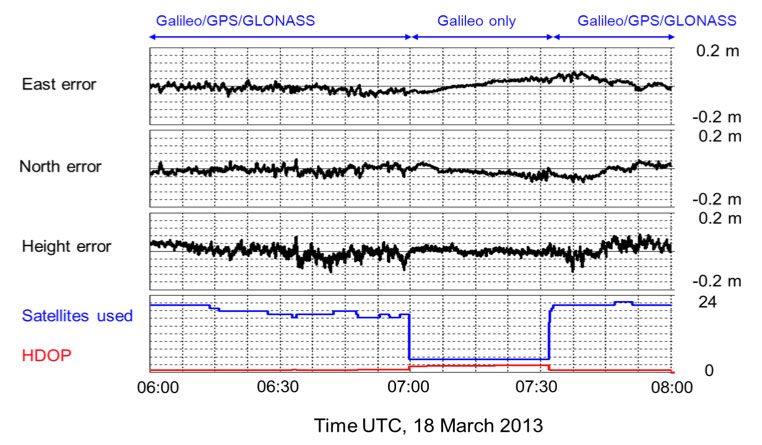
    The plot below shows performance of the Fugro orbit and clock service using GPS, GLONASS and Galileo satellites between 06:00 and 08:00 UTC,  March 18, 2013, in Oslo, Norway. Between 07:00 and 07:30 UTC, only the four Galileo satellites were used for the solution, which achieved a similar accuracy to Fugro’s existing service, the company said.

    “It is interesting that the noise level of the position is better with Galileo alone than when GPS and GLONASS satellites are also used,” Fugro said in a statement. “This is very encouraging as with only four satellites to choose from, the geometry of the Galileo-based solution is much weaker than the solutions before and after the Galileo-only period. This performance exceeds our expectations and suggests a strong future for Fugro’s Galileo PPP solution.”

    Fugro-chart

  • AtlasCT to Release Voice-Guided Navigation for Firefox OS

    AtlasCT has announced an April release date for the first, full featured, voice-guided turn-by-turn navigation solution for the Firefox OS. The software program will be released under the brand name of “EverNav for Firefox.” This announcement follows Mozilla’s launch of the Firefox OS during the Mobile World Conference in Barcelona in February.

    EverNav was initially released on September 2012 as an HTML5 turn-by-turn solution aimed at application developers and mobile marketing campaigns. The solution was quickly adapted by a large number of customers. Now, as part of the preparation for Mozilla’s release of the Firefox OS, a dedicated EverNav version will be released in April.

    “We were one of the first few companies to release HTML5 based navigation back in 2012 and we are proud to be the first to release a dedicated navigation solution for the Firefox OS today. HTML5 technology has come to the point that we were able to develop a full-featured navigation user experience, and we are extremely happy with the result,” said Ziv Avni, AtlasCT’s marketing director.

    EverNav for Firefox OS will include a personalized navigation experience with features like local information, live traffic reports, favorites and history sections, share location capability, social integration and more.

    “As the leading provider of HTML5 turn-by-turn navigation solutions, as soon as we learned about the Firefox OS, we decided to release a dedicated version,” said Shlomo Emanuel, AtlasCT’s CEO. “We are still looking into a number of possible business models for the services and this is one of the subjects we are discussing with mobile carriers that have already committed to backing the open web device initiative.”

    EverNav for Firefox OS will be available both on the Firefox Marketplace and on the EverNav website.

  • SuperPad 3.1 Supports Comune di Ovodda for Accurate Field Boundary and Prosperity Assessment

    Supergeo Technologies, a provider of GIS mapping software and solutions, announced that SuperPad 3.1 was selected by Comune di Ovodda to complete field data collection for accurate field boundary and prosperity assessment.

    Ovodda is a comune (municipality) in the Province of Nuoro in the Italian region of Sardinia.

    Today, economic development and governmental policy were the main driving factors of land-using change. In this procurement, Superpad 3.1, the mobile GIS software, is used by Comune di Ovodda to frequently update and improve the survey results and consequently promote the efficient land use of boundaries.

    SuperPad 3.1 allows field surveyors to effortlessly collect, update, and obtain various reliable field data such as the land use information, road conditions, and landforms to improve administrative efficiency and make better decisions, according to Supergeo.

  • BeiDou Ground System Approved

    A ground system aimed at enhancing the navigation precision of China’s homegrown BeiDou Navigation Satellite System (BDS) was approved in central China’s Hubei Province on Friday, according to NZWeek.

    The BeiDou Ground Base Enhancement System (BGBES) is a network consisting of 30 ground base stations, an operating system and a precision positioning system. It was approved by the evaluation committee led by Sun Jiadong, an academician with the Chinese Academy of Sciences (CAS) and chief designer of the BDS.

    The system is expected to improve the BDS’ positioning precision to 2 centimeters horizontally and 5 centimeters vertically via tri-band real-time precision positioning technology, and to 1.5 meters with the single-frequency differential navigation technology.

  • GPS Innovation Alliance Welcomes New Affiliates

    Five major national organizations representing a variety of industries are joining the GPS Innovation Alliance as affiliate members.

    The alliance announced today that the American Trucking Association, the Association for Unmanned Vehicle Systems International (AUVSI), Boat U.S., the National Rural Electric Cooperative Association (NRECA) and the National Society of Professional Surveyors (NSPS) have signed on as alliance affiliates. Each shares in the alliance’s goal of protecting, promoting and further enhancing one of the world’s most important enabling technologies — technologies that improve the lives of people around the globe.

    Headquartered in Washington, D.C., the GPS Innovation Alliance was launched in February. Its founding members are Garmin, John Deere, Topcon Positioning Systems and Trimble. Affiliate members previously announced include the Association of Equipment Manufacturers (AEM), General Aviation Manufacturers Association (GAMA) and the National Association of Manufacturers (NAM).

    Following are comments from representatives of the newly announced affiliates.

    Ted Scott, director of Engineering, American Trucking Associations: “GPS is important to the trucking industry. A robust and reliable GPS system enables drivers and fleet managers to select the best routes to guarantee pickup and delivery times, and to track shipments and fleets. It also helps save fuel by providing the most efficient routes. As GPS continues to modernize, we are pleased to support the GPS Innovation Alliance as an affiliate.”

    Curtis W. Sumner, executive director, National Society of Professional Surveyors: “The productivity and precision benefits GPS provides professional surveyors are boundless. Virtually all surveyors use it for a growing number of applications that improve the national infrastructure every day. The modernization of GPS is critical to the future of surveying, which is why NSPS is pleased to offer the GPS Innovation Alliance its support moving forward.”

    Michael Toscano, president and CEO, Association for Unmanned Vehicle Systems International: “All around the world, unmanned systems (air, ground and maritime) rely on accurate, dependable GPS signals. The lack of a reliable GPS signal poses a serious threat to our public safety and national defense, and this is why we support the GPS Innovation Alliance. We look forward to working with the Alliance in its effort to emphasize the importance of protecting our GPS.”

    Margaret Bonds Podlich, president, Boat U.S.: “For anyone who has sailed their boat in unfamiliar cruising grounds, sought out new fishing holes, had to navigate in foul weather or simply stay the course in an unmarked channel, a reliable GPS system is a critical safety issue for everyone aboard. It is the only electronic navigation system available to boaters, and for our half a million BoatU.S. members, it must work every time, all of the time.”

    Laura Marshall Schepis, senior director, Legislative Affairs, National Rural Electric Cooperative Association: “NRECA is pleased to be a part of the GPS Innovation Alliance. Electric cooperatives are increasingly relying on GPS technology as they upgrade and modernize the nation’s electric system. The GPS Innovation Alliance can support modernization by ensuring utilities have access to the spectrum they need for these new applications.”

    The GPS Innovation Alliance recognizes the ever increasing importance of GPS and other GNSS technologies to the global economy and infrastructure and is firmly committed to furthering GPS innovation, creativity and entrepreneurship. The GPS Innovation Alliance seeks to protect, promote and enhance the use of GPS.

  • Apple Buys Indoor Location Company WiFiSLAM

    The Wall Street Journal is reporting that Apple has acquired indoor-location company WiFiSLAM. Apple reportedly paid about $20 million for the Silicon Valley-based company. Apple has confirmed the purchase to MacRumors, but offered no details on its plans for the acquisition.

    Analysts say this is a sign that the war over indoor mobile location services is heating up.

    Apple’s acquisition of WiFiSLAM illustrates how 2013 will be a breakout year for indoor location as initial trials shift to technology deployments, application development, and revenues, according to ABI Research.

    Two-year-old start-up WiFiSLAM has developed ways for mobile apps to detect a phone user’s location in a building using Wi-Fi signals, according to the Wall Street Journal. It has been offering the technology to application developers for indoor mapping and new types of retail and social networking apps. The company has only a few employees. Co-founders include former Google software engineering intern Joseph Huang.

    “The move comes as Apple continues to build its arsenal against Google in mapping,” according to Wall Street Journal blogger Jessica E. Lessin. “It debuted its own mapping service last year to poor reviews and user complaints about inaccurate data. Apple chief executive Tim Cook apologized for the quality of the product, and Apple has continued to improve it.

    “Google already offers indoor mapping in certain locations like airports, shopping centers and sports venues,” Lessin said.

    ABI Research’s latest report “Indoor Location in Retail: Where Is the Money?” provides an overview of all major technologies, revenue opportunities and competitive environment. “Analyzing across 10 retail sectors, we are seeing a lot of cross pollination as companies combine handset and infrastructure based Wi-Fi, Bluetooth, and sensor location technologies. The emergence of public venue small cells and carrier Wi-Fi will also create a new wave of opportunity,” commented Patrick Connolly, senior analyst. “As a result, we expect to see a flurry of acquisitions and partnerships in 2013, as major players start to make their moves.”

    In support of these technologies, ABI Research is also forecasting smartphone retail apps to break 1 billion downloads, while indoor maps will break 1 million buildings, over the forecast period.

  • Hyundai Heavy Industry to Track Equipment with Telit

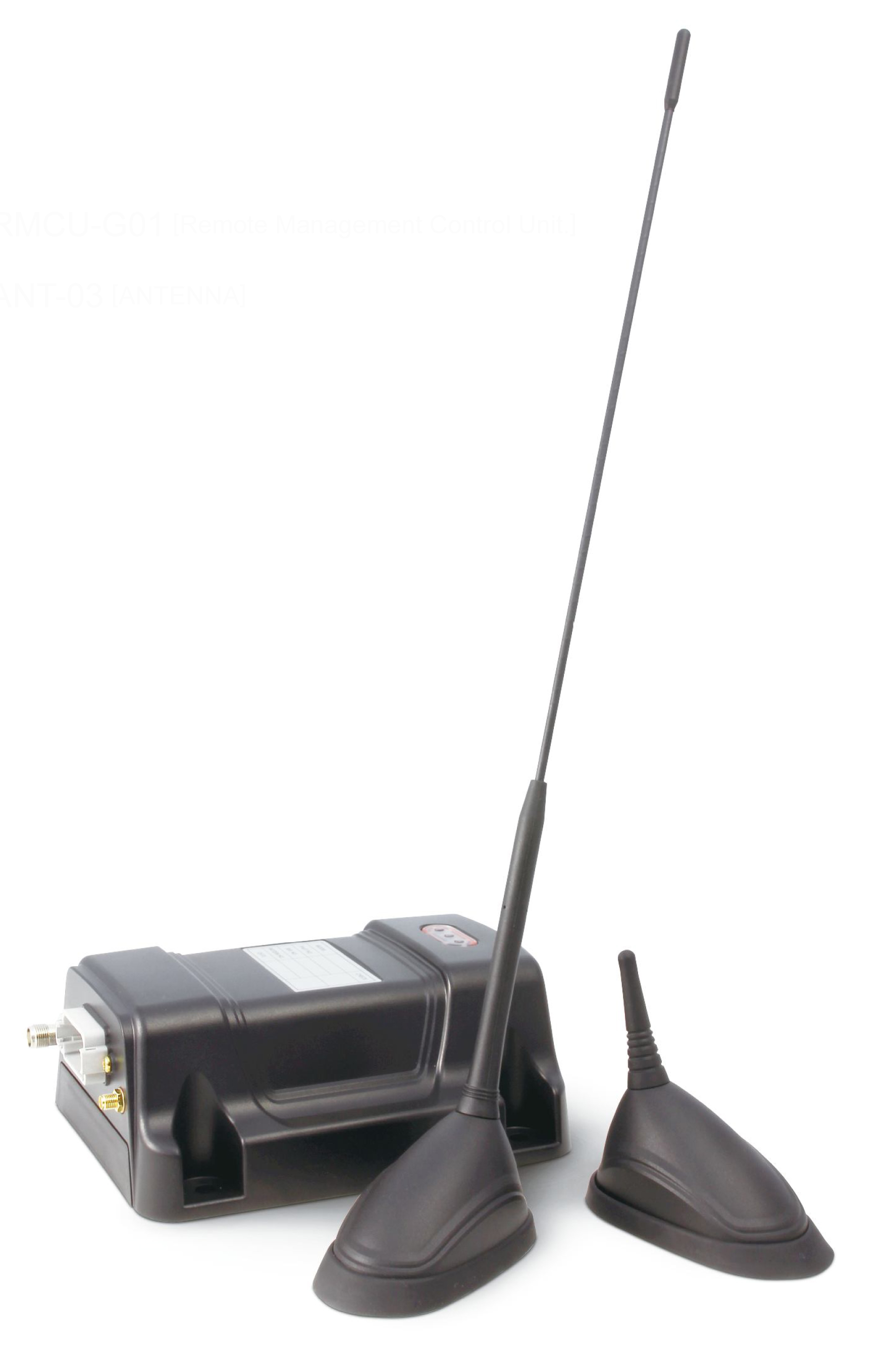
    3.20.13_Taeha_TH- RMCU_ ANTENNA-1.jpgTelit Wireless Solutions will provide the M2M communication module for the Taeha Mechatronics Remote Monitoring System (RMS). Taeha Mechatronics is a South Korean-based provider of electromagnetic control solutions for healthcare and industrial devices.

    The Taeha Mechatronics TH-RMCU, a remote management control unit, integrates Telit’s HE910, HSPA+ module, which delivers 14.4 Mbps downlink data rates. The solution has obtained SK Telecom certification, and will be used for tracking the location of Hyundai Heavy Industry’s global assets. This is the first such authorization by SK Telecom for a system to be used locally and globally. As a result the device can be used in other countries simply by roaming without need for additional regional variants, Telit said. This move is expected to allow more Korean companies to operate more easily abroad.

    The HE910 supports a large number of WCDMA frequency bands (850/900/1700/1900/2100 MHz), making it possible for it to be used in all countries with 3G networks via simple roaming, with no need for production of regional variants to address local frequency band availability, Telit said.

    Hyundai Heavy Industry installs an RMS device, composed of the control unit and antenna, into various types of heavy equipment in the field. It uses the solution to trace equipment location with the integrated GPS which transfers the related data to a server in real-time. With that the company looks to prevent theft and loss of its assets. Also, with the monitoring function, the company can effectively manage fuel consumption of their equipment, actively using it to reduce carbon emissions, Telit said.

    HE910 is a RoHS-compliant module that combines GSM, GPRS, EDGE and HSPA+ network compatibility with digital telecommunication service access. It is world’s smallest (28.2×28.2×2.6 mm) LGA form factor, and ideal for applications that process high-capacity multimedia data, such as e-readers, PDAs and real-time location tracing devices. The HE910 HSPA+ transmission speed is 14.4 Mbps on the downlink, and 5.7 Mbps on the uplink. It supports high-speed serial port, receive antenna diversity, with optional embedded high-sensitivity GPS; and simultaneous voice and data.

    “Solutions developed solely by Korean companies needed to go through many different testing processes to be able to be provided to global customers. By adapting Telit’s standard-based module, we were able to not only reduce cost, but also reduce time for development. We are planning to expand the usage of this solution from location tracing for asset management to other areas,” said Sang-hee Lim, CEO of Taeha Mechatronics.

    “As the interest grows in security and safety globally, tracking solutions are also becoming smarter, in particular for the manufacturing industry, which uses various types of equipment. Companies can dramatically improve management efficiency and productivity simply by deploying cutting-edge monitoring systems. We expect to see continued demand for M2M,” said Derick Tsang, APAC manager of Telit.

  • Trimble Launches New Mobile Apps, Website for Sportsmen

    Trimble has launched a new mobile mapping product for hunters and anglers. The launch includes two smartphone apps (Trimble GPS Hunt and Trimble GPS Fish), one tablet app (Trimble GPS Maps), and a new Website — GPSHuntFish.com.

    The offerings combine the latest in mobile GPS technology and Trimble’s exclusive outdoor maps to help sportsmen plan trips, navigate in remote areas, record GPS information, and privately share details with friends.

    “We are excited to launch a comprehensive solution for hunters and anglers,” said Rich Rudow, general manager at Trimble Outdoors. “Now hunters can scout a future hunt at GPSHuntFish.com then send maps and GPS details to their iPhone, Android, or iPad to use in the field. In addition, they can print custom waterproof maps that compliment the digital maps displayed in the mobile apps.”

    The launch includes:

    Trimble GPS Hunt App

    Runs on: iPhone and Android phones

    Find hunting spots on detailed outdoor maps, navigate in remote areas and track wildlife. The Trimble GPS Hunt app uses the GPS built into smartphones to track position in the field—even in areas without a cell or data connection. In addition, users can mark waypoints, record tracks, view weather forecasts, see sun and moon phases, and view compass and trip details.

    Trimble GPS Fish App

    Runs on: iPhone and Android phones

    Use Trimble GPS Fish to record fishing trips and keep a report of daily catches. Pinpoint the exact location of each catch, take photos, record GPS tracks, and view detailed street, topo and terrain maps. Use the app to return to previous fishing hotspots. In addition, with an Elite membership, users have access to more than 6,900 lake maps showing 10-foot lake depth contours.

    Trimble GPS Maps App

    Runs on: iPad

    Plan and organize your next hunting trip or fishing trip with the Trimble GPS Maps app. Research hunting lands, find fishing spots and scout access roads on your iPad. This app allows users to fade between street, aerial and topographic maps, and instantly copy-and-paste GPS coordinates onto the digital maps.

    GPSHuntFish.com

    Works on: PC and Mac with an Internet connection

    GPSHuntFish.com is a portal for all of the Trimble hunting and fishing apps. In addition, users can view and store their trips, view maps in large format, and print maps at home or as a custom print by MyTopo.com. All trips created in the Trimble fishing and hunting apps are stored in the Trip Cloud, an online service that auto-syncs trips between a computer, smartphone and tablet device.

    Trimble Elite

    Works with Trimble GPS Fish, Trimble GPS Hunt, Trimble GPS Maps, GPSHuntFish.com

    Trimble Elite members have access to public land boundaries for 46 states, lake maps for 6,900 lakes, forest road overlays for 134 national forests, real-time weather maps, online trip planning tools and discounts off printed maps. In addition, users can pick from a library of 3,000 Mega Offline Map bundles. These topo map bundles can be downloaded by state, county, or hunt unit and be accessed on the mobile device in remote areas, even with no cell or data connection.

    How to Buy. Trimble GPS Hunt and Trimble GPS Fish are available in the Apple App Store and Google Play store. Trimble GPS Maps are available in the Apple App Store. Each app comes in a free or pro version for $4.99. The Elite membership is available for purchase in all the apps and at GPSHuntFish.com for $29.99/year or $2.99/monthly.