Blog

  • RapidEye Imagery-Based MALAREO Project Complete

    RapidEye, a specialist in high-resolution, wide area repetitive coverage of earth through its constellation of five satellites, announced today that the African Malaria Control Project, MALAREORapidEye_coverage, which incorporates RapidEye data, has come to a close and results are now available on the project’s website.

    MALAREO, which began just over two years ago, was funded by the European Commission under FP7 and run by a mixed European-African comailnsortium, which incorporated years of experience in malaria control, with the Global Monitoring for Environment and Security (GMES) Earth Observation expertise.

    Remote Sensing Solutions GmbH (RSS) near Munich was responsible for data processing and the development of EO products for the project, which explored the spatial variability of malaria-relevant environmental factors at local level and supported the work of the National Malaria Control Programs in South Africa, Swaziland and Mozambique. The MALAREO study area, about 43,000 square kilometers, was imaged by the RapidEye satellite constellation, and data was provided via the EC/ESA GMES Space Component Data Access (GSC-DA).

    After completion of the project in January, a final meeting with end-users from the Southern African National Malaria Control programs and the MALAREO project team took place in Durban, South Africa, where the products derived from the RapidEye imagery were presented. The end-users emphasized the benefit of these products and the resulting Map Atlas for malaria control, as it greatly improves planning of malaria control measures. It also complements the approach of linking environmental and epidemiological data, which is a first step towards an early warning system for malaria.

    The MALAREO Map Atlas, summarizing the EO-based mapping approaches and additional information about the project can be found at the project website.

  • ikeGPS Shortlisted for GE Low Carbon Challenge

    ikeGPS, a maker of remote measurement and 3D modeling hardware and software solutions, has announced it has been shortlisted for the GE Australia & New Zealand Low Carbon Ecomagination Challenge. The challenge is an open call to businesses, entrepreneurs, innovators and students in Australia and New Zealand with breakthrough ideas for reducing our carbon footprint. Out of 191 entries, ikeGPS was selected to the shortlist of 35 finalists that will vie for five Innovation Awards of $100,000 and potential investment opportunities of up to $10 million from GE and its venture capital partners.

    ikeGPS’s entry,  ikeGPS Augmented Reality Network Management Solution, uses ikeGPS technology to make distribution network assets more efficient by enabling field crews to see network database information and models overlaid on the real-world assets, in real-time. ikeGPS has developed an end-to-end solution for electric utilities that combines the ikeGPS device (integrating laser rangefinder and camera technologies) with software for measuring and modeling pole infrastructure.

    “We are delighted to have been chosen by GE for the Ecomagination Challenge shortlist,” said Glenn Milnes, CEO of ikeGPS, headquartered in Wellington. “As a company, ikeGPS is committed to making a difference to reduce carbon emissions locally and globally. We are excited to be part of GE’s very important initiative.”

    54

  • Plotter Wins Top Award at SXSW Interactive

    Plotter, a social network for maps, won the top award for the social technologies category March 12 at the annual South by Southwest Interactive Festival in Austin, Texas.

    The company won one of six categories at the festival’s fifth annual SXSW Accelerator program, which has previously recognized companies such as Twitter and Foursquare. Unlike Google Maps and Apple’s default maps app, which allow people to search for a place on a map and look up directions, Plotter’s mobile maps app offers the ability to plot multiple locations at once. Users can also create maps of their favorite locations and share them with friends.

    The app was released earlier this month on the Apple iTunes Store.

  • Powelectrics and Telit Expand Cooperation in Wireless Telemetry Market

    Powelectrics and Telit Expand Cooperation in Wireless Telemetry Market

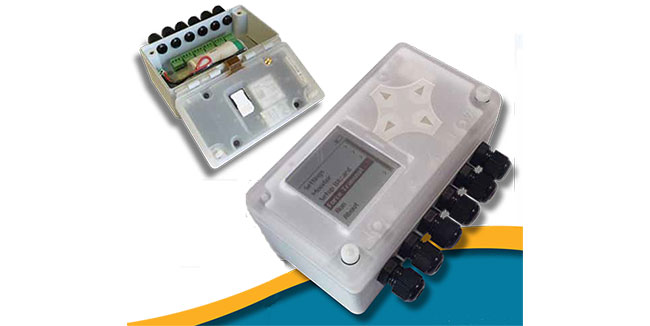
    Telit Wireless Solutions and Powelectrics Ltd. today announced collaboration in the wireless telemetry application market with the launch of Powelectrics’ Telit-based product Metron2.

    The Metron2 is a multi-function cellular-connected telemetry device capable of making remote fill-level readings in tanks containing liquids and gases.  The device’s integral display allows the unit to be used also as a local gauge and for system set up and testing. An optional pulse-counter board allows the device to take external meter readings.

    The Metron2 is wide-area-network connected with the Telit GE864-QUAD V2 cellular module and self powered from an internal battery. The Metron2 can be powered from different sources, including an internal battery or an external 6-24Vdc source. It is often not economically feasible to run power to the site for remote telemetry installation, the companies said, such as the cryogenic gas monitoring segment where it is important that the device be on and available to be polled any time, day or night. For this market, Powelectrics developed a solar-powered system.

    The solar-powered telemetry system allows the unit to remain always on and connected to the GSM/GPRS network so the server can make contact at any time with instant reading requests. Equipped with the Metron2, a tanker truck can be dispatched to best matching customer locations according to volume available in the tanker and volume required by customers, efficiently exhausting the tanker’s full supply of product instead of transporting it back to base saving fuel and removing the risk of the returned product contaminating the storage or process facility, the companies said.

    Knowing how much product is in the customer’s tanks makes it possible to plan when and which truck should make deliveries. This translates into fewer miles driven to deliver the same amount of product and therefore a significant reduction in costs. There is also a dramatic reduction in CO2 emissions. There are also accompanying operational benefits, including fewer emergency shipments, reduced customer service organization and reduced sales resources. These benefits translate into a balance sheet boasting reduced levels of finished goods and raw materials inventory.

    The European Chemical Industry Council (CEFIC) has been encouraging more extensive use of Enterprise Resource Planning (ERP) tools to improve supply chain efficiency. According to the Department for Transport in the UK, by 2015, total traffic on the roads will have grown by over 30 per cent compared to 2000 levels and the CBI has estimated that road congestion currently costs the UK up to £20 billion annually.

    Telit’s GE864-QUAD V2 ultra-compact, low-power, quad-band GSM/GPRS 3GPP Release 4 module integrated in Powelectrics’ Metron2 has one of the industry’s broadest certification profiles in its class, making it easily deployable anywhere in the global market, Telit said.  Modules in this family are capable of data rates of 48Kbps GPRS Class 10 also supporting 9.6Kpbs Circuit Switch Data (CSD) transfers ensuring connectivity in poor coverage areas. The GE864-QUAD V2 family features one of the market’s most compact Ball Grid Array (BGA) package measuring 30 x 30 x 2.8 mm and an extended operating temperature range of -40°C to +85°C, making it suitable for outdoor-environment mobile applications such as the Metron2.

    “The last couple of years have seen a dramatic upturn in demand for our product as users of telemetry become comfortable with the reliability and more aware of the benefits that telemetry brings. We continue to develop our already well proven solutions helping drive down the total cost of ownership and therefore reducing the payback time. Telemetry has never been so affordable,” said David Oakes, sales director, Powelectrics. “We realize the need to be flexible in what we offer. Some customers want a complete solution from us encompassing hardware, hosted software and SIM cards whereas others just want the hardware. It’s also vital that data is delivered where it is needed which often means us providing some form of automated interface into the clients systems, delivering data in a customized format.”

  • 3D Mapping & 3D Modeling Market worth $7.7 Billion by 2018

    According to a new market research report “3D Mapping Market: Global Advancements, Business Models, Technology Roadmap, Forecasts and Analysis (2013 – 2018)“, the 3D mapping and 3D modeling market is expected to reach $7.7 billion by 2018 at a CAGR of 47.9% from 2013 to 2018.

    According to the announcement, 3D mapping technology is one of the fastest and most complete ways to build 3D-environments in the market today. 3D mapping solutions enabled the user to swiftly build three-dimensional maps of the surroundings with supreme accuracy and clarity, ready to plug into professional visualization systems. With investments towering up for 3D maps applications to be introduced to smartphones, market players such as Nokia, Samsung and other smartphone companies have indicated string interest in this market. The 3D-enabling devices like sensors, cameras, scanners, GPS components, and other acquisition devices create huge potential in this market. The improvised 3D experience on smartphones, tablets, notebooks, PCs, cars, etc. is set to revolutionize the mobile device market and other GPS-enabled device market by broadening the horizons for the users to locate things easily using any device.

    The report stated that the 3D mapping and 3D modeling total market is expected to grow from $1.1 billion in 2013 to $7.7 billion by 2018, at an estimated Compound Annual Growth Rate (CAGR) of 47.9% from 2013 to 2018. North America, the first mover in the 3D mapping and modeling market, is expected to remain as the major market by 2018. Meanwhile, we also observe the Asia Pacific (APAC) and Middle East and Africa (MEA) regions to grow at a significant rate, mainly driven by opportunities in countries such as China and India. In 2013, Europe is expected to account for about 33.1% of the global market, and is expected to grow at a CAGR of 43.2% from 2013 to 2018. APAC is estimated to be a $1.6 billion market by 2018; at a CAGR of 66.38% 2013 to 2018. The market players include Tier 1 companies such as Google, Apple, Amazon, Saab and Hover.

    The report provides an in-depth analysis of the various industry verticals such as healthcare, automotive, transport and logistics, aviation and space, building and construction, defense and public safety, retail, others. It also analyzes the emerging trends in the 3D mapping and 3D modeling market across geographies.

    The past decade witnessed a giant leap in various industries, with 3D technology being implemented in various electronic devices and other objects. The need for 3D mapping arose after an attempt to make 2D maps more advanced and look more real. This was done by introducing sensors, cameras, scanners, GPS components, and other acquisition devices to capture the real time 3D images which are created into models incorporated into maps. This type of technology is often used in modern computer programs to provide a lifelike view of a place or thing on a map.

    Portable GPS devices use 3D mapping technology to provide automated directions. These devices have small screens that display a three-dimensional view of roads and maps. This is a good tool for people who travel or go for hiking to unfamiliar areas because the device uses satellites to pinpoint its exact location. Building schematics are blueprints used for the construction of houses. 3D mapping technology is often used to create construction schematics. This tool makes it easy to draw a three-dimensional version of a house plan. These plans are typically used to get building permits and construction material before any building starts.

    The improvised 3D experience in smartphones, tablets, notebooks, PCs, cars, etc. is set to revolutionize the mobile device market and other GPS-enabled device market by broadening the horizons for the users to locate things easily using any device. This report looks at the various applications of 3D modeling and mapping applied in various business verticals. It analyzes the challenges and opportunities for 3D mapping and modeling as well as its impact in the marketplace. The report also gives insights into the global adoption trends, key market players, future scope, drivers, and restraints in the market, along with growth potential across different geographies. It also analyzes various factors that will drive and restrain the market over the next 5 years.

    Scope of the Report

    This report segments the 3D modeling and mapping market by applications, business verticals, 3D-enabled devices, 3D-enabling devices, and geographies. The market forecasts in terms of revenues for all the segments and unit shipment forecasts are provided for the 3D-enabled device segment.

    On the basis of applications:

    The market by application type in 3D mapping is classified into 3 segments:

    • 3D projection mapping,
    • Mapping and Navigation
    • Other applications (3D mobile mapping, 3D laser mapping, 3D texture mapping, 3D video mapping, etc.)

    On the basis of Business verticals:

    The 3D modeling and 3D mapping market by verticals is classified on the basis of 7 segments:

    • Healthcare
    • Automotive, Transport and Logistics (ATL)
    • Aviation and Space
    • Building and Construction
    • Defense and Public safety
    • Retail
    • Others

    On the basis of 3D devices market:

    The 3D Modeling market by 3D-enabled device unit shipments is classified on the basis of 4 segments:

    • 3D-enabled smartphones
    • 3D-enabled tablets
    • 3D-enabled notebooks
    • Other 3D-enabled devices

    We have analyzed other 3D devices (3D sensors, 3D cameras, 3D displays, GPS components) in terms of market attractiveness.

    On the basis of geographies:

    The report segments the market geographically into

    • North America
    • Latin America
    • Europe
    • Middle East & Africa (MEA)
    • Asia Pacific (APAC)

    Each section provides market data, market dynamics (drivers, restraints, trends and opportunities), key players, and competitive outlook. This report provides 100+ market tables covering all sub-segments and micro-markets. In addition, the report provides 20 company profiles representing various sub-segments.

  • Septentrio Makes Galileo and Four-Constellation Position Fixes

    Septentrio Makes Galileo and Four-Constellation Position Fixes

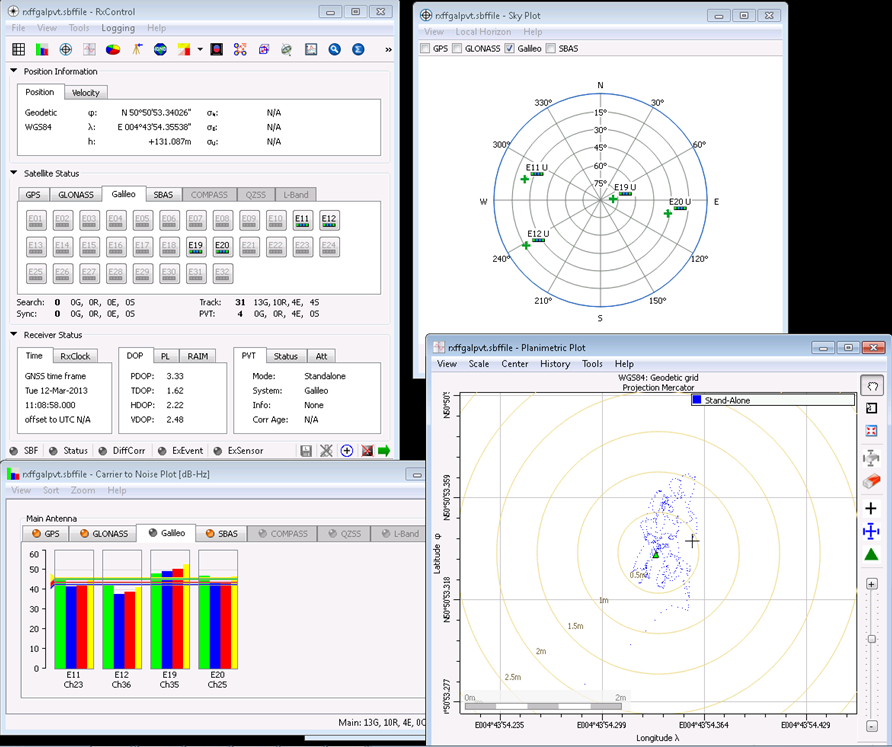
    Septentrio became the first receiver manufacturer to report an autonomous real-time position calculation using Galileo IOV satellites, with its own standard commercial receiver. The company based in Leuven, Belgium announced on March 12 that it performed a first autonomous real-time Galileo position, velocity, and timing (PVT) calculation, based on live Interface Control Document (ICD)-compliant Galileo messages from the four Galileo in-orbit validation (IOV) satellites.

    Galileo-PVT

    The standalone position was calculated from in-orbit navigation messages using a standard PolaRx4 GNSS receiver equipped with commercially released firmware.

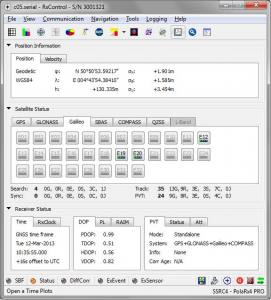
    This achievement followed another recent Septentrio milestone; the announcement of a first GPS+Glonass+BeiDou PVT less than two weeks after the BeiDou2 ICD publication in December — and it was itself followed by a Septentrio release stating performance of what it believes to be the first 4-constellation PVT performed by a standard commercial receiver.

    4-constellation_PVT

    “On Tuesday 12-Mar-2013 at approximately 10:35 UTC we included three Galileo IOV satellites (E12, E19 & E20) in a multi-constellation PVT. The 3D-position fix happened shortly after it was brought to Septentrio’s attention that the Galileo IOV satellites were transmitting, for the first time ever, a fully usable navigation message as part of an ESA experiment.

    “This ability to rapidly incorporate new constellations demonstrates the flexibility of the architecture of Septentrio receivers,” the company statement continued.

    “We are delighted that Septentrio receivers are amongst the first to witness the readiness of the Galileo navigation message to perform a position fix from in orbit signals,” commented Peter Grognard, Septentrio’s founder and CEO. “Septentrio has been involved since 2003 in all major milestones that pave the way for the European constellation genesis.”

  • Star Sensor for GLONASS Satellites to Undergo Testing

    RIA Novosti is reporting that German firm Jena-Optronik GmbH has delivered an advanced star sensor to Russia’s Reshetnev Information Satellite Systems company (ISS), which will test and integrate it on a GLONASS navigation satellite, Reshetnev said on Wednesday.

    The Astro APS sensor is part of the satellite’s altitude and orbit control system. It will help ensure that the GLONASS satellites maintain an accurate attitude in space.

    The sensor will be installed on a GLONASS-M satellite under a 2011 agreement signed between Reshetnev ISS and Jena-Optronik GmbH. It has a single box design with low mass and low power consumption. If tests are successful, it will be integrated on other ISS spacecraft.

  • Federal Steps Taken to Reduce GPS-Caused Bridge Strikes by Oversized Trucks

    The Federal Motor Carrier Safety Administration (FMCSA) will begin issuing official recommendations to members of the commercial trucking industry on the proper uses of GPS devices and incorporate GPS training into new entry-level certification programs for commercial motor vehicle operators.

    U.S. Senator Chuck Schumer, joined by Administrator Anne Ferro of the U.S. Department of Transportation Federal Motor Carrier Safety Administration (FMCSA), held two press conferences in the New York City area on March 11 to alert commercial vehicle drivers to the importance of using updated, professional-quality GPS devices to prevent routes that include height-restricted overpasses and bridges.

    Administrator Ferro also announced the availability of a GPS safety visor card for truck and bus drivers, now downloadable at www.fmcsa.dot.gov (and pictured above).

    Richard Langley of GPS World provided guidelines for consumers in a newspaper article in January about GPS use, which he spelled out in ten helpful tips. The tips also apply to commercial drivers.

    Under the recommendations, commercial drivers will be trained, and reminded, to only use GPS systems designed specifically for the industry. These specialized units take into account the specifics of the truck they’re in — including the height, weight and contents — and will then route the trucks onto appropriate roads. The consumer GPS units too often being used are frequently routing trucks onto inappropriate roads, causing them to crash into low overpasses and bridges.

    In September, Schumer called on the Department of Transportation (DOT) to investigate the dramatic increase in low bridge strikes by commercial trucks across New York State as a result of the growing use of GPS by drivers. According to reports from local police organizations, GPS-related bridge strikes in New York represent more than 80 percent of all such accidents. The accidents, in addition to being life threatening, cause massive delays and impose significant costs on taxpayers.

    In one press conference, Schumer and Administrator Ferro stood at the Eagle Avenue overpass, which spans the Southern State Parkway at exit 18. The overpass has been struck at least 27 times by trucks that are prohibited from driving on the parkway.

    “These education and training campaigns for commercial truck drivers will be the first major steps to thwarting life-threatening bridge strikes that have been causing massive delays and imposing significant costs on taxpayers with increasing frequency in recent years,” said Schumer. “These steps will help to once again make GPS devices an asset to drivers, and not a dangerously misused tool. I am pleased that the DOT heeded my call for reforms and I am confident that the combination of official recommendations and GPS training will limit the number of low-bridge strikes across Long Island. Thank you to FMCSA Administrator Ferro for recognizing the importance of this serious issue and for implementing a proactive approach towards teaching the industry how to eliminate GPS-related accidents.”

    “Even one truck or bus striking an overpass is one too many, which is why we’re taking action to ensure professional truck and bus drivers know the importance of selecting the right navigation system,” said FMCSA Administrator Anne Ferro.

    Commercial truck traffic is prohibited on New York State Parkways such as the Southern and Northern State Parkways on Long Island, the Hutchinson and Saw Mill Parkways in the Hudson Valley, and the FDR and Bronx River Parkway in New York City. Overpasses constructed over these parkways were built, in some cases, over 50 years ago, and at low heights. Although these parkways consist of numerous warning and directional signs alerting commercial drivers of the dangers, basic GPS devices often do not show these restrictions and funnel trucks into major danger zones.

    According to a recent NYS Department of Transportation study, more than 200 bridge accidents per year have occurred in New York since 2005. Of that total, more than 25 percent of these accidents occurred in Nassau, Suffolk or Westchester counties. Major repairs on the Long Island Expressway connected to these types of accidents have cost taxpayers $4.1million in recent years, according to the NYS Department of Transportation.

  • CSR Location Platforms Go Live with China’s BeiDou-2 Tracking

    CSR plc today announced that its SiRFstarV, SiRFprima and SiRFatlas location platforms are now able to acquire and track satellites and utilize location data from the recently activated BeiDou Satellite Navigation System.

    The addition of the BeiDou constellation is part of CSR’s ongoing efforts to support all global navigation satellite systems as they become available, with software or firmware upgrades, for greater performance and enhanced compliance with existing and future requirements of national GNSS systems, the company said.

    “CSR is committed to supporting all current and future GNSS constellations with its location platforms to boost location performance by increasing service availability, reducing observation time and making measurements more precise for the most demanding applications,” said Dave Huntingford, director of marketing for location at CSR. “With the addition of these new satellites, our location platforms can now actively utilize GPS, GLONASS, QZSS and SBAS, in addition to BeiDou-2, and they are ready to support Galileo as soon as it becomes available to provide continuous location awareness and the best location-based services experience.”

    Rob Yeh, director of product marketing for Automotive SoC at CSR, added, “All CSR’s latest multi-GNSS location platforms, including CSR SiRFatlasVI and SiRFprimaII, are now able to demonstrate live BDS (BeiDou System) navigation, and CSR will include BDS support in all future-generation location platforms. Besides providing flexibility and improved satellite acquisition and location tracking in challenging situations like urban canyons, the BeiDou support also improves CSR’s already industry-leading dead-reckoning technologies.”

    CSR maintains an experienced development team in mainland China to develop and support BeiDou-related products and technology.

    Also known as Compass and BeiDou-2, the Chinese BDS started operations in December 2012 and  has 14 active satellites in service over the Asia-Pacific region available to general users. When fully deployed by 2020, BDS is expected to comprise a total of 35 satellites offering complete coverage around the globe.

  • ENC 2013 Releases Preliminary Program

    The Preliminary Programme for the European Navigation Conference 2013 is now available.

    Early Bird Registration ends Friday, March 15.

    Organizers will also be hosting the European Satellite Navigation Competition 2013 International Kick-Off Meeting on April 25.

    The European Navigation Conference 2013 will be the 17th conference in the GNSS series held under the auspices of the European Group of Institutes of Navigation (EUGIN). The conference will be hosted by the Austrian Institute of Navigation (OVN) and will take place April 23-25 in Vienna, Austria.

    Each year the conference attracts researchers, policy makers, manufacturers, users and service providers from around the world. The conference will focus on the present status as well as on future developments in navigation systems, with special emphasis on Galileo. Thus, the ENC 2013 will be a showcase for state-of-the-art technology and for innovations in the fields of terrestrial and satellite navigation. The implementation of new technologies in navigation will be illustrated in the industry exhibition, running in parallel to the conference.

  • iTRAK WebApp Enables Fleet Management on Smartphones, Tablets

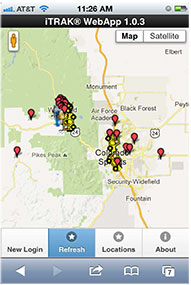
    The iTRAK web app displays vehicle fleet and landmarks.
    The iTRAK WebApp displays vehicle fleet and landmarks.

    iTRAK Corporation, provider of GPS-based tracking, mapping, and reporting solutions, has announced the commercial release of its iTRAK WebApp application. The WebApp provides much of the functionality of the iTRAK Fleet Executive software suite in a mobile environment.

    The new application allows iTRAK customers to view all their tracked devices on a wide variety of smartphones and tablets, such as iPhone and Android phones and iPAD tablets. The assets displayed can be tracked using dedicated, in-vehicle GPS devices or GPS-enabled cell phones. Managers and supervisors who regularly work out of the office can still view the location of the vehicles for which they are responsible, as well as historical location and stop data and user-defined landmarks. The mapping system is integrated with Google global street and satellite maps.

    iTRAK has been offering mobile fleet management solutions since 2007, when iTRAK FleetFinder, a system to display mobile assets on a Blackberry, was released. The iTRAK WebApp is a response to the convergence of multiple applications on mobile devices, and to customer requests for a mobile fleet management system that will support multiple platforms and operating systems.

    The iTRAK WebApp will run on devices that use Apple OS 5.1, 6.0, and 6.1, Android OS 4.0, 4.1, 4.2, and Blackberry 10. Future releases will add geofencing, stored, user-defined map views, and route display. Nine languages are supported: Arabic, Dutch, English, French, German, Italian, Polish, Portuguese and Spanish. There is also an API to the system that allows for third-party integration. Enterprise versions of the cloud services and server software are also available.

    iTRAK Corporation (formerly Data Burst Technologies) was founded in 1995 as a developer of GPS-based wireless tracking and AVL systems. The company’s principal offices and network operations center are located in Woodland Park, Colorado.


  • Connected Car Biggest MWC News, 2G to Retire

    Janice Partyka
    Janice Partyka

    It’s a streak. The Connected Car was yet again the most exciting emerging technology in the room, this time at the Mobile World Congress (MWC). The connected car service includes navigation, infotainment and location offerings. The big news in this sphere has come from General Motors, but more about that later. Do you remember the death of cellular digital packet data (CDPD)? Now it’s 2G’s turn. The 2G network used by many asset M2M tracking devices is going away. And Amazon is getting in Google’s face with a giant, well-oiled mobile ad network.

    Beginning with 2015 car models, AT&T will replace Verizon Wireless as GM’s communications partner. Next year, GM plans to install AT&T LTE modems into many of its vehicles and Verizon will be the network behind GM’s OnStar service. The new modems will enable richer, faster content, including streaming video and radio.

    The Connected Car squabbles. Should in-vehicle connectivity be controlled by a smartphone or by an embedded device? There are arguments on both sides. Ford’s forward-thinking connectivity choices have helped elevate what was a dowdy brand. “The last thing we want to do is take this [smartphone] thing that updates every 12-18 months and embed it into a car that has a lifecycle of at least 10 years,” asserted Doug VanDagens of Ford Motor Company. “Users are already paying for the data connection on their phone, and so they shouldn’t be assessed another fee for their car to access a network.” On the flip side, Glenn Lurie of AT&T raised concerns about software updates in a smartphone tethered scenario, in which a user might have to pay for data charges incurred by software updates that auto makers push to vehicles.

    Vast market. No matter the approach, the connected car is a huge market opportunity. By 2020, Machina Research predicts that 90 percent of new passenger cars will have some sort of a connectivity platform and the market will reach $600 billion. There are concerns that in-vehicle service offerings may be too complex and could delay uptake. Drivers will want to pay one vendor for in-vehicle services and have pricing and billing options that are not complex.

    Prepare for the death of 2G. AT&T plans to shut down its 2G networks by 2017. Verizon is planning to shut down its 2G and 3G EV-DO by 2021. The majority of small enterprises that track assets use 2G GPS modems. Many larger enterprises have been transitioning to 3G (HSPA) in this space. Companies that are considering M2M solutions may want devices that will work long into the future, and as the cutoff date approaches, customers will be increasingly reluctant to make purchases of 2G devices. LTE modems are currently about three times as expensive as 2G modems, which will put a dent in ROI calculations.

    Amazon is joining the game. Amazon is rolling out a mobile ad network juggernaut. The mobile ads API, now in beta, enables third-party developers to integrate advertising into Android games and applications. Ad targeting options include GPS coordinates, gender and product floor prices. Android developers have struggled to make money through Google’s own storefront. The Amazon App store for Android has proven lucrative. For every $1 generated by Apple’s App Store for iOS, Amazon generates an average of $.89 per user and Google Play generates just $.23 per user, reports Flurry. Apple has been laying the golden egg, but Amazon knows how to sell and just may surpass Apple.

    It’s smartphones. It has finally happened. This year, worldwide shipments of smartphones will squeak by feature phones shipments, predicts analyst firms IHS iSuppli and IDC. Falling smartphone prices and the rise of LTE networks have contributed to the growth in smartphone adoption.

    Who were we talking about? Lissted analyzed more than 7,000 tweets about the Mobile World Congress sent by 619 journalists and bloggers and 419 media outlets. Nokia was tweeted about more than any other company, followed by Samsung and Android. Who will lead the hashtag race at CTIA?

    Contact: [email protected]