Blog

  • Watching and Waiting. And Questioning. GPS in the Balance

    The difference between navigation and communication signals — a key point not well or not at all understood in Washington — and an FCC rule that could cause LightSquared to foot substantial GPS refitting bills even if it prevails to interfere, were two of several subjects that came to light in last week’s “LightSquared Watch” webinar. As the Federal Communications Commission goes through its deliberations, two inside-the-Beltway experts joined me to speculate on what may happen, what we might do about it at that time, and the long, strange trip that brought us to this point. These matters, and your questions answered, in this month’s column.


    To download the slides and one-hour audio recording of the “LightSquared Watch” webinar, click here.

    Webinar speaker Scott Pace, director of the Space Policy Institute at George Washington University, included in his presentation a substantial chunk from an FCC filing by Glenn Borkenhagen of Cody, Wyoming. Here it is, verbatim.

    Nav Signals Are Different from Com Signals

    “The interference problems exhibited by precision GPS receivers can be fixed with filters.”  [according to LightSquared]

    This sounds plausible, even to some engineers knowledgeable in radio-signal processing, until it is realized that the typical filtering concepts don’t really apply here because the critical data for accurate GPS position is the ranging information that is derived from the arrival times of the state transition in the code message modulated onto the GPS carrier frequency and the arrival times of the carrier waves.

    Synchronized atomic clocks on each of the satellites tell us when the signals leave the satellites, and when the GPS receiver is tracing four or more satellites the receiver can measure with atomic-clock accuracy when the clean signals arrive at the receiver’s antenna. To oversimplify a bit, the important factor about a clean code-message signal is that it has a good sharp and square edge when the digital signal modulated onto the carrier frequency changes from a digital 0 to a digital 1 or vice-versa.  We know the signal traveled at the speed of light from the satellite to the receiver’s antenna and when we know how long it took to make the trip we know how far the receiver’s antenna is from each satellite and can determine the position of the receiver’s antenna.

    Accurate edge/transition-time detection is necessary to determine when the signals arrive at the receiver’s antenna. When heavy filtering is applied to remove strong near-band interference, the signal edge transitions get rounded, blurred, and even time-displaced so determining an accurate arrival time becomes much more difficult if not impossible. It is easy in comparison to filter simple 0s and 1s to transmit a video file, for example – much more difficult to filter code and carrier without destroying the essential ranging information.  GPS is essentially determining position using a “measuring stick” that is moving at 3 x 10 **8 meter/second. 

    [end of Glenn Borkenhagen’s comments, as excerpted in the webinar]

    Thus, the fix proposed by LightSquared will not fix anything. It is broken to begin with.

    Pace also alluded briefly to Section 25.255 of the FCC’s own rules. It states:

    § 25.255 Procedures for resolving harmful interference related to operation of ancillary terrestrial components operating in the 1.5./1.6 GHz, 1.6/2.4 GHz and 2 GHz bands.
    If harmful interference is caused to other services by ancillary MSS ATC operations, either from ATC base stations or mobile terminals, the MSS ATC operator must resolve any such interference. If the MSS ATC operator claims to have resolved the interference and other operators claim that interference has not been resolved, then the parties to the dispute may petition the Commission for a resolution of their claims.
    [68 FR 33653, June 5, 2003]

    Note the date of enactment: 2003. This was at the time of, or immediately following, negotiations involving the FCC, a previous owner of the MSS band now held by LightSquared, and the U.S. GPS Industry Council. The regulation seems to imply that LightSquared could be held accountable for the costs associated with coping with the interference created by its signal, as incurred by the multitudinous arms of the GPS industry and user community, not to mention various arms of government such as the Federal Aviation Administration.  We’re talking many billions here.  Many billions.

    Our other webinar speaker, Jules McNeff, vice president of strategy and programs for Overlook Systems Technologies, noted that this is a very political process that since the beginning has appeared heavily slanted to favor LightSquared entry. The political access of company executives and the owner to the White House has been well documented. Misinformation is rampant throughout the waiver petitioner’s arguments pre- and post-, and the pressure for action before analysis has been strong, surprisingly so. History has been reinterpreted — and McNeff should know, he was a key participant in those historical discussions of the late 90s and early 2000s — with facts twisted to fit the desired reality. The FCC’s  actions are inconsistent with what public should expect from an unbiased federal rulemaking agency: public statements by agency leaders and staffers undermine the GPS industry and its users, agency positions ignore the fundamental differences between GPS and comm., and its statements resonate with assertions from LightSquared about the GPS community.

    Both speakers concurred that the safest and most fact-based course of action for the FCC to take — and the only approach fully consistent with the terms of both the National Space Policy and the Broadband Memorandum as well as the FCC’s own regulations — is for the agency to conclude that the terms of the LightSquared conditional waiver have not been met and withdraw LightSquared license to deploy a terrestrial network in the 1525-1559 MHz band.

    And now, your questions:

    Q: What GNSS frequencies will and will not be affected by Lightsquared?

    Webinar speakers’ Answer: The entire Radionavigation Satellite Service (RNSS) band from 1559 to 1610 MHz will be affected by LSQ transmissions below the band (ground stations) and above (handsets).

    Q: Will you discuss Doppler shift and how the GPS recieved frequencies may fall in the bandwidth being used by LightSquared?

    A: GPS uses relativistic doppler shift corrections and the adjusted carrier frequency is in the navigation message. Doppler effects don’t shift the received frequencies out of the RNSS band.

    Q: Are there other MSS service in the band that will be affected by the power levels of LS?

    A: Inmarsat is the primary MSS service affected that I’m aware of. Omnistar and Starfire use MSS to provide DGPS serives

    Q: Can we address the potential effects on GPS timed simulcast radio systems?

    A: Any GPS-enabled systems, capabilities, or applications would be affected within the areas covered by LSQ ground transmitters

    Q: Will this problem undermine the position of the FCC?

    A: If, on investigation by competent oversight authorities, the FCC’s actions prior to and following the issuance of the LSQ waiver (including rulemaking in previous years) are found to violate accepted practices or be motivated by political bias counter to the public interest or adversely affecting public safety, then yes, it will undermine the position (perception?) of the FCC as an independent federal rul
    emaking organization.

    Q: Does anyone have a read of how the FCC will actually rule and when? If the FCC approves LightSquared deployment, is the "Save Our GPS" coalition prepared to go to court in order to stop LightSquared deployment?

    A: No to both parts. Any further actions taken by the FCC are subject to unpredictable political considerations at present. The coalition itself likely does not have the legal standing necessary to bring a lawsuit.  Individual members and specific adversely affected parties would have to act

    Q: This appears to me to be a factual and fair interpretation of the situation. Thank you. I assume that that since the slides provide credit to their authors and origin, I can share them with others without reproach.

    A: Yes. To download the slides and full audio of the webinar, click here.

    Q: How long do you think the FCC will take to review the docket before issuing a decision? Does anyone know when the FCC will render its final decision?

    A: Any further actions taken by the FCC are subject to unpredictable political considerations at present.

    Q: Given that the laws and regulations cited are settled law, is the GNSS industry prepared to go to The Court of Appeals for the District of Columbia to stop the harmful and illegal waiver process?

    A: This matter is still being considered in the political arena for the moment, and so going to court is premature at this point.  If the FCC upholds the waiver it issued at the beginning of this year, then my personal opinion is that adversely affected parties would have to bring suit individually (at least at first) based on the specific damages they can attribute to the FCC’s decision.

  • LightSquared: The Ball is in the FCC’s Court

    The FCC’s public comment period regarding the LightSquared/GPS interference issue has ended and the reply comment period is over as well. To date, more than 3,300 comments (not including the 15,000+ that were submitted by the Boat Owners Association of the United States) were entered that the FCC must sift through and arrive at some sort of conclusion. Following are my last comments filed with the FCC as well as my best guess at where this is heading.

    I decided to file a “reply comment” submission on August 15 to the FCC based on an August 11 filing by LightSquared where LightSquared Executive Vice President Jeffrey Carlisle stated “had the GPS industry complied with the DoD’s recommended filtering standards for GPS receivers, there would be no issue with LightSquared’s operations in the lower portion of its downlink band.” It’s a blatantly false statement, so I couldn’t let it pass without a rebuttal. Following is what I submitted to the FCC:


    August 15, 2011

    Eric Gakstatter
    Editor – GPS World magazine Survey Scene enewsletter
    Editor – Geospatial Solutions
    High-precision GPS Consultant
    PO Box 663
    West Linn, OR 97068
    Marlene H. Dortch, Secretary
    Federal Communications Commission
    445 12th Street SW
    Washington, DC  20554
    Re: IB Docket No. 11-109


    Dear Ms. Dortch,

    In addition to my comments posted on July 28, 2011, I’d like to reply to comments submitted by LightSquared in their letter dated August 11, 2011.

    Again, by way of background, as a Contributing Editor to GPS World magazine, my specialty is high-precision GPS receivers of which I’ve been involved with for more than 20 years as a product developer, power user and consultant. I’m in touch with tens of thousands of high-precision GPS users from around the world through my newsletter articles (bi-weekly), webinars and my attendance at technical conferences. I consider myself and I’m considered by others to be an advocate for the high-precision GPS community.

    In Jeffrey Carlisle’s (LightSquared Executive Vice President) comments to the FCC dated August 11, 2011, he stated that “had the GPS industry complied with the DoD’s recommended filtering standards for GPS receivers, there would be no issue with LightSquared’s operations in the lower portion of its downlink band.”

    This is a false statement, and to make matters worse, he knows it’s a false statement. Here’s why…

    LightSquared sells high-precision satellite data communications services to the GPS industry. Before LightSquared was formed in 2010, its predecessors (Skyterra, MSV) sold the same services to the GPS industry for many, many years.  In the course of business over many, many years, LightSquared and its predecessors have encouraged GPS receiver manufacturers to design receivers that look into the MSS band (1525-1559MHz) in order to access LightSquared’s satellite data communication services. This service has generated tens of millions of dollars in revenue for LightSquared and its predecessors over many years and continues to be a revenue source for LightSquared today.

    If LightSquared chooses to stop supplying satellite data communications services to the GPS industry, that’s their choice, but they should not fabricate a statement claiming that only the reason for interference in the “lower portion of its downlink band” is due to filtering technology. It’s just not true. Tens of thousands, if not hundreds of thousands, of expensive high-precision GPS receivers were specifically designed to access LightSquared’s and Inmarsat’s satellite data communications services that they sell to the GPS industry.

    LightSquared may state they will continue to offer these services to the GPS industry in the upper portion of its downlink band (1545-1559MHz) to create separation from the lower portion of the downlink band (1526-1536MHz). It’s too late for that. Billions of dollars of expensive, high-precision GPS receivers are already in the market that were designed to look in the entire MSS L-band (1525-1559MHz) for services provided by LightSquared and Inmarsat. Had the GPS user community been given sufficient notice, tens of thousands of high-precision GPS equipment owners could have planned for transitioning their GPS receivers over many years with a manageable financial impact. Unfortunately, that’s not the case. The GPS user community was blindsided by LightSquared’s application in November 2010 and the FCC’s waiver granted to LightSquared in January 2011.

    LightSquared and the FCC failed to adequately notify the GPS user community of their intentions. As I’ve submitted before, the precedent has already been set on how to effectively notify the GPS user community about an action that would render several hundred thousand high-precision GPS receivers obsolete. In 2008, the U.S. Air Force proposed to discontinue supporting the semicodeless technique that is used by virtually every civilian L1/L2 high-precision GPS receiver in existence. It was the first time in history that an action would render several hundred thousand high-precision GPS receivers obsolete, a scale which is very similar to the impact of the LightSquared system.

    There was no industry coalition formed to engage the Air Force. There was no industry outcry. A public/private technical working group was not formed to test the effects on receivers if semicodeless was not supported. Why is that?

    The answer is very simple. The U.S. Air Force, to its credit, did a fantastic job of communicating directly with the GPS user community along with the Department of Commerce. It issued public statements describing the impact the action would have on high-precision GPS receivers.

    The U.S. Air Force did its homework. At the end of the day, it set a sunset date of December 31, 2020 to discontinue supporting the semicodeless technique. It correctly determined that 12 years is about the amount of time that would allow a smooth transition with a manageable financial impact to the high-precision GPS user community.

    Imagine if the U.S. Air Force had set a period of one year to transition away from using the semicodeless technique. That action would have destroyed the high-precision GPS user community resulting in billions of dollars in losses and widespread small business closure. Fortunately, they did their homework, understood the impact, and made the correct decision.

    LightSquared, on the other hand, either didn’t do its homework or intentionally kept quiet in order to fly under the radar and push its initiative through before the GPS user community (and others) knew what was happening. In either case, the GPS user community shouldn’t be held accountable in paying for the FCC’s and LightSquared’s lack of communication/notification.

    LightSquared and the FCC incorrectly assumed that communicating/negotiating with the U.S. GPS Industry Council (USGIC) was the equivalent of communicating/negotiating with the GPS user community. That is a false assumption. The USGIC does not communicate directly with the GPS user community and never has. That’s not their role. I’ve been perso
    nally involved in the high-precision GPS industry for 20+ years and writing a monthly newsletter on high-precision GPS technology for GPS World magazine for more than five years. I attend almost every major GPS conference and high-precision GPS market segment conference in the U.S. and some abroad. The first I’d heard about the LightSquared interference issue was November 2010.

    Even if LightSquared only uses the lower portion of the downlink band (1526-1536MHz) as they’ve proposed, the number of high-precision receivers affected would be at least 200,000 at an estimated replacement cost of $10,000 per unit which equates to a total equipment replacement cost of $2 billion dollars. That does not include the cost of removal/installation, lost productivity, required software upgrades, and training. Do LightSquared and the FCC expect the GPS user community to bear that cost? Hopefully, you can see by the overwhelming number of public comments from small businesses and local government agencies, such an action would be devastating to the U.S. economy.

    Lastly, please do not forget about the potential devastating impact of LightSquared mobile devices (uplink band 1626.5-1660.5MHz) on GPS and GNSS receivers. I’m afraid this is being lost in all the discussion about the downlink band.  The uplink band could have a worse affect on GPS and GNSS receivers than the downlink band.

    LightSquared mobile devices are potentially portable GPS/GNSS jammers. The FCC needs to seriously investigate the interference impact of LightSquared mobile devices (1626.5-1660.5Mhz) on GPS receivers. It is already known that Inmarsat (1626.5-1660.5MHz) devices and Iridium (1616-1626.5MHz) devices interfere with each other, but Iridium devices are only used in remote areas so it’s not a widespread problem. It is also known that these devices interfere with the GLONASS L1 signal (1597-1605MHz). We don’t know the extent of the effect that LightSquared mobile devices will have on GLONASS L1, GPS L1, Galileo L1, or Compass L1 signals. The problem is that no LightSquared mobile devices are available to test. Yes, lab simulations can be performed, but LightSquared devices will be made in Asia, among other places, where the designers won’t care one bit about GPS/GLONASS interference. There is not an acceptable design margin, if any, to allow for sloppy LightSquared device designs.

    Thank you for your attention. If you feel that further testimony is needed, I’m more than happy to oblige.

    Sincerely,

    /S/ Eric Gakstatter

    Eric Gakstatter
    Principal – Discovery Management Group LLC
    Editor – GPS World Magazine Survey Scene enewsletter
    Editor – Geospatial Solutions
    PO Box 663
    West Linn, OR 97068

    I think that three things are batting against LightSquared at this point:

    1. As much as they say they gave fair warning, LightSquared and the FCC didn’t communicate with the GPS user community at all on this issue. The U.S. GPS Industry Council (USGIC) doesn’t count. They don’t represent the GPS user community nor communicate with the GPS user community at all. So, the GPS user community was blindsided by this in Nov 2010.

    This was either intentional or sloppy, but it doesn’t matter either way. The bottom line is that you can’t give nine months notice on obsoleting 200,000+ very expensive GPS receivers that are installed and used in critical infrastructure applications. It would take many years to transition to new equipment. The U.S. Air Force and Dept of Commerce have already been through this drill already and they determined that 12 years was about the right timeframe needed to transition high-precision civilian GPS equipment to new technology. If LightSquared and the FCC really understood this market, they would know it’s not a four-year exercise.

    2. Even with LightSquared using only the lower spectrum (1526-1536Mhz), it still interferes with $2+ billion dollars worth of high-precision GPS receivers. Who’s going to pay that bill? The GPS user community that was given no advanced notice?

    They can argue all they want about who’s fault it is, new filter technology, DoD standards, etc., but at the end of the day, obsoleting 200,000+ expensive high-precision GPS receivers valued at  $2+ billion dollars would be devastating to American small businesses and Fed/State/Local gov’t.

    3. LightSquared sells high-precision satellite data communications services to the high-precision GPS industry. Before LightSquared was formed in 2010, its predecessors (Skyterra, MSV) sold the same services to the GPS industry for many, many years. In the course of business over many, many years, LightSquared and its predecessors have encouraged GPS receiver manufacturers to design receivers that look into the MSS band (1525-1559MHz) in order to access LightSquareds satellite data communication services. This service has generated tens of millions of dollars in revenue for LightSquared and its predecessors over many years and continues to be a revenue source for LightSquared today.

    If LightSquared chooses to stop supplying satellite data communications services to the GPS industry, thats their choice, but they should not fabricate a statement claiming that only the reason for interference in the lower portion of its downlink band is due to filtering technology. Its just not true. Tens of thousands, if not hundreds of thousands, of expensive high-precision GPS receivers were specifically designed to access LightSquareds and Inmarsats satellite data communications services that they sell to the GPS industry.

    LightSquared may state they will continue to offer these services to the GPS industry in the upper portion of its downlink band (1545-1559MHz) to create separation from the lower portion of the downlink band (1526-1536MHz). Its too late for that. Billions of dollars of expensive, high-precision GPS receivers are already in the market that were designed to look in the entire MSS L-band (1525-1559MHz) for services provided by LightSquared and Inmarsat. Had the GPS user community been given sufficient notice, tens of thousands of high-precision GPS equipment owners could have planned for transitioning their GPS receivers over many years with a manageable financial impact. Unfortunately, thats not the case. The GPS user community was blindsided by LightSquareds application in November 2010 and the FCCs waiver granted to LightSquared in January 2011.

    Of course, I didn’t mention aviation, maritime, military and other safety-of-life applications of GPS. That’s a whole other story…

    Does that mean the FCC is going to tell LightSquared to go home?

    Maybe, but I doubt it.

    In a letter dated August 10, 2011, the FCC Office of Engineering and Technology Chief Julius Knapp requested more data from LightSquared and the U.S. GPS Industry Council (USGIC). Following is an important excerpt from the letter:

    “It is unclear to what extent the GPS receivers and devices tested are current production models, into what market  segments those receivers and devices are most commonly sold, what fraction of a given market segment those devices represent, and their design lifetimes and typical owner-use lifetimes.This information is important in assessing the likely impact, if any, of interference on various use cases over time. We therefore request production and U.S. sales information for each of the devices tested, including (1) the dates of production, (2) the market segment(s) to which the device is targeted or sold,  (3) total annual sales volume and annual sales volume by market segment or estimates thereof, (4) the date on which full support of the device by th
    e manufacturer ceased (or will cease), (5) estimated time period after which the device owner would likely replace or discontinue use of the device”.


    The letter also requests updated information from LightSquared based on their proposal to use only the lower spectrum (1526-1536MHz). The timeframe to provide the requested information is very aggressive, with all information to be supplied on or before August 22, 2011.

    I think this is good news in general. It is the FCC’s first solid attempt to understand the GPS receiver markets in which the proposed LightSquared system will cause interference problems, including high-precision.

    The bad news is that the FCC is only requesting market information on GPS receivers that were tested. If you recall in one of my earlier articles, I listed the GPS receivers being tested by the high-precision team. Obviously, if the FCC only used market data from these GPS receivers, the numbers will be underestimated by a large double-digit value and maybe orders of magnitude because many receiver models weren’t included in the test. Also, many CORS in operation are legacy GPS receivers that are out of production. Based on their questions, I have a feeling the FCC will discount those to little or no value, when they actually still provide economic benefit. However, the CORS owner can’t or aren’t in a position to replace them, resulting in a net loss.

    No matter which way this goes, I’m pretty confident the FCC is going to use this opportunity to rattle the GPS industry’s cage. Spectrum is a finite resource and the FCC is going to look at ways to allocate spectrum as efficiently as possible, as they should. Is the MSS L-band (1525-1559MHz) being used in the most efficient manner? Probably not. I bet the FCC orders changes in that area, or at least the FCC sets the wheels in motion towards change. I’m ok with that as long as it doesn’t come at the unreasonable expense of the GPS user community, be it high-precision, aviation, military, etc.

    All of this bruha is really about timing. Given enough time, GPS receiver manufacturers and component manufacturers have a chance to develop new technologies that use the MSS spectrum more efficiently, if at all. Actually, if the FCC pushes forward like they seem to want, it really isn’t MSS (Mobile Satellite Service) spectrum any longer, it would become a Mobile Terrestrial Service. But developing new technologies, designing/testing products and then allowing the GPS user community enough time to adopt the new technology with a reasonable financial impact takes years, a lot of years, not four or five. It takes more years than what LightSquared has to give no matter which part of the MSS spectrum (low or high) one is discussing.

    I think in the short-term the FCC is going to order more testing in order to understand the impact on GPS receivers of LightSquared using only the lower end of the MSS spectrum (1526-1536MHz). We already know it’s going to hammer most high-precision GPS receivers valued collectively at $2+ billion dollars. I don’t have a good grip on how it will affect aviation, military and other receivers in critical apps. We’ll see.

    Actually, I agree with what Jeff Kagan of E-commerce Times writes. LightSquared is playing the public relations game the wrong way and they’re getting their nose punched every time they turn around. They should be spending their energy on talking about how wireless communications will be enhanced by their service instead of scraping up obscure DoD specifications they claim that commercial GPS receivers are supposed to adhere to. I still don’t understand what they bring to the table that Sprint, Verizon, AT&T, etc. don’t. Yes, I get that they are a wholesaler and can bring 4G LTE to small service providers. I’m talking about technology. What technology do they bring to the table? If they are just a new distributor in the mix, there’s not much to talk about and maybe that’s why they are fighting the public relations game the way they are. Interesting enough, earlier this week LightSquared announced they hired a new Senior Vice President for Public Relations and Communications, presumably to attempt to resolve the GPS interference fiasco.

    Dish Network Announces Plan for 4G LTE Network and Applies for FCC Waiver Similar to LightSquared

    Dish Network is trying something eerily similar to LightSquared, but it will have no effect on GPS receivers since their spectrum is far away from GPS (2+ GHz). Dish bought two bankrupt companies last year, Terrestar and DBSD, and have 40MHz of spectrum to play with in 4G LTE. It will be interesting to watch how the FCC deals with this, especially if the Dish waiver is pushed through as LightSquared’s was. With no GPS interference concerns, Dish might be able to field a 4G LTE system before LightSquared can.

    As Phil Goldstein from GPS World’s sister publication, Fierce Wireless, comments:

    “One of they issues that has come to the fore in the wake of the FCC’s decision to grant a similar conditional waiver to LightSquared is that LightSquared’s L-Band spectrum sits adjacent to GPS spectrum, and that terrestrial transmissions from LightSquared’s proposed wholesale LTE network in the upper portion of its spectrum is causing GPS interference. Pointedly, in its filing, Dish said its 2 GHz S-Band spectrum “will not raise the technical issues that have hampered the use of the MSS L-Band, such as the interleaving of the operators’ assignments and the severe interference claimed by systems operating in adjacent spectrum.”
     
    In return for the waiver, Dish said it will commit to a “substantial terrestrial network deployment” of a branded retail service intended to increase wireless broadband competition, including in rural areas, using LTE-Advanced network technology. Dish said it is prepared to work with the FCC “to develop a reasonable, attainable buildout schedule keyed to commercial availability of the LTE-Advanced standard,” and that it is committed to developing a buildout schedule “consistent with FCC precedent and based on the buildout principles established” in Sprint Nextel’s (NYSE:S) combination of its spectrum assets with Clearwire (NASDAQ:CLWR).


    Read the full article by clicking here.

    America’s Web Radio Guest Appearance

    Last week, I was a guest on the American Congress on Surveying and Mapping’s (ACSM) weekly, one-hour America’s Web Radio program. Web radio is actually a very creative idea. You can listen to the live program on your internet-connected computer (11am U.S. Eastern time every Monday) or you can download the recorded program in MP3 format and listen to it using your iPod or other MP3 player. Click here if you’d like to listen to last week’s program when I was the guest.

    Thanks, and see you next time.
    Follow me on Twitter at http://twitter.com/GPSGIS_Eric


  • Microsoft Missteps Add to Privacy Jitters

    Microsoft is contributing to the latest location privacy jitters. Missteps by Microsoft, Apple, and Google have the potential to dampen uptake of location solutions. Microsoft published the estimated locations of millions of laptops, cell phones, and other devices with Wi-Fi connections. The location database was assembled by Microsoft’s access to Windows phones and by vehicles that drive streets and record Wi-Fi signals accessible from public roads. The data were published on Microsoft’s Live.com website.

    The problem is that Wi-Fi devices can be individually identified by a unique code, often called a MAC address. It’s not just Wi-Fi routers that can be identified. Phones and computers can be used as Wi-Fi access points, via tethering and other means, and their location can be monitored. Using the Microsoft data on Live.com, CNET tracked an HTC mobile device’s movements between house addresses in the city of Columbus, Ohio.

    Skyhook conducts similar Wi-Fi mapping, but according to Ted Morgan of Skyhook, does not provides direct access to its database. “All our partners use our client location engine, which does the scanning and lookups to our system,” says Morgan. “We don’t gather any MAC addresses of client devices, only access points and devices that act as access points.” Google collects similar location information and curbed access to the data a few months ago after a CNET article appeared. Microsoft just announced it too would now restrict access. When will these guys learn?

    Googleola Marriage. The announcement of Google’s intention to buy Motorola Mobility for $12.5 billion, a heavy bucket of cash, will have repercussions throughout the industry. Google will become a mobile manufacturer in head-to-head competition with Apple and Research in Motion. For Research in Motion, maker of BlackBerry, this may be a kiss of death, unless they are snapped up by someone like Microsoft, who may feel pressured to join the game. Google will have bought itself entry into the ferocious patent lawsuit war between Motorola Mobility and Microsoft at a time when relations between Microsoft and Google had improved.

    Google’s Larry Page made assurances on the company’s blog that Android would remain an open system. “This acquisition will not change our commitment to run Android as an open platform. Many hardware partners have contributed to Android’s success and we look forward to continuing to work with all of them to deliver outstanding user experiences”. Say that as he may, other Android handset manufacturers will now be competing with the supplier of their operating software in a distribution channel tangle.

    Connected Car. The connected car, a vehicle with embedded modules and wireless services that link to the cloud and the car’s operating system, continues to evolve. The carriers are aggressively staking out territories. Verizon has shown off a car equipped with a 4G LTE modem with OnStar prototype apps. Sprint Nextel has worked with Aeris Communications to bring the Sprint network and cellular connectivity to the Hyundai connected vehicle program. AT&T has partnered with Panasonic Automotive.

    Ford has led the car manufacturers with its SYNC offering that provides hands-free, voice controlled in-car connectively. Already in 3 million vehicles, SYNC will become available on Ford’s entire passenger line-up for $295, down from its current $395.

    More than half of surveyed U.S. consumers find the concept of a connected vehicle appealing, according to a survey by Alcatel-Lucent. When it comes to opening wallets, the top applications are augmented GPS; maintenance, tracking, and notification; Wi-Fi; advanced voice features; and online environmental analysis.

    It’s not all about Smartphones. The global mobile app market for feature phones will almost double by 2016, reports Ovum. The success of smartphone apps will drive feature phone apps to a predicted $1 billion market. Feature phones outsell smart phones, but have lagged in applications uptake. The upswing should be helped by the increasing ease of developing apps and publishing them for this market.

    Personalization, not just Location. Feature phone mobile advertisements that are tailored to a consumer’s “tastes and interests” are four times more effective than offers based on location, time, or lifestyle, according to a poll of 2,000 U.S. consumers, commissioned by mobile marketing company, Upstream. The marketing activity that was found to most likely lead to a follow-up action included mobile coupons; opt-in text alert or message; an e-mail received on a mobile phone; an ad on a mobile website; or an ad that appears during an Internet search of a product or service.

    Mark your Calendar.  Don’t miss LocNav 2011 October 18-19 in San Jose. The Where Business has co-located its annual Location Business Summit and Navigation conferences to create an even bigger show. I’ll be moderating the panel, “Connecting People Places and Things: Advertising and Social Networking in the Location Ecosystem.”

  • Last Week’s Solar Storm and the Final LightSquared Push

    You may not have noticed it, but last Friday we experienced the first serious geomagnetic storm in this solar cycle (Solar Cycle 24), which began in 2009. Not all types of solar activity (sun spots, solar flares, solar burst, and solar radiation) affect GPS receiver operations. Geomagnetic storms are the ones that can cause problems for GPS receivers if those storms are powerful enough.

    Last Thursday, I received e-mail from Joe Kunches at NOAA (National Oceanic and Atmospheric Administration).

    “The Sun has been erupting and looks like a storm — say G3 level — could be on for Friday, August 5.”

    Joe was right, it hit about a day later, on Friday, August 5, as he predicted.

    The good news is that Joe says we generally have at least a 24-hour warning before a geomagnetic storm starts disturbing the ionosphere.

    That’s what it comes down to, the ionosphere.

    GPS signals being delayed as they pass through the ionosphere end up being the largest source of error in GPS positioning. The signals must pass through the ionosphere, which is full of free electrons. The density of these electrons in the ionosphere affects the speed at which GPS signals travel. If the density of the electrons in the ionosphere was consistent, then it would be straight-forward to create a model and largely mitigate its effects. However, that’s not always the case. The ionosphere has been relatively benign since the last solar cycle, and that’s one of the reasons that GPS accuracy has been so good, especially GPS L1 SBAS systems like WAAS/EGNOS/MSAS, which rely on modeling the ionosphere.

    The problem is geomagnetic storms. They wreak havoc on the free electrons in the ionosphere, making it difficult to accurately determine how much the GPS signals have been delayed.

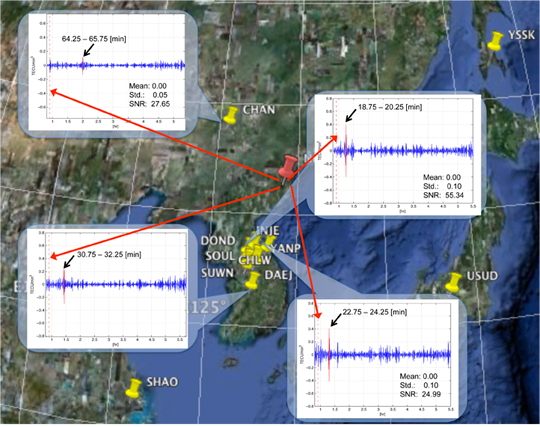
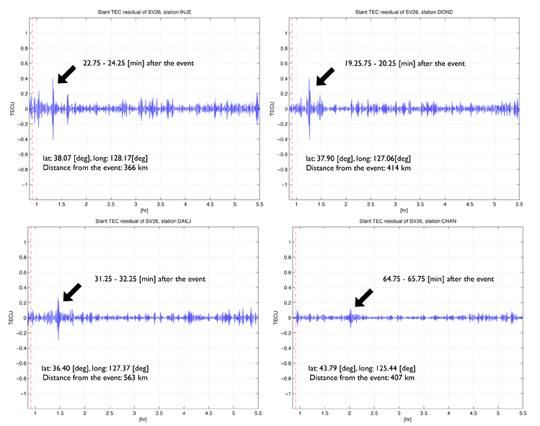
    The NOAA Space Weather Prediction Center (SWPC) is one of the foremost agencies that monitors the Total Electron Count (TEC) in the ionosphere. With Joe’s help, I was able to obtain dynamic plots of the TEC from last Friday so I could illustrate to you what happened. I was also able to obtain plots from Gavin Schrock at the Washington State Reference Network (WSRN) showing how it impacted the WSRN. I compiled the plots, added some text, and produced the following Youtube video.


    As I wrote in the Youtube video, to get the most updated solar activity information that’s related to high-precision GPS users, you should follow me on Twitter at GPSGIS_Eric.

    If you’re looking for a good backgrounder on how the ionosphere affects GPS, you might want to read this April 1991 GPS World column. Although it’s dated in some respects, the fundamental concepts are solid.

    Last Push on LightSquared

    There’s been some confusion on the FCC comment period regarding the LightSquared/GPS interference issue. The comment period was not extended. The public comment period was July 1 to July 30, 2011. The reply comment period is from August 1 to August 15, 2011. However, it appears the FCC is still logging new comments even after the July 30 cut-off date. Either way, do not hesitate to submit your comments before August 15; just mark it (dropdown menu) as a reply to comments.

    This is your last chance to speak out and let your government know how important GPS is to your orgnization.

    To date, there have been more than 2,900 individual comments electronically filed as well as more than 15,000 submitted in writing to the FCC (15,000 alone from the Boat Owners Association of the United States). The vast majority of the comments support GPS.

    Some good news. On Tuesday, August 9, the FCC held an invitation-only press conference. Click here to read PC World’s summary.

    To read the 2,900+ comments submitted to date, click here; type in proceeding # 11-109 and search.

    Thanks, and see you next time.

    Follow me on Twitter at http://twitter.com/GPSGIS_Eric


  • Product Review: The Trimble Ranger 3

    The Trimble Ranger 3 being tested in its natural environment.


    First of all, thanks to all those who wrote me about the Trimble Ranger 3 and suggested I pen a review.

    Rules of Engagement

    Many of my long time readers will know that I never write a bad review, which is why I found it interesting that an e-mail from a USAF captain fighter pilot in Afghanistan commented that I “seemed to really like” every unit I reviewed. So here again are the ROE (rules of engagement) for my reviews. I will never write a bad review, and believe me I see scores of “bad” (my evaluation) GPS units that I will never review or endorse in GPS World.

    The Trimble Ranger 3 was never of any danger of falling into the “non-review” category. The Ranger 3 impressed me from the very first moment I saw the unit. First of all, it is designated correctly by Trimble, and the military and first responder users who wrote me, as a rugged handheld GPS-enabled computer, and it certainly fulfills all the requirements for that designation.

    If you are looking for a GPS device the size of an Apple iPhone, this is not the device for you. The Trimble Ranger 3 is for the user, and many of you are warfighters and first responders who need a portable and rugged but powerful handheld computer with tightly integrated GPS capabilities that can connect and communicate, wired and wirelessly, with other users and servers. The Ranger 3 can accomplish all that and much more.

    GPS Capabilities

    As soon as I powered up the Ranger 3 for the first time, outdoors for this test, the stopwatch was running to see how long it took to figure out how to enable the unit’s GPS SiRFstar III chip and firmware and obtain an accurate position. This is the new handheld TTFF (time to first fix) scenario that I always go through, in the same geographic location, with any new unit. Some GPS units, even dedicated ones, fail miserably, but not the Ranger 3. Fortunately, the unit’s battery was fully charged when it arrived, and the green power button was obvious. The 4.2 inch TFT (thin film transistor) resistive touch, sunlight readable color screen fired up immediately with a Windows menu soft key, which led me via an iPhone like “flickable” scrolling screen to the GUI (graphical user interface) or icon labeled SatViewer, (version 1.0.4.0) which comes with every Trimble GPS unit I have ever tested or reviewed. I tapped that GUI or icon and hit connect GPS and within 40 seconds had an “unaided GPS position,” or so the voice prompt from the unit informed me. Exactly 28 seconds later I had a “GPS-aided” position, again I was informed by the voice prompt, which can be turned on and off by user input. I found the voice prompts helpful because I did not have to look back at any menus to determine what type of position I was using. The initial position “unaided” was four feet or 1.33 meters from a surveyed reference position at my home, and the “aided” position was under a meter from the surveyed position. As I said, the first unaided position was pronounced 58 seconds after removing the unit from the box for the first time and hitting the power button. The aided sub-meter position was announced at 1 minute and 26 seconds after initial power on. Very impressive, and something very few units can accomplish today. Not even the best MUE or military user equipment available today can equal this feat right out of the box.

    Afterwards I played around with the GPS advanced inputs but found very few settings that needed to be changed. It comes (default mode and with a default button) with SBAS capabilities enabled; in this case the FAA WAAS (Wide Area Augmentation System) was enabled. Had I been conducting this exercise in Europe, EGNOS or the European Geostationary Navigation Overlay would have been automatically enabled. There is also a tab for setting DGPS or differential GPS parameters, on or off or auto, and the unit software is designed for future enhancements. It incorporates an SBAS PRN designation capability, if you want to choose the SBAS PRN number manually, in case one is sending bad data and is NOTAMed (Notice to Airmen) or NANUed (Notice Advisory to NAVSTAR Users) out. Frankly, I just set the SBAS feature to auto and it worked flawlessly.

    GPS Bottom Line

    So the bottom line for the Ranger 3’s GPS capabilities is that the tightly integrated, aided GPS SiRFstar III receiver, compass, accelerometer, and 5 megapixel auto focus camera with auto flash and geotagged image capabilities enable almost endless possibilities for today’s ever-proliferating location-aware software to combine location, bearing, and motion data for use by our warfighters and first responders. Add these capabilities to the substantial communications features of the rugged handheld computer, and you have prodigious potentiality for the Trimble Ranger 3. There is not a single MUE GPS unit today that can touch the Ranger 3 for its tightly integrated GPS and subsequent capabilities and communications.

    I also tested several new windows applications that I will not name now because they require considerable testing before I review or recommend them, but the cogent message is they integrated automatically and worked flawlessly with the Ranger 3.

    Trimble SatView Software

    I will, however, comment on the installed Trimble SatView GPS software on the Ranger 3. It is just so absolutely intuitive that you never really wonder about what to do next, which button to push, or box to check. Just push the button or tap the box or icon you think is the correct one and most of the time you will be correct. And if you aren’t, nothing is undoable. I intentionally push the “wrong” buttons in my tests just to see what happens, and with SatView nothing catastrophic has ever occurred. I have always been able to navigate back to where I needed to be.

    The orbit inspired graphic depiction of the GPS satellites in view (almost always 12) and the satellites being used for your position (from 4 to 10+), to include SBAS satellites, is informative and useful. You merely tap on the PRN (pseudorandom noise code assignment) graphically designated SV (satellite vehicle) and it will open a tiny widow displaying the SVs PRN number, elevation, and azimuth. There is also a very useful graphical illustration of the current P (position), V (vertical), and H (horizontal) DOP for your position, which are also programmable simply by checking a box. Many of you say you don’t know or care about the various GPS DOP, even though Estimation of Dilution of Precision (DOP) plays an important role in determining the overall accuracy of your GPS position. For those of you who do care, the data are readily available on the Ranger 3. All the data, to include programmable mask angles and DOP parameters, can be automatically captured in a log file, saved, and downloaded for future use — a simple and intuitive task. I attached an 8 GB flash drive to the full-size USB port on the Ranger 3, and simply dumped the data log to a file on that device. The Ranger 3 saw the device as an extension of its built-in 8 GBs of flash storage (flash hard drive). You can also save data directly to the onboard flash memory. It is then a simple matter to export the data into an Excel spreadsheet and use however you see fit. Take it from me, not all datalogging programs are this simple and straightforward.

    As the CEO of MobileEpiphany, Glen Kletzky, who produces some of the most intuitive software I have ever had the pleasure of using, once informed me, “Software that is inherently useful with an intuitive interface usually seems simple to the user, but underneath is usually very powerful and sophisticated. My goal as a software provider is to ensure the user never has to deal with the complicated bit
    s.” In this regard, the Trimble SatView software as enabled on the Ranger 3 has met and exceeded the goals of simplicity, usefulness, exportability, and intuitiveness.

    Trimble Ranger 3 Specifications

    Now that we have covered the basic GPS functions, let’s look at the unit itself and all the Ranger 3’s integrated capabilities.

    As I said, the unit is physically imposing, especially if you are looking for an iPhone-type device, which the Ranger 3 is definitely not. But neither can the iPhone accomplish all the tasks of a rugged, handheld portable computer with multiple scanners, readers, and numerous ports.


    Physically the Trimble Ranger 3 is not small. It is 10.5 in × 5.2 in × 1.9 in (26.6 cm x 13.1 cm x 4.8 cm) and weighs in at 2.3 lb (1.04 kg), including battery and stylus. You don’t have to use the stylus, but for some functions it is more accurate than your fingertips. And of course, since this is a Trimble unit, to paraphrase that great entrepreneur Henry Ford, “You can have it in any color you desire as long as it is your basic black…with a yellow face.”

    The Ranger 3 has an elastic (black, of course) hand strap that stores the stylus, and enables you to hang on to the Ranger 3 during all kinds of field maneuvers. The stylus is also tethered to the back of the Ranger 3, and that is handy as well. All in all, ergonomically it is a very well-designed GPS-enabled rugged handheld computer.

    Features

    STANDARD FEATURES

    • Texas Instruments AM3715 Sitara ARM Cortex A8 superscalar processor
    • 256 MB of RAM
    • 8 GB of Flash storage (serves as hard drive)
    • Bluetooth 2.0 +EDR
    • Wi-Fi (802.11b/g)
    • GPS receiver (SiRFstarIII, SiRFInstantFixII, WAAS, EGNOS/SBAS capable)
    • Electronic compass
    • Accelerometer
    • Three tri-color notification LEDs
    • USB 2.0 full speed host port
    • USB 2.0 high speed client port
    • Serial port, 9-pin RS-232
    • Secure Digital (SD/SDHC) card slot
    • Microsoft Windows Mobile 6.5 Professional
    • 4.2 in (10.6 cm) landscape VGA display, sunlight-readable color TFT
    • Resistive touch screen
    • QWERTY keypad with number pad, directional buttons and 4 programmable buttons
    • Speaker and microphone
    • Headset jack (3.5 mm stereo audio and microphone)
    • Operating system language options: Simplified Chinese, English, French, German, Japanese, and Spanish (customer selectable on initialization)

    OPTIONAL INTEGRATED FEATURES

    • 5 MP auto focus camera with dual white LED flash
    • 3G GSM cellular data modem
    • LED Flashlight function
    • 1D barcode laser scanner

    STANDARD SOFTWARE

    • SMS Text Messaging Support
    • Microsoft Office Mobile, Mobile versions of Word, Excel, PowerPoint & Outlook
    • Internet Explorer Mobile
    • Calculator
    • Microsoft Pictures and Videos
    • Calendar/Contacts
    • Windows Media Player
    • Messenger
    • Adobe Acrobat Reader
    • Notes/Tasks
    • Trimble SatViewer (GPS interface software application)

    SOFTWARE FOR OPTIONAL FEATURES

    • Customized camera and flash control through Microsoft Pictures & Videos software
    • (Geo-tagging camera software)
    • Flashlight mode control application
    • Trimble CellStart software application (cellular connection setup)
    • Trimble ScanAgent barcode scanning software
    • Trimble Ranger 3 Software Development Kit

    STANDARD ACCESSORIES

    • Rechargeable lithium-ion battery pack
    • Black Elastic Hand strap
    • Stylus tether
    • Clear screen protectors
    • Display cleaning cloth
    • Quick Start guide sheet
    • Getting Started Guide on CD-ROM
    • International AC charging kit with four plug adapters
    • USB cable
    • Stylus with force-modulating spring tip (package of 2)
    • Audio port dust cover
    • I/O port dust cover

    OPTIONAL ACCESSORIES

    • Standard soft carry case
    • Vehicle mount (compatible with RAM mounts)
    • Spare battery charger and12 V vehicle charger

    ENVIRONMENTAL SPECIFICATION: Meets or exceeds:

    • Water: Immersed in 1 meter of water for 30 minutes
    • Water jet 12.5 mm diameter @2.5 m–3 m, 100 Liter/, min; IEC-529, IP67
    • Sand & dust: 8 hours of operation with blowing talcum powder; IEC-529, IP67
    • Drop: 26 drops at room temperature from 4 ft (1.22 m) onto plywood over concrete; 6 additional drops at –22 °F (–30 °C); 6 additional drops at 140 °F (60 °C)
    • MIL-STD-810G, Method 516.6, Procedure IV
    • Vibration: General Minimum Integrity and Loose Cargo test MIL-STD-810G, Method 514.6, Procedures I, II
    • Operating Temperature: –22 °F to 140 °F (–30 °C to 60 °C) MIL-STD-810G, Method 501.5, Procedure II MIL-STD-810G, Method 502.5, Procedure I, II, III
    • Storage Temperature: –40 °F to 158 °F (–40 °C to 70 °C) MIL-STD-810G, Method 501.5, Procedure II MIL-STD-810G, Method 502.5, Procedure I, II, III
    • Temperature shock: –31 °F/149 °F (–35 °C/65 °C) MIL-STD-810G, Method 503.5, Procedure I
    • Humidity: 90%RH temp cycle –4 °F/140 °F (–20 °C/60 °C) MIL-STD-810G, Method 507.5
    • Altitude: 15,000 ft (4,572 m) 73 °F (23 °C) 40,000 ft (12,192 m) –22 °F (–30 °C)
    • MIL-STD-810G, Method 500.5, Procedures I, II, III

    PHYSICAL

    • Size: 10.5 in × 5.2 in × 1.9 in (26.6 cm x 13.1 cm x 4.8 cm)
    • Weight: 2.3 lb (1.04 kg), including battery and stylus
    • Color: Black with Yellow face

    ELECTRICAL

    • Processor: TI AM3715 Sitara ARM Cortex–A8 Superscalar Processor at 800 MHz
    • Memory: 256 MB RAM
    • Storage: 8 GB non-volatile Flash
    • Expansion: SD/SDHC card slot, USB host port
    • Display: 4.2 in (10.6 cm), 640 x 480 pixel, VGA TFT
    • Batteries: 11.1 V, 2500 mAh, 27.8 Wh Li-ion rechargeable pack1
    • I/O: USB host and client; 15 V DC power; 3.5 mm stereo + microphone audio port; 9-pin RS-232 serial port
    • GPS accuracy: 2–4 m with SBAS correction2
    • Radios: Bluetooth 2.0 +EDR; Wi-Fi 802.11b/g
    • WWAN radios: HSDPA 3.6 Mbit/s, Tri-band; HSDPA/UMTS: 850/1900/2100 MHz, Quad-band; GSM/GPRS/EDGE: 850/900/1800/1900 MHz

    CERTIFICATIONS: FCC, CE, R&TTE, IC (Canada), C-tick, GCF compliant, RoHS compliant, Section 508 compliant, AT&T certified, Wi-Fi Alliance certified, MIL-STD-810G, IP67, MIL-STD-461.

    Torture Tests

    The Ranger 3 is already in garrison with several of our warfighters in Iraq and Afghanistan. As I said, it was letters from our warfighters and first responders that first alerted me to the Ranger 3’s capabilities for wartime and disaster-preparedness purposes.

    I have only been testing the Ranger 3 since early June, so many of you might erroneously assume that the freezing temperature, snow bank, and ice water immersion torture tests were not possible. Au contrair, mon ami —after all, this is the Rocky Mountains and there is almost always snow and ice somewhere to be found. This year, I found snow and ice and freezing water in the Snake River in Keystone and Breckenridge, Colorado, in June. Indeed, there was skiing at the A-Basin until late July. So the bottom line is the normal torture tests were inflicted upon the Ranger 3 and it passed with flying colors. And yes, before you ask, there have been several units that did not pass these torture tests, and they are dried out and mailed back to the manufacturers. A Trimble
    unit has never failed to pass the tests, even a couple that were not rated as truly rugged with MILSPEC qualifiers. Trimble makes a quality product, and the company is evidently learning more about battery technology from Apple. The battery on the Ranger 3 lasted well over 30 hours.

    Applications

    As I mentioned earlier, the software applications on the Ranger 3 make it entirely suitable for warfighters and first responders. Plus, with the Windows software and operating system, the 3G GSM (Global System for Mobile Communications) phone features and Wi-Fi (WWAN, Wireless Wide Area Network) capabilities, the Ranger 3 can communicate almost anywhere in the world you can legally travel (it won’t work in North Korea). The Ranger 3 recognized my phone’s 3G-sim chip immediately, and after loading Skype, I was able to make and receive calls and download files via Wi-Fi. By the way, if you don’t know about transferring files, and I mean large files, via Skype’s direct IP chat capability, then give it a try. It is an amazing capability, especially for handheld computers like the Ranger 3.

    While it is not necessary to use a headset with microphone for the communication capabilities on the Ranger 3, if you want any degree of privacy it is highly recommended. I tested several headsets, including a new Bose model that worked without any issues. No software downloads were required — all the headset models I tested were immediately recognized by the Microsoft Windows 6.5 mobile operating system.

    The unit I tested came complete with the optional laser scanner and bar-code reader, which worked as advertised.

    One feature that I found very useful but also one that is not aggressively marketed is the physical navigation pad with six buttons and scroll bars that can be operated with one thumb. With some practice you can use this navigation pad without ever resorting to the stylus or your fingers for inputs, other than text inputs of course. And in that regard another little touted feature is the Microsoft Word auto-completion software. The software suggests words with about, for me, 90 percent accuracy and learns as you go along. Within a particular document, the software will remember certain words and phrases and suggest them where it seems appropriate. For a rugged handheld computer with a small physical 56-key QWERTY keyboard with numeric keypad suitable only for thumb texting, the navigation panel and auto-completion software are a huge help and time savers.

    Bottom Line

    The bottom line for me echoes what Trimble says about the Ranger 3: “It has the outdoor rugged design and integrated features that users count on.” I think this is especially true for our warfighters and first responders, if my mail expounding the virtues of the Ranger 3 is an accurate barometer, and I believe it to be true.

    I am certainly taken with this unit and highly recommend it. As usual with Trimble equipment, I am going to hate to send it back. If you are currently using the Ranger 3, drop me a line and let me know how you are using it and how you like it.

    Until next time, Happy Navigating.

  • Google Buys The Dealmap, Is Social Shopping Market LBS Driver?

    Once again, it looks as if Google is taking a giant leap into location-based services with its recent acquisition of The Dealmap. Is this deal a signal that LBS market viability may be tied to the social shopping market? The market is potentially huge, with two big players and a third, Google, quickly developing. But is this the market that will propel LBS to the next level? One analyst says yes…and no.


    Technology giant Google is once more trying to corner more of the social shopping market by buying The Dealmap, a 15-month-old company that offers its own location-based daily deal service.

    Menlo Park, Calif.-based The Dealmap collects data from hundreds of sources and arranges deals by location, on its website and a smartphone application. The start-up, founded last year, has 15 employees and 2 million users, according to published reports.

    Google tried to buy Groupon for as much as $6 billion last year, and decided to launch its own service, Google Offers, in Portland. Google’s service has since expanded to New York and the San Francisco Bay Area.

    Google has made many moves into the location business in the last two years. It is trying to grab a large share of the European traffic market by offering real-time services in 13 European companies. Google shook up the navigation market with free navigation service for Android phones in 2009.

    At least one analyst said he was intrigued by the acquisition, of which financial details were not disclosed. Mike Dobson, TeleMapics president, said that The Dealmap acts as a deal aggregator and cross-channel distributor for national in-store deals from brand retailers, restaurant chains, and other businesses; local daily deals (from Groupon, Living Social, and more than 200 other sources); and what The Dealmap calls “store window” deals from individual local businesses.

    In a recent presentation that The Dealmap made at the Kelsey Deal3D Conference, the company claimed to have grown in its first year to 2 million-plus cross-channel users, including more than 1 million mobile users, said Dobson, who authors a location blog. The volume of monthly deal searches on its network was more than 75 million and the monthly network reach was estimated at 85 million, he said.

    The Dealmap and others (Borrell Associates, Needham and Company, and Groupon) have predicted that the projected size of the local daily deal market will be sized at $10 billion by 2015, while the online local ad revenue will be $32 billion by 2013, Dobson said. “The Dealmap claims that its deals provide more than $10 million in savings each day, although it is less clear what earnings it creates in the way of margin/profit for distributors, such as, well, Dealmap,” he said.

    Dobson said that the “deal supplier” market appears to be dominated by top sites. Eighty percent of the local deal inventory nationwide is dominated by 20 sources, 69 percent by 10 sources, and 40 percent by two sources, Groupon and Living Social, he said. “The Dealmap claims that its daily ad inventory is supplied at a modest 6.25 deals per source, while half the deal supply sources offer only one-to-two deals a day,” he said.

    “Perhaps more disconcerting is the fact that 69 percent of deal suppliers have a presence in from two to nine markets, while 19 percent cover only a single market. Only 4 percent of The Dealmap’s suppliers have a national footprint, which the company defines as 25 or more markets, Dobson said. “While this could suggest that the deal market is inherently local, I think it suggests that local suppliers add the ‘long tail’ that is appended in local markets to the offerings of Groupon and Living Social. In other words, the market appears to be close to a duopoly at a national scope, with numerous smaller players operating as regional and local suppliers. My conclusion is that the market for local deals from individual local suppliers is quite small, and that the major force of deals in all markets are national chains who wish to present deals to draw local users to their shops.”

    Dobson says the reason he makes this distinction is that it does not appear likely that “deal-based advertising” is going to be the replacement for local newspaper advertising, or a real-time Yellow pages, at least not as currently configured.

    “The Dealmap indicates that in a sample taken from Chicago for one day of deals, the inventory from the two leading providers was split one-quarter each for fitness spas and shopping, while attractions and dining evenly split the last quarter of the pie,” Dobson said. “When all deal suppliers were added, salons and services deals added 10 percent each to the mix, while dental deals (3 percent) and hotel deals (5 percent) rounded out the categories. Who knew that people looking for social shopping deals were looking for an athletic workout and liked to meet in spas, followed by a good meal and a visit to an attraction?”

    According to The Dealmap, more than 50 percent of deals searched for nationwide by consumers are related to dining, followed by shopping at 20 percent, while attractions, bars, spas, travel and “things to do” to ranked in the single digits. On mobile devices the search profile is somewhat different, with dining at 40 percent, shopping at 30 percent, spas and travel each at 12 percent, “things to do” at 4 percent (a 5-percent loss compared to deal-search in general), and bars at a measly 1 percent (a 3-percent drop compared to deal-search in general), Dobson said.

    “I am not sure how others perceive the message that can be found in the numbers above, but I think it might be hard to find a long-term growth business here. Google acquired The Dealmap because Google needs to buttress its local advertising empire, but clearly this is a small-potatoes business,” Dobson said. “Yes, I understand that Groupon walked away from a $6-billion-dollar offer from Google, but I suspect that they already regret their bristliness during the negotiations. I guess this shows that just because you can market deals, does not mean that you know how to negotiate one for yourself.”

    What’s the Big Deal for LBS?

    Dobson said that the big deal may be for the LBS industry. “It appears to me that the concept of ‘location’ is in the process of occupying its rightful place in a variety of industries that are clearly location-centric, and were location-centric before any of us thought of using the term location-based services to describe those business services that had a location component,” he said. “Perhaps the only thing that has changed for these industries is that the consumerization of GPS and the inclusion of its functionality in phones, laptops, PNDs, and other navigation devices have allowed these businesses to pinpoint the location of consumers and provide relevant services to mobile users.”

    While The Dealmap certainly fits within Dobson’s notion of LBS, he suspects that the company sees itself in the deal-distribution business and has forward integrated into location services to expand its deal-distribution capacity. “Google almost certainly did not acquire The Dealmap because the company had a new, unique, and proprietary location technology. Instead, they acquired The Dealmap for the company’s distribution strength (its distribution network and deal-distribution applications) and their knowledge of how Groupon and Living Social operate,” he said. “It seems to me that the one trend that continues in LBS is that service businesses require strong distribution channels and few companies in this space have capabilities in this respect. For this reason, the action in LBS will continue to be acquisitions by companies who already have the distribution, but need the know-how that will allow them to leverage location as a method of increasing their distribution capability. In short, ours is a market segment in which companies need to innovate, out-perform, and pray that they get noticed by the industry leaders in other market segments.”

    There are no potential Google or Facebook success stories in our midst, Dobson said “Our task is to build location engines, use them to solve common but ubiquitous problems involving location — and hope that our efforts get us to the finish line before anyone else,” he said.
     

  • Is Education Failing Society? Thirty-Nine States Don’t Require A College Degree for Land Surveying Licensure

    This week, I’m pleased to present to you an essay by Earl F. Burkholder, educator, professional land surveyor and professional engineer. Earl and I have been sharing thoughts since we had a chance to sit down and talk at the 2010 ACSM/GITA annual meeting in Phoenix, AZ.

    By way of background, Earl is a surveying engineering educator who retired in July 2010. Licensed both as a professional engineer and as a professional surveyor, his career includes five years working for an international engineering firm, 13 years teaching at Oregon’s Institute of Technology, 12 years at New Mexico State University, and being self-employed for five years during which time he incorporated Global COGO, Inc. to promote use of 3-D digital spatial data via the global spatial data model (GSDM). He wrote a book, “The 3-D Global Spatial Data Model: Foundation of the Spatial Data Infrastructure” which was published by CRC Press in April 2008.

    His education includes a BSCE from the University of Michigan, a MSCE from Purdue University, and sabbatical study at the University of Maine, Orono. He served two 4-year (non-consecutive) terms as Editor of the ASCE Journal of Surveying Engineering and has been involved in the ABET accreditation process since the early 1990s. He was Chair of the ABET Related Accreditation Commission (now known as the Applied Science Accreditation Commission) in 2000-2001. He is currently Secretary of the ASCE Geomatics Division (GMD) Executive Committee and will become Chair of the GMD on October 1, 2011.

    Is Education Failing Society?

    Earl F. Burkholder

    Our lives are enriched to the extent we understand the reasons for and the consequences of our decisions.  My assumption has long been that education is the foundation upon which we build that understanding.  Listening to the recent ongoing debate of LightSquared’s impact on GPS signals has given me reason to question that assumption.

    I agree with those who believe that education is essential for the survival and continued viability of the surveying profession.  Nonetheless, challenges remain. In my opinion, two of the most pressing challenges facing the surveying profession are:

    • Thirty nine (39) of the state boards of licensure for surveyors in the United States do NOT require a college degree as a prerequisite for licensure (Thompson 2011).
    • The onslaught of technology and the pervasive use of 3-D digital spatial data have out-paced the ability of many practicing surveyors (myself included) to keep up – except by using technology in a rote manner and relying on manuals and vendors for training and/or support.

    Wikipedia states, “Education is the process by which society transmits its accumulated knowledge, skills, and values from one generation to another.” I remain convinced that education deserves an unconditional commitment and that education is an important part of addressing the challenges facing the surveying profession.

    But, in an attempt to look at the bigger picture and to view the challenges from another perspective I offer the some comments and questions. Whether personal, business, governmental, or other – decisions and/or actions are based upon some combination of knowledge, ability, and authority. But the question is, “does the ability/authority to do something justify doing it?” That question could be asked regarding stem cell research or building atomic bombs. I’d rather look at it in terms of the LightSquared debate.

    “The Curious Capitalist” (Foroohar 2011) is a column in the April 4, 2011, issue of Time magazine which notes that Wall Street hires more science and engineering graduates than are hired by traditional high-tech industries. One Wall Street mathematician-turned-trader is quoted as asking why he should work on new high-tech products at Bell Lab when he could make five times as much crafting 12-dimensional models of the stock-buying and -selling behavior of the average Joe.  Foroohar observes that while expansion of the U.S. economy depends upon innovation, Wall Street would have us believe that they are “the grease on the wheels of the real economy.” This position has been weakened by recent studies showing that “the financial sector is sucking talent and entrepreneurial energy from more socially beneficial sectors of the economy.” Foroohar makes several other relevant points and closes by saying, “Bankers will undoubtedly continue to push the story line that they are funding innovation. The question is whether it’s the kind that’s real or the kind that’s synthetic.” I see the Light Squared-GPS interference debate as a case in point.

    According to LightSquared’s website, “LightSquared was established in mid-2010 by an experienced team of global communications executives and investors with the vision of revolutionizing the wireless experience in the United States.”  The referenced web site also highlights the background and experience of nine LightSquared executives.  The Management Team is truly an impressive collection of talent and they have laid out an ambitious vision for providing extensive wholesale wireless service throughout the United States. Information on the investors in LightSquared is found under the “our investors” tab of the LightSquared web site leading to information on Harbinger Capital Partners. The Wikipedia web page description of Harbinger Capital Partners lists an abundance of additional interesting information. LightSquared certainly has the ambition, knowledge, ability, and, with the FCC license, the authority to construct an impressive wireless network. Is such a project justified? Of course it is. Consumers are convinced that wireless is a good thing and that everyone deserves unlimited wireless access. Not so fast, larger issues need to be identified, debated, and resolved. This is the first of several articles devoted to larger issues.

    In addition to others, my suggestion is that there are lessons here for the surveying profession. In addition to the wireless network issue; GPS, laser scanning (both terrestrial and aerial), and cloud computing technologies are or will be available for our use – to what end?  In order to remain productive and to stay in business the prudent business professional will invest in the new technologies and will participate in more and more rote processes that will ultimately be as productive as the dog chasing his own tail.  The point was made (seriously) at the March 2011 SPAR Conference that the incremental cost per point of spatial data collection is asymptotically approaching zero. An extrapolation of that trend leads to the implication that traditional surveying will die, will be handled by others, or will become economically unviable. In other words, a surveyor will not be able to earn a decent living. I am leading up the point that the “values” part of our educational system needs immediate and careful attention.

    How many of the best surveying graduates (typically scholarship recipients) pursue a career with a manufacturer or a large corporation?  They are certainly entitled to do so and some who go that route do make significant contributions to our profession. Having taught surveying at the college level for 25 years, I know a number of surveying graduates who took that route and are now leaders in surveying profession. They have established a solid professional reputation and I am proud of their accomplishments. But, like Foroohar, somehow I get the feeling that surveying is one of those more beneficial sectors of our economy th
    at is getting shortchanged.

    I do not take exception to our democratic form of government where the economy is regulated by the government and ‘run’ by the banking industry. Within this environment, businesses and corporations operate according to capitalistic principles and fidelity to the stockholders is paramount. I fully support the right of businesses to pursue innovation, to develop a competitive edge, and to profit from efficient execution of a well-crafted business plan. Regretfully, I am also naïve enough to believe that each person (and business/organization/government entity) should act responsibly (some do, many don’t). I am also sufficiently tolerant to recognize that legitimate differences of opinion will be the basis of spirited discussions. Although I place much faith in such discussions, I am bothered by the apparent attitude that the ability or authority to do something (as long as it is legal) seemingly takes precedence over accomplishing something within the broader professional scope of what is the “right” or ethical thing to do.

    My plan is to discuss the following issues in more detail in subsequent articles.

    1. A summary article in which ethics/morality (value-based decisions) will be compared to legal issues (authority-based decisions).  What does it mean to say that morality cannot be legislated?
    2. Are there really two sets of rules for decision making – one for individuals (values and ethics based) and one for business/government (legal and authority based)?  Is it desirable or possible to reconcile the two?
    3. Bureaucrats, business, and courts preside over the “legal” decision making process while professional, religious, and civic organizations preside over the “ethical” decision making process.  Is it reasonable to expect that the U.S. Congress has the ability to act as an impartial arbitrator in passing legislation?  What is the influence of lobbyists and big business in Congress compared with the voice of professional associations and others representing “values” based decision processes?  Hopefully the LightSquared debate will provide some insight and answers.
    4. Checks and balances – independent professional boards of licensure exist in most states “to protect the health, safety, and welfare of the public against incompetent (unethical) practice.”  Is there a comparable system of checks and balances at the national and/or global level to provide safeguards against unwarranted economic exploitation of “the masses”?  From the grass-roots perspective, it appears that the current national (even global) economic crisis was brought on, in part, by “the fox guarding the henhouse.”  I need to listen to those representing a broader perspective but, so far, I remain convinced that the logic in “too big to fail” is faulty.
    5. Proposal – Professional associations need to sponsor and promote serious discussions involving the basis of ethical decisions at all levels of business, corporate, and governmental.  Many such ethics courses exist for individuals but what is the source of ethics enforcement for businesses, corporations, and governments?  Why are existing efforts so ineffective?
    Reader input and suggestions are always welcome.
    Earl F. Burkholder, PS, PE, F.ASCE 
    Global COGO, Inc.
    Las Cruces, NM 88003
    [email protected]
    www.globalcogo.com


    REFERENCES

    Foroohar, Rana, 2011; “The Curious Capitalist,” Time magazine, April 4, 2011, page 28.

    Thompson, Gary, 2011; “Strengthening Degree Requirements for Surveying Licensure Important for Public Protection,” June issue of NCEES EXCHANGE, page 4. (Download June 2011 issue and go to page 4)


    Thanks, and see you next week.
    Follow me on Twitter at http://twitter.com/GPSGIS_Eric
  • Faster? Shorter? Try Cheaper, Greener: Program Gives Drivers the Most Fuel-Efficient Route

    By Tracy Cozzens

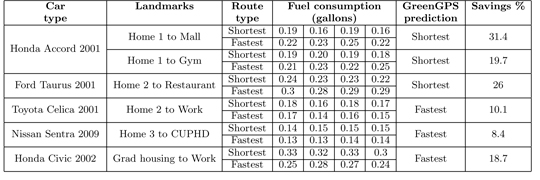
    Most GPS devices in cars today give the driver two choices: shortest route or fastest route. GreenGPS provides a third option: most fuel-efficient route.

    With gas prices skyrocketing, many drivers would be happy to spend a few more minutes on the road, or take a different route, if it meant burning less gas.

    The answer could be the GreenGPS navigation service, now being developed by researchers at the University of Illinois at Urbana Champaign (UIUC), which finds the most fuel-efficient route for your vehicle.

    “The most fuel-efficient route may be different from the shortest route because the latter may pass through downtown stop-and-go traffic,” explained Tarek Abdelzaher, project lead and computer science professor. “It may also be different from the fastest route because vehicles are not as fuel efficient at higher speeds.”

    All cars manufactured in the U.S. since 1996 come with a standard interface to their internal gauges and engine measurements called the On-Board Diagnostics Interface, or OBD-II. GreenGPS runs on the driver’s GPS-enabled cell phone and uses an off-the-shelf wireless adaptor plugged into the vehicle’s OBD-II port to receive engine readings via Bluetooth.

    The cell phone collects the readings and connects to a server that models the engine’s fuel efficiency and customizes navigation advice to the particular vehicle, Abdelzaher explained.

    The best route computed by GreenGPS to the same destination may differ from one vehicle to another. “For example, my vehicle uses about 20-25 percent more gas in stop-and-go traffic compared to free-flowing traffic, whereas my wife’s car uses closer to 40 percent more,” Abdelzaher said. “GreenGPS may recommend to her a path that is longer but has no traffic, whereas it might recommend to me a path that incurs some traffic but is shorter.”

    To users, GreenGPS looks like a regular navigation service. The driver specifies a destination, then ask the service to find a route. “It runs on your cell phone, except that in addition to the fastest and shortest route options, it offers the ‘least-fuel route’ option,” Abdelzaher said. “If the driver chooses that option, they receive the GreenGPS-recommended fuel-efficient route.”

    The program works best with a small hardware addition to collect readings specific to the vehicle. “In order for the advice to be customized to the performance of your specific vehicle, the driver should invest in buying the OBD-II adaptor. It costs about $50 and is a one-time investment,” Abdelzaher said.

    “If the driver does not wish to buy the adaptor, they can still use GreenGPS and supply the make, model, and year of their vehicle. In this case, GreenGPS will use data from other vehicles of the same make, model, and year, or vehicles as close to them as possible to compute the navigation advice,” Abdelzaher said. This social networking component is also being developed as part of the project.

    The system pulls the GPS data from the driver’s cellphone. “If you use a GPS phone (and most smartphones have GPS), the system simply finds out your current location from your phone. Otherwise, you would need to supply both source and destination addresses (like you would when you get directions from Google Maps) and the system will show you the route on a map.”

    Gas-Saving Pilots. In the first stage of testing, the team solicited volunteers to drive in the area of their university, in Urbana-Champaign, a city of 170,000. In all, 1,000 miles were driven by 16 different cars. Results demonstrated that following the fuel-efficient route saves on average 6 percent over the shortest route, and 13 percent over the fastest. “This was done on flat terrain and in the absence of significant congestion,” Abdelzaher said. “We expect that testing in higher traffic and richer topology will increase the variability in fuel consumption among different routes, resulting in even more potential savings when following the most fuel-efficient route. Verifying this conjecture is currently a topic of investigation for our ongoing research project.”

    Abdelzaher said his team has just started the second stage. “In the second stage of testing, we will deploy GreenGPS on the UIUC Facilities and Services fleet (about 100 cars) and monitor performance over a longer period of time. Preparations for this deployment are currently under way. We also expect to offer GreenGPS publicly to any other volunteers who wish to help with testing.”

    Impressed by early findings of gas savings, the second phase is being funded in part by a $300,000 grant from the National Science Foundation. Abdelzaher and Robin Kravets, another UIUC computer science faculty member, were awarded the grant this spring. It will help deploy GreenGPS among the campus fleet cars, and track and analyze the results.

    “By sharing data on speed, fuel efficiency, and location of vehicles, better real-time navigation services can be developed that guide drivers to routes that are maximally fuel-efficient for their cars, hence reducing transportation carbon footprint,” the grant reads. “This project helps usher in a new era of sensing applications with more integration of humans, networks, and the physical world, which may have a significant impact on the economy, energy, and the environment by reducing transportation energy cost and carbon footprint.”

    Other grant providers are the Office of Naval Research, which is funding research on the technology’s networking component, and IBM through its Smarter Planet initiative. As a part of this project, 200 or more cars in the Urbana-Champaign area of various makes and models will be fitted with GreenGPS. Through a social network of drivers, data and routes collected can be shared and used by those who don’t have the OBM-II adaptor installed.

    GreenGPS-Table-W  Source: Tracy Cozzens
    Fuel consumptions for the various roundtrips between different landmarks.
    GreenGPS-maps-B  Source: Tracy Cozzens
    The landmarks and corresponding shortest and fastest routes.
  • Detecting Nuclear Testing: Software Under Development by OSU Could Pinpoint Treaty Violations

    By Tracy Cozzens

    infobox_chart_2009-W Source: Tracy Cozzens
    Figure 1. Worldwide nuclear testing 1945–2009 (CTBTO website).

    Can GPS be used to detect underground nuclear explosions?

    A research team is developing a software program that uses GPS to analyze the ionospheric effect of nuclear explosions. Results would show when and where a country has conducted a secret underground nuclear test. Team members are Jihye Park, Ralph. R. B. von Frese, and Dorota A. Grejner-Brzezinska from The Ohio State University and Jade Yu Morton from Miami University.

    The Comprehensive Nuclear-Test-Ban Treaty was adopted by the United Nations General Assembly in 1996, but not all nuclear countries have ratified it, including the United States, China, Egypt, Indonesia, Iran, and Israel. Also, India, North Korea, and Pakistan have not signed the treaty.

    Park, a doctoral student in geodetic science at Ohio State, created the computer program to detect changes in the ionosphere from nuclear weapons testing.

    A previous study showed that the ionosphere was disturbed by underground nuclear testing conducted by Russia in 1990. GPS is capable of precisely measuring the total electron content (TEC) of the ionosphere along the path between satellite and receiver at a GPS station, so Park and her team decided to begin researching the use of GPS in detecting nuclear explosions.

    “Many studies have been done to monitor and model the atmosphere using GPS technology,” Park said. “Research has proven that GPS can detect natural disasters such as earthquakes or tsunamis. This study broadens those areas of study with its capability to detect underground explosions.”

    Detonation of a nuclear weapon results in a shockwave that travels through the atmosphere, changing the density of charged particles in the ionosphere. “The explosions can’t hide from the ionosphere,” said von Frese, geophysicist and project leader. “Our technology would be another nail in the structure to detect explosions.”

    “One of the arguments is ‘Well, how do you prove that a clandestine explosion occurred?’” said Grejner-Brzezinska, Park’s adviser and GPS World’s Tech Talk blog editor. “Now we can say, ‘Here, we have the data from GPS to show when and where.’”

    According to the Comprehensive Nuclear-Test-Ban Treaty Organization (CTBTO) nuclear testing has been carried out in the past by the United States, Russia, the United Kingdom, France, China, India, Pakistan, and North Korea (see Figure 1).

    Fig2_W Source: Tracy Cozzens

    Researchers, and those monitoring treaty violations, are able to target specific geographic areas that are equipped for tests, since development of a nuclear test site requires a lot of technical effort and budget. For example, the North Korean tests carried out in 2006 and 2009 were very close geographically.

    “They tend to stick to the same site and reuse their facilities for nuclear testing,” von Frese said. “So a country that has previously conducted underground nuclear testing probably will reuse the site if new testing is needed.”

    “They could be monitored using GPS as long as there are GPS stations nearby,” Park said.

    The new GPS nuclear-detection technology was presented at the Comprehensive Nuclear-Test-Ban Treaty Organization meeting held June 8–10 in Vienna, Austria, and received press coverage that drew additional interest.

    GPS Detection. The team zeroed in on a specific event to test the software, selecting a nuclear test conducted by North Korea in 2009 and using data pulled from nearby South Korean GPS stations.

    Traditional detection methods for underground nuclear tests include seismic and other sensors. The CTBTO operates an international monitoring system to detect explosions with a yield of at least one kiloton. Besides seismic sensors, monitoring includes hydroacoustic sensors to monitor for shockwaves on land and in water, infrasound to detect pressure waves, and radionuclide detectors for any gas that may have been generated, though the levels aren’t always detectable.

    “Even though there are four different systems available, they sometimes are unable to detect the underground nuclear explosions,” Park said. “GPS technology will make the detection validation stronger since each of them is based on a different theory. In the case of the nuclear test conducted by North Korea in 2009, only seismic and a few infrasound sensors detected the event because of their improved containment technique. Our study tracked down the 2009 event using GPS, and found it coincided with the seismic results.”

    Park was able to take advantage of the well-established worldwide infrastructure already in place for GPS for her software test. The team used GPS data recorded by South Korean GPS receivers of the 2009 North Korea test. “There are a few IGS (International GNSS Service) stations in South Korea, China, and Japan. Since South Korea runs their own GPS network, I requested the data so that we could obtain data from more stations located in South Korea,” Park said.

    “Since the stations we chose were permanent reference stations controlled by an international organization (IGS) and a specific country (Republic of Korea or South Korea) respectively, most of them have been running continuously except for unexpected data gaps from time to time,” Park said. Figure 2 shows the GPS stations processed for the project.

    With data in hand, Park was able to test her software. The results showed definite peaks from different stations at different times after the 2009 explosion. “We realized that the time of the detected peak was dependent on the distance between underground nuclear explosion and each GPS station,” Park said. Figure 3 shows four different stations’ TIDs (traveling ionospheric disturbances) that the team initially recognized.

    TIDs_obvious-W Source: Tracy Cozzens
    Figure 3. Traveling ionospheric disturbances (TIDs) detected at stations INJE (top left), DOND (top right), DAEJ (bottom left), and CHAN (bottom right). Click to enlarge.

    Ruling Out Quakes. One big challenge using GPS for ionospheric monitoring is determining the origin of an event. “Since earthquakes also disturb the ionosphere, distinguishing earthquakes from underground nuclear explosions are problematic even with GPS,” Park said. “Indeed, we only focused on examining and isolating TIDs from the nuclear explosions. We are now working to analyze the TIDs from earthquakes and compare them with nuclear TIDs.”

    Besides helping to distinguish between earthquakes and nuclear-test explosions, the software may eventually distinguish between nuclear plant fallout and nuclear test fallout.

    With this goal in mind, the team is analyzing the ionospheric data gathered from recent nuclear plant accidents such as the one in Japan following the earthquake and tsunami in March. “Since there were data gaps and other data issues, we have as yet nothing more to report. Hopefully, we find the earthquakes’ signature soon.”

  • Guiding the Troops: Operation Waypoint Puts GPS Devices into Soldiers’ Hands

    Operation Waypoint, a Minnesota-based, non-profit program administered by American Legion Post 621, has broadened its program from a state and regional focus to national in scope with its new website, gpsfortroops.org.

    Run by volunteers, the program is committed to increasing the safety of military men and women deploying to the Middle East with the guidance of highly accurate, handheld GPS units and mapping cards for Iraq and Afghanistan. Since its inception, Operation Waypoint has relied heavily on its partnership with GPS device manufacturer Lowrance to provide GPS products and charts to soldiers preparing to serve, as well as generous donations from service and social organizations and numerous individuals to fund the effort.

    Operation Waypoint was started in 2005 by retired educator Ed Meyer after a former student, preparing for deployment to Iraq, contacted him to ask what type of GPS unit would be best for his mission. As the military only provides one GPS device per unit, which is usually mounted in a vehicle, Meyer contacted a friend at Lowrance, requested three GPS handheld devices, and trained the company commander and two former students how to use them.

    Close Call in Baghdad. Shortly after the soldiers arrived in Iraq, while traveling at night, their 24-vehicle convoy took a wrong into a dangerous Baghdad neighborhood following the lead truck’s Army-issued GPS unit. Realizing the mistake, the convoy commander called Sgt. Gaylen Heacock, one of the soldiers equipped with a Lowrance GPS supplied by Meyer. Heacock’s device determined the correct route and was able to guide the convoy to safety. Upon hearing of how the Lowrance units aided in safety, Meyer worked through the American Legion Auxiliary and Post 621 to broaden the idea into a full not-for-profit program.

    “Our goal is to spearhead an even larger movement where communities nationwide can directly support our troops in a very meaningful way,” said Meyer. “I believe that every soldier that feels a GPS would aid them in their mission in the Middle East should have one with them.”

    With the enhancement of GPS accuracy and advanced features, today’s GPS units are even better suited to the challenges often seen by the military than when the program began. Operation Waypoint provides soldiers with Lowrance Endura Safari handheld GPS units that contain a precision GPS+WAAS antenna with 42-channel receiver and 3-axis magnetic compass to ensure troops have pinpoint accuracy for proper guidance or calling in air support when needed. The combination of the touchscreen, simple menus, and the ability to control one-handed or with gloves keeps usability fast and seamless, Meyer said. However, the most important benefit is the ability to store up to 2,000 waypoints for areas of safe passage, suspected insurgent buildings, and other items that are marked and identified with any of 193 different icons and then shared between GPS units over time or added to satellite maps.

    “The [GPS] unit helped ensure the safety of crews while running convoys through the worst part of Iraq,” said Sgt. Heacock. “It’s helpful in pinpointing casualty evacuation points and points of hostile action.”

    To date, Operation Waypoint is responsible for delivering more than 200 handheld devices into the hands of deploying soldiers. The St. Augusta American Legion accepts donations for Operation Waypoint and purchases its Endura Safari handheld GPS units directly from Lowrance. Lowrance also provides permission for the organization to copy and encrypt its Middle East mapping onto locally sourced microSD cards. While more work, this avoids packaging and operational overhead costs that would normally be seen by a manufacturer. Once the GPS and mapping cards are prepared, each participating soldier is personally trained on the GPS device and mapping before he or she takes it overseas.

    “Each Lowrance GPS and chart card costs $115 after corporate discounts are factored in,” said Meyer. “Unfortunately, there are still times when we can’t purchase enough units. I have even given my personal GPS away, because I can’t imagine turning down a brave soldier. The challenge, as with most non-profits, is maintaining enough donations to support the program effectively.”

    Operation Waypoint seeks to grow nationally by working with other American Legion Posts and organizations with a goal to provide a GPS device to every deployed unit. The Operation Waypoint website was redesigned to build awareness, make it easier for visitors to donate, and encourage other organizations to become partners in the project to provide GPS devices for soldiers in their own communities.

  • Out in Front: A Pawn in Their Game

    Maybe we got played. But we put up a good fight. We really had no option to do anything but fight. So we did, and we’re still fighting the LightSquared attack on the GPS signal. It’s not over yet, not by a long shot.

    Suspicions now creep in that the attack may have been a feint, that the company never really intended to do what it threatened: broadcast a very powerful signal from ground towers, on a frequency immediately adjacent to the GPS signal. LightSquared had its eye on another prize instead.

    Here’s what I have heard, independently from two people who follow the telecommunications industry for a living. Party number one:

    “These guys have b..ls.

    Off the record, their business plan is a 100 percent swap.

    So the more GPS gets irritated by their b..ls..t and says get out of the L-band, the more LS like it.

    Tell your friends to recommend that LS use their other [lower] spectrum.

    Now that’s what they don’t want.

    The trade is 40 MHz of new terrestrial spectrum.”

    Party number two, a Wall Street contact, said the same, implying a direct interaction with top-level LightSquared personnel as its source.

    Somewhere in the very early going, back in December of last year, I read a similar speculation, but gave it little credence because it seemed too good to be true. I’m still wary.

    But such deceit seems consistent with the sly and manipulative behavior that LightSquared has evidenced to date, on top of the near-total lack of any engineering or scientific case for its power play on spectrum. Time and again, company spokespersons made their case on legalistic and rule-making grounds, abetted by no less a person than the FCC chair. Any technical language or justification they used was transparently, almost laughably, unfounded.

    That’s the way government works, unfortunately. The laws of man are held above the laws of physics — even when it comes to rewriting the previous laws of man, which, it turns out, had some logic. The MSS spectrum, about which all this furor has raged, turns out to stand for Mobile Satellite Service spectrum. If the LightSquared signal were held to its license, it would broadcast from satellites, with a small provision for ancillary ground broadcast.

    Even with the Technical Working Group’s strong repudiation of both the LightSquared proposal and the FCC’s conditional waiver, and the stern-jawed joint letter from the Departments of Defense and Transportation, we are far from safe. I have seen too many government boards — local, state, and federal — fly in the face of evidence, to believe that facts rule.

    It ain’t over till the statuesque lady sings.