Author: Alan Cameron

  • Out in Front: GLAC issues BeiDou market projections


    Alan Cameron
    Alan Cameron

    We have grown accustomed to seeing market projections for some GNSS, notably Galileo. European GNSS Agency economists have done a remarkable job analyzing and predicting the global market over the past five years. Business intelligence firms in the U.S. periodically report on the power of GPS driving, or participating in, significant portions of the U.S. economy. Figures from Russia are scant but do occasionally emerge, even if they are difficult to integrate into a meaningful global picture.

    Now the Global Navigation Satellite System and Location-based Services Association of China (GLAC) has issued a report asserting some lofty, often staggering, and occasionally surprising statistics and projections.

    • China’s satnav system is helping generate $31.3 billion for the country this year. That benefit is expected to double in five years.
    • 70 percent of China’s population uses smartphones. That’s 980 million people who may be sending location requests at any given time. This constitutes the biggest growth sector found by the GLAC.
    • China’s installed base of navigation devices in private vehicles lags behind the United States, at less than 500,000, or 5 percent of cars, but 20 percent of 1 million commercial vehicles in China use products that access BeiDou technology.

    “Sky’s the Limit for BeiDou’s Clients,” crowed China Daily. Meanwhile, halfway round the world in Prague, the Czech Republic, Jing Li of the China Transport Telecommunication & Information Center, reported to a conference of the International Association of Institutes of Navigation that a BeiDou global service will be provided by 2020. The National Differential BeiDou Ground-Based Augmentation System will have 175 reference stations, with more than 1,000 network stations and a space-based augmentation system to boot. So far, the system has hit every benchmark.

    Some market projection figures strike one as wildly optimistic, while others have proved true. Some GNSS appear to grow or modernize in fits and starts. But BeiDou appears steadily ascendant.

  • Experienced leader returns to Galileo helm, now within ESA

    The European Space Agency (ESA) has unexpectedly announced a new leadership team. The naming of eight senior leaders to the heads of various departments brings back one figure very well-versed in Galileo matters to head the Galileo program and navigation-related activities: Paul Verhoef. Verhoef was the European Commission coordinator for Galileo activities from 2005 to 2011.

    In a rare weekend session of the ESA Council, termed “an extraordinary meeting” held “in restricted session” in the agency’s own official release, the agency announced new managers for several key agency positions, two each in the areas of space applications, science exploration, space and technology operations and administration. The reorganization apparently comes at the behest of ESA’s new director-general, Johann-Dietrich Woerner, who assumed his post in July 2015.

    The new leadership team is expected to start work in early 2016.

    The structure groups together separate directorates into themes, while not reducing the overall number of directors at the 22-nation agency. In ESA’s area of Space Applications, Paul Verhoef is named as Director of Galileo Programme and Navigation-Related Activities (D/NAV). It is not known currently where Didier Faivre, heretofore ESA’s Director of Galileo and navigation-related activities (since 2011), is headed.

    Verhoef has a master’s degree in electrical engineering from the Technical University of Eindhoven, the Netherlands. After working in the commercial sector as an engineer, lastly at Eutelsat in the ground segment procurement section for EUTELSAT-II satellites, he has held various posts at the European Commission, with a 1.5-year interlude as a vice president at ICANN, a not-for-profit public-benefit corporation dedicated to keeping the Internet secure, stable and interoperable.

    From 2005 to 2011 he was the EC’s Programme Manager for EU satellite navigation programmes. During the very turbulent and ultimately abortive public-private partnership (PPP) negotiation period for Galileo, he kept a level head and all communication avenues open between industry and government.

    Since that time he has served as the EC’s Head of Unit – Research and Innovative Transport Systems, DG MOVE, where he set up a new research and innovation unit in the transport field, and as Head of Unit – Renewable Energy Sources, DG RTD, in charge of research and innovation programming and policy development in the renewable energy technology and market take-up area.

    Verhoef will be working or at least corresponding to some extent with Jeremie Godet, the EC’s head of sector, Galileo Implementation. Godet is also new in his position, since August 2015. Previously, he held various Galileo-related posts in the EC, and had a two-year stint with the European GNSS Agency (GSA) as head of the Security Department. The December issue of GPS World will carry an article on Galileo’s future co-authored by Godet.

    Verhoef last appeared in the pages of the magazine in November 2010, giving a lengthy interview addressing aspects of interoperability with GPS and prospects for further development in that area, the need for an ongoing political commitment by the EU to Galileo, the challenges of financing, the prospects for an 18-satellite constellation (which he dismissed at the time as unrealistic), military considerations for both Galileo and GPS, and uncertainty around Galileo’s Public Regulated Service. See Galileo, View from the Top.

    The changes at ESA constitute the latest episode of an ongoing, and perhaps as-yet unresolved discussion (which can be a polite term for “power struggle”) regarding what role ESA, the EC and the European GNSS Agency (GSA) each have in the direction of the space-navigation program. The current shuffler, Johann-Dietrich Wörner, was previously chairman of the Executive Board of Germany’s space agency (DLR), and at least once when in that position publicly expressed his impatience with such long-running deliberations.

  • Out in Front: Readers, marketing partners co-engineer GPS World redesign

    Out in Front: Readers, marketing partners co-engineer GPS World redesign

    Alan Cameron
    Alan Cameron

    GPS to the power of PNT. Or, as I like to think of it, GPSPNT.

    We are rapidly entering — or we have already entered — the era in which we say “GPS” but we really mean so much more.

    • We mean GNSS: GPS + GLONASS + Galileo + BeiDou.
    • We mean all of the above plus satellite-based augmentation systems (SBAS), now encompassing WAAS, EGNOS, SDCM, QZSS, IRNSS, and I don’t think we’re done yet.
    • We mean all the above plus several private-sector corrections services, including but not limited to OmniStar, StarFire, Veripos, Fugro, Terrastar, Atlas, and surely more to come.
    • We mean all of the above plus back-ups in the event of jamming or other interference: eLoran is a prime candidate, and there are others.
    • We mean all of the above plus many technologies that can be integrated — are being integrated — with GPS/GNSS to achieve a seamless position, navigation and timing (PNT) solution: inertial and other MEMS, cell ID, Wi-Fi, Bluetooth, DSRC, FM and UHF, and many more. Think of a band of the RF spectrum (or even non-RF technology as the mentioned inertial/MEMS); it’s probably on that list or soon will be.
    • We mean all of the above plus many forms of software that go into making up a geographic information systems (GIS) backbone, a map-matching system, a building information model (BIM) or other application and extension of the GPS data.

    They all work together. They all need each other. But they all begin with GPS. Sometime tomorrow, they will all begin with GNSS. Today, GPS is the game in town.

    Saying “we mean,” I denote “we” in the loose or editorial sense: this magazine. We treat all of the technologies as ways to get to the solution: the ubiquitous, seamless PNT solution. We’ve been wondering recently if the umbrella has grown too wide for “GPS” to continue to be its label.

    No matter how professionally and technically correct both you and we aim to be by employing the terms GNSS, PNT and integrated positioning technologies as appropriate, the world at large probably will continue to call all of the above “GPS.” And the label remains the easiest shorthand for all of the above. That is one of the reasons we have decided to continue calling this great magazine GPS World.

    But we really mean so much more, and the pages that follow this one, and will follow in months to come, bring you so much more — fulfilling the promise of the “kicker” in our new name: GNSS, Position, Navigation, and Timing.

  • New BeiDou TMBOC Signal Tracked; Similar to Future GPS L1C Structure

    New BeiDou TMBOC Signal Tracked; Similar to Future GPS L1C Structure

    China’s new third-generation BeiDou satellites are broadcasting some new signals in space. The newest signal, which just began broadcasting from a satellite launched on Sept. 30, is similar to the future GPS L1C signal with time-division BOC(1,1) and BOC(6,1) signals. Such a type of modulation is called time-multiplexed binary offset carrier (TMBOC, see note below).

    Researchers at JAVAD GNSS have been tracking the new signals, particularly those from Beidou-3 I2S, an inclined geosynchronous orbit (IGSO) spacecraft, NORAD number 40938. I2S is transmitting on three frequency bands.

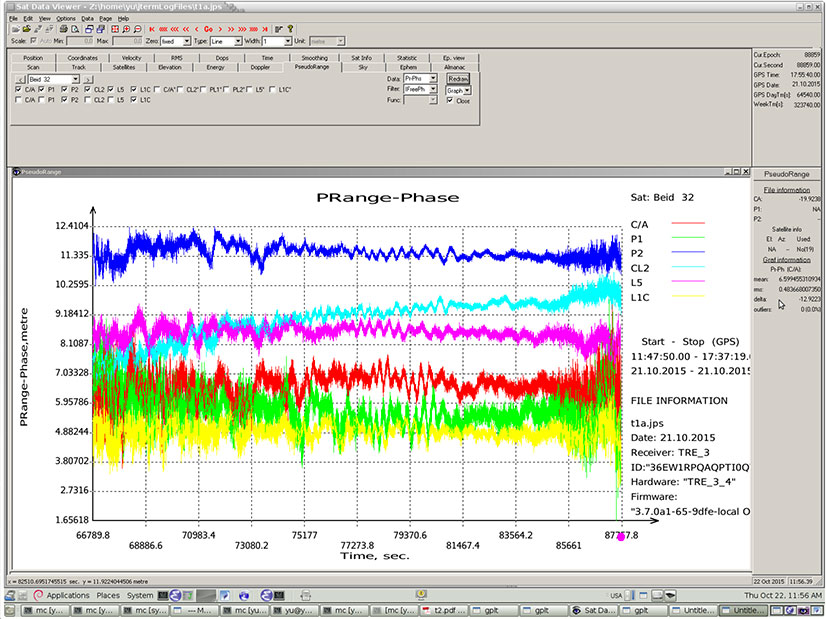
    The JAVAD researchers used the decoding approach described in their February 2013 GPS World article, “Signal Decoding with Conventional Receiver and Antenna: A Case History Using the New Galileo E6-B/C Signal” by Sergei Yudanov. As a result, the signal’s structure was decoded and L1C TMBOC tracking has been successfully tested on the JAVAD GNSS TRE-3 receiver.

    In addition, new signals on 1575.42+1.023*14 MHz (B1-2), 1176.45 MHz (E5A) and 1207.14 (E5B) frequencies for three satellites (PRN 32, 33, 34) also have been decoded and tested.

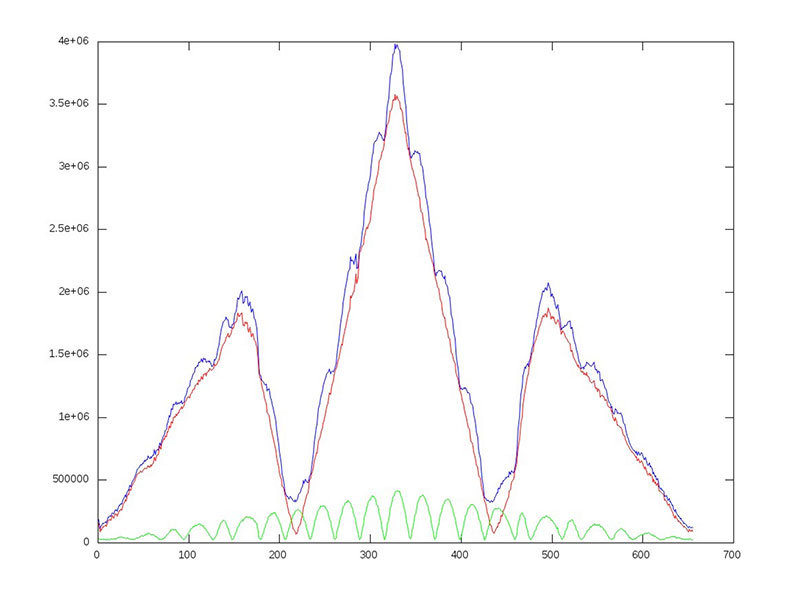
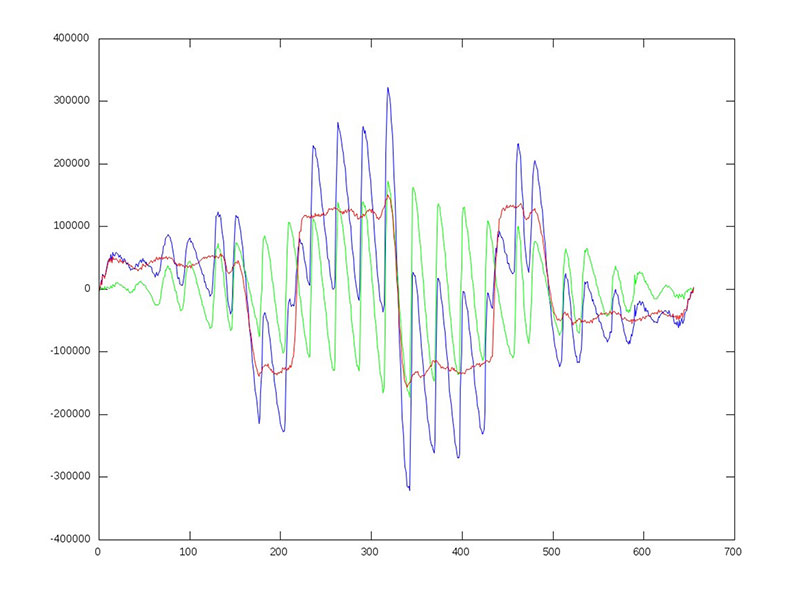
    The following graphs illustrate the experiment:

    I of BOC(1,1) (red), BOC(6,1) (green) and their sum (blue) vs code shift.

    JAVAD-TMBOC-1

    dI of BOC(1,1) (red), BOC(6,1) (green) and their sum (blue) vs code shift.

    JAVAD-TMBOC-2

    Horizontal axis: 0 – minus one chip shift; 327 – zero shift; 655 – plus one chip shift

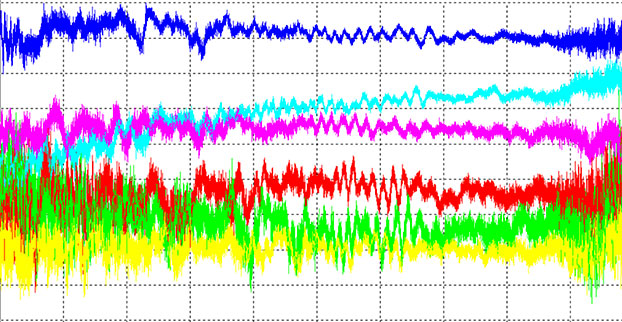
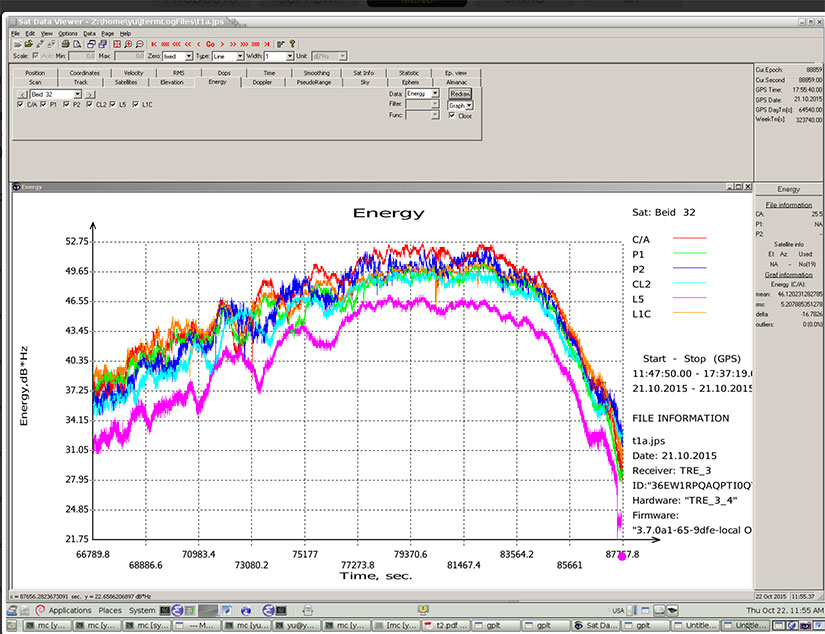
    C/NO and iono-free “range minus phase”.

    Slot – Beidou signal
    C/A – B1
    P1 – B1-2
    P2 – E5B
    L2C – B3
    L5 – E5A
    L1C – L1C

    JAVAD-TMBOC-3

    JAVAD-TMBOC-4

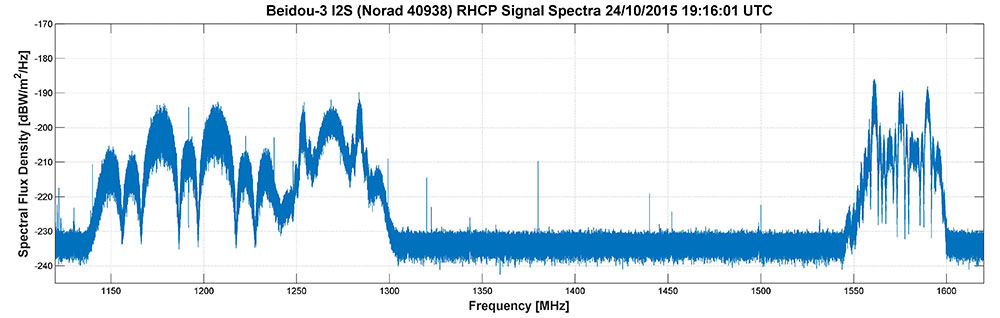
    Researchers Steffen Thoelert, Oliver Montenbruck and Michael Meurer from the Deutsches Zentrum für Luft- und Raumfahrt (DLR, German Aerospace Center) have also been busy tracking the newest BeiDou IGSO satellite. The following diagram shows a spectral measurement of the complete GNSS L-band frequency range, which shows the signal transmissions on B1, B2 and B3 band. The signal was captured with DLR’s high-gain antenna in Weilheim, operated by the DLR German Space Operations Center in Oberpfaffenhofen.

    Beidou3_I2S_Spectra_complete-W

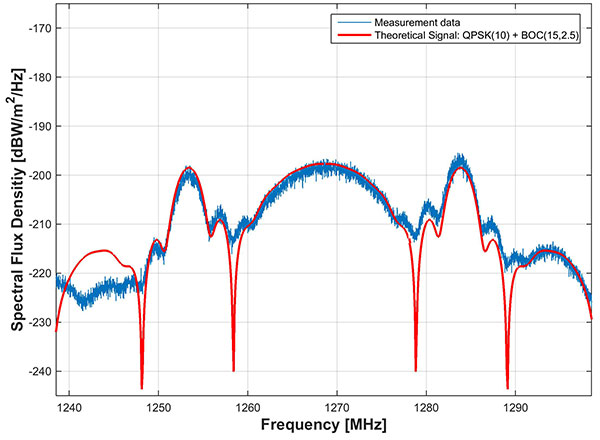
    In comparison to the two latest Beidou-3 MEO satellites, launched on July 25, the IGSO has an additional signal on the B3 band. The MEO satellites transmit only the QPSK(10) while the new IGSO also transmits an additional BOC(15,2.5) signal. The following picture shows the B3 frequency band separately including a combined theoretical signal (QPSK(10)+BOC(15,2.5)).

    Beidou3_I2S_Spectra_plusTHEORY-W

    The newest BeiDou satellite is the first in that constellation equipped with a hydrogen maser atomic clock. A series of tests related to the clock and a new navigation-signal system will be undertaken.

    China plans to expand the BeiDou services to most of the countries covered in its “Belt and Road” initiative by 2018, and offer global coverage by 2020.

    Read more about TMBOC in the June 2011 Innovation article “MBOC Signal Options: Performance of Multiplexed Binary Offset Carrier Modulations for Modernized GNSS Systems,” by E. Simona Lohan, Mohammad Z. H. Bhuiyan, and Heikki Hurskainen.

    Earlier this year, China stated that one of the July-launched MEO satellites was working autonomously and had set up a link with the other satellite, successfully testing the autonomous control technology of the Beidou constellation. The inter-satellite link realizes communication and distance measurement among satellites, bringing autonomous control of the system a step closer.

    Autonomous navigation is the project’s key to global operation. It enables satellites to work independently, providing users with more accurate data, according to BeiDou design engineers.

  • Out in Front: IOU on IOE

    Alan Cameron
    Alan Cameron

    Here it comes right at ya, down the cable into your living room, over the radio waves into the coffee shop or airport and your car: the Internet of Everything (IOE).

    The term connotes adding connectivity and intelligence to just about every tech device in use at home, office, or out on the street, to enable special functions, reporting, and command/control. From kitchen appliances to cars, it’s anything with “smart” in front of its name, tied to the Internet and interconnected to tech-ecosystems of software, services, data warehouses, and yet other smart devices, starting but certainly not ending with your phone, watch, tablet or PC.

    Most semiconductor companies have fielded new processors aimed at IOE. Broadcom’s new chip, reported in this issue, folds GNSS into the digital cake mix. Market research predicts 220 billion connected devices in use by 2020, and market size in the trillions. Trillions.

    The bandwidth to run this new ecosystem is truly staggering. Available spectrum just won’t do it, not in the way we’re using it. Far more precise timing of data packets shot through the cloud will be necessary.

    Thus our cover story. GNSS — well, GPS so far — is tightly woven into the fabric of financial and security infrastructure because it furnishes micro- and nanosecond synchronization. Nanos ain’t where it’s at in another eyeblink more. Picoseconds will be the new standard.

    GNSS as currently constituted cannot do picoseconds. Another technology or technologies will be required.

    This is true on nearly every front, every sector in which GNSS has enabled so much that previously was inconceivable or just plain unconceived. We’re headed further in all those directions, and GNSS can’t get us there alone. Aided and abetted by other positioning, navigation, and timing (PNT) technologies, it can.

    The magazine has long covered other PNT technologies, but starting in November you’ll see a whole lot more of this. Every PNT technology, in every issue, in some way. That’s my IOU. Because, after all, it’s a World of Everything.

    Pink for a Cure

    Our cover logo this month signals that North Coast Media (NCM) is doing something to help  make a difference. Because October is our company’s largest revenue month each year, our leadership team has  committed to donate a portion of the company’s October revenues to cancer research. In 2014, NCM donated $8,000  to this very worthy cause. The disease has touched the lives of nearly everyone on the NCM team; we’re very excited to be able to  do something that matters.

  • Galileo Space-Borne, Industry Land-Bound

    Galileo Space-Borne, Industry Land-Bound

    Galileo’s latest pair of full operational capability (FOC) satellites now orbit proudly in space, “performing beautifully.” The first two FOC birds may soon shift their focus from navigation to gravity experiments instead.

    Meanwhile, as the European Space Agency tries to fly, European industry seeks firmly grounded support in the form of an industrial policy and economic stimuli, expressing concern that the current situation “might jeopardize the achievement of the main objections of the European GNSS programmes.”

    Alba and Oriana (aka Galileo satellites 9 and 10), launched on Sept. 11, are drifting towards their target orbital positions. Thruster firings will resume around the end of October to stop their drift and achieve fine positioning in orbit. Their control now rests in the electronic hands of the Galileo Control Centre in Oberpfaffenhofen, Germany.

    Gravity Probe. The two satellites launched last September have not fared so well. Injected into the wrong orbit by a faulty Soyuz rocket, they were moved to a “usable” orbit in December 2014, reducing orbit eccentricity and avoiding the high radiation doses in the Van Allen belts, but still not high enough to function fully as navigation satellites. The European Commission (EC) and ESA remain convinced that Doresa and Milean (satellites 5 and 6) will be able to contribute in some limited fashion to Galileo’s PNT solutions, but they are also preparing alternate roles for the pair.

    Together with Sytèmes de Référence Temps Espace (SYRTE, or Time-Space Reference Systems department) of the Observatoire de Paris and the Center of Applied Space Technology and Microgravity (ZARM) at the University of Bremen, ESA has explored taking advantage of the combination of Dorena’s and Milesa’s eccentricity (about 0.15 in the corrected orbits), the passive hydrogen maser (PHM) on-board clocks’ high accuracy-stability (~10−14 per day), and high orbital precision to perform a measurement of the gravitational redshift. The redshift or Einstein shift is a process by which electromagnetic radiation originating from a source that is in a gravitational field is reduced in frequency, or redshifted, when observed in a region of a weaker gravitational field. The three organizations believe that the two satellites can help measure this effect with a superior accuracy compared to today’s state of the art, based on Gravity Probe A, an experiment performed in 1976.

    These tests are noted to have a high scientific relevance, as many alternative theories of gravitation predict violations of the Einstein Equivalence Principle at some level of accuracy. Two parallel research activities, with SYRTE and ZARM, will be launched by ESA to assess this potential in greater detail.

    See What the Future Brings. Two further Galileo satellites are scheduled for launch by end of this year. Next year the deployment of the Galileo system will be boosted by the entry into operation of a specially customized Ariane 5 launcher that can double, from two to four, the number of satellites that can be placed into orbit by a single launch.

    GalileoMustSucceed

    We Want What They Got. Earlier this month, the 29-company Galileo Services association, made up of European chipset and receiver suppliers and associated service providers, issued a position paper calling for “a coordinated industrial policy to support the European economy,” specifically that portion of the economy based on satellite positioning, navigation and timing. The companies jointly complain that in the United States, Russia, China and Japan, dedicated national strategies, including “massive funding” for both R&D and manufacturing, support GNSS downstream industries — but in Europe, no such backing exists. The un-level playing field imperils European commercial activity.

    “As things stand, in a few years, it will be difficult or nearly impossible for European industry to survive in the highly competitive GNSS global market,” the position paper reads. “Unless an effective and long-term strategy is put in place during the Galileo early services exploitation phase (2016–2020), the window of opportunity for European industry to benefit from the current GNSS market boom will soon be closed.”

    “Europe Must Succeed in the Global Navigation Market Race” (the full document is available here) calls upon European governments to devise and adopt a strategic plan to support Galileo’s downstream suppliers and manufacturers. The desired strategy connotes money and favorable regulations.

    Europe governmental hands may be a bit tied by a U.S.-European agreement that neither will put up barriers discriminating against each other’s satnav systems. China and Russia have not signed the agreement and so are not bound by its restrictions; the two countries can freely make “massive procurements equivalent to several billions of euros from the public sector, as anchor customer, which radically boosts private investment,” according to the Galileo Services paper. Further, the United States can step around the agreement’s terms via military contracts to U.S. manufacturers, leveraging their commercial ventures.

    Thirty-three or Bust. The report continues to reference the magic number 33 percent, the traditional European global market share in any high-tech sector. European industry partners estimate they hold 20 percent of the worldwide satnav currently, if even that, and, ominously, they see that share declining. They cast U.S. manufacturers in the dominant role: “80 percent of well-established market owners are of U.S. origin.” This is not the same as an 80 percent market share, but it still sounds scary to European ears. Meanwhile, “the size and growth of Chinese industry, which has already in just a few years outperformed European industry in the field of telecommunications, is particularly worrying” to satnav concerns.

    Section Two of “Europe Must Succeed” defines the strategic plan that the industry partners would like to see:

    • quantitative objectives in terms of market share, revenue, and job creation;
    • clear support actions in terms of public procurement and regulations;
    • key performance indicators to assess progress towards set milestones.

    Section Three lays out a series of recommended key support actions for public institutions to undertake, and Section Four proposes a Galileo Services Forum, a permanent and formal arena for discussions between the European Commission, the European GNSS Agency, and the European Space Agency on the one hand, and European GNSS downstream industry on the other.

    Interestingly, while the report in an earlier section calls out a number of promising application and service markets — basically all the usual suspects, from connected vehicles to offshore infrastructure — it singles out one, “the leading position of Europe in GNSS security and resilience,” for particular attention. It “should be strengthened, as it is critical for today’s and tomorrow’s markets.”

    The report also makes a pointed allusion to European industry’s “strong reputation for quality and reliability.” This note is not sounded elsewhere in the paper, suggesting a fear that price trumps quality in today’s marketplace. A well-founded fear.

    Galileo Services represents more than 180 members. Its most active and representative GNSS players include: Airbus Defence & Space, Ansaldo STS, CGI, European Satellite Services Provider (ESSP), Eutelsat, France Developpement Conseil, Fugro, GMV, Guide, Hertz Systems, Honeywell, Indra, Ineco, JAVAD GNSS, Kayser-Threde, Kongsberg, M3 Systems, NavCert, NLR, NovAtel, Nottingham Scientific Limited, OHB, QinetiQ, Septentrio, Catapult, Sogei, Spirent, Thales and Veripos.


  • The System: Galileo Turning Ten

    The System: Galileo Turning Ten

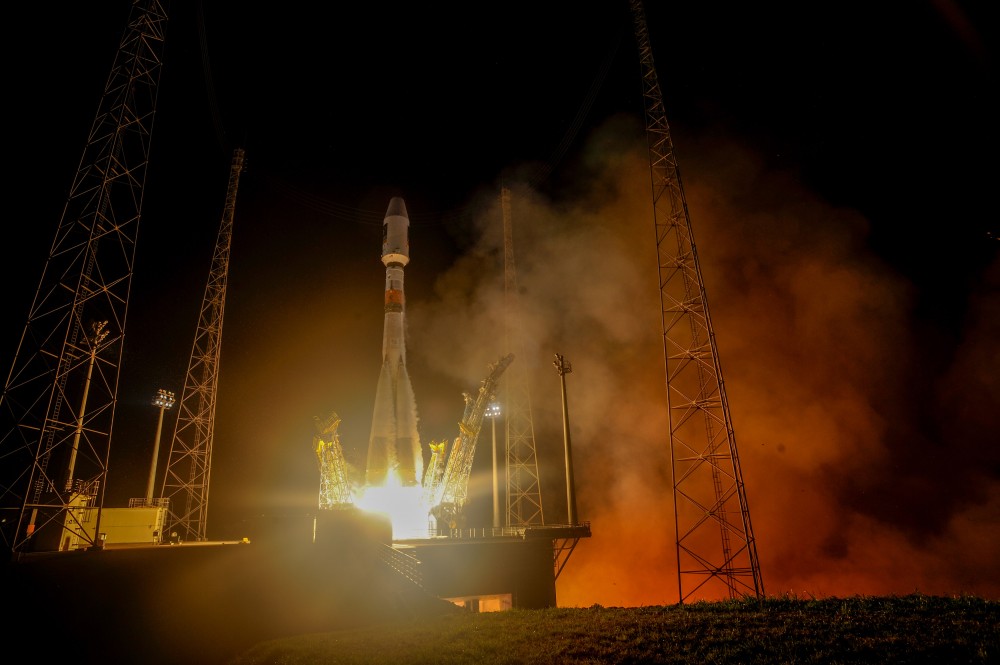
    Galileo 9 and 10 lift off. (Credit: ESA)
    Galileo 9 and 10 lift off. (Credit: ESA)

    Galileo satellites 9 and 10 are functioning perfectly, and the initial series of flight operations is continuing as part of the critical launch and early orbit phase, according to a European Space Agency Rocket Science blog by Daniel Scuka, senior editor for Spacecraft Operations at ESOC, ESA’s European Space Operations Centre, Darmstadt, Germany.

    Galileo 9 and 10 lifted off together on Sept. 11 from Europe’s Spaceport in French Guiana atop a Soyuz launcher, bringing the total number of Galileo satellites in orbit to 10.

    “The pair are being stepped through an intense series of check-outs, confirmations, mode changes, configurations and health verifications by the joint ESA/CNES mission team working around the clock at ESOC, Darmstadt, Germany,” according to the blog. “The team are now focusing on conducting a series of thruster burns designed to start the drift of the two satellites toward their target orbital positions.”

    “Following the burns performed during the LEOP (launch and early orbit phase), the satellites will continue naturally drifting, ending up in their final desired operational orbits at about 23,222 km after another set of thruster burns, planned to achieve fine positioning in orbit, around the end of October,” said Liviu Stefanov, co-flight director from ESA.

    With the excellent performance of the spacecraft and the ground teams, the LEOP is expected to wrap up soon.

    All the Soyuz stages performed as planned during the September 11 launch, relieving anxieties tied to a faulty Soyuz launch in September of last year. The Fregat upper stage released the satellites into their target orbit close to 23,500 km altitude, around 3 hours and 48 minutes after liftoff.

    “The deployment of Europe’s Galileo system is rapidly gathering pace,” said Jan Woerner, director general of the European Space Agency (ESA). “By steadily boosting the number of satellites in space, together with new stations on the ground across the world, Galileo will soon have a global reach. The day of Galileo’s full operational capability is approaching. It will be a great day for Europe.”

    Two more Galileo satellites are scheduled for launch by end of this year. These satellites have completed testing at ESA’s ESTEC technical centre in Noordwijk, the Netherlands, with the next two satellites also undergoing their own test campaigns.

    More Galileo satellites are being manufactured by OHB in Bremen, Germany, with navigation payloads coming from Surrey Satellite Technology Ltd in the UK, in turn utilizing elements sourced from all across Europe.

    “Production of the satellites has attained a regular rhythm,” said Didier Faivre, ESA’s Director of Galileo and Navigation-related Activities. “At the same time, all Galileo testing performed up to now — including that of the ground segment — has been returning extremely positive results.

    “And while the continuing deployment of Galileo remains our priority, along with exploitation of EGNOS — Europe’s already operational satellite navigation augmentation system — ESA is also looking farther ahead.

    “With the European Commission, we are doing the technical work to ensure Galileo goes on forever — locking in continuity of Europe’s navigation services into the long term, to meet performance on a par with the other global satellite navigation systems.”

    Next year Galileo deployment will be boosted by operation of a specially customized Ariane 5 launcher that can double, from two to four, the number of satellites that can be inserted into orbit with a single launch.

    European SBAS Advances, Improves

    After extensive ground and space testing, the SES-5 GEO satellite has entered into the European Geostationary Navigation Overlay Service (EGNOS) operational platform, broadcasting EGNOS Signal-In-Space (SIS). Replacing Inmarsat-4F2, SES-5 will ensure reliable EGNOS services until 2026, and will enable a range of performance improvements. In particular, EGNOS will offer even greater stability during periods of high ionospheric activity.

    “SES-5 is the first step of the complete renewal of the EGNOS Space Segment, securing the EGNOS services for the next decade and the future transition to the dual-frequency multi-constellation services,” said Carlo des Dorides, European GNSS Agency executive director. “It will be completed by the introduction of the ASTRA-5B signals and the procurement of a new EGNOS payload which are both planned for 2016.”

    SES-5, carrying EGNOS L1 and L5 band payloads, was launched in July 2012. The integration of a second EGNOS SBAS L1/L5 band payload on SES ASTRA-5B GEO satellite is currently ongoing. The introduction of the second SES GEO satellite for EGNOS is planned at the end of 2016.

    GAO Report Spotlghts OCX Delays, Cost Increases

    According to a report released by the U.S Government Accountability Office (GAO) on Sept. 9, titled “Actions Needed to Address Ground System Development Problems and User Equipment Production Readiness,” the Air Force has experienced significant difficulties developing the GPS next-generation operational control system (OCX). According to the report, completion of OCX will require $1.1 billion and four years more than planned to deliver OCX. The report Highlights section states, “The Air Force began OCX development in 2010,” and “accelerated OCX development in 2012 to meet optimistic GPS III satellite launch timeframes even as OCX development problems and costs grew, and then paused development in 2013 to address problems and resolve what it believed were root causes.

    “However . . . OCX cost and schedule growth have persisted due in part to a high defect rate, which may result from systemic issues. Further, unrealistic cost and schedule estimates limit OSD visibility into and oversight over OCX progress. “ The full report may be read online.

    During the course of development the Air Force made changes, updating the specifications for connections to other government systems and in the M-code signal requirements. Officials for Raytheon, the prime OCX contractor, estimated that, as a result of various modifications “nearly two-thirds of the requirements baseline as of [preliminary design review] had changed by mid-2012.” Subsequent software updates and modifications contributed to a high defect rate in the OCX software. “

    If you have requirements change at the same time you’re developing the software, it’s more likely that you could have a higher amount of defects that you have to change after the fact,” said Matthew Gilligan, Raytheon’s vice president for navigation and environmental solutions.

  • More, More, More. Accuracy, Accuracy, Accuracy.

    More, More, More. Accuracy, Accuracy, Accuracy.

    Reliable, consistent positioning accuracy has always driven new product development in the survey and mapping sector of the GPS/GNSS market. It’s remarkable how quickly the provided accuracy in successive new survey products over the years has increased the required accuracy from users and customers in the field, and consequently the desired accuracy in a feedback loop to the product developers.

    In other words, the degree of required accuracy has risen steadily over the three and a half decades since GPS was born. “Accuracy is addictive.” Somebody said that in the second decade of GPS development, that is, sometime in the 1990s. This statement continues to hold true, as true for this industry as Moore’s Law does for computer technology as a whole.

    Moore’s Law states that overall processing power for computers will double every two years; as a corollary or an extension, the size of said computers gets cut in half every two years, and the cost (sometimes) also comes down by 50 percent. Moore’s Law in action in the GPS/GNSS industry has driven the product developments that we have consistently seen for many years.

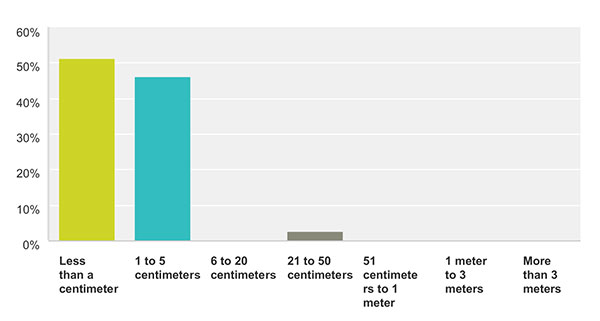
    We have seen the gradual tightening of accuracy requirements across all sectors of the positioning, navigation and timing (PNT) community with each passing year and with each new State of the Industry Report. This is the first time we have seen it cross the 1-centimeter line. Not in capability; sub-centimeter capability has been available for some time. But now that level of performance is the minimum acceptable “good enough” for more respondents in the survey and high-precision sector than any lesser degree of accuracy; in fact, greater than all other ranges combined.

    To put this into measurable, statistical form, GPS World has just released its fourth annual “State of the GNSS Industry Report.” In the years that we have conducted the survey, the accuracy required for the majority of survey applications has steadily come down. No surprises here.

    In 2013, those who said that the majority of this market sector needed accuracy of better than a centimeter amounted to only 8 percent of total respondents.

    In 2014, this group rose dramatically to 35 percent, while close to a majority, or 47 percent, held that a range of 1 to 5 centimeters was “good enough.”

    Now, in this year of 2015, the majority has shifted clearly to the side of 1 centimeter or better as the new standard of required precision; 51.25 percent held this view. From 8 percent to more than half in just two years — that’s some change!

    How accurate is good enough for the majority of this sector?
    How accurate is good enough for the majority of this sector?

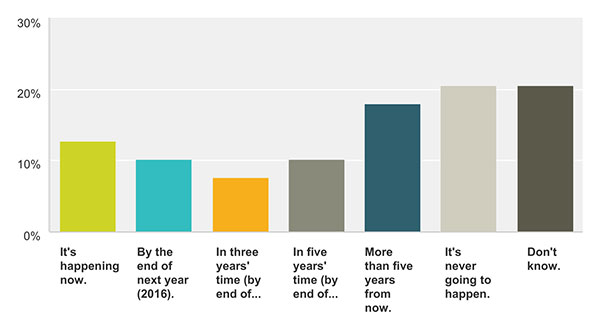
    Fewer people believe that a survey done completely on a computer and driven by remote-sensor data will occur in less than five years. Counter to last year’s expectations, most now think it will take longer than five years to come about.

    How soon will a survey be performed entirely from a computer, using high-resolution satellite and/or UAV-collected data, without any instrumented field work?
    How soon will a survey be performed entirely from a computer, using high-resolution satellite and/or UAV-collected data, without any instrumented field work?

    Those who are addicted to 1-centimeter accuracy form the new majority. Their preferences and their behaviors will rule the positioning world, not just in survey, but across all sectors supplied by GNSS and increasingly by a broad range of PNT technologies: defense, transportation, UAVs, machine control, precision agriculture, and much more. These other sectors will presumably answer likewise — “1 centimeter accuracy, that’s what I need!” in coming years, following the trail blazed by the you high-precision surveying pioneers.

    We have crossed the Rubicon. Unlike other obsessive behaviors, there is no going back in our case. This path is a one-way road to to the promised land of always-on, always-true, near-perfect provision of positioning.

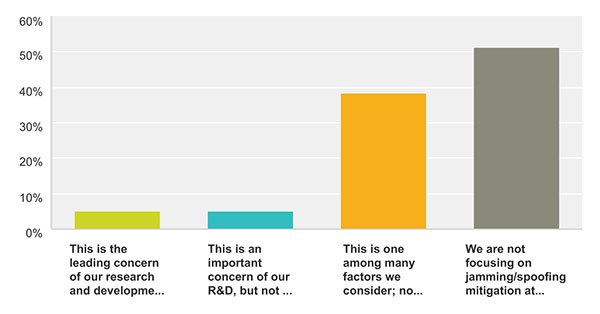
    How much effort are you devoting to mitigation of GNSS jamming or spoofing?
    How much effort are you devoting to mitigation of GNSS jamming or spoofing?


    Graphics: GPS World staff

  • Out in Front: Addiction on the Rise

    Out in Front: Addiction on the Rise

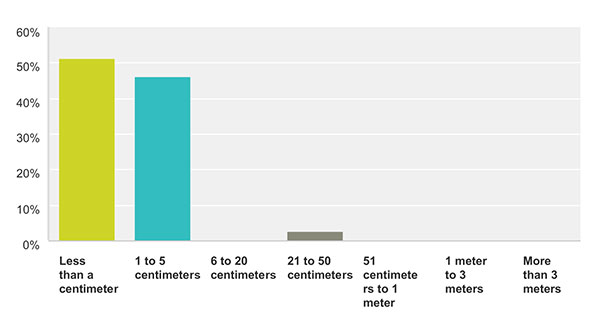
    How accurate is good enough for the majority of your market sector? This chart show the answers from those who identified themselves as members of the survey and high-precision community. For more results from this and other sectors, see the 2015 State of the GNSS Industry Report.
    How accurate is good enough for the majority of your market sector? This chart show the answers from those who identified themselves as members of the survey and high-precision community. For more results from this and other sectors, see the 2015 State of the GNSS Industry Report.

    Memory fails as to who first said “Accuracy is addictive.” Or perhaps it’s my knowledge base that is deficient. At any rate, I’ll gladly publish documented evidence from anyone who can show the earliest — print or audio — expression of that dictum. It continues to hold as true for this industry as Moore’s Law does for computer technology as a whole.

    We have seen the gradual tightening of accuracy requirements across all sectors of the positioning, navigation and timing (PNT) community with each successive iteration of our State of the GNSS Industry Survey, now in its fourth year. This is the first time we have seen it cross the 1-centimeter line. Not in capability; sub-centimeter capability has been available for some time. But now that level of performance is the minimum acceptable “good enough” for more respondents in the survey and high-precision sector than any lesser degree of accuracy; in fact, greater than all other ranges combined. These addicts form the new majority. Their preferences and their behaviors will rule our world.

    Other sectors will presumably answer likewise in coming years, following the trail blazed by the high-precision pioneers.

    We have crossed the Rubicon. Unlike other obsessive behaviors, there is no going back in our case. This path is a one-way road to  — well, not to the various hells entailed by other addictions — but to the promised land of always-on, always-true, near-perfect provision of positioning.

    Let’s not kid ourselves, however. The perfect world does not exist. The closer we get to millimetric accuracy, the more obstacles we find in our way. Indoor continuity aka ubiquity, jamming, spoofing, hacking, budget cutbacks, slides to the right — this list will surely grow.

    The more acute our addiction, the lower our tolerance for less-than-total fulfillment.

  • NDGPS Destined for the Technological Boneyard

    Let us not exaggerate — nor prematurely announce — the death of a subsystem. However, the demise of the U.S. Nationwide Differential GPS (NDGPS) network can be confidently foretold. Although a Federal Register notice dated Aug. 18 merely seeks public comment on plans to shut down a large portion of NDGPS, the handwriting is on the wall. Once having writ, the hand of fate moves on.

    We should neither lament nor applaud. NDGPS, like many other technologies, has seen its time come and go, while competitors have arisen to perform its role and take its place. Such is evolution in the industrial world as well as in the biological kingdoms.

    In 2016, three quarters of the currently operating NDGPS reference stations will be taken down and decommissioned. That’s not what the federal notice states, but that’s what it effectively says. The document’s comment period ends on Nov. 16. It is difficult to conceive of a public outcry that might reverse the intended course of the U.S. Coast Guard, Department of Transportation and Army Corps of Engineers.

    The NDGPS network had its birth in the 1980s, as a tool to provide real-time positioning accuracy for harbor entrances and coastal navigation. Inland components were added over the years to improve river navigation, NDGPS use in precision agriculture began to grow, and a role in railroad positive train control (PTC) was much discussed. But all these efforts could not gather enough momentum to firmly establish the network’s viability. Meanwhile, satellite-based differential services from both commercial providers and the U.S. government’s own Wide Area Augmentation System (WAAS), and a network of continuously operating reference stations (CORS) from the National Geodetic Survey continually nibbled away at NDGPS’s potential customer base. Consequently, industry fielded a meager range of radiobeacon DGPS receivers.

    The real death blow came in 2013, when the Federal Railroad Administration (FRA) eliminated an NDGPS requirement from its PTC program. The railroads, never a nimble industry nor one receiving the governmental support it enjoys in other countries, had by that time become the last hope of NDGPS. Ag users had already for the most part moved over to WAAS and commercial SBAS providers. Marine users did not by themselves form a sufficiently large constituency, and even they were not fully equipped nor wholesale adopters of the system.

    The story of Loran bears some similarities to NDGPS, but Loran now enjoys a resurgence that NDGPS will never see. It is destined for the technological graveyard. There is an ecosystem of positioning, navigation and timing (PNT) tools and applications. Operating in a free market, with some measure of governments’ interference and manipulation, it has its own patterns of natural selection. We will continue to see the rise and fall of species. NDGPS has now been branded a dinosaur. It will be interesting to see how other technologies, competing for the same finite range of resources, will interact, thrive, or decline.

  • Out in Front: Oh, the Wonder

    Out in Front: Oh, the Wonder

    Of it all. Of the broad expanse of the world and all its inhabitants, its layers, its depths and heights, the atmospheric mantle in which it wraps itself, its floating mountains of ice and its solid soaring peaks of rock and snow, its savage predators, and all its shades of human endeavor.

    Every August we marvel at the many applications of global positioning science, at real-world instances of hardware and software in the service of humankind and of Gaia itself.

    Eleven months out of the year we chronicle the business and technology of GNSS, as it says on the cover. Eleven months we busy ourselves with explorations of R&D, of novel concepts and experimental tests, of integration and augmentation and propagation and limitation and innovation; of algorithms and systems, theorems and OEMs, robotics and aeronautics, UAVs and degrees, integrity and capability and availability and mobility and connectivity and security, functionality and ambiguity and compatibility and velocity and linearity.

    Every once in a while we have to stop amid all this admittedly somewhat abstruse science and ask ourselves: “GNSS — what is it good for?”

    Answers are never lacking. Since Ivan Getting originated the idea of lighthouses in the sky for humanity in the 1960s, inventors have put forward new solutions for vexing problems — sometimes solutions for what we didn’t know was a problem, but upon investigation turns out to have a profitable resolution. Witness the stories in this issue, from sharks to space, from mountaintops to multi-sensor navigation under interference or heavy canopy.

    Not that we’ve loosened our grip for a moment on cutting-edge R&D. The article on chip transition-edge based signal tracking should fully satisfy that thirst for knowledge.

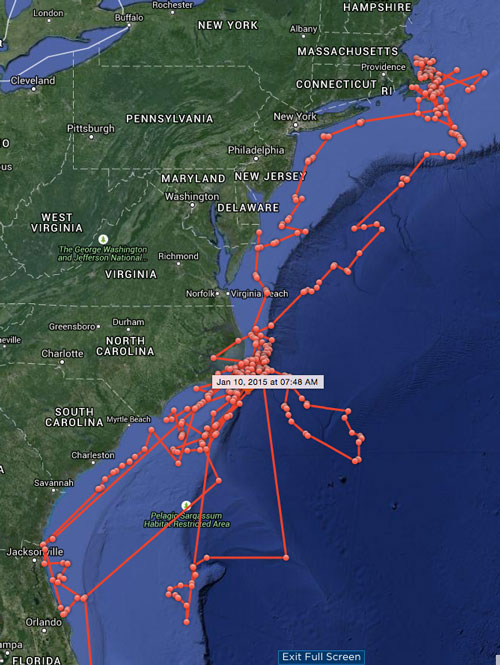
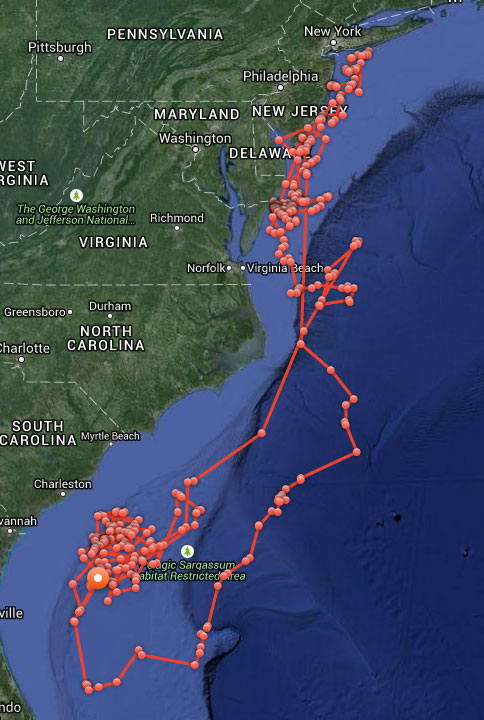
    Now about those sharks. In case you were wondering whether Katharine or Mary Lee might have been culpable in the seven shark bitings off North Carolina during May and June — they were not. The maps here and their GPS timelogs give both solid alibis for all the attacks in question.

    Katharine’s cruising over the past year.
    Katharine’s cruising over the past year.
    Mary Lee’s meandering over same time.
    Mary Lee’s meandering over same time.
  • To L2C or Not to L2C? That Is the Operational Question.

    Half of the GPS constellation now transmits the new civil signal, L2C. In a matter of weeks, that number will crest into the majority of the constellation when IIF-10 is set active and operational to users. By the end of the year or early 2016, look for 18 usable satellites transmitting L2C. That could be considered a nominal initial operating capability (IOC), though it is unlikely to be declared as such by the Air Force. We can anticipate a full operating capability (FOC) within five years. Many high-precision GPS receivers currently embody L2C signal processing capability.

    As Oscar Colombo, research scientist at NASA, noted in a recent CANSPACE contributed note, “This seems like a moment to start seriously thinking about using L2C as much as possible.”

    This month’s newsletter presents an amalgam, a panel discussion in virtual print, on several aspects and viewpoints stimulated by his posting,

    Some readers may want to peruse this U.S. government bulletin for a general description of L2C; others who feel sufficiently informed may skip directly two paragraphs down to “Three issues might be in the way of that being a practical proposition.”

    “L2C is the second civilian GPS signal, designed specifically to meet commercial needs. Its name refers to the radio frequency used by the signal (1227 MHz, or L2) and the fact that it is for civilian use. There are also two military signals at the L2 frequency. When combined with L1 C/A in a dual-frequency receiver, L2C enables ionospheric correction, a technique that boosts accuracy. Civilians with dual-frequency GPS receivers enjoy the same accuracy as the military (or better). For professional users with existing dual-frequency operations, L2C delivers faster signal acquisition, enhanced reliability, and greater operating range. L2C broadcasts at a higher effective power than the legacy L1 C/A signal, making it easier to receive under trees and even indoors. The Commerce Department estimates L2C could generate $5.8 billion in economic productivity benefits through the year 2030. The first GPS IIR(M) satellite featuring L2C launched in 2005. Every GPS satellite fielded since then has included an L2C transmitter.”

    Oscar Colombo’s CANSPACE note continues:

    “Three issues might be in the way of that [using L2C as much as possible] being a practical proposition, and I would appreciate comments on some or all of them:

    “(1) The fact that the new L2C navigation code (CNAV) is being transmitted, but flagged as pre-operational by the USAF, indicating that this organization is not yet ready to guarantee its fitness for use.

    “(2) The quarter-wave phase difference with the heritage signal L2.
    This one is important to know when fixing the ambiguities of differential observations (double differences and first order differences between satellites) combining L2C data from IIR-M and IIF satellites with those with only L2 (IIR and IIA). Some high-end commercial receivers correct for this phase difference, some don’t.  The latest RTCM document I’ve seen that touched on this issue came out in 2013 (RTCM Standard 10403.2, Paragraph 3.1.8, Table 3.1-5), and listed the choices , at that time, by nine leading manufacturers on this matter. The list does not include all of present-day manufacturers of high-end receivers, a list that changes over time.

    “(3) There is no proper place for L2C in files in the widely used Rinex 2.11 format.
    In principle, this can be taken care of by using data files in the Rinex 3 format. However, the use of Rinex 3, that has some major departures from 2.11, is not universal yet.

    “Does anyone  know of an up-to-date, reliable and comprehensive list of receiver manufacturers showing those that correct and those that do not correct for the quarter-wave phase shift?”

    GPS World contributing editors Eric Gakstatter (Geospatial Solutions) and Don Jewell (Defense) had a private conversation about the above, which I now make public.

    Don Jewell: “I can address this from a policy and operational perspective but you [Eric] have a better feel for the users perspective.

    “With two more successful IIF launches there will then be 18 L2C SVs broadcasting that signal, and that is considered by the government to be nominal IOC, an initial operating capability. Regardless of where you are on the Earth, shy of 60 deg N and 60 deg S, you should always have at least one or more L2C SVs in view.

    “We are probably looking at 2023 (8 more years) before the L2 carrier phase is in jeopardy of shifting without notice. If indeed that ever happens.

    “So from an operational and providers (HQ AFSPC, 50SW and 2SOPS) perspective, certainly the L2C signal should be useful and reliable. Just not normally guaranteed until FOC or full operational capability is declared, usually with 24 SVs broadcasting L2C. With no premature losses that will be halfway through the GPS III launch schedule ~ 2019-20.

    “Schedules are dynamic and always subject to change of course.”

    [Editor’s note: The L2 carrier isn’t going to go away or shifting to another frequency. What might go away is the P(Y) modulation on the L2 carrier if the DoD considers the P(Y) signals redundant once the M-code is fully embraced. If the P(Y) signal on L2 is no longer transmitted, then civil receivers currently using the P(Y) signal to obtain L2 carrier-phase measurements will no longer be able to do this.]

    Eric Gakstatter replied, “I’ve heard that some manufacturers say they are taking advantage of L2C when there are IIRM or IIFs in view and maybe some of the receivers I’m using are doing so. I’ve not paid attention to it.

    “It could be helpful in areas where users are trying to work in difficult environments such as near and under tree canopy.

    “In the case of RTK, I would think the reference station would have to broadcast L2C data.”

    A CANSPACE reader provided the following useful reference, which although it dates from 2012, still contains much immutable data: “The most recent view on the situation I have with L2C can be found here.”

    This links to the presentation slides from an American Geophysical Union 2012 Fall Meeting paper, “The Effects of L2C Signal Tracking on High-Precision Carrier Phase GPS Positioning: Implication for the Next Generation of GNSS Systems,” by Frederick Blume, Henry Beglund, and Lou Estey of UNAVCO, a non-profit university-governed consortium, facilitates geoscience research and education using geodesy.

    Oscar Colombo and other CANSPACE subscribers have contributed several further notes t the L2C discussion string.  To read them, it’s possible to access the archives here.
    Or you can more simply and elegantly subscribe to CANSPACE; see instructions here.

    Last month, Richard Langley and Oliver Montenbruck jointly communicated the following interesting aspect of the U.S. Federal Radionavigation Plan to CANSPACE readers:

    “in the new version of the FRP is a new phrasing of the earlier statement on guaranteed availability of the P(Y) signal only up to 2020:

    “The [U.S. Government (USG)] commits to maintaining the existing GPS L1 C/A, L1 P(Y), L2C, and L2 P(Y) signal characteristics that enable codeless and semi-codeless GPS access until at least two years after there are 24 operational satellites broadcasting L5. Barring a national security requirement, the USG does not intend to change these signal characteristics before then. Twenty-four satellites broadcasting the L5 signal is estimated to occur in 2024. This will allow for the orderly and systematic transition of users of semi-codeless and codeless receiving equipment to the use of equipment using modernized civil-coded signals. Note that it is expected that 24 operational satellites broadcasting L2C will be available by 2018, enabling transition to that signal at this earlier date. Civilian users of GPS are encouraged to start their planning for transition now.”

    Finally, Richard Langley notes that “I have a student looking into which Precise Point Positioning engines can currently process L2C observables, but his report is not yet available. Also, we are looking into adding an optional L2C processing capability to the University of New Brunswick PPP software, GAPS (GPS Analysis and Positioning Software), but that’s a month or so away.”

    As a postscript, there is a trending discussion at the LinkedIn group, GNSS R&D, Using C\A acquisition products to acquire L2C long code.