Author: Alan Cameron

  • New LightSquared, Same Agenda, Billions at Stake

    In a late June filing with the Federal Communications Commission (FCC), Lightsquared asked the agency to reassign its spectrum licenses — which were at the root of a prolonged dispute in 2010 and 2011, and have never been fully utilized —  to a new licensee that would be wholly owned by a new company, New LightSquared. This is part of LightSquared’s efforts to re-emerge from bankruptcy.

    LightSquared wants to resume its own interference testing scheme, floated in 2011 after an independent, collaborative effort found ample LightSquared interference with GPS. The company has contracted with Roberson and Associates, a technology consulting firm, to develop its interference study.

    LightSquared is being represented before the FCC by Reed Hundt, a former FCC chairman who served from 1993 to 1997.

    LightSquared listed 28 different GPS receivers and related devices that it wants to test for interference with its terrestrial mobile broadband service. The devices include certified and non-certified aviation receivers and avionics equipment, general location, cell phones and 13 different high-precision clocks and receivers.

    Hundt specificaly identifed three companies — Trimble, Garmin, and John Deere — that he wants to come forward and provide proprietary technical and business information “in confidence” to tester Roberson. In statements to the FCC, Hundt twice used the phrase “speak now or forever hold your peace.”

    In March of this year, LightSquared obtained U.S. court permission to exit bankruptcy protection, which it entered in 2012. At that time, the FCC had concluded, after lengthy testing, hearings, charges and countercharges, that the wireless broadband service  proposed by LightSquared would interfere with GPS signals and associated positioning, navigation, and timing.

    New LightSquared reportedly has $1.25 billion in operating funds to help “make full use of its spectrum to provide existing and innovative services.”

    In a recent trial involving the assets of the bankrupt company, the value of its spectrum bands was estimated at possibly $4.5 billion or higher.

    GPS Industry Response. The GPS Innovation Alliance responded in early July to media reports on LightSquared’s position regarding the testing of the compatibility of terrestrial broadband and GPS.

    Following is the GPS Innovation Alliance’s response:

    “The GPS Innovation Alliance (GPSIA) supports a consensus-driven process, including all government and non-government stakeholders, to clearly identify and address remaining technical issues raised by LightSquared proposals to repurpose mobile satellite spectrum for terrestrial broadband use.

    “The technical challenges posed by these proposals are formidable, as evidenced by the conclusions of multiple U.S. government entities. Specifically, the U.S. Departments of Defense and Transportation and the NTIA have all found in the last several years that LightSquared’s proposals have significant potential to interfere with GPS.

    “Contrary to LightSquared’s recent suggestions, this is not simply a private matter between three GPS companies and LightSquared, but is important to all GPS users who rely on this critical technology every day. The Department of Transportation has sponsored an ongoing effort to assess adjacent band issues, and the GPS industry is actively engaged with the Federal Communications Commission (FCC), Department of Transportation (DOT) and other government stakeholders to drive consensus around next steps.

    “While we welcome the participation of LightSquared consultants, any further analysis of the technical issues should be informed by input from all of the relevant stakeholders, rather than the one-off efforts of an interested party.”

  • Out in Front: The State of Our Union, 2015

    Sometimes you have to stop and, yes, smell the roses, but also survey just how far you’ve come, where you stand at this actual moment, and what directions hold the most promise for the future. When you’re moving as fast as the GNSS and PNT industries do, a periodic pause to assess becomes even more vital.

    That’s why we conduct the annual State of the Industry Survey, which generates the State of the Industry Report.

    Your part in this, the Survey, starts July 15, when the online survey will be posted at env-gpsworld-integration.kinsta.cloud/State15, and remain at that link until August 10.

    Our part, the Report of your filings, will appear in the September issue.

    Past State of the Industry Reports have borne such insights as these.

    September 2012. “Careful optimism appears to be the watchword for the GNSS industry as we head into the next year, tempered with the reality that a full economic recovery has not yet arrived; 65 percent of respondents described the market for GNSS products and services as enjoying either moderate growth or strong growth. ‘With the economy in the state it is in, competition is very tight. That is all right, it keeps our pencils sharp,’ wrote one industry veteran.”

    September 2013. After the passage of one year, 69 percent described the market for products and services in their sector as either relatively healthy or very healthy. That’s what’s known in economic circles as “a modest increase.”

    Dominating executives’ and managers’ awareness as a key issue shaping the future that year were three candidates, according to John Pottle of Spirent Communications. “Vulnerability of GNSS signals, the flurry of activity following the release of the BeiDou system ICD, and the continuing indoor navigation challenge. Whatever your viewpoint, one thing is clear: there remain plenty of challenges for us all, as indusry insiders, to solve over the coming years.”

    October 2014. With another 13 months under our collective belt, we had not fully mastered any of those top three challenges — but we had logged significant progress. Jamming, both intentional and unintentional, along with spoofing led all concerns for 28 percent of survey respondents, and if “constellation health” were added to those worries, fully half of our experts — meaning you — deemed this the industry “issue of the year.” Meanwhile, the percentage of those finding moderate to strong growth in their sector had risen to 74.

    Michael Ritter of NovAtel spoke for many when he wrote, “Ultimately, GNSS itself will no longer be enough. Ubiquitous positioining requires multi-sensor fusion that can exponentially increase availability.” And he revealed that NovAtel spends 30 percent of its annual revenue on research and development.

    The Future Begins Now. Only you, in your collective wisdom, can tell us where we stand and where we’re headed. I encourage you to help us compile the State of the Industry by filling out a relatively quick online questionnaire. Look for it to be posted on July 15.

  • eLoran Progresses Toward GPS Back-Up Role in U.S., Europe

    eLoran Progresses Toward GPS Back-Up Role in U.S., Europe

    eLoran-restart-W
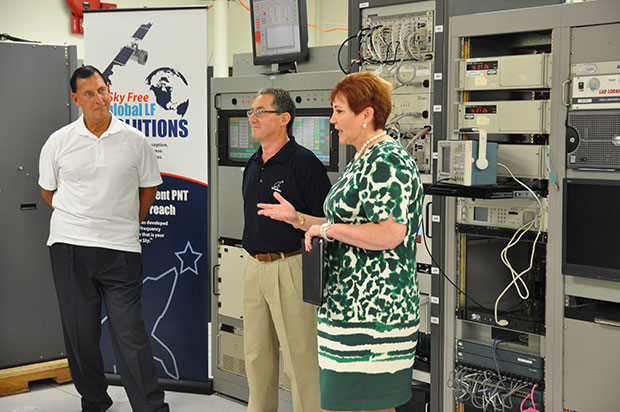
    (fFrom left) Congressman LoBiondo, UrsaNav CEO Chuck Schue and Harris Division President Pam Drew. (hoto Credit: Andrei Grebnev, UrsaNav)

    As of June 19, eLoran is on the air in the United States. The low-frequency signal emanates from a single station, a former U.S. Coast Guard Loran Unit in Wildwood, N.J., which sports a 625-foot signal mast that has been out of action for five years. The signal is receivable at distances of up to 1,000 miles.

    The facility began generating eLoran pulses at the press of a command button by Congressman Frank LoBiondo (R, N.J). Present for the ceremonial start of a 12-month demonstration and research program under the aegis of the Department of Homeland Security were project participants Charles Schue, CEO of UrsaNav; Pam Drew, president of Harris Information Systems; and Dana Goward, president of the Resilient Navigation and Timing Foundation.

    Brief remarks delivered at the turn-on collectively made the key points that:

    • GPS services are essential to national and economic security, yet are vulnerable to disruption.
    • The eLoran navigation and communications signal has  features that are complementary to GPS, making it difficult to disrupt; further, it could be an important part of enabling UAVs to fly safely in our airspace.
    • The U.S. Federal Radionavigation Plan cites not being critically dependent upon a single system for positioning, navigation, and timing as a national policy objective. The plan specifically identifies eLoran testing as an important step toward reaching that objective.

    The two engineering companies, UrsaNav, a supplier of eLoran technology, equipment, and services, and Harris (which recently acquired Exelis), provide funding and technology for the tests supported by the U.S. Coast Guard, Department of Defense, Department of Homeland Security and other federal agencies under a Cooperative Research and Development Agreement (CRADA) announced in May.

    The team will evaluate eLoran as a potential complementary system to GPS, exploring the capabilities and use methods of eLoran in depth to identify all strengths, capacities, and potential vulnerabilities of the technology. One goal of the CRADA is to reduce the size, weight, cost, power needs and other aspects of Loran, similar to what has evolved with GPS.

    “This is a phoenix arriving. We have the opportunity to add 2015 technology to the older idea,” said Schue of UrsaNav, once Coast Guard commanding officer at the former Loran station. “A prudent mariner always has two systems to navigate.”

    Dana Goward, also a retired Coast Guardsman whose non-profit Resilient Navigation and Timing Foundation is working on the project, stated that eLoran can attain positioning accuracy of six meters or better.

    “We will explore many places eLoran can be deployed where GPS isn’t available such as deep canyons, through buildings, in foliage and under water,” added Harris Corp.’s Drew. “We’re involved with unmanned aerial drones, and eLoran could be key. There are applications for civilian and military uses.”

    In this GPS World exclusive video, Admiral Thad Allen, former commandant of the U.S. Coast Guard, discusses PNT alternatives to GPS for navigation, including eLoran and the activation this week of the signal on the eLoran tower in New Jersey.

    eLoran in Europe

    Matters have moved a little further along in Europe. In 2013, the General Lighthouse Authorities of the UK & Ireland (GLA) established prototype eLoran Initial Operating Capability (IOC) in the United Kingdom, where eLoran now delivers PNT data at the 10-meter level from a network of high-power, low frequency, terrestrial transmitters.

    “To get high accuracy from eLoran requires accurate calibration of Additional Secondary Factor (ASF) through measurement,” according to paper delivered at the Institute of Navigation’s 2015 Pacific PNT meeting. “Can eLoran Deliver Resilient PNT?” was authored by Nick Ward, Chris Hargreaves, Paul Williams, and Martin Bransby of the GLA.

    The older Loran-C system suffered from significant positioning bias errors due to a number of radio frequency signal propagation delay factors, they write. “The Primary Factor (PF) is due to the signal travelling slower in air than free-space, the Secondary Factor (SF) is due to the presence of the Earth’s surface and the electrical properties of the oceans. Additional Secondary Factor (ASF) is due to the additional electrical resistance encountered by non-seawater terrain, land, mountains, deserts, and so on. PF and SF can be modeled, but to get high accuracy from eLoran requires accurate calibration of ASF through measurement.

    “To do this,” they continue, “ASF surveying and mapping has been conducted along the port approach channels at Aberdeen; along the Firth of Forth; Middlesbrough; Hull and the Humber Estuary Traffic Separation Scheme (TSS); Harwich and Felixstowe; The ports of London, Medway and the approaches past the London Array wind-farm and also through the Dover Straits.

    “To complement these services, seven differential-Loran (DLoran) Reference-Stations, one located close to each of these survey areas have been established. These stations monitor the time of arrival of the received eLoran signals, and generate differential-corrections that are broadcast via the Anthorn Loran Data Channel (LDC), to account for temporal variations in these ASF maps.

    “Making use of these ASF maps, combined with the locally-produced differential corrections, can allow a maritime user of eLoran IOC to obtain position accuracy of the order of 10m (95%), within a radius of 30 to 50 km of the DLoran reference station.”

    See also “Back-up to Vulnerable GPS Signals Required for Busy Shipping Lanes.

    The GLA authors conclude that:

    1. eLoran can deliver Resilient PNT and this has been demonstrated on several vessels.
    2. Seamless handover from primary (GPS) to secondary (eLoran) positioning source has been successfully implemented.
    3. Surveying and mapping of ASF has been carried out for several major ports and the required levels of performance demonstrated.
    4. DLoran reference stations to correct for short-term, temporal variations have been installed and commissioned.
    5. Good levels of performance have also been demonstrated for coastal voyage phase away from the ASF surveyed areas.

    eDLoran in Rotterdam. The July 2014 issue of GPS World presented a cover story showing results of a newer version, enhanced differential Loran (eDLoran), yielding position accuracies of approximately 5 meters.


    vw-W

    eDLoran: The Next-Gen Loran

    Potential GNSS Back-up Improves to GPS-Level Accuracy

    A new enhanced differential Loran system demonstrates 5-meter accuracy not achievable by the current DLoran system, and requires less expensive reference stations. A prototype tested in Rotterdam’s Europort area uses standard mobile telecom networks and the Internet to reduce correction data latency — a key source of error — by one to two orders of magnitude.

    By Durk van Willigen, René Kellenbach, Cees Dekker, and Wim van Buuren

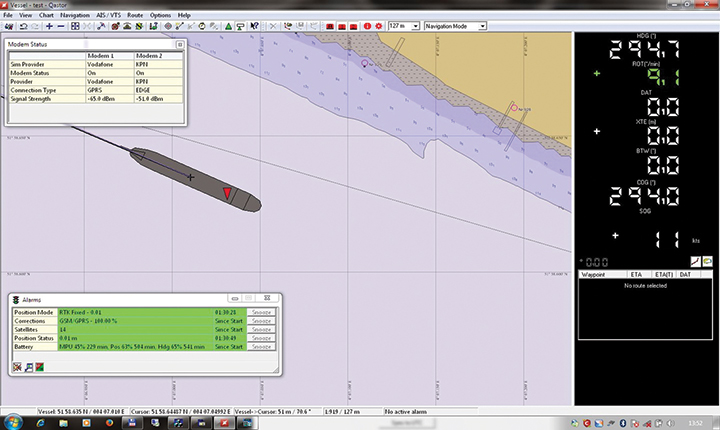
    Figure 12. The large ship symbol (grey) is derived from the GPS-RTK receiver of the Rotterdam pilots. The width of the ship symbol is 10 meters and the speed-over-ground was 11 kts. The red triangle is generated by the eDLoran receiver and remains between the required ± 5 meter limits for eDLoran.
    Figure 12. The large ship symbol (grey) is derived from the GPS-RTK receiver of the Rotterdam pilots. The width of the ship symbol is 10 meters and the speed-over-ground was 11 kts. The red triangle is generated by the eDLoran receiver and remains between the required ± 5 meter limits for eDLoran.
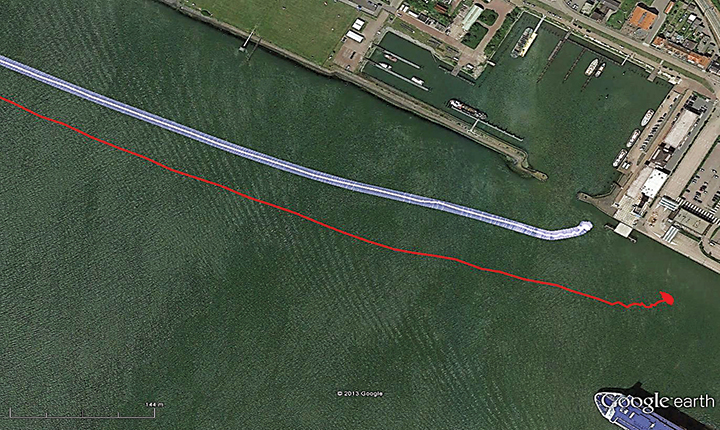
    Figure 13. The red track is based on raw eLoran data without any corrections. The transparent blue line is made by GPS-RTK and is widened to 10 meters giving the required ± 5 meter limits of eDLoran. The white line is output from the eDLoran receiver which stays within the borders of the 10 meter wide transparent blue line.
    Figure 13. The red track is based on raw eLoran data without any corrections. The transparent blue line is made by GPS-RTK and is widened to 10 meters giving the required ± 5 meter limits of eDLoran. The white line is output from the eDLoran receiver which stays within the borders of the 10 meter wide transparent blue line.

    The GLA authors from the UK give a perspective on the Rotterdam project, as follows:

    “A compatible system (eDLoran) has been developed for operation by ships’ pilots on the Europort approach to the Port of Rotterdam.

    “However, Loran is a regional system dependent on international collaboration. The 9 transmitters in northern Europe are operated by Denmark, France, Germany, Norway and the UK.

    “Both Norway and France have declared an intention to cease Loran transmissions at the end of 2015. Moreover, France intends to dismantle its Loran infrastructure in 2016. Arrangements for the commercial operation of the infrastructure are being investigated, but this depends on some form of regional agreement. The European Union appears to have no policy for resilient PNT, the European Radio Navigation Plan having twice been drafted but never published. The view seems to bee that the introduction of Galileo will achieve resilient PNT, which it will not.”

    And Elsewhere

    South Korea is implementing a national eLoran service, and it is understood that similar plans are being considered in Russia and China.

    Meanwhile, the U.S. Army is interested in eLoran PNT for the warfighter.

  • Establishing Orthometric Heights Using GNSS — Part 1

    Establishing Orthometric Heights Using GNSS — Part 1

    Editor’s Note: This month, we introduce a column by David B. Zilkoski, one of our two new Survey Scene editors. Zilkoski has worked in the fields of geodesy and surveying for more than 40 years, including serving as director of the National Geodetic Survey. See his full bio at the end of this article. He is joined by coeditor David Doyle, who contributed the May column.


    The Three Types of Heights Involved in Computing GNSS-Derived Orthometric Heights

    By David B. Zilkoski

    David B. Zilkoski
    David B. Zilkoski

    This column is the first in a series of newsletters discussing issues associated with establishing orthometric heights using GNSS. The purpose of my columns is not to promote a particular procedure or process, but to provide the reader with information and analysis tools to consider when using GNSS to estimate orthometric heights.

    This information is not new. During the past two decades, I have written several articles and papers on estimating GNSS-derived orthometric heights and presented numerous seminars describing guidelines on how to estimate GNSS-derived heights. However, due to the automation of technology and “blackbox” processes, many users are accepting results without performing the proper analysis to ensure that their results are reasonable and correct. These processes and procedures are not difficult to perform, but they can be very beneficial to obtaining an understanding of the accuracy of your results and ensuring your results are correct.

    To understand how to estimate GNSS-derived orthometric heights at centimeter-level accuracy, you must have a basic understanding of the types of heights involved, how these heights are defined and related and how accurately these heights can be determined. In other words, you need to obtain a basic understanding of ellipsoid, geoid and orthometric heights and how they are related and their estimated accuracies.

    To adequately address these topics, a series of Survey Scene newsletters will be separated into several sections. Some of this material will be a review (and probably boring) for those of you that have been performing GNSS-derived orthometric height surveys but, hopefully, you will gain a little benefit from the review. For those of you just starting out, I hope this will whet your appetite to obtain a better understanding of heights.

    The following is a brief outline of what the columns will address:

    • Description of the three types of heights involved in computing GNSS-derived orthometric heights. That is, the definition of ellipsoid, geoid and orthometric heights, and how they are related. The user should understand what potential issues can arise due to how each height was defined, modeled and published. For example, in the United States, what errors exist in the published NAVD88 heights due to the leveling network design and remaining systematic errors in the leveling data? Constraining a North American Vertical Datum of 1988 (NAVD 88) published height that’s less accurate than your GNSS-derived orthometric height may allow your results to be consistent with the surrounding published heights, but could be distorting the rest of your results. In the end, you may need to do that, but you should know how your decision has influenced the rest of your results. I was the NAVD 88 project manager, so I know where all the problems are hidden. I am just kidding about knowing where all the problems are hidden, but there are issues associated with performing a nationwide network adjustment. NGS’ latest scientific geoid models can be useful in identifying potential issues in NAVD88.
    • Basic procedures for detecting published NAD 83 (2011) ellipsoid height outliers and how repeatability does not mean accuracy. Why you can’t assume that the published ellipsoid heights between two closely spaced stations is accurate to the published formal errors.
    • A description of the differences between a scientific gravimetric geoid model and a hybrid geoid model, and why it is important to use both geoid models in your analysis. The latest NGS hybrid geoid model, Geoid12B, is made consistent with the published NAVD 88 heights. This means you will be consistent with NAVD 88 when using GEOID12B to estimate GNSS-derived orthometric heights. However, this doesn’t guarantee that your GNSS-derived orthometric heights are accurate. NGS’s new beta experimental geoid height model xGEOID14B is not distorted to fit the published NAVD 88 heights, so it is useful for identifying valid NAVD 88 benchmarks.
    • Basic procedures for validating NAVD 88 height constraints used to estimate GNSS-derived orthometric heights. How to ensure your monuments haven’t moved since their last survey, and how good are your leveling-derived orthometric height constraints? Based on all available information and data, basic procedures to determine how good the final set of GNSS-derived orthometric heights really are. NGS 59 guidelines outline basic rules and procedures that need to be adhered to for computing accurate NAVD 88 GNSS-derived orthometric heights.
    • A description of NGS’ proposed 2022 Vertical Reference Frame and why it will be a good replacement for NAVD 88.

    Background

    Since 1983, NOAA’s National Geodetic Survey (NGS) has performed control survey projects in the United States using GPS satellites. NGS used these early GPS surveys projects to develop guidelines and procedures to estimate GPS-derived orthometric heights. These publications are known as NGS 58 and NGS 59.

    Over the past three decades, GNSS surveying techniques have proven to be so efficient and accurate that they are now routinely used in place of classical line-of-sight surveying methods for establishing vertical control networks at the 2-cm level. Understandably, interest has been growing in using GNSS techniques to replace all leveling requirements. During the next decade, scientists will continue to develop better models and tools to facilitate GNSS-derived orthometric heights replacing classical line-of-sight surveying for many applications. In the meantime, it is important to have a clear understanding of the basic concepts of establishing GNSS-derived orthometric heights, otherwise water (or something worse) may not flow “down hill.”

    Let’s start with a review of the three types of heights used when estimating GNSS-derived orthometric heights and how they are related.

    Types of Heights and Their Relationship

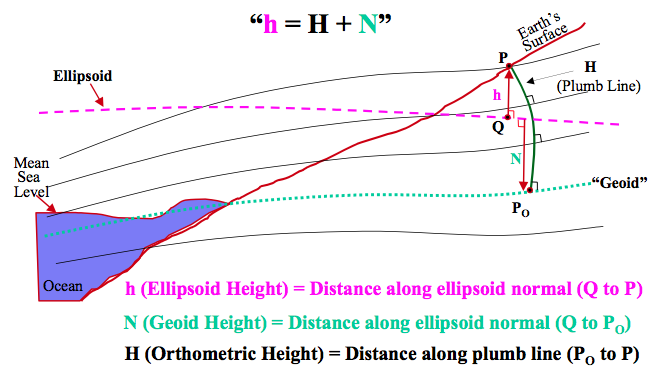
    Orthometric heights (H) are referenced to an equipotential reference surface, e.g., the geoid. The orthometric height of a point on the Earth’s surface is the distance from the geoidal reference surface to the point, measured along the plumb line normal to the geoid. These are the heights most surveyors have worked with in the past and are often called mean sea-level heights.

    Ellipsoid heights (h) are referenced to a reference ellipsoid. The ellipsoid height of a point is the distance from the reference ellipsoid to the point, measured along the line that is normal to the ellipsoid. Years ago, the term ellipsoid height may have been a new concept to many traditional surveyors, but prevalent today because ellipsoid heights are readily derived from GNSS measurements.

    At the same point on the surface of the Earth, the difference between an ellipsoid height and an orthometric height is defined as the geoid height (N). It should be noted that h=H+N is an approximate equation because H is measured along the plumb line normal to the geoid, where h is measured along a line normal to the ellipsoid (see Figure 1). For all practical survey projects, this small difference can be ignored.

    Figure 1. Relationship of ellipsoid, geoid and orthometric heights.(Figure from POB article by David Zilkoski, The GPS Observer column, Feb. 28, 2001)
    Figure 1. Relationship of ellipsoid, geoid and orthometric heights.(Figure from POB article by David Zilkoski, The GPS Observer column, Feb. 28, 2001)

    Several error sources that affect the accuracy of orthometric, ellipsoid and geoid height values are generally common to nearby points. Because these error sources are in common, the uncertainty of height differences between nearby points is significantly smaller than the uncertainty of the absolute heights of each point. This is the key to establishing accurate orthometric heights using GNSS.

    Orthometric height differences (dH) can then be obtained from ellipsoid height differences (dh) by subtracting the geoid height differences (dN):

    dH = dh – dN

    Each of these heights and height differences have systematic errors that are accounted for by following appropriate procedures during data acquisition, by applying corrections based on environmental conditions and models, and/or estimating parameters using adjustment techniques. There will always be remaining errors that are not accounted for, and you must perform the appropriate procedures to detect, reduce or eliminate these errors in the final set of GNSS-derived orthometric heights.

    Relative Accuracy Estimates

    Adhering to NGS guidelines (NGS 58), ellipsoid height differences (dh) over short baselines (less than 10 km) can now be determined with 2 sigma uncertainties that are typically better than +/ 2 cm. The requirement that each baseline must be repeated and agree to within 2 cm of each other, and they must be repeated on two separate days, during different times of the day, should provide a final GNSS-derived ellipsoid height better than 2 cm at the 2-sigma level. The requirement that spacing between local network stations cannot exceed 10 km helps to keep the relative error in geoid height small.

    Adding in the small error for the uncertainty of the geoid height difference and controlling the remaining systematic differences between the three height systems will produce a GNSS-derived orthometric height with 2-sigma uncertainties that are typically +/- 2 cm. Therefore, it is possible to establish GNSS-derived orthometric heights to meet certain standards, not millimeter standards, but 2-cm (95%) standards are routinely met now using GNSS.

    When high-accuracy field procedures are used, orthometric height differences can be computed from measurements of precise geodetic leveling with an uncertainty of less than 1 cm over a 50 kilometer distance. Less accurate results are achieved when third-order leveling methods are employed. Depending on the accuracy requirements, GNSS surveys and present high-resolution geoid models can be employed as an alternative to classical leveling methods.

    In the past, the primary limiting factor was the accuracy of estimating geoid height differences. With the computation of the more accurate National high-resolution geoid models, e.g., GEOID12A, the limiting factor is ensuring that the NAVD 88 orthometric height values used to control the project are valid. Strategically occupying benchmarks with GNSS that have valid NAVD 88 height values is critical to detecting, reducing or eliminating blunders and systematic errors between the three height systems. (Note: Valid NAVD 88 height values include, but are not limited to, the following: benchmarks that have not moved since their heights were last determined, were not misidentified, and are consistent with NAVD 88.)

    Conclusion

    This newsletter addressed the basic concepts of GPS-derived heights. To reiterate, it is important that you understand there are three types of heights involved with estimating GNSS-derived heights: ellipsoid, geoid and orthometric. Each of these heights has its own error sources that need to be detected, reduced or eliminated by following specific procedures or applying special models. This series of newsletter columns will address these potential errors sources and provide procedures to assist you in identifying these errors.

    My next column in this series, coming in the August Survey Scene, will review guidelines for detecting, reducing or eliminating error sources in ellipsoid heights, and provide a brief discussion on using published NAD 83 (2011) ellipsoid heights in your analysis.

    References

    NOAA Technical Memorandum NOS NGS-58, Guidelines for Establishing GPS-derived Ellipsoidal Heights (Standards: 2 cm and 5 cm), Version 4.3.

    NOAA Technical Memorandum NOS NGS-59, Guidelines for Establishing GPS-derived Orthometric Heights (Standards: 2 cm and 5 cm), are available. These guidelines address the establishment and densification of vertical control networks through the use of GPS surveys and valid NAVD 88 orthometric control.


    David B. Zilkoski has worked in the fields of geodesy and surveying for more than 40 years. He was employed by National Geodetic Survey (NGS) from 1974 to 2009. He served as NGS director from October 2005 to January 2009. During his career with NGS, he conducted applied GPS research to evaluate and develop guidelines for using new technology to generate geospatial products. Based on instrument testing, he developed and verified new specifications and procedures to estimate classically derived, as well as GPS-derived, orthometric heights. 

    Now retired from government service, as a consultant he provides technical guidance on GNSS surveys; computes crustal movement rates using GPS and leveling data; and leads training sessions on guidelines for estimating GPS-derived heights, procedures for performing leveling network adjustments, the use of ArcGIS for analyses of adjustment data and results, and the proper procedures to follow when estimating crustal movement rates using geodetic leveling data.  

  • The System: SBAS Agree to Common Message

    The System: SBAS Agree to Common Message

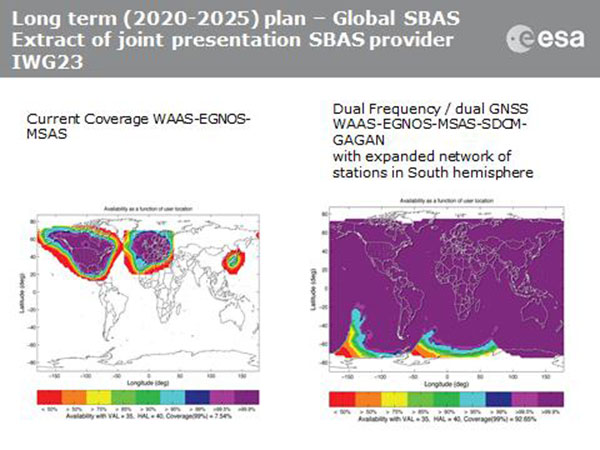
    current coverage (left) of WAAS, EGNOS and MSAS;  long-term 2020–2025 (right) plan for dual-frequency, dual-GNSS WAAS-EGNOS-MSAS-SDCM-GAGAN.
    Current coverage (left) of WAAS, EGNOS and MSAS;
    long-term 2020–2025 (right) plan for dual-frequency, dual-GNSS WAAS-EGNOS-MSAS-SDCM-GAGAN.

    SBAS Agree to Common Message

    Aircraft navigation and safety will benefit from enhanced, reliable satellite navigation signals on a seamless basis across much of the world in the 2020–2025 timeframe. The 28th Satellite-based Augmentation Systems Interoperability Working Group (IWG) came to agreement on standardization of satellite-based augmentation systems (SBAS) in a meeting hosted by the European Space Agency in early April. The group planned a shift from reliance exclusively on GPS to a multi-constellation design employing Galileo, BeiDou and GLONASS after 2020.

    The agreement centers around a message definition for a new secondary SBAS channel — to be known as L5, along with the current L1 — for second-generation SBAS systems, which will utilize dual-frequency multi-constellation signals, greatly increasing the accuracy of navigation systems available to airliners by largely eliminating ionospheric errors. Plans also call for an expanded network of stations in the Southern Hemisphere. The IWG document must now be accepted by the official international SBAS standardization bodies: the International Civil Aviation Organisation, the U.S. Radio Technical Commission for Aeronautics (RTCA) and the European Organisation for Civil Aviation Equipment.

    The meeting also reported on the state of development of the other global SBAS systems. Along with the four operational systems — the U.S. WAAS, European EGNOS, Japan’s Multi-functional Satellite Augmentation System (MSAS) and India’s GAGAN (GPS and geo-augmented navigation system) — these comprise South Korea’s KASS, China’s Beidou SBAS, Russia’s System for Differential Corrections and Monitoring (SDCM) and the West African Agency for Aerial Navigation Safety in Africa and Madagascar (ASECNA) SBAS.

    UAV Integration into Airspace

    The Federal Aviation Administration (FAA) announced two new initiatives related to unmanned aircraft systems (UAS) at the Association for Unmanned Vehicle Systems International (AUVSI) Unmanned Systems 2015 conference in Atlanta, Ga., in early May.

    FAA Administrator Michael Huerta told a large gathering of national journalists, “The unmanned aircraft industry is changing faster than any segment in the aircraft industry. A new project to harness that energy, the Pathfinder program, is partnering with three leading U.S. companies to expand unmanned aircraft operations in the United States.” The FAA is working with industry partners on three focus areas:

    • CNN will research visual line of sight (LOS) operations for newsgathering in urban areas. CNN will continue working with Georgia Tech University to improve newsgathering for all organizations.
    • PrecisionHawk will investigate agricultural operations for rural areas, flying outside LOS.
    • BNSF Railway, second-largest freight railroad network in North America, will undertake inspection of rail infrastructure, also beyond visual LOS.

    Huerta said that the partners, collectively, “are trying to push the envelope, what can we accommodate safely and what can we learn from that.  We’ll test a little, learn a little, then test some more. How do we see a staged implementation? To integrate unmanned aircraft, but to do it safely. We’re trying to push the edges of what we can allow, working with partners who have specific uses and resources.”

    As to a timeframe to reach new UAV regulations, he replied, “I can’t comment a lot on the rule itself, but it’s fair to say that in the rulemaking comment process [closed on April 24], we received more than 4,500 comments. It’s too early to say how those comments will shape the final rulemaking.

    “Assessment will be done in the coming months, perhaps by the end of the year, but that’s an aggressive timetable. That’s not accomplished in six months, nor should it take a million years.”

    New Airbus EGNOS-Capable

    The new Airbus A350 airliner, now entering service, comes fitted with EGNOS. The EGNOS system is being adopted by European airports to enable satellite-guided landing approaches. The A350’s Satellite Landing System allows pilots to perform precision-landing approaches guided by EGNOS or its U.S. equivalent, WAAS. The capability offers vertical landing guidance down to a minimum of 60 miles.

    New Galileo Satellite on the Air

    Monitoring by researchers at the German Aerospace Center (Deutsches Zentrum für Luft- und Raumfahrt, or DLR) indicates that one of the Galileo full-operational-capability (FOC) satellites launched on March 27 has begun transmitting standard L-band signals using pseudorandom-noise-code identifier 22.

    The first E1 and E5 signals from GSAT0204, also known as FOC-FM4 and Galileo 8 and as NORAD object 40545, were received at an International GNSS Service Multi-GNSS Experiment tracking station in Windhoek, Namibia, at about 11:32 UTC May 21. The satellite’s signals were subsequently tracked by a station in Wettzell, Germany, and then by others. 

    The signals will be set unhealthy for use until satellite commissioning is completed.

    News item courtesy of CANSPACE Listserv.

    Euroship Gets eLoran as Backup

    Container ship in port.
    Container ship in port.

    Ship management company EuroShip Services Ltd. has installed eLoran as a backup to GPS to ensure the safety of its vessels operating off the coast of the United Kingdom.

    The trial installation may lead to implementation across the full fleet of  16 vessels managed by Euroship, working routes in Northern Europe. The land-based radio navigation system is intended to seamlessly take over in the event of a GPS outage. EuroShip plans to simulate GPS outages to test eLoran provision of position, navigation and timing data automatically.

    New GPS III RFP

    The U.S. Air Force (USAF) has released a draft Request for Proposal for GPS III Launch Services, encompassing launch vehicle production, mission integration and launch operations.USAF reintroduces competition into the Evolved Expendable Launch Vehicle (EELV) program after more than a decade.

    GPS III is the first of nine launches the Air Force intends to compete  between now and 2017, followed by 25 more from 2018 to 2022.

    SpaceX’s certification has just been granted, enabling the company to compete with United Launch Alliance (ULA) for national security launches.

  • Model Plane Fliers to Get Real-Time, Location-Based Flight Safety Info

    Model Plane Fliers to Get Real-Time, Location-Based Flight Safety Info

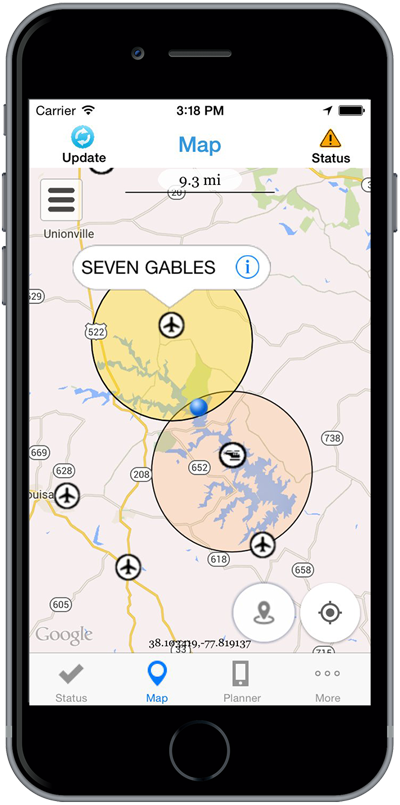
    Photo: B4UFLY iOS appToday’s second announcement of a new UAV-related initiative by the Federal Aviation Administration (FAA) was directed at private citizens: model airplane enthusiasts and hobbyists, also called modelers — not at industry or commercial use. See this story for information on the Pathfinder program for commercial drone use.

    A soon-to-be released smartphone app will proved users with real-time information on flight regulations, and restrictions for the user’s actual location; alternately, for a location to which the user is planning to travel to for a model plane flight. Named B4UFly, the app is designed to answer for users, “Is it safe and is it legal to fly my model aircraft based on where I am right now?” The overall goal is to encourage responsible use of model aircraft.

    The B4UFLY iOS app will be made available to 1,000 iPhone beta testers this summer. The first 700 emails received by [email protected] will make up the initial limited beta test group. The email is for model aircraft hobbyists only, who want to sign up for beta test. B4UFLY Version 1 for iOS will go out to the general public later this year. An Android app will come later.

    “Someone who got their first UAV as a gift probably does not know [the rules governing flight and airspace operation],” said Jim Williams, the manager of the FAA’s Unmanned Aircraft Integration office. “It’s a knowledge gap that is very very important that we fill. Hobbyists and modelers need to know that there are very real consequences if you don’t have that knowledge. The recent Incident on the White House lawn provides a perfect case in point.”  

    The app was developed in cooperation with the MITRE Corporation. Key features of the B4UFLY app include:

    • A clear “status” indicator that immediately informs operators about their current or planned location.
      Information on the parameters that drive the status indicator.
    • A “Planner Mode” for future flights in different locations.
    • Informative, interactive maps with filtering options.
    • Contact information for nearby airports.
    • Links to other FAA UAS resources and regulatory information.

    The FAA’s Know Before You Fly campaign launched just prior to Christmas last year was a preliminary step in this effort.

    Williams prefaced his remarks with, “These model planes and copters are ready to go, right out of the box.  I know, I have one.” He then guided press through a brief look a clips and demo of the app’s key features. The app will provide real-time access to rules, requirements and restrictions based on location, and suggests specific actions to take if the user is:

    • within five miles of an airport 
    • within a national park
    • within a restricted airspace (such as Washington, D.C.); and so.  

    The app will access the user’s location to automatically furnish this information. There is also a planning mode to see what data is available for a planned location to which you are preparing to go, although you are not there yet.

    “Unmanned aircraft should always yeild the right of way to manned aircraft,” Williams stressed. “This is not the be-all and end-all of when and where you can fly. It does not alleviate the user’s responsibility to operate safely.”

    In response to questions, FAA Administrator Michael Huerta clarified that the FAA currently issues flight restriction covering large public events, such as the Master’s golf tournament.

  • FAA, Industry Partners Launch Pathfinder Program to Define UAV Integration into Airspace

    FAA, Industry Partners Launch Pathfinder Program to Define UAV Integration into Airspace

    CNN will use Drone Aviation's tethered drones to gather footage in in urban areas from never-seen-before angles and heights. The company's WATT-200 was unveiled at the AUVSI this week.
    CNN will use Drone Aviation’s tethered drones to gather footage in in urban areas from never-seen-before angles and heights. The company’s WATT-200 was unveiled at the AUVSI this week.

    Federal Aviation Administration (FAA) Administrator Michael Huerta announced two new initiatives related to unmanned aircraft systems (UAS) today at the Association for Unmanned Vehicle Systems International (AUVSI) Unmanned Systems 2015 conference in Atlanta, Ga.

    Pathfinder, the first initiative, announced in the morning, is reported here. The second initiative is an app in development to enable drone hobbyists to fly their craft safety.

    Administrator Huerta told the large gathering of national journalists, “The unmanned aircraft industry is changing faster than any segment in the aircraft industry. A new project to harness that energy, the Pathfinder program, is partnering with three leading U.S. companies to expand unmanned aircraft operations in the United States.”

    Photo: Federal Aviation AdministrationThe FAA is working with industry partners on three focus areas:

    • CNN (Cable News Network) will research visual line of sight (LOS) operations for newsgathering in urban areas. CNN will continue working with Georgia Tech University to improve newsgathering for all organizations.
    • PrecisionHawk will investigate agricultural operations for rural areas, flying outside LOS.
    • BNSF Railway, second-largest freight railroad network in North America, will undertake inspection of rail infrastructure, also beyond visual LOS.

    Huerta said that the partners, collectively, “are trying to push the envelope, what can we accommodate, accommodate safely, and what can we learn from that.  We’ll test a little, learn a little, then test some more. How do we see a staged implementation? To integrate unmanned aircraft, but to do it safely, as directed by Congress.  We’re trying to push the edges of what we can allow, working with partners who have specific uses and resources that they will apply to those.”

    When asked for a timeframe to reach  new UAV regulations, he replied, “I can’t comment a lot on the rule itself, but it’s fair to say that in the rulemaking comment process [which closed on April 24], we received more than 4,500 comments. It’s too early to say how those comments will shape what the final rulemaking will take.  Assessment will be done in the coming months, perhaps by the end of the year, but that’s an aggressive timetable. This effort will go on as long as the partners want us to go on doing it.  That’s not accomplished in six months, nor should it take a million years.”

    As to LOS restrictions, and beyond LOS, he replied,  “The framework of the previously published rule was focused on LOS, and on the use of visual observers in addition to the operator.  Now we’re taking the next step, to explore beyond LOS uses. What are reasonable applications for that, and what mitigations for safety should be put in place for that? Everyone wants to get there. It’s important to figure out how we get there safely.”

    What mitigations will be put in place for beyond LOS? A vice president of BSNF Railway said that the company is “working with FAA and several vendors around command and control infrastructure. This is yet to be fully defined.  The railroad is a very safe an unforgiving environment.  This doesn’t replace anything we’re doing today, it’s an addition.” He defined the operating environment as ” a 300 or 400-mile capability, to fly looking for broken rail, etc., beyond the visual, on-the-ground inspections that rail crews already do. ” He anticiated the use of “sense-and-avoid technology [for the UAVs], not using chase planes but perhaps using communications capabilities from cell towers and railway infrastructure along the right of way.”

    The CEO of PrecisionHawk commented similarly, “We’re not changing much of our operational flow, just extending the baseline for it.  We will implement a traffic-management technology, called Lattice, leveraging to ensure safety and reliability beyond the operator’s LOS.”

    Gregory Agvent, CNN’s director of News Operations, said he looked forward to “some camera shots that were previously impossible for us, that now we’re going to be able to do.” Under the terms of the Certificate of Authorization (COA), Agvent said that “We’re capable of doing it [undertaking UAV missions] without asking for (FAA) permission” for specific flights. 

    The three industry participants concurred that they will work with their [UAV] partners in parallel with the rules to develop a certification process, so that the FAA can determine their vehicles are uniformly safe, the same way the y do with piloted aircraft currently. Both the railroad and PrecisionHawk have one currently operating flight platform each, and are looking at others, as theirs do not fit all applications.

    “These are not exclusive [agreements],” emphasized Huerta, “limited to particular platforms or applications. This is a practical research effort to apply, learn, and integrate on the broadest scale.” When asked about possible further participants in the Pathfinder project, Huerta indicated the three companies represented on the briefing platform with him: “They came to us.  You can interpret that as an invitation. We’re casting a very wide net. How do we et to a broader integration and implementation?  We need multiple ways to gather information.”

    Agvent urged, “It’s critical for manufacturers to come to the table, to get certified by make as opposed to individual models, to get free access to the sky.”

    Huerta concluded, “We are learning together, as an industry and as a regulator.  How can we collectively, as an industry, learn more in order to see a much more robust integration of unmanned aircraft into our aviation industry?  We’re all interested in pushing the boundaries, and sharing the information broadly across the industry.”

    The surprise preview of the pending announcement drew scores of curious and concerned industry representatives and exhibitors at the massive AUVSI show, who gathered anxiously outside the press briefing room, to which they were not admitted.

    “The FAA is moving ahead with safe integration of UAS into the busiest, most complex airspace in the world,” according to an FAA statement issued prior to the briefing.”Even as the agency proceeds with rulemaking for small UAS, it continues to look at new ways to foster safe UAS operations by both hobbyists and businesses.”

  • Out in Front: Good News for Modern Nav

    This year’s European Navigation Conference in Bordeaux, France, got underway with “Good news from up there .…”

    Galileo’s seventh and eighth satellites launched successfully in late March, the European Space Agency (ESA) plans four more satellites to reach orbit in 2015, and space maneuvers for Galileo 5 and 6 have been completed, with a recovery plan currently under study. ESA happily confirms that satellites 7 and 8 are in good position, under control, and behaving very well.

    Fiammetta Diani, deputy head of Market Development for the European GNSS Agency (GSA), followed her keynote opener with “… some good news also from down here.”

    Galileo_Ionospheric_Model-WThe GSA has just published a new document on the NeQuick Ionospheric Model to compensate for ionospheric errors on Galileo and other GNSS signals. The document, “European GNSS (Galileo) Open Service Ionospheric Correction Algorithm for Galileo Single Frequency Users,” contains detailed description and results from years of research. NeQuick improves accuracy levels globally when using single-frequency services, even during hyperactive periods of the 11-year solar cycle, according to the GSA. This document gets further discussion in my April GNSS Design & Test e-newsletter column.

    The GSA predicts that the installed base of GNSS devices will triple by 2023, with per capita rates of 2.5 in North America, and 2.3 in Europe and Russia. Around the rest of the world, in eight years nearly every person, on average, will possess a GNSS device.

    Axelle Pomies of Galileo Services, an association of industry players active in GNSS applications, stressed the need for a comprehensive, assertive industry policy to support the development of EGNOS/Galileo downstream sector, leading to growth, job creation and autonomy for Europe. She previewed the mid-May publication of a draft position paper in this regard, for wide consultation within the European downstream sector. Follow www.galileo-services.org for its first appearance.

    Concluding the ENC plenary, Florence Ghiron of Topos Aquitaine, a regional council of satnav and intelligent transport companies in southwest France, focused on opportunities and risks for small-to-medium enterprises. One of her points: the long development paths of public and regulatory policy do not help SMEs grow.

    The Galileo Services and Topos Aquitaine presentations receive more lengthy treatment in my online column mentioned above.

    Diani and Ghiron closed with a call to return to Bordeaux in October for the Intelligent Transport Systems World Congress, themed “Towards Intelligent Mobility: Better Use of Space.” GNSS looks to take a more central role than ever in this far-reaching economic segment. Good news — for us — indeed.

  • Galileo Update, Ionospheric Model Shared at ENC

    This year’s European Navigation Conference (April 7–10 in Bordeaux, France) got underway with “Good news from up there .…”

    Galileo’s seventh and eighth satellites launched successfully in late March, the European Space Agency (ESA) plans four more satellites to reach orbit in 2015, and space maneuvers for Galileo 5 and 6 have been completed, with a recovery plan currently under study. ESA also happily confirms that satellites 7 and 8 are in good position, under control, and behaving very well.

    Fiammetta Diani, deputy head of Market Development for the European GNSS Agency (GSA) followed her keynote opener with “ . . . some good news also from down here.”
    Photo: European GNSSThe GSA has just published a new document on the NeQuick Ionospheric Model, used to compensate ionospheric errors on Galileo and other GNSS signals. The document, titled “European GNSS (Galileo) Open Service Ionospheric Correction Algorithm for Galileo Single Frequency Users,” and downloadable, contains detailed description and results from years of intense research.

    Ionospheric Model

    The NeQuick model improves accuracy levels globally when using single-frequency services, even during hyperactive periods of the 11-year solar cycle, according to the GSA.

    (Last year, authors from the European Space Research and Technology Centre (ESTEC) at the European Space Agency (ESA) published an article in GPS World magazine, “Innovation: the European Way,” as the Innovation column edited by Richard Langley. From Langley’s introduction to the article: “The ionosphere is a dispersive medium for radio signals, so by making measurements simultaneously on two frequencies transmitted by a satellite, most of the effect of the ionosphere can be removed. However, single-frequency devices such as most vehicle navigation and handheld receivers don’t have the luxury of dual-frequency correction. These devices must rely on a single-frequency correction model. The coefficients for such a model are included in the navigation messages transmitted by all GPS satellites. Known as the Ionospheric Correction Algorithm or Klobuchar Algorithm, it removes at least 50 percent of the ionosphere’s effect.

    “The Galileo satellites also include the parameters of an ionospheric algorithm, called NeQuick G, in their navigation messages. In this month’s column, the Galileo system design team describes the novel European way for modeling the ionosphere for single-frequency users and compares its performance to the current GPS approach.”

    The online version of the Innovation column contains an extensive Further Reading list, including resources on the GPS (Klobuchar) ionospheric model.)

    Receivers operating in single-frequency mode may use a single-frequency ionospheric correction algorithm,which is given in the report in the form of two equations, to estimate the ionospheric delay on each satellite link. The Effective Ionisation Level, Az, is determined from three ionospheric coefficients (broadcast within the navigation message) and the Modified Dip Latitude (MODIP) at the location of the user receiver. MODIP is expressed in degrees and a table grid of MODIP values versus geographical location is provided together with NeQuick G model. The receiver then calculates the integrated Slant Total Electron Content along the path using NeQuick G and converts it to slant delay using a stated equation for ionosphere group delay (delay on the pseudo-range or signal code phase), neglecting higher order terms.

    A further section of the report describes practical guidelines for the implementation of the single-frequency ionospheric model within Galileo user receivers, with sub-sections detailing:

    • Zero-valued coefficients and default Effective Ionisation Level;
    • Applicability and coherence of broadcast coefficients;
    • Effective Ionisation Level boundaries;
    • Integration of NeQuick G into higher level software;
    • Computation rate of ionospheric corrections.

    In a document annex titled “Performance Results,” the performance of the model is compared with that of the GPS Ionospheric Correction Algorithm (ICA) algorithm, also known as the Klobuchar model.

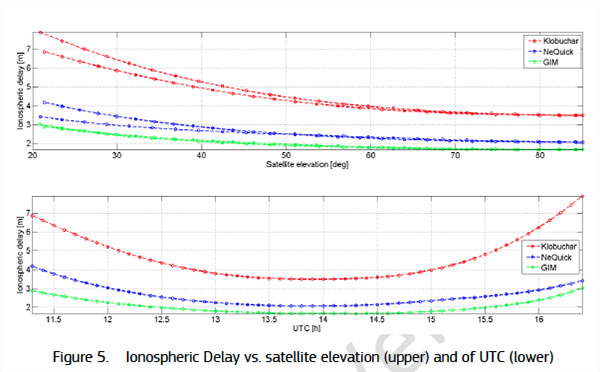
    “As an example of the behavior of the two models as a function of the time of day, the delay computed using Klobuchar and NeQuick G are plotted as a function of the satellite elevation and of UTC in Figure 5. For this example, in order to have a direct comparison between the two models, the delays computed using Klobuchar and NeQuick are compared with respect to the delay estimated using Global Ionospheric Map (GIM). The plots have been computed for a station in latitude [deg] 40.8234, longitude [deg] 14.2161, altitude [m] 122.6590 m, using GPS satellite PRN 11 and for day 16 of year 2010 characterized by quiet geomagnetic activity.”
    GNSS-D&T-Figure-5

    Several further figures and tables within the document annex give more details on the performance results obtained.

    The NeQuick electron density model was developed by the Abdus Salam International Center of Theoretical Physics (ICTP) and the University of Graz. The adaptation of NeQuick for Galileo single-frequency ionospheric correction algorithm (NeQuick G) has been performed by the European Space Agency (ESA) involving the original authors and other European ionospheric scientists under various ESA contracts.

    GNSS Market

    In market forecasts, Diani related some high-level results from the GSA’s 2015 GNSS Market Report.  Among other insights, the GSA predicts that the installed base of GNSS devices will triple by 2023, with per capita rates of 2.5 in North America (currently 1.4), and 2.3 in Europe and Russia (now 1.1 and 0.8, respectively). Around the rest of the world, in eight years nearly every person, on average, will possess a GNSS device. Currently rates are 0.5 in South America, 0.2 in Africa, and 0.4 in the Middle East and non-Russian Asia.

    Galileo Services: Proposal for an Industry Policy

    Axelle Pomies of Galileo Services, an association of industry players active in GNSS applications, stressed the need for a comprehensive, assertive industry policy to support the development of EGNOS/Galileo downstream sector, leading to growth, job creation, and autonomy for Europe.

    As stated in her presentation, GNSS market trends do not currently favor Europe, as the continent aggregately currently holds a market share of less than 20%, whereas the usual European market share in other high-tech sectors is around 33%. European GNSS downstream industry suffers from a competitive disadvantage vis-à-vis industry from other regions, because dedicated national programs/strategy in the United States, Russia, China, and Japan support competitiveness of their respective industries and enhance GNSS market take up, including funding from R&D to manufacturing capabilities; regulation; and massive public procurement. Europe has none of these, or at least not to the same degree.

    Among the risks this entails for European Union autonomy are that Galileo may not be used as intended; there is little predicted interest for most user applications to track four constellations. Meanwhile GPS, GLONASS and BEIDOU are already in place.

    She cited a number of key GNSS application markets where European industry must position itself strongly and securely. In her view, the most promising markets in terms of growth potential and strategic placement include:

    • Road (intelligent transport systems, connected vehicles, and advanced driver asisstance systems, or ADAS)
    • agriculture
    • autonomous/unmanned vehicles
    • rail
    • timing
    • critical infrastructures
    • multimodal logistics
    • defence
    • Internet of Things.

    In that regard, Pomies posited the necessity of a comprehensive and assertive industry policy to support the development of EGNOS/Galileo downstream sector, with the goals of  fostering the use of European GNSS infrastructures; encouraging European Industry to develop EGNSS equip/apps; fostering the manufacturing of E-GNSS based solutions in Europe; and supporting the European industry competitiveness in the GNSS global market and fostering the emergence of European champions.

    Support from European and national institutions is necessary for the full success of the EGNOS programmes, she said, and she previewed the mid-May publication of a draft position paper from Galileo Services in this regard, for wide consultation within the European downstream sector.

    Follow www.galileo-services.org for its first appearance.

    Key Issues in Intelligent Transport and Location-Based Services

    Concluding the ENC plenary, Florence Ghiron of Topos Aquitaine, a regional council of satnav and intelligent transport companies in southwest France, focused on opportunities and risks for small-to-medium enterprises. One of her key points regarding the intelligent transport systems market: the long development paths of public and regulatory policy do not help SMEs grow.

    Today, several GNSS-based road schemes are already operational, but they tend to be limited to specific applications, to regional areas and/or to specific classes of vehicles, for example, trucks above a certain weight !

    Moreover, each country tends to work with their national champion. This has led to fragmentation of the targeted markets all over Europe. Thus, the need for interoperability between schemes is an increasingly important factor.

    Among her major recommendation for supporting application and business development:

    Support GNSS stakeholders at promoting their innovative GNSS applications towards the largest possible community. This encompasses:

    • Visibility of GNSS mature solutions/applications

    • Cost-benefit analyses for already developed GNSS-applications

    • Identification of the best ways/means to help SMEs  promote their offers towards public purchasers

    • Development of a Directory of European regional and national contact points

    She further proposed additional funding mechanisms for SMEs to bridge the gap between the R&D step and the industrialization/market development phase.

    Finally, help medium/small regions and cities to purchase or procure the innovative GNSS-ITS applications they need to answer their public transportation/mobility needs.

    Further information on the Topos project SUNRISE (Strengthening User Networks for Requirement Investigation and Supporting Entrepreneurship), a European project managed by the GSA, may be found at www.topos-aquitaine.org.

    Back to Bordeaux in October

    Both Diani and Ghiron closed their presentations with invitations to return to Bordeaux in October for the Intelligent Transport Systems World Congress, themed “Towards Intelligent Mobility: Better Use of Space.” GNSS looks to take a more central role than ever in this far-reaching economic segment.

  • Down in the Flood with GPS

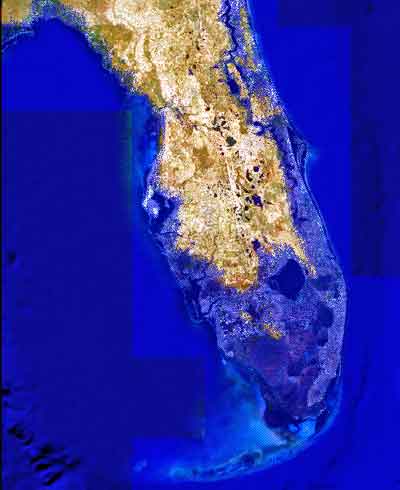
    Image from flood.firetree.net, using Google Earth.
    Image showing projected Florida flooding, from flood.firetree.net, using Google Earth with NASA data. Image from flood.firetree.net, using Google Earth.

    Surveyors, prepare to get your feet wet. Global warming is about to hit you in the job list. By 2050, a majority of U.S. coastal areas are likely to be threatened by 30 or more days of flooding each year. This according to a December report in Earth’s Future, a journal of the American Geophysical Union.

    [Parenthetically, the next issue of Survey Scene, in May, will be written by an actual geodesist. Until then, you have to put up with GPS World’s editor in chief — by no means a surveyor. Patience.]

    The study used data from National Oceanic and Atmospheric Administration (NOAA) tide gauges to show the annual rate of coastal floods has accelerated in recent years. These are now five to 10 times more likely today than 50 years ago — and getting worse.

    Mitigation decisions could range from retreating further inland to coastal fortification or to a combination of “green” infrastructure using both natural resources such as dunes and wetland, along with “gray” man-made infrastructure such as sea walls and redesigned storm water systems. And that’s not even mentioning such basics as redrawing property lines. Any way you look at it, surveyors are going to be involved.

    “As communities across the country become increasingly vulnerable to water inundation and flooding, effective risk management is going to become more heavily reliant on environmental data and analysis,” said Holly Bamford, NOAA acting assistant secretary for conservation and management.

    The recent U.S. Hydro 2015 conference in National Harbor, Maryland — an area particularly called out for vulnerability to the oncoming floods — naturally found a lot to talk about in this and related areas of interest for surveyors, with session tracks including: Effects of Climate Change on our Oceans and Waterways; Coastal and Ocean Mapping Initiatives; Advances in Unmanned System Technology, and several more.

    Some of the papers presented that GPS World found of interest, and hopes to present or encapsulate in some form in the near future, include:

    • Resolving Systematic GPS Interference from Aeronautical Distance Measuring Equipment during Mission-Critical Shallow Water Multibeam Surveys
    • GPS Water-Level Buoy for Hydropgraphic Survey Operations
    • Examining the Uncertainty Associated with the Establishmenbt of an Ellipsoid to Chart Datum Separation Surface Using GNSS Buoys
    • Comparison of Horizontal and Vertical Resolvable Resolution between Repetitive Multibeam Surveys Using Different Kinematic GNSS Methods.

    And those just came from the poster sessions. In the technical sessions, Jack Riley from the NOAA Coast Survey’s Hydrographic Systems and Technology Program presented a GPS Buoy Water Level Uncertainty Case Study.

    Data from on High

    Since you can’t get at a coastline from all angles — with any degree of stability, that is — data from overhead, sometimes far overhead, proves invaluable. Such as that provided by aerial digital imagery, LiDAR, and increasingly, satellites.

    Because digital aerial images are already in electronic form, they can quickly be processed and made available to users. Most of the special cameras in use nowadays provide direct georeferencing capability, which allows camera position and orientation to be determined automatically using GPS and inertial measurement equipment. An entire mini-industry has grown up around integrating aerial data with that taken from ground surveys.

    Light detection and ranging (LiDAR), a remote sensing system, became available for commercial topographic mapping in 1993. An airborne laser scanning system paired with a kinematic GPS receiver and an inertial navigation system can calculate and produce a highly accurate spot elevation. It is possible to obtain point densities that would likely take months to collect using traditional ground survey methods. The National Geodetic Survey (NGS) is currently implementing LiDAR into their shoreline mapping production process.

    Our Record So Far

    Coverage of these salty issues has been sparse in GPS World and associated newsletters, but not entirely absent. In 2006, the May issue featured “GPS Buoys Nautical Measurement.”

    In 2008, Richard Langley edited an Innovation column on “Tsunami Detection by GPS,” featuring work for which co-author Attila Komjathy eventually won a GPS World Leadership Award in 2013. And in 2010, Langley brought forth an Innovation column on “Monitoring Water Level with GNSS.”

    And way, way back in 2005, we published “Abreast of the Waves: Open-Sea Sensor to Measure Height and Direction.” This was prior to our digital era, so until we can scan a paper copy into here, we’ll simply give the abstract: “Accurate and timely information on open-sea wave conditions can help in preventing large-scale maritime disasters. This article describes a new, low-cost Global Positioning System (GPS)-based sensor that measures wave height with an accuracy of several centimeters and direction with an accuracy of 5 degrees. The receiver is mounted on a buoy, and a high-pass filter is used to extract the movement of the buoy and thus minimize GPS positioning errors. The data provided by the sensor is intended to improve wave prediction models. In addition, since this GPS-based sensor transmits only analyzed ocean wave data, it reduces the volume of data and leads to lower operating and acquisition costs. The article describes the concept of the GPS-based wave sensor, algorithms that are used for filtering and extracting wave data, as well as the results of open-sea trials.”

    So there’s more to come. Watch this space. In the meantime, we leave you with Bob Dylan’s prophetic words, circa 1967.

    Well, it’s sugar for sugar
    And salt for salt
    If you go down in the flood
    It’s gonna be your own fault.

  • Out in Front: The Things We Carry

    Out in Front: The Things We Carry

    Alan Cameron, editor-in-chief
    Headshot: Alan Cameron, editor-in-chief

    We have entered a discussion phase at the magazine, a fierce conversation if you will, occasioned on the one hand by the periodic need to freshen our appearance, but also to re-investigate and re-evaluate our whole approach. The way we do things, and the actual things we do. The thoughts and pre-conceptions and mental equipment we carry with us to do our jobs: gathering and presenting the news and the newest in GNSS technology and business.

    In the beginning, or before the beginning, really, I asked myself these questions:

    • What has changed in the last year?
    • Where are we succeeding?
    • Where are we failing?
    • What have we learned in the last six months?
    • What is required of us now?

    Some of the answers to these questions are of course proprietary, but some at least can be shared. So: What has changed in the last year — in the market?

    Among new developments, we can count diversification away from the core of GPS/GNSS standalone technology. Never again, really, will satnav positioning suffice to answer the needs of the day. That ship has sailed. That dog has left the porch.

    Certainly, though this is nothing new, we also see more international participation in the market, more international involvement on the part of all GNSS companies, no matter where their base, and more international collaboration.

    The story of the year, replacing jamming and interference which were the stories of the last few years, is the rise of unmanned autonomous vehicles (UAVs), whether in the air, on land, or sea.

    Finally, as a reflection of these trends, some trade shows and conferences are declining, while others grow in importance, attendance, and exhibitors.

    In the context of future change, here’s a question I’d like to ask all of our readers. I welcome your answers to any of the questions you see posed here, or any thoughts at all, even if they consist of more questions. Send all and sundry to: editor @ gpsworld.com

    But if you wouldn’t mind, please include this one:

    Where do you see your efforts and those of your organization focusing primarily over the next five to 10 years?

    A. Primarily on GPS.

    B. Inclusive also of multiple GNSS: GLONASS, Galileo, BeiDou, various satellite-based augmentation systems.

    C. More broadly, on positioning, navigation, and timing (PNT) systems generally and in an integrated fashion, including other sensors.

    D. Encompassing all the above and geospatial software such as geographic information systems (GIS) and location-based services (LBS).

    Skipping ahead now to some outcomes, under the heading of what is required of us now, we here at the magazine are leaning more every day on these precepts:

    • Grow digitally and grow internationally. These are the only true paths to growth, at least in business-to-business publishing.
    • Beef up our geospatial presence. You can see this in action at geospatial-solutions.com.
    • Increase show tie-ins at newly developing conferences.
    • Aggressively pursue small, diverging markets.

    That’s the new equipment we’re picking up. That’s what we carry now.

  • GNSS Constellations March On

    This week nearly all the global navigation satellite systems will push their spatial presence one or two steps further, or higher, if they perform as scheduled. Rarely if ever has there been such a concentrated period of activity in the catapult category. Are we witnessing the real dawn of the multi-GNSS era? GPS, Galileo, BeiDou, and IRNSS all have positioned loaded rockets on the launching pad, destined to heave satnav payloads aloft. Only GLONASS seems stuck in stasis.

    Leading the pack, as ever, GPS should send forth the ninth GPS Block IIF satellite (GPS IIF-9) on March 25 at 2:36 in the Eastern U.S. afternoon. Perhaps the event has already occurred by the time you read this.

    The seventh and eighth Galileo satellites, Adam and Anastasia, are destined for a double date in space on March 27. After a four-hour flight into orbit 22,300 kilometers high, the duo will spring away from their Fregat fourth stage in opposite directions.

    The launch of the fourth satellite for the Indian Regional Navigation Satellite System, scheduled for March 9 but postponed to replace a faulty onboard telemetry transmitter, will now take place on March 29. IRNSS-1D will pass the halfway point in India’s march to a seven-spacecraft regional constellation.

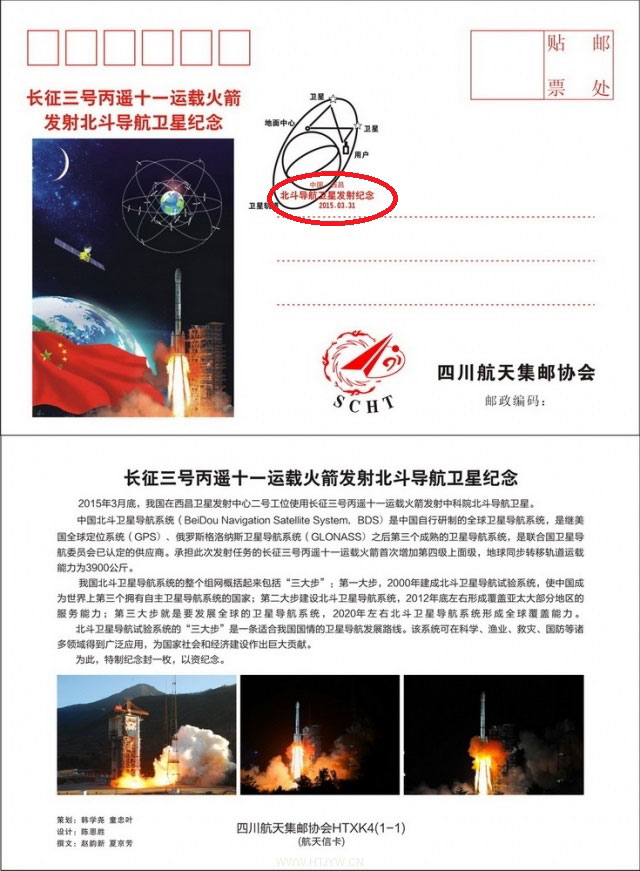
    HTXK4 Credit: BeiDou
    This philatelic first-day cover to commemorate an upcoming BeiDou launch indicates a specific date of March 31, 2015 (circled in red). Credit: BeiDou

    There are indications that the first satellite in the BeiDou Phase 3 expansion may be launched by the end of March. Apparently, a BeiDou satellite has been shipped to the Xichang launch site, and tracking ships have left port for the open ocean. Also, a postal stamp first-day cover for the launch — a common Chinese practice — has been issued with a March 2015 inscription. The launch will likely be that of a medium Earth orbit satellite.

    A GLONASS-M single-satellite launch from Plesetsk had been expected in the first quarter of this year, but has not materialized. A GLONASS-M triple-satellite launch from Baikonur is expected in the April/May 2015 timeframe. The Russian constellation’s orbit count now stands at 26, fully sufficient for global coverage.

    As the Ides of March in 44 B.C. mark a turning point in Roman history, the transition from Republic to Empire, so might this week mark complete world domination. GPS is now ¾ down the last section of road that leads to the fully modernized Block III generation. Galileo will reach, numerically, 1/3 of the total number of satellites it needs for full operational capability, although there is some doubt about whether all satellites now in orbit can be counted as full integers. BeiDou will mark its 15th operational satellite, out of a planned total of 35, with the new philatelically commemorated rising. And, as mentioned, IRNSS will pass its halfway point this weekend.

    Ironically, just as GNSS begins to show signs of approaching its apogee (similar to the dawning of Empire in the Augustan Era that followed Caesar’s assassination on the Ides of March), the world is starting to turn away from, or turn beyond, GNSS.

    GNSS will remain at the core of our navigation and positioning technologies — as Roman values remain at the core of Western civilization. But we need to go now to multi-sensor approaches for several reasons:

    • some requisite positioning data, such as precise attitude, is not optimally derived solely from GNSS measurements;
    • despite their increasing numbers, GNSS satellites will never be ubiquitous enough to be visible in sufficient numbers everywhere;
    • threats such as jamming and interference will likely surmount all efforts at single-solution resilience to overcome GNSS vulnerability.

    ‘Twas ever thus. With rise come decline, with ripeness, decay. Sic transit Gloria.