Author: Alan Cameron

  • GNSS has bad days, too

    GNSS has bad days, too

    (courtesy Ursanav)
    (courtesy UrsaNav)

    “Even the best technology has a bad day,” Charles Schue told the New York Stock Exchange (NYSE), which relies very heavily on the best technology to keep the world’s financial edifice afloat. Vulnerabilities in the stock market were pointed up during a demonstration on April 19, showcasing how one positioning, navigation and timing (PNT) system can cover the chinks in another. Respectively, eLoran and GPS in this case.

    Schue is CEO of UrsaNav, a company that has been developing complementary PNT solutions, specifically the high-power, low-frequency (LF), ground-wave technology that is eLoran, which UrsaNav calls “the most reliable, scalable, and future-proof available.” Schue spoke at the NYSE along with representatives from the Department of Homeland Security (DHS), the U.S. Coast Guard, Juniper Networks and Harris Corporation.

    “2014 was a very bad year for GNSS,” Schue continued, citing the GLONASS full-system outage for 11 hours and Galileo’s wrong-orbit launch of two satellites. “This year, GPS, the gold standard, had an ‘oops’ and slipped from gold to silver, when one satellite kind of wigged out, a 13.7 microsecond error that contaminated 15 other satellites.” He ran a simulation that showed how, at one point, six GPS satellites were communicating bad timing to the Eastern seaboard, where the NYSE is located.

    2016 has also seen renewed GPS jamming from North Korea.

    The stock exchange, along with other global financial markets, relies on microsecond timing to properly execute all transactions. The U.S. air traffic management system likewise relies on high-precision aspects of GPS that are vulnerable to interference, jamming, and even occasional system failure. Many other industries, telecommunications principally among them, are also building infrastructures and applications that rely on GPS for precise timing, thus making them vulnerable as well.

    One Back-Up Transmitter in Place

    An eLoran transmitter in Wildwood, New Jersey, relies on three primary reference standards, three atomic clocks, just as each GPS satellite carries three or four atomic clocks. “The signals coming from space, the signals coming from ground, they’re very similar.” ELoran also has monitoring and control sites on the ground, just like the satellite system; it has differential reference stations, and of course eLoran receivers, playing the same role as GPS receivers.

    Schue asserted that the cost of launching one GPS satellite into space would fund an eLoran system for the continental United States for 20 years. Also, that a lot of industries in addition to the financial community are building infrastructures and applications that rely on GPS for precise timing, and so are equally vulnerable.

    The eLoran demonstration showed how the Wildwood station sent a timing signal 130 miles to the NYSE, deep within several urban canyons and enveloped in several layers of concrete, steel and glass. A GPS receiver in the room did not pick up anything. The eLoran receiver showed precise time, to the standard of NYSE requirements.

    Equipment utilized included a Spectracom SecureSync providing time to the network, once it received it from eLoran.

    On a screen display showing plus or minus 500 nanoseconds relative to Coordinated Universal Time, “that red line is us receiving eLoran timing at that antenna, 130 miles away, through the urban canyons, inside this building, right now at minus 14 nanoseconds.” The eLoran equipment transmitted and received two signals, with a data channel on one of the signals. “We could put the data channel on both signals, and we could put multiple data channels on both on there as well.”

    Photo: UrsaNav Photo: UrsaNav

    Schue said another demo inside a downtown Boston hotel, 305 miles from the New Jersey transmitter, obtained 83-nanosecond accuracy. A 2015 test to an outdoor receiver in Bangor, Maine, 500 miles from the transmitter, logged 68-nanosecond accuracy.

    Plus or minus 100 nanoseconds is the typical GPS performance. “We can do far better, and GPS often does far better than that.”

    Initial operating capability for a wide-area eLoran service providing precise time for the continental United States would require four transmitter sites across the middle of the country. The corporate and government partners hope to use some repurposed Loran-C assets and turn them into eLoran stations. Wildwood is transmitting at 360 kilowatts; if transmitting at 1 million watts, or 1 megawatt, the signal could penetrate even further inside buildings. The cost difference between the two powers of transmitter is not significant.

    Bringing six more continental eLoran transmitter sites online, for a total of ten, would add a back-up positioning capability in addition to timing. “This is very important, because with positioning, you get mobile time — a co-primary solution for position, navigation, and timing.”

    Using a differential receiver would yield even better local-area accuracy for about 35 miles around a selected site, for high-priority locations. Such a higher-precision system for the nation’s top 50 metropolitan areas, top 50 airports, and top 50 harbors could be accomplished with 71 differential sites.

    Concurrence from Government and Other Industry Partners

    Spokespersons from the DHS, Coast Guard, Juniper Networks and Harris Corporation preceded Schue at the NYSE presentation, all giving similar perspectives on U.S. vulnerability in many aspects, due to reliance on GPS as a sole, unsupported source of precision PNT.  “Of the 16 critical infrastructure / key resource sectors in the United States, 15 use GPS for timing. GPS timing is deemed essential for 11 of these sectors,” stressed DHS.

  • SatNav engineering by the book

    Betz-book-coverEngineering Satellite-Based Navigation and Timing: Global Navigation Satellite Systems, Signals, and Receivers

    John W. Betz

    ISBN: 978-1-118-61597-3; 672 pages

    December 2015, Wiley-IEEE Press

    Hardcover print or ebook available


    A new book by a recognized authority in signal design and processing, structured as a textbook for an upper-level undergraduate course or a graduate course in satnav engineering, will also admirably serve anyone seeking to enhance his or her skills in satnav engineering, or as a reference and indicator of future paths for a practicing satnav engineer.

    Author John Betz contributed to the international interoperability and compatibility efforts leading to the design of the GPS L1C civil signal. His binary offset carrier (BOC) technique is used for the GPS M-code signal, and has been adopted by satellite navigation systems developed by Russia, Europe, China, Japan and India.

    He played an active role in the United States/European Union negotiations that established compatibility and interoperability between GPS and Galileo. More recently, he provided critical analysis related to GPS modernization, recommending affordable enhancements to address increasing threats and to shape the architecture of military GPS for decades to come.

    The book comprises four large sections:

    • System and Signal Engineering. Describes principles and practices, including the basic calculations that describe system operation and performance: link budgets, signal-to-noise ratios, and error sources.
    • System Descriptions. All active or nascent global, regional and satellite-based augmentation systems, with detailed yet succinct signal characteristics.
    • Receiver Processing. Essential aspects of receiver design and means of evaluating performance from front end through tracking loops to position calculation.
    • Specialized Topics. Modern and future signal use increasingly involve more advanced techniques and capabilities to attain next level(s) of performance and enable ever-advancing applications. Interference, multipath, augmentations using differential satnav, assisted satnav, integrated receiver processing, and an appendix on theoretical foundations.

    Learn more about the book here.

  • Driverless Conference sparks autonomous car development analysis

    Driverless Conference sparks autonomous car development analysis

    driverless-logo-no-tagGPS and GNSS have changed the world. Of that there can be no doubt. But in terms of sheer change, both qualitative and quantitative — we ain’t seen nothing yet.

    We now witness the creation of an industry. This will be very disruptive. We’ve had change instituted by GNSS; we know what that looks like. We haven’t yet seen a true revolution.This is something entirely new, and there are many things about which we don’t yet have a clue .

    What happens to that great American institution, the private car? The relationship between the individual and its four-wheeled extension?

    And on the industrial side, do automakers disappear as OEMs — do they become Tier 1 suppliers to Google, Uber and Lyft?

    Because of the massive impact of this particular rollout of GNSS-enabled capabilities, I am devoting this issue of the GNSS Design & Test e-newsletter to it, even though it is not in itself a system in space. It is the most radical transformation of life on Earth we have seen, driven by our systems in space.

    The following are notes jotted during the Driverless Conference,  March 23 in San Francisco.

    “In the early 90s, when I was part of a government ride-sharing initiative, we used to talk about these new portable devices bringing data communication into … wherever we go. Now they’re here, and they’re well established. Very soon, this is going to change things, and enable many of the things we’ve only talked and dreamed about so far.” Thus spoke Steve Wollenberg of Automatiks, opening the conference.

    “We’re at the confluence of great technological developments. We’re seeing great acceleration of all of them.”

    Virtually all  the speakers, all these driverless enthusiasts, really love cars. Some  own up to collecting them, having multiples in their home garage(s). A bit wistfully, Wollenberg foresaw the new control technology taking over public roadways. “In ten years, racetracks may be the only place where you’re allowed to drive your own vehicle.”

    Ride Share. “Four years is the entire lifetime of the ridesharing industry,” said Emily Castor of Lyft, who by virtue of her tenure there for that period, can be termed an industry veteran.

    “We’ve seen a full-about turn in the regulatory environment. We see ride-sharing as the stepping stone to a world in which people no longer drive vehicles. Getting an autonomous vehicle on demand through a shared network will be much easier and cheaper than owning a private vehicle.”

    Lyft talked with General Motors last year, and found a shared vision of shared use.

    Amitai Bin-Nun from Securing America’s Future Energy (SAFE), a non-partisan advocacy organization with business leadership, introduced his organization’s broad mission: reducing U.S. petroleum dependence. Instability in parts of the world is fueled by  petroleum dependence.

    “This is a hard process. It takes a long time to overturn an established system.” A key obstacle is the lack of compelling new consumer experience, currently. Using connected and autonomous vehicles in a ride-sharing network is an opportunity to get this new experience, and drive the transformative process. Re-order the transportation system.

    Mariel Devisa of Travelers Insurance announced that Travelers has launched a ride-share insurance product, live now in 16 states.

    In two fairly conservative industries — automotive and insurance — with long-established partners and practices, the efforts to move and change are, frankly, surprising and faster than anticipated, according to moderator Wollenberg. “It’s a fun time.”

    Freight and Fleets. Steve Boyd of Peloton made the case that trucking fleets can serve a critical role in pushing the technology forward, because some segments of the transportation industry move faster than others. Getting state approvals without having to go federal is the route  pursued now, in terms of full-scale roadtesting of autonomous driving. That will enable early adoption heading into commercial pathways: freight-truck platooning and drafting. Volvo, Intel, Nokia, Denso, UPS and a number of other companies are closely involved.

    Boyd announced a set of fleet trials this year, starting in Texas, “a very truck-friendly state.” Legislative approval for trials has passed or is pending in several other states, as many as a dozen. Prospective customers are already lined up in the freight space.

    In Europe, an April 6 EU Platooning Challenge will take place in Rotterdam. The Netherlands is leading the EU in the current cycle to approve truck platooning by early 2018.

    There’s “a platooning gap” developing between the U.S. and Europe, according to Boyd. Silicon Valley may lead on the technology, but if this is not matched by activity on the regulatory side, it will lose out to other areas that aggressively pursue approvals as well as technology.

    Traditionally, the automotive and trucking OEM industries have been very competitive, but now they are seeing the necessity to collaborate to push the policy side forward. This is happening in the insurance industry, too. Competition will certainly still be there, but to enable vehicle-to-vehicle communication a broad measure of collaboration will be necessary.

    Photo: Google

    The road environment today is very imperfect, with many thousands of fatalities and countless more serious injuries. Trucks drive too close together. Highway safety needs innovation and regulatory change in order to improve.

    The Long Vision. An autonomous car can’t count on the ability of the driver to retake control of the vehicle in 5 or 10 seconds. So the vehicle needs to be able to take care of itself — fully. Therefore, an evolutionary approach to installing autonomous capabilities may not work.

    Some initiatives, however, continue to bring services into the vehicle one by one, gradually. How engaged will the driver be, and in what timeframe? There’s debate, and a shift in thinking may currently be underway.

    Traditionally, a 5- to 7-year product cycle in automotive starts when new features are introduced in upmarket vehicles. Examples: adaptive cruise control (to follow the car in front of you at a set distance), lane-keeping assistance. Gradually, these new features are installed in lower price-point models until they become standard throughout the line. With multiple products and product cycles, it will thus take multiple decades. 220 million vehicles are owned by households. An integrative approach to autonomy will take a long, long time.

    There is a rising tide for autonomy may take a different approach: autonomy first, that is, full autonomy will take over the vehicle — and as many vehicles as possible.

    (Something that no one has mentioned but I can’t help thinking: Given the longstanding and extremely virulent controversy in this country over private gun ownership… What does this bode for something shaping up as a massive social, structural change, not just a new technological wrinkle?  What is more American than a gun? A car.

    If you thought the Internet, or smartphones, or for heavensakes even GPS/GNSS have radically altered the world — again, we ain’t seen nothin’ yet.)

  • World dodges GPS bullet

    World dodges GPS bullet

    It happened in the blink of an eye. Less than a blink. Far less, actually. Slightly more than one one-thousandth of an eye blink, according to calculations. In that amount of time, one of your eyelashes traverses 10 micrometers on its journey toward your lower eyelid.

    And yet it was long enough to throw computers and communications systems around the world out of whack, generate thousands of alarms, and pull engineers from their beds at 2 a.m.

    One occurrence might have been enough to do all that. I’m not sure. But it kept happening over and over again. Thus the alarms, the out-of-whackness, the sleep deprivation. At least it did not generate massive financial trading sell-offs, blow holes in national security, or shut down Facebook, Instagram and Snapchat. For that, we may be thankful.

    But it might have.

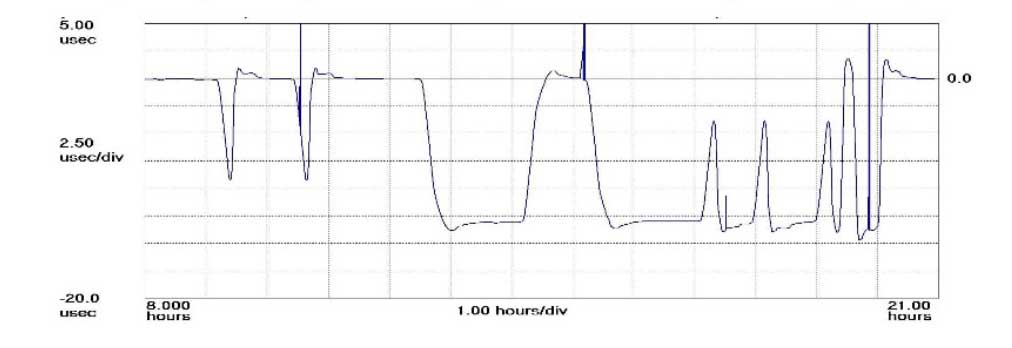
    The plot shows how the anomaly event impacted one GPS timing receiver during the day. (Click to enlarge | Chart: Chronos Technology)
    The plot shows how the anomaly event impacted one GPS timing receiver during the day. (Click to enlarge | Chart: Chronos Technology)

    “On 26 January at 12:49 a.m. MST, the 2nd Space Operations Squadron at the 50th Space Wing, Schriever Air Force Base, Colo., verified users were experiencing GPS timing issues. Further investigation revealed an issue in the Global Positioning System ground software which only affected the time on legacy L-band signals. This change occurred when the oldest vehicle, SVN 23, was removed from the constellation. While the core navigation systems were working normally, the coordinated universal time timing signal was off by 13 microseconds which exceeded the design specifications. The issue was resolved at 6:10 a.m. MST, however global users may have experienced GPS timing issues for several hours.” (This excerpt from an U.S. Air Force communiqué appears in a brief news account.)

    “The Joint Space Operations Center at Vandenberg AFB has not received any reports of issues with GPS-aided munitions, and has determined that the timing error is not attributable to any type of outside interference such as jamming or spoofing. Operator procedures were modified to preclude a repeat of this issue until the ground system software is corrected.”

    Companies and their time-servers around the world were subsequently hit by up to 12 hours of system warnings after 15 GPS satellites broadcast the wrong time, according to Chronos, a UK-based time-monitoring firm.

    Telecommunications companies constitute only a small part of industry users who rely on the highly precise accuracy of time measurements — supplied by GPS — to control data flow through their networks. Global financial networks and trading markets similarly depend on GPS, as do electrical power grids and many other sectors of critical national infrastructure. These companies and networks invest significantly in highly sophisticated equipment to monitor said timing accuracy as conveyed by GPS signals. Because billions, make that trillions — or actually even more — are riding on it.

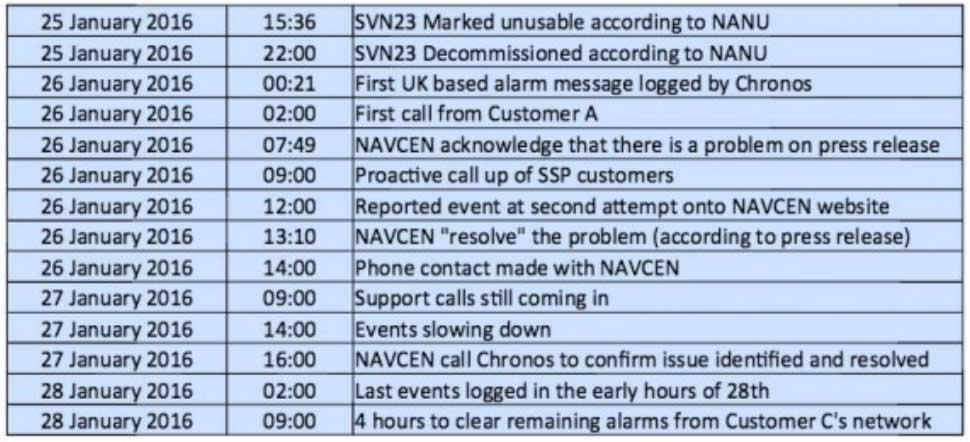
    A week after the eye blinks, Chronos Technology released a white paper describing the ensuing fallout for its clients, who are timing equipment users in more than 50 countries around the world. Table 1 from the white paper reports the experience of a few during the event. One company registered nearly 2,500 alarms from its timing equipment during the outage.

    Click to enlarge. (Table: Chronos Technology)
    Click to enlarge. (Table: Chronos Technology)

    At one point during the crisis, according to the white paper, “it appeared that the GPS error had cleared and the Chronos SSP Manager was able to force the units out of holdover. However the scale of the problem escalated as these sites went back into holdover along with dozens of other sites suffering GPS-based timing issues. It was apparent at this point that there was something amiss with the GPS constellation itself.”

    Later on, the report states, “This event linked to SVN23 has been one of the most significant service affecting issues for GPS timing users and sits alongside the April 1st 2014 GLONASS outage in scale — however its impact on global timing services is much more extreme.”

    Ominously, “Chronos is aware of other more catastrophic impacts to networks and non-telecom applications which were not under supply and support contracts.”

    As Loran Is Our Savior. At least one timing-reliant company was not disturbed by the problems, because it was testing an alternative timing service provided by enhanced Loran (eLoran) signals.

    Unfortunately for them — and for the rest of us — eLoran has a very uncertain future. In fact, they were lucky to have an eLoran signal at all on January 26, because it was supposed to have been turned off on December 31. Somebody must have forgotten to tell the operators at the Anthorn giant antenna field in Cumbria to go home.

    France, Norway, and the United Kingdom, three countries that had been keeping eLoran alive, officially abandoned the effort at the end of last year, reportedly because of lack of leadership from the United States.

    The U.S. government decommissioned all its Loran stations a few years ago, even going to the extent of blowing some of them up (perhaps to prevent them from falling into the hands of subversives). Despite a recent reinvigorated interest in enhanced Loran technology, it may be too little, too late.

    Whoa, Nellie. The first recorded use of the term “back-up technology” occurred in 1892, when farmers were urged not to prematurely abandon their mules in favor of John Froehlich’s new gasoline tractor.

    Dan Albone on his prototype Ivel Agricultural motor. (Photo: North Bedfordshire Gazette, 1903)
    Dan Albone on his prototype Ivel Agricultural motor. (Image: North Bedfordshire Gazette, 1903)

    That admonition, however prudent, has since passed from view. But the concept remains sound. It has surfaced many, many times in GPS World magazine. Certainly not the first incidence, but the farthest back that I can retrieve via search on our website, came in 2007 from Defense contributing editor Don Jewell. “Why do we need a backup? Here is a classic case in point.” He describes a Joint Navigation Conference briefing on a surprise jamming incident that had occurred in January of that year.

    In 2009, we reported on an Independent Assessment Team (IAT) report that “unanimously recommends that the U.S. government complete the eLoran upgrade and commit to eLoran as the national backup to GPS for 20 years.” The report was written in 2007, but quashed by the Department of Transportation and Department of Homeland Security (DHS) Executive Committees that commissioned it. Its public release came only after an extensive Freedom Of Information Act (FOIA) battle.

    The U.S. government proceeded, despite its paid experts’ recommendations, to blow up those old Loran stations. The current renewed interest and the Wildwood experiment are worthy — more than worthy. Can they prevail? Can they survive blind reliance on a single string of vulnerable technology?

    Indubitably, the critical role of GPS back-up was advanced prior to 2007, I just can’t document it this morning by deadline. For the sake of argument, let’s take April 12, 2007, as our start.

    We are now 3,229 days out. That’s 77,496 hours, or nearly 279 million seconds. Correct me if wrong, but that appears to make 21.5 million-million times the length of January’s GPS timing error. Surely sufficient to blink a few times, scratch one’s head, and wonder.

    Could there be a better way?

  • Out in Front: ION-ITM addresses ethics of autonomy

    Source: Alan Cameron
    Attention-grabbing graphic from “Navigating Autonomous Requirements” at ION-ITM.

    The talk veered off into rather heady philosophical realms at the plenary session for ION’s International Technial Meeting in late January. Two of the three speakers had been encouraged to go well outside the box — and not to employ any equations in doing so — to address or envision the autonomously navigated future.

    We are caught in the act of seeing ourselves become obsolete, at least behind the steering wheel of an automobile. The Google driverless car has logged more than a million miles, exploring the traffice terrain that will soon be home to millions of autonomous vehicles. What has it found? That the human in the loop (HiL) is the biggest source of error and catastrophe.

    There remain a few technical issues to sort out before this particular future is upon us. One of these, one that excites John Fischer of Spectracom, is the time-sensitive network concept: a standard and securable network that provides a platform for connecting critical system infrastructure with IT features. These networks deal in velocity accuracies of centimeters per millisecond, The V2V and V2X (vehicle-to-vehicle and vehicle-to-network) systems that will support autonomous driving must reduce latency to nearly imperceptible levels for functions like crash avoidance and lane awareness to work reliably.

    We were encouraged to consider the ethics of autonomous navigation by Mikel Miller of the Air Force Research Lab, Sensors Directorate. Once the vehicle becomes autonomous, it decides for the driver — including life or death choices.

    Imagine a situation that could actually happen less than a decade from now. Riding in a driverless car on a curving coast highway, you round a curve to see a group of children crossing the road. Detecting them, the car begins to brake, but quickly calculates it cannot stop in time. Programmed to avoid collisions with pedestrians and other vehicles, it is also programmed to protect its passengers. It must choose between carnage on the highway or driving you off the adjacent cliff into the ocean.

    Which to choose? Four lives versus one. Other ethical dilemmas have arisen in the history of GPS, GNSS, and precise PNT, chiefly concerning privacy. We are about to enter a more difficult realm.

  • SBIR Regulatory Enforcement Issues

    Small Business Innovation Research (SBIR) Regulatory Enforcement Issues

    Alison Brown, Co-Chair Government Contracting Working Group

    Small Business Administration (SBA) Regulatory Fairness Board, (719) 331 2844 [email protected]

    1       Overview

    The National Defense Authorization Act of 2012 contained SBIR/Small Business Technology Transfer (STTR) reauthorization provisions which included language that indicated strong Congressional intent to improve the process of rapidly transitioning SBIR/STTR (hereafter SBIR) innovative technologies for insertion into DOD fielded systems and platforms. The law specifically states:

    “Sec. 5108: To the greatest extent practicable, Federal agencies and Federal prime contractors shall issue Phase III awards relating to technology, including sole source awards, to the SBIR and STTR award recipients that developed the technology.”

    Phase III is further defined as (see Sec. 5125) – “for work that derives from, extends, or completes efforts made under prior funding agreements under the SBIR program.”]

    This provision is the strongest statement to date that Congress is serious that agencies and prime contractors issue Phase III awards to SBIR producers of technology – a mandate, – no longer merely an issue of discretion. Congress had good reason for its action since, while SBIR commercialization outside of the agencies is strong, for Federal programs, as one participant in Congressional hearings noted, “SBIR transition is horrible.”

    SBIR contractors, however, have raised serious concerns about the degree to which DOD complies with the restrictions in existing law and policy. In particular, contractors have reported difficulties in retaining their data rights in Phase III of the SBIR program, which involves commercialization of the project. Many report that agencies and/or prime contractors “pressure” them to turn over their rights, or “fight them” in their attempts to retain their rights. Some firms also allege that agencies improperly procure goods through non-SBIR contracts that are follow-on to Phase II SBIR contracts, and should go to SBIR firms.

    Table 1 – Extract from HASC report, “Challenges to Doing Business with the Department of Defense”, March, 2012[1]

    In a panel report to Congress, supported by the Department of Defense (DOD) , it was acknowledged that one of challenges faced by small businesses was that DOD was not consistently following the existing law and policy in the SBIR Policy Directive (see Table 1).

    Attachment 1 includes case studies describe avenues that small businesses have used to attempt regulatory enforcement of the SBIR Policy Directive for cases where Phase III SBIR work was improperly awarded to entities other than the SBIR firms. However, currently there is currently no effective recourse for small businesses or avenues for enforcement of the current SBIR Regulations[2] within the DOD and other government agencies.

    2       SBA SBIR Phase III Contract Appeal Process

    Under the SBIR Regulations, if a small business brings forward concerns on Phase III work being awarded to another entity, then “SBA may then appeal an agency decision to pursue Phase III work with a business concern other than the SBIR awardee that developed the technology to the head of the contracting activity”. The problem with this path is that the SBA Office of Technology which is identified in the SBIR Policy Directive as responsible for coordination, has no staff available for routinely pursuing time consuming appeals and so rarely can take action on issues raised to them by small businesses.

    Contract appeals for other than SBIR issues are normally executed by the SBA Procurement Center Representatives (PCRs), for example when contracts are incorrectly awarded to other than a small business. However, the SBA PCRs are not currently trained on the SBA Policy Directives on how to handle Phase III contract appeals when a small business identifies work that should have been awarded to an SBIR company.

    3       SBIR Regulatory Enforcement Recommendations

    3.1     Train SBA PCRs in SBIR Phase III Appeal Process

    Training should be provided by the SBA Office of Technology to the SBA PCRs on the Phase III Preference established in the SBIR Policy Directive. The SBA PCRs should then be empowered to use the SBA’s appeal authority when approached by small businesses with valid claims that Phase III work is being awarded with a business concern other than the SBIR awardee that developed the technology.

    3.2     Identify SBA PCRs as POCs for SBIR Regulatory Enforcement

    Currently the SBA Office of Technology is the only office referenced as the SBA representative in the Policy Directive. While the SBA Office of Technology is the correct point of contact for guidance and clarification on Policy Directive and for receiving agency reports, they are not staffed for regulatory enforcement. The SBIR Policy Directive should be clarified to identify the correct POCs to which small businesses should address Regulatory Enforcement issues.

    4       Measurable Impact

    4.1     Number of SBIR Issues raised to PCRs

    Number of SBIR Phase III contracting issues identified to SBA PCRs by small businesses.

    4.2     Number of SBA PCR Appeal Processes Initiated on SBIR Phase III

    Number of submissions by SBA PCRs of “Notice of Intent to Appeal” related to SBIR Phase III contracting issues.

    4.3     Number of Additional Phase III Contracts Awarded

    Number of additional Phase III contract awards made to SBIR companies as a result of SBA engagement that otherwise would be been awarded to an entity other than the SBIR company.

    Attachment 1: Outcomes from Prior SBIR Regulatory Enforcement Cases

    1       US Court of Federal Claims – Spectrum

    In this case, Spectrum Sciences and Software, Inc. (Spectrum), a munitions assembly systems manufacturer, entered into a Cooperative Research and Development Agreement (CRADA) with the Air Force Research Lab to implement a prototype of their SBIR developed technology for improving a munitions assembly conveyor (MAC) used by the Air Force to assemble aerial bombs. In a suit filed through the United States Court of Federal Claims[3] (Spectrum Sciences & Software, Inc. v. United States, 84 Fed. Cl. 716

    (2008) and 98 Fed. Cl. 8 (2011)), Spectrum alleged that the Air Force used technical data derived from Spectrum’s prototype to issue a competitive solicitation and award a contract to a competitor of Spectrum for implementing the MAC enhancements. The court ruled in Spectrum’s favor and determined damages were owed by the defendant to the plaintiff.

    Although Spectrum won their case in the US Court of Federal Claims, they went out of business. Under the Equal Access to Justice Act[4] a plaintiff may be awarded legal fees, but attorney fees may not be awarded in excess of $125/hour meaning that small businesses, even when they prevail in a court case, are facing a significant unreimbursed legal expense. The length and cost of a legal suit, which was extended in Spectrum’s case by the Air Force appealing an initial judgement, makes this an unattractive option for most small businesses seeking enforcement of the intellectual property right protection granted to them for follow-on work under the SBIR Policy Directive.

    2       Government Accountability Office (GAO) – Complere

    In this case, NASA awarded Complere Inc. (Complere) SBIR phase I and phase I research contracts. After the phase II contract concluded, Complere submitted an unsolicited phase III proposal, which NASA did not accept–electing instead to do its own research on the topic in-house. Complere filed a GAO bid protest, alleging that NASA had acted improperly.

    The GAO dismissed Complere’s bid protest[5]. The GAO noted that “an agency is not required to enter a phase III funding agreement with a phase II awardee . . . and may even enter into a phase III funding agreement with an entity other than the phase II awardee, requiring only that the agency notify the SBA of such action.”[6]


    The GAO continued: “We conclude from our review of the SBIR Program Act and SBA’s policy guidance that an agency decision not to enter into a phase III funding agreement is generally not subject to our bid protest review, given the broad discretion accorded agencies to determine whether, and with whom, to enter into phase III funding agreements.”

    The GAO left the door open to the possibility of bid protest jurisdiction if an agency used non-SBIR federal funds to conduct a SBIR phase III competition. However, in the “typical” SBIR case, like this one, an agency’s decision not to fund a SBIR phase III agreement is not subject to the GAO’s bid protest jurisdiction.

    Although Congressional language made it clear that preference is to be given to an SBIR company, over any other entity (which would include internal Government researchers) for Phase III work that “extends, derives from or logically concludes” prior SBIR funded research, this decision by the GAO removes the bid protest process as a viable avenue for small businesses to pursue.

    3       SBA Phase III Contract Appeal – NAVSYS Corporation

    NAVSYS Corporation developed and fielded a precision GPS navigation capability, Talon NAMATH, under a Phase III SBIR contract to Air Force TENCAP. The systems was declared “provisionally operational” and used in theater in Operation Iraqi Freedom. Although the Talon NAMATH system was declared a huge success in theater, the follow-on contract for a fully operational system was awarded to the incumbent Boeing.

    NAYSYS complained to the SBA as under the SBIR Regulations, Agencies, that intend to pursue R/R&D, production, services, or any combination thereof of a technology developed under an SBIR award, with an entity other than that SBIR awardee, must notify SBA in writing prior to such an award. Based on information from NAVSYS, the SBA filed a Notice of Intent to Appeal the decision to pursue Phase III work with a business concern other than the SBIR awardee and the Air Force issued a Stop Work Order on Boeing. After over a year of wrangling, NAVSYS was ultimately awarded a follow-on contract.

    [1] http://armedservices.house.gov/index.cfm/files/serve?File_id=f60b62cb-ce5d-44b7-a2aa-8b693487cd44

    [2] SBIR Policy Directive, http://sbir.gov/sites/default/files/sbir_pd_with_1-8-14_amendments_2-24-14.pdf

    [3] http://www.uscfc.uscourts.gov/sites/default/files/opinions/ALLEGRA.SPECTRUM021411.pdf

    [4] http://www.law.cornell.edu/uscode/text/28/2412

    [5] http://www.gao.gov/assets/600/591916.pdf

    [6] http://smallgovcon.com/gaobidprotests/gao-agencies-sbir-phase-iii-decision-not-protestable/#sthash.GYZhyMMJ.dpuf

  • GPS recruits: Uncle Sam wants your ideas!

    The GPS modernization funding picture cannot be called bright, yet neither can it be characterized as dim. While big money for big projects appears hard to come by, the U.S. government and military offer many smaller allocations to help fill the chinks in GPS armor. Such initiatives concern jamming, PNT solutions in GPS-denied environments and other conundrums. A run of Small Business Innovation Research (SBIR) requests for proposals have appeared recently.

    A caveat: the U.S. government has some history of soliciting innovation from small firms, then awarding continuation of the work to big, established government contractors, under the rationale that these companies have capacity to carry out large-scale manufacturing.

    The current batch of RFPs specify Phase I contracts that will, by statute, all go to small businesses, as will Phase II. The problem then — for these contract winners —is that follow-on work typically goes to large primes.

    Jamming. The objective of a tender issued in December of last year, with a closing date of Feb. 17, is to “develop a ground-based GNSS Jammer Location capability utilizing a single GNSS receiver capable of estimating the position of a GNSS jammer within 100 meters, and estimating jammer position within 10 meters when networked with other sensors.”

    The Department of Defense (DoD) continues: “Although many effective techniques exist, they primarily rely on airborne equipment, using either high demand, low density assets or dedicated aircraft such as unmanned aerial vehicles (UAVs). To enhance the future Navwar capabilities of DoD, a ground-based capability that can operate in urban canyons or mountainous terrain will provide a significant improvement to overarching Navwar capability. In some cases, jammers may be deployed on mobile ground vehicles in an urban environment, making them difficult to detect and track.”

    DoD wants you to exploit opportunities offered by multipath and controlled radiation pattern antennas (CRPAs) to detect and locate 100-watt mobile jammers.

    “Four alternatives should be evaluated: 1) a single GNSS receiver without a CRPA, 2) a single GNSS receiver with a CRPA, 3) two or more networked receivers without a CRPA, and 4) two or more GNSS receivers with a CRPA. For each alternative, assess the location accuracy, cost (both recurring and nonrecurring), and suitability for integrating in a ground vehicle.”

    See the SBIR’s RFP here and the corresponding DoD document here

    The DoD also offers stimulus funding for a range of other problems seeking a solution. The closing date is Feb. 17 for all of these, so sharpen your pencils and put on your thinking caps.

    Contracts and Future Work. Concerning the follow-on work issue, Alison Brown, Co-Chair of the Government Contracting Working Group in the Small Business Administration’s (SBA’s) Regulatory Fairness Board, has written a white paper, “SBIR Regulatory Enforcement Issues,” available here. In it, she reviews the degree to which DoD complies with existing law. Congress has enacted Sec. 5108, mandating that  “To the greatest extent practicable, Federal agencies and Federal prime contractors shall issue Phase III awards relating to technology, including sole source awards, to the SBIR and STTR award recipients that developed the technology.”

    Brown states that “currently there is no effective recourse for small businesses or avenues for enforcement of the current SBIR Regulations  within the DOD and other government agencies.” She recounts in the paper her own experience, as founder and CEO of NAVSYS Corporation.

    NAVSYS developed and fielded a precision GPS navigation capability, Talon NAMATH, under a Phase III SBIR contract to Air Force Tactical Exploitation of National Capabilities (TENCAP).  The systems was declared “provisionally operational” and used in theater in Operation Iraqi Freedom.  Although the Talon NAMATH system was declared a huge success in theater, the follow-on contract for a fully operational system was awarded to Boeing.

    Brown is also a longtime member of GPS World’s Editorial Advisory Board.

  • Optimal search strategies, open-interface receiver: New speakers for webinar on GNSS receiver design

    New speakers have been announced for the Jan. 21 webinar “GNSS Receiver Design: New MEMS Components, Optimal Search Strategies.”

    The new speakers are Esther Anyaegbu, a senior systems architect at Intel Mobile Communication (UK), and Matthias Overbeck, group manager of the Precise GNSS Receiver program at the Fraunhofer Institute for Integrated Circuits (Germany).

    They join Mark Petovello, professor in the Position, Location And Navigation (PLAN) Group in the Department of Geomatics Engineering, University of Calgary, and Sandy Kennedy, director and chief engineer, core receiver cards, from NovAtel, in making presentations during the webinar. Register free here.

    Guest speakers for the Jan. 21 webinar are Mark Petovello, Esther Anyaegbu, Matthias Overbeck and Sandy Kennedy.
    Guest speakers for the Jan. 21 webinar are Mark Petovello, Esther Anyaegbu, Matthias Overbeck and Sandy Kennedy.

    Anyaegbu’s subject is Optimal Search Strategies in a Multi-constellation Environment. Traditional methods for satellite search and acquisition have been dominated by methods best suited for GPS. The signal performance analyses using five different GNSS constellations are combined to give an optimal search strategy which exploits the advantages of the signal structures of the different GNSS signals.

    Overbeck will present on the GNSS Receiver with Open Software Interface (GOOSE) hardware platform, which provides a development chain from experimental PCIe slot card to an embedded GNSS receiver. The main benefits for potential product developers are an improved development process for GNSS receiver firmware, the possibility to embed application-specific software on the receiver, an access to all potentially relevant data for an improved position solution based on open white-box approach and the enabling of deeply coupled inertial sensors.

    Petovello will cover the topic of his January cover story in GPS World magazine (with co-author Bernhard Aumayer), MEMS Oscillators on the Move. Advances in micro-electro-mechanical sensors (MEMS) technology include temperature-sensing MEMS oscillators (TSMO). Pairing a TSMO with a GNSS receiver, the authors successfully performed carrier-phase positioning and obtained accuracies better than typically required for automotive applications. MEMS oscillators can present space and cost advantages in integrated circuit assembly.

    They will be joined on the webinar panel by Sandy Kennedy of NovAtel, whose topic will be announced soon. Each speaker will talk for 10–12 minutes, with slides, and there will be a question-and-answer period with the audience to conclude the hour.

    The Jan. 21 Receiver Design webinar is sponsored by NovAtel.

  • Out in Front: Resilient navigation and timing

    Space maps of some of 13,986 satellites, below, and some navigation satellites, above (courtesy Esri).
    Space maps of some of 13,986 satellites, below, and some navigation satellites, above (courtesy Esri).
    Alan Cameron
    Alan Cameron

    Advocacy in the U.S. capital urges augmentation of GPS/GNSS with eLoran and other “complementary terrestrial PNT services to increase resilience.” See the Resilient Navigation and Timing Foundation’s website, rntfnd.org. This is assuredly a good thing, a worthy cause.

    I’ve come to believe, however, that true resilience goes beyond what we normally think of as position and timing sensors. Stimulus comes from a keynote lecture by Dawn Wright, Esri chief scientist, at the 2015 American Geophysical Union Fall Meeting. I hope Esri or the AGU will publish the lecture or post the video. For now, bear with my limited rendition.

    In “Toward a Digital Resilience, with a Dash of Location Enlightenment,” Wright describes the new science of big data: the flood of info from satellites, sensors and other measuring systems; the issues inherent in large data sets; and the insight discovered through their manipulation and exploration. She talks to geographic information systems professionals, software makers and users, but her remarks resonate beyond that associated industry sector and well into that of PNT hardware, where we live.

    Integrate, integrate, integrate! Interoperability and crosswalking with other systems and data sets. To make it reproducible, make it virtual — as in virtual, living journals. These are three of the eight ideas toward digital resilience that she espouses, making communities more resilient with tools and data.

    I’ll return to this in a later editorial; there’s much around which still to wrap my head. But here’s the moral: resilient PNT will ultimately mean more than complementary sensors. It will entail a seamless mesh of hardware and software, of pre-existing and new data, much of it from sources we don’t currently consider PNT-relevant, of input from amateur app makers and users and more.

    It’s a big universe out there.

  • System of Systems: Galileo turns 12 — or 9

    System of Systems: Galileo turns 12 — or 9

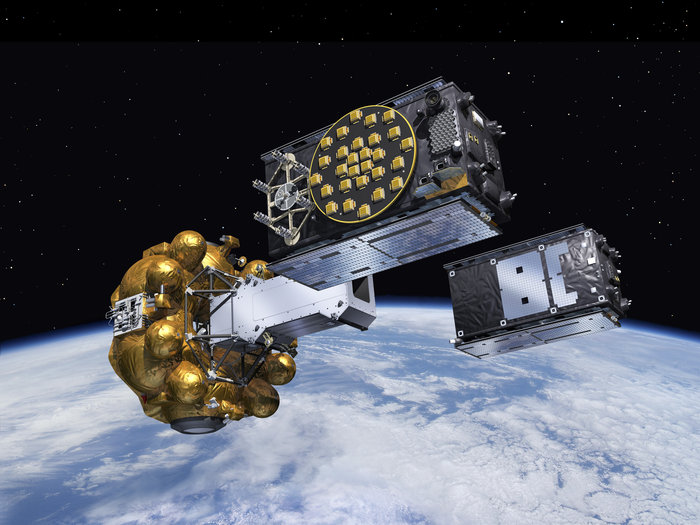
    Galileo Twins Alba and Oriana separate in mid-Earth orbit from the Fregat mother ship (artist’s concept, courtesy of ESA).
    Galileo Fregat upper stage flew the latest two Galileo satellites most of the way up to medium-Earth orbit before they finally separated. (Artist’s concept, courtesy of ESA).

    Galileo satellites 11 and 12 lifted off together on Dec. 17 atop a Soyuz rocket, and successfully deployed in space four hours later. The pair effectively doubles the number of Galileo satellites in space over the last nine months.

    Five satellites are now set operational to the user. Once 9 and 10 (launched in September 2015) as well as 11 and 12 are set operational, a total of nine usable satellites will be in orbit. Satellites 5 and 6 may be partially usable at some point.

    “Along with the ground stations put in place around the globe, this brings Galileo’s completion within reach,” said Jan Woerner, director general of the European Space Agency.

    “Production, testing and launch of the remaining satellites are now proceeding on a steady basis according to plan,” added Didier Faivre, ESA’s director of Galileo and navigation-related activities.

    Starting with launches in the third quarter of 2016, four rather than two satellites at a time will rise into orbit. This accelerated deployment should bring 30 satellites on line — 24 operational and six orbit spares — by 2020 for full operational capability of the European GNSS. Initial operating capability is foreseen by the end of 2016.

    “The target is initial service next year, with a reduced constellation, for the Open Service, Public Regulated Service and Search-and-Rescue,” said Carlo des Dorides, executive director of the European GNSS Agency (GSA). “We will also start proof-of-concept testing for the Commercial Service. The performance will be reduced in terms of availability and continuity because of the reduced number of satellites — but not in terms of accuracy.”

    Fundamental Elements. For the benefit of users and industry on the ground, the GSA announced in September the provision of 100 million euros ($110 million) to promote development of chipsets and receivers. Slated for distribution between 2015 and 2020, the funds are to stimulate market reception for Galileo. The announcement followed a paper published by the Galileo Services industry consortium urged accelerated investment by European governments to safeguard competitiveness of European manufacturers with U.S. and Chinese industry in the satnav user equipment market.

    Sensitivity on PRS. Sorting out access to the encrypted Public Regulated Service (PRS), even among the 28 EU member nations, involves some thorny issues. EU officials have grappled with so-called Common Minimum Standards that set rules on PRS access for national government agencies and PRS hardware manufacturers, with the goal of ensuring that the encrypted signal is not compromised. The diversity of EU nations’ security precautions is wide enough that the European Commission (EC) has reserved the right to conduct inspections of agencies and companies working with PRS to verify compliance. Each nation using PRS will create a specialized agency responsible for its use.

    Due to the sensitive subject matter, the EU will not publish supporting documents for the Common Minimum Standards in the EU’s Official Journal. The standards were nonetheless approved in November.

    Nations outside the EU face a more difficult path to PRS. Norway and the United States have applied. Both are members of the North Atlantic Treat Organization (NATO), and military use by all agreeing parties is a tacit aspect of the PRS. The next step to granting U.S. and Norwegian access is for the EU’s highest decision-making body, the European Council, to give the European Commission authority to open negotiations with U.S. and Norwegian authorities.

    New ICD. In late November, the European Commission published a new release 1.2 of the Galileo Open Service Signal In Space Interface Control Document (OS SIS ICD v1.2).


    GPS Fully Funded, Minus $2 Million

    In late November, President Obama signed the National Defense Authorization Act (NDAA) for Fiscal Year 2016, after vetoing a previous version. The enacted NDAA complies with the two-year budget agreement, which called for a reduction in defense spending.

    The act reduces the GPS IIF line item by $2 million, citing “unjustified support growth” from the U.S. House of Representatives Committee on Appropriations, but otherwise recommends full funding for the Air Force GPS program ($936.775 million).

    Privacy Uptaken. In other Capitol developments, Sen. Al Franken (D-MN) reintroduced the Location Privacy Protection Act. According to the senator’s office, “The Location Privacy Protection Act of 2015 closes legal loopholes that allow stalking applications to exist on smartphones.

    “Sen. Franken’s bill fixes this problem by requiring companies to get customers’ permission before collecting their location data or sharing it with third parties.”

  • The GNSS of Things, and a Galileo/Copernicus interface

    A software offering an “open-source innovation platform for the GNSS of Things”  won the Special Prize in the Galileo Masters competition. Another entry showed the opportunities that lie at the interface of Galileo and Copernicus, the EU’s Earth-observation satellite project. The UK government has just published its first ever space policy document, and I am amazed as well as somewhat surprised that it took so long.

    Brits in Space
    I was born in 1961, the year of the original spaceman, and just a few days old when Yuri Gagarin boarded Vostok 1 and launched the era of manned spaceflight. My childhood was vividly punctuated by the triumphs and disasters of the early days of our exploration of outer space. So I am amazed – and somewhat perplexed – to think that it is only now, 55 years later – that the first British taxpayer-funded astro/cosmonaut has made it into orbit! But congratulations to Major Tim Peake and our best wishes for his six-month mission on the International Space Station.

    Even more amazing is that, coinciding with Major Peake’s flight, the UK government has just published the first ever UK Space Policy document. We Brits do consider ourselves to be pretty good at the old aeronautics and aerospace game, so again, it is amazing that we have not had a written space policy before now.

    The good news is that, apart from articulating an ambition to establish a commercial ‘space port’ in an otherwise currently undisturbed part of rural England, the policy has a clear focus on innovation and the use of space-based solutions for public services and security.

    Berlin innovation

    Much European satellite innovation in the GNSS and Earth Observation sectors was on display at the Satellite Masters Conference and Awards Ceremony that took place in Berlin at the end of October. This annual event once again highlighted the wealth of creative people in the downstream GNSS community in Europe. As ever it was a joy to meet and talk to people young – often very young – and old who had genuine enthusiasm for the technical and commercial opportunities that GNSS technology is bringing and the ambition to bring these ideas to concrete fruition.

    In particular the European Satellite Navigation Competition (ESNC), otherwise known as the Galileo Masters, has helped to foster this community. And ESNC 2015 was no exception.

    For example, the recipient of the European GNSS Agency (GSA) Special Prize award at the Masters ceremony in Berlin was Rafael Olemedo. Rafael is a serial GNSS innovator and entrepreneur and his KYNEO concept is very much of the moment.

    The Internet of Things (IoT) – the integration of uniquely identifiable devices on the internet – is one of the main current global technology themes and GNSS is integral to its success. Location based services and timing data are essential of IoT applications in particular as a means to control and monitor mobile IoT devices.

    The basis of the KYNEO concept is a real need to be able to fast prototype applications and devices in the rapidly developing IoT field. Rafael describes KYNEO as an “open innovation platform for the GNSS of Things.”

    As I said Rafael has been here before and is a previous winner of the GSA Special Prize. In 2012 he won with his 3DSound idea: a personal navigation solution based on the integration of acoustic binaural technologies (i.e. 3D sounds) and GNSS technologies to guide people along a predefined track. His insight with KYNEO is that many different products and services are looking for similar solutions for positioning that can be flexibly adapted in different contexts. This is particularly so for developers in the IoT field.

    KYNEO is essentially an Arduino-compatible board that allows developers to rapidly and flexibly build their own solutions based on open–source software. Arduino is an open-source electronic prototyping platform for the creation of interactive electronic objects.

    Rafael highlights the flexibility of the KYNEO concept. “The KYNEO concept can easily provide a portfolio of functionalities in terms of positioning technologies, connection with other sensors, memory options, networking and communications,” he says. “Application developers can use it as a ‘black box’ or get more involved to customise the unit.”

    The KYNEO product is designed to be low-cost and competitive, but Rafael sees associated services as being the main money-spinner for his company. “There will be some profit in selling the products themselves, but these sales will open doors to services and consultancy,” he explains. “The product will give visibility to KYNEO and the technology support and consultancy services we provide.”

    It was also great to briefly meet up with the team behind the VADASE project who have developed a real-time GNSS monitoring system for seismology that I first covered in this column in September 2014. Dr Gabriele Colosimo and colleagues at Rome’s “Sapienza” University talked about their successful efforts to translate what had originally been an academic exercise to an industrial application. Their motto in commercialising the system was similar to Rafael’s being “keep it fast, keep it simple” and this year Leica Geosystems – for whom Gabriele now works – have launched a stand-alone receiver with the VADASE computational engine integrated. The receiver is able to compute real time fast displacements autonomously in man-made and natural structures.

    The Satellite Masters conference itself featured extended discussion of the leveraging of satellite-derived data and other space solutions for business and society. The amount of data that is, and will, be generated by space-based systems is quite incredible and possibly overwhelming. This is especially so for Earth Observation sector. How useful and timely information is derived from this torrent of data is a major challenge. As one participant put it: “Data is worth only as much as the insight you can gain from it.”

    One approach was demonstrated by the excellent GEO-VISION application that also showed the opportunities that lie at the interface of Galileo and Copernicus. Dr Harald Skinnemoen from AnsuR Technologies claims the project outcomes can provide visual situational awareness capability anywhere in the world, with the aim of enabling “observation to action”, within one minute worldwide. Quite an ambition.

    He sees two main markets: humanitarian and financial. Interestingly this research project is releasing products and applications to the market as it progresses. The project’s output was used, for example, by the UN to map the effects of the earthquake in Nepal and help prioritise their operations there. This provides valuable feedback to the research team and also means that investment for future development is being attracted from the start.

    Up in the air

    Of course all these innovative applications rely on there being satellites up there to provide the infrastructure. And 2015 has been a very busy year for Galileo launches. The three launches in the year have effectively doubled the constellation in-orbit.

    The recent successful launch on 17 December from Kourou provides the next two satellites (named Andriana and Liene – aka FOC 11 and 12) that will be used to launch Galileo Early Services. This last launch was almost ten years on from first ever Galileo launch. Galileo GIOVE-A took off on 28 Dec 2005 from the Baikonur facility to lay claim to the frequencies allocated to Galileo by the ITU and to technically demonstration of the concept. It has been slow progress but perhaps we are almost there?
    A press conference on the eve of the launch discussed the future programme for Galileo, the status of the in-orbit satellites and Early Service provision.

    Carlo des Dorides confirmed that the nine fully viable satellites in orbit (including the two launched on 17 December) represent the “reduced constellation” that will deliver Galileo Early Services during the second half of 2016. The two satellites launched in September have almost completed their in-orbit testing and are on schedule to begin providing navigation signals during January. Carlo said the Early Services would consist of the Open Service (OS), Search and Rescue (SAR) and the Public Regulated Service (PRS) and provide proof of concept testing for Commercial Services (CS).

    These services will provide 100% of the accuracy to be expected from the full constellation but clearly cannot provide 100% continuity and availability. There are in fact 12 satellites in orbit but two are in eccentric orbits and one has a power problem.

    The European Commission’s Galileo Programme Manager Paul Flament talked about the two off-orbit Galileo satellites. Doresa and Milena are now in improved but eccentric orbits and a further few months of testing is being undertaken to confirm the contribution they can make to the Galileo GNSS services. But he confirmed that it was “100% sure” that they be contributing to the SAR and OS services in 2016. The only constraint was the Public Regulated Service (PRS) where security concerns meant they would definitely not contribute.

    With the four IOV satellites manufactured by Astrium and the 22 FOC satellites ordered from OHB that makes a total of 26 satellites – all to in the sky by 2018. You need 24 for a full constellation so with three satellites at less than 100% operational function currently – I make that one short. So it was good to hear that the European Commission will be publishing an open tender for the provision of eight more Galileo FOC satellites in the very near future. Paul Flament emphasised that European Union rules meant that a tender of this value had to be offered to the whole market. It will be interesting to see if more than one serious bid is received.

    During 2016 there is likely to be only one Galileo launch said current ESA Director of Galileo Programmes and Navigation-Related Activities Didier Faivre. He indicated that one Ariane 5 launch with the new four satellite dispenser would happen in a launch window between September and November. He indicated that there was an outside possibility of a second Ariane 5 launch in this window, but that depends on the overall launch calendar at the European spaceport. He was confident that the production and test chain for the Galileo satellites was working very well and could fulfil a second Ariane launch if an appropriate window was made available.

    This was Didier’s last Galileo launch as he will hand over to Paul Verhoef in 2016 (see below).

    Paul Flament also revealed that negotiations for possible US (and Norwegian) access to the Galileo PRS may start soon as Common Minimum Standards (the who and what legal and regulatory basis for users and receiver manufacturers etc.) had been agreed by EU Member States. This opens the way for the Commission to receive a mandate from the European Council to start negotiations with third party countries about participation in this government-only secure service.

    New faces, old faces
    The European GNSS world has seen a change of command over the autumn/ fall period. On 21 November the European Space Agency (ESA) Council approved new ESA Director General Johann-Dietrich Woerner’s proposal for his senior management team.

    Jan Woerner himself, of course, took up duty as ESA Director-General just six months ago on 1 July 2015. He seems to be bringing a breath of fresh air to ESA and is continuing to write a regular blog offering insights on his thinking. He first started the blog in 2010 when Chairman of the German Aerospace Centre (DLR).

    Of most importance to European GNSS stakeholders was the naming of Paul Verhoef as the new Director of Galileo Programmes and Navigation-Related Activities at ESA replacing Didier. Dutch national Verhoef is a former head of unit for satellite navigation programmes at the European Commission. He served in this position between 2005 and 2011 and was heavily involved in shaping the Galileo programme as we see it today. More recently he has been working as Head of Unit on renewable energy in the Commission’s Research and Innovation DG. Verhoef takes up his new role early in 2016.

    To complete the recent appointment news Carlo des Dorides was re-elected by unanimous vote as the Executive Director of the European GNSS Agency (GSA) on 30 October. His second four-year term at the helm of the GSA will focus on using the organisation that he has essentially built from the ground up to achieve the best possible return on Europe’s investment in this area.

    I hope that with all the players in place they can work together for a common goal. As Jan Woerner puts it at the end of a recent blog on the outcomes of the EU-ESA Space Council:

    “My sincere hope is that all future developments between the different actors in the European space sector are dictated by their respective expertise rather than any form of vanity or power games. The citizens of Europe have a right to expect from all of us that we use their money as efficiently as possible, avoiding any duplication of efforts and pointless struggles over position and status. This can be summarised under the motto United Space in Europe.”

    A statement that I feel all stakeholders in the European space community – and GNSS stakeholders in particular – can fully support.

    Best wishes to all our readers for 2016 – the year in which we all hope to see (at last) Galileo Early Services available.

    A bientȏt as they say in these parts.

  • 12 GNSS birds for December, and a document under the tree

    Just what every satnav engineer wanted for the holidays: a new Interface Control Document to unwrap under the tree. On Nov. 30, the European Commission (EC) published version 1.2 of the Galileo Open Service Signal In Space Interface Control Document (OS SIS ICD v1.2). The document provides the information for receiver and chipset manufacturers, application developers and service providers to process and make use of the open signals generated by the Galileo satellites. This most recent iteration incorporates feedback from receiver manufacturers and other stakeholders.

    The Galileo OS SIS ICD v1.2 specifies:

    • Galileo signal characteristics.
    • Characteristics of Galileo spreading codes.
    • Galileo message structure.
    • Message data contents.

    Key new features in version 1.2 include:

    • An annex with numerical examples of FEC coding and interleaving.
    • A revised and simplified license agreement.
    • Cross-reference to a companion document, “Ionospheric Correction Algorithm for Galileo Single Frequency Users,” containing details on the ionospheric model used for Galileo.

    In addition, a number of minor editorial improvements including corrections and clarifications have been made.
    The Galileo OS SIS ICD v1.2 document can be downloaded here.

    The Ionospheric Correction Algorithm for Galileo Single Frequency Users document can be downloaded here.

    Twelve Birds for December

    Also timely for end-of-year celebrations, Galileo satellites 11 and 12 lifted off together on Dec. 17 atop a Soyuz rocket, and successfully deployed in space four hours later. The pair effectively doubles the number of Galileo satellites in space over the last nine months.

    Five satellites are now set operational to the user. Once 9 and 10 (launched in September 2015) as well as 11 and 12 are set operational, a total of nine usable satellites will be in orbit. Satellites 5 and 6 may be partially usable at some point.

    “Along with the ground stations put in place around the globe, this brings Galileo’s completion within reach,” said Jan Woerner, director general of the European Space Agency.

    “Production, testing and launch of the remaining satellites are now proceeding on a steady basis according to plan,” added Didier Faivre, ESA’s director of Galileo and navigation-related activities.

    Starting with launches in the third quarter of 2016, four satellites at a time will rise into orbit on all except one date, which remains at two. This accelerated deployment should bring 30 satellites on line — 24 operational and six orbit spares — by 2020 for full operational capability of the European GNSS. Initial operating capability is foreseen by the end of 2016.

    Service Centre and Help Desk

    The European GNSS Agency (GSA), responsible for Galileo service provision as directed by the EC, is developing the European GNSS Service Centre (GSC), which provides the single interface for information and help to users of the Galileo Open Service (OS). The GSC will eventually operate on a 24/7 basis and offer a range of services, including hosting the Galileo User Helpdesk, providing the interfaces between the Galileo System and OS users and hosting a centre of expertise for OS service aspects.

    Related links:
    Galileo Programme Reference Documents
    Video: “Message received: Ensuring that navigation devices are ready for Galileo”
    European Commission Galileo

    Information, images and videos referenced in this story all come courtesy of the GSA.