Author: GPS World Staff

  • Royal Institute Hosts New Navigation Conference

    Royal Institute Hosts New Navigation Conference

    INC_2015_logoThe Royal Institute of Navigation is launching a new international conference series, tackling some of the biggest issues across the domains of modern navigation: land, sea, air and space.

    The RIN is now accepting abstracts for the conference.

    The International Navigation Conference 2015, set for February 24-26, 2-15, is planned as a first event in a new series of world-class conferences. The first conference will highlight the state of the art in fields such as GNSS and Galileo, indoor positioning, autonomous transport, security and resilience of navigation in the world of cyber attacks, and new quantum technologies. The event will be of special interest to the maritime, aviation, PNT, transport, research and development and security communities.

    Speakers, and the topics they will discuss, include:

    • Privacy In Tracking (smartphones and indoor navigation) – Google
    • Security and resilience — Dana Goward, president and executive director, U.S .Resilient Navigation and Timing Foundation
    • Multi-Constellation GNSS — Gian Gherado Calini, GSA
    • Multi-Sensor Integration — Professor Dorota Grejner-Brzezinska, The Ohio State University
    • Quantum Technologies — Sir Peter Knight, professor of Quantum Optics and Senior Research Investigator, Imperial College London
    • Emerging Trends and Current Challenges — Colin Beatty FRIN, CBiL
    • Autonomy in transport — BAE, ASTREA
    • Legal Aspects of Navigation — Professor Frans von der Dunk, Institute of Space Law, Leiden University

    To learn more, visit the conference website.
  • Topcon Releases Next-Generation 3D Laser Scanners

    Topcon Releases Next-Generation 3D Laser Scanners

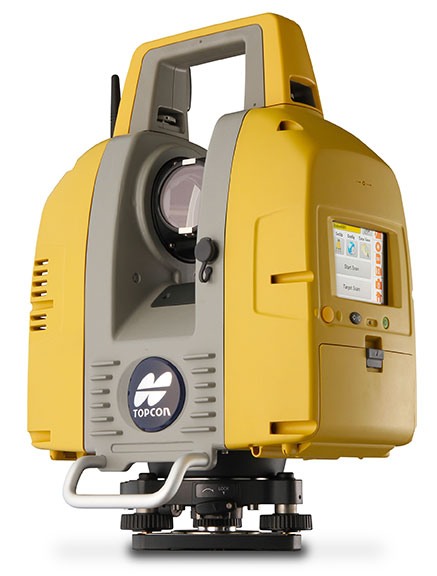
    GLS-2000 laser scanner by Topcon.
    GLS-2000 laser scanner by Topcon.

    Topcon Positioning Group announces the release of the newest edition to the GLS line of laser scanners, ­ the GLS-2000. Featuring an expanded field of view, the GLS-2000 is designed to pair with ScanMaster v3.0 software for quickly capturing and processing 3D point-cloud data.

    “The GLS-2000 is the fastest and most versatile scanning system in its class,” said Charles Rihner, vice president for the Topcon GeoPositioning Solutions Group. “With a scan range of more than 350 meters, the GLS-2000 is capable of accurately capturing long-distance measurements in applications where access is limited due to safety or logistics concerns.”

    Using Topcon Precise Scan Technology II, the GLS-2000 is designed to emit pulse signals three times faster than earlier models. “Using faster pulse signals enables timing to be detected more precisely, which results in reduced noise and higher-accuracy data,” said Rihner.

    “With the on-board control software, scanning can simply be started with the touch of a button. Even entry-level users can intuitively operate the GLS-2000 that comes complete with a color graphical display,” said Rihner.

    Additional features include a full-dome scanning range, user selectable Class 3R or 1M laser, and an exclusive laser plummet function that measures instrument height with a one-touch operation.

  • Trimble Releases Software for Real-Time Construction Equipment Inspection

    Trimble has announced three new asset inspection software solutions for heavy civil contractors—Trimble Inspector, Trimble Inspector Pro and Trimble Asset Manager.

    Trimble Inspector is a free mobile app that allows equipment managers to easily inspect assets in real-time using their smartphone or tablet.

    Trimble Inspector Pro, the premium, subscription version of Trimble Inspector, is used to wirelessly aggregate and share asset condition across multiple sites using Trimble Asset Manager office software.

    Trimble Asset Manager software gives contractors the ability to store the inspection data of all assets in a centralized, Web-based database for accurate reporting and documentation.

    “Contractors can achieve significant cost savings by proactively scheduling asset maintenance with Trimble’s new inspection solutions,” said Alan Sharp, business area director for Trimble Heavy Civil Construction. “Trimble takes the guesswork out of asset maintenance and puts the control back in the hands of the equipment manager.”

    Trimble Inspector, a free mobile app, runs on both Android and iOS smartphones or tablets for daily, weekly and monthly visual inspections using a library of equipment, machine and vehicle types, makes and models, and inspection checklists. Reports containing current visual health status, hours, odometer reading and general condition can be promptly emailed to equipment and maintenance managers. The reports, along with photos, can then be retained for legal documentation of health and safety standards compliance, and for audit purposes. In addition, Trimble Inspector assists with scheduling maintenance to reduce equipment downtime and unplanned stoppages. The app is also ideal for trade-in or auction house inspections of used equipment.

    Trimble Inspector Pro has all the functionality of Trimble Inspector, with the added benefits of customized inspection reports to meet health and safety requirements, and comprehensive maintenance reports for service crews. Equipment managers can record equipment service issues and notify site management staff of equipment status on multiple sites within seconds of the completed inspections. Trimble Inspector Pro requires a subscription to Trimble Asset Manager office software to access the additional functionality.

    Trimble Asset Manager is a software as a service (SaaS) application used in the office to integrate, store and report asset condition data collected in the field by Trimble Inspector Pro. Asset information is kept in a secure, centralized online database accessible by authorized users in the company. Users can create asset records, document inspections and customize reports so managers get the data they need quickly and easily.

    Trimble Inspector and Trimble Inspector Pro are available now worldwide from the Google Play Store or the Apple App Store. Trimble Asset Manager is available now globally through Trimble’s SITECH Technology Dealer Channel.

  • Grant Available to Promote EGNOS for Aviation

    The European GNSS Agency (GSA) has launched a call for proposals to foster further EGNOS adoption in the European civil aviation sector. The grant aims to support projects that enable users to equip and use their aircraft or rotorcraft fleet with GPS/SBAS-enabled avionics and allow Air Navigation Service Providers and aerodromes/heliports to implement EGNOS-based operations in Europe.

    The purpose of the call is to co-fund projects capable of fostering EGNOS operational implementation for regional, business and general aviation and rotorcraft. In addition, commercial operators and original equipment manufacturers (OEMs) interested in benefiting from EGNOS may also apply.

    Specifically, the call aims to:

    • Foster the design, development and operational implementation of EGNOS-based operations, including approach procedures at different European aerodromes and EGNOS based routes.
    • Develop and install GPS/EGNOS enabled avionics and granting of airworthiness certification for RNP APCH procedures down to LPV minima, including the development of Supplemental Type Certificates (STC) or Service Bulletins (SB).
    • Approve Air Operator Certificates for LPV operations of aircraft already equipped with SBAS capabilities.
    • Develop enablers to accelerate EGNOS adoption and preparation for its future capabilities, such as LPV 200.

    The deadline for submitting applications is 16:00 CET, October 31. 

    Applications will be assessed in terms of relevance of the proposal and credibility of the proposed approach, economic and societal impact, and coherence and effectiveness of the work plan.

    The total budget of the call is EUR 6,000,000 and maximum EU financing of eligible direct costs is 60 percent. In addition, a flat-rate amount of 7% of the total eligible direct costs of the action is eligible under indirect costs.

    Awarding of the grants will happen in December 2014, with each grant agreement having an estimated duration of two years.

  • QZSS May Expand to Meet Japan’s Surveillance Needs

    The Japan News is reporting that the Japanese Committee on the National Space Policy has compiled a draft proposal that includes increasing the number of quasi-zenith satellites (QZSS), Japan’s satellite navigation system, from the current single satellite to a total of four.

    Currently, Japan is operating only one quasi-zenith satellite, named Michibiki.

    The increase would be made to strengthen Japan’s overall surveillance systems, in light of developments such as China’s maritime expansion. “China’s high-pressure maritime advances have become a menace to the security of countries in Asia. Continued vigilance is also required against North Korea’s missile launches and nuclear weapons development program,” according an editorial published by The Japan News.

    The additional QZSS satellites would presumably supplement Japan’s surveillance satellites with positioning information. Japan currently has four information-gathering satellites, which lack the flexibility to boost the accuracy of ground surveillance activities and swiftly grasp movements of objects such as vessels at sea.

    “For surveillance activities, acquisition of high-precision positioning information using space technology is also important. Only the global positioning system (GPS) run by the United States is currently reliable for this purpose,” the editorial said.

    A four-satellite QZSS system will allow positioning surveillance of all regions around the clock. Based on the proposal, the government is expected to revise the Basic Plan on Space Policy within the year.

    The proposal also stipulates that the country should aim to operate seven quasi-zenith satellites as early as possible, which would allow stable management of the system, according to The Japan News.

  • Galileo Launch Successful, Satellites Deployed

    Galileo Launch Successful, Satellites Deployed

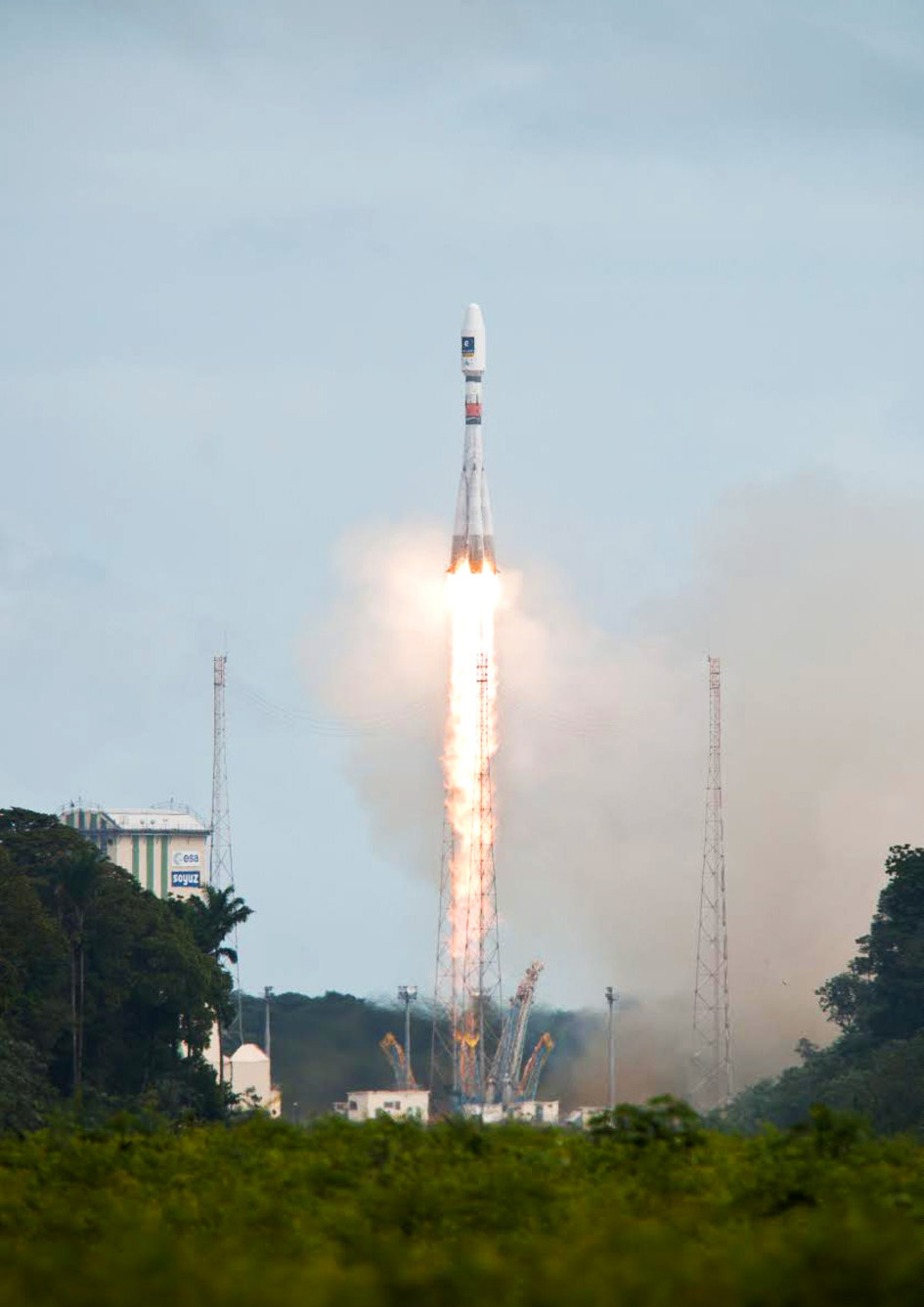
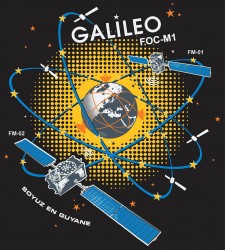
    Soyuz Flight VS09, carrying Europe's fifth and sixth Galileo satellites, lifts off from Europe's Spaceport in Kourou, French Guiana.
    Soyuz Flight VS09, carrying Europe’s fifth and sixth Galileo satellites, lifts off from Europe’s Spaceport in Kourou, French Guiana.

    Soyuz Flight VS09, carrying Europe’s fifth and sixth Galileo satellites, lifted off from Europe’s Spaceport in Kourou, French Guiana, today (August 22, 12:27:11 UTC/14:27:11 CEST.)

    All the stages of the Soyuz vehicle performed as planned, with the Fregat upper stage releasing the satellites into their target orbit close to 23,500 km altitude, 3 hours 47 minutes after liftoff.

    These new satellites joined four Galileo satellites already in orbit, launched in October 2011 and October 2012 respectively. This first quartet were In-Orbit Validation (IOV) satellites, serving to demonstrate the Galileo system would function as planned.

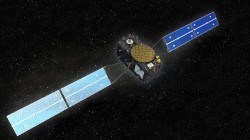
    Satellites 5 and 6, the first Full Operational Capability (FOC) satellites, are significant as the first of the rest of the Galileo constellation. This launch marks the start of a new phase in the European satellite navigation program where the full constellation will be deployed with short intervals between launches. A steady stream of launches will follow to build the complete Galileo constellation.

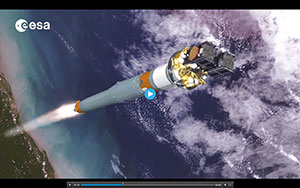
    Watch a video of the launch here:

    On completion of the initial checks, run jointly by the European Space Agency (ESA) and the French space agency CNES, the two satellites will be handed over to the Galileo Control Centre in Oberpfaffenhofen, Germany, and the Galileo in-orbit testing facility in Redu, Belgium, for testing before they are commissioned for operational service in the autumn.

    The deployment of the constellation will now move more quickly, with six to eight satellites launched per year using a series of Soyuz and Ariane launches from the CSG, along with finalization of the remaining elements of the ground network.

    The final constellation will consist of 24 satellites expected to be ready in 2017 and complemented by six in-orbit spares.

    This deployment phase of the Galileo program is being managed and funded by the European Commission, with ESA acting as design and procurement agent on behalf of the Commission.

  • Update: Galileo Launch Rescheduled for Friday

    UPDATE: The next launch attempt for Soyuz VS09 with Europe’s fifth and sixth Galileo satellites is Friday, August 22, at 12:27 GMT, 14:27 CEST. Arianespace had decided to postpone the launch of Soyuz flight VS09 carrying Europe’s fifth and sixth Galileo satellites, because of unfavorable weather conditions over the Guiana Space Centre.

    Follow the launch live. Streaming starts at 12:07 UTC/14:07 CEST.

    The launch was originally scheduled for August21. Read more about the planned launch here.

  • Omnitracs Tracking Offers Enhanced Mobile Workforce Management

    Omnitracs, LLC, a provider of fleet management solutions to transportation and logistics companies, is making available Omnitracs Tracking powered by Roadnet, a mobile workforce tracking application for smart devices. Omnitracs Tracking offers basic capabilities to help companies track the locations of their mobile workers throughout the day and get additional performance data to help make them safer and more productive, the company said.

    “Every transportation company with a mobile workforce wants to know the location and key behaviors of their drivers,” said Dan Speicher, chief technology officer at Omnitracs. “Omnitracs Tracking powered by Roadnet enables companies that have not adopted a fully featured mobile fleet management solution to utilize their existing smart devices in order to track locations of mobile workers, improving safety, productivity and customer satisfaction.”

    Benefits of Omnitracs Tracking include:

    • Location Tracking. By leveraging existing smart device GPS positioning technology, location tracking pinpoints drivers’ locations in real-time using satellite and street maps.  Fleet managers access this information through a web-based application, enabling them to provide customers with timely updates on the status of their delivery or service call.
    • Speed Tracking. The application monitors drivers’ speed throughout the day, allowing fleet managers to take prompt action to help preempt potential safety issues.
    • Exception Reporting. Users can predefine thresholds for maximum speed allowed, GPS gap, over road speed and stationary position time limits. Exception reporting helps to quickly identify driver behaviors that may lead to unsafe driving and reduced productivity.

    “Omnitracs is committed to leveraging the expertise and capabilities of our business units to continuously bring value to our customers. Our newest basic tracking application will give companies the tools they need to better manage their mobile workforce and take fast, appropriate action to improve safety and productivity,” added Speicher.

    Omnitracs Tracking is available exclusively through Roadnet and Omnitracs’ resellers. For more information about the application, visit.

  • Galileo Satellites Encapsulated for Launch

    UDPATE:

    After a one-day postponement, The fifth and sixth Galileo satellites were successfully launched and deployed.

    UPDATE:

    Arianespace has decided to postpone the launch of Soyuz flight VS09 carrying Europe’s fifth and sixth Galileo satellites. This is due to unfavorable weather conditions over the Guiana Space Centre.

    Another launch date will be decided depending on the evolution of the weather conditions in Kourou.


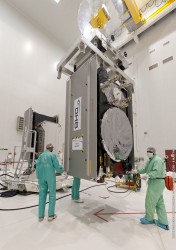
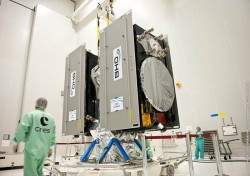
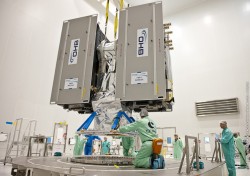
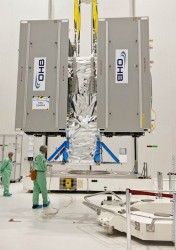
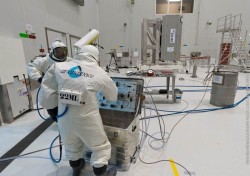
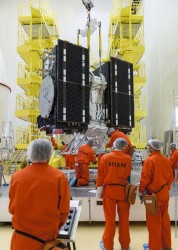
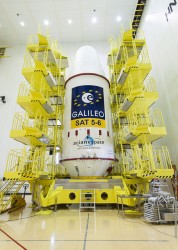
    Europe’s latest Galileo satellites have been sealed within their launch fairing, atop the Fregat upper stage that will carry them into their final orbit on August 21, ushering in the system deployment phase and paving the way for the start of initial services. Galileo SATs 5-6 are scheduled to lift off at 12:31 GMT from Europe’s Spaceport in French Guiana on top of a Soyuz rocket.

    The two Galileo satellites had been attached together on the dispenser that secures them during flight, and then delivers them into orbit. Then August 14 saw the follow-on installation of the stack — the two satellites plus dispenser — onto the Fregat stage. The following day was the last time the two Galileo satellites were seen by human eyes, as the two halves of the protective launch fairing were sealed around the satellites and their upper stage.

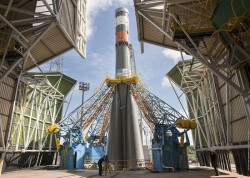
    Meanwhile, on August 18, the satellites’ three-stage Soyuz launcher was moved by rail onto its launch pad then lifted to the vertical position. The launcher’s mobile gantry was then moved into position around the upright launcher. This allows the next step of the launch campaign to take place, the hoisting up and attachment of the entire upper composite — the launch fairing containing the Galileo satellites, their dispenser and the Fregat fourth stage. At three hours, 47 minutes and 57 seconds after liftoff, the satellites will then be deployed from their Fregat by the dispenser’s pyrotechnic separation system, once their final 23,500 km altitude is reached.

    These new satellites will join four Galileo satellites already in orbit, launched in October 2011 and October 2012 respectively. This first quartet were in-orbit validation satellites, serving to demonstrate the Galileo system would function as planned. Now that work has been done, the Full Operational Capability (FOC) satellites being launched on Thursday are significant as the first of the rest of the Galileo constellation.

    The payloads generating navigation signals to Earth have been manufactured by Surrey Satellite Technology Ltd in the UK, while the satellites carrying them have been built by OHB in Germany.
    A steady stream of launches is planned for the next few years, with two Galileo satellites flown per Soyuz launch and four Galileo satellites flown per launch of an Ariane 5 variant currently in preparation.
    The definition, development and in-orbit validation phases of the Galileo program were carried out by ESA and co-funded by ESA and the EU. The Full Operational Capability phase is managed and fully funded by the European Commission. The Commission and ESA have signed a delegation agreement by which ESA acts as design and procurement agent on behalf of the Commission.

    The August 21 launch can be watched live here.

  • Galileo Deployment Phase Overview

    Galileo Deployment Phase Overview

    Galileo-Deployment-Video-300

    This video by the European Space Agency recalls the success of Galileo’s in-orbit validation phase and explains what will be the mission of the fifth and sixth Galileo satellites, set to launch August 21.

    Included is an interview with Sylvain Loddo, Galileo ground segment manager. The launch itself can be watched live here.

    View the video below.

  • JAVAD GNSS Introduces TRIUMPH-F1 UAV with Video

    JAVAD GNSS Introduces TRIUMPH-F1 UAV with Video


    JAVAD GNSS is introducing its new unmanned aerial vehicle with the dramatic flourish of a video showing the UAV in flight, accompanied by the “Also Sprach Zarathustra” theme from 2001: A Space Odyssey.

    The TRIUMPH-F1 unmanned aerial vehicle is based on the JAVAD GNSS TRIUMPH-1. TRIUMPH-1 is the company’s field-tested high-precision geodetic GNSS receiver with 864 channels to track all current and future GNSS signals.

    When used on the ground, the TRIUMPH-F1 can function as a TRIUMPH-1 base or rover. The four motor arms (for eight motors) are detachable. There are four screw inserts in the bottom to attach the TRIUMPH-F1 to a pole mount for field use.

    The TRIUMPH-F1 features user-friendly mission programming. The four lithium polymer batteries that power the eight propeller motors, arranged in a stacked quad formation, each have a test button and LEDs to indicate the current charge level, as well as accessible ports for easy charging.

    The TRIUMPH-F1 also has two micro-SD slots for image storage, a SIM card slot, a USB connector for uploading flight plans and downloading collected images, and indicators for satellite tracking and communications. Other indicators are dedicated to flight status and gyro. It comes equipped with four angled documentation cameras and a downward high-precision camera for photogrammetry.

    JAVAD GNSS will exhibit the new device at InterGeo, to be held October 7-9 in Berlin.

    To learn more, watch the video or visit JAVAD GNSS.

    JAVAD-Triumph-F1


  • Motion Tracker for Industrial Applications

    Motion Tracker for Industrial Applications

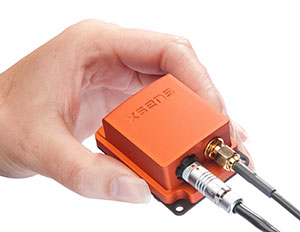
    MTi-G-700_hand-WThe MTi-G-700 by Xsens is a GPS-aided, IMU-enhanced GPS/INS that offers high-quality orientation and position. It makes use of sensory measurements from magnetometer, barometer, and a high-sensitivity GPS-L1 receiver to provide navigation estimates of position, velocity, and orientation at high data rates under high-dynamic conditions.

    The Xsens estimation engine (XEE) sensor-fusion framework enables the motion tracker to take advantage of different aiding sensor measurements and optimally fuse them to get robust tracking estimates. The MTi-G-700 has a u-blox 6 internal 50-channel L1C/A code receiver with 2-meter horizontal accuracy and 5-meter vertical accuracy; SBAS; a 4-Hz update rate; 27-second cold start-up time; and -161 dBM tracking sensitivity.

    The MTi is being used by customers for many maritime and oceanographic applications that require 3D orientation, 3D position, 3D velocity, and 3D dynamic data, such as a monitoring system in a barge master vessel where the MTi monitors the movement of a wave-compensated crane.