Author: GPS World Staff

  • Transportation Department to Hold GPS Adjacent Band Compatibility Workshop

    The U.S. Department of Transportation is holding a “GPS Adjacent Band Compatibility Assessment Workshop” on September 18, 10 a.m.–5 p.m. Eastern Daylight Time. Registration for the workshop is required, and closes September 4. The general public can either attend in person or via WebEx.

    The workshop is being held to discuss implementation of a GPS Adjacent Band Compatibility Assessment. Discussion will focus on the various implementation steps of the assessment, including development of GPS receiver use cases, identification of representative GPS receivers, and development of a test and analysis program. “In particular, emphasis will be placed on the information needed from GPS receiver and antenna manufacturers, and the logistics of procuring and handling that information to safeguard manufacturer proprietary data,” according to the Federal Register.

    The sponsoring agency is the Office of the Assistant Secretary for Research and Technology, Department of Transportation.

    To register, send the following information to [email protected]:

    • Name
    • Organization
    • Telephone number
    • Mailing and email addresses
    • Attendance method (WebEx or on site)
    • Country of citizenship

    The meeting will be held at the U.S. Department of Transportation, John A. Volpe National Transportation Systems Center, 55 Broadway, Cambridge, MA 02142. ID is required to enter the building.

    For more details, see the Federal Register notice.

  • Galileo Towards the Future

    GalileoVideo-W

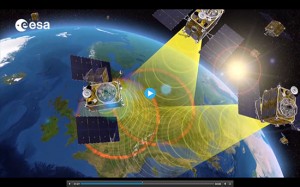
    The special significance of next Thursday’s launch for the Galileo system as a whole is highlighted in a new video by the European Space Agency, with an interview with Didier Faivre, Galileo Program director.

    On August 21, ESA will launch two more Galileo satellites on a Soyuz rocket from Europe’s Spaceport in Kourou, French Guiana. The satellites mark the beginning of a new phase for Galileo, the deployment phase, which will secure the completion of the constellation thanks to accelerated production of satellites and supported by regular launches.

    At the same time, ESA and the European Union also look toward the future and are preparing the evolution of Galileo.

    View the video below.

  • Galileo Open Service ICD Released, Comments Sought

    A new draft version of the Galileo Open Service Signal in Space Interface Control Document (OS SIS ICD), issue 1, revision 2, was published by the European Commission (EC) on June 30, and is available for download.

    The European Commission has launched an open public consultation process in order to improve and consolidate the current draft document and to ensure that any further development of the Galileo OS SIS ICD takes into account the views of key GNSS stakeholders.

    The OS SIS ICD contains the publicly available information on the Galileo Signal In Space. It is intended for use by the Galileo Open Service (OS) user community and specifies the interface between the Galileo Space Segment and the Galileo User Segment.

    The public consultation process provides stakeholders with an opportunity to improve the quality and clarity of the document and to suggest new elements to be included in future versions, for instance, inclusion of multi-GNSS products and services. According to the European Commission, the public consultation process will contribute towards a smooth and rapid rollout of Galileo equipment and applications, and the earliest possible delivery of user benefits.

    Comments are being accepted until September 22, 2014; a form for submitting comments is available via a link on this page.

  • New GNSS Market Outlook Report Forecasts to 2020

    Research and Markets has announced the addition of the “GNSS Market Outlook 2020” report to its offerings.

    Research and Markets explained that GNSS has developed its applications across various industries worldwide. Some applications are simple, such as determining a position, whereas others are complex blends of GNSS with communications and other technologies. Over the past few years, the rapid growth in GNSS commercial applications has been observed by the firms building navigation satellites and equipment. According to the report, the GNSS market is expected to flourish with new technological applications and is anticipated to grow at a CAGR of 9.4 percent during 2014-2020.

    The report “GNSS Market Outlook 2020” is an outcome of the research company’s exhaustive research and comprehensive analysis of the worldwide GNSS market. “Our report provides a complete overview of the GNSS market globally. Over and above, all the current trends and drivers coupled with the potential growth areas of the GNSS industry have been evaluated in the report,” the company said in a statement.

    The report analyzes the GNSS market by its major application areas such as location-based services, transportation, surveying, and agriculture, over a period of eight years (2013-2020). In addition, the transportation section covers the GNSS market by road, rail, air, and marine navigation segments, which are creating a wide opportunity to the overall GNSS market, according to the report.

    The report provides extensive analysis of the GNSS market by each of these segments up to 2020.

    Topics Covered:

    1. Analyst View

    2. Research Methodology

    3. Global Navigation Satellite Systems (GNSS) – Overview

    4. Current Industry Trends

    5. Market Outlook to 2020

    6. Key Country Profile

    7. Potential Growth Areas

    8. Competitive Landscape

    Companies Mentioned:

    • AgJunction
    • CSR
    • Furuno Electric Co Ltd.
    • Garmin Ltd.
    • MiTAC International Corp.
    • Raytheon Company
    • Rockwell Collins
    • TomTom NV
    • Topcon Corporation
    • Trimble Navigation Ltd.
  • CSR, Maestro Offer High-Performance GNSS Module

    CSR, Maestro Offer High-Performance GNSS Module

    maestro-a5100-a-W

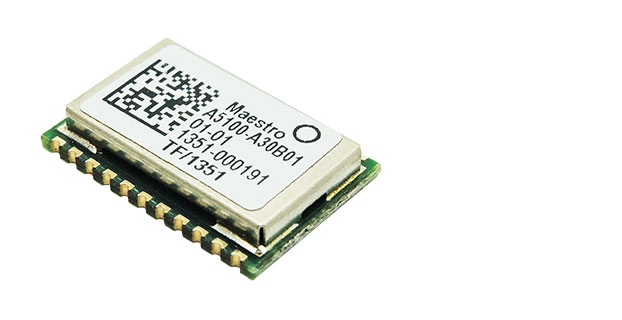
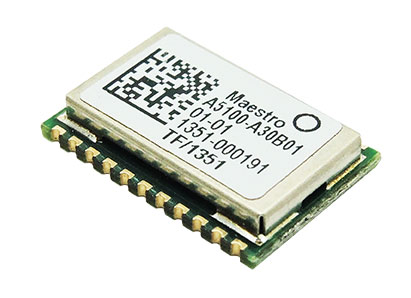
    Hong Kong-based Maestro Wireless Solutions, a manufacturer of location receivers, and CSR plc, a global provider of silicon and software solutions for location-aware applications, announce the immediate availability of the A5100-A, a next-generation SiRFstarV GNSS positioning module that combines high-performance GPS and GLONASS receiver technology in a small 10 x 15 mm package.

    The A5100-A is designed for a wide range of applications including wearable devices, cameras and automotive trackers.

    The A5100-A is the first release within Maestro’s new line of GNSS receivers. It achieves high accuracy with quad-constellation support, up to 30 percent faster time-to-first-fix (TTFF), and up to 20 percent lower power consumption using CSR’s TricklePower and Push-to-Fix (PtF) modes. The module also accelerates customer time to market and reduces development risks by integrating a number of features, including TCXO, SAW filter, RTC, antenna-control mechanism, and flash memory for future-proof upgrades, as well as offering a drop-in replacement capability for Maestro’s previous SiRFstar4 generation modules. The castellated-edge form factor also enables simpler manufacturing and reduces assembly cost, the companies said.

    Supporting all currently deployed GNSS, the A5100-A acquires and tracks all visible GPS, GLONASS, QZSS, and SBAS satellites. Concurrent GNSS performance enables the A5100-A to choose the best satellites from different constellations and deliver optimal location information. Immediate benefits are better coverage, enhanced stability, and accuracy in difficult environments, such as urban canyons, and stronger resilience to multipath and signal jamming. This ensures consumers maintain a position fix whether they’re in the middle of a busy city or in a remote rural location, the companies said.

    The A5100-A offers a range of other features including:

    • Direct to Battery connectivity: Connects directly to a rechargeable 1.8V-3.6V Lithium battery enabling system cost reduction and increased power efficiency.
    • Low Power technology: Optimized for power consumption by incorporating CSR’s PtF technology.  PtF rapidly establishes a valid position fix enabling the module to hibernate for longer periods of time, and adaptively changes power depending on the operating environment and motion conditions. Advanced algorithms and a powerful on-chip DSP processor maintain high accuracy (QoS) while achieving the lowest power level possible for the given environmental and motion conditions.
    • InstantFix Extended Ephemeris (EE): Accelerates TTFF for devices without internet connectivity such as cameras and wearable devices, by autonomously predicting EE for as long as three days and up to 31 days when connected to a network that supports SiRFInstantFix server generated extended ephemeris data (SGEE).

    “Maestro Wireless has worked closely with CSR for many years to design and commercialize highly accurate and reliable location products,” said Anthony Murray, senior vice president, Business Group at CSR. “But to win in today’s highly competitive consumer electronics market performance isn’t enough. That’s why we’ve worked with Maestro Wireless to develop a solution that excels in a range of performance metrics but also offers the small form factor essential for today’s compact devices and is highly integrated to help them get to market fast.”

    “The A5100-A is perfect for customers designing highly integrated products that need uncompromising performance but are pressured by the speed required to go-to market and lack of development resources,” said Olivier Bernard, EVP of Business Development at Maestro. “By combining low power consumption with high sensitivity, high jamming immunity and concurrent GNSS operation, and with its drop in upgrade path to the A2200-A, the A5100-A creates a fast and convenient route to the latest GNSS offering in the marketplace, to meet these needs quickly.”


  • Two More Galileo Satellites Scheduled for August 21 Launch

    Two More Galileo Satellites Scheduled for August 21 Launch

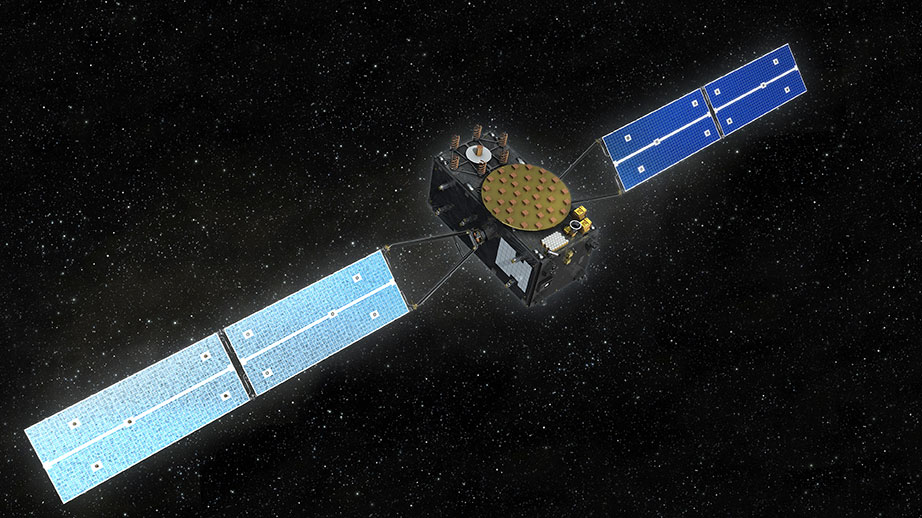
    Artist’s rendering of an OHB-designed Galileo satellite. OHB in Germany and SSTL in the UK are building the next 14 Galileo satellites.
    Artist’s rendering of an OHB-designed Galileo satellite. OHB in Germany and SSTL in the UK are building the next 14 Galileo satellites.

    UDPATE:

    After a one-day postponement, The fifth and sixth Galileo satellites were successfully launched and deployed.

    UPDATE:

    Arianespace has decided to postpone the launch of Soyuz flight VS09 carrying Europe’s fifth and sixth Galileo satellites, because of unfavorable weather conditions over the Guiana Space Centre.

    Another launch date will be decided depending on the evolution of the weather conditions in Kourou.


    The next satellites in Europe’s Galileo satellite navigation system will be launched on August 21, ushering in the system deployment phase and paving the way for the start of initial services, according to the European Space Agency (ESA).

    Galileo SATs 5-6 are scheduled to lift off at 12:31 GMT (14:31 CEST, 09:31 local time) August 21 from Europe’s Spaceport in French Guiana on top of a Soyuz rocket. They are expected to become operational, after initial in-orbit testing, in autumn.

    The launch can be watched live here.

    The two satellites will join the four Galileo in-orbit validation satellites already in space. Launched in pairs in October 2011 and October 2012, these four satellites — the minimum required to obtain a position fix — served to demonstrate and validate the space and ground segments of the system.

    Galileo SATs 7-8 are scheduled to follow end of year 2014.  Then the constellation will be gradually deployed with six to eight satellites launched per year using a series of Soyuz and Ariane launches from Kourou, along with remaining elements of the ground network.

    Satellite “Midwives”

    Galileo’s post-launch team at ESA has finalized its preparations for taking control of the twin satellites. Following launch, the most crucial point in the flight comes when the two satellites separate from their upper stage — and the Launch and Early Operations, or LEOP, phase begins, run from ESA’s Space Operations Centre, ESOC, in Darmstadt, Germany.

    If the moment of separation is the point when satellites are born, then the LEOP team can be thought of as midwives.

    Any tumbling from the satellites being pushed away pyrotechnically must be corrected, and their positions stabilized in space. Next, they have to deploy their solar wings, to ensure a steady flow of power.

    Flight Operations Director Hervé Côme at ESOC.
    Flight Operations Director Hervé Côme at ESOC.

    Then comes time to switch on and check out all the satellite systems one by one, to ensure everything has endured the launch in working order.

    If all goes well, LEOP should take about a week before control of the satellites can be handed over to the Galileo Control Centre in Oberpfaffenhofen, overseeing the satellites, and ESA’s Redu centre in Belgium, for detailed payload testing.

    Galileo’s LEOP team has been in training for months, explained Hervé Côme, flight director for Galileo at ESOC, with preparations stretching back two and a half years. “A simulation campaign has been running since March and the system and its operators have performed flawlessly,” Côme said. “To date, 20 simulations, in both nominal and contingency cases, have been conducted.”

    Testing Teams and Technology

    The satellites themselves participated in multiple end-to-end system compatibility tests to ensure that they are fully compatible with the various elements of the Galileo ground segment, extending to far-flung ground stations variously belonging both to ESA and to France’s CNES space agency, the Agency’s partner for LEOP.

    A joint team from ESA and CNES oversaw LEOP for the first four Galileo satellites, similarly launched in pairs in 2011 and 2012. That work was carried out from CNES’s LEOP and Network Operations Control Centre in Toulouse, France.

    This time, ESOC is hosting the LEOP team, with mission control and flight dynamics systems inherited from the first four in-orbit validation satellites adapted for these new Full Operational Capability (FOC) Galileo models.

    The LEOP procedures and timeline have been fully validated, and system configurations frozen. From here on in, ESOC’s Mission Control Team — following a short summer break — will concentrate on further fine-tuning their organization and procedures in advance of next month’s launch.

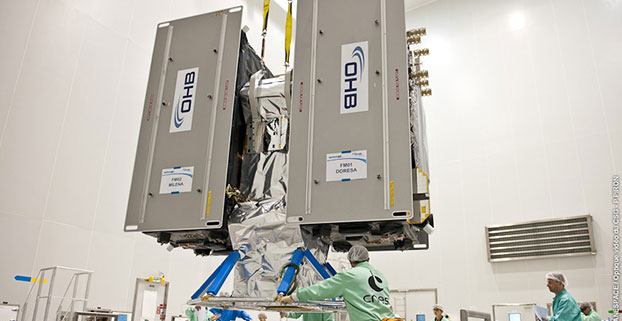
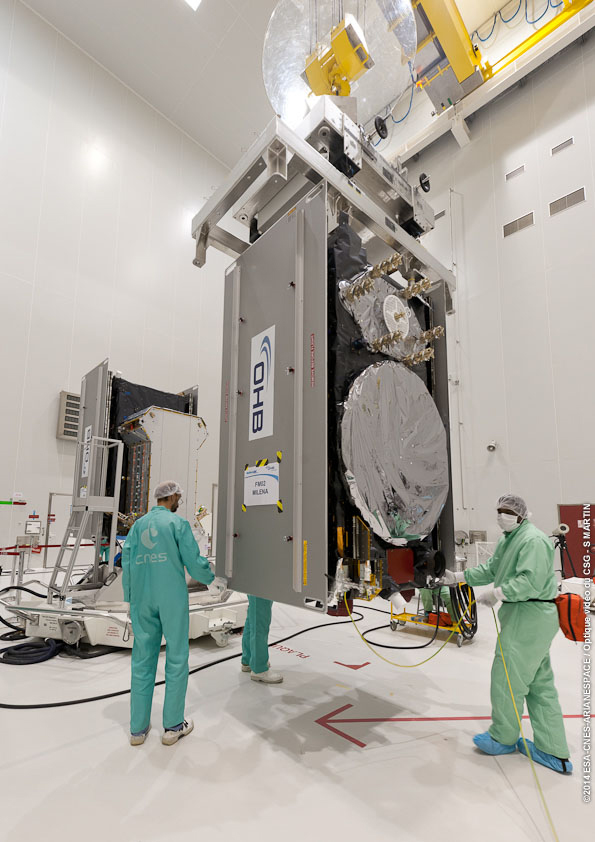
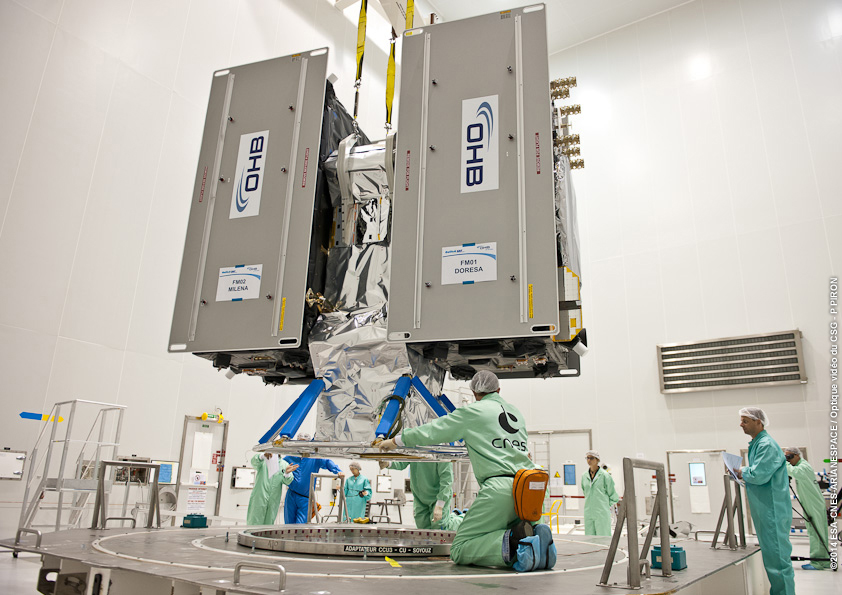
    The Galileo FOC satellite named “Milena” is mated on its Soyuz dispenser unit, joining the already-installed “Doresa” satellite.
    The Galileo FOC satellite named “Milena” is mated on its Soyuz dispenser unit, joining the already-installed “Doresa” satellite.
    The completed dispenser unit is ready to be transferred from the S5 payload preparation facility at the Spaceport in French Guiana for its integration atop Soyuz’ Fregat upper stage.
    The completed dispenser unit is ready to be transferred from the S5 payload preparation facility at the Spaceport in French Guiana for its integration atop Soyuz’ Fregat upper stage.
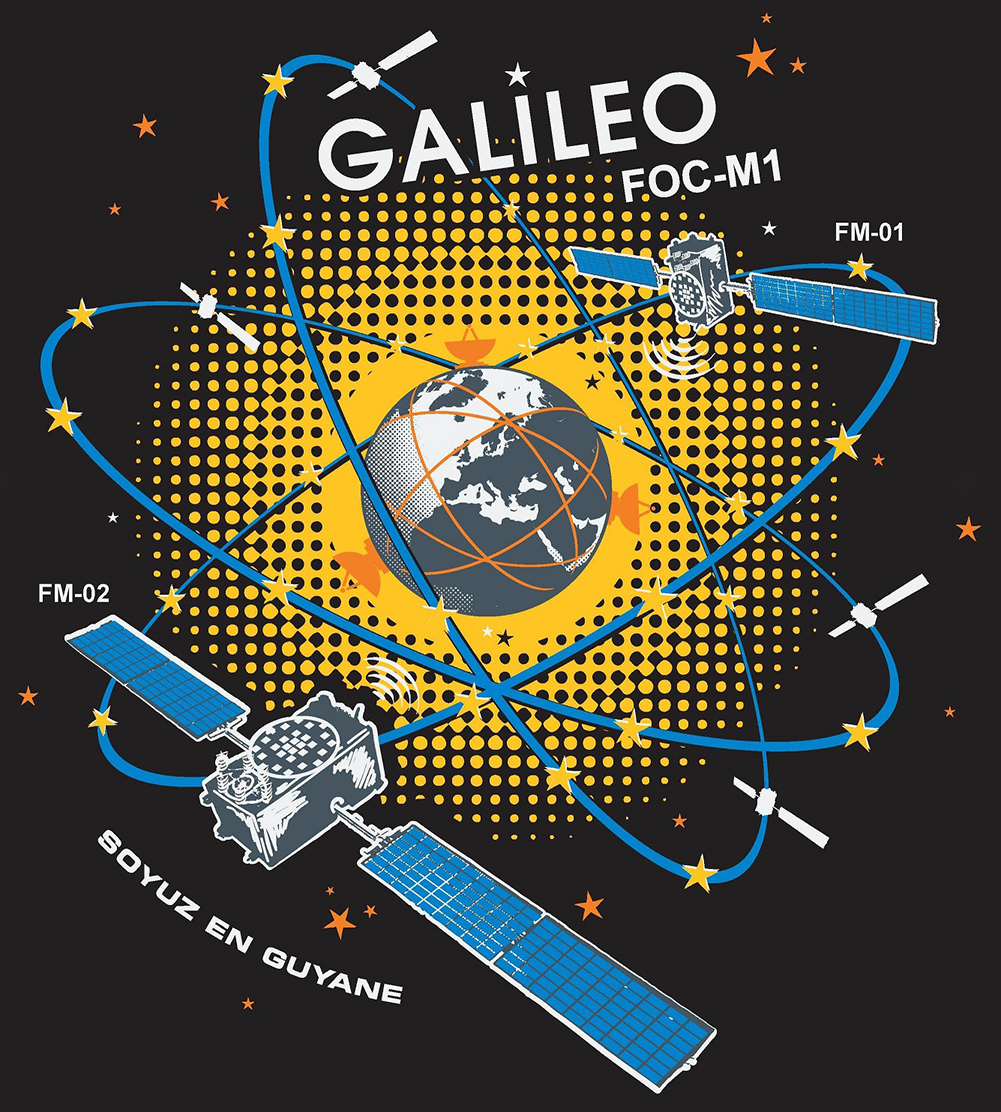
    The local (Kourou) poster of the launch.
    The local (Kourou) poster of the launch.


  • Take Our State of the Industry Survey, Win Prizes

    Take Our State of the Industry Survey, Win Prizes

    soi_cvr2013

    What are your challenges this year? How are you driving business in today’s economy? What issues are you concerned about? We want to know, and so does the rest of the industry.

    GPS World is conducting its annual State of the Industry Survey asking GNSS professionals about the state of their business, the economic climate for GNSS products and services, driving market factors, the government’s role in funding and regulating, budgets devoted to R&D, the effects of jamming, and the “Issue of the Year.”

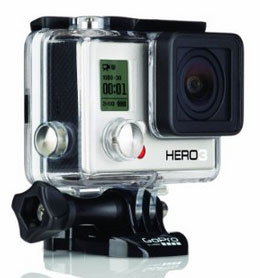
    This GoPro Hero3 video camera could be yours.
    This GoPro Hero3 video camera could be yours.

    Everyone who takes the survey will be automatically entered in a drawing for these prizes:

    • A GoPro Hero3 professional-quality video camera
    • A pair of tickets to GPS World’s 2014 Leadership Dinner (for those not attending ION GNSS+ in Tampa, Florida, we’ll send a voucher for a comparable dinner in your hometown);
    • $50 Mastercard gift cards

    The survey should take about 10 minutes, and your responses are confidential.

    Complete the survey by August 31. Then look for a complete report of our findings in the October issue of GPS World.

    Click here to begin the survey.

  • Juniper Systems Opens Rugged Handheld Company, Cedar Tree Technologies

    Juniper Systems Opens Rugged Handheld Company, Cedar Tree Technologies

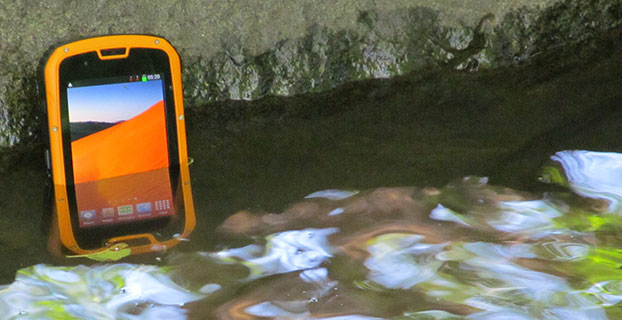
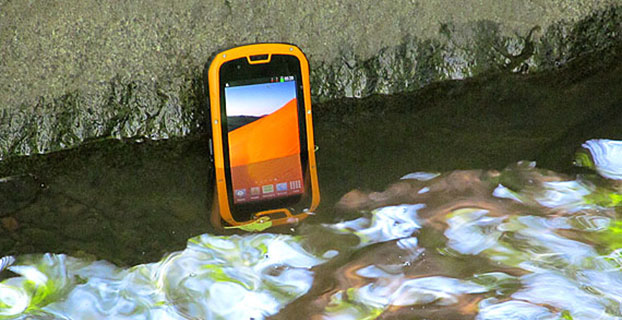
    The Cedar Tree CT4 handheld.
    The Cedar Tree CT4 handheld.

    Juniper Systems is launching Cedar Tree Technologies, a rugged handheld company. Cedar Tree, based in Corvallis, Oregon, brings ruggedness, affordability, and intuitive software to its customers — mainly consisting of mapping and field service professionals, according to Juniper Systems.

    Cedar Tree Technologies is a recently launched rugged handheld company founded by Juniper Systems.
    Cedar Tree Technologies, which exhibited at the Esri User Conference in July, is a recently launched rugged handheld company founded by Juniper Systems.

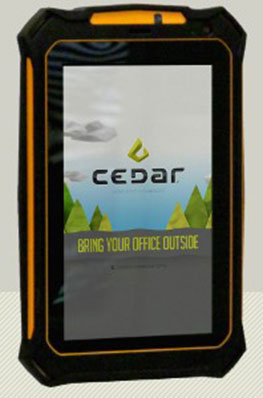
    Cedar Tree’s new products — the CT7 tablet and CT4 handheld — run on the Google Android operating system, providing access to thousands of business and field-ready apps on the Google Play Store. Both devices can easily be customized by users via software.

    The CT7 tablet features a 7-inch display, while the CT4 handheld has a more compact design, with a smaller 4.3-inch display. Both devices provide useful features such as GPS and camera, as well as excellent durability and functionality — all for the price of a smartphone. The CT7 and CT4 will be shipping within the next 30 days.

    “By leveraging the wide array of apps and services available through the Android operating system, Cedar Tree Technologies offers users a complete rugged data collection solution out of the box,” said Rob Davis, Cedar Tree Technologies’ General Manager. “Add to that the fact that you can purchase one of these durable devices for about the same price as your smartphone, and it really makes it an easy decision.”

    “Cedar Tree Technologies builds upon Juniper’s product offering, providing customers with a broader range of choices,” said Juniper Systems’ CEO, Rob Campbell. “This additional product variety allows customers to find the best fit for their needs, whether they need maximum ruggedness from a Juniper Systems product, or whether they need a very durable product that runs on more consumer-like platforms, like Cedar Tree’s products.”

    The Cedar Tree CT7 tablet.
    The Cedar Tree CT7 tablet.
  • ION Journal NAVIGATION to Be Indexed by Thomas Reuters

    UPDATE: According to ION, Thomas Reuters is starting the indexing process, which is expected to take several more weeks.


    NAVIGATION, the Journal of The Institute of Navigation, has been accepted for indexing in several Thomson Reuters databases. “This indexing is an exciting step in the fundamental growth of the journal and will increase the visibility and discoverability of all the articles published since 2012,” said Boris Pervan, NAVIGATION editor.

    Beginning with V. 59 (1) 2012, NAVIGATION will be indexed and abstracted in:

    • Science Citation Index Expanded (also known as SciSearch)
    • Journal Citation Reports/Science Edition
    • Current Contents / Engineering Computing and Technology

    The Science Citation Index Expanded covers more than 6,500 notable and significant journals, across 150 disciplines, from 1900 to the present. These journals, alternately described as the world’s leading journals of science and technology, because of a rigorous selection process, provides researchers, administrators, faculty, and students with quick, powerful access to the bibliographic and citation information they need to find research data, analyze trends, journals and researchers, and share their findings.

    The Journal Citation Reports (JCR), an annual publication by the Science and Scholarly Research division of Thomson Reuters, has been integrated with the Web of Science and is accessed from the Web of Science-Core Collections. It provides information about academic journals in the sciences and social sciences, including impact factors.

    The Current Contents Connect is a current awareness database that provides easy Web access to complete tables of contents, abstracts, bibliographic information, and abstracts from the most recently published issues of leading scholarly journals, as well as from more than 7,000 relevant, evaluated websites.

    NAVIGATION, the quarterly Journal of The Institute of Navigation is published in partnership with John Wiley & Sons, Inc., and publishes peer-reviewed articles on all areas related to the science and technology of air, sea, land and space navigation, including estimation of position, velocity, attitude, and time.

  • Carlson BRx5 GNSS Receiver Introduced

    Carlson BRx5 GNSS Receiver Introduced

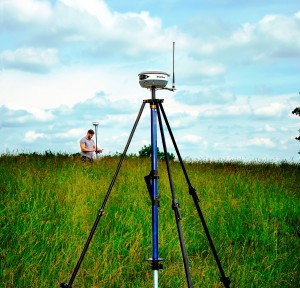
    The Carlson BRx5 GNSS receiver.
    The Carlson BRx5 GNSS receiver.

    The Carlson BRx5 GNSS receiver, an integrated all-in-one pole-top GNSS receiver, has just been released by Carlson Software, Inc. Each BRx5 contains a multi-constellation, multi-band 270-channel GNSS receiver, internal GSM cell modem, UHF radio, dual hot-swappable batteries and internal level sensors. Designed for survey and GIS professionals, the Carlson BRx5 delivers both affordability and the highest positional accuracy, the company said.

    “Carlson’s exclusive LDL (live digital level) feature in SurvCE 4.0 uses the BRx5’s internal level sensors to provide electronic leveling for better x,y accuracy as you work,” said Bruce Carlson, president of Carlson Software. “In addition, it holds fix under canopy better than most GPS systems currently on the market.”

    Manufactured to Carlson’s exacting specifications by Hemisphere GNSS, the BRx5 receivers can each be configured as base, rover, or network rover. They come with dual Bluetooth ports, allowing users to connect both data collector and a cell phone, and they each come with a fully integrated multi-constellation dual frequency GNSS receiver with UHF radio and GSM cell modem.

    SurvCE 4.0 allows high positional accuracy with the BRx5′s integrated level sensors.
    SurvCE 4.0 allows high positional accuracy with the BRx5′s integrated level sensors.

    Designed for use by surveyors, contractors, builders, engineers and many others, the BRx5 can be purchased as either a Rover or as a Base/Rover package. The Base/Rover package includes two BRx5 GNSS receivers, one hard-sided carrying case, four BRx5 batteries with two chargers, one GPS tribach and one tribach adapter,  and two Carlson GPS receiver poles.

    With its dual hot-swap batteries, there’s no need to stop work to recharge or replace battery packs. In addition, the BRx5 is OmniSTAR-capable with submeter differential correction available worldwide.

    The Carlson BRx5 GNSS receiver is designed to work seamlessly with most data collectors including Carlson’s rugged and popular data collectors: the Carlson Surveyor+, the Carlson MINI2, and the Carlson Supervisor.


  • LORD MicroStrain Offers GPS/INS High-Performance MEMS

    LORD MicroStrain Offers GPS/INS High-Performance MEMS

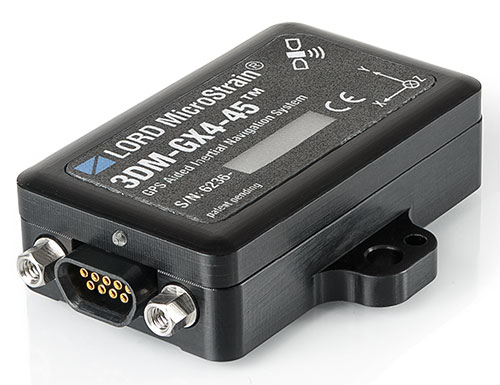
    The 3DM-GX4-45 by LORD MicroStrain.
    The 3DM-GX4-45 by LORD MicroStrain.

    The 3DM-GX4-45 by LORD MicroStrain is a miniature, industrial-grade GPS-aided inertial navigation system that uses high-performance MEMS sensor technology. It combines a triaxial accelerometer, triaxial gyro, triaxial magnetometer, temperature sensors, pressure altimeter, and dual on-board processors running a sophisticated Extended Kalman Filter (EKF) to provide excellent position, velocity, and attitude estimates.

    It offers a range of fully calibrated AHRS measurements, including acceleration, angular rate, magnetic field, deltaTheta and deltaVelocity vectors. GPS measurements include LLH position, ECEF position and velocity, NED velocity, UTC time, GPS time, and SVI.  The receiver is a 50-channel u-blox 6, which receives GPS L1 C/A code, and the SBAS signals WAAS, EGNOS, and MSAS.

    The 3DM-GX4-45 provides accurate navigation and orientation under dynamic conditions for applications such as GPS-aided navigation; unmanned vehicle navigation; camera stabilization; robotic control; and reconnaissance, surveillance, and target acquisition.

    Learn more at the LORD MicroStrain website.

  • EUROGI Conference to Be Held in Conjunction with InterGeo

    EUROGI Conference to Be Held in Conjunction with InterGeo

    imaGIne2014 ConferenceLogo_1000_465

    The European-focused imaGIne conference will provide attendees with an opportunity learn what is going on in the geospatial sector and to network with important decision-makers. EUROGI’s “imaGIne: Opportunities Everywhere” Conference will be held October 8-9 in Berlin, Germany.

    The imaGIne conference will take place at the same venue and at the same time as the InterGeo trade fair.

    A key aim of the conference is to showcase the best that Europe has to offer in the geospatial field, thus the conference subtitle “Geographic Information Expertise: Made in Europe.” The aim has guided EUROGI and its member associations in the selection of themes and speakers, organizers said.

    Plenary Sessions and Keynotes

    During the plenary sessions, presentations will be given by top European and global experts.

    • Roberto Viola, deputy director, Directorate General CONNECT, European Commission, will provide an outline of the European Union’s Digital Agenda Europe, with particular emphasis on geospatial aspects.
    • Detlef Dauke, director general, German Federal Ministry for Economic Affairs and Energy will speak on behalf of the German vice-chancellor, who is the patron for the conference.

    Two speakers will provide a view of the state of the European geospatial industry from a global perspective, highlighting its strengths, weaknesses, opportunities and threats. Other issues which will be covered in the plenaries include the Internet of Things (billions of interlinked sensors across Europe), Linked Data (joining up data which was otherwise unconnected) and Big Data (massive amounts of data from diverse sources and across many fields).

    In addition to the plenary sessions, there will be 15 parallel sessions of 90 minutes each, each of which has a specific thematic focus. The themes include Job Creation and Economic Growth, Energy, Environment, Demography, Smart Cities, Copernicus (Europe’s Earth Observation initiative), Open Data, Big Data, and Insurance. The sessions will not only provide interesting insights, but will also feature panel sessions with discussions of pertinent issues, as well as opportunities for audience engagement.

    The European Commission’s Joint Research Centre will provide an opportunity to discuss the European Union Location Framework, a set of policies and measures which aim to facilitate the integration of geospatial information into e-government services and to increase alignment in and between existing and future EU policies.

    InterGeo Fair. InterGeo is the world’s leading trade fair for geodesy, geoinformation and land management. With over half a million event website users, over 16 000 direct visitors each year from 92 countries and more than 500 exhibitors, it is one of the key platforms for business dialogue in the geospatial information sphere.

    Registration for EUROGI’s imaGIne conference will automatically entitle delegates to visit the fair.

    More information about the conference can be found at www.imagine2014.eu. The website also provides the opportunity to register. An early-bird discount rate will be available until August 31.

    The Geospatial Sector — Huge and Growing Fast

    Geospatial information, also often referred to as geographic information, is any information that has a location/position “tag.” The tags can take many forms, including for example, postal codes, street addresses, words that have a location/place reference (such as Barcelona, the Rhine, Slovenia, etc.), north/south coordinates, and more. Organizing and managing tags enables vast amounts of otherwise disparate information to be integrated and new and innovative insights and services to be provided.

    According to a report published last year by Oxera, a leading UK economic research firm that was commissioned by Google, at $150-270 billion annually the geospatial sector globally was one third the size of the global airline industry. (See “What is the Impact of Geospatial Services?”)

    The report states, “Geo services are making an important contribution to the global economy and to future productivity. The efficiency gains they create are helping to facilitate future economic activity and generate additional consumer welfare.”

    Everyone is aware of the airline industry, but very few are aware of the geospatial industry, an industry that to a very large extent operates out of direct public view, but that produces products and services that impact on billions of people worldwide on a daily basis. The insurance, automotive, telecommunications, navigation, marine, agriculture, energy, utilities, tourism, and recreation and media industries are just some of sectors that rely heavily on geospatial products and services.

    Apart from the enormous size of the sector, another key point highlighted in the Google-sponsored research report is that the sector is growing globally at about 30 percent annually. With overall global economic growth taking place in the lower single-digit range, growth of this nature can truly be described as explosive, conference organizers said.