Author: GPS World Staff

  • Averna Wins 2013 DesignVision Award

    Averna, developer of test solutions and services for communications and electronics device makers worldwide, today announced that its Proligent Analytics has been honored with a DesignVision award for most innovative verification tool of the year.

    The awards ceremony took place on January 29, in Santa Clara, California, during the 2013 DesignCon show. The DesignVision awards, handed out annually, honor the most innovative design tools in the electronics industry. Winners were selected based on three criteria: how well the product met the market’s vision and offered unique insight into customer needs; the originality of the solution and if it offered a new approach to meeting market needs; and the quality of the implementation and how well it fits the market requirements.

    Proligent Analytics gives OEMs a tool to centrally monitor and control manufacturing test operations across their supply chain. Version 6.0, released in August 2012, includes enhancements that provide easier navigation of test and quality data, broader reporting, and alarm capabilities for improved and quicker root-cause analysis.

    “We had quite a challenging time choosing these winners among all of the innovative products we judged,” said Patrick Mannion, Content Director and Brand Director EDN, Test & Measurement World & Planet Analog. “Ultimately, our 2013 winners represent the best of the best in each of their respective industries.”

    “With contract manufacturers and service centers dispersed across the globe, test data is often scattered across multiple sites and can require months to gather and transform it into useful information. Such delays can lead to significant quality-related issues. Proligent Analytics was designed specifically to offer product designers better access to their test data and give them important visibility regarding product development,” said Eric Lamontagne, Team Leader Proligent Analytics for Averna. “We are honored that Proligent Analytics was recognized with this prestigious award. It is a validation of our efforts.”

    Be sure to check out Averna’s White Paper, “Expanding GNSS Testing,” offered by GPS World.
  • GLONASS 743 Set Healthy, Constellation Back to Full Strength

    News courtesy of CANSPACE Listserv.

    GLONASS 743, recently moved from orbital slot 2 to orbital slot 8, was set healthy on March 5 at 07:28 Moscow Time according to NAGU 017-130305. Although the NAGU states that Moscow Time is three hours ahead of UTC (and this is the time difference normally used for GLONASS as stipulated in the GLONASS ICD), officially, it is actually four hours and has been since the switch to year-round daylight saving time on 27 March 2011. In this case, the NAGU appears to be in error since GLONASS 743 was actually set healthy at 03:28 UTC and not at 04:28 UTC. This is confirmed by Roscomos monitoring and by the navigation data collected by stations of the International GNSS Service (IGS).

    There are once again 24 healthy GLONASS satellites on orbit.

    For those keeping track of frequency channel changes, GLONASS 743 was switched from frequency channel 6 to channel -6 on 1 March some minutes before 10:45 UTC and back to channel 6 on 2 March, again some minutes before 10:45 UTC as determined from IGS navigation files. Although a NAGU was issued for the first frequency change (stating that it occurred at “1344 MT (UTC+0300)”), no NAGU has been issued to document the second frequency shift although the set-healthy NAGU does give the frequency channel as 6.

    Meanwhile, in other GLONASS news, a single GLONASS-M satellite (Block 47s) is to be launched from the Plesetsk Cosmodrome on April 26 at 05:23:41 UTC according to the NASA Forum blog.

  • Spectracom Simulators Add Channels, Signals

    Spectracom announces its ability to simulate up to 64 RF channels in four frequency bands for testing the integration of most advanced GNSS receivers.

    The GSG series of GNSS simulators are designed to offer as much capability as needed by developers, integrators, and manufacturers of applications for global satellite navigation. “We understand the needs for simulating GPS and GNSS signals varies as much as the applications themselves,” said Spectracom CTO John Fischer. “Now the diversity of GNSS signals enables a new generation of receivers requiring a new set of test tools. We designed our simulators to grow along with the GNSS eco-system while maintaining the affordability and ease-of-use that has been our hallmark.”

    Spectracom offers two fully configurable and upgradeable platforms. For common single frequency applications, the GSG-5 series simulates up to 16 GPS satellites in the L1 band. Users can start with a single-channel RF generator and upgrade their unit in the field when their needs change. For more advanced applications, the GSG-6 series offers up to 64 channels in four different frequency bands simultaneously. Current firmware generates GPS and GLONASS satellites in L1, L2, L2C, and L5. Customers will receive firmware updates when they need to simulate Galileo and Beidou satellites in the E1/B1, E5/B2, E6/B3 bands.

    In addition to generating satellite signals, these GPS and GNSS simulators include other advanced capability in every unit such as simulating satellite-based augmentation systems (SBAS), dynamic motion characteristics (trajectories), multipath, white noise, and interference. Tests can be performed anywhere, anytime, from the convenience of the test bench, Spectracom said.

    “Comprehensive testing and validation of high-reliability positioning, navigation and timing applications has been a natural extension of our rich heritage in delivering precision time and frequency products and systems,” said Spectracom CEO Lisa Withers. “As we continue to expand our GNSS signal management offerings, we are excited to introduce synchronization, simulation and test  solutions that are geared to be readily adaptable to our customers’ unique applications.”

  • Shark in the Water! Find out Where

    Shark in the Water! Find out Where

    Did you just watch Jaws? Are you worried your trip to the beach might be interrupted by an unwelcome guest? Now you can go online and see if any great white sharks are visiting nearby waters (the tagged sharks, at least.)

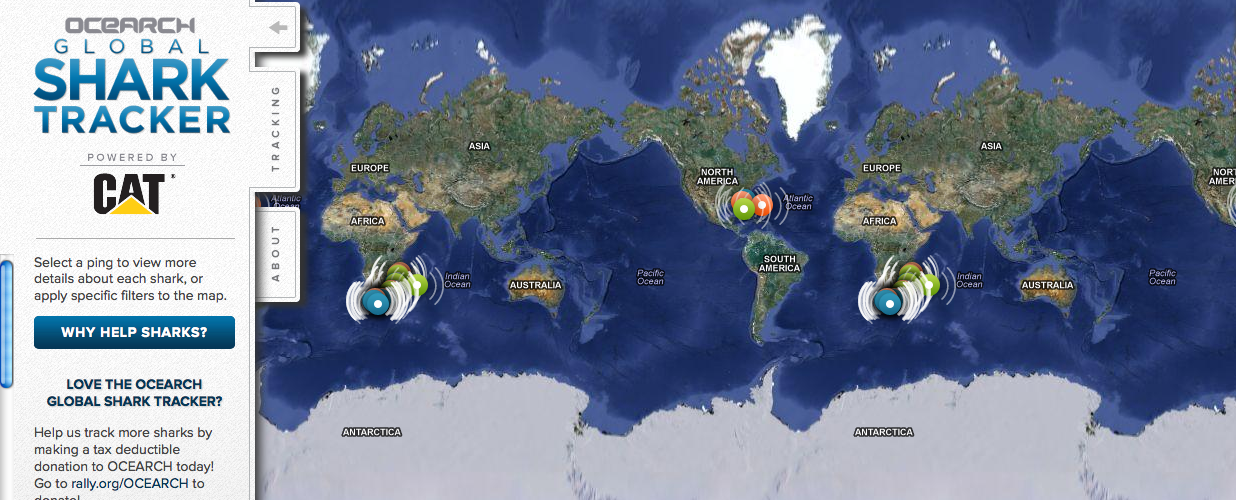
    The Ocearch Global Shark Tracker is a global project to tag and track the navigational patterns of great white sharks in the world’s oceans. The team is currently tracking nearly 40 sharks. The team of scientists have 15 minutes to pull a shark from the water, tag it, and release it, a process which was highlighted in an ABC Nightline feature.

    Ocearch’s founder is Chris Fischer, former star of the History Channel reality TV show “Shark Wranglers.” Ocearch is “seeking to attain groundbreaking data on the biology and health of sharks, in conjunction with basic research on shark life history and migration,” according to its website.

    On the Shark Tracker, sharks that have been tagged appear as bright colored dots. Orange means a ping is less than 72 hours old, green means a ping is less than 30 days old and blue means a ping is more than 30 days old.


  • Fujitsu Shows off High-Tech Walking Cane with GPS

    Fujitsu has revealed a walking cane with built-in GPS. Fujitsu displayed the cane at Mobile World Congress 2013 in Barcelona, Spain, reports engadget. No launch date has been set for the device.

    Fujitsu’s GPS cane allows users to set a route and get directions through an LED display in the handle, and follow directions along with a large arrow. If the walker turns the wrong way, the handle vibrates to alert him or her. The cane also allows friends and family to track a user’s location, and send an email alert if the user has fallen down.

    The cane include medical monitoring features, with a sensor that monitors the heart rate and skin temperature of the user. This information can be viewed online in real time, giving caregivers peace of mind while allowing the cane user greater independence.

    Read more about the device, and engadget’s hands-on demo, at the blog’s website.

  • Wake up! Smartphone App Aims to Alert Drowsy Drivers

    A new technology to combat dozing off when driving is being developed by two universities with industry partner Ficosa. The drowsiness alerter, Somnoalert, is a smartphone application that uses inertial sensors and GPS data to detect movements that are characteristic of nodding off at the wheel, such as deviation from the driving lane or sudden corrections. A later prototype also incorporates biomedical sensors to analyze respiration data.

    The patented software is the result of a collaborative project between Institute for Bioengineering of Catalonia’s Signal and Information Processing for Sensing Systems group led by Santiago Marco, the Universitat Politecnica de Catalunya’s Department of Electronic Engineering and Ficosa, a Barcelona-based multinational that researches, develops, produces and commercializes automobile systems and parts.

    “One of the main causes of car accidents is drowsiness, especially on long highway trips,” explains Santiago. “Most monitoring systems developed in the last few years have been integrated systems that need to be connected to the car’s system. Our device combines our group’s expertise in sensors and biological data analysis with FICOSA’s vehicle know-how, and is completely portable.”

    “Accidents related with drowsiness have a very high social and economical impact, that the key automotive industry players are facing as a whole, in order to reduce current accident statistics,” said Alan Montesi, who heads the project for FICOSA.

    Here is a video of the app:

    Another video shows the use of the sensor:

  • Pole Star Offers ‘in the Box’ Indoor Location Platform

    Pole Star has launched its new indoor location platform, NAO Cloud. NAO Cloud simplifies the deployment of indoor location solutions by introducing an automated deployment process that dramatically reduces time-to-market and the costs of indoor location-based services, Pole Star said.

    NAO Cloud integrates the NAO Campus Software Deployment Kit (SDK), and enables customers and partners to deploy NAO Campus, Pole Star’s indoor location solution, in just a few hours, by using cloud-based software tools as well as positioning databases already available and shared by worldwide partner program members.

    In addition, third parties will have access to NAO Cloud’s crowdsourcing capabilities, eliminating field interventions for a simpler, faster and more affordable deployment and maintenance process, Pole Star said. Behavioral analytics or geofencing are also supported by NAO Cloud to maximize the monetization of value added location-based services.

    The NAO Cloud platform targets a wide range of businesses such as venue owners, advertising platform providers, application developers, global solution integrators or network operators. NAO Cloud makes deployment, integration in mobile apps and maintenance of indoor positioning services a simple process, from a single venue to a worldwide multi-site coverage, Pole Star said.

    “The indoor location services market has reached maturity. Multi-venue owners, marketing agencies and major telcos understand the challenges and the value of hyper-local information and real-time interactions with customers and related Indoor Location Analytics. Indoor positioning is the core technology that brings high value,” said Christian Carle, CEO of Pole Star. “NAO Cloud is the result of years of innovation and deep market experience through very large and complex field deployments around the world.”

    In 2012, Pole Star achieved several major innovation milestones, such as the integration of Bluetooth Low Energy and Inertial Sensors in its NAO Campus fusion engine, in addition to Map Data, Wi-Fi and GPS signals. The dynamic combination of these technologies provides today the best indoor location performance results in the market, while addressing any type of building and minimizing network infrastructure, deployment and maintenance costs, Pole Star said.

    The NAO Campus solution is now available for more than 80% of the smartphone market, compliant with Android and iPhone devices and embedded in consumer applications on the Google Play Marketplace and the Apple App Store.

    Today, Pole Star’s indoor location solutions have been deployed in more than 43 million square feet, in 15 countries such as airports (Paris Charles de Gaulle), shopping centers in Europe and North-America, museums and department stores. In 2011, Pole Star opened its North American headquarters in Palo Alto and has expanded its international presence in 2012, building deep partnerships with companies in Europe, North-America, Asia, Australia and the Middle East. Finally, at the end of 2012, in time for the holiday season, Pole Star launched, its “living lab” mobile application, Mall Buddy, that covers 9 of the biggest malls in Silicon Valley, from San Francisco to San Jose and demonstrates the worldwide extension capability of Indoor location services.

  • European Nav Conference Extends Early Bird Registration to March 15

    Because of widespread interest in European Navigation Conference 2013, organizers have decided to extend Early Bird Registration until March 15.

    “The interest of the navigation community for the European Navigation Conference 2013 is tremendous. We have received more than 150 oral presentations and 50 poster presentations that will be showcased in 32 sessions,” said Susanne Fuchs, organizing committee member. Among those who are taking part as keynote speakers or panelists are:

    • Paul Weissenberg (Deputy Director General of the DG Enterprise and Industry of the European Commission),
    • Didier Faivre (Director of Galileo Programme & Navigation Related Activities, European Space Agency),
    • Carlo des Doride (Executive Director of the European GNSS),
    • Frank Salzgeber (Head of Technology Transfer Office, ESA),
    • Gard Ueland (Chairman of Galileo Services),
    • Bernhard Hofmann-Wellenhof (Vice Rector for Academic Affairs, TU Graz) or Harald Posch (Austrian Space Agency)

    The European Navigation Conference 2013 will be the seventeenth conference in the GNSS series held under the auspices of the European Group of Institutes of Navigation (EUGIN). The conference will be hosted by the Austrian Institute of Navigation (OVN) and will take place from 23-25 April 2013 in Vienna, Austria.

    Each year the conference attracts researchers, policy makers, manufacturers, users and service providers from around the world. “Thanks to the wide variety of topics in navigation and the outstanding expertise of the attending speakers, we will be able to bring together more than 600 experts,” Fuchs said.

    The conference will focus on the present status as well as on future developments in navigation systems, with special emphasis on Galileo. Thus, the ENC 2013 will be a showcase for state of the art technology and, more importantly, for innovations in the field of terrestrial and satellite navigation. The implementation of new technologies in navigation will be illustrated in the industry exhibition, running in parallel to the conference.

    For more events, visit our Events page.

  • Handheld’s Ruggedized Computers and Smartphones Have u-blox GPS Inside

    Swedish-based Handheld, maker of mobile computers designed for extreme environments, has integrated u-blox’ GPS modules in four of its most popular products: the Algiz 7 and Algiz 10X tablets, Algiz XRW notebook, and Nautiz X1 smartphone. These tough computers are designed for and used in demanding environments such as polar expeditions, marine exploration, and rescue operations, as well as outdoor industrial applications such as utility maintenance and logistics. The devices depend on u‑blox’ LEA, NEO, and AMY families of compact, high-performance GPS modules to provide reliable navigation and positioning in challenging conditions.

    “Handheld is proud to have achieved an industry-leading position for dependable, ruggedized mobile computers that can be trusted to work in the most hostile environments” said Jerker Hellström, CEO Handheld Group, “To achieve this extremely high-level of performance, we only select components with the highest reliability on the  market. GPS positioning is one of the most important functionalities of our products. For this mission-critical feature, we chose u-blox.”

    Handheld’s lineup of rugged PDAs and mobile computers is specifically developed for use in tough environments in industries such as geomatics, logistics, forestry, public transportation, construction, mining, field service, utilities, maintenance, public safety, military and security.

  • FICOSA Integrates OriginGPS Antenna Module in Telematic Unit

    FICOSA demonstrated a telematic unit integrating a multi-service antenna module for positioning and satellite navigation supporting all the geographic positioning standards at the 2013 Mobile World Congress in Barcelona in February.

    The major advantage of this technological innovation is that the proposed multi-channel GPS/Galileo/GLONASS/BeiDou/QZSS receiver allows tracking across all the different navigation and positioning satellite standards worldwide, so that automakers can  the having to manage different variants of in-vehicle telematic units (iVTUs) depending on the geographical market. iVTUs are needed for emergency call function, fleet management, and other functions. It incorporates an OriginGPS antenna.

    The new module is a complete system-in-package featuring miniature surface mount device technology footprint designed to commit unique integration features for high volume, low power and cost-sensitive applications.

    In addition, the reduced size of the receiver module makes the most of a stacked-up in board integration through miniaturized integrated circuits and surface mount devices, allows an aggressive reduction of the iVTU packaging, which is advantageous for the OEM for car assembly, iVTU localization inside the vehicle, and weight reduction.

    The innovation represents the result of the international collaboration between FICOSA and OriginGPS. “We view the telematics market as a growing market and it is our privilege to cooperate and partner with Ficosa and its excellent engineering team,” said Haim Goldberger, CEO and founder of OriginGPS.

    “In FICOSA, innovation and technology are two main tools for our future and working with OriginGPS is a great issue,” said Jose María Forcadell, Advanced Communications Business Unit Director at FICOSA.

  • GT-1 Tracks Equipment in Remote Locations, Extreme Conditions

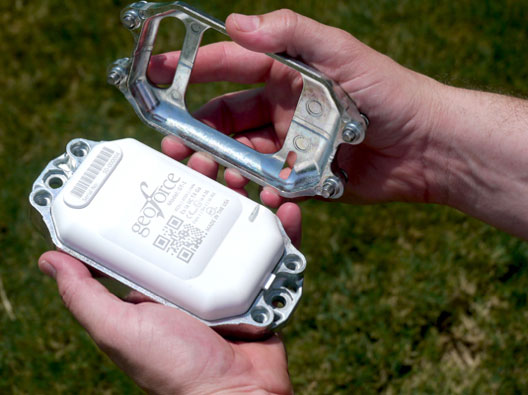
    GT-1 Asset Tracker, the world’s most reliable asset tracker combining GPS, RFID, Bluetooth and Satellite technologies into one compact design. Photo: Geoforce
    GT-1 asset tracker combines GPS, RFID, and Bluetooth technologies. Photo: Geoforce

    Geoforce, Inc. is announcing commercial availability of its GT-1 asset tracking device that can track field equipment in locations and conditions previously too challenging for other devices to function effectively. A globally certified GPS device, the GT-1 enables oil and gas service providers to proactively monitor and share data on vehicles and equipment for more cost effective operations, helping to meet ongoing environmental responsibilities, the company said.

    “We have been waiting a long time for a device like this,” said Michael Rolston, operations manager at Permian Equipment Rentals.  “It’s small, it’s incredibly rugged, it will last years without replacement. It’s also surprisingly low cost — given all its features and capabilities.”

    The GT-1 was previously offered in limited release to several major international service and rental companies beginning in the fourth quarter of 2012. To date, thousands have shipped and are actively tracking oilfield assets around the globe.

  • Lockheed Martin Powers on First GPS III Satellite

    The Lockheed Martin team developing the U.S. Air Force’s next-generation Global Positioning System III  satellites has turned on power to the system module of the program’s first spacecraft, designated GPS III Space Vehicle One (SV-1). The milestone is a key indication the team is on track to deliver the first satellite for launch availability in 2014, the company said.

    The GPS III program will replace aging GPS satellites, while improving capability to meet the evolving demands of military, commercial and civilian users. GPS III satellites will deliver better accuracy and improved anti-jamming power while enhancing the spacecraft’s design life and adding a new civil signal designed to be interoperable with international global navigation satellite systems.

    “This milestone is the latest in a series of critical events signifying that our joint government and industry GPS III team is performing efficiently and meeting its commitments,” said Lt. Col. Todd Caldwell, the U.S. Air Force’s GPS III program manager.

    Successfully powering on GPS III SV-1 demonstrates mechanical integration, validates the satellite’s interfaces and leads the way for electrical and integrated hardware-software testing. The satellite will complete its Assembly, Integration and Test (AI&T) in Lockheed Martin’s new GPS Processing Facility (GPF) designed for efficient and affordable satellite production. Like in aircraft or automobile manufacturing, each GPS III satellite will move through sequential work stations for various AI&T operations, culminating with shipment to the launch site.

    “Turning power on to the first GPS III satellite is a major milestone for the team,” said Keoki Jackson, vice president of Lockheed Martin’s Navigation Systems mission area. “The successful integration of the first satellite’s system module follows on the heels of our pathfinder GPS III Non-Flight Satellite Testbed (GNST), and demonstrates the great value of the investments made by the Air Force to implement low-risk spacecraft acquisition. In this challenging budget environment, we are focused on delivering the critical GPS III capabilities to users affordably and on schedule.”

    Lockheed Martin is currently under contract for production of the first four GPS III satellites, and advanced procurement funding of long-lead components for the fifth, sixth, seventh and eighth satellites. The Air Force plans to purchase up to 32 GPS III satellites.

    The GPS III team is led by the Global Positioning Systems Directorate at the U.S. Air Force Space and Missile Systems Center. Lockheed Martin is the GPS III prime contractor with teammates ITT Exelis, General Dynamics, Infinity Systems Engineering, Honeywell, ATK and other subcontractors. Air Force Space Command’s 2nd Space Operations Squadron (2SOPS), based at Schriever Air Force Base, Colo., manages and operates the GPS constellation for both civil and military users.