Author: Tracy Cozzens

  • Analysis of satellite imagery shows reduced NO2 in China, Italy

    Analysis of satellite imagery shows reduced NO2 in China, Italy

    Screenshot: ESA video
    Screenshot: ESA video

    Descartes Labs, a geospatial data analytics company, is using satellite imagery analysis to examine how the coronavirus reduced nitrogen dioxide (NO2) emissions in China.

    NO2 is produced by vehicles, power plants and heavy industries such as cement manufacturing, which were shut down during the coronavirus epidemic.

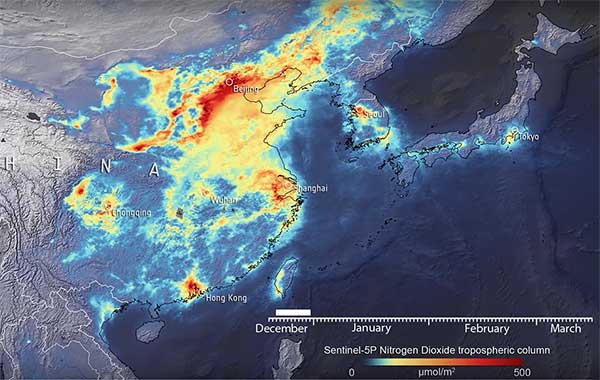
    Descartes Labs shared its visualization in a Facebook post. The visualization maps a time series of NO2 levels across Eastern China, Japan and the Korean Peninsula using data from the European Space Agency (ESA)  Sentinel-5P satellite.

    Plots of NO2 emissions from 2019 compared to 2020 show declines of nearly 60%. Read more on Descartes Lab’s blog.

    Copernicus data shared

    In a video provided by ESA, a drop in concentrations in late January is visible in China, coinciding with the nationwide quarantine; from the beginning of March, the nitrogen dioxide levels have begun to increase.

    Italy reduction

    Copernicus data also reveals the decline of air pollution, specifically nitrogen dioxide emissions, over Italy. This reduction is particularly visible in northern Italy, coinciding with its nationwide lockdown to prevent the spread of the coronavirus.

    “Satellites offer a unique vantage point to monitor the health of our planet,” said Josef Aschbacher, ESA’s director of Earth Observation Programmes. “Sentinel-5P is one of seven Copernicus satellites in orbit today. It currently provides the most accurate measurements of nitrogen dioxide and other trace gases from space.

    “As nitrogen dioxide is primarily produced by traffic and factories, it is a first-level indicator of industrial activity worldwide,” Aschbacher said. “What is clearly visible is a significant reduction of nitrogen dioxide levels over China, caused by reduced activity due to COVID-19 restrictions, but also the Chinese New Year in January. The Copernicus programme is a perfect example of how space serves all European citizens by combining the political strength of the EU with the technical excellence of ESA.”

    “We can certainly attribute a part of the nitrogen dioxide concentration reduction to the impact of the coronavirus,” said Claus Zehner, ESA’s Copernicus Sentinel-5P mission manager. “We currently see around a 40% reduction over Chinese cities, however these are just rough estimates, as weather also has an impact on emissions. We are conducting a detailed scientific analysis which will soon provide more insights and quantified results in the following weeks and months.”

    The Copernicus Sentinel-5 Precursor mission, also known as Sentinel-5P, is dedicated to monitoring air pollution by measuring a multitude of trace gases as well as aerosols — all of which affect the air we breathe.

  • Unmanned vessel aids near-shore projects with Trimble GNSS

    Unmanned vessel aids near-shore projects with Trimble GNSS

    Image: Trimble/Teledyne Marine
    Photo: Trimble/Teledyne Marine

    Teledyne Marine has released the Z-Boat 1800-T unmanned survey vessel, equipped with Trimble’s high-precision GNSS heading receiver and compatible with Trimble Marine Construction (TMC) software.

    The Z-Boat 1800-T enables marine construction and dredging projects to run efficiently and be monitored in real time anywhere in the world.

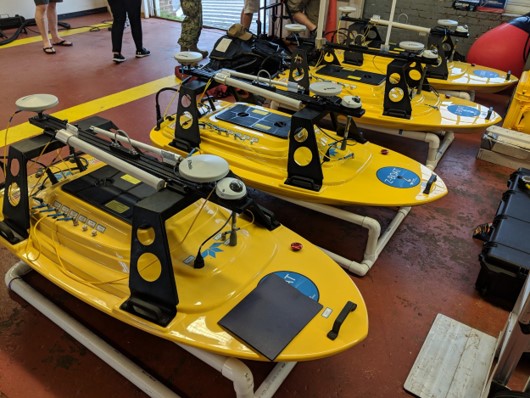
    Z-Boat 1800-T Trimble Edition fleet. (Photo: Trimble)
    Z-Boat 1800-T Trimble Edition fleet. (Photo: Trimble)

    The Z-Boat 1800-T, designed and manufactured by Teledyne Oceanscience, is a high-resolution shallow water hydrographic unmanned survey vehicle with the newly released Odom Hydrographic Echotrac E20 Singlebeam Echosounder and dual antenna Trimble BX992 GNSS heading receiver. Each sensor is integrated into a compact, portable and cost-effective package.

    The combination of Trimble’s high-precision heading and positioning/guidance paired with Teledyne’s accurate/precise sonars allow for data collection under harsh conditions. Both sensors can be removed and mounted on other watercraft and barges to maximize data-collection capabilities.

    The data is remotely viewable in real time, giving the operator full control and confidence. The boat’s small footprint allows access to areas that are too small, confined or unsafe for larger vessels.

    Photo: Teledyne Marine
    Photo: Teledyne Marine

    “Teledyne Marine and Trimble continue to create a paradigm shift for marine construction by providing real-time vision, guidance and survey across a project’s complete construction lifecycle — improving safety, eliminating or reducing work redoes, and helping to complete projects faster and under budget. This system provides as-building updates or what we call ‘eyes below the water,’” said Ted Germann, Teledyne Marine’s vice president of Emerging Markets.

    “Trimble’s experience in GNSS guidance systems, and Teledyne’s leadership in shallow-water hydrographic surveying provides an ideal solution for marine construction contractors and surveyors,” said Kevin Garcia, general manager of Trimble Civil Specialty Solutions. “The Teledyne Z-Boat 1800T release means that near-shore construction workflows now have a quick mobilization tool to identify sub-surface obstructions, provide ad hoc inspections and increase site safety. This feature-loaded solution makes the unmanned surveying vessel affordable for all sizes of customers.”

  • Coronavirus and location: Is there a line?

    Coronavirus and location: Is there a line?

    No, I’m not talking about the line at the grocery store to buy toilet paper and hand sanitizer. Or the line at the doctor’s office. I’m talking about that gray privacy line invisible to the naked eye, but all too accessible on our mobile devices.

    On March 16, Israeli Prime Minister Benjamin Netanyahu and his cabinet approved using citizens’ smartphones to track the locations of people infected with the novel coronavirus (COVID-19), as well as anyone they might have had contact with.

    Such a strategy might work — some citizens reported receiving smartphone alerts when they were near an infected person. However, it does raise the ubiquitous privacy concerns of allowing your government to know your every move.

    Some may think this an acceptable use of tracking, except that the Israeli Knesset — the citizenry’s representative legislature — was not involved in the decision. The tracking didn’t require a court order, and records were to be kept until the new regulation expired.

    A few days later, Israel’s top court put a stop to the program, saying there would be no tracking of Israelis by the Shin Bet without Knesset oversight.

    Of course, Israel is a democracy, and Netanyahu’s move is nowhere near the draconian measures undertaken by the Chinese government in response to the virus. Those actions included forcibly removing people from their homes and placing them in quarantine.

    Yet China’s actions worked. As of press time, the outbreak there is under control, with no new cases reported on March 19. That’s impressive, if one can trust the state news. After all, this is the same country that warned the doctor who discovered the virus not to talk about it. Dr. Li Wenliang died in February of the disease.

    Privacy versus public health: Something to think about while social distancing at home.

    Image: Yuuji/E+/Getty Images
    Image: Yuuji/E+/Getty Images
  • WHO Health Alert brings COVID-19 facts to billions via WhatsApp

    WHO Health Alert brings COVID-19 facts to billions via WhatsApp

    Image: wildpixel/iStock/Getty Images Plus/Getty Images
    Image: wildpixel/iStock/Getty Images Plus/Getty Images

    The World Health Organization (WHO) has launched a messaging service with partners WhatsApp and Facebook to keep people safe from coronavirus.

    The messaging service has the potential to reach 2 billion people and enables WHO to get information directly into the hands of the people that need it.

    From government leaders to health workers and family and friends, this messaging service will provide the latest news and information on coronavirus including details on symptoms and how people can protect themselves and others. It also provides the latest situation reports and numbers in real time to help government decision-makers protect the health of their populations.

    The service can be accessed through a link that opens a conversation on WhatsApp. Users can type “hi” to activate the conversation, prompting a menu of options that can help answer their questions about COVID-19.

    The WHO Health Alert was developed in collaboration with Praekelt.Org, using Turn machine learning technology.


    Check out more of GPS World‘s coverage of coronavirus here.

  • Septentrio begins production of mosaic-X5 for high-volume applications

    Septentrio begins production of mosaic-X5 for high-volume applications

    Image: Septentrio
    Image: Septentrio

    Septentrio is starting high-volume production of mosaic-X5, its next-generation multi-constellation and multi-band receiver module.

    Featuring the company’s latest GNSS technology, mosaic-X5 brings centimeter-level positioning to technologies such as robotics, automation, smart wearables and telematics among others. Its small form factor and low-power design makes high-performance positioning accessible to volume applications, the company said.

    “For smooth, uninterrupted operation in the field mosaic-X5 is the logical choice for an industrial-grade GNSS positioning module,” said Francois Freulon, head of Product Management at Septentrio. “In an industrial setting the cost of equipment downtime can quickly get out of hand. We designed mosaic to be robust in difficult environments, ensuring continuous operation as well as quick set-up times for our customers.”

    Septentrio’s mosaic-X5 was conceived to be the first GNSS receiver module on the market without performance compromises. Featuring complete multi-frequency multi-constellation technology mosaic receives every existing and future signal from all GNSS constellations including the American GPS, European Galileo, Russian GLONASS, Chinese BeiDou, Japanese QZSS, Indian NavIC and L-Band satellites. Such signal diversity allows maximum positioning availability even in difficult environments such as near tall structures or under foliage.

    The compact GNSS module features Septentrio’s proprietary Advanced Interference Mitigation (AIM+) technology, which shields the receiver from jamming and malicious spoofing. This allows machinery and robotics equipped with GNSS to keep on working, instead of being grounded by RF interference. mosaic-X5 also includes the unique RAIM+ integrity engine essential for safety-critical applications such as autonomous systems.

    For those who want to try out the mosaic-X5, evaluation kits can now be ordered directly at shop.septentrio.com.

    Volume order quotes can be requested at shop.septentrio.com/quote.

    For more information about mosaic or other Septentrio precise positioning and timing solutions, contact [email protected]/

  • COVID-19: Israel’s citizens now tracked by their smartphones

    COVID-19: Israel’s citizens now tracked by their smartphones

    Image: Yuuji/E+/Getty Images
    Image: Yuuji/E+/Getty Images

    UPDATE: Israel’s High Court of Justice put a stop to the tracking on Thursday, March 19. The court declared that the Shin Bet security service may not track confirmed and suspected coronavirus patients if a Knesset panel to oversee this practice isn’t set up by noon Tuesday, according to Israel news agency Haaretz.


    Israel’s internal security agency Shin Bet is using citizens’ smartphones to track the locations of people infected with the novel coronavirus (COVID-19) as well as anyone they might have had contact with, news agencies are reporting. Some citizens report receiving smartphone alerts when they have been near an infected person.

    Privacy concerns. The tracking doesn’t require a court order and records will be kept until the regulations expire, according to Israeli news source Haaretz. The regulation can be renewed, and the country’s Health Ministry can keep the location records for 60 days after the regulation expires.

    Israeli Prime Minister Benjamin Netanyahu told The New York Times that the government would approve the plan Monay night. “We have to maintain the balance between the rights of the individual and needs of general society, and we are doing that,” he told the newspaper.

    No legislature involved. The plan was reportedly approved by cabinet members without approval of the Knesset, the Israeli legislature, which has just been sworn into office and has not yet convened.

  • Farming by Satellite Prize 2020 opens for applications

    Farming by Satellite Prize 2020 opens for applications

    The competition promotes the use of GNSS and Earth observation in European and African agriculture

    The European GNSS Agency (GSA) is bringing back the Farming by Satellite Prize. Registration is now open for young innovators to explore the use of satellite technologies in agriculture to enable sustainable farming practices, improve efficiency and reduce the environmental impact.

    The Farming by Satellite Prize is a joint initiative with the European Environment Agency (EEA), the European Union agency that provides independent information on the environment to decision makers and the public. The EEA also manages the Copernicus Land Monitoring Service and cross-service in situ coordination.

    Innovation is crucial for the growth and sustainability of the agricultural sector, enabling it to respond to emerging global challenges such as the rise of the global population and the impact of climate change.

    The Farming by Satellite Prize is designed to encourage young professionals, farmers and students in Europe to create new, sustainable and environmentally friendly solutions using Copernicus, EGNOS and Galileo.

    The 2020 edition of the Farming by Satellite Prize includes the Special Africa Prize, which aims to encourage young Africans to develop satellite-based solutions able to cater to the specific needs and resources of communities and lands in Africa.

    “Who would have thought that Galileo and Copernicus would have convinced the young farmers to become tech-savvy entrepreneurs bringing innovation gained by space data to improve quality of life,” said Pascal Claudel, acting executive director of the GSA. “We need young farmers to be innovative to develop a competitive and yet sustainable agriculture. Of course, they take advantage of what is available thanks to space technologies and our objective with this competition is to support them to reach the best possible solution.”

    “It is clear that we need to make food production much more sustainable and lessen its impact on the environment and climate,” said Hans Bruyninckx, EEA executive director. “Satellite data, technology and innovation can support this change, which is why partnering with this initiative aligns well with the EEA’s commitment to protecting our nature, climate and human health.”

    Applicants can take part as individuals or as a team and are invited to register online between March 16 and June 15. The top teams will be selected as finalists to enter the deep dive phase. A total prize purse of €10K will be distributed among the top four applicants.

    The 2020 edition of the Farming by Satellite Prize is supported by industry partners with the sponsorship of CLAAS, a manufacturer of agricultural engineering equipment. Full details on the competition are available at www.farmingbysatellite.eu. Participants are invited to register early and submit their full written application before the registration deadline on June 15 deadline.

    Photo: subman/E+/Getty Images
    Photo: subman/E+/Getty Images
  • Genasys releases COVID-19 interactive map layer service

    Genasys releases COVID-19 interactive map layer service

    Access to global web map service feature free for public and enterprise use

    Image: wildpixel/iStock/Getty Images Plus/Getty Images
    Image: wildpixel/iStock/Getty Images Plus/Getty Images

    Genasys Inc., a global provider of critical communications solutions, has released an interactive map layer service for daily monitoring of Coronavirus – COVID-19 cases.

    The company-created Web Map Service (WMS) displays daily spatial data from Johns Hopkins University. The data from reporting countries, which includes U.S. states and territories, tracks confirmed cases and other information.

    “As a global provider of critical communications solutions, Genasys is strongly committed to providing information to help keep people safe during emergencies and crisis situations,” said Richard Danforth, chief executive officer, Genasys. “We are providing free use of our WMS feature to keep people informed and assist businesses with decisions regarding employee safety. Additional Genasys COVID-19 response initiatives are planned.”

    Follow this link for more information and access to the interactive Genasys WMS: genasys.com/corona/

    The unified Genasys Public Safety Mass Notification Platform provides a multi-channel approach to deliver geo-targeted alerts, notifications, instructions and information before, during and after public safety threats and critical business events. The Company’s end-to-end critical communications solution includes SMS, cell broadcast, email, social media and other mobile device emergency messaging.

    Genasys systems are in service in 72 countries around the world in diverse applications, including public safety, national emergency warning systems, mass notification, defense, law enforcement and critical infrastructure protection.

  • GPS satellite gets a digital twin to ensure cyber security

    GPS satellite gets a digital twin to ensure cyber security

    Artist's rendering: U.S. Air Force
    Artist’s rendering: U.S. Air Force

    The U.S. Air Force is using a digital replica of a GPS IIR satellite to detect any cyber-security issues, reports Air Force Magazine.

    Booz Allen Hamilton created the “digital twin” of the Lockheed Martin-built Block IIR GPS satellite — and then tried to hack the system.

    “The satellite itself was on orbit,” BAH Vice President Kevin Coggins told Air Force Magazine. “So we built this digital model … and then we went looking for vulnerabilities. We did [penetration] testing and we saw what we could discover.”

    The project is in response to a congressional mandate to test GPS for cyber vulnerabilities. Testing areas include the satellite, ground control stations and the radio-frequency links between them. BAH then conducted “man-in-the-middle” attacks on the communication links to identify potential weaknesses between the satellite and its ground control station.

    The 12 Block IIR legacy satellites, launched between 1997-2004, were designed for a 7.5 year lifespan, but it will be years before they can be decommissioned.

  • GLONASS-M satellite launched into orbit

    GLONASS-M satellite launched into orbit

    Russia has launched another GLONASS-M satellite, according to Roscosmos, the Russian State Space Corporation.

    A Soyuz-2.1b launch vehicle successfully carried the satellite to its planned orbit from the Plesetsk cosmodrome. The launch took place on schedule on March 16.

    Ground-based facilities of the G.S. Titov Space Forces VKS immediately took control of the satellite. A stable telemetry connection has been established and maintained with the satellite. The onboard systems of the spacecraft are operating normally.

    The launch used a Fregat booster block produced by NPO Lavochkin, part of the Roscosmos State Corporation. The satellite was manufactured by ISS, also part of Roscosmos State Corporation.

    The Soyuz-2.1b launch vehicle with encapsulated Glonass-M satellite is transported to the launchpad. (Screenshot: Russian Ministry of Defense video)
    The Soyuz-2.1b launch vehicle with encapsulated GLONASS-M satellite is transported to the launchpad. (Screenshot: Russian Ministry of Defense video)

    For the GLONASS constellation, a full complement of 24 satellites are set healthy. In addition, four satellites previously in the constellation are classified as spares, in maintenance or in test.

    The just-launched satellite is expected to replace a currently operational GLONASS-M satellite, specifically GLONASS 735 in orbital slot 24). Of the 24 healthy satellites, one is a K1; the rest are Ms. The satellite in test is also a K1 (the first K1 to be launched).

  • DOT holds first GPS backup technology demonstration

    DOT holds first GPS backup technology demonstration

    Notes from DoT GPS Backup Demos – Part I

    Government officials, advisors and congressional staff gathered at NASA’s Langley Research Center on March 13. They were there to discuss the Department of Transportation’s (DoT’s) GPS Backup Technology Demonstration program and view the offerings of six different companies.

    A second event to view and discuss technologies offered by the other five companies in the program is scheduled (as of this writing) for Friday, March 20, at Joint Base Cape Cod, Massachusetts.

    View from Washington, D.C.

    The day began with remarks by Karen Van Dyke from the U.S. Department of Transportation, as well as remarks prepared by Colonel Joseph Frankino, deputy director of the National Coordination Office, a multi-agency staff that supports the National Space-Based Positioning, Navigation, and Timing (PNT) Executive Committee, whose members were unable to attend.

    Van Dyke provided an overview of the program and pointed out the increasing importance of resilient PNT. As just one example, improvements in autonomy and self-driving cars are entirely dependent upon consumers having confidence in the entire system, much of which is underpinned by PNT.

    Col. Frankino’s remarks reflected the Defense Department’s commitment to and support of DoT’s resilient PNT efforts. He pointed out that the nation’s military depends upon the defense industrial base, which depends upon uninterrupted PNT.

    Volpe Transportation Systems Center

    The technology demonstration effort is being coordinated by Andrew Hansen from DoT’s Volpe Center. Dr. Hansen pointed out that the ongoing effort, the analysis and assessment of which is expected to be concluded in May, is a series of demonstrations vice tests. This means that the companies involved were showing what their systems could do, vice being measured against set criteria.

    He also mentioned that the maturity of all the systems involved seems to have improved significantly over the last year. All are at Technical Readiness Level 6 or better. Also, that things so far had gone very smoothly with no need for any “re-dos.”

    GPS and a cesium clock were being used as reference standards for the demos. Two of the systems, NextNav and Skyhook, were also demonstrated on a drone at Langley’s 150 acre open air site.

    Report and Transparency

    Data from the demos is not proprietary and belongs to the government which intends to make “as much of it available as possible.” DoT representatives mentioned several times their desire for maximum transparency.

    Admiral (ret.) Thad Allen (left), chair of the National PNT Advisory Board, was among the attendees learning about DoT’s GPS Backup Technology Demonstration project at NASA’s Langley Research Center. (Photo: RNT Foundation)
    Admiral (ret.) Thad Allen (left), chair of the National PNT Advisory Board, was among the attendees learning about DoT’s GPS Backup Technology Demonstration project at NASA’s Langley Research Center. (Photo: RNT Foundation)

    Attendee Observations

    After a day of viewing and discussing the six different technologies with their vendors, the group reconvened to offer feedback. All agreed the day was very worthwhile and complemented DoT and NASA on the event.

    Kicking off the discussion, the DoT hosts remarked that the department is fully committed to GPS and its modernization. That said, there is broad recognition of the importance of other PNT systems. This is evidenced by the recent White House Executive Order on PNT.

    Also, that there is no single solution that will fill the PNT needs of everyone. In fact, GPS does not serve the PNT needs of everyone. The need across sectors for a wide variety of sources to “backup” GPS is why the demonstration project includes some systems that only provide time, or only positioning.

    Feedback from attendees included:

    • The reason for this project is that we have a 20th-century GPS and 21st-century threats. New technologies need to be examined for vulnerabilities. Security must be “baked in” from the beginning. Moderators commented that the DHS Conformance Framework was one of the tools that would help with this.
    • Rural and other underserved areas (such as wilderness, remote transportation networks, maritime) need PNT and should be a part of the government calculus.
    • Many systems depend upon infrastructure provided by others versus being self-sufficient.
    • In the view of many in Congress, it is good to see the demos going well. Overall, though, things are about two years late. Members and staff are very interested in when there will be an RFP and schedule for implementing the timing system mandated by the National Timing Resilience and Security Act of 2018.
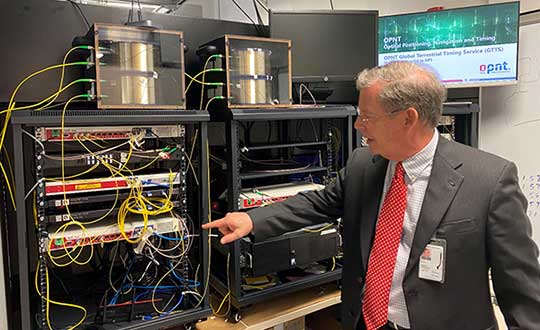
    Monty Johnson of OPNT demonstrates precise time transfer through 100 kilometers of spooled fiber-optic cable. (Photo: RNT Foundation)
    Monty Johnson of the company OPNT demonstrates precise time transfer through 100 kilometers of spooled fiber-optic cable. (Photo: RNT Foundation)

    Systems Demonstrated at NASA Langley

    During the course of the day, attendees had the opportunity to interact with representatives from the following companies and their systems.

    Vendor Service Technology
    TRX Positioning Inertial Measurement Units
    NextNav Positioning & Timing Metropolitan Beacons
    Skyhook Positioning WiFi, cell ranging, very large proprietary database of site locations
    Echo Ridge Positioning & Timing Uses Global Star LEO constellation of 24
    OPNT Timing Timing Fiber & White Rabbit protocol
    Seven Solutions Timing Timing Fiber & White Rabbit protocol


  • Komatsu partners with Cesium on Smart Construction solutions

    Komatsu partners with Cesium on Smart Construction solutions

    Screenshot: Cesium
    Screenshot: Cesium

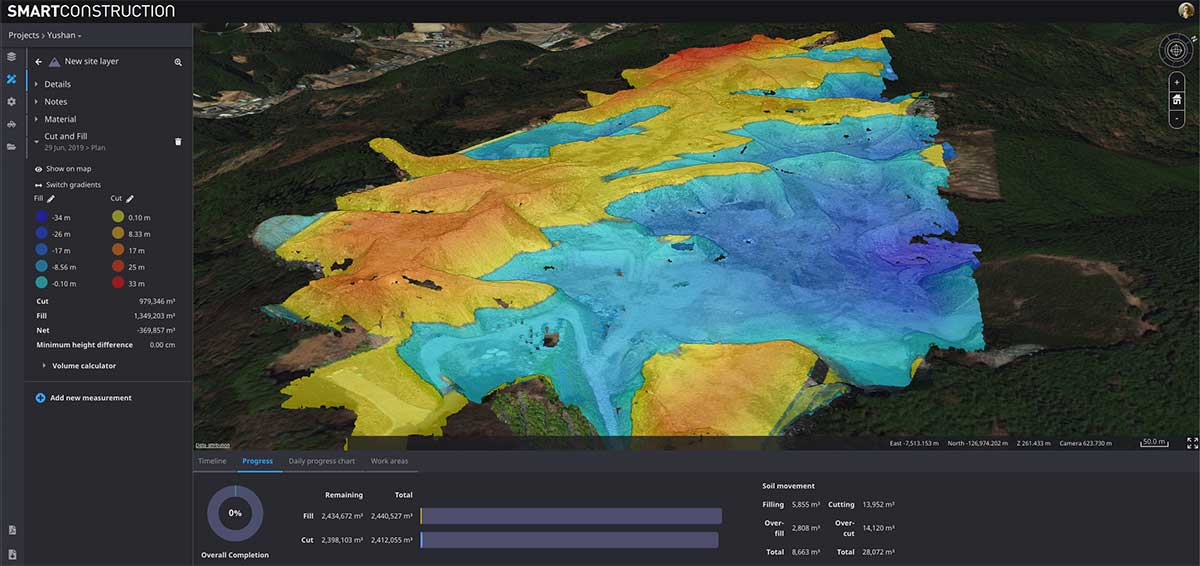
    Cesium’s 3D technology will power smart construction dashboard to make construction safer, more efficient and more profitable

    Komatsu has officially announced an incoming suite of the company’s Smart Construction solutions, which will include the 3D visualization power and geospatial accuracy of Cesium, a platform to visualize, analyze and share 3D data.

    “Together, Komatsu and Cesium are bringing a new era of innovation to the construction industry,” said Rod Schrader, Chairman and CEO of Komatsu’s North American operations. “As experts in 3D data visualization, computer graphics and open-source software, Cesium’s technology will help power our Smart Construction Dashboard.”

    Komatsu made the announcement at ConExpo 2020, held in Las Vegas.

    As the key strategic partner for 3D data visualization, Cesium built the company’s Smart Construction dashboard. The dashboard enables users to monitor a construction site from anywhere in the world, see how it changes over time and compare architectural plans with real-world data.

    It is compatible with different types of data — collected from sensors on individual construction machines, drone surveys, or computer generated files like BIM/CAD models — allowing users to visualize them all in a single scene within a web browser, as well as calculate precise measurements for cut and fill, slope, contours and more.

    As Komatsu noted today, the worldwide construction industry is on the cusp of rapid change and innovation driven by technology. Collecting data from people and machines — and connecting all of it across an open platform — optimizes processes and delivers insights that will enable customers to make data-driven decisions.

    Komatsu chose to partner with Cesium because of its powerful 3D visualization engine and accuracy in tying data to precise locations on the globe. Cesium’s ability to keep millimeter-level accuracy while tracking satellites in complex orbits was important to attain the level of precision Komatsu’s Smart Construction initiative demands.

    “We believe in Komatsu’s vision to create construction sites that are safer and more efficient through Smart Construction.” said Cesium CEO Patrick Cozzi. “We are proud that visualization and analytics with the hallmark precision of Cesium will provide technology for the industry’s digital transformation.”