Author: Tracy Cozzens

  • Seen & Heard: Shackleton’s ship, Beijing underground

    Seen & Heard: Shackleton’s ship, Beijing underground

    “Seen & Heard” is a monthly feature of GPS World magazine, traveling the world to capture interesting and unusual news stories involving the GNSS/PNT industry.


    Photo: dk1234/iStock/Getty Images Plus/Getty Images
    Photo: dk1234/iStock/Getty Images Plus/Getty Images

    POSITIONING UNDERGROUND

    A “BeiDou positioning system for subways” began construction March 20 on the Beijing subway capital airport express line. The project will cover a 30-kilometer-long section of the express line, including five stations. To provide positioning, the BeiDou Navigation Satellite System (BDS) will be combined with 5G for indoor positioning or in areas where the satellite signals are blocked. The system will improve the positioning accuracy in subways to less than 2 meters, making it available for vehicle dispatching, passenger transport organization and emergency response. In addition, it allows passengers to use their phones to navigate and position in complex environments in subway stations through three-dimensional navigation.


    Image: ESA
    Image: ESA

    THE SHAPE OF OCEAN WATER

    The European Space Agency (ESA) investigated a technique to precisely measure sea-surface topography based on an idea submitted by the Institute for Space Studies of Catalonia (IEEC). The technique involves GNSS reflectometry — signals that have been reflected off of the sea surface at very low angles. The ESA-funded activity involved developing a GNSS receiver and setting up an experiment in the Balearic Islands to collect GNSS signals reflected off the sea surface. The team linked the coherence of the reflected signals to wave height and elevation angle of GNSS satellites. The team then processed the signals for optimized measurements of the shape of the sea surface, useful in applications such as ocean current forecasting, climate research, ship routing, cable laying and debris tracking.
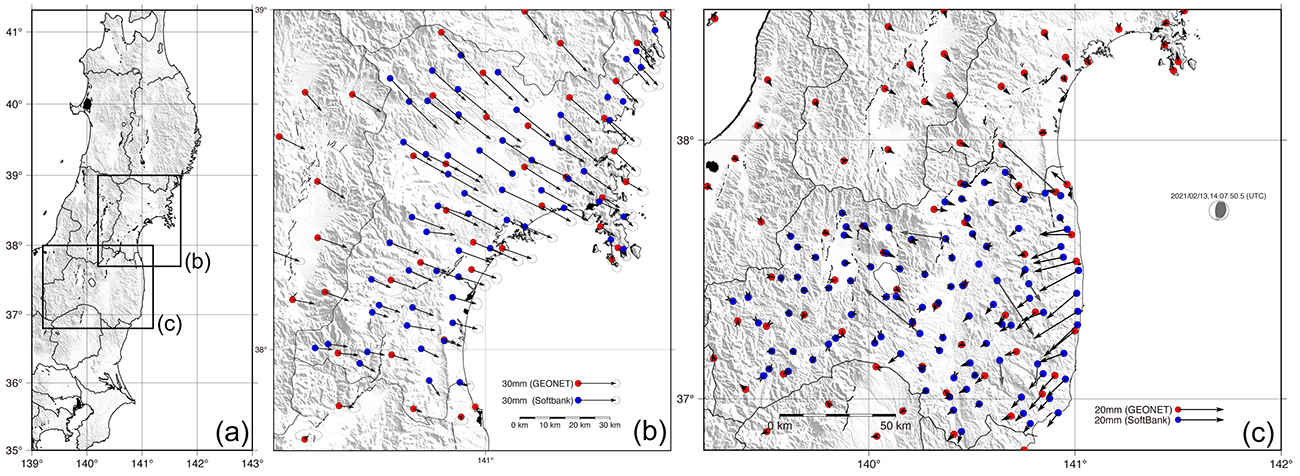

    Image: Japan network/Ohta and Ohzono, Tohoku University
    Image: Japan network/Ohta and Ohzono, Tohoku University

    CELLPHONE NETWORK DETECTS EARTHQUAKES

    A paper published Feb. 9 in Earth, Planets and Space by Japanese Earth science researchers analyzed the potential of a dense network of GNSS receivers, installed at cellphone base stations, to monitor crustal deformation as an early warning indicator of seismic activity. Results showed that data from a cellphone network can rival the precision of data from a government-run GNSS receiver network, while providing more complete geographic coverage. Japanese cellphone carriers have constructed networks of GNSS receivers to improve locational information for such purposes as automated driving. The study examined the potential of a GNSS network built by SoftBank Corp. to play a role in monitoring crustal deformation.


    Photo: Falklands Maritime Heritage Trust
    Photo: Falklands Maritime Heritage Trust

    ENDURANCE IN POLAR ICE

    Researchers have discovered the remarkably well-preserved wreck of polar explorer Ernest Shackleton’s ship, Endurance, a century after it was swallowed up by Antarctic ice. A team of marine archaeologists, engineers and other scientists used an icebreaker ship and underwater drones to locate the wreck at the bottom of the Weddell Sea, near the Antarctica Peninsula. The ship is at a depth of 3,008 meters, 4 miles south of the position originally recorded by navigator Frank Worsley. The expedition team used two Saab autonomous underwater vehicles to explore in a pre-programmed search pattern. After the ship was located, technicians swapped out sonar equipment for a high-resolution camera and a laser-surveying device to make highly detailed scans of the site.

  • Mapping Marvel: Ukraine war moment by moment

    Mapping Marvel: Ukraine war moment by moment

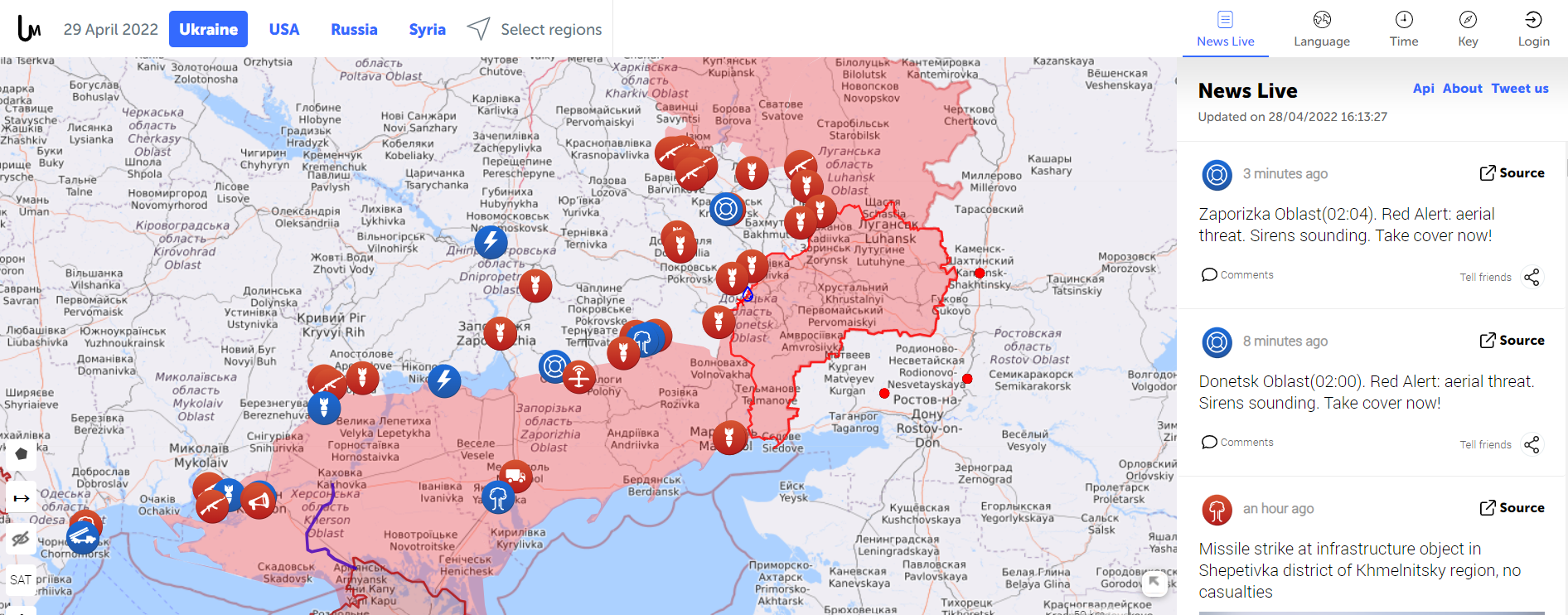
    Screenshot: Liveuamap
    Screenshot: Liveuamap

    A mapping service provider birthed during the 2014 Ukraine conflict is tracking the current war through crowdsourced photos, Tweets, posts, news and other channels.  

    The Live Universal Awareness Map was founded by a team of software developers and journalists to inform the world about the Ukraine conflict. By viewer request, it quickly expanded to cover other regions, including Syria, Israel-Palestine and “Islamic State war” news. Today, it covers more than 30 regions and topics, offers translations in several languages, and can be used on mobile browsers via its own Android and iOS apps. 

    The independent global news and information site is dedicated to factual reporting of important topics such as conflicts, human rights issues, protests, terrorism, weapons deployment, health matters, natural disasters and weather-related stories from a vast array of sources.  

    Its map-centric approach to the organization of information allows viewers to quickly find relevant stories in geographies of their interest. Events are archived, and can be reviewed for analysis or historical trends. “Through our big-data analysis methods, we aim to help predict and prevent future conflicts, minimize the impact of disasters, and assist travelers around the world in making conscious decisions about their security throughout their journeys,” the service states. 

    Liveuamap uses proprietary software tools, such as artificial-intelligence web crawlers, to find newsworthy stories. These sources are then forwarded to a group of expert analysts for fact checking. In the final step, editors decide which facts and stories should be displayed on the map to minimize spam.  

    An improvement under development will enable viewers to create and manage their own maps. 

  • DroneShield releases major firmware release for its C-UAS devices

    DroneShield releases major firmware release for its C-UAS devices

    DroneShield RfPatrol body-worn C-UAS device with enrolled firmware upgrades. (Photo: DroneShield)
    DroneShield RfPatrol body-worn C-UAS device with enrolled firmware upgrades. (Photo: DroneShield)

    DroneShield has begun releasing a software update across its counter-unmanned-aerial-system (C-UAS) devices, including portable, vehicle-based and fixed-site devices. The devices are used by the military, the intelligence community, U.S. Homeland Security, law enforcement, critical infrastructure and others.

    The updates will be rolling out across DroneShield devices globally in the coming week, with heightened urgency given the widespread use of drones in Ukrainian and Middle Eastern conflicts. The technology upgrade is validated by deployments with the U.S. Air Force and Australian Army.

    Enrolled devices receive quarterly firmware updates of the proprietary DroneShield RFAI artificial intelligence engine. Some of these updates are major enhancements, such as this 2Q22 release.

    Major upgrades include:

    • Site Install Wizard. The new Spectrum Viewer mode, in which C-UAS detection devices scan the deployment area for optimal sensor placement
    • Machine Learning in the Loop. This option enhances the RFAI engine from the data received by the user.

    Both features were added in response to end-user requirements.

  • Honeywell expands navigation portfolio with new HGuide products

    Honeywell expands navigation portfolio with new HGuide products

    New offerings will deliver accurate navigation to industrial applications even in areas where GPS is unavailable

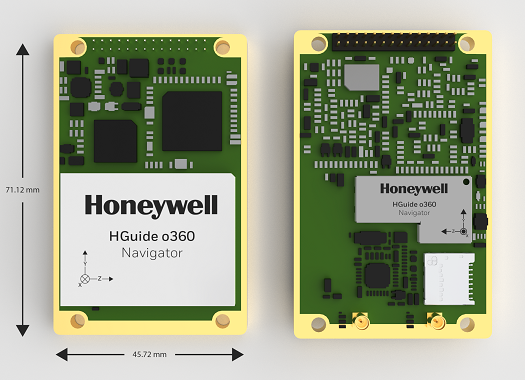
    The HGuide o360 Navigator. (Photo: Honeywell)
    The HGuide o360 Navigator. (Photo: Honeywell)

    Honeywell has expanded its HGuide industrial navigation portfolio with three new technologically advanced navigation systems — the HGuide o360 INS/GNSS navigator, HGuide n500 inertial navigator and the HGuide g080 GNSS receiver.

    The new HGuide products are designed for a wide array of industrial and autonomous applications across air, land and sea vehicles and related equipment.

    The HGuide o360 navigation system is a compact single-card, all-attitude inertial navigation system (INS) GNSS navigator that can deliver an accurate and robust position and attitude navigation service, even through GNSS-challenged or denied environments, to industrial and autonomous applications. It provides the features and compatibility needed for a simple integration.

    “The HGuide o360 is an engineering marvel and a technological breakthrough. There are no similar competing products in the industry today that can achieve such a high-performance level at this price point and size,” said Matt Picchetti, vice president and general manager, Navigation & Sensors, Honeywell Aerospace. “The entire HGuide product line is suitable for a wide range of industries, including autonomous vehicles, marine and a host of industrial applications where accurate positioning and attitude information is required in real time.”

    The HGuide o360 INS/GNSS navigator contains a powerful dual antenna, multi-frequency, multi-constellation, real-time kinematic (RTK) GNSS receiver, Honeywell’s i300 inertial measurement unit (IMU) technology, and a high-grade calibrated magnetometer.

    The HGuide o360 is designed for platforms that require high-performance navigation data in an ultra-low size, weight and power (SWAP) package.

    The HGuide n500 inertial navigator is a navigation-grade bring-your-own-GNSS all-attitude navigator that supports continuous position and attitude navigation even during prolonged GNSS outages. The HGuide n500 is built on Honeywell’s HG4930 IMU plus the Honeywell HGuide Sensor Fusion software.

    The HGuide g080 GNSS receiver is a dual-antenna, triple-radio frequency, all-constellation GNSS receiver that delivers heading and positioning down to sub-centimeter levels even in GNSS-challenged environments. It includes an onboard IMU to allow tracking during short GNSS outages and enable smooth and fast reacquisition. The product is available with or without RTK functionality.

    Inertial navigation systems are highly critical in navigation and comprise an IMU, a GNSS receiver and sensor fusion software. These components work together to calculate position, orientation and velocity to deliver critical navigation information in GNSS-denied areas such as urban canyons, bridges, tunnels, mountains, parking garages and dense forests.

  • 90 groups mark 2-year Ligado Order anniversary with new letter

    90 groups mark 2-year Ligado Order anniversary with new letter

    A new letter has been sent to both President Biden and congressional leadership by 90 groups opposed to Ligado’s plans to launch a terrestrial network in the L-band used by GPS.

    The letter, dated April 25, marked the two-year anniversary of a controversial decision by the U.S. Federal Communications Commission (FCC) to adopt the Ligado Order.

    The 90 groups represent companies, organizations and associations united in their grave concerns over “imminent — but preventable — harm from Ligado’s proposed terrestrial network.” These groups have serious concerns about how Ligado’s plan threatens to interfere with services provided by the GNSS, aviation and real-time environmental satellite-data communities.

    Staying the order is necessitated by the clear bipartisan will of Congress. After adoption of the order in 2020, Congress mandated an independent technical review to further assess the harmful interference that would be caused by Ligado’s proposed network and required the Department of Defense to brief federal representatives across the government “at the highest level of classification” on the potential for widespread harm from Ligado’s proposed terrestrial operations.

    On this basis alone, the FCC should stay the order to adequately consider the material new information that will be uncovered as a result of these ongoing Congressionally mandated processes, according to the letter writers.

    Their concern was made even more real following the announcement by Ligado that the company intends “to commence operations in the 1526-1536 MHz band on or after Sept. 30, 2022.”

    Image: A-Digit/DigitalVision Vectors/Getty Images
    Image: A-Digit/DigitalVision Vectors/Getty Images
  • Microchip Technology offers GridTime 3000 for utilities

    Microchip Technology offers GridTime 3000 for utilities

    The GridTime 3000 GNSS time server meets rugged international environmental standards for power plants and substations

    The GridTime 3000 GNSS time server. (Photo: Microchip)
    The GridTime 3000 GNSS time server. (Photo: Microchip)

    Microchip Technology Inc. has announced its GridTime 3000 GNSS time server, a software-configurable solution providing power plants and substations with a new level of redundancy, security and resiliency to protect against surges, adverse weather and cyberattacks targeting critical infrastructure.

    Meeting the Need

    Power plants and substations rely on high-speed communications networks to transmit critical data including operability metrics, network health, fault monitoring, power measurement and usage trends. To synchronize communications and ensure continuity across these networks, substations require secure, precise timing and synchronization to avoid false tripping and to provide accurate time-stamping of substation data including system faults, power-measurement data and substation status information.

    The launch of the Microchip GridTime 3000 GNSS Time Server assists power-grid operators to meet these requirements.

    The GridTime 3000 system generates precise time and frequency signals to synchronize analog and digital communication systems. This resilient timing platform incorporates multiple timing inputs for protection in the event of a GNSS signal disruption caused by severe weather, environmental disturbances or signal jamming or spoofing.

  • SBG Systems launches Quanta Micro INS

    SBG Systems launches Quanta Micro INS

    Photo: SBG Systems
    Photo: SBG Systems

    SBG Systems has announced a new inertial navigation system (INS) named Quanta Micro, completing its Quanta product line.

    The Quanta Micro GNSS-aided INS offers a unique combination of navigation performance and low size, weight, power and cost (SWAP-C).

    Quanta Micro leverages a survey-grade inertial measurement unit (IMU) for optimal heading performance in single antenna applications, and high immunity to vibrating environments. An optional secondary antenna enables fast heading initialization in low dynamic applications.

    Main Features

    • Accuracy: 0.015° roll/pitch, 0.035° heading, 1 cm position (PPK)
    • Integrates a survey-grade IMU: 0.8°/h gyro bias instability
    • Versatile INS/GNSS to suit land, air or marine applications
    • Highly tested and calibrated from -40°C to 85°C
    • Robust to vibrating environments
    • Quad-constellation multi-band RTK GNSS receiver
    • Smooth post-processing workflow with Qinertia software
    • Major size reduction with no compromise on performance.
  • Tallysman adds XF antennas to helical line

    Tallysman adds XF antennas to helical line

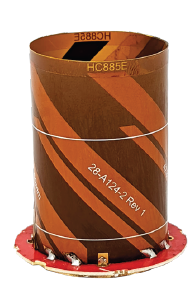
    The HC885EXF embedded helical antenna. (Photo: Tallysman)
    The HC885EXF embedded helical antenna. (Photo: Tallysman)

    Tallysman Wireless has added the housed HC885XF and embedded HC885EXF dual-band eXtended Filtering (XF) antennas to its line of helical antennas.

    The antennas receive GPS/QZSS L1/L5, GLONASS G1/G3, Galileo E1/ E5a/b, BeiDou B1/B2/B2a and L-band corrections services.

    Historically, dual-frequency antennas and receivers commonly supported GPS L1 and L2 and GLONASS G1 and G2. In recent years, GPS, GLONASS, Galileo, BeiDou and NavIC have added GNSS signals in the L5 frequency band (1160-1217 MHz).

    As a result, the new dual-frequency GNSS standard has become L1 and L5.

    Tallysman’s new HC885XF antenna has been tuned to provide optimal support for the entire L1/G1/E1/B1/L-band correction and L5/G3/E5/B2 bands.

    The radio frequency spectrum has become congested worldwide as many new LTE bands have been activated, and their signals or harmonic frequencies can affect GNSS antennas and receivers. In North America, the planned Ligado service, which will broadcast in the frequency range of 1526 to 1536 MHz, can affect GNSS antennas that receive space-based L-band correction service signals (1539-1559 MHz). New LTE signals in Europe [Band 32 (1452-1496 MHz)] and Japan [Bands 11 and 21 (1476-1511 MHz)] have also affected GNSS signals. Tallyman’s XF models mitigate the effects of these new signals.

    The Tallysman HC885XF housed helical antenna weighs ~42 g and is enclosed in a robust, military-grade IP67 plastic enclosure. The antenna base has an integrated SMA connector, a water-proofing O-ring, and three screw holes to enable secure attachment.

    Tallysman’s embedded HC885EXF helical antenna weighs ~8 g. It is easily mounted with an optional embedded helical mounting ring, which traps the outer edge of the antenna circuit board to the host circuit board or any flat surface. An MCX connector is installed in the base of the antenna.

    Tallysman HC885EXF and HC885XF antennas are suitable for a variety of applications, including lightweight unmanned autonomous vehicle navigation (land, sea, and air), land survey devices, automotive positioning, timing and other precise-positioning applications.

  • Analog Devices converter sets performance benchmarks for harsh environments

    Analog Devices converter sets performance benchmarks for harsh environments

    Radio frequency analog-to-digital converter sets performance benchmarks for space and harsh environments

    Photo: Analog Devices
    Photo: Analog Devices

    Analog Devices has released the AD9213S-CSH, a highly integrated RF analog-to-digital converter (ADC). The ADC is a 12-bit, 10.25 giga samples per second (GSPS) ADC in high-reliability packaging, with advanced production screening and quality inspection.

    It is the company’s fastest ADC available for the space environment.

    The AD9213-CSH enables the next generation of software-defined systems for satellite communications, radar and remote sensing, driving greater system integration, lower costs, reduced power consumption and decreased size, weight and power (SWaP).

    Additionally, a high sample rate and integrated post-processing enable further performance gains for narrow-band applications.

    The AD9213-CSH provides space customers with greater flexibility and the ability to process larger sections of the spectrum for electronic support measures, as well as increased-resolution radar designs.

    The wider Nyquist bandwidth allows satellite-communications customers to deliver products with increased bandwidth. In addition, wide input bandwidths combined with high sample rates enable new wideband digital predistortion architectures communications applications.

  • Bad Elf unveils base/rover feature for survey-grade GNSS accuracy anywhere

    Bad Elf unveils base/rover feature for survey-grade GNSS accuracy anywhere

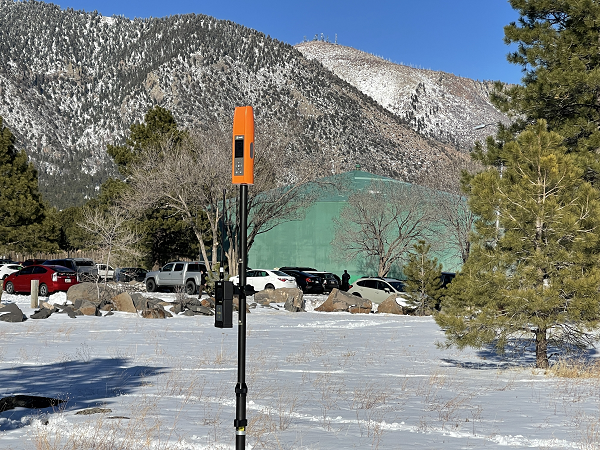
    Photo: Bad Elf
    Photo: Bad Elf

    Bad Elf has introduced a base/rover feature built upon its Bad Elf Flex GNSS receiver. The new base/rover feature brings affordable centimeter-level accuracy to surveyors and geospatial professionals working anywhere in the world.

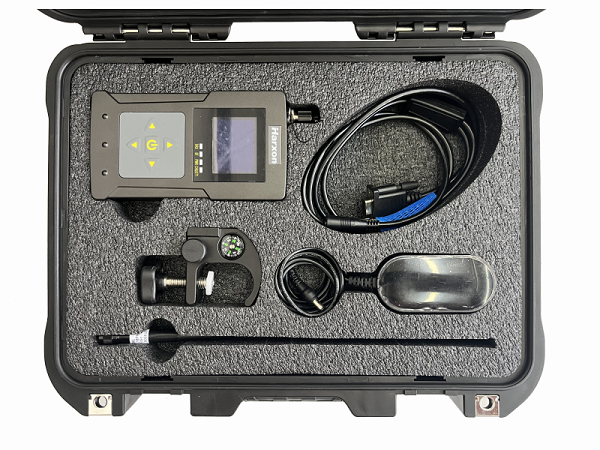
    The solution consists of two Flex GNSS receivers and two UHF radios, allowing customers to perform high-accuracy field data collection in areas where traditional real-time kinematic (RTK) corrections or cellular coverage is not available. Existing Flex customers can upgrade by adding Flex radio kits.

    Bad Elf designed the base/rover feature with emphasis on accuracy, affordability and versatility. The Bad Elf Flex enables reliable data collection either as a standalone receiver or paired with apps on iOS or Android phones and tablets. A checklist-based workflow ensures consistent results and eliminates many common issues associated with setup and deployment of a base/rover solution.

    Photo: Bad Elf
    Photo: Bad Elf

    “The Bad Elf app walks the user through these steps and more, and it doesn’t let the project proceed until each checklist is complete,” said Larry Fox, vice president of Marketing and Business Development at Bad Elf. “The automated checklists simplify every process, so that geospatial professionals and surveyors of every experience level get reliable results.”

    The base feature requires only one Flex Extreme and a radio kit. Customers may choose to use either Standard or Extreme Flex with a radio kit for rovers. Using Flex Standard and one daily token provides access to the rover feature.

    Bad Elf’s flexible hardware-as-a-service model provides a mechanism for customers to further reduce the capital cost of a complete base/rover system. In addition, customers can deploy multiple rovers in either configuration for larger projects.

    “For about one-third of the purchase price of competing products available today, our base/rover feature makes survey-grade one-centimeter accuracy a reality worldwide,” said Fox. “And our pay-as-you-go Flex Token model dramatically reduces operating expenses by allowing users to activate — and pay for — just the service levels needed on a given day.”

    Complete base/rover kits are available immediately, along with à la carte options for existing Flex customers. The Flex base/rover solution is compliant with FCC operating standards in the United States. Bad Elf provides customers with complete instructions for acquiring a radio operator license and call-sign designation.

  • Orbital Insight partners with Satellogic on satellite imagery and video

    Orbital Insight partners with Satellogic on satellite imagery and video

    A sample image from Orbital Insights showing classes of military aircraft at a base. (Image: Orbital Insights)
    A sample image from Orbital Insights showing classes of military aircraft at a base. (Image: Orbital Insights)

    Orbital Insight will integrate Satellogic’s high-resolution multispectral imagery, hyperspectral imagery, and full-motion video into its GEOINT platform

    Geospatial intelligence company Orbital Insight has partnered with Satellogic, a leader in sub-meter resolution satellite imagery collection. The partnership will integrate Satellogic’s high-frequency, high-resolution collections of satellite imagery and full-motion video into Orbital Insight’s platform and offer customers better access to high-quality data, improve the revisit rate, and reduce the cost of running analytics.

    Satellogic designs, manufactures and operates its own constellation of Earth observation satellites. It  has 22 operational satellites in low Earth orbit with plans to launch up to 12 additional satellites by the end of the year. The company aims to expand its constellation to more than 200 satellites by 2025 for daily global coverage of the entire surface of the Earth.

    Orbital Insight’s flagship GO platform combines information from the world’s sensors to analyze economic, societal and environmental trends at scale and support activity-based intelligence. Commercial businesses and government agencies use the self-service platform to synthesize answers to critical questions about what’s happening on and to Earth.

    Satellogic will provide high-resolution Earth observation data at vastly superior unit economics. This will allow Orbital Insight customers to increase the number of daily revisits on points of interest, see a more granular picture and get deep insights that were not possible before.

    “Advanced geospatial analytics require access to high-resolution, high-frequency satellite imagery and simple tasking,” said Kevin O’Brien, CEO, Orbital Insight. “Satellogic is disrupting the industry with a cost-effective, vertically integrated business model. This approach aligns well with our philosophy of making geospatial intelligence efficient, intuitive, and simple so that our customers can get timely insights, make critical decisions, and respond faster.”

    “Our mission is to enable greater access to critical Earth observation data. Working with Orbital Insight extends our reach, making our data available to more customers across diverse fields who need to know how the world around them is changing,” said Emiliano Kargieman, CEO and co-founder of Satellogic.

  • Draganfly drones head to Ukraine to meet medical needs

    Draganfly drones head to Ukraine to meet medical needs

    The first Draganfly humanitarian drone shipped to Revived Soldiers Ukraine (RSU) has arrived in Europe and will soon deliver insulin to hard-to-reach hospitals in Ukraine. Draganfly is a North American drone manufacturer.

    RSU ordered 200 Draganfly medical response drones equipped with temperature-managed payload boxes that can transport up to 35 pounds of blood, pharmaceuticals, insulin/medicines, vaccines and wound-care kits. Because insulin is a temperature-sensitive product, quick and safe transportation of the hormone is a top priority.

    About 2.3 million people in Ukraine live with diabetes. Many are Type 1 diabetics who need multiple daily injections of insulin to survive. For those living in high-conflict areas of the country, access to life-saving insulin is limited or non-existent.

    NuGen Medical Devices donated the needle-free injection devices and 5,000 needle-free disposable syringes to be filled with insulin. Not only are life-saving medical supplies like insulin dwindling in Ukraine, but there is also an urgent need for many medicines across the country as hospitals have been under direct attack since Russia invaded on Feb. 24.

    Draganfly medical relief drone. (Photo: Draganfly)
    Draganfly medical relief drone. (Photo: Draganfly)