Category: Applications

  • CES 2016: Qualcomm unveils processor for connected cars

    Snapdragon-QualcommQualcomm Technologies has introduced its latest Qualcomm Snapdragon automotive processors, the Snapdragon 820 Automotive family, offering a scalable next-generation infotainment, graphics and multimedia platform with machine intelligence and a version with integrated LTE (long-term evolution)-Advanced connectivity.

    The Snapdragon 820A is Qualcomm Technologies’ newest automotive-grade system-on-chip (SoC). Qualcomm Technologies has taken a modular approach to designing the Snapdragon 820A, enabling a vehicle’s infotainment system to be upgradable through both hardware and software updates, thereby enabling vehicles to be easily upgraded with the latest technology.

    The Snapdragon 820A’s sensor integration provides cognitive awareness and vehicle self-diagnostics, supports ADAS features for improved vehicle safety systems, and provides location and navigation through GNSS and dead-reckoning technologies.

    Qualcomm Technologies is demonstrating the upgradeable module at the Qualcomm Automotive booth, North Hall #915, at CES 2016, being held in Las Vegas this week.

    The Snapdragon 820A family is based on 14-nm FinFET advanced process node running Qualcomm Technologies’ custom 64-bit Qualcomm Kryo CPU, Qualcomm Adreno 530 GPU, Qualcomm Hexagon 680 DSP with Hexagon Vector eXtension (HVX), Qualcomm Zeroth machine intelligence platform, and the Snapdragon 820Am version with integrated X12 LTE modem capable of 600 Mbps downlink/150 Mbps uplink. The 820A is engineered with custom-built, highly optimized cores designed for heterogeneous computing — the ability to combine its diverse processing engines within the SoC, such as the CPU, GPU and DSP cores, to achieve previously unattainable performance and power savings.

    The Zeroth initiative, a machine intelligence platform on Snapdragon 820A, is designed to enable automakers to develop state-of-the-art deep learning-based solutions using neural networks for advanced driver assistance systems (ADAS) and in-vehicle infotainment scenarios, and run them efficiently on embedded platforms in the vehicle. Zeroth accelerates execution of deep neural networks using the heterogeneous compute engines that are part of the Snapdragon 820A. A Zeroth-powered development kit for automotive solutions will be available for the Snapdragon 820A.

    “With the Snapdragon 820 Automotive processing platform, we are delivering an unprecedented level of performance and technology integration designed to significantly enhance the consumer’s safety and in-vehicle experience. Never before has the unparalleled combination of integrated LTE cloud connectivity, powerful heterogeneous computing, leading-edge multimedia performance and breakthrough machine learning capabilities been delivered in a single chip, fully integrated, automotive grade solution,” said Patrick Little, senior vice president and general manager, automotive, Qualcomm Technologies.

    “The automotive industry has long been asking for a single scalable solution capable of delivering the rich user experience and level of performance, connectivity and upgradability that consumers are accustomed to on their personal mobile devices,” Little said, “including real-time cloud connectivity and navigation, immersive 4K graphics and video displays, the flexibility of hardware and software upgradability, and the deep learning and remote diagnostic capabilities needed to deliver the next level of safety performance in the vehicle. The Snapdragon 820 Automotive platform has been designed to deliver all of these capabilities and much more.”

    The version with integrated X12 LTE modem is designed to support continuous in-car and cellular connectivity, featuring the leading 4G LTE Advanced Pro that can support up to 600 Mbps download/150Mbps upload speeds, stream HD movies into the car, serve as a Wi-Fi hotspot supporting 802.11ac 2×2 MIMO, connect multiple mobile devices inside the car, and support 802.11p DSRC for V2X (vehicle to vehicle/infrastructure/pedestrian) communications. Local connectivity inside the car via Bluetooth supports content sharing between mobile devices brought into the car and the car’s infotainment system.

    Qualcomm Technologies is also helping to lead the 3GPP in developing specifications for automotive V2X, for both LTE release 14 (LTE V2X) and 5G standards.

    “Like Qualcomm Technologies, AT&T is committed to the connected car and takes a similar approach to technology development with the AT&T Drive platform, offering a global, modular solution to automakers to enable best-in-class user experiences for their drivers,” said Chris Penrose, senior vice president, Internet of Things, AT&T Mobility. “We design our solutions to provide better connectivity, flexibility and upgradability on our network, and Qualcomm Technologies’ development of the Snapdragon 820A Smart LTE Module is a prime example of this same approach to technology.”

    By integrating advanced camera and sensor processing, the 820A supports critical always-on warnings and emergency services, extends standard cameras to Intelligent Cameras, and supports parking assist periphery vision features using surround view cameras. These features are supported by the on-chip Hexagon 680 DSP with HVX, which supports multiple automotive camera sensors connected simultaneously.

    The Snapdragon 820A family of automotive-grade processors is designed for the automotive ecosystem and offers these features:

    • Scalable and modular platform offering pin, package and software-compatibility, with optional integrated LTE capability that is hardware and software upgradeable as wireless network technology evolves.
    • Supports vertical tiering options by offering the Snapdragon 820A family across premium to standard performance configurations.
    • Comprehensive software support for QNX, Linux and Android, as well as substantial platform-level integration of high value sub-systems to respond to the acceleration in refresh cycles while managing cost.
    • The connectivity, multimedia and graphics capabilities allow many real-time cloud based features, including streaming multimedia, enterprise collaboration, real-time maps and location services, remote diagnostics and one-touch telematics, with substantial potential for performance, connectivity and multimedia innovation for auto OEMs.
    • The upgradability option allows a wireless operator to offer an 820A Smart LTE Module concept for the version with an integrated modem that allows cellular connectivity to be updated through both hardware and software when new features become available on the cellular network.

    Qualcomm Technologies is also collaborating with Aisin AW to develop the modular infotainment solution utilizing the Snapdragon 820A. “We expect the 820’s powerful features will deliver superior processing power, graphics performance and low power consumption demanded by next generation infotainment systems,” said Kyomi Morimoto, managing officer, Aisin AW.

    Automotive samples of the 820A family are expected to be available in the first quarter of 2016. A number of concept vehicles and demonstrations based on the Snapdragon 820A, from Qualcomm Technologies and other automotive industry leaders, will be shown in the Qualcomm Automotive booth, North Hall #915 at CES 2016.

  • CES 2016: Bosch Sensortec unveils intelligent accelerometers and high-performance gyroscopes

    Bosch Sensortec is unveiling new generations of intelligent accelerometers and high-performance gyroscopes at the 2016 International CES in Las Vegas.

    Aimed at smartphones, tablets and wearables, the new devices cover a wide range of requirements, from low-power consumption for always-on applications such as step counting, to high-performance optical image stabilization (OIS).

    Intelligent three-axis accelerometers — BMA422 and BMA455

    Today’s applications running on modern mobile devices place many demands on motion sensors. These sensors are required to continuously sense motion, such as for step counting operations, while at the same time delivering a high level of performance without compromising battery lifetime.

    To meet these challenges, the new sensors from Bosch Sensortec integrate embedded intelligence functionality into standalone accelerometers. Adding intelligent features to an accelerometer enables innovative applications, while minimizing power consumption by eliminating the need to wake up an application processor or an additional discrete sensor hub. Overall system power management and user experience can be improved by the accelerometer detecting and processing motions such as glance, pick-up and tilt.

    Current consumption of the new accelerometers is kept very low to extend battery life. The integrated Android 6.0 “Marshmallow” features minimize programming effort for customers. Each device delivers outstanding accelerometer performance for low offset, low temperature coefficient offset (TCO) and low noise levels, the company said.

    Two new accelerometers are being launched: the BMA422 “all-rounder” is suitable for standard applications, and the BMA455 provides high performance for gaming and immersive activity tracking. In addition, the high level of performance enables demanding applications covering augmented reality, virtual reality, image stabilization and industrial measurement applications such as spirit leveling and inclination measurement.

    High-performance gyroscopes — BMG250 and BMG280

    Mobile devices require gyroscopes for many applications, including gaming, augmented reality, virtual reality and OIS. To provide the necessary performance, Bosch Sensortec’s new gyroscopes combine the most important parameters in a single device: low noise, low TCO and high bias stability.

    Although delivering high performance, they do both feature the lowest power consumption of any standalone gyroscope in the market, thus helping to extend battery lifetime in mobile devices.

    Today’s announcement includes two three-axis gyroscopes: the BMG250 provides low noise, low TCO and high bias stability, while the BMG280 delivers ultra-low noise optimized for OIS and includes a secondary interface for OIS, making it fit for use in camera modules. The BMG280’s secondary interface can be used in parallel with the primary user application interface, for example for simultaneous panorama creation and OIS.

    Packages and availability

    The new devices are provided in small packages. The BMA422 measures 2.0 x 2.0 x 0.95 mm³, while the BMA455 is 2.0 x 2.0 x 0.65 mm³. The BMG250 and BMG280 gyroscopes both measure 3.0 x 2.5 x 0.83 mm³.

    Samples of the all sensors are available now, with mass production of the gyroscopes to commence in Q1 2016 and mass production of the accelerometers starting in mid-2016. For pricing, contact Bosch Sensortec.

  • Bluvision demonstrates indoor location solution at CES 2016

    Bluvision, a real-time location services (RTLS) provider, will be demonstrating its RTLS solution along with Texas Instruments (TI) at CES 2016.

    Bluvision’s location algorithms “continue to redefine how technology can be used for indoor location,” the company stated in a news release. Its RTLS solution uses Bluetooth low-energy and Wi-Fi technology to determine specific positioning, leveraging multiple techniques, including smart machine learning algorithms for accuracy.

    The combination of Bluetooth Smart, Wi-Fi and sophisticated algorithms on the cloud allows tracking and monitoring of assets — equipment or people — without the need for a smartphone application and uses minimum hardware that is fast and easy to implement, Bluvision said.

    Bluvision’s RTLS solution is accurate down to three feet even in harsh conditions. It can be deployed in a large area within hours. The solution supports creating multiple alerts and policies, including creating multiple virtual geofences that trigger alerts when entering or leaving pre-defined areas.

    Bluvision will demonstrate the RTLS solution in the TI Village (#N115-N118) at CES 2016, using TI’s SimpleLink Bluetooth Smart CC2640 wireless microcontroller (MCU).

    “Our LBS (location-based service) solution is disruptive,” said Jimmy Buchheim, CEO of Bluvision. “Using TI’s SimpleLink CC2640 wireless MCUs with built-in SDR (software-defined radio) and the combination of our talented data scientists, advanced algorithms team and cloud team, allows us to revolutionize indoor location, achieving what is considered impossible accuracy for Bluetooth-based technology.”

    For more information on the demo or Bluvision’s RTLS solution, contact Subhashree Sukhu.

  • P3 predicts connected car focus of upcoming automotive, tech shows

    Automotive and consumer technology teams in Detroit and Silicon Valley remain hard at work preparing to kick-off the New Year with new technology at two of the nation’s biggest showcases of automotive connectivity: CES 2016, held Jan. 6–9 in Las Vegas, and the North American International Auto Show, held Jan. 11–24 in Detroit.

    Samit Ghosh, Ph.D., president and CEO of P3 North America, has worked with U.S. automakers on connected vehicle technology since 2005. He shared his thoughts on the future of driving and what to expect at the upcoming shows in a news release from the company.

    “Autonomous driving, information and entertainment systems will continue to take center stage in 2016 as automakers focus on chips, sensors and smartphone applications as key consumer differentiators,” Ghosh said. “In-car entertainment and safety capabilities provided through telematics and infotainment technologies are rapidly becoming the reasons consumers buy vehicles, so the stakes have never been higher.”

    Underscoring the growing intersection of consumer technology and the car, Ghosh pointed to CES reports that its automotive exhibit space will grow 25 percent at the 2016 show, with nine auto makers and 115 automotive tech companies debuting products.

    “Complex technologies require efficient processes,” Ghosh said. “The connected car ecosystem is complicated and faces many challenges, but automakers are beginning to think differently about the way they incorporate technology into cars. They need to start by rethinking their organizations and processes, breaking down organizational silos and taking an end-to-end view of all the touch points that spell success in the rapidly changing IoT ecosystem.

    “Hot topics at this year’s auto shows will be the security of connected vehicle systems and the safety implications of evolving driver interfaces. Automakers also face the tough decision to remain proprietary or join the open source software movement, as smartphones become universal devices for controlling every consumer’s world. From personalized in-car entertainment to smart home integration, the car is becoming a critical link in our interconnected world,” he said.

    According to Ghosh, in the software-focused world, carmakers can achieve far greater economies of scale by sharing technology with all other automakers. He cited GENIVI open source In-Vehicle Infotainment software as one force working to shorten development cycles and reduce OEM costs.

    “As an independent systems integrator, P3 efficiently connects and unites large industry players to quickly and successfully innovate,” Ghosh said. “The way we manage projects and optimize our clients processes is extremely unique. Our international experience in both the automotive and the telecommunications industries gives us the exact perspective needed to help these converging industries accelerate the development of connected car technology.”

  • Updated US Topo maps for Wisconsin add Census Bureau road data

    Updated 2015 version of the Madison West US Topo quadrangle with orthoimage turned on. (1:24,000 scale. (1:24,000 scale).
    Updated 2015 version of the Madison West US Topo quadrangle with orthoimage turned on. (1:24,000 scale. (1:24,000 scale).

    The USGS US Topo map program has entered its third, three-year cycle of revising and updating the digital US Topo maps. To start this new cycle, the USGS National Geospatial Program is excited to announce the inclusion of U.S. Census Bureau’s Topologically Integrated Geographic Encoding and Referencing (TIGER) roads data for the new US Topo maps, starting with the state of Wisconsin.

    “The addition of TIGER’s roads layer into the US Topo maps is a great example of how data from one agency can benefit another agency,” said Timothy Trainor, Chief, Geography Division, U.S. Census Bureau. “The Census Bureau and the USGS have a long history of collaboration and sharing. This is another win for the American public.”

    The TIGER database is provided by the U.S. Census Bureau and was created before the 1990 census to provide over a million unique maps sheets to census enumerators. The TIGER was the basis for the first coast-to-coast digital map to modernize the once-a-decade count. Since 1990, TIGER has evolved into a dynamic mapping system that helped catapult the growth of the geographic information system industry and improve Census Bureau data products.

    The TIGER database contains all geographic features — such as roads, railroads, rivers, and legal and statistical geographic boundaries — needed to support the Census Bureau’s data collection and dissemination programs. The TIGER/Line Shapefiles are constantly improving, updated annually, and available for free download.

    TIGER’s roads layer includes 6.3 million miles of roads. The original TIGER GIS vector data are available for free download from the TIGER products page. TIGER data are public domain, so using these road data on US Topo removes a previous use restriction from this USGS map product

    Other improvements to the new Wisconsin US Topo maps include the addition of the crowdsourced trail data from the International Mountain Bike Association, increased parcel land data (PLSS), and most recently, trail data from the U.S. Forest Service.

    Additionally, segments of The Ice Age Trail, one of 11 National Scenic Trails, will continue to be featured on select US Topo maps. The USGS partnered with the National Park Service, Wisconsin Department of Natural Resources and Ice Age Trail Alliance to incorporate the Ice Age Trail onto Wisconsin’s maps. The NPS is celebrating its 100th anniversary this year.

    These new US Topo maps replace the second edition US Topo maps and are available for no-cost file download from The National Map, the USGS Map Locator & Downloader website , and several other USGS applications.

    To compare change over time, scans of legacy USGS topo maps, some dating back to the late 1800s, can be downloaded from the USGS Historical Topographic Map Collection.

  • New Esri book teaches principles of map design

    A new Esri book guides mapmakers through the process of designing visually pleasing and easily understandable maps.
    A new Esri book guides mapmakers through the process of designing visually pleasing and easily understandable maps.

    More emphasis today needs to be placed on map design, especially on the web, according to Esri president Jack Dangermond. “We need to spend more time designing maps and not just producing them,” Dangermond said at a recent geodesign conference.

    Cartographer Cynthia A. Brewer’s new edition of Designing Better Maps: A Guide for GIS Users, published by Esri, will guide mapmakers through the process of designing visually pleasing and easily understandable maps. “This book helps you develop the graphic skills you need for mapmaking,” said Brewer, a professor and head of the geography department at Pennsylvania State University.

    In writing the book, Brewer drew on 30 years of experience teaching and working in map design. The book focuses on the basics of cartography, including layout design; working with basemaps, legends, scales, and projections; selecting colors and type; and customizing symbols. In this second edition, Brewer has added a chapter on publishing and sharing maps and devotes a section to her ColorBrewer application, an online color selection tool that any mapmaker can use. ColorBrewer is now part of the new Esri ArcGIS Pro application.

    The large selection of color maps included in the book prove to be very instructional, with examples of poor or mediocre maps being compared to well-designed maps. For example, there are two maps of Waterton-Glacier International Peace Park, located in the United States and Canada. One map is what Brewer calls “excessively decorated,” with a huge scale bar, illegible typeface, and other elements that distract from the map. The second map, meant to showcase vegetation types, is simple and designed to make the most important information stand out.

    Brewer has been a faculty member at Pennsylvania State University for 21 years, teaching introductory cartography and other map design courses. She has written four books, including Designed Maps: A Sourcebook for GIS Users, which complemented her 2005 edition of Designing Better Maps: A Guide for GIS Users.

    Brewer also is an affiliate faculty member at the U.S. Geological Survey (USGS) Center of Excellence for Geospatial Information Science (CEGIS). She has done consulting work with the National Park Service, the U.S. Census Bureau, the National Cancer Institute, the National Center for Health Statistics and Esri. She won the Henry Gannett Award for Exceptional Contributions to Topographic Mapping from the USGS in 2013.

    A video about the book is available to watch at esriurl.com/designingbettermaps.

    Designing Better Maps: A Guide for GIS Users is available in print (ISBN: 9781589484405, 250 pages, $59.99), or as an e-book (ISBN: 9781589484375, 250 pages, $49.99). The book is available at online retailers worldwide, at esri.com/esripress, or by calling 1-800-447-9778. Outside the United States, visit esri.com/esripressorders for complete ordering options, or visit esri.com/distributors to contact your local Esri distributor. Interested retailers can contact Esri Press book distributor Ingram Publisher Services.

  • Summit CE Group to debut Car and Driver dash cam line at CES 2016

    Summit CE Group, in its partnership with Hearst Brand Development, has announced in a news release it will launch a new line of Car and Driver-branded dash cams at the Consumer Electronics Show, which will be held Jan. 6–9 in Las Vegas, in booth No. 14617.

    The new line of dash cams, created with the automotive magazine Car and Driver, features 1080p recording, loop recording, accident/motion detection, auto on/off, parking mode, night vision to Wide Dynamic Range, GPS logger, lane departure warning, speed alerts, WiFi, 3G and Android-powered touch screen models.

    “The Car and Driver Dash Cams allow drivers to hit the road with confidence, knowing that every mile and minute will be recorded in HD video,” said Glen Ellen Brown, vice president, Hearst Brand Development. “Our partner Summit CE Group has developed a high-quality line of dash cams with innovative features that consumers expect from the leading automotive media brand.”

    Summit CE Group has more than 50 years of experience in the designing and manufacturing of consumer electronics. The Car and Driver dash cams will be available at leading consumer electronic stores, auto care and online retailers in spring 2016.

  • WayRay offers holographic navigation system for cars


    Swiss startup WayRay has introduced an augmented reality navigation system that projects holographic GPS imagery and driver notifications onto the windshield of a car.

    Navion, billed as the “first-ever holographic navigation system for cars,” is placed on a car’s dashboard and projects a virtual route into the regular focal range of the driver. The driver sees the navigation signs laid out directly on the road ahead of the moving vehicle, while the driver’s eyes are safely focused on the road at all times. “We call this concept natural navigation, and we believe it will change the way we drive,” WayRay said in a press release.

    In contrast to other augmented reality devices currently on the market, no additional eyewear or headgear is needed to see the image. Navion’s interface provides the driver with clear route indicators even in bright sunlight, the company said.

    Navion responds to simple hand gestures and voice control. Certain features are available for use only when the car is stopped or moving at a very low speed.


    WayRay is a Swiss-based innovator working with augmented reality technology to develop holographic navigation systems and advance the connected car. The WayRay story goes back to 2012, when Founder and CEO Vitaly Ponomarev had an unexpected experience.

    “I was living in Moscow at the time, and I was driving at a low speed while also trying to adjust my brand-new GPS,” Ponomarev said. “My attention got distracted just for an instant and I had my first-ever car accident. The accident had a profound effect on me and I began to think about how the windshield is the perfect place to start when it comes to improving car safety. That began this remarkable journey and inspired the creation of WayRay.”

    In its two years of development, the company has emerged as a premier developer in connected cars by applying aerospace technology to land navigation — the principles behind its two key products.

    The company first developed the WayRay Element, a smart car tracker that collects data from the car and transforms it into statistics about the driver. Element works in conjunction with the WayRay Navion. Both products are to be released in 2016.

    “I think WayRay is the step between where we are now and the future self-driving car that is connected to a city’s infrastructure,” Ponomarev said.

    WayRay is headquartered in Switzerland with offices in Moscow and San Francisco.

  • Magellan to highlight DashCam navigators at CES 2016

    Magellan expands MiVue DashCam lineup

    Magellan has expanded its lineup of MiVue DashCam devices to be displayed at the Consumer Electronics Show, which will take place Jan. 6–9 in Las Vegas. The four new models include the MiVue 320, MiVue 420, MiVue 430 and MiVue 450D.

    “Magellan is excited to expand its award-winning line of MiVue DashCam models. Our four new models are designed with superior image quality, large storage capacity and extended battery life,” said Stig Pedersen, Magellan associate vice president of product management, in a news release. “Plus, select new models have new features such as lane departure and collision avoidance warnings, dual cameras and wide angle lenses that increase driver peace of mind and safety.”

    All MiVue DashCams include the MiVue Manager to record and manage videos that can be shared on social media. A parking mode for the MiVue DashCams allows an event to be recorded in case there is no impact. The impact sensor records the impact force and has a night view enhancement. A camera mode collects photos for evidence immediately, and it can be taken off out of the car for close-up photos. There also is a rotating mount design with a built-in GPS receiver that records location and time for playback of videos.

    Magellan to debut new RoadMate DashCams

    \Magellan is set to introduce its new family of three DashCam Navigators at CES 2016, according to a news release from the company. The flagship model for the family, the RoadMate 7670T-LM — project name: Hybrid 360Vue — is a CES 2016 Innovation Awards Honoree in the Vehicle Intelligence category.

    Magellan’s DashCam Navigator family is designed for safety-conscious drivers who want to record traffic incidents, as well as scenic and unusual events., the company says. It also includes a host of advanced navigation features and location-based content.

    “Our new DashCam Navigators give users flexibility, peace of mind and the confidence gained from using dependable Magellan engineering,” Pedersen said. “Plus, each model comes with well-known Magellan navigation features such as landmark guidance, junction view, parking mode and red light and speed camera warnings from PhantomALERT for improved driver safety.”

    The RoadMate 6630T-LM and RoadMate 7630T-LM devices include a fully integrated DVR and a software interface for recording, viewing and deleting videos and photos. The Lane Departure ­feature is an audio alert and icon that appears when departing to the left or right of the current lane. There also is an alert and icon that appears when a traffic-facing camera detects that the driver is getting too close to the car ahead.

    The devices will be displayed at in the Magellan booth in LVCC South Hall MP25441.

  • CES 2016: Excelfore to launch cloud solutions for intelligent transportation

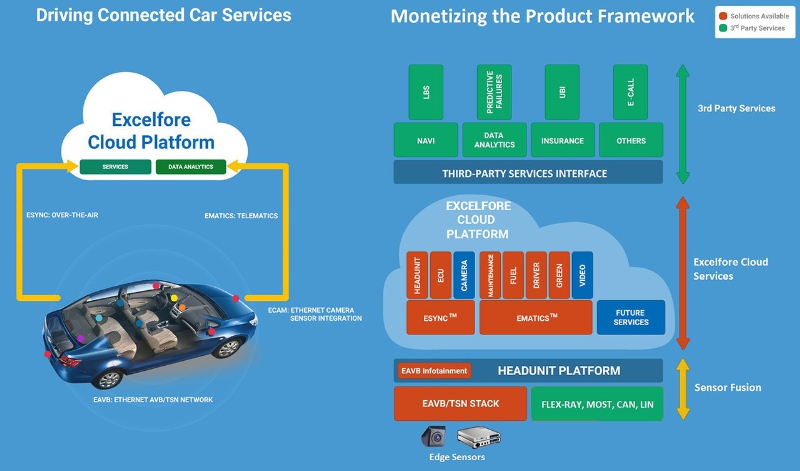
    Excelfore, a provider of cloud solutions for intelligent transportation, will launch its comprehensive suite of secure cloud and connectivity solutions at CES 2016, the Consumer Electronics Show that will be held in Las Vegas this week.

    Excelfore provides an end-to-end intelligent transportation framework to the automotive industry using a cloud solutions platform along with in-vehicle connectivity technologies.

    Excelfore will demonstrate solutions during CES 2016 in two locations: at the Excelfore Suite (MGM Grand, Las Vegas, Nevada (Jan. 6-8), and at GenIVI Showcase at Trump International (Jan. 6-7).

    ESync enables full vehicle over-the-air update of all vehicle components for the Headunit, multiple Electronic Control Units (ECU) and Telematics units. ESync updates the firmware components (FOTA), and software components (SOTA), including OS, kernel, kernel, drivers and applications.

    Excelfore provides a cloud-based solution for connected car services. (Image: Excelfore)
    Excelfore provides a cloud-based solution for connected car services. (Image: Excelfore)

    Excelfore leverages its patented machine-to-machine (M2M) distributed architecture to support cloud-to-vehicle connectivity and multiple in-vehicle networks including LIN, CAN, FlexRay and Ethernet. New advanced security features include enhanced Hash functions, multiple-levels of encryptions, content-delivery network (CDN) integration and end-to-end security from the cloud to the vehicle-components.

    “Connected cars are revolutionizing the automotive industry,” said Erich Geiger, former CEO of Harman/Becker Automotive Systems. “Excelfore’s EMatics and ESync platform with their advanced security and scalability will help accelerate adoption of innovative solutions for the automotive industry.”

    “By continuing to deliver to the automotive industry over the last several years, our cloud platform has architecture has evolved into a sophisticated offering with advanced security and scalability,” said Shrinath Acharya, CEO of Excelfore. “Within our product framework, we also offer data analytics and monetization by integrating with third-party services. Our platform enables fast and cost-effective deployment solutions for OEMs and Tier-1s.”

    The Excelfore team has delivered OEM programs (US, European, and Japanese Tier-1s and OEMs) and aftermarket automotive solutions to millions of vehicles.

    Highlights of ESync

    • Tailored for automotive headunit and electronic control units (ECUs)
    • Updates headunits, ECUs, telematics units (TU), and IoT edge devices, including cameras
    • Updates using any communication link (over the air, other networks)
    • Ease of implementation of the cloud platform for SOTA/FOTA deployment
    • Key features of the OTA updater
    • Full campaign management capability
    • Secure administration
    • Creation and delivery of packages for faster transmission and updates
    • Complete, differential and incremental software updates
    • Patented adaptive compression and M2M technology

    Highlights of EMatics

    Fleet Monitoring: Access a fleet from anywhere in the world at anytime. Quickly access vehicle information including location, driver, fuel and battery voltage. Monitor vehicles closely when needed using high frequency tracking.

    Automated Service Scheduling: Automatically get timely reminders on upcoming services, and schedule vehicle servicing by notifying preferred vendors.

    Fuel Management: Get detailed fuel data for an entire fleet including usage, consumption and mileage trends.

    Driver Rating: See who the most fuel-efficient drivers are. Get insights on how to improve driving behavior to reduce fuel usage and costs.

    Vehicle Travel History: Get detailed trip information including distance, duration, idling time along with date and time of trips. Easily differentiate personal versus business trips and automate reporting.

    Vehicle Safety: Set geo-boundaries and curfew periods. Get notified instantly when any vehicle violates curfews.


  • Antenova’s latest modules add GNSS to consumer devices and wearables

    Antenova Ltd., manufacturer of antennas and RF antenna modules for machine-to-machine (M2M) and the Internet of Things, has released two new modules for GPS and GNSS. Both provide an easy drop-in receiver solution — a way to add a location capability to very small consumer devices.

    The two modules are similar, both measuring 9.0 x 9.0 x 1.8 millimeters, with low current consumption, making them suitable for smaller portable devices such as smartwatches, navigation devices, OBD II modules, asset tracking, personal safety, sports cameras and equipment. They are based on a MediaTek processor.

    The M10578-A2 module operates with GPS, with a 1-5 Hz update rate, and the M10578-A3 operates with GPS, GLONASS, BeiDou and Galileo with an update rate of 1-10 Hz.

    Antenova has added two features to enhance performance of the modules. An internal self-generated orbit prediction uses two GNSS systems simultaneously to give a faster time to fix, and a second high-quality low noise amplifier (LNA) boosts low-powered satellite signals.

    The new M10578 modules are the latest in Antenova’s Radionova series of fully optimized RF modules for wireless M2M and embedded devices. Both modules are pin compatible, offering easy integration and upgrade from GPS to GNSS; for the antenna function, Antenova offers the small Sinica SR4G008 GNSS antenna.

    The new modules are built on high-grade FR4 substrates with a high density, multi-layered design that places the critical RF functions in the best position for location finding and performance.

    The M10578-A2 and M10578-A3 are available to order now.

  • PCTEL launches new member of GNSS antenna portfolio

    PCTEL SkyCompass Dual MIMO LTE AntennaPCTEL Inc. has launched a new antenna for high-speed rail, fleet and other transportation modes. The new SkyCompass Dual multiple input, multiple output (MIMO) Long Term Evolution (LTE) antenna is designed for high data-rate applications such as direct video feeds and broadband connectivity for commuters.

    The SkyCompass series comprises six new configurable antenna platforms, including single-band and multiband GNSS options that address the majority of rail and fleet management installation needs. The antenna features new ultra-ruggedized design and housing, outstanding electrical efficiency performance, high isolation between elements and pattern consistency.

    In addition, as wireless routers adopt MIMO, the antenna’s inherent MIMO capabilities protect a network’s investment in cellular and — more specifically — LTE installations.

    “MIMO and efficiency with optimized patterns enable high throughput in performance critical mobile applications for public safety, fleet and rail markets,” said Rishi Bharadwaj, vice president and general manager of PCTEL’s Connected Solutions. “PCTEL’s innovations continue to deliver high performance antennas in robust, easy-to-install housings.”

    The series is currently available to select OEM customers and will be generally available at the end of January 2016.