The growth of precision farming market is expected to be remarkable, and is estimated to reach $3.7 billion by 2018, at an estimated CAGR of 13.36% to 2018, according to a report by ReportsnReports. The global population is expected to rise up to nearly 7.5 billion by the year 2020, and the ability to manage and tackle the ever-increasing demand for food will in all likelihood continue, the report says.
Climate Change. Global warming continues to be an influential deciding factor in determining agriculture productivity, as well as soil properties and sustainability of natural resources. The effect of climate change on agriculture is related to variability in local climates rather than global climate patterns. All these concerns marked the way for the entry of the new world of agriculture management practices, the report says. Precision farming can significantly reduce the amount of nutrient and other crop inputs used while boosting yields. Farmers, thus, obtain a return on their investment by saving on phytosanitory and fertilizer costs. The second large-scale benefit of targeting inputs in spatial, temporal and qualitative terms reduce concerns of environmental impacts, the report says.
The major drivers for this market are augmented yield and profitability, which are the major contributing factors for farmers to go for precision farming; other drivers like energy and cost saving and government assistance have also been contributing to the market growth. Major restraints such as high initial investments, and lack of awareness and their impact analysis, are also covered under this study. North America leads the market share for precision farming as this region has the maximum adoption. The Asia-Pacific region (APAC) is the emerging market for precision framing and has been enjoying the highest growth rate among all the geographic regions. It is believed that the APAC market will grow at a CAGR of 25.16% from 2013 to 2018.
The report covers all the technologies, components, and applications of precision farming; it provides a detailed analysis of the current market scenario and estimation for the next five years. Major applications like field mapping and yield monitoring are driving the market. Moreover, the market is driven by some of the most important technologies like GPS and variable rate technologies. This market is already progressing well in developed countries, and it is also expected to grow well in developing nations as a result of their ever-growing food demands.
Companies like Ag Business & Crop Inc., Ag Leader Technology, Ag-Nav Inc., Agco Corporation, Agjunction Inc., Agri Con Gmbh, American Sensor Technologies Inc., Autofarm, Automata Inc., Deere & Company, Dickey-John Corporation, Echelon Ag Inc., Jain Irrigation Systems Ltd., Omnistar, Planting Inc., Precisionagriculture.Com.Au, Raven Industries Inc., Soyl Precision Farming, Teejet Technologies, The Toro Company, Topcon Precision Agriculture & Trimble Navigation Limited are profiled in this research available for purchase.
This report profiles companies which are major players, and are active in this market. The report presents the ‘competitive landscape of the players’ that covers key growth strategies followed by all the major players.
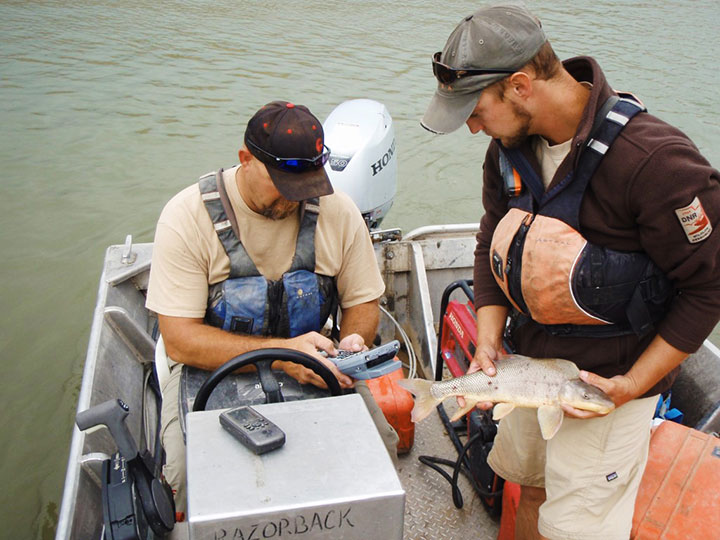
A Utah DWR field crew rides along in an electrofishing boat.
The Utah Division of Wildlife Resources (DWR) is using rugged Juniper Systems handhelds in an innovative way: to remove an invasive fish species from the Green River so that native fish can flourish.
A DWR field crew first used the Allegro MX handheld, loaded with custom fisheries software, to monitor native fish species and remove invasive fish in a 2013 project along the Green River, located near Dinosaur National Monument in Utah’s northeast corner.
The field crew’s work involved boat electrofishing, in which the researchers ride along in a boat with electrodes protruding into the water. The electrodes send out an electrical current, temporarily stunning the fish.The fish float to the surface, where they are netted and inspected.
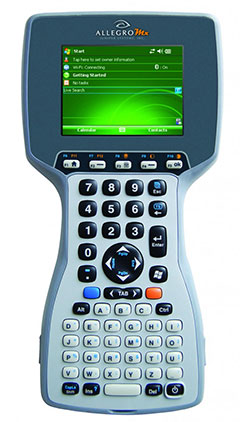
Invasive fish are collected and removed from the river. Invasive species can degrade fisheries habitats and harm the ecosystem. Right, the Allegro MX handheld.
Every five miles, the crew stopped the boat and collected data on the fish. In a single day on a 12-mile stretch of the Green River, the crew caught 2,800 fish.
When a native species was caught, the fish was given a passive integrated transponder tag. Data was collected about the fish, and then it was released. When an invasive species was netted, however, it was kept for later data collection, and then removed from the river. Invasive species — fish transplanted from another location — can outcompete native fish, degrade fisheries habitats, and harm the ecosystem.
With high-value native fish, the team took a GPS point and collected data on the species, length, weight, sex, ripeness, and more, explained Juniper Systems’ natural resources market manager Trevor Brown, who accompanied a crew.
Brown explained that understanding the location of native fish helps fisheries biologists determine the effectiveness of previous removal efforts: Are native fish prospering in areas where invasive species were previously removed? Location also helps biologists associate where native fish are caught with habitat characteristics, which helps guide more targeted invasive removal efforts.
Allegro MX handheld.
Because the Green River is a a major tributary of the Colorado River, the boat crews submit their data to a central database that supports a larger effort to understand the status and health of fisheries systems of the entire Colorado River watershed. The information is used to guide management and policy decisions, fish regulations, and fisheries research.
“Location-specific data can help biologists understand population and dispersal of both native and non-native fish at a macro level,” Brown said.
The Utah DWR made the switch to the Allegro MX after seeing its benefits, including its full alpha-numeric keyboard, which allowed for rapid, accurate data entry, as well as its extreme ruggedness, sunlight-readable display, integrated GPS, and RFID compatibility.
The team even found the Allegro MX, rated IP67, could float — an additional bonus when working along a river in a shallow craft.
Brown customized the fisheries software for the Utah DWR field crews. The crews previously collected data using pen and paper, and then manually entering it into Microsoft Excel, a time-consuming and error-prone process. The custom fisheries software, available through Juniper Systems, reflects the data that needs to be collected, with required data fields and streamlined data entry. Because many of the Utah DWR crews are made up of seasonal workers, Brown designed the fisheries app to be easy to learn and use.
Biologists use the Allegro MX to collect data on the fish, including this endangered razorback sucker.
Northern Pike. Besides boat electrofishing, the fisheries software can be used for other applications, including an invasive fish removal application called fyke netting. Shaped like a bag with several hoops forming its structure, a fyke net acts as a funnel to trap swimming fish. The Utah DWR uses fyke nets primarily in the spring to trap invasive northern pike while they are spawning. After setting the fyke nets, crews return to check them and collect data on the trapped pike.
The fisheries software is also used for tributary electrofishing data collection, in which wader-clad crews walk along tributaries with electrofishing backpacks, shocking the water. As in boat electrofishing, the crews collect the invasive fish for later data collection, and they tag and collect data on native fish before releasing them.
The team experienced significant improvement with the new data collection process. “[The fisheries software] greatly reduced the data-entry time to the point where it has already paid for itself,” said Joe Skorupski, Native Aquatics Biologist at the Utah DWR. “Last year with three people, we took over 200 hours to enter, verify, and manipulate data. This year, it took one person 20 hours and errors were nonexistent due to the software and new data-collection process. I could go on and on about all the great improvements due to the handheld and the software.”
Since 2013, the Utah DWR has expanded its use of the Allegro MX and software for parallel projects, such as native fish sampling on fast-moving sections (Flaming Gorge) of the Green River, where fewer invasive fish are present.
Where are bets on new technology being placed? Prominent venture capital (VC) firms are investing in companies with indoor location solutions. But with more than 50 companies to choose from and at least ten unique technologies, it is hard to judge who will make it into the winner’s circle. There is no early leader to put money on, and unlike other location-based markets like mapping, I expect this market to support many competitors and not be dominated by a few. The vertical markets that are ripe for indoor location have different needs for accuracy, cost and speed. Promising applications include retail, advertising, manufacturing, asset tracking, gaming, intelligence and public safety, but who knows what other applications will emerge. GPS has infiltrated everyday life in ways unimagined at its start.
With no obvious front-runner technology, many companies hedge their bets and offer multiple technology solutions. With infrastructure already installed throughout the great indoors, the easiest solution may appear to be Wi-Fi triangulation. While the cost may be attractive, the accuracy is not precise enough for many apps. Other solutions include Wi-Fi fingerprinting, Bluetooth, sensors and beacons.
Some companies are offering technologies outside of the mainstream. ByteLight provides a solution based on LED lights mounted in the ceiling that generate fast pulses that can’t be seen by people. A smartphone can detect the pulses and triangulate position by identifying different lights by pulse pattern. Indoor Atlas and Indoo.rs use sensors to detect Earth’s natural magnetic fields for positioning. Camera technology is being used by WhereLab and Omiimii. Object recognition software determines location.
The accuracy requirements of applications will drive the choice of technologies. Low accuracy is more than 11 meters, and medium accuracy is six to ten meters. High accuracy is one to five meters. High-accuracy solutions are generally more expensive and require more infrastructure.
Apple iBeacon Changes to Opt-Out
Anything that Apple does garners attention, including iBeacon for indoor location, which uses low-energy Bluetooth to communicate to phones and computers. Apple has some showcases, including a few Eagle and Safeway grocery stores using the iBeacon to send marketing messages to customers. The Peeble smartwatch added iBeacon support and reportedly can zero in on a lost phone. iBeacon technology at some of the Virgin Atlantic gates can trigger an app to automatically display a boarding pass as a traveler approaches. BeHere automates classroom attendance.
I often write about privacy issues, and so I wonder, where are the techno-privacy advocates challenging Apple on iBeacon? You would think that there would be a tangle of permissions required of users, including turning on the beacon and giving an app permission to locate the user and for receiving notifications. Apparently, Apple thought the permissions were unwieldy. Apple users had to opt-in to turn on iBeacon, but in March with the new iOS release, the default changed to opt-out.
Apple users may be unaware that an app using iBeacon doesn’t need to be open to interact with the phone. If the Safeway app is installed, the user will receive messages from the store, even when the app isn’t running and phone screen is locked. Even though iBeacons don’t track users or collect data from them, I find this functionality to be unsettling.
Advertising in Minority Report was very personal.
Stores are having trouble competing with online shopping and are looking for ways to interact with shoppers when they come through the door. That interaction might be loyalty points, greetings or personalized special offers. Only three percent of retailers currently have the ability to identify customers coming through their doors, according to a survey of top retailers by Boston Retail Partners. ABI Research predicts beacons will be installed at 30,000 locations worldwide by year’s end. If beacons alone can generate such widespread usage so quickly, it is easy to see why indoor positioning technology companies have been a magnet for VCs.
Do you remember the scene in the movie Minority Report when Tom Cruise enters a clothing store? As Cruise passes by advertisements, they address him by name. Indoor location can get creepy.
Proximity and indoor positioning will grow as technology gets better — and consumers value its benefits. Attendees at the recent Place conference in New York had the opportunity to hear from companies who advocated Bluetooth, Wi-Fi and even magnetic positioning technology. In addition, several advertising agencies and retailers attended, showing that the nascent proximity/indoor location niche could be a major market in the next few years.
NEW YORK — The potential for indoor positioning and proximity marketing is huge if even a fraction of overall retail sales are attributed to the information the technology gives to retailers, said panel members at the July 22 Place conference here.
The indoor opportunity is huge as studies have shown that 70 percent to 89 percent of consumers use smartphones in stores to compare prices and shop for coupons, said Greg Sterling, Opus Research senior analyst. “About $20 to $50 billion of purchases were influenced at point-of-sale in stores. $500 billion of retail sales came without any premeditated product selections,” he said. “Even if a small fraction shifts to mobile devices, that’s an enormous amount of money.”
Sterling said that despite consumers’ ambivalence to privacy issues, if they are guaranteed some sort of benefits to being tracked, they will opt-in. “72 percent said they don’t want tracking [without benefits]. That number goes up to 66.4 percent who say ‘yes’ if there are specific benefits — rewards and discounts,” he said. “It is about educating consumers [as to benefits of location-based advertising].”
Technology improvements and retailer awareness in the last two years have made such mobile advertising agencies as Joule interesting in location as a data point beyond geofencing, said Michael Lieberman, company co-president.
“I am biased as we are mobile agency, so for us, most of our clients are using location to identify buyers. Ideally, we see a device in multiple locations, we understand consumers’ behavior,” Lieberman said. “If I see you every morning at a Starbucks, you are a coffee drinker and I should target you that way. However, if you are trying to use location as a national campaign you will only get a percentage of accuracy — you are missing out on other information.”
Right now, retailers have little idea how and why a consumer makes a purchase, Lieberman said. “The [important] point is in [indoor location’s] measurement — what happens in the store environment. You walk in store, make a purchase, right now we have no idea what they did to buy a product,” he said. “We are losing that piece — and it is a big gap in thinking. Everything about consumer path in that store determines a purchase. What’s valuable is the in-store data that gives you the most actionable information.”
Location today is used for targeting, but not for the total consumer measurement that Facebook requires, said Doug Stotland, Facebook product marketing director. “IKEA recently ran a campaign in a local radius, they wanted to see who showed up in their parking lot,” Stotland said. “It’s really compelling when you look at the methodology — you want to see if people actually showed up at the store. The home run is how to tie it to what they actually buy.”
Stotland said Facebook uses location information for targeting, but basically users tell the company where they live and that’s it. “We can do better than that — there is definitely a big opportunity there. The great thing about Facebook is that I am always logged in — there is no value for targeting if I am not.”
In a case study session at Place, Korean telecom provider SK Telecom has been making inroads in indoor positioning markets for several years, said John Kim, SK Telecom senior business development manager. “While we are the number one mobile operator in Korea, like other companies, we were hitting saturation levels,” Kim said. “We found that location-based services for telecos are a key service, basing this on earlier tracking, navigation and security markets.”
SK Telecom ran indoor positioning tests at Seoul National University Hospital, which has 1,360 beds, making it hard to find patients. Kim said younger indoor positioning users liked the service and found it easy to use. “We also found that it was difficult for active marketing — what does a hospital use to promote it? Two-for-one x-rays?” Kim said. “The service was also difficult for remote maintenance and support.
Kim said that SK Telecom is installing the product as a test in a Seoul sports stadium and at the L’Oreal Madrid flagship store. “We are also partnering with [Herndon, Va.-based] APX to work in their Google Glass product to provide location information.”
Overall, the upside of indoor location is huge, said Don Dodge, Google developer advocate. “Imagine if you can look at phone to know exactly what stores your family members are in at the mall. At CES, you have no idea where 15 to 20 of your friends are,” he said. “If my wife gives me a list of groceries, I can find them in certain areas and know what price they are. First responders, fire departments, can find their way around in a burning building — and find a safe way out.”
Privacy: The Attack on Opt-In
In a privacy panel, members put a dark cloud over the ubiquitous answer by many companies that consumer opt-in alleviates all concerns for the location industry.
Amanda Koulousias, a Federal Trade Commission attorney, said Section Five of the FTC Act, which has been expanded to cover tracking users over a certain time, prohibits deceptive practices that are likely to mislead people acting reasonably.
Privacy seems to be a hot topic for reporters. Kate Kaye, a panel member who is a reporter with Advertising Age, said that security issues around beacons and leakages is a story. She also said that the Associated Press recently ran a story critical of the new Verizon rewards program. “The story typifies the balance a lot of marketers are trying to straddle — how much information can we gather, and how do we not [anger] consumers. Verizon Wireless prompts you to join their loyalty rewards program, but you have to opt-in to their location data program,” she said.
Privacy panel moderator Jules Polonetsky, Future of Privacy Forum executive director, said a way some companies get consumers to opt in to being tracked is just to say “download this app.”
The location industry’s privacy issues are not going away — and the path for resolution isn’t clear, said Greg Turetsky, principal engineer in Intel’s wireless communications group. “The privacy issue is so complex legally, economically and socially, that I expect it will not be resolved any time soon,” he said.
In other Place conference news:
Opus Research, the organizer of the conference, published a report on magnetic positioning, which has a unique footprint. The company contends that magnetic positioning, which can be complimented by other technologies, offers six-foot accuracy with 90 percent precision. In comparison, Bluetooth offers proximity, but not the blue dot solution magnetic positioning currently has. In addition, Opus believes that Wi-Fi positioning, which has 40-foot accuracy, needs too much support and is expensive.
InvenSense, Inc., a provider of intelligent sensor solutions, has signed a definitive agreement to acquire Trusted Positioning, Inc. (TPI), a privately held indoor/outdoor tracking company with the vision to provide “Positioning Everywhere.” InvenSense is also acquiring context analysis software company Movea.
TPI’s location tracking technology improves accuracy both indoors and outside by augmenting GNSS and Wi-Fi based location infrastructure. Using inertial sensors such as accelerometers, gyroscopes, magnetometers, and pressure sensors in mobile and wearable devices, TPI’s software platform provides continuous and accurate positioning and also solves the difficult problem of alignment between the user and the mobile device. The TPI platform provides complete inertial navigation software solutions for a variety of industries including smartphones, tablets, wearables, in-vehicle navigation, personnel tracking, and machine guidance and control.
“InvenSense shares our passion for ‘positioning everywhere,’ and they have been a strong supporter of the Trusted Positioning team, technology and vision,” said Chris Goodall, Trusted Positioning’s chief executive officer. “We are pleased to be joining the InvenSense family with the goal of making indoor/outdoor positioning ubiquitous. Together with InvenSense we will now have the required resources and investment to mainstream this technology.”
InvenSense has also signed a definitive agreement to acquire Movea, a privately held company that provides software for ultra-low power location, activity tracking, and context sensing. Movea’s products, technology, and IP cover a broad range of signal-processing and data-fusion technology applied to consumer mobile (smartphones and tablets), TV interaction, and wearable sports and fitness applications.
Movea is dedicated to context analysis using both motion and audio sensors to determine, for example, a person’s state/activity, their energy expenditure, their location, and an athlete’s speed and cadence. Movea’s algorithm and software framework expertise is expected to further scale InvenSense’s leadership in motion software and accelerate InvenSense’s “AlwaysOn” low-power solutions for mobile and the Internet of Things.
“With the addition of Movea and TPI, InvenSense achieves a significant milestone as it transitions to a leading provider of intelligent sensor System on Chips (SoC) for the fast growing mobile market. ‘AlwaysOn’ location and activity tracking are essential to enabling contextually aware products and services,” said Behrooz Abdi, president and chief executive officer, InvenSense. “The tight integration of our low-power, high performance, motion and sound sensors, along with TPI’s advanced location tracking software and Movea’s data fusion algorithms, will position us to deliver on this ‘AlwaysOn’ promise.”
In connection with the acquisition of both companies, InvenSense expects to pay approximately $81 million, net of cash assumed, to acquire all of the outstanding shares of capital stock and other equity rights of Movea and Trusted Positioning, Inc. The purchase price will be paid with $6M of InvenSense common stock and the remainder in cash, except that portion attributable to unvested employee stock options will be paid in stock options exercisable for shares of InvenSense’s common stock.
A portion of the cash consideration payable to the stockholders will be placed into escrow pursuant to the terms of the acquisition agreement. The estimated financial impact of the acquisitions upon the future operating results of InvenSense, which is not expected to be significant, will be discussed during the next regularly scheduled quarterly investors analyst conference call planned for July 29.
The boards of directors of InvenSense and the two companies have approved the mergers. The transactions are expected to close by the end of InvenSense’s second quarter, September 30, and remains subject to the satisfaction of regulatory requirements and other customary closing conditions.
NovAtel, Inc., is offering a promotion for existing customers, on the company’s recently launched NovAtel CORRECT with TerraStar PPP subscription service. The promotion will run until September 30, 2014.
Promotion Details
Customers using NovAtel legacy equipment (OEMV generation receivers or earlier) or NovAtel’s current OEM6 technology, qualify for the following offers:
Trade in legacy NovAtel hardware for a FlexPak6, antenna and one-year TerraStar subscription for $4995.
Buy a minimum one-year TerraStar subscription for any OEM6 receiver and get a NovAtel CORRECT PPP receiver firmware upgrade for free.
Customers who want to learn more or take advantage of this promotion can call 1-800-668-2835 or email: [email protected].
The European Business Aviation Association (EBAA) and the European GNSS Agency (GSA) have signed a Memorandum of Understanding to promote the wide use of EGNOS — precision-based navigation (PBN) — at regional airports in Europe, following discussions at the European Space Solutions Conference in Prague in June.
Maintaining all-weather access at secondary and tertiary airports is becoming more and more important for the air transport community with ever-increasing difficulties when it comes to access at major hubs, according to the EBAA. Business aviation is now in a position to optimize access at more of these regional airports which are often characterized by limited investment or technical innovation on the ground. By improving penetration of EGNOS, the entire air transport value chain will be enhanced, the EBAA said.
“The aviation community stands to benefit greatly from EGNOS because it means safe access to small- and medium-sized airports without the need for expensive ground equipment,” said Fabio Gamba, EBAA CEO. “Approach procedures have been published for around 100 airports, which is still a far cry from where we should be. A move towards this technology is well overdue, and this is evident if you compare Europe to the U.S. We are proud to have signed this MoU with GSA and together we are committed to having many more procedures published in the near future.”
“The business aviation segment is a pioneer in the use of EGNOS and most new business aircraft are already equipped. This means that operators can start using published LPV procedures immediately, without making any upgrades, just by obtaining the operational approval from the authority where the aircraft is registered,” said Carlo des Dorides, GSA executive director.
“EGNOS increases accessibility and enables safer approaches to underserved airports also in poor weather conditions,” said Gian Gherardo Calini, GSA head of market development. “We are committed to working with business operators to enable opening new routes that best serve their specific needs.”
Swiss u-blox, a provider of cellular, short-range radio and GPS/GNSS semiconductor components, has launched a new online shop in the U.S. and Canada, with expanded features and reduced prices.
u-blox’ Online Shop is a fast and secure way to obtain module samples and pre-production quantities of the company’s comprehensive line of cellular modem and GPS/GNSS positioning modules, u-blox said. Support tools such as evaluation kits and wireless module adapters can also be ordered.
All module products and support tools are typically shipped within 24 hours directly from the u-blox U.S.-based warehouse in Reston, Virginia, near the Washington Dulles International Airport. Technical support for all products are provided from one of u-blox America’s three technical support centers in Virginia, Minnesota, and California.
For convenience and improved production planning, customers can also request a specific delivery date at no extra cost. Customers with an established line of credit with u-blox America can order against invoice. Credit card and pre-payment options are available.
Trimble has announced that Mesa County in Colorado has received a Certificate of Authorization (COA) that will allow the Public Works Department to operate its Trimble UX5 Aerial Imaging Solution throughout the county. A COA is an authorization from the Federal Aviation Administration (FAA) allowing the operation of an unmanned aircraft in a designated area and not for commercial use.
The authorization is currently required to legally operate a public unmanned aircraft in the U.S. The COA was granted to the Mesa County Sheriff’s Office, who manages the county’s unmanned aircraft system (UAS) operations and has been flying systems since 2008.
Mesa County’s Public Works chose the Trimble UX5 for a variety of applications including determining volumes and compaction of its county landfill, surveying and monitoring capital improvement projects such as roads and bridges, as well as assist the Mesa County Sheriff’s Office or other county departments, as needed. “With the Trimble UX5, Mesa County is one of the first to benefit from a cutting-edge solution that can change how surveyor’s collect data,” said Frank Kochevar, GPS/Survey Supervisor for Mesa County Public Works. The Trimble UX5 was used by Mesa County Public Works to gather aerial images of the landslide that occurred in Western Colorado in May of this year.
“Trimble’s goal is to allow geospatial professionals to quickly and efficiently capture and convert existing field conditions into actionable information for their customers. We are pleased that Mesa County will now be able to apply the Trimble UX5 Aerial Imaging Solution to meet their public works department needs,” said Phil Sawarynski, business area director for Trimble’s Geospatial Imaging solutions.
Mesa County has received multiple COAs since 2008 from the FAA for public safety purposes. This is the first COA issued to the Mesa County Sheriff’s Office that will be used specifically for aerial mapping on surveying and engineering projects, in partnership with the Public Works Department. According to Ben Miller, UAS Program Director for the Mesa County Sherriff’s Office and coordinator for all their COA’s, “In collaboration with Trimble, Mesa County, Colorado continues to demonstrate that small unmanned aircraft are not just a tool to save lives, but a community asset that can help save its citizens tens of thousands of tax payer dollars.”
The Trimble UX5 is an unmanned fixed-wing aircraft targeted at the surveying, oil & gas, mining, environmental and agriculture industries. The system autonomously captures a series of high-resolution images during flight, which is typically up to 50 minutes covering as much as 2.3 square kilometers (approximately 1 square mile) when flying 120 meters (approximately 400 feet) above the ground. Using Trimble Business Center Office software, images are used to easily generate 2D and 3D deliverables such as orthomosaic images, three-dimensional point clouds and contour maps. The Trimble UX5 enables the collection of large amounts of data, often faster than traditional surveying technologies.
If you’d like to experience an industry first, I think, I’ll be participating in a live webinar being held during the Esri conference at the San Diego Convention Center on Thursday, July 17, at 10:00 a.m. U.S. Pacific time. I’ll have some planned guests, and perhaps drop-in guests, discussing the complexities of integrating mobile devices with disparate operating systems (Android, iOS, Windows, Windows Mobile, Windows Phone) into your GIS workflow. If you’re at the conference and would like to see us in action, stop by the podcast booth near Room 27 of the convention center. If you’d like to tune in live via the Internet, please sign up by clicking here.
This week is the mecca of GIS, at least in the U.S.; the Esri International User Conference (UC) in San Diego, California, and I’m swimming in GIS up to my ears.
There’s always a myriad of Esri-centric meetings and events during the weekend prior to the UC, and this year was no exception. During the weekend prior, I attended the AEC Summit, formerly named the Survey Summit. The AEC Summit bills itself as the “Forum for High-Accuracy” GIS.
The dominant technology discussed at the AEC Summit was UAS (aka UAVs, Drones). There was lots of discussion about the forthcoming Federal Aviation Administration rules (due September 30, 2015) and “potential” UAS applications. However, one presentation gave the audience a practical look at the value of a UAS. Burns & McDonnell, in association with the University of Connecticut, reported their company worked nine months to gain approval (Certificate of Authorization) from the Federal Aviation Administration (FAA) to conduct a transmission line inspection using a rotary-wing aircraft.
Steven Santovasi, GISP at Burns & McDonnell, gave a summary presentation of their experience with UAS technology. He started with this slide that frames the UAS device market, divided into three device segments: fixed-wing, rotary craft, and a hybrid version with the hover features of a rotary UAS but the speed and stability performance of a fixed-wing UAS.
Types of UAS used for Mapping
Santovasi reported that using the rotary UAS allowed his company to perform an inspection that he thought couldn’t be performed by a manned aircraft. He said that the UAS was able to get within five feet of the structure and take detailed, high-resolution photos. In fact, he said his team was able to identify a failing bolt that may have caused a significant power outage. He reported that a representative of the transmission line owner said that the discovery of the failing bolt “paid for the project.” The transmission line is strung on a 250-foot-tall tower.
Following is a photo of the bolt (and accompanying structure) taken by the rotary craft UAS. There’s actually a much higher-resolution an close-up photo of the bolt I’ll try to obtain and update in this article.
Failing Bolt Identified by High-Resolution Photo Captured from a UAS at Close Range
There was some discussion in the audience that the FAA may not make the September 30, 2015, deadline, or that it will issue a partial set of rules. Last month, a Washington Post article reported the same. If that happens, it’s going to be really interesting. It seems like with each day that goes by, the heat gets turned up a little more for the FAA to act. More frequently, perhaps fueled by the FAA vs. Pirker case where the FAA was slapped by a NTSB judge for not having enforceable rules to punish “violators,” there are media reports that individuals and companies are using UASs for commercial purposes regardless of the FAA’s position. For example,
However, the FAA is not giving up in its attempt to assert its rules despite the ruling by the NTSB judge. On June 23, the FAA issued a press release offering “guidance to Model Aircraft Operators” in an attempt to squelch commercial UAS operators from believing they can fly under modeler rules.
User Conference Plenary
Every year, I look forward to Esri President Jack Dangermond’s keynote at the plenary. I love that Esri is still a privately held corporation, having only to answer to themselves. They don’t have to worry about Wall Street quarterly reports as publicly-traded companies do, so they can choose to change strategy or take on projects that may not appeal to public shareholders. Given that, you really never know what Mr. Dangermond might decide to do, or say, so it’s always interesting to listen to his thoughts on Monday morning.
Of course, there were tons of ideas shared, some new products introduced, and some impressive fourth-graders speaking to a crowd the size that 99.5% of us will never have the opportunity to address. But, after listening to the plenary, watching Twitter, reading blogs and news releases, etc., I can boil it down to one word where this technology is headed…real-time (or is that two words hyphenated? :-) ). I want current information, and I want information as events occur. That is the definition of real-time. I was struck by the City of Rancho Cucamonga’s presentation, which won Esri’s President’s Award. The city has deployed a GIS that allows it to “see” events as they happen, whether it be a traffic accident, fire or other public emergency. Of course, you can easily extrapolate that to include public works nuisances like potholes, traffic signal outages, and street closures, then further extrapolate to society where you have something like Waze, a mobile phone app that allows millions of drivers to share real-time information about traffic conditions.
City of Rancho Cucamonga Executive Dashboard for Monitoring Municipal Gov’t Activity
In geographic regions where there is solid wireless connectivity, there’s no reason we can’t or shouldn’t have access to real-time information on a broad scale, in a very accessible manner. And of course, geographic location is a super-important part of that real-time information. Accurate, real-time information allows us to make accurate, real-time decisions.
The real-time theme bubbles and oozes from GIS, and GIS is begging to be a real-time technology. This is largely driven by mobile devices and sensors. It’s not like the real-time “transaction,” as Mr. Dangermond has coined in past Esri UC conferences, is a new concept. That concept hasn’t changed. What has changed is the proliferation of mobile devices and sensors that enable us to carry the power of GIS in our pockets. They are the technology enablers of real-time GIS, and the trend is crystal clear. It is what people want, and they will get it because GIS, mobile devices and sensor technologies are converging, and to a price point that is very affordable. This year, Mr. Dangermond mentioned the Internet of Things during the general plenary. This is exactly what I’m referring to. Devices and sensors will each have an IP address, or some method of making themselves known on a network. Some people call this Big Data. Regardless, we’re seeing this transformation beginning.
I saw a great example of the transition from labor-intensive transactions to real-time transactions at a Esri UC presentation this week. It’s a utility company that was using a data check-in/check-out workflow to collect high-precision GPS data for its infrastructure (e.g., valves, meters, etc.). The company was spending a significant amount of time dealing with the data check-in/check-out procedure and data post-processing. Some downsides of the data check-in/check-out workflow listed were:
many opportunities for human or technical error
clunky and arduous QA/QC process
slow and expensive workflow that is difficult to scale
software maintenance cost and overhead
In the past six months, the company transitioned to a real-time data collection process that posts high-precision GPS transactions in real-time within SDE in ArcMap. Some of the benefits listed were:
GPS points update in real-time within SDE
laterals and fittings draw and populate automatically
support for a wider variety of software data collection tools like ArcGIS Mobile, ArcPad (either SDE or ArcGIS Online) or Collector
simple design for tablet use (either online or offline)
software cost reduction (unlimited seats of ArcGIS Mobile w/Server, Collector free through ArcGIS Online)
Perhaps the words that best describe the company’s transition to a real-time GIS transaction workflow were contained in the summary page of the presentation.
Time: Our Most Precious Resource
‘ Nuf said.
Plenary Opening Keynote by Mr. Dangermond
If you want to take a look Mr. Dangermond’s opening keynote, including the presentation by the City of Rancho Cucamonga, following is a 22-minute video that’s worth a look.
GPS World is at the 2014 Esri User Conference, being held July 14-18 in San Diego. Check out our slideshow for key photos from the first day of the conference. Follow tweets from GPS World and Geospatial Solutions for live updates from the conference.
Welcome to the 2014 Esri User Conference (UC) Photo Slideshow.
SmarterBetterCities creates 3D scenarios using its 3D Cities Libraries, functional in Esri CityEngine and ArcGIS Desktop.
Conference exhibitors at the Esri UC take a seat.
The 2014 Esri UC is being held July 14-18 in San Diego.
Motorola is focusing on its PremireOne public safety applications suite with realtime data.
A member of NASA Langley’s GIS Team mans the booth on the show floor.
Topcon’s Sirius Pro is designed for high accuracy mapping using GNSS RTK.
GPS World will be producing a live webinar in this booth outside of room 27 at 1 p.m. EDT on Thursday.
Leica’s Pegasus:Two is a mobile mapping solution integrates hardware platforms including cameras and lidar profilers.
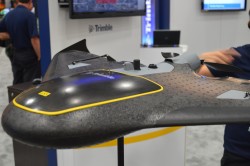
The Trimble UX5 focuses on image quality and photogrammetric accuracy.
Topcon Positioning Group announces the integration of the Android platform to the eGIS field software system.
A view of the Esri UC from the outside looking in.
Cityworks’ booth at the Esri UC.
TomTom is at the Esri UC for the 22nd year.
Cedar Tree Technologies is a recently launched rugged handheld company founded by Juniper Systems.
Riegl’s VUX-1 laser scanner.
Exhibitors checking out the National Geospatial-Intelligence Agency’s Latin American physical and political geography map.
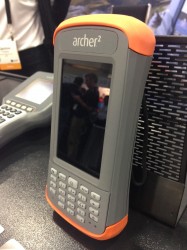
Juniper Systems is featuring its Archer 2 at the Esri UC.
CompassCom will offer Esri User Conference attendees a sneak peek at advanced asset tracking capabilities in the upcoming version of its CompassTrac software powered by Esri ArcGIS technology. Scheduled for release in late summer, CompassTrac 6 provides Esri users with custom digitizing tools for geofencing applications and map optimization for any electronic device.
CompassCom will demonstrate the new CompassTrac 6 capabilities in booth #2307 at the Esri User Conference, being held July 14-18 in San Diego.
“The newest version of CompassTrac will enable Esri GIS users to keep track of their vehicles and high-value assets with greater ease than ever before whether they are in the office or out in the field,” said CompassCom CEO W. Brant Howard. “On-the-fly geofence alerts increase fleet efficiency and improve crew safety.”
CompassTrac is the software tool that enables Esri ArcGIS users to view the locations and statuses of vehicles and other high-value assets on their GIS map in real time. Leveraging existing Esri architecture and GIS data files, CompassTrac locates addresses and displays vehicle positions, speeds, and heading on the fly using selected ArcGIS data layers as the map background, including satellite and aerial imagery, the company said.
Over the past 16 years, CompassTrac has provided field service management services for thousands of vehicles operated by organizations involved in public safety, public works, utilities, road maintenance, delivery and transportation.
The premier upgrade to CompassTrac version 6 is a set of digitizing tools that allows the user to draw a geofence polygon around any feature or area — a street, neighborhood or town — on the GIS map. If any vehicle or asset being tracked by the system crosses the geofence boundary, CompassTrac will automatically send a text or email alert to select users and highlight the vehicle in question on the map display. These geofence alerts occur instantly and on the fly in real time, providing enhanced tracking of mobile resources to help operators manage their mobile work force.
Now with version 6, CompassTrac is also hardware agnostic. The software will automatically scale, or optimize, its map view to fit on the screens of desktop computers, laptops, tablets and smartphones, giving Esri users the ability to track assets from any location where they have Internet.
Visitors to CompassCom’s booth #2307 at the Esri User Conference will also view demonstrations of the new CompassLDE Connector, which provides plug-and-play capabilities to link AVL and mobile resource management tracking to the Esri ArcGIS GeoEvent Processor.