Category: Applications

  • Ford Studies Space Robots for Connected Vehicle Communications

    Ford is studying communications between space robots and Earth to enhance future applications of the connected-car communications protocol. The research furthers the company’s commitment to the development of connected vehicle communications to help reduce traffic congestion and aid in the advancement of emergency vehicle communication methods, Ford said.

    Ford has launched a three-year research partnership with the telematics department of St. Petersburg Polytechnic University in Russia in its association with that country’s space industry. The goal is to analyze space-based robotic communications systems for vehicle mesh networks to aid in mobility solutions.

    The development of connected vehicle communications has the potential to reduce traffic accidents and ease congestion by enabling vehicles to communicate with each other, and to communicate with buildings, traffic lights, the cloud and other systems to deliver a message or detect and respond to imminent collision warnings.


    Webinar: The Connected Vehicle

    All major international car-makers are installing telematics units, sending a signal that wireless information and connectivity is here to stay in the vehicle, and location will be a big part of the growth. To learn more about the rapid changes in the connected vehicle field, tune in to our September 19 webinar, hosted by Wireless LBS editor Janice Partyka. Registration is free.


    “Ford has been committed to the research and development of connected vehicle communications for more than a decade,” said Paul Mascarenas, chief technical officer and vice president, Ford research and innovation. “Our participation in this research can aid in the development of next-generation Ford driver-assist technologies. These technologies will globally benefit Ford customers, other road users and the environment.”

    Emergency Situations. One promising development from Ford’s research project with St. Petersburg Polytechnic University is the advancement in emergency vehicle communication methods. Ford is analyzing how emergency messages should be sent to ensure delivery if network failures were to occur, identifying the systems and methods that provide redundancy in case of primary delivery failure.

    For example, if an accident were to cause vehicle-to-cloud communications (V2C) to be broken, a vehicle may still have access to a vehicle-to-vehicle (V2V) communications network. An emergency signal message could potentially be sent through V2V to a vehicle nearby, and then between vehicles and infrastructures until it reached EMS.

    “The research of fallback options and robust message networks is important,” said Oleg Gusikhin, technical leader in systems analytics for Ford. “If one network is down, alternatives need to be identified and strengthened to reliably propagate messages between networks.”

    Space Telematics. Telematics — the long-distance transmission of digital information — developed for use on space stations provide excellent potential for improving the reliability of future vehicle-to-cloud, vehicle-to-infrastructure, vehicle-to-vehicle and other forms of communication (V2X). The communications blend multiple networking technologies including dedicated short-range communication (DSRC), cellular LTE wireless broadband and mesh networking to ensure robust and reliable connectivity for optimum signal strength for critical messages.

    Using the knowledge accrued from analyzing the space robots, Ford engineers could then develop an algorithm that is integrated into the V2X system resulting in a message that would route through the appropriate network depending on the level of its importance. An emergency message, for example, may be communicated through the faster mesh network, whereas an entertainment-related message would route through a vehicle-to-infrastructure application, an embedded device or a brought-in device network.

    “We are analyzing the data to research which networks are the most robust and reliable for certain types of messages, as well as fallback options if networks were to fail in a particular scenario,” said Oleg Gusikhin, technical leader in systems analytics for Ford. “In a crash, for example, a vehicle could have the option to communicate an emergency though a DSRC, LTE or a mesh network based on the type of signal, speed and robustness required to reach emergency responders as quickly as possible.”

    The specific space robots leveraged for Ford’s telematics analysis include the JUSTIN Humanoid, EUROBOT Ground Prototype and NASA Robonaut R2.

    Here is a video showing how Ford is studying space robot communications.

    Findings from this work could potentially enhance Ford’s wireless communication technologies and Blueprint for Mobility. Ford’s Blueprint for Mobility details the company’s vision on how to tackle the issues of mobility in an increasingly crowded and urbanized planet between now and 2025.

  • USGS Releases Updated U.S. Topo Maps of Alaska

    AK_Fairbanks

    The U.S. Geological Survey (USGS) announced that more than 400 new topographic maps are now available for the state of Alaska. The new maps are part of the U.S. Geological Survey Alaska Mapping Initiative, to update foundational data for the state and to replace the existing maps that are about 50 years old.

    “These new digital maps of Alaska are elevating our visual record of the surface of the state to 21st century levels,” said Anne Castle, Assistant Secretary of the Interior for Water and Science.  “The associatedadvances in human safety, navigation, and natural resource management cannot be overestimated. The productive partnership between the State government and the USGS is facilitating acquisition of the necessary data to complete digital mapping of Alaska, which is a critical chapter in the history of our geographical knowledge of the North American continent.”

    The first 400-plus new US Topo maps for Alaska are now accessible and are the beginning of a multi-year project, ultimately leading to more than 11,000 new maps for the entire state. The goal of the AMI is the production of a complete series of digital topographical maps at a scale of 1:25,000 to replace the 1:63,360-scale maps produced about 50 years ago. The maps will be published in digital PDF format (GeoPDF) and are available for free download and manipulation on a computer.

    These new maps include several layers, with an option for the user to turn them on or off. Major updated features include:

    • Satellite image layers which allows a recent view of the earth’s surface.
    • Contours and shaded relief layers showing the lay of the land derived from newly acquired 5-meter radar elevation data.
    • Surface water features from the USGS National Hydrography Dataset, which are updated by local stewards and USGS.
    • Glaciers updated using Randolph Glacier Inventory data.
    • Boundaries integrated from multiple sources, including Census and major Federal landholders.
    • The Public Land Survey System layer from the Bureau of Land Management.
    • Roads from a commercial vendor under a USGS contract.
    • Railroads and the Trans-Alaska oil pipeline data from local sources.
    • Important buildings including police stations, schools, and hospitals.
    • Airports, heliports and seaplane landing strips compiled by USGS from multiple sources.
    • Feature names from the USGS-maintained Geographic Names Information System.

    To ensure that the maps meet current accuracy specifications and standards, the maps will be made using newly acquired elevation and imagery data from multiple state, federal and commercial sources. The map-making process will be largely automated using software specially adapted by the USGS to create approximately 11,275 digital map quadrangles, covering the entire area of the state.

    Mapping in Alaska did not keep pace with records for the rest of the nation as a result of difficult terrain, remote locations, and vast distances. Modern mapping information does not exist over the majority of land in the state. Prior to this effort, topographical maps for much of Alaska were about 50 years out of date and not produced to current standards, which rely largely on high resolution digital imagery and elevation data. As a consequence, essential public services have suffered, among them transportation planning and safety, urban and regional planning, economic development, natural resource management, conservation and scientific research.

    This new generation of digital topographic maps will continue the rich and valuable USGS cartographic history, and serve the Nation by providing reliable scientific information to describe and understand the Earth; minimize loss of life and property from natural disasters; manage water, biological, energy, and mineral resources; and enhance and protect quality of life.

    For more information and download, go to: http://nationalmap.gov/alaska/

  • Garmin Updates Astro GPS Dog Tracking System with the DC 50 Collar


    Garmin International Inc. now offers the DC 50 – a new and improved GPS dog tracking collar that’s even more robust and reliable than previous models.

    “From more reliable satellite reception to a more rugged design, the new DC 50 gives sporting dog owners what they’ve been asking for,” said Dan Bartel, Garmin’s vice president of worldwide sales. “The new DC 50 has the features that will bring the benefits of GPS tracking to first-time users, and will convince existing Astro customers to upgrade.”

    The DC 50’s main housing sits below the dog’s neck while a low-profile, high-sensitivity GPS antenna is now positioned atop the dog’s neck, providing a clearer view of satellites.  In addition to tracking GPS satellites, the DC 50 can also utilize the GLONASS system. When using GLONASS satellites, acquisition time is (on average) approximately 20 percent faster than using GPS.  And when using both GPS and GLONASS together, the receiver has the ability to lock on to 24 more satellites than when using GPS alone. In practical terms, that means sporting dog owners will spend less time waiting for the collar to acquire satellites before the hunt, and the collar will better maintain its location even in heavy cover and deep canyons during the hunt.

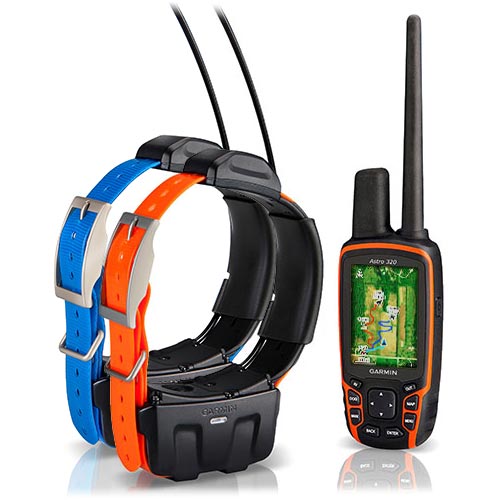
    The Garmin Astro 320 GPS tracking device with two DC-50 collars.
    The Garmin Astro 320 GPS tracking device
    with two DC-50 collars.

    The newly redesigned 22.5-inch long VHF antenna is made of braided steel that’s built to take any punishment that hard-charging dogs can deliver.  Hunters can track their dogs up to nine miles in flat, unobstructed ground as often as every five seconds.  A shorter 18.5-inch antenna is also included.

    The battery life of the DC 50 has improved over previous generations, too.  At a five second update rate, the DC 50 will get approximately 26 hours of battery life when fully charged.  By slowing the update rate down to once every two minutes, the DC 50 collar can get up to 54 hours of use.   As a safety feature, the DC 50 also has a selectable Dog Rescue mode, which automatically switches the DC 50 to a two minute update rate when the battery is less than 25 percent charged – making it easier to recover a lost dog.

    For houndsmen, the DC 50 also features built-in Bark Detection, which alerts a hunter when their dog is barking frequently, even out of earshot.  Users can customize the Bark Detection feature to adjust the frequency of barking and the manner in which the user is notified (visual, tone, vibration, or a combination of each).

    The DC 50 features a standard one inch coated polyurethane collar strap that can be swapped out for a different color to easily distinguish between multiple dogs.  The collar transmitter is waterproof to 10 meters (33 feet).  Shipped alone, the DC 50 features a blue collar, and when purchased in conjunction with an Astro 320, the collar strap is orange.

    When paired with the Astro 320, the system can track up to ten dogs per receiver at once, and will indicate the dog’s distance, direction, and status (sitting, running, pointing, or treeing).  The Astro 320 features a full color, sunlight readable display with a pre-installed basemap.  In addition to the pre-installed basemap, the Astro can be loaded with optional 100k Topo or 24k Topo maps or photorealistic BirdsEye Satellite Imagery.  Many third-party specially-designed hunting maps are also available.

    The DC 50 is compatible with Astro 320 handhelds that are currently in service, but users must download a free software update to their handheld before pairing the new collar, by visiting www.garmin.com/webupdater.  The DC 50 is not compatible with the Astro 220 handheld or the Alpha Track and Train system.

    Purchased alone, the DC 50 has a minimum retail price of $229.99, and the DC 50 bundled with the Astro 320 system has an MRP of $599.99.

  • NovAtel Offers Commercial Tactical-Grade MEMS IMU

    NovAtel Offers Commercial Tactical-Grade MEMS IMU

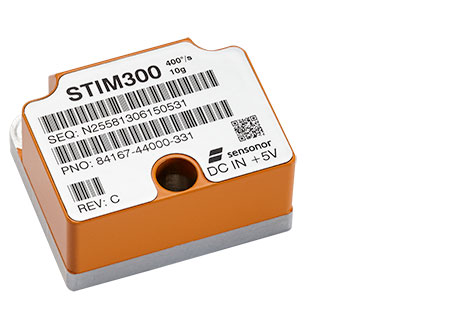
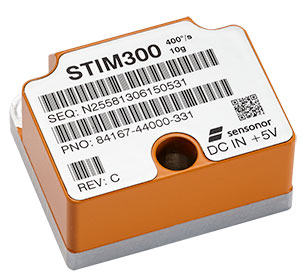
    NovAtel OEM-IMU-STIM300.
    NovAtel OEM-IMU-STIM300.

    NovAtel has added Sensonor’s commercially exportable OEM-IMU-STIM300 to its SPAN GNSS + INS line of positioning products. The OEM-IMU-STIM300 is a Micro Electromechanical System (MEMS) Inertial Measurement Unit (IMU) that integrates with NovAtel’s OEM6 receiver technology to provide a powerful 3D continuous position, velocity and attitude solution, the company said.

    The distinguishing characteristic of the OEM-IMU-STIM300 is its small form factor with tactical-grade performance capabilities. “As an OEM supplier, our customers come to us with a wide range of application demands. The addition of the OEM-IMU-STIM300 to our SPAN portfolio enables us to provide a cost-effective solution for weight and space constrained environments without having to compromise performance in any way,” said Jason Hamilton, NovAtel director of marketing.

    NovAtel’s proprietary MEMS Interface Card (MIC) integrates the OEM-IMU-STIM300 with NovAtel’s OEM6 receiver products for full SPAN navigation capabilities. The product will be available as an integrated single-enclosure SPAN solution (SPAN-IGM-S1), enclosed standalone IMU (IMU-IGM-S1) for use with external SPAN-enabled receivers, and as an OEM component (OEM-IMU-STIM300).

    OEM-IMU-STIM300 is available for delivery in September, followed by SPAN-IGM-S1 and IMU-IGM-S1 in November 2013.


  • Kickstarter Comes to GPS; Plus, Jammers and Field Technology Conference

    $2,000 for an RTK base and rover? Yes, it’s real. Well, at least it seems real.

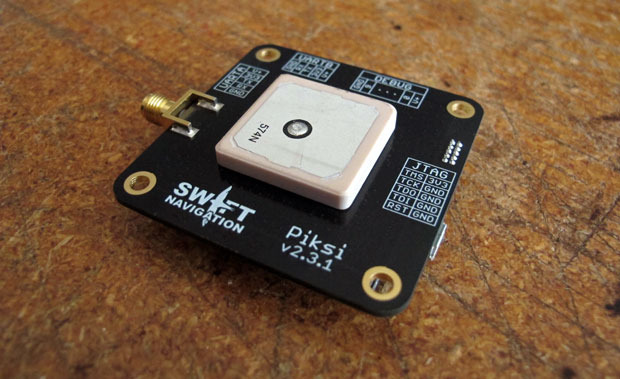
    For $2,000, you can order an RTK base and rover set named Piksi, including radios.

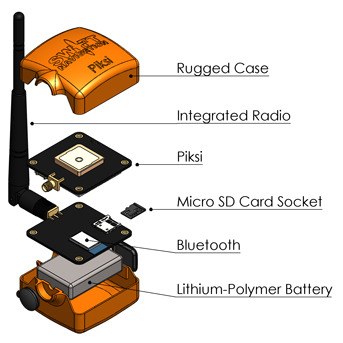
    Photo: Piksi (Swift Navigation)  Piksi_rugged

    It’s an intriguing opportunity, and might be the first brush stroke of the picture I’ve been painting (metaphorically speaking) for the past few years about inexpensive RTK receivers forthcoming. But, before you get really excited, read on.

    Besides the attractive price, something else that makes Piksi interesting is the way the company is financed. The way that a typical company funds new product development is through its own cash flow or financing. The company designs and produces a product, then announces it to potential buyers (you), who then touch, feel and use the product to understand how it performs…all before making the decision to purchase. Piksi (Swift Navigation) doesn’t follow that model.

    Piksi is using a new-age, crowd-sourced funding model called Kickstarter. With Kickstarter, a group of people (creators) offer to design and produce a certain product if they can recruit enough “investors” to fund their endeavor. The “investors” aren’t traditional venture capitalists, nor people who would own stock in said company. The investment is simply a commitment to buy the product based on the specifications provided by the creators, before the product is finished. If the company has enough commitments from “investors,” the creators commit to designing, building and delivering the product.

    Furthermore, there are certain levels of investment available for Piksi, from $7 which will get you a Swift Navigation micro-USB cable, to $2,000, which will get you a ruggedized version of the complete RTK kit, including base, rover, XBee radios, Bluetooth and SD card storage. So far, Swift Navigation has raised $161,369 towards the project with today, September 4, being the last day. That’s far more than the $14,000 goal it set.

    The caveat is that the product is not complete yet, at least the RTK portion. According to Swift Navigation:

    We have already built a small batch of Piksi receivers that are ready to ship and have locked down all part sourcing and manufacturing for further batches, so there are unlikely to be any unanticipated delays in the delivery of Piksi hardware.

    However, it’s difficult to know exactly how long the RTK functionality will take to implement — software development schedules seem to always run over their anticipated delivery dates, even when you take into account Hofstadter’s Law. We feel the goals we’re proposing to accomplish with this campaign are reasonable — adding a new set of software functionality (which we successfully implemented on a previous platform) upon an existing base of stable hardware and software.

    The gamble that the investor takes is that Swift will be able to finish the product, produce it, and meet the performance specifications. However, that’s only part of the battle. I spent better than 10 years of my life managing the design and production (somewhat) of GPS-based hardware and software for mapping and surveying. There are a million details. A major part of developing a hardware/software product like this is making it reliable. What I mean by reliable is that it behaves the same way every time you push the ON button, and works consistently and reliably all day until you press the OFF button. That’s not easy to achieve without a lot of sophisticated testing in different environments, and nothing can fix a poor reliability design (except a redesign).

    The guys behind the Piksi don’t seem to be total GPS-rookies, but do lack substantial real-world experience. Click here and then click on Bios to read about their backgrounds. But who knows? Maybe that’s an advantage, not being conditioned to “follow the rules.”

    One last note, and an important one. It’s only an L1 system, so don’t get too excited. L1 means that you really can’t use an RTK network (practically speaking) and that the baseline distance needs to be pretty short. The RTK initialization and re-initialization times will be measured in minutes, not seconds, and that’s assuming they get the RTK algorithms correct (and reliable).

    Sorry to burst your bubble.

    Actually, the concept of an inexpensive, bootstrapped L1 RTK system is not difficult to envision. The GPS OEM boards are readily available, as well as the GPS antennae, wireless comms and the rest of the components. At the risk of sounding pompous, I could put that kind of project together. The trickiest part of the project would be developing/implementing reliable RTK software.

    No matter what, it will be interesting to hear about what these guys come up with. In the words of the late Steve Jobs, “stay hungry, stay foolish.”

    GPS jammers are cheap, but don’t get caught using one.

    Even though they are illegal to market, sell and operate in the U.S., Americans are buying cheap GPS jammers, via Internet stores, from companies operating outside of the U.S. Operating one of these devices in the U.S. is a risky venture (as you’ll read below).


    Although they don’t seem to be a serious threat yet, they could become a threat as GPS receivers become more ubiquitous and concerns about privacy continue to ramp up.

    The Federal Communications Commission (FCC) is responsible for enforcing the U.S. laws enacted that prohibit the use of GPS jamming devices. If you look at the FCC’s enforcement history here, you’ll see that there isn’t much enforcement activity. However, a recent enforcement action was imposed on a guy in New Jersey who made the mistake of driving by the Newark International airport with his GPS jammer turned on. Uh oh. The FCC tracked down the offender and issued a Notice of Apparent Liability for Forfeiture that included a fine of nearly $32,000. Whoa, that’s a lot of dough. Wonder if he is trying to sue the company he bought it from? Not likely, as they are most certainly outside of the U.S. and out of reach of the U.S. judicial system. Caveat emptor.

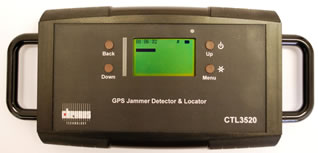
    You can be assured that if jamming reports increase, there will be more jamming detection and location equipment deployed to hold people accountable, like this new, handheld GPS jammer detector and locator from Chronos:

    Chronos_ctl3520

    You might want to visit this GPS.GOV website on GPS jamming. It contains a lot of information about the U.S. regulations surrounding the marketing, sales and use of GPS (and cell phone) jamming devices.

    Third annual Field Technology Conference

    FTC2013_logo

    In 2010, I, along with two colleagues, put together a conference here in Portland, Oregon, and named it the Field Technology Conference. We created the conference to focus on geospatial technology hardware and software used in the field. It’s the essence of what a conference should be, a group of people gathering to share ideas of common interest. It’s mostly devoid of commercial interests, save a few really neat (and valuable) giveaways and a few exhibit booths. You probably haven’t heard about the conference because we have a very small marketing budget, and the organizers (three of us) can only spend a few hours a month brainstorming, finding speakers, and organizing the event.

    This year, our third, will focus on existing and emerging technologies: GPS/GNSS, UAVs, 3D printing, mobile devices, imagery and geospatial software. Our outdoor demonstration area was very popular last year so we’ll offer that again, as well as a UAV demonstration. We’re also planning an on-site demonstration of 3D printing. Can you imagine 3D printing a topographic survey?

    Something new this year is our association with the CGSIC (Civil GPS Service Interface Committee). CGSIC is co-locating a regional event with our conference. What that means is that speakers from the U.S. government (Air Force, State Deptartment, DOT, etc.) will make GPS-centric presentations. CGSIC events are the only live communication channel between the U.S. Air Force GPS operations personnel and civilian GPS users. This is your chance to ask Air Force personnel questions, in person, that you’ve always wanted to know about GPS. If you’re unable to travel to Portland for the conference (October 23-24), GPS World magazine is planning on streaming the CGSIC presentations live over the Internet, as well as posting the recording on its website.

    Although the conference is organized by the Western Forestry and Conservation Association (which organizes a lot of conferences), take a look at the agenda and you’ll see the content will be of interest to anyone involved with geospatial data collection and processing technology, not just foresters and environmental scientists. For conference details, click here.

    Thanks, and see you next month.

    Follow me on Twitter at https://twitter.com/GPSGIS_Eric

  • USGIF Workshop Offers Preview of GEOINT 2013

    Two weeks ago, I attended a USGIF workshop in Huntsville sponsored by GEO Huntsville, through the considerable efforts of Directions Magazine Editor-in-Chief and Vice Publisher Joe Francica and his staff.  The United States Geospatial Intelligence Foundation (USGIF) is a non-profit dedicated to promoting the geospatial intelligence tradecraft across industry, academia, government, professional organizations and individual stakeholders.

     GEO Huntsville's Geospatial Intelligence (Geoint) Workshop was held August 14 at the Von Braun Center Civic Arena in Huntsville, Alabama.
    GEO Huntsville’s Geospatial Intelligence (Geoint) Workshop
    was held August 14 at the Von Braun Center Civic Arena in Huntsville, Alabama.
    Keith Masback, USGIF
    Keith Masback, USGIF chief executive officer.

    The workshop was a collection of geospatial-related presentations starting with Keith Masback, the USGIF chief executive officer, who gave an interesting history of NGA based on his extensive experience in the geospatial community.  He reviewed that NGA had a somewhat shaky start that grew out a vision of Rear Admiral Bill Owens, which was part of the 1996 “Joint Vision 2010” that formed the concept of network-centric operations. Looking at the past, the Joint Vision participants saw that the future would require a new way of doing intel business. They determined that information had to be brought near the user, not at some distant command center. It would need to be as close to real time as possible. It would have to be precise and able to ID combat targets.  It would have to be integral with missile defense and provide detailed urban data.

    So in 1996, the NIMA (National Imagery and Mapping Agency) was formed by combining the DMA (Defense Mapping Agency) and the CIO (Central Imagery Office).  The merging of mapping and imagery communities proved very difficult as the two cultures collided. Even the internal NIMA commission was bent on dissolving the marriage. Fortunately, after working through the issues, the commission came to the conclusion that the marriage was really in the best interest of the country and both communities.

    It was also at the same time that Jim Clapper took over the week of 9/11. That event sharply focused everyone’s minds. General Clapper decided that the best way to unify the command was to get rid of the separate words “imagery” and “mapping” — thus was born the new title National Geospatial Intelligence Agency, and to put it in the same company of other three-letter agencies, it was dubbed NGA. NGA really worked hard to meet the vision set in 1996.  Keith cited the Bin Laden apprehension as a good example.

    He then explained how NGA felt it needed to evolve. He cited the example that our troops needed to be as location enabled as kids are with their mobile devices. Crowd sourcing is playing an ever-increasing roll, and despite the belief that the cyber world is locationless, location is a very real aspect of cyber warfare. Users have locations as well as servers and the interconnecting framework. Asymmetrical urban warfare demands even more precise location mapping, including building interiors. Keith cited Robert Scoble’s keynote at The Next Web Conference Europe as a must-view video by everyone in the geospatial community, to place his comments in context. Robert Scoble and Shel Israel are going to be keynote speakers at GEOINT 2013.

    Additionally, although the military is taking a lion’s share of sequestration cuts, the two areas that are not seeing significant cuts because of WMDs are ISR (intelligence, surveillance, and reconnaissance) and cyber. He said that some people question the need for geospatial capabilities in a cyber world, but he quickly cited that servers have locations, that networks have locations, and most hackers/persons of interest have locations, which also point to the growing need for indoor urban tracking of users. And all this takes on even more significance with the proliferation of WMDs.  Although not as immediate, NGA is also very supportive and promotes STEM (science, technology, engineering, and mathematics) education so we maintain the pipeline of talent. He also talked about the growing drumbeat for geospatial intel certification, especially for contract work.

    Randy Jones of the Missile and Space Command spoke of the much shorter timelines of intelligence and needed action, that we have a flood of information but have a poverty of attention. That there is a growing need for “object-based intelligence” or, as some refer to it, “activity-based intelligence.”  The flood of data is overwhelming analysts, and NGA is looking for increasingly sophisticated algorithms to sort the massive data collections. The are many opportunities for small, innovative companies in this arena to help DIA, NGA, and NSA.

    Robert Zitz of SAIC gave his take on current actions in Washington. He quoted James Clapper as saying, “We’ve run out of money, so now we have to think.” He also cited Latisha Long that although DoD was seeing 5% sequestration cuts, DHS may see increases to its budget due to WMD and cyber concerns, specifically power, water and transportation. (As a side note, I harp to all my family members and friends the need to heed the DHS warning for all citizens to maintain a two-week supply of food and water in their home.)  There is also special attention being given to joint efforts of special operations, cyber security and border security.  Those intel dollars are increasing especially for real-time data collection, multi-int fusion and predictive analytics.

    A representative from Sierra Nevada and L3 talked about wide area air surveillance (WAAS), specifically Gorgon Stare and the domestic manned aircraft version Vigilant Stare, which is also being linked with full-motion video. The key issue is analytics to filter and provide timely actionable intelligence.

    MIC cameras from Bosch Security Systems feed a Coastal Remote Monitoring Program for the Alabama Department of Conservation and Natural Resources.
    MIC cameras from Bosch Security Systems feed a Coastal Remote Monitoring Program for the Alabama Department of Conservation and Natural Resources.

    A very clever use of lower cost, off-the-shelf hardware to solve a critical need was presented by Major Scott Bannon of the Alabama Marine Resources Division and Tim Erwin of Crystal Data International. Major Bannon’s small staff is tasked with monitoring more than 600 miles of Gulf Coastline. They installed a network of ruggedized video cameras, some in very remote locations, that were connected via a wireless network with all the cameras controlled by the users.  This is not much different than many systems seen in urban areas, but the challenge was building a  rugged system with some very remote locations lacking power or connectivity.  The cameras were geo-referenced on Google Earth and controllable by his staff from mobile devices.  Although the images are not directly geo-referenced, their position coupled with user knowledge permitted them to search and identify objects in the water accurately enough to task rescue assets to craft in distress. The night low-light imaging capability helped in several high-interest events.  A new version will provide accurate azimuth data recorded with the imagery.

    Dr. Michael Botts presented his work to develop common standards for web enablement of sensors. SML (Sensor Markup Language) is being backed by the OGC to permit sensor web enablement (SWE). See the OGC website for more details.

    The workshop was closed by Sandra Broadnax, the NGA Small Business Programs director.  Her presentation was probably the best received session because of her infectious enthusiasm. She explained how NGA Director Long was extremely supportive of small business innovations and contributions to the intelligence community. She explained how NGA maintains a very comprehensive list of changing requirements on both the high and low sides. She strongly encouraged all geospatial firms to monitor the NGA site, since there were many opportunities that are not published in FedBizOps. At the session she wasted no time building connections by identifying those who had SCIFs in Huntsville and those who might need access so they could view and respond to classified requirements.

    So, the key topics that I believe will dominate GEOINT 2013 are:

    • Persistent wide area air surveillance
    • Social media, big data, human geography
    • Every individual a consumer and provider of intel data
    • “Object” or “Activity” based intelligence, even inside buildings
    • Integration of real-time actionable intelligence to users in the field
    • The geospatial links of cyber threats

    As you can see, even in the short span of one year, the geospatial community continues to evolve significantly. I’m going to attend GEOINT 2013 in October and the GaTech Research Institute GIS conference Spatial Plexus in November.  If you see me, please introduce yourself.

  • Nokia Unveils Its Connected Car Platform

    HERE, a Nokia business, has announced a complete Connected Driving offer, which will help car makers and in-vehicle technology suppliers connect the car and the driver to the cloud. The offering includes HERE Auto, HERE Auto Cloud, and HERE Auto Companion. In addition, HERE has radically improved its Traffic product, HERE Traffic, by building a new system to process data even faster and more accurately than before, Nokia said. The HERE Connected Driving offering will be demonstrated at the International Motor Show in Frankfurt, Germany, starting on September 10.


    Webinar: The Connected Vehicle

    All major international car-makers are installing telematics units, sending a signal that wireless information and connectivity is here to stay in the vehicle, and location will be a big part of the growth. To learn more about the rapid changes in the connected vehicle field, tune in to our September 19 webinar, hosted by Wireless LBS editor Janice Partyka. Registration is free.


    Technology is rapidly transforming driving, with connectivity bringing the outside world to the car and the sensor revolution creating new possibilities for the automobile industry, Nokia sai,d. People today demand that cars become integrated into their ecosystem of connected devices with the same level of innovation they see in their personal devices.

    HERE Connected Driving offers a full range of automotive products and services that builds on our high-quality and fresh map to go beyond navigation. The customizable offering is a fully flexible framework that allows automakers to differentiate the driving experience. It will help them solve the problems that drivers face every day such as synching routes and other personal information across their car and devices and finding the right parking spot or closest gas station.

    HERE Auto is the first embedded in-car navigation experience that delivers the right map at the right moment with and without a data connection. Drivers can get turn by turn voice guided navigation in 95 countries and 2D, 3D and satellite map views including street level imagery. In the future, car makers will be able to easily extend the HERE Auto experience using a software development kit (SDK) to create entertainment and other applications, such as in the areas of music and social networking. HERE Auto is already integrated in Continental’s next-generation Open Infotainment Platform. HERE is also working with partners such as Magneti Marelli and others to bring HERE Auto to the market in the coming months.

    HERE Auto Cloud provides drivers with always-on access to several dynamic services such as real-time traffic updates, helping drivers avoid congested areas, road closures or blockages that occur en route. Drivers can also get recommendations on places to eat, parking spots, information on where to charge an electric vehicle or where to find the most inexpensive fuel.

    HERE Auto Companion, a customizable mobile and web application, keeps drivers connected outside of the car allowing them to synchronize their favorite places and routes across their devices so that they won’t need to re-enter their route when they get in the driver’s seat. Car makers can tap assets from the existing HERE suite such as walking navigation, public transit routes and even indoor venue maps to build custom mobile applications. Drivers could use the app to remotely find their car with their device using LiveSight augmented reality technology and check the car’s vital stats such as fuel levels and tire pressure.

    HERE Traffic has been radically improved by “Halo,” our new engine that processes data quickly and accurately. Every month we’re collecting ever greater numbers of high-quality data, such as probe points and sensor information to deliver real-time information such as weather, traffic congestion, road construction and other factors that affect a drive. With our new Traffic product drivers get improved travel time estimates, so they can better plan their routes and quickly re-route on the go.

    “By 2016, the majority of consumers in mature markets will consider in-vehicle web-based data access a key criterion in their automotive purchase,” said Thilo Koslowski, VP of Automotive at Gartner. “Successful connected vehicle solutions will add value to the connected driver’s digital lifestyle and enable integrated cross-device experiences relevant for people everyday.”

    For more information about HERE Auto, visit Nokia’s blog.

  • GPSTrackIt Announces New Analytics Dashboard

    GPSTrackit’s Fleet Manager Software now features an Analytics Dashboard that enables fleet managers to monitor and review fleet performance by reviewing historical data in a series of charts and graphs. Fleet Manager is a robust application providing fleet owners and managers with a comprehensive suite of integrated tools, GPSTrackIt said.  The system delivers real-time GPS vehicle tracking, vehicle maintenance scheduling, and a wide range of alerts. The Analytics Dashboard brings to the system a new array of powerful and flexible capabilities.

    “It puts the information fleet managers and owners need at their fingertips,” said Eddie Bermudez, GPSTrackIt’s product manager.  “We already provide all the historical data via the reports system. This new feature brings that data to life with dynamic graphics.”

    The dashboard displays up to six charts, which can be configured as bar charts or pie charts. Each chart can focus on particular issues important to fleet owners, managers and dispatchers: Idle Time, Drive Time, Stop Time, Speeding and Mileage.

    “The charts can be configured to show data for all units or a single group,” explained Bermudez. “Or a chart can compare groups by displaying their data side-by-side using different colors.”

    In addition, three composite charts are available; Engine Time, which monitors idle time and driving time; Driving Overview, which monitors idle time and driving time and stop time; Idle Stop, which monitors idle time and stop time. The time metric determines which historical data is used. Options available are week, month, quarter, and year.

    “Charts can be rearranged on the dashboard by dragging and dropping,” added Bermudez.  “And there are several additional options that can be configured. Chart labels of up to 25 characters can be added. The start of day can be set to any of the 24 hours. For bar charts, the average value can be shown superimposed on the graph.”

    Bermudez continues, “The Analytics Dashboard can also display the highest or lowest values for a given graph. This can be configured to show values from one to 20. Selecting Highest and a numerical value of five on an Idle Time chart, for example, displays the five vehicles with the highest values for idle time.”

    “This is important for fleet managers to know because of added fuel consumption, as well as vehicle wear,” according to Bermudez.  ”Selecting Lowest and a numerical value of ten on a Speeding chart shows the ten vehicles with the lowest incidence of speeding.”

  • Trimble Launches Connected Farm Dashboard

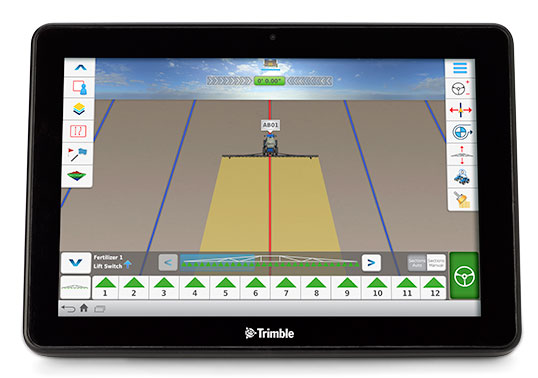
    Trimble has launched the Connected Farm dashboard, which provides one centralized location for farmers to view key information impacting their operations. With this information, farmers will be able to make better daily decisions based on the latest data. The Connected Farm dashboard is customizable and accessible via Internet-enabled devices such as desktop and notebook personal computers, smartphones and tablets, and Trimble’s new TMX-2050 display.

    Trimble TMX-2050 display.
    Trimble TMX-2050 display.

    The TMX-2050 display is a next-generation display built on the Android operating system. It offers an intuitive interface that enables farmers to easily implement precision agriculture solutions as their business grows. Its flexible software platform improves the ability for a customer to seamlessly add applications to their operations while the modular architecture allows for future expandability.

    The TMX-2050 display is an addition to Trimble’s existing line of guidance displays, which include the EZ-Guide 250 lightbar guidance system, CFX-750 display, and FmX integrated display.

    The Connected Farm dashboard will allow farmers to:

    • Check daily rainfall totals for each virtual rain gauge—without the use of physical rain gauges. (Made possible by Trimble’s acquisition of RainWave’s assets). This will allow a farmer to reprogram his irrigation system based on the previous evening’s rainfall, optimizing the use of water.
    • View the weather forecast weekly, daily, or hourly for a given location including temperature, humidity, chance of precipitation and wind speed. For example, wind speed will allow a farmer to plan when to spray a given field.
    • Set up a Doppler radar map to show upcoming weather patterns for their area. This will allow a farmer to assess in real time whether or not to continue with a current activity.
    • Check the latest commodity prices. Farmers will be able to select the commodities that matter to them and list them based on personal priority.
    • View farming operations data. For example, if the farmer is viewing yesterday’s planting activities, the dashboard may show population, singulation, skips and doubles.
    • Monitor a fleet by tracking the location and status of vehicles and receive geo-fence and curfew alerts. Farmers also can link through to Trimble’s new Connected Farm fleet app to add landmarks or for turn-by-turn directions to locate vehicles from their current position, and view historical positions.
    • View a boundaries map created with Trimble’s Connected Farm scout app.

    Following the completion of the recently announced IQ Irrigation asset acquisition, irrigation pivot data is expected to be available on the Connected Farm dashboard in New Zealand in the fourth quarter of 2013 and the U.S. in the first half of 2014.

    “With the Connected Farm dashboard, farmers can quickly see a snapshot view of their latest field operation as well as key information that may impact today’s activities such as rainfall, commodities, and the day’s weather forecast,” said Joe Denniston, vice president for Trimble’s Agriculture Division. “With this information available in one convenient central location through Connected Farm, farmers can access the information they need to make the best daily decisions about their farm. Since the dashboard can be accessed from Internet-enabled devices, farmers can make these decisions from potentially any location at any time.”

    The Connected Farm dashboard is a free web portal and is currently available. To view rainfall totals, monitor pivot irrigators (when available), or for fleet management, customers will need to purchase these services.

    On August 27, Trimble acquired the assets of privately-held RainWave, LLC and Hydro-Engineering Solutions, LLC of Auburn, Alabama. The acquisitions will help to extend the monitoring and reporting capabilities of Trimble’s Connected Farm solution and strengthen its water management expertise. Financial terms were not disclosed.

    RainWave provides precipitation monitoring services for agribusiness, construction and engineering, government and consumer industries. RainWave will be part of the Connected Farm solution, which simplifies and integrates operations management by providing information exchange across the entire farm. This RainWave service will provide farmers across the U.S. with vital rainfall data they can use to better manage their crop production.

    Using RainWave, farmers can set up a virtual rain gauge by entering GPS coordinates for identified locations to receive a rainfall report for those locations. Since on-site rain gauges are not needed, farmers no longer need to monitor dispersed gauges or manually track precipitation. The farmer will now be able to obtain this rainfall information through their Connected Farm dashboard. RainWave’s convenient, accurate rainfall information allows farmers to make better management decisions by optimizing irrigation plans and application timing, and comparing yield against rainfall to plan for next season’s crop. This results in savings of time and water usage.

    Hydro-Engineering Solutions is a civil engineering company that specializes in hydrology and hydraulics. The company provides high-quality engineering services to federal, state and local governments as well as commercial entities, and has extensive experience with streams and rivers. Hydro-Engineering’s expertise in hydrology and hydraulics modeling is expected to strengthen Trimble’s water management solution in watershed analysis for both drainage and irrigation.

  • AvMap Introduces Flight Unit

    AvMap Introduces Flight Unit

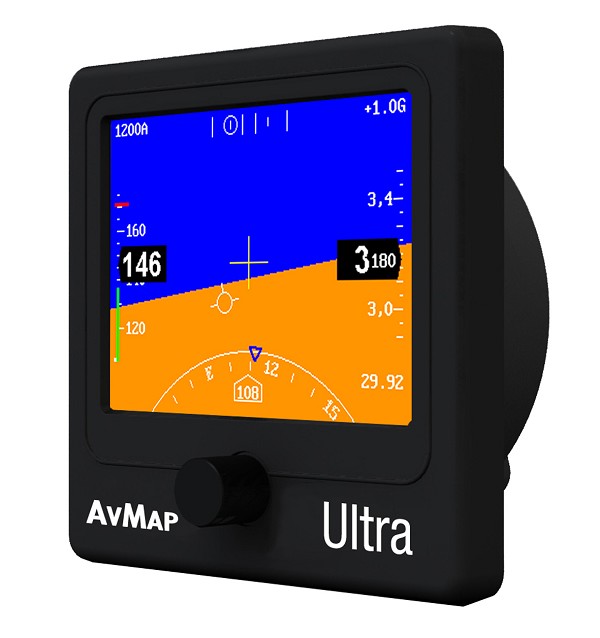
    Photo: AvMapAvMap, the Italian manufacturer of GPS since 1994, presents the Ultra EFIS, a stand-alone unit providing air data, attitude, heading and altitude reference for flights.

    The AvMap Ultra EFIS is a stand-alone device with a 3.5-inch ultra bright, sunlight readable LCD display. The unit is compact (1.95 inches / 49.5 millimeters installing depth) and ultra-light (5.1 oz / 145 g) compared to other products on the market (around 1 lb 9 oz / 700 g.).

    Fitting in a standard 84 millimeters (3.3-inch) panel hole, the AvMap Ultra EFIS can be installed in a panel and be connected to the GPS receiver (included) and to the aircraft Pitot-static system to provide reliable and advanced ADAHRS.

    Designed for light-sport, ultra light and experimental aircrafts, the AvMap Ultra EFIS contains solid-state gyros, accelerometers, magnetic field sensors, air data sensors and UAV Navigation motion processor, the outcome of more than eight years of motion and flight control experience at UAV Navigation.

    “AvMap products range is extending beyond navigation to include more and more avionic tools with the objective to provide a complete AvMap Glass Cockpit system. To this purpose we are selecting the best partners in the market to work with, such as UAV Navigation,” said Simone Lazzarini, CEO at AvMap.

    AvMap Ultra EFIS is the second product developed in collaboration with UAV Navigation, after the A2 ADAHRS module launched this April.

    AvMap can stand alone or be integrated with EKP V. According to cockpit space availability and navigation needs, users can choose two displays or one device. The Ultra EFIS is the stand-alone solution for panel mounting; otherwise, for those who already own an EKP V, users may consider buying the A2 ADAHRS module to be used together with the cockpit docking station to complete the AvMap EFIS set. The A2 ADAHRS module extends the functionalities of the EKP V Aeronautical Navigator bringing attitude and airspeed to the moving map and converting it into a centralized Glass Cockpit System for both navigation and primary flight display.

  • GPS Source Awarded Contract for DAGR Distributed Device

    GPS Source Awarded Contract for DAGR Distributed Device

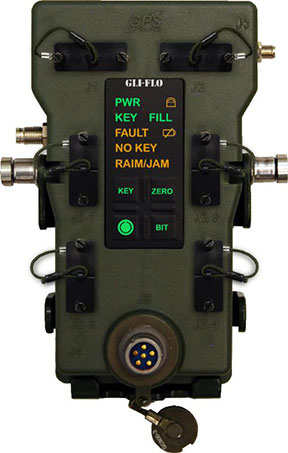
    The GLI-FLO by GPS Source.
    The GLI-FLO by GPS Source.

    GPS Source has received an indefinite-delivery/indefinite-quantity, firm-fixed-price contract with a maximum value of $16,613,430 for the procurement of defense advanced global positioning system receiver distributed devices (D3).  The Army Contracting Command, Aberdeen Proving Ground, Md., was the contracting activity (W15P7T-13-D-C116).

    GLI-FLO was developed by the defense contract engineering firm, GPS Source.  GLI-FLO is a DAGR Distributed Device (D3) that can replace the position, navigation and timing (PNT) role currently required of the DAGR or other GB-GRAM devices inside a fixed vehicle platform. Designed as a single, secure access point to multiple devices requiring PNT data on a fixed vehicle platform, it saves space, weight and power (SWaP).

    “The GLI-FLO contract award is an important milestone in GPS Source’s initiative for the defense market,” said Robert Horton, CEO of GPS Source. “Getting this award was a complicated process, but it helps fulfill our vision of continual innovation in GNSS Signal Availability, especially for the warfighter. We look forward to continuing to provide manufacturing and engineering support services to the Department of Defense.”

  • SkyTraq Introduces Consumer GPS/GNSS Receiver

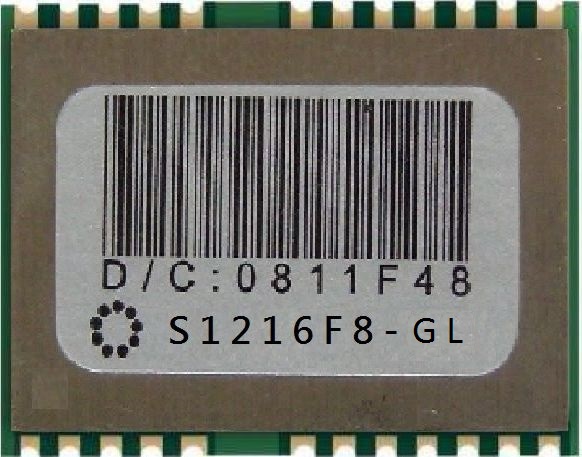
    The S1216F8 receiver by SkyTraq Technology.
    The S1216F8 receiver by SkyTraq Technology.

    SkyTraq Technology, Inc., a fabless GNSS positioning technology company, has introduced its fast consumer-grade 50-Hz update rate S1216F8 GPS receiver module. The module supports GPS, QZSS, WAAS, EGNOS, MSAS, and GAGAN satellite signal reception. The S1216F8 receiver is based on SkyTraq’s newest 55-nm Venus 8 GPS/GNSS chipset.

    The Venus 8 is a low-cost commercial GPS/GNSS chipset incorporating an IEEE-754 compliant FPU. With RISC/FPU running at 100 MHz, the S1216F8 GPS receiver module has industry leading 50-Hz update rate, very fast and accurate position/speed response, suitable for UAV, RC plane flight logging, and high-performance race car or speed boat data logging applications. When running at lower 1 Hz, 5 Hz, or 10 Hz update rate, the S1216F8 receiver can be used as a typical GPS receiver module currently available on the market.

    The S1216F8 GPS receiver module measures 12mm x 16mm and consumes 26mA @ 3.3V during continuous navigation at 50-Hz update rate.

    The S1216F8 is among SkyTraq’s S1216 family of form factor compatible, high-performance, low-cost GNSS modules. The S1216F8-GL GLONASS/GPS module and S1216F8-BD Beidou/GPS module both have a 20-Hz update rate.

    The S1216 family of 50-Hz GPS, 20-Hz GLONASS/GPS, and 20-Hz Beidou/GPS receiver modules are in production. Datasheet, engineering sample, evaluation kit and reference design are available.