Category: Applications

  • Leica Camera Integrates u-blox GPS into M-System Series

    Swiss-based u-blox has been chosen by Leica Camera as provider of GPS technology for its premium M-System camera and accessory series.

    Leica, which makes high-end and professional cameras, has integrated u-blox’ NEO GPS module into its new Multifunctional Handgrip M. The geotagging feature injects location data directly into each photo’s Exif header (Exchangeable image file format), allowing photos to be filed and retrieved according to where they were taken. The accessory is compatible with the new flagship Leica-M rangefinder digital camera series.

    The Multifunction Handgrip M connects directly to a computer via an integrated USB socket, allowing full remote control of the camera and image access using the Leica Image Shuttle software package. The handgrip also facilitates the safe and steady handling of the camera, particularly when shooting with heavier telephoto lenses.

    The handgrip’s features include a supplementary flash connector, a socket for an external power supply, and a sync socket for studio flash systems. An optional supplementary power source is also available.

    “Leica focuses on providing the highest quality photographic equipment on the market,” said Stefan Daniel, director of product management at Leica Camera.“When a customer purchases a Leica, they realize they are making an investment in a robust, high-performance camera that delivers outstanding results. To meet these expectations, we design with only the best mechanics, optics and electronics. For global positioning, we chose u-blox.”

    “We are proud to have been selected for our GPS technology by such a prestigious brand as Leica,” said Jochen Steinhauer, u-blox sales manager. “When you pick up a Leica camera, you immediately see and feel the high quality of every component. It is designed for perfection, a philosophy that u-blox also follows in our design of the world’s highest-quality global positioning modules.”


  • Esri Releases Android Mapping App to Open Source Community

    Esri announced in a blog post that they have released an Android-based mapping app, based built entirely on the ArcGIS Runtime SDK for Android V 10.1.1,  to the open source community.


    Today we are proud to announce the app has been released to the open source community on Github.  There have been some design changes and updates to the app since it’s debut including some of the following:

    • Portal API to populate a gridview with basemaps available to change in the map
    • Reverse Geocoding class
    • PopUp API to view and edit popups from a WebMap.

    This is a great starting point for developers who want to create mobile mapping apps like Google Maps & MapQuest.  Some features available now include:

    And there is more to come.  We encourage developers to collaborate with us as we use Github to continue developing this app together with our developer community.  Anyone and everyone are welcome to contribute.  We will review/accept pull requests, submit/fix issues, & use milestones for updates.  Four things you can do now include:

    1. Get Involved
    2. Report Issues/Enhancements
    3. Contribute code
    4. Improve documentation

  • Registration Opens for ION PTTI 2013 Conference

    Registration is now open for the Institute of Navigation’s (ION) Precise Time and Time Interval Meeting (PTTI) to be held December 2-5, 2013 (Tutorials will be held December 2) at the Hyatt Regency Bellevue, Bellevue, Washington. Registration and program information will be available online only.

    PTTI is an annual conference sponsored by ION with a technical program designed to disseminate and coordinate PTTI information at the user level, review present and future PTTI requirements, inform government and industry engineers, technicians, and managers of precise time and frequency technology and its problems, and provide an opportunity for an active exchange of new technology associated with PTTI.

    This year’s conference will feature a technical program around important PTTI issues including:

    • Advanced Atomic Frequency Standards Applications
    • High Performance Time and Frequency Transfer via Fiber
    • Next Generation PTTI Applications
    • Network Synchronization and IEEE 1588, NTP
    • PTTI in Space
    • PTTI Time and Frequency Laboratory Activities
    • State of the Art GNSS Timing Receiver
    • Metrology and Applications
    • Time and Frequency Transfer Applications –
    • Milliseconds to Picoseconds
    • Time Scales and Algorithms

    In addition to a commercial exhibit, this year’s program includes a Panel Discussion on Near-term GNSS deployments and the impact on PTTI Applications and Performance Current and future status of: GPS, GLONASS, Galileo, BeiDou/Compass, QZSS, WAAS, EGNOS and INRISS.

    This year’s conference will also feature pre-conference tutorials December 2, including

    • Introduction to Precise Time and Frequency
    • Time and Frequency Transfer
    • Two-Way Satellite Time Transfer (TWSTT)
    • Global Navigation Satellite Systems (GNSS) I & II
    • IEEE 1588: The Precision Time Protocol – An Overview
    • Introduction to Atomic Clocks


  • Microsoft to Acquire Nokia’s Devices & Services Business

    Microsoft Corporation and Nokia Corporation today announced that the Boards of Directors for both companies have decided to enter into a transaction whereby Microsoft will purchase substantially all of Nokia’s Devices & Services business, license Nokia’s patents, and license and use Nokia’s mapping services.

    HERE-pod-3-920-USA-jpg

    Under the terms of the agreement, Microsoft will pay EUR 3.79 billion to purchase substantially all of Nokia’s Devices & Services business, and EUR 1.65 billion to license Nokia’s patents, for a total transaction price of EUR 5.44 billion in cash. Microsoft will draw upon its overseas cash resources to fund the transaction. The transaction is expected to close in the first quarter of 2014, subject to approval by Nokia’s shareholders, regulatory approvals and other closing conditions.

    Building on the partnership with Nokia announced in February 2011 and the increasing success of Nokia’s Lumia smartphones, Microsoft aims to accelerate the growth of its share and profit in mobile devices through faster innovation, increased synergies, and unified branding and marketing. For Nokia, this transaction is expected to be significantly accretive to earnings, strengthen its financial position, and provide a solid basis for future investment in its continuing businesses.

    “It’s a bold step into the future – a win-win for employees, shareholders and consumers of both companies. Bringing these great teams together will accelerate Microsoft’s share and profits in phones, and strengthen the overall opportunities for both Microsoft and our partners across our entire family of devices and services,” said Steve Ballmer, Microsoft chief executive officer. “In addition to their innovation and strength in phones at all price points, Nokia brings proven capability and talent in critical areas such as hardware design and engineering, supply chain and manufacturing management, and hardware sales, marketing and distribution.”

    “We are excited and honored to be bringing Nokia’s incredible people, technologies and assets into our Microsoft family. Given our long partnership with Nokia and the many key Nokia leaders that are joining Microsoft, we anticipate a smooth transition and great execution,” Ballmer said. “With ongoing share growth and the synergies across marketing, branding and advertising, we expect this acquisition to be accretive to our adjusted earnings per share starting in FY15, and we see significant long-term revenue and profit opportunities for our shareholders.”

    “For Nokia, this is an important moment of reinvention and from a position of financial strength, we can build our next chapter,” said Risto Siilasmaa, Chairman of the Nokia Board of Directors and, following today’s announcement, Nokia Interim CEO. “After a thorough assessment of how to maximize shareholder value, including consideration of a variety of alternatives, we believe this transaction is the best path forward for Nokia and its shareholders. Additionally, the deal offers future opportunities for many Nokia employees as part of a company with the strategy, financial resources and determination to succeed in the mobile space.”

    “Building on our successful partnership, we can now bring together the best of Microsoft’s software engineering with the best of Nokia’s product engineering, award-winning design, and global sales, marketing and manufacturing,” said Stephen Elop, who following today’s announcement is stepping aside as Nokia President and CEO to become Nokia Executive Vice President of Devices & Services. “With this combination of talented people, we have the opportunity to accelerate the current momentum and cutting-edge innovation of both our smart devices and mobile phone products.”

    Nokia has outlined its expected focus upon the closing of the transaction in a separate press release published today.

    TERMS OF THE AGREEMENT

    Under the terms of the agreement, Microsoft will acquire substantially all of Nokia’s Devices and Services business, including the Mobile Phones and Smart Devices business units as well as an industry-leading design team, operations including all Nokia Devices & Services-related production facilities, Devices & Services-related sales and marketing activities, and related support functions. At closing, approximately 32,000 people are expected to transfer to Microsoft, including 4,700 people in Finland and 18,300 employees directly involved in manufacturing, assembly and packaging of products worldwide. The operations that are planned to be transferred to Microsoft generated an estimated EUR 14.9 billion, or almost 50 percent of Nokia’s net sales for the full year 2012.

    Microsoft is acquiring Nokia’s Smart Devices business unit, including the Lumia brand and products. Lumia handsets have won numerous awards and have grown in sales in each of the last three quarters, with sales reaching 7.4 million units in the second quarter of 2013.

    As part of the transaction, Nokia is assigning to Microsoft its long-term patent licensing agreement with Qualcomm, as well as other licensing agreements.

    Microsoft is also acquiring Nokia’s Mobile Phones business unit, which serves hundreds of millions of customers worldwide, and had sales of 53.7 million units in the second quarter of 2013. Microsoft will acquire the Asha brand and will license the Nokia brand for use with current Nokia mobile phone products. Nokia will continue to own and manage the Nokia brand. This element provides Microsoft with the opportunity to extend its service offerings to a far wider group around the world while allowing Nokia’s mobile phones to serve as an on-ramp to Windows Phone.

    Nokia will retain its patent portfolio and will grant Microsoft a 10-year license to its patents at the time of the closing. Microsoft will grant Nokia reciprocal rights to use Microsoft patents in its HERE services. In addition, Nokia will grant Microsoft an option to extend this mutual patent agreement in perpetuity.

    In addition, Microsoft will become a strategic licensee of the HERE platform, and will separately pay Nokia for a four-year license.

    Microsoft will also immediately make available to Nokia EUR 1.5 billion of financing in the form of three EUR 500 million tranches of convertible notes that Microsoft would fund from overseas resources. If Nokia decides to draw down on this financing option, Nokia would pay back these notes to Microsoft from the proceeds of the deal upon closing. The financing is not conditional on the transaction closing.

    Microsoft also announced that it has selected Finland as the home for a new data center that will serve Microsoft consumers in Europe. The company said it would invest more than a quarter-billion dollars in capital and operation of the new data center over the next few years, with the potential for further expansion over time.

    NOKIA LEADERSHIP CHANGES

    Nokia expects that Stephen Elop, Jo Harlow, Juha Putkiranta, Timo Toikkanen, and Chris Weber would transfer to Microsoft at the anticipated closing of the transaction. Nokia has outlined these changes in more detail in a separate release issued today.

    EXTRAORDINARY SHAREHOLDERS MEETING

    Nokia plans to hold an Extraordinary General Meeting on November 19, 2013. The notice of the meeting and more information on the transaction and its background are planned to be published later this month.

    PRESS CONFERENCE

    Nokia will host a press conference today, Tuesday, Sept. 3, at 11 a.m. EEST in Dipoli, Espoo (Otakaari 24). Registration will start at 10 a.m., and the doors will open at 10.40 a.m. Due to space constraints, only media who show valid press credentials at the registration will be admitted. Media are encouraged to watch a live webcast of the press conference at:http://press.nokia.com/

  • Handheld Ships New Version of Algiz 7 Tablet

    Handheld Group has announced the launch of the new version of its popular Algiz 7 rugged tablet computer. The updated Algiz 7 is considerably faster than its predecessor, with better storage capacity, improved security and quicker communication capabilities.

    According to the announcement, the ultra-rugged Algiz 7 tablet PC is small, light and fast, with multiple connectivity options and a wide range of functions, ideal for field workers demanding a super-durable product that is tough and powerful, yet light and easy to work with. The Algiz 7 meets stringent MIL-STD-810G military standards for withstanding humidity, vibrations, drops and extreme temperatures, and with its IP65 rating it keeps dust and water out as well.

    Algiz-7-handheld-tablet-facing-left-newThe new Algiz 7, which started shipping this week, features the following improvements from earlier versions:

    • A fast and powerful N2600 1.6 GHz Dual-Core Intel ATOM processor.
    • More memory, with 4 GB of DDR3 RAM.
    • Better storage, with a 128GB SSD SATA II with recovery partition.
    • Two full mPCIe slots for improved flexibility.
    • Ethernet 10/100/1000 (Gigabit).
    • Added data security with TPM chipset board (chip 1.2).
    • An updated version of the wireless Gobi 3000 technology for higher communications speed.
    • A 5-megapixel camera.
    • Antenna diversity (two antennas) for improved coverage.

    “We’ve made significant improvements to the new Algiz 7,” said Jerker Hellström, CEO of Handheld Group. “Better storage, a much faster processor, improved security, a better camera and better communications are some enhancements – and we’ve kept the price point the same as for the previous version of the Algiz 7. This product should remain the tablet of choice for anyone looking for portable, professional field performance.”

    The Algiz 7 weighs 1.1 kilograms and has a 7-inch widescreen touch display that features the new and unique MaxView technology, providing brightness in outdoor conditions — even direct sunlight. It runs the state-of-the-art Microsoft Windows 7 Ultimate operating system. GPS navigation functionality is fully built in.

    The Algiz 7 is specifically developed for use in tough environments in industries such as mining, geomatics, logistics, forestry, public transportation, construction, utilities, maintenance, military and security.

  • Geospatial on Everything

    By Alan Cameron

    Everything has a geospatial aspect. Everything.

    Over grits, coffee, and the airborne delicacy purveyed at the Flying Biscuit Cafe (right out of the oven, right into your mouth) in Sandy Springs, Georgia, I absorbed this high-tech homily.

    You’ve heard of the European financial crisis. Trace it back to geospatial, from the Greek banking collapse, which in turn had roots in the implosion of the Greek tax system, due to a plethora of gaps, inconsistencies, and exceptions filed in a largely uncontrolled property cadastre — the register of real property, including details of ownership, precise location (by GPS coordinates), and value of land parcels.

    Lose control of your cadastre (your GIS), lose the country. With global interconnections, soon the continent, if not perhaps the world economy.

    For want of a nail, the battle was lost.

    Jump forward, technologically, to flash lidar. Ball Aerospace created this ability to capture continuous rapid multiple laser interferometry detection and ranging (LiDAR) images/point clouds, merged with continuous high-resolution optical images, to create full-color 3D models in real time. Stitched together with GPS, this produces real-time full-motion video: interactive geo-referenced metric 3D models.

    In field application, this can yield time-critical 3D mapping for urgent missions, enhanced situational awareness, battlefield characterization, and tactical mission planning. It can help with disaster-response planning and event forensics. Real-time models could be communicated with the public through easily comprehended moving images via television or the Internet. of the actual progress of a fire or flood, together with evacuation routes.

    Jump again to fabfi. What’s a fabfi?

    FabFi is an open-source, lab-grown system out of MIT using common building materials and off-the-shelf electronics to transmit wireless Ethernet signals across distances up to several miles. Communities can build their own networks for high-speed Internet connectivity, and access to online educational, medical, and other resources.

    Simple, low-cost, and feasible in unstable environments: Afghanistan, Kenya, and any number of countries that leapfrogged telephone landlines to come quickly into the cellular era; now they can leapfrog Ethernet cable networks and even WiFi for virtual connectivity. Implement with locally available materials. Print out a 2D design file and create the pieces out of wood, metal, acrylic, clay, stone, or ice, as long as you can attach a metallic RF reflective surface to the front.

    If you haven’t guessed the geospatial aspect of this, I assure you it’s there, but I’ve run out of room here.

    For these geospatial glimpses, I am indebted to contributing editor Art Kalinski. Read his monthly columns here.


    Alan Cameron is editor-in-chief and publisher of GPS World magazine, where he has worked since 2000. He also writes the monthly GNSS System Design e-mail newsletter and the Wide Awake blog.

  • Garmin Launches GPS Devices Designed For Navigating By Bike

    Garmin Launches GPS Devices Designed For Navigating By Bike

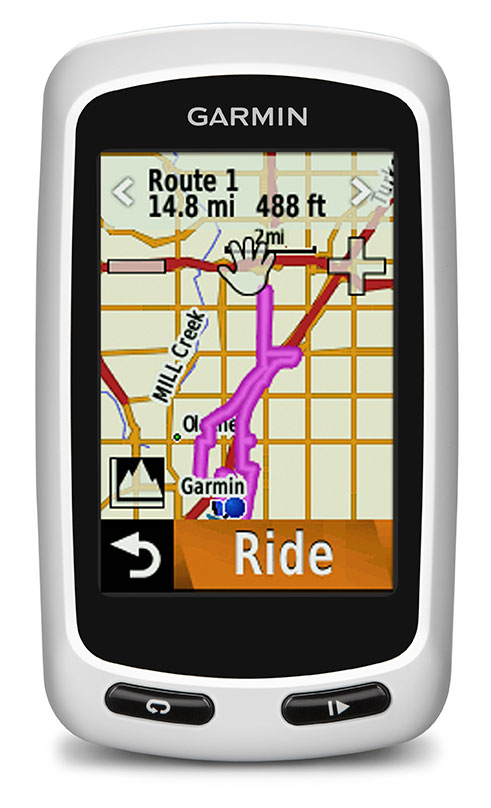
    Garmin International IncGarmin International Inc., a unit of Garmin Ltd., today announced the Edge Touring and Edge Touring Plus GPS navigators designed for touring cyclists, commuters, mountain bikers and those seeking navigation on their handle bars. Edge Touring and Edge Touring Plus work like a GPS navigator for a car, yet with bike-specific features, preloaded maps and points of interest to help cyclists to find their way. They provide both on-road and off-road navigation and can provide round-trip ride options based on a set distance.

    The Edge Touring and Edge Touring Plus will debut at the Eurobike exhibition August 28-31 in Friedrichshafen, Germany (Hall A5, booth 201) and at Interbike in Las Vegas, Nevada (booth 11058), September 18-20, where they will be prominently displayed.

    “The new Edge Touring and Edge Touring Plus are perfect for those whose bikes mean adventure, freedom, exploration and a way of life,” said Dan Bartel, Garmin vice president of worldwide sales. “Easy to set up, easy to use and preloaded with bike-specific maps, they will let riders navigate safely and securely to their destinations.”

    Edge Touring comes preloaded with bike-specific maps that make it easy for cyclists to stay on the route and find their way back again. Whether cyclists are riding from A to B, asking Edge Touring to provide a round trip route, or following a ride that they have planned or downloaded from Garmin Connector Garmin Adventures, Edge Touring will guide them on their ride with clear turn-by-turn visual instructions. Cyclists can choose between Cycling, Tour Cycling and Mountain Bike modes to calculate the most appropriate route. Edge Touring will then guide cyclists on suitable roads or bike-paths to their destination. With the new round trip routing feature, cyclists need only to input the distance they want to ride and Edge Touring will do the rest. It will calculate up to three routes to choose from, including their distance and elevation profiles. Cyclists can compare the routes, choose the one to follow and are one tap of the screen away from turn-by-turn directions the entire way.

    This Garmin video shows Edge Touring and Touring Plus in action:

    Edge Touring is robust and water resistant and has a 2.6’-inch touchscreen that works in the wet and with gloves. It weighs less than 100g and fits  on the stem or on the bars. The rechargeable battery will last up to 17 hours, and it is also compatible with optional solar external battery pack, which will give an additional 20 hours of ride time.  Edge Touring displays key ride data such as time, speed, average speed, max speed, distance and much more. Cyclists can view from 1 to 10 fields on a clear customizable screen. Edge Touring comes with a quarter-turn bike mount and can be easily transferred between bikes.

    Edge Touring records how far, how fast and where cyclists ride so users can replay, relive and share each ride in detail once it has been uploaded to Garmin Connect. Cyclists can share their own rides or search for ones others have completed in Garmin Connect or look for Adventures in Garmin’s free Basecampsoftware. Cyclists can also create custom courses within Garmin Connect and send them directly to their Edge Touring.

    Edge Touring Plus provides all bike-specific features of Edge Touring, in addition to compatibility with ANT+heart rate monitors to help cyclists know how hard they are working, and will even display key data such as range or remaining charge from ANT+ compatible eBikes. It also includes a barometric altimeter for accurate elevation, gradient, ascent and descent data.

    Edge Touring and Touring Plus are expected to ship fall 2013 and have a suggested retail price of $249.99 and $299.99 respectively.

  • Trimble Offers Site Positioning System for Small Construction Companies

    Trimble introduced today a Site Positioning System designed for owner operators, small site contractors or construction companies new to GPS. The Trimble Site Positioning System Essentials Kit is comprised of the new Trimble Site Mobile controller, Trimble SCS900 Site Controller Software and Trimble SPS985L GNSS Smart Antenna for a complete GPS positioning solution. Using GPS, a grade checker or site engineer can check a grade, slope or alignment more accurately and in less time than with traditional construction survey methods.

    “The Trimble Essentials Kit is an exciting new addition to our positioning portfolio,” said Elwyn McLachlan, business area director for Trimble Site Positioning Systems. “Budget-conscious contractors can realize a quick return on investment by giving more personnel on the job site access to technology, enabling more productive and efficient field crews.”

    The slim, lightweight and rugged Trimble Site Mobile controller is an all-in-one mobile device that enables enhanced connectivity in the field. Featuring a large, capacitive touch screen with superior sunlight readability, an integrated 8-megapixel camera and the convenience of a built-in smartphone, the Site Mobile eliminates the need to carry multiple devices on the construction site.

    A new, entry-level version of Trimble SCS900 Site Controller Software has been designed to run on the Site Mobile controller. The software is simple to use and learn, making it ideal for contractors who are new to construction technology. In addition, the SCS900 is upgradeable to more complex functionality as a contractor’s needs change.

    The SPS985L GNSS Smart Antenna has the same tough casing and compact design as other Trimble GNSS Smart Antennas at an attractive price point. For accurate construction site measurement, the SPS985L provides precision Real Time Kinetic (RTK) positioning by using GPS and GLONASS.

    The Essentials Kit can be upgraded to take advantage of Connected Site technology, including VRS networks, Internet Base Station Service (IBSS), Trimble Remote Assistant and wireless data sync.

  • Qualcomm to Sell Fleet Management Unit for $800M

    Qualcomm to Sell Fleet Management Unit for $800M

    Logo: OmnitracsQualcomm Incorporated has signed a definitive agreement to sell its fleet management and tracking business Omnitracs to Vista Equity Partners for $800 million in cash.

    The acquisition will include all of Omnitracs operations in the U.S., Canada and Latin America, including Sylectus and FleetRisk Advisors, which were acquired by Omnitracs in 2011. The transaction is expected to be completed during the first quarter of Qualcomm’s fiscal 2014.

    Omintracs, formerly known as Qualcomm Enterprise Services, provides integrated fleet management applications, services and platforms to transportation and logistics companies. The company provides solutions for safety and compliance, driver retention, GPS fleet tracking, and fleet maintenance software.

    “In the late 1980s, Qualcomm pioneered the use of commercial vehicle telematics with the introduction of the first mobile information system for transportation and logistics,” said Qualcomm executive vice president Derek Aberle. “As one of Qualcomm’s earliest businesses, Omintracs has maintained a leadership position within the industry for 25 years. Today, the opportunity for fleet management and telematics is evolving rapidly, and we believe Omnitracs is well positioned to continue its leadership position as a stand-alone entity.”

    “We are long-term investors in enterprise software, data and technology-enabled businesses that are committed to being leaders in their fields,” said Robert Smith, chief executive officer and founder of Vista Equity Partners. “We are impressed with the compelling value proposition Omnitracs’ products and services offer their customers. We look forward to working with them and helping them to reach their full potential.”

    The closing of the transaction is conditioned upon, among other things, clearance under the Hart-Scott-Rodino Antitrust Improvements Act of 1976 and other customary closing conditions.

  • Mobile Resource Market Shows Largest Growth in Location Industry

    Mobile resource management has never been a sexy market full of buzz and excitement — we are talking tracking trailers and containers. However, it is on pace to see double-digit growth through 2020. Led by a handful of companies in local fleet, long haul, cellular and trailer tracking, MRM has never faced ups and downs like other location market segments. In fact, acquisitions and growth appear to be in the future for this market segment.

    With more than 5.7 million tracking units nationwide, and 9 million more expected to be sold by 2015, the mobile resource management market continues to be one of the steadiest, and profitable, location businesses.

    In one of the bigger MRM deals earlier this month, Danaher Corp. purchased Garden City, California-based Teletrac, which was owned by Vector Capital. Teletrac, which offers a cloud-based software as a service (SaaS), has units installed in more than 200,000 vehicles in 87 countries.

    In terms of segments within MRM, the local fleet market continues to be the largest, according to Clem Driscoll, president of CJ Driscoll and Associates, who is completing a multi-client study of U.S. fleet operators that is sponsored by two major wireless carriers.  Local fleet operators had more than 3 million units installed in 2012. In 2000, local fleet companies had about 250,000 units installed, according to Driscoll.

    Another growing MRM market segment include cell-phone-based systems with 1 million units.  Long-haul trucking and trailer tracking both have less than 1 million units installed in 2012. The major players in long-haul trucking markets have included Qualcomm, PeopleNet and XRS (Xata), but Qualcomm just announced that it is selling its fleet management and tracking business Omnitracs to Vista Equity Partners for $800 million in cash.

    Driscoll says the largest GPS fleet management company is Fleetmatics, which recently went public, raising $94.3 million. The company has 331,000 units installed worldwide, and had $127.5 million in revenue last year.

    Driscoll has identified several MRM trends: hardware prices are declining, MRM service providers are bundling the hardware; leveling off of equipment purchases for local fleet markets as suppliers transition to third-generation devices; increased integration with Android; smartphones and tablets; and more acquisitions.

    Speaking of acquisitions, the past year was a busy one for MRM. Telogis bought Maptuit and NavTrak. CalAmp bought Wireless Matrix, which is a GPS-cellular tracking company.

    For long-haul trucking acquisitions, the biggest deals came from Trimble, which purchased TMW Systems, ALK Technologies and GEOTrac, an oil and gas monitoring company.

    In Europe, the United Kingdom and France could see growth, but Spain has economic problems. Germany still is a strong long haul market, Driscoll says. In Asia, there should be 9 million potential units sold in the next few years, with China being the dominant player. Korea and Japan are maturing markets.

    Overall, by 2020, MRM could achieve the same level of penetration as the smartphone market.  Today’s smartphone may be the ultimate telematics equipment, and future MRM equipment of choice, as the automotive OEMs have found out by listening to their consumers, Driscoll said.

    Google Maps Already Using Waze 

    In other location industry news, Google Maps this week is using Waze real-time traffic reports on its app for Apple iOS and Android, according to a blog post from Google. The announcement constitutes the first significant use of the Waze app since Google purchased the Israeli startup for $1 billion in June.

    While Google Maps users will be able to use reports about accidents, construction and road closures, Waze consumers will be able to get access to Google search and Street View. According to published reports, more than 15,000 new map editors joined the Waze editing community this month, which is a 43 percent month-over-month increase.

    Intel Shuts Down Telmap

    Late last month, after our LBS Insider deadline, Intel announced it was shutting down Telmap, an Israel-based company it acquired in 2011 for a reported $120 million. The move signals the end of Intel’s navigation business, which had hoped to offer end-user tools and white label technology for developers.

    Telmap employed 150 people at its development center in Herzliya, Israel, and had dozens of other employees at various Intel branches throughout Europe and the United States. Telmap rolled out a free navigation app called M8, which was launched earlier this year. The app drew revenue from advertising and was marketed to wireless carriers for rebranding.

    In Israel, Orange, Cellcom and Pelephone, the country’s largest wireless carriers, all use Telmap’s white-labeled product, according to published reports.

    According to published reports, some of the Telmap employees will be placed in other positions within Intel Israel. The reports said that Intel was too late with its free app and was way behind crowdsourced traffic providers such as Waze.

    Telmap, founded in 2000, was viewed as an up-and-coming player in the location industry. It supported wireless carriers mainly outside of the United States such as Orange FT Group, SingTel, MTS, Vodafone, Vodacom, SFR, Telefonica-02 and others. Its U.S. partners included Nokia (Navteq), MapQuest and Inrix.

    Is the Location Industry Conference Dead?

    After working overseas for nearly a year, I have noticed that there are not a lot of industry events to cover, particularly pure location conferences. There may be a connected vehicle panel at the Consumer Electronics Show or a CTIA trade show.

    However, the location-centric conference appears to have died in the wake of industry consolidation (and Google’s giving navigation away for free). Replacing these conferences are connected vehicle and insurance telematics conferences that feature an occasional wireless, or LBS, panel.

  • ION Joint Nav Conference 2014 Accepting Abstract Submissions

    Abstract submissions are now being accepted for the Institute of Navigation (ION) 2014 Joint Navigation Conference (JNC) to be held June 16-19, 2014.

    For Official Use Only (FOUO) U.S.-only sessions will be held June 16-18 at the Renaissance Orlando at SeaWorld, Orlando, Florida; and the 4-EYES CLASSIFIED sessions will be held June 19 at Shades of Green Walt Disney World.

    The conference, sponsored by the ION’s Military Division, is the largest U.S. military positioning, navigation and timing conference of the year with joint service and government participation. The event will focus on technical advances in guidance, navigation, and control (GN&C) with emphasis on joint development, test and support of affordable GN&C systems, logistics and integration.

    The 2013 Joint Navigation Conference was canceled, so this will be the first time the conference has been held in two years.

    From an operational perspective, the conference will also focus on advances in battlefield applications of GPS; critical strengths or weaknesses of fielded navigation devices; warfighter PNT requirements and solutions; and navigation warfare.

    The ION JNC features more than 200 operational presentations on a diverse array of topics including:

    • Advanced Security Technologies/SAASM
    • Alternate Navigation Technologies: I, II & III
    • Atomic Clocks and Timing Applications
    • Autonomous Navigation
    • Aviation Applications
    • Battlefield Smart Phone Applications
    • Celestial Navigation and Star-Tracker Technology
    • Collaborative Navigation Techniques
    • GPS Constellation Performance
    • GPS in Military Applications/NAVWAR
    • GPS Modernization
    • Land Applications
    • Marine Applications
    • MEMS Inertial Measurement Unit
    • Micro Navigation Applications
    • Military GPS Receivers and Military GPS Receiver Technology
    • Military GPS Use and Experiences
    • Military GPS/Antenna Technologies and Interference Mitigation
    • Missile Applications
    • Modeling and Simulation
    • Multi-GNSS Receivers for Military Applications
    • Multi-Sensor Solutions for Guidance, Navigation, and Control
    • Navigating in Challenged Environments (e.g. Urban, Indoor and
    • Sub-Surface Navigation)
    • Precision Azimuth Sensing
    • Precision Navigation Capabilities for Test and Training
    • Robust Navigation Systems/Solutions
    • Space and Satellite Applications
    • Warfighter Requirements and Solutions

    Abstracts are being accepted through March 4, 2014.

    Technical Exhibit and Operational Product Demonstrations. JNC also features a technical exhibit and showcase of Guidance, Navigation and Control technology products and services and Operational Product Demonstrations. For more information on exhibiting and product demonstrations at the ION Joint Navigation Conference, call ION at 703-366-2723 or go to www.ion.org/jnc.

    Attendance Restricted. FOUO U.S. ONLY. JNC conference attendance (June 16-19) will be controlled by the Joint Navigation Warfare Center and will be restricted to U.S. ONLY.  The classified sessions will have 4-Eyes access (June 19) for citizens of U.S.A., Australia, Canada, and the United Kingdom. All participants must establish a need to know and be approved by the Joint Navigation Warfare Center security office.

  • SiriusXM to Acquire Connected Vehicle Unit of Agero

    Sirius XM Radio has entered into a definitive agreement to acquire the connected vehicle services business of Agero, Inc. for $530 million in cash.

    The connected vehicle unit of Agero is a leading provider of innovative telematics services, according to Sirius, offering safety, security and convenience services for drivers and end-to-end, turnkey solutions for automakers. Following the acquisition, SiriusXM will provide connected vehicle services to numerous automotive manufacturers, including Acura, BMW, Honda, Hyundai, Infiniti, Lexus, Nissan, and Toyota.


    Webinar: The Connected Vehicle

    All major international car-makers are installing telematics units, sending a signal that wireless information and connectivity is here to stay in the vehicle, and location will be a big part of the growth. To learn more about the rapid changes in the connected vehicle field, tune in to our September 19 webinar, hosted by Wireless LBS editor Janice Partyka. Registration is free.


    SiriusXM offers “unparalleled audio entertainment and data services available in more than 50 million vehicles,” the company said in a statement. “Telematics and connected vehicle solutions are key elements in the future of the auto industry. The acquisition of the connected vehicle business of Agero establishes SiriusXM as the leading provider for services in this growing industry.”

    “The acquisition of Agero’s connected vehicle business is a natural fit for Sirius XM,” said Jim Meyer, Chief Executive Officer, SiriusXM. “As the world’s leading provider of in-vehicle subscription services, SiriusXM is uniquely positioned to offer world-class end-to-end telematics services.”

    Meyer said the transaction accelerates SiriusXM’s development in architecture supporting connected vehicle services, as well as the ability to provide services over both satellite and cellular networks. “Agero’s connected vehicle team is known for their experience, innovation and technology, and we look forward to welcoming them to SiriusXM as we work to capture the significant growth opportunities in connected vehicle services.”

    The transaction is subject to the expiration or early termination of the Hart-Scott-Rodino antitrust waiting period and other customary closing conditions. The transaction is expected to close in the fourth quarter of 2013. Morgan Stanley acted as financial advisor to SiriusXM in connection with this transaction.