Category: Applications

  • Trimble Acquires Google’s SketchUp 3D Modeling Platform

    Trimble announced that it has entered into a definitive agreement to acquire SketchUp, one of the most popular 3D modeling tools in the world, from Google. The transaction is expected to close in the second quarter of 2012, subject to customary closing conditions and expiration of the waiting period under the Hart-Scott-Rodino Antitrust Improvements Act. While financial terms are not being disclosed the transaction is not expected to be material to 2012 earnings per share.

    According to the announcement, as part of the SketchUp platform, Trimble will also partner with Google on running and further developing SketchUp’s 3D Warehouse, an online repository where users can find, share, store and collaborate on 3D models. The site enables users to create collections of models, including 3D Buildings, and share them with fellow modelers around the world. Individual models can be loaded, saved and viewed in 3D from within SketchUp or a web browser. For the foreseeable future, Google will host and operate the 3D Warehouse for Trimble and together the companies will continue to offer the same capabilities, functions and services that are offered today. The ability for users to submit 3D Buildings for potential acceptance and viewing in Google Earth will be maintained. Currently the 3D Warehouse has almost two million user-generated models.

    “SketchUp and the corresponding 3D Warehouse provide an important element of our long term strategy by enhancing the integration of our field presence with the wider enterprise,” said Bryn Fosburgh, Trimble vice president. “Trimble has already created the de-facto standard for field data models and project management tools for our key markets. SketchUp, together with these existing capabilities, will provide a stand-alone and enterprise solution that will enable an integrated and seamless workflow to reduce rework and improve productivity for the customer. Users will be able to collect data, design, model, and collaborate on one platform. The combined capability will enhance our ability to extend our existing market applications including the cadastral, heavy civil, and building and construction industries. In addition, the SketchUp platform will enable Trimble, third-party developers and our distribution partners to efficiently develop new applications.”

    “Since its inception, the SketchUp team has been committed to providing a robust, user-centric solution to its community and we look forward to engaging their talent and expertise. Beyond extending the reach of the product into Trimble’s commercial markets, we are committed to continuing to provide SketchUp as a free version to millions of users. Trimble and Google will also continue to collaborate on utilizing other Google tools for Trimble’s markets that, along with SketchUp, will provide our customers innovative and productive tools that transform their work,” concluded Fosburgh.

    “In Trimble, we found a partner that will grow SketchUp in a way that best supports the SketchUp team and our users,” said Brian McClendon, Google’s vice president of engineering. “While at Google, the SketchUp community grew significantly because the team put users first, and we are confident they will continue to do so at Trimble. We at Google look forward to a continued partnership with Trimble and the SketchUp team.”

    Trimble reports that SketchUp will continue to support all of its current users through its Web site at: http://sketchup.google.com. Concurrently, the SketchUp engine will be integrated into Trimble’s current solutions in its Engineering and Construction, Field Solutions and Mobile Solutions segments.
  • NASA Tests GPS Monitoring System for Big U.S. Quakes

    NASA Tests GPS Monitoring System for Big U.S. Quakes

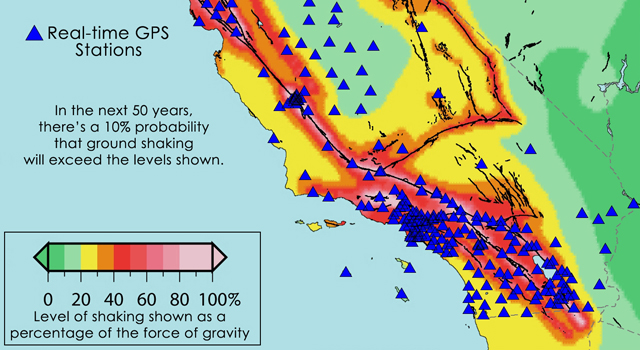
    Location of the more than 500 real-time GPS monitoring stations in the western United States that make up the Real-Time Earthquake Analysis for Disaster Mitigation Network. Image credit: USGS/UC Berkeley/Scripps Institution of Oceanography.
    Location of the more than 500 real-time GPS monitoring stations in the western United States
    that make up the Real-Time Earthquake Analysis for Disaster Mitigation Network.
    Image credit: USGS/UC Berkeley/Scripps Institution of Oceanography.

    The space-based technology that lets GPS-equipped motorists constantly update their precise location will undergo a major test of its ability to rapidly pinpoint the location and magnitude of strong earthquakes across the western United States, according to NASA. Results from the new Real-time Earthquake Analysis for Disaster (READI) Mitigation Network soon could be used to assist prompt disaster response and more accurate tsunami warnings.

    The new research network builds on decades of technology development supported by the National Science Foundation, the Department of Defense, NASA and the U.S. Geological Survey (USGS). The network uses real-time GPS measurements from nearly 500 stations throughout California, Oregon and Washington. When a large earthquake is detected, GPS data are used to automatically calculate its vital characteristics, including location, magnitude and details about the fault rupture.

    “With the READI network, we are enabling continued development of real-time GPS technologies to advance national and international early warning disaster systems,” said Craig Dobson, natural hazards program manager in the Earth Science Division at NASA Headquarters in Washington. “This prototype system is a significant step towards realizing the goal of providing Pacific basin-wide natural hazards capability around the Pacific ‘Ring of Fire.’”

    Accurate and rapid identification of earthquakes of magnitude 6.0 and stronger is critical for disaster response and mitigation efforts, especially for tsunamis. Calculating the strength of a tsunami requires detailed knowledge of the size of the earthquake and associated ground movements. Acquiring this type of data for very large earthquakes is a challenge for traditional seismological instruments that measure ground shaking.

    High-precision, second-by-second measurements of ground displacements using GPS have been shown to reduce the time needed to characterize large earthquakes and to increase the accuracy of subsequent tsunami predictions. After the capabilities of the network have been fully demonstrated, it is intended for use by appropriate natural hazard monitoring agencies. The USGS and the National Oceanic and Atmospheric Administration are responsible for detecting and issuing warnings on earthquakes and tsunamis, respectively.

    “By using GPS to measure ground deformation from large earthquakes, we can reduce the time needed to locate and characterize the damage from large seismic events to several minutes,” said Yehuda Bock, director of the Scripps Institution of Oceanography’s Orbit and Permanent Array Center in La Jolla, Calif. “We now are poised to fully test the prototype system this year.”

    The READI network is a collaboration of many institutions, including Scripps at the University of California in San Diego; Central Washington University in Ellensburg; the University of Nevada in Reno; California Institute of Technology/Jet Propulsion Laboratory in Pasadena; UNAVCO in Boulder, Colo.; and the University of California at Berkeley.

    NASA, NSF, USGS and other federal, state and local partners support the GPS stations in the network, including the EarthScope Plate Boundary Observatory, the Pacific Northwest Geodetic Array, the Bay Area Regional Deformation Array and the California Real-Time Network.

    “The relatively small investments in GPS-based natural hazards systems have revolutionized the way we view Earth and allowed us to develop this prototype system with great potential benefits for the infrastructure and population in earthquake-prone states in the western United States,” said Frank Webb, Earth Science Advanced Mission Concepts program manager at JPL.

    The READI network is the outgrowth of nearly 25 years of U.S. government research efforts to develop the capabilities and applications of GPS technology. The GPS satellite system was created by the Department of Defense for military and ultimately civil positioning needs. NASA leveraged this investment by supporting development of a global GPS signal receiving network to improve the accuracy and utility of GPS positioning information. Today that capability provides real-time, pinpoint positioning and timing for a wide variety of uses, from agriculture to Earth exploration, NASA said.

    “Conventional seismic networks have consistently struggled to rapidly identify the true size of great earthquakes during the last decade,” said Timothy Melbourne, director of the Central Washington University’s Pacific Northwest Geodetic Array. “This GPS system is more likely to provide accurate and rapid estimates of the location and amount of fault slip to fire, utility, medical and other first-response teams.”

    The GPS earthquake detection capability was first demonstrated by NASA-supported research on a major 2004 Sumatra quake, conducted by Geoffrey Blewitt and colleagues at the University of Nevada in Reno.

  • OAG Launches Mapper, a New Network Analysis Mapping Tool

    OAG unveiled its new aviation analysis mapping tool, OAG Mapper. This latest innovation, from the global leader in aviation intelligence, combines a powerful global flight schedule query with advanced mapping software technology to quickly plot route network maps, based on data drawn from OAG’s market leading schedules database of 1,000 airlines and over 3,500 airports. It is ideal for those in commercial, marketing and strategic planning roles across the airlines, airports, tourism, consulting and route network related industry sectors.

    According to the announcement, a web-based tool that eliminates the need to hand-draw network routes onto maps, OAG Mapper allows users to either import IATA Airport codes, or to enter a carrier, airport, equipment type or a combination of these and generate custom network maps in seconds. The user can then highlight key routes by changing the thickness and colour of the lines and label them for easy reference, save the map to their profile and export to jpeg for use in network planning, forecasting, strategy and executive presentations.


    “Aviation professionals who plan, forecast and analyse airline networks have never before had a single system that allows them to bring their network plans and presentations to life in an online format,” said Rob Shaw, OAG Product Director. “The OAG Mapper tool provides users with the ability to easily build an online library of custom-generated aviation route maps. It is a great example of how using OAG data intelligently can lead to the development of new solutions that help streamline our customers’ processes, increasing productivity and saving valuable time.”

  • TomTom Launches New Global Geocoding Web Service

    At the Geospatial World Forum, TomTom announced the launch of its high volume batch geocoding web service. The TomTom Global Geocoder enables businesses to process large amounts of data with a single click of a button and return results quickly.

    According to the announcement, geocoding is the process of converting addresses into geographic coordinates to allow location analysis. By combining geographic knowledge with business information, businesses can make smarter decisions that will lead to better products, as well as cost savings and process improvements. For example, insurance companies are relying on geocoding techniques to help set premiums and make underwriting decisions based on the physical locations of the insurance projects.

    “Geocoding is part of TomTom’s DNA. With close to 30 years of experience developing global digital maps, TomTom is known for its expertise in geocoding,” said Dan Adams, Vice President, Location and Live Services at TomTom. “By launching our global batch geocoding web service, we are providing critical spatial data to fuel our customers’ analytic engines.”

    The TomTom Global Geocoder offers the following benefits:

    • High volume results in one easy step, with no usage restrictions
    • International coverage enables one stop for all geocoding needs
    • Highly accurate, address point level matching
    • Fast results delivering hundreds of thousands of records per hour

    Visit TomTom at Geospatial World Forum booth #19 in hall 10 to learn more about the TomTom Global Geocoder, as well as other products.

  • U.S. Army Geospatial Center Introduced the HyDRA Android App

    The U.S. Army Geospatial Center (AGC) and Engineer Research and Development Center introduced the Hydrologic Data Resources Application (HyDRA) – a Web-based data survey and analysis tool created to provide the Dept. of Defense (DoD) logistics and geospatial intelligence-related water communities with information on water resources data collection, visualization and dissemination in a mobile, enterprise-enabled environment.


    According to the announcement, HyDRA allows users to view, collect and edit unclassified water resources features via Android 2.2+ OS smart devices using Google Maps and Google Earth applications. Wells, water tanks, water storage points, dams, treatment plants and other features may be added, queried and edited in “connected” and “disconnected” modes; collected features may also be edited through a Web page using the same functionality. The Web page and app were created to assist U.S. Army engineers and the water community working in infrastructure and reconstruction operations with feature collection and identification. A compass feature is also included to assist the user in finding the nearest water feature and its bearings.

    The mobile application may be downloaded from the AGC’s Web site. An offline version of the mobile application is under development and will allow the user to store collected data locally and sync to the server after an internet connection becomes available.

  • SeaZone Introduces SeaZone HydroSpatial 2

    HydroSpatial announced it has released the first in a new series of marine mapping layers to sit within the new HydroSpatial 2 Product Family. Benefits include an enhanced data model, allowing for intuitive feature filtering; geo-processing and spatial analysis to create customised data outputs and map views using both real world and abstract feature types. Mapping is delivered in themed tiers with improved symbology, and licensed as a complete package, delivering an exceptional user experience in both desktop, and web GIS.

    According to the announcement, SeaZone HydroSpatial Base provides users with a definitive worldwide marine reference map incorporating large-scale, authoritatively sourced, marine geographic datasets. The content is processed to form a continuous vector layer dataset, with a well structured and defined feature and attribute model, providing the best possible marine mapping experience. SeaZone HydroSpatial Base is ideal for use as a marine spatial planning aid and as a primary decision support tool. It has a global reach and is available for regions where content is captured to scales greater than or equal to 1:1,500,000. The feature attribution for SeaZone HydroSpatial Base is comprehensive and serves a wide range use scenarios. For the high end technical user, HydroSpatial Base performs well when interrogated by vigorous and complex geo-processing or spatial analysis in GIS. For less demanding requirements, HydroSpatial Base represents an excellent high-resolution selectable back-drop with flexible filtering and styling.

    SeaZone reports that the HydroSpatial Base provides decision makers with accurate information to make effective decisions in the marine environment. SeaZone HydroSpatial Base was delivered as a result of an extensive consultation with our HydroSpatial customers about how they would like the product to evolve, the improvement content they needed and the prices they would like to pay. SeaZone acknowledges the support of EU Interreg IVB Bringing Land and Sea Together (BLAST) Project in developing and testing the HydroSpatial Base concept.

  • FAA Awards Raytheon Two-year Contract Extension on WAAS

    The Federal Aviation Administration (FAA) has awarded Raytheon Company a two-year contract extension to continue to provide services for the Wide Area Augmentation System (WAAS), a safety system that provides satellite-based navigation in the continental United States, Alaska, Canada and Mexico. The $30.1 million contract extends the period of performance through Sept. 24, 2013.

    “Raytheon has been the FAA’s prime contractor for WAAS since the system was commissioned for operational use in the United States in 2003,” said Michael Prout, vice president of Security and Transportation Systems for Raytheon’s Network Centric Systems business. “The contract marks another milestone in the continuing partnership between Raytheon and the FAA to improve safety and efficiency for pilots.”

    According to the announcement, Raytheon will provide life-cycle support and other services to improve service reliability and availability, and increase the coverage area through system enhancements. WAAS enables GPS to meet air navigation performance and safety requirements for en route, terminal, non-precision approach, and approach with vertical guidance operations.

  • u-blox Acquires 4M Wireless for LTE Technology

    u-blox, fabless provider of positioning and wireless semiconductors, software and solutions, will acquire 4M Wireless, a company that designs and develops software and test solutions for developing fourth-generation (4G) mobile wireless devices based on the latest Long Term Evolution (LTE) standards.

    The acquisition will give u-blox ownership of advanced protocol stacks that are licensed to chipset vendors whose products enable 4G user equipment for applications with needs for high-speed data connectivity such as smartphones, tablet computers, notebooks, and any other high-speed wireless modems, u-blox said. Also a variant of the products is licensed to manufacturers of 4G test equipment. 4M Wireless was founded in 2006 and has headquarters in the UK and operations in Lahore, Pakistan.

    Key terms of the transaction include acquisition of 100% of the shares of 4M Wireless at a price of approximately $9 million US, depending on earn-out; intellectual property and software in the area of LTE wireless technology; and integration of the 4M Wireless business and employees into u-blox’ organization.

    LTE is a unifying technology for almost all mobile operators around the world. All GSM/UMTS operators as well as most CDMA operators have agreed to evolve to LTE. Currently, there are 35 commercially available LTE networks in more than 20 countries, and 48 manufacturers have already announced 197 different LTE end-devices. 300 Million LTE subscribers are expected by 2015.

    The acquisition is subject to customary closing conditions and pending regulatory approval. Closing is expected by September 2012.

  • Geosoft 2012 Software Released

    Geosoft announced the availability of its 2012 Software Release, including updates to Oasis montaj, Target, Target for ArcGIS and GM-SYS Modelling software, and the new release of Geosoft VOXI Earth Modelling, a geophysical inversion software service that generates 3D voxel models from airborne or ground gravity and magnetic data. The 2012 release includes major 2D and 3D workflow enhancements and new capabilities that deliver greater efficiency and flexibility for resource explorers and earth scientists exploring the earth’s subsurface.


    “Each year Geosoft has continued to make improvements in developing our software technology to support explorers challenged to visualize and analyze more complex structures, deeper under cover, within integrated interpretations,” says Louis Racic, Geosoft Product Director. “The 2D to 3D workflow is an important one to get right, and a particular challenge for geoscientists working across GIS and exploration software platforms. Bridging the gap between 2D and 3D is a key improvement area within our 2012 Software Release.”

    Release highlights

    According to the announcement, new capabilities and workflow improvements in the Geosoft 2012 Software Release help save time and provide greater flexibility when visualizing multidisciplinary geoscience data in 2D and 3D.

    Improved 2D to 3D workflows in Target for ArcGIS: The 2D to 3D workflow enhancements, include new display capabilities, and new section import and export options. Layers, such as interpretation layers from sections or plans can now be easily displayed in their correct geospatial orientation within your 3D view. 2D section interpretations can be exported to a 3D georeferenced file, such as shapefiles or DXF files, to be shared with other 3D applications. 3D vector files, such as open pit outlines, and wire frames can now be easily imported to multiple section and plan maps.

    3D Viewer improvements: Geosoft 3D gridding methods have been expanded to include IDW and direct gridding; these new methods better support the 3D gridding of a broad range of data types. Angled clipping of objects in 3D views provides the ability to clip parallel or perpendicular to dataset orientation or geological strike. Geoscientists can set a clipping plane that aligns with any direction chosen.

    Expanded GM-SYS 3D density model support: Voxels can be used to define the 3D density variation within GM-SYS 3D model layers. This provides more direct integration with 3D seismic data as the generated density cubes may be used directly in the GM-SYS model.

    BING Maps imagery: Geoscientists can now add satellite imagery to their basemaps by connecting to the Bing Maps online data source. This is a useful, additional data layer which provides geographic context to maps.

    VOXI Earth Modelling

    Geosoft VOXI Earth Modelling is a new geophysical inversion software service that generates 3D voxel models from airborne, ground gravity and magnetic data. VOXI Earth Modelling is accessiblewithin Geosoft Oasis montaj and uses the power of cloud computing to rapidly invert large exploration datasets. More information on VOXI Earth Modelling is available at www.geosoft.com/voxi.

    Release availability

    Online installation of the Geosoft 2012 Software Releaseis available within Geosoft software and from the Downloads page within the Geosoft online support centre. Information on how to request an update DVD is available in the Geosoft Support Knowledge Base.

  • Trimble Introduces Ultra Rugged GNSS Smart Antenna for Heavy Civil Construction

    Trimble Introduces Ultra Rugged GNSS Smart Antenna for Heavy Civil Construction

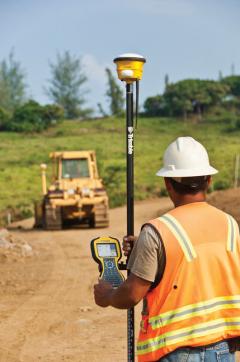
    Photo: TrimbleTrimble has introduced the ultra-rugged Trimble SPS985 GNSS Smart Antenna for performing high-accuracy construction site measurements. The new smart antenna is made of a specially developed alloy that combines unprecedented strength and durability into a compact form to withstand the daily abuse of construction work, Trimble said.

    With its enhanced internal shock isolation, the SPS985 is suited for high-vibration use on an all-terrain vehicle (ATV) or supervisor truck. User-friendly features such as a quick release connector and smartphone configuration make it easy to deploy and use as a base station or rover, mounted on a range pole or truck roof, Trimble said. Advanced communications including Wi-Fi, Bluetooth, and optional wideband radio integrate the receiver into the connected construction site.

    “The Trimble SPS985 was engineered to be the toughest, smallest and easiest to use GNSS receiver we’ve ever built,” said Chuck Maniscalco, director of engineering for Trimble. “We listened to customer feedback and built the housing 50 percent stronger than any previous Trimble antenna, because we wanted it to perform ideally under extreme conditions — such as being dropped, tossed in a truck bed, rained on and otherwise abused in the construction setting. Contractors will likely never treat their SPS985 antennas as harshly as the Trimble engineering team has, but we intended to take rugged GNSS to the next level and we certainly achieved that.”

    When used as a rover, the SPS985 allows for maximum flexibility for use on a wide variety of site measurement tasks. For initial site reconnaissance, it can be deployed with satellite-delivered GNSS corrections without a base station. For higher accuracy site measurements, it can receive Real-Time Kinematic (RTK) corrections via the internal wideband radio, Wi-Fi or the Internet.

    An SPS985 unit can be easily moved from carrying case to range pole, tripod, t-bar, or vehicle with a single click — making it faster to begin working and allowing for more flexibility of operation techniques. For example, a grade checker can mount the SPS985 to an ATV and easily conduct site topos, check as-builts and verify road centerlines where it is not easy or safe to walk with a range pole. Extending its productivity, the same unit can then be mounted on the roof of a supervisor’s truck roof to collect and manage progress data.

    As a base station, the SPS985 incorporates Wi-Fi communications for small site projects and optional wideband radio for long-range operations on large projects. Designed for ease of use, it will automatically establish a radio or Wi-Fi connection and transmit RTK corrections to another rover or machine control system, Trimble said. Construction crews can spend more time doing the work and less time setting up and maintaining the equipment.

    As a component of the Trimble Connected Site solutions portfolio, the SPS985 also offers connectivity features that save administrative time and increase working productivity. When used with a Connected Controller such as the Trimble TSC3 or Trimble Tablet, job crews can connect to a mobile hotspot in the site trailer or supervisor’s truck and receive GNSS corrections via VRS network or Trimble Internet Base Station (IBSS). They can also save considerable time by wirelessly synchronizing progress data and as-built information to the job supervisor or head office and receiving updated design information back without ever leaving the job site.

    Quick start technology and the ability to set up and configure the receiver using a smartphone increases flexibility and eliminates the need to use a more expensive controller for daily setup. The Trimble Web UI is optimized for small screen devices, allowing a GNSS manager to monitor base station performance, availability and configuration without visiting the job site to set up each day.

    The new Trimble SPS985 GNSS Smart Antenna is available now through Trimble’s worldwide SITECH Technology Dealer Channel.

  • Urban Airship Partners with Meridian for Indoor Location Targeted Mobile Messaging


    Urban Airship has announced a strategic partnership with Meridian for indoor location targeted mobile messaging. Meridian’s technology will enable Urban Airship customers with physical locations to reach people at the point of decision with indoor location targeting. Together, the companies’ solutions offer broad capabilities for location-targeted messaging, from quickly identifying audiences with certain behaviors or preferences in regions down to a neighborhood level, to delivering pinpoint targeted messages inside buildings.

    Since partnering with Cisco to build an “indoor GPS” app for the American Museum of Natural History, Meridian has helped many different types of venues offer apps with campus and building-specific search functionality, multimedia, turn-by-turn directions, and push messaging powered by Urban Airship. Urban Airship Segments enables marketers to segment mobile audiences by location, time, context and preferences to improve the relevancy and targeting of messages and offers. Together, the organizations offer capabilities to utilize context and location to drive mobile audiences to and through physical locations.

  • Qualcomm Announces Commercial Availability of MCP50 for Fleet Management


    Qualcomm announced the commercial availability of the Mobile Computing Platform 50 (MCP50). For fleets of all sizes, the fleet management solution helps transportation companies meet safety and regulatory compliance requirements to manage their business operations, Qualcomm said. Qualcomm also launched flexible new monthly pricing plans.

    “We are committed to helping fleets succeed and grow as they adapt to new industry demands and regulations,” said Norm Ellis of Qualcomm Enterprise Services. “With more than 150 private and for-hire fleets of all sizes already committed to adopting the MCP50, we are pleased that our industry-leading fleet management applications are now more accessible than ever to help fleets address a broad range of operational challenges, including safety, compliance, productivity and fuel efficiency.”

    MCP50 delivers applications to meet the core operational needs, including safety and compliance requirements, such as FMCSA’s HOS regulations and CSA program. Applications include: Qualcomm Hours of Service, CSA Safety Performance Service, Critical Event Reporting, CoPilot Truck In-Cab Navigation provided by ALK Technologies, Performance Monitoring with Fuel Manager, Analytics Manager and Vehicle Inspection Report. Other Qualcomm applications planned for future releases of the MCP50 include Circle of Service Workflow, Trip Manager and Vehicle Maintenance.

    MCP50 is available for $799 SRP through local dealers and resellers that are part of the Pana-Pacific distribution network or directly from Qualcomm Enterprise Services. Qualcomm Enterprise Services also offers six different monthly service pricing plans, starting at $19.95 per month.