Category: Applications

  • Telematic Future: eCall, Insurance, Drive-Share

    By Moni Malek

    Consider two notable developments in 2011 that will influence the development of consumer transportation:

    • China became the largest manufacturer of automobiles, producing more than 18 million vehicles, easily overtaking Europe and North America.
    • Smartphone volume shipments surpassed the volume of laptops and desktop PCs combined.

    Reflecting these two rising economic rockets, the November Munich Telematics show drew its largest attendance yet, 500-plus participants, and a greatly expanded exhibit area.

    The rising dominance of smartphones — one participant observed that they are taking over the world —will have a big impact on how users expect to access or view their telematics data; that is, any wireless information accessed by them while in their car. Developers and manufactures used to have a problem regarding which system to support, but with Android now at more than 50 percent of smartphones share, it is becoming the de facto first-choice standard and will probably become the user interface model.

    eCall. Also in 2011, the European Union finally mandated eCall, the emergency call system in automobiles that sends vehicle position to emergency services after a crash. Unfortunately, the mandate is for 2015. I guess this gives them a chance to use the European satnav system Galileo, which hopefully may have something to offer hopefully by then.

    This year the Russians leapfrogged the Western Europeans and mandated their own version of eCall, known as ERA, for 2013. It will use GLONASS, the Russian satnav system, which unlike Galileo is operational now. Of course, GPS is still employed, and the real benefit today is using GLONASS plus GPS in a multi-constellation fix mode for higher reliability especially in urban areas compared to GPS alone.

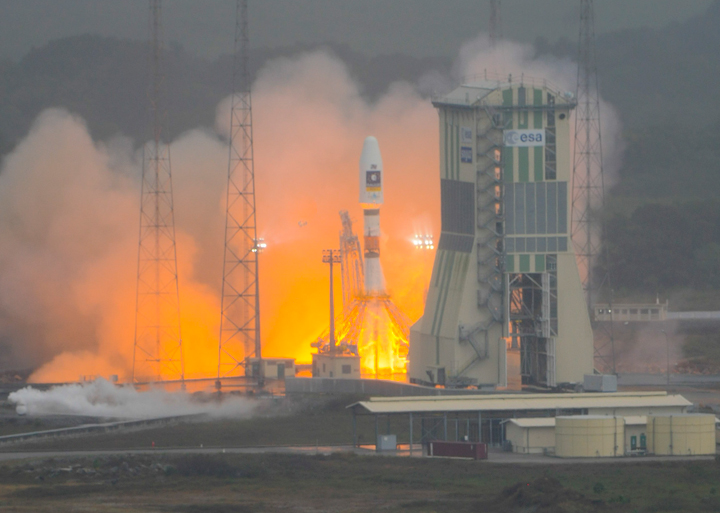
    Malek-1A . Credit: Moni Malek
    Malek-2B . Credit: Moni Malek

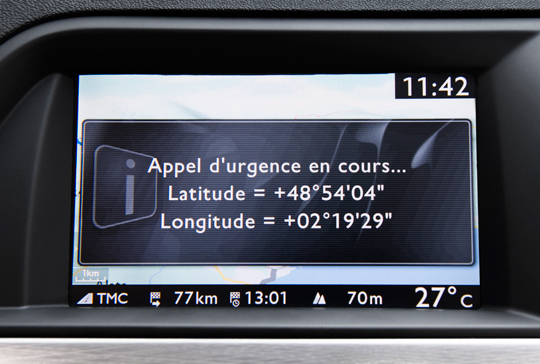
    Emergency call in progress, triggered by SOS button in PSA Peugeot Citroen’s roof panel (bottom photo).

    At the Munich Telematics show it was clear that the Russian mandate has put wind into the telematics emergency call market’s sails. From the Russian company Cesar’s presentation, we learned that following road accidents in Russia, 14 percent of car occupants die, compared to 2 percent in the United States. Getting emergency support to the scene more quickly is critical to reducing fatalities, and on this basis Russia has got some catching up to do.

    You would think that everyone would be rushing to get more safety, and as one market research presenter said, it comes high on the user wish list. Another presenter stated that while people may desire it, they seem reluctant to pay for it at first. As an historical example, initially when people had the option of paying for airbags as an extra, it was practically never taken as an option. Now it is standard in all cars for drivers and passengers.Think about it — would you now buy a car without an airbag?

    PSA Peugeot Citroen, the big French car company, shows the way with a version of eCall in their cars that doesn’t lose money! There is a big debate about who gets called when a crash happens. Is it the public service access points (PSAPs) or third-party services (TPS). Peugeot favours the TPS model, which can filter the more common breakdown and false alarms from true crash calls to be forwarded to the emergency services at PSAPs. While eCall initially favoured PSAP, the trend seems to support Peugeot’s decision and TPS.

    The PSA eCall also does not support the so-called in-band modem, which allows crash-position data to be sent over a voice call on the eCall box by encoding the data into a speech-like signal. The modem theory is, you need to keep the voice call open to keep talking to the person in the automobile. According to PSA, apart from the issue of patents with the in-band modem, it seems that 30 percent of the data is lost, and 40 percent of the PSAPs in Germany cannot handle it.

    GPRS is the best way of sending crash-position data with SMS text message as a back-up. As for voice, most people get out of their car after an accident and do not speak on the eCall box. I guess if people are unconscious and are not able to get out of the car, they won’t speak either.

    While smartphones dominate in many areas, they have been ruled out for eCall safety apps in cars, as no one can guarantee a smartphone will work after an accident. As for crash detection, that can only work if a device is bolted down to the car frame. Only that way can you sense the high-G forces during a crash.

    Insurance. Until the mandates kick in for eCall/ERA, you can understand why an automobile manufacturer’s marketing imagery does not include one of their car crashing or breaking down. So selling the eCall feature in this mindset is hard. On the other side are guys that do have the image of helping you after a crash: the insurance companies. And true to form, the big business has become insurance telematics.

    Octo Telematics has taken a pole position in this area and had an impressive crashing-car demo that you could sit in at the show. The insurance telematics box then becomes an aftermarket product that is cross-subsidized by the insurance company. In return they receive crash data and get to monitor you to help you improve driving habits to reduce crashes.

    Malek-2 . Credit: Moni Malek
    Octo Telematics crash simulator. Show attendees were taken for a ride! The telematics box sends crash data to the insurance company to help drivers improve driving habits.

    A last word on safety: most accidents now seem to occur when people are texting while driving. Apparently when the Blackberry message service was down for three days in Dubai, there were 20 percent fewer accidents.

    Apart from eCall and insurance telematics, the other famous perennial telematic application is the connected car. As we all expected, we saw a lot of presentations on this. In simple terms, via telematics, a car is connected to the Internet. As the definition of telematics The branch of information technology that deals with long-distance transmission of computerized information, this might seem a no-brainer. But exactly how the car is connected and what value that offers constitute the two key questions for any application and market segment. Today a car buyer will almost certainly be an internet user.

    How Is It Connected? For basic telematic apps like eCall and stolen vehicle recovery, it suffices to connect to the 2G GSM/GPRS wireless network that gives worldwide coverage. Operators like Telenor offer a so called global subscriber identity module (SIM) model that supports worldwide access at a price that makes business real.

    For the so-called infotainment connectivity, the trend is 4G LTE, which offers the high data rates that the car companies dream about and flat-rate smartphone users expect. LTE is a packet mobile phone network already at Verizon and in European trial that is ideal for data. It appears that in the future, the best mobile phone network will be a combo of 4G LTE for infotainment data with 2G GSM for speech and 2G GPRS for global coverage telematic data.

    What Value Does It Offer? The blanket answer is, unless it offers a useful service, it won’t really be used. Today most connected car services drop to a poor 10–20 percent retention after the free trial period. The key is really to look for helpful services. For instance, the connected heater or rather the ability to switch your car heater remotely on in cold winters of Sweden increased Volvo connected usage 50 percent. Saving fuel in this energy conscious low CO2 emission days would seem a useful application. Couple that with a connected car, traffic information, best routes, good driving-habit rewards, social network to let you post your good driving score, and ….

    Fiat showed its eco:Drive solution, helping people save 6 percent on fuel consumption on average. That’s a start.

    At the end of the day, more efficient cars are the answer to that. Getting people to use more efficient small cars for short trips is one of the ideas behind the BMW car-sharing model. Based on the BMW One series and the Minis made by BMW, it offers a service in Munich and Berlin (I have to admit I live in Munich and haven’t tried it yet). When you register, you present your driving license and the service add an RFID. You can use this RFID as a keyless entry into a car share. Of course the cars are connected, and a smartphone app helps you find the next free car. You can pick it up and drop it off where you want. Because they are new, more efficient small cars than your average old gas guzzler, they have done a deal to get free parking in town. It costs a flat 29 cents (Euro cents) per minute to drive, which includes the fuel price. I can remember when a mobile phone call cost that much before!


    Moni Malek is CEO of ML-C MobileLocation-Company GmbH, based in Munich, Germany.

  • Three Geospatial Trends/Technologies for 2012

    A friend of mine is in the bathroom fixture business. When I talk to him, it really makes me appreciate the geospatial industry. While there isn’t much uncharted territory and innovation in bathroom fixtures business, the geospatial industry is ripe for opportunity and innovation. Yes, two out of three of my geospatial technology trends are mobile devices. As I wrote last month, I think the geospatial bottleneck is data. Mobile devices help ease the bottleneck by providing a widely deployed data-collecton platform. How many people do you know who own a smartphone or tablet computer that didn’t own one three years ago? They are proliferating like crazy, and geospatial apps can turn them into geospatial data-collection devices allowing more fuel (data) to flow into the GIS engine.

    Following are my three geospatial trends/technologies for 2012.


    1. Building Information Modeling (BIM)

    Over the past 40 years, fed/state/local government and commercial entities have spent a tremendous amount of time and energy developing outdoor GISs for applications ranging from land parcel management to utility pole management. I guess it was the case of tackling the “low-hanging fruit” since we had GPS, aerial photography, and other sensors that allowed us to collect outdoor geographic data relatively efficiently. Also, the ROI (return on investment) case for many outdoor GIS can be clearly visualized and stated. The ROI for BIM hasn’t always been easy to visualize, and the cost of populating a geodatabase with BIM information can be a challenge. But, I think we’ve turned the corner and realized the potential for BIM is astounding. Take a look at some of the following articles weve written on the subject over the past few years.

    Is the Geospatial Bottleneck Software or Data?

    Visualization in Transportation Symposium

    INTERGEO 2011: The World’s Largest Geospatial Conference

    As Data Collection Technology Advances, So Does BIM

    BIM, Son of CAD and GIS


    2. Smartphone Adoption

    Who can ignore the rapid adoption of smartphones around the world?

    “Crackberries” (Blackberry) have been around for many years and are largely thought of as the defacto standard for smartphones. However, the Blackberry is giving way (but still growing) and being overtaken by Apple and Android-based smartphones.

    Today’s software developers have the challenge of deciding which operating system platform to support. Should it be iOS (Apple), Android (Google), RIM (Blackberry), or Windows Mobile (Microsoft)? Although some companies with the software development resources choose to support all four, more than likely a company will select two. Which two? With RIM fading a bit, I’d say they can be dismissed first. Google and Microsoft make software development a lot easier for developers than Apple does, but who can ignore the huge iPhone market?

    Nonetheless, a huge number of geospatial apps are being built and deployed for smartphones. Take a look at some of these articles.

    Android Beating iPhone and Blackberry in Smartphone Operating System Market Share, says Nielsen Research

    RIM Nose Dives After Another Disaster Of An Earnings Report

    2011 Showed Better LBS Market Gains, But Was It All About Google?

    On the Edge: Driving Reality Home

    CSR, Navizon Debut Indoor Location and Navigation Systems

    Location Apps Popular in Japan Quake’s Wake


    3. Tablet Computer Adoption

    Given the tremendous consumer acceptance of the Apple iPad, the geospatial industry really hasn’t adopted the Apple iPad as much as one would think. I’m even surprised by its lackluster adoption by geospatial professionals, but I understand. The iPad isn’t exactly a computing powerhouse. It’s a sleek, attractive sports car with an engine built for efficiency and beauty, not for brute-force computing.

    However, what Apple has done is attract a number of manufacturers to pay attention to the tablet computing market.

    Also, it has brought the prices of tablet computers down to consumer price levels. The days of $4,000-$5,000 tablet computers are numbered, even the “ruggedized” ones.

    How can an organization justify $4,000 for a “ruggedized” tablet computer when they can purchase a consumer tablet computer, running Windows, for well under $1,000? Yes, in some cases you can justify the data is worth the capital expense, but in an era of severe budget cuts, it’s inceasingly more difficult to justify the expense.

    The Apple iPad Factor

    The Apple iPad Factor – Continued

    Dry Corp, LLC Introduces Waterproof Case for Smartphones and Tablet Computers

    GammaTech Introduces Rugged, Convertible Notebook Computer

    A Look at the Rugged Handheld Algiz 7

    Juniper Launches Mesa Rugged Notepad

    Take a look here for a list of consumer tablet computers from NewEgg.com. Consumer tablet computers for well under $500.

    Thanks, and see you next week.
    Follow me on Twitter at http://twitter.com/GPSGIS_Eric
  • Interview: 2nd Space Operations Squadron Commander, Lt. Col. Jennifer Grant

    December is typically the month when writers of regularly featured columns wax nostalgic and engage in a certain amount of prognostication. This year I enlisted the help of Lt. Col. Jennifer Grant, the 2SOPS/CC at Schriever AFB, the home of GPS, to help us with our year-end review and crystal-ball gazing as we look ahead to the GPS horizon. Lt. Col. Grant reminisces about her first 16 months as 2SOPS/CC, reviews numerous major accomplishments, and updates us on the status of the GPS constellation as well as the often overlooked, ever contentious and always seemingly in flux critical Command and Control (C2) segment.


    By way of introduction, I first met Lt. Col. Grant when she was assigned to the Command Suite at Headquarters Air Force Space Command at Peterson AFB in Colorado Springs, Colorado, and served under the four-star commander General Robert Kehler, who is now the commander of USSTRATCOM (United States Strategic Command). At the time she impressed me as being intelligent and insightful. Her professional reputation as a perfectionist certainly supported that assessment. The next time I met Jennifer, we were both wearing different hats and serving in different roles.

    Several of us on the GPS Independent Review Team (GPS-IRT) were sent by General Kehler to Schriever AFB to check in with the new 2SOPS/CC and see if we could offer her any assistance. This is a role we, the IRT, have played many times in the past, and just like the old saw concerning Inspector General (IG) visits, our mantra was and is “…we are only here to help…that’s our story and we are sticking to it.” Regardless of the perception or even trepidation over our visit, Jennifer and her staff were extremely supportive and it was abundantly clear that Lt. Col. Grant was drinking from a fire hose and doing more than surviving. She actually seemed to be handling it well and possibly even enjoying herself. While she was not new to Space Command, she was new to the GPS.

    More than a year later, I and another IRT member paid Lt. Col. Grant another official visit and the transformation was nothing short of amazing. Did I fail to mention that she is also known as a quick study? In 16 months’ time Jennifer went from the new kid on the block in GPS operations to a sophisticated, erudite, extremely knowledgeable and passionate advocate and supporter of the GPS and all aspects of 2SOPS operations.

    Recently she stood toe-to-toe in a meeting with the same GPS-IRT members that visited her 16 months ago and proved without a doubt that she has matured as a commander and GPS operator beyond our wildest imaginations. To her credit she is not intimidated by titles, rank or history. She knows her job. She walks the talk and will not hesitate to challenge anyone, although very politely and with a smile, who is not totally accurate and fair in his or her assessment of GPS operations yesterday, today and tomorrow.

    Like any good commander, she is totally and relentlessly supportive of her command and her people. However, she is pragmatic enough to know that changes, and big ones, are on the horizon. At the same time she realizes that she commands not only the largest and most well-known military space constellation on orbit today, but also one that supports the entire planet’s critical infrastructures with crucial timing, frequency, position and navigation information. GPS has become the de facto time and time frequency distribution system for the world we live in today. There are more than two billion known users worldwide, and that conservatively equates to more than 5 billion GPS receivers. Indeed, given the number of stealth GPS receivers in almost every appliance we use today, that number could easily grow to more than 10 billion. No stress there!

    When I called Lt. Col. Grant about a follow-up IRT visit and mentioned that an interview might also be in order, she replied that she would get right on that as soon as she spent Thanksgiving with her family. Imagine that, she actually took a day off. In the real world she seems to balance being a wife, mother and commander of the world’s most visible satellite constellation with a maturity beyond her years.

    Now that we have peeled back the curtain just a bit, let’s see what Lt. Col. Jennifer Grant has to say about the Global Positioning System and PNT in general.


    DJ: Don Jewell, GPS World Defense Editor
    JG: Lt. Col. Jennifer Grant, 2SOPS Commander 


    DJ: What can you tell us about your first year as the 2SOPS/CC?  What makes you happy about your command job and GPS specifically?

    JG: Don, my time as the new 2SOPS/CC has really passed quickly! Commanding the largest DoD satellite constellation is both humbling and invigorating. It is amazing to look back over the past year and recount our accomplishments as a team: I accepted satellite control authority of the first two GPS IIF satellites; we completed the largest satellite repositioning in history with expandable-24; we successfully completed two major test exercises involving demonstrations of flex power and SA/ASM (Selective Availability and Anti-Spoofing Module), respectfully; we successfully completed the largest major software sustainment installation, AEP 5.7.0 [ed. Architecture Evolution Plan]; we flawlessly executed two operation mission transfers to our back-up (Command & Control) location; we’ve completed dozens of station-keeping maneuvers; we’ve resolved on-orbit anomalies and sustained the constellation of satellites which have outlived their estimated design life — and celebrated the 21st birthday of SVN-23, our oldest IIA satellite on orbit. We’ve also disposed of SVN-24 and are preparing for the disposal of SVN-30. Our GPS Operations Center (GPSOC) has provided 75,000+ products to our mission planners and warfighters down range, and we have seen the implementation of our GPS Google Earth tool.

    On the personnel front, we were part of the team, along with 19SOPS and SMC — Space and Missile Systems Center, awarded the USAF Chief of Staff Team Excellence Award (CSTEA) in Washington, D.C., for the GPS IIF Launch; and we were part of the past and present GPS team of personnel earning the International Aerospace Federation’s 60th Anniversary Award for excellence in aerospace. General Shelton accepted this award in Johannesburg, South Africa, on behalf of the U.S. Air Force contributions to the GPS. We have also achieved the most accurate signal-in-space in our history, far surpassing the office of the Secretary of Defense, Standard Positioning Service Performance Standard requirement of seven meters!

    2SOPS, with assistance from our reserve mission partner, 19SOPS, supports more than two billion position, navigation and timing (PNT) users worldwide. The work we do every day and the mission we execute supports critical infrastructure, life-saving missions and worldwide operations.

    100820-F-1631A-028 . Headshot: Lt. Col. Jennifer Grant
    Lt. Col. Grant speaks at the change of command ceremony in August 2010,
    when she took over command of 2SOPS.

    In short, Don, I love my job — and I have the sharpest, best and brightest team of personnel employed to execute these tasks. I am amazed every day at the level of proficiency and professionalism demonstrated by our Total Force team of active duty, reservists, aerospace engineers, contractors and government personnel. Our team has managed and maintained the position, navigation and timing gold standard and will continue to do so.

    Making a difference in the lives of people gives me a great deal of personal and professional satisfaction. We are not doing our jobs right if we are not making the world a better place…one contact at a time, be it people or payloads.

    DJ: Can you give us a status of GPS as a system of systems, to include ground control, monitoring and the on-orbit constellation? Give us, if you will, a status brief of where GPS stands today, including SVN-49. And, since you are known for being precise when you speak about GPS matters, can you please answer using the nomenclature we should all use when we refer to the various segments of the GPS?

    JG: Absolutely, Don! The GPS constellation is the most robust and capable system in the history of space.  We currently have 30 actively engaged operational satellites on orbit (9 GPS IIAs, 12 GPS IIRs, 7 GPS IIR-Ms and 2 GPS IIFs). We maintain a program baseline minimum 24-satellite constellation consisting of six orbital planes each containing four primary satellite slots. Our four dedicated ground antennas and six monitoring stations are working as intended, and our MCS (Master Control Station) at Schriever AFB as well as our AMCS (Alternate Master Control Station) at Vandenberg AFB are both fully functional.

    On 15 June 2011, we completed expansion of a total of three primary slots, which added 3 satellites into our current baseline and enables us to optimize GPS assets to improve operational effectiveness for global users and warfighters in terrain-challenged areas.

    Currently, there are 30 satellites set healthy to users, and a 31st satellite, a GPS IIA, will be set healthy on 16 December 2011. We have one satellite awaiting disposal and three remaining satellites in residual status. Each of the three remaining residual satellites are in LADO, which is our unique Launch/Early Orbit, Anomaly Resolution, Disposal, and Operations system. One of the residual satellites is SVN-49, and they will all be tested and checked out for determination of future use and viability as a long-term operational decision.

    DJ: Those of us who have been Squadron Commanders know there are persistent problems in any organization that just won’t go away, be they programmatic, operational or personnel issues. What is it that keeps you up at night?

    JG: Thankfully, Don, I am a sound sleeper with peace of mind, so not much!  But really, one of the main responsibilities we manage is maintenance and sustainment of the GPS constellation, and the older the satellites in the constellation get, the more care and feeding they require. Right now, about a third of our constellation has exceeded its satellite design life by 100% — satellites designed to last 7.5 years are between 15 and 21 years old. So we have invested a great deal of time into contingency planning in the event of component failures, multiple vehicle anomalies, etc. We are doing everything we can to continue to extend the lives of our satellites, and it is a tribute to engineering, design and the satellite builders as well as the expert sustainment operations and engineering that they have lasted as long as they have.

    We need to ensure our replenishment launches for the current generation IIF vehicles stay on schedule and a priority.

    DJ: Would you give us your view and hopefully the MAJCOMs view of the way ahead for GPS as it supports military, civil and commercial users around the globe? Look forward to the future for us — how do you see GPS operations evolving in the years ahead?

    JG: Don, the Air Force is constantly being asked to do more with less — resources, manpower and time.  In this fiscally constrained environment we are being challenged to find effective and efficient ways to accomplish our mission. We have come a long way from the legacy systems in improving our operations, and I think we will see even more improvements in increased automation, faster satellite contact times, and increased downlink capabilities, as well as streamlined operations.

    We will also, I believe, see an increased need for interaction and interoperability with our international position, navigation and timing providers and consumers. GPS, though still the largest PNT provider, is no longer the only game in town.

    Although the GPS satellite constellation is procured and operated by the US Air Force, we understand we support a much broader user community in the civil, commercial and military sectors. We take pride in providing extremely accurate PNT services to billions of users worldwide.

    And we are spending considerable resources to modernize the GPS constellation to provide even better service in the future. The continued fielding of new GPS IIF satellites and GPS control segment software updates are key to current modernization efforts. GPS III satellites and the Next Generation Control System (OCX) will further enhance GPS capabilities. Fully compliant user equipment is essential as modernization efforts continue.

    We’ll continue to improve our constellation with the launches of new satellites; the next GPS IIF is scheduled to launch in September of 2012 and the first GPS III should be available for launch in FY 2014. And OCX remains on-track for a Ready-To-Operate (RTO) date in 2015.

    DJ: And finally, if you were Queen for a Day, what would you like to see changed?

    JG: For operators, there is always an interest in and a desire for greater capability, faster processing…and for us it is in pushing the envelope for even greater accuracy with precision timing, position and navigation.

    There is also an interest in expanding application of our NAVWAR (Navigation Warfare) knowledge, application and operations — having an even greater number of people trained and embedded with warfighters as NAVWAR experts. This is where I think we will see some real growth in the future.

    DJ: Colonel Grant, I know you are incredibly busy and I can’t thank you enough for your time, your expertise and the look ahead to the future of GPS. Best of luck in all your future endeavors.


    Editor’s Note: I have visited the 2SOPS more than 20 times in the past five years, and I have known and visited every 2SOPS commander since that organization began to include then Lt. Col. and now General William Shelton, the four-star AFSPC/CC. I have never seen a more motivated GPS crew force than the one I saw during my last visit with Lt. Col. Grant. Squadrons tend to reflect the work ethic, mores and integrity of their commander, and my hat is off to Lt. Col. Jennifer Grant because her crews are obviously very motivated to support the warfighter, and they seem very happy in their jobs. The atmosphere in 2SOPS these days is positive, upbeat and very customer (that’s you and me) oriented. Plus, many of the crewmembers are just back from tours in Afghanistan and Iraq, so they know the needs of the warfighter and they are working hard to fulfill them.
    Till next time, happy holidays and happy navigating.

  • 2011 Showed Better LBS Market Gains, But Was It All About Google?

    2011 was a decent year for the location-based services industry. It was an even better year if your company was lucky enough to get bought out by an ebay, Google or Intel. While acquisitions stood out as the key LBS news in 2011, privacy stood out as an ugly issue that threatened consumer acceptance. In addition, automobile manufacturers are viewing social media as a new profitable technology for vehicles and were trying to convince consumers that the connected vehicle is the way of the future.


    This year featured a slew of location-based company acquisitions and consolidation — far more than in 2010. The acquisitions of such established location companies as Where and Telmap by eBay and Intel, respectively, at least show that bigger companies want that capability in their online offerings.

    Google made many moves into the location business in the last two years — and really went crazy in 2011 with acquisitions. Google is trying to grab a large share of the European traffic market by offering real-time services in 13 European companies. Google shook up the navigation market with free navigation service for Android phones in 2009.

    To top off a big year for Google, the company is taking its mapping technology indoors with the launch of Google Maps 6.0. Indoor mapping and positioning received big headway in 2011, and it was reasonable to assume that the 800-pound LBS gorilla, Google, would be a big player to entice big retail companies to come on board for location technology to allow customers to find products.

    According to published reports, some of the big-box retail stores such as IKEA, Macy’s, Home Depot and Bloomingdales have been mapped. However, a lot of the bigger malls, and Target and Wal-Mart, have not been mapped.

    The cool thing about the product is that it also tells customers what floor they are on in a building. The uncool thing about the product is that Google Maps 6.0 is only available for Android.

    Google’s indoor mapping partners include 18 U.S. airports, which will open up more partners and LBS relationships in the future.

    A look at all of Google’s location market moves, and analysis, in 2011:

    • Google’s major partners, who have more than 25,000 Google Maps application uses per day, will be charged starting next year. Some say it won’t hurt small companies much—and may even help companies who compete with Google. Either way, some say the decision was inevitable for companies making a profit–and using Google’s resources for free.
    • The recent $12.5-billion Google acquisition of Motorola Mobility has some industry experts saying that the location market piece of pie is getting smaller every time the search giant makes a deal. Many industry experts have said that the main makers of Google Android smart phones should feel challenged as well as the company has seemingly gone into business against them. Google is once more trying to corner more of the social shopping market by buying The Dealmap, a 15-month-old company that offers its own location-based daily deal service.
    • Google purchased Menlo Park, Calif.-based The Dealmap, a company that collects data from hundreds of sources and arranges deals by location, on its website and a smartphone application. The start-up, founded last year, has 15 employees and 2 million users, according to published reports. Google tried to buy Groupon for as much as $6 billion last year, and decided to launch its own service, Google Offers, in Portland. Google’s service has since expanded to New York and the San Francisco Bay Area.

    More transition is happening in the LBS market this year — even at our deadline. As GPS World reported, LBS company Gowalla looks like it is shutting down by the end of January 2012, according to the company’s blog. Company president Josh Williams said he and his staff are now going to work for Facebook.

    While some LBS analysts said this year that GPS technology, and its offshoot niche navigation capability, are just embedded widgets in the overall location market, others say they still are the driver to consumer awareness and acceptance.

    “In my opinion, one of the biggest trends in 2011 included market acceptance — and demand — of GPS technologies. We are now seeing end-users demand GPS technologies in the workplace,” said Jonathan Hubbard, SpeedGuage CEO and co-founder. “In fact, truck drivers now say if you don’t have GPS-enabled automated logging of my work hours, or what we in the transportation sector call hours of service monitoring, then I won’t work for you. That’s a significant change in how GPS-enabled technologies were formerly viewed — more or less — for solely tracking purposes, and we see this trend only continuing and gaining momentum in the coming year.”

    Other Markets and Issues Made Big Splash In 2011                                                                 

    In vehicle technology also made headlines in 2011 when automakers said they would be increasing social media and other capabilities for new car models. Because of larger screens going into many vehicles, LBS seems like a natural advertising fit, but Thilo Koslowski, Gartner vice president, said that car companies will developing market strategies along traditional display-type marketing models.

    Koslowsi said the biggest competition the auto industry has is the smartphone or other consumer mobile device. “We will see growth in vehicle application on the Android platform, while Apple will be leveling off. [Research in Motion] will have a lower share,” he said.

    The other big “issue” confronting the LBS industry is privacy, which became big news in May when it was revealed that location data was secretly stored in all iOS 4 devices. It was learned that Apple was storing a file with location data in every iPhone or iPad with iOS 4.    These discoveries prompted Sen. Al Franken (D-Minn.), who was concerned that as many as 15 percent of users are children, to ask now-deceased Apple boss Steve Jobs about the operating system. In a letter to Jobs, Franken, who presided over hearings on location technology and privacy, asked why Apple consumers were not informed of the collection and retention of their location data, how frequently is a user’s location recorded, why is this information not encrypted, with whom has the information been shared, and what is the purpose of collecting the location data.

    Apple contended that iOS devices are not logging the location of the user, but caching a database of Wi-Fi hotspots and cell tower locations around a user’s position. Some of these cell towers may be many miles away from the user.

    In other LBS Insider news:

    • Veteran telematics vendor Cross Country Automotive Services and its subsidiary, ATX Group, which is a provider to BMW, Hyundai, Infiniti, Lexus, Rolls-Royce Motor Cars and Toyota, announced their new corporate brand name, Agero. Cross Country, which purchased ATX in 2008, says Agero will create products for auto manufacturers, insurance carriers and aftermarket providers.
    • GPS World Magazine is GPS-Wireless 2012’s official media partner. GPS-Wireless 2012 will be March 21-22 at the Hyatt Regency—San Francisco Airport.
    • LBS Insider will be covering the Consumer Electronics Show in Las Vegas next month. Please send me your news tips and releases.
  • A Nationwide RTK Network: A Great Idea, But…

    Gavin Schrock, LS, is a licensed surveyor, technology writer, and administrator of the Washington State Reference Network, a regional cooperative GPS network (RTN) in the Pacific Northwest. He has worked in surveying, mapping, data management, and GIS for over three decades in the civil, utility, and mapping disciplines. He has published in these fields and has taught these subjects at local, state, national, and international conferences.


    Some folks are proposing that a nationwide RTK Network (RTN) be piggy-backed on the controversial LightSquared communications network. That could be cool, if it can be done. No one is saying that it can’t be done, but there are reservations on whether it would be worth the massive investments needed to pull it off, and that there might be little gain at all over the existing presence of RTN in the U.S.

    RTN are arrays of continuously operating GNSS reference stations that can provide correctors for high precision positioning. Centimeter positions instantaneously; imagine what could be done with a capability like that. People have not only imagined such things, but have implemented over 100 of these in the U.S. and over 350 worldwide serving industries such as surveying, mapping, construction, precision agriculture, science, machine control, public safety, precise navigation. If you feel you have heard all of this before, you probably have, and chances are you might have heard this from an RTN junkie like me.

    I am a strong supporter, even a rabid supporter and promoter of the expansion of RTN and the many benefits that can be realized where RTN exist. I have bored many people to tears with my idealistic ramblings about RTN, and have seized opportunities to jump on any bandwagon that promotes more widespread or even nationwide RTN (e.g. On-Grid Goal, GPS World 2006). There are many countries that already have nationwide RTN like Japan, Germany, Denmark, Greece, and many others; but under completely different circumstances, and none piggybacked on communication network towers. So why haven’t we seen a nationwide RTN in the U.S.? There are a lot of good practical reasons why this has not happened, and likely won’t. It is not a matter of a single design or business model issue standing in the way, and likewise the solving of a single issue will not bring the entire dream to reality. There are far too many moving parts to an RTN; hurdles that would have to be overcome to realize a nationwide RTN. Examining those hurdles might bring us closer to visualizing the dream, but perhaps instead we should focus on what is realistically possible and provide the best possible amalgam of many well run RTN to provide the same utility.

    The Nationwide RTN Carrot. In the course of the past year, and the LightSquared broadband plan interference controversy, RTN have been mentioned in the context of both a reason to oppose the broadband plan in question, and by others as a reason to support the broadband plan. Some have suggested that the LightSquared plan in question would be the catalyst for a nationwide RTN, as it could possible fulfill the crucial communications element of an RTN, and have touted this as a carrot for approval of the entire broadband plan. The idea of piggybacking an RTN on a communications network towers is not a new idea, and it has been studied seriously by many folks, including myself. There have been GNSS manufacturers and mobile phone service providers who have looked at this idea; but none that have acted on the idea; for good reasons.

    I would really like to see a nationwide RTN, but this particular carrot is not backed up yet by a credible plan that has been formally proposed and presented for scrutiny, it does look mighty tasty at first glance. Are there too many compound assumptions being made with regards to this particular carrot? Or is there real potential for a grand RTN? The controversial broadband plan asks a lot of people to sacrifice a lot in direct costs and lost productivity during transition; so the various carrots being touted should be scrutinized very carefully. The first glance look at the assertion that a nationwide RTN could be piggybacked on the proposed LightSquared LTE build-out does appear to provide two key RTN elements: secure station sites (perhaps as many as 40,000 to choose from) with power and low-latency communications for both stations and rovers. But are tower sites really suitable? And can it be done with the tower sites alone? Can it be done in a manner that would greatly improve the coverage of RTN and at a dramatically lower cost? Let’s takes a closer look at what it would take to stake a nationwide RTN on an array of wireless communication towers before we jump to any conclusions.

    Secure sites with power. Yes, the proposed tower sites are essentially cellular tower sites with fences and reliable AC power. But the assumption that one can simply rely on tower sites only applies to the limited area of the country that will be covered by the terrestrial component, the rest would need new stand-alone CORS sites to be presumably served by the satellite component of the plan (not a good idea and adds more infrastructure costs).

    Tower mounts. A communications tower is subject to movement, and therefore not a good candidate for mounting a high-precision GNSS CORS antenna. Even as little as one centimeter of incidental movement (and much more in high winds) is not only not a good practice for an RTN station, it would compromise the relative integrity between RTN stations and the resultant real-time solutions. If you expect your rovers to achieve centimeter positions, the RTN stations must be stable to a few millimeters. But don’t cell towers already have GPS antennas on them? Yes, but these are typically tiny little single frequency units used to time the communications systems where positional precision is not a consideration.

    Co-Location at Tower Sites. You will not find very many RTN stations co-located at wireless communications tower sites, and those that are have been placed on stable ground mount far from tower (south side preferred for maximum constellation) to mitigate as much multipath from the tower as possible. Most tower sites are not big enough to accommodate this. It may take a separate lease of a fenced area far away from the tower. This greatly reduces the number of potential sites.

    Leases. Wireless communications  tower sites are mostly leased from local land owners, and the towers themselves are often owned by third parties from whom communications companies lease space on the towers. The LightSquared plan is not calling for wholly-owned and leased sites; other parties and leases will be required. For instance, Sprint has been proposed as a LightSquared partner for providing tower infrastructure. Site and tower owners want to make money from their property. Towers = more ongoing costs.

    Site Geology. Potential RTN station sites are carefully vetted for sources of incidental geological movement. For example, alluvial fans or slumping slopes are not good candidate sites. An RTN serves as the active control component of a geodetic reference framework; and strict criteria are followed. Tower sites are not necessarily vetted on the same criteria. The potential site list becomes even more narrow.

    Interference. While sources of interference from other radio frequency appurtenances on the towers might not be an issue, then there is the question (ironically) of the possible LightSquared interference as these stations would be at ground zero. Assuming that there are solutions for what is referred to as the lower 10MHz plan interference, what of the upper 10Mhz plan? Recent lower 10MHz filtering tests aside, the upper 10 MHz band plan has still not been taken off the table. No one has demonstrated any credible filtering plan (even LightSquared admits this is still theoretical or at least years away) for the upper 10MHz. Would the RTN stations be immune to such interference? Depending on how the upper band issue plays out, this idea (and viability of every other every other RTN, not to mention all high precision GPS in the U.S.) might be dead in the water.

    Geometry and Coverage. RTN stations are spaced as close as 30km or as far apart as 100km depending on what type of solution is being sought, terrain and elevation differences, tropospheric trends, redundancy considerations, and site suitability/availability as outlined above. With the LightSquared plan proposing as many as 40,000 possible tower sites it would otherwise  be possible to find enough in densely populated areas of the country to have decent geometry and coverage, but only if all of the other design criteria can be met. The point may be moot as tower sites overall are not good candidate sites and won’t cover the majority of the country without adding satellite communication-served sites.

    Geodesy. If the relative positional integrity of an RTN is not maintained, and elements like plate tectonics and ocean tide loading are not taken into account, the resultant solutions suffer. Poor geodesy renders an RTN useless for high precision positioning. There are amazing tools for monitoring, maintaining, and updating the geodesy of an RTN available in some of the commercial RTN operations software suites, but this proposal would be taking on an unprecedented huge and expensive geodetic burden – even if a fraction of the 40,000 sites are included. The National Geodetic Survey maintains system of 1,800 CORS maintained by over 200 different partnering organizations. Even with the most advanced tools and some of the finest geodetic minds in the world, maintaining the geodesy of these sites is straining the NGS resources. The threshold for update on NGS CORS is when its network integrity exceeds two centimeter horizontal by for centimeter vertical; completely unacceptable for the relative integrity that RTN requires. RTN operators maintain registration to the National Spatial Reference System via constraining to a minimum number of CORS, but then have to maintain a further level of relative integrity locally for the RTN to run. A nationwide RTN would need to be run as an array of sub-networks for independent geodetic regions; some RTN have to do this even within a single state to accommodate regions of varied tectonic velocity. A small army of geodesists would be needed to oversee a nationwide RTN resulting in another significant cost.

    Ubiquitous Communications. The term “ubiquitous” gets thrown around a lot with regards to the current plan. Go online and look at a population density map and then look at any of your favorite cellular coverage maps. Now look at a terrestrial component deployment map (Source: TMF Associates) for the proposed network from October 2010. It does not cover huge areas of the country; instead the satellite component of the proposed plan would need to be used. RTN CORS do not need a lot of bandwidth, but they do need low latency communications. Satellite communications links are rarely used for RTN. An RTN might get away with a few isolated high-latency satcomm served sites, but too many clustered together in a network solution do not work. Also notice the population map and the coverage map of some common cell/broadband providers look very similar; the profitable areas are targeted. Many companies are steadily deploying LTE broadband (LTE was not invented in the past year). While the plan calls for providing services to an admirable goal of 260 million potential subscribers, the remaining 50 million plus in rural areas will be left out as they have been by other carriers, or simply served by slower satellite communications.

    Nationwide does not really mean nationwide in the commercial communications business, and that would be the same for RTN. Communications networks get built where the potential subscriber base can support the investments. The same can be said for RTN. You will find RTN covering the same densely populated areas, or over areas where precision agriculture is being implemented. There are actually RTN and arrays of single-base RTK stations in places that are not covered well by broadband and would not likely be covered by this plan or the others. In these areas radio and satellite-based augmentation systems are the cost effective alternative. Even though the communications component of the plan (that might arguably be more bandwidth and possibly faster or cheaper) will not be much more ubiquitous in terms of RTN functionality than what is available now, there would still be big holes in a “nationwide” RTN.

    Wholesale. LightSquared plans to offer wholesale bandwidth. This might equate to any number of retail providers offering the bandwidth through proprietary or open source communications devices. LightSquared is promoting this as “the dumbest of pipes”; essentially a great big pipe of bandwidth, which is a cool idea and prime for a wholesale model. More options for communications through these retailers might arguably be a good thing for RTN users, but not necessarily for any entity trying to put together a nationwide RTN unless there was some kind of exclusive deal attached. Competition can lead to lower costs overall, but subscriptions are typically what the market can bear and that might not be stupendously lower than what we pay now because everyone in between needs to take a cut. One strong point of the model was supposed to be unified communications for RTN, but instead we may be looking at a fractured element. The potential RTN operator would have to deal with as many, if not more, wireless communications providers than currently exist.

    But in another potential model, if the RTN provider were also a LightSquared broadband retail “reseller”, that might be a key to streamlining the model. However, if every end user was to buy the same units or brand with built in broadband receivers from one of the preferred retailers (wishful thinking), that would streamline the model even more. There are too many existing RTN (some free or at nominal cost), and too much legacy equipment out there to expect users to accept and rapidly execute dramatic upgrades, replacements, or carrier changes unless the full LightSquared plan is approved and they are forced to upgrade.

    The Elastic and the Brittle. I hate to rain on anyone’s parade, but RTN are not the dramatic cash cow one might imagine. The worldwide experience of RTN is very similar in that there is a limited market for network corrections. Even if one was to count on signing up all of the current RTN users in the U.S., plus all of the precision agriculture market (and a mighty hard sell that would be as they have made some huge investments in their own systems), it is still unlikely that there would be enough revenue to fund the initial and ongoing infrastructure investments, and to sustain the ongoing costs of operations, geodesy, leasing, maintenance contracts, and account management. If anyone is entertaining thoughts of consumers paying extra for higher precision on their cell phones and car navigation devices they might be greatly mistaken. The consumer seems quite happy with accuracy on the order of a few meters, and multiple constellations and  modernization will be providing higher fidelity to them soon enough. One wireless service provider even experimented with delivering corrections to mobile phone users from the national RTN where they are based and found consumers in their test group to be indifferent and even thinking it was a silly idea.

    Private RTN have spread across areas of the U.S., somewhat organically as opportunities arise, partners are secured, and where the market can support them. Public and cooperative RTN have spread in areas where the sponsoring entities can realize cost-benefits from their investments like a state department of transportation for their own projects. Public RTN have often filled regions where a private network may not have otherwise been cost effective. Together public and private RTN have covered a substantial area of the U.S. The nature of RTN in the U.S. is a healthy elasticity which fits the market and needs. With RTN being narrow-margin enterprises, this is a good thing. Developing a huge single entity RTN on narrow margins leaves the entire enterprise quite brittle. Investors might view areas that have a low or negative return as not worth retaining or even building out in the first place. The cards are really stacked against a ubiquitous nationwide RTN, unless as some assert there were elements of overriding public interest to justify some level of public investment or partnering.

    RTN Coverage of the U.S. as a percentage of Total Area

    Infrastructure Investment. Typical RTN stations have cost between $10,000 and $50,000 each to establish and sites requiring satellite communications start at a minimum of $20,000. Let’s say for arguments sake that only 10,000 of the tower sites were utilized, with perhaps just as many in satellite communications-served sites also needed. That might not even exceed the coverage of existing RTN. Even so, at $10,000 each, that is $100,000,000 up front; not to mention the satellite communications-served sites on top of that. Some may question those costs, so let’s break them down. A RTN receiver has to be dual-frequency, multi-constellation, geodetic-grade, enable remote operations, and be paired with a geodetic-grade antenna. Sure, used receiver/antenna pairs can be had for as little as $2,000-$6,000. Let’s say for arguments sake a manufacturer was able to build and sell (or essentially give away) a new unit for the unlikely price of $2,000, there is still the cost of a stable ground mount, conduit, enclosures, labor, site selection, engineering, fuel, logistics, and contract management. These would very likely add up to $10,000. But let’s say for arguments sake this could be done for $8,000. It would still cost $80,000,000 up front, and maybe triple that to add enough satellite communications-served sites. One would have to question the robustness and viability of an RTN built so cheaply. Realistically, it would be more like $100,000,000 to $360,000,000 to build out.

    Ongoing Costs. Break even operations costs for an RTN average around $1,000-$4,000 per station annually. This includes hardware replacement, software contracts, operations staff, geodesy, training, support, billing, leases, power, communications, data processing, and more. Again, for arguments sake let’s say on a grand scale that cost could be brought down to $1,000 per station per year, that sill represents $8,000,000 to $10,000,000 per year, but more realistically like $15,000,000 to $20,000,000 annually with double or triple to that cost for satellite communications-served sites.

    Pricing Model. The carrot has been touted with assertions that the services would be provided at dramatically reduced costs for both communications and corrections. No one involved would be expected to give anything away. A fair price for all elements would be exacted like it would for any other enterprise. For existing RTN, price is not typically what holds back potential customers. The RTN’s in the U.S. charge very reasonable prices, and much lower than some RTN in other countries. The limitation is the existing and potential pool of users as a function of geographic area. To operate an RTN at greatly reduced prices does not work because many public RTN that initially offered free services are exploring at least nominal fees for the future. It does cost money to run an RTN. Even if a new cut-rate nationwide RTN were to assume it could assimilate all current RTN users, plus a substantial segment of agriculture users, it is likely that the revenues would not be able to justify covering more area of the country than existing RTN already do.

    What do we make of this carrot?

    I completely welcome this idea for consideration, but it needs to be examined seriously before any speculative cost benefits can be added to the value equations folks are presenting as rationale for approving the LightSquared plan. There are a lot of unknowns about what folks have in mind when they tout this piggyback-on-LightSquared-nationwide-RTN carrot.

    Too many unknowns encircle this carrot. If a credible plan were offered up for scrutiny and proposed coverage were shown, all of the design and business model issues I’ve outlined were addressed, the FCC approves the LightSquared LTE plan and there were investors who were willing to see modest returns at best, then I would be among the first to jump on the bandwagon, sing praises, and actively promote the idea.

    However, in light of the tremendous uncertainty we face not only in considering this carrot, but the fate of the broadband proposal it serves to sweeten, touting of this particular nationwide RTN proposal must be viewed at best with a not insignificant amount of skepticism and perhaps at worst be viewed as somewhat disingenuous. The seed for this carrot has not yet even been sown.

  • Directions 2012: A Look Ahead

    At the end of every year, I title this column Directions, in which I discuss significant developments, trends, technologies, companies, etc. in the GNSS industry. This year, two entities have captured my attention and I think have the potential to significantly transform the GNSS industry.

    The two entities I’m referring to are the U.S. Federal Communications Commission (LightSquared) and Europe’s GNSS Agency (Galileo).

    What conversation about GNSS today can we have without LightSquared being at its center? LightSquared, or rather the FCC’s looming decision about LightSquared’s proposal, has the potential to bring significant changes to the high-precision GNSS industry in 2012 and beyond.

    An FCC decision in favor of LightSquared can cause a paradigm shift in the GNSS competitive landscape in the North American market. By that, I mean significant market-share changes. The high-precision GNSS market is currently dominated by three key players: Trimble, Leica, Topcon. What if the FCC approves LightSquared’s plan, and thousands upon thousands of users need to upgrade their equipment? Will they purchase the same brand they currently own?

    The answer, in my opinion, really depends on how much of an upgrade is required. Since each GPS receiver model is designed differently, the extent of the upgrade can vary greatly among GPS receiver models. Some receivers may not require anything; some may require a new antenna design; and still others may require a new antenna design and new GPS receiver circuitry design.

    Since LightSquared’s plan has changed considerably over the past few months, and testing based on its latest plan isn’t complete (or even started in some cases) yet, it’s too early to say how particular receivers are going to be affected.  I’m sure each manufacturer has a good idea about each of their receiver models, but they aren’t talking yet.

    The current focus of testing is on the effects of the 10L (low) spectrum (10Mhz of spectrum at 1526-1536MHz), which is furthest from GPS L1 (centered at 1575.42MHz). If you recall, LightSquared’s initial plan was to roll out their service using the 10H (high) spectrum (1545-1555MHz), but that idea was abandoned in June 2011 when the Technical Working Group (TWG) testing clearly showed that GPS receivers, of all kinds, were jammed due to the 10H frequency being so close to GPS L1 and the signal being so strong compared to GPS, more than a billion times stronger.

    Since the original TWG testing was focused on 10H (with some 10L testing), the affect of rolling out LightSquared’s system on 10L is not fully known. Therefore, in September 2011 the FCC (via NTIA) ordered new testing focused solely on 10L. The testing for consumer-grade GPS (mobile phones, general navigation) was to be completed and analyzed by November 30, 2011. The NTIA has not released any information regarding the test results. My guess is that the testing will show that mobile phones and general navigation devices will be free of interference since those GPS receivers don’t need to use the entire GPS band (only 2MHz) like high-precision GPS receivers do (20+MHz), and aren’t designed to use GPS correction services broadcast in the MSS spectrum (such as OmniSTAR and Starfire).

    Separately, the DoD (Department of Defense) is conducting their own classified tests to understand the affect of 10L on military GPS receivers. We may hear bits and pieces of the results, but I’m guessing the DoD test results will largely remain classified and therefore not be made known to the general public. Interestingly enough, the DoD holds the most powerful LightSquared trump card, although we’ll likely never know if it was played.

    Besides the national security trump card the DoD could play, the Federal Aviation Adminstration (FAA) holds the slightly less powerful safety-of-life card that could trump LightSquared. The FAA is super-conservative (no one wants to be responsible for crashing an airliner) and their processes/procedures can take forever. A few weeks ago, I saw an FAA presentation with the following information:

    Next Steps:

    Preparing of NPEF Test report for NCO, EXCOM and NTIA/FCC

    Scope Next LightSquared Test Phase(s)

    – High Precision and Timing Receivers (different timelines)

    • Awaiting LSQ-provided High Precision and Timing Filters (November and March 2012 respectively), antennas and handsets.

    -Schedule

    • Tentatively, Spring of 2012
    • Test Test Types – Lab; Chamber; Live Sky; Aggregate Effects
    • Test Agency/Location – TBD

    -Funding – Cost Estimate; Source TBD


    LightSquared is fighting the time clock.

    Industry analyst Tim Farrar projects that LightSquared could run out of cash as early as April 2012. Wall Street isn’t helping, as the value of LightSquared’s debt has declined as much as 50 percent or more. Obviously, the company is scrambling. Last month, it told the FCC that the agency should ignore the opinions of other Federal agencies when evaluating their GPS-jamming problem.

    Another time crunch problem it has is its deal with Sprint. LightSquared isn’t “building towers,” at least for the bulk of their infrastructure. It is relying on an agreement with Sprint in which it will pay Sprint $9 billion over an 11-year period to use Sprint’s infrastructure, paying some $290 million up front.

    Sprint CFO Joseph Euteneuer, during Sprint’s 2Q 2011 Earnings Call, said “we’ve gotten the $290 million.” Furthermore, Euteneuer stated “…we will be getting pre-funding of any work that we would be doing for LightSquared.”

    Regarding the GPS-jamming problem, Euteneuer said “…we need clear GPS spectrum before we go forward. So we can get started with a lot of the planning and those things, but we need to get clearance on the spectrum before we start any heavy construction.”

    Sprint has the right to terminate the deal with LightSquared if LightSquared doesn’t receive FCC approval on the 20MHz (10L and 10H) of MSS spectrum by the end of this month. Clearly, that isn’t going to happen. Maybe Sprint will grant an extension to LightSquared, but it has to know the only thing LightSquared might bring to the table at this point is 10L sometime next year, and even that is a crap shoot given the huge cost that the Fed/state/local government agencies would incur in addition to private corporations, not to mention the DoD and FAA discussion above. Finally, Sprint has to know that there’s no chance for the 10H spectrum to be approved in the foreseeable future. The June 2011 Technical Working Group (TWG) test report clearly showed that 10H jams virtually all GPS receivers.

    That leaves LightSquared in a really tough spot, and is the reason its public relations campaign machine has really cranked up these past few months.

    Today (Wednesday, Dec. 7), LightSquared announced that “testing conducted by an independent laboratory has confirmed that several major high-precision receivers, including those developed by GPS pioneer, Javad GNSS, are 100 percent compatible with LightSquared’s network. These results show that LightSquared is well on its way to demonstrating that GPS interference issues have been resolved.” The message lacks specifics, and there has as yet been no verification of the unnamed independent lab’s results.

    LightSquared is taking the message this week to Capitol Hill trying to convince uninformed legislators and other public officials that the end is in sight. The problem is…it’s not true.

    Here’s why:
    1. LightSquared’s preliminary “independent testing” indicates that some receivers are tested to be 50 percent compatible with LightSquared’s network. Remember, we are only talking about 10L at this point, which is only half of LightSquared’s spectrum. Since LightSquared has not abandoned the 10H spectrum, it’s not true to say “100 percent compatible with LightSquared’s network.”
    2. These are newly-developed receivers, which means hundreds of thousands of high-precision receivers would be obsolete. Who will pay for replacing/upgrading them?
    3. LightSquared’s “independent testing” doesn’t include FAA (aviation) or DoD (military) testing.
    4. LightSquared’s “independent testing” doesn’t include LightSquared mobile devices (they don’t exist yet). As I’ve written before, they are potential portable GPS jammers.
    5. LightSquared’s “independent testing” announcement provides no details on GPS performance. A performance hit of 2 or 3 db of signal strength can make a significant difference when tracking in marginal GPS conditions.
    If you’d like to read a further (and more detailed) list of concerns, you might want to read Richard Keegan’s December 1, 2011 GPS World article.
    At the end of the day, LightSquared’s “independent testing” doesn’t address any of the outstanding issues. It’s just more public relations noise.


    Galileo – Europe’s satellite navigation system

    Unfortunately, the ongoing LightSquared debate has overshadowed one of the most important events in the history of GNSS, the launch of the first two operational Galileo satellites in October 2011.

    For more than a decade, Galileo has been discussed and debated, to the point that few believed it would ever come to fruition. Even today, some folks still don’t believe Galileo is real. Given the history and the current state of the European economy, I don’t blame them.

    However, the chips are down, and the stack is high. Europe is “all in.” As the Galileo folks head further down the road, it becomes much more difficult to pull back. The next launch of two Galileo sats is slated for next summer. The four are dedicated for In-Orbit Validation (IOV), but unlike the two Galileo test satellites that have been in orbit for several years (GIOVE-A, GIOVE-B), the latest IOV satellites will become part of the operational Galileo constellation of 30.

    Whereas I’m bullish on Galileo, the schedule is a bit more unpredictable. The European GNSS Agency (GSA) estimates that the first 18 Galileo satellites will be in orbit in the 2014/2015 timeframe. If they stick to it, it would have a profound effect on the GNSS industry fairly soon. As I’ve written before, Galileo supports the new L5 signal along with GPS; this means that L1/L5 dual-frequency, dual-constellation GNSS receivers will be low-cost and very accurate. Regardless if Galileo sticks to its schedule or not (not to mention  GPS sticking to its own schedule), when Galileo does finally have 18 satellites operating in orbit, it will change GNSS positioning forever.


    Webinar  – December 8, 2011

    I’m pleased to participate in a webinar  featuring Dr. Javad Ashjaee who is presenting his solution for the LightSquared interference problem. If you’re unable to attend, please register anyway and you will be emailed instructions on how to view the webinar at your convenience. It will be available for download within a few days of the live presentation.


    Thanks, and see you next time.

    Follow me on Twitter at http://twitter.com/GPSGIS_Eric
  • On the Edge: Go Big Green

    By Tracy Cozzens

    Nav On Time, a French Company located in Toulouse, has successfully completed a trial campaign of its Mow-By-Sat precision guidance on a commercial lawnmower. In August, the prototype of a GPS-guided robot lawnmower was installed on a golf driving range near Toulouse and tested in real conditions of use, day and night, maintaining a 25,000 square meter lawn since then. In a previous campaign, the mower covered more than 2.2 million yards — equal to1,250 miles or 2,000 kilometers — in 2,100 hours. (See videos of the mower in action at www.youtube.com/DSnavontime.)

    With such a success under its belt, Nav On Time is negotiating with different lawnmower manufacturers to bring a product to market. The autonomous lawnmowers already on the market, including machines commercialized by research partner BelRobotics, use underground wired perimeters for delimiting the lawn by an electromagnetic signal, the strength of which is measured by a mower-embedded sensor to determine its distance to the lawn’s limit. But that wire, and its required installation, are technical barriers for a lot of potential customers. Nav On Time is one of the companies developing solutions to get rid of the perimetric wire yet still be able to guide the mower autonomously with accuracy and efficiency.

    Between January 2009 and June 2010, Nav On Time coordinated the Mow-by-Sat project, a research and development effort that received funding from the European Union’s Seventh Framework Programme (FP7/2007–2013). Partners included Belrobotics of Belgium, a large lawn-maintenance robot manufacturer, and the University of Catania in Sicily, Italy, through its robotics research department.

    The Mow-by-Sat project (www.mow-by-sat.eu) was also undertaken to support development of a GNSS-based navigation and guidance system integrated into an autonomous lawnmower, paving the way for industrialization and commercialization of GNSS applications for a domestic service robot operating outdoors. Beyond this concrete application, the project aimed to increase the adoption of GNSS technologies in robotics applications, studying the benefits of European GNSS (especially EGNOS and Galileo).

    Mow-By-Sat uses a virtual fence to replace the wired boundary traditionally used in robot lawnmowers, which provides better flexibility for defining and modifying a mowing area. Mow-By-Sat enhances the machine’s efficiency by a factor of three, as full steering substitutes for the random operation mode, the company said.

    Built around a European GNSS L1 automotive receiver, the u-blox T, Mow-By-Sat uses L1 fixed / floating real-time kinematic (RTK) techniques. A tight coupling between the RTK positioning firmware and the guidance application software aids the mower’s precision. Nav On Time compared it to the challenges of aviation, where the required navigation performance depends on the flight phase.

    In its patented architecture, the module embedded in the rover is dumb, and the ground-based station acts as a remote control, ensures traffic management between several machines, and serves as a gateway for remote services such as installation, supervision, and surveillance, all accessible from the Internet. Nav On Time developed both the positioning firmware and guidance application software.

    According to Nav On Time CEO Michèle Poncelet, Mow-By-Sat offers significant competitive advantages to the machine manufacturer compared to expensive RTK solutions now on the market. She cited:

    • easy customization because of its open architecture,
    • an affordable solution for small and inexpensive mobile machines,
    • a technology enabler for replacing human-controlled and energy-consuming machines with smaller and cheaper machines that have a smaller carbon footprint.

    With six Engineers, Nav On Time, founded in 2007, is offering a product line dedicated to precision control solutions for small and inexpensive mobile machines, under a business-to-business model through industrial partnerships. According to Poncelet, its market stretches from human controlled machines (precision agriculture or crane collision avoidance) as driver’s assistance, to unmanned machines (autonomous lawnmowers, other unmanned ground vehicles, intelligent vehicles, and more generally service robots) with full steering.

    Other applications envisioned by Nav On Time include a golfball retrieval robot for driving ranges, a beach cleaner robot, and a surveillance robot — any application that requires passing through a pre-determined area in a methodical and systematic way.

    Breaking Ground

    It would seem mowing lawns isn’t a beloved pastime, as autonomous lawn mowers have been the subject of numerous research projects. For the past eight years, the Institute of Navigation has sponsored a Robotic Lawnmower Competition as a way to encourage college students to develop autonomous steering techniques. During the second ION Autonomous Lawnmower competition, Frank Van Graas, who accompanied the winning Ohio University team, told GPS World, “The centimeter-level positioning accuracy required for lawnmowers in the contest is actually more difficult than automatically landing an airplane.”

    One research project, carried out by Navcom Technology in 2005, resulted in an autonomous mower taking on the precise mowing techniques of baseball stadiums, with its checkered patterns. The Navcom project, documented by Michael Zeitzew in his paper “Autonomous Utility Mower,” used a series of beacons to augment GPS. Two off-the-shelf John Deere utility mowers were modified for X-by-wire control, and fixed navigation beacons were mounted around the stadium. Next, the field boundaries were surveyed and input into a map file, used to create the mower’s mission plan.

    “The use of GPS requires good sky visibility,” explained Zeitzew. “In this application, due to the stringent navigation accuracy requirements, an RTK-GPS solution is required, which requires the use of a base station. Because many of the baseball stadiums have high walls and other obstructions around the field, RTK-GPS is inadequate, even with augmentation by (affordable) inertial sensors or odometry sensors. This necessitated the use of alternative technology.”

    Navcom fielded two mower systems into professional baseball stadiums, one major league and one minor league. Both systems were used over the course of several weeks during the spring 2005 baseball season, and received positive reviews from the professional groundskeepers, who quickly grew comfortable using the machines. The project proved not only that autonomous mowers are possible even for large-scale sites such as a stadium, but that there is indeed a market for them.


  • Technology: Friend or Foe?

    More than 20 years ago, I was tasked with training a group of foresters to use new field data collection technology that would require them to change their field procedures. Needless to say, most of them vehemently opposed the change. Even with pressure from the organization to adopt the technology, some continued to rebel to the point that they would use their legacy methods (pencil/paper) in the woods, only to return to their truck and enter the data from the paper to the handheld data recorder.

    I admit it, I hate to change too.

    In fact, my notebook computer is way past its retirement age (four years old). The sound doesn’t work any more, some screen pixels don’t work, the battery lasts abut 45 minutes, and it’s running Windows Vista. I’ve actually bought another notebook computer, but haven’t made the transition. The pain of trying to find all of the software installation CDs, etc. of all the software I have on this computer is still greater than the pain of no sound, a so-so screen, and a lousy battery. So, I carry two notebook computers with me when I travel. It’s pretty sad.

    Sometimes we don’t have the luxury of choice and we are forced to change. Today’s world is not what it was when I was growing up. It’s changing, and it keeps changing. My father worked for the same organization for 30+ years. We had dinner every evening at 5:30 p.m. when we all sat around the dinner table. That’s the life I knew. Set it on cruise control and enjoy the ride.

    However, that way of life is over. It was great while it lasted, but I doubt it will ever exist again.

    At 24, after my four-year stint in the U.S. Air Force and picking up my college degree, my first job out of college was at a high-technology start-up company. At the time, I had no clue how that experience would help prepare me for today’s economy.

    As many of you know, at a small company (especially a start-up in the high-technology industry) it’s all about getting the job done. Pulling all-nighters, working through lunch, and working 12-hour days is a regular part of life. “Whatever it takes” is a common phrase. The concept of comp time, sick days, and even vacation days (at times), are luxuries only enjoyed by others. On more than one occasion, I watched my vacation days evaporate on December 31. It’s not a particularly healthy lifestyle if you don’t pay attention to work/family balance.

    However, it did prepare me for the harsh reality of the new economy, one in which job security is minimal and one in which you need to prove your worth on a weekly basis, making it tough to avoid pulling your weight, and some extra. In short, one needs to bring their “A” game every week.

    I’ve spoken with many, many people who dream about “the way things used to be.” They say it was an easier and less stressful time, and they generally hold a negative view of technology because they feel it has cost jobs. They say that computers have replaced people.

    I agree, it was an easier and less stressful time. However, I submit that pressure and stress forces us to find more creative and innovative solutions. Walter Isaacson’s biography of Steve Jobs is the #1 non-fiction best seller, according to the New York Times. It’s clear that Jobs produced some of the most innovative and successful products and services of our time. Yet, he created a highly stressful and uncomfortable work environment. Emotional outbursts and “on-the-spot” firings were not unusual and directed at those who weren’t producing at the level Jobs deemed essential. Obviously, it wasn’ t the healthiest environment, but is there a better way to squeeze the highest performance from people?

    It reminds me of a quote from Tom Landry, who for many years was the coach of the Dallas Cowboys professional football team. He said “Leadership is getting someone to do what they don’t want to do, to achieve what they want to achieve.”

    Reading that statement makes me think back to the group of foresters I mentioned above. None of them wanted to change. They really didn’t see the benefit of the electronic devices over their proven pencil/paper technology. They thought it was great for the data processing folks who didn’t have to transcribe the paper notes any longer, but thought the field foresters were the ones who were paying the price by hauling around the handheld devices. Eventually, they succumbed to the technology and it became the “new normal.” Years later, many of them told me that they eventually tossed out their pencil/paper and couldn’t imagine going into the woods without their handheld computer. I’m sure there were a few die-hards who bought enough time until their retirement to avoid the pain of change, but the others had no choice to transition to the electronic age.

    One of the major changes the world is facing today is geography. With respect to our profession, digital geography (GIS) has a tremendous amount of upside. It’s not just a tool for scientists any longer. Digital geography in everyone’s lives is becoming more ubiquitous, from GPS navigation systems in your car to different location-based services (LBS) apps on your mobile phone.

    On the other hand, physical geography is working against some industries. It used to be that having a “local office” allowed companies to charge a premium for their service. Before the Internet revolution, how did you buy an airline ticket? When’s the last time you visited a travel agent? What happened to travel agencies? Whereas they had a valuable geographic advantage that linked the services providers (airlines, cruise lines, hotels, rental cars, etc.) to the consumer, that advantage disappeared almost overnight with the Internet revolution. At the end of the day, 90 percent of the travel agencies didn’t offer enough value beyond the geographic advantage to justify their existence.

    Think about other industries that rely on physical geography to justify their existence. Realtors, insurance agents, etc. I just recently dumped Allstate as my automobile insurance provider and signed up with GEICO. Allstate has a local agent, or three. GEICO doesn’t, as far as I know. Do I care? No. In the five or so years I was with Allstate, I don’t remember ever meeting the agent. He’s doing a disservice to Allstate and to himself. He’s made himself insignificant.

    That’s really what it boils down to in this economy. How much value do you bring to your organization? If you call in sick tomorrow, does anyone care? Have you made yourself valuable enough to your organization that they can’t afford to let you go?

    Recently, one of my Facebook friends posted a quote from George Monbiot. I don’t know if it is an original quote of his or not, but here goes.

    “If wealth was the inevitable result of hard work and enterprise, every woman in Africa would be a millionaire.”

    It’s really not about how hard you work. Most of us probably couldn’t keep up with the woman in Africa Monbiot is referring to with respect to hard work. It is about what you bring to the table. If your best skill is possessed commonly by others, then you’re relatively insignificant. That translates into poor job security and low pay. If you are indespensable to your organization, it will go out of its way to keep you employed and likely pay you what you are worth.

    Like it or not, the world economy is not going to return to what it used to be. We had one heck of a run starting with the industrial revolution. The 30+-year career like my father had is a rarity instead of the norm. Careers will be dynamic, moving from project to project. The more unique your skillset is, the better choice of projects you’ll have.

    Last week, I was traveling  and stopped by one of the golf course projects I’m involved in. The club hired a new assistant superintendent (greenskeeper). He is a very recent college graduate. Most golf course superintendents like to be outdoors instead of driving a desk. As a result, many of them aren’t technology savvy, especially when it comes to GIS and GPS technology. After spending a couple of hours with him, he picked up the concept and operation of the tree mapping system quite well. Then his mind started working and he started asking me about other things he could do with the system (mapping irrigation, drainage, greens, etc.). I suggested that if he could master this technology, he’d be a step ahead of the crowd in his chosen profession.

    “Yep,” he said, “one more thing to add to my resume.”

    He probably didn’t understand how profound that statement was.

    Thanks, and see you next time.

    Follow me on Twitter at http://twitter.com/GPSGIS_Eric

  • LightSquared: Five Questions of My Own

    In true Wall Street lawyer fashion, LightSquared Executive VP Jeff Carlisle thinks he’s entitled to receive answers with regards to LightSquared’s GPS-jamming problem instead of providing answers. He seems to forget that LightSquared is the one applying for approval to proceed, and needs to provide the answers and solutions.

    Interestingly enough, LightSquared’s questions really point out how ignorant the company continues to be about the GPS industry, which is surprising since it’s been about a year since it submitted its application to the FCC. By now, you’d think that the company would have performed enough due diligence to become familiar with the GPS industry. From the questions for which it demands answers, apparently not.

    First of all — I’ve written before and I’ll write it again — the GPS user community is in its own corner on this issue. No one is looking out for your interest unless you are able to persuade your congressperson to act on your behalf.

    Incidentally, I spoke to a state legislator last week who reached out to me about the LightSquared GPS-jamming issue. He was one of those legislators who had submitted a letter of support for LightSquared to the FCC during the public comment period. He said that LightSquared lobbyists were reaching out again last week to state legislators looking for letters of support. He said he didn’t know anything about the technology but believed LightSquared’s claims of 15,000 jobs being created. What he didn’t understand was the chaos it would cause to the economy with respect to small business (agriculture, engineering, construction), fed/state/local government, aviation, and military. Of course, once he understood the full impact, he made it clear that he would not approve of a system that would have a negative impact on GPS. When I informed him that there’s a solution being floated by LightSquared (the “fix”), but that it is yet to be vetted and that the upgrade cost would run into the billions, he concluded “we can’t afford it.”

    I think this is a typical situation among legislators and other public officials who have voiced their support for LightSquared. They just don’t understand the issue and take what LightSquared lobbyists say at face value. Once it’s explained to them, they quickly understand that America can’t afford LightSquared’s current proposal.

    Speaking of lobbyists, if you didn’t watch “60 Minutes” on November 6, take a look the following video on the corruption taking place in the U.S. Congress. It’s disgusting.

    Now, back to the subject at hand.

    Yes, Trimble, Deere/Navcom, Garmin, and other GPS manufacturers are putting up a good fight via the Coalition to Save Our GPS. They’ve invested tens of millions, if not more than $100 million, in this debate over the last year, largely on behalf of and in support of the GPS user community. But make no bones about it, if LightSquared is granted approval to proceed, and that action requires your equipment to be upgraded (if an upgrade is even possible), this will be a huge windfall for the GPS manufacturers. They will make a ton of money. Salespeople will sit back and take orders. There’s no easier business than a forced upgrade (do you remember the Y2K problem?).

    That brings us to LightSquared’s first question to which it demands an answer.

    LightSquared Question #1: Isn’t it true that the so-called “non-biased” PNT Advisory Board, which advises the Pentagon, is represented by board members of GPS companies who have a financial stake in LightSquared not getting approval to proceed?

    They are referring primarily to Dr. Brad Parkinson, who has been a Trimble board member for many years, and who even acted as Trimble CEO for a period of time, more than a decade ago, after Charlie Trimble’s departure.

    Dr. Parkinson is an aeronautical engineer. He’s retired from the U.S. Air Force (at the rank of colonel) and is a professor emeritus at Stanford University. He was the first GPS Program Manager for the U.S. Air Force, and is largely responsible for the GPS getting on the road to being what it is today.

    LightSquared’s question implies that Dr. Parkinson, a Trimble shareholder and board member who has voiced his opposition to the LightSquared initiative, will somehow profit if LightSquared’s application is rejected by the FCC.

    If LightSquared personnel put some thought into it, they’d understand that Trimble (and its shareholders) stand to make a lot more money if LightSquared is allowed to proceed than if it isn’t. In other words, if LightSquared is allowed to proceed, Trimble makes a ton of money in forced upgrades from GPS users who hadn’t planned on it.  If LightSquared isn’t allowed to proceed, Trimble has just spent a year and ~$25 million (my estimate) in direct and indirect costs participating in this fire drill, not to mention the opportunity cost of the distraction of high-level engineers and executives.

    For example, the company/entity/individual who just bought the latest and greatest Belchfire XYZ GNSS receiver six months ago would face   an upgrade charge of thousands because it needs a new circuit board and a new antenna or antenna element. This would be gravy for Trimble because it’s revenue they thought they’d never see for a long time from a customer who just bought the receiver six months ago.

    Again, this assumes a technical fix is possible. That hasn’t been proven yet.  Far from it.

    LightSquared Question #2: Numerous annual reports and SEC filings from GPS manufacturers going back to 2001 acknowledge material harm to their business due to interference with neighboring spectrum. Why did you not prepare your devices with filters if you’ve known for ten years there would be interference problems caused by your devices looking into adjacent spectrum?

    Ok, for how long does LightSquared want to continue ignoring the fact that LightSquared and its predecessors (Skyterra, MSV) encouraged GPS receiver manufacturers to design GPS receivers that “look” into the MSS spectrum?

    Why would LightSquared and its predecessors encourage this?

    The answer? Because LightSquared and its predecessors sell satellite data communications services to the GPS industry using the MSS spectrum (via OmniSTAR), generating tens of millions of dollars in revenue from LightSquared and its predecessors.

    Now, if LightSquared chooses not to sell those satellite data communication services to the GPS industry any longer, that’s the company’s choice, but don’t blame the receiver because it was designed to receive LightSquared’s satellite data communication service it was promoting. That sort of logic is, well, illogical.

    LightSquared Question #3: True or false? Did the GPS industry manufacture devices knowing there would be interference with neighboring spectrum because this enhanced their performance?

    False. LightSquared promoted GPS receivers be designed to access the MSS spectrum in order to access its satellite data communication services that it sells to the GPS industry. Furthermore, LightSquared profited from it.

    LightSquared Question #4: Who funds the Coalition to Save Our GPS?

    I don’t know. Who cares? Certainly not Friends of LightSquared. Can you really not figure that out?

    LightSquared Question #5: Did the GPS industry falsely claim that it would take billions of dollars and more than a decade to find a solution to this problem?

    I don’t know who made this statement, but it wasn’t me.

    I do believe that LightSquared has no clue as to the extent of the negative economic impact its proposed system will cause — and it doesn’t care. The $50 million the company has pledged to repair damage it creates to federal government GPS users constitutes a sliver of what it will actually take.

    But all of this is moot until any sort of proposed “fix” is fully understood and vetted across all product lines and markets. Clearly, LightSquared does not understand the extent of the problem its system causes; otherwise it would have never predicted an FCC decision by the end of this year.

    My Questions

    I was offered the opportunity to interview LightSquared a few months ago. I declined. It’s senseless to speak to a lawyer or marketing guy about this technology. They don’t know what they are talking about. They just regurgitate the same senseless spin.

    But, given that they keep ignoring the fact that they sell satellite data communications services to the GPS industry utilizing the MSS spectrum, I’d pose these questions:

    Question #1 to LightSquared: True or false, does LightSquared sell satellite data communication data services to the GPS industry via frequencies in the MSS spectrum (1525-1559MHz)?

    Question #2 to LightSquared: True or false, did LightSquared’s predecessors, Skyterra and MSV, sell satellite data communications services to the GPS industry via frequencies in the MSS spectrum (1525-1559MHz)?

    Question #3 to LightSquared: When did LightSquared and its predecessors (Skyterra/MSV) first begin selling satellite data communication services to the GPS industry via frequencies in the MSS spectrum (1525-1559MHz)?

    Question #4 to LightSquared: How much gross revenue, in total, has LightSquared and its predecessors (Skyterra and MSV) generated from the GPS industry since they began selling said services to the GPS industry via frequencies in the MSS spectrum (1525-1559MHz)?

    Question #5 to LightSquared: List all of the frequencies in the MSS spectrum that LightSquared and its predecessors (Skyterra and MSV) have utilized in delivering satellite data communication services to the GPS industry since LightSquared/Skyterra/MSV began selling said services?

    Let’s see if LightSquared is as bold in answering questions as they are in asking.

    Thanks, and see you next time.

    Follow me on Twitter at http://twitter.com/GPSGIS_Eric


  • The Good, the Bad, and the Really Ugly

    The Good, the Bad, and the Really Ugly

    The Good

    This month there is good news — great news, actually — where GPS and PNT (Position, Navigation and Timing) systems are concerned. On October 22, a Russian Soyuz rocket placed in orbit the first two validation satellites, built by EADS Astrium Germany, in the Galileo PNT constellation after making its maiden launch from Kourou. Don’t confuse these recent satellites with the earlier experimental satellites, GIOVE-A launched in 2005 followed by GIOVE-B launched in 2008. These initial satellites served to preserve the Galileo ITU frequency filings and test the first-ever space borne Hydrogen Maser atomic clock, which by all accounts is proving to be extremely accurate.

    21102011-_SCO3184-W-1
    The Soyuz launch of two Galileo IOV satellites.

    While it is interesting the Europeans decided on a Russian vehicle for the first Galileo dual launch, the U.S. recently pinned its hopes on a European Ariane Five (pictured at right) to launch a commercially hosted U.S. government payload known, appropriately enough, as the “Commercially Hosted Infrared Payload” or CHIRP sensor, which was specifically developed by the U.S. government as a test payload to test both the payload sensor capability and the commercially hosted options for sensor payloads in GEO. The CHIRP sensor features a fixed telescope that can view one quarter of the Earth from geosynchronous orbit. So it appears that hosted payloads and international launch cooperation efforts are growing and are apparently working successfully.

    The two newest Galileo satellites deployed four hours after the Soyuz rocket lifted off from Kourou, in French Guiana.

    The Soyuz launched the first two of four validation Galileo satellites designed to validate the Galileo concept by testing both space and ground operations. Two additional validation satellites are scheduled to follow in the summer of 2012. Once the In-Orbit Validation (IOV) phase is completed, an additional 12 satellites will be launched to reach an Initial Operational Capability (IOC) of 16 satellites sometime in 2014, and that date looks extremely doubtful.

    According to our own Richard Langley, “During initial operations, the [Galileo] satellites will be controlled by a joint ESA and CNES French space agency team in Toulouse, France. Once that week-long phase ends, the satellites will be handed over to the Oberpfaffenhofen Galileo Control Centre near Munich, [Germany], operated by the DLR German Aerospace Center, which will be responsible for routine operations. Operating the satellite payloads to provide navigation services will be the task of the Fucino Control Centre, near Rome, operated by Telespazio.”

    Now, does that sound like a confusing and expensive ground support system? Everybody and every country insist on their piece of the pie, regardless of efficiency and continuity of operations. Who knows this might work; only time will tell.

    The approximately $7.5 billion Galileo constellation will eventually, hopefully, comprise a retinue of 27 operational satellites with three on orbit spares by 2020.

    The PNT business is obviously good for the Russian launch business. Russia successfully launched a GLONASS-K1 test satellite back in February, followed by three GLONASS-M satellites this month into a constellation that finally, after 29 years, accounts for 23 operational and three hopefully soon-to-be operational satellites. The first operational GLONASS-K1 is not scheduled to be launched until sometime early in 2012. GLONASS satellites have historically proven to be fragile affairs with extremely short lifespans; it remains to see how long this number and capability will be maintained. Hopefully the new K1 and M generation GLONASS satellites have resolved many of the longevity issues. Only time will tell when and if the Russian GLONASS will ever regain Full Operational Capability (FOC), which requires 24 simultaneously operating satellites. The Russians were briefly FOC in December 1995, but unfortunately only for a few months. The word “simultaneous” is important as Russian scientisst frequently state they have 25 or 27 GLONASS satellites in orbit, but unfortunately only 22 or 23 of them are operating. But it is possible, miracles still happen, that by the time you read this GLONASS may actually legitimately have achieved FOC once again.

    Now on the Boeing IIF side of the house, more good news as it was announced this week that the second IIF satellite (IIF-2), which has been operational with an elevated signal strength for several months, now has its signals back within the specified signal strength and is good to go. GPS IIF-3 was originally scheduled for launch this coming summer, but the latest launch schedules show the launch in September 2012, about 11 months from now. With 30+ operational GPS satellites on orbit plus residuals, hopefully this will be soon enough.

    Apple & GLONASS

    Always betting on the come, we now know that the late genius Steve Jobs directed his enterprising engineers to include GLONASS PNT software in the latest iPhone 4S; the latest version iPhone that sold 1.3 million units in one day. This effectively gives the iPhone 55 potential satellites to choose from for PNT information as well as the Wi-Fi, cellular tower, and SkyHook Wireless PNT information. With the addition of the GLONASS PNT resources, the iPhone may now well be the most versatile and capable general-purpose PNT platform that exists today. Is that a sad commentary for other GPS and mobile phone providers, a marketing challenge, or merely a positive sign of the technologically advanced times in which we live? It may in fact simply be a true reflection of the capabilities of the most recognized and profitable corporation in the world today. Apple is doing many things right, and one of them is listening to the consumer and giving them more than they expect. Consequently, customers are loyal and Apple Inc. surpassed Microsoft in market capitalization in 2010, and in 2011 became the most valuable consumer-facing brand in the world. Apple is a company Fortune magazine has named the most admired company in the United States for the last three years running. Apple iPhones and numerous PNT applications are certainly in use by thousands of our warfighters in and out of theater. Interesting, to say the least, plus food for thought and a topic for a future column.

    The Bad

    The bad news not surprisingly comes via the U.S. government and no, it is not about LightSquared, because that situation continues to be worse than merely bad. No, the bad news comes in the form of a recently released but curiously out-of-date publication concerning GPS by the Congressional Budget Office (CBO).  In late October 2011, the CBO released a publication entitled The Global Positioning System for Military Users: Current Modernization Plans and Alternatives.

    I was unfortunate enough to receive both a soft and hard copy; and to make matters worse I don’t own a parakeet. The good news is we do have several fireplaces in our home and winter is rapidly approaching. Truthfully, the report is that bad and out of date, but at least it is boring and long. Fortunately hardly anyone is likely to actually endure the pain and suffering required to read through the entire document. However if you are a masochist and/or suffering from acute insomnia I highly recommend this CBO report as a possible cure. Some of you might justifiably complain I have no business giving medical advice because I am not a medical subject matter expert (SME) and I wholeheartedly agree, just as I agree that the CBO is definitely not a GPS SME and should stay with what they do know. Whatever that is.

    I can assure you when and if the military needs advice concerning future GPS operations and options the last place they will or should turn is to the CBO. For example, the preface of the document clearly states, “In keeping with CBO’s mandate to provide objective, impartial analysis, this study makes no recommendations.” Contrary to what you may think this is actually good news, since now we don’t have to waste valuable time dealing with flawed recommendations; garbage in, garbage out. Now if only the analysis were impartial or objective, which it is decidedly not. I would even settle for accurate, which it is definitely not. The information in this document is in some cases, as in M-Code satellites, erroneous and confusing; it is out-of-date where the GPS III nomenclature and options are concerned, especially the spot-beam; and it is always misleading concerning objectivity that presents facts not in evidence. There is so much erroneous and misleading information in this report that I sincerely hope no one else reads it, especially our military users.

    Seriously, all kidding aside, if you must read this document, consider it to be retitled as: The Global Positioning System for Military Users: Outdated Modernization Plans and Alternatives Not Currently Being Considered by the DoD.

    Against my better judgment I am including a link to the CBO document for those of you who practice self-flagellation. I truly regret the number of tree lifespans cut short to produce this confusing, misleading, out-of-date, and totally unnecessary document. Sometime I will tell you how I really feel.

    The Really Ugly

    The “really ugly,” as you have probably surmised by now, refers to LightSquared and the clueless FCC. Can you believe we have been dealing with this fiasco for more than 12 months? You are probably tired of it all, I know I am, but I see that as a true danger signal. The situation is very clear technically, the LightSquared signals, both from the terrestrial transmitters and receivers, will significantly impair and jam GPS signals to the detriment of all GPS users. Of course the political and business ineptness continues apace so who knows how long we will be dealing with this issue, but we cannot afford to let down our guard. Although this is exactly what LightSquared, the FCC, and the current administration, in an upcoming Presidential election year, obviously hope will happen. They hope we will all just get tired of dealing or even hearing about this LightSquared mess and then they win by default. We all have more important matters demanding our attention, right? Of course we cannot and are not going to allow that to happen. We will continue to use LightSquared as a verb when necessary and keep the real facts front and center, right here in GPS World, until all aspects are resolved. You can count on it.

    Until next time, happy navigating.


  • Google to Charge High-Volume Users for Map Use

    It couldn’t stay free forever. Google’s recent decision to charge high-volume users may force some of the larger companies to look elsewhere for alternatives. In the meantime, attendees at two San Francisco Bay Area conferences learned that push location marketing is not the cool thing to be into, privacy still is a big deal that thwarts consumer acceptance…and that the word “experience” is being used too much.


    SAN FRANCISCO — Google’s major partners, who have more than 25,000 Google Maps application uses per day, will be charged starting next year — a decision that was a hot topic at the Geo Loco conference here. Some say it won’t hurt small companies much — and may even help companies who compete with Google. Either way, some say the decision was inevitable for companies making a profit — and using Google’s resources for free.

    “It’s really not going to affect a lot of people — just those at the over 25,000 uses a day threshold,” said J. Kim Fennell, deCarta CEO, on a Geo Loco panel. Fennell said he sees a lot of commoditization of the LBS space, from maps to navigation. “The big thing, now that maps are commoditized, is better local search capabilities for the consumer,” he said.

    One panel member, Gary Gale, director of Places Registry for Nokia, disagreed, saying that while Google keeps on giving its location products and capability away for free, it may force companies to look elsewhere when it decides to charge them. “People don’t like change. Some people will look for alternatives,” he said.

    According to published reports, high-volume websites will be offered Google Maps Premium, a paid service that costs $10,000 per year. Planned fees will be $4 per 1,000 page loads over the 25,000 per day threshold.

    Google’s Bernardo Hernandez, head of global emerging platforms, told Geo Loco attendees that the company, which recently purchased restaurant guide publisher Zagat, says there are millions of Google Maps users worldwide each day. He said that heading use trends is the continued growth in mobile applications. “Phones are pocket guides,” he said in a reference to the Zagat purchase.

    Facebook Debunks Push Location Marketing

    If one looks beyond a young high-tech company speaker constantly saying the word “experience” (as in consumer experience or user experience), sometimes something important is said. Facebook’s Paul Adams, global brand experience manager, said that companies should not use push location marketing to consumers. Rather, they should have their friends and family tell them what products and services they should use.

    Adams said that Facebook is the platform to do that — basically saying that the average Facebook user has 130-170 friends that equate into about 8,000 friends of friends, exploding into even larger numbers for friends of friends of friends (whew!).

    In other Geo Loco news, location-based deals seem to be lackluster in revenue growth. Groupon Now’s location-based capability is only 1 percent of its revenue. “The motivation for merchants and consumers to participate [in Groupon Now’s program] is just not there. People just aren’t using it,” said David Hagreaves at the Geo Loco conference. Hargreaves, a consultant, said that the big ticket items that Groupon seems to be excelling at — restaurants, spa/beauty — are just not seeing the numbers for LBS.

    Indoor Positioning Big Topic at Two Conferences

    Indoor positioning capability, boosted by Wi-Fi and other technology, seemed to be the hot market topic at both CSR Locations and Beyond Summit 2011 and Geo Loco conferences. CSR rolled out its SiRFstar V and SiRFusion location platform at their conference.

    The products fit in the company’s strategy of offering and enabling mainstream consumer location indoors or outdoors, said Kanwar Chadha, CSR’s chief marketing officer.

    Years ago, it took a long time to get an outdoor position fix, much less a seamless handoff of a signal indoors. However, Wi-Fi technology, combined with satellite positioning, pedestrian dead reckoning (using MEMs sensors), and crowd-sourced location and aided data from a cloud-based server, has made accurate indoor positioning possible, CSR contends.

    Such companies as Micello attended both the CSR and Geo Loco conferences to hawk products that use indoor positioning. Micello is working to offer developers access to thousands of indoor maps to enable applications for airports, trade shows, shopping malls and other complex indoor venues.

    In other Locations and Beyond Summit news, privacy was a hot topic, though it is being labeled as a service provider problem, not a developer’s. “The industry has a lot more work to do in regards to privacy. The younger generation understands the implicit use of location — and privacy has been built into the infrastructure,” Chadha said. “We have no control of those elements. That responsibility belongs to the service provider.”

    A CSR moderator, Tim Bajarin, president of Creative Strategies, said that the younger generation “scares the heck out of me” in terms of their willingness to embrace location services without care of privacy issues. “But having said that, you can’t beat the value of LBS when you need it,” he said.

    In other conference news:

    • David Chiu, who spoke at Geo Loco and is running for San Francisco mayor, said there is big opportunity for companies who want to work with the city. He said buses don’t arrive on time — nor does the city know where they are most of the time.
    • James Urquhart, who spoke at the CSR conference and is cloud computing and virtualization marketing manager for Cisco, said that the industry has a rare and huge opportunity to reduce costs that directly affect profit and loss in the M2M space.
    • Duncan McCall, who spoke at CSR and is CEO of PlaceIQ, said that while location-based advertising has been promised for some time, there still are not enough location impressions. He says data is not yet aggregated together in a useful way.
    • While folks have been quick to point out that LBA is in its early stages, Alistair Goodman, Placecast CEO, at CSR, said that his company is seeing advertisers spend six- and seven-figures on campaigns in this space.
    • Kanwar Chadha, CSR CMO, said he does not like the term LBS, but prefers “location experience.”
  • Indoor Location Apps Lead to Compelling User Experience

    Indoor location technology is evolving; indoor mapping is coming along and apps that seamlessly work in and out of doors will make a compelling experience more compelling. Bringing mobile location to indoors will stimulate our industry. The killer app? Apps that can self learn to be personalized to a user’s life, lived in and out of doors (check traffic before I leave my desk). Hop on board.

    Indoor Mapping. The indoor market is getting more interesting as Google’s Street View Mapping edges indoors. In a new pilot project, Google is providing glimpses through the front doors of retail businesses. Restaurants, hotels, stores, and other venues will show a 360-degree inside perspective. The imagery will appear on Google’s Places pages, all using the same Street View technology that enables its other map images. The company’s plans are to eventually allow users to virtually enter indoor spaces from street maps. It is a way for businesses to entice new customers. Companies in the pilot volunteer for inclusion. The project links nicely to indoor mapping plans under way.

    Finding Location Indoors. Cambridge Silicon Radio (CSR) introduced a new mobile phone processor to improve the accuracy of indoor navigation. It is a “self learning” indoor location platform that fuses real-time Wi-Fi, satellite positioning data, MEMS sensors, and crowd-sourced location data. The company claims it can achieve continuous and rapid indoor position fixes. The system’s distinction, says CSR’s Dave Huntingford, is it doesn’t require manual surveys to build and maintain its Wi-Fi and cellular location data base. The CSR system debuts next year.

    Leading Vehicle Integration. “The automakers that can provide the most elegant integration of vehicle and mobile apps will lead the next revolution of providing social media and other capabilities in cars,” states a report from market analysts IHS iSuppli. Integration is critical as automotive infotainment will derive functionality from smart mobile devices like smartphones and tablets. Globally, Toyota and Ford lead in successful integration of car infotainment systems with mobile devices, IHS iSuppli reports. A study of production-ready applications showed that the Toyota Entune and Ford Sync AppLink apps had the highest performance on at least four criteria, including content variety, level of integration, daily relevance, and implementation.

    Being Watched? The well-publicized case in front of the Supreme Court may define the power of police forces to put location devices on vehicles for surveillance. The court’s decision may extend beyond vehicles into the far more prevalent police practice of tracking cell phones. According to the Wall Street Journal, Los Angeles police tracked 295 phones, up 35 percent from the previous year. The paper reports that a magistrate in Texas who approves cell-tracking requests has used public records to estimate that U.S. federal courts issue 20,000 to 30,000 cell-phone tracking orders annually. In 2010, in comparison, state, local and federal courts approved a little over 3,000 wiretaps.

    Location Data too Accurate? Precise location info spawns lawsuit. Customers concerned about HTC’s location tracking practices have hit the company with a lawsuit. HTC is charged with using the AccuWeather app to track customer’s precise locations and providing it to advertisers who use it for location targeted ads. It boils down to location precision. The suit claims that HTC collects “unnecessarily precise” location data. Weather is a regional phenomenon based on coarse location and can be easily determined by cell towers, and not the GPS data HTC obtains. The AccuWeather app is integrated into some HTC phones and cannot be uninstalled, according to the suit. HTC can be added to the honor roll of company blunders that fuel concerns about the misuse of location data.

    New Innovators. Localmind was one of the winners at recent competitions for young location-oriented companies. This real-time, location-based clever Q&A platform leverages social check-in services. Users can ask questions of others. For instance, someone might query about waits at a restaurant, liveliness at a bar, or the state of the Wi-Fi at a coffee shop. Another winner, Tagwhat, offers a multimedia location guide that reveals videos, photos, narratives, and audio about the world around people wherever they go, based on the users’ pre-selected, customized interests such as food, music, movies, heritage, and sports. Containment in a personalized bubble may or may not be a good thing. A third winner, Right Back on Track (RBT), enables schools to reduce truancy and drop outs. The system lets schools and families know the whereabouts of truant students to enable interventions to attract the students back in school.