Category: Applications

  • North Korea Jamming Incident; LightSquared Issue

    My mailbox is currently overflowing with comments and questions concerning rampant rumors that in the March 2011 time frame a U.S. military reconnaissance aircraft was forced to land during an annual major east Asian military exercise, known as Key Resolve, due to GPS jamming. The jamming reportedly took place along the northern portion of the 684-mile long Korean peninsula, with the jamming supposedly originating with the North Koreans. The jamming scenario should come as no surprise, but it is the emergency or forced landing due to loss of a GPS signal among other supposed “facts” with which I take issue.

    The Rest of the Story

    As a former USAF (United States Air Force) aviator, who spent literally thousands of hours in the cockpits and mission compartments of various and highly sophisticated reconnaissance aircraft, allow me to set the record straight on several important issues. First the reports that the plane was forced down or made an emergency landing due to loss of GPS are certainly inaccurate, an exaggeration, and a devious way to generate headlines. The journalist who initially reported the incident was simply seeking media attention and was unfortunately successful. The reconnaissance aircraft was not forced down by jamming or enemy interference but rather the aircraft commander took the most prudent action, both from a military and political vantage point, and it may well have saved lives.

    Sordid Aviation and Military History

    Lest we forget, historically civilian airliners have been harassed, intercepted and even shot down in this area of the world. Consider North Korea’s extreme and high-profile actions of late concerning the U.S and South Korean military as well as the civilian populace of South Korea are solely for the purpose of provoking a military response. Both the U.S. and South Korean military have shown remarkable restraint. This latest jamming incident is merely another in a long series of provocations by North Korea. Remember the North Koreans reportedly sank a South Korean military vessel recently, with all lives lost, because it was supposedly in North Korean waters. Authorities do not know, or have not said, for certain if the South Korean vessel experienced GPS jamming, but GPS readouts and coordinates have now become the defacto standard for proving or disproving the legitimacy of reported border incursions, whether by land, sea, or air.

    To reiterate, the U.S. reconnaissance pilot took the prudent action once the GPS signal was reportedly jammed even though I can assure you the pilot (and crew if there were any) had numerous other means of navigation at their disposal. None of our reconnaissance aircraft depend solely on GPS for PNT information.

    Unlike so many of the critical, uninformed responses I have read concerning this incident, I applaud the reconnaissance pilot for making the right decision. And since this was a reconnaissance aircraft, it is very possible the military gained all the necessary data before deciding to terminate the mission. Suffice it to say our SIGINT (SIGnals INTelligence) tools are extremely sophisticated.

    Are We Too Dependent on GPS?

    This incident reminds me that the 19th USAF Chief of Staff, General Norton A. Schwartz, provoked quite a furor just 20 months ago when he spoke of a troubling operational dependency on GPS that must be tempered by other technologies and capabilites lest we become too dependent on one technology that could be denied our warfighters at critical times. It was reported at the time, by yours truly in GPS World and others, that General Schwartz’s call for alternative or augmenting technologies was “driven by serious threats to GPS… Officials familiar with the issue would not discuss current threats; however, they confirmed the GPS has been jammed or interfered with recently.”

    Course of Action

    The correct course of action is not to limit GPS — just the opposite. Refine GPS; increase the overall signal strength and accuracy for all users by integrating GPS with other embedded PNT (Position, Navigation and Timing) and communications systems through the use of intelligent software-defined receivers capable of utilizing all PNT signals available.

    The dynamic Perfect Handheld or embedded GPS Transceiver (PHGPST) that I originally wrote about in March 2007 has evolved. The PHGPST must now be capable of receiving PNT signals from GPS, GLONASS, Galileo, Compass, among others. It must be capable of receiving all the wide area and local area augmentation systems available globally, such as DGPS (Differential GPS), WAAS (Wide Area Augmentation System), and EGNOS (European Geostationary Navigation Overlay Service), just to name a few. Such a system would also utilize a chip-scale atomic clock (CSAC) and ingenious commercial systems such as Skyhook Wireless, which uses Wi-Fi and GPS carrier signals for immediate (under four seconds) PNT results, even indoors.

    Of course, to provide any future PNT capabilities GPS and all other satellite-borne PNT systems must exist within the protected satellite navigation spectrum currently threatened by LightSquared and an apparently clueless FCC (Federal Communications Commission).

    eLORAN

    The current LightSquared debacle and the North Korean jamming incident certainly underscore the reasons for General Schwartz’s concerns. The fact that the U.S. military has recently decommissioned one of the primary and historically viable backups and augmentations for GPS, that was essentially too powerful to be easily jammed — and I am speaking of course of eLORAN — is another matter for another column. In my opinion, and it is an opinion shared by many in the know, decommissioning eLORAN was a major operational blunder induced by minor budget concerns that both the current administration and the Coast Guard need to remedy. I would very much appreciate your comments, pro and con, on the eLORAN debate. This is far from a dead issue. Drop me a line at [email protected]. I digress.

    Historical Viewpoint: Lessons Learned

    The entire incident with the North Korean’s supposedly jamming GPS and General Schwartz’s comments regarding our dependency on GPS brings to light navigation concerns, actions, and lessons we should have learned from another well-known general officer who served as the fifth chief of staff of the USAF and as the commander of Strategic Air Command (SAC). I am speaking of the famous General Curtis “Bombs Away” LeMay who had a well-known aberration for navigation devices that were not passive in nature or integral to the aircraft being navigated. And even though he was primarily a command pilot, General LeMay understood navigation; in 1940 he served as the navigator on the prototype Boeing XB-15 heavy bomber that when it first flew, in 1938, was the most massive and most voluminous aircraft ever built in the United States. Late
    r in his career as USAF CSAF (Chief of Staff) General LeMay strongly advocated the introduction of satellite technology for navigation and pushed for the development of the latest electronic warfare techniques. However, for General “Iron Pants” (the XB-15 could fly unrefueled for over 20 hours) LeMay new technology was never allowed to overshadow or jeopardize the primary mission.

    General LeMay was a big believer in the basics, especially celestial navigation, and I can testify from personal experience that just a few years past, long after the advent of GPS and LORAN (LOng RAnge Navigation), SAC navigators and crews routinely flew vast distances across oceans and continents with nothing but a sextant and a very busy and nervous navigator. General LeMay was also concerned about SIGINT and required SAC aircraft to routinely practice radio and signals silence, no signal emissions. Entire missions were frequently flown from takeoff to landing without a single radio call or signal being transmitted. There were totally radio silent air refuelings by SAC tankers and bombers. Consider that celestial, inertial, eLORAN, and GPS fall into the silent and SIGINT free category. The inveterate cigar chomping and garrulous General LeMay would undoubtedly have approved and championed these new technologies. But he would never have allowed the loss of one capability to compromise the overall mission, and thankfully that same attitude is still prevalent in our Air Force today. Hence the timely comments by General Schwartz.

    Today SAC’s assets (SAC was disestablished as a USAF Major Command — MAJCOM — in June 1992 after the end of the Cold War) are divided among Air Combat Command (ACC), Air Mobility Command (AMC), and Air Force Global Strike Command (AFGSC). To my knowledge none of these MAJCOMs today require crews to carry sextants onboard their aircraft, and indeed many of the newer aircraft do not have sextant ports. Apparently manual aviation celestial navigation skills are no longer taught at the joint military navigation courses except to Navy and Coast Guard shipboard navigators/personnel. Perhaps a back-to-basics approach is needed in training as well as in operations.

    LightSquared Debacle

    While we should not be surprised that GPS jamming takes place, we should be surprised and indignant that the current FCC commissioner has initially authorized legal GPS jamming by LightSquared. I originally penned three articles about the FCC and the ridiculous chain of events that led to the LightSquared debacle, and then circumstances precluded me writing any further articles on the topic. What I can say now is the LightSquared terrestrial transmitters and receivers, if approved by the FCC, amount to FCC-sanctioned jamming that will cause mayhem among GPS users worldwide. This is no longer an issue confined to the CONUS (Continental United States). There are billions of dollars in economic and containment costs at stake as well as lost income and revenue, not to mention the potential loss of life, detailed in a recent FAA report. Approval of the LightSquared terrestrial plan would be a global catastrophe and I am incredulous that the administration and the FCC are still unsure of what action to take.

    Way Ahead

    It is really rather simple: LightSquared originally signed on to provide broadband communication capabilities via satellite to everyone in the U.S. They propose broadcasting in the spectrum allocated to satellite transmissions, and as long as they fulfill that mission at the nominal satellite power levels from orbit there is not an issue. In this originally approved LightSquared scenario, all users would have the capability to receive broadband signals everywhere they can now receive a GPS signal. As we all know, with ever more sensitive receivers you can now routinely receive GPS signals almost everywhere, even indoors. The proposed broadband satellite coverage area provides a huge customer base for LightSquared but apparently it is not enough. It becomes a matter of market dominance versus market share. The FCC needs to wake up and take immediate actions to curtail plans for all high-powered terrestrial transmissions in the protected satellite spectrum or face the disastrous consequences. The North Korean jamming headlines are bad enough; none of us want to read a headline that says “FCC GPS Actions Cause Huge Loss of Life as Airliners Collide.” This is far from over; write your Congressman.

    Until next time, happy navigating.

  • Is Google’s Acquisition of Motorola Mobility an Attempt to Control Location Biz?

    Google is at it again. This time Motorola Mobility is on the buying block. What does this mean to the location-based services market? Another potential location platform market closed off? Some industry experts believe this is the case. In addition, Iridium and TeleNav are making LBS news with recent product launches and acquisitions.


    The recent $12.5-billion Google acquisition of Motorola Mobility has some industry experts saying that the location market piece of pie is getting smaller every time the search giant makes a deal.

    “I think with Google controlling both the hardware and software stack of the Android ecosystem it will be hard for any technology company to work with Motorola. They want to own the whole shooting match for themselves,” said Ted Morgan, Skyhook Wireless CEO.

    Boston-based Skyhook is suing Google for allegedly using tactics to block Motorola Mobility and Samsung from contracts that use the company Wi-Fi-based tracking system in Android smartphones.

    Many industry experts have said that the main makers of Google Android smartphones should feel challenged as well as the company has seemingly gone into business against them.

    Google has made many moves into the location business in the last two years. It is trying to grab a large share of the European traffic market by offering real-time services in 13 European companies. Google shook up the navigation market with free navigation service for Android phones in 2009. Last month, LBS Insider detailed Google’s purchase of The Dealmap, which offers a location-based daily deal service.

    Google’s acquisition of Motorola is another step in a development strategy that appears to be aimed at increasing the company’s ability to compete across multiple markets that are served by mobile computing, said Mike Dobson, Telemapics president, author of Exploring Local. “[This is] supplemented by the company’s ability to supply its customers proprietary content that can provide a unique and informed world view whether those customers are at home or on the road exploring new geographies,” he said.

    Dobson says that Google clearly wants to compete on a level playing field with Apple and appears to feel that the only way they can do so is to acquire one of the premier manufacturers of mobile phones. “While Google had hoped to control the mobile market by developing Android, doing so has not allowed them the gather the strategic control of phone design, pricing, positioning, placement, or distribution,” he said. “Conversely, Apple has been able to bring mobile phones to the marketplace whose features, functionality, and looks have generated a design revolution that has enchanted consumers in a manner dissimilar to anything we have ever seen in the mobile marketplace.”

    Although Motorola’s brand has been tarnished in recent years, it is clearly the case that they are an extraordinarily talented developer of popular mobile devices that continue to stretch to boundaries of the capabilities of the cell phone world, said Dobson, who believes that this is evidenced by the fervor of anticipation surround the current release of the dual-core, 4G LTE compatible Motorola Droid Bionic.

    Motorola’s design team, however, does not appear to understand the consumer mobile phone market with the same ability to interleave design and hardware functionality that is the hallmark of all Apple products, including the iPhone. “Nor do I believe that Google has the capabilities, as of this time, at least, to remedy this situation,” he said.

    Dobson said that Google’s proposed acquisition of Motorola, coupled with those like its acquisition of Zagat’s and proposed acquisition of ITA Software, an airline ticketing company, seems to indicate that Google is interested not only in providing the platform and OS, but also the common content that might be of interest to users of their mobile devices. “When Google’s control of key content is wrapped within the control of the delivery platform and nested within the Internet’s most successful advertising delivery platform, AdSense/AdWord, it would appear that Google will have advantages in the mobile world far superior to any company that currently exists,” he said.

    Now that the U.S. government has blocked AT&T’s acquisition of T-Mobile, all eyes are on Google’s newest purchase. Dobson has said that while it is impossible to estimate the size and data usage total that can be attributed to location services, there is little reason to assume that it does not mirror the growing trend in data growth.

    At the time the AT&T/T-Mobile deal was announced, Dobson told LBS Insider that if AT&T can advantage itself by easing its spectrum crunch through the acquisition, it could result in the company being more interested in navigation and LBS than in the past.

    Iridium Making LBS Foray

    As GPS World reported, McLean, Va.-based Iridium Communications announced that its Iridium Force strategy will include LBS and M2M to grow its personal mobile satellite capabilities beyond satellite phones. The new capability enables communication with Wi-Fi-enabled devices such as smartphones, tablets, and laptops. The Iridium Extreme, which is the company’s smallest, will be connected to online portals with GPS and LBS capabilities.

    The company also says that Iridum Tracking Portals allow customers to access location monitoring that show real-time status and location, scheduling regular check-ins, geo-fencing, and other features.

    In a July interview with LBS Insider, Patrick Shay, Iridium vice president and general manager for data services, said that the machine-to-machine market constitutes the company’s fastest growing segment. The company said it reached 500,000 total billable subscribers for its satellite voice and data services worldwide. The breakdown of subscribers includes 90 percent commercial customers and 10 percent U.S. government customers.

    TeleNav Buys LBS Firm Goby

    In a smaller acquisition, of which financial details were not disclosed, TeleNav purchased Boston-based Goby, a local and travel search startup that focuses on mobile applications — and will look at advertising revenue models.

    TeleNav has been tight-lipped about the acquisition, only saying that they are impressed with the small company and its personnel and technology. Published reports indicate that the company, and 10 employees, are staying in Boston.

  • Microtechnology Comes of Age

    By Andrei M. Shkel, Defense Advanced Research Projects Agency (DARPA)

    The aggregated DARPA Microtechnology for Positioning, Navigation, and Timing (micro-PNT) program is pursuing a new wave of innovation focused on bringing to life revolutionary ideas and fabrication technologies on micro/nano/pico/femto/atto scales, packaging, ultra-low-power electronics, innovative algorithms, never-before-explored architectures, and exploitation of new integration paradigms.

    After about two decades of harmonic investment in developments, potential users of so-called small technology for positioning, navigation, and timing (PNT) applications increasingly ask, “Are we there yet?” Clearly, some significant advances have been made, and we see a footprint of the technology in an ever-growing consumer electronics market full of interactive products enabled by inertial and timing microtechnologies. These products include accelerometers for gaming applications, gyros for auto safety, resonators for clocks, and more.

    The question remains, however: Is the technology really on the level of what we consider to be precision navigation and timing, that is, is it capable of achieving an accuracy level of at least 10 meters in position and 1 nanosecond in time throughout the entire duration of missions that may range from minutes to hours to days? In reality, small technology remains several orders of magnitude short with respect to long-term stability, dynamic range, and accuracy compared to conventional technology, which is already known to perform adequately for many military applications.

    Why does making inertial instruments and clocks small necessarily lead to degradation in performance?

    We don’t yet have a complete answer to this question, and we are still working hard to disprove the contention that high-performance inertial micro-instrument is a contradiction in terms. We can make things small, but we cannot yet make them sufficiently precise and uniform; the accuracy of lithography-based manufacturing is on the order of 10–2–10–3 (the ratio of the average defect to the smallest feature size), while the accuracy of conventional manufacturing utilizing precision machining is two to three orders of magnitude higher, on the order of 10–5. We know we can deposit materials layer-by-layer with high precision, but we cannot make micro-devices truly 3D, as is readily achievable using conventional machining. We consistently have an excellent case for low-cost and bulk fabrication, but we cannot seriously challenge so-called boutique processes when it comes to achieving precision, structural complexity, and long-term stability.

    We need new knowledge regarding the dimensional stability of materials. We also need a better understanding of material scaling, surface effects, energy-loss mechanisms, and the consequences of fabrication imperfections on the performance of micro-instruments.

    PNT applications demand both unusual new fabrication technologies and new materials with special properties. To achieve the required phenomenal accuracy for precision navigation and timing, we need a new wave of innovation in design and refinement of many existing transducers. Future breakthroughs in microtechnology for PNT will likely rely on yet-to-be-exploited physics, new materials, highly specialized fabrication technologies and batch assembly techniques, selective wafer-level trimming and polishing, a combination of passive and active calibration techniques strategically implemented right on-chip, and introduction of innovative test technologies.

    Need for Advanced Capabilities

    PNT technology usage has doubled every five years since 1960, mostly due to GPS and the miniaturization of electromechanical components. Future PNT usage is expected to double every two years as a result of telecommunication, automobile navigation, robotics, and other commercial markets inserting micro-electromechanical systems (MEMS) technologies. The modern PNT paradigm is based on the assumption that space-based GPS is accessible most of the time to provide position, velocity, and timing information, enabling every user to operate on the same reference system and timing standard.

    Today’s military systems increasingly rely on GPS, creating a potential vulnerability for U.S. and allied war-fighters should GPS be degraded or denied. When GPS is inaccessible, critical information with respect to position, orientation, and timing can only be gathered through self-contained onboard instruments: a local clock and two triads of inertial sensors (three accelerometers for position and three gyroscopes for orientation). The ideal solution would be a self-sufficient instrument not relying on any external information. Precision microscale clocks and inertial sensors are required to address the paradigm of self-contained PNT.

    Clocks. Position and time have a relationship important to a broad spectrum of military applications, including communication systems that feature efficient spectrum utilization, resistance to jamming, high-speed signal acquisition, and an increase in the period of autonomous operation. Other important applications include surveillance, navigation, missile guidance, secure communications, identification friend-or-foe, and electronic warfare.

    The emerging applications require new compact time-distribution systems technologies capable of achieving signal phase (time) common synchronization of better than 10–9 seconds relative to the Coordinated Universal Time (UTC) standard; intersystem synchronization of less than 10–8 seconds relative to battle group; and less than 10–9 seconds for interoperability, surveillance, and high-speed communications. Solid-state and atomic oscillators are the key components enabling time and frequency distribution for communication, navigation, and command and control systems.

    To support emerging applications, we are interested in clocks with

    • signal phase (time) communication synchronization less (better) than 28 nanoseconds (ns) within 5 minutes (real time), UTC;
    • intersystem synchronization less (better) than 28 ns relative to other system nodes within 5 minutes (real time); and
    • local navigation/communication systems capable of time transfer less (better) than 28 ns, UTC.

    The operational frequency mismatch (δf=f), where f is a nominal frequency and δf is a frequency deviation from the nominal, is a measure of oscillator quality and subsequently the quality of the frequency distribution system. Different applications can tolerate different levels of frequency mismatches. For example, for low-accuracy aircraft/land mobile platforms, the requirement for frequency mismatch is 10–12, while for intermediate land reference sites the requirement is an order of magnitude smaller, 10–13. For large time-division multiple-access (TDMA) systems, the tolerable frequency mismatch is on the order of 10–11.

    Small size, weight, and power (SWaP) are critical metrics for portable time and frequency distribution systems. The target performance characteristic for low-power clocks and oscillators is long-term stability (aging), which need to be less than 10–11/month, with less than 1 W power consumption. It is desirable that the oscillators have small SWaP and preserve the level of long-term stability while surviving an inertial environment with accelerations on the level 10,000 g, where g is the gravity constant.

    For comparison, the one-way satellite transmission from a GPS satellite in common view at two sites allows one to do accurate time transfer to within 10 ns, with a potential to achieve accurate time transfer of the order of 1 ns. Achieving an accuracy of time transfer on the level of 1 ns is loosely defined as precision timing.

    Inertial Navigation Systems. The navigation-grade performance provided by inertial sensors is defined as an INS that accumulates an uncertainty in location not greater than one nautical mile (nmi), or 1.852 km, after one hour of navigation. The error in position is historically defined by the circular error probable (CEP) of 50 percent. The ability to achieve a CEP of 1 nmi in one hour (or 1 nmi/hour) does not translate to a unique performance requirement for a gyroscope and/or an accelerometer. Rather, it presents a trade-off in the overall inertial measurement unit (IMU) error budget. The trades can be generated within a family of gyroscope errors, such as gyro angle random walk (ARW) versus bias drift, or similarly within a family of accelerometer errors. For example, an IMU with gyroscope bias drift of 0.01º/hour combined with an accelerometer bias drift of 25 μg would guarantee a CEP of less than 1 nmi/hour, if no other errors are present. To generate the trade-off space for component performance, one efficient approach is to first generate the parameter space at the linear error covariance level, taking into account the bias drift of components, and subsequently perform  more extensive modeling in a bounded trade-off space by a nonlinear Monte Carlo simulation.

    The ability to navigate and keep precise timing has been an important factor in defining the military and economic power of nations for at least a millennium. For almost a century, the development of high-performance inertial instruments has been an extensive area of research. It is anticipated that the following level of performance will soon be achieved, significantly reducing navigation errors and enhancing military capabilities, within the next 5 to 10 years:

    • < 0.1 nmi/hour CEP for aircraft, vehicle, or spacecraft for attitude, guidance, and control;
    • < 1.0 nmi in 30 hours for ships;
    • < 0.4 nmi/hour CEP for missiles.

    It is critical that future-generation INS systems be capable of operating through shock levels greater than 1,000 g.

    Similar to clocks, the reduction of SWaP and cost (SWaP+C), while not compromising in performance, are the critical metrics for future development of IMUs. The current performance of state-of-the-art MEMS-based IMUs is on the level of tactical grade, with CEP approaching 100 nmi/hour. There is a great potential for achieving performance improvements that will subsequently enable platforms for personal navigation, precision navigation of small unmanned aerial vehicles (UAVs), unmanned underwater vehicles (UUVs), and GPS-free navigators for missiles. It is expected that the performance levels of chip-scale inertial instruments and clocks, shown in Table 1, could be achieved within the next 5 to 10 years, thus significantly enhancing military capabilities. The conservative estimations are projected by the Department of Defense’s Science and Technology List for Positioning Navigation and Timing. The aggressive estimates presume successful completion of the micro-PNT program described here.

    The military has access to a currently specified accuracy of 21 meters (95 percent probability) from the GPS Precise Positioning Service (PPS). Accuracy can be improved after calibration for some of the GPS errors, for example, by utilizing optimal estimation techniques correlating GPS and INS signals. A CEP of less than 10 meters has been routinely achieved, with a potential to achieve accurate positioning on the order of 1 meter CEP.

    Navigation, guidance, and automatic control are not the only military applications that could benefit from improvements in inertial sensors. Azimuth or north-pointing determination systems include celestial devices, magnetic compasses, and inertial sensors. Utilization of gyroscopes to precisely determine orientation has a number of benefits attributed to their immunity to magnetic fields, speed of acquisition, and potentially small SWaP+C. For this purpose, a variety of inertial equipment is being explored, including IMUs, attitude-heading reference systems (AHRS), and gyro-compasses. Providing an azimuth or north-pointing accuracy of less (better) than 0.5 arc minute multiplied by secant latitude has the potential to significantly enhance military capabilities for many targeting applications, especially for anticipated mobile platforms.

    Current Research

    This section provides an overview of the ongoing efforts funded by DARPA (Defense Advanced Research Projects Agency) under the micro-PNT program.

    Clocks. The potential payoff of the precision-clock technology developed by the program will enable ultra-miniaturized and ultra-low power absolute time and frequency references for applications such as nano/pico satellite systems, UUVs, UAVs, wristwatch-size high-security UHF communicators, and jam-resistant GPS receivers.

    There are currently two efforts within the micro-PNT program involving the development of clocks: Chip-Scale Atomic Clock (CSAC) and Integrated Micro Primary Atomic Clock Technology (IMPACT).

    The goal of the CSAC effort is to create ultra-miniaturized, low-power, atomic time and frequency reference units that will achieve, relative to present approaches: more than 200× reduction in size (from 230 cm3 to <1 cm3); more than 300× reduction in power consumption (from 10 W to less than 30 mW); and matching performance (1 × 10–11 accuracy and 1 ns/day stability). This work, funded by DARPA since 2002, has been supporting 11 teams. The program is currently in its final phase and supports two performers, Symmetricom and Teledyne Scientific. Symmetricom has already demonstrated pilot units that are 1 cm3 in volume, consume on the order of 100 mW of power, and perform on the level of better than 30 × 10–11 short-term 1 sec instability (Allan Deviation) and 5 × 10–11/day (1.4 × 10⁻¹⁰/month) long-term frequency drift.

    The IMPACT program seeks to improve the stability and accuracy of microscale atomic clocks by as much as two orders of magnitude. Atomic-clock performance is affected by buffer gases (nitrogen or argon), which are necessarily present in either rubidium- or cesium-based atomic clocks. Buffer gas atoms interact with alkali atoms and effectively shift the resonant frequency of atoms. Emerging atomic-clock technologies based on laser-cooled atoms and trapped ions could overcome the limitations of CSAC.

    The goal of IMPACT is to create miniaturized, low-power, integrated micro primary atomic clock technology that will achieve significant reduction in size relative to conventional clocks, but slightly larger than CSAC (volume less than 5 cm3 in final package, excluding battery); significant reduction in power relative to conventional clocks, but slightly greater than CSAC (50 mW); and two orders of magnitude increase in performance relative to CSAC (frequency accuracy 1 × 10–13, Allan deviation at one-hour integration time, and stability characterized by 5 ns/day time loss). The work, funded by DARPA since 2008, currently involves four teams: Honeywell, Symmetricom, Sandia National Laboratories, and OE Waves.

    The overall approach is based on sampling of atomic transitions at extremely low temperatures, requiring vacuum on the level of 10–9 Torr and the ability to trap atoms in a small volume. The technology has been previously demonstrated on a large scale, but transferring the technology to small scale is far from trivial, requiring major innovations. The effort has already demonstrated magneto-optical trapping in a 16 cm3 atomic cell, and chip-scale clocks implemented using cold atoms performing on the level, quality factor × signal/noise ratio ∼ 2.6 × 10¹⁰, time loss after 1 ms equal to 10–4 ns; after 1 second, 6 × 10⁻³ ns; after 1 hour, less than 10 ns; and after 24 hours, on the order of 100 ns. Frequency retrace was demonstrated at the end of the phase on the level of 10–11.

    Inertial Sensors and Systems. There are currently three efforts within the micro-PNT program involving the development of inertial sensors and systems: Navigation-Grade Integrated Micro Gyroscopes (NGIMG), Micro Inertial Navigation Technology (MINT), and Information Tethered Micro Automated Rotary Stages (IT-MARS).

    The NGIMG effort seeks to develop tiny, low-power, rotation-rate sensors capable of achieving performance commensurate with requirements for GPS-denied navigation of small platforms, including individual soldiers, unmanned (micro) air vehicles, unmanned underwater vehicles, and even tiny (for example, insect-sized) robots. By harnessing the advantages of microscale miniaturization, the NGIMG effort is expected to yield tiny (if not chip-scale) gyroscopes with navigation-grade performance characteristics: overall size less than 1 cm3 (no power source), power consumption less than 5 mW, ARW less than 0.001°/√hour, bias drift less than 0.01°/hour, scale factor stability on the order of 50 parts per million (ppm), full-scale range greater than 500°/sec, and bandwidth on the order of 300 Hz.

    The NGIMG effort has been funded by DARPA since 2005, and work is currently being conducted by three teams: Northrop Grumman, Boeing, and Archangel Systems. The work has demonstrated several experimental prototypes (some, but not all, independently verified by the government) performing on the level of ARW 0.01°/√hour,  and bias drift 0.05°/hour.

    The MINT effort seeks to develop microscale low-power navigation sensors that allow long-term (hours to days) precision navigation in GPS-denied environments. The goal is to create high-precision, navigation-aiding sensors that directly measure intermediate inertial variables, such as velocity and distance, to mitigate the error growth encountered by integrating signals from accelerometers and gyroscopes alone. In addition to aiding sensors such as velocity sensors, the combination of microscale inertial sensors will be integrated to a form-factor of one or two integrated circuits. Such an integrated sensor suite will be incorporated into the sole of a shoe for accurate and precise velocity sensing using zero-velocity events during walking.

    The final goal of MINT is to achieve an overall package and form-factor for a velocity sensor (excluding IMU) of less than 1 cm3, power consumption for the velocity sensor of less than 5 mW, 1-meter position accuracy after 36 hours of walking, and 10 µmeter/second velocity sensing bias per step. The effort has been funded by DARPA since 2008 and involves work by four teams: Carnegie Mellon University, Analog Devices, Northrop Grumman, and Case Western Reserve University/University of Utah. To date, the work has demonstrated positioning error on the order of 4 meters after 30 minutes of walking.

    The goal of the IT-MARS program is to implement and demonstrate a MEMS-fabricated rotary stage providing a rotational degree of freedom to planar MEMS structures and sensors, thus enabling free rotation of micro-structures and micro-sensors relative to the package, with coupled power and signal transfer from the rotating platform to the package. The IT-MARS effort may enable highly accurate calibration of inertial sensors and serve as a micro-platform for carouseling of inertial sensors that further enable on-chip calibration and gyro compassing. The ultimate program goal is to achieve an overall volume of no more than 1 cm3, power consumption for actuation on the order of 10 mW, angle position absolute accuracy to within 1 milli-degree, maximum wobble of 10 micro-radians, a rotation rate of 360°/second, and reliability (run time of rotor) greater than 104 hours.

    This effort, which has been funded by DARPA since 2009, supports three teams: UCLA, UC-Berkeley, and the Boyce Thompson Institute. The work has already demonstrated free rotated platforms, and future efforts will focus on manufacturability and precision control of the stage-rotation and reduction of wobbling.

    New Initiatives

    In January 2010, DARPA launched a coordinated effort focused on the development of microtechnology specifically addressing the challenges associated with miniaturization of high-precision clocks and inertial instruments. The new program, Microtechnology for Positioning, Navigation, and Timing (micro-PNT), aggregated the existing efforts (CSAC, IMPACT, NGIMG, MINT, and IT-MARS) and initiated four complementary new developments:

    • Microscale Rate Integrating Gyroscopes (MRIG),
    • Chip-Scale Timing and Inertial Measurement Unit (TIMU),
    • Primary and Secondary Calibration on Active  Layer (PASCAL),
    • Platform for Acquisition, Logging, and Analysis of Devices for Inertial Navigation & Timing (PALADIN&T).

    The overall goal of the new aggregated micro-PNT program is to focus all of these complementary efforts toward achieving one specific overarching goal: self-contained chip-scale inertial navigation (see opening illustration). The reduction of SWaP+C of IMUs and timing units (TUs) is the technological objective. The developments consider a number of operational scenarios, ranging from dismounted-soldier navigation to navigation, guidance, and control (NGC) of UAVs/UUVs and guided missiles. The new micro-PNT initiatives will increase the dynamic range of inertial sensors, addressed by the new MRIG effort; reduce the long-term drift in clocks and inertial sensors, addressed by the PASCAL work; develop ultra-small chips providing position, orientation, and time information, addressed by the TIMU effort; and provide a universal and flexible platform for the testing and evaluation of components developed within the comprehensive micro-PNT program, addressed by the PALADIN&T effort.

    The primary goal of MRIG is to create a vibratory gyroscope that can be instrumented to measure the angle of rotation directly, thereby extending the dynamic range and eliminating the need for integrating the angular rate information; MRIG will thus eliminate the accumulation of errors due to numerical/electronic integration.

    The final goals are to:

    • extend the dynamic range to 15,000°/second;
    • achieve drift repeatability on the level of 0.1°/hour (angle dependent) and 0.01°/hour (bias-dependent) under variable –55°C to 85°C thermal conditions;
    • achieve ARW of 0.001°/√hour, an operation range of 1,000 g with acceleration sensitivity of 10–5 degrees/hour/g, vi
      bration sensitivity angle random walk of 0.01°/√hour per g/√Hz, and drift rate of 0.01°/hour per g2/√Hz.

    These performance characteristics are thought to be achievable through development of precision 3-D fabrication technologies utilizing high-Q materials; development of wafer-level balancing and trimming techniques that reduce the effects of aniso-inertia (mass misbalance), aniso- compliance (stiffness misbalance), and aniso-damping (damping misbalance); and development of active control and an active calibration architecture.

    These performers have been selected for the initial phase of the MRIG effort: Draper Labs, Honeywell, Northrop Grumman, Systron Donner, UC-Irvine, UC-Davis, UCLA, Cornell, University of Michigan, and Yale University.

    The TIMU effort will address challenges associated with the development of a miniature (10 mm3), low-power (200 mW), high-performance (CEP on the order of 1 nmi/hour), and self-sufficient navigation system on-a-chip. The smallest state-of-the-art IMUs perform on the level of tactical-grade instruments (CEP on the order of 100 nmi/hour) and are about the size of an apple (more than 104 mm3). This effort intends to develop a technological foundation for a navigation-grade TIMU (CEP less than 1 nmi/hour and time accuracy of 1 nanosecond/minute) with a significant reduction in SWaP, potentially miniaturizing the TIMU to the size of an apple seed (10 mm3).

    PASCAL will develop self-calibration technologies intended to eliminate long-term bias drift of inertial sensor and clocks. The grand challenge of this effort is to raise long-term bias stability to the level of 1 ppm.

    This level of stability represents a two-orders-of-magnitude improvement compared to state-of-the-art inertial microsensors, currently at 200 ppm. The work will investigate an approach for fabricating sensors on an active layer that may serve as a calibration layer for micro-PNT systems.

    The PALADIN&T effort will develop a universal platform for test and evaluation of early prototypes developed in the micro-PNT program. The effort will also simplify the uniform evaluation of pilot prototypes within the program and provide an early field demonstration, advancing the technology readiness level.

    Conclusions

    Current state-of-the-art microscale clocks and inertial instruments can provide the required level of precision only for missions having a duration of no more than about one minute. The micro-PNT program at DARPA is developing small SWaP+C inertial sensors for a variety of operational scenarios for missions ranging from minutes to hours. Current projects (CSAC, IMPACT, NGIMG, MINT, IT-MARS) mainly focus on navigation, characterized as missions of prolonged durations in relatively benign environments (a few hours of operation on a platform moving at relatively low speed, less than 100 km/hour).

    The new initiatives (MRIG, TIMU, PASCAL, and PALADIN&T) target the challenges of missile guidance for precision engagement scenarios, short duration missions in highly dynamic environments (10 seconds to 3 minutes of operation at speeds of 1,000 km/hour and higher). Ongoing efforts and new initiatives explore new physical phenomena, high-quality factor materials, specialized fabrication technologies, and innovative approaches to system integration.

    Disclaimer. The views, opinions, and findings in this article are those of the author and should not be interpreted as representing official views or policies, either expressed or implied, of the Defense Advanced Research Projects Agency or the Department of Defense. The document GPS0911 [DISTAR case 17952] is approved for public release, distribution unlimited.


    Andrei M. Shkel received a Ph.D. in mechanical engineering from the University of Wisconsin-Madison and is a program manager in the Microsystems Technology Office at the Defense Advanced Research Project Agency (DARPA), and on-leave professor of mechanical and aerospace engineering at University of California, Irvine, where he is also the director of the UCI Microsystems Laboratory. He holds 15 U.S. and international patents (12 pending) on micromachined angle-measuring gyroscopes, wide-bandwidth rate gyroscopes, light manipulators and tunable optical filters, and hybrid micromachining processes.

  • Availability and Safety

    Many maritime users today believe that GPS will always be available. This is simply not the case.

    By Alan Grant, Paul Williams, George Shaw, Michelle De Voy, and Nick Ward, The General Lighthouse Authorities of the United Kingdom and Ireland

    GNSS availability can be affected in many ways, through events or conditions that affect constellation health, the signal-in-space, or the reception of that signal. The primary means of positioning, navigation, and timing (PNT) employed in maritime applications, whether stand-alone or augmented, has well known vulnerabilities.

    This article considers three specific threats and reports on how they may affect maritime safety: GNSS interference and jamming; constellation availability; and space weather events.

    Interference and Jamming

    There has been a marked increase in both the use and the availability of GPS jamming equipment in recent years. The implications are that jamming units may find their way onto ferries and around ports or harbors where they will interfere with the many systems utilizing GPS, thus affecting maritime safety.

    GPS jamming units are widely available on the Internet, with current models already capable of jamming L1, L2, and L5 signals. While we report here on the jamming of GPS, all GNSS constellations would be affected in a similar manner.

    To understand the effects of jamming and GPS service denial on maritime safety, the General Lighthouse Authorities of the United Kingdom and Ireland (GLAs) conducted two jamming trials, in collaboration with the UK Government’s Ministry of Defence (MOD), who provided and operated the GPS jamming units. For the safety of all GPS users, and in line with MOD regulations for the peacetime use of GPS jamming units, notice was given to all national bodies. In addition, the GLAs issued notices to mariners explaining that aids to navigation (AtoNs) using GPS in the vicinity of the trials location would be unreliable during the jamming periods.

    Flamborough Head. The first jamming trial was conducted off the East coast of the United Kingdom near Flamborough Head. The aim of this trial was to understand the effect GPS jamming may have on ship-borne and shore-based equipment, GLA AtoNs, and also on the crew.

    The Northern Lighthouse Board vessel Pole Star steamed between two known waypoints, through an area affected by the jamming signal. Data was recorded from two typical marine-grade GPS receivers installed on the vessel, along with an eLoran receiver that provided the true position throughout the trial.

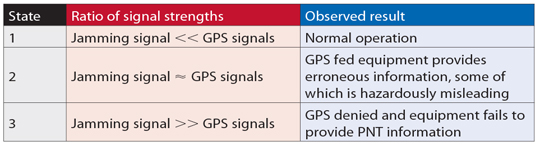
    The results identified three distinct states (Table 1) corresponding to the manner in which GPS-fed equipment responded to jamming conditions. When the jamming signal was sufficiently strong to prevent reception of GPS signals, a large number of alarms sounded on the bridge almost simultaneously, providing a potentially disconcerting and confusing environment for the mariner. However, the effect that represented the highest risk was the provision of erroneous data from some GPS receivers.

    Table1 Source: Alan Grant, Paul Williams, George Shaw, Michelle De Voy, and Nick Ward, The General Lighthouse Authorities of the United Kingdom and Ireland
    Table 1. Effects observed for the three states identified from Flamborough Head trials.

    Figure 1 compares an erroneous position reported by a typical marine-grade GPS receiver with the vessel’s true location. In this figure, the light blue line shows the path taken between the two waypoints.

    The colors of the plotted position points indicate vessel speed. The three states described in Table 1 can be seen.

    State 1 is observed at either end of the passage where the solid blue line occurs; this is where the jamming signal strength is much lower than the GPS signal strength, and the GPS-fed systems are operating normally.

    As the vessel approached the main lobe of the jamming signal, indicated by the red lines, it reached an area where the jamming signal was comparable with the received GPS signals, leading to State 2. During this state, erroneous data can be observed with the receiver reporting the vessel on land traveling at high speed.

    As the vessel entered the main lobe of the jamming signal, State 3 was observed: the GPS signals were swamped by the jamming signal, and the receivers failed to provide an output. Then, as the vessel continued the passage out of the jamming area, one can observe the change in states as the ratios of jamming to GPS satellite signals decrease, and GPS is reacquired.

    In the worst case, the GPS receiver reported a position some 22 kilometers  away from the true location. The GPS receiver nevertheless declared the position valid. This position was made worse by the fact it was reported inland at a speed of more than 100 knots, while the trial vessel steamed steadily at 10 knots. Depending on how the resulting GPS positioning data is used, it could feasibly result in vessels changing course, through the use of an autopilot, and it could also affect the vessel’s reported position to the outside world. This would then not only affect the vessel’s situational awareness but also the situational awareness of vessels in the vicinity.

    The errors observed in Figure 1 were also seen on the vessel equipment fed by the onboard GPS receivers. Erroneous positions were observed on the vessel’s electronic chart display and information system (ECDIS), on the automatic identification system (AIS) positions (where loss of position prevents the unit from calculating a range or bearing to nearby vessels, greatly affecting the crew’s situational awareness), and on the vessel’s radar (Figure 2).

    The results observed during these trials gave an important example of what can happen to onboard equipment as well as the impact it can have on the mariner during periods of GPS jamming and service denial. It is clear that GPS denial caused by jamming can not only prevent PNT information from being calculated, it can also result in erroneous data being presented to the mariner.

    Newcastle. A second series of demonstrations was conducted off Newcastle-upon-Tyne, on the North East coast of England, to communicate the importance of resilient PNT to a selected audience. The audience included a number of key decision-makers from European and UK governments, maritime industry, mariners, and other aids-to-navigation service providers. The demonstrations took place onboard the Trinity House vessel Galatea.

    For this trial, the GPS jamming unit was installed onboard the Galatea and configured to jam GPS within a small
    area around the vessel. As before, two typical marine-grade GPS receivers were installed along with an eLoran receiver; for this trial, a modified electronic chart display was also installed and altered to enable two position inputs to be displayed at the same time, to compare the reported GPS and eLoran positions in real-time.

    Throughout the demonstrations differential Loran (dLoran) corrections were provided using a transportable reference station installed on the shore at South Shields, to mitigate the impact of temporal variations on the eLoran position. Differential-Loran corrections were generated by the reference station and sent to the GLAs’ eLoran transmitter in Cumbria for inclusion in the eLoran Loran Data Channel (LDC) broadcast. The eLoran receiver on the vessel received the broadcast and was able to extract and apply the corrections in order to obtain an eLoran position within 9 meters (95 percent).

    One demonstration scenario showed the sudden effect of a strong jamming signal, designed to simulate a jamming unit being brought onto a ferry or other vessel. This took the vessel’s equipment directly to State 3: complete loss of GPS information with a large number of alarms sounding on the bridge. The loss of GPS data prevented the Galatea’s AIS and VHF units, among other systems, from operating correctly.

    Before the second scenario was conducted, the jamming unit was stopped, and all of the GPS receivers integrated into the bridge equipment were allowed to reacquire satellites and fully recover. The second scenario was designed to reflect a vessel steaming towards a jamming source. The field strength of the jamming signal was slowly increased until State 2 was observed, with erroneous and often hazardously misleading information reported.

    As with the Flamborough trials, erroneous GPS positions reporting unfeasibly high speeds were observed as shown in  the OPENING Figure. However, significantly more subtle errors were seen: errors where the vessel’s reported position differed only very slightly from the true location and wandered around slowly. These subtle changes produce believable positions but hazardously misleading information (HMI). While the overall result of GPS jamming on Galatea was consistent with that observed on Pole Star, there were a few marked exceptions.

    The effect of GPS jamming can be seen (Figure 3) on the erroneous positions reported by the trial vessel NLB Pole Star (center right) and also on the vessel Dutch Progress (top left).

    The ECDIS onboard the Pole Star reported erroneous positions and ultimately failed with the complete denial of GPS. However the ECDIS on the Galatea continued to track the vessel’s position due to an additional position feed from the vessel’s gyro, making it more resilient to jamming, but only in the short term until the gyro requires re-calibration. This is carried out with its built-in GPS receiver! In addition, the AIS transceiver on the Pole Star reported the vessel’s position erroneously due to jamming, and this was observed at shore-based traffic monitoring stations.

    During the demonstrations on the Galatea, the AIS transceiver did not provide any erroneous position information, as can be seen in Figure 4. These differences show that the impact of GPS jamming will be different for each vessel and depends on the model, installation, and configuration of the onboard systems.

    Effect of Jamming on Safe Navigation

    To navigate safely, the mariner needs reliable, clear and trusted information about where the ship is and what is going on around it, so that any threat can be located and identified. While consideration is often given to threats such as areas of shallow water, obstacles, or other vessels; consideration is not generally given to the loss of positional information, timing, or situational awareness.

    Loss of GPS-derived PNT information at sea results in the loss of the vessel’s ECDIS, AIS, GPS, and DGPS receivers, preventing the mariner from being able to position the ship and others around it through what are nowadays regarded as the normal means. In addition, the systems one would normally expect to be independent from GPS, and as such available for use in GPS-denied conditions, are also affected; namely the vessel’s radar and gyro-compass.

    The radar takes a GPS input to provide a “North-up” setting and the gyro-compass uses GPS to stabilize drift error. Under GPS-denial conditions these units also enter an alarm state and should not therefore be used in that condition.

    Clearly GPS jamming can significantly affect the safety of mariners. From these trials it can be seen that the extent of the impact varies from vessel to vessel depending on the equipment installed and the configuration selected.

    Satellite Constellation. From the users’ perspective, GNSS availability is the percentage of time they can receive usable data from sufficient satellites in order to calculate their position. The reduction in the number of available satellites in the constellation will have a direct impact on the system’s availability.

    A report from the U.S. Government Accountability Office (GAO) in 2009 predicted “significant challenges in sustaining and upgrading widely used [GPS] capabilities” due to delays in launching modernized GPS satellites. The GAO reported the probability of maintaining a constellation of at least 24 usable GPS satellites could reduce to 80 percent or less by 2011, and not return to 95 percent probability consistently until 2015. This could lead to reduced satellite numbers causing coverage “windows” where less than four satellites could be observed and as such reduced GPS availability.

    A later report by the GAO indicates that the probability of maintaining a constellation of at least 24 operational GPS satellites is now expected to be 95 percent for the foreseeable future. This figure is based on the current launch schedule, and although the U.S. Air Force Space Command (AFSPC) has provided reassurances, the satellite launch program has in recent years experienced delays, and therefore the risk of reduced satellite availability still remains.

    Following the 2009 report, the GLAs commissioned a study to investigate the impact a reduced GPS constellation would have on users in their waters. This study was conducted by the GNSS Research and Applications Centre of Excellence (GRACE) and was split into two parts. The first part was to analyze the impact theoretically and found that with a 21-satellite constellation, GPS coverage “windows” (for example, fewer than four satellites) could last for several minutes and cover a large proportion of the UK and Ireland (Figure 5). This can cause reduced GPS availability and therefore increased likelihood of position errors affecting maritime safety.

    The second part of the study investigated the effects further through a dynamic simulation, investigating the effects should a vessel be position
    ed off the coast of Belfast during one of the coverage windows. For this a marine-grade GPS receiver and a simulator were used to observe the effects. The study found that the number of available satellites fell below four for several minutes and the reported position data from the receiver appeared to freeze for up to 10 minutes.

    If a mariner was traveling at a speed of 35 knots when the position input froze, his reported position would be in error by 10 kilometers from an outage lasting 10 minutes. These outages are significant, and mariners need to be informed of such risks to GPS (and GNSS in the future) before they occur, so they are prepared for any disruptions.

    Space Weather. Space-weather events are a particular concern to GNSS availability due to their random nature. It is known that GNSS signals are delayed proportionally to the number of free ions as they propagate through the Earth’s atmosphere enroute to the receiver. The amount of ions in the ionosphere, the total electron count (TEC), is dependant on time of day, latitude, and solar activity, among other factors. During high solar activity, the number of ions in the atmosphere is much higher than at any other time. The greater the signal delay, the larger the errors are in the satellite’s pseudo range and hence the position error can be significant.

    Variation in electron density along the GNSS signal path causes signal refraction that produces phase scintillation, introducing group delay that may cause large errors in the pseudorange measurement. Diffraction of the signal wave front induces amplitude scintillation — variations in signal amplitude — with strong fades possible, leading to a GNSS receiver losing signal tracking, and at worst the GNSS navigation solution may be lost.

    Solar activity is cyclical, peaking at a maximum approximately every 11 years, during which periods GNSS performance can be severely degraded, especially at equatorial, auroral and polar latitudes. The next solar maximum is predicted to occur during 2013.

    During quiescent periods of solar activity, ionospheric effects on GNSS can be managed such that the residual errors caused by the ionosphere do not generally pose a problem to maritime navigation performance.

    The GLAs’ DGPS corrections significantly reduce common mode errors, including the effects of the ionosphere. However, at the peak of the solar cycle with high levels of sunspot activity, solar storms and flares, the application of ionospheric models and differential corrections may be less effective, and this could increase position errors and introduce an integrity risk to maritime navigation.

    Maritime navigation systems and services that rely on GNSS are at greatest risk of disruption from the ionosphere during the period from 2011 to 2015. Even during a quiet solar maximum, the occurrence of individual sun spots could produce significant effects for discrete events. The effects vary with latitude, season, and time of day (the hours soon after sunset being most affected).

    Space weather events have the potential to affect GNSS availability, either by affecting the performance of the satellites themselves or by preventing signal reception.

    Mitigation. In general, a number of steps can be taken to help reduce the impact of these threats:

    • Increase awareness of GNSS vulnerabilities.
    • Detect incidents and warn the mariner when they occur.
    • Prevent incidents from occurring, where possible, through legislation and enforcement.
    • Reduce as much as possible the effects of incidents when they occur, through the hardening of GNSS technology.
    • Have alternative means of PNT, independent of GNSS.

    Understanding that these threats exist and knowing what disruption they may cause is the first step to mitigating their effects, but this does not stop them happening. Being able to identify that an event is occurring and that the data being received from the receiver may not be true is an important part of mitigating the effects.

    For jamming issues specifically, the use of GPS jamming units is illegal in the UK and Ireland; however, preventing them from being used is very difficult to achieve. Jamming units are small and easily hidden; however, port-side security and vessel security procedures should prevent jamming units from being used in these locations.

    It is a different case, however, to prevent a jamming unit from being used at a coastal location or headland due to the remote nature of these areas.

    Mitigating the effect of jamming can be achieved in a number of ways: by limiting the effect within the receiver by using anti-jamming techniques, or by hardening GNSS receivers. Ultimately the best mitigating activity is to not rely on GNSS PNT once the integrity of the data has been compromised.

    For space weather events or cases of reduced satellite numbers, there is very little action the mariner can take to remedy the problem or stop it happening. The mitigating action here is one of awareness — information forewarning the mariner that such a condition is imminent, for example.

    Monitoring and detection networks can assist in providing such notifications and real-time information on GNSS problems. The need for such a network across the UK and Ireland is the subject of a different GLA publication, but the GLAs support the discussion on a body to monitor GNSS performance and to take the lead in the dissemination of key information.

    For periods where GNSS availability has been affected by mutual interference, jamming, space weather events or constellation issues, the best mitigating action is to use PNT information from a second source, one with dissimilar failure modes.

    Mariners need to be prepared for GNSS failures and have access to PNT information through dissimilar systems. In addition, procedures covering what to do in the case of GNSS unavailability should also be provided and rehearsed. It is with this view that the GLAs firmly promote the use of all available means of navigation.

    Conclusions

    All three threats to GNSS availability reviewed here could affect maritime safety. The two trials observed presentation to the mariner of erroneous data, some of which could be considered hazardously misleading, along with the degradation of crews’ situational awareness. The main effects observed were:

    • The presentation of random errors leading to hazardously misleading information that could, depending on installation, cause a vessel to move off course.
    • The presentation of erroneous and potentially misleading data to other vessels and shore-based infrastructure.
    • The sheer number of alarms on the bridge of the vessel could be disconcerting and distracting for the mariner.
    • The loss of GPS-fed systems, which can create an unfamiliar bridge situation and remove safety-critical systems from operation.
    • A large number of bridge systems are integrated with GPS and enter an alarm state during periods of GPS outage.

    The loss of GPS or a lack of integrity in the reported information leads to an unfamiliar situation on the bridge.

    The crews of the Pole Star and the Galatea were expecting to lose GPS, were well-trained, and had primed other systems so they could navigate safely. In real life, there would be no advance notice, and the impact on the crew would be more severe.

    The impact of low satellite numbers, as predicted in the 2008 GAO report, could produce poor constellation availability and a loss of PNT information for a considerable period of time. This could result in the same outcome as observed in the GPS jamming trials when entering State  3, where many systems on the bridge failed and entered an alarm condition.

    Space weather events are difficult to predict both in terms of when they may occur and their severity. Events could affe
    ct satellite positions, their operation, and the reception of their signals by the user, and are clearly a threat.

    The GLAs strongly support the need for a resilient PNT solution, one that could continue to provide reliable information during such threats for the safety and benefit of all mariners.

    Acknowledgment

    This article is based on a paper given at the Institute of Navigation’s 2011 International Technical Meeting.


    Alan Grant is a principal engineer for the Research and Radionavigation Directorate of the GLAs of the UK and Ireland, technical lead and project manager for all GNSS projects there. He has a Ph.D. from the University of Wales.

    Paul Williams is a principal development engineer with the Directorate and currently technical lead of the GLAs’ eLoran Work Programme. He has a Ph.D. in electronic engineering from the University of Wales.

    George Shaw is an engineer at the Directorate and holds a master’s degree in mathematics from the University of Cambridge.

    Michelle De Voy is a development engineer for the Directorate, with an MSc in oceanography from the University of Southampton and an MSc in satellite positioning from the University of Nottingham.

    Nick Ward is research director of the General Lighthouse Authorities of the UK and Ireland, with responsibility for strategy and planning of research and development.

  • Expert Advice: Exploring the Technologies Behind Location-Gate

    Feuerstein-200
    Marty Feuerstein

    By Marty Feuerstein

    For the past several months, controversy has raged over the revelation that Apple and Google tracked mobile subscriber location movements and stored that information in an unencrypted file on the handset, where it was potentially vulnerable to hacking and other inappropriate usage. The resulting Location-gate scandal highlights the sometimes tenuous control of mobile subscriber information versus the business objectives of dominant platform and applications providers. These business objectives may include immediate revenue opportunities from the subscriber being tracked or broader self-interest initiatives, such as collecting marketing data that may be valuable to third parties like advertisers, or building subscriber-reported Wi-Fi access point databases.

    Furthermore, while much has been written about the privacy impacts of the collection and use of consumer location information, few articles have clearly outlined the technologies behind Apple and Google’s tracking activities. It is important to fully explore and understand these technology methods, and how they differ from other location technologies in use, in order to properly evaluate the threat posed by Location-gate and to develop responses that maintain privacy while enabling the benefits of location-based services.

    Location, Tracking, and Storage

    iPhone and iPad subscribers had previously been aware that Apple tracked their location via GPS, because the company notified subscribers when an app required the use of GPS to identify location, and asked them to opt-in. However, soon after Location-gate erupted, Apple’s vice president of software technology, Bud Tribble, testified to Congress in May 2011 that Apple also had been tracking device locations over time using triangulation between nearby Wi-Fi access points and wireless base stations. Triangulation is the moderately accurate method in which the mobile device measures the nearby cell site or access point identifications and possibly signal strengths, typically pinpointing device location to within a few hundred meters.

    Following this revelation, Apple’s initial response was that “users are confused” and that it was simply “maintaining a database of Wi-Fi access points and cell towers around your current location…to help your iPhone rapidly and accurately calculate its location when requested.” Soon after Apple location tracking activity was revealed, it became known that Google was doing essentially the same thing, although to a slightly lesser degree (Android phones stored only the 50 most recent coordinate fixes and up to 200 Wi-Fi access-spot locations), and using a similar triangulation method without the subscriber’s explicit knowledge. Google Android devices also have GPS capability.

    Why, if both OS providers embedded or leveraged GPS in their phones, would they resort to a less accurate location method, triangulation?

    Neither company has provided an answer. We know that the triangulation method uses less battery power than GPS, conserving battery life for other uses while filling in performance holes for GPS in urban and indoor environments. Also, unlike with GPS, mobile subscribers are either not able to disable triangulation or must disable it separately. More relevant is the fact that triangulation allowed the OS providers to identify location automatically and track it over time in the background without the subscriber’s knowledge, for purposes such as building and maintaining a subscriber-reported database of Wi-Fi access points.

    From a privacy perspective, there is a dramatic difference between tracking someone’s location over time (the bread crumb trail that Apple and Google used), versus locating one’s position for a specific purpose and handling the location information only within the confines of a secure wireless network. Useful applications that are universally accepted, such as E911 for safety-of-life situations, employ the latter method.

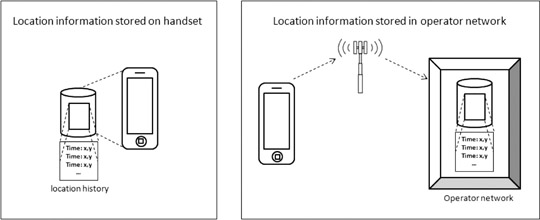
    Other players in the mobile ecosystem, such as wireless network operators, have collected subscriber location information as well, but not by storing it in the device as historical files in the same way that Apple and Google did. Some information exists on the network side in association with billing records for calls (call detail records or CDRs), but this is not bread-crumb tracking of cell-IDs. E911 calls have records stored for use by public safety agencies, but most users never make an E911 call. Other messages containing coarse location may exist on a transitory basis (for example, location area updates), but these are not typically aggregated or stored for later processing.

    feurstein_figure-W
    Depictions of location information stored on handset and in operator network.

    Alternative Geo-Location Methods

    There exist location methods that provide far greater privacy and security than the location tracking and handset storage that Apple and Google have utilized. Standard methods exist for performing location using the wireless service provider’s network elements. These are called control-plane methods, which follow standards developed by 3rd Generation Partnership Project (3GPP) and 3GPP2. Other standard methods exist using IP transport from the client phone to a location server. These are called user-plane methods, such as the Secure User Plane Location (SUPL) standard from the Open Mobile Alliance (OMA). Both control- and user-plane location standards incorporate mechanisms for data security and user privacy. These standard control- and user-plane methods differ from the proprietary methods used by many client applications and OSs, which are inherently user-plane in nature but with non-standard implementations.

    Methods using a client application with handset-based location on the mobile device, also called user-plane methods, bypass the carrier’s wireless network elements and instead rely on an IP connection to transmit information from the client application to a server on the Internet. These user-plane location methods, such as client applications for handset-based A-GPS, as discussed, are already widely in use for location-based services. Handset applications are inherently vulnerable to hacking and privacy intrusions, as the recent spate of mobile viruses on Android has highlighted.

    A-GPS is highly accurate at identifying location in direct line-of-sight conditions with the satellites (open sky conditions), as found in suburban and rural areas, but performs less well in challenging dense urban and indoor environments. GPS in the phone can be easily disabled by the end user, and the receiver chip in the handset can cause significant battery consumption when used in demanding applications, such as navigation and monitoring geo-fences. A-GPS, as used by wireless network operators for navigation and other location-based services, does not usually store unencrypted files of historical location information in the handset, as Apple and Google did.

    Alternative, network-based, or control-plane, methods make use of the wireless services provider’s network elements to keep location information wholly behind the security of the operator’s firewall, employing highly standard protocols for security and privacy. Control plane location methods are used for today’s safety-of-life applications, like E911, where security and privacy are prime considerations.

    One example of a network-based location technology that can work in control-plane is RF pattern-matching (RFPM), which is the only high accuracy, software-based, scalable location solution that requires no additional hardware changes/additions to the mobile device or at the base stations. It compares mobile measurements (signal strengths, signal-to-interference ratios, time delays, and so on) against a geo-referenced database of the mobile operator’s radio environment. RFPM boasts a 100 percent security record for subscriber mobile location information it produces, for critical applications such as E911 emergency call and law enforcement location applications.

    Location information for growing consumer uses deserves the same privacy and security protections that other standards-compliant control-plane solutions provide for today’s mission-critical and safety-of-life location applications. RFPM works extremely well in non line-of-sight conditions such as dense urban and indoor environments, where GPS-based solutions face challenges. RFPM also offers low battery consumption and geo-fencing capabilities, which makes it ideal for providing location for the growing opportunity in location-based advertising and other location-based services (widely believed to be the true driver behind Apple and Google’s location tracking activities).

    As Location-gate clearly illustrates, there is no shortage of methods to identify and track one’s location via mobile device. Now that the issue has been raised, it is imperative that the entire mobile ecosystem — network operators, OS providers, regulators, and subscribers — clearly understand what methods are used, when one’s location is being identified and tracked, and what is being done with that data. Breadcrumb trails are useful if you’re trying to find your way out of the forest, but not if Big Brother is tracking you.


    Marty Feuerstein is chief technology officer of Polaris Wireless, where he leads research into new products, algorithms, system performance, and regulatory activities. He has a Ph.D. in electrical engineering from Virginia Tech.

  • Locata, A New Constellation: ICD and Live Demos at ION-GNSS 2011

    “GPS can no longer evolve fast enough. Satellite-based systems cannot maintain the speed of development now required for the hyper-fast evolutionary pace of modern applications and devices. For positioning for the future, it has become exceedingly clear that GPS now needs a terrestrial component.” — from a Locata Corporation prospectus

    A large number of companies and engineers have thrown billions of dollars at trying to improve GPS in urban and indoor applications,” states Locata Corporation co-founder Nunzio Gambale. “From a technological perspective, Locata has created something completely new: the capability to autonomously create a GPS-style system on the ground.”

    Members of the GNSS community can see for themselves at Locata’s coming-out party at ION-GNSS 2011, including release of a Locata signal interface control document (ICD). GPS World took an advance look at the technology in a June trial of the demo that all ION attendees can see. This article presents these reports, after an outline of the technology.

    The key to Locata’s positioning system is the signal generated by the Locata transceiver, or LocataLite, to synchronize its time to other LocataLites in a network. Locata creates a network that, according to the company, “is in almost perfect synchronization” without using atomic clocks. Each transmitter dynamically synchronizes with other Locata transmitters using a patented method called Time-Loc. Gambale says that a Locata network currently locks to about 2 nanoseconds.

    Each LocataLite base station has an uninterrupted range of approximately 10 kilometers, with indoor signal penetration similar to that of a mobile phone tower.

    The company emphasizes that its transceivers are not pseudolites, but devices that create TimeLoc synchronization, and thereby enable an autonomous synchronized network that, locally, looks like GPS. The local constellation is under local control, and can therefore be designed for deployment at any power, any frequency, or any density required by an application.

    The networks can scale easily. The term “local” can mean a room or warehouse (100s of m2), a campus or open-cut mine (10s of km2), an airport terminal area with approach and landing routes (100s of km2), or a wide area, range, or city (1,000s of km2)

    Gambale sees markets for Locata’s technology in defense, mining, emergency services, construction, and security. Locata is designed to integrate with existing GPS technology, as simply another constellation. This means an approprieate GPS-Locata receiver can use the satellite signal when outside the range of a Locata network. To a combined GPS-Locata chip, the LocataLite will appear as another satellite.

    The company sold its first Locata network in July 2005. Locata has signed partnership agreements of various kinds with Leica Geosystems and Newmont Corporation (mining), the U.S. Air Force, the Advanced Navigation Technology Center of the Air Force Institute of Technology, and several other firms under non-disclosure terms. There was an initial test deployment at Holloman Air Force Base in May 2008, as a truth reference system spanning a test area of about 52 by 15 kilometers.

    For high-multipath environments such as indoors and warehousing, the company’s latest development is a new antenna called a TimeTenna, which it will demonstrate at ION-GNSS.

    Future research and development will focus on the miniaturization of the Locata receiver. Work has begun on a combined GPS-GLONASS-Locata chip that can be integrated initially into professional and industrial devices, and eventually into consumer devices such as mobile phones.

    Locata plans to work with integrators only, not with end users, making the technology available to qualified partners developing receivers and applications. The ICD is the first step in Locata’s technology rollout.

    #2
    LocataLites awaiting boards. Each LocataLite transmits four PRN signals.

    A Long Time Coming

    Eric Gakstatter, Survey editor

    You may have heard the Locata name pop up over the past several years. It would be in the news, then back underground into stealth mode. About five years ago, I heard some interesting rumors about its technology but I decided not to take them seriously until I saw some real products.

    Two years ago, I sat down with Nunzio Gambale, Locata CEO, at the ION-GNSS conference. At last year’s ION, I talked with him again. At that point, I understood the potential impact of Locata’s technology — if it worked as advertised. I again told myself that before I spent more time on it, I wanted to see a product introduced to the market based on Locata technology. In January of this year, it happened.

    Leica Geosystems introduced its terrestrial GPS Augmentation Network for the mining industry, based on Locata technology. To me, that was a pivotal point. Leica is a reputable company and wouldn’t introduce a product without a thorough vetting.

    I contacted Nunzio and we had further discussions. I wanted to see the technology in action — hard to do since Locata is based in Australia, I’m in Portland, Oregon, and an early installation occurred in South Africa. Fortunately, the company’s need to do a real run-through of its demo on site, prior to ION, meant that I got what I wanted to see, right on my doorstep: a Locata preview at the Oregon Convention Center in June.

    The Technology

    Essentially, Locata has developed a system that is very much GPS-like in that one has a network of reference stations (LocataLites) that interface to an unlimited number of rovers. One major difference is that there is no space segment. It doesn’t need or use satellites. Essentially, each reference station behaves like a satellite on the ground, with the rover moving around inside the polygon formed by the reference stations. The rover position is accurate to the centimeter level.

    The value of the Locata receivers is that they don’t need a clear view of the sky to operate like a GPS receiver does. Yes, that means centimeter-level positioning indoors, where RTK GPS doesn’t work due to satellite visibility constraints, as well as outdoors.

    Sound cool? It is. I saw it working indoors at the Oregon Convention Center. Locata staff set up a large room with Locata reference stations around the perimeter. They had two different rovers: one mounted on a small push cart and the other on a golf cart. We were able to move the rovers around the room freely and view the updated coordinates at 1 Hz intervals (although it’s capable of much faster update rates).

    The Challenges

    The new TimeTenna (see facing page) is large. Today that form factor is required to handle the high-multipath indoor environment. Locata is working on a scaled-down version, although it’s not unreasonable to envision the current model being mounted on a forklift or other vehicle if it was mechanically hardened. The antenna for Locata’s outdoor systems (for mining and other less hostile environments) is much lower profile and similar to a standard GPS antenna.

    The Locata system requires that you manage a network of Locata reference stations. Similar to an RTK network, the Locata system is based on a network of reference stations around the project area. The baseline distances can be quite long (tens of miles), but nevertheless, one must install and manage the network much as one would a GPS RTK network, albeit with much less IT department involvement than a GPS RTK network.

    Lastly, Nunzio Gambale wholeheartedly agrees that Locata’s technology is still developing. He likens it
    to where GPS was in 1990. I tend to agree. The antenna technology needs to reduce in size and the system architecture needs to be vetted for reliability in production environments. But keep in mind that Leica and the U.S. Air Force’s 746 Test Squadron have already bought into Locata’s technology in a big way.

    Although I don’t pretend to have the technical understanding that some of the others in the room possessed during the June demo, I did hear one of the sharper engineers exclaim “genius” at one point, referring to the design.

    It’s certainly worth a close look as Locata’s technology continues to develop and be deployed. I think the day isn’t far away when we will see a system from Locata that will allow a user to transition seamlessly from centimeter-level positioning outdoors using RTK GPS to centimeter-level positioning indoors without breaking a step.

    Now I’m a Believer

    Tony Murfin, Professional OEM editor

    I was invited to Portland in late June to preview an operational system which promises to help GPS in tough signal situations and work well indoors. While Europe, China, India, Japan, and of course Russia are all working to get more operational satellites in space, Locata in Australia has quietly been perfecting its terrestrial navigation system. I say perfecting because skeptics and naysayers have criticized Locata and what was seen as a pseudolite system with a rather lengthy development cycle. But nothing speaks as loudly as an operational system adopted and fielded by Leica Geosystems or a contract with the U.S. Air Force to get people’s attention back in the right place, even though Locata would claim it is only just getting started.

    As I walked into the Portland Convention Center I was certainly apprehensive as to how any GPS-like system could function well within the massive concrete and steel building. When I found the smiling Locata group tucked away in one of the side ballrooms, it didn’t take long before I became a believer. Those wall dividers that allow the Convention Center to reconfigure rooms are apparently referred to as Acousti-Seal 931 Steel Operable Wall panels — yep, perfect multipath reflectors. So to see totally repeatable few centimeter positions in this cavern was not what I was anticipating.

    The ballroom’s carpeted floor had been carefully laser-surveyed with a matrix of 5-meter squares, with a high-precision dot marking each grid intersection. LocataLite stations were set up at each corner and one in the middle at the far end, each with three antennas. A master station at the left corner of the entry wall originated the TimeLoc signal, and on each station one antenna pointed to an adjacent station, over which TimeLoc synchronization was cascaded around the network. This is a key feature of the ground network, allowing it to become fully synchronized and also to be extended or reconfigured at will.

    Of course, when you run your own ground network it helps to be able to run at power levels significantly higher than GPS, so it’s easy for each station to communicate with another, provided they roughly have line-of-sight of each other — kind of like having to actually see a GPS satellite to get it into your GPS position solution. If you have some buildings or bushes or trees to contend with, having higher power available makes things easier, especially if you want an RTK carrier solution.

    The secret to working indoors appears to be the TimeTenna phased-array antenna that Locata demonstrated in the steel-clad ballroom. With this top-hat-like antenna mounted on a wheeled cart along with a receiver and laptop, and positioned over one of those surveyed locations on the carpet, we could easily see that positions within less than 5 centimeters were consistent and solid. As a truth system, the company also had a motorized laser scanner pumping out centimeter-level positions on a parallel measurement system, and it was clear that there was excellent centimeter-level correlation.

    But don’t take my word for it. Come to Portland for the ION-GNSS conference, September 20–23, and see the Locata demo for yourself — you’ll be impressed too!

    Then there is the sole-source U.S. Air Force contract that has Locata updating an existing network to provide independent reference positions over 2,500 square miles of the White Sands Missile Range in New Mexico. The Air Force apparently needs to know how its navigation systems work when it turns on localized GPS jamming. The Locata system is designed to give the Air Force better than the specified <18-centimeter position accuracy in GPS-denied environments.

    In August, Locata cleared the final USAF critical design review milestone for the wide-area White Sands Missile Range deployment. This is clearly a good sign that Air Force wants to continue with the next-generation Locata system. With GPS denied on this range, test vehicles will likely be constrained to inertial-only navigation, but with a LocataLite receiver onboard pumping out high-accuracy position measurements, the Air Force will no doubt have plenty of location data to track dynamic performance under GPS jamming conditions.

    Another application that Locata has been investigating involves airborne trials in Australia, where initial results indicate position accuracy of less than 3 meters at up to 50 kilometers. The trials have involved a ground network with six base stations spread over a roughly square area of 1,500 square kilometers.

    A University of New South Wales test aircraft equipped with precision GPS, inertial reference system, and laser scanner for truth reference use flew to within 3 to 49 kilometers of the reference stations at around 7,000 feet, producing the reported <3-meter code solution. Trials data is still being analyzed to produce a higher accuracy carrier solution, and Locata expects to issue these results at ION.

    Airborne Reference Equipment

    Leica has apparently been working with Locata for some time. The proof-of-concept installation at a 300-foot deep diamond mine in South Africa and a production set-up at a gold mine in Western Australia are going strong.

    The gold-mine installation has now been extended to two pit sites using 15 LocataLite transmitters in total. LocataLite receivers are mounted on vehicles, atop drills and shovels, and all run off the multi-pit Locata network. The mobile units not only carry LocataLite receivers, but also precision Leica GNSS receivers running off side-by-side antennas. As time progresses, the ultimate solution will use integrated multi-constellation/LocataLite receivers: the Locata signals integrated into a combined satellite+terrestrial receiver position solution, using a single integrated antenna.

    It’s easy to envisage such an integrated receiver and antenna where the Locata ground-network signals are used as just another local constellation. The investment to get to such a receiver would of course have to be justified by a whole proliferation of Locata networks. This would seem to be on the way, given the significant progress that Locata has now unveiled.

    Will It Fly — Literally?

    William Shears, aviation engineer

    If you are an aviation satellite navigation enthusiast, you probably noticed this hasn’t been an auspicious year for aviation GNSS or for GNSS applied to any other user segment that needs highly reliable GNSS service. Between personal privacy jammers, instances of accidental interference, and the big chill sent through the community by the LightSquared debacle, many are asking if GNSS is now or ever will be reliable enough to be a sole means of position and time for safety-of-life applications.

    A few years ago, the very idea that ordinary people would want to own GPS jamming devices and that they would be easily obtainable on the Internet would have been considered absurd. Similarly, the idea that the U.S. government would not vigorously protect GPS from interference was just not credible. But here we are in mid-2011 and the vulnerability of GNSS to interference has come home to roost, in several very big ways. This new awareness of the weaknesses of GNSS has led the U.S. Federal Aviation Administration (FAA) and civil aviation authorities of other countries to start rethinking their long-term strategies with respect to satellite navigation.

    Even well before LightSquared crept into the consciousness of the GPS community and then burst forth as the apocalyptic specter that threatens to virtually end the utility of GPS in North America, the FAA had begun a study to consider the need for an alternate positioning, navigation, and timing (APNT) system to support critical aviation needs. The idea being that as the U.S. air traffic management system transitions to become increasingly dependent on management of traffic via four-dimensional trajectories, reversion to a non-trajectory based mode (for example, controllers vectoring aircraft as they do today) would become unfeasible. Hence, airplanes will need a very reliable source of 4D positioning and outages for any extended period of time due to interference, or anything else will be unacceptable. The FAA set about studying what level of performance would be required for a system intended to back up GNSS in the future. Other countries began to follow suit, and whereas the concept of an APNT was obscure a year and a half ago, it has become a significant point of discussion at the International Civil Aviation Administration (ICAO) as well as within various countries, including the United States, Australia, and several in Europe.

    At first blush, the Locata system would seem to be a ready-made solution poised to fulfill aviation’s need for a GNSS backup system. In fact, acting as an independent backup (and/or an augmentation to) GNSS is one of the main motivations in Locata’s development. The technology seems to have promise in meeting the aviation community’s needs for an APNT. Locata is relatively mature technology that has demonstrated accuracies well in excess of what is required of an APNT meant to back up GNSS for enroute, terminal, and non-precision approach operations. Perhaps even precision approach and landing could be supported. Also, the system is very flexible, which suggests that service coverage could be tailored as needed around important airports. The system has significant redundancies built in, including multiple frequencies, multiple antennas for path diversity, and the ability for the network to reconfigure which LocataLite uses which other LocataLite for time synchronization.

    Given this flexibility and redundancy, it should be possible to configure a system that provides highly reliable service where it is needed. Another major advantage of the Locata technology for aviation is the higher signal power level that comes from using terrestrial signals rather than signals from space. In theory, a Locata system would be more robust to interference than space-based GNSS signals.

    Some people are indeed thinking about Locata for aviation use. Locata has conducted flight trials in Australia using a prototype demonstration network of six LocataLites covering an area of more than 1,500 square kilometers around Cooma airport in Australia. Locata has reported code positioning solutions of better than 3 meters at ranges up to 50 kilometers, and will present higher accuracy carrier-phase solutions at ION. The U.S. Air Force is also preparing to use Locata in an aviation environment as an independent truth reference.

    At the ICAO Navigation Systems Panel (NSP) meeting in May 2011, the Australian panel member presented a paper outlining the general need for an APNT. The paper included a description of Locata as an example of what an APNT solution might look like. However, it is interesting that the paper fell short of proposing that the panel pursue Locata as the solution or to suggest that any standardization of a solution for APNT begin immediately. In spite of all the potential advantages discussed above, the Locata system faces a major obstacle before it can practically be used in aviation applications: standardization.

    The first aspect of standardization that is likely to be a huge impediment for Locata (or any other APNT proposal, for that matter) is spectrum. The Locata systems implemented to date have been designed to operate in the 2.4 GHz unlicensed industrial applications band. For Locata to support safety-of-life applications, national aviation authorities will require that an APNT system use spectrum that is properly allocated for use in a safety-critical aeronautical navigation system, that is, spectrum allocated for Aeronautical Route Navigation Services (ARNS). Spectrum allocated as ARNS is afforded special protection from interference. Coordination of services in or near ARNS spectrum is often difficult, time-consuming, and expensive. For example, coordination between civil aviation use of the 108–118 MHz band (used for instrument landing systems, or ILS, and VHF omnidirectional range, or VOR) and FM broadcasting in the 88.1–107.9 MHz band produces real costs and restrictions to be borne by the FM broadcasters. Consequently, any proposal to convert non-ARNS allocated spectrum to ARNS is likely to be met with significant opposition.

    Spectrum is a finite resource, and virtually all spectrum is already in use by someone. So, the reality is that a future APNT will likely have to be implemented in some existing ARNS spectrum, since a new global allocation of spectrum for ARNS is an unlikely proposition.

    The current allocations for ARNS include:

    • 108–118 MHz (ILS/VOR),
    • 960–1215 MHz (DME/Mode-S/ADS-B/SSR/JTIDS/MIDS),
    • 1556–1626 MHz, and
    •  5.1–5.25 GHz.

    All indications are that a Locata system could be could be operated at these frequencies. However, services that already exist in those bands will continue for the foreseeable future. So, to be viable, a Locata system would have to coexist in one of these bands with other existing systems, that is, not interfere with the operation of those other systems. Such coexistence has yet to be demonstrated either by analysis or test.

    After suitable spectrum has been identified, the next major hurdle for Locata is standardization of the signal-in-space to the degree that supports interoperability of equipment produced by different manufacturers in different countries. The Locata ICD released at ION-GNSS 2011 is a good step in the right direction. But for an aviation application, a great deal more would need to be specified, including details about the waveform (spectral mask, out-of-band emissions, and so on), the protocols for producing the signals, and the standard protocols for the application of data to derive a position solution. A clear allocation of responsibility between the ground processing and airborne processing will need to be defined so that system integrity can be analyzed and assured.

    At the international level, such standardization activities can take a decade or more. The length of time required depends on the maturity of the system that is proposed for standardization. The existence of a similar standard, with perhaps a significant user base and operational experience also helps (for example, an IEEE standard or RTCM standards). So, again, the ICD is a good start.

    Beyond the technical aspects of standardization, there are political and institutional aspects that can often be more formidable barriers. Issues with spectrum have already been mentioned. Beyond that, there are issues with intellectual property. Creating aviation standards based on proprietary technology is unpopular although not unprecedented. Proposals for standardization are more likely to be successful the fewer strings, such as licensing agreements or fees, that are attached. This is a challenge since companies that have worked hard to develop cool new technology are often reticent to give away their intellectual property in the name of standardization.

    Given all the barriers, how does new technology ever get implemented in civil aviation? Typically, applications begin in one of two ways:

    • in support of war.
    • in support non-safety related industrial applications.

    The military has historically pioneered many technologies (radar, DME/TACAN, GPS) that would probably not have been developed otherwise. Even after the initial military experience, there is typically a period of time when the new technology is used in a non-safety-critical capacity to support some commercial objective. In the case of Locata, some potential applications would be flight-test position-reference systems, high-precision photogrammetry, high-precision positioning for crop dusting, and any other applications that require a highly robust, high-accuracy position solution in a well-defined region where interoperability and certification are not issues. Those are relatively small niche applications, which may provide some valuable operational experience.

    However, serious movement towards adopting Locata as a standard for APNT is unlikely to happen without the support of at least a couple of large countries. Even a large user base with equipage does not guarantee that countries will adopt the technology or that air navigation service providers will authorize the use of the technology for safety-critical applications. For example, many carriers are equipping with broadband Internet equipment to provide service to the passenger cabin. Yet, there is no serious discussion of using that datalink capability for safety-related communications. Similarly, a very large number of aircraft are equipped with Aircraft Condition and Reporting System (ACARS) datalink, yet use of that system is largely limited to non-essential Airline Operational Communication (AOC) applications.

    So will Locata fly? I believe that is entirely up to Locata and other companies that work with Locata to address the initial military and niche airborne positing markets. Operational experience gained by such early adopters will be critical in laying the groundwork for the support that will be needed from large states like the United States, Australia, China, and those in Europe, if Locata is to be a player in the longer-term international standardization of APNT.

    In the near term, Locata is already serving the aviation community by demonstrating the art of the possible relative to what a ground-based navigation system based on modern technology could be.

  • Expert Advice: Cloud-Based Location Changes Enterprise Playing Field

    Mario Proietti
    Mario Proietti

    By Mario Proietti

    New technology and wireless carrier openness now make real-time access to telephone location information available to the enterprise with no application required on the mobile device.

    Yes, that’s right: no application required! Cloud-based location, offered via direct connections to wireless operators, changes the playing field for enterprises to introduce instant operational efficiencies. Marrying location insight, privacy controls, and multi-modal communications through network application programming interfaces (APIs) provides enterprises with flexibility, cost savings, and time-to-market advantages. Whether delivering geo-targeted promotions, dispatching services, verifying worker activities, or performing other location-relevant actions, businesses now have cross-carrier access to location information for more than 85 percent of U.S. wireless subscribers — instantly!

    This enables businesses to go app-less with no costly, time-consuming deployment and maintenance of handset applications. Additionally, no specialized hardware is required. Location through carrier networks also assures secure and tamper-proof delivery of the location information since no potentially hackable client software is involved in the generation or delivery of that information. It comes straight from the carrier network over secure connections.

    Cloud-based deployment, such as that available through TechnoCom’s Location Platform, opens up location intelligence to all device types, including both smartphones and feature phones. This removes a huge barrier that exists with the existing smartphone-only applications and enables businesses to immediately tailor their workflows and business processes to utilize the knowledge of real-time location from a secure and dependable source. Development cycles and costs are a fraction of those required for smartphone applications, such as Droid or iPhone apps, and the adoption hurdle of user download initiation is eliminated.

    Simplification of access and deployment paves the way for adoption and finally opens the floodgate for location-based services to be implemented on a large scale across all wireless networks. This is analogous to the inflection point that cross-carrier text messaging access and interoperability had on cellular text messaging adoption rates in the ’90s.

    By leveraging technology similar to that in the carrier networks and proven for use in 911 emergencies, businesses instantaneously benefit when new data is exposed by wireless operators, such as device capabilities, presence, rate plan status, roaming status, and so on. Enterprises may immediately harness this insight with upgrades to their server applications and no new technology deployments required in the field. That offers businesses a huge return on investment as they integrate once and consume enhancements dynamically. Location from the cloud opens up a new, instant intelligence frontier that was not possible for businesses to leverage just last year.

    This unprecedented access to location information comes with a responsibility to comply with industry-accepted privacy controls. To make this easy on enterprises that are not expert in such policies, TechnoCom Location Platform provides carrier-approved privacy management functionality, and we work hand-in-hand with our customers to ensure their implementations are in line with best practices established by CTIA.

    Tapping into location from other mediums such as VoIP, Wi-Max, NFC, Wi-Fi will increase the ubiquity of cloud-based location access even further. As devices get smarter and more powerful, better communications, device intelligence, and positional awareness will catapult businesses to yet another level of efficiencies in interacting with their mobile users, workers, and assets.


    Mario Proietti is co-founder and chief executive officer of TechnoCom Corporation, and a member of the Editorial Advisory Board of GPS World magazine. He has a master’s degree in electrical engineering from the University of Southern California. TechnoCom delivers cross-carrier location services to enterprises through its location platform’s web services APIs. The company also integrates location technologies into wireless networks, products, and software, and works with wireless carriers to enable E911 and location-based services.

  • LightSquared: The Ball is in the FCC’s Court

    The FCC’s public comment period regarding the LightSquared/GPS interference issue has ended and the reply comment period is over as well. To date, more than 3,300 comments (not including the 15,000+ that were submitted by the Boat Owners Association of the United States) were entered that the FCC must sift through and arrive at some sort of conclusion. Following are my last comments filed with the FCC as well as my best guess at where this is heading.

    I decided to file a “reply comment” submission on August 15 to the FCC based on an August 11 filing by LightSquared where LightSquared Executive Vice President Jeffrey Carlisle stated “had the GPS industry complied with the DoD’s recommended filtering standards for GPS receivers, there would be no issue with LightSquared’s operations in the lower portion of its downlink band.” It’s a blatantly false statement, so I couldn’t let it pass without a rebuttal. Following is what I submitted to the FCC:


    August 15, 2011

    Eric Gakstatter
    Editor – GPS World magazine Survey Scene enewsletter
    Editor – Geospatial Solutions
    High-precision GPS Consultant
    PO Box 663
    West Linn, OR 97068
    Marlene H. Dortch, Secretary
    Federal Communications Commission
    445 12th Street SW
    Washington, DC  20554
    Re: IB Docket No. 11-109


    Dear Ms. Dortch,

    In addition to my comments posted on July 28, 2011, I’d like to reply to comments submitted by LightSquared in their letter dated August 11, 2011.

    Again, by way of background, as a Contributing Editor to GPS World magazine, my specialty is high-precision GPS receivers of which I’ve been involved with for more than 20 years as a product developer, power user and consultant. I’m in touch with tens of thousands of high-precision GPS users from around the world through my newsletter articles (bi-weekly), webinars and my attendance at technical conferences. I consider myself and I’m considered by others to be an advocate for the high-precision GPS community.

    In Jeffrey Carlisle’s (LightSquared Executive Vice President) comments to the FCC dated August 11, 2011, he stated that “had the GPS industry complied with the DoD’s recommended filtering standards for GPS receivers, there would be no issue with LightSquared’s operations in the lower portion of its downlink band.”

    This is a false statement, and to make matters worse, he knows it’s a false statement. Here’s why…

    LightSquared sells high-precision satellite data communications services to the GPS industry. Before LightSquared was formed in 2010, its predecessors (Skyterra, MSV) sold the same services to the GPS industry for many, many years.  In the course of business over many, many years, LightSquared and its predecessors have encouraged GPS receiver manufacturers to design receivers that look into the MSS band (1525-1559MHz) in order to access LightSquared’s satellite data communication services. This service has generated tens of millions of dollars in revenue for LightSquared and its predecessors over many years and continues to be a revenue source for LightSquared today.

    If LightSquared chooses to stop supplying satellite data communications services to the GPS industry, that’s their choice, but they should not fabricate a statement claiming that only the reason for interference in the “lower portion of its downlink band” is due to filtering technology. It’s just not true. Tens of thousands, if not hundreds of thousands, of expensive high-precision GPS receivers were specifically designed to access LightSquared’s and Inmarsat’s satellite data communications services that they sell to the GPS industry.

    LightSquared may state they will continue to offer these services to the GPS industry in the upper portion of its downlink band (1545-1559MHz) to create separation from the lower portion of the downlink band (1526-1536MHz). It’s too late for that. Billions of dollars of expensive, high-precision GPS receivers are already in the market that were designed to look in the entire MSS L-band (1525-1559MHz) for services provided by LightSquared and Inmarsat. Had the GPS user community been given sufficient notice, tens of thousands of high-precision GPS equipment owners could have planned for transitioning their GPS receivers over many years with a manageable financial impact. Unfortunately, that’s not the case. The GPS user community was blindsided by LightSquared’s application in November 2010 and the FCC’s waiver granted to LightSquared in January 2011.

    LightSquared and the FCC failed to adequately notify the GPS user community of their intentions. As I’ve submitted before, the precedent has already been set on how to effectively notify the GPS user community about an action that would render several hundred thousand high-precision GPS receivers obsolete. In 2008, the U.S. Air Force proposed to discontinue supporting the semicodeless technique that is used by virtually every civilian L1/L2 high-precision GPS receiver in existence. It was the first time in history that an action would render several hundred thousand high-precision GPS receivers obsolete, a scale which is very similar to the impact of the LightSquared system.

    There was no industry coalition formed to engage the Air Force. There was no industry outcry. A public/private technical working group was not formed to test the effects on receivers if semicodeless was not supported. Why is that?

    The answer is very simple. The U.S. Air Force, to its credit, did a fantastic job of communicating directly with the GPS user community along with the Department of Commerce. It issued public statements describing the impact the action would have on high-precision GPS receivers.

    The U.S. Air Force did its homework. At the end of the day, it set a sunset date of December 31, 2020 to discontinue supporting the semicodeless technique. It correctly determined that 12 years is about the amount of time that would allow a smooth transition with a manageable financial impact to the high-precision GPS user community.

    Imagine if the U.S. Air Force had set a period of one year to transition away from using the semicodeless technique. That action would have destroyed the high-precision GPS user community resulting in billions of dollars in losses and widespread small business closure. Fortunately, they did their homework, understood the impact, and made the correct decision.

    LightSquared, on the other hand, either didn’t do its homework or intentionally kept quiet in order to fly under the radar and push its initiative through before the GPS user community (and others) knew what was happening. In either case, the GPS user community shouldn’t be held accountable in paying for the FCC’s and LightSquared’s lack of communication/notification.

    LightSquared and the FCC incorrectly assumed that communicating/negotiating with the U.S. GPS Industry Council (USGIC) was the equivalent of communicating/negotiating with the GPS user community. That is a false assumption. The USGIC does not communicate directly with the GPS user community and never has. That’s not their role. I’ve been perso
    nally involved in the high-precision GPS industry for 20+ years and writing a monthly newsletter on high-precision GPS technology for GPS World magazine for more than five years. I attend almost every major GPS conference and high-precision GPS market segment conference in the U.S. and some abroad. The first I’d heard about the LightSquared interference issue was November 2010.

    Even if LightSquared only uses the lower portion of the downlink band (1526-1536MHz) as they’ve proposed, the number of high-precision receivers affected would be at least 200,000 at an estimated replacement cost of $10,000 per unit which equates to a total equipment replacement cost of $2 billion dollars. That does not include the cost of removal/installation, lost productivity, required software upgrades, and training. Do LightSquared and the FCC expect the GPS user community to bear that cost? Hopefully, you can see by the overwhelming number of public comments from small businesses and local government agencies, such an action would be devastating to the U.S. economy.

    Lastly, please do not forget about the potential devastating impact of LightSquared mobile devices (uplink band 1626.5-1660.5MHz) on GPS and GNSS receivers. I’m afraid this is being lost in all the discussion about the downlink band.  The uplink band could have a worse affect on GPS and GNSS receivers than the downlink band.

    LightSquared mobile devices are potentially portable GPS/GNSS jammers. The FCC needs to seriously investigate the interference impact of LightSquared mobile devices (1626.5-1660.5Mhz) on GPS receivers. It is already known that Inmarsat (1626.5-1660.5MHz) devices and Iridium (1616-1626.5MHz) devices interfere with each other, but Iridium devices are only used in remote areas so it’s not a widespread problem. It is also known that these devices interfere with the GLONASS L1 signal (1597-1605MHz). We don’t know the extent of the effect that LightSquared mobile devices will have on GLONASS L1, GPS L1, Galileo L1, or Compass L1 signals. The problem is that no LightSquared mobile devices are available to test. Yes, lab simulations can be performed, but LightSquared devices will be made in Asia, among other places, where the designers won’t care one bit about GPS/GLONASS interference. There is not an acceptable design margin, if any, to allow for sloppy LightSquared device designs.

    Thank you for your attention. If you feel that further testimony is needed, I’m more than happy to oblige.

    Sincerely,

    /S/ Eric Gakstatter

    Eric Gakstatter
    Principal – Discovery Management Group LLC
    Editor – GPS World Magazine Survey Scene enewsletter
    Editor – Geospatial Solutions
    PO Box 663
    West Linn, OR 97068

    I think that three things are batting against LightSquared at this point:

    1. As much as they say they gave fair warning, LightSquared and the FCC didn’t communicate with the GPS user community at all on this issue. The U.S. GPS Industry Council (USGIC) doesn’t count. They don’t represent the GPS user community nor communicate with the GPS user community at all. So, the GPS user community was blindsided by this in Nov 2010.

    This was either intentional or sloppy, but it doesn’t matter either way. The bottom line is that you can’t give nine months notice on obsoleting 200,000+ very expensive GPS receivers that are installed and used in critical infrastructure applications. It would take many years to transition to new equipment. The U.S. Air Force and Dept of Commerce have already been through this drill already and they determined that 12 years was about the right timeframe needed to transition high-precision civilian GPS equipment to new technology. If LightSquared and the FCC really understood this market, they would know it’s not a four-year exercise.

    2. Even with LightSquared using only the lower spectrum (1526-1536Mhz), it still interferes with $2+ billion dollars worth of high-precision GPS receivers. Who’s going to pay that bill? The GPS user community that was given no advanced notice?

    They can argue all they want about who’s fault it is, new filter technology, DoD standards, etc., but at the end of the day, obsoleting 200,000+ expensive high-precision GPS receivers valued at  $2+ billion dollars would be devastating to American small businesses and Fed/State/Local gov’t.

    3. LightSquared sells high-precision satellite data communications services to the high-precision GPS industry. Before LightSquared was formed in 2010, its predecessors (Skyterra, MSV) sold the same services to the GPS industry for many, many years. In the course of business over many, many years, LightSquared and its predecessors have encouraged GPS receiver manufacturers to design receivers that look into the MSS band (1525-1559MHz) in order to access LightSquareds satellite data communication services. This service has generated tens of millions of dollars in revenue for LightSquared and its predecessors over many years and continues to be a revenue source for LightSquared today.

    If LightSquared chooses to stop supplying satellite data communications services to the GPS industry, thats their choice, but they should not fabricate a statement claiming that only the reason for interference in the lower portion of its downlink band is due to filtering technology. Its just not true. Tens of thousands, if not hundreds of thousands, of expensive high-precision GPS receivers were specifically designed to access LightSquareds and Inmarsats satellite data communications services that they sell to the GPS industry.

    LightSquared may state they will continue to offer these services to the GPS industry in the upper portion of its downlink band (1545-1559MHz) to create separation from the lower portion of the downlink band (1526-1536MHz). Its too late for that. Billions of dollars of expensive, high-precision GPS receivers are already in the market that were designed to look in the entire MSS L-band (1525-1559MHz) for services provided by LightSquared and Inmarsat. Had the GPS user community been given sufficient notice, tens of thousands of high-precision GPS equipment owners could have planned for transitioning their GPS receivers over many years with a manageable financial impact. Unfortunately, thats not the case. The GPS user community was blindsided by LightSquareds application in November 2010 and the FCCs waiver granted to LightSquared in January 2011.

    Of course, I didn’t mention aviation, maritime, military and other safety-of-life applications of GPS. That’s a whole other story…

    Does that mean the FCC is going to tell LightSquared to go home?

    Maybe, but I doubt it.

    In a letter dated August 10, 2011, the FCC Office of Engineering and Technology Chief Julius Knapp requested more data from LightSquared and the U.S. GPS Industry Council (USGIC). Following is an important excerpt from the letter:

    “It is unclear to what extent the GPS receivers and devices tested are current production models, into what market  segments those receivers and devices are most commonly sold, what fraction of a given market segment those devices represent, and their design lifetimes and typical owner-use lifetimes.This information is important in assessing the likely impact, if any, of interference on various use cases over time. We therefore request production and U.S. sales information for each of the devices tested, including (1) the dates of production, (2) the market segment(s) to which the device is targeted or sold,  (3) total annual sales volume and annual sales volume by market segment or estimates thereof, (4) the date on which full support of the device by th
    e manufacturer ceased (or will cease), (5) estimated time period after which the device owner would likely replace or discontinue use of the device”.


    The letter also requests updated information from LightSquared based on their proposal to use only the lower spectrum (1526-1536MHz). The timeframe to provide the requested information is very aggressive, with all information to be supplied on or before August 22, 2011.

    I think this is good news in general. It is the FCC’s first solid attempt to understand the GPS receiver markets in which the proposed LightSquared system will cause interference problems, including high-precision.

    The bad news is that the FCC is only requesting market information on GPS receivers that were tested. If you recall in one of my earlier articles, I listed the GPS receivers being tested by the high-precision team. Obviously, if the FCC only used market data from these GPS receivers, the numbers will be underestimated by a large double-digit value and maybe orders of magnitude because many receiver models weren’t included in the test. Also, many CORS in operation are legacy GPS receivers that are out of production. Based on their questions, I have a feeling the FCC will discount those to little or no value, when they actually still provide economic benefit. However, the CORS owner can’t or aren’t in a position to replace them, resulting in a net loss.

    No matter which way this goes, I’m pretty confident the FCC is going to use this opportunity to rattle the GPS industry’s cage. Spectrum is a finite resource and the FCC is going to look at ways to allocate spectrum as efficiently as possible, as they should. Is the MSS L-band (1525-1559MHz) being used in the most efficient manner? Probably not. I bet the FCC orders changes in that area, or at least the FCC sets the wheels in motion towards change. I’m ok with that as long as it doesn’t come at the unreasonable expense of the GPS user community, be it high-precision, aviation, military, etc.

    All of this bruha is really about timing. Given enough time, GPS receiver manufacturers and component manufacturers have a chance to develop new technologies that use the MSS spectrum more efficiently, if at all. Actually, if the FCC pushes forward like they seem to want, it really isn’t MSS (Mobile Satellite Service) spectrum any longer, it would become a Mobile Terrestrial Service. But developing new technologies, designing/testing products and then allowing the GPS user community enough time to adopt the new technology with a reasonable financial impact takes years, a lot of years, not four or five. It takes more years than what LightSquared has to give no matter which part of the MSS spectrum (low or high) one is discussing.

    I think in the short-term the FCC is going to order more testing in order to understand the impact on GPS receivers of LightSquared using only the lower end of the MSS spectrum (1526-1536MHz). We already know it’s going to hammer most high-precision GPS receivers valued collectively at $2+ billion dollars. I don’t have a good grip on how it will affect aviation, military and other receivers in critical apps. We’ll see.

    Actually, I agree with what Jeff Kagan of E-commerce Times writes. LightSquared is playing the public relations game the wrong way and they’re getting their nose punched every time they turn around. They should be spending their energy on talking about how wireless communications will be enhanced by their service instead of scraping up obscure DoD specifications they claim that commercial GPS receivers are supposed to adhere to. I still don’t understand what they bring to the table that Sprint, Verizon, AT&T, etc. don’t. Yes, I get that they are a wholesaler and can bring 4G LTE to small service providers. I’m talking about technology. What technology do they bring to the table? If they are just a new distributor in the mix, there’s not much to talk about and maybe that’s why they are fighting the public relations game the way they are. Interesting enough, earlier this week LightSquared announced they hired a new Senior Vice President for Public Relations and Communications, presumably to attempt to resolve the GPS interference fiasco.

    Dish Network Announces Plan for 4G LTE Network and Applies for FCC Waiver Similar to LightSquared

    Dish Network is trying something eerily similar to LightSquared, but it will have no effect on GPS receivers since their spectrum is far away from GPS (2+ GHz). Dish bought two bankrupt companies last year, Terrestar and DBSD, and have 40MHz of spectrum to play with in 4G LTE. It will be interesting to watch how the FCC deals with this, especially if the Dish waiver is pushed through as LightSquared’s was. With no GPS interference concerns, Dish might be able to field a 4G LTE system before LightSquared can.

    As Phil Goldstein from GPS World’s sister publication, Fierce Wireless, comments:

    “One of they issues that has come to the fore in the wake of the FCC’s decision to grant a similar conditional waiver to LightSquared is that LightSquared’s L-Band spectrum sits adjacent to GPS spectrum, and that terrestrial transmissions from LightSquared’s proposed wholesale LTE network in the upper portion of its spectrum is causing GPS interference. Pointedly, in its filing, Dish said its 2 GHz S-Band spectrum “will not raise the technical issues that have hampered the use of the MSS L-Band, such as the interleaving of the operators’ assignments and the severe interference claimed by systems operating in adjacent spectrum.”
     
    In return for the waiver, Dish said it will commit to a “substantial terrestrial network deployment” of a branded retail service intended to increase wireless broadband competition, including in rural areas, using LTE-Advanced network technology. Dish said it is prepared to work with the FCC “to develop a reasonable, attainable buildout schedule keyed to commercial availability of the LTE-Advanced standard,” and that it is committed to developing a buildout schedule “consistent with FCC precedent and based on the buildout principles established” in Sprint Nextel’s (NYSE:S) combination of its spectrum assets with Clearwire (NASDAQ:CLWR).


    Read the full article by clicking here.

    America’s Web Radio Guest Appearance

    Last week, I was a guest on the American Congress on Surveying and Mapping’s (ACSM) weekly, one-hour America’s Web Radio program. Web radio is actually a very creative idea. You can listen to the live program on your internet-connected computer (11am U.S. Eastern time every Monday) or you can download the recorded program in MP3 format and listen to it using your iPod or other MP3 player. Click here if you’d like to listen to last week’s program when I was the guest.

    Thanks, and see you next time.
    Follow me on Twitter at http://twitter.com/GPSGIS_Eric


  • Microsoft Missteps Add to Privacy Jitters

    Microsoft is contributing to the latest location privacy jitters. Missteps by Microsoft, Apple, and Google have the potential to dampen uptake of location solutions. Microsoft published the estimated locations of millions of laptops, cell phones, and other devices with Wi-Fi connections. The location database was assembled by Microsoft’s access to Windows phones and by vehicles that drive streets and record Wi-Fi signals accessible from public roads. The data were published on Microsoft’s Live.com website.

    The problem is that Wi-Fi devices can be individually identified by a unique code, often called a MAC address. It’s not just Wi-Fi routers that can be identified. Phones and computers can be used as Wi-Fi access points, via tethering and other means, and their location can be monitored. Using the Microsoft data on Live.com, CNET tracked an HTC mobile device’s movements between house addresses in the city of Columbus, Ohio.

    Skyhook conducts similar Wi-Fi mapping, but according to Ted Morgan of Skyhook, does not provides direct access to its database. “All our partners use our client location engine, which does the scanning and lookups to our system,” says Morgan. “We don’t gather any MAC addresses of client devices, only access points and devices that act as access points.” Google collects similar location information and curbed access to the data a few months ago after a CNET article appeared. Microsoft just announced it too would now restrict access. When will these guys learn?

    Googleola Marriage. The announcement of Google’s intention to buy Motorola Mobility for $12.5 billion, a heavy bucket of cash, will have repercussions throughout the industry. Google will become a mobile manufacturer in head-to-head competition with Apple and Research in Motion. For Research in Motion, maker of BlackBerry, this may be a kiss of death, unless they are snapped up by someone like Microsoft, who may feel pressured to join the game. Google will have bought itself entry into the ferocious patent lawsuit war between Motorola Mobility and Microsoft at a time when relations between Microsoft and Google had improved.

    Google’s Larry Page made assurances on the company’s blog that Android would remain an open system. “This acquisition will not change our commitment to run Android as an open platform. Many hardware partners have contributed to Android’s success and we look forward to continuing to work with all of them to deliver outstanding user experiences”. Say that as he may, other Android handset manufacturers will now be competing with the supplier of their operating software in a distribution channel tangle.

    Connected Car. The connected car, a vehicle with embedded modules and wireless services that link to the cloud and the car’s operating system, continues to evolve. The carriers are aggressively staking out territories. Verizon has shown off a car equipped with a 4G LTE modem with OnStar prototype apps. Sprint Nextel has worked with Aeris Communications to bring the Sprint network and cellular connectivity to the Hyundai connected vehicle program. AT&T has partnered with Panasonic Automotive.

    Ford has led the car manufacturers with its SYNC offering that provides hands-free, voice controlled in-car connectively. Already in 3 million vehicles, SYNC will become available on Ford’s entire passenger line-up for $295, down from its current $395.

    More than half of surveyed U.S. consumers find the concept of a connected vehicle appealing, according to a survey by Alcatel-Lucent. When it comes to opening wallets, the top applications are augmented GPS; maintenance, tracking, and notification; Wi-Fi; advanced voice features; and online environmental analysis.

    It’s not all about Smartphones. The global mobile app market for feature phones will almost double by 2016, reports Ovum. The success of smartphone apps will drive feature phone apps to a predicted $1 billion market. Feature phones outsell smart phones, but have lagged in applications uptake. The upswing should be helped by the increasing ease of developing apps and publishing them for this market.

    Personalization, not just Location. Feature phone mobile advertisements that are tailored to a consumer’s “tastes and interests” are four times more effective than offers based on location, time, or lifestyle, according to a poll of 2,000 U.S. consumers, commissioned by mobile marketing company, Upstream. The marketing activity that was found to most likely lead to a follow-up action included mobile coupons; opt-in text alert or message; an e-mail received on a mobile phone; an ad on a mobile website; or an ad that appears during an Internet search of a product or service.

    Mark your Calendar.  Don’t miss LocNav 2011 October 18-19 in San Jose. The Where Business has co-located its annual Location Business Summit and Navigation conferences to create an even bigger show. I’ll be moderating the panel, “Connecting People Places and Things: Advertising and Social Networking in the Location Ecosystem.”

  • Last Week’s Solar Storm and the Final LightSquared Push

    You may not have noticed it, but last Friday we experienced the first serious geomagnetic storm in this solar cycle (Solar Cycle 24), which began in 2009. Not all types of solar activity (sun spots, solar flares, solar burst, and solar radiation) affect GPS receiver operations. Geomagnetic storms are the ones that can cause problems for GPS receivers if those storms are powerful enough.

    Last Thursday, I received e-mail from Joe Kunches at NOAA (National Oceanic and Atmospheric Administration).

    “The Sun has been erupting and looks like a storm — say G3 level — could be on for Friday, August 5.”

    Joe was right, it hit about a day later, on Friday, August 5, as he predicted.

    The good news is that Joe says we generally have at least a 24-hour warning before a geomagnetic storm starts disturbing the ionosphere.

    That’s what it comes down to, the ionosphere.

    GPS signals being delayed as they pass through the ionosphere end up being the largest source of error in GPS positioning. The signals must pass through the ionosphere, which is full of free electrons. The density of these electrons in the ionosphere affects the speed at which GPS signals travel. If the density of the electrons in the ionosphere was consistent, then it would be straight-forward to create a model and largely mitigate its effects. However, that’s not always the case. The ionosphere has been relatively benign since the last solar cycle, and that’s one of the reasons that GPS accuracy has been so good, especially GPS L1 SBAS systems like WAAS/EGNOS/MSAS, which rely on modeling the ionosphere.

    The problem is geomagnetic storms. They wreak havoc on the free electrons in the ionosphere, making it difficult to accurately determine how much the GPS signals have been delayed.

    The NOAA Space Weather Prediction Center (SWPC) is one of the foremost agencies that monitors the Total Electron Count (TEC) in the ionosphere. With Joe’s help, I was able to obtain dynamic plots of the TEC from last Friday so I could illustrate to you what happened. I was also able to obtain plots from Gavin Schrock at the Washington State Reference Network (WSRN) showing how it impacted the WSRN. I compiled the plots, added some text, and produced the following Youtube video.


    As I wrote in the Youtube video, to get the most updated solar activity information that’s related to high-precision GPS users, you should follow me on Twitter at GPSGIS_Eric.

    If you’re looking for a good backgrounder on how the ionosphere affects GPS, you might want to read this April 1991 GPS World column. Although it’s dated in some respects, the fundamental concepts are solid.

    Last Push on LightSquared

    There’s been some confusion on the FCC comment period regarding the LightSquared/GPS interference issue. The comment period was not extended. The public comment period was July 1 to July 30, 2011. The reply comment period is from August 1 to August 15, 2011. However, it appears the FCC is still logging new comments even after the July 30 cut-off date. Either way, do not hesitate to submit your comments before August 15; just mark it (dropdown menu) as a reply to comments.

    This is your last chance to speak out and let your government know how important GPS is to your orgnization.

    To date, there have been more than 2,900 individual comments electronically filed as well as more than 15,000 submitted in writing to the FCC (15,000 alone from the Boat Owners Association of the United States). The vast majority of the comments support GPS.

    Some good news. On Tuesday, August 9, the FCC held an invitation-only press conference. Click here to read PC World’s summary.

    To read the 2,900+ comments submitted to date, click here; type in proceeding # 11-109 and search.

    Thanks, and see you next time.

    Follow me on Twitter at http://twitter.com/GPSGIS_Eric


  • Product Review: The Trimble Ranger 3

    The Trimble Ranger 3 being tested in its natural environment.


    First of all, thanks to all those who wrote me about the Trimble Ranger 3 and suggested I pen a review.

    Rules of Engagement

    Many of my long time readers will know that I never write a bad review, which is why I found it interesting that an e-mail from a USAF captain fighter pilot in Afghanistan commented that I “seemed to really like” every unit I reviewed. So here again are the ROE (rules of engagement) for my reviews. I will never write a bad review, and believe me I see scores of “bad” (my evaluation) GPS units that I will never review or endorse in GPS World.

    The Trimble Ranger 3 was never of any danger of falling into the “non-review” category. The Ranger 3 impressed me from the very first moment I saw the unit. First of all, it is designated correctly by Trimble, and the military and first responder users who wrote me, as a rugged handheld GPS-enabled computer, and it certainly fulfills all the requirements for that designation.

    If you are looking for a GPS device the size of an Apple iPhone, this is not the device for you. The Trimble Ranger 3 is for the user, and many of you are warfighters and first responders who need a portable and rugged but powerful handheld computer with tightly integrated GPS capabilities that can connect and communicate, wired and wirelessly, with other users and servers. The Ranger 3 can accomplish all that and much more.

    GPS Capabilities

    As soon as I powered up the Ranger 3 for the first time, outdoors for this test, the stopwatch was running to see how long it took to figure out how to enable the unit’s GPS SiRFstar III chip and firmware and obtain an accurate position. This is the new handheld TTFF (time to first fix) scenario that I always go through, in the same geographic location, with any new unit. Some GPS units, even dedicated ones, fail miserably, but not the Ranger 3. Fortunately, the unit’s battery was fully charged when it arrived, and the green power button was obvious. The 4.2 inch TFT (thin film transistor) resistive touch, sunlight readable color screen fired up immediately with a Windows menu soft key, which led me via an iPhone like “flickable” scrolling screen to the GUI (graphical user interface) or icon labeled SatViewer, (version 1.0.4.0) which comes with every Trimble GPS unit I have ever tested or reviewed. I tapped that GUI or icon and hit connect GPS and within 40 seconds had an “unaided GPS position,” or so the voice prompt from the unit informed me. Exactly 28 seconds later I had a “GPS-aided” position, again I was informed by the voice prompt, which can be turned on and off by user input. I found the voice prompts helpful because I did not have to look back at any menus to determine what type of position I was using. The initial position “unaided” was four feet or 1.33 meters from a surveyed reference position at my home, and the “aided” position was under a meter from the surveyed position. As I said, the first unaided position was pronounced 58 seconds after removing the unit from the box for the first time and hitting the power button. The aided sub-meter position was announced at 1 minute and 26 seconds after initial power on. Very impressive, and something very few units can accomplish today. Not even the best MUE or military user equipment available today can equal this feat right out of the box.

    Afterwards I played around with the GPS advanced inputs but found very few settings that needed to be changed. It comes (default mode and with a default button) with SBAS capabilities enabled; in this case the FAA WAAS (Wide Area Augmentation System) was enabled. Had I been conducting this exercise in Europe, EGNOS or the European Geostationary Navigation Overlay would have been automatically enabled. There is also a tab for setting DGPS or differential GPS parameters, on or off or auto, and the unit software is designed for future enhancements. It incorporates an SBAS PRN designation capability, if you want to choose the SBAS PRN number manually, in case one is sending bad data and is NOTAMed (Notice to Airmen) or NANUed (Notice Advisory to NAVSTAR Users) out. Frankly, I just set the SBAS feature to auto and it worked flawlessly.

    GPS Bottom Line

    So the bottom line for the Ranger 3’s GPS capabilities is that the tightly integrated, aided GPS SiRFstar III receiver, compass, accelerometer, and 5 megapixel auto focus camera with auto flash and geotagged image capabilities enable almost endless possibilities for today’s ever-proliferating location-aware software to combine location, bearing, and motion data for use by our warfighters and first responders. Add these capabilities to the substantial communications features of the rugged handheld computer, and you have prodigious potentiality for the Trimble Ranger 3. There is not a single MUE GPS unit today that can touch the Ranger 3 for its tightly integrated GPS and subsequent capabilities and communications.

    I also tested several new windows applications that I will not name now because they require considerable testing before I review or recommend them, but the cogent message is they integrated automatically and worked flawlessly with the Ranger 3.

    Trimble SatView Software

    I will, however, comment on the installed Trimble SatView GPS software on the Ranger 3. It is just so absolutely intuitive that you never really wonder about what to do next, which button to push, or box to check. Just push the button or tap the box or icon you think is the correct one and most of the time you will be correct. And if you aren’t, nothing is undoable. I intentionally push the “wrong” buttons in my tests just to see what happens, and with SatView nothing catastrophic has ever occurred. I have always been able to navigate back to where I needed to be.

    The orbit inspired graphic depiction of the GPS satellites in view (almost always 12) and the satellites being used for your position (from 4 to 10+), to include SBAS satellites, is informative and useful. You merely tap on the PRN (pseudorandom noise code assignment) graphically designated SV (satellite vehicle) and it will open a tiny widow displaying the SVs PRN number, elevation, and azimuth. There is also a very useful graphical illustration of the current P (position), V (vertical), and H (horizontal) DOP for your position, which are also programmable simply by checking a box. Many of you say you don’t know or care about the various GPS DOP, even though Estimation of Dilution of Precision (DOP) plays an important role in determining the overall accuracy of your GPS position. For those of you who do care, the data are readily available on the Ranger 3. All the data, to include programmable mask angles and DOP parameters, can be automatically captured in a log file, saved, and downloaded for future use — a simple and intuitive task. I attached an 8 GB flash drive to the full-size USB port on the Ranger 3, and simply dumped the data log to a file on that device. The Ranger 3 saw the device as an extension of its built-in 8 GBs of flash storage (flash hard drive). You can also save data directly to the onboard flash memory. It is then a simple matter to export the data into an Excel spreadsheet and use however you see fit. Take it from me, not all datalogging programs are this simple and straightforward.

    As the CEO of MobileEpiphany, Glen Kletzky, who produces some of the most intuitive software I have ever had the pleasure of using, once informed me, “Software that is inherently useful with an intuitive interface usually seems simple to the user, but underneath is usually very powerful and sophisticated. My goal as a software provider is to ensure the user never has to deal with the complicated bit
    s.” In this regard, the Trimble SatView software as enabled on the Ranger 3 has met and exceeded the goals of simplicity, usefulness, exportability, and intuitiveness.

    Trimble Ranger 3 Specifications

    Now that we have covered the basic GPS functions, let’s look at the unit itself and all the Ranger 3’s integrated capabilities.

    As I said, the unit is physically imposing, especially if you are looking for an iPhone-type device, which the Ranger 3 is definitely not. But neither can the iPhone accomplish all the tasks of a rugged, handheld portable computer with multiple scanners, readers, and numerous ports.


    Physically the Trimble Ranger 3 is not small. It is 10.5 in × 5.2 in × 1.9 in (26.6 cm x 13.1 cm x 4.8 cm) and weighs in at 2.3 lb (1.04 kg), including battery and stylus. You don’t have to use the stylus, but for some functions it is more accurate than your fingertips. And of course, since this is a Trimble unit, to paraphrase that great entrepreneur Henry Ford, “You can have it in any color you desire as long as it is your basic black…with a yellow face.”

    The Ranger 3 has an elastic (black, of course) hand strap that stores the stylus, and enables you to hang on to the Ranger 3 during all kinds of field maneuvers. The stylus is also tethered to the back of the Ranger 3, and that is handy as well. All in all, ergonomically it is a very well-designed GPS-enabled rugged handheld computer.

    Features

    STANDARD FEATURES

    • Texas Instruments AM3715 Sitara ARM Cortex A8 superscalar processor
    • 256 MB of RAM
    • 8 GB of Flash storage (serves as hard drive)
    • Bluetooth 2.0 +EDR
    • Wi-Fi (802.11b/g)
    • GPS receiver (SiRFstarIII, SiRFInstantFixII, WAAS, EGNOS/SBAS capable)
    • Electronic compass
    • Accelerometer
    • Three tri-color notification LEDs
    • USB 2.0 full speed host port
    • USB 2.0 high speed client port
    • Serial port, 9-pin RS-232
    • Secure Digital (SD/SDHC) card slot
    • Microsoft Windows Mobile 6.5 Professional
    • 4.2 in (10.6 cm) landscape VGA display, sunlight-readable color TFT
    • Resistive touch screen
    • QWERTY keypad with number pad, directional buttons and 4 programmable buttons
    • Speaker and microphone
    • Headset jack (3.5 mm stereo audio and microphone)
    • Operating system language options: Simplified Chinese, English, French, German, Japanese, and Spanish (customer selectable on initialization)

    OPTIONAL INTEGRATED FEATURES

    • 5 MP auto focus camera with dual white LED flash
    • 3G GSM cellular data modem
    • LED Flashlight function
    • 1D barcode laser scanner

    STANDARD SOFTWARE

    • SMS Text Messaging Support
    • Microsoft Office Mobile, Mobile versions of Word, Excel, PowerPoint & Outlook
    • Internet Explorer Mobile
    • Calculator
    • Microsoft Pictures and Videos
    • Calendar/Contacts
    • Windows Media Player
    • Messenger
    • Adobe Acrobat Reader
    • Notes/Tasks
    • Trimble SatViewer (GPS interface software application)

    SOFTWARE FOR OPTIONAL FEATURES

    • Customized camera and flash control through Microsoft Pictures & Videos software
    • (Geo-tagging camera software)
    • Flashlight mode control application
    • Trimble CellStart software application (cellular connection setup)
    • Trimble ScanAgent barcode scanning software
    • Trimble Ranger 3 Software Development Kit

    STANDARD ACCESSORIES

    • Rechargeable lithium-ion battery pack
    • Black Elastic Hand strap
    • Stylus tether
    • Clear screen protectors
    • Display cleaning cloth
    • Quick Start guide sheet
    • Getting Started Guide on CD-ROM
    • International AC charging kit with four plug adapters
    • USB cable
    • Stylus with force-modulating spring tip (package of 2)
    • Audio port dust cover
    • I/O port dust cover

    OPTIONAL ACCESSORIES

    • Standard soft carry case
    • Vehicle mount (compatible with RAM mounts)
    • Spare battery charger and12 V vehicle charger

    ENVIRONMENTAL SPECIFICATION: Meets or exceeds:

    • Water: Immersed in 1 meter of water for 30 minutes
    • Water jet 12.5 mm diameter @2.5 m–3 m, 100 Liter/, min; IEC-529, IP67
    • Sand & dust: 8 hours of operation with blowing talcum powder; IEC-529, IP67
    • Drop: 26 drops at room temperature from 4 ft (1.22 m) onto plywood over concrete; 6 additional drops at –22 °F (–30 °C); 6 additional drops at 140 °F (60 °C)
    • MIL-STD-810G, Method 516.6, Procedure IV
    • Vibration: General Minimum Integrity and Loose Cargo test MIL-STD-810G, Method 514.6, Procedures I, II
    • Operating Temperature: –22 °F to 140 °F (–30 °C to 60 °C) MIL-STD-810G, Method 501.5, Procedure II MIL-STD-810G, Method 502.5, Procedure I, II, III
    • Storage Temperature: –40 °F to 158 °F (–40 °C to 70 °C) MIL-STD-810G, Method 501.5, Procedure II MIL-STD-810G, Method 502.5, Procedure I, II, III
    • Temperature shock: –31 °F/149 °F (–35 °C/65 °C) MIL-STD-810G, Method 503.5, Procedure I
    • Humidity: 90%RH temp cycle –4 °F/140 °F (–20 °C/60 °C) MIL-STD-810G, Method 507.5
    • Altitude: 15,000 ft (4,572 m) 73 °F (23 °C) 40,000 ft (12,192 m) –22 °F (–30 °C)
    • MIL-STD-810G, Method 500.5, Procedures I, II, III

    PHYSICAL

    • Size: 10.5 in × 5.2 in × 1.9 in (26.6 cm x 13.1 cm x 4.8 cm)
    • Weight: 2.3 lb (1.04 kg), including battery and stylus
    • Color: Black with Yellow face

    ELECTRICAL

    • Processor: TI AM3715 Sitara ARM Cortex–A8 Superscalar Processor at 800 MHz
    • Memory: 256 MB RAM
    • Storage: 8 GB non-volatile Flash
    • Expansion: SD/SDHC card slot, USB host port
    • Display: 4.2 in (10.6 cm), 640 x 480 pixel, VGA TFT
    • Batteries: 11.1 V, 2500 mAh, 27.8 Wh Li-ion rechargeable pack1
    • I/O: USB host and client; 15 V DC power; 3.5 mm stereo + microphone audio port; 9-pin RS-232 serial port
    • GPS accuracy: 2–4 m with SBAS correction2
    • Radios: Bluetooth 2.0 +EDR; Wi-Fi 802.11b/g
    • WWAN radios: HSDPA 3.6 Mbit/s, Tri-band; HSDPA/UMTS: 850/1900/2100 MHz, Quad-band; GSM/GPRS/EDGE: 850/900/1800/1900 MHz

    CERTIFICATIONS: FCC, CE, R&TTE, IC (Canada), C-tick, GCF compliant, RoHS compliant, Section 508 compliant, AT&T certified, Wi-Fi Alliance certified, MIL-STD-810G, IP67, MIL-STD-461.

    Torture Tests

    The Ranger 3 is already in garrison with several of our warfighters in Iraq and Afghanistan. As I said, it was letters from our warfighters and first responders that first alerted me to the Ranger 3’s capabilities for wartime and disaster-preparedness purposes.

    I have only been testing the Ranger 3 since early June, so many of you might erroneously assume that the freezing temperature, snow bank, and ice water immersion torture tests were not possible. Au contrair, mon ami —after all, this is the Rocky Mountains and there is almost always snow and ice somewhere to be found. This year, I found snow and ice and freezing water in the Snake River in Keystone and Breckenridge, Colorado, in June. Indeed, there was skiing at the A-Basin until late July. So the bottom line is the normal torture tests were inflicted upon the Ranger 3 and it passed with flying colors. And yes, before you ask, there have been several units that did not pass these torture tests, and they are dried out and mailed back to the manufacturers. A Trimble
    unit has never failed to pass the tests, even a couple that were not rated as truly rugged with MILSPEC qualifiers. Trimble makes a quality product, and the company is evidently learning more about battery technology from Apple. The battery on the Ranger 3 lasted well over 30 hours.

    Applications

    As I mentioned earlier, the software applications on the Ranger 3 make it entirely suitable for warfighters and first responders. Plus, with the Windows software and operating system, the 3G GSM (Global System for Mobile Communications) phone features and Wi-Fi (WWAN, Wireless Wide Area Network) capabilities, the Ranger 3 can communicate almost anywhere in the world you can legally travel (it won’t work in North Korea). The Ranger 3 recognized my phone’s 3G-sim chip immediately, and after loading Skype, I was able to make and receive calls and download files via Wi-Fi. By the way, if you don’t know about transferring files, and I mean large files, via Skype’s direct IP chat capability, then give it a try. It is an amazing capability, especially for handheld computers like the Ranger 3.

    While it is not necessary to use a headset with microphone for the communication capabilities on the Ranger 3, if you want any degree of privacy it is highly recommended. I tested several headsets, including a new Bose model that worked without any issues. No software downloads were required — all the headset models I tested were immediately recognized by the Microsoft Windows 6.5 mobile operating system.

    The unit I tested came complete with the optional laser scanner and bar-code reader, which worked as advertised.

    One feature that I found very useful but also one that is not aggressively marketed is the physical navigation pad with six buttons and scroll bars that can be operated with one thumb. With some practice you can use this navigation pad without ever resorting to the stylus or your fingers for inputs, other than text inputs of course. And in that regard another little touted feature is the Microsoft Word auto-completion software. The software suggests words with about, for me, 90 percent accuracy and learns as you go along. Within a particular document, the software will remember certain words and phrases and suggest them where it seems appropriate. For a rugged handheld computer with a small physical 56-key QWERTY keyboard with numeric keypad suitable only for thumb texting, the navigation panel and auto-completion software are a huge help and time savers.

    Bottom Line

    The bottom line for me echoes what Trimble says about the Ranger 3: “It has the outdoor rugged design and integrated features that users count on.” I think this is especially true for our warfighters and first responders, if my mail expounding the virtues of the Ranger 3 is an accurate barometer, and I believe it to be true.

    I am certainly taken with this unit and highly recommend it. As usual with Trimble equipment, I am going to hate to send it back. If you are currently using the Ranger 3, drop me a line and let me know how you are using it and how you like it.

    Until next time, Happy Navigating.

  • Google Buys The Dealmap, Is Social Shopping Market LBS Driver?

    Once again, it looks as if Google is taking a giant leap into location-based services with its recent acquisition of The Dealmap. Is this deal a signal that LBS market viability may be tied to the social shopping market? The market is potentially huge, with two big players and a third, Google, quickly developing. But is this the market that will propel LBS to the next level? One analyst says yes…and no.


    Technology giant Google is once more trying to corner more of the social shopping market by buying The Dealmap, a 15-month-old company that offers its own location-based daily deal service.

    Menlo Park, Calif.-based The Dealmap collects data from hundreds of sources and arranges deals by location, on its website and a smartphone application. The start-up, founded last year, has 15 employees and 2 million users, according to published reports.

    Google tried to buy Groupon for as much as $6 billion last year, and decided to launch its own service, Google Offers, in Portland. Google’s service has since expanded to New York and the San Francisco Bay Area.

    Google has made many moves into the location business in the last two years. It is trying to grab a large share of the European traffic market by offering real-time services in 13 European companies. Google shook up the navigation market with free navigation service for Android phones in 2009.

    At least one analyst said he was intrigued by the acquisition, of which financial details were not disclosed. Mike Dobson, TeleMapics president, said that The Dealmap acts as a deal aggregator and cross-channel distributor for national in-store deals from brand retailers, restaurant chains, and other businesses; local daily deals (from Groupon, Living Social, and more than 200 other sources); and what The Dealmap calls “store window” deals from individual local businesses.

    In a recent presentation that The Dealmap made at the Kelsey Deal3D Conference, the company claimed to have grown in its first year to 2 million-plus cross-channel users, including more than 1 million mobile users, said Dobson, who authors a location blog. The volume of monthly deal searches on its network was more than 75 million and the monthly network reach was estimated at 85 million, he said.

    The Dealmap and others (Borrell Associates, Needham and Company, and Groupon) have predicted that the projected size of the local daily deal market will be sized at $10 billion by 2015, while the online local ad revenue will be $32 billion by 2013, Dobson said. “The Dealmap claims that its deals provide more than $10 million in savings each day, although it is less clear what earnings it creates in the way of margin/profit for distributors, such as, well, Dealmap,” he said.

    Dobson said that the “deal supplier” market appears to be dominated by top sites. Eighty percent of the local deal inventory nationwide is dominated by 20 sources, 69 percent by 10 sources, and 40 percent by two sources, Groupon and Living Social, he said. “The Dealmap claims that its daily ad inventory is supplied at a modest 6.25 deals per source, while half the deal supply sources offer only one-to-two deals a day,” he said.

    “Perhaps more disconcerting is the fact that 69 percent of deal suppliers have a presence in from two to nine markets, while 19 percent cover only a single market. Only 4 percent of The Dealmap’s suppliers have a national footprint, which the company defines as 25 or more markets, Dobson said. “While this could suggest that the deal market is inherently local, I think it suggests that local suppliers add the ‘long tail’ that is appended in local markets to the offerings of Groupon and Living Social. In other words, the market appears to be close to a duopoly at a national scope, with numerous smaller players operating as regional and local suppliers. My conclusion is that the market for local deals from individual local suppliers is quite small, and that the major force of deals in all markets are national chains who wish to present deals to draw local users to their shops.”

    Dobson says the reason he makes this distinction is that it does not appear likely that “deal-based advertising” is going to be the replacement for local newspaper advertising, or a real-time Yellow pages, at least not as currently configured.

    “The Dealmap indicates that in a sample taken from Chicago for one day of deals, the inventory from the two leading providers was split one-quarter each for fitness spas and shopping, while attractions and dining evenly split the last quarter of the pie,” Dobson said. “When all deal suppliers were added, salons and services deals added 10 percent each to the mix, while dental deals (3 percent) and hotel deals (5 percent) rounded out the categories. Who knew that people looking for social shopping deals were looking for an athletic workout and liked to meet in spas, followed by a good meal and a visit to an attraction?”

    According to The Dealmap, more than 50 percent of deals searched for nationwide by consumers are related to dining, followed by shopping at 20 percent, while attractions, bars, spas, travel and “things to do” to ranked in the single digits. On mobile devices the search profile is somewhat different, with dining at 40 percent, shopping at 30 percent, spas and travel each at 12 percent, “things to do” at 4 percent (a 5-percent loss compared to deal-search in general), and bars at a measly 1 percent (a 3-percent drop compared to deal-search in general), Dobson said.

    “I am not sure how others perceive the message that can be found in the numbers above, but I think it might be hard to find a long-term growth business here. Google acquired The Dealmap because Google needs to buttress its local advertising empire, but clearly this is a small-potatoes business,” Dobson said. “Yes, I understand that Groupon walked away from a $6-billion-dollar offer from Google, but I suspect that they already regret their bristliness during the negotiations. I guess this shows that just because you can market deals, does not mean that you know how to negotiate one for yourself.”

    What’s the Big Deal for LBS?

    Dobson said that the big deal may be for the LBS industry. “It appears to me that the concept of ‘location’ is in the process of occupying its rightful place in a variety of industries that are clearly location-centric, and were location-centric before any of us thought of using the term location-based services to describe those business services that had a location component,” he said. “Perhaps the only thing that has changed for these industries is that the consumerization of GPS and the inclusion of its functionality in phones, laptops, PNDs, and other navigation devices have allowed these businesses to pinpoint the location of consumers and provide relevant services to mobile users.”

    While The Dealmap certainly fits within Dobson’s notion of LBS, he suspects that the company sees itself in the deal-distribution business and has forward integrated into location services to expand its deal-distribution capacity. “Google almost certainly did not acquire The Dealmap because the company had a new, unique, and proprietary location technology. Instead, they acquired The Dealmap for the company’s distribution strength (its distribution network and deal-distribution applications) and their knowledge of how Groupon and Living Social operate,” he said. “It seems to me that the one trend that continues in LBS is that service businesses require strong distribution channels and few companies in this space have capabilities in this respect. For this reason, the action in LBS will continue to be acquisitions by companies who already have the distribution, but need the know-how that will allow them to leverage location as a method of increasing their distribution capability. In short, ours is a market segment in which companies need to innovate, out-perform, and pray that they get noticed by the industry leaders in other market segments.”

    There are no potential Google or Facebook success stories in our midst, Dobson said “Our task is to build location engines, use them to solve common but ubiquitous problems involving location — and hope that our efforts get us to the finish line before anyone else,” he said.