Category: GNSS

  • US Naval Observatory chooses NovAtel GPS anti-jam technology

    US Naval Observatory chooses NovAtel GPS anti-jam technology

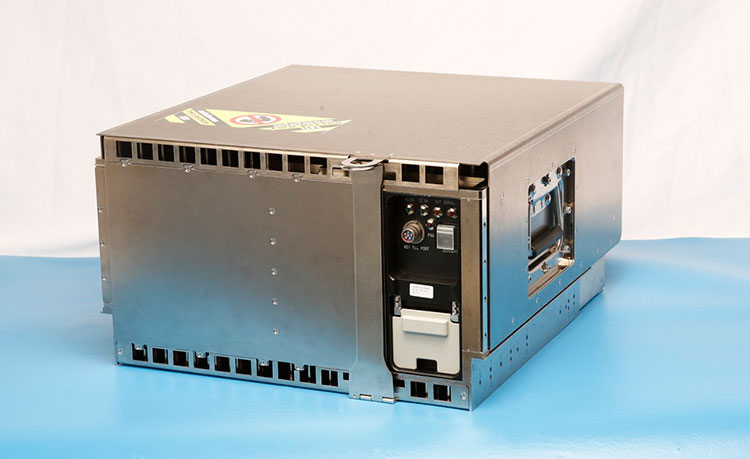
    The GAJT by NovAtel.
    The GAJT by NovAtel.

    The United States Naval Observatory (USNO) has selected NovAtel’s GPS Anti-Jam Technology (GAJT) to satisfy a requirement for a controlled reception pattern antenna capability at sites throughout the Department of Defense Information Network (DoDIN).

    The DoDIN is the core global enterprise network of the United States military and is depended upon for secure and sensitive voice, data, video and bandwidth services. This latest order brings the number of NovAtel GAJT antennas ordered by the U.S. Navy to more than 600.

    GAJT protects GPS-based navigation and precise timing receivers from intentional jamming and accidental interference. It is a null-forming antenna system that ensures satellite signals necessary to compute position and time are always available.

    The commercial off-the-shelf product comes in versions suitable for land, sea, fixed installations and smaller platforms such as UAVs. Military vehicles and platforms, networks and timing infrastructure also benefit from the protection that GAJT provides. There is no need to replace GPS receivers already installed, as GAJT works with civil and military receivers, and is ready for M-code, according to NovAtel.

    NovAtel’s manufacturing techniques and quality processes mean that that the company can ramp up quickly to meet volume requirements, the company said.

    “This order underlines our ability to deliver GAJT in volume and on time,” said Michael Ritter, president and CEO of the Canada-based NovAtel. “GAJT has now been shipped and is in use operationally by 12 allied nations around the globe. We are grateful for the rigorous technology selection process conducted by USNO which led to this latest order.”

    The U.S. Naval Observatory is located in Washington, D.C.
    The U.S. Naval Observatory is located in Washington, D.C.

    Located in Washington, D.C., the USNO is one of the oldest scientific agencies in the United States, with a primary mission to produce Positioning, Navigation and Timing for the United States Navy and the United States Department of Defense.

  • Register by Tuesday for Friday’s adjacent band compatibility workshop

    The U.S. Department of Transportation will host its fifth workshop on the GPS Adjacent Band Compatibility Assessment effort on Oct. 14 in Washington, D.C. The workshop is open to the general public by registration only. Those who would like to attend the workshop are asked to register by Tuesday, Oct. 11.

    Read the Federal Register Notice here.

    The purpose of this workshop is to discuss the results from testing of various categories of GPS/GNSS receivers to include aviation (non-certified), cellular, general location/navigation, high precision and networks, timing, and space-based receivers. The workshop also will include a discussion on the development of use-case scenarios for these categories.

    Register at Global Positioning System Adjacent Band Compatibility Assessment Workshop V.

    DATE/TIME: Oct. 14  / 10 a.m. – 4 p.m. (Eastern Daylight Time).

    LOCATION: RTCA, Inc., 1150 18th St. NW, Suite 910, Washington, D.C.  20036.

  • Antenova’s Beltii miniature antenna designed for small PCBs in GNSS devices

    beltii-gnss-antennaAntenova Ltd., manufacturer of antennas and RF antenna modules for machine-to-machine (M2M) and the Internet of Things, is now offering Beltii (P/N SR4G013), an embedded antenna that measures 15.6 x 3.3 x 4.4 millimeters and operates with all satellite navigation constellations.

    The antenna has been designed to work over a very small ground plane on a small printed circuit board (PCB), where it can be placed in a corner position, and does not need any ground clearance.

    Beltii works with GPS, GLONASS, BeiDou and Galileo, and can add a positioning capability to any small, lightweight device at 1559-1609 MHz. It is suitable for wearable electronics, trackers, drones, navigation devices, and sports applications, the company said.

    It is the latest in Antenova’s lamiiANT range of antennas, which are manufactured from FR4 materials and use the latest in dielectric constant laminate substrates to construct smaller, more efficient antennas.

    “Beltii is a brand-new design using new materials. It beats the typical larger, ceramic patch antennas on all counts: it is smaller, more efficient, and performs better,” said Antenova CEO Colin Newman. “It is a great addition to our range of positioning antennas.”

    Beltii radiation pattern at 1557.42 MHz.
    Beltii radiation pattern at 1557.42 MHz.

    Because the performance of a wireless device depends on the performance of its antenna, and the performance of the antenna depends on how it is integrated into the PCB, Antenova’s antenna designers give the integration requirement top priority and design each antenna so that it can be integrated easily, and to perform well in situ within the device. Antenova calls this concept DFI, or Design For Integration.

    Antenova also provides detailed datasheets with advice on integrating the antenna, and offers the services of its engineering team to help customers and OEMs with antenna integration if required.

    Evaluation boards (P/N SR4G013-U1) are available with full details of all of Antenova’s embedded antennas.

  • High plains PNT: Awareness and sense of place

    The plenary talk by John O’Keefe at ION GNSS+ stimulated a lot of neuron firing inside this old noggin. For a synopsis of “The Positioning System of the Brain,” see this column by Managing Editor Tracy Cozzens. I had the difficult task of following this brilliant scientist to the podium and introducing ION’s track chairs for previews of the conference’s technical content. Here’s how I attempted to stitch together the two parts of the evening program.

    Dr. O’Keefe’s talk called two things powerfully to my mind. The first is us, here, now. In the Oregon Convention Center, where we have gathered four times before. How do we remember its hallways, spaces, electronic stairways? What will direct us to technical sessions over the next three days? Our neural system enables us to orient within an environment, to navigate from one place to another and to remember spatial information. I’ve always struggled to understand aspects and workings of memory. Now to find that place is a key driver, that’s powerful.

    The second thing it called to mind is a book I read forty years ago, that has lingered with me since. In Cheyenne Autumn, Mari Sandoz evokes the Native American precursive sense of place. Both past and future exist simultaneously in the present. When the nomadic tribe on their annual migration cycle rode to their summer hunting grounds or through their autumn passages, the events in their past that took place in those areas became very much alive in their awareness. And the figures from their history spoke to them and rode with them through the sandhills, ravines and river crossings of Nebraska and Wyoming.

    In their tragic 1878 outbreak for freedom, the Cheyenne eluded the technological might of the U.S. Army sent to intercept them. They did so through their multisensory connection, through memory, to place and direction. Though ultimately defeated, they left us a legacy, an awareness, a state of mind to nurture: understanding memory — with place. And understanding place — with memory.

  • Rocket readied for 4 at once for Galileo

    The first rocket to loft four global positioning satellites at once has begun its build-up at the European Space Agency’s Spaceport in French Guiana.  The milestone mission, scheduled for Nov. 17, will carry four Galileo satellites into orbit.

    Ariane 5’s core stage is transferred for positioning over a mobile launch table inside the Spaceport’s Launcher Integration Building. Flight VA233 will carry four Galileo satellites.
    Ariane 5’s core stage is transferred for positioning over a mobile launch table inside the Spaceport’s Launcher Integration Building. Flight VA233 will carry four Galileo satellites.

    This launcher  began the integration process with the cryogenic core stage’s positioning over a mobile launch pad, followed by integration of the vehicle’s two solid propellant boosters. Designated as Flight VA233, the Ariane 5 rocket is being assembled inside the Spaceport’s Launcher Integration Building. Once completed, it will be moved into the Final Assembly Building  for installation of the four Galileo spacecraft.

    Arianespace already has orbited 14 Galileo spacecraft, all lofted in pairs on seven missions aboard the company’s medium-lift Soyuz launcher, with the most recent conducted last May.

    For its maiden Ariane 5 mission at the service of Galileo, Arianespace’s workhorse heavy-lift vehicle will be equipped with a dispenser system that secures the quartet of Galileo satellites in place during ascent, and deploys them in rapid sequence at a targeted release altitude of 23,222 kilometers.

    The four spacecraft were built by OHB System in Bremen, Germany, with their navigation payloads provided by Surrey Satellite Technology in the U.K.

  • GPS III 9 and 10 procured, targeting 2022 launch

    GPS III 9 and 10 procured, targeting 2022 launch

    The first eight GPS III satellites are under contract and in production at Lockheed Martin’s GPS III Processing Facility outside of Denver.
    The first eight GPS III satellites are under contract and in production at Lockheed Martin’s GPS III Processing Facility outside of Denver.

    The U.S. Air Force Space and Missile Systems Center awarded a contract option to Lockheed Martin Space Systems Company to procure two additional GPS III satellites, space vehicles nine and 10 of the next generation. The contract option procures long lead and production hardware.

    “The GPS III SV 9 and 10 satellites are expected to be ready for launch in 2022, thus sustaining the GPS constellation and the global utility the world has come to expect,” said Lt. Gen. Samuel Greaves, the Space and Missile Systems Center’s commander and Air Force program executive officer for space.

    The Lockheed Martin team is finishing up final testing and integration activities on the first GPS III satellite, GPS III SV01, and is preparing to deliver it to the Air Force later this year. The second satellite, GPS III SV02, is poised to have its major functional systems fully integrated into one space vehicle prior to starting its own environmental testing. GPS III SV03 also is beginning to take form in the company’s production clean room as its major subcomponents are being assembled.   \All eight of the first set of GPS III satellites are in various stages of production at Lockheed Martin’s GPS III Processing Facility outside of Denver.

    190921-f-zz999-108The government expects to compete future purchases of GPS III satellites, beginning with GPS III SV 11. This competition will maintain the current technical baseline of GPS III and will add additional hosted payloads to increase system accuracy, search and rescue capability, and universal S-band compatibility.

  • Discover your inner GPS

    Discover your inner GPS

    O’Keefe (left). Grid cells form networks with the place cells in the hippocampus, a circuitry that creates a comprehensive positioning system — an inner GPS — in the brain. (Source: Nobel Committee)
    O’Keefe (left). Grid cells form networks with the place cells in the hippocampus, a circuitry that creates a comprehensive positioning system — an inner GPS — in the brain.(Source: Nobel Committee)

    The Institute of Navigation Satellite Division looked deeply inward for its keynote speaker at this year’s ION GNSS+ conference, held Sept. 12–16 in Portland, Oregon.

    Nobel Laureate John O’Keefe provided insight into how our brains determine position. In 1971, O’Keefe recorded signals from individual nerve cells in the hippocampus of rats roaming about a room. He found that a type of nerve cell in the hippocampus was always activated when a rat was at a certain place, and other nerve cells were activated when the rat was at other places.

    O’Keefe concluded that these “place cells” formed a map of the room. The place cells were not just registering visual input, but building an inner map of the environment. The hippocampus generates numerous maps, which can be seen by the activity of place cells activated in different environments. The memory of an environment can be stored as a specific combination of place-cell activities in the hippocampus.

    In 2005, co-laureates May-Britt and Edvard Moser discovered another key component of the brain’s positioning system. “Grid cells” generate a coordinate system and allow for precise positioning and pathfinding. Their research showed how place and grid cells make it possible for rats — and presumably us — to find our way around, determining where we are in the world and which way to go.

    Recent investigations show that place and grid cells also exist in humans. In patients with Alzheimer’s disease, the hippocampus is frequently affected, causing those afflicted to lose their way. Knowledge about the brain’s positioning system may help us understand the mechanism underpinning the disease.

  • Harris delivers first OCX receiver

    Harris delivers first OCX receiver

    Photo: Harris
    Photo: Harris

    Harris Corporation delivered the first of 34 modernized receivers to support the GPS Next-Generation Operational Control System (OCX). They will receive the signals sent by the current GPS satellite constellation plus the new signals sent by the next generation GPS III — 13 military and civilian signals in all.

    The receiver was shipped to the prime contractor, Raytheon Company, in Aurora, Colorado, after it passed a critical electromagnetic interference test, the first of many stringent qualification requirements. Though the receivers will be placed throughout the world, this first production unit will be installed in Aurora as OCX software development and integration continues.

    OCX will replace the existing ground control system that receives signals from the 31 operational GPS satellites already orbiting Earth. Only OCX will be able to receive and decrypt all GPS III military and civil signals, however.

    In addition to receivers, Harris has delivered 14 ground encryptors that will help protect the GPS signal. Harris also is providing critical software elements, which provide the fundamental navigation data to the GPS satellites and enable U.S. Air Force operators to better know and monitor the exact position and timing of the GPS constellation.

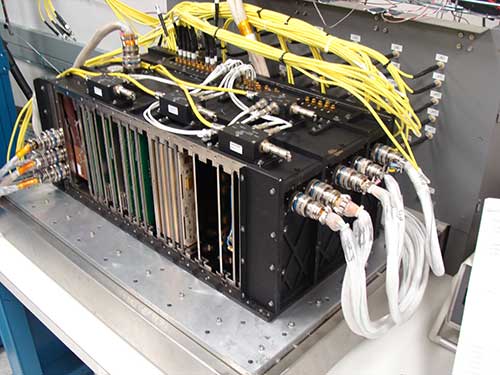
    Pictured here is the advanced MDU on navigation payloads being delivered for GPS III Space Vehicles 1-10. (Photo: Harris)
    Pictured here is the advanced MDU on navigation payloads being delivered for GPS III Space Vehicles 1-10. (Photo: Harris)


  • Portrait of Galileo: European groups say constellation is ready for service

    galileo-programme-update-ion-2016-vf1
    From a Galileo programme update presented at ION GNSS+ 2016.

    Spokespersons from the European Commission, the European Space Agency and the European GNSS Agency (GSA) built a portrait of Galileo at the ION GNNS+ conference of a satellite constellation ready to step upon the world stage. Meanwhile, four new satellites are scheduled to launch aboard a single Ariane rocket on Nov. 17, leading to declaration of initial services by the end of the year.

    With 14 satellites in orbit, 12 ordered and four on the launchpad, system operators feel confident in predicting initial operational capability by the end of this year. They already have their eyes set on additional service distinctions driven by emerging new requirement from user communities:

    • Authentication, for applications requiring trusted position and timing information; a key feature to enable new types of commercial applications such as pay-as-you-drive car insurance, road user charging (highway tolling) and access to mobile content
    • A robust timing service
    • Advanced receiver autonomous integrity monitoring (ARAIM)
    • Emergency warning services
    • A Galileo regional service
    • Ionosphere prediction service
    • SBAS authentication

    Key areas identified to drive Galileo evolution included timing for 5G telecoms, digital video broadcasting and autonomous vehicles.

    GNSS will increasingly be used not as a sole localization solution but deeply integrated with several positioning networks and sensors to work across an array of contexts, according to the several European experts. However, despite growing alternative solutions, GNSS will remain core as the most cost-effective global positioning technology, especially for outdoor location information and larger scale applications.

    Looking at the future, for the majority of mass-market applications, an accuracy of a few meters is sufficient, but key strategic users will need (some already need) better performance that must be satisfied. Galileo evolution has to offer enhanced performance, enabling new and strategic applications, to remain at the center of the positioning and timing market.

    Galileo’s evolutionary targets to improve in the future were listed as: a ranging accuracy between 2 and 5 times that to be declared at Galileo FOC (in 2020?); position accuracy down to sub-meter level; timing accuracy increased by two times over Galileo FOC; better support of spoofed users; enhanced authentication (nav message authentication) and anti-replay.

    New Operations Center in Spain. The European GNSS Agency (GSA) is gearing up to assume its operational role for Galileo in early 2017. During the summer the GSA formally accepted their Loyola de Palacio facility in Madrid, Spain that houses the European GNSS Service Centre (GSC).

    GSA already oversees the operation and service provision for the European Geostationary Navigation Overlay Service (EGNOS) (since 2015) along with managing the security accreditation and general security provision for both programmes.

    Since 2013, the core team at GSC has been providing limited services and working as a precursor to GSC v1. Its key work includes supporting the lead-up to Galileo Initial Services provision, along with operating the GSC Helpdesk, disseminating orbital products to the Search and Rescue (SAR) community, supporting GNSS-related research and industrial activity and monitoring user satisfaction. Once operational, GSC v1 will be connected to the Galileo core system, thus enabling the long anticipated Commercial Service. This service is expected to enter operations by mid-2017.

    Galileo Hackathon in Berlin. The GSA invites coders, app developers and other interested parties to a two-day event in early November, the Galileo Hackathon. “Be one of the first to use Galileo!” The online invitation seeks those who want to shape the future of Location-Based Services (LBS) and Geo-IoT to become pioneer developers, showcase their skills, connect with the Geo-IoT app-dev community, and win prizes. November 3–4 in Berlin.

  • Munich Summit to emphasize GNSS back-up

    “Is it Time for GNSS Back-Up?” has been announced as the the theme of the 2017 Munich Satellite Navigation Summit, to take place March 14–16 in the prestigious and ornate Residenz Munich, royal palace of the Bavarian monarchs of the House of Wittelsbach in the center of Munich. International experts will gather to discuss recent position, navigation and timing developments and the necessity for GNSS backup solutions.

    Among the topics, in addition to system updates on all major GNSS, the first conference announcement lists:

    • From Iridium to e-Loran — GNSS in need for a Backup.

    • Galileo after the Brexit.

    • Civil use of the Galileo Public Regulated Service (PRS).

    • Network-based solutions for GNSS Backup.

  • Galileo Initial Services looming

    With Galileo Initial Services at last on the horizon and a quadruple satellite launch scheduled for November, here’s hoping that Europe’s GNSS constellation will be delivering limited, but reliable, global PNT services before the year is out.

    The four Galileo satellites for Arianespace’s first Ariane 5 mission for the constellation are being prepared at ESA’s launch facility in French Guiana. The flight is scheduled for 17 November. However neither these four new satellites, nor the two orbited in May, are required to deliver Galileo Initial Services, which should be launched officially some time in November. Fingers crossed.

    The European GNSS Agency (GSA) is gearing up to assume its operational role for Galileo in early 2017. During the summer the GSA formally accepted their Loyola de Palacio facility in Madrid, Spain that houses the European GNSS Service Centre (GSC). This is a significant milestone in the development of the programme and its service provision as Galileo’s “door to the GNSS world” as GSA Executive Director Carlo des Dorides described the facility at the handover ceremony.

    GSA already oversees the operation and service provision for the European Geostationary Navigation Overlay Service (EGNOS) (since 2015) along with managing the security accreditation and general security provision for both programmes.

    The GSC offers over 1,100 square metres of space and currently employs over 40 people. Since 2013, the core team at GSC has been providing limited services and working as a precursor to GSC v1. Its key work includes supporting the lead up to Galileo Initial Services provision, along with operating the GSC Helpdesk, disseminating orbital products to the Search and Rescue (SAR) community, supporting GNSS-related research and industrial activity and monitoring user satisfaction. Once operational, GSC v1 will be connected to the Galileo core system, thus enabling the long anticipated Commercial Service. This service is expected to enter operations by mid-2017.

    Once the Galileo Operations Contract is awarded and Initial Services officially declared, the GSC is expected to see a significant increase in staff.

    Also in the summer CNES President and France’s inter-ministerial coordinator for European satellite navigation programmes Jean-Yves Le Gall was elected as the new chair of the GSA Administrative Board with Mark Bacon, representing the United Kingdom, elected as deputy chair.

    “I am honoured to have been elected chair of the GSA Administrative Board, with Galileo now poised to enter its operational phase,” said Le Gall. “This election confirms the desire of Member States to join forces on the cusp of a prolific period for European space as we move Galileo towards full operational capability.”

    Brexit blues?

    Mark Bacon added “I am very pleased to have been elected to work with the Board and I look forward to helping the GSA deliver on the Galileo and EGNOS programmes over the coming years.”  However the UK’s decision to leave the EU (Brexit) must make his position rather uncomfortable – and temporary – to say the least.

    The GSA Administrative Board is composed of representatives from each EU Member State, the European Commission, and the EU parliament. The Board meets three times per year to ensure that the Agency performs its tasks correctly. As things stand if the UK is no longer an EU Member State it must lose its representative(s) on the advisory board.

    However, the relationship between the UK and EU space programmes is, of course, subject to the Brexit negotiations. The UK will almost certainly remain a member of the European Space Agency (ESA) as this is a pan-European body not an EU agency, however when it leaves the EU the country will have to renegotiate terms if it wants to continue to participate in the key EU programmes such as Galileo GNSS and Copernicus Earth Observation system.

    The ESA is autonomous from the EU and should not be directly affected by Brexit confirmed Jean Bruston, head of ESA’s EU policy office at a media briefing in mid-September. But “As soon as it [Britain] is leaving the EU it is not participating in these programmes [Galileo / Copernicus] any longer,” he observed.

    In addition, UK-based companies hold contracts worth tens of millions of euros from ESA to supply hardware for the Copernicus and Galileo GNSS. “If nothing changes [and Brexit goes ahead], we would have to stop these contracts,” said Bruston bluntly.

    Of course, Britain could still contribute to Galileo and Copernicus if it negotiated a third-party agreement with the EU, as Norway and Switzerland (both non EU members) have done. The down side is that this may take some time to initiate, let alone complete, and if Britain sticks to its guns on issues such as free movement of people then the likelihood of a successful outcome for the UK is not high.

    In an interview with French media ESA director-general Jan Woerner reinforced Bruston’s views saying that “the UK will remain a member state of ESA, this is very clear” but also continuing “As we are also dealing with European programmes like Copernicus and Galileo, and also the question of UK citizens working on the continent and all these legal issues, we have to take this into account.”

    EU opportunity

    Many in ‘continental Europe’, as we Brits so often condescend to describe our fellow Europeans, will be more than happy to see the U.K. no longer participating in deciding key aspects of EU space and other policy areas.

    It is no coincidence that the European Commission has become much more vocal on plans for a European defence force since the Brits announced their departure. The U.K. has long been opposed to the concept of an ‘EU Army.’ However planning and military cooperation between Member States outside normal NATO channels has been increasing over many years. The small and discreet (so discreet that I didn’t realise the exact location of its HQ in Brussels until the recent terrorist incidents meant burly Belgian paratroopers were stationed outside and I asked them what they were guarding. Has to be said they were not discreet!) has seen its budget frozen for the last five years, but this may now change.

    The interface of EU space and defence policy – in particular ‘dual use’ issues – will also become simpler without the U.K.’s protests. A leaked draft of the upcoming EU Space Policy communication talked directly of dual-use synergies to reinforce security from space, in particular to reduce costs and improve efficiency, and that the next generation of EU GNSS and Copernicus programmes should be designed from the start to be more relevant for security purposes. Defence-related research is also slated for future Horizon 2020 calls.

    The draft policy document also underlines that with EU space programmes becoming fully operational, building stability, trust and confidence in users is a key objective. Current services must be fully deployed and their long-term continuity and evolution assured. This continuity should be driven by user needs and take into consideration the mid-term (hardly mid-term for Galileo!) evaluation of the programmes that should happen in 2017. For Galileo and EGNOS, the document looks to improvements in the current services, including greater robustness and performance, and provision of additional services, such as regional or timing services.

    California dreaming

    So with Brexit what is the U.K.’s GNSS – and space-related – industry and research community to do? Of course many of the UK industrial players are multi-national companies and internal transfer of people and/ or projects will overcome many issues. And bi-lateral collaborative agreements on exchange of talent and ideas between partners can also achieve the same results for smaller companies and research groups. However not having a seat in the policy process and the development of programmes will put ‘UK plc’ at a distinct disadvantage in my opinion.

    But U.K. leaders say that Brexit is an opportunity to be seized and that the U.K. should be looking to sell  goods and services in other global markets than the EU. Which is something most U.K. industry has been doing since trade/ time began. And in my experience U.K. business leaders have always been much more eager to go jump on a plane to the States or Australia than go visit their European neighbours – something to do with our renowned national language skills perhaps?

    Space is no exception – and one that has been shown to be a success in recent times. A helping hand is provided by InnovateUK, the U.K.’s government innovation agency, that is organising its third ‘Space Mission UK’ to the US in November. These are trade and investment missions specifically designed to support U.K. start-up companies to build world-leading space and satellite application businesses.

    Space Mission 1 visited Utah, LA and Silicon Valley in August 2015 and Space Mission 2 landed in Houston in November 2015. Space Mission 3 will visit San Francisco and LA from 5-11 November this year.

    Mission programmes are varied but typically include visits to companies working at the forefront of the sector, networking opportunities with investors and corporate venture people interested in space, visits to incubators, accelerators and technology hubs, and masterclasses on pitch development, business culture and market entry.

    The previous two Space Missions have had immediate impact for the companies involved, including securing over £1 million in investment, and initiating collaborations with major organisations such as NASA and (ironically) ESA, and winning contracts with the UK Ministry of Defence at home.

    GNSS-related companies in previous missions include Arralis who build high-end semiconductor chips but have also been funded to develop novel GNSS antennas, and an exciting data fusion start-up – Gyana – that takes complex inputs from multiple data sources, including satellite, to build simple to understand 3D situational images. The founder of the business, engineering graduate Joyeeta Das, has raised US $1.1m since the mission.

    You can find a complete list of companies who have participated on the previous missions here.

    The selection for Space Mission 3 has closed and I am told there is at least one GNSS applications company that has been chosen to be on the plane in November. Good luck to them all!

    Google emergency LBS upgrade

    E112 is a location-based version of the 112 universal European emergency number, where the telecommunication operator transmits location information to the emergency centre in parallel to the call itself. With more than 70 percent of calls to emergency services coming from mobile phones, getting help fast and efficiently to the caller can be challenging if they don’t know where they are. Now, in a major step forward for implementation, Google has created and rolled out in two European countries (U.K. and Estonia) its Emergency Location Service on Android, with other regions to follow. The feature, when supported by the caller’s network, sends the phone’s location to emergency services when the 112 (or equivalent) emergency number is dialed.

    Emergency Location Service is supported by more than 99 percent of existing Android devices (version 2.3 and above) through Google Play services. The service activates when supported by the mobile network operator or emergency infrastructure provider.

    The new geographical location system claims to identify the source of a mobile phone emergency call to typically within 0.003 square kilometres (less than half the size of a football field) instead of a current average of around 12 square kilometres.

    When an emergency call is made with an enabled Android smartphone, the phone automatically activates its location service and sends its position by text message to the 112 service. This usually takes less than 20 seconds. This text message is not visible on the handset and is not charged for.

    And the first European Galileo-ready smartphone has been launched with the Aquaris X5 Plus smartphone, produced by the Spanish technology company BQ, and based on the Galileo-supported Qualcomm Snapdragon 652 processor with Galileo capability accessible via a software update to be released in Quarter 4 2016.

    U.S.-based Qualcomm announced in June that it was adding support for Galileo across its Snapdragon processor and modern portfolios for smartphone, computing, automotive and IoT applications.

    As well as Galileo capability, the Aquaris X5 Plus is powered by the latest Google Android OS and has all the usual features of a top end smart phone including 16 mega pixel ‘back’ camera and support for 4k video recording with a stabiliser and fingerprint recognition for added security.

    If you want to take the pulse of the GNSS user technology industry and keep up with the latest trends then you’ll need to get your hands on the GSA’s GNSS User Technology Report due out at the beginning of October.

    The 2016 report will be launched on 4 October as part of the Horizon 2020 Space Information Days in Prague. This two-day GSA-hosted event will introduce the third call for GSA-funded Horizon 2020 research and innovation proposals for Galileo and EGNOS.

    The document will take an in-depth look at the latest state-of-the-art GNSS receiver technology, along with providing expert analysis on the various trends that are defining the future global GNSS technology landscape. The report will focus on three key areas: mass market solutions; transport safety and liability-critical solutions; and high precision, timing and asset management solutions.

    Pulsar GNSS for deep space

    The use of pulsars, highly magnetized, rotating neutron star that emits a beam of electromagnetic radiation with a very precise period, have been potential candidates for a deep space navigation system for many years. Now a paper from the U.K.’s National Physical Laboratory (NPL) and the University of Leicester shows that pulsars can be used to obtain position along a particular direction in space to an accuracy of two kilometres in the direction of the pulsar. Furthermore such a technology could operate autonomously and greatly increase the number and capabilities of space missions, the paper claims.

    To calculate their position a space craft would need to carry a small X-ray telescope. The method uses X-rays emitted from pulsars, which can be used to work out the position of a craft in space in 3 dimensions to an accuracy of 30 km at the distance of Neptune. Certain types of pulsar, called ‘millisecond pulsars’, emit pulses of radiation with the regularity and precision of an atomic clock and therefore could be used much like GNSNS in space.

    The paper, published in Experimental Astronomy[1], details simulations undertaken using data, such as the pulsar positions and a craft’s distance from the Sun, for an ESA feasibility study of the concept. The simulations took these data and tested the concept of triangulation by pulsars with current X-ray telescope technology and state-of-the art position, velocity and timing analysis. This generated a list of usable pulsars and measurements of how accurately a small telescope can lock onto these pulsars and calculate a location.

    The key finding was that at a distance of 30 astronomical units – the approximate distance of Neptune from the Earth – an accuracy of 2km or 5km can be calculated in the direction of a particular pulsar (PSR B1937+21) by locking onto the pulsar for ten or one hours respectively and that by locking onto three pulsars, a 3D location with an accuracy of 30km can be calculated.

    This is an improvement on the current navigation methods of the ground-based Deep Space Network (DSN) and European Space Tracking (ESTRACK) network as it could be autonomous with no need for Earth contact for months or years, if an advanced atomic clock is also on the craft. Also ESTRACK and DSN can only track a small number of spacecraft at any one time. It is also possible that the pulsar technique could be quicker.

    Dr Setnam Shemar from NPL commented: “How these [space]craft navigate will in future become a limiting factor to our ambitions. The cost of maintaining current large ground-based communications systems based on radio waves is high and they can only communicate with a small number of craft at a time. Using pulsars as location beacons in space, together with a space atomic clock, allows for autonomy and greater capability in the outer solar system.”

    This simulation uses real-world technology and proves its capabilities for this navigation task. The X-ray telescope can be launched into space due to its low weight and size and it will be flown on a mission to Mercury in 2018. Could we be seeing the emergence of a navigation technology that can enable a new era of space exploration?

    And with that look into the future it is time to say “adios” to this column. From now on my EAGER dispatches will be sprinkled through other GPS World imprints and platforms. I’ll be at the global geospatial fun-fest that is Intergeo in Hamburg in October and sniffing around the first Galileo ‘hackathon’ in Berlin in early November, so I hope to see many of you at those and subsequent Euro-GNSS events in the future.

    A bientot as they say in these parts.

    [1] Towards practical autonomous deep-space navigation using X-Ray pulsar timing’ Shemar, S., Fraser, G., Heil, L. et al. Exp Astron (2016). doi:10.1007/s10686-016-9496-z

  • ION GNSS+ a playground for high precision

    Every year, some of the brightest minds and most influential people in the GNSS industry that guide the direction of global GNSS system deployments (GPS, GLONASS, Galileo and BeiDou) and design the most advanced GNSS receivers in the world, gather at the ION GNSS+ conference.

    I almost always attend this conference, as it provides a look into what GNSS receiver researchers, designers and program managers are working on that will affect high-precision GNSS performance in the next few years and beyond. ION GNSS+ is a playground for someone like me, who’s knee-deep in high-precision GNSS.

    The satellite constellations

    GPS is what it is. It’s the most mature and reliable constellation of navigation satellites, period. All of the model IIFs have been launched. The U.S. Air Force launched the balance of them in 24-month flurry that ended in May 2016. The next-generation GPS III satellites aren’t going anywhere soon. It will be at least two years before the first GPS III is launched. Would sooner be better? Of course, but either way won’t have a major impact on high-precision GNSS performance since the constellation is capped at 31 satellites for the foreseeable future.

    [View the presentation on GPS provided by the U.S. Air Force.]

    GLONASS is in the same boat as GPS. It’s not as reliable as GPS (remember this?), but it has been a valuable service for high-precision GNSS users for many years. GLONASS sats don’t necessarily improve GNSS receiver precision, but they certainly improve productivity by allowing high-precision GNSS users to work in impaired environments where GPS-only receivers aren’t nearly as effective. The GLONASS constellation is mature at 24 satellites (You can monitor it here.) and that’s not changing anytime soon. Much like the U.S. with regards to GPS, Russia is in replenishment mode with GLONASS. It is not a growing constellation.

    The following is where the magic starts to happen with high-precision GNSS receivers:

    Galileo (Europe) is ramping up: currently nine healthy satellites. From my office in Portland, Oregon, Galileo adds up to four additional satellites using a 10-degree elevation cutoff. Four more Galileo satellites are scheduled to launch in a couple of months (Nov. 17). All four are being sent into orbit on a single Ariane-5 rocket from a spaceport in French Guyana. The European GNSS Agency (GSA) reported it is planning similar launches of four in 2017 and 2018.

    BDS or BeiDou (China) is also ramping up. Currently there are 17 healthy satellites, with most flying regional orbits in Asia, as opposed to global orbits. While China generally keeps its BDS plans out of public eye, but I’ve heard BDS officials state, on separate occasions, that a full constellation of 30 satellites providing global coverage will be deployed by 2020.

    Following is a satellite visibility chart showing the number of GPS (green), GLONASS (red), Galileo (Blue) and BDS (yellow) that are visible from my office in Portland with a 10-degree elevation cutoff.

    gnss-planning-gss-eric

    As you can see above, a four constellation configuration is starting to become interesting with Galileo and BDS contributing up to 7 additional satellites. In a clear sky environment, this may not be substantial; however, in an impaired environment (e.g. around trees, buildings, terrain), a few additional satellites can make the difference between staying productive or work stoppage. Even further, imagine four years from now when Galileo and BDS constellations are fully operational. In that scenario, there will be upwards of 35 satellites in view. Even before then, like two months from now when four more Galileo satellites are launched, each new satellite in orbit will add a marginal increase in GNSS receiver performance if your receiver is designed to track and use Galileo satellites.

    Is more better? Almost certainly. If nothing else, it gives the GNSS receiver more signals to choose from and a lot of redundancy. This is especially true with RTK (real-time centimeter positioning), which is a satellite-hungry technology. RTK is easy in the wide open sky. It’s not so easy in residential areas with lots of trees, areas of rugged terrain and urban areas. More satellites doesn’t mean you’ll enjoy ubiquitous RTK precision in all environments, but it will translate into greater productivity, at the centimeter level, than what is possible today. Will productivity increase 10 percent or 50 percent — or more? That’s the only question.

    Another high-precision GNSS technology that was discussed at length, and during several sessions, was Precise Point Positioning (PPP). There were quite a few technical papers and discussion panels on this technology. Real-time PPP services are commercial satellite subscription services like StarFire (Deere), RTX (Trimble), Atlas (Hemisphere) and Terrastar (Veripos). These services rely on a very sparse network of GNSS base stations to compute precise clock/orbit values then deliver them to the user via satellite or internet. The upside is that a dense network of GNSS base stations is not needed like with RTK; however, the downside is that high-precision PPP requires quite a bit of time to convergence to the desired precision (e.g. 10 centimeters). This can be as little as five minutes or as long as 30 minutes or more. This is acceptable in industries like agriculture where there is a clear view of the sky and the farmer only needs to wait for convergence one time in the morning. But, in environments where there are trees, buildings and rugged terrain, PPP convergence gets interrupted many times per day and to a point where it kills productivity. More time is spent waiting for convergence than working.

    RTK fares much better in this environment. Yes, it will lose initialization in those environments, but it only takes a few seconds to re-initialize. From a productivity standpoint, I don’t get it. Real-time PPP is a step backwards from RTK. But, who says it has to be one or the other?

    RTK’s greatest weakness is the requirement for consistent data connection to an RTK base or network of RTK base stations. By consistent, I mean that every second counts, without a hiccup. Wireless connectivity (like a cell phone network) is the most common RTK communication technology.  Everyone with a cell phone knows that cell coverage can be spotty in certain geographic areas — even densely-populated ones. This is the Achilles heel of RTK, and where real-time PPP, delivered by satellite, can help. Some of the commercial services like RTX, Starfire and Atlas offer a type of hybrid RTK/PPP solution to optimize productivity. When RTK quits working, real-time PPP takes over until RTK returns. Organizations love tools that increase productivity, and this is a powerful combination.

    Lastly, I can’t leave you without mentioning a presentation from Broadcom that I attended. Broadcom makes the GNSS chipsets used by Apple and Samsung in their smartphones. It’s crazy to think that Apple and Samsung pay under US$1 for each powerful GNSS chip used in smartphones. The challenge for Broadcom is that GNSS chips have become a commodity, so it’s a race to the bottom when competition starts to separate based largely on price.

    To that end, Broadcom is testing a dual frequency L1-E1/L5-E5 GNSS chipset. They aren’t talking RTK … yet. But, they did present some preliminary results showing an increase in accuracy (by four times) over the single frequency GNSS chips being used in smartphones today. Take a look at the following slide.

    rtk-broadcom-gss

    u-blox, a company based in Switzerland, has developed a similar product, and presented it in a technical session at ION: a consumer-grade chip that does L1 RTK. They are initially looking at UAV use, but this could have many other applications as well. For details and performance data, see the cover story of the October issue of GPS World magazine, out soon.

    It’s pretty clear that it’s only a matter of time before high-precision GNSS technology makes it way into mainstream smartphones. It may be another ten years or less, but it will happen. Why?

    The answer is the same reason that people dream of ascending Mt. Everest.

    Because it’s there.

    Follow me on Twitter.