Category: GNSS

  • BeiDou Launch May Take Place This Month

    BeiDou Launch May Take Place This Month

    News courtesy of the CANSPACE Listserv.


    The first satellite in the BeiDou Phase 3 expansion could be launched by the end of March. Apparently, a BeiDou satellite has been shipped to the Xichang launch site, and tracking ships have left port for the open ocean.

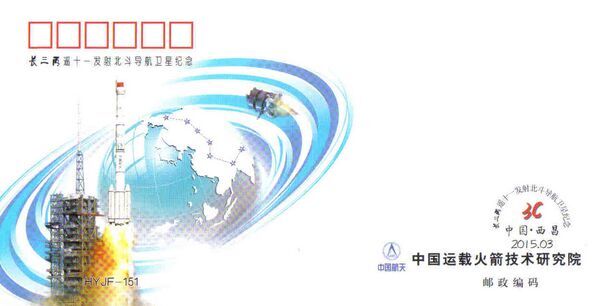
    Also, a philatelic first-day cover for the launch (a common Chinese practice) has been issued with a March 2015 inscription. This is likely a launch of a medium Earth orbit (MEO) satellite.

    The new BeiDou satellite would be the fifth GNSS satellite planned for launch by the end of the month, joining GPS Block IIF-9 (March 25), Galileo 7 and 8 (March 27) and IRNSS-D (March 29).

    Below is the first-day cover.

    BDS-3_M1_launch_cover.jpg
    First-day stamp cover for BeiDou commemorates an upcoming MEO launch. Photo: BeiDou


  • CNAV Performance ‘Matches or Slightly Outperforms’ Legacy Signals

    CNAV_Performance Chart_10_Mar_2015_public

    A quarterly meeting of the U.S. GPS Program’s interagency Civil Navigation Signals (CNAV) Tiger Team on March 5 focused on the new L2C and L5 GPS civil signals. “CNAV Message Types 10, 11, 30 and 33 are currently transmitted on seven GPS IIR-M (L2C) and eight GPS IIF satellites (L2C and L5),” wrote Rick Hamilton, CGSIC Executive Secretariat, USCG Navigation Center, in a status email to the Civil Global Positioning System Service Interface Committee (CGSIC).

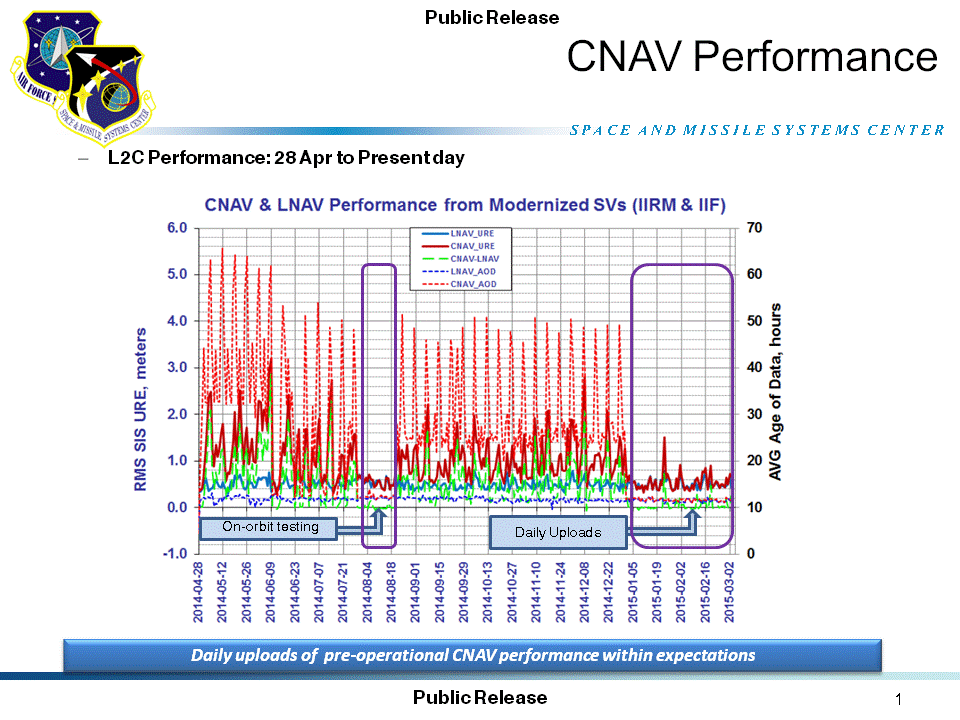
    “A Modernized Navigation (MODNAV) Tool integrated with the GPS ground control software (Architecture Evolution Plan or AEP) is generating the CNAV data messages,” Hamilton wrote. “Daily CNAV uploads began December 31, 2014, and the U.S. Air Force reports that signal performance of CNAV matches or slightly outperforms Legacy performance: average user range error (RMS URE) from 25 February – 3 March 2015 was 0.50 m for Legacy and 0.57 m for Modernized; best week for Modernized signals since the broadcast initiated April 2014 was 0.42 m for 6 – 13 January 2015.

    The graph above, from the Coast Guard Navigation Center website, illustrates the CNAV performance.

    Users are reminded that these CNAV signals are ‘pre-operational’ and should be used with discretion until they become fully operational; the L5 message is currently set unhealthy,” Hamilton concluded.

  • Galileo at Your Service


    On the eve of the Galileo 7 and 8 launch, the European Space Agency has created a short video to explain the value of the satellite constellation to its citizens. With the Galileo System, Europe will provide a full range of services and applications across many different areas for Europe and beyond.

  • EGNOS-Africa Joint Programme Office Launched

    The SAFIR (Satellite navigation services for AFrIcan Region) project has officially launched the EGNOS-Africa Joint Programme Office, laying the first stone of its future office building in a ceremony in Dakar, Senegal.

    SAFIR is part of the Africa-EU long-term strategic partnership to enhance safety in air transport. Its global objective is to build capacity within African ACP countries for the future deployment of GNSS/EGNOS in the region. The three-year project is funded by the European Union and financed from the 10th EDF Intra ACP envelope with 3.7 million euros, under an international consortium led by ASECNA (Agence pour la Sécurité de la Navigation Aérienne en Afrique et à Madagascar) with Egis, Pildo Labs and ESSP.

    The ceremony took place in Dakar on March 3. Those attending included Matthias Petschke, EU Satellite Navigation Programmes director; Karolina Stasiak from the UE Delegation in Sénégal; and Amadou Ousmane Guittèye, director general of ASECNA.

    “Satellite navigation can bring huge societal benefits, be it in transport, in agriculture or land management,” Petschke said in remarks at the launch ceremony. “Satellite-based augmentation systems in particular, like EGNOS, can bring enormous social and economic benefits. I attach, therefore, great importance to the setting up of the EGNOS Africa Joint Programme Office and am particularly pleased to see this team of African experts who have extensive experience and knowledge to support the development of an African satellite based augmentation system.”

    In his speech, Guittèye said, “The first mission of the JPO is to ensure Africa has developed adequate competencies and then to coordinate the implementation of the development and of the deployment of GNSS/EGNOS services and applications in the continent. The EGNOS-Africa Joint Programme Office (JPO) is a pan-African entity that acts for the benefit of Africa and supports stakeholders in their GNSS/EGNOS strategy, developments and implementation.”

    The ceremony also was attended by officials from the International Civil Aviation Organisation (ICAO), the African Civil Aviation Commission (AFCAC), the Agence Nationale de l’Aviation Civile et de la Météorologie (ANACIM) , the Aéroports du Sénégal (ADS) and local authorities.

    The SAFIR project began on January 15, 2013. It covers the set-up, staffing and operations of an EGNOS-Africa Joint Programme Office, and sets up and supports a number of technical working sessions composed of regional stakeholders concerned with GNSS/EGNOS in sub-Saharan Africa.

    ASECNA has 18 member states. With air navigation safety as its main mission, it cooperatively manages African airspace for the countries of Benin, Burkina Faso, Cameroun, Central African Republic, Comoros, Congo, Côte d’Ivoire, France, Gabon, Guinea Bissau, Equatorial Guinea , Madagascar, Mali, Mauritania, Niger, Senegal, Chad and Togo.
  • GPS IIF-9 Prepped for March 25 Launch

    GPS IIF-9 Prepped for March 25 Launch

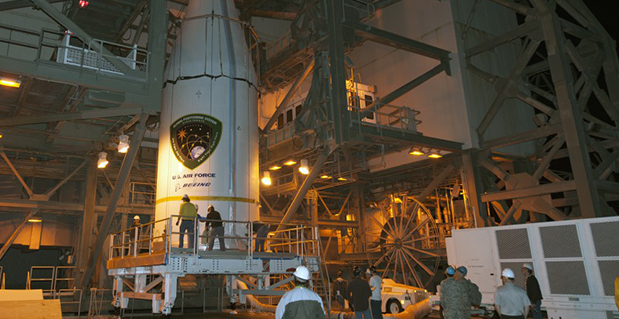
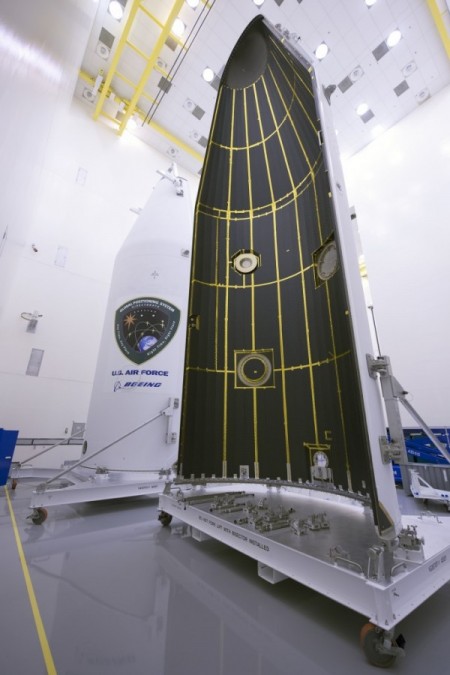
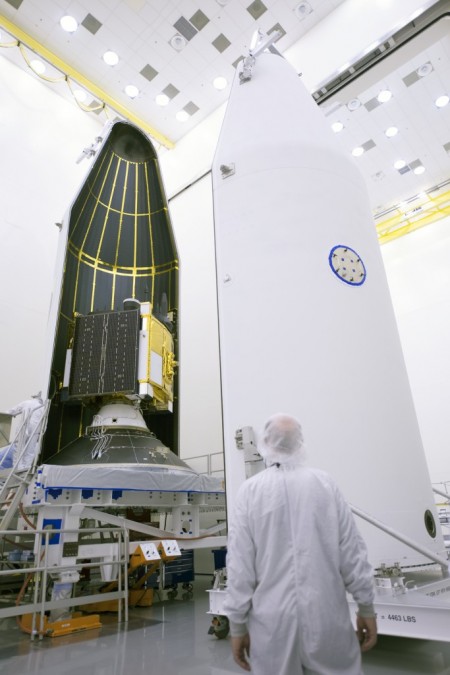
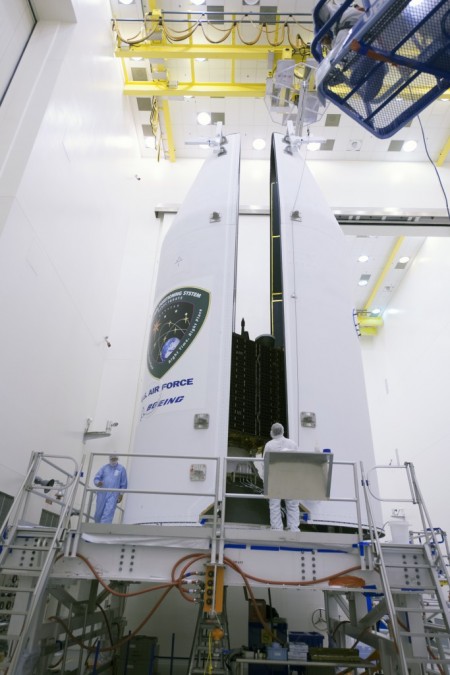
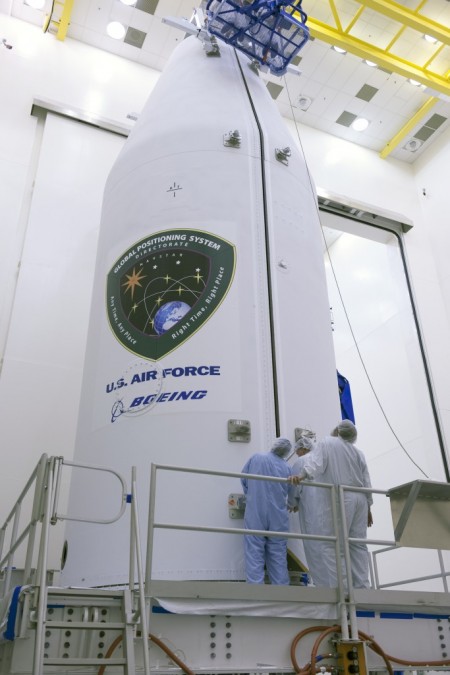
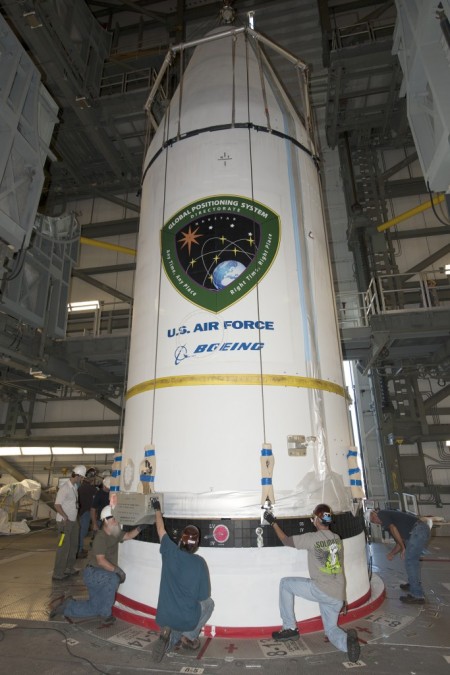
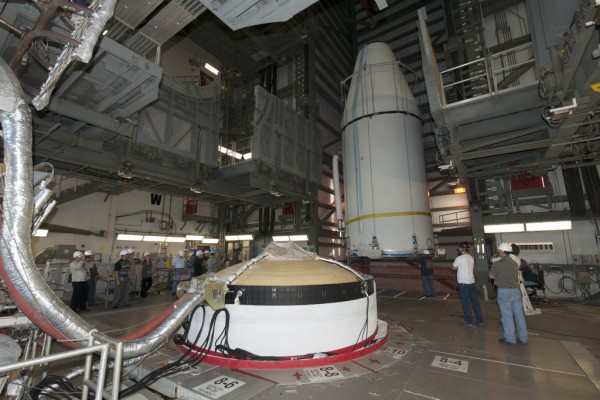
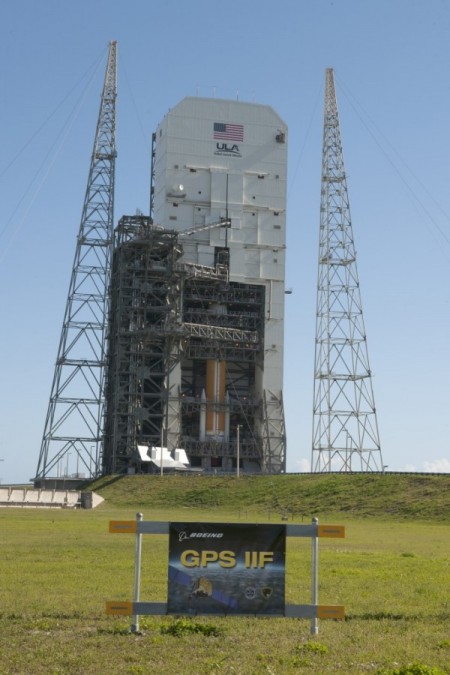
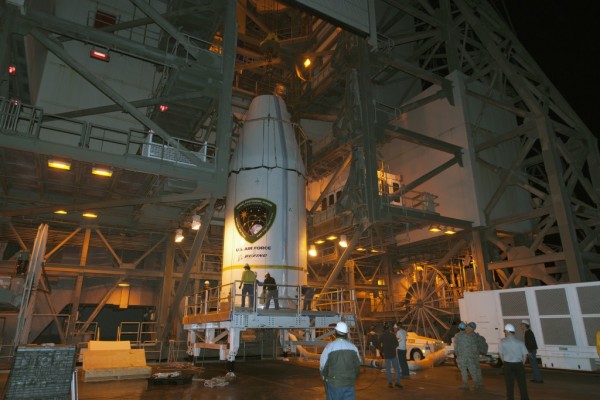
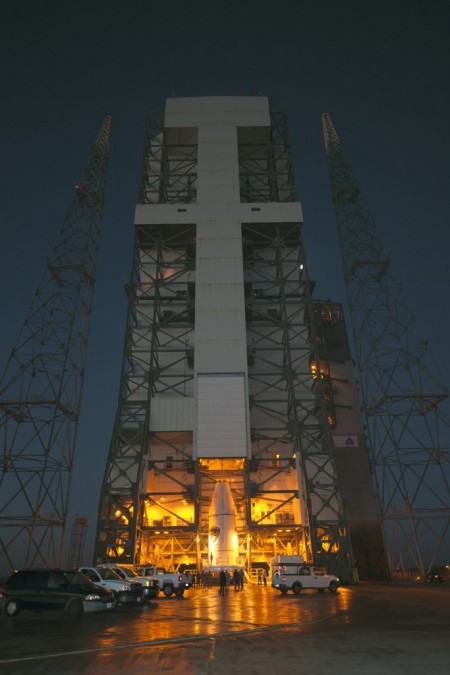
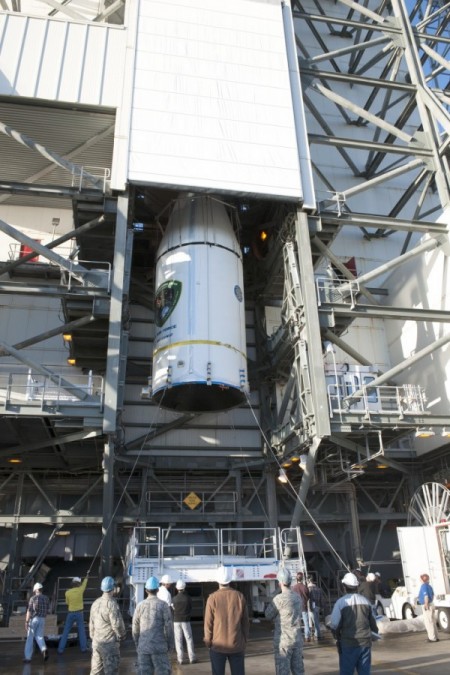
    The U.S. Air Force’s ninth GPS Block IIF satellite (GPS IIF-9) has been encapsulated in the Delta IV rocket’s four-meter-diameter nose cone at a processing facility, and moved to the launch pad at Space Launch Complex 37 for mating to its booster inside the mobile service tower.

    Launch is scheduled for March 25 at 2:36 p.m. EDT (1836 GMT) from Space Launch Complex 37 at Cape Canaveral Air Force Station, Fla. GPS IIF-9 marks the 29th Delta IV launch and the 57th operational GPS satellite to launch on a ULA or heritage launch vehicle.

    To follow the launch countdown, dial the ULA launch hotline at 1-877-852-4321 or join the conversation on Facebook, Twitter or Instagram.

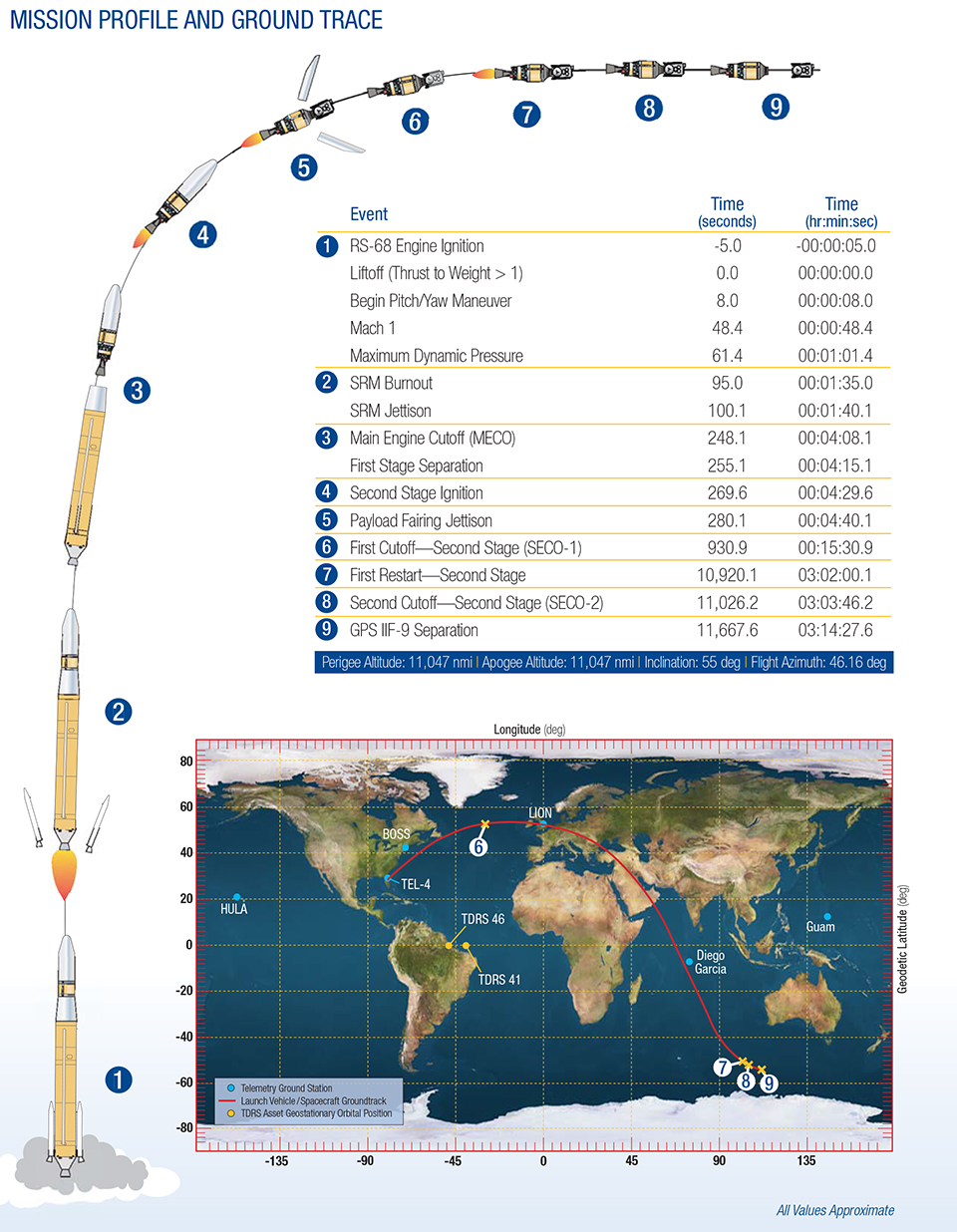
    GPS IIF-9 Mission profile and ground trace. (courtesy of ULA)
    The planned GPS IIF-9 launch trajectory, event times, and ground trace. (courtesy of ULA)

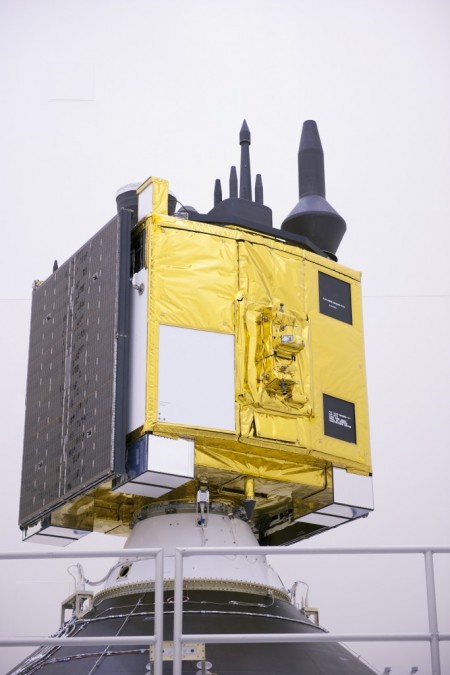
    Below are photos from the United Launch Alliance, which supplies the Delta IV rocket and serves as the launch provider for the GPS Directorate.


  • Galileo 6 Signals Acquired

    News courtesy of CANSPACE Listserv.

    On March 17, some stations participating in the International GNSS Service Multi-GNSS Experiment acquired E1 and E5a signals from Galileo 6 (FOC-FM2, GSAT0202). The satellite is using pseudorandom noise code E14.

    The orbit of Galileo 6 was recently adjusted to make it more circular with a higher perigee after it was launched into an incorrect orbit last August.

  • Galileo 7 and 8 Fitted to Dispenser in Preparation for Launch

    Galileo 7 and 8 Fitted to Dispenser in Preparation for Launch

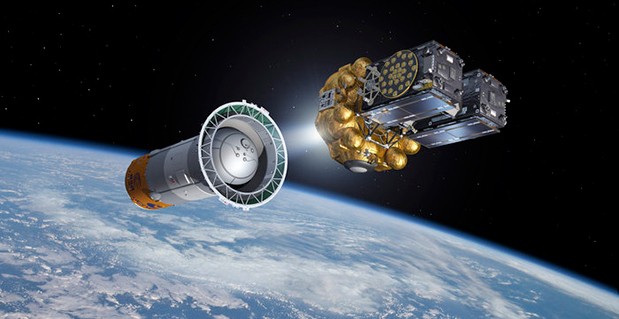
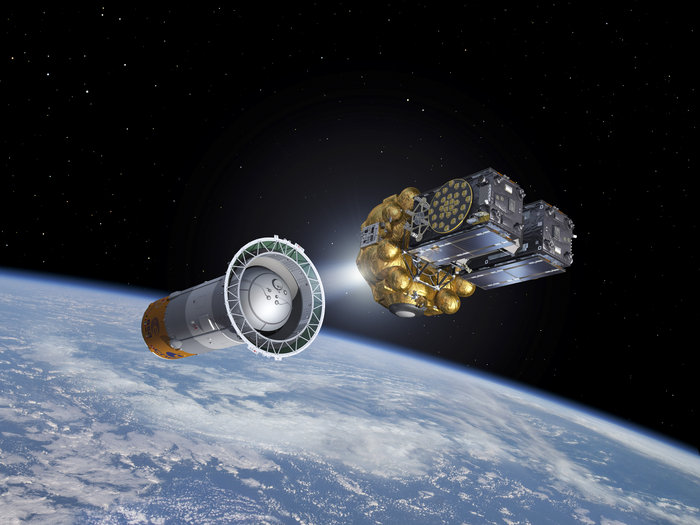
    Artist's view of Galileo satellites attached to their dispenser atop their Fregat upper stage separating from the Soyuz upper stage. The Fregat then flies them the rest of the way up to medium-Earth orbit.  (courtesy of ESA)
    Artist’s view of Galileo satellites attached to their dispenser atop their Fregat upper stage separating from the Soyuz upper stage. The Fregat then flies them the rest of the way up to medium-Earth orbit. (courtesy of ESA)

    News courtesy of the European Space Agency

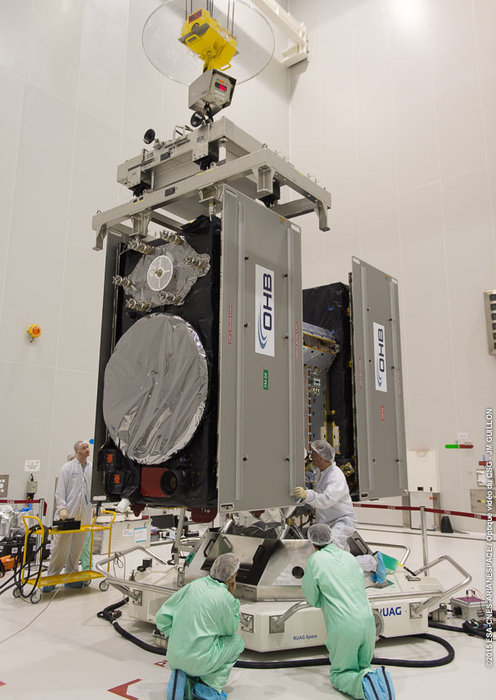
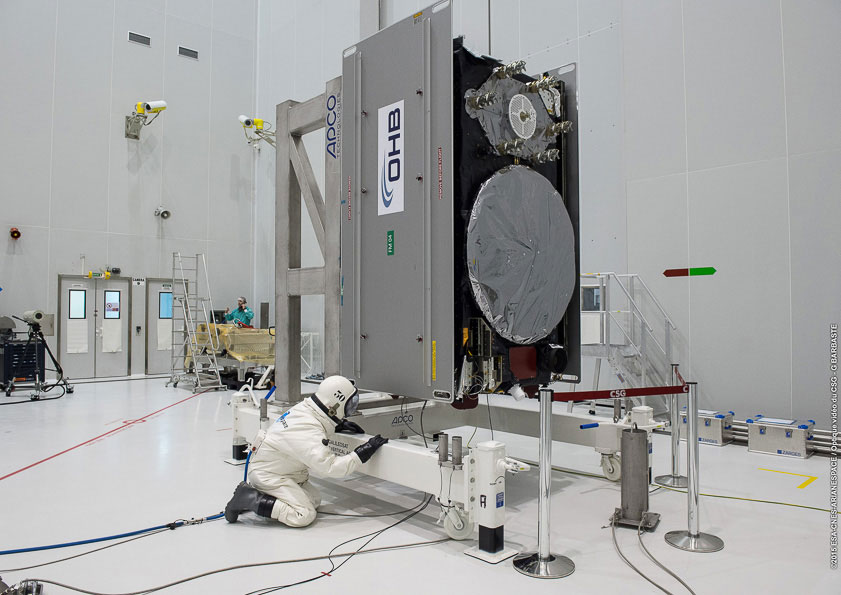
    The seventh and eighth Galileo satellites being fitted together onto the dispenser, March 16-17. (Photo courtesy of ESA)
    The seventh and eighth Galileo satellites being fitted together onto the dispenser, March 16-17. (Photo courtesy of ESA)

    The seventh and eighth Galileo satellites, set for launch together in nine days’ time, have been fitted together onto the dispenser that will carry them during their flight to orbit.

    The fueling of the two satellites was completed last week, leaving them ready to be placed into launch configuration. They were carefully lowered into place then attached to the dispenser. The operation went smoothly, the two satellites having previously gone through separate “fit checks” with the dispenser in advance of fueling.

    The specially designed carrier will hold the satellites in place during their four-hour flight into orbit some 22,300 km above our planet. Then, at the correct altitude, the two satellites are sprung away in opposing directions. Next, the dispenser plus satellites will be placed onto the Fregat upper stage of their Soyuz ST-B launcher.

    As much a spacecraft as a launch stage, the reignitable Fregat will haul the Galileo satellites most of the way up to their final orbital altitude, once the first three stages of the Soyuz have taken them up to their initial orbit.

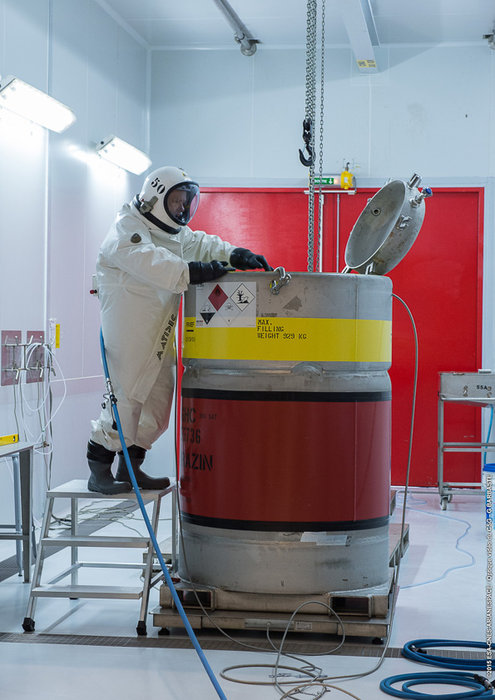
    Fuel for the seventh and eighth Galileo satellites, checked by an engineer in a protective SCAPE (Self Contained Atmospheric Protective Ensemble). Fuelling of the two satellites took place at the end of the second week of March 2015, allowing the satellites to be fitted to their launch dispenser ahead of the March 27 launch. (Photo courtesy of ESA)
    Fuel for the satellites is checked by an engineer in a protective SCAPE (Self Contained Atmospheric Protective Ensemble). (Photo courtesy of ESA)

    Note the protective metal panels covering the solar wings folded against the sides of the Galileo satellites. Protecting these delicate solar arrays during handling on the ground, these panels will be removed ahead of launch.

    The launch of the seventh and eighth Galileo satellites is scheduled for March 27.

  • Solar Storm Hits Earth’s Magnetic Field

    Solar Storm Hits Earth’s Magnetic Field

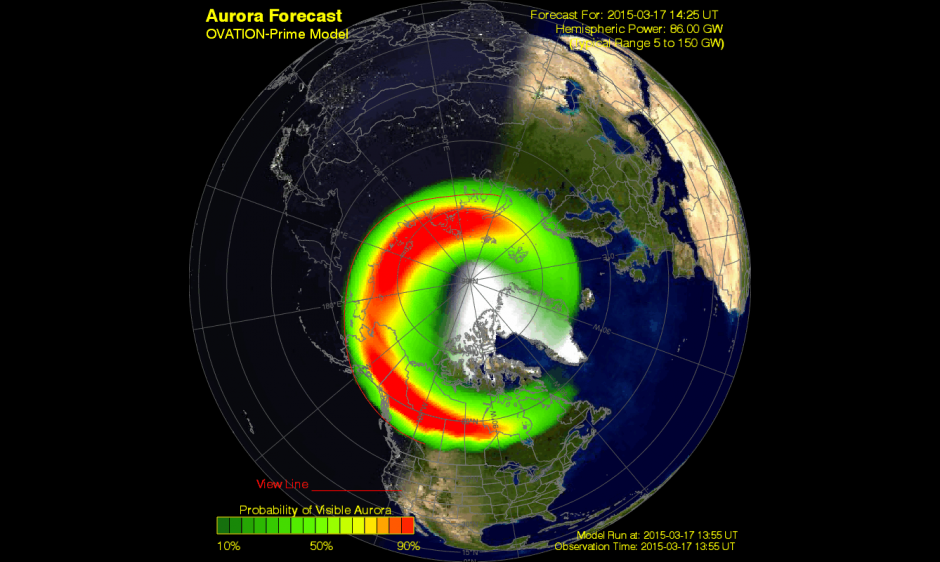
    A G4 (Severe) geomagnetic storm was observed today at 07/1358 UTC (09:58 am EDT). This is the response to a pair of CMEs observed leaving the Sun on 15 March. Shown here is a model depiction of where the aurora is likely visible. Storm conditions are forecast to persist for the next several hours before beginning to wane down towards the end of the UT day. (Courtesy of NOAA)
    A G4 (Severe) geomagnetic storm was observed today at 07/1358 UTC (09:58 a.m. EDT). This is the response to a pair of CMEs observed leaving the Sun on March 15. Shown here is a model depiction of where the aurora is likely visible. Storm conditions are forecast to persist for the next several hours before beginning to wane down towards the end of the UT day. (Courtesy of NOAA)

    A G4 (severe) geomagnetic storm is now taking place, the most powerful solar storm of the current solar cycle, reports Discovery.com.

    Initially triggered by the impact of a coronal mass ejection (CME) hitting our planet’s magnetosphere, a relatively mild geomagnetic storm erupted at around 04:30 UT (12:30 a.m. EDT), but it has since become a severe G4-class geomagnetic storm. Bright auroras were sighted over several northern-tier U.S. states including Minnesota, Wisconsin, Montana, the Dakotas and Washington. The storm could continue for many hours as Earth passes through the turbulent wake of the CME.

    Storm conditions are forecast to persist for the next several hours before beginning to wane down towards the end of the UT day.

    Not all types of solar activity (sun spots, solar flares, solar burst, and solar radiation) affect GPS receiver operations. Geomagnetic storms, however, can cause problems for GPS receivers if the storms are powerful enough.

    The solar cycle is about 11 years long, during which the sun waxes and wanes in magnetic activity.

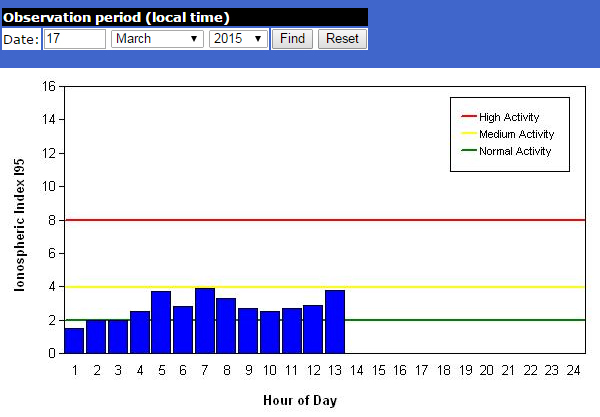
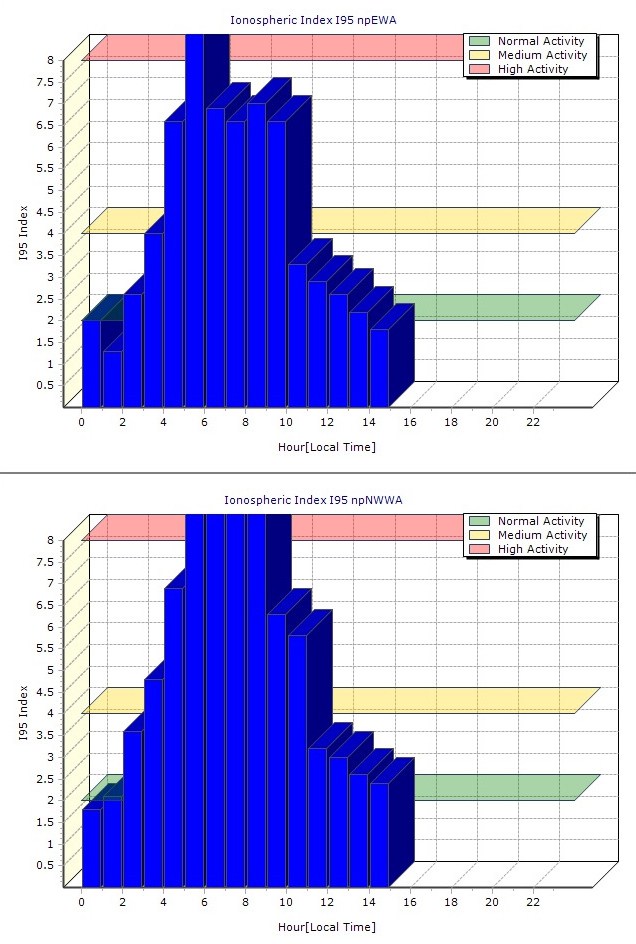
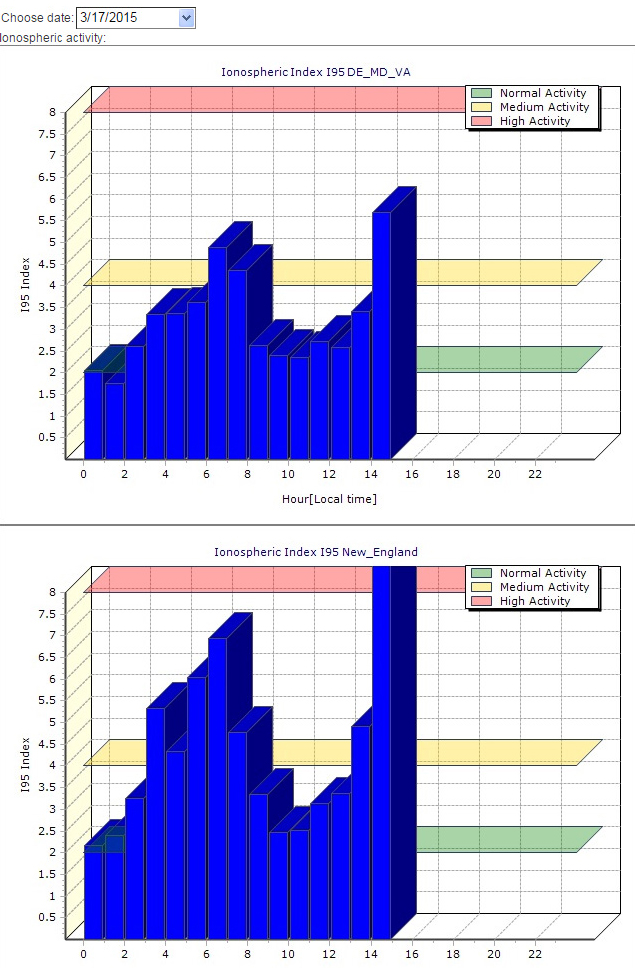
    Below are ionospheric charts from Missouri, Washington State and New England.

    Missouri ionosphere chart during the March 17 geomagnetic storm.
    Missouri ionosphere chart during the March 17 geomagnetic storm.
    Washington ionosphere chart
    Washington ionosphere chart during the March 17 geomagnetic storm.
    New England ionosphere chart during the March 17 geomagnetic storm.
    New England ionosphere chart during the March 17 geomagnetic storm.
  • Moscow Navigation Forum to Focus on GLONASS Market

    announcement
    Credit: Navitech

    The International Navigation Forum is a central event of year in the field of the commercial use of satellite navigation technologies — especially of the Russian navigation system GLONASS. The forum will be held April 22-23 at the Expocentre Fairgrounds in Moscow, in conjunction with the 7th International Exhibition on Navigation Systems, Technologies and Services (Navitech), which takes place April 22-24.

    The forum is designed to inform Russian and foreign audiences about state policies in the development and application of GLONASS technology in Russia and worldwide. It also aims to analyze the latest trends of the navigation industry, as well as to discuss the product and service market for various consumers and conditions for its export to foreign markets.

    The Navitech 2015 exhibition is aimed at world leaders in satellite navigation, as well as information technologies, geodesy and cartography. Navitech 2015 unites leading Russian and foreign developers and manufacturers of navigation equipment, services and software, including mapping apps. It reflects current world trends and serves as a main exhibition event for industry specialists. The Navitech Exhibition is the only specialized satellite navigation exhibition in Russia.

    The agenda of the 9th International Navigation Forum is designed for the end-user of navigation products and services, and highlights all aspects of their practical use for building a successful business and enhancing its efficiency.

    Forum attendees will receive detailed information about legal aspects of using satellite navigation, be introduced to navigation and communication equipment of leading Russian and foreign manufacturers, and learn about different industry applications and leading companies’ experiences in the practical use of navigation technologies, including business cases of using satellite navigation by Russian business representatives.

    Sessions and roundtables will present the most current information about developed products and important issues in the fields of navigation, mapping, and legal regulation. The participants will be able to give their suggestions on creating favorable conditions for the effective introduction of innovative technologies and exchange experiences.

    Forum topics:

    • Status and development prospects of GLONASS and foreign navigation satellite systems
    • Major development trends of the Russian market of navigation services and equipment
    • Practical experience of using satellite navigation technologies in different sectors of the Russian economy
    • Navigation technologies for intellectual transport systems
    • Information and navigation services, systems and equipment for mass market
    • Navigation technologies for passenger transport
    • Navigation and communication equipment of leading Russian and foreign manufacturers
    • Geoinformation systems for various purposes

    Exhibition topics:

    • In-vehicle navigation and information systems
    • Navigation technologies for land development, survey, design and construction
    • Automotive and personal navigation, equipment, LBS
    • Professional navigation equipment, modules and components

    To learn more, visit the websites: www.glonass-forum.com and www.navitech-expo.ru/en/. To participate as a delegate, speaker, sponsor or a partner, contact ProConferences by phone + 7 (495) 641 57 17 or email [email protected]


  • Sixth Galileo Satellite Reaches Corrected Orbit

    Sixth Galileo Satellite Reaches Corrected Orbit

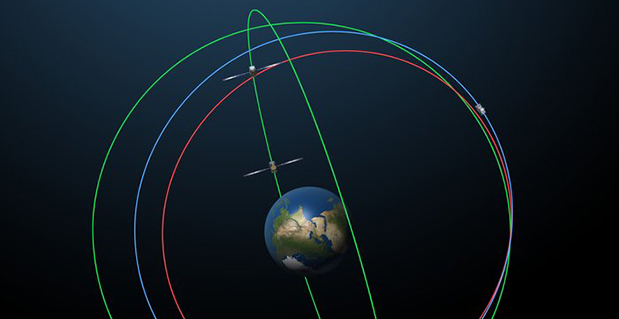
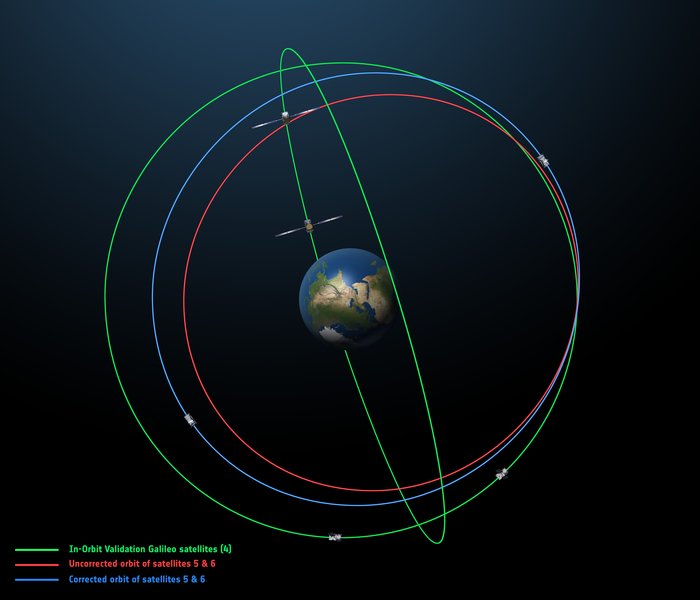
    The original (in red) and corrected (in blue) orbits of the fifth and sixth Galileo satellites, along with that of the first four satellites (green). Photo: European Space Agency
    The original (in red) and corrected (in blue) orbits of the fifth and sixth Galileo satellites, along with that of the first four satellites (green). Photo: European Space Agency

    By the European Space Agency

    The sixth Galileo satellite of Europe’s navigation system has entered its corrected target orbit, which will allow detailed testing to assess the performance of its navigation payload.

    Launched with the fifth Galileo last August, its initial elongated orbit saw it traveling as high as 25,900 km above Earth and down to a low point of 13,713 km — confusing the Earth sensor used to point its navigation antennas at the ground.

    A recovery plan was devised between ESA’s Galileo team, flight dynamics specialists at ESA’s ESOC operations centre and France’s CNES space agency, as well as satellite operator SpaceOpal and manufacturer OHB. This involved gradually raising the lowest point of the satellites’ orbits more than 3500 km while also making them more circular.

    The fifth Galileo entered its corrected orbit at the end of November 2014. Both its navigation and search and rescue payloads were switched on the following month to begin testing. Now the sixth satellite has reached the same orbit, too.

    This latest salvage operation began in mid-January and concluded six weeks later, with 14 maneuvers performed in total. Its corrected position is effectively a mirror image of the fifth satellite’s, placing the pair on opposite sides of the planet. The exposure of the two to the harmful Van Allen Belt radiation has been greatly reduced, helping to ensure future reliability.

    Significantly, the corrected orbit means they will overfly the same location on the ground every 20 days. This compares with a standard Galileo repeat pattern of every 10 days, helping to synchronize their ground tracks with the rest of the constellation.

    The test results from Galileo 5 proved positive, with the same test campaign for the sixth satellite due to begin shortly, overseen by ESA’s Redu centre in Belgium. A 20 m-diameter antenna will study the strength and shape of the navigation signals at high resolution.

    “I am very proud of what our teams at ESA and industry have achieved,” says Marco Falcone, head of Galileo system office. “Our intention was to recover this mission from the very early days after the wrong orbit injection. This is what we are made for at ESA.”

    The decision whether to use the two satellites for navigation and search-and-rescue purposes will be ultimately taken by the European Commission, as the system owner, based on the in-orbit test results and the system’s ability to provide navigation data from the improved orbits.

    The next pair of satellites is due for launch on March 27.

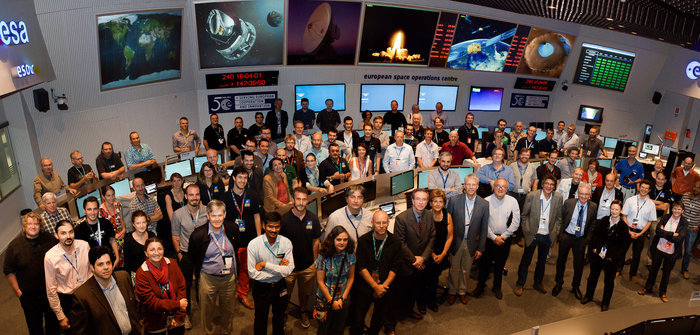
    The Galileo operations team, joined by Director General Jean-Jacques Dordain, Director of Human Spaceflight and Operations Thomas Reiter and experts from European industry, in the Main Control Room at ESA’s Space Operations Centre, ESOC, in Darmstadt, Germany, August 28, 2014. (Photo courtesy of ESA)
    The Galileo operations team, joined by Director General Jean-Jacques Dordain, Director of Human Spaceflight and Operations Thomas Reiter and experts from European industry, in the Main Control Room at ESA’s Space Operations Centre, ESOC, in Darmstadt, Germany, August 28, 2014. (Photo courtesy of ESA)
  • Launch Prep on Track for Galileo’s Next FOC Satellites

    Launch Prep on Track for Galileo’s Next FOC Satellites

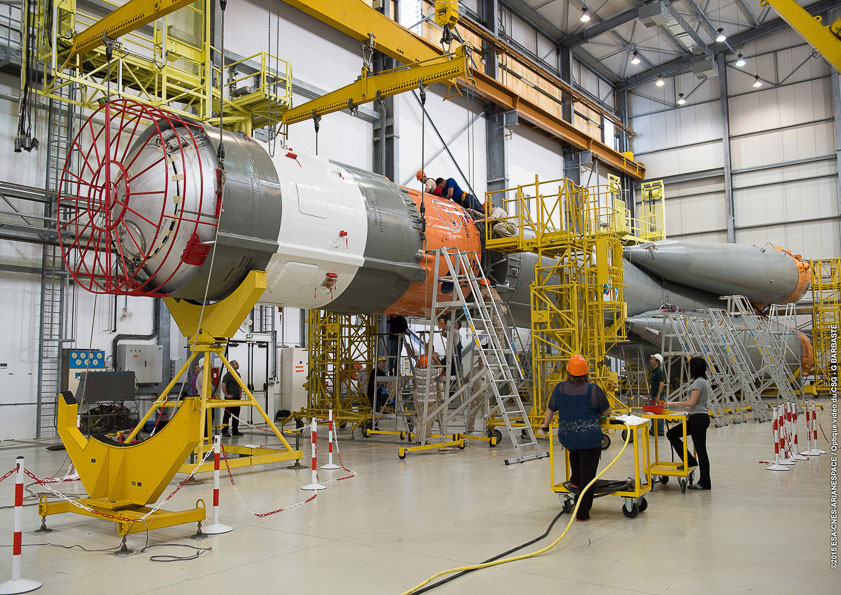
    Soyuz’ Block I third stage is mated to the launcher at the Spaceport’s MIK integration building.
    Soyuz’ Block I third stage is mated to the launcher at the Spaceport’s MIK integration building. Photo: Galileo

    Preparations for Arianespace’s next Soyuz flight, which will lift into orbit two more Galileo satellites, are in full swing at multiple locations across the spaceport in French Guiana. Work includes a key integration step for the medium-lift launcher, plus the start-up of fueling for its Galileo satellite passengers.

    Soyuz’ Block I third stage was mated to the vehicle’s core during activity today in the MIK Launcher Integration Building, concluding its basic build-up. Once the checkout process is completed, Soyuz will be transferred to the launch pad, where it will receive the two Galileo spacecraft and the Fregat upper stage, all of which are well into preparation phases of their own.

    Payload fueling began earlier this week, with Galileo 8 (Galileo FOC-FM4) — the fourth Galileo Full Operational Capability (FOC) satellite, and eighth overall — receiving its propellant load in the Spaceport’s S5A fueling and integration hall. After its sister Galileo FOC-FM3 (Galileo 7) co-passenger undergoes this same process, the two will be integrated side-by-side on a dispenser for their shared ride aboard Soyuz on March 27.

    The fueling process followed the finalization last week of FM3 and FM4’s hardware and software, as well as the charging of their batteries — which will be relied upon during the short period from launch to unfurling of these spacecraft’s solar arrays in orbit.

    The Galileo program is Europe’s initiative for satellite navigation, providing a highly accurate global positioning system under civilian control — to consist of 30 satellites in total, along with European control centers and a worldwide network of sensor and uplink stations.

    Galileo’s FOC phase — during which the network’s complete operational and ground infrastructure will be deployed — is managed and funded by the European Commission, with the European Space Agency delegated as the design and procurement agent on the Commission’s behalf.

    The FM3 and FM4 spacecraft were built by OHB System in Bremen, Germany. Their navigation payloads, which will generate the precision positioning measurements and services to users worldwide, were supplied by Surrey Satellite Technology Ltd. in Guildford, UK.

    This upcoming mission is designated Flight VS11 in Arianespace’s numbering system. It will be the company’s fourth launch carrying spacecraft for the Galileo constellation, as well as the 11th flight of a workhorse Soyuz from French Guiana since the 2011 introduction.

    the fourth Galileo Full Operational Capability (FOC) satellite is loaded with on-board propellant inside the S5A fueling and integration hall. Photo: Galileo
    the fourth Galileo Full Operational Capability (FOC) satellite is loaded with on-board propellant inside the S5A fueling and integration hall. Photo: Galileo
  • Orbit of Second Wayward Galileo Satellite Adjusted

    Editor’s Note: See the report from the European Space Agency here.


    An official with the European Space Agency has confirmed that the sequence of maneuvers to adjust the orbit of the second of two Galileo satellites launched into a wrong orbit in August 2014  has been completed.

    The orbit of the first satellite, known variously as GSAT0201, Galileo FOC-FM1 or Galileo 5 (with COSPAR ID 2014-050A and NORAD ID 40128) was raised during operations carried out in November, and the satellite began transmitting L-band signals on Nov. 29.

    Maneuvering of the second satellite (GSAT0202, Galileo FOC-FM2 or Galileo 6, with COSPAR ID 2014-050B and NORAD ID 40129) began around Jan. 15. The procedure took somewhat longer than that for the first satellite as it also involved changing the mean anomaly of the satellite to be about 180° away from that of the first satellite.

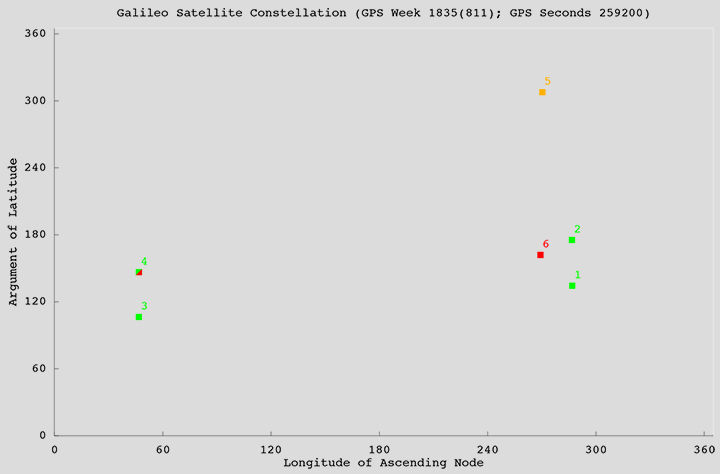
    The locations of the satellites in the Galileo constellation are shown in the accompanying figure. Satellites in green are transmitting a full complement of L-band signals. Galileo 4 (GSAT0104), one of the in-orbit validation satellites, suffered a power anomaly and only transmits on the E1 frequency. Galileo 5 is transmitting L-band signals but its orbit cannot be properly represented in the Galileo broadcast almanac. Galileo 6 has not started transmitting valid L-band signals yet.

    Officially, all Galileo signals are currently declared unavailable during an extended period of testing following ground segment upgrades. However, signals continue to be monitored by stations participating in the International GNSS Service Multi-GNSS Experiment.

    galileo_constellation-rev