Category: GNSS

  • GNSS Future Glimpsed at Summit in Munich

    The Munich Satellite Navigation Summit annually gathers people involved with GNSS from around the world to report on current status and progress of the multiple systems. It is a high-level briefing of significant global importance. Of course Europe, Germany, Bavaria, and the European GNSS industry, now recognized around the world, all take the opportunity to present their capabilities and successes.

    This year’s Summit covered a lot of ground, and I’ve tried to do it justice in this column. For an overview, here are the main topics covered in what follows:

    • Opening Plenary
    • Constellation Updates
    • Regional and Augmentation Updates
    • Bavarian Highlights
    • GNSS Interference
    • Legal impacts of Personal Privacy Devices (PPDs)
    • Precise Point Positioning (PPP)
    • Future of GNSS in the User Segment

    I used to spend quite a lot of time in Munich working on a multi-national, multi-role fighter aircraft program, so returning for this year’s Summit stirred some good memories for me.

    Held in the opulent Residenz Muenchen, the conference derives a special atmosphere from these historic surroundings, some dating back to 1385.  The former royal palace of Bavarian monarchs, the labyrinthine palace has ten courtyards and 130 rooms. Overall, this is a delightful setting.

    Regional Flavor. Munich is in the southern German state of Bavaria, and Bavaria has taken a real interest in the promotion and success of Galileo; witness the expansive Bavarian booth at recent European and North American GNSS conferences, and the siting of a Galileo control center in Oberpfaffenhoffen, once a sleepy village in the Bavarian countryside 20 kilometers outside Munich, but now a significant high-tech research center with many aerospace facilities. Germany has of course been one of the lead nations funding Galileo from its inception.

    Opening Plenary: A View from the Top

    The host of the Summit is actually the University of the German Federal Army in Munich, and we received a warm welcome from two leading professors – Dr. Eissfeller and Dr. Niehuss, the president.

    The theme of the Summit is to move from implementation to utilization, and in typical European form, all parties were looking to shower potential users with funded solutions to problems of which users are not yet aware — so users clearly need government-provided education, pilot projects, and funding. Not exactly a North American concept, where we tend to encourage users to buy our innovative stuff by demonstrating how it can save them money or earn them more revenue. But there’s a city called Rome over here . . .

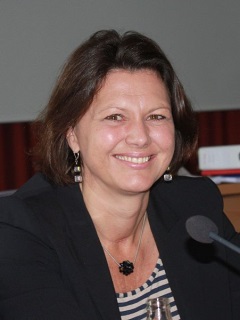
    The opening plenary session covered GNSS, Earth Observation (EO) and Telecommunications — an extensive mandate — with a panel headed by Ilse Aigner, Bavarian State Minister of Economic Affairs and Media, Energy and Technology, an equally extensive portfolio, even for a state-certified engineer who used to work for Eurocopter.

    The European Commission, the European Space Agency (ESA), the German Aerospace Agency (DLR), the European GNSS Agency (GSA), and leading manufacturers Airbus, OHB (providers of the Galileo full-operational capability (FOC) satellites), and Telespazio were also represented. The Minister did indeed associate with and praise the local area, claimed 1,000 jobs created related to Galileo through an incubation center at Oberpfaffenhofen, and declared whole-hearted Bavarian support for satellite navigation.

    Among important matters mentioned by the plenary panel:

    • an €11 billion budget for Galileo/EGNOS and Copernicus (an EO project) under the Horizon 2020 program;
    • an intent to declare Early Service for Galileo before the end of this year with two or three dual Galileo satellite launches.

    Two Launches this Year. The first two FOC (production) SVs should go to the European launch center in Kourou in April in preparation for launch around June.  I heard in a corridor that launches may be planned for June, October and December, but an EU spokesman later said that there would only be two launches this year. OHB now has the contract to build 22 FOC Galileo SVs, each with a design life of 14 years, and they are bullish on their ability to deliver on time and budget.

    Constellation Updates

    • GPS. An estimated 2 billion GPS receivers are in use, and there may be ~10 billion by 2020. A return-on-investment (RoI) analysis is currently underway, but a rough guess is that costs are in the tens of $Billions, while annual returns are of the order of $60–100B/year. Another IIF satellite (SV) launched last month brought the total to 5 SVs transmitting L1, L2C, and L5 – with 7 more to come, and multiple launches are expected this year. There are 30 operational SVs on orbit. Signal performance significantly exceeds the specs, and consistent, dependable performance has been provided for more than 20 years.
    • Galileo. First fix achieved 12 March, 2013 with four SVs, two (maybe three?) launches of two SVs each planned for 2014 & early operational capability to be declared by end of this year. €7B funding provisioned for 2014-2020, 16-24 operational ground stations, Commercial Service (CS) planned by 2016 (more on this later), and a long-term evolution plan is being worked up during this year.
    • BeiDou. 14 SVs are on orbit: 5 geosynchronous orbit (GEO), 4 mid-Earth orbit (MEO) similar to GPS and other GNSS birds, and 5 inclined geosynchronous orbit (IGSO), together providing dual-frequency services. 30 total SVs are planned, and the intent is to provide open, compatible, interoperable signals with other GNSS, free of charge. There was not much other news to report, other than China intends to invest significantly in BeiDou to keep improving services.
    • GLONASS.  Russian delegates were notably absent, and there was much speculation that they declined to attend due to the Crimean situation. One U.S. delegate even inferred that they were ‘un-invited.’
    • United Nations ICG. Nine nations and the European Union = International Committee on GNSS (ICG), with 20 other associate and observer states.  Activities include GNSS compatibility/interoperability, GNSS enhancements, information sharing, and reference frames, timing & applications – lots of upcoming meetings and activities (see associated story).

    Regional & Augmentation Updates

    • WAAS (the U.S. Wide Area Augmentation System). Phase IV is underway with GEO replenishment begun, introduction of L5 to replace L2, and replacement of obsolete component parts. 100 GIII receivers were ordered with L1/L2C and L5 capability for delivery by September this year– and have capacity to also add Galileo. GIII receivers have already been fielded in six locations as part of initial integration testing. The Safety computer will also be upgraded starting this year.  3,912 LP/LPV approaches have been approved, of which 3,379 LPVs serve 1,667 Airports.
      GBAS CAT I is progressing with four US airport installations, system design approval began in January this year, and United Airlines has begun equipping more than 90 B737/B787 for GPS approach and landing. Alternative Positioning, Navigation and Timing (APNT) investigations are underway (as a backup to GPS) with a hybrid DME-pseudolite configuration currently favored. Stanford University subsequently presented this and other concepts.
    • EGNOS (the European Geostationary Navigation Overlay Service).  €1.58B budget approved, EGNOS V3 evolution is underway – introduction of L1/L5 and GEO (SES 5 and Astra 5B) replenishment, a requirement to expand East and West and to the North to provide full coverage to all EU States.There are ~100 EGNOS LPV approaches approved, this year it is hoped to add 150 more.
    • QZSS (Japan’s Quasi-Zenith Satellite System). Operational concept has been proven with 1st IGSO SV (Michibiki), so Japan is moving forward quickly to add another 3 SVs  (3xIGSO and 1xGEO) and ultimately would like to have a total of seven SVs in orbit providing QZSS services. L1/L1C/L2C/L5 signals are identical to GPS and L1s/L5s are augmentation signals, while L6 is proposed to be similar to Galileo E6, providing cm level PPP type service. QZSS essentially is intended to provide higher-elevation satellites to improve urban navigation in dense cities.
    • IRNSS (Indian Regional Navigation Satellite System).  Coverage extends 1500 kilometers beyond India’s land area, target is <20m accuracy, signals are in L5 and S band and can be used independently or in dual frequency combinations. A 2nd IRNSS-1B GEO satellite is scheduled to launch on April 4th.
    • GAGAN The Indian SBAS was commissioned and certified in February this year with a number of ground stations, redundant uplinks and two on-orbit GSAT 8 & 10 GEOs. Gagan is now qualified to provide RNP0.1 (navigation accuracy to 0.1 miles).

    Bavarian Highlights

    A collection of examples of Bavarian GNSS innovations followed in a very interesting session led off by an overview of Business Incubation Centers and their collaboration with government agencies and research centers. Small business start-ups are encouraged to apply during four annual time-slots, and receive two years’ incubation support and cash incentives.  This has lead to 81 new ventures and has apparently been the source of the 1,000 new jobs mentioned by the Minister of Economic Affairs.

    The annual European Satellite Navigation Competition and Galileo Masters competition have also generated a large number of ideas and concepts (8,000), some of which have found support through this incubation process.

    Airbus Defence gave a short overview of the testing work they accomplished in supporting the first Galileo fix. The company fix has prepared several vehicle test platforms, ready to take the next phase of Galileo testing to the streets in realistic, real-world environments.

    DLR provided insights into a number of their activities, namely: Iono mapping; signal distortion; multipath; jammer mitigation – adaptive antenna and processing; GNSS repeaters – how they can become unintentional jammers; spoofer and multipath investigations; antenna designs; GNSS evolution – maser and clock combination benefits.

    IFEN provided information on the activities at the GATE ground-based pseudolite range, which has enabled realistic outdoors testing of Galileo receivers, well in advance of signals from orbiting satellites. Recent testing has now been able to include the four operating Galileo SVs on orbit with GATE pseudolite signals. GATE will continue to evolve over the next few years to keep up as more Galileo orbital signals come on-line.

    Fraunhofer presented information on their 40-channel GPS/Galileo/GLONASS chip-receiver, claiming 1m accuracy, low-cost, robust reliable position solution, small form-factor and low-power. Following PRS test-bed development efforts, Fraunhofer has now received a contract to also deliver 20 pre-operational Galileo PRS receivers for use in initial pilot projects.

    GNSS Interference

    Vidal Ashkenazi, in his inimitable form, led a panel discussion on interference, jamming (in particular personal privacy devices (PPD)) and spoofing, and coaxed his panel members to provide a quantity of information on what’s being done, mitigation capabilities and potential enforcement. Unlike all the other sessions, panel members did not use presentations, instead responding to some wide-ranging questions on the subject from the session chair.

    David Turner, representing the U.S. Department of State, indicated that the ICG will meet shortly in Geneva hosted by the International Telecommunication Union (ITU) to focus on interference, jamming and mitigation. The recourse that nations have for use of PPDs by their people is the law — jammers are illegal, sale and purchase of them is illegal — however internet sales are very difficult to police. So detection and mitigation are required to find and shut them down. Dave’s presentation on the GPS.gov website indicates that the ICG is working on an education program for States to inform about GNSS sensitivity to interference and the threat to critical infrastructure if they are allowed to operate. The ICG also has a task force on detection, reporting and systems development.

    The Indian Space Research Organization (ISRO) indicated that PPD jammers in India are restricted but permitted for gatherings such as at churches where personal safety may be an issue. Ground-based detection is needed and stronger legal protection which may well prohibit use of PPDs altogether.

    Japan Aerospace Exploration Agency (JAXA) indicated that they are working on ‘signal proofing’ for QZSS.

    BeiDou said that they are building a monitor network in China which will detect jamming.

    There was a general discussion on whether receiver manufacturers should be mandated to make receivers which are resilient to jamming. Many thought that there have already been significant advances in the direction by manufacturers. The normal approach would be to develop requirements with industry, agency and user inputs, publish them and call up the requirements in equipment specifications. In the United States, the Department of Homeland Security is seeking an approach to detection and location.

    Legal impacts of Personal Privacy Devices (PPDs)

    While the audience may have had high hopes that the ‘Legal Eagles’ could come up with some magic prevention and prosecution solution, the next session was more of a legal background briefing, without any concrete conclusions (quite similar to other discussions I’ve had with some lawyers in the past, actually).

    The first briefing was from the European Commission/European Union who indicated that the EU doesn’t own the frequency rights to Galileo (uh-oh). They have to operate through a member state, which gets the rights through the International Telecommunication Union (ITU) and then licenses use to the EU – the bottom line being that EU enforcement of jamming protection laws maybe be difficult, as the legal framework only exists at the national level for each State. The EU is trying to get recognition under another class of ITU membership.

    EU regulations were presented, stating that GNSS re-transmitters can only be operated legally by governments or government contractors. Or can be used indoors for indoor navigation, but only for emergency services at fixed sites which are pre-approved. Pseudolites can only be operated indoors,and there should be no interference to other systems. Jammers are forbidden and cannot be placed on the market for sale. 

    Eurocontrol had a lot to say about the impact on aviation navigation infrastructure and receivers on aircraft. Existing ground nav aids have limitations, the world-wide equipment infrastructure is becoming quite old, aviation has generally moved away to GNSS and inertial based navigation, and uses ground navaids as backup. There is a conflict between regulating GNSS heavily for aviation and how people want to use it in the commercial world. We may have to consider a trade-off between heavily restricted GNSS operations, and wide open commercial GNSS applications.

    David Sobel from Electronic Frontier Foundation in the United States presented the contrary case for individual privacy. His argument is that sale of tracking devices is unregulated and can readily be purchased, so people may presumably use them to track others, thereby infringing their privacy. So why shouldn’t people be able to ‘defend their privacy’ by use of PPDs?

    Say an employer insists that a vehicle you are driving have a tracking device so he knows where you are, isn’t the driver also justified in trying to protect his privacy? Since U.S. police can no longer place tracking equipment on suspect vehicles without a warrant, tracking appears to be down to private individuals or companies, who it would appear, have the legal ability to attach tracking devices under most circumstances. So the argument goes that if people have a legitimate concern about privacy, there should be acceptable provisions to allow them to disrupt tracking.

    If there is a service such as road tolling, there is an incentive for people to avoid these costs. So systems should be robust enough to avoid disruption. Enforcement is a problem. Should police chase people they suspect have jammers, or should they rather chase criminals or help and protect citizens? Mitigation systems need testing, so to test these systems there has to be jamming transmission, which needs to be controlled and regulated. Restricting the import of bad devices into a country might be desired, but the manufacturing countries don’t tend to want to restrict exports, as exports help their economy. Again, the argument seems to be that of personal privacy over potential risks and damages to society.

    No solutions, but a healthy discussion of views from a legal perspective.

    Precise Point Positioning (PPP)

    The group discussing PPP options consisted of the GSA (charged with exploitation of Galileo services), several principal industry service providers of PPP, and the Federal agency which provides PPP-like services in Germany.

    The GSA presented its ideas concerning the provision of high-accuracy PPP corrections over the Galileo E6 signal – the so called Commercial Service (CS). The intent however would not be to disrupt the commercial market-place. Nevertheless, GSA is proposing a public-funded service  to be sold to users within a market that is already well served by commercial worldwide service providers who charge users for cm-level PPP service.

    While Trimble made a polite presentation on the many levels of capabilities of their TerraSat services, as did Veripos and to some extent Fugro, it was clear that the commercial providers are not eager to find competition in their market from a government entity. NovAtel also chimed in on this conflict as it will be involved in Veripos/TerraStar, following the acquisition of the latter by Hexagon, which also owns the former. Fugro appeared to be interested in acquiring rights to distribute CS on behalf of GSA.

    The German Federal agency promoted open data, source and standards from the IGS network to which they contribute: IGS is supported by numerous national agencies around the world. Orbit and Clock PPP service is available 24/7 from multiple sources. However, the service is offered on a best-efforts basis without a service guarantee and cannot achieve the accuracies or convergence times of commercial services.

    I talked subsequently with Michael Ritter, CEO of NovAtel to learn the background to the Veripos/TerraStar acquisition. It is clear that providing PPP services means added-value to NovAtel when it sells receivers with PPP capability, so it will quickly discontinue offering Omnistar subscriptions and will launch ‘NovAtel Correct’ shortly, offering Veripos (marine) and TerraStar (land) PPP subscription services. NovAtel is making significant inroads in the agriculture segment and sees PPP service as an essential element of this and other businesses. The acquisition was worth something on the order of $200 million, so there is a vested interest in making these services pay, and discouraging GSA entry into this market. Veripos will continue supplying other GNSS OEM receiver manufacturers — notably Septentrio — who use TerraStar services, now adding NovAtel, and potentially another major GNSS manufacturer.

    Future of GNSS in User Segment

    Chaired by Greg Turetzky of Intel, this session opened the third day of the Summit. The presenters offered their concepts for current and future GNSS equipment and systems.

    Stanford University outlined its work with the U.S. Federal Aviation Administratin (FAA) on an alternate PNT system to be used as a back-up to GNSS. It used to be that GNSS systems were designed to overcome ‘space-weather’ effects and faults in equipment design or manufacture. Nowadays there are ‘bad-guys’ out there and we need to ‘protect, toughen and augment’ these systems. Antennas can be built which impart a specific signature to the signals they transmit, and this may aid in finding and prosecuting the bad guys, but the main focus of work is development of a hybrid system using Distance Measuring Equipment (DME) and a pseudolite.

    Tests have demonstrated good performance and these prototype efforts could lead to aviation requirements (MOPS) development by 2018 and deployment by 2020.

    Septentrio has been involved in Galileo since it began and was the first company with Galileo receivers. Nowadays it fields receivers in multiple commercial applications including machine control, maritime, aviation, automation, and measurement, delivering accuracies from a meter down to a centimeter. It will add E6 to the AsteRx family of multiple-channel, multi-frequency, multi-constellation receivers, has developed a number of hardware and software mitigation techniques to combat jamming, interference and multipath, and integrate receivers with inertial units for aiding.

    Furuno is interested in resilient PNT for marine applications, and has examined the use of eLoran as an alternative to GPS, but has moved towards a system of radar beacons that detect radar pulses from passing ships and transmit their position, enabling position determination. In tests, accuracies of around 2 meters have been obtained with two beacons.

    Quascom adds ‘firewalls’ inside receivers which ‘toughen’ the processing and prevent distortion of position information. It believes this will be necessary until authentication can be added into the GNSS system itself, so that any data received is validated and is known to be good.

    Chris Rizos from the University of New South Wales, Australia drew attention to the ‘holes’ that exist in GNSS and reviewed a number of possible ‘band-aid’ fixes, such as WiFi especially for indoor location. However his solution seems to be to establish terrestrial networks transmitting GNSS-like signals.

    Eurocontrol indicated that aircraft currently use inertial and DME extensively as a back-up to GNSS navigation. By 2030 there will be multiple constellations, and dual-frequency use should become commonplace in aviation, so GNSS navigation should be much more robust. Aircraft approaches are required to be in conformance with Required Navigation Performance (RNP), so would it be possible to develop RNP procedures for DME and Inertial to be used as back-up during approaches in the event GNSS is disrupted?

    To conclude the session, Airbus provided a ‘starter-course’ overview on inertial systems – how they work, the range of different types available, what they can achieve, costs, strengths and weaknesses and integration with GNSS.

    The Summit continued with subsequent sessions on: space technologies and users; GNSS monitoring of Earth and disaster management; Copernicus – Earth Observation; GNSS Education. Unfortunately neither the space available here nor my deadline allowed me to attend these equally interesting presentations.

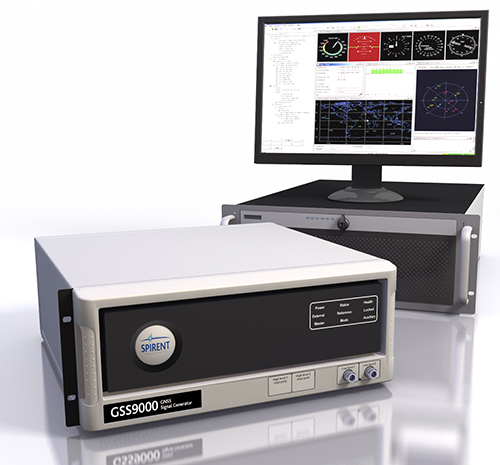
    manufacturers’ exhibit area at the Summit   fits into a couple of corridors near the main Hall, around 20 booths. I talked with several of the manufacturers, including Spirent who has launched its latest GSS9000 multi-frequency-constellation simulator, with a four-fold increase in system iteration rate over the previous model. Exhibitors appeared to be pleased to be at the Summit and the level of interest shown by the attendees.

    As this year’s Munich Summit concludes, where does it leave us? We’ve learned some new things about several GNSS topics and heard some interesting new concepts. Europe appears to be now focused on users and applications, to ensure there is market growth and use of Galileo.

    What stands out for me is the contrast between how European governments go about GNSS and how North America and the commercial world does the same thing without as much direct influence. This is nothing new of course, it is simply the European way.

    ——————–

    Tony Murfin is GPS World’s contributing editor for the Professional OEM e-newsletter.


  • EGNOS, European Superiority, and the Need to Get ‘Very, Very Busy’

    The European GNSS scene received an early Easter present with the successful launch of two new-generation transponders for the European Geostationary Navigation Overlay Service (EGNOS) satellite-based augmentation system (SBAS). The two geostationary transponders, GEO-2, rose on board the SES ASTRA 5B satellite from the European Space Port in Kourou, French Guiana, on March 22 via an Ariane 5 lifter. The new transponders will provide higher accuracy positioning signals to those citizens and professionals using EGNOS enabled receivers.

    Together with the previous transponder replenishment on the SES-5 satellite launched in July 2012, GEO-2 will ensure the continuity and quality of the EGNOS open service and safety-of-life services for the next 15 years. Once validated in orbit, the signals will be introduced in current EGNOS operations and will support the new EGNOS generation (EGNOS V3). EGNOS V3 will provide dual-frequency signals on L1 and L5 bands and augment both GPS and Galileo constellations as part of the Multi-Constellations Regional System (MRS) concept.

    EGNOS is currently made up of transponders on board three geostationary satellites (Artemis, Inmarsat 3F2, Inmarsat 4F2), and an interconnected ground network of forty positioning stations and four control centres which cover most of the territory of the European Union. The ASTRA 5B payload for EGNOS will essentially extend transponder capacity and geographical reach over Eastern Europe and neighbouring potential markets.

    Europe’s first venture into satellite navigation, EGNOS represents a major stepping-stone towards Galileo. EGNOS improves the accuracy of GPS by providing a positioning accuracy to within three metres together with system integrity messages. The system offers three services: an Open Service that is free of charge; a Safety-of-life Service (SoL) that was certified for civil aviation in 2011; and a Commercial Service – the EGNOS Data Access Service (EDAS) that disseminates EGNOS data in real time.

    Since the beginning of 2014 the European GNSS Agency (GSA) has been responsible for the operation and service provision of EGNOS. “The successful launch is an important achievement in view of the enhanced performance that EGNOS will provide both today and in the future,” said Carlo des Dorides, GSA executive director.

    EGNOS Extension

    Future extension of EGNOS was discussed at the recent Munich Satellite Summit (see below and other articles in this issue of EAGER).

    While GSA is now EGNOS exploitation manager, the European Commission is responsible for the overall programme, said Ignacio Alcantarilla Medina, deputy EGNOS project manger at the Commission. With medium-term finances for the service secured, through a budget of € 1,580 million for the period 2014 to 2021, the main aim for service extension was to ensure complete coverage of all EU territories.

    “Coverage of Member States is the priority; that is what budget is for,” said Alcantarilla Medina. This essentially means reinforcing coverage in the east of Europe and extreme north and overall increase robustness.

    Currently (March 2014) there are 100 EGNOS-enabled LPV procedures for the civil air space published in Europe. During 2014 a further 150 LPV procedures should be completed, he stated.

    Once all EU territory is adequately served, then further extension might be possible. International projects in terms of demonstration were being undertaken under the European Commission’s FP7 and Horizon 2020 research programmes and funding for international extensions could come from third party or Commission sponsored development funding.

    Interestingly, in the light of recent political events, funding for extension of EGNOS to the Ukraine has already been allocated in the European Commission’s budget by DG Development. Other countries could benefit from this type of funding or from other international development aid. An ambitious flight test campaign over Moldova, Poland, Romania, and Ukraine was carried out in the second quarter of 2013 under the auspices of the EGNOS Extension to Eastern Europe: Applications (EEGS2) project. Full demonstration of EGNOS performances and capabilities was performed flying Instrument Landing System (ILS) overlay procedures and by providing real guidance to the pilots during final approach. In total, 19 flight trials were performed between April and June 2013.

    European Showcase at Munich Summit

    Perhaps the good EGNOS news created the warm glow bathing the Munich Satellite Summit in late March. While input arrived from all parts of the world and all major satellite navigation programmes — except Russia and GLONASS — the majority of the discussions focused on the European programmes, Galileo/EGNOS and Copernicus/Earth Observation, and thus by extension on European technological accomplishment.

    Matthias Petschke, Director of EU Satellite Navigation Programmes at the European Commission proclaimed: “Galileo is a reality. We are on track again!” But he stressed that infrastructure does not automatically generate services, and the focus must now be on service provision. On integration, Petschke emphasised that in most cases services meant applications, and few current applications relied on only one source of data. This meant it was not a question of “whether” for integration, but “what else” can be gained from integration of data.

    The big challenge is to transform space infrastructure into commercial service platforms that provide clear benefits to users and society. The introduction of Galileo Early Services, possibly as early as Q4 2014, would herald this move to service platforms and that was when Europe needed to “get very, very busy.”

    Galileo Boasts of Superiority. The plenary audience heard repeated statements from leading European figures on the ‘superiority’ of the Galileo system over current GPS satellites. The grinding of teeth from the various U.S. delegates was almost audible on some occasions but, in the spirit of world peace, they deigned to publicly challenge such statements.

    Typical was Jean-Jacques Dordain, director-general of ESA, who proclaimed Galileo as a success with technologies much better than GPS. Although he did concede that with 22 satellites still to launch this “was not the end of the process – but a real good start.”

    Evert Dudok of Airbus Defence and Space stated, “To develop from scratch a system significantly better than GPS is not easy, but we are creating the best system.” A number of delegates supported this, indicating Galileo’s better-quality code and phase measurement signals that were particularly important for higher-accuracy applications. The excellent, over-specification performance of the initial four in-orbit satellites was often quoted.

    From a commercial point of view, Carlo des Dorides of the GSA claimed that effectively the European Union already had a 25 percent share of the sat nav market and that one-third of the existing global receiver base was already Galileo compatible. He saw a great future for the system.

    “Galileo is unique compared to other GNSS due to its civil nature,” said des Dorides. And the user was at centre of the system’s evolution, with developments in Galileo moving from technology push to demand pull. The clear role of GSA was to ensure that both Galileo and EGNOS delivered the valuable services they are designed to deliver.

    Galileo’s public regulated service (PRS) should be a key factor in growing market share in secure civilian applications with its enhanced ability to counter intentional and unintentional signal interference – another main topic of the Summit. In a dedicated session on combating interference, the introduction of a ‘PRS-lite’ authentification signal on the Galileo open service was mooted, which could be a very interesting development.

    The absence of any Russian input to the Munich SatNav Summit — save for a small pile of the unexpectedly glossy GLONASS Herald publication outside the registration hall — brought the chill of geopolitics into the usually apolitical space arena.

    Does Augmentation Have a Future?

    Another interesting question raised at the Summit – given the near-future fact of four compatible GNSS constellations on station – was whether there will be a role for augmentation systems such as EGNOS and WAAS?

    Deborah Lawrence of the FAA was clear that her organisation was working to take advantage of the multi-constellation future and that the role of SBAS might change, but that the FAA is already looking towards what the requirements for SBAS in 2040 might be.

    European Commission spokespersons agreed with the need for multi-constellation, globally interoperable SBAS for the foreseeable future, not least because the currently installed receiver base in the aviation sector would likely have a 20-year replacement horizon.______________

    Tim Reynolds is director of Inta Communication Ltd. and a long-term Brussels observer writing on many aspects of European government policy and implementation for a range of clients and publications. The material presented here was first prepared in a somewhat different form for the GSA.
       He is the contributing editor for GPS World’s new quarterly e-newsletter, EAGER: the European GNSS and Earth Observation Report. Subscribe free at env-gpsworld-integration.kinsta.cloud/subscribe.

  • Squeeze at the Launchpad for Galileo

    With the first two full-operational-capability (FOC) Galileo satellites successfully through their thermal-vacuum tests, the program’s next hurdle is securing a firm launch date in June aboard a Europeanized Russian Soyuz rocket, operated from Europe’s spaceport on the northeast coast of South America.

    It will not be a walk in the park. Competing with the two Galileo FOC satellites for the same June Soyuz launch are four commercial broadband communications spacecraft owned by O3b Networks of Britain’s Channel Islands, a start-up that promises, if all goes well, to launch as many as 100 satellites.

    O3b and Galileo managers as of late March were rushing to complete final tests to be able to be first to ship their craft to the spaceport and thereby lay claim to priority rights aboard the June Soyuz. Both say they can be on a plane to the Guiana Space Center launch base in April. Should they arrive within days of each other, the already nightmarish dilemma confronting the Arianespace commercial launch consortium will only grow more complicated.

    Here’s the matchup.

    Powerful Backer. O3b, in addition to its plans to launch dozens of satellites if the business model proves out, is backed by SES of Luxembourg, the world’s second-largest satellite fleet operator and as such a big Arianespace customer.

    SES has already shown itself disinclined to maintain its loyalty to the heavy-lift Ariane 5 rocket operated by Arianespace by booking three less-expensive launches, one already completed, aboard the new Falcon 9 rocket operated by SpaceX of the United States. Arianespace can ill-afford to alienate SES, whose 50-satellite fleet requires 3-4 launches per year just to maintain its existing capacity.

    The four first O3b satellites in orbit all have a defect that could cause one or more of them to stop functioning at any time. Without at least four satellites — and preferably six — O3b does not have a business and its future is put into question.

    It would be, to say the least, a public relations calamity for the company if its initial commercial operations, which began in March, were to be suspended in the wake of a satellite failure while waiting for a second batch of four spacecraft. This explains the extraordinary pressure that SES is placing on Arianespace on behalf of a June Soyuz launch for O3b.

    Does it really matter, O3b backers say, if Galileo waits until the next Soyuz launch slot, tentatively set for August?

    Emphatic Politician. It matters to the European Commission, which owns Galileo. Commission Vice President Antonio Tajani has all but pounded the table, insisting that the European Space Agency, hired to oversee Galileo’s technical development, ensure three Galileo launches on Soyuz rockets in 2014.

    Four initial-operating-capability Galileo satellites are in orbit. Indications are that their performance exceeds specifications. Three Soyuz launches carrying two satellites at a time would bring the constellation to 10 spacecraft, enough to offer initial commercial services, according to the Commission.

    Tajani has made clear how much he wants that feather in his cap as he prepares to leave the EC this year, probably headed for a political career in Italy. Make no mistake: as is the case with many wounded animals, Tajani’s status as a lame duck has made him all the more fierce in his insistence that Galileo meet its three-launch schedule in 2014.

    Tajani has put very public pressure on the European Space Agency, which in turn is pressuring Arianespace, for Galileo launches.

    Ariane’s Quandary. Arianespace is already facing an exceptionally crowded launch manifest in 2014 as it coordinates the schedules of three vehicles: the small Vega rocket in addition to the medium-lift Soyuz and the heavy-lift Ariane 5. Because both O3b and Galileo are late, neither has an obvious claim of priority status at Arianespace, which is clearly hoping that the problem will solve itself when either O3b or Galileo arrives at least several weeks ahead of the other.

    At press time, the next Soyuz launch was scheduled for April 3, carrying a European Commission environment-monitoring satellite. Commission officials will attend the launch and no doubt use the occasion to press their case for Galileo.

    There is no telling how this will turn out. Satellites have been known to face last-minute problems even after arrival at the spaceport. This happened to O3b in 2013, as the in-orbit defect did not surface until just before its scheduled Soyuz launch.

    But if one were to hazard a guess, here is the most likely scenario: O3b arrives ready for launch several weeks ahead of Galileo and secures the June launch. Galileo moves to August and is promised a second launch in the autumn. O3b’s planned second launch in 2014 is moved to early 2015, as is the planned third launch of Galileo.

    The effect of these schedule slips on the cost of the Galileo program, which is about a year late — cost overruns that Tajani has vowed will not be paid by the Commission — is a subject for another day.

  • Synergies between Europe’s Rail and SatNav Programs Can Make Rail Travel Affordable

    Cost-effective synergies between the European Rail Traffic Management System (ERTMS) and satellite technologies such as Galileo can make rail transport more efficient and reliable, agreed European authorities in February at a Rail Forum Europe dinner in Brussels. But while the technology is now available, its implementation pace is still too slow due to the long term return on investment.

    Francesco Rispoli, manager of satellite technologies at Ansaldo STS, an Italian provider of rail-traffic management, planning, train control and signalling systems, stressed that satellite technology can improve the penetration of ERTMS in the worldwide market as well as on European local and low-traffic lines. He predicted that further synergies will be developed on the SHIFT²RAIL initiative: “EGNOS and Galileo are key enabling technologies for a market-driven step change in the rail sector” he concluded. In that light, Ansaldo STS is developing an open platform to allow the ERTMS to fully exploit EGNOS and Galileo.

    Olivier Onidi, director for Innovative and Sustainable Mobility at the EC’s Directorate General for Mobility and Transport (DG MOVE), highlighted the role of ERTMS in achieving an interoperable Single European Railway Area. “2014 is a key year in terms of innovation for the rail sector. Major progress is expected on ERTMS, Galileo, and SHIFT2RAIL”.

    SHIFT²RAIL is a European technology initiative  seeking to double the capacity of the European rail system, increase its reliability and service quality by 50 percent ,and cut lifecycle costs in half.

    Carlo des Dorides, executive director of the European GNSS Agency, applauded the ERTMS Memorandum of Understanding envisaging the future use of EGNOS and Galileo to improve the competitiveness of train control systems. “There are signs that GNSS will be adopted globally as in the aviation sector. In this scenario, Europe now has the opportunity to exploit the synergy between ERTMS and GNSS.”

  • Galileo Countdown to 10 by Year’s End

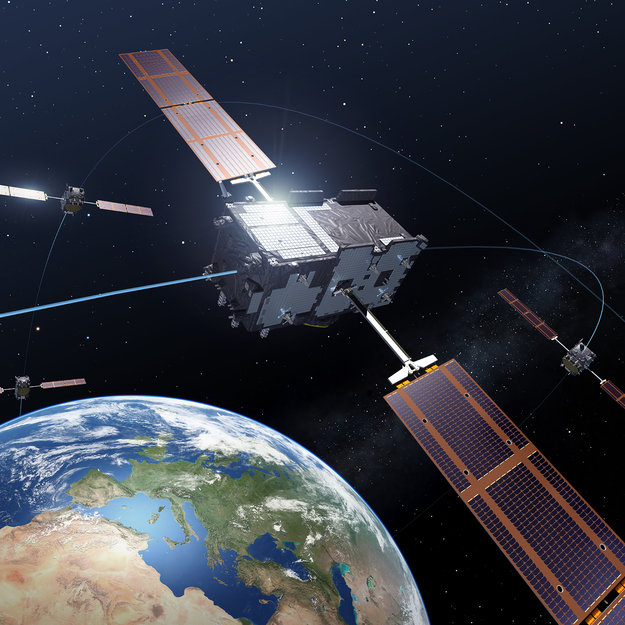
    Europe’s Galileo satnav system.
    Europe’s Galileo satnav system.

    Signs Point Toward Early Services in December, If ESA Delivers

    A February conference on the European Union’s space policy in Brussels sought to set a course for 2020 and close official ranks behind the prospect of early Galileo services at the end of this year. Much in the business community’s perception of the new system — critical for device availability and mass- and professional-market adoption of Galileo — will depend on meeting the projected unveiling of early services in December. This is turn depends on an operational 10-satellite constellation; the fleet now stands at four.

    Among trends noted at the meeting: the growing importance of the European GNSS Agency (GSA)  as Galileo service provider, with perhaps more authority — and budget — than it has had in the past to get the job done. “The GSA will gradually assume responsibility for the operational management of the programmes while ESA will remain responsible for the deployment of Galileo, and the design and development of new generation of systems,” announced the European Commision (EC).

    EC Vice President Antonio Tajani reiterated there will be three Galileo launches in 2014 to reach the requisite year-end total. “The first will come in June. Two satellites have passed the necessary tests. We need to keep this up, and continue to raise our game.”

    Trouble on the Equator. The next two Galileo satellites may be ready to ship to Europe’s spaceport in South America by early April. But a large European commercial satellite customer is crowding the schedule, pressuring launch operator Arianespace to lift its satellites first. This could delay the Galileo birds, now set for June rise.

    ESA’s year-end plan calls for two more dual-satellite launches in October and December on Russian Soyuz rockets — new partners to the Galileo dance, bringing perhaps new technical connectivity issues.

    It’s Not Easy. With Galileo and EGNOS  financed to the tune of €7 billion for 2014–2020, expectations are high, yet the European Commission brings a decidely conservative approach to expenditure on new ventures.

    “To take a chance, to do what no one has ever done — it’s not easy in a culture that doesn’t like risk,” said ESA director Jean-Jacques Dordain.

    Other conference speakers pointed to the securely established European Geostationary Navigation Overlay Service (EGNOS), the first generation of Europe’s GNSS, now fully operational.

    Carlo des Dorides, executive director of the GSA, responsible for operating EGNOS through the EGNOS Service Provider (ESSP), elaborated on his big job in 2014: maintaining and improving EGNOS performance and maximizing user adoption, particularly in the aviation, maritime transport, and rail transport sectors.

    “The experience we gain through our work with EGNOS will be instrumental as we move towards Galileo service delivery.”

    As well as organizational experience with EGNOS, user adoption of the GNSS precursor augurs much for Galileo. With one eye on the present and another on the future, the GSA has a big serving coming to its plate by December: management of a long-awaited, heavily invested system that has been in discussion since the 1990s and in various stages of gestation since 2000.

  • Downstream Dialog, Tests in Europe

    With Galileo services set to take effect in December, the two European entities charged with the program are engaging manufacturers — the European Space Agency (ESA) in consumer markets, and the European GNSS Agency (GSA) in the government security sector, respectively.

    “We put out an open call to satnav manufacturers offering testing with our laboratory facilities,” said the head of ESA’s Radio Frequency Systems, Payload, and Technology  Division. “We have gone on to work with five mass-market chipset makers and a comparable number of professional receiver manufacturers.”

    Available ESA facilities include:

    • a hybrid localization solution rack for receiver plug-in; it generates simulated constellations of multiple satnav systems along with Wi-Fi or mobile networks. It can also simulate inputs from inertial devices.
    • the octobox, a mini anechoic chamber into which phones or mobile devices can be placed, to feed them simulated satnav and cellular network signals.
    • a telecommunications and navigation testbed vehicle for field tests, carrying its own extremely accurate receivers to assess the performance of the consumer devices under test.

    “Thanks to earlier collaboration with ESA and the EU, the millions of multi-constellation satnav chips we sell annually have been equipped for Galileo signals since 2009,” stated Philip Mattos of ST Microelectronics, whose Teseo II receiver chips are used in satnavs and embedded in cars (see detailed technical article on page 36). “It will take only a software update to enable them to start using Galileo. This cooperation allows us to optimize our software based on access to actual signals and background technical information.”

    Regulated Service. The GSA invited European industries and member states’ Public Regulated Service (PRS) authorities to share views and ideas on technologies at the user segment level for the adoption of the PRS. The PRS uses encrypted signals designed to resist jamming, involuntary interference, and spoofing. GSA’s objective is to ensure that PRS service is affordable and secure for all interested users while also ensuring that European industry maintains its competitive edge in the global satellite navigation marketplace.

    GSA consultations will focus on:

    • steps transforming technologies into products competitive enough in terms of cost, power, dimension;
    • euro-manufacturing capability and capacity, especially nanotechnology;
    • how to build the manufacturing lines capable of serving PRS user segment needs;
    • main domains, elements, and interfaces that will benefit from standardization, allowing for a stronger market adoption of PRS.


  • Galileo Product Showcase

    System Design & Test

    Galileo Test Bed

    Over the past few years, GATE has become well known for being a top-level Galileo test and development range worldwide. It is operated by IFEN GmbH under contract of the owner DLR (German Aerospace Center). The GATE test bed offers a wide range of possibilities for navigation test scenarios with realistic Galileo signals on three frequencies simultaneously in an outdoor environment. Although the test range is, of course, a ground-based infrastructure in the Berchtesgaden Alps, the certified GATE system is able to transmit the original navigation signals from eight “virtual” Galileo satellites. This also includes the simulation of natural influences such as ionosphere or troposphere delays, the adaptation of other signal characteristics, as well as effects of signal strength. Furthermore, GATE includes the capability to induce dedicated “Feared Events” and alerts for one or several satellites of the simulated Galileo constellations.

    IFEN


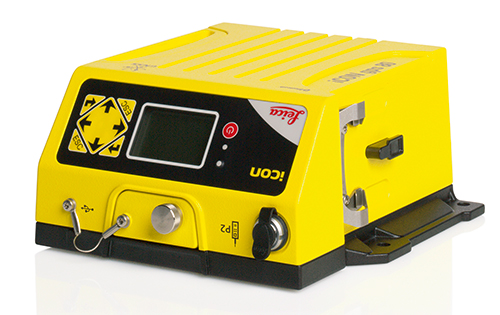
    Leica-iconMachine Control

    Machine Receiver

    The Leica iCON gps 80 GNSS machine receiver offers features and benefits for system integrators looking for powerful, reliable, and future-proof GNSS machine receivers. It increases the overall performance of the iCON machine control system, allowing users to work more productively. Besides Galileo, signals tracked include GPS, GLONASS, and BeiDou. The iCON gps 80 increases the overall performance of the system, so that the uptime of dozers, excavators, drilling and dredging machines, wheel loaders, graders, and pavers is maximized with fast, reliable 3D positioning and productive operation by a perfectly tuned machine control system.

    xRTK allows machine guidance in difficult environments, increasing machine productivity. Leica iCON telematics provides remote access to the machine computer for fast data transfer and support.

    Leica Geosysems


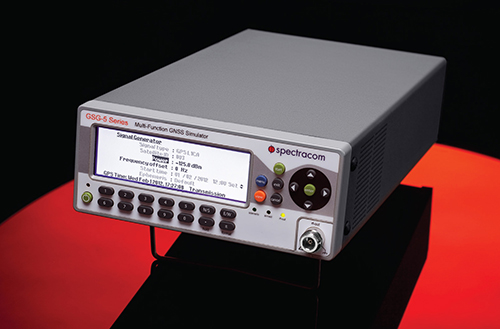
    GSG-51-GNSS-Signal-Generator-WSimulation

    GNSS Signal Generator

    The GSG-51 GNSS signal generator provides a fast and cost-effective solution for production testing for Galileo and other GNSS. It emulates a single GNSS signal and can be upgraded for Galileo, as well as to increase the channel count, add receiver trajectory control, and add advanced features such as SBAS (WAAS, EGNOS,MSAS, or GAGAN), white noise generation, or multipath simulation. Its main application is a simple but very fast manufacturing test, to assure that the assembly is correct, that the antenna is properly connected, and that the receiver can receive and identify a satellite signal, for instance, in mobile phones with integrated GNSS receivers.

    With a wide RF level range from –65 to –160 dBm, the sensitivity of all types of GNSS receivers can be verified with a minimum of delay. The 60-dB of extra power from normal test scenarios allows for splitting the signal many times.

    Spectracom


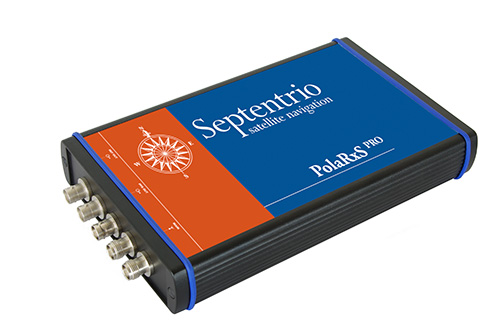
    Septentrio-PolaRxSSpace Weather Monitoring

    Multi-Constellation Receiver

    The PolaRxS is a multi-frequency, multi-constellation receiver dedicated to ionospheric monitoring and space weather applications. It features simultaneous high-quality tracking of all visible signals (L1, L2, L5, E5ab/AltBOC GPS/GLONASS/Galileo/Beidou/SBAS) at low noise levels. The receiver outputs an extensive set of GNSS measurements, including signal phase and intensity at up to 100 Hz, with a phase noise standard deviation (phi60) as low as 0.03 rad.

    The A Posteriori Multipath Estimator (APME+) tackles short-delay multipath to enhance the measurement quality, while LOCK+ tracking guarantees robust tracking of rapid signal dynamics during scintillation events. Included tools provide continuous total electron content (TEC) and scintillation indices logging for space weather and ionosphere monitoring.

    Septentrio


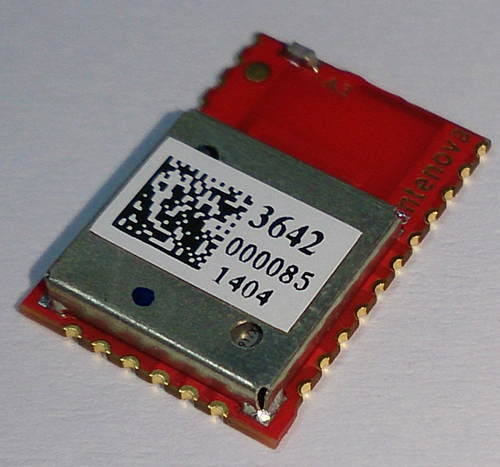
    A3-angle-view-WPersonal Tracking

    Multi-GNSS Antenna Module for Wireless

    The M2M Radionova M10478-A3 antenna module combines a full receiver and antenna on the same ultra-compact module. The highly integrated multi-GNSS RF antenna module is based on the Mediatek MT3333 architecture combined with Antenova’s antenna technology, receiving Galileo as well as GPS, GLONASS, BeiDou, QZSS, and SBAS signals. Using patented external matching means this module is suitable to applications from small watches to smartphones and asset trackers. All front-end and receiver components are contained in a single package laminate base module, providing a complete GNSS receiver for optimum performance.

    Antenova


    Location-Based Services / Wireless

    Software Receiver

    A software-based GNSS receiver from Galileo Satellite Navigation (GSN) is available on Tensilica ConnX digital signal processor (DSP) cores, for wireless mobile applications. The GSN GNSS receiver running on a Cadence ConnX BBE16 DSP consumes as little as 10 mW of power on a 40-nm process and has the ability to work in lower rates, or snapshots, for ultra-low-power mobile scenarios. It delivers high-sensitivity tracking, offering a seamless GNSS experience in challenging environments. This provides customers with the ability to upgrade their designs to include future satellite systems, including Galileo. With no additional silicon costs and a low cost of deployment, this software-based solution offers a way to implement satellite navigation functionality in many products where it otherwise might be impractical.

    Cadence; Galileo Satellite Navigation


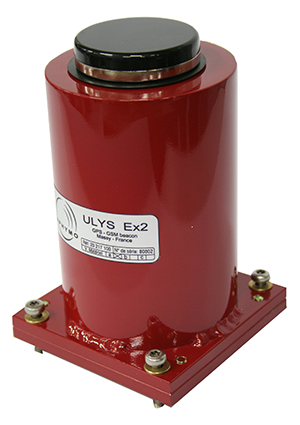
    Ulys-Ex2-20217100-detouree-WAsset Tracking

    Hazardous Goods Surveillance

    The Ulys-Ex2 beacon is a standalone tracking unit providing worldwide location-based alerts for up to seven years, for monitoring of unpowered mobile assets in potentially explosive atmospheres.

    With a Galileo-ready u-blox receiver, it provides monitoring data for tank containers and tank-trailer transport operations, increasing the level of security and safety of explosion-sensitive shipments. The beacon is part of a turnkey, real-time dangerous goods monitoring solution adapted to risk environments, guaranteeing global visibility on routing from the production site to the customer delivery point. It is ATEX Zone 1 certified for Europe — Zone 1 is an atmosphere where a mixture of air and flammable substances in the form of gas, vapor, or mist is likely to occur in normal operating circumstances.

    Saphymo


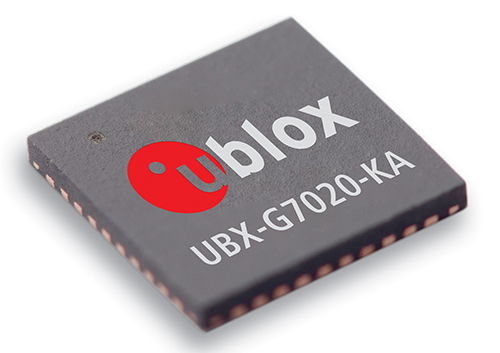
    ubx-m8030-WConsumer OEM

    Galileo-Ready Module

    The Galileo-ready NEO-M8 series of standalone concurrent GNSS modules is built on the u-blox M8 GNSS (GPS, GLONASS, Galileo, BeiDou, QZSS, and SBAS) engine in the NEO form factor. The NEO-M8 series provides high sensitivity and minimal acquisition times while maintaining low system power. It is optimized for cost-sensitive applications, with the NEO-M8N and NEO-M8Q providing high performance and easier RF integration. Sophisticated RF-architecture and interference suppression ensure maximum performance even in GNSS-hostile environments. The NEO-M8 combines a high level of robustness and integration capability with flexible connectivity options. The future-proof NEO-M8N includes an internal Flash that allows simple firmware upgrades for supporting additional GNSS systems, making the NEO-M8 suitable for industrial and automotive applications.

    u-blox


    Novatel-OEM638-WProfessional OEM

    High-Precision Receiver Card

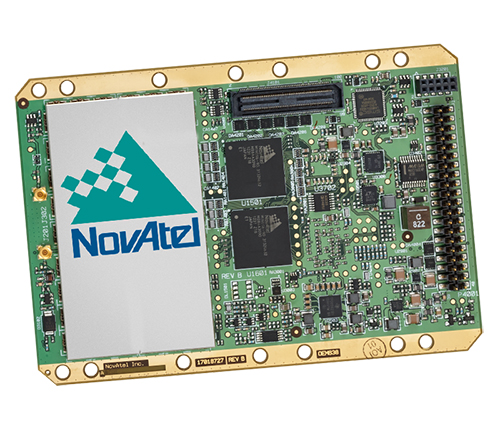
    The OEM638 high-precision receiver card tracks all existing and planned constellations including Galileo, GPS, BeiDou, GLONASS, and QZSS. By providing flexible positioning options, from standalone meter-level to AdVanceRTK centimeter-level accuracy, the OEM638 offers the flexibility to meet a wide range of positioning requirements. A powerful API, 4-GB on-board data storage, wide input voltage, and a host of interface options simplifies integration, decreasing time to market and overall system costs. With 240 channels and comprehensive tracking and positioning with all current and planned GNSS signals, the OEM638 is field upgradeable. It offers user configurability for reference station, timing, and other precision positioning applications.

    NovAtel


    Consumer OEM

    Infineon-WLow-Noise Amplifier

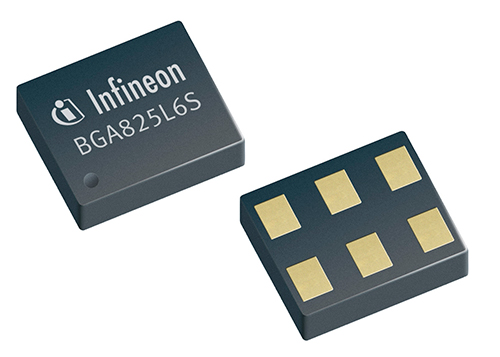
    The BGA825L6S is a cost-effective low noise amplifier (LNA) for Galileo and other GNSS. It features an ultra-low noise figure, high linearity, high gain, and low current consumption over a wide range of supply voltages from 3.6V to 1.5V. It is designed for GNSS LNA, as it improves sensitivity, provides greater immunity against out-of-band jammer signals, and reduces filtering requirements, which lowers the overall cost of the receiver. The low noise figure of 0.6 dB is a key parameter for GNSS systems as it directly influences the sensitivity of the system, as well as the time-to-first-fix and time-to-subsequent-fix. LNAs with a lower noise figure enable mobile phones with faster GNSS signal fix and higher end-user satisfaction.

    Infineon Technologies AG


    GSS9000-WSimulation

    RF Constellation Simulator

    The newly released Spirent GSS9000 Multi-Frequency, Multi-GNSS RF Constellation Simulator can simulate signals from all GNSS and regional navigation systems, including Galileo. The GSS9000 offers a four-fold increase in RF signal iteration rate (SIR) over Spirent’s GSS8000 simulator. The GSS9000 SIR is 1000 Hz (1ms), enabling higher dynamic simulations with more accuracy and fidelity. It includes support for restricted and classified signals from the Galileo and GPS systems, as well as advanced capabilities for ultra-high dynamics. It can evaluate resilience of navigation systems to interference and spoofing attacks, and has the flexibility to reconfigure constellations, channels, and frequencies between test runs or test cases.

    Hardware changes can be done in the field, supported by the new on-board calibrator module. The GSS9000 is extensible and can support the widest range of carriers, ranging codes, and data streams for the Galileo, GPS, GLONASS, and BeiDou systems, as well as regional/augmentation systems. Multi-antenna/multi-vehicle simulation, for differential-GNSS and attitude determination, and interference/jamming and spoofing testing are also supported.

    Spirent


    Teseo_III_p3509-WTransportation

    eCall-Ready Positioning Chip

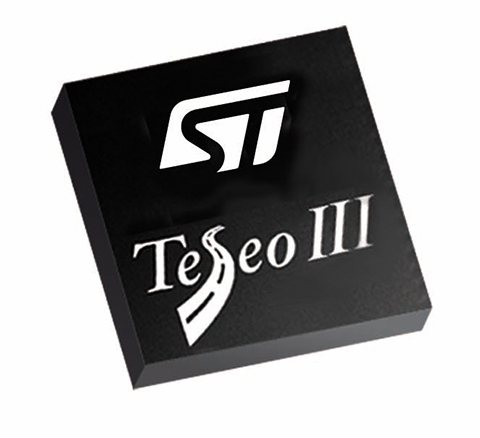
    The Teseo II (STA8088 series) is a single-chip positioning device capable of receiving signals from multiple satellite navigation systems, including Galileo, GPS, GLONASS, and QZSS. The Teseo II combines high-positioning accuracy and indoor sensitivity performance with powerful processing capabilities and design flexibility, making Teseo II suitable for eCall, ERA-GLONASS, telematics, handheld, consumer, portable navigation devices, marine, and in-car navigation systems. The Teseo II is being tested by the European Space Agency and the European Commission Joint Research Center for eCall approval. The testing campaign is coordinated by the European GNSS Agency as part of its effort to accelerate Galileo adoption.

    While the Teseo II Ihas always had the capability to be Galileo-ready, ST is enabling a firmware update from Galileo that benefits consumers and doesn’t require a hardware modification. The Teseo II chips can simultaneously use signals from multiple satellite navigation systems, including the currently available Galileo satellites, and progressively, as future satellites are launched, the full satellite constellation.

    STMicroelectronics


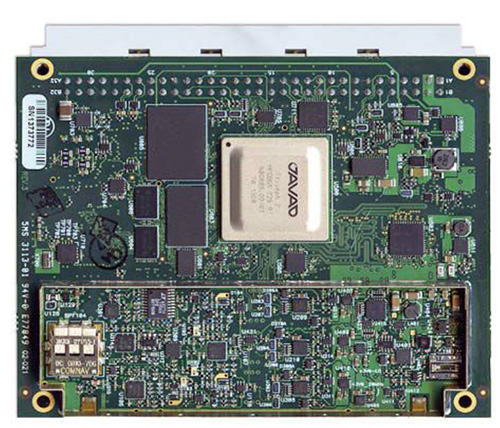
    JAVAD_TRE-3Professional OEM

    High-Precision Receiver

    The 864-channel TRE-3 receiver can simultaneously access all current GNSS signals, with room to spare for multiple-channel tracking of select signals. The new product offers three ultra wide-band (100 MHz) fast sampling and processing, programmable digital filters, and superior dynamic range. After 12-bit digital conversion, nine separate digital filters are shaped for each of the nine bands: GPS L1/Galileo  E1, GPS L2, GPS L5/Galileo E5A, GLONASS L1, GLONASS L2, Galileo E5B/BeiDou B2/GLONASS L3, Galileo altBoc, Galilee E6/BeiDouB3/QZSS LEX, and BeiDou B1.

    JAVAD GNSS


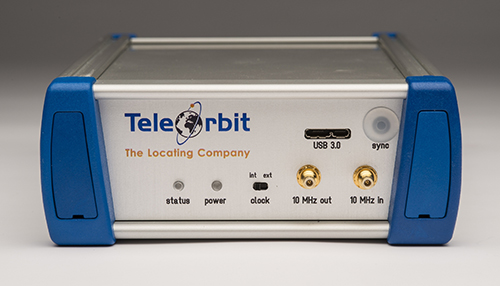
    TeleOrbitInterference Monitoring

    Modular RF Front-End

    The GTEC-RFFE is a flexible, portable, and affordable ultra-wideband recording solution that can be adapted to the reception of all GNSS bands available, including Galileo, supporting up to 80 MHz of RF bandwidth. Because of its modular concept, the GTEC-RFFE not only supports a set of pre-selected configurations, it can be set up for multi-antenna inputs, user selectable bandwidth, intermediate frequencies, and customized ADC sampling rates and resolutions. It is designed for development of software-defined radios and receivers, GNSS multi-system signal analysis and comparison, analysis of atmospheric effects such as ionospheric and tropospheric irregularities and scintillation, and interference monitoring for protecting critical operations and infrastructures.

    TeleOrbit


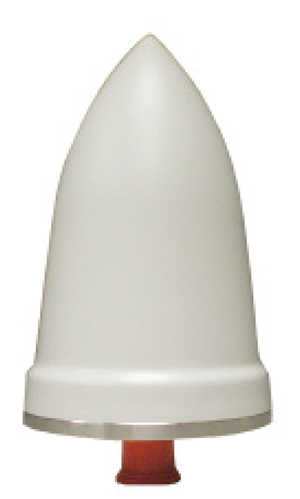
    PCTEL-GNSS1-TMG-26N-WTiming

    GNSS Timing Reference Antenna

    The GNSS1-TMG-26N is a fixed-mount network timing antenna covering Galileo L1, as well as GPS, GLONASS, and Beidou frequencies. It is designed for long-lasting, trouble-free deployments in congested cell-site applications. The low-noise, high-gain amplifier is suited to address attenuation issues associated with applications requiring longer cable runs. The proprietary quadrifiliar helix design, coupled with multistage filtering, provides superior out-of-band rejection and lower elevation pattern performance than traditional patch antennas.

    PCTEL


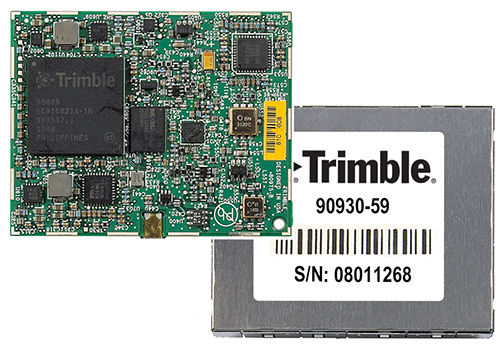
    Trimble-BD930-WProfessional OEM

    Positioning and Heading System

    The Trimble BD930 supports both triple frequency from the GPS and GLONASS constellations, plus dual frequency from Galileo and BeiDou. As the number of satellites in the constellations grows, the BD930 is ready to take advantage of the additional signals to deliver fast and reliable RTK initializations for 1–2 centimeter positioning. Different receiver configurations are available, including autonomous GPS L1 to four-constellation triple-frequency RTK.

    Trimble


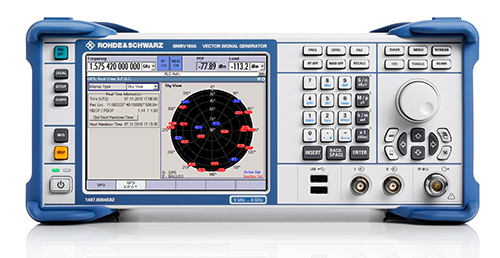
    SMBV100A_GNSS_front-WSimulation

    Vector Signal Generator

    The R&S SMBV100A vector signal generator can generate Galileo, GPS, and GLONASS signals for up to 24 satellites in realtime. With the SMBV-K107 option, the simulator covers the BeiDou standard as well.

    The R&S SMBV-K101 option allows developers in the automotive and wireless communications industries to test GNSS receivers for specific effects such as obscuration and multipath propagation. If the GNSS receiver of a navigation instrument or smartphone is located inside a vehicle, testing must also take into account the obscuring effect of the vehicle’s metal body. The R&S SMBV-K102 option can simulate this obscuration and, if required, the additional antenna pattern.

    In addition to test scenarios for A-GPS, smartphone developers have the Assisted Galileo (R&S SMBV-K67) and Assisted GLONASS (R&S SMBV-K95) options at their disposal.

    Rohde & Schwarz


    GPS30-blue-WSignal Amplification

    Antenna Amplifier

    The GPS35-BNC is an inline antenna amplifier for both the L1 and L2 frequencies of the Galileo, GPS, and GLONASS satellite systems. When connected between the GPS receiver and the GPS antenna, power from the GPS receiver that normally powers the active antenna powers both the active antenna and the GPS-BNC, so no extra power supply is needed. The GPS35-BNC can be used with either active or passive GPS antennas by selecting internal jumpers. The GPS35-BNC provides a gain of 35 dB between 1200 and 1607 MHz. With the GPS35-BNC installed, extra lengths of cable can be used between the antenna and the GPS receiver itself. If low-loss cable is used, cable lengths over 350 meters (1,150 feet) can be used without any degradation to the GPS signal.
    The noise figure of the GPS35-BNC is less than 3 dB, and signals in the cellular or mobile frequency bands are rejected by more than 35 dB.

    Precision Test Systems


  • General Dynamics Awarded $26M for GPS III Communications

    General Dynamics Advanced Information Systems, a business unit of General Dynamics, has been awarded a $26 million contract from Lockheed Martin to support the U.S. Air Force GPS III  Network Communications Element (NCE).

    General Dynamics is already under contract with Lockheed Martin to produce the NCE for the first four GPS III space vehicles (SV01-SV04), as well as for the procurement of long lead material for the second set of four space vehicles (SV05-SV08). This follow-on contract provides General Dynamics with the funding to complete the NCE for SV05 and SV06.

    General Dynamics’ NCE components provide the communications functions for the GPS III satellites, including the ground-to-space command and control channel, the space-to-space inter-satellite channel, and the command and telemetry communications channels within each satellite. NCE components have been delivered for SV01 and SV02. The NCEs for SV03 and SV04 are scheduled for delivery by June 2014.

    “We bring more than a half-century of experience in the spacecraft communications and navigation domain to this program,” said Kirstan Rock, vice president and general manager of Intelligence, Surveillance and Reconnaissance at General Dynamics Advanced Information Systems. “We look forward to continuing working with Lockheed Martin to deliver high-quality, reliable and affordable solutions to the Air Force to advance their mission.”

    The Air Force’s next-generation GPS III satellites will improve position, navigation and timing services and provide advanced anti-jam capabilities yielding superior system security, accuracy and reliability.

    GPS III is a critically important program for the U.S. Air Force, affordably replacing the aging constellation of GPS satellites currently in orbit. Compared to prior GPS vehicles, GPS III satellites will deliver three times better accuracy, provide up to eight times more powerful anti-jamming capabilities and include enhancements that extend spacecraft life 25 percent further. GPS III-series satellites also will carry a new civil signal designed to be interoperable with other international global navigation satellite systems, enhancing civilian user connectivity.

  • EGNOS Satellite Launched Successfully

    The satellite ASTRA 5B, which will become part of the European Commission’s European Geostationary Navigation Overlay Service (EGNOS), launched successfully after a one-day delay. It lifted off on March 22 aboard an Ariane 5 ECA rocket at 2204 GMT (6:04 p.m. EDT) from the Guiana Space Center near Kourou, French Guiana.

    Officials from Arianespace, the French launch services company, declared the mission a success following the rocket’s deployment of the ASTRA 5B and Amazonas 4A communications satellites about a half-hour after liftoff, reports Spaceflight Now.

    ASTRA 5B carries a hosted L-band payload for EGNOS. It will also extend transponder capacity and geographical reach over Eastern Europe and neighboring markets for DTH, direct-to-cable, and contribution feeds to digital terrestrial television networks.

    “Today’s successful launch, the 59th in a row for Ariane 5, confirms the unrivaled reliability and availability of the European launcher,” said Stephane Israel, chairman and CEO of Arianespace. “We take particular pride in being able to offer this service excellence to two leading European operators, SES and Hispasat, both long-standing customers of Arianespace, as well as the European Commission, which has an EGNOS satellite navigation payload integrated on the ASTRA 5B satellite.”

    The spacecraft, based on the Airbus Defence and Space Eurostar E3000 satellite bus, is flying with a hosted L-band navigation payload for EGNOS, which augments GPS navigation signals over Europe for specialty users such as the aviation and surveying industries.

    “EGNOS will be able to continue to provide valuable positioning services to users all over Europe, be it in the field of aviation, transport or agriculture,” said Christoph Kautz, deputy head of the European Commission’s enterprise and industry unit.

    ASTRA 5B was built by Airbus Defence and Space (formerly Astrium) in Toulouse, France, using a Eurostar E3000 platform. The multi-mission satellite will be located at 31.5 degrees East.

  • Dutch Company Powers Galileo Satellites

    Dutch Company Powers Galileo Satellites

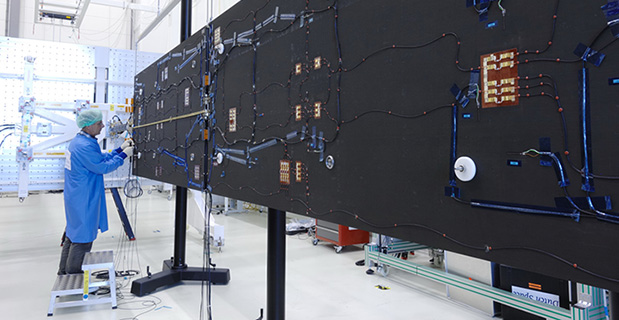
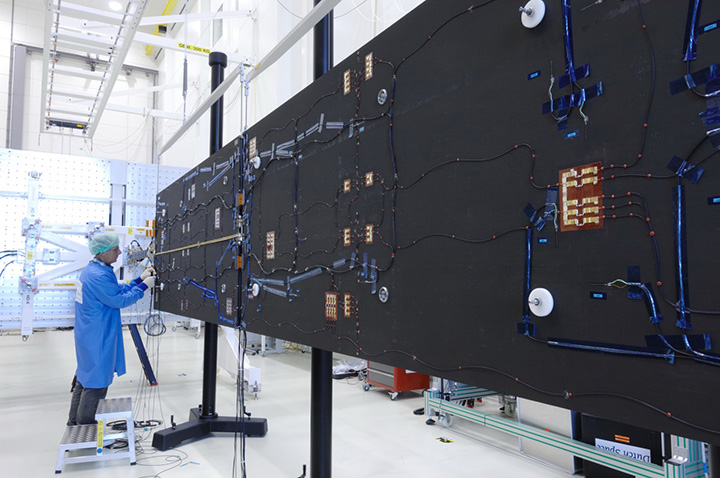
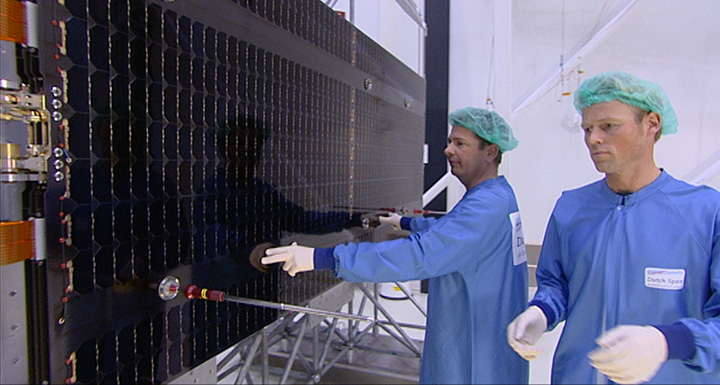
    Solar arrays for a Galileo Full Operational Capability (FOC) satellite at the Dutch Space company near Leiden in the Netherlands. A pair of 5 m-long solar arrays supply 1.9 kilowatts of power – about the same as an average household’s consumption. The side of the solar array normally left in shadow is seen here.
    Solar arrays for a Galileo Full Operational Capability (FOC) satellite at the Dutch Space company near Leiden in the Netherlands. A pair of 5 m-long solar arrays supply 1.9 kilowatts of power – about the same as an average household’s consumption. The side of the solar array normally left in shadow is seen here.

    By the European Space Agency

    As they bathe the ground below them in test navigation messages, Europe’s Galileo satellites are kept alive by the Sun.

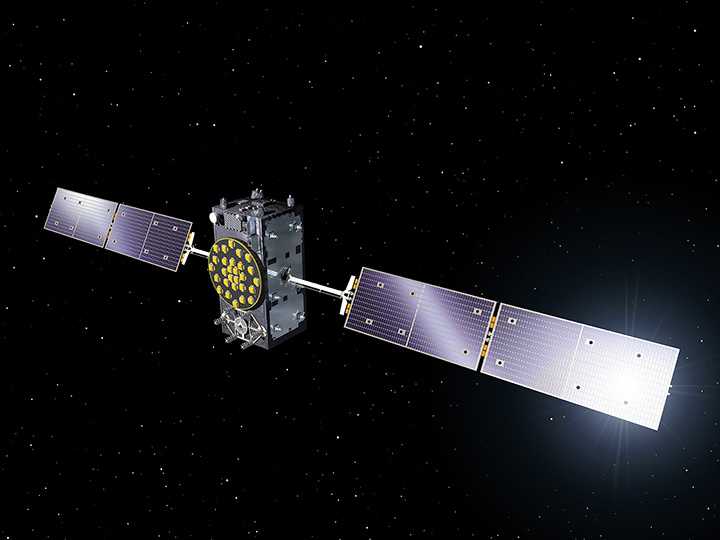
    A pair of 5 m-long solar arrays supply 1.9 kilowatts of power – about the same as an average household’s consumption. These arrays are sourced from the Dutch Space company in the Netherlands.

    Located just outside Leiden, a short drive from ESA’s Technical Centre, the Airbus Defence and Space subsidiary is based in what might appear to be a standard office building, the only clue to its space-based focus being an Ariane 5 frame outside.

    Inside its specialized facilities include a class 100 000 cleanroom, space simulation equipment and a “Very Large Sun Simulator” — a giant camera flash able to test the electrical performance of the solar arrays the company supplies to about two thirds of ESA missions — which includes all Galileo satellites commissioned to date, as well as one of their two GIOVE predecessors.

    “Think of us as the prime contractor for Galileo’s solar panels,” explains senior project manager Jan Zuidam, overseeing the work for Dutch Space. “We build nothing directly ourselves, but — working with a network of partner companies — oversee the panels’ design, engineering management, assembly and testing, all performed here in these buildings.

    The composite panel substrates, sourced from local Dutch company Airborne Composite, are equipped with solar cells in the Airbus Defence and Space facility in Ottobrunn, Germany, with the photovoltaic cells themselves sourced from German company Azur Space Solar Power. It is a bit like the way silicon chips are mounted on printed circuit boards, only on a much bigger scale.”

    The cells in question are state-of-the-art “triple junction” gallium arsenide designs, with sandwiched layers optimised for different segments of the solar spectrum.

    At Ottobrunn these cells are interconnected together into “strings” that run the length of each panel. The bare cells have also have protective cover glass added at this stage, without which they would be quickly tarnished by the radiation and unfiltered sunlight prevailing in orbit.

    Testing

    Before delivery to Dutch Space, each panel is thermal vacuum tested at IABG, Germany, followed by the absolute performance measurement and inspection.

    Solar arrays for a Galileo Full Operational Capability (FOC) satellite at the Dutch Space company near Leiden in the Netherlands. A pair of 5 m-long solar arrays supply 1.9 kilowatts of power – about the same as an average household’s consumption. The side of the solar array normally left in shadow is seen here.
    Solar arrays for a Galileo Full Operational Capability (FOC) satellite at the Dutch Space company near Leiden in the Netherlands. A pair of 5 m-long solar arrays supply 1.9 kilowatts of power – about the same as an average household’s consumption. The side of the solar array normally left in shadow is seen here.

    This includes flash testing to illuminate all the cells at once to check the arrays meet the set power requirements, as well as electrical luminescence testing, where an electrical current is run through each string to make them glow red, basically reversing the way solar cells usually work. Visual inspection is typically enough to ensure all connections are properly linked.

    At Dutch Space, the panels from Ottobrunn are integrated together with the mechanisms, typically sourced from local Dutch companies assembled and tested by Dutch Space, into complete solar array wings.

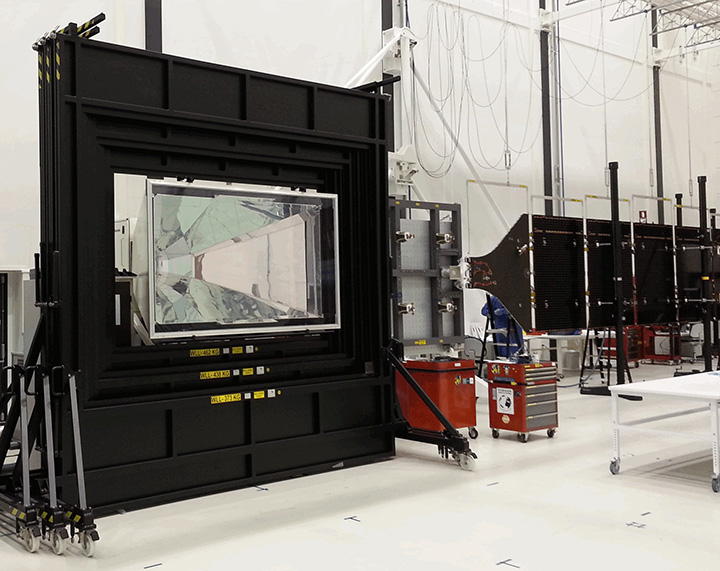
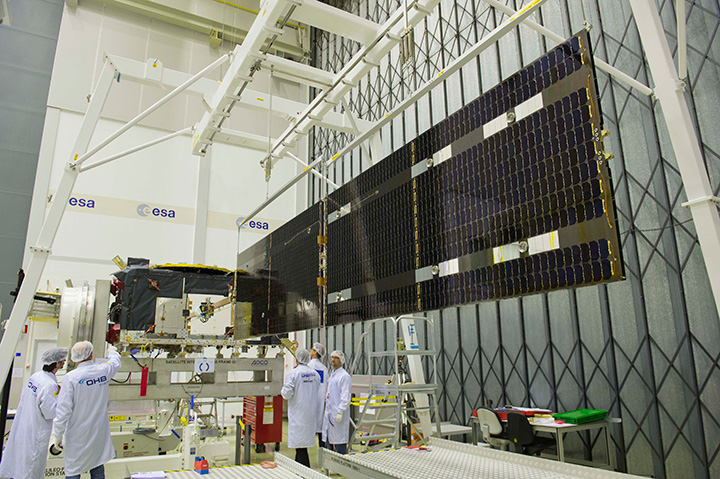
    The completed wings are suspended on specially weighted deployment rigs, to compensate for the presence of gravity the 29 kg wings are not designed to endure. Here alignment testing is performed, to check the wings will unfold in a straight line as planned.

    Galileo solar arrays being inspected in the Dutch Space cleanroom. The panels received from Ottobrunn in Germany are integrated together with the mechanisms, typically sourced from local Dutch companies assembled and tested by Dutch Space, into complete solar array wings. The completed wings are then suspended on specially weighted deployment rigs, to compensate for the presence of gravity the 29 kg wings are not designed to endure. Here alignment testing is performed, to check the wings will unfold in a straight line as planned.
    Galileo solar arrays being inspected in the Dutch Space cleanroom. The panels received from Ottobrunn in Germany are integrated together with the mechanisms, typically sourced from local Dutch companies assembled and tested by Dutch Space, into complete solar array wings. The completed wings are then suspended on specially weighted deployment rigs, to compensate for the presence of gravity the 29 kg wings are not designed to endure. Here alignment testing is performed, to check the wings will unfold in a straight line as planned.

    “Alignment testing involves the use of reference mirrors and theodolites to check the arrays’ straightness, down to a scale of a tenth of a millimeter at wing tip,” Jan explains.

    “In orbit, any bad alignment would be felt by the satellite’s attitude control system, and might even reduce a satellite’s operational life. We also make stiffness tests, which involves hanging weights on a rope on the end of the array, to see what the resulting displacement is. Flex to 100 mm is expected, but not more.”

    A large‘ambient pressure temperature test chamber can simulate the rapid temperature swings the arrays will experience as they pass between orbital daylight and darkness. A much smaller cabinet does the same in vacuum conditions, and is used for accelerated lifetime testing to simulate the total life of the arrays, although only for a 50 x 50 cm sample array.

    Dutch Space has been designing its Advanced Rigid Array family of arrays for space missions since the 1970s, Jan recalls: “Each mission has different requirements. Low-Earth orbiting arrays such as those for ESA’s Automated Transfer Vehicle need protection from erosive atomic oxygen, found at the top of the atmosphere, while deep space missions like Rosetta or the US Dawn spacecraft require low-intensity low-temperature LILT solar cells to go on producing power far from the Sun.

    Deployment of the solar wings on the first Galileo satellite 'Full Operational Capability' satellite is shown being checked at ESA’s ESTEC technical hub in the Netherlands at the end of June 2013. The navigation satellite’s pair of 1 x 5 m solar wings, carrying more than 2500 state-of-the-art gallium arsenide solar cells, will power the satellite during its 12-year working life.
    Deployment of the solar wings on the first Galileo satellite ‘Full Operational Capability’ satellite is shown being checked at ESA’s ESTEC technical hub in the Netherlands at the end of June 2013. The navigation satellite’s pair of 1 x 5 m solar wings, carrying more than 2500 state-of-the-art gallium arsenide solar cells, will power the satellite during its 12-year working life.

    “Galileo flies in medium-Earth orbit, and in the process passes through Earth’s radiation belts. This heightened radiation exposure implies a higher loss factor of cells, which is accounted for with higher capacity at the start. We design solar arrays based on their end-of-life performance — how can we ensure they will still meet mission requirements after 12 years in orbit?”

    Galileo’s solar arrays are also designed to guard against potential harmful electrostatic discharge — a spark caused by the build-up of static — by introducing gaps any charge cannot traverse, as well as other voltage safeguards.

    “As a safety margin, Galileo’s arrays can go on operating satisfactorily with the loss of one complete string of cells.”

    The completed arrays are sent on to Full Operational Capability (FOC) prime contractor OHB in Bremen, Germany for integration onto the satellites. Although this is not quite the end of the story for Dutch Space.

    “We have a 100% record of successfully deployed wings in space and we’d like to keep it that way,” Jan comments. “So we provide training to our customers on handling and storing the wings, and especially in working with our unique hold-down system that keeps the solar arrays stacked on either side of the satellite during launch.”

    The panels are delicate, composed of just four layers of carbon fibre, and would break easily if struck hard. They are therefore tied tight against the satellite during the violence of launch.

    The Kevlar restraint cables are then severed by thermal knives, with two in place per each hold-down point.

    “The Kevlar is weakened gradually instead of suddenly snapping,” Jan explains. “This reduces the amount of shock the arrays experience, compared to the pyros or unwinding rods that other companies use. The arrays then unfold gradually due to springs in the hinges, the process taking a few minutes in all.

    “But the system depends on correct tensioning at the outset, which is why we like to be there in person for this point.”

    A Galileo Full Operational Capability (FOC) satellite, following on from the first four Galileo satellites already in orbit. A total of 22 FOC satellites are on the way, built by OHB in Germany with navigation payloads from Surrey Satellite Technology Ltd. in the UK.
    A Galileo Full Operational Capability (FOC) satellite, following on from the first four Galileo satellites already in orbit. A total of 22 FOC satellites are on the way, built by OHB in Germany with navigation payloads from Surrey Satellite Technology Ltd. in the UK.

    Dutch Space is well ahead on its Galileo obligations, with 88 substrate panels manufactured and 72 panels equipped with solar cells ready for wing integration. They are carefully stored in gaseous nitrogen until needed,  separately from each other for the most part, with integration performed before delivery.“Our continued involvement with Galileo has been very important to the company,” reflects Jan.

    “Dutch Space has worked on batch production previously, such as with solar arrays for the ATV and the US Orbital company’s Cygnus supply vehicle to the International Space Station, but the scale of Galileo is even larger.

    We have had a valuable learning curve, finding ways to optimize our production flow and working methods so that we’ve been able to reduce the time needed by 50% from the initial satellite to the latest. And all the things we learn should make us leaner and cheaper for future one-off missions as well.”

  • Russia Launches another GLONASS-M Satellite

    Russia has launched another GLONASS-M satellite into space, reports Spaceflight Now. The launch occurred on Sunday. The Soyuz 2-1b rocket lifted off at 22:54 GMT (6:54 p.m. EDT) from the Plesetsk Cosmodrome about 500 miles north of Moscow.

    The GLONASS-M satellite, designated No. 54, was manufactured by ISS Reshetnev and is designed for a seven-year operational life. A spokesperson with the Russian Aerospace Defense Forces told Interfax the spacecraft was communicating with ground controllers and functioning normally.

    Five GLONASS satellites are scheduled for launch this year.