Category: GNSS

  • The System: EGNOS Toolkits Enhance GPS Accuracy

    EGNOS Toolkits Enhance GPS Accuracy

    Free downloadable software Toolkits at www.egnos-portal.eu can help cell-phone and handheld receiver developers enhance location and timing applications with GPS corrrection data from the European Geostationary Navigation Overlay Service (EGNOS) satellite-based augmentation system.

    The Toolkits include software packages, demo applications, and supporting materials, enabling application developers, researchers, university students, and others to create, use, and maintain EGNOS-capable positioning applications.

    For handheld receiver manufacturers and mobile-phone developers, the Toolkit contains free source code for easy integration of EGNOS capabilities into a smartphone, and all the necessary files for the demonstration application, for use as a basis for a new application, as well as core libraries, to integrate enhanced EGNOS positioning capability into an existing application.

    For the simply curious, an EGNOS Toolkit provides a means of exploring and understanding the entire chain from the raw GNSS satellite signal to enhanced EGNOS positioning data.

    The development kit provides an easy way incorporate all EGNOS corrections and integrity capabilities, allowing developers to perform real EGNOS integration directly into a smartphone. It works with different operating systems, including Android, Apple, and RIM.

    Static and kinematic tests show that EGNOS performs well in both cases: “The EGNOS SDK provides an average increase of 30 percent in position accuracy over GPS alone,“ according to developer DKE Aerospace.


    EGNOS Software Development Kit provides a software receiver to enhance GPS positions, displaying position accuracy increases on average of 30 percent.


    DOT Blank Stare on LightSquared

    The U.S. Department of Transportation (DoT) responded to a Freedom of Information Act (FOIA) request by GPS World for its recommendations to the National Telecommunications and Information Administration (NTIA) regarding LightSquared interference with GPS. The DoT wrote, “We are withholding two pages [of thirteen relevant pages] in part and eleven pages in their entirety,” and enclosed two completely blacked-out pages.
    Kathy Ray, DoT FOIA officer, added,  “We have determined that the release of the redacted and withheld portions would foreseeably cause harm to the government’s deliberative process.”

    The blacked-out DOT letter is dated August 25, 2011. How it differs from the agency’s July 21 “LightSquared Impact Assessment,” publicly available courtesy of the U.S. House of Representatives Committee on Science, Space, and Technology, cannot, of course, be known.

    The Department of Homeland Security wrote in response to GPS World’s FOIA request, “We conducted a comprehensive search of files with the Science and Technology Directorate’s Homeland Security Enterprise and First Responders Group, and Cyber Security Division for records that would be responsive to your request. Unfortunately, we were unable to locate or identify any responsive records.”

    The National Institute of Standards and Technology of the Department of Commerce replied, “NIST has no documents that are responsive to your request.”

    The Department of the Interior provided the same documents that were previously made public by the House committee.

    The National Aeronautics and Space Administration made a similar determination, but did not send a document, referring instead directly to the committee’s public website.

    PNT Board Hears Proposal for LightSquared Solution

    The  November 9 meeting of the National Space-Based Position Navigation and Timing (PNT) Advisory Board in Alexandria, Virginia got several earfulls regarding the LightSquared/GPS controversy. One of seven speakers on a two-hour panel, Javad Ashjaee, president and CEO of JAVAD GNSS, demonstrated his company’s newly developed filter technology that he said could protect GPS receivers from LightSquared broadband network interference.

    As Ashjaee stated, the proposed solution does not protect against interference from the so-called high-10 signals, one of two bands (the other is known as the low-10) for which LightSquared has received a conditional waiver. Unless and until a solution for the terrestrial high-10 signals is found, LightSquared transmissions in that band will still interfere with the GPS signal. The technical solution proposed by JAVAD GNSS addressed only the low-10 band.


    Proposed filter to “harden” high-precision GPS receivers against Lightsquared Lower 10 (click to enlarge.)
    The JAVAD GNSS proposed fix consists, in simplified form, of a ceramic filter followed by a series of surface acoustic wave (SAW) filters.
    A PDF of Ashjaee’s 76-slide Powerpoint demonstration, without his verbal explanations and commentary, along with other presentations from the board meeting, are available at www.pnt.gov/advisory/2011/11/. A December 8 GPS World webinar reprised the same presentation, and the download at env-gpsworld-integration.kinsta.cloud/webinar includes audio of Ashjaee’s remarks.

    Ashjaee said that his company’s testing of its own filter methodology found no GPS signal loss due to a low-10 (10L) signal power of –10 dBm. An “Ultimate Test: Special Zero Baseline” put receivers on a Moscow skyscraper with multipath from both above and below. One antenna fed two receivers (zero baseline). One receiver used standard filtering and the other the new filters. He said that over 15 hours of testing the average carrier-phase error between the two receivers was 0.2 millimeters, and the average code difference was about 5 centimeters.

    JAVAD GNSS has started production of what Ashjaee calls “LightSquared-compatible” Triumph GNSS receivers. He brought 40 units to the PNT Board meeting. The company will begin manufacturing “LightSquared-integrated” receivers in May 2012, for RTK positioning using the proposed LightSquared broadband network for high-speed communication, if and when it is deployed.

    Fellow presenter Jim Kirkland, vice president and general counsel for Trimble Navigation, pointed out that such filters represented a potential solution only for one class of high-precision receivers. Whether it would work for other classes of high-precision receivers had yet to be verified. Kirkland said that even if further independent testing shows that the filter solution is viable at the lower 10 MHz of the spectrum, retrofits would be costly and time consuming.

    Questions regarding cost and responsibility of retrofit, should the solution prove practical, were not discussed at length at the meeting, nor was any solution proposed.

    LightSquared executive vice president Martin Harriman did not directly answer a question as to whether his company intends to develop the upper 10 MHz for which it has been given a conditional waiver.

    Scott Burgett, software engineering manager for Garmin International, said, “It is almost impossible to design new products compatible with LightSquared’s proposed system without knowing its technology’s end state.” He estimated 10–15 years to properly retrofit Garmin devices, which are widely distributed in general aviation, personal navigation, car navigation, and other sectors, so that they could coexist with LightSquared.

    The panel was moderated by Tom Stansell of Stansell Consulting, who concluded, “I think we learned, thanks to Javad, about a very clever solution to a particular problem for a particular range of products — the products he is most familiar with. It may or may not fit in some of the other applications.

    “What we have not addressed is the elephant in the living room,” Stansell continued. “That is the cost, and time delay, and changeover process if LightSquared is allowed to go forward. Will it be the lower 10, upper 10? That has to be resolved. There are very large questions remaining to be discussed, and [they] may or may not be fully solved in a short period of time.”

    Constellation Updates

    Where Is Compass ICD?

    The long-awaited signal interface control document (ICD) for China’s Beidou/Compass GNSS has not yet appeared, despite an announcement at the ION-GNSS conference by Chinese delegates that ICD document v1.0 will be published in 2011, “probably” in the month of October. When it does appear, it should be available for download on the Compass website, www.beidou.gov.cn (as yet without an English version), also at www.compass.gov.cn.

    The delay in publishing a document may reflect a system very much in formulation, with ongoing discussions among the principal parties to its design, with different views on system architecture and possibly even final signal structure. This was one possible conclusion that could be inferred — a dynamic system in formation and growing rapidly — from varying reports given by different Chinese representatives, governent and academic, at the ION Compass session.

    There was some disagreement among panelists at that time as to, for example, the final targeted number of satellites in the system: either 30, or 35.

    The ICD has been rumored to be available previously to receiver manufacturers within China, creating some disgruntlement among companies outside the country. One of the ION panelists affirmed that GPS/Compass chips and receivers are being actively developed by many Chinese manufacturers and research institutes.

    The next BeiDou/Compass launch, which will be for the system’s fifth inclined geosynchronous orbit satellite, is expected during the first few days of December, according to web discussions. As of press time for this magazine, there had been no official announcement on the Chinese official government BeiDou website, www.compass.gov.cn.

    The site has posted Chinese and English versions of a document titled “Report on the Development of BeiDou (COMPASS) Navigation Satellite System (V1.0)” by the China Satellite Navigation Office. The pages are viewable as separate images.

    Galileo Under Control

    Europe’s first two in-orbit validation satellites reached their final operating slotss 23,222 kilometers above Earth, have been activated, and are now undergoing tests of their navigation payloads, reports the European Space Agency (ESA).

    Marking the formal end of their Launch and Early Operations Phase, control of the satellites passed on November 3 from the French space agency (CNES) center in Toulouse to the Galileo Control Centre in Oberpfaffenhofen, Germany.

    Oberfaffenhofen, operated by the German Aerospace Center (DLR), will be in charge of the satellites’ command and control for the whole of their 12-year operating lives. The navigation signals are being checked out by ESA’s ground station in Redu, Belgium, where a 20-meter antenna measures the shape of the signals to a high degree of accuracy. Once the navigation payload is fully checked out and activated, a second Galileo Control Centre in Fucino, Italy, will oversee all navigation services. All activities are performed under contract to SpaceOpal, a joint subsidiary of DLR and the Italian company Telespazio.

    GLONASS as Expected

    The Satellite System Mission Control Center of the Russian Ministry of Defence, with the ISS-Reshetnev Information Computation Center, established communication with the three GLONASS satellites launched November 4. The satellites are earth- and sun-oriented, and their subsystems are functioning properly.

    According to NORAD tracking, the three satellites were inserted into Plane 1. This was expected as there are only seven active satellites in this plane, whereas the other two planes have a full complement of eight satellites. Orbit slot 3 in Plane 1 is currently vacant. According to Nikolay Testoyedov, ISS-Reshetnev general designer and director general, the new satellites will ensure the operation of a complete 24-satellite GLONASS constellation, and allow creating the necessary orbital reserve.

    GPS GEO-MEO Floated

    In a presentation titled “Analysis of Alternatives  for Future GPS Architecture; Considerations for Constellation Sustainment,” made to the U.S. PNT Advisory Board on November 9, Kirk Lewis, senior advisor from the Institute for Defense Analyses (IDA), put forth the concept of “boosting” GPS III payloads onto commercial geostationary Earth-orbit (GEO) satellites.

    After concluding that the current program of launches and orbit costs extending into the Block III-C generation is not sustainable, Lewis presented several alternatives, but quickly eliminated two that involved low-Earth-orbit satellites and non-space options, due to technical, scheduling, and performance issues. Remaining in play are “potential and realistic” GEO and mid-Earth orbit (MEO, the configuration of the present GPS constellation) options, used individually or in combination.

    IDA analysis found that two GEO satellites, separated by 15 degrees or more longitude, supplied almost the same signal performance as adding six MEO satellites. The presentation is available at www.pnt.gov/advisory/2011/11/.
  • Consumer GPS/GLONASS: Accuracy and Availability Trials of a One-Chip Receiver in Obstructed Environments

    By Philip Mattos, STMicroelectronics R&D Ltd.

    A one-chip multiconstellation GNSS receiver, now in volume production, has been tested in severe urban environments to demonstrate the benefits of multiconstellation operation in a consumer receiver. Bringing combined GPS/GLONASS from a few tens of thousands of surveying receivers to many millions of consumer units, starting with satnav personal navigation devices in 2011, followed by OEM car systems and mobile phones, significant shifts the marketplace. The confidence of millions of units in use and on offer should encourage manufacturers of frequency-specific components, such as antennas and SAW filters, to enter volume mode in terms of size and price.

    One-chip GPS/GLONASS receiver trials in London, Tokyo, and Texas sought to demonstrate that the inclusion of all visible GLONASS satellites in the position solution, in addition to those from GPS, produces much greater availability in urban canyons, and in areas of marginal availability, much greater accuracy.

    Multi-constellation receivers are needed at the consumer level to make more satellites available in urban canyon environments, where only a partial view of the sky is available and where extreme integrity is required to reject unusable signals, while continuing to operate on other signals deeply degraded by multiple reflection and attenuation. This article briefly outlines the difficulties of integrating a currently non-compatible system (GLONASS), offering an economic solution in the mass market where cost is king, but performance demands in terms of low signal, power consumption, time-to-first-fix, and availability are extreme. While the accuracy achieved is not at survey levels, we deem it sufficient to meet consumer demands even at the worst signal conditions.

    The aim is to provide improved indoor and urban canyon availability for mass-market GNSS by using all available satellites; in 2011, that requires GLONASS support, as the constellation availability precedes Galileo by around three years. The aim is to overcome the hardware incompatibility issues of GLONASS, that is, its frequency division multiple access (FDMA) signal rather than the code division multiple access format used by GPS, different centre frequency, and different chipping rate, all without adding significantly to the silicon cost of the receiver chipset. This then allows a total satellite constellation of about 50 to be used at present, even before two recently launched Galileo IOV satellites.

    It is expected that in benign conditions the additional satellites will give little benefit, as availability approaches 100 percent, and accuracy is excellent, with GPS alone. Though dominated by the ionosphere, using seven, eight, or nine satellites in the fix minimises the amount of error that feeds through to the final position.

    In marginal conditions, where GPS can give a position, but is using 3/4/5 satellites and those are clustered in the narrow visible part of the sky resulting in poor DOP values, the increased number of satellites benefits the accuracy greatly, due to both improved DOP and multipath-error averaging. Limited satellites mean the full multipath errors map into position and are magnified by the DOP. Adding the second constellation means more clear-view satellites for accuracy, more total satellites to minimise the errors, and the errors are less magnified by the geometry due to better DOP.

    In extreme conditions, where insufficient GPS satellites are seen to give a fix, the additional GLONASS satellites increase the availability to 100 percent (excluding actual tunnels).

    Availability is a self-enhancing positive feedback loop… if satellites are always tracked, even if rejected on a quality basis by the RAIM/fault detection and exclusion (FDE) algorithms, then they do not need to be reacquired, so become available for use earlier. If position can be maintained, then the code phases for obstructed satellites can continue to be predicted accurately, allowing instant reacquisition after obstruction, and instant use as no code pull-in time is required. Once availability is lost, the reverse applies, as wrong position means worse prediction, longer re-acquisition, and hence again less availability.

    The extra visible satellites are very significant for the consumer, particularly — as for example with self-assistance where the minimum constellation is five satellites, not three to four — to autonomously establish that all satellites are healthy using receiver-autonomous integrity monitoring (RAIM) methods. Self-assistance has further major benefits for GLONASS, in that no infrastructure is required, so there will be no delay waiting for GLONASS assistance servers to roll out. The GLONASS method of transmitting satellite orbits is also very suitable for the self-assistance algorithm, saving translation into and out of the Kepler format.

    Significance of Work

    Previous attempts to characterize the multi-constellation benefits in urban environments have been handicapped by the need to use professional receivers not designed for such signal conditions, and by the need to generate a separate result for each constellation or sacrifice one satellite measurement for clock control. These problems made them unrepresentative of the performance to be expected from the volume consumer device.

    This new implementation is significant in being a true consumer receiver for high sensitivity, fully integrated both for measurement and for computation. Thus fully realistic trials are reported for the first time.

    Background

    The tests were performed on the Teseo-II single chip GNSS receiver (STA-8088). A brief history: our 2009 product Cartesio+ already included GPS/Galileo, and the digital signal processor (DSP) design has been extended to include GLONASS also for Teseo2, the 2010 product. Test results with real signal data through FPGA implementations of the baseband started in late 2009, and with the full product chip in 2010.

    The architectural design showed that the silicon could be implemented with only small additional silicon area. Changes to the baseband DSP hardware and software were small and were included in the next scheduled upgrade of the chip, Teseo2. The RF chip silicon requires much greater attention, duplicating the intermediate frequency (IF) path and analog-digtal converter (ADC), with additional frequency conversion and a much wider IF filter bandwidth; however, as the RF silicon area is very small in total, even a 30 percent increase here is not a significant percentage increase on the whole chip. As the design is for an integrated single chip system (RF and baseband, from antenna to position, velocity, and timing (PVT) solution), the overall silicon area on a 65-nanometer process is very small.

    Commercially, it is new to include all three constellations in a single consumer chip. Technically it is new to use a pool of constellation-independent channels for GLONASS, though standard for GPS/Galileo. Achieving this flexibility has also required new techniques to manage differing RF hardware delays, different chipping rates, in addition to the coordinated universal time (UTC) offset and geoid offset problems already well known to the surveying community.

    It is also very unusual to go direct to a single-chip solution (RF+baseband+CPU) for such a major technology step. The confidence for this step comes from the provenance of the RF and the baseband, the RF being an extension of the STA5630 RF used with Cartesio+, and the baseband being significant but not major modifications of the GPS/Galileo DSP used inside Cartesio+. 5630/Cartesio+ were proven in volume production as separate chips before the single-chip three-constellation chip starts production.

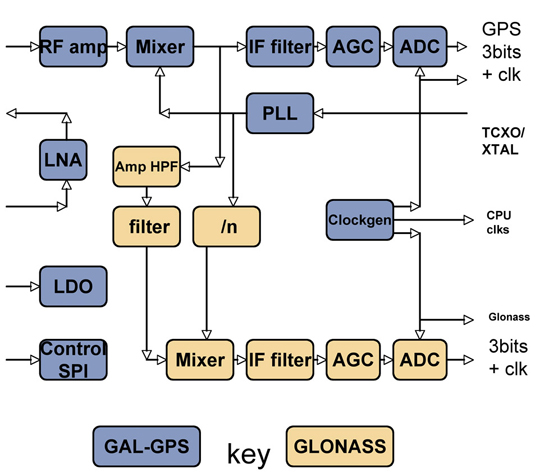
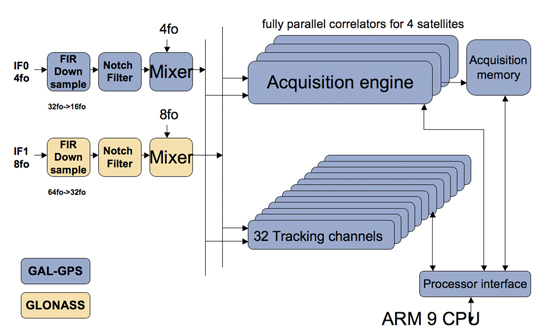
    The steps forward from the previous generation of hardware are on chip RF, Galileo support, GLONASS support. While Galileo can pass down the existing GPS chain, with appropriate bandwidth changes, additional changes are required for GLONASS: see Figures 1 and 2.

    figure1 Philip Mattos, STMicroelectronics R&D Ltd.
    Figure 1. RF changes to support GLONASS.
    figure2 Source: Philip Mattos, STMicroelectronics R&D Ltd.
    Figure 2. Baseband changes to support GLONASS.


    In the RF section, the LNA, RF amp, and first mixer are shared by both paths, in order to save external costs and pins for the equipment manufacturer, and also to minimize power consumption. Then the GLONASS signal, now at around 30 MHz, is tapped off into a secondary path shown in brown, mixed down to 8 MHz and fed to a separate ADC and thus to the baseband.

    In the baseband, an additional pre-conditioning path is provided, again shown in brown, which converts the 8 MHz signal down to baseband, provides anti-jammer notch filters, and reduces the sample rate to the standard 16fo expected by the DSP hardware.

    The existing acquisition engines and tracking channels can then select whether to take the GPS/Galileo signal, or the GLONASS signal, making the allocation of channels to constellations completely flexible.

    Less visible but very important to the system performance is the software controlling these hardware resources, first to close tracking loops and take measurements, and secondly the Kalman filter that converts the measurements to the PVT data required by the user. This was all structurally modified to support multiple constellations, rather than simply adding GLONASS, in order that future extensions of the software to other future systems becomes an evolutionary task rather than a major re-write.

    The software ran on real silicon in 2010, but using signals from either simulator or static roof antennas, where accuracy and availability of GPS alone are so good that there is little room for improvement. In early 2011, prototype satnav hardware using production chips, antennas, and cases became available, making mobile field trials viable.

    Actual Results

    Results have already been seen from trials using professional receivers with independent GPS and GLONASS measurements. However, those tests were not representative of the consumer receiver because they are not high sensitivity; because the receivers require enough clean signal to operate a PLL, which is not realistic in a mobile city environment; and because they were creating two separate solutions, thus needing a continuous extra satellite to resolve inter-system time differences.

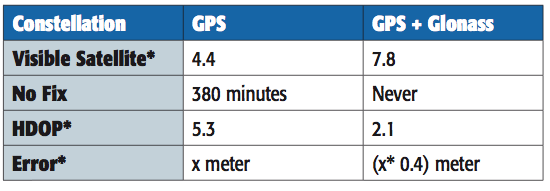
    A 2010 simulation of visible satellites in a typical urban canyon of downtown Milan, Italy, produced the results, every minute averaged for a full 24 hours, shown in Table 1. The average number of satellites visible rises from 4.4 with GPS alone, to 7.8 for GPS+GLONASS, with the result that there are then zero no-fix samples. With GPS alone there were 380 no-fix samples, or 26 percent of the time.

     Table 1. Accuracy and availability of GPS and GPS+GLONASS, averaged over 24 hours. Source: Philip Mattos, STMicroelectronics R&D Ltd.
    Table 1. Accuracy and availability of GPS and GPS+GLONASS, averaged over 24 hours.

    However, availability is not itself sufficient. Having more satellites in the same small piece of sky above the urban canyon may not be sufficient, due to geometric accuracy limitations. To study this, the geometric accuracy represented by the HDOP was also collected, and shows an accuracy 2.5 times better.

    Previous studies suggested that in the particular cities tested, two to three additional satellites were available, but one of these was wasted on the clock solution. Using the high-sensitivity receiver, we expected four or five extra satellites and none wasted.

    The actual results far exceeded our expectations. Firstly, many more satellites were seen, as all previous tests and simulations had excluded reflected signals. Having many more signals, the DOP was vastly improved, and the effect of the reflections on accuracy was greatly reduced, both geometrically, and by the ability of the FDE/RAIM algorithms to maintain their stability and down-weight grossly erroneous signals rather than allow them to distort the position.

    The results presented here are from a fully integrated high-sensitivity receiver optimized to use signals down to very low levels, and to give a solution derived directly from all satellites in view, no matter which constellation.

    This produces 100 percent availability, and much improved accuracy in the harsh city environment.

    Availability

    The use of high-sensitivity receivers, not dependent on phase-locked loops (PLLs) for tracking, produces 100 percent availability in modern cities, even high-rise, due to the reflective nature of modern glass in buildings, even for GPS alone. Thus some other definition of availability is required rather than “four sats available,” such as sats tracked to a certain quality level, resulting in a manageable DOP. Even DOP is difficult to assess, as the Kalman filter gives different weights to each satellite, not considered in the DOP calculation, and also uses historic position and current velocity, in addition to instantaneous measurements, to maintain the accuracy of the fix.

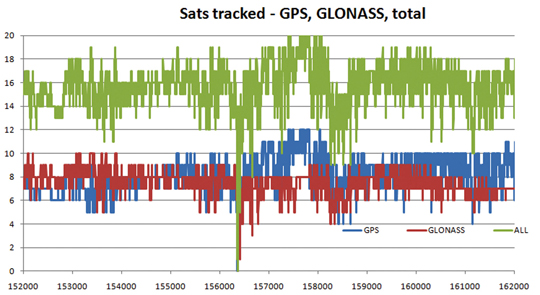
    Figure 3 shows the availability of tracked satellites in tests in the London City financial district in May 2011.

    figure3 Source: Philip Mattos, STMicroelectronics R&D Ltd.

    As can be seen, there are generally seven to eight GLONASS satellites and eight to nine GPS satellites, for a total of around 16 satellites. The only period of non-availability was in a true tunnel (Blackfriars Underpass) at around time 156400 seconds. In other urban canyons, around time 158500 and 161300, individual constellations came down to four satellites, but the total never fell below eight. Note this is an old city, mainly stone, so reflections are limited compared with glass/metal buildings.

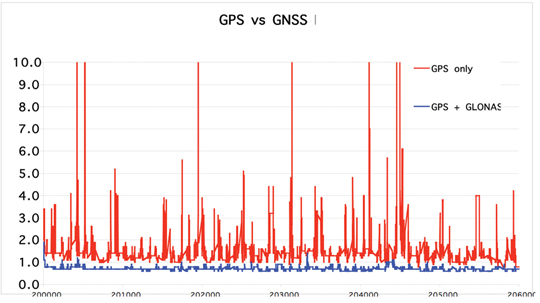
    While outside tunnels, availability is 100 percent, this may be limited by DOP or accuracy. As can be seen in Figure 4 on another London test, the GNSS DOP remains below 1, as might be expected with 10–16 satellites, while GPS-only frequently exceeds four, with the effect that any distortions due to reflections and weak signals are greatly magnified, with several excursions over 10.

     Figure 4. GPS-only versus combined GPS/GLONASS dilution of precision. Source: Philip Mattos, STMicroelectronics R&D Ltd.
    Figure 4. GPS-only versus combined GPS/GLONASS dilution of precision.

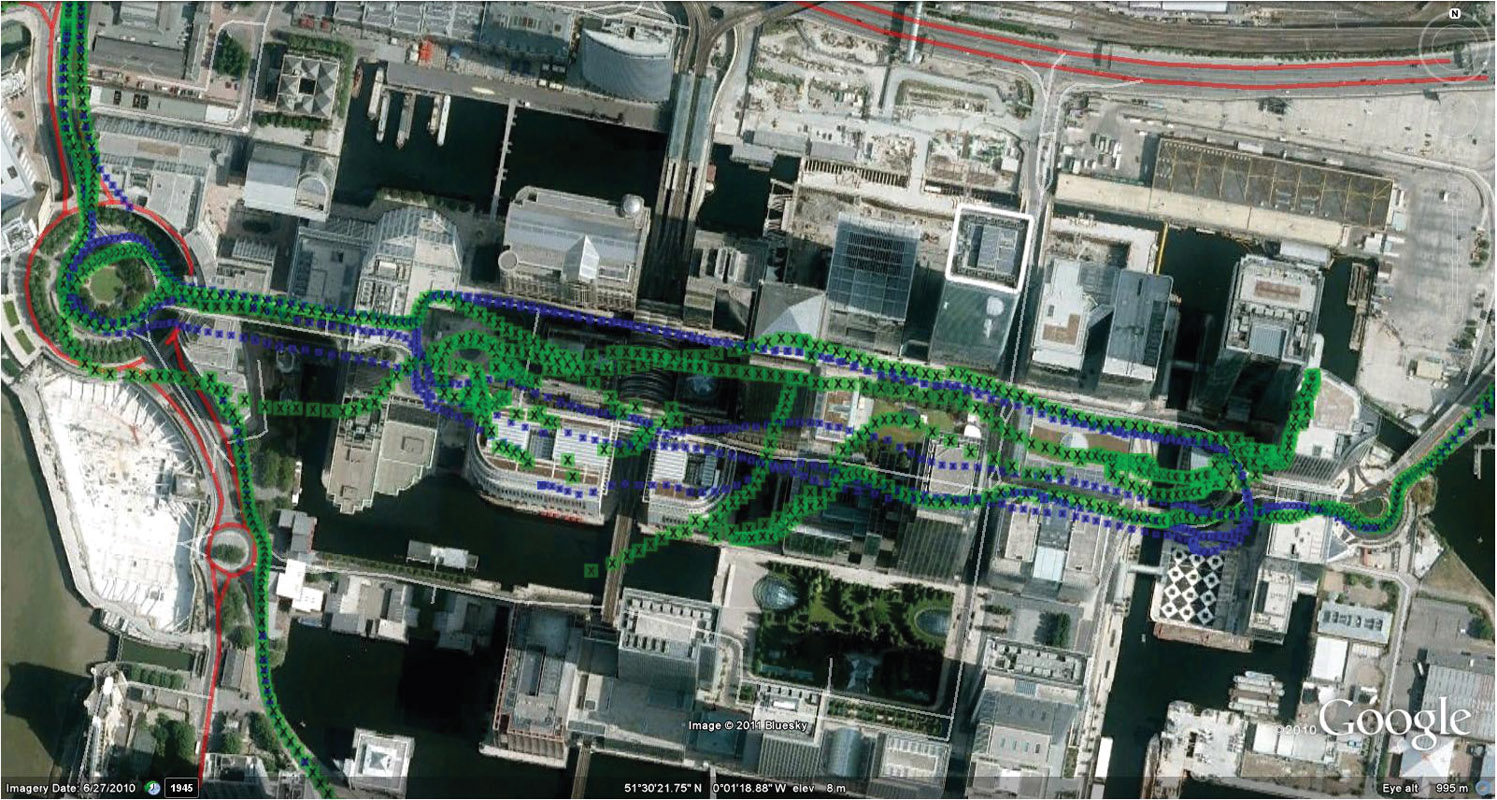
    As the May 2011 tests had not been difficult enough to stress the GPS into requiring GNSS support, a further trial was performed in August 2011. This was in a modern high-rise section of the city, Canary Wharf, shown in Figure 5 on an aerial photograph. In addition to being high-rise, the roads are also very narrow, resulting in very difficult urban canyons. Being a modern section of the city, the buildings are generally reflective glass and metal, rather than stone, testing RAIM and FDE algorithms to the extreme.

     Figure 5. GPS versus GNSS, London Canary Wharf (click to enlarge.) Source: Philip Mattos, STMicroelectronics R&D Ltd.
    Figure 5. GPS versus GNSS, London Canary Wharf (click to enlarge.)

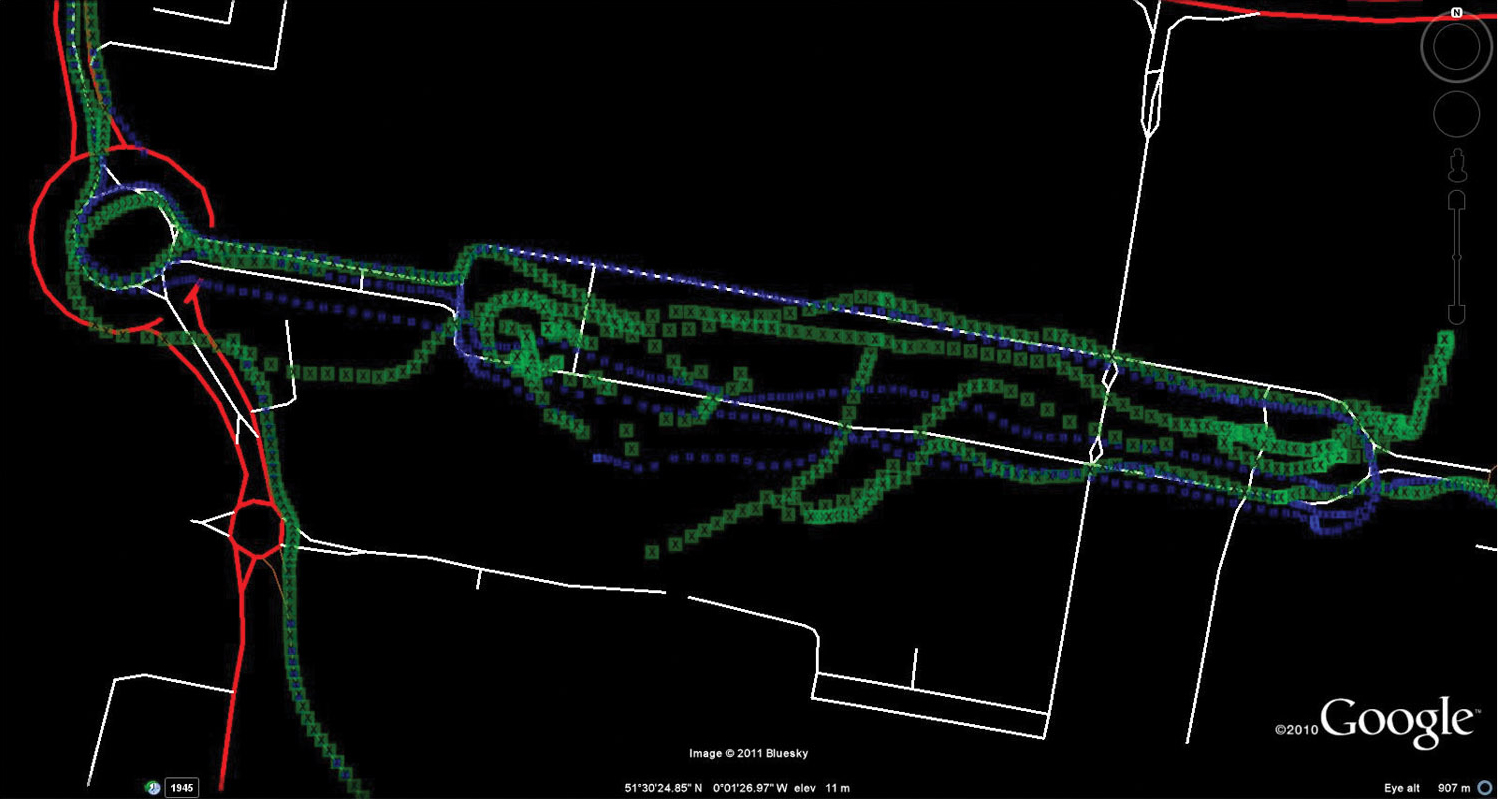
    This resulted in difficulty for the GPS-only solution, shown in green, especially in the covered section of the Docklands station, center-left, lower track.

    Figure 6 shows the same test data displayed on truth data taken from the ordnance survey vector map data of the roads.

     Figure 6. GPS versus GNSS, London Canary Wharf, on vector truth (click to enlarge.) Source: Philip Mattos, STMicroelectronics R&D Ltd.
    Figure 6. GPS versus GNSS, London Canary Wharf, on vector truth (click to enlarge.)

    The blue GNSS data is then extremely good, especially on the northern (eastbound) part of the loop (UK drives on the left, thus one-way loops are clockwise).

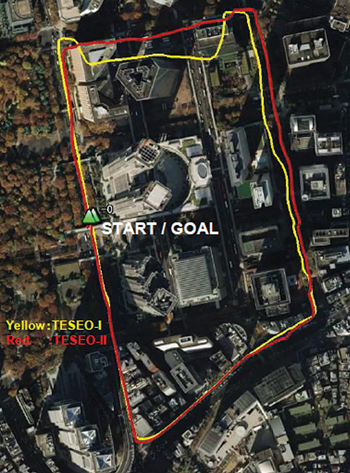
    Further tests were carried out by ST offices around the world. Figure 7 shows a test in Tokyo, where yellow is the previous generation of chip with no GLONASS, red was Teseo-II with GPS plus GLONASS.

     Figure 7. Teseo-I (GPS) versus Teseo-II (GNSS) in Tokyo test. Source: Philip Mattos, STMicroelectronics R&D Ltd.
    Figure 7. Teseo-I (GPS) versus Teseo-II (GNSS) in Tokyo test.

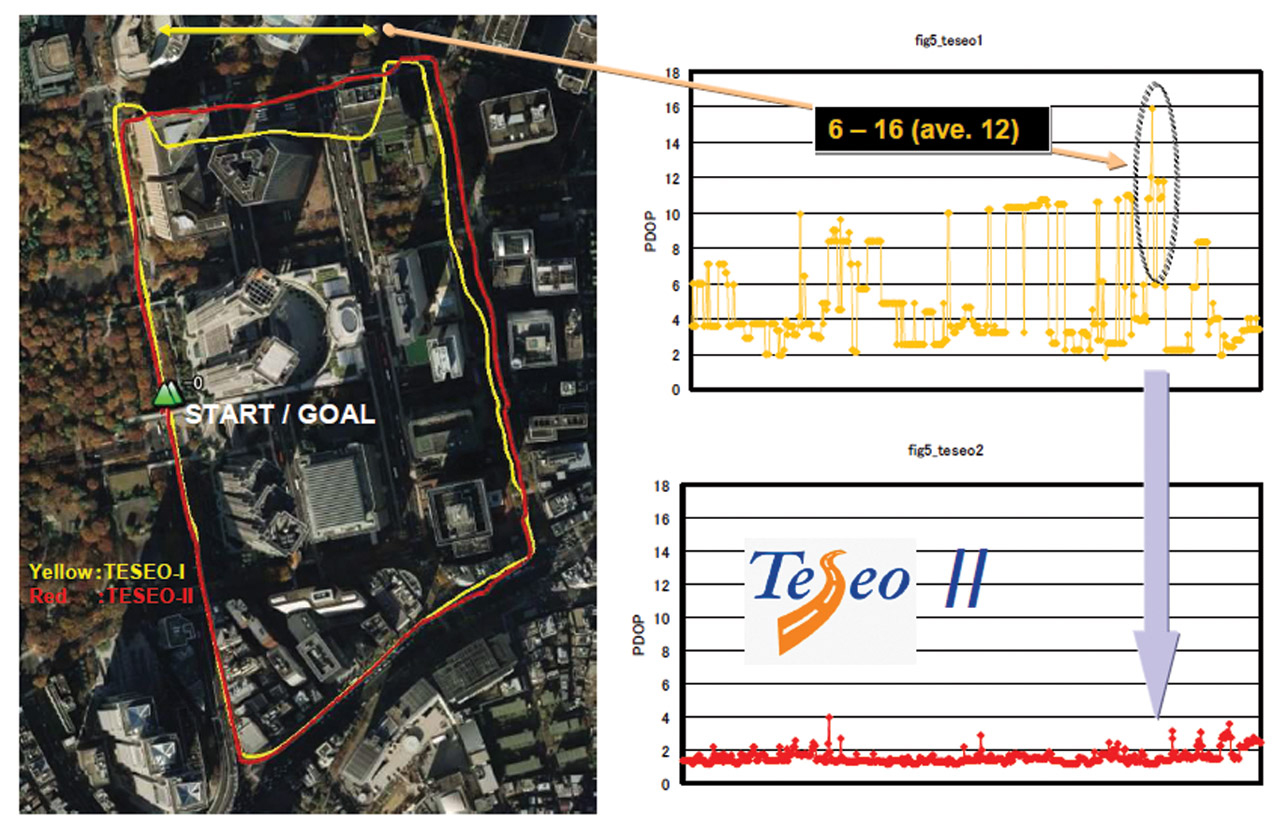
    Again, here the scenario is not sufficiently challenging to hurt the availability even of GPS alone, but the accuracy is limited.

    Figure 8 gives some explanation of the accuracy problems, by showing the DOP during the test. It can be seen that Teseo-II DOP was rarely above 2, but the GPS-only version was between 6 and 12 in the difficult northern part of the test, circled for illustration.

     Figure 8. DOP during Tokyo tests (click to enlarge.) Source: Philip Mattos, STMicroelectronics R&D Ltd.
    Figure 8. DOP during Tokyo tests (click to enlarge.)

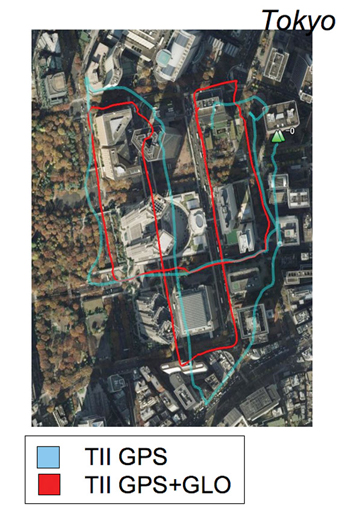
    Further Tokyo tests were performed entering the narrower urban canyons in the same test area, shown in Figure 9. Blue is GPS only, red is GPS+GLONASS, and the major improvement is obvious.

    Figure 9. GPS only (blue) versus GNSS (red), Tokyo. Source: Philip Mattos, STMicroelectronics R&D Ltd.
    Figure 9. GPS only (blue) versus GNSS (red), Tokyo.

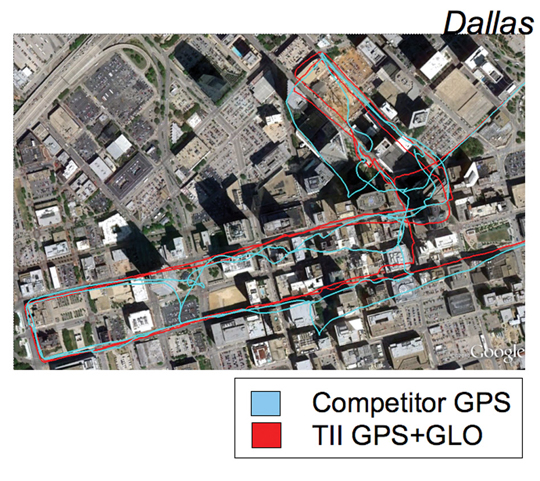
    Figure 10 uses the same color scheme to illustrate tests in Dallas, this time with a competitor’s GPS receiver versus Teseo-II configured for GPS+GLONASS, again a huge benefit.

     Figure 10. GPS only (blue, competitor) versus GNSS (red), Dallas.
    Figure 10. GPS only (blue, competitor) versus GNSS (red), Dallas.

    Other Constellations

    While Teseo-II hardware supports Galileo, there are no production Galileo satellites available yet (September 2011), so the units in the field do not have Galileo software loaded.

    However, the Japanese QZSS system has one satellite available, transmitting legacy GPS-compatible signals, SBAS signals, and L1C BOC signals. Teseo-II can process the first two of these, and while SBAS is no benefit in the urban canyon as the problems of reflection and obstruction are local and unmonitored, the purpose of QZSS is to provide a very high-angle satellite, so that it is always available in urban canyons.

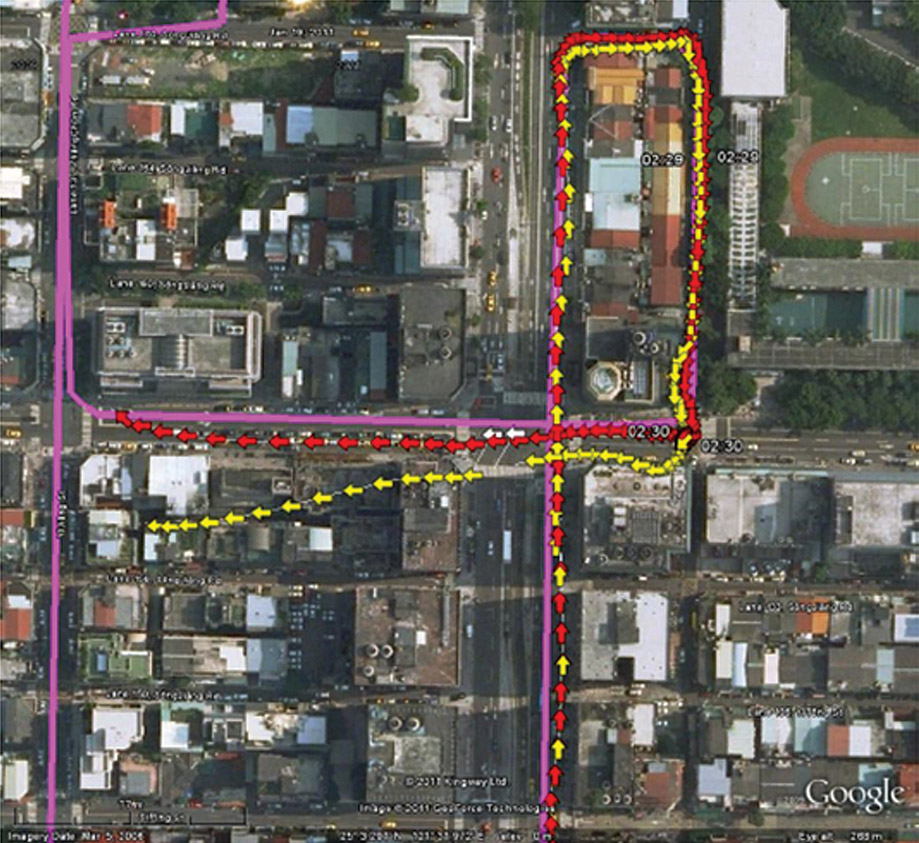
    Figure 11 shows a test in Taipei (Taiwan) using GPS (yellow) versus GPS plus one QZSS satellite in red, with the truth data shown in purple.

    figure11_B Source: Philip Mattos, STMicroelectronics R&D Ltd.
    Figure 11. GPS only (yellow) versus GPS+QZSS(1 sat, red), truth in purple, Taipei (click to enlarge.)

    Further Work

    The test environment will be extended to yield quantitative accuracy results for UK tests where we have the vector truth data for the roads.
    The hardware flexibility will be extended to support Compass and GPS-III (L1-C) signals, in addition to Galileo already supported. Acquisition and tracking of these signals have already been demonstrated using pre-captured off-air samples.

    In 2010, the Compass spec was not available. Thus the Teseo-II silicon design was oriented to maximum flexibility in terms of different code lengths, such as BOC or BPSK, so that by using software to configure the hardware DSP functions, the greatest chance of compatibility could be achieved.

    The result was only a marginal success, in that the 1561 MHz frequency of the regional Compass system can only be supported using the flexibility of the voltage-controlled oscillator and PLL, meaning that it cannot be supported at the same time as other constellations. Additionally, the code rate on the regional system is also 2 M chips/second, which is not supported, so is approximated by using alternate chips, producing serious signal loss.

    So the hooks for Compass are only useful for research and software development, either for a single-constellation system, or using a separate RF front end.

    The worldwide Compass signal, which is on a GPS/Galileo signal format in both carrier frequency and in code length and rate, will be directly compatible, but is not expected to be fully available until 2020.

    The city environment testing will be repeated as the Galileo constellation becomes available. With 32 channels, an 11/11/10 split (GPS/Galileo/GLONASS) may be used when all three constellations are full, but for the next few years 14/8/10 satisfies the all-in-view requirements.

    Conclusions

    The multi-constellation receiver can include GLONASS FDMA at minimal increased cost, and with its 32 channels tracking up to 22 satellites in a benign environment, even in the harshest city environment sufficient satellites are seen for 100 percent availability and acceptable accuracy. 10–16 satellites were generally seen in the urban canyon tests. The multiplicity of measurements allows RAIM and FDE algorithms to be far more effective in eliminating badly reflected signals, and also minimizes the geometric effects of remaining distortion on the signals retained.

    Acknowledgments

    ST GPS products, chipsets, and software, baseband and RF are developed by a distributed team in Bristol, UK (system R&D, software R&D); Milan, Italy (silicon implementation, algorithm modelling and verification); Naples, Italy (software implementation and validation); Catania, Sicily, Italy (Galileo software, RF design and production); and Noida, India (verification and FPGA). The contribution of all these teams to both product ranges is gratefully acknowledged.


    Philip Mattos received a master’s degree in electronic engineering from Cambridge University, UK, a master’s in telecoms and computer science from Essex University, and an external Ph.D. for his GPS work from Bristol University. He was appointed a visiting professor at the University of Westminster. Since 1989 he has worked exclusively on GPS implementations and associated RF front ends, currently focusing on system-level integrations of GPS, on the Galileo system, and leading the STMicroelectronics team on L1C and Compass implementation, and the creation of generic hardware to handle future unknown systems.

  • Galileo IOV Satellites Reach Operating Orbits

    News from CANSPACE Listserv.

    An announcement from ESA on November 4 stated "Europe’s first two Galileo IOV satellites have reached their final operating orbits, opening the way for activating and testing their navigation payloads." But, based on NORAD/JSpOC tracking of the satellites, it seems that the final orbits were achieved only a day or so ago.

    The plot above (and linked here) shows the mean motion (mm) of the PFM and FM2 satellites since launch. As evidenced by the lengthy gaps in the mm history, it is clear that NORAD/JSpOC sometimes has difficulty in reacquiring satellites after delta-V manoeuvres. We do know, however, that both satellites have appeared to reach their final orbits sometime between November 19 and 23. The mm values are now very close to the value 1.7046556 orbits per day derived from the mean semimajor axis of the Galileo constellation as given in the Galileo Open Service Signal-In-Space Interface Control Document: 29601.297 km.

    The arguments of latitude of the two satellites, essentially in the same orbit plane, are now 40 degrees apart as intended. There have not been any public reports that navigation signals from the satellites have yet been switched on.

  • The Good, the Bad, and the Really Ugly

    The Good, the Bad, and the Really Ugly

    The Good

    This month there is good news — great news, actually — where GPS and PNT (Position, Navigation and Timing) systems are concerned. On October 22, a Russian Soyuz rocket placed in orbit the first two validation satellites, built by EADS Astrium Germany, in the Galileo PNT constellation after making its maiden launch from Kourou. Don’t confuse these recent satellites with the earlier experimental satellites, GIOVE-A launched in 2005 followed by GIOVE-B launched in 2008. These initial satellites served to preserve the Galileo ITU frequency filings and test the first-ever space borne Hydrogen Maser atomic clock, which by all accounts is proving to be extremely accurate.

    21102011-_SCO3184-W-1
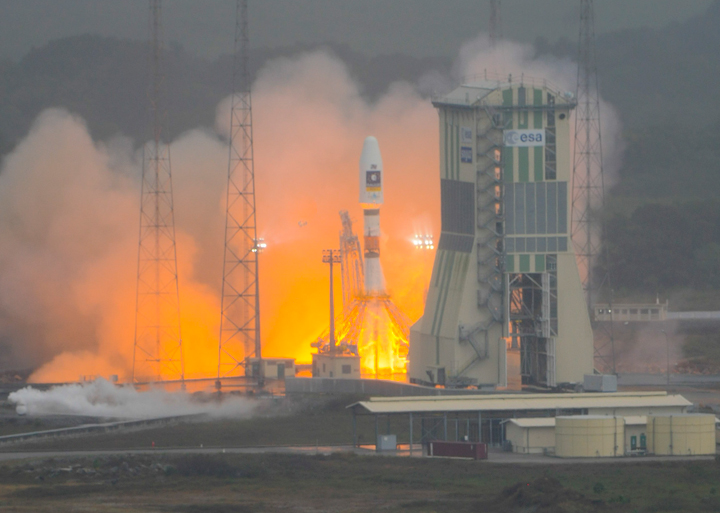
    The Soyuz launch of two Galileo IOV satellites.

    While it is interesting the Europeans decided on a Russian vehicle for the first Galileo dual launch, the U.S. recently pinned its hopes on a European Ariane Five (pictured at right) to launch a commercially hosted U.S. government payload known, appropriately enough, as the “Commercially Hosted Infrared Payload” or CHIRP sensor, which was specifically developed by the U.S. government as a test payload to test both the payload sensor capability and the commercially hosted options for sensor payloads in GEO. The CHIRP sensor features a fixed telescope that can view one quarter of the Earth from geosynchronous orbit. So it appears that hosted payloads and international launch cooperation efforts are growing and are apparently working successfully.

    The two newest Galileo satellites deployed four hours after the Soyuz rocket lifted off from Kourou, in French Guiana.

    The Soyuz launched the first two of four validation Galileo satellites designed to validate the Galileo concept by testing both space and ground operations. Two additional validation satellites are scheduled to follow in the summer of 2012. Once the In-Orbit Validation (IOV) phase is completed, an additional 12 satellites will be launched to reach an Initial Operational Capability (IOC) of 16 satellites sometime in 2014, and that date looks extremely doubtful.

    According to our own Richard Langley, “During initial operations, the [Galileo] satellites will be controlled by a joint ESA and CNES French space agency team in Toulouse, France. Once that week-long phase ends, the satellites will be handed over to the Oberpfaffenhofen Galileo Control Centre near Munich, [Germany], operated by the DLR German Aerospace Center, which will be responsible for routine operations. Operating the satellite payloads to provide navigation services will be the task of the Fucino Control Centre, near Rome, operated by Telespazio.”

    Now, does that sound like a confusing and expensive ground support system? Everybody and every country insist on their piece of the pie, regardless of efficiency and continuity of operations. Who knows this might work; only time will tell.

    The approximately $7.5 billion Galileo constellation will eventually, hopefully, comprise a retinue of 27 operational satellites with three on orbit spares by 2020.

    The PNT business is obviously good for the Russian launch business. Russia successfully launched a GLONASS-K1 test satellite back in February, followed by three GLONASS-M satellites this month into a constellation that finally, after 29 years, accounts for 23 operational and three hopefully soon-to-be operational satellites. The first operational GLONASS-K1 is not scheduled to be launched until sometime early in 2012. GLONASS satellites have historically proven to be fragile affairs with extremely short lifespans; it remains to see how long this number and capability will be maintained. Hopefully the new K1 and M generation GLONASS satellites have resolved many of the longevity issues. Only time will tell when and if the Russian GLONASS will ever regain Full Operational Capability (FOC), which requires 24 simultaneously operating satellites. The Russians were briefly FOC in December 1995, but unfortunately only for a few months. The word “simultaneous” is important as Russian scientisst frequently state they have 25 or 27 GLONASS satellites in orbit, but unfortunately only 22 or 23 of them are operating. But it is possible, miracles still happen, that by the time you read this GLONASS may actually legitimately have achieved FOC once again.

    Now on the Boeing IIF side of the house, more good news as it was announced this week that the second IIF satellite (IIF-2), which has been operational with an elevated signal strength for several months, now has its signals back within the specified signal strength and is good to go. GPS IIF-3 was originally scheduled for launch this coming summer, but the latest launch schedules show the launch in September 2012, about 11 months from now. With 30+ operational GPS satellites on orbit plus residuals, hopefully this will be soon enough.

    Apple & GLONASS

    Always betting on the come, we now know that the late genius Steve Jobs directed his enterprising engineers to include GLONASS PNT software in the latest iPhone 4S; the latest version iPhone that sold 1.3 million units in one day. This effectively gives the iPhone 55 potential satellites to choose from for PNT information as well as the Wi-Fi, cellular tower, and SkyHook Wireless PNT information. With the addition of the GLONASS PNT resources, the iPhone may now well be the most versatile and capable general-purpose PNT platform that exists today. Is that a sad commentary for other GPS and mobile phone providers, a marketing challenge, or merely a positive sign of the technologically advanced times in which we live? It may in fact simply be a true reflection of the capabilities of the most recognized and profitable corporation in the world today. Apple is doing many things right, and one of them is listening to the consumer and giving them more than they expect. Consequently, customers are loyal and Apple Inc. surpassed Microsoft in market capitalization in 2010, and in 2011 became the most valuable consumer-facing brand in the world. Apple is a company Fortune magazine has named the most admired company in the United States for the last three years running. Apple iPhones and numerous PNT applications are certainly in use by thousands of our warfighters in and out of theater. Interesting, to say the least, plus food for thought and a topic for a future column.

    The Bad

    The bad news not surprisingly comes via the U.S. government and no, it is not about LightSquared, because that situation continues to be worse than merely bad. No, the bad news comes in the form of a recently released but curiously out-of-date publication concerning GPS by the Congressional Budget Office (CBO).  In late October 2011, the CBO released a publication entitled The Global Positioning System for Military Users: Current Modernization Plans and Alternatives.

    I was unfortunate enough to receive both a soft and hard copy; and to make matters worse I don’t own a parakeet. The good news is we do have several fireplaces in our home and winter is rapidly approaching. Truthfully, the report is that bad and out of date, but at least it is boring and long. Fortunately hardly anyone is likely to actually endure the pain and suffering required to read through the entire document. However if you are a masochist and/or suffering from acute insomnia I highly recommend this CBO report as a possible cure. Some of you might justifiably complain I have no business giving medical advice because I am not a medical subject matter expert (SME) and I wholeheartedly agree, just as I agree that the CBO is definitely not a GPS SME and should stay with what they do know. Whatever that is.

    I can assure you when and if the military needs advice concerning future GPS operations and options the last place they will or should turn is to the CBO. For example, the preface of the document clearly states, “In keeping with CBO’s mandate to provide objective, impartial analysis, this study makes no recommendations.” Contrary to what you may think this is actually good news, since now we don’t have to waste valuable time dealing with flawed recommendations; garbage in, garbage out. Now if only the analysis were impartial or objective, which it is decidedly not. I would even settle for accurate, which it is definitely not. The information in this document is in some cases, as in M-Code satellites, erroneous and confusing; it is out-of-date where the GPS III nomenclature and options are concerned, especially the spot-beam; and it is always misleading concerning objectivity that presents facts not in evidence. There is so much erroneous and misleading information in this report that I sincerely hope no one else reads it, especially our military users.

    Seriously, all kidding aside, if you must read this document, consider it to be retitled as: The Global Positioning System for Military Users: Outdated Modernization Plans and Alternatives Not Currently Being Considered by the DoD.

    Against my better judgment I am including a link to the CBO document for those of you who practice self-flagellation. I truly regret the number of tree lifespans cut short to produce this confusing, misleading, out-of-date, and totally unnecessary document. Sometime I will tell you how I really feel.

    The Really Ugly

    The “really ugly,” as you have probably surmised by now, refers to LightSquared and the clueless FCC. Can you believe we have been dealing with this fiasco for more than 12 months? You are probably tired of it all, I know I am, but I see that as a true danger signal. The situation is very clear technically, the LightSquared signals, both from the terrestrial transmitters and receivers, will significantly impair and jam GPS signals to the detriment of all GPS users. Of course the political and business ineptness continues apace so who knows how long we will be dealing with this issue, but we cannot afford to let down our guard. Although this is exactly what LightSquared, the FCC, and the current administration, in an upcoming Presidential election year, obviously hope will happen. They hope we will all just get tired of dealing or even hearing about this LightSquared mess and then they win by default. We all have more important matters demanding our attention, right? Of course we cannot and are not going to allow that to happen. We will continue to use LightSquared as a verb when necessary and keep the real facts front and center, right here in GPS World, until all aspects are resolved. You can count on it.

    Until next time, happy navigating.


  • Galileo Satellites Handed over to Control Center in Germany

    Europe’s first two Galileo satellites have reached their final operating orbits, opening the way for activating and testing their navigation payloads, reports the European Space Agency (ESA).
     
    Marking the formal end of their LEOP Launch and Early Operations Phase, control of the satellites was passed on November 3 from the CNES French space agency center in Toulouse to the Galileo Control Centre in Oberpfaffenhofen in Germany.

    Oberfaffenhofen, operated by the German Aerospace Center DLR, will be in charge of the satellites' command and control for the whole of their 12-year operating lives, ESA said.

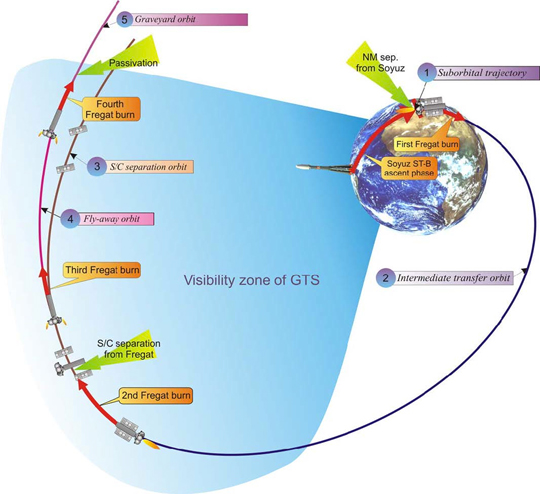
    The two Galileo satellites were launched by Soyuz from French Guiana on 21 October. Three hours and 49 minutes after launch, their Fregat-MT upper stage carried them into their planned 23 222 km orbit, where they were released simultaneously.

  • GLONASS Modernization

    By Yuri Urlichich, Valery Subbotin, Grigory Stupak, Vyacheslav Dvorkin, Alexander Povalyaev, Sergey Karutin, and Rudolf Bakitko, Russian Space Systems

    The GLONASS-K satellite, transmitting a CDMA signal in the L3 band, inaugurates a new era of radionavigation signals for both the Russian system and for international GNSS interoperability. As demand for high-precision services through dual- or triple-frequency user equipment increases, GLONASS will come to the forefront. The 2014 GLONASS-K2 satellite will have an FDMA signal in the L1 and L2 bands and CDMA signals in L1, L2, and L3. The overall constellation update will be completed in 2021. Another 2014 launch will fill the Russian SBAS orbit constellation with three geostationary space vehicles.
    Glonass-M-W
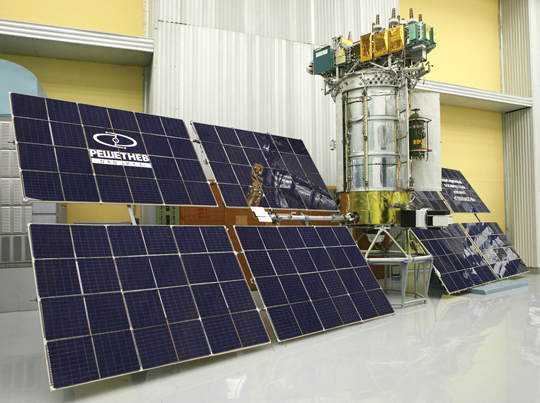
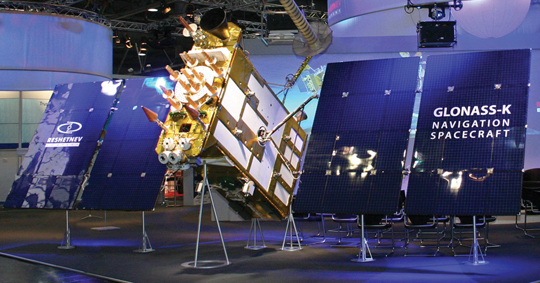
    GLONASS-M satellite. (Photos courtesy of Roscosmos and Information Satellite Systems Reshetnev Company)
    Glonass-K-W
    GLONASS-K satellite. (Photos courtesy of Roscosmos and Information Satellite Systems Reshetnev Company).

    With the February launch of the first GLONASS-K satellite, and its transmission of a new CDMA signal in the L3 band, a new era of radionavigation signals has begun: international GNSS interoperability. As we have seen rapidly growing demand for high-precision services provided with dual- or triple-frequency user equipment, introduction of new GLONASS signals in the L1 and L2 bands will come next. The first launch of GLONASS-K2 satellite, with FDMA signals in L1 and L2 bands and CDMA signals in L1, L2, and L3, is planned in 2014. A complete update of the full orbiting constellation will conclude in 2021.

    One satellite per year of the Luch family will be launched into orbit over the next three years, and by 2014 the System of Differential Correction and Monitoring (SDCM) constellation will be in operation with three geostationary space vehicles.

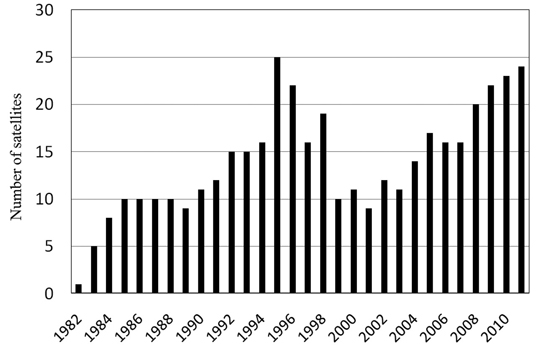
    Constellation Status. In spite of the unsuccessful launch of three satellites at the end of 2010, currently GLONASS is fully deployed again with 23 satellites set healthy to the user, and more in orbiting reserve. Figure 1 shows the evolution of the constellation since its first launch in 1982. The number of satellites used for service provision is calculated at the end of each year. In order to avoid dramatic situation in 1996–2000, when satellite numbers fell, the system now carries both an on-orbit and a ground reserve of space vehciles. This will help avoid service and availability gaps that could be created by satellite failure.

    Karutin-1-W Source: Yuri Urlichich, Valery Subbotin, Grigory Stupak, Vyacheslav Dvorkin, Alexander Povalyaev, Sergey Karutin, and Rudolf Bakitko, Russian Space Systems
    Figure 1. GLONASS constellation development.

    GLONASS-M. The current constellation consists largely of GLONASS-M satellites, the first generation of GLONASS space vehicles, with characteristics of:

    • FDMA сivil signals in L1 (1.6 GHz) and L2 (1.25 GHz) bands, with increased transmitting power;
    • intersatellite link both inside one plane and between planes with ranging and communication capabilities;
    • relative daily frequency stability of the cesium onboard synchronizer of 5 × 10–14;
    • increased orientation accuracy of solar panels;
    • guaranteed active lifetime of seven years.

    New satellites can be launched into orbit either as a part of multiple launch consisting of three satellites on the launch vehicle Proton with booster Breeze-M from the Baikonur spaceport, or on the launch vehicle Soyuz with Fregat booster from Plesetsk.

    GLONASS-M is the last GLONASS satellite with its payload in a sealed container. This container provides the high-temperature stability for the onboard clocks. The GLONASS-M power-supply system includes nickel-hydrogen batteries and silicon solar arrays of 30 square meters, providing 1,400 W for onboard systems.

    GLONASS-K. Currently, on-orbit flight tests of the new GLONASS-K satellite (OPENING PHOTO) are under way. The first satellite in the GLONASS-K family, it has a payload located in open space and an active lifespan of 10 years. The forming and transmitting functions of navigation and inter-satellite signals are united in one module in order to increase synchronization accuracy. Besides broadcasting radionavigation signals in three bands, this satellite carries the transponder of the search-and-rescue system COSPAS-SARSAT. The overall weight of the satellite is less than 1,000 kilograms, and about 30 percent of this is the payload weight. The power-supply system generates about two times more energy than the same GLONASS-M system.

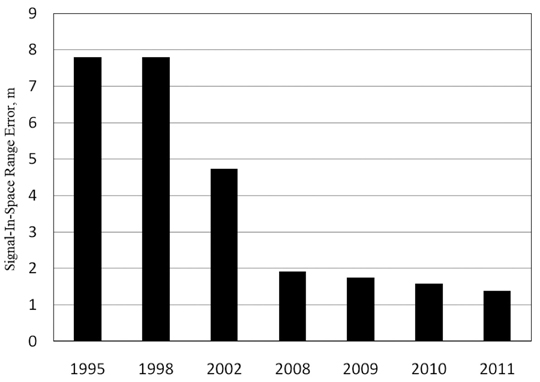
    At the same time, ground-control facilities modernization and implementation of new inter-satellite measurement technology has enabled system operators to effectively increase the accuracy of broadcast ephemeris and clocks. Currently the signal-in-space range error (SISRE) equals 1.37 m (Figure 2). Further increases in accuracy will be carried out through the modernization of satellite-control technologies and development of a global network of measuring tools.

     Figure 2. GLONASS signal-in-space range-error improvement. Source: Yuri Urlichich, Valery Subbotin, Grigory Stupak, Vyacheslav Dvorkin, Alexander Povalyaev, Sergey Karutin, and Rudolf Bakitko, Russian Space Systems
    Figure 2. GLONASS signal-in-space range-error improvement.

    Navigation Signals

    Since February 2011, GLONASS-K has been transmitting the first CDMA navigation signal in L3 band coherently with existing L1 and L2 signals. This was a first step in a new navigation signal development strategy. Future steps of GLONASS CDMA navigation signal development will focus on L1 and L2 bands. In order to design user-friendly signals, the following assumptions have been taken into account:

    • GLONASS coherent FDMA and CDMA navigation signal sets should satisfy a wide range of user requirements, from ordinary navigation to high-precision applications;
    • Signals should be within the bands allocated for GLONASS by the International Telecommunications Union (ITU);
    • Low spectral density of signal power in radio astronomical band of 1610.6-1613.8 MHz;
    • Compatibility with other GNSSs;
    • Interoperability with other GNSSs.

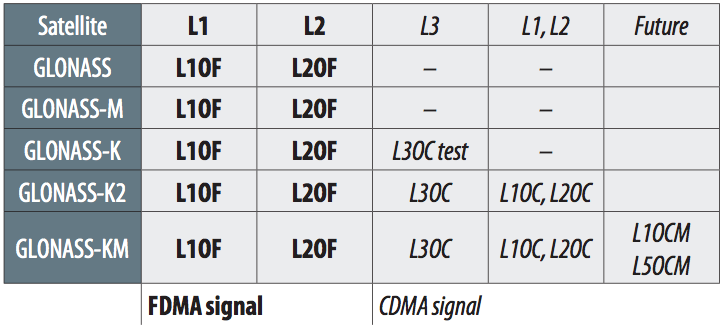
    The plans for signal development with GLONASS code division are presented in Table 1.

     Table 1. FDMA (in bold type) and CDMA (in slant type) signals in current and future GLONASS satellite generations. Source: Yuri Urlichich, Valery Subbotin, Grigory Stupak, Vyacheslav Dvorkin, Alexander Povalyaev, Sergey Karutin, and Rudolf Bakitko, Russian Space Systems
    Table 1. FDMA (in bold type) and CDMA (in slant type) signals in current and future GLONASS satellite generations.

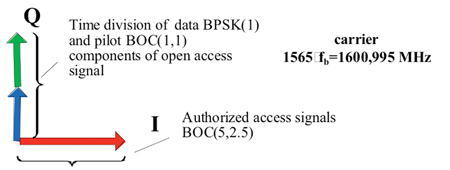
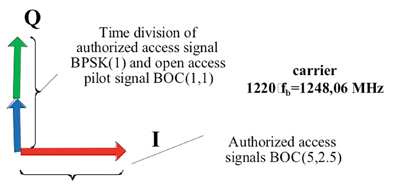
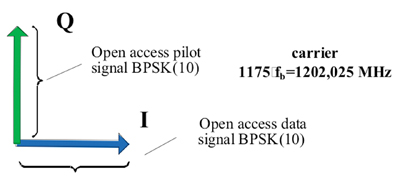
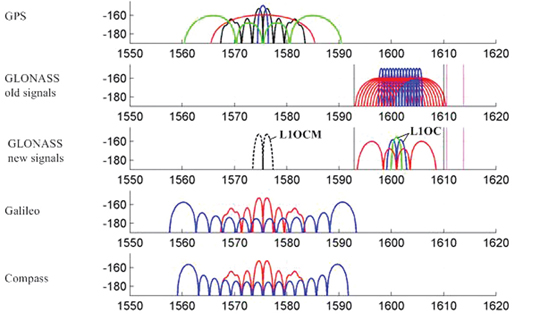
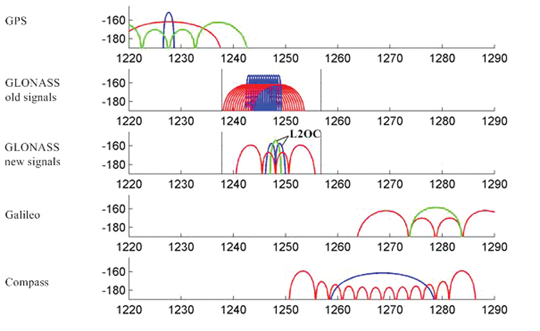
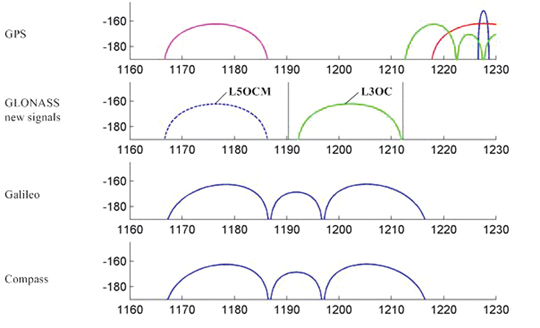
    Figures 3–8 show the proposed structures of GLONASS CDMA signals and also the spectrums of these signals in the context of the other GNSS signal spectrums.

     Figure 3. GLONASS L1 CDMA signal. Source: Yuri Urlichich, Valery Subbotin, Grigory Stupak, Vyacheslav Dvorkin, Alexander Povalyaev, Sergey Karutin, and Rudolf Bakitko, Russian Space Systems
    Figure 3. GLONASS L1 CDMA signal.
     Figure 4. GLONASS L2 CDMA signal. Source: Yuri Urlichich, Valery Subbotin, Grigory Stupak, Vyacheslav Dvorkin, Alexander Povalyaev, Sergey Karutin, and Rudolf Bakitko, Russian Space Systems
    Figure 4. GLONASS L2 CDMA signal.
     Figure 5. GLONASS L3 CDMA signal. Source: Yuri Urlichich, Valery Subbotin, Grigory Stupak, Vyacheslav Dvorkin, Alexander Povalyaev, Sergey Karutin, and Rudolf Bakitko, Russian Space Systems
    Figure 5. GLONASS L3 CDMA signal.
     Figure 6. L1 band. Source: Yuri Urlichich, Valery Subbotin, Grigory Stupak, Vyacheslav Dvorkin, Alexander Povalyaev, Sergey Karutin, and Rudolf Bakitko, Russian Space Systems
    Figure 6. L1 band.
     Figure 7. L2 band. Source: Yuri Urlichich, Valery Subbotin, Grigory Stupak, Vyacheslav Dvorkin, Alexander Povalyaev, Sergey Karutin, and Rudolf Bakitko, Russian Space Systems
    Figure 7. L2 band.
     Figure 8. L3 band. Source: Yuri Urlichich, Valery Subbotin, Grigory Stupak, Vyacheslav Dvorkin, Alexander Povalyaev, Sergey Karutin, and Rudolf Bakitko, Russian Space Systems
    Figure 8. L3 band.

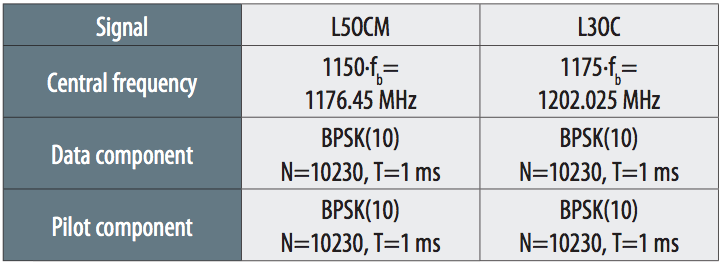
    Due to the growing use of GNSS signals in L3/L5 band, the future GLONASS navigation family will include two signals in this band. Table 2 contains some parameters of these new signals in this band.

    Table 2. Table: Yuri Urlichich, Valery Subbotin, Grigory Stupak, Vyacheslav Dvorkin, Alexander Povalyaev, Sergey Karutin, and Rudolf Bakitko, Russian Space Systems
    Table 2.

    GLONASS Augmentation Development

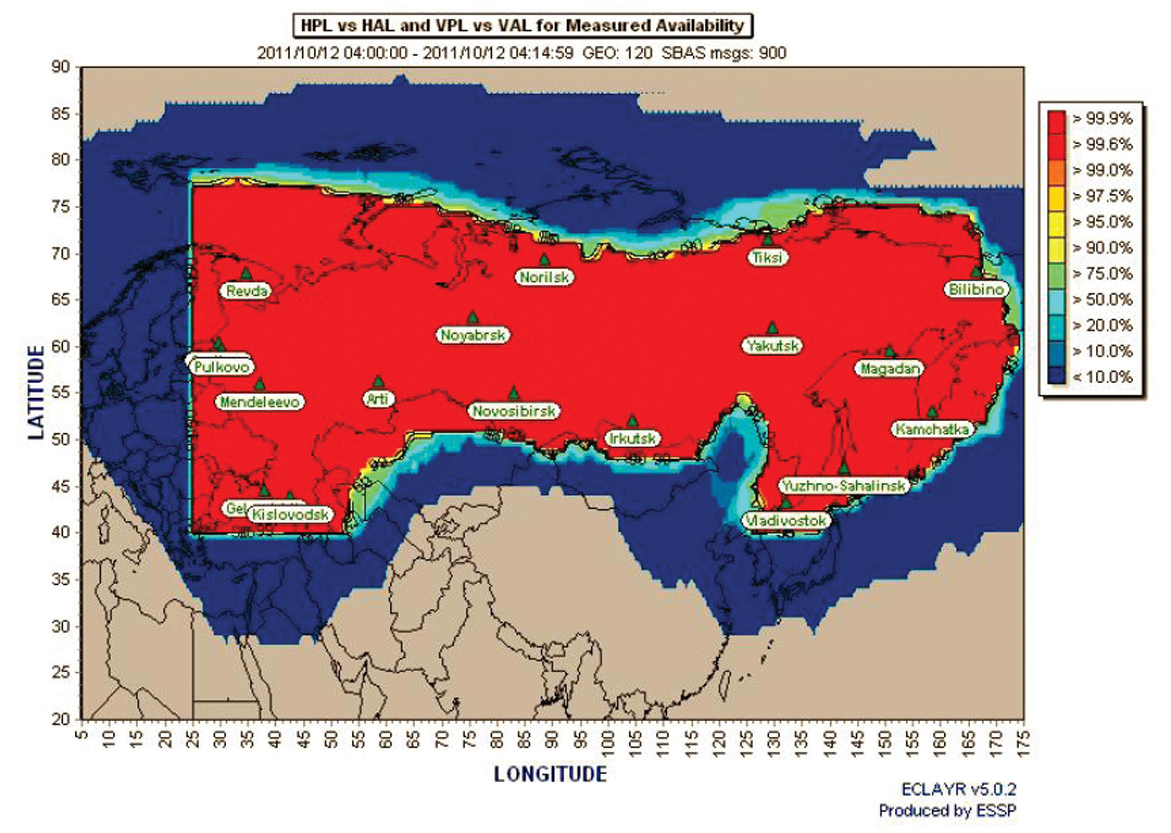
    SDCM development is now entering its deployment and completion phase. The network of reference stations is almost completely established. It enables the global integrity monitoring of radio navigation signals of both GLONASS and GPS satellites, gathering raw measurements of pseudorange and carrier phase in L1, L2, and L3/L5 bands. Based on these measurements, the SDCM central processing facility calculates orbits and clock corrections, and formulates SBAS messages. Preliminary results of SDCM service-quality estimation, based on corrections calculated using existing stations network, are shown in Figure 10.

     Figure 10. SDCM horizontal protection Level (HPL) versus horizontal alert limit (HAL). Image updated April 16, 2012. Source: Yuri Urlichich, Valery Subbotin, Grigory Stupak, Vyacheslav Dvorkin, Alexander Povalyaev, Sergey Karutin, and Rudolf Bakitko, Russian Space Systems
    Figure 10. SDCM horizontal protection Level (HPL) versus horizontal alert limit (HAL). Image updated April 16, 2012.

    The last quarter of 2011 will see the launch of space vehicle (SV) Luch-5А, carrying an SDCM transponder. Initially, this SV will be put for testing on geostationary orbit at 55 degrees East, and then will be relocated to 16 degrees West. The onboard transponder will broadcast radio signals on 1575.42 MHz. Taking into account that the main SDCM coverage area is in the northern hemisphere, the SV antenna beam will be deviated from the Equator by 7 degrees to the north.

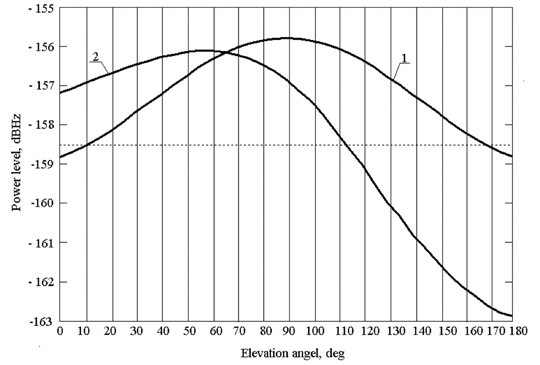
    Due to this deviation of the gain pattern from traditional orientation to the Equator, the Earth surface power distribution diagram is changed. Figure 11 presents two variants. The first one is a case in which the transmission antenna is directed on the Equator (curve 1) and the second one is a case when antenna is deviated by 7 degrees to the north from equator (curve 2). In the latter case, we obtain an increase of signal strength to the users for which this SV is under small elevation angles, that is, for the users in the northern areas of the Russian Federation.

    Kartin-figure10 Source: Yuri Urlichich, Valery Subbotin, Grigory Stupak, Vyacheslav Dvorkin, Alexander Povalyaev, Sergey Karutin, and Rudolf Bakitko, Russian Space Systems
    Figure 11. SDCM minimum user-received signal levels: (1) antenna pointing to the equator; (2) antenna deviated by 7º to the north.

    Further SDCM development is predicated upon the launch of two Luch satellites, in the first half of 2012 and in 2013, respectively. Also in the plans is the design of a new Luch-4 satellite with dual-frequency navigation transponder, for a 2014 launch, completing the satellite-based augmentation system.

    Conclusion

    GLONASS system replenishment has almost finished, and the system enters a new historical phase. New CDMA navigation signals and deployment of a national SBAS system will provide not only a significant quality improvement of GLONASS navigation services, but also will create the favorable prerequisite for the development of applied navigation technologies in the territory of the Russian Federation, and also in Europe, the Middle East, and the Far East.


    Yuri Urlichich is a general director-general designer of Joint Stock Company (JSC) Russian Space Systems, GLONASS general designer, doctor of science, professor, author of more than 150 papers and holder of 20 patents.

    Valery Subbotin is a first deputy general director–general designer of JSC Russian Space Systems, and doctor of science. He has been working in the space industry for more than 40 years and has published more than 50 papers.GRigory Stupak is a deputy general director–general designer of JSC Russian Space Systems, deputy general designer of GLONASS, and professor at the Bauman Moscow State Technical University (BMSTU). He has worked in the space industry more than 35 years and has published more than 150 papers.

    Vyacheslav Dvorkin is a deputy general designer of JSC Russian Space Systems”and doctor of science. He has been developing GLONASS, GNSS augmentations and user equipment for more than 35 years. He has written 50 papers in the satellite navigation field.

    Alexander Povalyaev is a deputy head of division in JSC Russian Space Systems and professor at the Moscow Aviation Institute. He has been developing methods and algorithms for GNSS carrier-phase measurements processing for more than 30 years and has more than 40 papers in satellite navigation field.

    Sergey Karutin is deputy head of division in JSC Russian Space Systems and assistant professor at the BMSTU. He has a Ph.D. and has been working on the GLONASS team since 1998, developing GNSS augmentations and user equipment.

    Rudolf BAKITKO is a department head in JSC Russian Space Systems and a GLONASS navigation payload designer. Rudolf developed on-board equipment for space vehicles Luna, Mars, Venus, GLONASS, and COSPAS-SARSAT, and has more than 50 papers and 10 patents.

  • Expert Advice: Realizing Europe’s SatNav Ambitions

    Exp-Adv-NovBy Axelle Pomies and Gard Ueland

    The 21st century today faces and will continue to encounter many new societal challenges, all mutually interdependent: health, environment, agriculture, ageing population, personal security, public and civil protection, safe and efficient transport and mobility, citizen rescue, land management, energy (supply, security, and efficiency), full employment, new consumer services, high-tech industry, business security, connectivity, globalization, intellectual property management and protection.

    All these challenges have a common denominator: the economic health of Europe: growth, competitiveness, and job creation. Along these lines, the European Union (EU) created the Europe 2020 strategy for smart, sustainable, and inclusive growth. Its goal is to achieve growth by “developing an economy based on knowledge and innovation, promoting a more resource-efficient, greener, and more competitive economy, fostering a high-employment economy delivering social and territorial cohesion.”

    The role of European institutions in the growth process is especially decisive at a time when all organizations struggle to borrow, spend, and invest in the current economic situation. The need to stimulate the economy and to ensure competitiveness and return on investment in Europe is more important than ever. Among the growth-enhancing items identified in the EU2020 strategy, research and development (R&D) and innovation are part of the top priorities: “3 percent of the EU’s gross domestic product (GDP) should be invested in R&D” is one of five top EU targets. The European Commission also put forward the Innovation Union concept initiative “to improve framework conditions and access to finance for research and innovation so as to ensure that innovative ideas can be turned into products and services that create growth and jobs.”

    Given EU budgetary restrictions, as stated in the EU2020 strategy, the financial framework must be “devised to maximize impact, ensure efficiency, and EU value-added.” This is why the EU budget must be carefully invested in research and innovation areas that both have strong growth potential and satisfy Europe’s political, societal, and economic interests.

    The domain of satellite navigation applications, rapidly becoming a pillar of 21st-century society, offers a splendid opportunity among the most promising ones!

    Key GNSS Applications

    • Transport. Increased safety and efficiency for aviation, maritime and inland waterways, rail, road transport, and more.
    • Environmental protection. Support to environmental driving, car parking, waste control, low-cost sensors for landscape monitoring, resource monitoring. and land administration through surveying and mapping…
    • Health. Tracking and tracing of medical goods, assistance to elderly and disabled people.
    • Agriculture. Precision agriculture, livestock management…
    • Mobility. Navigation, road tolling and charging, location-based services, multi-modal transport services…
    • Security and Safety. Pay-as-you-drive insurance, law enforcement, protection of intellectual property rights, secure asset and personal tracking, unmanned vehicles, integration of GNSS, satellite communications, and global monitoring for environment and security, customs and freight monitoring…
    • Timing and Networks. Synchronization of smart grids, telecommunications, banking, and digital video broadcast networks…

    Public Funding Requirement

    EU public funding is necessary for Europe to attain excellence, compete in a global market, and expect future commercial and societal benefits.

    GNSS positioning, navigation, and timing technology is fast becoming a mature commodity, but major improvements are still required. Without EU public support, such as the Framework Programs for R&D, GNSS development will continue to follow a purely economic approach from industry, that is, maximizing return on investment rather than seeking to innovate technology. Industries will naturally look to combine commercial off-the-shelf sensors and functions, with minimal effort on R&D, rather than improving GNSS technology’s ability to meet evolving needs.

    This approach jeopardizes both European excellence in the GNSS field and the future take-up of European GNSS infrastructure.

    Foster Knowledge, Create Jobs. There is a compelling need to foster European knowledge and capability to reach excellence in the GNSS field, in order to maximize competitiveness, growth, and job creation in Europe. The purely commercial approach will continue to place the U.S. GPS as a standard; this constitutes a major risk for Galileo and for the EU economy as a whole, as it would continue to rely on a GNSS service over which it has no control.

    Therefore, EU public funding, through such initiatives as framework programs (FPs), competitiveness and innovation programs, and Horizon 2020, is essential to ensure the use of European infrastructures and the generation of benefits for Europe. This will give the means to the EU industry to get a better share of the global GNSS downstream market.

    It is a question of business, growth, employment, and return of EU investment in the European GNSS programs. As an example, most non-aviation applications of the European Geostationary Navigation Overlay Service (EGNOS) infrastructure exist solely from the stimulation of FP6 and FP7 projects.

    Finally, the cycle of EU public funding — which creates projects that link people not used to working together, to stimulate creativity and foster innovation — also must be underlined. Through these programs, small-to-medium enterprises (SMEs), large companies, academia, and research institutes from EU countries and beyond can meet and work together. To link people and brains and stimulate creativity is a perfect springboard for new ideas and market opportunities.

    We emphasize at this point the huge risk of the absence of FP7 GNSS applications R&D budget until 2014 — the dedicated FP7 budget being exhausted due to extensive cuts, leaving only ϵ100 million in the GNSS FP7 budget line, instead of the ϵ350 million granted at the outset. A lack of public support for R&D effort would significantly limit the potential of innovation and growth as well as European ambitions in GNSS.

    The European Parliament Resolution of June 7, 2011, on “Transport applications of Global Navigation Satellite Systems: Short- and Medium-term EU Policy” revives hope among European downstream research and innovation actors. Among other things, Parliament calls on the European Commission (EC) “to ensure that the ϵ100 million likely to be underspent in payment appropriation for research within the 7th FP is made available for the development of GNSS applications.”

    Applications a Promising Market

    GNSS-based positioning/timing technologies and services must be part of the long-term growth priorities of the European Union. As part of the solution to the next generation of challenges, GNSS technology can contribute significantly to all major EU policies.

    GNSS applications and services development can bring immediate benefits — creation of new industrial activities and hundreds of thousands of jobs — and enhance daily life and well-being of Europe’s citizens; the core vocation of GNSS applications is fully in line with the Lisbon Treaty.

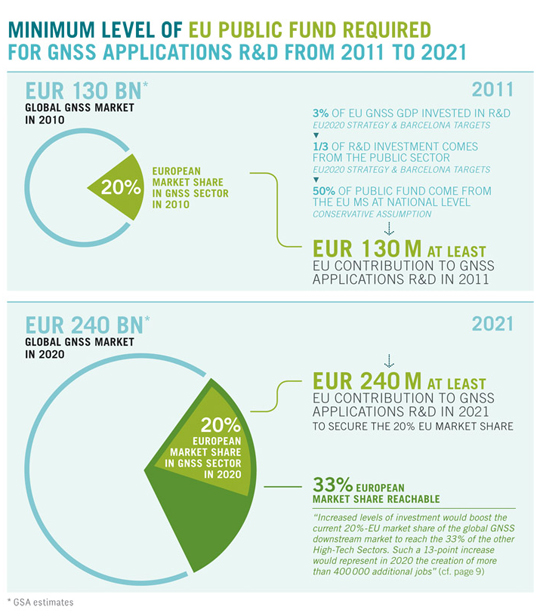
    Further, GNSS applications and services constitute one of the most promising sectors for European growth. The global GNSS market amounted to around ϵ130 billion in 2010 and is expected to reach ϵ240 billion by 2020. This corresponds to a sustained growth rate of more than 11 percent per year.

    EU public funds invested in GNSS applications R&D would catalyze growth, enabling market development and maximizing the efficiency of EU budget. With only a small part of its budget dedicated to GNSS applications R&D, the EU would see both an important and decisive impact on the GNSS market and a snowball effect, seminating further applications and domains with GNSS technology.

    The 2010 FP7 budget for GNSS R&D was ϵ30.5 million. Assuming that EU27 member states made similar contributions at the national level and that two-thirds of GNSS R&D investments come from the private sector, the total EU investment in GNSS applications R&D totalled ϵ180 million in 2010.

    Since the EU GDP of GNSS applications and services amounted to around ϵ26 billion in 2010, the rate of GNSS GDP to investment in applications R&D’ corresponds to a factor more than 100. In other words, ϵ1 invested by in GNSS application R&D generates about ϵ100 of revenue.

    The Need for Dramatic Increase

    As stressed in the EU2020 strategy, “R&D spending in Europe is below 2 percent [of GDP], compared to 2.6 percent in the United States and 3.4 percent in Japan.” The Barcelona EU goals specify that R&D financing should be shared between public (one-third) and private sectors (two-thirds).
    In 2011, EU public investment in GNSS applications R&D is expected to be 0.1 percent of EU GNSS GDP — well below the required threshold. If the R&D budget is not restored, this rate will come very close to zero until 2014.

    In the Barcelona and Europe 2020 goals, the level of EU contribution to GNSS applications R&D investments can be computed (Figure 1). Ensuring EU benefits would require annual public support to GNSS applications research rising from ϵ100 million in 2011 to ϵ200 million in 2021.

    Schema_HD
    Figure 1. Minimum level of EU public funding required for GNSS applications R&D from 2011 to 2021.

    Increased investment would enable Europe to boost its current 20 percent market share to reach the 33 percent share that Europe enjoys in other high-tech sectors. This would mean creation of more than 400,000 new jobs in 2020.

    Contrary to the United States, China, and Russia, the EU lacks a large military applications R&D program, which elsewhere helps support industry investments in commercial and civil applications. Given European investments in other sectors and investment of other countries in GNSS application R&D, a level of EU public investment between ϵ100 million and ϵ200 million per year is essential.

    Horizon 2020

    Galileo Services makes the following recommendations for the EU program Horizon 2020.

    GNSS technologies and services.

    • Support European industry in investing and developing critical technologies, applications, and services based on end-user requirements: security, reliability, robustness, and high performance;
    • Pursue research to improve GNSS performance, mainly multi-constellation multi-sensor receivers;
    • Encourage innovative ideas, whatever the domain may be, through very open calls for proposals.

    Market penetration and development.

    • Adequate value-added content (such ashigh-precision or indoor digital maps) to leverage application development;
    • Market analyses and business cases, with a focus on new uses of GNSS;
    • Promotion and awareness activities;
    • Standardization in relevant domains;
    • A certification process for safety- and security-critical applications;
    • Demonstrations and pilot projects, focusing on implementation of GNSS solutions tightly integrated in the user workflow, involving all value chain actors;
    • Use of large European companies  — industry locomotives — and SMEs’ innovative capability to penetrate markets and spin off new business opportunities;
    • International cooperation established by: favoring EU industry interests within bilateral discussions between EU and non-EU countries, involving non-EU partners only if providing opportunities for market penetration beyond EU boundaries or specific skills and/or technology not available in Europe, and setting up adequate intellectual protection rights (IPR) policy.

    Other support.

    • Expectations of significant public-sector funding and regulations will stimulate private GNSS investment. Such tools are widely exploited in America, Russia, and Asia;
    • Regional and national procurement plans would benefit from coordination at the EU level;
    • A close dialogue has been established between European institutions and GNSS downstream industry, represented by Galileo Services, in recent years. In this framework, crucial issues such as licensing rules, IPR policy, and international cooperation can be discussed. This initiative must be pursued and even reinforced.

    Galileo Services is a non-profit organization founded in 2002 as a major partner for the Galileo program and GNSS application development. Although Galileo is a key area of interest for Galileo Services, the association focuses on all types of PNT systems such as GPS, GLONASS, Galileo, EGNOS, WAAS, and so on. Having merged with OREGIN (the Organization of European GNSS Industry of equipment and services) in 2009, Galileo Services network represents more than 180 member organizations from Europe, North America, and Asia, ranging from SMEs to large companies. Gard Ueland is president of Galileo Services, and Axelle Pomies is its permanent representative.

  • The System: Galileo IOV Satellites Now in Orbit

    The first two satellites for Europe’s Galileo global navigation satellite system were lofted into orbit October 21 by the first Russian Soyuz vehicle ever launched from Europe’s Spaceport in French Guiana in a milestone mission, reports the European Space Agency (ESA).

    The launch occurred one day after initially scheduled to resolve a problem with the ground-support fueling system.

    The Soyuz VS01 flight, operated by Arianespace, started with liftoff from the new launch complex in French Guiana at 10:30 UTC on October 21. All of the Soyuz stages performed as expected and the Fregat-MT upper stage released the Galileo satellites into their target orbit at 23,222 kilometers altitude, 3 hours 49 minutes after liftoff.

    The two Galileo satellites are part of the In-Orbit Validation (IOV) phase that will see the Galileo system’s space, ground, and user segments extensively tested. During initial operations, the satellites will be controlled by a joint ESA and CNES French space agency team in Toulouse, France. Once that week-long phase ends, the satellites will be handed over to the Ober-pfaffenhofen Galileo Control Centre near Munich, operated by the DLR German Aerospace Center, which will be responsible for routine operations. Operating the satellite payloads to provide navigation services will be the task of the Fucino Control Centre, near Rome, operated by Telespazio.

    The next two Galileo satellites, completing the IOV quartet, are scheduled for launch in summer 2012. Together, alll four are intended to prove the design of the Galileo system in advance of the other 26 satellites.

    These first four satellites, built by a consortium led by EADS Astrium Germany, will form the operational nucleus of the full Galileo satnav constellation. According to ESA, the satellites combine the best atomic clock ever flown for navigation — accurate to one second in three million years — with a powerful transmitter to broadcast precise navigation data worldwide.


    Artist’s depiction of a Galileo satellites being ejected from the dispenser.

    Second IIF Good Now

    The second GPS Block IIF satellite, SVN63/PRN01, launched in mid-July, was finally set healthy on October 14. The delay in bringing the satellite into service was due, in part, to extended testing of the cesium atomic frequency standard (AFS) on the satellite.
    GPS IIF satellites carry three AFSs: one cesium and two rubidiums. The performance of the cesium AFS, independently confirmed, was poor. A switch to one of the rubidium AFSs took place on October 5.

    U.S. Agencies Speak Out on LightSquared; Others Hide Their Cards

    The U.S. House of Representatives Committee on Science, Space, and Technology has released some of the impact statements provided by federal agencies to the National Telecommunications and Information Administration (NTIA). The reports reveal deep concerns about and opposition to the LightSquared proposal, and detail cost estimates and other adverse impacts to government-wide operations should it go forward.

    The NTIA itself has refused to make these agency reports public, rebuffing a Freedom of Information Act (FOIA) request by GPS World magazine and, so far, giving the same response to congressional committees on both the House and Senate side.

    Missing in Action. The House Committee does not yet have access to all the agency statements; still missing are those from:

    • the Department of Homeland Security,
    • the Department of Commerce,
    • the National Oceanic and Atmospheric Administration,
    • the National Institutes of Standards and Technology.

    The House committee has written to those departments asking for their reports; GPS World has also filed further FOIA requests specifically with those agencies. The Department of Defense impact statement is presumed to be classified.

    Seventy-Two Billion. The Federal Aviation Administration (FAA) impact statement is the strongest statement of those provided so far to the House committee. It asserts, among many other findings, that the LightSquared proposal would cost the aviation community at least $72 billion, preclude elimination/reduction of an estimated 794 air-traffic fatalities over the next 10 years, set back planned air-traffic safety and efficiency measures by that same period, affect U.S. leadership in aviation, and damage the international market for U.S. satellite technology.

    “FAA cannot conclude that operations using just the lower portion of the spectrum are compatible with civil aircraft receivers without definition of LightSquared’s end-state deployment and further study,” the FAA said. “Proposed LightSquared deployment (both upper and lower channels by 2014) would result in an estimated aviation community cost impact of at least $72 billion and delay NextGen implementation by approximately 10 years.

    “Proposed LightSquared operations would severely impact the efficiency and modernization of the safest, most efficient aerospace system in the world.”

    Not Feasible. The National Aeronautics and Space Administration stated, in part:

    “NASA feels that due to the severity of the operational impacts, to both government and commercial users, it is conclusive that LightSquared’s implementation on the upper 10-MHz is not feasible in the near or long-term.”

    Constellation Updates from ION-GNSS

    During the Civil GPS Service Interface Committee (CGSIC) meeting held in conjunction with the ION GNSS 2011 conference in September, several presentations were given on the status and future of the global navigation satellite systems. Here are highlights, with updated information from elsewhere:

    GPS. As of today, 30 satellites are in operation and set healthy. SVN27/PRN27, a Block IIA satellite launched in 1992, was decommissioned on August 10, 2011. The satellite has been removed from broadcast almanacs but continues to transmit L-band signals, presumably for end-of-life testing.

    SVN35 returned to active service, once again, this time as PRN30, on August 16, to replace SVN30/PRN30, which was decommissioned from active service on July 20. SVN35 is being moved to the B1-F slot, previously occupied by SVN30.

    There are currently four backup or residual satellites: SVNs 30, 32, 37, and 49. SVN30 is deemed no longer usable and there are plans to dispose of it.

    SVN24/PRN24, a Block IIA satellite launched in 1991 and the second oldest active GPS satellite, reportedly experienced a reaction wheel failure on September 30. It has stopped broadcasting L-band signals.

    GLONASS. Currently, 23 GLONASS satellites transmit usable L-band signals; 22 are set healthy. The first GLONASS-K1 satellite is still undergoing flight tests and is set unhealthy. According to Sergey Revnivykh, deputy director general, Central Research Institute of Machine Building of the Russian Federal Space Agency, the satellite will likely not be set healthy for users in the near future, not even for just the legacy FDMA signals. It will be considered a backup satellite that could be pressed into service if necessary. This decision was taken based on the fact that five GLONASS-M satellites are scheduled to launch this fall — indeed, one did so on October 2 — and they should be adequate to maintain a healthy 24-satellite constellation for some time. The current GLONASS signal specification cannot handle more than 24 operational satellites.

    CDMA signals will be available to users from in-orbit GLONASS-K satellites by 2014.


    QZSS. The Japanese press reported that a government ministerial council consisting of the entire cabinet and headed by Prime Minister Yoshihiko Noda has taken the decision to expand the Quasi-Zenith Satellite System to seven satellites and will seek 4.1 billion yen (about $53 million) in the fiscal 2012 national budget to start the process. According to Hiroshi Nishiguchi of the Japan GPS Council, QZSS has a top priority in the budget.
    The future QZSS constellation structure is still under design. Nishiguchi stated that the constellation could involve a mixture of inclined geosynchronous orbit (IGSO) and geostationary Earth orbit (GEO) satellites. For a seven-satellite constellation, options include three IGSOs + four GEOs, or four IGSOs + three GEOs, or five IGSOs + two GEOs. He said that hopefully the funding and the future constellation structure will be known by the end of the year.

    Beidou-2/Compass. A special Compass workshop (see also the October issue of GPS World) stated that there are nine Compass satellites “in service.” But that may not be correct. While nine Beidou-2 or Compass satellites have been launched, Beidou G2, the first GEO to be launched, appears to be uncontrollable and is in a librating orbit. Some reports, perhaps overly optimistic, claim this satellite is undergoing “in-orbit maintenance.”

    The last IGSO satellite to be launched, Beidou IGSO4, may not be in service yet. One workshop presenter indicated that the currently used constellation consists of three GEOs and three IGSO satellites. It seems that the medium Earth orbit (MEO) satellite, Beidou M1, is not considered useful for actual applications at the present time. It was also stated that this satellite is undergoing “in-orbit maintenance.”’

    Two more Beidou-2/Compass satellites are to be launched in 2011 and five satellites are to be launched in 2012 to bring the number of operational satellites to 14 by the end of 2012: five GEOs, five IGSOs, and four MEOs. This is a sufficient number of satellites to provide the planned regional Phase II service. A 30-satellite global service, expected by 2020, will reportedly use three GEOs, three IGSOs, and 24 MEOs.

    Beidou-2/Compass will also offer a 1-meter level differential service.

    A Beidou-2/Compass Interface Control Document (ICD) is to be published this month. As of press time for this magazine, it had not yet appeared.

    — Richard B. Langley

  • Galileo IOV Satellites Succesfully Launched into Orbit

    21102011-_SCO3184-W

    The first pair of satellites for Europe’s Galileo global navigation satellite system has been lofted into orbit by the first Russian Soyuz vehicle ever launched from Europe’s Spaceport in French Guiana in a milestone mission, reports the European Space Agency.

    The launch occurred one day after initially scheduled to resolve a problem with the ground-support fueling system.

    The Soyuz VS01 flight, operated by Arianespace, started with liftoff from the new launch complex in French Guiana at 10:30 GMT on October 21. All of the Soyuz stages performed as expected and the Fregat-MT upper stage released the Galileo satellites into their target orbit at 23,222 km altitude, 3 hours 49 minutes after liftoff. A launch replay is available. A look inside the IOV satellite is available on the BBC website.

    The two Galileo satellites riding the Soyuz are part of the In-Orbit Validation (IOV) phase that will see the Galileo system’s space, ground and user segments extensively tested. The satellites are now being controlled by a joint ESA and CNES French space agency team in Toulouse, France. After these initial operations, they will be handed over to SpaceOpal, a joint company of the DLR German Aerospace Center and Italy’s Telespazio, to undergo 90 days of testing before being commissioned for the IOV phase.

    The next two Galileo satellites, completing the IOV quartet, are scheduled for launch in summer 2012.

    “This launch represents a lot for Europe: we have placed in orbit the first two satellites of Galileo, a system that will position our continent as a world-class player in the strategic domain of satellite navigation, a domain with huge economic perspectives,” said Jean-Jacques Dordain, director General of ESA.  “Moreover, this historic first launch of a genuine European system like Galileo was performed by the legendary Russian launcher that was used for Sputnik and Yuri Gagarin, a launcher that will, from now on, lift off from Europe’s Spaceport.

    “These two historical events are also symbols of cooperation: cooperation between ESA and Russia, with a strong essential contribution of France; and cooperation between ESA and the European Union, in a joint initiative with the EU. This launch consolidates Europe’s pivotal role in space cooperation at the global level. All that has been possible thanks to the vision and commitment of ESA member states.”

    This was also the first Soyuz to be launched from a site outside of Baikonur in Kazakhstan or Plesetsk in Russia. A new site for Soyuz in French Guiana, operated by Arianespace, adds to the flexibility and competitiveness of Europe’s fleet of launchers.

    Soyuz is a medium-size vehicle, complementing ESA’s launchers: Ariane 5 handles large payloads, and the new Vega, planned to debut in 2012, will lift smaller satellites.

    Launching from close to the equator allows the European Soyuz to offer improved performance. From French Guiana, Soyuz can carry up to 3 tonnes into the ‘geostationary transfer orbit’ typically required by commercial telecommunications satellites, compared to the 1.7 tonnes that can be delivered from Baikonur.

    Source: GPS world staff
    The launch profile of the Galileo IOV satellites.


  • Galileo Launch Scrubbed; Possible on Friday

    UPDATE: Following the work performed on the Soyuz launch facility and the associated additional checks, Arianespace has decided to restart the countdown operations for the launch VS01, Soyuz STB – Galileo IOV-1. Liftoff of the Soyuz ST-B launcher is now set for Friday, October 21, at
    exactly:
    10:30:26 a.m.  (UTC) Friday, October 21
    07:30:26 a.m.  (French Guiana time)
    12:30:26 p.m.  (Paris time)
    06:30:26 a.m.  (Washington, D.C., time)
    02:30:26 p.m.  (Moscow time)


    Galileo's Soyuz awaits it's flight.

    A problem with the ground-support fueling system for the rocket carrying two Galileo in-orbit validation (IOV) satellites has delayed their launch either until Friday, October 21, or perhaps indefinitely.

    A statement from launch operator Arianespace said, “A ground support system leak during third-stage fueling of the Soyuz launcher was the cause of today’s delay for this medium-lift vehicle’s inaugural flight from French Guiana. Arianespace Chairman & CEO Jean-Yves Le Gall said the leak was in a launch pad pneumatic system that activates the pre-planned disconnection of fueling lines to Soyuz’ third stage before the vehicle lifts off."

    “During the final phase of third-stage fueling, there apparently was a change in pressure in this pneumatic system, and we observed the unplanned disconnection of the two connectors that enable the fueling of Soyuz’ third stage with liquid oxygen and kerosene,” Le Gall told reporters during a briefing at the Kourou Spaceport’s Jupiter mission control room. “The problem apparently is due to a valve leak in this pneumatic system, and we have taken the decision to empty the launcher and replace the valve.”

    Le Gall underscored that the identified anomaly is in the ground-based pneumatic system, not on the launch vehicle. Fueling of the Soyuz is performed inside the mobile service gantry, which continues to remain in place on the launch pad. The launcher and its payload of two Galileo IOV satellites are in a safe mode, as is the ELS launch site.

    Le Gall said a decision is to be made later today on whether to reschedule the liftoff for tomorrow. “We will confirm this once the valve is replaced; the decision also will take into account the launch team members — who worked all night during the original countdown.” If the launch is approved for tomorrow, October 21, the lift-off time would be four minutes earlier — at 7:30 a.m. local time.

    One scientist who is following the situation from afar commented that possibly lyrics by the rock group Queen would be appropriate for the launch watch:

    "Open your eyes. Look up to the skies and see
    Thunderbolt and lightning, very, very fright'ning me
    (Galileo) Galileo (Galileo) Galileo
    Galileo figaro – magnifico"


    Artist's depiction of a Galileo satellites being ejected from the dispenser.
     

  • Rocket to Carry First Galileo Satellites Moved to Launch Pad

    This unusual view from underneath the launch table at French Guiana highlights the nozzle clusters of Soyuz’ four first-stage boosters and its central-core second stage.


    The first Soyuz to take off from Europe’s Spaceport in French Guiana was moved to the launch pad October 14. The rocket that will carry the first two Galileo navigation satellites into orbit is on track for liftoff on October 20, reports the European Space Agency (ESA). Video of the transfer is available here.

    Launch of the first two Galileo IOV satellites is scheduled for October 20 at 10:34:28 UTC.
     
    The three-stage Soyuz ST-B was rolled out horizontally on its erector from the preparation building using the 600 m-long railway that leads to the pad. The vehicle was then raised into its launch position.
       
    Earlier this week, the two Galileo In-Orbit Validation satellites, attached to their dispenser, were mated to the Fregat-MT upper stage and then enclosed in the fairing. This ‘Upper Composite’ was also transferred October 14 and added onto the vehicle from above, completing the very first Soyuz on its launch pad at Europe’s Spaceport. The new mobile launch gantry, built specifically for the rocket’s operations in French Guiana, also protects the satellites and the vehicle from the humid tropical environment.

    The Soyuz and Upper Composite will undergo a full launch dress rehearsal in the next few days, including preparations for fuelling the vehicle, which will begin four and a half hours before liftoff.

    According to ESA, October’s launch will be doubly historic: the first Soyuz from a spaceport outside of Baikonur in Kazakhstan or Plesetsk in Russia and the start of building Europe’s Galileo satnav constellation.In 2012 the second pair of satellites will arrive in orbit, ready to prove the design of the Galileo system in advance of the other 26 satellites. This quartet of satellites, built by a consortium led by EADS Astrium Germany, will form the operational nucleus of the full Galileo constellation.

    More images and details are available at ESA’s website.

    To watch the launch live, visit one of these sites:

    European Space Agency

    European Parliament

    DLR German Aerospace Centre

    For more information:

    Special ESA IOV website

    Launch kit

    Arianespace website

  • Galileo IOV Satellites Fueled for October 20 Launch


    Dispenser check-out with upper stage.


    The first two Galileo navigation satellites are both now fueled and checked for their launch by Soyuz from French Guiana on October 20, reports the European Space Agency.
     
    The two Galileo In-Orbit Validation satellites reached Europe’s Spaceport in September. Galileo’s second flight model, FM2, touched down on September 7 on an Antonov-124, and the Galileo Protoflight Model followed it seven days later on an Ilyushin 76. Both satellites are now fueled and ready to be mated this week onto the dispenser that will hold them in place during launch before deploying them into their final 23 222 km orbit. 

    The combined payload stack — the dispenser and both satellites — will then be transported from the fueling facility to the Upper Composite Integration Facility S3B for integration with their Fregat-MT upper stage and subsequent encapsulation.

    ESA has set up a website dedicated to the launch.


    Encapsulated under fairing.