Category: Opinions

  • Augmenting reality with geospatial information

    Geographic information systems and augmented reality are a part of our daily lives, so much so, we hardly notice them. GPS World columnist William Tewelow explores how these technologies will continue to change our lives.

    Geographical information systems (GIS) and augmented reality (AR) have become a part of our daily lives, so much so that we hardly notice them. Those of us in the profession make our living by them; millions, soon billions more in the consumer world benefit from them without even realizing they are there.

    The world is filled with data. Using AR, that data can be draped in front of us in a tapestry based upon our individual needs and interests. Applications multiply daily.  Many physical tools now in use will become virtual tools; workspaces, living spaces and the commutes between them (if they even exist at all) will change almost unrecognizably.

    The world is poised to become an amazing and magical place.

    Before we jump whole hog into the future — something that AR assuredly enables us to do — a glance back at the past can fill out our understanding of these great tools, GIS and AR — each great in and of its own, but virtually invincible when combined. Come with me down the corridors of history . . .

    When Great Swords Clash

    World War II was a fight against global domination — mankind’s greatest struggle for survival. Tyranny or freedom hung in the balance. The greatest minds raced to harness the powers of nature and science, plying them towards victory. This culminated in the invention of the ultimate weapon, The Great Sword, able to lay waste entire cities and ending the Second Great War in 1945, the year the world returned to peace. Freedom reclaimed the throne, euphoria spread — but the celebration was short-lived.

    Kazakhstan. (Map: CIA archives)
    Kazakhstan. (Map: CIA archives)

    In the summer of 1949, the world split in half. In the United States, families gathered around the radio for comedy and drama before putting the children to bed, but on the other side of the world, deep in the center of a faraway, unknown land, on a cool Monday morning as the sun lazily rose over a barren terrain, a second blazing sun rose into the sky. The Soviet Union unsheathed and brandished its own Great Sword, making remote Kazakhstan the center of the world in that brief moment. The sound of the bomb was heard in Washington, D.C., and phones throughout the city rang into the night. Russian spies had stolen America’s atomic secrets. Nuclear annihilation was a reality. The Cold War had begun.

    The threat of nuclear weapons in Soviet hands was too great a risk. The United States had to know the extent of the threat. Satellites did not yet exist. Airplanes had limited capabilities. The only way to know what was going on inside the Iron Curtain was intelligence assets on the ground, but the Soviets controlled the ground.

    Play Your Aces High

    Penetrating the skies over the Soviet Union became the top priority. In 1954 Operation AQUATONE began to build the first U-2 spy plane to fly at an altitude above the limits of enemy air defenses.

    U-2 spy plane. (Photo: U.S. Air Force)
    U-2 spy plane. (Photo: U.S. Air Force)

    But Operation Aquatone was only half the challenge. In the vacuum-tube and wet-film era, building a camera small enough to fit on the U-2 and able to take pictures at the required resolution from so high an altitude was needed. These two efforts took place simultaneously on opposite sides of the country. Operation Aquatone took place in the Mojave Desert at what is now famously known as Area 51, and Operation HTAUTOMAT, the photogrammetry and photo-interpreters effort took place in Boston, Massachusetts and Washington, D.C. Both programs came together successfully in 1956 and the U-2 made its first reconnaissance flight over Eastern Europe.

    Almost immediately, the demand for photo intelligence skyrocketed. In 1957 the Soviets launched Sputnik, the first manmade satellite to circle the Earth. Sputnik’s beeps could be understood in every language. Each of the beeps said, I am here above you no matter where on Earth you are, ultimately asking the question, What if I was a nuclear warhead? This elevated the need to surveil Khrushchev’s nuclear weapons capabilities. The Space Race had begun.

    Five of a Kind Beats a Straight Flush

    Satellite imagery from Discoverer XIV. (Photo: National Reconnaissance Office)
    Satellite imagery from Discoverer XIV. (Photo: National Reconnaissance Office)

    The U-2 flew unimpeded anywhere in the world for four years. But that ended in May 1960 when Captain Gary Powers, the U-2 pilot was shot down 300 miles east of Moscow. In August that same year the world sat transfixed watching the Soviet show trial of the captured U-2 pilot. President Eisenhower took full advantage of the diversion to launch the Discoverer XIV satellite, the first fully operational reconnaissance satellite under the CORONA program. A day later the satellite dropped its first payload, a 20-pound capsule of film. It was retrieved over the Pacific by a C-119 Flying Boxcar. It contained 1.6 million square miles of Soviet territory, providing more imagery than the entire U-2 program combined.

    The Photo Interpreters Division (PID) was established to deal with the huge volume of imagery. It was renamed the National Photographic Interpretation Center (NPIC). NPIC used an ALWAC III computer, advanced for its time, but it ran on vacuum tubes and punch cards. It could calculate size and distance in imagery. Over 12 years, the CORONA program collected 2.1 million feet of film, but its processing could not keep pace with the flood of incoming imagery.

    Development of the TX-2 computer in 1959 altered this picture, but two problems persisted. First, computers’ limitations prevented an analyst from working directly with imagery. Additionally, finding something noteworthy in an image was only half the problem; the other half was piecing together where on a map the feature belonged. Interior maps of the Soviet Union were vast, featureless, and not well developed.

    Let Your Wild Horses Run

    MIT graduate student Ivan Southerland solved the first problem, inventing a graphical user interface (GUI) on a TX-2 computer for his doctoral thesis, thereby revolutionizing computer graphics, computer-generated imagery (CGI), and computer-aided design (CAD). Southerland soon found himself heading the government’s Advanced Research Projects Agency (ARPA) to further develop the GUI. His innovations greatly advanced programs such as NPIC, allowing photo-interpreters to work directly with imagery displayed on a computer screen.

    A visionary, Southerland saw computer-generated synthetic worlds merging man and computer; he created what became known as the Sword of Damocles, the first augmented-reality (AR) headset. It was so heavy it had to be suspended from the ceiling on cables in a big swindling contraption, hence its name. The Sword of Damocles evolved into the helmet-mounted display that military pilots use today, and became the foundation for development of Google Glass, Oculus Rift, Microsoft’s HoloLens and Meta.

    Several years later, Southerland went to Harvard as an associate professor, continuing his work with computer graphics. During his tenure, a student working in Southerland’s computer graphics and spatial analysis lab saw the potential of combining CGI and CAD with his own knowledge of environmental science and landscape architecture. That student was Jack Dangermond, who created Esri in 1969.

    Solitaire Takes Two

    Thanks to Jack Dangermond and Ivan Southerland, GIS and AR are a part of our daily lives, so much so, we hardly notice them. They have changed how we watch sports. Long gone are the days of John Madden with an electronic pen scribbling out plays with great wit but terrible penmanship. Now, football shows a red scrimmage line on every play and the first down line in blue. We wonder why they have to take out the chains to measure the down because we can clearly see it on screen, but on the field they don’t have the luxury of AR.

    Game highlights show a player encircled in a column of light for the commentator’s in-depth coverage. Live imagery projects the commentator into the image of the replay as if he or she is on the field in the midst of the action. Further back, advertisements appear on sideboards of the stadium stands, but only to television viewers. To those physically present at the game, the advertisements do not exist. You can observe this during an instant replay. Take notice of the sideboards during the game and then look at them during the replay. It is a blank, green board — same with baseball.

    AR makes it easier to watch a hockey puck with a blurred red tail as it zips across the ice. In golf, a light green glow surrounds the ball on long drives enhancing our entertainment experience.

    AR works by knowing where the observer is and where the observer is looking and integrating that information with line-of-sight data. Smartphones provide that capability, ushering in the age of personal AR apps. My personal favorite is FlightAware to track airplanes by aiming a phone’s viewfinder at the aircraft to know the altitude, speed and other information.

    For identifying celestial objects, SkyMap helps find a planet, star or constellation. Real-world AR gaming is upon us, the most famous being PokemonGo. A more interesting game is Ingress, which uses real-world landmarks (featured in Nov 2017 article, Game-based learning improves training, engagement). MapBox has a location-based AR platform to support gaming.

    Figments of Imagination

    Museums consider AR the next frontier. Imagine putting on a pair of AR glasses and seeing things come alive. Stand on the Moon or Mars, or fly in the cockpit of an X-1B, the first supersonic aircraft. Go to an art museum and step into Van Gogh’s painting, Starry Night; the world around you becomes iridescent, globular, and thickly swirled in bold colors. (See Alex Mayhew’s exhibit, ReBlink at the Art Gallery of Ontario).

    Walk through a park and statues become human, blink their eyes and speak to you. Dinosaurs, typically static monoliths, roar to life. It is no longer imagination. The Smithsonian’s National Museum of Natural History has an exhibit using your phone to do that very thing. It might seem as if AR is the future, but it is also revealing the past. Archaeology is using AR to see ancient cities as they once were. Those experiences enhance our learning, but what about more practical daily uses?

    The world is filled with data. Using AR, that data can be draped in front of us in a tapestry based upon our individual needs and interests. That data can be passive, like location information such as place names appearing in the field of view as icons helping guide you where to go. No more looking down at a smartphone trying to figure out which way to walk. A light blue transparent dotted walking path will lie before you, leading to the icon above the door of the place you are going. Active AR, on the other hand, try to engage you, such as advertisements. A box will seemingly glitter and glow mesmerizing a person into buying it. Another will have tiny figures dancing on it enticing a customer. Look at a menu and the items will appear real for you to inspect before you order. The world is about to become an amazing and magical place.

    How about workstations? They’ll be a thing of the past. No need for a monitor in the physical sense. It can be created as large as needed and placed anywhere as well a virtual keyboard. Interface directly and more naturally with the world around you.

    Many of the physical tools now in use will become virtual tools, such as a measuring tape, a ruler, a laser level, a GPS receiver, and even pen and paper to some degree. They will just be apps in your smartglasses, call it AR-ware — mere programs, what we used to call figments of our imagination. Grab an AR-ware pen and paper and the handwriting appears perfectly normal but it is just digital text: save it, email it, or print it. Make up new tools or download tools as we do apps on our smartphones. Imagination will be the limiting factor.

    Upload CAD blueprints and schematics into an AR generator and look around the house with x-ray vision and see inside or through walls and floors. A plumber can see pipes in the wall, their sizes and what they are made of. An electrician can see the wiring, frames, and pass-through holes. An insurance adjuster can look at damage, take notes in AR then pass everything along to the company who passes it on to the contractor.

    Take that same scenario and scale it up to the size of a city. AR allows companies to see the vast network of utilities and assets hidden in the subsurface. The water company can know exactly where its water and sewer lines are located, as well as what other utilities are nearby? Contractors can see exactly where to dig, and just as importantly, where not to dig. INTUS Inc. is a leader in the rapidly growing field of subsurface assets using GIS and AR technology. INTUS’s CEO, Dimitris Agouridis, calls it “intelligent infrastructure.” He goes on to say the technology supports the Call Before You Dig law, and helps avoid costly mistakes that can destroy property, the environment and people’s lives. It saves time, money and resources, and reduces outages due to repairs that inconvenience residents. It also increases a city’s resiliency after a disaster.

    The fascinating reality ahead of us is mere moments away measured in months and years. We will walk into museums and experience them in new ways. We will stand in an ancient place and see it reconstructed to its former glory from eons ago. We will work using smartglasses in ways we can only begin to imagine. Road crews will do precision repairs. One day, I will write this article, but not on a laptop, and instead sitting in a world part real, part virtual tied together by a perfect symmetry of place and time. A magical future awaits us created by merging GIS and AR.

    My next column, coming in March, will go further into augmented reality and other emerging technologies that rely upon geographic information to build the next generation of intelligent infrastructure.


    William Tewelow can be reached on LinkedIn.

  • All hail the GPS Gold Standard’s new golden era

    All hail the GPS Gold Standard’s new golden era

    Alan Cameron
    Alan Cameron, editor-in-chief

    Elsewhere in this (January) issue you’ll find the hard facts — basic, but hard — concerning the inaugural launch of the long-awaited GPS III constellation. On pages 10 and 12, with some seasoned leavening between, on page 11.

    This column instead waxes briefly on the phenomenon of time, and humankind’s struggle to dominate it, to subject the fourth dimension to its own will.

    For GPS III has been, yes, long awaited, long debated, long victim to multiple delays of many colors and causes, scrutable and inscrutable, of technological challenges and institutional barriers, and of that base determinant, money. The Government Accounting Office has issued its fair and due share of reports pointing alarmed fingers at constellation gaps and fulfillment shortfalls and the trials of OCX, the ground control system without which GPS III satellites may some day, soon or not-soon, be capable of broadcasting powerful new signals from space, yet not able to do so because of lagging accomplishment on Earth.

    It’s often said that GPS is a victim of its own success, that older satellites living beyond their forecast lifetimes have allowed the Air Force to economize by not replenishing when unnecessary. There’s wisdom in this, of course.

    Were my friend Don Jewell still with us, he would be justifiably proud of the Air Force for launching this new golden era of the gold standard in positioning — yet he would have seethed for years over the continued pushes to the right.

    This reminds me a good deal of the drama and occasional comedy in the rise of Galileo, observed from afar. Next month I’ll give a talk at the European Space Agency, provisionally titled “An Outside History of Galileo,” the bemused viewpoint of one who only heard and interpreted the news, but did not participate in its forming.

    For such complex endeavors do not happen easily or speedily or exactly as planned by mere mortals. Nor should they. Despite much gnashing of teeth, no one — in the civil sphere at least — has suffered unduly from the longish delays in either satnav system’s modernization. Perhaps a few lives could have been saved in the military, or greater strategic advantage gained, with the new capabilities that III will offer warfighters, had same been available on schedule, say, four to six years ago. But even this is mere conjecture.

    There is a rhythm and a flow to life, and we are part of it. You can hurry neither sundown nor sunrise. Things happen in their own due course.

    When full GPS III capabilities arrive — I don’t believe 2023 — then it will still be in good time. In its own best time, actually, to be here.

  • Editorial Advisory Board PNT Q&A

    Editorial Advisory Board PNT Q&A

    What is the “sweet spot” for high-precision multi-GNSS receivers, factoring cost, capability and robustness: processing of 2, 3 or 4 GNSS constellation signals?


    Miguel Armor
    Miguel Armor

    “Users expect an available GNSS position in the most demanding environments, making the combination of all constellations and frequencies the real sweet spot. The benefits of using all constellations and frequencies is very important and will only increase in the future.”
    Miguel Amor
    Hexagon Positioning Intelligence


    Headshot Terry Moore
    Terry Moore

    “Combining frequencies is a way of removing the impact of ionospheric disturbances. Some new GNSS signals such as Galileo E5 are so high-quality that the solution degrades when they are combined with lower quality signals on other frequencies. We must now use other, novel, approaches to remove the ionosphere disturbances.”
    Terry Moore
    University of Nottingham


    Brad Parkinson

    “Four constellations are now virtually free, and incorporated into new, inexpensive GNSS phone chips. A more complex issue is using all frequency bands. Benefits are enormous. With volume, costs will plummet. So, the sweet spot moves to use of all frequencies, particularly L5 and equivalents.”
    Bradford W. Parkinson
    Stanford Center for Position, Navigation and Time

    Other members of the EAB

    Thibault Bonnevie
    SBG Systems

    Alison Brown
    NAVSYS Corporation

    Ismael Colomina
    GeoNumerics

    Clem Driscoll
    C.J. Driscoll & Associates

    John Fischer
    Orolia

    Ellen Hall
    Spirent Federal Systems

    Jules McNeff
    Overlook Systems Technologies, Inc.

    Jean-Marie Sleewaegen
    Septentrio

    Michael Swiek
    GPS Alliance

    Julian Thomas
    Racelogic Ltd.

    Greg Turetzky
    Consultant

  • GPS III finally aloft, benefits on the way

    SpaceX’s Falcon 9 rocket orbited the first GPS III satellite on Dec. 23, 2018. (Photo: SpaceX)
    SpaceX’s Falcon 9 rocket orbited the first GPS III satellite on Dec. 23, 2018. (Photo: SpaceX)

    On December 23, the first GPS III satellite entered an orbit around Earth, after a five-day delay. This first of a new breed of GPS satellite also experienced a four-year delay, with its original launch scheduled for 2014.

    While the system has experienced more than its share of problems, at the start of a new year I want to focus on the benefits to come.

    Few of us realized how much our lives would change when the first GPS satellite was launched in 1978. GPS III could bring about a similar trajectory of changes. Civilians can expect a more reliable and accurate service. The smartphone message “searching for signal” could become a dim memory.

    GPS III signals will be three times more accurate than the current GPS Block II models. The navigation payload has more than three times reduction in range error and up to eight times increase in power — its signals should be much easier to pick up under tree canopy, within urban canyons and inside buildings.

    GPS III also has four civilian signals. The L1C signal is interoperable with international GNSS, meaning users can receive signals from any country’s satellites. Also, using two civilian signals means GPS III can directly detect and correct ionospheric errors.

    In addition to a standard wide-angle antenna for broad coverage, the GPS III satellites include a high-gain directional antenna that will operate with 100 times (+20 dB) the power of the wide-angle antenna, and will be exclusively for use with M-code (military) transmissions. This directional antenna’s spot beam covers an area 120 miles at high power— boosting the power of military GPS signals by 100 times in specific regions, making military GPS even harder to jam.

    These advantages may not reach the battlefield for a decade. The new constellation will take time to build. The GPS III constellation is projected to be fully capable in June 2023, when 10 Block IIIA satellites are expected to be in orbit. Ten follow-on satellites are planned to be placed into orbit from 2026 to 2034.

    Back here on Earth, equipment makers will need time to develop and supply warfighters with military GPS user equipment (MGUE) that can take advantage of all that GPS III has to offer.

  • Surveyors and GNSS in 2018 — A look ahead to 2019

    Surveyors and GNSS in 2018 — A look ahead to 2019

    Calendar pages allows seem to fly by quickly, and 2018 was no different. While many of the items discussed in last year’s review continued to be topics of advancement, there are several new sources of technology, data collection and potential issues for surveyors going into the new year.

    Let’s look back at the stories that affected the surveyor and their use of GNSS technology in 2018.

    FCC broadband accuracy

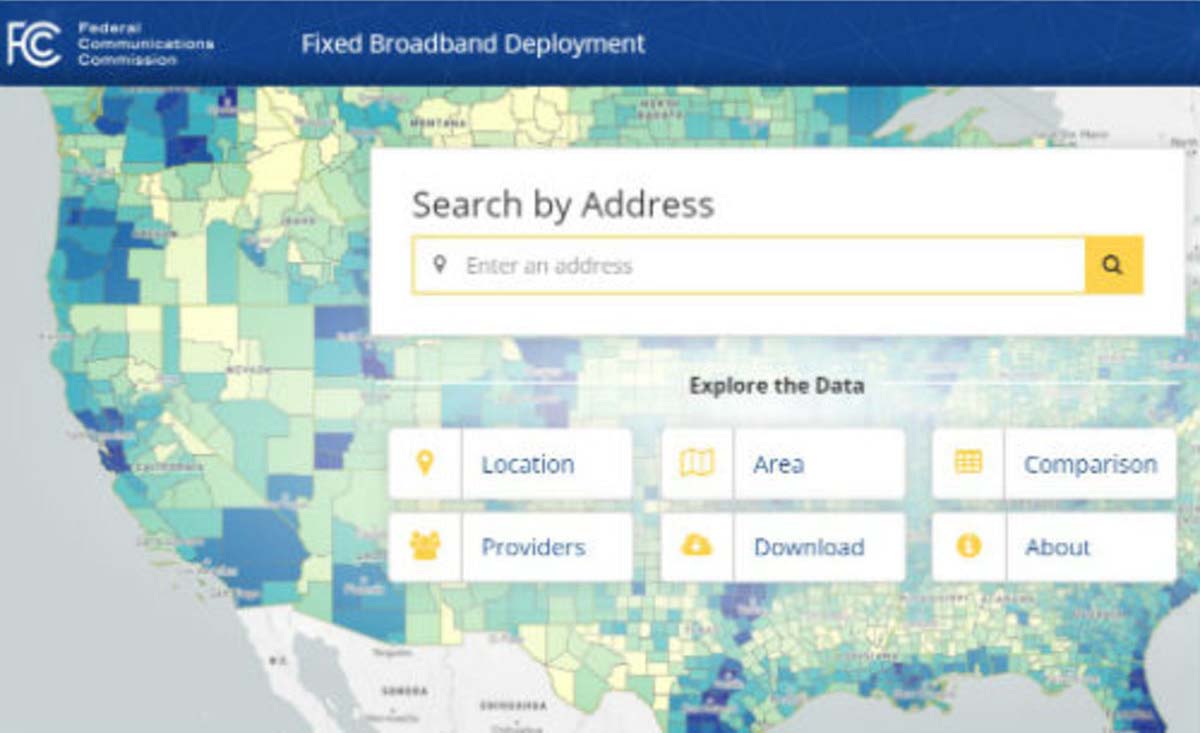
    The race across America to provide better broadband coverage hit a snag late in 2018 when critics of the Federal Communications Commission (FCC) voiced their displeasure with the accuracy of maps produced to depict the coverage of broadband access.

    These critics are pressuring the FCC to verify internet coverage and speed of data availability in rural areas as reported by the broadband companies.

    The FCC unveiled a new broadband map in February 2018. (Image: FCC)
    The FCC unveiled a new broadband map in February 2018. (Image: FCC)

    These broadband companies are only required to report on the advertised availability and data speeds and not the actual coverage/speed of the installed networks. Critics of the FCC have found that information used from the broadband providers overstates the available speeds and number of internet service providers, thus allowing the FCC to produce mapping of broadband that is not correct.

    Because of this incorrect reporting, it is estimated that almost 40 percent of rural America doesn’t have access to broadband data with no formal plan of rectifying this situation. The FCC has stated that they will investigate these coverage maps in order to determine if monies distributed to broadband providers were not used in accordance with the promised delivery of coverage and data speed.

    Why does this matter to surveyors? As previously discussed in past columns, the reliance on the real-time network capability of GNSS is one of the biggest time and production savers for the surveyor and for those working in rural America is no exception.

    Not just in small towns but out in the open where large parcels are being surveyed for many different reasons, including pipelines, wind and solar installations and title conveyances. By having broadband available use by surveyors, these tasks can be accomplished with shorter timeframes and less steps to keep critical data in compliance with established coordinate systems.

    Geospatial Data Act

    On Oct. 5, 2018, the Geospatial Data Act (GDA) was signed into law as part of the FAA Reauthorization Act (see Geospatial Solutions, “Geospatial Data Act will bring huge changes to America, and the world“).

    While this bill received lots of attention because of the FAA implications, the portion of the bill concentrating on geospatial oversight will have a lasting effect on the governance and development of the national mapping industry.

    For many years, the ever-developing amount and sources of geospatial data has been growing within several different agencies of the United States government. This bill was established to help streamline the efforts and availability of geospatial data by assigning specific agencies to oversee the development and introduction of new technologies.

    The biggest takeaway from this bill will be the reduction of agencies working on concurrent data sets for public and private use and therefore streamlining the opportunities to introduce newly acquired information into critical programs, (such as FEMA floodplain mapping, GAO asset management, etc.).

    Part of the reason I wish to highlight this bill was the efforts of the National Society of Professional Surveyors (NSPS) to keep the state professional licensing laws intact, the use of private sector businesses for providing surveying services, and to keep quality-based selection (QBS) as the primary tool for awarding contracts for procurement services.

    Because of the actions and reasoning by NSPS, the authors of the bill withdrew the language that would allow “low bid” opportunities within these contract awards. This influence by NSPS is a prime example of how a profession can influence legislation through our democratic process.

    Galileo implementation, Beidou installation, GPS Block III launches

    SpaceX’s Falcon 9 rocket orbited the first GPS III satellite on Dec. 23, 2018. (Photo: SpaceX)
    SpaceX’s Falcon 9 rocket orbited the first GPS III satellite on Dec. 23, 2018. (Photo: SpaceX)

    In November 2018, the FCC opened a new chapter in GNSS observation by approving a waiver to allow GNSS receivers to utilize Galileo transmissions for location determination without a specific FCC license. Traditionally, the FCC would require licensing of public, receive-only GNSS equipment used with any foreign-based systems but worked with several US agencies to create a waiver to allow faster implementation to use the Galileo signals.

    It should also be noted that the Chinese government has been rapidly building the latest stage of their own GNSS constellation, the BeiDou system. The United States and China have been promoting cooperation to allow each side to better understand the current workings of GPS and BeiDou, (GPS-BeiDou Statement). China is currently completing its third phase of the navigation system that potentially will surpass the United States GPS constellation in data availability and accuracy, (See GPS World “Directions 2019: BeiDou accelerates global deployment,” December 2018).

    Not to be outdone, the U.S. has begun its implementation of their next wave of satellites, the GPS III containing the latest technology, the L1C civil signal, with improved accuracy and anti-jamming programming. On Dec. 23, the SpaceX Falcon 9 rocket delivered the GPS III SV01 into its intended orbit (SpaceX Launch) with more launches scheduled for additional satellite vehicles in 2019.

    These efforts to increase satellite coverage and accuracy will only improve the use of GNSS receivers by surveyors. While I look forward to software and receiver upgrades to take advantage of the newer birds, we still need a backup plan in case of international conflicts and a reduction/discontinuation of GNSS service.

    GPS and terrestrial backup

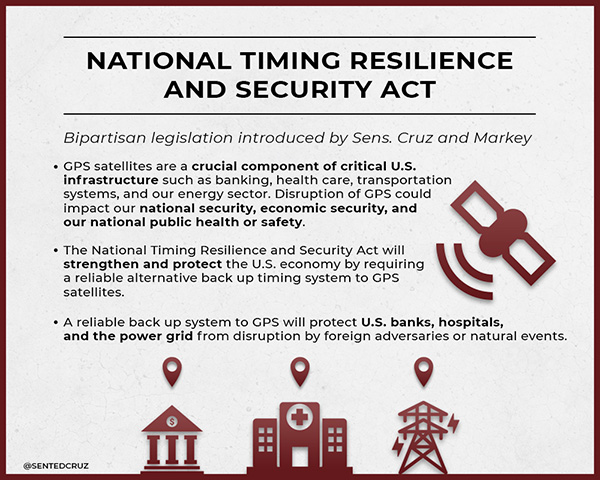
    Image: @SENTEDCRUZThe Frank LoBiondo U.S. Coast Guard Authorization Act of 2018, which also included the National Timing Security and Resilience Act, was signed into law on Dec. 4 and directs the Secretary of Transportation to establish a terrestrial back system for the U.S. satellite navigation system within a two-year period (see  “GPS to get terrestrial backup system”).

    The bill lays out specific conditions for the backup plan:

    • terrestrial
    • wireless
    • synchronized to UTC
    • difficult to disrupt
    • able to penetrate underground and inside buildings
    • capable of deployment to remote locations
    • expandable to provide position, navigation and timing (PNT), and
    • able to work in concert with similar systems such as eLoran.

    However, this bill did not provide any funding for the creation of this system but now allows the introduction of appropriations in future bills and acts. As I have written in past columns (see “The day GPS went away,” September 2017), it won’t be a matter of if but when something happens to our current GNSS capabilities and we need to develop this backup plan yesterday.

    Dual-band GNSS cellphones as the new norm

    My last submission featured the latest in chipset for cellphones and utilizing dual-frequency GNSS signal reception. Xiaomi, based in Beijing, China, introduced the Mi 8 phone with a dual-frequency GNSS chip in the Spring of 2018 to rave reviews.

    This chip frequency reception (E1/L1+E5/L5) is targeted to embrace the Galileo and GPS constellations for increased accuracies (within a decimeter) well beyond the current norm for smartphones (typically 1-3 meters +/-).

    Since then, Xiaomi has released the Mi Mix 3 and Huawei has released the Mate 20, Mate 20 Pro and Mate 20 X, all with dual-frequency chipsets. However, all of these phones are not available in the U.S., and the security issues with Huawei has been well documented (CNBC Report, February 2018).

    The reason I still bring these up for the surveyor is because soon we will have dual-frequency capability on the phone in our pockets here in the U.S. Such phones can greatly increase efficiencies, especially when used during reconnaissance efforts. I believe many more phone manufacturers will begin to incorporate dual-frequency chips in their future models to increase location accuracies for the users and take advantage of upcoming network enhancements (see GPS World “Dual-frequency GNSS smartphone hits the market,” June 2018.)

    Surveyors vs. technology disruptors

    The Mi 8 smartphone offers dual-frequency capability. (Image: Xiaomi)
    The Mi 8 smartphone offers dual-frequency capability. (Image: Xiaomi)

    One of the biggest stories in the surveying world made national headlines after a start-up “GEO-spatial” consultant created by retired bankers was sued by the Mississippi Board of Licensure for Professional Engineer and Surveyors for having “engaged, and continues to engage in the practice of surveying while not licensed by the Board.” (Madison County, Mississippi, Chancery Court.) While the initial suit remained under the national radar, the countersuit by the consultant and subsequent articles in national websites brought the situation to the front page.

    The issue at hand is the creation of “plats” combining a legal description for a parcel with a high-resolution photo (captured by various means, including UAV) and depicting said legal description on the photo for use by banks and other financial institutions for risk evaluation. Their argument is that they have “First Amendment rights” to provide public information (the legal description) on a recent aerial photograph in order to provide an exhibit for lenders to review and make loan decisions. Banks are now paying much less in fees to this company for an exhibit instead of a Plat of Survey provided by a licensed surveyor, yet the exhibit provides no assurance (or certification) to its validity and/or any metadata for the represented information.

    The subsequent articles by both Bloomberg and Ars Technica writers liken the situation to Airbnb versus hotels and Uber/Lyft versus taxi drivers as a new “disruption in technology” brings forth change to previously licensed professions. In fact, the author of the Bloomberg article stated, “the clients are sophisticated, and they’re not complaining.”

    Using this mentality, we could apply it to any licensed profession and allow services normally regulated by laws to be administered by non-professionals, as long as the client “is sophisticated and not complaining.” This means anyone can provide accounting, medical, dental or even law services if the client is satisfied. As previously published here, (see GPS World “Accuracy, precision and boundary retracement in surveying” July 2017), a boundary survey is not simply a mathematical figure from a legal description. It takes a trained person to know how to properly relate a legal description to a physical parcel and professional licensing provides that assurance (and protection) to the public.

    This situation falls squarely in the GNSS wheelhouse for surveyors, especially as technology advances and accuracies become smaller with progress, (i.e. GPS Block III, BeiDuo, Galileo, etc.) and the ability to measure with higher positional accuracy, (i.e. Xiaomi Mi 8 and other to follow).

    The surveying profession has joked for years that when these technologies do come forward, many unlicensed “professionals” will come forward with their measuring devices (phones) and locate property lines as part of their service.

    But for now, it isn’t just the physical location by GNSS measurement we should worry about; it is the high-resolution photo software, GIS data sources and those folks enterprising enough to put all this information together. The surveying profession will need to ramp up its message to public to help better define what the licensed surveyor provides versus the “we can do it much cheaper and faster” stories. More often than not, you get what you pay for.

    Data collection advancements

    Emlid Reach RS w/ iPad Photo: Tim Burch (SPACECO Inc
    Emlid Reach RS with iPad. (Photo: Tim Burch)

    While 2018 didn’t see any revolutionary changes to GNSS data collection, several small advances are noteworthy. Besides the previously mentioned dual-frequency cellphones, we are also seeing more integration with the cellphones themselves as data collectors in conjunction with stand-alone GNSS receivers (see GPS World “University research uses smartphones for precision GNSS,” September 2018).

    Several of the major survey equipment manufacturers are joining a group of small GNSS start-ups by introducing single- and dual-frequency receivers to work with both Android- and iOS-based phones and tablets for more cost-effective positional solutions.

    Another trend that is becoming very popular is the use of post-processing kinematic (PPK) solutions with many of the newest models of multi-rotor and fixed wing UAVs. The early (and expensive) trend of aerial vehicles produced by the major surveying equipment manufacturers insisted on installation of a dual-frequency RTK receiver in order to provide a more robust control system for the orthometric photo process. Because there is still a need to combine the still photos from the UAV flight via various “stitching” software, the need (and expense) of RTK within the receiver, while a nice feature, has become overkill for most aerial needs. However, there are times and applications when a fixed-RTK location could be useful, especially during emergency situations when needing to utilize the UAV for live streaming purposes.

    Propeller Aeropoint w/ DJI Inspire 2. Photo: Brian Kravets (SPACECO Inc.)
    Propeller Aeropoint w/ DJI Inspire 2. (Photo: Brian Kravets, SPACECO Inc.)

    The last big trend to gain popularity comes from Propeller, a young tech company from Australia that provides both a control point product and data reduction/reporting service. Their revolutionary ground control point (GCP) target, the Aeropoint, is becoming a very popular item for UAV pilots worldwide. These 24-inch (61-CM) square foam targets contain a single-frequency GNSS receiver that collects RINEX data while performing your UAV flight. Spread these targets around your site, setup and perform your survey, then download the target data to the Propeller app on your phone/tablet. The app automatically uploads the data to the company’s site and processes the geographical location for each target into your chosen coordinate system. It truly is that simple and the Propeller folks have made it easy to use. Their online software, Propeller Platform, is also available for photo/data processing and site analysis/visualization/volume computations. They, too, are now teaming with DJI to offer PPK solutions combining Aeropoint data along with Phantom 4 RTK photo data in a convenient, streamlined process.

    For 2018, our firm (SPACECO Inc) expanded our UAV program in several ways to take advantage of these trends. First, we been using the Emlid Reach RS single-frequency GNSS receiver utilizing a Bluetooth connection to an iOS-based tablet to GCP’s for our UAV program. The receiver’s low cost and ease of use with an RTN network has been a pleasant change from typical surveying equipment. We also use Propeller’s Aeropoints in locations where the RTN coverage is not readily available. For sites that are substantial (typically 300 acres+), we often send our data to the Propeller Platform for photo stitching and data reduction to take advantage of their computing power.

    WingtraOne. Photo: Brian Kravets (SPACECO Inc.)
    WingtraOne. (Photo: Brian Kravets, SPACECO Inc.)

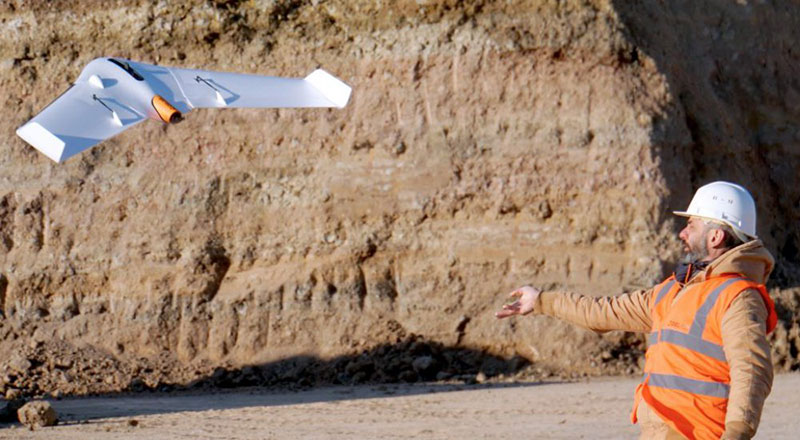
    Lastly, we wanted to expand our fleet of quad-rotor UAV’s to include a fixed wing model for larger sites. A visit with the Wingtra crew at InterGeo 2017 in Berlin convinced me that a vertical take-off and land (VTOL) model would be a great addition, so we took delivery of our WingtraOne this past summer. The ease of use and amount of project space the Wingtra can cover was already great but we’ve added the PPK module to reduce the amount of GCP’s necessary, especially in inaccessible areas. All these additions to our survey department (carefully vetted and purchased; no freebies from any of the manufacturers!) have provided new ways to expand our services to our clients and allows us the opportunity to enjoy what we do along the way. It is my pleasure to report from personal experience that these trends are solid and will continue to increase our abilities and productivity for days to come.

    What’s next for 2019?

    Some of the items I see gaining traction in 2019 will include additional sensors for UAV’s (LiDAR, hyperspectral, infrared), continued improvement in cost effectiveness of laser scanners and LiDAR, increased interest in SLAM (simultaneous localization and mapping) technology and, of course, more geolocation services tied into autonomous vehicles/delivery. Will 2019 be the year Amazon drops my packages by UAV at my front door? As fast as these technologies are developing, I wouldn’t bet against it.

  • Iono Blob holds back air safety advances

    Iono Blob holds back air safety advances

    Where have all the SBAS gone?

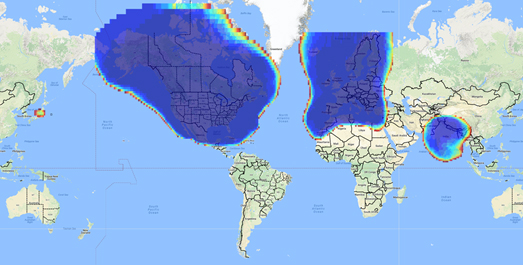
    Space Based Augmentation Systems (SBAS) –  known in North America as the Federal Aviation Administration’s (FAA’s) Wide Area Augmentation System (WAAS) – have been fully operational in one form or another for several years. The FAA’s incremental improvements to integrity, accuracy and reliability in WAAS have brought the system to a point where we have precision en-route navigation for aircraft, and we can also land aircraft using WAAS signals at thousands of airports in the US and in Canada.

    Why not Mexico, which also benefits from the same WAAS coverage? More on that later, as we piece together the many parts of the complex SBAS mosaic.

    SBAS precision approach coverage, May 2016. Graphic: FAA Tech Center, Lockheed Martin, GMV
    SBAS precision approach coverage, May 2016. Graphic: FAA Tech Center, Lockheed Martin, GMV

    Europe benefits from high-accuracy en-route navigation, and there are also hundreds of operational approaches using the European Geostationary Navigation Overlay Service (EGNOS) SBAS.

    In India, the GPS Aided Geo-Augmented Navigation (GAGAN) system provides accurate en-route navigation and approach capability. However, ionospheric disturbance may limit some aspects of performance.

    Japan established the Multi-functional Satellite Augmentation System (MSAS) SBAS, and has benefited from improved en-route navigation, but it’s possible that the more limited geographic distribution of GPS ground reference stations has restricted improvements to approach capabilities.

    But what happened to the International Civil Aviation Organization (ICAO) concept from 2007, supported by all the ‘aviation-going’ countries of the world, that SBAS would evolve and eventually multiple national systems would provide coverage around the rest of the world, maybe even by 2016?

    Countries in Asia, South America, Africa and the continent of Australia all appear to have looked closely into establishing their own SBAS, but nothing seems to have come out of these investigations. Technical issues, cost, and political obstacles have all hindered global SBAS progress.

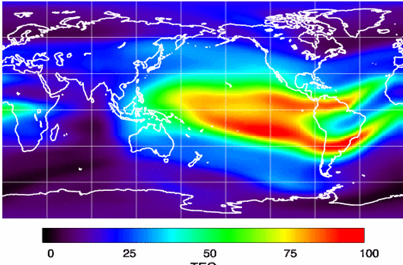
    The ionospheric challenge. Graphic: GMV and Lockheed-Martin
    The ionospheric challenge. Graphic: GMV and Lockheed-Martin

    Technical Issues. Ionospheric scintillation problems around the Equator seem to be at the root of most technical problems for SBAS. Getting to the required level of probable, bounded system error  is hugely difficult. The iono disturbance ‘blob’ follows the sun around the Equator and wipes out any chance of satisfactory system performance when it passes over Equatorial countries.

    As total electron count (TEC) increases, the ionospheric grid, which most SBAS use to predict ionospheric variation across their geographic area between fixed reference stations, well, it just doesn’t work anymore.

    Cost. The capital cost of building a satellite-based augmentation system and the on-going cost of maintaining a bunch of geographically distributed reference sites, building and launching GEO satellites or renting transponders on someone else’s orbiting asset, establishing, operating and maintaining redundant uplink stations, redundant terrestrial data links, and setting up control systems that collect and create the SBAS uplink message — it  all adds up. Millions and maybe even billions of dollars or equivalent, in total, have been spent by those select countries who could afford their own SBAS. Others named above have lesser financial resources upon which to draw.

    Political Obstacles. One of the trickiest issues is sovereignty: the need for a country to control its own navigation and landing system. This has likely been the source of most resistance to more SBAS systems being set up and shared by bordering countries around the world.

    For a large number of smaller countries, SBAS would only make sense if it was shared across a number of neighboring countries, but that means relinquishing sovereignty to some degree. In several regions of the world a number of geographically adjacent countries don’t particularly like each other, never mind thinking of such sharing/collaboration.

    National sovereignty, by the way, isone of the main reasons that existing satellite navigation systems underpinning SBAS, such as Galileo, GLONASS, IRNSS (now NAVIC), QZSS and of course BeiDou have all been put in place.

    Another problem with potential SBAS sharing across adjacent countries stems from responsibility for liability. Should something not work and an accident ensues from such a malfunction, who’s liable? Mexico seems to have adopted the view that since the US provides WAAS on what could be called an ‘as-is’ basis, then the potential liability issue seems to trump using the system.

    Solutions? Technical issues with the ionosphere may soon be resolved by using dual-frequency L1/L5 airborne receivers that directly calculate their own ionospheric corrections, rather than using the computed SBAS iono grid. If we add in dual-frequency E1/E5a signals from Galileo, things start to get even better. New requirements and prototype equipment are already being developed for dual frequency multi-constellation airborne receivers. Airbus anticipates equipping aircraft with such receivers around 2025. Could this solve the SBAS technical issue for Equatorial countries?

    ARINC (now a UTC/Rockwell Collins company) and SITA (in Europe) have been providing commercial aircraft with operational communications services on a pay-for-use basis for a number of years, and this is notarized as an accepted means of compliance within ICAO policy/requirements:

    From ICAO Doc. 9161, Sec. 3.99: “A group of states or a regional organization might also undertake to operate the augmentation satellite service required, either by themselves or by contracting a commercial or government organization to do so on their behalf.”

    ARINC en-route coverage. Graphic: ARINC
    ARINC en-route coverage. Graphic: ARINC

    Aireon has partnered with NAV CANADA, the Irish Aviation Authority (IAA), Enav, NATS and Naviair, as well as Iridium Communications and Harris Corporation to provide real time ADS-B data (GPS position output from aircraft) to air-traffic control providers. Aireon’s payloads on the new Iridium NEXT Low-Earth Orbit (LEO) satellite constellation will receive aircraft ADS-B messages and relay them to Air Traffic Controllers in real-time.

    There are 66 Iridium NEXT satellites in operation, with significant overlap and redundancy built into the system to enable this safety-of-life service to be provided on a pay-for-use basis to the aviation industry. We could at last know the location of every suitably equipped aircraft in the air, in almost real-time. The ICAO requirement is for an update rate of 15 minutes.

    Inmarsat ADS-C is a similar service available to aircraft on a contracted, pay-for-use basis via Inmarsat GEO satellites.

    Market Solutions. If a substantial company showed up with a worldwide distributed SBAS solution and offered it on a fee for service basis, why wouldn’t countries that are already accustomed to ARINC and SITA pay-for-use communications? The Aireon international aircraft tracking system, to be provided on the same basis, adds to the credibility of such a pay-for-use service.

    So why wouldn’t these accepted services demonstrate to those countries concerned about control and national sovereignty that an SBAS service could be provided on this basis?

    The liability for provision of service sits with the providers, so user countries/airlines would have someone to turn to about liability issues, and there presumably could be contract terms to provide system performance guarantees.

    No huge capital costs, no system to construct, nor staff to operate or maintain, and yet a level of control similar to that which has been around for commercial aircraft communications for decades.

    Would this be of interest to countries that have not yet jumped on the SBAS bandwagon? A definite ‘maybe,’ we could imagine? What’s not to like?

    The punch line to all this is that Lockheed Martin and GMV (Spain) have teamed to challenge these non-SBAS countries with a solution which may appeal.

    Uralla reference test site. Photo: Lockheed-Martin
    Uralla reference test site. Photo: Lockheed-Martin

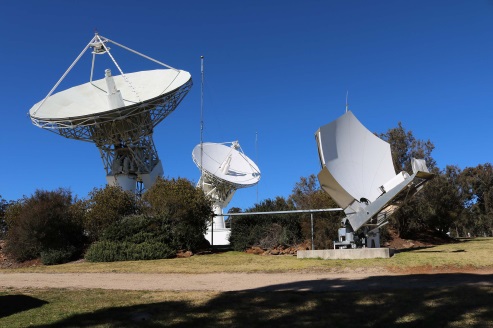
    To present convincing evidence that it would work, a dual frequency GPS (L1/L2) + Galileo (E1/E5a) reference site has been set up in collaboration with Geoscience Australia and Land Information New Zealand. The reference site is located at Uralla, New South Wales on Australia’s East Coast, where it gathers data demonstrating bounded errors within the operational range which could enable GNSS approach capability.

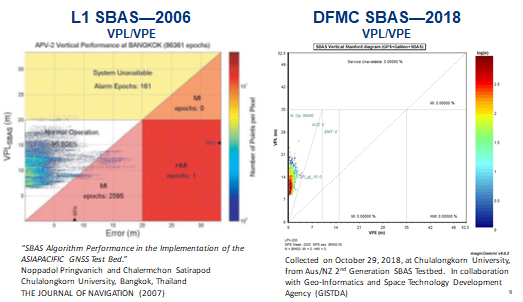
    L1 (2006) vs. DFMC (2018) SBAS at Bangkok. Graphic: Lockheed-Martin, GMV
    L1 (2006) vs. DFMC (2018) SBAS at Bangkok. Graphic: Lockheed-Martin, GMV

    Another test site in Bangkok, Thailand has demonstrated that existing L1-only SBAS in this area cannot manage this performance (all current SBAS are L1 only), but that with dual-frequency multi-constellation (DFMC) GPS L1/L2+Galileo E1/E5a, the required performance limits could be met.

    Lockheed Martin has also been using the Uralla uplink site to test the uplink and downlink of dual-frequency SBAS-like test messages.

    The Moral of the Story. There are no miracles as yet, but interest in the pay-as-you-go SBAS concept appears to be growing, and the LM/GMV team continues to work to bring their approach to market.

    A large number of countries could well benefit from the high accuracy, integrity and continuity of SBAS service if this all comes together.

  • A look at NGS’ experimental and hybrid geoid models

    A look at NGS’ experimental and hybrid geoid models

    On Aug. 10, the National Geodetic Survey (NGS) released its latest experimental geoid model, xGeoid18. In early 2019, NGS is scheduled to release its next hybrid geoid model, Geoid18.

    NGS’ 2018 experimental geoid model, xGeoid18, and the next hybrid geoid model, Geoid18, are not the same. This column will address the latest experimental geoid model, xGeoid18, and the future hybrid geoid model, Geoid18, and why it’s important to understand that they are very different and cannot be interchanged.

    In my October 2015 column, I described the differences between NGS’ hybrid geoid models and their experimental geoid models. It has been three years since I wrote the newsletter that addressed the differences between the experimental geoid model and hybrid geoid models. NAPGD2022 is now only about three years away. There will be significant differences between NAVD 88 and NAPGD2022 height.

    My June 2017 column provided an estimate of the differences based on the 2016 experimental geoid model, xGeoid16b. These differences between NAVD 88 and NAPGD2022 will vary from state to state, as well as within an individual State. Products referenced to NAVD 88 will be different from products referenced to NAPGD2022. Users will need to prepare for the NAPGD2022 and develop implementation plans. Users should obtain an understanding of the differences between NAPGD2022 and NAVD 88.

    NGS has a webpage that provides information on all of their experimental geoid models. It page provides information on the development of the program and information on each of the experimental geoid models.

    NGS’ Experimental Geoid Website

    Photo: National Geodetic Survey Photo: National Geodetic Survey. Click to enlarge.

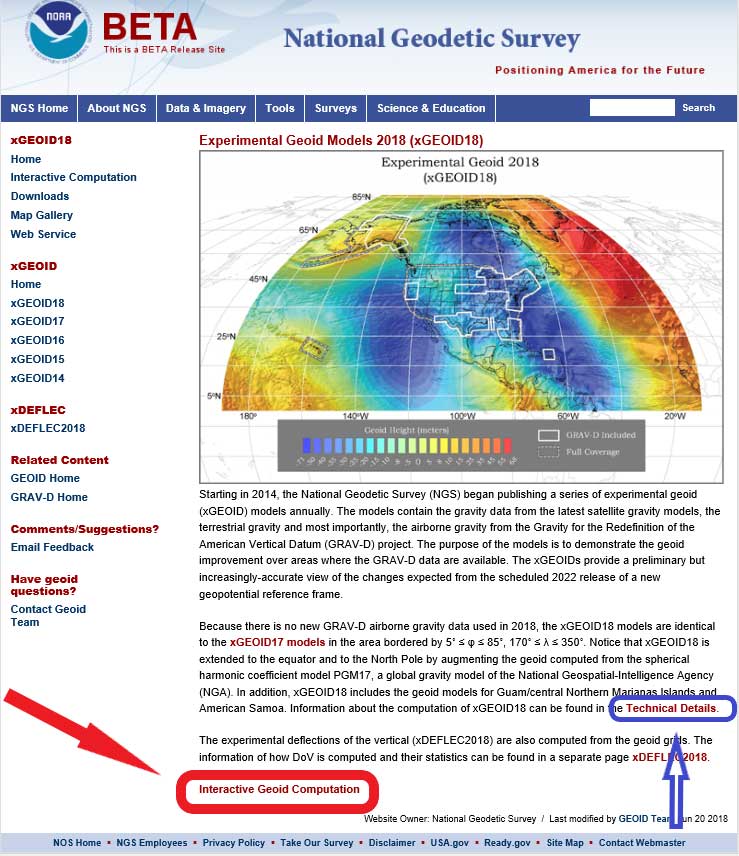
    If the user clicks on the xGeoid18 button (see orange arrow in the box titled “NGS’ Experimental Geoid Web Site”), the experimental geoid model xGeoid18 web page appears (see box titled “NGS’ Experimental Geoid Models 2018 Web Site”).

    NGS’ Experimental Geoid Models 2018 Website

    Photo: National Geodetic Survey

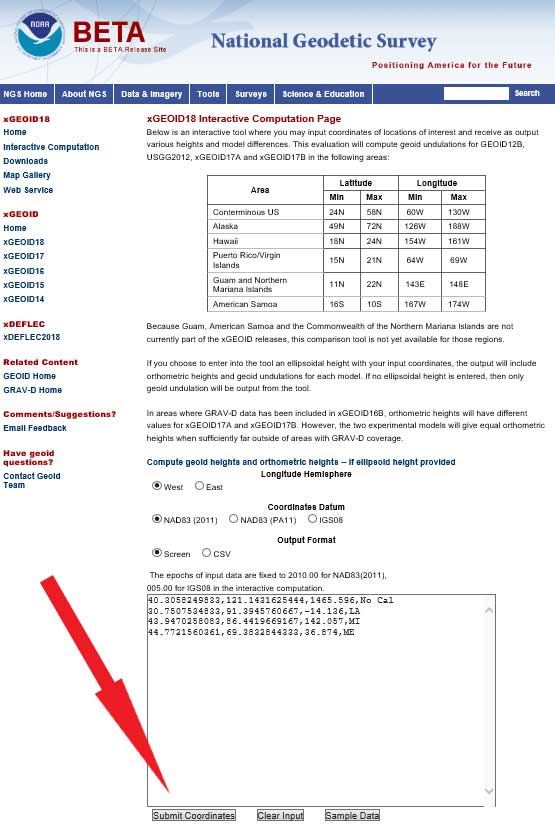
    Once users get to the xGeoid18 web site, they can obtain estimates of xGeoid18 values for any latitude and longitude by clicking on the button titled “Interactive Geoid Computation.” See red arrow in box titled “NGS’ Experimental Geoid Models 2018 Web Site.”

    Input Page of xGeoid18 Interactive Web Page Using the Sample Dataset

    Photo: National Geodetic Survey

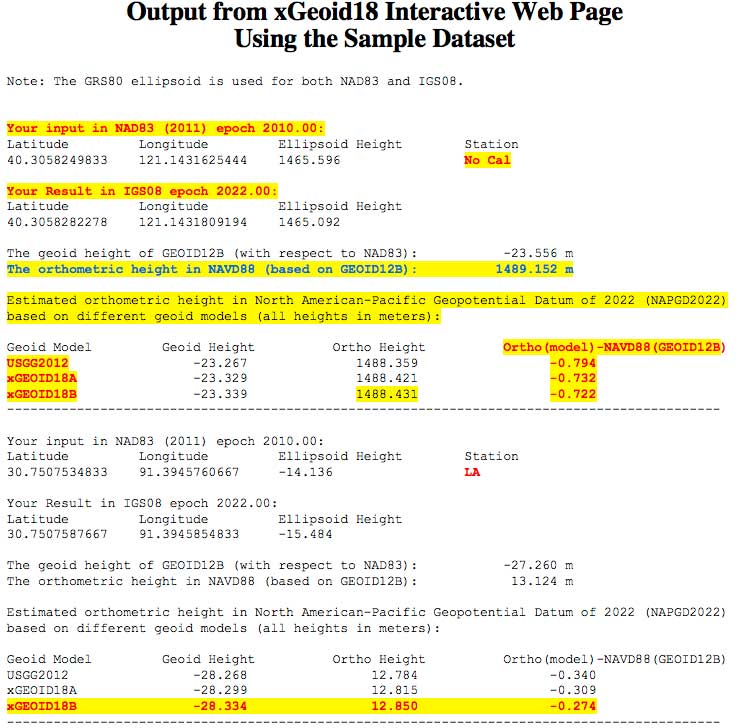
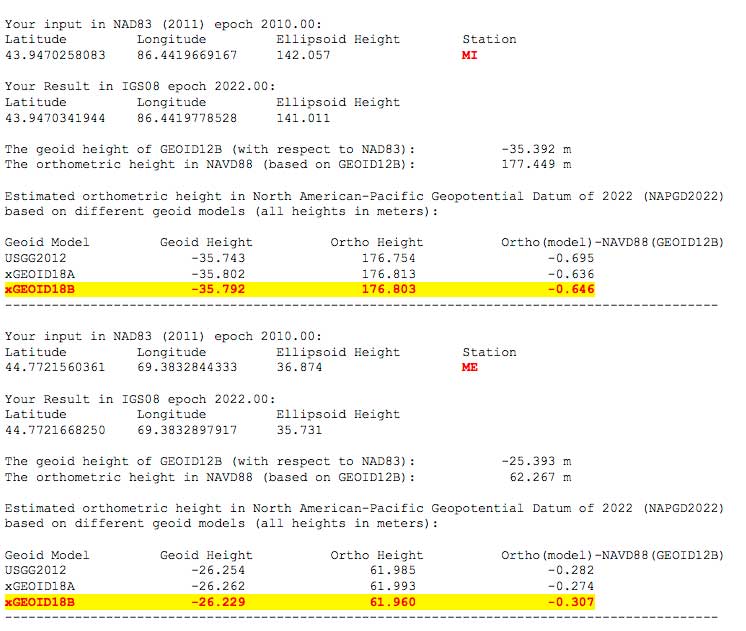
    Users should note that the output of the xGeoid18 interactive web service provides the results in IGS08 epoch 2022.00. The output provides an estimate of the NAVD 88 orthometric height based on GEOID12B, an estimate of the NAPGD2022 orthometric height based on xGeoid18b, and the difference between NAPGD2022 and NAVD 88. The box titled “Output from xGeoid18 Interactive Web Page Using the Sample Dataset” shows the output from the interactive web service using the sample dataset provided by the web service.

    The sample dataset has four stations — a station in California, Louisiana, Michigan and Maine. The results indicate that the differences will vary from state to state — the difference between NAPGD2022 and NAVD 88 in California using xGeoid18b is -0.722 meters, in Louisiana the difference is -0.274 meters, in Michigan the difference is -0.646 meters, and in Maine the difference is -0.307 meters (see box titled “Output from xGeoid18 Interactive Website Using the Sample Dataset”). More detailed estimates of differences between NAPGD2022 and NAVD 88 based on xGeoid16b can be found in my June 2017 column.

    Output from xGeoid18 Interactive Website Using the Sample Dataset

    Note: The GRS80 ellipsoid is used for both NAD83 and IGS08.

    Data: National Geodetic Survey

    Data: National Geodetic Survey

    Users can find technical information on xGeoid18 by clicking on the link labeled as Technical Details on the xGeoid18 website (see blue arrow in box titled “NGS’ Experimental Geoid Models 2018 Web Site”). The box titled “Excerpt from Technical Details for xGEOID18 Models” provides an excerpt of the technical details of xGeoid18.

    Excerpt from Technical Details for xGEOID18 Models

    Summary
    xGEOID18 is identical to xGEOID17 in the area bordered by 5˚ ≤ φ ≤ 85˚, 170˚ ≤ λ ≤ 350˚, which includes CONUS, Alaska, Hawaii, and Puerto Rico. Therefore, for information on xGEOID18 in those areas, the user should refer to the Technical Details of xGEOID17.

    For extended areas down to the equator and above latitude 85˚ north, the geoid is computed from the NGA’s Preliminary Geopotential Model 2017 (PGM17).

    The geoid models for Guam/central Northern Marianas Islands and American Samoa are computed in the closest way as xGEOID17 using the shipborne gravity, altimetric gravity and the reference gravity model PGM17.

    The deflections of the vertical are computed from all the geoid grids and the plumb curvature correction is applied by using the classical Bouguer reduction.


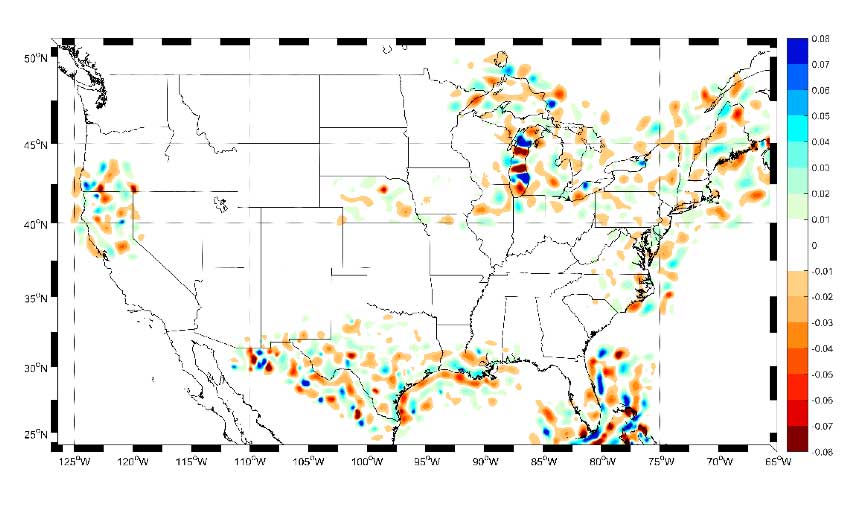
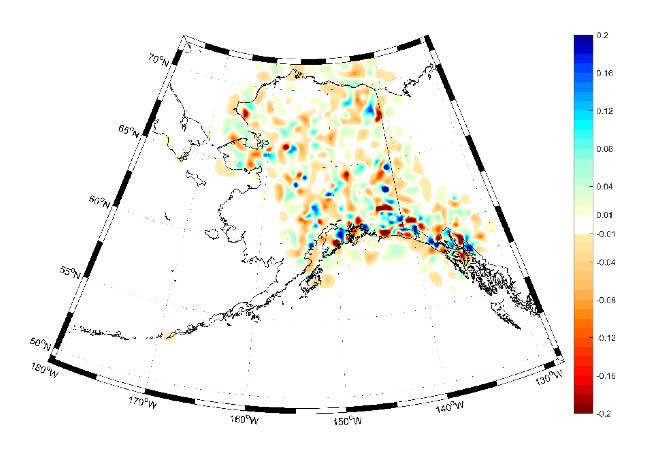
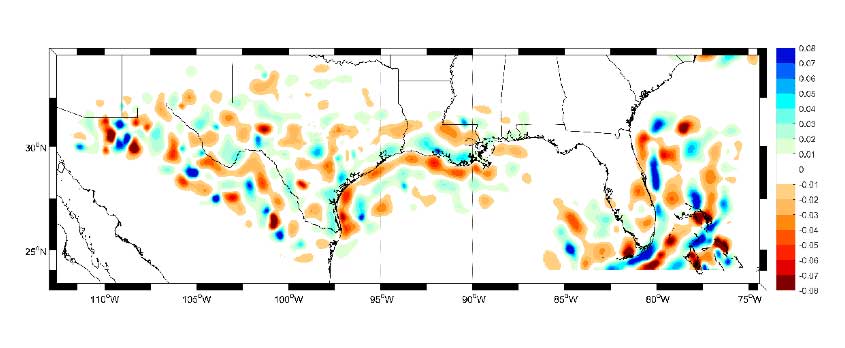
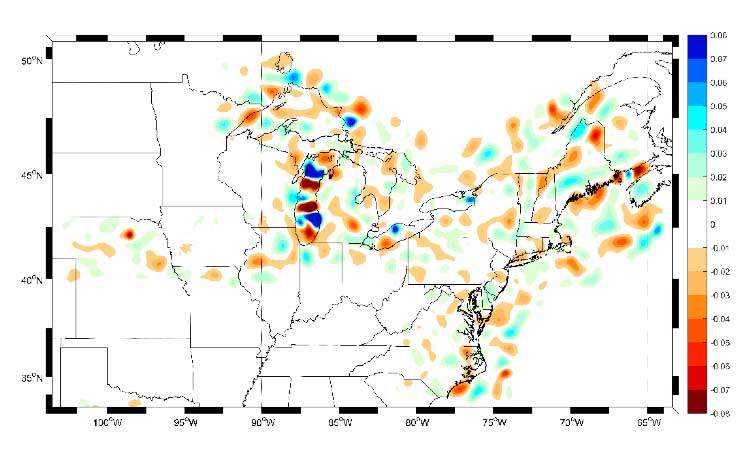
    As the technical detail webpage states, xGEOID18 is identical to xGEOID17 in the area bordered by 5˚ ≤ φ ≤ 85˚, 170˚ ≤ λ ≤ 350˚, which includes CONUS, Alaska, Hawaii and Puerto Rico. Therefore, for information on xGEOID18 in those areas, the user should refer to the Technical Details of xGEOID17. The box titled “Excerpt from Technical Details for xGEOID17 Models” provides an excerpt of the technical details of xGeoid17. This link provides figures that show the contribution of the airborne gravity data to the geoid models. See boxes titled “Excerpt from Technical Details for xGEOID17 Models” and “Figure (2,3,4,5) from Technical Details for xGEOID17 Models.” As stated in the technical details, users can examine each of the regional plots to see where the incorporation of GRAV-D data has changed the values of the xGeoid17B model.

    Excerpt from Technical Details for xGEOID17 Models

    GRAV-D Airborne Gravity Contribution

    The xGEOID17A and xGEOID17B models are identical except that xGEOID17B includes the available GRAV-D airborne gravity data. The difference between the two models shows the contribution of the airborne gravity data to the geoid models. Since the differences are only in areas where the GRAV-D airborne gravity data has been used, examining the regional plots given below will illustrate the varying levels of improvement due to GRAV-D, seen in different parts of the country.

    Photo: National Geodetic Survey

    Figure 1. CONUS – Contribution of GRAV-D airborne gravity [units in cm]

    Figure 2 from Technical Details for xGEOID17 Models

    Photo: National Geodetic Survey

    Figure 2. Alaska – Contribution of GRAV-D airborne gravity [units in cm]

    Figure 3 from Technical Details for xGEOID17 Models

    Photo: National Geodetic Survey

    Figure 3. Gulf Coast – Contribution of GRAV-D airborne gravity [units in cm]

    Figure 4 from Technical Details for xGEOID17 Models

    Photo: National Geodetic Survey

    Figure 4. Northeast – Contribution of GRAV-D airborne gravity [units in cm]

    Figure 5 from Technical Details for xGEOID17 Models

    Photo: National Geodetic Survey

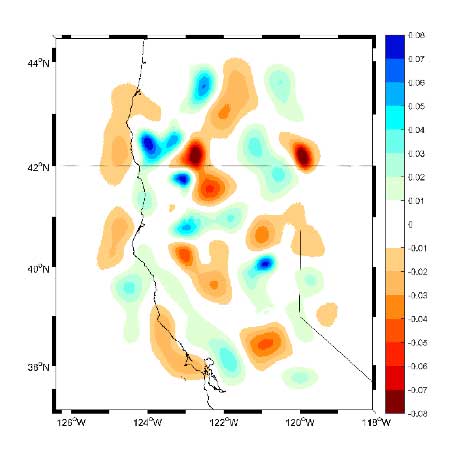
    Figure 5. Pacific Coast – Contribution of GRAV-D airborne gravity [units in cm]

    What does mean to a user today? A station can now have a published ellipsoid height, modeled GEOID12B value, a published NAVD 88 orthometric height, and several xGeoid modeled values. This can lead to confusion if the user is not careful about providing the correct metadata associated with their data and results.

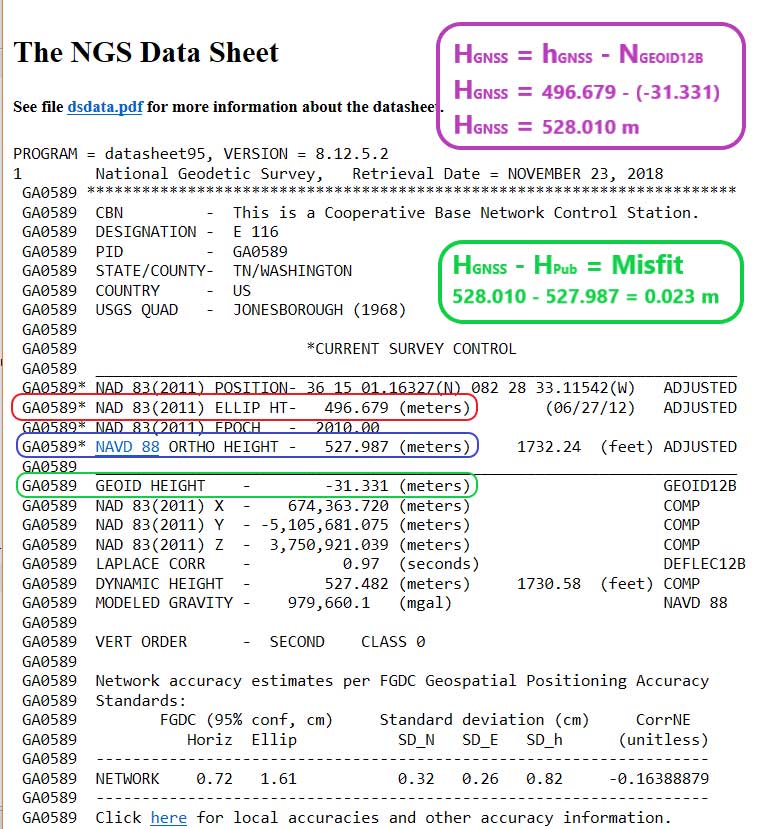
    The box titled “Excerpt from The NGS Data Sheet for Station E 116 (PID GA0589)” provides the output from NGS data sheet retrieval program. The first item to note is that if you compute the GNSS-derived orthometric height (HGNSS) using the formula:

    Equation: National Geodetic Survey Equation: National Geodetic Survey

    the computed value does not equal the published NAVD 88 leveling-derived orthometric height. In this example, the two heights differ by 2.3 cm. As explained in a previous column, GEOID12B is a hybrid geoid model that is distorted to be consistent with NAVD 88 published heights. It is a model and the documentation states that “The relative accuracy of GEOID12B to NAVD88 is characterized by a misfit of +/-1.7 centimeters nationwide.” The box titled “Excerpt from The NGS Data Sheet for Station E 116 (PID GA0589)” provides the computations and the results.

    Excerpt from The NGS Data Sheet for Station E 116 (PID GA0589)

    Data: National Geodetic Survey

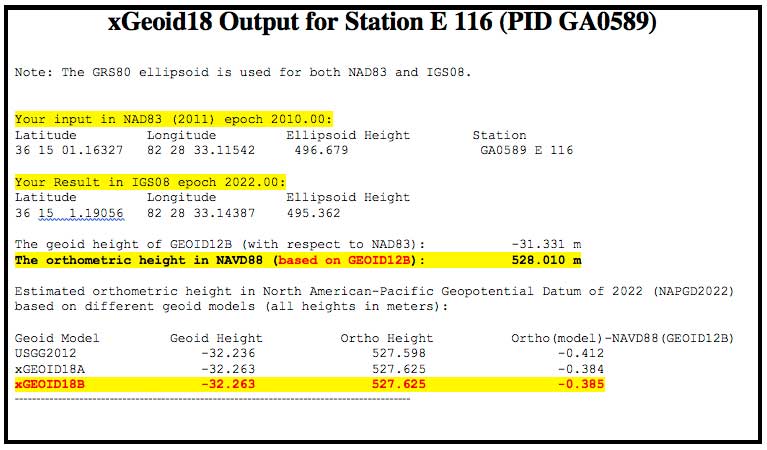
    Users can also obtain a xGeoid18B value for the station. The box titled “xGeoid18 Output for Station E 116 (PID GA0589)” provides the output of the xGeoid18 using NGS’ xGeoid18 interactive web service. It should be noted that the xGeoid18 output only provides the NAVD 88 orthometric height using GEOID12B; it does not include the published NAVD 88 orthometric height from the NGS Datasheet.

    xGeoid18 Output for Station E 116 (PID GA0589)

    Note: The GRS80 ellipsoid is used for both NAD83 and IGS08.
    Data: National Geodetic Survey

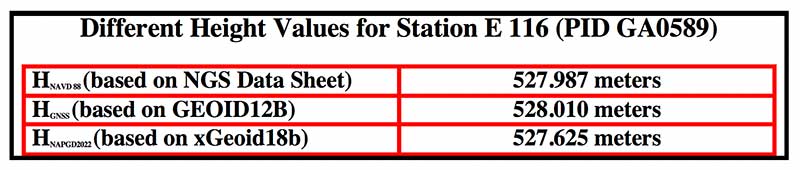
    The box titled “Different Height Values for Station E 116 (PID GA0589)” provides three different height values that are currently available from NGS web services. These different heights could lead to confusion if users are not careful. Most users won’t be using the experimental geoid interactive web service to compute an estimate of an orthometric height but all users should provide the appropriate metadata to avoid any confusion.

    Different Height Values for Station E 116 (PID GA0589)

    Chart: National Geodetic Survey Chart: National Geodetic Survey

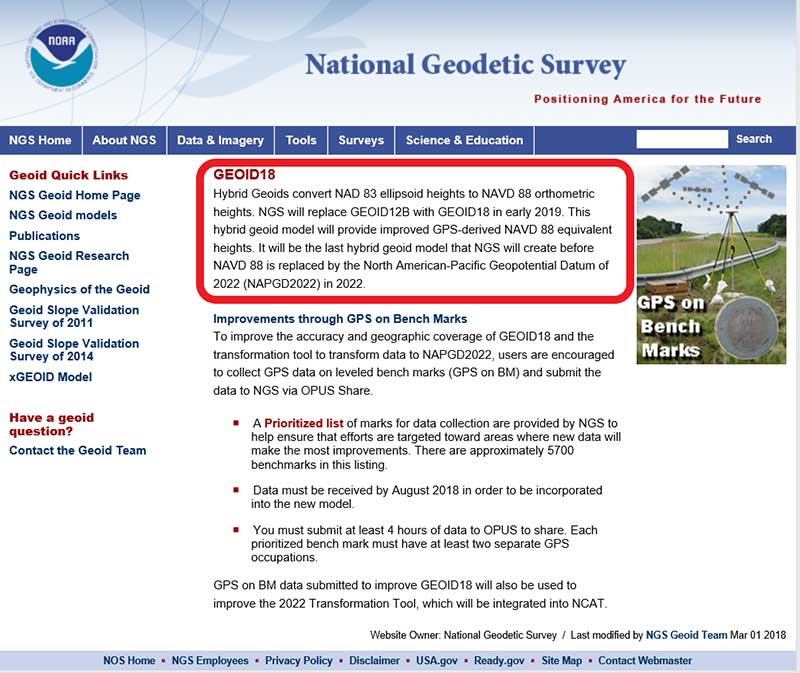
    The hybrid geoid model GEOID18 is currently being developed and is not ready to be published, but there is a web page that highlights that it will replace GEOID12B in early 2019 [see box titled “Hybrid GEOID18 Website“] GEOID18 values will be similar to GEOID12B because both hybrid geoid models are made to be consistent with published NAVD 88 values. Saying that, there will be differences especially in areas where the GPS on BMs program identified stations that have moved since the last time they were leveled and, therefore, they were not used in GEOID18.

    Hybrid GEOID18 Website

    Photo: National Geodetic Survey Photo: National Geodetic Survey

    My last column provided an update and status report on stations observed in support of the 2018 GPS on BMs program. Many stations with potential invalid published orthometric heights have been identified by the GPS on BM program. This information will be very useful to the surveying and mapping community as well as to NGS. Once NGS publishes the next hybrid geoid model, GEOID18, OPUS results will probably provide an estimate of the NAVD 88 orthometric height computed using GEOID18 similar to what it does now using GEOID12B. In my opinion, the results of GEOID18 will be better than GEOID12B in most areas of the United States and will be helpful in identifying stations that have moved since they were last leveled.

    NGS’ official date for accepted data for inclusion in the next hybrid geoid model, GEOID18, ended September 21, 2018. Continuing to submit your results to OPUS Shared will provide a way for others to analyze the results to determine whether a station has an issue that requires attention. New OPUS shared results will be very useful for evaluating the reliability of the model. After the hybrid geoid model, GEOID18, is published, NGS’ GPS-on-Bench-Mark Program will expand to include other regions and will focus on data to improve NGS datum transformation tools. Further columns will address differences between GEOID12B and GEOID18 after GEOID18 officially replaces GEOID12B.

  • Out in Front: Your future revealed

    Out in Front: Your future revealed

    Graphic: NicoElNino/Shutterstock.com
    Graphic: NicoElNino/Shutterstock.com

    As in, your future reading, in these pages.

    Changes are in store, and soon to become real. (Isn’t that always the way?) But truly, while continuing to cover every front of GNSS and PNT development, both businesswise and technologywise, we are improving the methods by which we do so. After listening to your input, of course.

    Among the questions we asked you in the course of the 2018 State of the GNSS Industry Survey was:
    “Please share story ideas with the editors of GPS World and/or let us know if your company is doing something unique.”

    Among the answers you gave — here’s where the bit about your future comes in — were these, and here’s some of the content with which we’ll be seeking to fill 2019’s pages:

    • Using a manned experimental jet aircraft to simulate low observable cruise missiles for countermeasures flight testing.
    •  UAV remote sensing legal issues.
    • Transitioning from GPS to internal building locating.
    • Definition of safety standards for autonomous road vehicles.
    • IoT sensors for remote monitoring with GPS and mobile for asset monitoring, biofuel stockpiles, personal tracking.
    • Data point collection for integration into Esri parcel fabric / CadNSDI development.
    • Increasing lifespan of professional surveyors.
    • Modernizing National Height System, validating existing geoid model, running precise first-order leveling, and taking GNSS observations.
    • More on geodesy, for example, mapping projections, ellipsoids, geooids, and so on.
    • Augmented GPS for integration with the 911 Emergency system.
    • After 30 years in government doing threat analysis and 18 years consulting/contracting, I plan to smell the flowers, but keep my hand in where needed. I have noticed, on issues of national security that are technology driven, we are often filling even the lowest managerial level with non-technical persons, who are often not qualified to assess the analysis they must review. Hence the product and the analysis suffer. I’m guessing the same thing is happening at the systems acquisition world. And might be a major factor in the “business as usual” cost and schedule overruns. We need fewer “suits” and more sweatshirts.
  • GPS reveals Antarctic bedrock rising

    The entirety of West Antarctica contains enough ice that, if it were to melt, would cause oceans to rise 10 feet. While the West Antarctic ice sheet is at risk of collapse, GPS data suggests this crisis could be averted because the bedrock supporting it is rising.

    Using GPS, an international team of researchers found that the viscosity of the mantle under the West Antarctic Ice Sheet is much lower than expected, with the crust rebounding faster than expected, possibly stabilizing against catastrophic collapse. According to the study, in 100 years, the uplift rates at the GPS sites will be 2.5 to 3.5 times more rapid than currently observed.

    Backer Islands GPS station: The small mushroom-shaped GPS antenna is supported by the nearby equipment with solar panels. (Photo: David Saddler via Colorado State University)
    Backer Islands GPS station: The small mushroom-shaped GPS antenna is supported by the nearby equipment with solar panels. (Photo: David Saddler via Colorado State University)

    Participating researchers led by scientists at the Ohio State University installed a series of GPS stations on rock outcrops around the region to measure the Earth’s rise in response to thinning ice. Measurements showed that the bedrock uplift rates near the coast of West Antarctica were as high as 1.6 inches per year, one of the fastest rates ever recorded in glacial areas.

    “This very rapid uplift may slow the runaway wasting and eventual collapse of the ice sheet,” said Rick Aster, a co-author of the study from Colorado State University. Nevertheless, Aster told the UK’s Independent, “To keep global sea levels from rising more than a few feet during this century and beyond, we must still limit greenhouse gas concentrations in the atmosphere, which can only occur through international cooperation and innovation.”

    The team also included DTU Space. Study results were published in the journal Science.

  • FAA program advances drone integration in National Airspace System

    FAA program advances drone integration in National Airspace System

    This report covers a number of UAV topics, including the news of another U.S. Federal Aviation Administration (FAA) program to advance drone integration in the U.S. National Airspace System (NAS); an initial effort towards Type Certification for a larger UAV/UAS; cautious steps to protect U.S. Navy and Coast Guard ships from unwanted drone overflight; and what would appear to be a surge in the number of acquisitions across the industry.

    FAA Integration Pilot Program

    There are signs of growing momentum to get UAVs flying in the U.S. NAS. The FAA Integration Pilot Program (IPP) website indicates that this latest initiative is spread across a number of different applications, locations and supporting organizations. The FAA cites the following objectives for IPP:

    • Connecting local and national UAS integration interests
    • Improving local, state and tribal communications
    • Addressing security and privacy risks
    • Speeding up special authorizations.

    So it’s perhaps more about getting organizations at the local level into the picture, and fostering cooperation with national interests. But, at the same time, pilot projects will feed knowledge into the hopper of how to get UAVs into the U.S. NAS.

    Operational concepts to be investigated include night operations, flights over people, flights beyond visual line of sight, package delivery trails, testing detect-and-avoid technologies and verifying the reliability and security of UAS data links.

    Certification Program underway for Insitu ScanEagle3

    Along the same lines, Insitu is working with FAA staff towards certification of the commercial ScanEagle3 drone system to enable flights in U.S. controlled airspace. A recent three-day Type Certification Board meeting held between FAA and Insitu included launch-to-capture flight tests, plus review of applicable standards, flight training and technical publications and manuals to determine Insitu’s basis for the proposed UAS Type Certification of the ScanEagle3 in 2019.

    Once an aircraft or UAS gains Type Certification, it should be possible to fly that model on a regular basis, without the need for special FAA authorization of individual operations, as is currently the requirement for drones — other than for small UAS (sUAS), which already have FAA approved operational regulations. This effort could also clear the way for certification of larger drones to regularly operate in the NAS. Filing a flight plan with local FAA controllers prior to each flight would then typically be required, as is standard for all manned aircraft.

    FAA review teams examine Insitu’s ScanEagle3 at a type certification board meeting in Bingen, Washington (Photo: Insitu)
    FAA review teams examine Insitu’s ScanEagle3 at a type certification board meeting in Bingen, Washington (Photo: Insitu)

    At the recent review meeting with FAA team members from various certification groups, Insitu discussed its internal culture of safety, which is in line with the FAA’s extremely strict safety standards. The design and technology of ScanEagle3 was demonstrated, and the maturity of Insitu as an aircraft manufacturer was emphasized.

    The FAA teams participated in an overview of Insitu’s Project Plan for Certification, examining Insitu’s detect-and-avoid (DAA) capability planning, safety management system and model-based engineering processes.

    Insitu is hopeful that Type Certification will enable ScanEagle3 to be applied quickly to all types of operation, which could include data collection, analysis and delivery; aerial infrastructure survey; disaster recovery; and wildfire suppression – without the delay currently associated with seeking permits and overcoming temporary flight restrictions.

    FAA restricts drone operations near sensitive U.S. facilities

    Meanwhile, the FAA flexed its legal muscles to restrict drone flights near U.S. Navy (USN), U.S. Coast Guard (USCG) and Department of Energy (DoE) facilities and assets. Growing concerns with potential malicious drone flights over sensitive, high-priority facilities and ships apparently prompted the FAA to issue two NOTAMs (Notice to Airmen). The first notification describes the locations and the assets – in this case, ships operating from two bases — and includes the form of restrictions that are being applied.

    Drone flights have been restricted around USN and USCG vessels operating near Naval Base Kitsap in Washington state and Naval Submarine Base Kings Bay in Georgia. Drones are not allowed to get closer than 3,000 feet laterally and 1,000 feet vertically from vessels. And the NOTAMs carry the dire warning that these ships have the authorization and ability to take whatever action they feel necessary to protect themselves from such threats.

    In other words, if the nut-case flying an unwelcome drone penetrates the restricted area around a Navy or Coast Guard ship, the target ship might well take out the unwanted drone. And the FAA may also pursue civil penalties and/or criminal charges against the operator for disobeying the restrictive notice.

    The second NOTAM warns drone flyers to remain clear of all national Department of Defense (DoD) and DoE facilities and mobile assets, as well as USCG vessels. With UAVs carrying explosive devices becoming more common in areas of conflict or political unrest (in Venezuela, for instance), it’s not surprising that U.S. DoD is concerned this could soon start to happen closer to home.

    Industry consolidation continues

    Finally, following a letter of intent from Textron Systems to buy Howe & Howe Technologies a land mobile robotics defense outfit, drone industry consolidation also seems to be gaining momentum.

    Howe & Howe’s land vehicles are built and proven for extreme environmental conditions, and U.S. government customers have selected Howe & Howe’s small, highly mobile Ripsaw Super Tank for its speed, mobility and off-road performance, while the RS2-H1 SMET was down-selected to compete to be the U.S. Army’s first platoon load-carrying robot, after completing a 60-mile test through swamp and jungle terrains.

    Textron Systems continues to position itself as a global leader in autonomy applications in air, land and sea.

    In addition, Delair has just announced an agreement to acquire the key assets of Airware — a developer of software analytics tools for data collected by drones. The acquisition quickens Delair’s growth and increases options for the commercial UAV market. Delair provides end-to-end solutions, including fixed-wing drones, cloud-based data processing and analysis, local customer support and custom consulting services.

    Delair UX11 mapping drone (Photo: Delair)
    Delair UX11 mapping drone (Photo: Delair)

    The acquisition is through an asset purchase of Airware’s technology, including proven software, related personnel in Paris, existing customer relations and established distribution channels. Airware’s data management and data analysis tools will be highly complementary with Delair’s existing solutions and will also expand Delair’s U.S. market presence, providing access to additional key industrial markets.

    Airware, based in California, has provided a cloud-based software solution to large companies in the construction, mining and insurance industries. Its software solution was developed with support from Caterpillar and has been distributed by Caterpillar dealers to more than 50 countries to improve the productivity and safety in mines, quarries and construction sites.

    Delair, with more than 180 employees worldwide, has customers in a number of industries including mining, construction, energy, utilities, oil and gas, transportation and security.

    PrecisionHawk has also announced the purchase of Uplift Data Partners, which provides turnkey inspection services for construction, building information management (BIM) and real-estate. This is PrecisionHawk’s fifth acquisition during 2018 — earlier acquisitions have included Droners.io, Airvid, HAZON and InspecTools. These acquisitions have created dynamic synergy, and provided enhanced airborne intelligence with strengthened data value for PrecisionHawk.

    Uplift’s commercially trained drone pilots will join PrecisionHawk’s network of more than 15,000 drone pilots, one of the largest networks of its kind. Suzanne El-Moursi, CEO of Uplift, will join PrecisionHawk’s executive team and will manage the company’s construction business.

    The intent is for customers to receive best-in-class aerial data and analytics for complex construction and facility inspection projects, through combined PrecisionHawk’s advanced products and services, and Uplift’s industry experience and training standards.

    PrecisionHawk and Uplink will combine products for construction projects. (Photo: PrecisionHawk)
    PrecisionHawk and Uplink will combine products for construction projects. (Photo: PrecisionHawk)

    Uplift Data Partners has been an integrated subsidiary of Clayco, an architecture, engineering, design-build and construction firm, with more than $2 billion in annual revenue. Following the spin-off, Clayco will still source its construction projects exclusively to PrecisionHawk, and will support PrecisionHawk’s board of advisors.

    The construction industry has rapidly adopted commercial drone technology — transforming construction processes by decreasing the need for protracted visual inspections, shortening planning time, improving worker safety and quickly identifying problems.

    And finally — Microdrones, a provider of professional UAV solutions, has announced that it has acquired geomatics service provider Navmatica Middle East (ME) with an office and team in Dubai, UAE. Navmatica ME supplies services and custom software development for geodetic positioning, airborne mapping, mobile mapping and indoor mapping.

    Microdrones md4-3000 drone (Photo: Microdrones)
    Microdrones md4-3000 drone. (Photo: Microdrones)

    The acquisition establishes a foothold in the Middle East market for commercial drones, and adds an experienced team of geomatics engineering specialists, software developers and systems engineers who have a proven track record of providing customers with high-quality geomatics services and technology.

    Summary

    We have FAA efforts to move further forward with UAV integration with its IPP program, first steps down the lengthy and somewhat arduous path towards the certification of larger UAVs to enable less restrictive flight in the U.S. NAS, notifications to operators to improve protection of Navy and Coast Guard ships from unwanted overflight and potential drone attack, and plenty of signs of drone service and manufacturer business consolidation — lots of what we may think of as positive indications of greater maturity and progress for the UAV industry.

  • Geospatial Data Act will bring huge changes to America, and the world

    Photo: iStock.com/Jirantanin Chanachaiviriyakul
    Photo: iStock.com/Jirantanin Chanachaiviriyakul

    “The benefits of geospatial technology are truly untold. However, when our federal agencies use geospatial data, different agencies can acquire duplicative information and waste precious taxpayer resources in the process. I am glad House leadership listened to industry stakeholders and included the Geospatial Data Act in the FAA Reauthorization Bill of 2018. This will streamline the collection of this data across the federal government while saving money, improving information accuracy, and providing a more modern system for collecting and sharing geospatial data.”

    — Rep. Bruce Westerman, Arizona, introducing the Geospatial Data Act to the House of Representatives, 115th Congress

    On Oct. 3, I was at a crowded after-hours event with friends in Washington, D.C., standing in a darkened corner of the room where I could both see and hear the speaker. A man approached me, a featureless silhouette in the dark tapping me on the shoulder. He introduced himself as an employee of the U.S. Geological Survey, and said he heard I was with the Federal Aviation Administration.

    He asked if I knew anything about the FAA Reauthorization Bill because it had language from the Geospatial Data Act in it. His mention was the first I had heard of it. It came as a surprise. I expected a few passages from the Bill but nothing more; and, in fact, I did not expect it to even come up for a vote this year because of the divisive political atmosphere.

    Two days later, on Friday, Oct. 5, President Donald Trump, along with 11 high ranking officials, signed the FAA Reauthorization Bill into law with overwhelming support. The Senate passed it 93-6, and the House passed it 398-23. The bipartisanship of this bill should have made the news – both sides of the contentious isles coming together to pass so important a piece of legislation. It happened without fanfare or recognition aside from certain circles, but within H.R. 302 was contained the entire Geospatial Data Act 2018.

    An email from the Maryland State Geographic Information Committee (MSGIC) alerted me. Not even the FAA sent an email praising the aspects of the bill beyond what immediately applied to the FAA. If the stranger from USGS had not forewarned me I would not have been keen to the press release and overlooked its significance.

    Most people are unaware that the Geospatial Data Act (GDA) is now law. Even fewer realize that the GDA applies not only to the FAA, but to all government agencies except for the Department of Defense and the intelligence community.

    The Long and Winding Road of the Geospatial Data Act

    Attempts at creating a unifying federal geospatial policy can be traced to shortly after the Civil War. There was no powerful, central, national unifying authority before then. The states were sovereign entities with their own maps, and place names did not have to be agreed upon between states.

    This is visible today in the names of Civil War battles, many of which are named differently by each warring side; for example, the bloody Battle of Antietam is the same as the Battle of Sharpsburg, and the Battle of Bull Run is the same as the Battle of Manassas. Upon those hallowed grounds so many died that the dual names exist because they were paid for in blood.

    War drives the need for intelligence. Geography is of paramount importance for generals. The 1860s was a boom time for surveyors and cartographers because of the Civil War and the American Indian Wars.

    Additionally, in the 1860s Alaska was purchased from Russia and America built the first transcontinental railroad. Those geopolitical events changed the country, and the government needed to inventory the emerging nation.

    Many companies were employed to do the work, but they were not coordinated, costing excess amounts of money. This prompted the establishment of the United States Geological Survey (USGS) in 1879 to oversee the survey companies.

    Roosevelt on a digging machine during construction of the Panama Canal, circa 1908. (Photo: Library of Congress, Prints and Photographs Division)
    Roosevelt on a digging machine during construction of the Panama Canal, circa 1908. (Photo: Library of Congress, Prints and Photographs Division)

    Problems were identified among the many maps created. Place names and spelling changed from map to map. The country needed a coordinated effort to deal with these discrepancies. President Benjamin Harrison addressed this with Executive Order 28 (27-A) in 1890, establishing the Board of Geographic Names.

    In 1906, during the middle of building the Panama Canal, President Theodore Roosevelt — who had direct experience with survey and mapping companies — signed Executive Order 493 renaming the Board of Geographic Names to the U.S. Geographic Board and adding to its purpose reducing duplicative survey and mapping efforts.

    In 1956 the National Interstate and Defense Highways Bill was signed, beginning the interstate network we enjoy today. Building the interstates was a huge expense, and like before, many survey companies were involved. Anticipating these challenges in 1953 President Eisenhower, the Office of Management and Budget wrote Circular A-16, which identified better coordination acquiring geographic information and reducing duplicate efforts as ways to reduce costs and improve efficiency.

    In 1990 during the months leading up to Gulf War I, which showed geospatial precision’s awesome power and forever changed the face of war, also brought changes to OMB Circular A-16 for more domestic purposes. The circular was revised, reflecting the influence of the digital era and establishing the Federal Geographic Data Committee (FGDC) to promote the coordination of geospatial data.

    Recognizing the importance of geospatial information systems (GIS), on April 11, 1994, President Clinton signed Executive Order 12906: Coordinating Geographic Data Acquisition and Access: The National Spatial Data Infrastructure (NSDI). The executive branch continued to lead the government’s efforts to advance a unified geospatial policy.

    When 9/11 Happened

    Seven years later, in June 2001, Congress attempted to pass its first federal geospatial policy, but Sept. 11 changed everything. The greatest terrorist attack in U.S. history made everything else pale by comparison. National security and intelligence became the focus.

    Congress tried again in 2003, the same year the National Imagery and Mapping Agency (NIMA) changed its name to the National Geospatial Intelligence Agency (NGA), but Gulf War II and the Global War on Terrorism stole center stage.

    In 2005, Congress tried again, but to no avail. The bill changed names several times. The contents evolved. Attempts to introduce the bill went dormant until 2012 when it stalled again without support. Proponents continued reintroducing the bill under various names in 2013, 2014 and 2015.

    In 2015 it made a second debut with the name Geospatial Data Act (GDA) and maintained that name going forward. The GDA was reintroduced in 2016, twice in 2017 and again in 2018. In total, the bill was introduced more than a dozen times since 2001. Finally, 139 years since the founding of USGS, a federal geospatial policy is now the law of the land.

    You Have an Opportunity

    “This legislation will significantly address how location intelligence is organized and disseminated and will foster continued strength in our industry’s partnership with government users.”
    — Jack Dangermond, Esri founder and CEO

    It takes courageous leadership to get legislation passed. We can all breathe a sigh of relief. This great “tech-tonic” shift happened during our working lives. We can all say we were there when the world changed. This is a golden opportunity. Knowledge is power; however, knowledge is only potential power — real power is action. Step up, volunteer, and lead the change. Your agency needs you. The country needs you. Don’t let this opportunity pass you by.

    Your first step is to read the Geospatial Data Act 2018 contained within the FAA Reauthorization Act, Title VII, Subtitle F: Geospatial Data, Sections 751-759. Become familiar with the GDA. Learn who the points of contact are for your agency. Make yourself known. Be a leader. When others see chaos, leaders see opportunity.

    Economic Impact of the Geospatial Data Act 2018

    “The economic benefits of smart infrastructure investment are long-term competitiveness, productivity, innovation, lower prices, and higher incomes, while infrastructure investment also creates many thousands of American jobs in the near-term.”
    — 
    White House, National Economic Council and the President’s Council of Economic Advisers, July 2014

    Since Roger Tomlinson first created a geographic information system in the 1960s, GIS has become a multi-billion dollar global industry. By 2020, it is forecast to be nearly a half-trillion dollars annually. The global GIS market is expected to double in seven years.

    GeoBuiz estimates that GIS influences 20 percent the world’s entire $80.7 trillion global annual production. According to the Countries Geospatial Readiness Index, the United States leads the world in GIS. What is amazing is that all these estimates were made prior to the passage of the GDA — the gale force winds that have thus far blown will soon become a hurricane.

    The sweet spot of opportunity is the forward edge of a growing industry. In the mid-90, the growth of the geospatial industry was led by state and local government (See GeoIntelligence Insider: In Jack Maple’s Steps – Fighting Crime with GIS, May 2018). In the mid-2000s, growth accelerated due to the intelligence and military communities. The next big boom in GIS begins now as the federal government complies with the GDA. There will be an even longer growth trend internationally as other countries make their own conversions.

    It is a common adage that forecasts usually overestimate the near term and underestimate the long-term, especially in regard to technology. Consider how one man’s idea to sell books online in 1995 made him the wealthiest man in the world 23 years later, or how a simple search engine in 1998 is now a global behemoth. Of course, those references are to Jeff Bezos of Amazon and to Google.

    And, consider the impact GPS has made since May 1, 2000, when President Clinton discontinued Selective Availability, opening GPS to the masses. Four years later, in June 2005, Google Earth was launched. The iPhone came out two years later. Then, a year later, Google Maps with real-time navigation was released.

    Businesses like Uber that depend on GPS and GIS began in 2012. Now, industries such as drones and autonomous vehicles are on the verge of exponential growth.

    Apply a similar trajectory to GIS and combine it with smart technologies like the internet of things (IoT), open data, data science, artificial intelligence, augmented reality, and other emerging technologies and the growth potential is unprecedented, not to mention the infrastructure rebuild of America about to take place.

    An Economic Analysis of Transportation Infrastructure Investment - White House, July 2014, National Economic Council and the President’s Council of Economic Advisers. (Image: WhiteHouse.gov)
    An Economic Analysis of Transportation Infrastructure Investment – White House, July 2014, National Economic Council and the President’s Council of Economic Advisers. (Image: WhiteHouse.gov)

    Smart technologies will play a huge role in rebuilding the United States infrastructure like sensors, advanced materials, self-aware neural networks, IoT devices, energy recapture systems, smart lighting, and more; many such technologies will be connected geospatially.

    This will require an advanced 3D Smart Grid Reference System (3D SGRS), a term I coined in 2015 when I worked at the Department of Transportation and began developing a crowdsource application for the National Address Database. I saw it becoming the framework for a 3D SGRS, enabling pinpoint accuracy of locations in X-Y-Z.

    I can cover the 3D SGRS in a future article. I write about it here because it will be required in order to modernize America’s infrastructure.

    Before passing any infrastructure bills, it is necessary to have a sound geospatial policy to avoid the misspending identified by the previous administrations mentioned earlier. The GDA, in essence, is the first step to modernize America. A brief overview of proposals sitting before Congress is an indicator of the economic tsunami about to be unleashed now that the GDA has been established.

    Legislation has been introduced for establishing infrastructure bonds and banks for investing in infrastructure projects. Individual bills are for railroads, land, air, and sea ports; intermodal freight transfer stations, highways, critical infrastructure, rural development and stormwater systems, including water retention ponds and reservoirs that make up a large part of city and suburban green space. There are bills to fund pollution prevention programs.

    Infrastructure cybersecurity is also addressed. There are bills for job creation, including employing disabled veterans in transportation. There is even a bill for proclaiming a National Infrastructure Week.

    Once these legislative efforts begin getting passed, a tsunami of economic growth will be released unlike few alive have ever seen.

    The Geospatial Data Act – A Matter of Necessity

    “The Geospatial Data Act will save taxpayer dollars, increase government efficiency, and unlock innovation in the public and private sectors.”
    — Congressman Seth Moulton, Massachusetts, co-signer of the Geospatial Data Act to the House of Representatives, 115th Congress

    Rebuilding America is one of the boldest, grandest and costliest undertakings the country has seen. Being one of the costliest, one has to ask where the money is going to come from.

    The GDA will create entrepreneurs, new products and services, and job growth, which will generate revenue. Many infrastructure-related bills have tax incentives built into them. Money will come from the economic restructuring of trade deals currently taking place with many of the United States’ trading partners. Money will also come from America’s oil and gas renaissance.

    Outline of the Geospatial Data Act 2018

    This article put the Geospatial Data Act into context, but it would not be complete if it did not at least outline the major provisions of the new law.

    These are the primary tenets of the GDA:

    • It establishes the Federal Geographic Data Committee (FGDC)
    • It establishes the National Geospatial Advisory Committee (NGAC)
    • It establishes the National Spatial Data Infrastructure (NSDI)
    • It establishes the National Spatial Data Asset data themes (NSDI-dt)
    • It establishes GeoPlatform as the clearinghouse for geospatial data
    • It sets Geospatial Data Standards.

    Senator Orrin Hatch, who introduced the bill to the Senate four times since 2015, called it, “…a good-governance bill that will bring structure and Congressional oversight to federal geospatial data spending, accounting, and usage. The GDA will:

    • Dramatically reduce duplicative spending and, according to the Government Accountability Office, save the federal government billions of dollars;
    • Bolster federal emergency response capabilities by enabling smarter, more efficient disaster relief;
    • Improve infrastructure planning nationwide by providing state and local governments with access to higher-quality, more robust data.

    The bill is supported by over 65 universities, industry groups, trade associations, companies, and state and local stakeholders, including the National Association of Counties and National League of Cities.”

    Some of the stakeholders Sen. Hatch referred to are Bert Granberg, president of the National States Geographic Information Council (NSGIC), who stated, “From transportation, to natural resources, to homeland security, map-based digital information has quietly become mission critical to how work gets done and to future economic growth. We need an efficiency and accountability framework to build, sustain and share geographic data assets for the entire nation. The GDA delivers just that, and our members appreciate Representative Westerman’s leadership.”

    Molly Schar, executive director of NSGIC, shared her thoughts, saying, “The Geospatial Data Act has been a top legislative priority for NSGIC for several years. We have worked with state governments, Congressional offices, federal agencies, and many other stakeholder groups committed to building more resilient communities by ensuring they will have access to the consistent high-quality data they need to do their jobs,”

    And, after the bill’s passage she proclaimed, “It was a big win for the entire geospatial community and quite a team effort!”

    For more information

    This report has given you the background and the context of the Geospatial Data Act. To become intimately familiar with the GDA, I highly recommend reading the Congressional Research Service Report about GDA 2018, released Oct. 22.

    Also, it also goes without saying, you should read the GDA 2018 contained within the FAA Reauthorization Bill, Title VII, Section F, paragraphs 751 – 759.

  • Expanded GNSS and 5G: A gift for the surveyor

    Expanded GNSS and 5G: A gift for the surveyor

    Regular readers of GPS World are aware of many of the rapidly developing technologies and navigational systems being created around the world, but often the everyday surveyor shows up late to the party.

    While smartphones get the most mainstream media coverage, other navigational devices and measurement systems are adapting to evolving technical breakthroughs and new methods of transmitting a variety of data wirelessly.

    This month’s article looks at the increase in satellite navigation networks along with the rollout of 5G cellular technology. Both advancements will benefit the surveying community; to start, I’ll explain what this means for accuracy and precision of survey measurements as well as productivity.

    Everybody gets a constellation! (with apologies to Oprah)

    I’ve been known to wax poetic in this column about my admiration of GNSS technology, and I continue to marvel at the “accidental” civilian use of a military tool. This method of measurement and navigation continues to expand, refine and transcend everyday life, and surveying is no exception.

    The satellite constellation is the mainstay of this navigational system. The United States began the charge several decades ago, but other nations are quickly catching up. Let’s look at the current constellations and their status.

    Operational Systems

    • GPS (United States)
    • GLONASS (Russia)
    • Galileo (European Union)
    • Beidou (China)
    • QZSS (Japan)
    • IRNSS (India)
    Chart: GPS World
    Chart: GPS World

    There are now more satellites. What’s the big deal?

    The addition of these constellations provides large gains for the surveying community in several different ways.

    First, the additional satellites mean more signals to help with the mathematical equations necessary for positional determination. While traditional surveying in the general public’s eye is associated with measurements on the ground, our expansion of services into the air and water relies heavily on GNSS determined positions.

    No matter what type of remote sensing equipment is being used (lidar, photogrammetric, sonar, etc.), positional determination for most of those sensors are derived from GNSS-based receivers. Add to these measuring methods the ability to perform operations via remote-controlled or autonomous vehicles in both air and water, and the availability of additional satellite signals enhances the reliability of GNSS-derived data and attributes.

    Second, by having more satellite signals to utilize, GNSS receiver manufacturers can improve the software for processing the positional information with greater certainty of accuracy.

    Before the introduction of additional constellations and receivers with expanded signal reception, GNSS users relied on less sophisticated software to identify potential “bad” signals that would lead to incorrect positions. While the software generally provided reasonable reliability, it was not foolproof and occasionally would allow bad data to be accepted.

    Like most everything tech-related, however, the GNSS industry has benefited from increased computing power to go along with the additional satellite constellations. The latest GNSS receivers can accept well over 500+ signals from a variety of sources (including land-based transmitters). The software used to reduce all that data has increased in complexity along with number of those data sets.

    Complex computations that were once limited to mini-computers or even mainframes are now being completed on handheld data collectors in minuscule timeframes compared to their predecessors.

    The software has also been enhanced to analyze the data in real-time, compute the likely position of the receiver and notify the user of potential incorrect or “spoofed” data from any number of satellites.

    Considering that many of the remote-sensing sources now collect millions of points based upon one GNSS-based position, the need for increased positional verification has become a critical issue. By having many more constellations to provide signals for positional data, the percentage of establishing a correct location for each data point has increase significantly.

    The improved computing power and verification ability of today’s GNSS software is helping to eliminate errors in positional accuracy and instill more confidence in the surveyor’s data collection activities.

    Add to these additional constellations the planned installation of more land-based signal providers to augment or provide a backup plan for satellite systems, and it’s clear that the future is quite bright for GNSS-based receivers and data collection for everyone — especially the surveying community.

    The history of wireless communication

    While surveyors marvel at the advancements of GNSS-based measurement, it pales in comparison to the rapid growth of modern technology with cellular devices. Notice I didn’t write cellular phones, as the technology has quickly established itself as much more than voice communication. Before we lay out the future of cellular data networks, let’s take a step back and see how this type of communication has revolutionized GNSS-derived data collection for surveyors and others.

    Two-way, CB and shortwave ham radio

    1947 two-way radio advertisement. (Image: Motorola)
    1947 two-way radio advertisement. (Image: Motorola)

    The technology behind wireless communication goes back several decades, but didn’t become a mainstream system until the late 1970s and early 1980s. Motorola is known as the early force behind the two-way radio system, but the base and remote transmitters were not cost effective for small businesses. This type of system was also limited to single-purpose radios with individual crystals wired within that only allowed specific frequencies to be transmitted.

    Another type of communication used by some was the citizens band radio, affectionately referred to as CB radio. This radio was limited to 40 channels and didn’t allow for private transmission between two parties. During the 1970s, the use of the CB radio was not limited to long-haul truck drivers — many people used the medium for basic communication.

    Vintage CB radio ad from Radio Shack. (radioshackcatalogs.com)
    Vintage CB radio ad from Radio Shack. (radioshackcatalogs.com)

    Telephone service during these times was still costly and long-distance calls were not cost-effective, so many found the CB radio as an alternative to conventional phone service. Looking back now, it is not a stretch to classify this type of broadcasting as a primitive social media precursor to today’s methods but limited to live chats and no visuals.

    Another method of transmission was short-wave radio. This system was like two-way radios with an established base transmitter, but broadcast on public frequencies over greater distances than CB radios. One of the big drawbacks was the upfront costs, which were much more significant than the other radios. Even more expensive was outfitting a vehicle with a shortwave system, so cost was the biggest limiting factor for this mode of communication.

    Pagers of all shapes and sizes

    Motorola's Pageboy pager. (Photo: Motorola)
    Motorola’s Pageboy pager. (Photo: Motorola)

    The popularity of telephone-based pagers didn’t hit its zenith until the early 1990s, but the technology and actual use dates to the early 1960s. The first commercial pager was produced by Motorola in 1964 and called the Pageboy. There was no screen or display; the user was notified by a variety of tones preset for distinct situations or needs. As this technology advanced, variations in screens, message types and even two-way communication became possible.

    By 1994, there were more than 60 million pagers in use, but a change was in the technological wind; cellular phones were marching toward the mainstream.

    Cellphones on every street corner

    Motorola DynaTAC 8000X portable cellular phone, 1984. (Photo: Motorola)
    Motorola DynaTAC 8000X portable cellular phone, 1984. (Photo: Motorola)

    While the concept of wireless telephone communication existed in several laboratories around the world for years, the first big breakthrough was made by researcher Martin Cooper, who developed a prototype cellular device for Motorola in the early 1970s. He famously made the first public cellular phone call on April 3, 1973, to Joel Engel, head of research at Bell Labs, during a walk in New York City. Cooper and Engel were engaged in a rivalry to develop the first commercially available cellular phone with the Motorola DynaTAC prototype being the first to make a successful call.

    However, the rush to get cellular phones to market took longer than anticipated. It wasn’t until the introduction of the Motorola DynaTAC 8000 in 1983 (available to the public in March 1984) that the reality of wireless phones came to life. The cost of wireless freedom came at a price: $3,500 for a brick-sized phone that took 10 hours to charge for 30 minutes of use. The cost of the service was also expensive due to the limited cellular infrastructure.

    The next decade brought us expanded cellular coverage along with miniaturization of phone; each subsequent model provided more features and longer battery life. From the Nokia “candy bar” to the Motorola Razr, the cellphone era had engulfed the mainstream, but more changes were ahead for mobile communications.

    The late 1990s saw the introduction of the cellphone as a computer modem, with limited email connectivity and primitive internet browsers built into the operating systems. But like many electronic technologies that came before, the cellphone would begin a radically different life in the mid-2000s.

    Enter the smartphone to help us dummies

    The IBM Simon Personal Communicator and charging base. (Photo: IBM/public domain)
    The IBM Simon Personal Communicator and charging base. (Photo: IBM/public domain)

    Officially, the smartphone has been in existence since 1992 with the creation of the Simon Personal Communicator from IBM. At a cost of $1,100, with a monochrome screen that was 4 ½ x 1 ½ inches, the Simon allowed the user access to email and faxes (remember those?) along with the phone function — but users had to make it fast; the battery only lasted an hour. IBM sold 50,000 of these units before pulling the plug on the project, but it started the trend toward mobile telephones with a graphical interface and extended uses beyond the standard verbal communications.

    Just like the Apple Newton was the failed precursor to the Palm Pilot, various tablets and eventually today’s smartphone platform, the Simon broke ground and established new directions for future communication.

    The early 2000s introduced us to the Blackberry personal digital assistant (PDA) and phones from Research in Motion (RIM), a small electronic communications company from Ontario, Canada. RIM started small with a two-way paging system that became popular in Europe and quickly morphed into cellular devices that worked on the DynaTAC network used by Motorola.

    A recent model Blackberry PDA. (Photo: Blackberry)
    A recent model Blackberry PDA. (Photo: Blackberry)

    By the mid 2000s, their devices became affectionately known as the “Crackberry” as users became addicted to the functions and capability of this communication tool. These devices were popular with business users as the security encryption was considered more effective than any of the other communication apparatuses of the day.

    By 2009, Blackberry had reached the zenith of the mobile device market (second only to the conventional mobile-phone platform dominated by Nokia) but began a rapid decline due to proliferation of the next big thing — the touchscreen smartphone.

    After Apple’s introduction of the iPhone in 2007, followed by a crowd of Android-powered phones in 2008 and beyond, Blackberry’s market share has been reduced to a small niche group.

    And now, why this relates to the surveyor…

    The rollout of Steve Job’s dream of combining Apple’s industry-defining iPod with mobile phone capability revolutionized not only the way we communicate — it has redefined our everyday environment. Many of the tasks we accomplish every day have been incorporated into a smartphone application, which brings us back to the reason this article is directed at surveyors: the device that hangs on your belt or rests in your pocket is revolutionizing the way today’s surveyors work.

    Not that long ago, the only navigational devices available were large, expensive and difficult to use. Now, nearly everyone owns a device with GNSS capability. When we combine the ever-expanding number of devices along with the increased coverage of GNSS satellite constellations, the ability to georeference any piece of data to greater precision and accuracy is improving.

    Surveyors need to embrace this technology within their smartphones to increase their efficiencies. At the same time, we need to help educate the public on why having better smartphone location capability doesn’t mean the masses can perform their own boundary analyses. For more information on this subject, see the GPS World July 2017 article.

    Surveyors should embrace the smartphone as an important tool; the introduction of new survey-grade GNSS receivers that use an app for the user interface will soon become commonplace.

    Several GNSS manufacturers have introduced receivers that exclusively use a smartphone and app for data collection, eliminating the need for a dedicated (and usually proprietary) data collector for obtaining centimeter-level location data. I’m not advocating that the surveying community throw their existing systems in the trash in favor of these newer receivers, but the data-collection techniques utilized by smartphones can increase efficiency and reduce equipment costs.

    The Mi 8 smartphone offers dual-frequency capability. (Image: Xiaomi)
    The Mi 8 smartphone offers dual-frequency capability. (Image: Xiaomi)

    Another reason to pay attention to the smartphone as a location tool will be the expanded use of dual-frequency chipsets to provide even higher accuracies. One of the fastest growing phone makers worldwide is Xiaomi, based in Beijing, China, which introduced the Mi 8 phone with a dual-frequency GNSS chip. This chip frequency reception (E1/L1+E5/L5) is targeted to embrace the Galileo and GPS constellations for increased accuracies (within a decimeter),  well beyond the current norm for smartphones (typically 1-3 meters, plus or minus). For the surveyor, having this capability in their pocket can greatly increase efficiencies, especially when used during reconnaissance efforts. I believe many more phone manufacturers will begin to incorporate dual-frequency chips in their future models to increase location accuracies for users and take advantage of upcoming network enhancements.

    Speaking of network enhancements, let’s talk 5G as a gamechanger.

    The latest buzz in the general population’s lexicon is 5G and how it will push high-speed internet to all corners of the world. While this is a possibility, it means much more to the surveyor than meets the eye. Yes, there will be increased cellular coverage in places that previously lacked it, or only had limited access, but 5G means much more than that.

    Image: NTT DOCOMO Inc. 5G white paper.
    Image: NTT DOCOMO Inc. 5G white paper.

    Let’s refresh our view of what cellphone coverage currently means to the surveyor. The use of cellular-based RTK receivers has been greatly expanded due to the increased coverage of 4G LTE signals throughout the world, but it’s still scarce is some parts. This is mostly due to the transmission of cellular signals being required from towers and higher placed antennas with powerful transmitters. These transmitters are costly and typically owned and installed by the larger telecom companies, so placement is traditionally in more populated areas.

    Enter 5G — while it will provide enhancements for all users, it will be revolutionary for the surveyor. 4G cell coverage was a broad and powerful signal from large transmitters; 5G cellular service consists of smaller cell signals placed in a tight grid of broadcast positions. These transmitters will be more cost effective for many telecom providers and will increase data reception for many users. For surveyors, the additional coverage of 5G will make possible the use of cellular-based RTK GNSS data collection in places not previously possible.

    Besides the extended coverage of 5G, the 10-fold speed of the new data transmission protocol compared old 4G LTE creates many possibilities for information collection growth. Soon it will be possible for a field personnel and the office staff to be linked in real time during the data collection process.

    From boundary-point recovery to complex topographic surveys, a field crew’s work can be supervised and reviewed while being completed, allowing for instantaneous analysis and guidance from senior staff. This process will allow for more oversight, quality control and mentoring of field staff than is possible for today’s remote crew operations. The new technology will also allow for reduced timeframes when crews are required to provide field data for tight deadline requests and gives us a method of instant feedback on the amount and quality of the data collection.

    Some may see this improvement in connectivity as an avenue for office staff to be intrusive on their field activities, but I see this as an opportunity for improved quality control and increased team interaction. More connected teams can lead to improved efficiencies and overall increases in productivity, profitability and morale among team members.

    From outside to inside

    Another breakthrough created by 5G will be the enhancement of indoor georeferenced location services. By having several transmitters placed throughout a facility, trilateration will be possible to provide more accurate location information for places not typically available to surveyors.

    Depending on the accuracy needed and placement of the cell providers, it will possible for surveyors to use devices designed for remote sensing (laser scanners, lidar, SLAM, etc.) and collect georeferenced data with greater accuracy in relation to a known coordinate system. This by-product will also aid rescue and medical providers during emergencies to help pinpoint individuals through their cellphone connection more accurately than before.

    5G is more than just bringing YouTube videos to your phone faster; it will improve the data collection process of all shapes and sizes. Surveyors will not get left out, but we will need to be ready to take advantage when it comes online. For more on the 5G revolution, see the GPS World February 2018 article on this topic.

    As surveyors, just when we think that technology can’t take us further, we blink and change happens. Moore’s law stated (depending on which revision) that technology would double the number of transistors every one to two years. While some may say that technology is making Moore’s law obsolete, I believe the creativity being used to invent new processes based upon the technology is holding strong.

    I, for one, look forward to many more enhancements to follow in the coming years. Surveyors be ready; the future is here.