Category: Opinions

  • GIS in the Cloud

    Geospatial Capability Without the Heavy Overhead


    Capistrano

    In the early 1990s, when I was the GIS manager for the Atlanta Regional Commission, I saw many counties and municipalities get into financial and political trouble by jumping into expensive “Cadillac” GIS operations without understanding the pitfalls. Occasionally the euphoria of the cutting-edge technology gave way to panic, as some local governments lost their GIS managers to fatter paychecks, leaving a GIS that no one could operate. That’s why I recommended that GIS newbies take baby steps first, starting with simple low-cost systems such as ArcView I and II fed with free GIS data from state or federal agencies. As their experience and comfort level grew, they could then ease into six-figure GIS operations with full aerial imagery collects. Although, to a lesser extent, the same pitfall still exists today.

    A somewhat analogous situation existed in the early days of the Internet with organizations wanting their own websites. To have a website, an organization had to hire or have in-house HTML programming talent. The process was slow and expensive, and changes to the website could only be made by the HTML programmers. Today, numerous services such as www.wix.com or www.web.com permit anyone to build and update their own websites in the cloud without HTML experience.

    The same kind of capability was needed for geospatial applications. ESRI, Intergraph, TerraGo, Google and others have provided online geospatial tools, but not the kind of environment that would encourage mass adoption. Digital Map Products, Inc., of Irvine, California, sort of backed into the vacuum with several web service solutions (LandVision, GovClarity and CommunityView) that embed GIS functions into real-world workflows to deliver geospatial capabilities for non-GIS professionals.

    These services grew out of years of experience in the geospatial data business. In 1990, DMP started work as a data collector and integrator of parcel-level data. DMP developed public-private partnerships with county governments to continually update and share this valuable GIS data with a variety of public and private users. As a result, it now maintains one of the largest nationwide parcel boundary databases available. From these beginnings, DMP started creating applications around the data and deploying them through the Internet for the real-estate industry and local governments. DMP products became an authoritative and continuously updated source of parcel data that was quickly adopted by many counties, municipalities, home builders, commercial brokers, utilities and even some federal agencies.

    Experience with cloud-based geospatial delivery services such as LandVision caused DMP to realize that it had a potentially powerful capability that could be expanded to meet broader local government needs. This led to the development of an entirely new generation of services, GovClarity and CommunityView, which drilled even deeper into the day-to-day work processes needed by governments.  These two cloud-based services provide GIS capabilities that could only be matched by a strong in-house GIS team with considerable hardware and software support. GovClarity provides enterprise GIS tools and capabilities to municipal employees, while CommunityView improves public service by providing map-based query tools and information open to all public users.

    Talking with several users of the three services, I learned that GovClarity and CommunityView are seeing increased adoption by local governments. Just like current website publication services, the DMP cloud-based services are providing GIS capabilities to customers without the headaches and expense of maintaining their own in-house GIS team. DMP does the heavy lifting by combining established geospatial services such as Bing and Pictometry, overlaying locally produced data, and then delivering the total package with custom-designed interfaces. The service, delivered through the local government’s website, is designed to be intuitive even by non-GIS staff members and constituents.

    The City of San Juan Capistrano, California, is a good example that you can view for yourself. The site integrates Bing ortho imagery with street centerline data, and parcels and links to oblique views from Pictometry. There are numerous local data layers such as tracts, neighborhood associations, trash pick-up, hiking trails, and many others. The interface is limited but very easy to navigate for non-GIS users.

    A nice feature is linked videoclips of their trails so a user can do a virtual walk/ride through in preparation for actual use (see image below).

    Capistrano video link

    For those who want to extend the capabilities of GovClarity and CommunityView, DMP provides API access to its underlying platform for further customization. There is even a capability to connect GovClarity to ArcGIS to leverage all GIS assets within the organization.

    Talking with San Juan Capistrano’s City Engineer, Ziad Mazboudi, PE, about his experience with GovClarity and CommunityView, he cited several uses and benefits that the city experienced. GovClarity is being used as a GIS viewing and analysis platform by all departments without the need for separate GIS software or dedicated GIS staff. Users can view imagery and city data, do measurements, and update both feature and attribute data. The city has one GIS technician who builds local data layers that are uploaded to DMP for inclusion in GovClarity and CommunityView. Additionally, use of both ortho and oblique imagery with change detection has proved to be a powerful tool for code enforcement. As you can imagine, GovClarity is also a strong visualization environment for commission and public meetings. They project maps, ortho and oblique imagery on a big screen as an interactive viewing environment so everyone can see and quickly comprehend the issues being discussed.

    CommunityView is the city’s public access site. The city has terminals at the front counters of many public offices that permit citizens to view and print maps and imagery. This has significantly reduced the time and difficulty answering questions and responding to the public. The same site is available 24/7 through home computers, and has resulted in strong customer satisfaction.

    Many large counties have sophisticated geospatial operations, but the bottom line being the bottom line, those kinds of systems are not always practical for small municipalities and agencies. Ziad was pleased to report that building the city’s geospatial capability using a traditional in-house GIS department would have cost four to five times as much as the DMP cloud service.

    Does DMP have a perfect solution? I don’t know, but time will tell. A downside is the need to maintain Internet connectivity, but DMP is working to build a work-around by caching data locally for limited periods of time in its mobile and tablet-based applications. DMP may or may not be a perfect solution, but the company seems to have hit a sweet spot with local governments and other clients by meeting their needs with a low-cost, low-risk and easy-to-use option. I believe DMP is worth your serious consideration.

    R/Art

    P.S.  I’m going to attend GEOINT in Tampa next month. If you see me, please stop and say hello. I enjoy meeting my readers.




  • Out in Front: Who’s Been Mining My Location?

    Out in Front: Who’s Been Mining My Location?

    Conventional wisdom holds that smartphone users will tolerate diluted privacy — specifically, privacy of their own location — in return for the many advantages delivered by the location-based services on their devices. This conventional wisdom, I put it to you, has been disseminated over the years by conventional wise men, that is, those selling the services and the devices. Users themselves have not, in the full awareness of their situation, been sounded or heard from. Now murmurs bubble to the surface.

    Five researchers at Rutgers University recently published a paper, “A Field Study of Run-Time Location Access Disclosures on Android Smartphones,” based on work supported by the National Science Foundation. The paper describes how they created an application to inform users which other apps are mining their GPS location data, and then asked users how they felt about this.

    Participants took various actions to manage their privacy. These included uninstalling apps, stopping the use of some apps, reducing the time using some apps, and searching through apps’ setups to disable location accesses.

    “[They] appreciated the transparency brought by our run-time disclosure method,” the researchers state. “They wanted to continue receiving the notifications after completing the study. Most participants reported having trade-offs between location privacy and the convenience of using their apps. We observed that some participants would rather give up the convenience to protect their location privacy.”

    First, the researchers had to figure out how to provide the information to project participants; in other words, how to let them know who was watching them and tracking their movements?

    “[Although] there is no obvious way for a normal Android app to monitor whether other apps are accessing location, we discovered we could exploit the method getLastKnownLocation available in the Android Location API for this purpose.”

    Participants — those in the know, at least — described the study as “an eye opener.” In one of the most telling details, delivered in the paper’s last sentence, we find out why. The study encompassed two groups: one was shown that other apps accessed their data, and the other group was only informed of this after the project was completed. “The No Disclosure group were generally not aware of what was happening on their own phones.”

    Caveat orator.

    Steve Copley, GPS World publisher.
    Steve Copley, GPS World publisher.

    In other news, I am happy and proud to announce that former associate publisher Steve Copley is now full-on publisher of this magazine. After a year in the traces (or should that be trenches?), Steve has ably reinvigorated business aspects of the operation, cleaned house, kicked buttstock, and taken names. It is due and fitting that he now tackle further challenges.

    As I shall also, in my new role of group publisher. While continuing to do what I do, my purlieu extends more fully over geographic information systems and Earth observation, as well as new initiatives in the European market. Specifically, the new EAGER newsletter, the EuropeAn GNSS and Earth Observation Report.

  • FAA Says Commercial Drone Operations Are Illegal… Public Says So What?

    March 6, 2014 update: On March 6, 2014 Federal Judge Patrick Geraghty ruled against the FAA in its case against Rapheal Pirker, opening up commercial use of drones in the U.S.

    March 3, 2014 update: On February 26, 2014, the FAA published “Busting Myths about the FAA and Unmanned Aircraft” in an effort to clarify its position on commercial use of drones in the U.S.

    Forgive me for circling back on the the topic of drone use for commercial mapping in the U.S., but I’m drawn to it like a bee to honey. Perhaps it’s because I used to fly airplanes, or because drone technology encompasses a lot of the technology I’m involved with: GNSS, inertial navigation, GIS, imagery. Be that as it may, the most intriguing aspect of this issue in the U.S. is that seemingly law-abiding citizens are knowingly (or unknowningly) disregarding the Federal Aviation Administration’s (FAA) firm stance that no commercial drone operations are allowed.

    According to the FAA, it doesn’t matter if the drone flies under 400 feet. It doesn’t matter if an operator only flies the drone above his/her own property. It doesn’t matter if the drone operator doesn’t charge for the service. If its business-related (such as mapping your fields), it’s illegal, according to the FAA.

    But, who cares?

    Late last year, Fox News published a story about a farmer in Idaho who uses a drone he built to monitor activities on his farm. According to the report, he’s not waiting around for the FAA “to work out rules for drones.” Countless U.S. start-up companies are promoting their mapping drones by either selling drones (MarcusUAV, Honeycomb, VoltAerial Robotics, Precision Drone, etc.) or selling services to process data collected by drones (such as DroneMapper).

    Last week, online magazine Politico published an article appropriately titled “FAA Risks Losing the Drone War.” The article summarizes that as much as the FAA wants to tell you it’s illegal to fly drones commercially, people are doing it anyway. They aren’t sneaking around trying to hide it! High-profile people have openly used drones without regard to the FAA’s opinion. Martin Scorsese reportedly hired a drone service company to shoot one of the scenes in the 2013 movie “The Wolf of Wall Street.”

    Last year, NBC News published an article entitled “Damn the regulations! Drones plying US skies without waiting for FAA rules.” In the article, they quote an anonymous operator.

    “Honestly?” said one commercial operator, who requested anonymity to protect his business. “My hope is that I’m far afield enough and small enough potatoes to the FAA that I can fly under the radar on this one.”

    I think that’s the most honest statement I’ve read so far, and that’s probably the attitude of nearly every operator who is flying drones commercially in the U.S., even as they attempt to justify how they are legally (or illegally) dancing around the FAA rules.

    The FAA has to take the majority of the blame for letting this happen. Perhaps it’s intentional? A “don’t ask, don’t tell” policy? There seem to have been very few enforcement actions taken by the FAA. In November 2013, I requested a list of enforcement actions from the FAA regarding UAVs. Despite giving me delivery dates, nothing has arrived and I’m told I won’t likely see anything from the agency. In an article published by BusinessWeek last week entitled “The FAA Finds Commercial Drone Flights Hard to Police,” BusinessWeek reports that the FAA informed the magazine that it took action “17 times in 13 months ending July.” Furthermore, the article quotes a former FAA employee involved with drones as saying “The reality is, there is no way to patrol it.”

    March 3, 2014 Update: On February 26, 2014, the FAA published “Busting Myths about the FAA and Unmanned Aircraft”.

    Thanks, and see you next time.

    Follow me on Twitter at https://twitter.com/GPSGIS_Eric


  • Mobile World Congress Features Connected Cars, Indoor Positioning

    Mobile World Congress Features Connected Cars, Indoor Positioning

    Mobile World Congress 2014.
    Mobile World Congress 2014.

    The Mobile World Congress in Barcelona has turned into a mini Consumer Electronics Show. The term “Internet of Things” is the new hot buzz word this year. The show had an estimated 75,000 attendees spread across two sites and eight football-field-sized exhibit halls. While the connected car continued to have high visibility, other technology such as location-enabled advertising and indoor positioning received buzz.

    BARCELONA — Fueled by connected car popularity, automakers and vendors converged on the Mobile World Congress here to assess the market in a continent that has not fared well economically. Some say the European market for location products is slower than that of North America — others say it is doing fine.

    In this climate, a few automobile analysts have indicated they were worried that a large player such as Google or Apple will swoop in and take control of the connected car market — and tell automakers what to put in a vehicle. Last month, Google even formed its own group, the Open Automobile Alliance, with GM, Honda, Audi, Hyundai and chipmaker Nvidia.

    Jorg Brakensiek, Car Connectivity Consortium chair of technical work group and Nokia principal architect, smart devices, doesn’t believe that Google will tell automakers what to do when it comes to connected vehicles. “Android is a consumer electronic device. Completely different than what we do,” he said. “Certainly, there are complimentary applications. We are not dominated by a single partner.”

    At MWC, the Car Connectivity Consortium, or CCC, rolled out MirrorLink Developer Fast Track to allow developers to gain MirrorLink certification, an industry standard for car-smartphone interoperability, for their connected car applications. “We believe in standardization of the technology.  But also do not put restrictions on business models and feel we allow a very open ecosystem [for members],” Brakensiek said.

    Several industry analysts have said that the connected car market will eventually drive the autonomous vehicle movement, also championed by Google. Brakensiek said people still have to make the decisions — driverless cars initially will not be fully autonomous. “People have to make the judgment whether to hit the kid, or drive into a car next to them. Will that decision be made entirely by a car? I hope not,” he said.

    CCC said that Coyote, Glympse and Parkopedia are the first developers admitted to the program. CCC said developers will have access to technical support, social media and press inclusion, promotion of the application among members and other benefits.

    At an MWC developer’s conference, CCC said that Peugeot Citroen will roll out two MirrorLink-enabled vehicles, the C1 and 108, at the Geneva International Motor Show.

    One company, Cincinnati-based RacoWireless, has been working with a number of overseas wireless carriers as well as automakers to power connected vehicles. The company recently signed a deal with AT&T Mobility to connect the Audi A3 line to LTE. As GPS World reported, AT&T had announced its LTE commitment to Audi at CES.

    “We want to have our customers get the connectivity they need.  We have signed dozens of carriers [worldwide], but now we are looking at more strategic partnerships,” said John Horn, RacoWireless president, who also says the Latin America is a growing market, working with its carrier partner, Telefonica, there.

    At MWC, RacoWireless said it would integrate Inmarsat’s M2M service into its Omega Management Suite. The OMS is a cloud-based dashboard that helps to enable RacoWireless’ network of more than 1,000 providers. The deal could be significant as satellite connectivity services, required in remote areas, are growing in the M2M market.

    Magellan Boss Outlines Strategic Vision

    One of the companies trying to establish deep roots in the connected vehicle market is Magellan. Peggy Fong, Magellan president, said the company’s strategic focus is now in two areas: Wearables and connected vehicles.

    “We have set a clear direction for the company in next few years.  Our focus will be the cloud connected car, which is not traditional navigation,” she said. “Our other focus will be wearables. We saw that market coming when we identified that [portable navigation device] sales were declining five years ago.”

    Magellan’s first foray into the wearable/smartwatch market wasn’t a success. The new product, Echo, was launched at CES, works with a smartphone. “The first product built a foundation. We are focusing on the sports watch market, which is different than the fitness market,” Fong said.

    In addition to Magellan’s rollout, Garmin teamed up with Sony at MWC to offer navigation on a smartwatch.  The app has speed warnings, traffic tracking, social media capability. The unit, launching later this spring, has a monthly service charge.

    Fong believes that navigation on a watch won’t catch on because consumers are already carrying a smartphone with that capability. “We don’t believe navigation is the best use for a watch,” said Fong, who indicated that the company was working on other applications for its own wearable product.

    Garmin also is offered its Navigon, Streetpilot navigation units for iPhones, iPad, Android and Windows phones at MWC.  Its Head-Up Display Plus was getting a lot of buzz at the Showstoppers event the day before the conference.

    Established Location Companies Exhibit at MWC

    Telecommunication Systems’ two location entities — one based in California and the other in Washington state — displayed location-based services and navigation systems at MWC.

    TCS rolled out its DopplerNav embedded weather overlays at the show. The company is also trying to establish a foothold with European wireless carriers with its Gokivo 2.0 location-based technologies for both Android and iPhone smartphones.

    “Users can see real-time weather and be able to adjust routes around it. The released version of the product is scheduled for April, but we are rolling it out in Europe,” said Michael Loo, TCS senior marketing manager, of the new DopplerNav unit.

    The company’s Seattle unit, which was made up of former Autodesk employees, is seeing inroads in Latin American markets.  Europe, however, has been a tough nut to crack as carriers haven’t signed up for its white label locater product.

    “Our Family Locater and Workforce Locator products are doing well in Latin America. We are trying to gain a foothold here in Europe,” said Javier Ferraez, TCS senior product manager, location applications.

    Overall, TCS was one of the companies that had been hurt by Google’s free maps and navigation, but is now seeing growth in niche LBS and navigation areas.

    Also at MWC, Nokia’s Here unit had a few product announcements such as a mapping product with CNN; Here maps and turn-by-turn navigation integration into the parent company’s first Android-based phone, Nokia X (which doesn’t incorporate Google maps and navigation); Here Auto Cloud that powers Volvo navigation; and even location-based games.

    Where’s Indoor Positioning? 

    Some of the usual industry players had displays on indoor positioning, but there were no big announcements. Such companies as SK Telecom displayed beacons with centimeter-level accuracy that leverage Bluetooth, Wi-Fi and UWB technology.

    “We have indoor and outdoor beacons. The outdoor beacons can last three years without a battery change,” said John Kwon, Idolink CEO, who was displaying a system that is not on the market to assess European carriers’ interest.

    SK Telecom displayed its augmented reality platform, also not yet on the market, which allows users to point a camera at an object, have it identified, mapped/located and described. The company says it will allow the development of many business-to-business and business-to-consumer augmented reality services and content by third-party developers. This may open the door to several markets such as advertising agencies, education and publishing companies.

    In other Mobile World Congress news:

    • ALK Technologies showed off its free CoPilot GPS app, which has turn-by-turn navigation. The app has a new feature called CommuteMe, which learns a driver’s daily commute routing, tracking streets and freeways they frequently use.  ALK was another company that focused on enterprise markets, particularly when Google invaded the market with free maps and navigation.
    • Is the Mobile World Congress outgrowing Barcelona? Seems as if it is almost as hard to get a hotel room, flight and other travel as it is to the Consumer Electronics Show in Las Vegas. One attendee said he found great lodging near the conference, but obtained it in October. Others in the industry believed that the enormous trade show is getting too expensive — and too far away — to realistically attend and market products and services.
    • There were many more meeting rooms this year than at previous MWCs.  Many companies are opting in on these private venues to talk with customers and potential customers.
    • Mark Zuckerberg came out in his trademark short sleeved T-shirt and jeans. He promoted Internet.org, an effort to get the web into underdeveloped countries. Of course, he was talking to a room of wireless executives and others who would have to build/pay for that capability. He also said he was done acquiring companies for now — does that mean there will be no $19 billion Whatsapp pay day for a location company?
  • FCC Ready for Indoor Location Rules for 911 Calls

    FCC Ready for Indoor Location Rules for 911 Calls

    Janice Partyka
    Janice Partyka

    Last week, the FCC proposed to update 911 regulations to require carriers to be able to locate 911 calls that are made indoors. The current rules were made in 1996 and only required carriers to locate outdoor calls. Then, the outdoor-only rule made sense. We used wireline indoors, and complex indoor technology wasn’t in sight. That is no longer the case. Nearly 73 percent of 911 calls in California are made from wireless phones. The FCC wants to start small; in the near term, wireless carriers would need to identify the building, as well as the floor, from where the call is being made. I’ll get to the proposed long-term rules in a bit.

    How do I think this will play out? Dialing back in time to the turn of the century, you will recall that the carriers were stomping their feet in outrage over FCC rules that required carriers to send the location of an outdoor 911 call to dispatch centers. The word onerous was used generously by the carriers. K Street filled its pockets lobbying the FCC to water down location accuracy requirements and reporting. There were certainly some challenges complying with the FCC rules, but they were greatly overstated.

    Back then, I served two terms on the board of the E911 Institute, which supported a caucus in Congress devoted to promoting emergency response. The board included wireless carriers, vendors and public safety professionals. While, on the face of it the carriers were providing support for E911, at the same time, they were working hard to take teeth out of the implementation. We will see how the carriers respond this time.

    So let’s look at the FCC’s proposed rules for the long-term. The commission is proposing more detailed indoor location accuracy standards that would require identification of the specific room, office or apartment where a wireless 911 call is made. Imagine a call being placed from a college dorm or arena and the value is clear. And with regard to the technology, my retailer in the mall can trace my location throughout the mall, before and after I enter their store. As usual, the commercial arena has showed us what’s possible. Let’s see what the carriers say this time about stricter rules on location.

  • Europe’s Spring Season for GNSS

    Europe’s Spring Season for GNSS

    EUResidencePermit-WThe hounds of spring are on winter’s traces. As Galileo emerges from its long, cold slumber, the energy of a new constellation radiates through the skies to encourage blossoms across Europe. ESA’s recent declaration of in-orbit validation means the downstream satnav market can now truly get going.

    If a lot of demand has yet to be demonstrated, certainly a lot of pioneer applications have been developed, and the pent-up current is about to flow. Witness a plethora of GNSS and geospatial conferences in March, April, May, and June, from Munich to Rotterdam to Geneva to London, and on to Prague. The presentations at these gatherings no longer lean so heavily on academic and technical projections and predictions, but embody real-world applications and actual products. Long awaited, Europe’s GNSS spring has finally sprung.

    Brad Parkinson, the chief and original architect of GPS, fittingly kicked off the season this month in London, where he told a UK conference that GNSS needs to be made more robust to ensure worldwide availability of services to users. His concerns over signal availability relate to threats such as the loss of authorized frequency spectrum (implicitly creating licensed jammers), space weather due to hyperactive ionospheric conditions, and deliberate or inadvertent jamming of GNSS signals. Parkinson made his remarks as the keynote speech at GNSS Vulnerabilities and Resilient PNT 2014, hosted by the Royal Institute of Navigation.

    Coming up soon, Dr. Parkinson will also deliver the keynote address for the European Navigation Conference on April 15 in the Netherlands — but more on that anon.

    Munich Satellite Navigation Summit, Munich, March 25–27

    The scene now shifts southward to Bavaria, where the long-running Munich Summit gathers government, financial, industrial, and scientific dignitaries for high-level perspective on all GNSS, certainly with a Galileo emphasis but prominently featuring GPS, GLONASS, BeiDou, QZSS, IRNSS, and SBAS.

    The technical program of the Munich Satellite Navigation Summit includes a multitude of panel discussions involving invited speakers on further topics such as the legal issues of privacy devices and GNSS re-transmitters, achieving precise point positioning (PPP) on a global scale, the role of other autonomous sensors in future navigation, monitoring of climate and natural disasters, and integrated applications of GNSS and Earth observation.

    The summit will also officially open the European Satellite Navigation and provide a parallel track on Copernicus, the European Commission´s Earth observation program.

    GPS World’s contributing editor Tony Murfin will file a complete report on the Munich Summit in the inaugural issue of EAGER, the European GNSS and Earth Observation Report. Subscriptions are free to this new quarterly email newsletter at the preceding link.

    EAGER will feature news of European industry, agency, and scientific developments in satellite-based positioning, navigation, and timing; geospatial technology; Earth observation from space; digital mapping; and location-based services. EAGER focuses on the EU programs Galileo, EGNOS, and Copernicus along with their applications, but also encompasses European involvement in the other GNSSs and their geospatial applications of all kinds. Knowledgeable reporting from European sources, and interviews with and articles by European GNSS/geospatial community leaders. The latest technologies, launch schedules, applications, equipment, and industry and policy developments.

    ENC GNSS 2014, Rotterdam, April 14–17

    More than 120 technical papers will be presented at the European Navigation Conference (ENC 2014), under the thematic header Technology, Innovation, Business. As previously mentioned, Bradford Parkinson will deliver one of the two keynotes on “Assured PNT – Assured World Economic Benefits,” joined on the podium by Prof. Erik Theunissen of Delft Technical University, speaking on “So You Think You Are Safe.”

    The program continues with a Galileo session, in which ESA will present the latest results of Galileo IOV and future plans for FOC.

    Preliminary meetings will be held by the European Maritime Radionavigation Forum (EMRF), the Resilient PNT Forum, EUGIN, IAIN, and European Journal of Navigation. On Tuesday, another kick-off (!!) of the European Satellite Navigation Competition (ESNC) 2014 will take place.

    The Netherlands Institute of Navigation’s organizing committee chair Jac Spaans (also a long-time Editorial Advisory Board member of this magazine, and furthermore a knight in the Order of Orange-Nassau) is pleased to invite all satnav enthusiasts to the conference, taking place the week before Easter, allowing you to extend your stay and enjoy the tulip fields, the windmills, and other objects of interest in The Netherlands. Host-city Rotterdam, one of the biggest ports in the world, gives proof the Dutch saying, “In Rotterdam they do not sell shirts with long sleeves, because they roll them up anyway.”

    Another of GPS World’s contributing editors, Don Jewell, will attend and report on the conference, either in his Defense PNT newsletter in May or as a guest columnist in this GNSS Design & Test newsletter of that month. To be sure, his column will also appear prominently in the second (June) issue of EAGER, the European GNSS and Earth Observation Report. Subscriptions are free to this new quarterly email newsletter at the preceding link.

    Geospatial World Forum, Geneva, May 5–9

    Geo-World-ForumNow in its sixth edition, the Geospatial World Forum concentrates on geographic information systems (GIS) in mapping, remote sensing, satellite navigation as applied to the electricity sector and energy distribution; architecture, engineering, and construction; sustainable agricultural industrialization; smart cities, municipal management; disaster preparedness and coping, natural hazard monitoring; big data as a competitive business asset, business intelligence, and market analysis; multi-sensor integration for monitoring; geospatial’s role in healthcare; global peace and prosperity; and last but by no means least, in fact probably the most important in our long term, climate change.

    If I’m lucky, I’ll make it there myself. Did I mention that coverage will surely feature in EAGER, the European GNSS and Earth Observation Report? Subscriptions are free!

    GEO Business 2014, London, May 28–29

    Next up on our busy travel schedule — and nothing says an industry is growing like the launch of another new conference — comes GEO Business, primarily an exhibition but also conference featuring industrial training and demonstrations featuring the technology and services used by those working with spatial data.

    GEO Business boasts that it was born out of consultation with key industry leaders, and as a result the show is organized in collaboration with the Chartered Institution of Civil Engineering Surveyors (ICES), the Royal Institution of Chartered Surveyors (RICS), The Survey Association (TSA), and the Association for Geographic Information (AGI). This is a joint cooperative event involving major players, both organizational and industrial, in the geospatial community.

    Presentations will be given by Leica Geosystems (Mobile GIS), Esri UK, Carlson Software, Fugro (Advanced airborne survey), Trimble, GeoPlace (spatial addressing), Altus Positioning Systems (single- and dual-frequency data collection), Topcon (global-scope monitoring), Spectra Precision, Ordnance Survey (geospatial data management), iXBlue, and others.

    GPS World publisher Steve Copley will attend, and you can bet I will lean on him for reportage in the June issue of EAGER, the European GNSS and Earth Observation Report.

    By this point, I should start charging a subscription fee to anyone who has failed to sign up for EAGER.

    European Space Solutions 2014, Prague, June 11–13

    EuropeanSpaceSolutions
    photo: European Space Solutions

    Finally, the European Space Solutions conference in Prague has yet to be formally announced by the European GNSS Agency, but a pre-registration page is open.

    The 2013 generation of this conference featured sessions on indoor location-based services and solutions, environmental protection, emergency response and disaster management, mobile applications, sustainable energy, road and traffic management, and the future of the Galileo Public Regulated Service, an encrypted navigation service designed to be more resistant to jamming, involuntary interference and spoofing, designated for authorized users.

    Tim Reynolds, GPS World’s newest contributing editor, will likely report from Prague on this, as he will from several of the earlier spring shows. Based in Brussels for the last decade-plus, Tim will provide in-depth and up-close perspective on Galileo, Copernicus, and all things Europe connected with space and satellite navigation. His main public forum will be EAGER, the European GNSS and Earth Observation Report, but he will also furnish regular stories for the Navigate! e-newsletter and this one.

    Turn on and tune in!

    For winter’s rains and ruins are over,

    And all the season of snows and sins;

    The days dividing lover and lover,

    The light that loses, the night that wins;

    And time remember’d is grief forgotten,

    And frosts are slain and flowers begotten,

    And in green underwood and cover

    Blossom by blossom the spring begins.

     Algernon Charles Swinburne, 1837–1909

  • The Gold Standard: What’s in a Name?

    The Gold Standard: What’s in a Name?

    Our esteemed editor-in-chief and publisher at GPS World, Alan Cameron, penned an editorial in January concerning claims made by the People’s Republic of China regarding the Gold Standard for PNT (position, navigation and timing). The Chinese recently claimed that its BeiDou system averaged a user range error (URE) of 2.5 meters using zero age of data (ZAOD), 95% of the time.

    Alan correctly made the point that today BeiDou is strictly a regional system, and that while the published and arcane (30-year-old) standard for GPS is 6 meters under the same conditions, this is merely a standard, a never-to-exceed boundary, and not an actual URE measurement. GPS has always provided significantly better than 6 meters accuracy, with a reasonable age of data, while the GPS numbers for URE have significantly improved on a consistent basis since 1978 and today are the best in the world for any global PNT system.

    Dr. Bradford Parkinson, the father of GPS, after reviewing the Chinese data pointed out that, “ If a GNNS has full view and an immediate update (such as Compass [BeiDou]) they can drive the AOD down, effectively becoming a WAAS system. This result would not represent a global capability. Plus, there are other errors for a single-frequency receiver in addition to the ionosphere (that is calibrated by WAAS and EGNOS), including troposphere modeling errors, and multipath that drive the ranging error up for a civil user depending on the situation.”

    The civilian version of the GPS statistics and accuracy parameters for a single-frequency GPS civilian receiver can be found at http://www.nstb.tc.faa.gov/DisplayGPSReportCardArchive.htm.

    Civil Report Card on GPS Performance – Accuracy Parameters

    RMS Single Frequency User Range Error

    Constellation Median
    CY 2012    2.00 meters
    Sept 2013  1.89 meters
    Oct 2013    2.31 meters

    Worst Satellite
    CY 2012    2.38 meters
    Sept 2013  2.26 meters
    Oct 2013    3.30 meters

    This data is very useful for GDOP (Geometric Dilution of Precision) statistics, which are quite surprising – and come about because of the 30+ GPS satellites in view and the resulting excellent geometry available.

    image001

    The public data clearly shows that the GPS system is every bit as accurate, and indeed comparatively nominally much more accurate, than BeiDou, and GPS covers the entire globe, not just an area over China and portions of Australia.

    It All Starts Here — GPS SIS URE

    The GPS accuracy equation begins with the signal in space (SIS).  Since 1978, the SIS figures for GPS satellites have continuously improved, as I said primarily due to more accurate orbit determination and more stable atomic reference systems, while the GPS URE numbers have continued to decline. Which is a good thing – smaller URE numbers are better.

    Indeed, this clearly explains, in my opinion, why SVN49, which is a perfectly healthy GPS satellite, has never been set to healthy status. While the SVN49 GPS signals are all well within the published 6 meter URE – a never exceed threshold – they are significantly greater than 2 meters. Accuracy matters with GPS, so until corrections can be made, the satellite will remain in test status. Today, it serves as a very useful orbiting GPS test bed but does not enter into the SIS or URE equation.

    GPS SIS URE is best explained as the pseudo-range inaccuracy due to ephemeris (orbit) and clock (atomic reference system) errors, which are common to all modern space PNT systems. The SIS root-mean-square (RMS) URE for GPS has been steadily declining over time (smaller numbers are better) and, consequently, so have the user range errors for users on the Earth. However, for my technical readers and space physics buffs, SIS errors are not determined by simple equations and therefore are sometimes difficult to describe accurately because they are neither purely stochastic nor deterministic. Indeed, Ph.D.-level subject matter experts such as Liang Heng, Grace Xingxin Gao, Todd Walter, Sherman Lo and Per Enge, from Stanford University, have clearly shown that SIS errors do not necessarily have a normal distribution Also, the traditional statistics such as sample mean and sample standard deviation may be affected by extreme excursions or outliers. However, these deviations do not significantly affect URE for most users, as they are effectively smoothed by long-term trend analyses and an active Kalman filter.

    Better Clocks

    Certainly, better atomic reference systems with frequency stabilities on the order of 1×10-E13 or better are partially responsible for these improvements, since one nanometer of clock stability typically equals one foot of position accuracy on the Earth’s surface. That number is important because I clearly remember the day in 1990 at the 1CACS (1st Command and Control Squadron) in Cheyenne Mountain (the 1 CACS is now located at Vandenberg AFB in California), when it was explained that the nominal ephemeris tracking error via optical systems for GPS satellites was on the order of two kilometers. The 1 CACS was responsible for providing collision-avoidance support during NASA shuttle missions and is still responsible for maintaining an extensive space satellite and space object catalog. Today, that error, using different tracking methods — including a global network of dual-frequency GPS tracking and monitoring sites — for GPS SVs approaches two centimeters or better. Consequently, better (more stable) clocks and more precise orbit determinations have greatly reduced the signal-in-space errors and significantly improved the position accuracy for all GPS users on a global scale. And for me that is the crux of the issue for GPS versus any other space-borne PNT system in existence today, or for any system in the near future.

    A Global System

    GPS is and has always been a global system, since its inception (1973) 41 years ago this year and since President Reagan decreed on September 16, 1983, just 15 days after Korean Air Flight 007 was tragically shot down by fighter aircraft from the Soviet Union (there were four other similar tragedies involving the Soviet Union on record) for being off course, that the Global Positioning System would be a gift from the United States to the world for precise navigation, so that this type of disaster need never happen again. Since that time GPS has been a truly global system for all users, friend or foe, without distinction. Of course longevity and dependability are merely two of the important factors that makes GPS the PNT Gold Standard.

    GPS Stands Alone

    I do not intend nor do I need to defend GPS as the global Gold Standard for PNT, the figures speak for themselves, however I do feel that the words Gold Standard, as I and many other subject matter experts, interpret them, may need a bit of an explanation.

    One of my professional colleagues and a dear friend, for more years than I care to count, and I have long disagreed on this terminology. He feels the term Gold Standard is easily misinterpreted and should not be applied to GPS simply because it is not always well understood; instead he prefers the term system of first choice. However, that just does not have the same ring or historical significance as the Gold Standard.

    What is a Gold Standard?

    Leaving aside the monetary or financial implications for our PNT purposes, a Gold Standard is defined as the best one or the very best example of its kind — with synonyms such as: a system benchmark, a yardstick, a touchstone, the criterion, a paradigm and the epitome. Add to these descriptors the sense of longevity, endurance, dependability, and quality the GPS engenders among users — and you may be approaching the true sense of the phrase “Global PNT Gold Standard.” I can say unequivocally that the GPS is the only space-based PNT system in existence today that meets all these exacting and more fluid definitions simultaneously.

    Historical Perspective

    The Global Positioning System has had a continuous on-orbit presence since the second NRL Test and Development satellite was launched in 1977. GPS achieved IOC or Initial Operating Capability with 24 SVs (satellite vehicles) on December 8, 1993 (2SOPS celebrated the 20th anniversary of GPS IOC in December 2013). GPS FOC or Full Operational Capability was achieved on April 27, 1995, just 16 months later. Since that date, the GPS has never been less than fully operational, providing both the military Precise Positioning Service (PPS) and the civil Standard Positioning Service (SPS) to global users. As the staff writers at GPS Daily stated in a recent anniversary article:

    Amazingly, though many Navstar satellites have been launched and been decommissioned over the past 20 years, four of the original Block IIA satellites which made up the IOC constellation (SVN-23,SVN-26, SVN-34, and SVN-39) are still operating and providing reliable PNT services as of this 20th Anniversary of IOC.

    GPS has grown to become a vital worldwide utility serving billions of users around the globe. GPS multi-use PNT services are integral to the United States global security, economy, and transportation safety, and are a critical part of our national infrastructure. GPS contributes vital capabilities to our nation’s military operations, emergency response, agriculture, aviation, maritime, roads and highways, surveying and mapping, and telecommunications industries, as well as recreational activities.

    It is not an overstatement to say GPS is fundamental to today’s technical infrastructure and culture. GPS provides the ‘winning edge’ to our warfighters and allies by delivering premier space-based PNT services to the nation and the world.

     This indeed supports the definition, as I see it, of a Gold Standard for global PNT. A system that is long-lived, dependable, and just keeps improving every day. A ubiquitous utility that has changed the world we live in and the way we live our lives for the better, a system that now defines not only the critical national infrastructure of the United States but of many nations around the globe.

    As for GLONASS, Galileo and BeiDou, we can have this discussion again in 20 years or so when they have been IOC and FOC for a credible period of time and have proven their accuracy, longevity and utility. For now, there is only one Gold Standard and that is the Global Positioning System.

    What Is Don Reading?

    This month, my reading preferences centered around mythical and real life figures in the CIA or Central Intelligence Agency. And frankly, sometimes it was hard to tell the difference.

    Clancy-CommandAuthority
    screenshot: “Command Authority”

    Command Authority, by Tom Clancy with Mark Greaney
    Putnam and Sons, ISBN: 978-0-399-16047-9

    I devoured this 740-page tome in one weekend and was looking for more when I finally finished. This is one of those books you don’t want to end. It describes the life of the young Jack Ryan as a CIA operative during the Cold War, and of his son, Jack Jr., today. The authors manage the timeline to and fro adroitly so that it is never an issue. As usual, the action spans the globe and as far as I can determine the historical facts are accurate and the scenarios are riveting but believable.

    Tom Clancy passed way just about two months before this final book was published. He managed to write 28 books in 30 years, a prodigious feat considering most of them were on the order of 700 pages or more (Threat Vector runs 840 pages). But to my mind, they were all too short, and Tom managed to exit, as any writer would desire, leaving his avid readers yearning for more.

    Until next time, happy navigating, and think about what a difference GPS, the PNT Gold Standard, has made in your life. You might be surprised. And then grab a good Tom Clancy book. You have 28 excellent volumes from which to choose.


  • CycloMedia: Geo-Referenced Measurable Street-Level Imagery

    Over the past decade, there have been numerous efforts to capture and deliver street-level imagery of major urban areas. The big players, Google Street View and Bing Map Streetside, are well accepted, and most of us use them regularly to get around. But as both indicate in their user agreements, they are for entertainment and marketing and not intended for critical applications. Other than geo-referencing the camera location, there is no metadata and no measurement capability.

    More serious users such as tax assessors, transportation planners and emergency responders look to companies like iLookAbout, Facet, Tyler Technologies (formerly Yotta MVS), Geospan and others for imagery that is geo-referenced, measurable with good metadata. IMTS has even been used in overseas combat areas to gather baseline data for intelligence and tactical planning. Its accurately positioned imagery has been used to fill in detail and occluded areas of 3D models derived from aerial imagery.

    Although most of the above systems produce excellent geo-referenced imagery, the imagery is not geo-referenced to the pixel, and measurements are generally derived from linked ortho, oblique or LiDAR data. The exceptions are earthmine of Berkley California and a Dutch firm called CycloMedia, which has been in the imagery business for more than 30 years. Both have similar technology, but CycloMedia seems to have significantly more coverage and a more refined toolset.

    The patented CycloMedia system uses a process that captures overlapping ground-level 360° panoramic images, called Cycloramas, at 5-meter intervals. The company initially tried merging its imagery with LiDAR data to derive point locations, but that method proved cumbersome and not very accurate, so CycloMedia developed a system that used only its images. Using its system of stereo pair analysis, CycloMedia is able to derive 3D location information with accuracies of 10 cm. The automated system is fast enough to collect those 5-meter interval images at speeds up to 70 mph.

    car

    The car-mounted system simultaneously collects accurate location information for the camera system using IMUs, RTK GPS, temperature sensors and precise ground-tracking odometers. The detailed location information combined with imagery from high-resolution cameras then forms the basis of an accurate three-axis location and measurement system. Although this is a very sophisticated system, no special vehicle modifications are needed, and the entire equipment package can be installed and removed when not in use. The system can even be installed on boats and compensates for the boat’s motion.

    Once captured, CycloMedia then uses its GlobeSpotter viewing software to accurately locate and measure features in the imagery. The system uses two or more Cycloramas to determine the location of any point in 3D space using geometry between different views and achieving 10-cm accuracy. Earlier versions of GlobeSpotter required the user to identify corresponding spots on two or more Cycloramas to accomplish the point location calculations. That process has now been streamlined with the single spot “Smart Click” selection tool and process. When a user clicks on an object or spot in a Cyclorama, algorithms identify the same spot in adjacent Cycloramas. This facilitates the geometric calculation of the spot in 3D space. The software can then calculate distance measurements in 3D space between the accurately located points.

    There is a very good video that shows the process better than I can explain it in this short article. The video shows how the images are organized and accessed in an ArcGIS Desktop integration including measurements, GIS data overlay and polygon creation from the imagery. The creation of these precision 3D environments then opens the door to other capabilities such as 3D model creation and the ability to accurately overlay GIS vector data. Note this example of the Cyclorama footprint locations with planimetric data overlaid on this road and overpass. The same system accuracy also facilitates very accurate edge matching of imagery as a user moves along a road.

    overpass

    CycloMedia and GlobeSpotter are designed to operate as a web service with all imagery stored in the cloud, but the system can also be run as a thick client with the imagery stored on local media. GlobeSpotter integrates Cycloramas, aerial imagery, GIS vector data and documents. It performs the calculations and builds the visualizations. Currently, all leading GIS software suppliers including Esri have built interfaces that allow for the integration of CycloMedia’s GlobeSpotter software with their solutions.

    Note this screenshot of an ArcGIS Online session showing the Navy Memorial on Pennsylvania Avenue. You can view the same site and try navigating it yourself. Search for Washington, DC, and zoom in far enough to see and click on the silver balls linking to CycloMedia images.

    ArcGIS

    Uses

    The very robust and accurate thre-axis measurement capabilities of CycloMedia make it a natural for tax appraisers as well as a tool for city planning work. Features such as street lighting, road markings, bus stops, benches and other infrastructure are easily viewed, measured and inventoried. The extensive metadata, including location and date of capture, will help anyone needing accurate historic data or images for forensic work.

    An especially strong capability of CycloMedia is signage inspection and inventory. When I was with the Atlanta Regional Commission, we spent considerable time and effort working with the Georgia Tech Research Institute to develop an automated video street sign identification and inventory system. The ability of CycloMedia to display each sign with high-resolution imagery, facilitate accurate measurements, and easily geo-locate and link each sign to a GIS database makes the system a powerful tool for transportation managers. The same capabilities could prove invaluable for firefighter pre-plans as well as police tactical planning.

    Additionally, extensive work is underway to use the data rich imagery provided by CycloMedia to create photo-realistic and photo-accurate 3D models that could be interactively navigated. See more here.

    CycloMedia seems to be a significant improvement in street-level imagery capture. The accurate geo-referencing combined with strong metric tools and the ability to build 3D models could prove especially valuable for military applications as well as disaster response and recovery. My thoughts jump back to Katrina recovery efforts. CycloMedia could have inventoried affected areas by car or boat. The resultant imagery could have been annotated and exported as a GIS layer. It would be interesting to measure the cost vs. benefits of CycloMedia compared to other technology and delivery platforms.

  • Centimeter-Level RTK Accuracy More and More Available — for Less and Less

    Eric Gakstatter
    Eric Gakstatter

    Last month, I started off 2014 with a bang by listing all the public RTK bases available in the United States, most of them being free. I received a lot of positive feedback and some enlightenment. For example, I didn’t know that in California, there are more than 330 RTK public base stations accessible by anyone for free via the California Real Time Network website at the University of California at San Diego! What a tremendous resource for California surveyors and GISers.

    Remember that RTK will give you 1-2 cm accuracy horizontally and twice that for vertical. If you know that and also know that there are 330 free RTK bases in California, why would anyone use post-processing for high-precision (e.g., sub-foot) GIS data collection? RTK technology used to be reserved for people who could spend tens of thousands of dollars on a GNSS receiver. Not any longer. RTK receivers are available for under $7,000, and you don’t need to invest in a RTK base unit if you’re in range of a public one on my list (or a commercial one not on my list).

    I’m pretty sure it was Charlie Trimble (founder of Trimble Navigation) who said “accuracy is addictive.” It sure is. Once you experience real-time centimeter-level accuracy (RTK) in the field, you won’t be satisfied with anything less, and neither will your GIS.

    I’ll keep updating the List of Public RTK Base Stations in the U.S. as people continue to inform me of ones that aren’t on my list. If you know of one, please email me.

    Keeping on the subject of RTK, 2014 might be the year of inexpensive RTK receivers. Whereas today you can find L1/L2 GNSS RTK receivers (in the U.S.) ranging from US$6,500 to US$25,000, there are rumors that some manufacturers are going to break through the US$6,500 price point.

    This is in line with the prediction I made a few years ago, but for a different reason. In 2010, I wrote that RTK receivers would become very inexpensive due to the new L5 signal being introduced, which would increase competition among GNSS receiver designers. I speculated that with more competition, the selling prices would significantly decline. Well, we are still without a usable L5 signal (although making progress) due to the slow deployment of modernized GPS satellites and the delay in Europe’s Galileo system, but we are still seeing a steady decline in the price of RTK receivers. Why is this?

    Even though there are a limited number of designers of RTK GNSS receivers, an increasing number of companies are buying RTK GNSS boards from these designers and making their own finished RTK GNSS receivers that look and perform very similar to receivers available today, for a fraction of the price. This is especially true in China, where there are several manufacturers buying RTK GNSS receiver boards from Trimble, Novatel, Hemisphere et al, making their own finished products and selling them. They were initially selling to very price-sensitive markets such as Africa, but now you see them setting up distribution in North America.

    This “OEM Syndrome” has put tremendous price pressure on existing brand-name RTK GNSS receivers as the Chinese-equivalent products are priced as little as 25% of the equivalent brand-name products. Of course, this drives the leading brand-name companies crazy. They are forced to either drop their price or otherwise convince buyers that their products are worth a significant premium. During these times of tight capital budgets, it’s increasingly difficult to do the latter. When enough satellites are in orbit broadcasting the L5 signal, you’ll really see this effect gain traction because there will be a lot more RTK GNSS designs to choose from, and the result will be better quality. More competition always results in better product quality and performance.

    The fact is that RTK receivers are moving towards becoming a commodity. As much as your local salesperson would like you to think they are selling a better RTK GNSS receiver, the technology gap between leading-brand designers and others is closing and probably unnoticeable to most of you. The major differences end up being the quality and reliability of the finished product (system design, battery, display, antenna integration, power supply, etc.). Having a great RTK GNSS receiver board inside is useless if the system design is unreliable.

    More Real-time PPP Competition

    For the longest time, it’s only been OmniStar (now owned by Trimble) and Starfire (owned by Deere & Co.) in the L-band high-precision correction game. Then, last year, the International GNSS Service announced its free decimeter real-time PPP service.  The catch is that receiver designers must incorporate IGS firmware to make use of the signal and…it’s only an Internet-based service (no satellite communications).

    In the past couple of months, Hexagon (which owns both Leica and Novatel), made a bid for Veripos. Veripos operates an L-band GNSS correction service for the oil and gas industry. Last year, TerraStar, a subsidiary of Veripos, announced its new decimeter service that is very similar to OmniStar and Starfire. It uses satellite communications for a data link. Altus Positioning Systems incorporated the TerraStar service into its receivers. Hexagon is very close to closing the deal with Veripos and just last week announced a partnership with competitor Topcon Positioning Systems. The result is that Leica and Topcon both will start offering high-precision L-band GNSS correction services with their receivers. If you’re an L-band decimeter user, this is probably good news for you. More competition = higher quality and lower price.

    Thanks, and see you next month.

    Follow me on Twitter at https://twitter.com/GPSGIS_Eric

  • Out in Front: Complements of the Season

    Alan Cameron
    Alan Cameron

    In the wake of last month’s Expert Advice column on eLoran — “The Low Cost of Protecting America” by Dana Goward of the Resilient Navigation and Timing Foundation —  come several positive comments and encouraging developments. Rather than rehearse all the arguments why we should care about this, I’ll repeat the one word that I heard most often in GNSS circles in 2013: jamming. Followed closely by: spoofing.

    “I have been advocating strongly for reconsideration of the government’s domestic Loran decision for the last year or so,” writes one reader positioned on Washington’s Beltway, “and specifically working within the Department of Defense (DoD) to ensure it is aware of international developments for eLoran in the UK and South Korea, and the possibilities inherent in other former Loran chains.

    “The DoD is beginning to recognize the value of eLoran as a complement to GPS, not only for international missions, but in cooperation with the departments of Transportation and Homeland Security for domestic critical infrastructure.”

    Last fall, Don Jewell’s Defense PNT newsletter on the same subject drew this reply from another well-known expert:

    “One of the key short-term actions is to prevent the decommissioned [Loran] sites from being sold off for subdivisions. These sites are a national treasure with unique properties: soil conductivity, water content, metal content, and more that are hugely important in siting low-frequency positioning systems. Those long-gone engineers of the 1940s and ’50s knew this and chose accordingly.”

    Before last month’s issue appeared but after it had gone to press, President Obama signed the National Defense Authorization Act (NDAA) for 2014.  It contained several favorable New Year’s auguries for positioners, navigators, and timers.The act evinced an acute awareness of the vulnerability of space systems to disruption. The act is also a law governing the land. Through it Congress requires the administration to, among other things, explain biennially in its “Space Protection Strategy” report exactly how, in the event space systems are disrupted, DOD and the intelligence community “plan to provide necessary national security capabilities through alternative space, airborne, or ground systems.”

    Since said administration acted early in its first term to decommission Loran-C, the congressional directive is pointed.

    The next big thing coming up on the GNSS international horizon takes place in Rotterdam, the Netherlands, April 15–17: the European Navigation Conference, ENC-GNSS 2014. It includes a track session on “eLoran and other Low-Frequency Systems,” and I’ll be there with pencil sharpened.

    Brad Parkinson will give the ENC keynote, and he is on record as one of an august group of Institute for Defense Analyses experts who unanimously recommended that the existing Loran-C be greatly updated and modernized to eLoran. We should hear more from him on this subject amid the wharves, waterways, and docks of Europe’s largest port (world’s third busiest).

    There’s barely room left to report the successful tests of Enhanced Differential Loran (eDLoran) by Dutch specialists Reelektronika: absolute accuracy of 5 meters in the North Sea and in the Rotterdam Europort harbor area.

  • Who Carries the Gold Standard Now?

    Who Carries the Gold Standard Now?

    China’s BeiDou system claimed a user range error (URE) of 2.5 meters zero age of data (ZAOD) 95% recently.  The parallel GPS specifications commit to 6 meters 95% ZAOD and 7.8 meters 95% all AODs.  Does this mean that BeiDou is more accurate than GPS? Not so fast.

    In late December, director Ran Chengqi of China’s Satellite Navigation System Management Office announced the BeiDou Navigation Satellite System (BDS) Public (or Open) Service Performance Standard. The document details the public service performance parameters of the BeiDou system, including service area, accuracy, integrity, continuity, and availability. It is a basic commitment to customers from BDS providers, but also an important basis for customers to choose, use, and evaluate the system performance.

    A few important qualifications of BeiDou’s performance standard first:

    According to the foreword of the document, “This document specifies the BDS open service performance standard at the current stage.” This is as it should be.

    A paragraph on service volume, however, highlights the fact that BeiDou is as yet a regional service.

    “4.4 BDS OS Service Volume

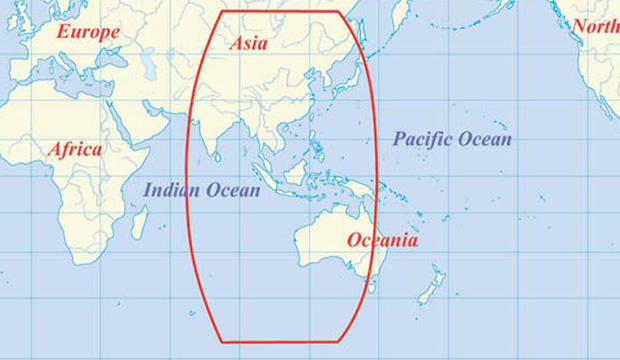
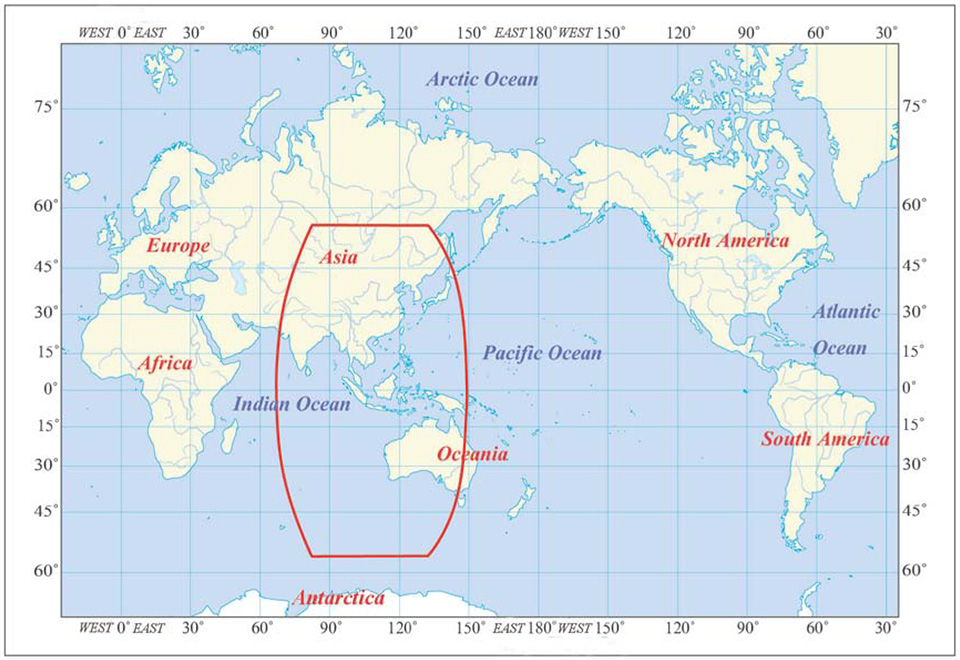
    The BDS OS service volume is defined as the OS SIS coverage of the BDS satellites where both the BDS OS horizontal and vertical position accuracy are better than 10 meters (probability of 95%). At the current stage, the BDS regional service capability has been achieved, which can provide continuous OS to the area as shown in Figure 2 & Figure 3, including the most part of the region from 55°S to 55°N, 70°E to150°E.”

    The BDS Service Area.
    The BDS Service Area.

    This means that BeiDou commits to 2.5 meter accuracy in China, as well as neighboring countries — and importantly, trading partners — in Southeast Asia plus Australia.

    Does this mean that once BeiDou attains global status, it will provide 2.5 meter accuracy everywhere, on its basic single frequency, open service?  Hard to tell.  Much of its strength, its core strength, one might say, comes from 5 geostationary Earth orbit (GEO) satellites and 5 Inclined Geosynchronous Satellite Orbit (IGSO) satellites. The GEOs  hover over the Equator more or less permanently, south of but in the general longitude of  China’s sovereign national territory. The IGSOs move back and forth from the northern to the southern hemispheres in the same area.

    When BeiDou achieves its planned global reach, an event scheduled for 2020, the constellation will consist of 35 satellites: 5 GEOs, stationed at longitudes so their footprints cover China,  27 medium Earth orbit (MEO) satellites encircling the globe in continuous paths as do those of GPS, and 3 IGSOs over the East and Southeast Asian regions.

    Will globally available accuracy at that point match what is achievable in China?  It takes a better geometric mind than mine to fathom this.

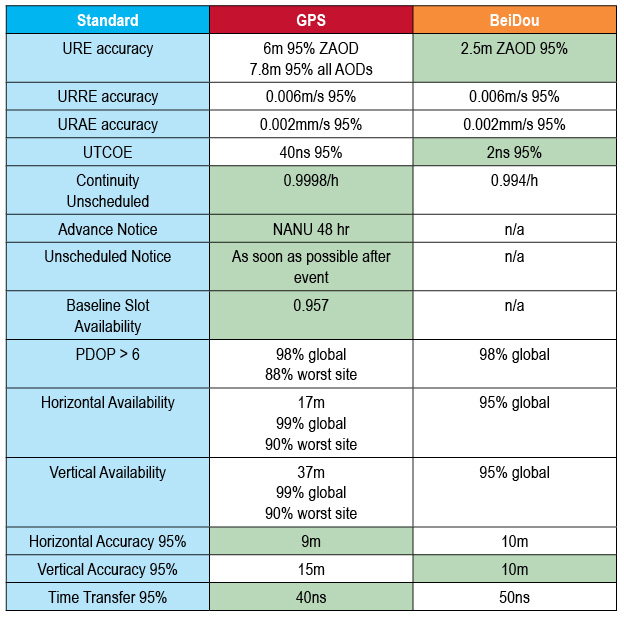
    Even disregarding the geographic limit of the 2.5-meter claim, and ignoring for the moment the mathematical conundrum outlined above, there are reasons to scrutinize the BeiDou Performance Standard more closely, as John Lavrakas of Advanced Research Corporation has done.  His notes, and an illuminating table, follow below after a bit more introduction and background on the general topic.

    The publishing of the Public Service Performance Standard, a common practice among GNSS operators, is also a prerequisite for BeiDou system involvement in international civil aviation, international maritime, 3rd Generation Mobile [phone] System, and other international standard-setting organization activities.

    The document has Chinese and English versions. Because document download from the BDS government website can be difficult, Richard Langley has made them available at the University of New Brunswick website:

    http://www2.unb.ca/gge/Resources/beidou_open_service_performance_standard_ver1.0.pdf

    http://www2.unb.ca/gge/Resources/beidou_icd_english_ver2.0.pdf

    Analysis

    John Lavrakas of Advanced Research Corporation posted the following comment to the an earlier online article announcing the Performance Standard document.

    “I took a quick look at comparing the BeiDou Open Service Performance Standard with the GPS Standard Positioning Service Performance Standard and obtained mixed results.”

    Table 1. Coded to show green for the GNSS service committing to a more stringent standard over the other. Courtesy of Advanced Research Corporation.
    Table 1. Coded to show green for the GNSS service committing to a more stringent standard over the other. Courtesy of Advanced Research Corporation.

    “In some cases, the commitments from BeiDou were stronger (URE accuracy, vertical position), and in other cases the commitments from GPS were stronger (continuity of service, advance notice of outages).

    “The good news is that GNSS systems are documenting the service levels that users can expect. What we will need next is monitoring to verify these service levels are being met.

    “Here is a link to my quick look:

    http://oregonarc.com/2014/01/beidou-performance-standard-how-good-is-it/.”

    Thank you, John.

    A final note.  As the GPS stewards from the U.S. Air Force carefully and proudly remind us at each GNSS conference where they deliver a briefing, actual GPS performance has almost always bettered its specs over the last decade or two — often by a considerable margin.

    And with that, I think we may all return to our various pursuits, secure in the knowledge that while the gold standard may — repeat, may — at times pass in limited special circumstances or under particular conditions, from system to system, overall GNSS Things Are Getting Better All the Time.